Archive | Marketing / Communications RSS feed for this section

Myers-Briggs in Healthcare: Part 2 of X

I was looking for a book the other day to read on some of my flights and came across Health Care Communication Using Personality Type by Judy Allen and Susan A. Brock. I have just started reading it, but I related very well to their key assumptions:

  1. People prefer to communicate in different ways.
  2. Most people have a preferred style of communication.
  3. It is easier to communicate with some people than it is with others.
  4. A system exists which provides a simple framework for understanding these differences.

As I have mentioned before, I think that Myers-Briggs is a good framework for understanding people. I often pull up my notes about my personality type and can see that I respond as predicted to certain situations.

Applying some of their initial thoughts with my perspective, it would seem like there are some basic hypotheses that you could make in talking with patients.

  • Extraversion: People that like to talk things out. Probably more likely to respond to verbal outreach.
  • Intraversion: People that like to think things through. Probably more likely to respond to print (e.g., letter or web).
  • Sensing: People that like the specifics and the details. Probably more responsive to a detailed message (e.g., you can save exactly $X by doing this). Probably want to see the path of exactly who needs to do what.
  • Intuition: People that see the big picture. Probably more responsive to a communication that helps them understand the impact of their decision on overall healthcare trend. Probably want to understand their options versus being guided down a path.
  • Thinking: People who are very logical. They should respond well to automation and would want an if/then type of message.
  • Feeling: People that are more emotional. They would likely respond best to live agents where they could empathize with them and potentially even respond to a “peer pressure” type of message (e.g., most people are now using generic prescription drugs).
  • Judging: People that are organized, punctual, and focused on getting things done. They would likely respond to messages about how to save time and money delivered in the quickest format possible.
  • Perceiving: People that are flexible, don’t plan ahead, and are often more disorganized. They would likely respond to a just-in-time message, a compliance reminder, and a communication process that did everything for them (e.g., you should go in for a colonoscopy…would you like us to schedule that for you).

Obviously, one framework doesn’t solve everything, but I expect that there is a lot more to gain from this book as I read through it. I was just so excited after the first section given my interests that I wanted to post this quick entry.

COB Predictive Values

COB (or Coordination of Benefits) is a core managed care function that is often ignored (and varies by state to make things more complicated). It is a required process by which managed care companies need to identify if people have other coverage (i.e., should I send someone else the bill). Given the high dollars here, you would think companies would be focused on driving this as a cost management or profit initiative.

Good companies find 2.5% or more of their population have secondary insurance. I have seen analysis saying that if you include claims that should be billed to worker’s compensation, auto insurance companies, etc. that the number could be as high as 15%, but that seems really high.

An interesting fact that one of our experts shared with me was that claims data could explain over 65% of the variance in COB responses for a working age population while it could only explain just over 40% for seniors. They have found some incredible correlations to create ROIs for clients in the 2,000% range. [Not bad. If I could get my boss a 20:1 return, I think he would pay attention.]

Of course, as a patient, all I care about is that my claim gets paid, and I don’t get a bill from my provider.

Again…I may be preaching to the choir, but this is why data matters. This is why you need metrics. This is why you need to know your baseline and track how you improve this.

And, always make sure you understand the definition, the data sources, and the data quality. I remember doing data standardization processes for Sprint back in the mid 1990s. It took a while just to get agreement on what a customer was from a business and systemic perspective. Another example I previously had when looking at two vendors was defining success. They attempted to create a standard metric of abandonment for people that came to a website to take a survey (i.e., how many abandoned the process before completion). One seemed dramatically better than the other.

Upon research, we found that one broke the survey into sections and offered them an out on each page. As long as the consumer exited at a planned opt-out point, they were a “success” and had not abandon the survey (even though they hadn’t completed it). The other only counted those that finished the survey. Not surprising who had a better score.

Why Consumerism Matters For Pharmacy

I found this Hewitt data in a presentation by UHPS (United Healthcare Pharmaceutical Services) which is the subsidiary of United Healthcare that manages the Medco relationship (they still outsource their pieces including mail and claims adjudication) and the RxSolutions (former Pacificare PBM). It was from a slide deck given by their National Sales Director at an AeA Seminar on 9/20/07.

[On an interesting side note, UHPS recently won a 1M life competitive contract for PBM services which I believe is one of their biggest wins as a PBM selling outside their existing base.]

I think the key point from this image is that patients have the most influence over the drugs they utilize. With multiple drugs for any therapy and lots of information out there, patients can have an intelligent dialogue with their physician about their choices. This becomes much harder for certain medical situations.

If you get fascinated by the space, they talk about a few of their differences:

  1. A different formulary strategy – evidence based, real-time changes, place drugs on any tier (e.g., generic on 3rd tier if appropriate)
  2. They recommend a $35 differential between Tier 2 and Tier 3 (which probably means that their clients are price neutral if the patient chooses Tier 3…they may even be better off as the rebates to be at Tier 2 are probably much less than $35)
  3. They recommend a 2.5x to 3x multiplier for mail order (i.e., take your 30-day copay and multiply it by2.5 or 3 to determine your 90-day copay). This probably means very little mail adoption, but that patients that use mail will save the payor money on brands. They probably save on generics no matter what.

It is interesting to see the different models emerging in the PBM space. For a while the companies were highly clustered and faced with a price path. Now, you have a few key differences:

  • CVS / Caremark has the play of integrating retail and mail
  • Medco is going down the path of disease state differentiation
  • Express Scripts latest presentations have focused on consumers and engaging them
  • United is talking about their different approach along with the benefit of an integrated data set and captive PBM working with the managed care entity. If they figure out the evidence-based strategy and convince their clients of the value of this, they may be able to get a jump start on the market from a clinical perspective.

The one constant for all of them is communications and engaging the consumer. Interesting. A friend of mine who works with benefit consultants told me that that is the hot topic he hears everywhere today. They want to know how to engage them, what the value is, and how to prove it.

hewitt.png

Glass Ceiling for Adoption of New Programs

A common discussion point that I have had with many people is why don’t companies adopt more cost control mechanisms.  Some typical programs from a pharmacy perspective would include:

  1. Limited formulary (cover less drugs)
  2. Percentage copay versus flat dollar copay
  3. Mandatory generics (you have to get the chemically equivalent generic if available or pay the difference)
  4. Mandatory mail order (you have to fill any maintenance drug at mail after the 2nd fill)
  5. Limited retail network (you can only use certain preferred retail pharmacies)
  6. Step therapy
  7. Prior authorization
  8. Quantity level limits
  9. Intervention programs (you are taking a brand name drug with a therapeutically equivalent generic.  if you switch to the lower cost drug, with your physician’s approval, we will waive your copayment for the next 6 months.)

Since the reality is that the most effective programs have traditionally been programs that contain a hard edit or reject at the pharmacy or ones that clearly transfer cost to patients if they don’t take the preferred route, these programs cause disruption.  Some people hate that word, but it is the reality.  People call into the call center.  They call HR.  They log onto the website.  They talk with their friends.  They have to call their physician to get a new script.  It is not business as usual.

So, in a theory proposed by Larry Zarin (Chief Marketing Officer at Express Scripts), you could visualize a glass ceiling which blocks adoption of new programs.  So the question is how to raise the glass ceiling such that those paying the bill would be willing to be more aggressive in managing their drug trend.  (The same theory applies to managed care also.)

I agree with the null hypothesis that says that education is the key.  The question is how to drive information at a broad scale when you don’t know who will be affected necessarily.  And, the reality is that those that aren’t immediately impacted will likely ignore the general educational message.  We want targeted, personalized messages that are timely and come exactly when I am about to be impacted.

You are likely to be going to refill your prescription for ABC in the next 3 days.  If you continue using this drug, your copayment will have increased from $25 to $50 as the drug has moved to the third tier of our formulary.  Please say help to talk to a live agent or log on to our website at www to see your alternatives. 

So, it is really a question of creating generalized information and then having a communication campaign that is triggered by events – a claim, a diagnosis, logging into the website, calling a call center agent, etc.  Something has to happen that tells you the person is a likely target and receptive to the message.  Then, you can target them with a personalized communication.

Information Latency: Why Don’t We Change?

I have had this note to self for a while so I am finally going to put a quick entry out here on the topic.

The issue is data latency or more appropriately information latency.  The data often exists right away, but the challenge is how to you get the data into a usable form, with context, and with enough data to make decisions.

In communications, this manifests itself in healthcare in two ways that immediately jump to mind:

  1. In a traditional letter program:
    • You send a letter to a patient (7-10 days from data targeting to mailbox)
    • Patient opens the letter and has to contact their physician (if they choose to do anything)
    • Patient trades messages with physician and/or has to schedule an appointment
    • Patient meets with physician who (for example) writes them a new prescription
    • Patient waits for medication to run out then refills with new drug (e.g., generic, on-formulary drug)
    • Claims get aggregated and reports run
    • Best case – 30+ days to see if program had any effect (most likely 6 months)
  2. In a traditional survey:
    • Company prints a survey and mails it to 10,000 people hoping for a 10% response rate to get a statistically valid sample size of 1,000
    • Patients fill out the survey over the next month and mail them to a data entry company
    • Data entry company manually enters them, aggregates the data, and creates a report
    • 45-60 days later the company has information from the survey

Of course, the issue with both of these is that you have lost a huge window of time especially if you need to make changes to your program or the survey tells you that you need to gather more information.

Why don’t more companies talk about on-the-fly program changes and how to use modern technology to get real-time feedback for programs where they can pause the program, make change (e.g., change the message, add a new question), and then continue the program?

Another AIS Gem

AIS has a daily newsletter that comes out which starts with a quote.  I have found a lot of these good teasers.  Here is one from last week.

“Providing education and information [about Health Savings Accounts] is very important. Too many companies talk too much about the money. That’s not the key. The tax benefits are nice, but people want to know what happens if they get sick. They want to know how the HSA works and whether they’re going to be stuck with a medical bill.”

— Roger Abramson, director of legal, compliance, education and human resources at Fontis Healthcare Services, Inc., told AIS’s Inside Consumer-Directed Care.

It is a good point about how often we communicate one thing which seems relevant to us without thinking about the receiver of information’s framework and hierarchy of information needs.

Generic Changes: Patient’s Confused

Typically these things play out behind closed doors or in court and don’t always impact the patient, but I think the latest Protonix saga will have a brief impact on patients.  Primarily causing some confusion.

The basic scenario:

  • Teva decided to challenge Wyeth’s patent and launches generic Protonix early (this means that they are going at risk and if they lose the patent fight that they owe Wyeth 3x the revenue collected from the product)
  • Teva ships about $300-$400M worth of generic Protonix in December and January
  • Wyeth fights them in court and decides to bring its own generic version of Protonix to market
  • Now, Teva has decided to stop shipping generic Protonix (see WSJ blog on this)

If you’re a United patient, you likely just got a letter telling you that they have moved the generic to the third tier (i.e., highest copay) and moved the brand to the first tier which is typically for generics.  They obviously worked a deal directly with Wyeth.  But, the consumer has to deal with issues such as state mandatory generic laws that require the pharmacy to fill a brand drug that has a chemically equivalent generic available with the generic unless the physician has checked DAW (dispense as written) for the brand drug.

Good business logic saving everyone money, but this may burden the consumer and the pharmacy and the physician.  Hopefully, they have an effective communication strategy to drive patient behavior.

So, your prescription history might look something like this (while staying on the same drug):

  • November – brand Protonix (2nd tier)
  • December – generic Protonix from Teva (1st tier)
  • January – generic Protonix from Teva (1st tier)
  • February – brand Protonix (1st tier)
  • March – generic Protonix from Wyeth (1st tier)

Single Answer or Multiple Answers

I was having an interesting discussion yesterday about how to solve a problem.  The two opinions were whether there is a best answer or whether there are multiple best answers.  It’s a great question.

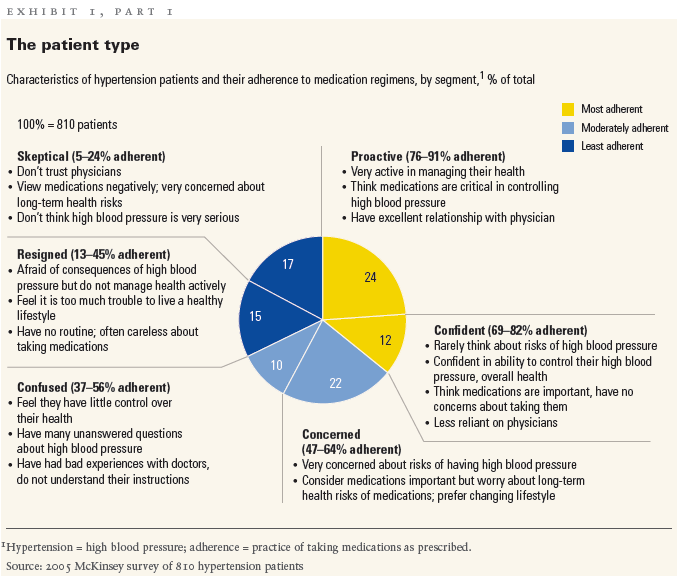
Let’s frame it this way.  Is there a message that is most likely to drive compliance for a group?  I gave them the benefit of the doubt that they aren’t crazy enough to suggest that one message works generally with no segmentation.  (McKinsey‘s article “Getting Patients To Take Their Medication” has some good research around creating segments and showing how some of the segments vary in what they want.)

The other person was presenting a case that they could do lots of research on linguistics and other topics and suggest one optimal message that would work across broad segments of the population.  I was of the opposite opinion that a personalized message that had certain core research but varied by geography, condition, age, income, benefit type, prior interactions, etc. was better.  And, that what is good today may change both generally and individually over time.

I would rather get all the micro-niches of people to their highest compliance and adherence level versus getting a better average across all group. 

Basically, my position is that there are multiple optimal solutions to the problem not just one.  It triggered a memory for me of when I first went to business school.  In architecture school, design is somewhat subjective.  (There are some logical rules such as the Fibonacci Sequence which serve as guiding principles of scale…for example.)   We were taught to always bring three solutions to our initial presentations to let the judges decide which one we should push to finalize.  We had to pick one for a deliverable, but it was always a tradeoff.  In business school and the hard sciences, there is often only one answer that is valid.  (1+1 always equals 2.)

But, for communications, marketing, and other things, it seems obvious to me that companies are best served by dynamic flexibility that allows them to bring multiple solutions to the market in parallel that adapt to different patients and change over time to respond to the market and the patient.

Here is a quick snapshot of the segmentation from the McKinsey report…

mckinsey-hypertension-segmentation.png

Call Center Metrics – JD Powers

As you know, I love metrics.  I began my business career in that space working on Balanced Scorecards and Datareferee.jpg Warehousing.  I got a press release announcement the other day about CVS/Caremark winning a JD Powers Call Center Award.  It caught my attention.  Obviously, I haven’t dug into all the data, but from how it is described, it appears that they are focused on the right metrics and winning an award for this would be meaningful.

In order to qualify for certification, a call center must perform within the top 20th percentile of all centers evaluated nationwide, based on benchmarks established by J.D. Power and Associates for courtesy; knowledge, concern for the customer; usefulness of the information provided; convenience of operating hours; ease of reaching a representative and timely resolution of issues. Call centers must also successfully pass a detailed audit of their recruiting, training, employee incentives, management roles and responsibilities, and quality assurance capabilities. As part of its evaluation, J.D. Power and Associates conducted a random survey of Caremark’s customers who recently contacted its call centers.

Excellent Versus Very Good Service

On my vacation, we took the kids on a Disney Cruise.  We also went last January.

For the first time, I think I can actually differentiate between very good and excellent on the survey.  I always struggle with that and tend to grade down.  In general, we love the Disney experience and the cruise is very well run.  We are already booked for next year and will be going with several other families.

Anyways, on the boat, you go to a different restaurant each night and your wait staff follow you.  This year, they were attentive.  No food was messed up.  They were polite.  They did magic for the kids each night at the table.  They engaged us in conversation.  It was very good service.  Better than almost any restaurant.

BUT, since we were there last year, we had a very high expectation.  Last year, the wait staff learned each day.  After day one, they knew what drinks my kids liked and had them waiting for them when we arrived for dinner.  By day three, they knew my son was a picky eater and had one of his favorite foods on the table.  And, they knew that my daughter wanted some snack other than the typical appetizers and they had that waiting.  Basically, they learned, adapted, personalized, and acted proactively.  The difference was amazingly clear within very tight parameters.

Of course, it took someone else to point out to me that this was an example to share since this is the key point for my healthcare companies.  You need to learn from your communications.  You need to adapt to today’s technology and your patient’s expectations.  The patient experience has to be personalized (in scale) to be in a message they respond to, in a channel they like, at a time that is convenient to them, and based on previous interactions.  And, you have to act proactively.  The patient doesn’t always know when to act.

Since traditional differentiators are basically null (i.e., network size, plan design), it becomes all about communications and service.  How do you drive the patient experience?   It is worth looking at the Forrester data on customer experience index.  Healthplans score incredibly low in terms of usefulness, ease of use, and being enjoyable.  The highest (that they looked at) was Kaiser at 63% with the lowest being Aetna at 49%.   [60-69% meant that the customer had an “okay” experience with the company.]

Communications

I can never stress the value of communication skills to anyone I met regardless of the path they want to go down in life.  I have had the luxury from an early age of public speaking beginning with something called Model United Nations (MUN) where you represent a country in mock-simulations of the UN process.  [We even won a national championship at my high school…and it really isn’t as geeky as it sounds.]

In graduate school, I participated in Toastmasters for a while which I think is great for someone who needs a casual setting to practice and get feedback.  I can even remember using one of the techniques from there (counting “ums”) when my sister told me she was going to be a lay minister in the Catholic church and be giving sermons.  [Note: Feedback on presentation skills isn’t always well received by people not seeking it out.]

I found a couple of presentations on the topic that I thought might be interesting to some of you.  Additionally, you might research the Minto Pyramid Principle which is a structured approach to communicating by an ex-McKinsey consultant.  (It was required reading/training at Ernst & Young years ago.)

This one is a little basic, but I have seen so many bad powerpoint presentations that obviously many people could use the primer.

One last one before getting back to work…Here is one on marketing which obviously has communications at its core.

Concise Summary of Compliance Reality

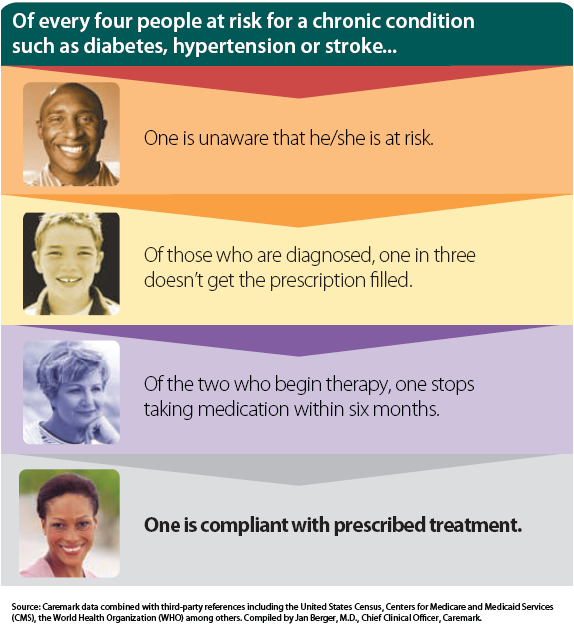
I have shared other facts with you on compliance. This is a hot topic in healthcare right now. I thought pulling this one graphic out of my entry on Caremark’s trend report made sense. This really gets to the point. Take this in light of the following quote from WHO (World Health Organization) and you can understand why.

“Increasing the effectiveness of adherence interventions may have a far greater impact on the health of the population than any improvement in specific medical treatments.”

caremark-compliance.png

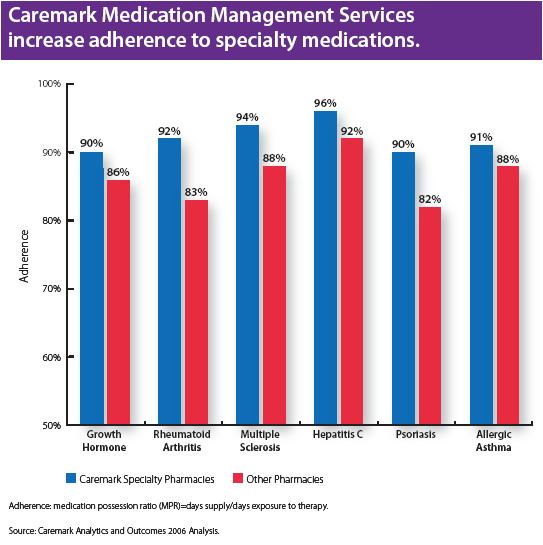
They have a good chart in the document about speciatly medications and the impact of medication management services.

caremark-specialty-adhearence.png

Increasing GDR

I love reading healthcare articles which have acronyms that not everyone knows. (Maybe it was defined earlier, but I didn’t see it.)

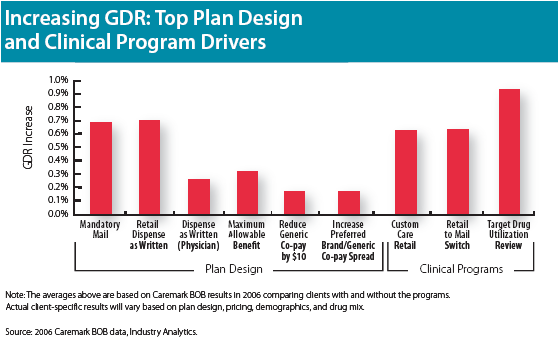
Another nugget from the Caremark trend report is on programs and plan design components to drive generic dispensing rate (GDR) which is the number of prescriptions filled as generics divided by the total number of prescriptions filled. (Versus generic substitution rate which is the number of prescriptions filled as generics divided by the total number of prescriptions filled for which a chemically equivalent generic is available. I can’t remember whether we used only A-B rated generics or all generics, but that is a technical discussion for another time.)

caremark-driving-gdr.png

This is great. It tells you the impact (on average) of implementing a plan design or some of their clinical programs on your GDR. (BTW…a good rule of thumb is that an increase of 1% in GDR is worth about 0.75-1.5% savings in your overall prescription spend.)

Caremark’s TrendsRx Report 2007

Well…I better get this posted before all the 2008 reports start coming out. I have started it a few times, but there is so much good content in here that I haven’t finished. I am determined to get this done tonight. As you may know, all of the PBMs publish very well done annual research reports on the trends in the industry and what they have learned from their data. I have talked about Express Scripts research and reports (here, here, and here) and Medco’s report (here). [Note: For simplicity sake, I am not going to put all the sources here. They are in the Caremark
document.]

“Consumers experience the [healthcare] system as complex, impersonal, disconnected, reactive, and increasingly unaffordable.”

  • In 2006, the average number of retail Rxs per capita was 12.4.
  • 59% of those <65 had an Rx in 2004 and 92% of those >65.
  • With consistent use of effective prevention, early intervention, and adherence strategies, they estimate that 30% of current healthcare spending could be eliminated. Image the impact of that on MLR (medical loss ratio) which is a key metric for managed care companies on how much of each premium dollar they actually spend on healthcare costs.
  • They layout a very logical vision that would take advantage of their unique set of assets with CVS, Caremark, and MinuteClinic.
    • Preference based consumer access.
    • Patient focused view within their systems and communications.
    • POC (point-of-care) connectivity. (i.e., pushing relevant information real-time to physicians and pharmacists to optimize care)
    • Personalized health advocacy (“make the healthcare experience less disconnected and impersonal”)
  • The price of brand drugs (on average) increased by a rate of 3x the CPI (consumer price index) in 2006…the highest since 2002. [In my opinion, this will continue as they face more price pressures with the government being the largest buyer now with Medicare Part D and with the majority of claims now being filled with generics.]
  • At the same time, the price of generic drugs decreased by 1.2%.
  • With Medicare, Medicaid, and other public payer, the government now pays 40% of the total drug spend in the US.
  • They are working with the Coalition for a Competitive Pharmaceutical Marketplace (CCPM) to reduce patent expiration “loopholes” (aka ways that brand manufacturers extend their patent lifecycles which are often perceived to not add any additional value).

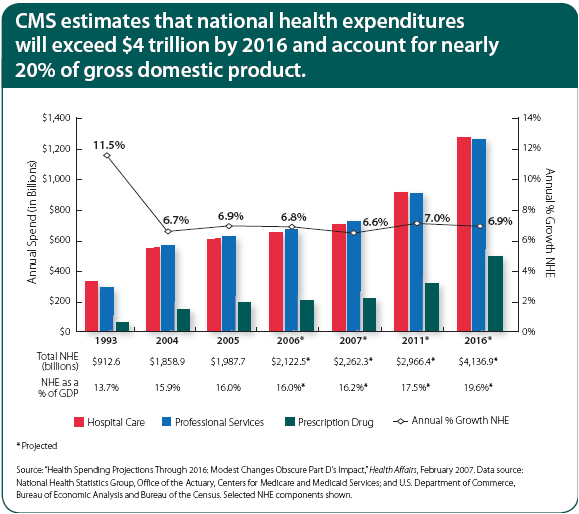
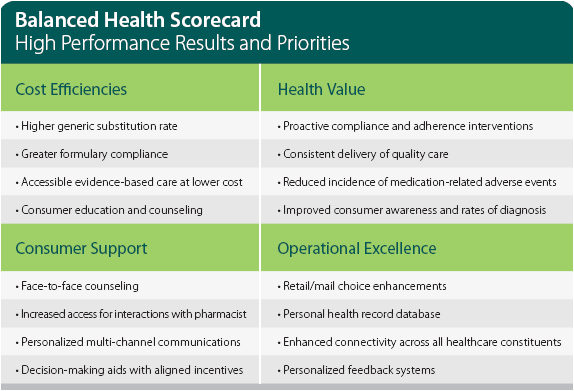
Some of the graphs and charts that I found interesting and helpful are below. (I pulled one of my favorites out in its own posting.)

caremark-national-health-expenditures.png

caremark-30-reduction.png

caremark-balanced-scorecard.png

caremark-awp-inflation.png

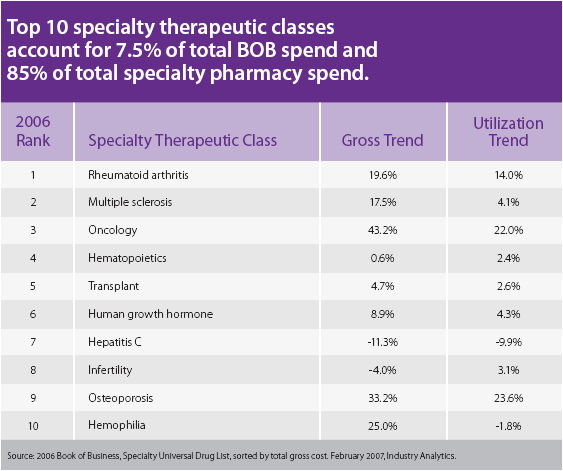
(BTW – If you don’t know who BOB is, it stands for Book of Business which means the payors whose data was included in the analysis.)

(They make the point that 5 of the 10 drugs face patent expiration by 2010 so as expected prices are increased in the years prior to maximize return.)

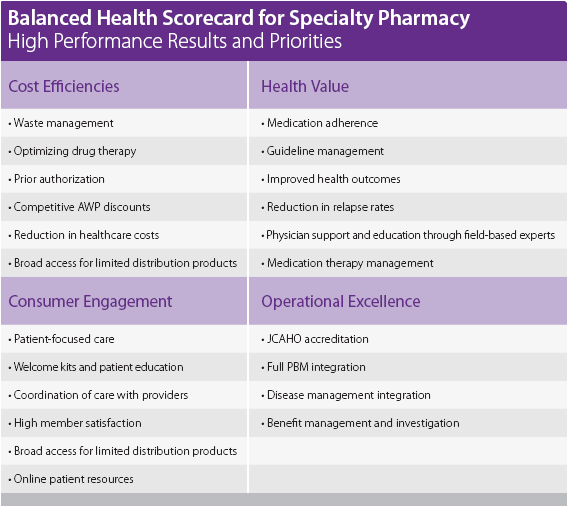
I haven’t talked a lot about specialty drugs here on the blog. Here is a good list of the top classes. Typically these drugs are either high cost and/or require special care (mostly meaning injection). The average specialty drug would typically cost $1,500 per 30-day supply versus more like $80 for a non-specialty drug.

caremark-specialty.png

caremark-specialty-balanced-scorecard.png

Freakonomics on Pharma

The Freakonomics blog has an interesting piece on pharmaceuticals.  It basically asks five experts what is the best secret in the industry.  Here were a few of the quotes from the posting…

  1. “Events are revealing that many pharmaceutical companies, along with their consulting academic physicians, have engaged in practices that obscure or misrepresent information about their products.”
  2. “The United States is subsidizing prescription drug prices for the rest of the world.”
  3. “The obscene profits made on generic drugs by the large chain stores.”
  4. “While most people understand in a vague way that modern biomedical science is advancing at a remarkable pace, many people are less aware that we have been far less successful at translating science from the laboratory bench to the clinic. This is not to say that the pharmaceutical industry has been quiescent; total spending on health related research by the drug industry has increased from about $6 billion in 1980 to about $39 billion in 2004. During that period, basic science research has increased the number of potential drug targets (the biological site on which a drug is intended to act) from 500 to more than 3,000.”
  5. “Underpinning many of the marketing strategies of big drug companies is a very sophisticated and comprehensive plan to widen the boundaries of illness, and create an environment in which more and more formerly healthy people are defined as ‘sick.'”

Paying MDs to Switch

Another WSJ article that I caught on the plane ride home last night was about Doctors Paid To Prescribe Generic Pills. When I read the WSJ Health Blog about this, I was shocked by the comments. It would appear that the blog is followed by people that don’t believe generics make sense. That perspective is a little outdated now that most therapy classes have one of the most popular drugs available as a generic.

Yes, in some cases there have been minor improvements, but I don’t think anyone can (with a straight face) get up and talk about how Nexium is clinically superior to generic or OTC Prilosec (see general comments about category of PPIs). There has been numerous research showing that the probability of having success with any anti-depressant is the same regardless of what drug you begin therapy with (so why not start with a generic). And, generic drugs have been around for a long time so all their side effects and drug-drug issues are well known and documented. There has never been a generic drug pulled from the market.

Here was what I posted there.

Wow! There seem to be a lot of the glass is half-full people out here. What if the generic (which often was the most prescribed drug in the class before the patent expired) is clinically appropriate.

There are 10,000+ drugs out there. Physicians can’t be expected to know and monitor the comparisons on each one. That is what technology and pharmacists are focused on. So, if companies can identify a way to help the patient save money, what’s wrong with switching drugs.

The exact process of paying the physician seems suspect, but some incentive to reward them for their time (perhaps regardless of outcome) makes sense. You are asking them to pull the patient’s file, look at a different drugs and perhaps some clinical information provided by the payor, and determine if a switch makes sense.

Physicians today rarely have an incentive linked to drugs so why not prescribe the most expensive, most heavily sampled, most advertised drug. That’s the easy path.

I don’t disagree that more sharing of the benefits might make sense, but the market has changed. Generics and therapeutic conversions can make a lot of sense.

The issue of incentives is a broader one.  Paying physicians directly per switch seems a little suspect.  But, incenting them to save money for plans and patients makes a lot of sense.  But, like any incentive system, it has to be balanced.  Health outcomes balanced with cost management.  Patient satisfaction balanced with simplicity of the process.  I won’t get on my soapbox here.  Metrics are difficult, but the system today doesn’t always align the parties correctly.

Handwriting Analysis

This has always been a topic that fascinates me.  Learning from someone’s handwriting.  So I liked seeing a cliff note summary of The Complete Idiot’s Guide to Handwriting Analysis by Sheila Lowe in Spirit Magazine.  I am not sure I would be ready for this to be part of an employment process although I have taken personality tests such as Myers-Briggs (test yourself here) before.

Here are a couple of the items on handwriting:

  • Balanced margins; clear spaces between words = ability to plan ahead
  • All the letters connected in every word = logical thinker who enjoys debating to the point of nitpicking
  • Abrupt breaks between letters = person who jumps to conclusions without the benefit of logic
  • Large letters = loves the spotlight
  • Small letters = finds more satisfaction in working then socializing
  • Lots of rounded letters = outgoing person
  • Straight lines and angles = aggressive person who pushes hard for what they want
  • Lots of loops and close spaces between words = big imagination and need for social contact
  • Few loops and wide spaces between words = intellectual loner
  • Thin writing with illegible words = creative genius OR slippery character
  • Hidden personality traits are seen in the lower loops of letters g, y, f, p, and z):
    • Moderately wide loop =  welcomes a variety of experiences
    • Skinny loop = sticky to what they know
    • Extremely wide loops = bragger who doesn’t follow through
  • The upper loop slant measures emotional responsiveness:
    • Extreme right slant = emotionally explosive
    • Moderate right slant = warm and responsive
    • Vertical = cool headed
    • Left slant = friendly on the surface but hard to get to know

Now, I know you are dying to go look at your writing and see what it says about you.

EDM, Gartner, and Event Driven Communications

edm-blog.jpg
I mentioned the EDM (Enterprise Decision Management) Blog a few weeks ago. James Taylor has a post out there today about Using EDM to deliver event-based marketing. Those of you that know me or have been reading the blog for a while know that this fits into what I talk about perfectly. It involves decomposing a process into its key tasks, understanding the rules behind the process, determining data events that can be used to identify opportunities, and then executing a coordinated communication process.
He references a Gartner publication with the following abstract:
“Successful event-triggered marketing is a process of identification, categorization, monitoring, optimizing and executing. Marketers that do this right will see their marketing messages receive up to five times the response rate of nontargeted push messages.”
He also talks about key considerations such as rules, analytics, predictive modeling, champion/challenger, and multi-modal.

Using Thermometers To Avoid Foot Ulcers

600,000 diabetics get foot ulcers each year and over 10% of those lead to amputation of toes, feet, and lower legs.  A study discussed in USA Today showed that almost 2/3rds of those ulcers could be avoided by using a thermometer to identify whether an ulcer is developing.  So simple…so much savings (pain and financially)

So, assuming there isn’t some analysis or clinical bias that I don’t know about, this seems like a low-hanging opportunity for managed care companies.  What are you doing to reach out to your patients, get them a thermometer, collect their data, and remind them to use it on some regularity?

Coordinated Communications

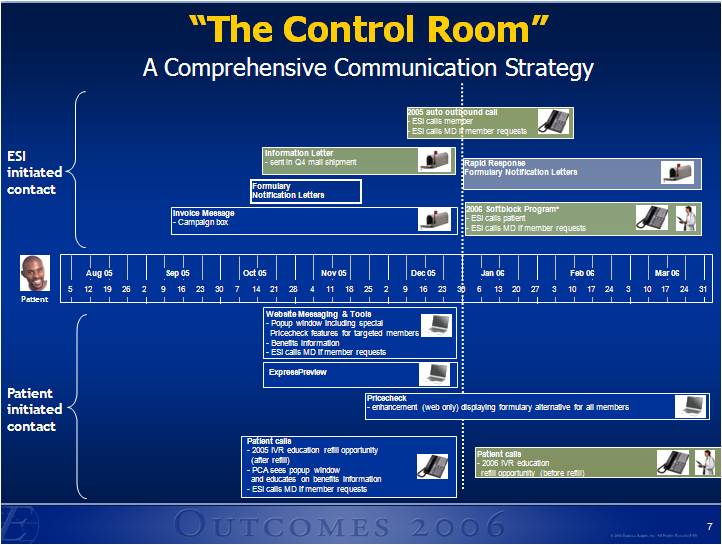
A few days ago, I talked about a press release from Express Scripts around formulary change programs to encourage patients to move to a different drug (same therapeutic category different chemical entity). I mentioned in there a single frame that I created to organize the program. Happily, I found it publicly so I can share it. Here it is. The key points here were – identifying the different constituents, determining the best mode of communication, coordinating across channels, and determining how to sequence communications based on events (aka triggers) which might be a date or a percentage of their prior prescription being used.

zocor-control-room.jpg

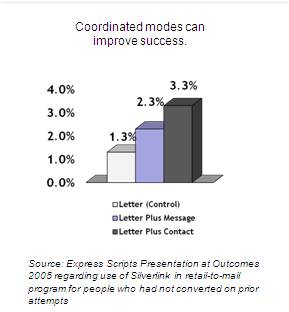
While I was searching, I also found the presentation we gave on how multi-modal coordinations using a letter and an automated call impacted success for my retail-to-mail program. The key to remember here is that we targeted people who had already received one or more letters and had not responded. The results were great.

esi-rtm-results.jpg

How Some People Feel About HealthComm

Healthcare Communications (HealthComm) are never what we run home to receive, but they are often important.  Unfortunately, it has lacked a focus historically.  Most of the focus was on claims systems and underwriting and network size.  Not that those areas work perfectly, but there is clearly a movement toward customer service, patient satisfaction, and communications (inbound/outbound, letter/call/e-mail/live agent).

Look at this blog entry on a very popular blog and some of the comments.  It is a big uphill battle.

Learning Deficit In Healthcare Setting

Typically, when you are receiving care and instructions from a physician or other medical staffer, you are sitting down or laying down in a hospital bed.  Given some of the research discussed in an article today in the Boston Sunday Globe, it makes me wonder if patients are immediately at a disadvantage.  This article discusses research which correlates learning and the brain with physical movement.  An area called “embodied cognition”.

“Work led by Susan Goldin-Meadow, a psychology professor at the University of Chicago, has found that children given arithmetic problems that normally would be too difficult for them are more likely to get the right answer if they’re told to gesture while thinking. And studies by Helga Noice, a psychologist at Elmhurst College, and her husband Tony Noice, an actor and director, found that actors have an easier time remembering lines their characters utter while gesturing, or simply moving.”

see-hear-speak.jpgObviously, there is lots of research about how people learn.  At the simplest level, some people learn by reading, some by hearing, and others by experiencing.  Plenty have studies have been done to say people who get information in multiple ways are the most likely to learn it.  I don’t have it with me right now, but when I have done communication seminars for people before, we have talked a lot about why you want to teach and/or present using all three modes.

Tell them…Show them…Make them experience it.

This is why multi-modal coordination (e.g., letter followed by call or call giving you a website) has value and is more effective.

Is The Perception Of Health Skewed By Your Health?

I was reading a story in the WSJ (1/12-13/08) about “How the Rich Define Rich” and wondered if those that are healthy have a different perception of healthy.  Is it an endless path or is there an end goal?  I certainly think that those that are healthy have a different perception of what it means to be healthy.  I would believe they are more likely to buy natural foods, exercise, and take other actions to continue to be healthy.

“Of the respondents, 45% said $5 million or more [is how much it takes to be rich], 25% said $25 million or more, and 8% said $100 million.”  Survey of affluent households with investible assets of $500,000 or more.

For example, a marathon runner would view a 30-minute workout as pretty limited.  But, someone who doesn’t workout would think of a 30-minute workout as pretty strenuous.   Obviously, this is important when you interact with them.  The message you deliver to motivate those 3 different groups may need to be very different.  Given some of the research out last year about your health being motivated by the health of your friends, there is clearly a Health 2.0 opportunity to create communities and health activists to motivate people to improve their health together.

A Great Communication Example

google-ad.png

Don’t get.  Don’t worry.  You’re probably not the target.  This is a Google recruiting advertisement that they put up a few years ago.  It led you to a website which had another puzzle for you to solve.

Why is this so great?  It’s targeted exactly to the niche of engineers that they wanted to have apply for the jobs.  It’s memorable (i.e., sticky).  It compels you to action (if you’re the person they are looking for).  It creates buzz.

It is a great single frame if you want to address segmented communications that are successful.

Types of Business Blogs

I was looking at something that someone sent me from Paul Gillin’s Social Media Report about different types of blogs. I found it pretty interesting especially some of the examples.

First, he talks about company blogs including the CEO blog and the group blog. They definitely can be interesting, but it really is a question of momentum and interest. I also think blogging has to be from top of mind not from some carefully scripted public relations process. (I.e., there will be times that the blogger gets someone upset and stirs some discussion…which ultimately is a positive)

For example, I was really disappointed to see that Unica was unable to continue their blog. Now, on the other hand, I do think there is a definite role for topical blogs that have numerous participants from several companies. I used to syndicate my old process management blog through one of these sites and found it worked great. (Not to mention that I got 7,000 readers overnight.)

Paul talks about three other types of blogs – Executive Blog; Advice Blog; and Advocacy Blog. Here are a couple of examples that he gives:

For more on corporate blogs, you can go to his website or BlogWrite.

I have talked about why I blog before, but I often think about it as a modern journal and an alternative to e-mailing people with articles that I read. If it helps business…great. The reality is that I am passionate about what I do and talk about it all the time. I choose the job to emulate my passion. I would think that is the only way a corporate blog will work and be genuine.

Is Your Protected Health Information (PHI) In The Garbage?

We always hear about the need to protect your personal information (i.e., social security number, credit card numbers) from people. You can be paranoid about it (which may be appropriate) or simply smart about it. In general, you probably don’t have people rummaging through your garbage each week (unless you’re Bill Gates or someone like that).

I guess it is an older story (from 2006), but I was surprised to hear about pharmacies throwing out trash that includes prescription and patient information into unsecured dumpsters. Hopefully, it has been addressed by now, but here is a link to the story.

13 Investigates found legally-protected patient information on prescription labels, patient information sheets, pill bottles, prescription forms and customer refill lists in dumpsters in and around Boston, Chicago, Cleveland, Dallas, Denver, Detroit, Louisville, Miami, New Haven (Conn.), Philadelphia, and Phoenix.stop-sign.jpg

As a corporate person, one of the things I found interesting was the responses. Regardless of the idiosyncrasies of the law, the CVS answer clearly seems more appropriate than the Walgreen‘s answer. I can imagine any patient wanting to think that their information is just being dumped.

“We are not safeguarding customer privacy as we are required to do,” said CVS corporate privacy officer Kristine Egan. “It’s sad and intolerable … and we need to do better. We will do better.”

A Walgreens spokesman said his company has not broken the law by placing patients’ personal information in unsecured dumpsters. Walgreens corporate communications manager Michael Polzin told 13 Investigates that federal law “doesn’t prohibit disposing of information in dumpsters.”

Does Brand Matter?

As anyone who works in or with marketing or sales would tell you…Of course, brand is very important.

So, that makes this study from Gorman Group on Medicare very surprising.

“Seniors with the highest [Medicare Advantage plan] satisfaction levels don’t even know what health plan they’re in.”
Jeff Fox, president of Gorman Health Group, LLC, discussing his firm’s research that indicates brand is less important than it was several years ago.

istock_decision-cube.jpgIf you’re interested in some good discussion on the topic of marketing, I would encourage you to look at Foghound. I had a chance to work with Lois Kelly from there years ago and was impressed. I think you will find their articles and frameworks very helpful.

The $1,400 Physical

If you’ve never heard of it, concierge medicine is an interesting extreme of consumerism.  I met a physician in St. Louis about 7 years ago who had such a model.  He didn’t take insurance.  Each patient had their own voicemail box for exchanging messages with the physician.  Everyone paid him an annual fee for unlimited access.  Most of his revenue was for a private company’s executive team and their families.  He spent lots of time with the patients, focused on preventative care, and kept trying to find ways to keep them healthy.

Newsweek had an article about this in their 11/26/07 publication called “The Blue Chip Checkup“.  It talks about the Concierge Medicine clinic in LA where you can go get a $1,400 Vehicle Loans physical just like the President gets.  It is so comprehensive that it even includes a skin consultation.  Apparently, over the past year, they have had 600 people come in to get this physical.

I know lots of people are pretty skeptical about this.  I am not sure I have an opinion yet.  It’s interesting.  Obviously, you don’t want to create unneeded costs and certainly we don’t want to make care a luxury good.  But, having people take responsibility for their health and wanting to learn as much as possible about how to manage their care seems like a positive.

Ideally, there should be lots that we can learn about patient-MD interactions, value of testing, preventative care, and what would happen in an ideal setting where insurance and money was not an issue.

Pharmacy Satisfaction: Communication is Key

It’s always great when you find research that clearly reinforces one of the things you always talk about – communications. At PharmacySatisfaction.com which is a website sponsored by WilsonRx and Boehringer Ingelheim, it lists the 10 steps to customer satisfaction for a pharmacy. A few key items that I think are relevant to a lot of what I talk about and do with customers in pharmacy and healthcare in general:

  1. Know your customer (database marketing / management)
  2. Speak up (you’re the expert…help them)
  3. Educate the customer (reach out to them proactively and help them with information)
  4. People skills (understand that different people respond to different messages, mediums, voices, times of day, etc)
  5. Address compliance (refill reminders)

It also made me think about two topics which I think are relevant to communications success – Linguistics and Nuerosciences. As you might expect, there are lots of blogs on both. Here is a list of blogs and some definitions:

Linguistics is the study of the nature, structure, and variation of language, including phonetics, phonology, morphology, syntax, semantics, sociolinguistics, and pragmatics (per The American Heritage Dictionary of the English Language).


Neuroscience is a branch (as neurophysiology) of the life sciences that deals with the anatomy, physiology, biochemistry, or molecular biology of nerves and nervous tissue and especially their relation to behavior and learning (per Merriam-Webster’s Medical Dictionary).

Enhanced Communications Have An Impact

On January 4th, Express Scripts put out a press release about consumers using a home delivery pharmacy being more likely to choose lower-cost therapies. It is an interesting study as published in the December 2007 issue of the Annals of Pharmacotherapy. I had the fun job of designing the program as one of my projects before I left Express Scripts. I will never forget my boss coming to me and asking me to think about how we could drive market share movement of several large drugs if we took them off formulary (i.e., Lipitor). He handed me a white paper written the year before on what to do. Since he was new, I didn’t give him too much grief since I was the author of the white paper from the year earlier about what we should have been doing for the past 12-months to prepare for this.

Anyways, I pulled a lot of input and created a great single-frame image which showed the major constituents and the tools/tactics we would use to drive market share both pre-formulary change and post-formulary change. I went back to my day job, but the image became the roadmap for a multi-modal communications strategy. As was my intention (since I was responsible for mail order), it looks like it worked both to move share and to show how mail could be better than retail.

Here are a few of the highlights from the press release:

  • Express Scripts evaluated consumer behavior after they made a change to the formulary positioning of cholesterol lowering drugs to prepare for Zocor going generic in mid-2006.
  • They looked at more than 200,000 retail and mail patients.
  • All patients got a formulary notification letter informing them of their therapeutic options, materials for their physician, a website for more information, and toll-free number to call. [2 years earlier I had created the business case for mass mailings of formulary notification letters.]
  • The IVR refill line included messaging about switching to a formulary agent, and we placed automated outbound calls to mail order patients [using Silverlink Communications].
  • Patients that were interested were queued up for a change at mail after 1/1/06 (so as not to lose rebates for our clients in 2005).
  • Obviously, other plan factors (i.e., copay differentials, step therapy) impacted choice. [I.e., if I only have to pay $5 more per month for a drug that I am used to, I probably won’t switch]
  • The results were great. 52% of the mail order patients and 33% of the retail patients chose to switch therapies.
  • Some of the retail patients were part of a rapid response program in which they received a letter telling them about their options in the therapy class right after they received their first fill of the non-formulary drug in the new year. [another program which I developed and launched for step therapy] Receiving this letter increased their likelihood of switching by 28%. [BTW – we tested this with letters vs. automated calls from Silverlink back in 2005 and the results were very similar.]

“Creating a dialogue with consumers is a crucial factor in successfully changing behavior and delivering value at the consumer level,” explains Emily Cox, Ph.D., senior director of research at Express Scripts. “Home delivery consumers received additional information and were more likely to seek further assistance through the Web and by calling Express Scripts. Enhanced communication clearly has an impact. The effectiveness of the rapid response program for retail consumers also supports the value of enhanced communications.”

As I have mentioned before on the blog, this was a great program. It proved that PBMs can influence market share. I was more than a little disappointed to see that after we moved all these patients to Zocor to take advantage of the generic then company than moves Lipitor back on formulary only to have to ask the patients to switch drugs again. [Fortunately, I was not there for these discussions.]