Archive | Research RSS feed for this section

Every 2 Weeks A Language Disappears

According to Ethnologue, there are 6,912 languages in the world.  Lots of these are at risk of being lost.  It is estimated that one “disappears” every two weeks as the last person who can speak the language dies.

The Living Tongue Institute for Endangered Languages is rapidly trying to capture and document them before they disappear.

Buyology: Best Book of 2009

I am finally getting around to writing this up. I mentioned the book – Buyology – a few weeks ago. It is definitely the best book I have read this year. It is by Martin Lindstrom and is all about neuromarketing.

For those of you that don’t think it’s relevant to healthcare, think again. Healthcare is all about compelling individuals to take action and become responsible for their health. That is about understanding how they interpret information and what drives them.

Here are some of my notes from the book:

  • One of the processes used was fMRI (functional Magnetic Resonance Imaging) which measures the amount of oxygenated blood throughout the brain. Scientists can see what part of the brain is working at any given time.
  • The other process used was SST (steady-state typography) which tracks rapid brain waves in real time.
  • One of his first studies looked at the effect of cigarette warning labels and found that they not only failed to deter smoking but activated the nucleas accumbens.
  • What people say on surveys and in focus groups does not reliably affect how they behave. [although it is often the best we have]
  • Brand matters…He re-conducted the Pepsi Challenge and showed that if people knew what they were drinking they preferred Coke to Pepsi. When they didn’t know, 50% of people liked Coke. When they knew, 75% of people liked Coke.
  • He showed that consumers have no memory of brands that don’t play an integral part in the storyline of a program. Just putting something in the movie, TV show, or video game isn’t enough to get you mindshare. AND, those successful placements also weaken our ability to remember other brands.

“Our irrational minds, flooded with cultural biases rooted in our tradition, upbringing, and a whole lot of other subconscious factors, assert a powerful but hidden influence over the choices we make.”

  • In the Smiling Study that he references, they revealed that people are far more positive and have a better attitude toward the business when the person they are dealing with is smiling. [Maybe a key thing for avatars and real agents as they talk to people over the computer and/or phone.]
  • Our mirror neutrons allow us to get pleasure just by observing or reading about people doing something that would give us pleasure – e.g., opening a present with a new Wii in it. [You can go to www.unbox.it.com or www.unboxing.com to enjoy this.]
  • Logos are dead. They showed that images that are associated with smoking (for example) were far more potent in creating a reaction in the brain than the logo.
  • “Secret Ingredients” matter…he shared several examples of how things sold differently when there were non-existent things listed on the label.
  • When people viewed images associated with strong brands – iPod, Harley-Davidson, Ferrari – their brains registered the same activity as when they saw religious images.
  • They studied and showed that odor can activate the same brain response as the sight of the product. He talked about an interesting study that showed that “feminine scents” such as vanilla were sprayed in women’s clothing sections, sales of female apparel actually doubled.
  • Sex, extreme beauty, or a celebrity in an advertisement can hijack attention away from the information in the advertisement.

“I predict that soon, more and more companies (at least those who can afford it) will be trading in their pencils for SST caps. That traditional market research – questionnaires, surveys, focus groups, and so on – will gradually take on a smaller and smaller role, and neuromarketing will become the primary tool companies use to predict the success or failure of their products.”

Some interesting facts:

  • 300 million people, including 60% of male doctors, in China smoke.
  • 8 out of 10 new product launches fail within 3 months.
  • In 2005, 156,000 new products debuted globally (or one product every 3 minutes).
  • In 1965, a typical consumer could recall 34% of advertisements from TV. In 1990, that number dropped to 8%. In 2007, consumers could only remember 2.21 advertisements from all advertisements they had ever seen. [Talk about saturation.]
  • We walk almost 10 faster than we do a decade ago. 3.5 mph
  • A study in Denmark showed that people talked 20% faster than they did a decade ago.
  • And, if you don’t believe that culture matters…In Asian cultures, four is an unlucky number and one researcher found that heart attacks among US residents of Chinese descent spiked as much as 13% on the fourth day of each month.
  • Children that experience social difficulties in school are more likely to be preoccupied with collecting.
  • Both J&J and Play-Doh have lost their original fragrances and haven’t been able to replicate it.
  • When classical music was piped over loudspeakers in the London Underground, robberies, assaults, and vandalism dropped by over 25%.

Some of the interesting companies mentioned:

I thought he had a great story about a rock. If I gave it to you for your birthday, you’d be offended until I told it was from the Berlin Wall. And then when I told you it was from the moon, you would be even more impressed.

For more information, there is also a neuroscience blog.

Struggles Of A Working Family Report

The Kaiser Family Foundation has released a report and video that they did on several families looking at their struggles to pay bills and survive.

The report, Snapshots from the Kitchen Table: Family Budgets and Health Care, is based on interviews with 27 families from six cities across the U.S.. It finds pervasive uncertainty over job security and households teetering on the financial brink, stretching to pay for basics such as food and housing and ill-equipped to cope with unexpected costs for things such as a medical emergency or a necessary home repair.

Health care costs were of particular concern, with many families forgoing doctor visits, skipping prescription medications and postponing needed care. Even those with health insurance reported delaying care in order to avoid co-payments, rising deductibles and out-of-pocket expenses for uncovered services.  Despite barely being able to meet the cost of basic needs, many families did not qualify for public programs like Medicaid and the Children’s Health Insurance Program.

Is Your Conversation With The MD One-Sided?

USA Today had an article earlier this week called “Doctors Take Decider Role” which is about the fact that patients are often not asked about their opinions.  This is a problem on many fronts.  If you’re not discussing the pros and cons, you are not as likely to buy into the recommended treatment plan leading to lower compliance.

“In the real world, people agree to take drugs, have surgery and undergo tests after a much more one-sided process, new studies show. As a result, researchers say, too many people get care they don’t want or need and miss out on options that make more sense for them.”

In a scary example, the research showed the 69% of men heard the procs of taking a blood test for prostate cancer, but only 18% heard about the downside.  The research also showed that only 41% of patients were asked how they felt about taking blood pressure medications.  But, this obviously varies since 76% were asked to weigh in on their back surgery.

It begs the question of how aware doctors are of patients concerns and priorities.

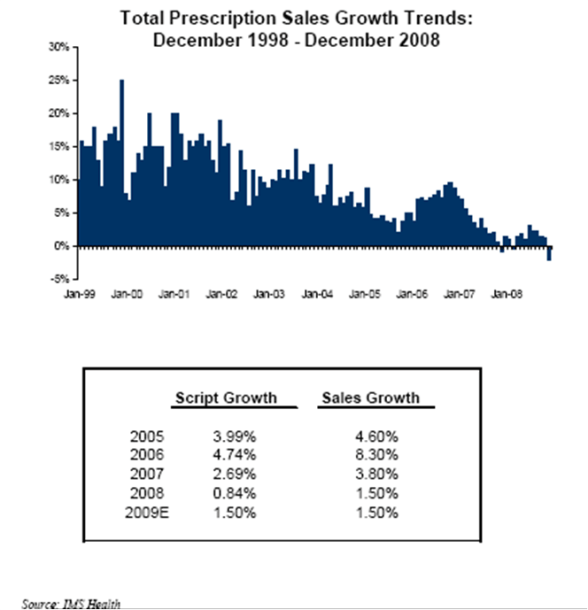
Script Growth Especially At Mail Continue To Slow

Based on IMS data, prescription growth continues to slow especially at mail order where it’s negative.  Interestingly, in a report by Barclay’s Capital, they estimate that Caremark will grow mail by 10% next year, Express Scripts will lose mail scripts by about 0.5%, and Medco will only grow by 0.8%.

Medco is easy to understand since they are currently the market leader in terms of mail order penetration.  The Express Scripts number requires some additional analysis.  Is it due to client loss?  Is mail just not growing?  The Caremark growth is meaningful.

ims-script-growth-barclaysims-mail-growth-barclays

Shifting Trends

Anyone whose read my blog knows that I find Penelope Trunk’s insights both interesting and unique.  She cuts to the chase and talks about things very directly.  As always, I think you will find some of her comments about how the economy is changing our behavior interesting.

She lays out 5 items here and they talk about it being cool to be cheap and women earning more than men.

Is Choice Good?

In recent discussions, I was talking with some clients about helping members or consumers save money in healthcare.  On the one hand, you can educate them about all the different opportunities.  On the other hand, you can focus them on one or two opportunities.  Those could offer the most value, be the simplest to execute, be the easiest to understand, or have some other logic in prioritization.

The question in my mind was what would drive the best results.  If you look at the research around consumer products and 401K’s (for example), it is clear that choice is not always best.  When presented with more options, people don’t always make a decision.  They get overwhelmed.

So, think about focus and simplification.

Personalized Medicine Webinar

I don’t have anything to do with this, but it sounds pretty interesting.  Medco and Regence are talking.  Here is the teaser.  (Click here for more info and registration.)

Personalized medicine is moving rapidly. The FDA in December considered requests to require genetic testing for the colon cancer drugs Vectibix and Erbitux. Approval of such labeling changes could pave the way for a slew of other personalized therapies and diagnostics now waiting in the wings. Stakeholders anticipate significant clinical and financial savings. Recently approved genetic testing for the blood thinner warfarin, for instance, is projected to avoid 85,000 serious bleeding events annually and save roughly $1.1 billion a year!

On the other hand, questions remain whether the model actually provides a favorable return on investment (ROI). A new study finds that genetic testing for warfarin does not appear to be cost-effective in certain patients. And health plans and PBMs are trying to sort out which of the numerous diagnostic tests on the market actually provide clinical utility and improved results. One large health plan, for example, says its costs for diagnostic testing are growing at nearly 20% a year.

So where does all of this leave Rx payers in February 2009?

Siftables: Very Cool Tools From TED

A friend shared this video this morning with me. Very cool. This is a presentation by David Merrill from MIT about Siftables. He has integrated new technologies with our traditional building blocks to build interactive, high tech blocks that can be used for spelling, math, music, and other ideas.

Imagine the ability to use these to teach people.

Focus On Chronic Diseases

People are always talking about where to focus to reduce costs in the US health care system…Here’s a hint from the January 2009 Health Affairs Health Policy Update:

“Now three-quarters of the $2 trillion-plus that we spend on U.S. health care each year goes to paying the bills for chronic illness:  cardiovascular and pulmonary disease, cancers, diabetes, arthritis, high blood pressure, depression.  Globally, the World Health Organization estimates, three out of every five deaths – four out of five in low- and middle-income countries – stem from chronic disease.”

Are You A Registered Organ Donor?

According to one article, there are about 70M registered organ donors which is a number that has increased as 31 states now allow people to register online.  Considering the wait list for donations – just over 100,000 today according to The Organ Procurement and Transplantation Network – this is an important thing to consider.

Here is some of their data:

Government Takeover Of Healthcare

Since I very much believe in our capitalist society (even with all the mistakes that have taken us down this recession / depression path), I was a more than a little surprised that in a survey in yesterday’s USA Today 59% of the people surveyed thought government would do the same or better job than private health insurance companies.

Coupoing Back in Vogue

I don’t know what the statistics were before, but these statistics published this morning in the USA Today seem high.

    65% of people 18-39 examined mail more carefully for coupons versus six months earlier

    73% of people 40-49

    And, 57% of people 50+.

coupon

With unemployment expected to come out today at 7.5% (the highest in 17 years), we shouldn’t be expected, but it certainly puts new focus on using incentives to drive healthy behaviors.

Excess Healthcare Spending

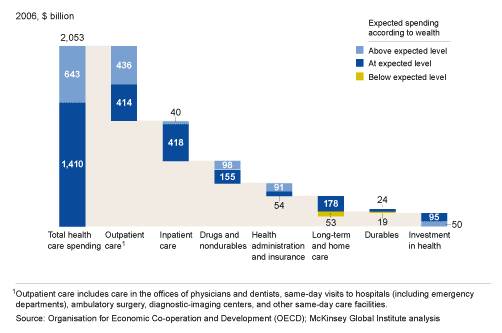
According to McKinsey

McKinsey research shows that the United States spends about $650 billion more than might be expected given its level of wealth and the experience of similar countries.

Here is a chart that breaks this down in a typically McKinsey framework (which I love BTW):

mckinsey-on-excess-hc-spending1

Will Plans Cover Genetic Testing?

I came across this fact the other day from Systemed Group, a division of Medco. According to the 300 health plans they surveyed, 38% of them said they will definitely (3%) or probably (35%) cover genetic testing within five years.

Interesting. What will this mean? What will these test consist of? What will they cost? How will they be used? Will they cover the drugs that are personalized based on genetic makeup?

7 e-Patient Conclusions

Thanks to e-patient Dave’s reminder on the e-Patient blog

Here are 7 conclusions from the white paper that came out last year on this topic. Very important in diffusing some of the myths around the role of social networking in healthcare and the use of the Internet for information.

1. e-patients have become valuable contributors, and providers should recognize them as such.
“When clinicians acknowledge and support their patients’ role in self-management … they exhibit fewer symptoms, demonstrate better outcomes, and require less professional care.”

2. The art of empowering patients is trickier than we thought.
“We now know that empowering patients requires a change in their level of engagement, and in the absence of such changes, clinician-provided [information] has few, if any, positive effects.”

3. We have underestimated patients’ ability to provide useful online resources.
Fabulous story of the “best of the best” web sites for mental health, as determined by a doctor in that field, without knowing who runs them. Of the sixteen sites, it turned out that 10 were produced by patients, 5 by professionals, and 1 by a bunch of artists and researchers at Xerox PARC!

4. We have overestimated the hazards of imperfect online health information.
This one’s an eye-opener: in four years of looking for “death by googling,” even with a fifty-euro bounty for each reported death(!), researchers found only one possible case.

* “[But] the Institute of Medicine estimates the number of hospital deaths due to medical errors at 44,000 to 98,000 annually” … [and other researchers suggest more than twice as many]
* We can only conclude, tentatively, that adopting the traditional passive patient role … may be considerably more dangerous than attempting to learn about one’s medical condition on the Internet.” (emphasis added)

5. Whenever possible, healthcare should take place on the patient’s turf. (Don’t create a new platform they have to visit – take yourself wherever they’re already meeting online.)

6. Clinicians can no longer go it alone.

* Another eye-popper: “Over the past century, medical information has increased exponentially … but the capacity of the human brain has not. As Donald Lindberge, director of the National Library of Medicine, explains ‘If I read and memorized two medical journal articles every night, by the end of a year I’d be 400 years behind.”
* In contrast, when you or I have a desperate medical condition, we have all the time in the world to go deep and do every bit of research we can get our hands on. Think about that. What you expect of your doctor may shift – same for your interest in “participatory medicine.”

7. The most effective way to improve healthcare is to make it more collaborative.
“We cannot simply replace the old physician-centered model with a new patient-centered model… We must develop a new collaborative model that draws on the strengths of both systems. In the chapters that follow, we offer more suggestions on how we might accomplish this.”

Did You “Catch” Your Obesity?

What if obesity were a virus that once you caught it you couldn’t manage it with simply diet and exercise?  That would be a very discouraging fact.

sneezeWell, some recent research is finding a link between a virus and obesity and claiming just that.  Of course, the primary issue is overeating especially with limited exercise, but this presents a new wrinkle in solving the obesity crisis.

So, to manage obesity, you need to sleep more and eat better.  Exercise has an impact, but it may not be the best way to try to lose weight (see article).

Regence Quote On Pharma Studies

I always find some great nuggets in the AIS daily news.  I thought I would pass on this one from the head of pharmacy at RegenceRx.

“Unfortunately, we find that only 15% to 20% of pharmaceutical studies are reliable. Our findings are not unusual. For example, Pitkin, R. et al (JAMA. 1999; 281:1110-11) found that 18% to 68% of abstracts in six top-tier medical journals contained information not verifiable in the body of the article. To assure Regence doesn’t disregard valid studies, we request full study information from pharmaceutical manufacturers in addition to reviewed published information. Unfortunately, it’s rare for manufacturers to provide information beyond what’s in the published study.”

— Helen Sherman, Pharm.D., senior director of pharmacy services and chief pharmacy officer at The Regence Group, which operates BCBS plans in the Northwest, told AIS’s DRUG BENEFIT NEWS.

Breaking Down The 2008 PBM Customer Satisfaction Report

PBMI (Pharmacy Benefit Management Institute) put out its 14th report on employer satisfaction with their PBMs. Here are some of the highlights from the report:

  • 275 employers representing 11.3M members responded.
  • The overall rating was an 8.0 out of 10.0. (up from 7.9 in 2007)
  • 6.7% of respondents perceived that their benefit costs were increasing more than others and ranked their PBMs lower. (perhaps a validation that trend management matters…hence the “battle” to show the lowest year-over-year trend to the street in the individual trend reports)
  • PBMs were ranked on three factors – overall service and performance, delivering promised savings, and delivering promised services.
  • For the overall score:
  • Aetna (6.6), Argus (4.8), Innoviant (8.7), MedImpact (8.0), NMHC (7.5), and Prime Therapeutics (9.0) also were part of the report but had limited profiles due to a lower number of surveys being received.
    • As far as I know, Prime doesn’t contract directly with employers but just through their BCBS owners. That would seem to disadvantage them in this survey.
  • Employers can contract directly with PBMs or thru a managed care entity or buying group. Those that contracted directly ranked their PBMs higher (8.2 versus 7.6) which makes sense since they are more involved and more likely to be actively managing trend and having lower costs.
  • This is validated by the fact that those with very aggressive intervention in benefit management rated their PBMs much higher (8.6 versus 7.1). About 33% considered themselves to be very aggressive.
  • PBMs were rated the worst (7.2) for their disease management programs.
  • When looking at factors that were correlated with satisfaction there were a few surprises and a few no-kidding variables:
    • I was surprised the member website, specialty pharmacy, and mail service pharmacy ranked low on the list of variables (i.e., less correlation).
    • I was not surprised that account management ranked high and retail pharmacy network was low. In many cases, the networks are pretty similar. I would be interested to see how large employers ranked PBMs versus smaller employers since they probably get different levels of service.
  • Looking at the overall scores from 2004-2008:
    • Caremark, Catalyst, Cigna, Express Scripts, and Medco all went up.
    • Walgreens and Wellpoint went down.

Looking at the ranking of key factors:

Highest Ranked Function(s)

Lowest Ranked Function(s)

Aetna Retail pharmacy network

ID card production

Mail service pharmacy

Disease mgmt programs

Argus Retail pharmacy network

ID card production

Formulary mgmt and rebates

Account mgmt

Catalyst Retail pharmacy network

Claims processing

Disease mgmt programs

Mail service pharmacy

Cigna Account mgmt

Member services

Delivering promised savings

Disease mgmt programs

CVS Caremark Retail pharmacy network

Claims processing

Formulary mgmt and rebates

Disease mgmt programs

Envision Overall service and performance

Account mgmt

Disease mgmt programs
Express Scripts Retail pharmacy network

ID card production

Member services

Formulary mgmt and rebates

Disease mgmt programs

Innoviant Formulary mgmt and rebates

Delivering promised savings

Utilization and benefit mgmt consulting

Member website

Medco Retail pharmacy network

ID card production

Utilization and benefit mgmt consulting

Mgmt reports

Disease mgmt programs

MedImpact ID card production

Claims processing

Retail network

Formulary mgmt and rebates

Drug utilization mgmt

Specialty pharmacy

Delivery promised services

NMHC Retail network

Plan implementation and changes

Specialty pharmacy

Mail service pharmacy

Disease Mgmt programs

Prime Therapeutics ID card production

Retail network

Disease Mgmt programs

Specialty pharmacy

Formulary mgmt and rebates

Walgreens Retail pharmacy network

Mail service pharmacy

Mgmt reports

ID card production

Member website

Wellpoint Retail pharmacy network

Claims processing

Acct mgmt

Disease mgmt programs

Mgmt reports

Utilization and benefit mgmt consulting

So…my overall assessment is that it is a good report. It is limited by response and limited by the fact that there aren’t major differences between PBM scores (with a few exceptions). But, it certainly would give me some clues on what to expect, where to push, and how I should evaluate my PBM.

100 Smart Choices – Optum Health

Optum Health, a part of United Healthcare, has released a book called 100 Smart Choices. It lays out tips, advice, and tools to help you take control of your health. Since 87.5% of health care costs are due to individual choices, this is a big deal.

We don’t need to create the most medicated generation, we need to find a way to eat better, exercise more, have less stress, and act preventatively.

“Individuals can feel healthier and happier, avoid unnecessary trips to the emergency room or a doctor’s office, and cut their health care expenses by tapping the information in this book,” said Dr. Michael Rosen, national medical director for OptumHealth Care Solutions and consultant on the book. “As we developed the book, we made sure that all of the content was consistent with evidence-based guidelines and assisted members in making informed health care decisions.”

Insights From Mercer’s Annual Survey

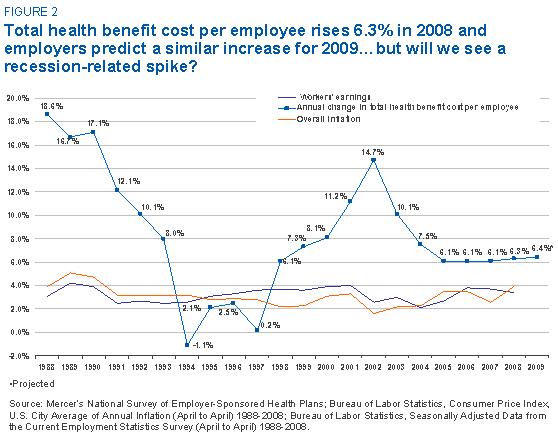
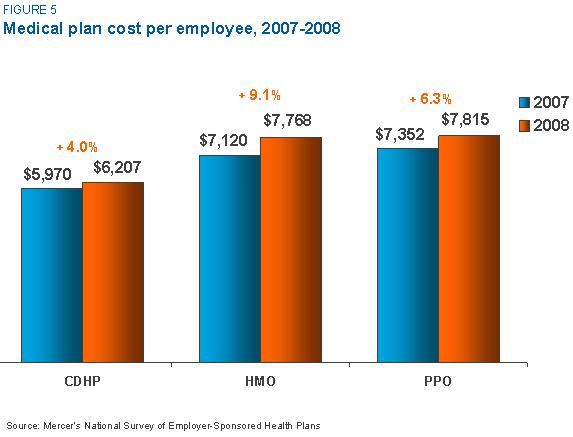
Here are a few insights from Mercer’s Annual Survey of Employee-Sponsored Health Plans:

1 – Less than 1% of all employers have provisions where smokers pay more (but 15% of employers with over 10,000 employees have such provisions).
2 – 32% of large employers off on-site or near-site clinics. (WOW! That surprised me.)
3 – 8% of large employers have provisions preventing coverage of spouses who have other coverage.
4 – A $1,000 health plan deductible is the norm.

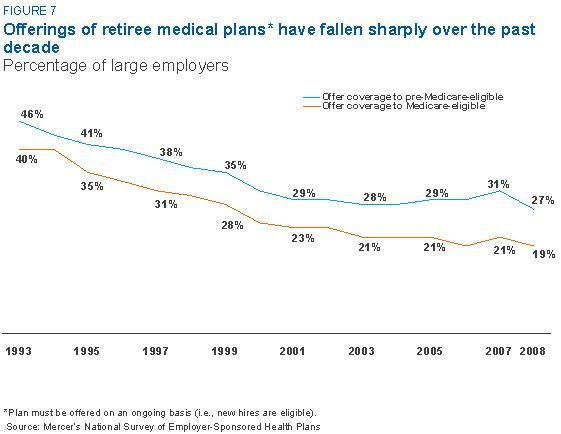
mercer-cost-increase
mercer-cost-pmpy
mercer-retiree-medical

10% of Older Men Taking Risky Combo of Drugs

A new study that came out looked at utilization of drugs by seniors and raises the flag that people are mixing drugs with other drugs or vitamins that may put them at risk. Since pharmacists and doctors don’t always know all the things their patients are taking, it is a lot harder to catch these issues than traditional drug-drug interactions which are caught at the pharmacy.

A couple of the most common combinations that they cite are:

Warfarin, a potent prescription clot-fighting drug, was often taken with aspirin. Both increase the risk of bleeding, so the odds are even higher when both drugs are taken. The researchers said these risks also occur when warfarin is taken with garlic pills, which some studies have suggested can benefit the heart and help prevent blood clots.

Aspirin taken with over-the-counter ginkgo supplements, increasing chances for excess bleeding.

Lisinopril, a blood pressure drug, taken with potassium, which combined can cause abnormal heart rhythms. Potassium is often prescribed to restore low levels of this important mineral caused by certain blood pressure drugs.

Prescription cholesterol drugs called statins [Lipitor, Crestor, Simvastatin/Zocor] taken with over-the-counter niacin, a type of vitamin B that also lowers cholesterol. This combination increases risks for muscle damage.

Mean Or Nice: Which Is More Contageous?

I found this blog entry on Dr. Gupta’s blog very interesting. It talks about the fact that being mean is more likely to stick with someone and effect them than being nice. Isn’t that frustrating? Wouldn’t we all like to believe that we could make things better by being nice when all it takes is a few rude people to change that.

That’s because, it seems being inconsiderate and rude to people has a much bigger impact than being nice. A recent study, conducted at the University of Chicago Booth School of Business, found feeling slighted can have a bigger impact on how a person treats another, than being the recipient of someone’s generosity.

Working with college students who were tasked with exchanging money in an orchestrated test of taking and sharing, researchers found the young people were willing to share at beginning of the study. But when they felt they were being taken advantage of, or that their fellow students were cheating them, they became more aggressive and greedier, rather than stepping back and appreciating what they were given.

Psychologists say this is not unusual. The meaner deed has the greater impact. Give something to someone and they may appreciate it. Take it away and they’ll fight you or at least object strongly.

As the doctor says “All this anger and hostility not only leads to unhappy people, but can cause anxiety, which raises our blood pressure, and puts stress on our hearts.”

And We Have Two Winners??

In looking at recent investor decks from both Medco and Express Scripts, I was surprised to find almost identical charts each claiming victory on drug trend management.  Here are the two charts…you can judge for yourself.

(Express Script’s from Credit Suisse Healthcare Conference 11/13/08)

(Medco’s from 2008 Analyst Day 11/21/08)

medco-drug-trendesrx-drug-trend

BCBSA On Consumer Driven Care

The BCBS Association released a study a few months ago on Consumer Driven Care.  Here is the presentation and a few highlights.  In general, it appears to show that it is working to save costs and get members engaged without negative side effects of them not using needed care.

  • CDHP enrollment is up 25%.
  • 10 percent more members said they would be careful about healthcare costs if they shared in the savings (incentives work)
  • 43% of those HSA (Health Savings Account) eligible with an open account use mail order pharmacy versus 30% of those with non-CDHP plans.  (Since overall mail use is around 18% this seems high, but the point is valid.)
  • 52% of those HSA eligible with an open account ask their MD about the cost of treatments
  • HSA eligibles are much more involved in tracking and estimating healthcare costs
  • HSA enrollees require more support from their plan – communications and service become more critical in driving their satisfaction.

Spend Time With Your Positive Friends

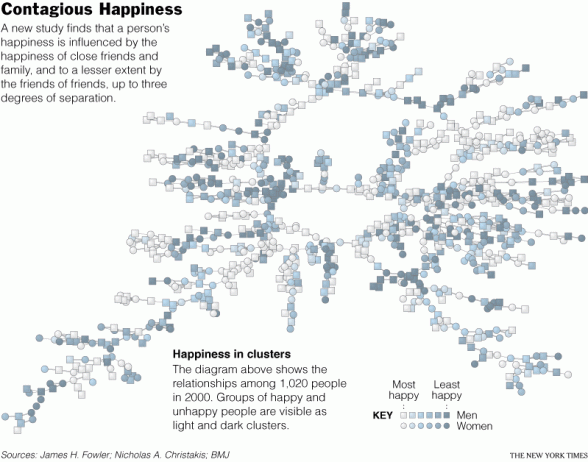
Earlier in the year, there was a study that showed how your friends and social network can affect your weight loss.  I blogged about this and quiting smoking as part of your network earlier.  Now, in Penelope Trunk’s blog, she talks about how your friends can make you happy and that happiness is linked to better health.  Interesting, she also says that if you say you are happy then you get the same benefits.

“optimism, a trait shown to be associated with good physical health, less depression and mental illness, longer life and, yes, greater happiness”  Time Magazine article

It brings me to two thoughts:

  1. You should tell yourself that you are happy and you’ll feel better.
  2. Member communications should stress happiness and help people understand how they can be happy by taking certain actions.

happy

Off Label Drug Use

Once a drug is approved, it can be prescribed by physicians for any reason.  Those reasons can include conditions that were not studied by the manufacturer in the clinical trials.  And, those off-label uses are not things that can be marketed to the physican.

Some of this is controlled by prior authorizations (PAs) which require a physician to call into the managed care company or the pharmacy benefit management (PBM) company to justify the use of the medication.  This is often used on high cost medications with a high percentage of off-label prescribing.

For example, it is estimated that 76% of the prescriptions writen for Seroquel are for off-lable purposes.  (See article on this and other information here.)  This article also lays out the top drugs that are used off-label.

  • Bupropion (Wellbutrin) approved for depression, commonly used off-label for bipolar diaorder.
  • Sertraline (Zoloft) approved for depression, commonly used off-label for bipolar disorder.
  • Venlafaxine (Effexor) approved for depression, commonly used off-label for bipolar disorder.
  • Celecoxib (Celebrex) approved for joint sprain/strain, used off-label for fibromatosis — soft tissue tumors.
  • Lisinopril (Prinivil, Zestril) approved to treat high blood pressure, used off-label for coronary artery disease.
  • Duloxetine (Cymbalta) approved to treat depression, used off-label for anxiety.
  • Trazodone (Desyrel) approved to treat depression, used off-label for sleep disturbance.
  • Olanzapine (Zyprexa) approved to treat schizophrenia, used off-label for depression.
  • Epoetin alfa (Procrit, Epogen) approved to treat chronic renal failure, used off-label for anemia from chronic disease.

MD Rating Sites

(Getting a few things out here and off my desk)

This is a question I often wonder about.  I was glad to see that e-patients put a report online.  I haven’t read it yet, but I think it is something that many of you would want to know.

I think that the main issue Given hit upon in the report (but I’m not sure she recognizes as the primary challenge of doctor rating sites) is the numbers issue. With over 700,000 physicians in the U.S., a ratings database of 10,000 or even 20,000 is pitifully and woefully small.