Archive | Research RSS feed for this section

Costs Of Presenteeism and Absenteeism

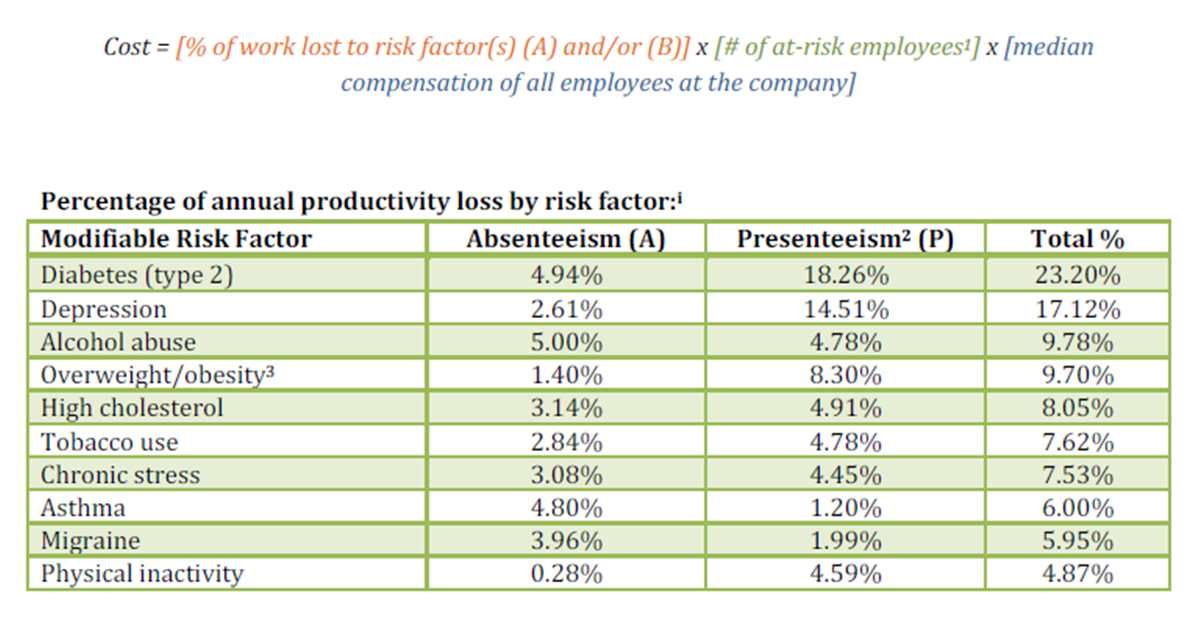
At the World Health Care Congress (WHCC), one of the presenters was making a great case for why employers want to continue to be involved in healthcare.  Their point was that the costs of presenteeism and absenteeism are significant and make health a bigger issue than simply the obvious medical and pharmacy claims costs.  (In one study, presenteeism costs alone were more than medical costs.)

While absenteeism costs are obvious as in sick days paid out, presenteeism is harder to estimate but can have significant costs.  Presenteeism occurs when people come to work sick and are not productive.

I’m sure there are numerous methodologies out there, but I found this one that seemed simple and gave me some data by condition on both factors.

Infographic: Decoding Your Medical Bills

Here’s a great infographic on costs.  This is another reason why you need a company monitoring your claims for cost savings opportunities and working with patients and physicians to implement evidence-based medicine and route patients to centers of excellence (better outcomes for lower costs).

Decoding Your Medical Bills
Created by: MedicalBillingAndCodingCertification.net

Eating Chocolate = Lower BMI!

Here’s a study that all of us with a sweet tooth should love…

In Time (4/9/12), they say:

Eating chocolate five or more times a week on a regular basis can translate to a one point drop in BMI on average, compared with those that don’t eat it.

It sounds too good to be true, but apparently chocolate can help the body absorb fewer calories from fat.

See the full study here.

(My question is why don’t I hear these messages from my health plan.)

And, for those of you that like salty snacks instead, the same page in Time talks about the fact that popcorn has more polyphenols by weight than fruits and vegetables. (Polyphenols can neutralize cancer causing free radicals.)

Changing Marketing Paradigms

Traditionally, consumer marketing has focused on the “young invincibles” as they are sometimes referred to in healthcare. Those are the 18-34 year olds that traditionally were the DINKs (dual income no kids) and younger population with more disposable income or focused on acquiring goods (as they bought homes and started careers).

Well, I think this quote by Sunil Gupta summarizes the issue:

If [young adults] have no money in their pockets, there is nothing to sell them.

With 46% of those age 18-24 unemployed and 20% of those 25-34 living at home, this group’s financial dynamics are very different. The focus on both those with money and those driving the healthcare costs have shifted to Baby Boomers. (Facts from Time article on page 16 in the 4/9/12 edition.)

At the same time, I read an article about marketing to women which continue to make majority of healthcare decisions both for themselves and their families. (and caregivers (often women) are less likely to be adherent to their own medications.)  Here were the recommended approaches:

  • Offer highly personalized formats
  • Provide complete anonymity
  • Eliminate the middle man
  • Understand self-perceptions
  • Consider the unique point of sale

And, some of these changes are driven by the economy. For example, according to NCH Marketing and Parks Associates, 81% of people are using coupons regularly and they redeemed them for 3.5B in 2011. (Of course, the jury is still out on the Groupon model…)

Is Prescribing A Trial And Error Process?

I found this chart fascinating.  As we know, drugs don’t always work (and not just because people don’t actually take them).  BUT did you realize in some cases it’s a coin flip of whether a drug will work for you?

Data like this is just more support for the case for personalized medicine.  If a genetic test can help determine which drug will work in a patient, you can address their disease faster, avoid unnecessary side effects, and impact overall healthcare consumption and costs.

The key of course is finding tests that can be administered easily and at a low cost for which the economic benefits exceed the costs.  Of course, addressing the education gap within the physician community and patient community to separate facts from myths is important.

Some Facts On Palliative Care

In the book called Healthcare in 2020 by Steve Jacob, there is a chapter on End-of-Life Care. It provides some great data all sourced there (so not repeated here). I find this whole are of discussion especially around palliative care very interesting.

First, let’s define palliative care:

Palliative care (from Latin palliare, to cloak) is an area of healthcare that focuses on relieving and preventing the suffering of patients. Unlike hospice care, palliative medicine is appropriate for patients in all disease stages, including those undergoing treatment for curable illnesses and those living with chronic diseases, as well as patients who are nearing the end of life. Palliative medicine utilizes a multidisciplinary approach to patient care, relying on input from physicians, pharmacists, nurses, chaplains, social workers, psychologists, and other allied health professionals in formulating a plan of care to relieve suffering in all areas of a patient’s life. This multidisciplinary approach allows the palliative care team to address physical, emotional, spiritual, and social concerns that arise with advanced illness. (from Wikipedia)

The challenge of course is that most people don’t want to talk about dying, and physicians are taught to try everything to cure someone. After talking with a few people working in this area, the general scenario is where clinicians and other social workers are helping to enable to a patient to talk to their family and care team about their wishes. It’s not to make the decisions, but to give patients the tools to have an informed discussion.

Here were some of the interesting things from this chapter in the book:

  • Less that ¼ of physicians were familiar with the term in a survey
  • The American Society of Clinical Oncology has established a goal of integrating palliative care into its model of comprehensive cancer care by 2020.
  • A 2009 study of cancer patients found that palliative care improved patient satisfaction and eased pain, fatigue, nausea, insomnia, anxiety, and depression. And, increased appetite.
  • According to the Worldwide Palliative Care Alliance, more than 100M people worldwide would benefit annually from either palliative care or hospice…yet only 8% have access to it.
  • The average physician’s estimate of how long a patient will live was 530% too high.
  • Fewer than 40% of oncologists speak candidly with patients about end-of-life treatments.
  • Physicians equate suggesting hospice as “giving up”.
  • A 2008 published study showed that patient satisfaction was higher, more advance directives were completed, fewer ICU admissions were necessary, and medical costs were lower for patients in palliative care.
  • Patients with lung cancer that received palliative care lived 3 months longer than those with standard care (which compares to only getting 2-3 months of life from chemotherapy). [BTW – 1 in 5 cancer patients are still receiving chemotherapy in the last two weeks of life.]
  • A hospitalized palliative-care patient costs $279-$374 less per day.
  • In a Medicare study, patients who received palliative care cost $6,900 less during a hospital stay.

This seems like great data. Imagine that you can improve a patient’s experience in the last months of life and lower costs. To me, that’s a lot of what our healthcare system needs these days.

What Is Motivational Interviewing?

Motivational interviewing (MI) is a technique that we’ve been talking about in pharmacy for years (e.g., study re: MI and adherence), and care management has also been using this approach (e.g., CV study and chronic kidney study).  As we all know, getting consumers to engage is difficult.  It’s even more difficult to get them to engage and actually change behavior.

As I understand it, this technique is focused on using open ended questions to understand a patient’s barriers to change as expressed in their own words.  It seems to be based on the traditional concept of active listening.  In healthcare, this changes the paradigm from a prescriptive approach to more of an enablement apporach.  Just like health literacy, I think of motivational interviewing as another leg of stool in creating an effective program for care management.  (article on nurse training)

Definition from Wikipedia:

Motivational interviewing (MI) refers to a counseling approach in part developed by clinical psychologists Professor William R Miller, Ph.D. and Professor Stephen Rollnick, Ph.D. The concept of motivational interviewing evolved from experience in the treatment of problem drinkers, and was first described by Miller (1983) in an article published in Behavioural Psychotherapy. These fundamental concepts and approaches were later elaborated by Miller and Rollnick (1991) in a more detailed description of clinical procedures. Motivational interviewing is a semi-directive, client-centered counseling style for eliciting behavior change by helping clients to explore and resolve ambivalence. Compared with non-directive counseling, it is more focused and goal-directed. Motivational Interviewing is a method that works on facilitating and engaging intrinsic motivation within the client in order to change behavior. The examination and resolution of ambivalence is a central purpose, and the counselor is intentionally directive in pursuing this goal.

Motivational interviewing recognizes and accepts the fact that clients who need to make changes in their lives approach counseling at different levels of readiness to change their behavior. If the counseling is mandated, they may never have thought of changing the behavior in question. Some may have thought about it but not taken steps to change it. Others, especially those voluntarily seeking counseling, may be actively trying to change their behavior and may have been doing so unsuccessfully for years. In order for a therapist to be successful at motivational interviewing, four basic skills should first be established. These skills include: the ability to ask open ended questions, the ability to provide affirmations, the capacity for reflective listening, and the ability to periodically provide summary statements to the client.

Here’s a video on motivational interviewing:


Understanding Health Literacy Is Important For Care Management

If you’re going to care for a patient, it’s critical to understand their level of health literacy.  A new study shows the correlation (not necessarily cause and effect) between health literacy and death.  Older people were twice as likely to die if they had poor health literacy in a five-year period.

“Previous studies have found that low health literacy is associated with less knowledge of chronic diseases, poorer mental and physical health, less use of preventive health services and higher rates of hospital admission, according to background information in the report.”

Your Behavior Affects Your Memory

All the talk about Alzheimer’s disease makes you wonder what you’ll be like when you’re older. Several studies are beginning to point to different things that affect our memory:

  • People who eat > 2,143 calories a day are 2x as likely to have mild cognitive impairment as those that eat less than 1,526 a day.
  • People age 45-80 who don’t sleep well were more likely to have amyloid proteins which is the hallmark of Alzheimer’s.
  • Both physical exercise and cognitive exercise have been shown to prevent dementia.

Some general facts about Alzheimer’s (source):

  • Today, 5.4 million Americans are living with Alzheimer’s disease – 5.2 million aged 65 and over; 200,000 with younger-onset Alzheimer’s. By 2050, as many as 16 million Americans will have the disease.
  • Two-thirds of those with the disease – 3.4 million – are women.
  • Of Americans aged 65 and over, 1 in 8 has Alzheimer’s, and nearly half of people aged 85 and older have the disease.
  • Another American develops Alzheimer’s disease every 69 seconds. In 2050, an American will develop the disease every 33 seconds.
  • Most people survive an average of four to eight years after an Alzheimer’s diagnosis, but some live as long as 20 years with the disease.
  • On average, 40 percent of a person’s years with Alzheimer’s are spent in the most severe stage of the disease – longer than any other stage.
  • Four percent of the general population will be admitted to a nursing home by age 80. But, for people with Alzheimer’s, 75 percent will be admitted to a nursing home by age

Additionally, The Alzheimer’s Challenge 2012 was recently announced.

The Alzheimer’s Challenge 2012 seeks the development of simple, cost-effective, consistent tools that could be easily used to assess memory, mood, thinking and activity level over time to help improve diagnosis and monitoring of people with Alzheimer’s disease. Today, easy to use, reliable, objective and cost-efficient methods to track and monitor Alzheimer’s disease — which is not a normal part of aging — remain an unmet need. The Alzheimer’s Challenge 2012 supports the U.S. Department of Health and Human Services (HHS) call to harness new thinking to deliver better care and better health at lower cost and provides an entrepreneurial springboard to harness new thinking and approaches to improve Alzheimer’s care.

Curing Cancer Starts With Prevention

“We have forgotten that curing cancer starts with prevention of cancer in the first place.” Dr. David Agus, author of The End of Illness

Dr. Agus is a prominent cancer researcher who’s views on cancer are apparently radical (although seem logical to me). In an article about him in Fortune (2/27/12), it talks about how use of statins lowered cancer rates by 40% (although why isn’t known). It also talks about how inflammation is linked to diseases like heart attacks, Alzheimer’s, and diabetes and how taking a baby aspirin might curb inflammation.

He’s gone on to be part of the founding team at Navigenics and then subsequently Applied Proteomics.

Navigenics, Inc. develops and commercializes genetics-based products and services to improve individual health and wellness. Navigenics educates and empowers individuals and their physicians by providing clinically actionable, personalized genetic insights about disease risk and medication response to catalyze behavior change and inform clinical decision-making. The company was founded by leading scientists and clinicians, and continues to advance genomic knowledge and adoption of molecular medicine through studies with leading academic centers. Navigenics’ services are available through employer wellness programs and health plans, as well as through physicians and medical centers.

Proteomics, the study of proteins expressed by the body, has the greatest potential for biomarker discovery. Protein expression profiles, determined from easy-to-collect body fluids (e.g., blood, urine, saliva, etc.), represent a snapshot of the current health status of an individual, a sum of the influence of genetics and environment. However, assaying such markers is not without its challenges, and proteomics has failed in the past due to immature technologies and a lack of process control. Lack of control adds noise and variability that block effective biomarker discovery and validation.

Applied Proteomics, Inc. was founded in May 2007 by Dr. Danny Hills (Applied Minds, Inc.) and Dr. David Agus (USC-Keck School of Medicine) to make proteomics-based biomarker discovery practical and productive. Using their combined expertise in oncology, proteomics, systems control, and computation, the company has developed the leading protein biomarker discovery platform. API’s systems control and computational expertise as well as recent technological innovations (e.g., improved instrumentation, faster computing, and extensive genome annotations) make proteomics-based biomarker discovery possible as a replicable, industrial application. API has demonstrated that its approach leads to superior data (better signal, less noise), which leads to better results (more protein features and biomarkers observed). Better results will lead to improved diagnostics and a more efficient and effective healthcare system.

The article talks about several negative reactions to his philosophies, but I must agree that a simple approach to prevention seems much easier to live with then complicated treatment plans on the backend.

At the same time, I was talking with an oncologist the other day about the fact that you’re seeing more and more long-term cancer survivors and what their needs are from the healthcare system. This is changing the needs of the system, but it also is complicating the data that physician’s see. If you base your perception of success on survival, the data is skewed based on earlier screening. (see Reuters article)

Employee Wellness Matters

If you look at the infographic below, it paints a sad picture of how work impacts our healthcare.  At the same time, we have lots of discussion about the benefits (or lack of) for disease management and wellness programs.

I think its critical for employers to play a role in helping engage and educate their employees about health and wellness.  I think this interview with MemorialCare Health System paints a good picture of why and how to approach this.

A University of Michigan study revealed health costs for a high-risk worker is three times that of a low-risk employee. American Institute of Preventive Medicine reports 87.5 percent of health claim costs are due to lifestyle. Companies implementing wellness activities save from $3.48 to $5.42 for every dollar spent and reduce absences 30 percent.

Work Is Murder
Created by: Online University

Infographic: Student Health

We all know that college is often not the healthiest time period for many people between all-nighters, dorm food,  caffeine, and alcohol.  I find the correlation between health and grades interesting and got the original source for it to support the infographic that I’m sharing below.
Student’s Guide to Health and Fitness

Do Hospital Ratings Matter?

Younger people who make more money and have a college education are most likely to care about hospital ratings.  Not a big surprise.  But, less than half of those surveyed by the Thomson Reuters 2010 PULSE Healthcare Survey were “very likely” to even look for a hospital rating.  In my opinion, we’re still in a world where we make decisions about our healthcare facilities by looking out the windshield of our car.  [borrowing from someone’s else’s analogy]

I’m not sure I understand why income isn’t a straight line correlation with this.  It’s those making >$100K and then those making less than $25K that are most likely to look for a hospital rating. 

As you get into the impact of the ratings, I thought there were several interesting things.  For example:

  • Younger people were more likely to change hospitals because of a low rating, but least likely to be influenced by a top rating. 
  • For a serious illness, younger people were more likely to be influenced by the top rating while older people were more likely to choose the local hospital over the top rated hospital.
  • Education was clearly correlated with choice especially when faced with a serious illness.

This generally correlates with the infographic I shared previously on millenials.

My PCMA Presentation On Copay Cards

I’m giving my PCMA presentation in FL right now about copay cards. For those of you that can’t attend, here is my executive summary and a copy of some slides. (My actual slide deck was shorter for presentation but this gives more data to those of you looking online.)

I focused on three key points:

  1. Copay cards are a direct threat to the PBM model. They can run against the idea of copay differentials and formulary tiers. Since they’re not allowed at mail order, they create a disconnect there. And, eventually, I believe they will be in conflict with rebates (i.e., why pay for both).
  2. The cost numbers to the payer are huge ($32B according to Visante) although this is less than $1 per Rx over that 10 year time period. But, it’s concentrated on 3% of all scripts which makes it a big deal.
  3. There should be a win-win IF they are concentrated on specialty medications with a link to improved adherence and health outcomes.

There doesn’t seem to be clear data (although another article says it is available) but the general data shows that availability and use of copay cards is growing rapidly.

Investing in copay cards seems to be based on four myths:

  1. Cost is a large issue in non-adherence. It’s an issue but not the dominant issue.
  2. Costs will influence physician choice. The reality is that they don’t know the costs and see this as a pharmacist issue.
  3. Copay cards are a cost effective way to improve adherence. They get about a 10% improvement in MPR which sometimes produces a positive ROI. There are much lower cost ways to get a similar improvement.
  4. Copay cards can delay conversion to generics. This is still in the air with the Pfizer Lipitor program, but if it works, it will be a lightning rod for PBMs and payers to focus on.

This topic’s not going away. For now, the easy PBM response is to close down the formulary, move more scripts to mail, and implement prior authorization programs. I would expect this will happen more often unless there is more transparency here around what’s happening and the benefits. Things like ZQuiet can, indeed, help one to stop snoring when used correctly.

Reading Labels; Understanding Side Effects

We all know people don’t read labels on their medications or their over-the-counter (OTC) pills. If they did, their eyes would gloss over, and they would start to worry about all the side effects. Of course, this is a problem since some things can create drug-drug interactions or create an overdose.

I was reading an article in USA Today called “Read the labels because ‘all drugs have side effects’“. It lists out Tylenol, Advil, Motrin, Benadryl, Claritin, and Zantac as examples of OTC medications with overdose risks. It gives more details on these and provides several other examples. Here’s a quote from the article:

“It’s important for the public to realize that all drugs have side effects. It doesn’t matter if they’re prescription, over-the-counter, herbals or nutritional supplements. If they have active ingredients, they have side effects and can interfere with normal body functions.” Brian Strom, director of the Center for Clinical Epidemiology and Biostatistics and the University of Pennsylvania

The reality is that we’re making an unconscious choice about tradeoffs. Do the risks and probabilities of the side effects outweigh the probabilities of improvement?  Of course, in many situations, they do. 

I think this points to several things:

  • Document everything you take whether it’s an Rx, OTC, herbal, or supplement.
  • Read labels.
  • Tell your MD and Pharmacist what your taking especially if it’s regular and long-term.

Ideally, once we have broad use of PHRs (personal health records) which are tied into our grocery bills to track purchases and use then computer algorithms can look for risk factors. And, with personalized medicine, we might one day know which things to avoid based on our genes.

The Well Being Index

I find this to be an interesting study (the Gallup-Healthways Well-Being Index). Gallup and Healthways are surveying 1,000 people per day for 350 days per year and has been doing it for several years.

I was reading one of their brochures looking at data from 1/2/10 – 12/30/10. Here’s a few observations:

  • The index score across all states varies by a narrow range of 9.3 points.
  • The top 5 states (in 2010) were:
    • Hawaii
    • Wyoming
    • North Dakota
    • Alaska
    • Colorado
  • The top 5 large cities were:
    • Washington-Arlington-Alexandria, DC-VA-MD-WV
    • Austin-Round Rock, TX
    • San Jose-Sunnyvale-Santa Clara, CA
    • Seattle-Tacoma-Bellevue, WA
    • San Francisco-Oakland-Freemont, CA

The overall composite score is based on six sub-indices:

  • Life Evaluation
    • Partially based on the Cantril Self-Anchoring Striving Scale
  • Emotional Health
    • A composite of how the consumer felt yesterday along nine dimensions
  • Physical Health
    • Body Mass Index
    • Disease burden
    • Sick days
    • Physical pain
    • Daily energy
    • History of disease
    • Daily health experiences
  • Healthy Behavior
    • Life style habits
  • Work Environment
    • Feelings and perceptions about work
  • Basic Access
    • 13 items measuring:
      • Access to food
      • Access to shelter
      • Access to healthcare
      • Having a safe and satisfying place to live

This gives an interesting macro view of healthcare at a localized level. The thing I’d like to learn is how this is shaping communities and health care entities to act different. Is this changing engagement strategies? Is this changing regional investments? Can the data be tied back to individuals and used to help improve outcomes?

90 Day Rxs Get Better Adherence

I think we can all agree now that 90-day prescriptions are correlated with better adherence (and the percentage of retail 90-day scripts is going up).  The latest study here is from Walgreens.

A new Walgreens study analyzing relative medication adherence of patients filling 90-day supplies of maintenance medications using retail and mail order channels over a one-year period concluded that patients who fill prescriptions via retail have as high or slightly higher adherence levels than those utilizing mail (77 percent vs. 76 percent). The study, “Medication Adherence for 90-Day Quantities of Medication Dispensed Through Retail and Mail Order Pharmacies,” was recently released in the November issue of The American Journal of Managed Care.

This reflects other studies from CVS Caremark, Express Scripts, Kaiser, and BCBSNC.  (Although sometimes it shows mail order as better and sometimes retail.)

Of course, the data is slightly different in either case, but the general consensus is the same.  So, the question is what’s next.  How should you compare the two channels?

  • Generic fill rate
  • Overall health literacy and health outcomes
  • Patient experience / satisfaction
  • Payer cost
  • Cost to fill

This issue won’t go away so it’s going to be important to continue to find ways to compare the channels and find populations that are similar for comparison or remove the bias.


NYT Article On ACOs Replacing Health Insurers

I think it’s a bold (maybe foolish) prediction that is made in the NY Times article saying that ACOs (Accountable Care Organizations) will be the end of health insurers.  We don’t even know that ACOs will work yet.  You can even see some debate on this topic in this blog post on Why ACOs Won’t Work.

But, I’m not an ACO expert so let me focus on what I found interesting in the NYT article.  It points out a few things:

  1. The focus on preventative care
  2. The fact that some managed care organizations are changing (and others will too)
  3. The fact that “ACOs” (in whatever form they take) will need a platform

This is what I find interesting.

I think the concept of an ACO (or Patient Centered Medical Home) where care becomes localized and there is greater focus on prevention and wellness not just sick-care is great.  We should all want that to happen in some form.

But, in all cases, this changes the data needs and role of the physician.  They need to be empowered with new information and tools.  How do they manage their panel of diabetics?  Will some database track them and monitor their screenings and blood sugar?

When the field of medicine is constantly changing with new drugs and new studies, how will physicians have the best practices pulled into their practice?  They won’t want to wait the 16 years it takes for things to work their way through the system.  They’ll actually want to embrace the best solutions and see more comparative effectiveness information.

I see a huge opportunity here for someone to create an ACO “platform” that embeds business rules, tele-monitoring, consumer engagement, and reporting into a way to create the “i-physician” (informed physician) of the future.

Uping The RxAnte: An Adherence Predictive Model

Those of you that have heard me speak know that I look at this topic of predicting adherence both from an area of fascination along with the eye of a skeptic.  While I love the concept of predicting someone’s adherence and therefore determining how to best support them from an intervention approach, I also believe that the general predictors are pretty straightforward:

  1. Number of medications
  2. Plan design (i.e., cost)
  3. Gender
  4. Health literacy and engagement (see PAM score research)

And, this is a hot topic (see post on FICO adherence score).  You can see my prior posts on some different studies, on the Merck Estimator, and some notes from the NEHI event on this topic.  It generated a good dialogue on Kevin MD’s blog when I talked about paying MD for adherence.

I had a chance to talk with Josh Benner the CEO of RxAnte the other day.  It sounds very interesting, and they have an impressive team assembled.  In general, they’re focused on:

  • Predictive modeling
  • Decision rules
  • Monitoring and managing claims to track adherence
  • Evaluating effectiveness of interventions
  • And creating a learning system

There are definitely some correlations to the work we do at Silverlink Communications around adherence.  We’re helping clients determine a communication strategy that might include call center agents, direct mail, automated calls, e-mail, SMS, mobile, or web solutions.  We’re looking at segmentation and prioritization.  We’re looking at past behavior and messaging.  The goal is how to best spend resources to drive health outcomes from primary adherence to sustaining adherence.  This is a challenge, and we all need to build upon the work that each other is doing to improve in this area.  We have a huge problem globally with adherence.

Why People Under 35 Are Stressed

This is a great list from what Beth Braverman calls “The Beaten Generation” looking at what’s happened since 2005:

  • Their home equity has dropped 51%
  • Their net worth is down 55%.
  • Their student debt is up 19%.
  • Unemployment for college grads is up 64%.
  • Their income is down 4.5%
  • 31% more are living with their parents.
  • The birth rate is down 7.1%.
  • 22% less think they’ll be able to retire by age 65.

And, we wonder why they’re pessimistic…

Stressed Out Workers Spend 2X On Healthcare

Are you stressed out? In today’s economy, many people are. Whether it’s being a caregiver, your job, or other concerns (like just paying the bills), have you ever thought about how much that costs you?

According to some data shared by Money Magazine, here are some examples of stress related ailments and their average annual costs:

  • Obesity – $2,600-$4,900
  • Back Pain – $1,300
  • Insomnia – $200-$1,200
  • Hypertension – $1,100
  • Teeth Grinding – $200-$1,100

That’s real money!

Some of their suggestions (other than going on a long vacation):

  1. Take advantage of the EAP (Employee Assistance Program) that your company might offer.
  2. Use the wellness programs that your employer might offer (since 74% of them do offer something).
  3. Go see a therapist and look into CBT (cognitive behavioral therapy).
  4. Workout.
  5. Take a break from e-mail (or your smartphone and constant Facebook updates).
  6. Stop multi-tasking.
  7. Meditate.

(Beat Stress For Less by Kate Ashford)

Be Happier To Be Healthier

Since happiness is correlated with better health, I thought this article in Money Magazine was relevant in the hints it gave about becoming happier. (Jan/Feb 2012 article by Donna Rosato)

  1. Spend a little a lot of the time. (multiple, small indulgences are better than less, large indulgences)
  2. Free yourself from credit card debt. (less satisfied in your relationship when have debt)
  3. Focus on having a rainy day fund. (best predictor of financial satisfaction)
  4. Find a new job. (if you’re not happy)
  5. Give more to charity.
  6. Use your vacation days. (even anticipation of a vacation increases happiness)

Here are a few more articles on happiness and health:

The New Post-Recession Consumer

I’m always fascinated by segmentation, and I think understanding how market events like the Great Recession have changed the fundamentals of the game is important. In November 2011, Money Magazine shared some data from a survey they did. Here are some of the results.

  • 53% of Americans aren’t sure their kids will better off then they are.
  • 67% are worked their quality of life will suffer in retirement.
  • 80% say they’re eating at home more.
  • 75% say time with family is more important than ever.

“Big periods of economic upheaval can define a generation. Not so much because of the depth of this recession, but because of its prolonged nature, it will have lasting impact.” Paul Flatters, Managing Director of Trajectory Partnership. (How The Economy Changed You by Dan Kadlec)

  • 85% spend more time looking for deals before they buy. (hence the couponing craze)
  • 57% are building an emergency fund.
  • 51% are pessimistic about the US economy in the next 12 months.
  • 61% are pessimistic about government officials spurring growth.

I don’t know about you, but I see a ton of nuggets in here about positioning generic drugs, preventative health, adherence, mail order, and many other cost savings actions in healthcare.

Pharmacy Needs A Neuromarketing Study

I was reading this article in Fast Company about neuromarketing with a focus on the CEO of NeuroFocus. Companies like PepsiCo, Intel, CBS, ESPN, and eBay have used them and many others are trying work in this area. But, I’ve never heard of a healthcare company doing anything in this space. I’ve talked about this before in my article about the book Buyology. It’s fascinating, and the mobile tool that NeuroFocus has created could create new ways of capturing data.

One interesting example he talked about was the expression of a person on a poster (for example). If the expression is too easy to decipher, we simply move on…BUT if it’s hard to decipher, it causes us to pause and think.

He also talks about always putting images on the left hand side of the screen and words on the right. (Seems applicable to direct mail and maybe my next slide presentation.)

Another example is that the brain loves curves not sharp edges.

Given the shifting pharmacy marketplace, I would think this is a study that the industry needs. The PBMs should better understand what the consumer thinks about when they hear the word mail order. Manufacturers should understand the reaction to brand names or copay cards. The retailers should think about how brand equity plays into choice. There are endless opportunities here. (A business opportunity perhaps!)

(They Have Hacked Your Brain by Adam Penenberg)

Speaking at the upcoming PCMA Event

I just got added to the agenda for the February PCMA event so look me up if you’ll be there.  I’ve spoken on the topic of copay cards a few times for AIS in the past.  Since then, there have been a few significant events:

  • The Pfizer Lipitor strategy and push around a copay card.
  • The PCMA study on the impact of copay cards.
  • CVS Caremark’s changes to their formulary of which some were attributed to the existence of copay cards.

As always, I welcome comments, articles, suggestions, or data to support this discussion.  It is certainly one where there is limited data or facts.  Thanks.