Archive | Value Propositions RSS feed for this section

Time To Sell?

There is always debate about captive PBMs (i.e., those owned by a managed care company).  In theory, I have always argued that they should have a leg up.  But, since pharmacy represents only 10% of total healthcare spend, the majority of the strategic focus is typically on the health insurance side of the business.  [BTW – The 3 largest captive PBMs are Wellpoint, Aetna, and Cigna.]

So, if you look at the stock charts below, you can see that while the PBMs (Express Scripts, Medco, and CVS Caremark) have all held up pretty well the managed care stocks (Aetna, Cigna, United Healthcare, Humana, and Wellpoint) have not held up as well.

If I owned a captive PBM, would this be the time for me to consider selling?  I have heard this debate a lot more recently than in recent years.

PBM 5-Year Stock Chart

express-medco-cvs-caremark-5-yearManaged Care 5-Year Stock Chart

wellpoint-cigna-aetna-united-humana-5-year[As I have disclosed before, I do not hold any individual stocks.]

Social Media Myths

This was a great article in Business Week.  It lays out nicely six myths to watch out for as you jump on the social media bandwagon.

  1. Social media is cheap if not free
  2. Anyone can do it
  3. You can make a big splash in a short time
  4. You can do it all in-house
  5. If you do something great, people will find it
  6. You can’t measure social media marketing results

Personalized Medicine Webinar

I don’t have anything to do with this, but it sounds pretty interesting.  Medco and Regence are talking.  Here is the teaser.  (Click here for more info and registration.)

Personalized medicine is moving rapidly. The FDA in December considered requests to require genetic testing for the colon cancer drugs Vectibix and Erbitux. Approval of such labeling changes could pave the way for a slew of other personalized therapies and diagnostics now waiting in the wings. Stakeholders anticipate significant clinical and financial savings. Recently approved genetic testing for the blood thinner warfarin, for instance, is projected to avoid 85,000 serious bleeding events annually and save roughly $1.1 billion a year!

On the other hand, questions remain whether the model actually provides a favorable return on investment (ROI). A new study finds that genetic testing for warfarin does not appear to be cost-effective in certain patients. And health plans and PBMs are trying to sort out which of the numerous diagnostic tests on the market actually provide clinical utility and improved results. One large health plan, for example, says its costs for diagnostic testing are growing at nearly 20% a year.

So where does all of this leave Rx payers in February 2009?

Ix for Rx Management

Josh Seidman from the Center for Information Therapy today announced on their blog that the center is going to begin focusing on “Ix for Rx Management” that will look at adherence along with other critical issues.  As I talk about all the time, finding the right way to deliver information to people in a way that they can accept it and act upon it is critical.  Given that we use more and more medications, this is a critical area where the center’s leadership can help build awareness of the problems.

“Although awareness certainly is an important precursor, it may be the easiest step in the pathway that takes the average consumer along the road to information consumption, then knowledge accumulation, and ultimately leading to behavior change. We know there’s a large body of research that tells us that, in order to be successful, our Ix initiatives need to “meet people where they are.” More specifically, we need to target the information to the individual’s particular moment in care and tailor it to their particular needs and circumstances.”

The Young Invincibles

“I could have gone to a major university for a year. Instead, I went to the hospital for two days.”

The New York Times had a good article about young people without insurance.  According to the article, there are 13.2M within this group or 29% of the age bracket (which I believe is limited to people in their 20’s).  The article talks about borrowing medications, setting their own bones, and using the Internet to self-diagnose.

“We see people with urinary tract infections taking meds better suited for ear infections or pneumoniaDr. Barbie Gatton explained (ER doctor in NY) “Or they take pain medicine that masks the symptoms. And this allows the underlying problem to get worse and worse.” — the problem is, they haven’t really treated their illness, and they’re breeding resistance.”

My impression is that most people in this age group only act as “invincible” since they can’t afford coverage.  The article does talk about legislation that would allow people to be covered under their parents insurance until they are 29.  That certainly helps some, but it puts a burden on employers that may not be fair.

Seeing Significant Improvements With BPO

Business Process Outsourcing (BPO) or as I will sometimes call it CPO (Communications Process Outsourcing) is something we are definitely seeing a growing demand for in the market.  It blends technology, services, process management, consulting, and analytics.

Both IDC and Gartner have now talked about this in recent reports.

According to Janice Young, IDC program director, Payer IT Strategies, “we expect to see an increasing interest and likely investment in BPO in 2009 and 2010 for healthcare payers. Our recent results from our January 2009 healthcare payer survey of IT spending indicate that 45% of healthcare payers expect BPO investments to increase this year.” These trends are highlighted in IDC‘s U.S. Healthcare Payer 2009 Top 10 Predictions (January 2009).

Gartner research vice president, Joanne Galimi, reported on BPO services within health plans in a recent report entitled Healthcare Insurer Business Process Outsourcing Trends (January 2009). “Although things look gloomy for the larger economy, the potential for BPO to address immediate business pressures and long-term recovery goals for the health plans will be unprecedented,” says Galimi.

When I first came to Silverlink as a consultant in early 2007, this was exactly my vision.  I always talked about the “one throat to choke” model.  When you are in an operations role, it is always so difficult to coordinate modes, vendors, discrete data sources, and ultimately to get a holistic view of the member (or patient).  This is what I wanted to help build and is exactly what we have done.

Fortunately, we are now in a position where we can talk about how this service model has grown and how offering turnkey services for clients has driven results.  I love to focus on outcomes so this is exciting.  Here are a few from the press release we put out this morning:

  • Over a 300% improvement in retail-to-mail conversions for a large pharmacy benefit manager (PBM),
  • 54% increase in participation for a pharmacy program, representing between $150 and $175 per year per prescription in consumer savings,
  • 400% improvement in yield in a COB program, translating to over $20 million in cost savings to a major U.S. health plan, and
  • Up to an 82% increase in transfer rates for population health engagement for disease management, lifestyle management and treatment decision support programs.

Pharmacy Principles for Healthcare Reform

Several pharmacy groups have put out their principles for healthcare reform:

“Proper use of prescription medications helps improve quality of life and health outcomes. How ever, the health care system incurs more than $ 177 billion annually in mostly avoidable health care costs to treat adverse events from inappropriate medication use. T he proper use of medication becomes even more important as treatment of chronic disease costs the health care system $ 1.3 trillion annually, or about 7 5 cents of every health care dollar.”

The document goes on to talk about the importance of pharmacists in managing chronic diseases and helping patients.  A role that I completely support although I question the bandwidth of the pharmacists to do this given the massive shortage in the US.

The Principles are:

  1. Improve Quality and Safety of Medication Use
  2. Assure Patient Access to Needed Medications and Pharmacy Services
  3. Promote Pharmacy and Health Information Technology Interoperability

They are kind of like “No Child Left Behind” in that you can’t argue with the concepts.  At first read, the only thing that raised an eyebrow for me was some of the language around Principle 2.  I could interpret it to be a subtle play against some of the trend management tools that the PBMs use to help control prescription costs – e.g., mail order pharmacies.

Process…The Key to Success

“We get brilliant results from average people managing brilliant processes. We observe that our competitors often get average (or worse) results from brilliant people managing broken processes.”

Sources: “Decoding the DNA of the Toyota Production System,” Steven Spear and Kent Bowen, Harvard Business Review, September-October 1999

I think this is so important especially in times like this when we are all focused on doing more with less. It is critical to understand how your process works; how to apply automation; and how to learn and improve it over time.

I came across a presentation from a webinar I gave back in 2007 on Business Process Management (BPM) which made me think about this. (Some of the vendors in this space include Pega Systems, Lombardi, and Appian.)  It’s also very relevant given Gartner‘s recent report on Business Process Outsourcing (BPO) in the payor space.

“Healthcare insurers should view business process outsourcing as a means to achieve business transformation while minimizing risk. Therefore, using BPO for nondifferentiating business processes is an essential step toward achieving competitive success and business growth.” Joanne Galimi in Healthcare Insurers Business Process Outsourcing Trends (January 23, 2009).

Finding a business partner that can work with you to understand your processes, understand what measures matter, help you improve your approach, and that is willing to take risk based on your success is important.   I always encourage people to not think of companies as vendors but as partners that bring them innovative ideas and help them iterate to improve.  I don’t believe in the big bang theory that I can do it right the first time and never need to change.  That flies in the face of everything that has been observed in different industries.


Walking Surveillance Device

There is always lots of debate on the issue of privacy.  Clearly, there are military reasons to collect data (with debates on appropriate use).  There are programs we willingly opt into (like when I sign up for an organizations e-mail list).  Within healthcare, we have HIPAA that tries to protect our personal data.  Then there is the constant paranoia about how much your employer monitors on your computer – what sites you visit, your keystrokes, what you say on the phone.  Then on the more debated side there is what information is it okay for a company to aggregate and use to push information to me that makes me healthier or saves me money.  I don’t expect this will get solved anytime soon.

I think this is why I found the story about Google’s G1 interesting in yesterday’s paper where it talks about how Google aggregates information from you to better target you with advertisements.

“It enables Google to field your search queries quickly when you’re on the run. It also gives Google access to your contact lists, IMs, e-mails, personal calendar, social networking and video downloading — the videos you’d fess up to publicly, as well as the ones you might not. As for all those “personal photos” swapped with pals on Facebook, MySpace and Twitter: Google can grab those, too.

Everything gets crammed into your personal “file,” so to speak, along with a lot of other stuff — such as where you bank, shop and cruise on the Web when you’re lonely, bored or just in the mood for a little fun.

Once your information has been collected and stored, there’s no way to get rid of it. You can’t see what’s been collected or have it expunged. It’s Google’s for as long as it wants to hold onto it.”

Obviously, more and more people use mobile devices and the mobile web.  It’s one thing to have your information aggregated when you use a service (i.e., Google search).  It seems another thing for them to pull information from your device and aggregate it.  I am not sure how this will play out, but I expect there will be a lot of discussion on blogs about this topic.

Focus On Chronic Diseases

People are always talking about where to focus to reduce costs in the US health care system…Here’s a hint from the January 2009 Health Affairs Health Policy Update:

“Now three-quarters of the $2 trillion-plus that we spend on U.S. health care each year goes to paying the bills for chronic illness:  cardiovascular and pulmonary disease, cancers, diabetes, arthritis, high blood pressure, depression.  Globally, the World Health Organization estimates, three out of every five deaths – four out of five in low- and middle-income countries – stem from chronic disease.”

Are You A Registered Organ Donor?

According to one article, there are about 70M registered organ donors which is a number that has increased as 31 states now allow people to register online.  Considering the wait list for donations – just over 100,000 today according to The Organ Procurement and Transplantation Network – this is an important thing to consider.

Here is some of their data:

The Easiest $400+ You Can Save In Healthcare

In today’s economy, we are all looking for ways to save. And, it should be no surprise that pharmacy is the most frequently used benefit since, on average, people get fourteen 30-day prescriptions per year.

That being said, there are still hundreds of dollars that millions of us can save. Let’s take an easy example – Lipitor. Lipitor still has about $8B in sales here in the US. If you assume the monthly cost is $125 per 30-day supply and everyone on the drug filled it 12 times per year (which doesn’t happen but is a topic for another day), that means that each consumer on Lipitor represents $1,500 in revenue to Pfizer per year. Dividing the $8B by $1,500 tells me that there are about 5.3M consumers using Lipitor in the US.

On most formularies (or preferred drug lists), Lipitor is a 3rd tier drug meaning that consumers are paying $40-$50 per month for this drug. Considering the fact that Lipitor has a generic alternative which is called simvastatin (aka generic Zocor), consumers can often talk to their physician and use this drug as a lower cost alternative. Additionally, both of these drugs are maintenance drugs that can be filled at mail order which often represents a 30% savings to a consumer (based on average plan designs). And, finally, simvastatin is a drug which can be split according to many different companies.

Here is the math, but a consumer on Lipitor could talk to their physician to get started on simvastatin, split the pills, and after a few months move to mail. That would save them $400+ in many cases.

  • Assuming Lipitor is a 3rd tier drug with a $40-$50 monthly copay and the consumer fills the drug every month for a year, they would spend $480-$600 out-of-pocket.
  • Assuming they moved to simvastatin (with their MD’s approval) with a $10 copay, they would immediately drop their costs to $120.
  • Assuming they split their pills (i.e., got a higher dose of the medication and used a pill splitter to use ½ the pill each day), they would typically reduce their copays by 50% or drop their costs to $60 a year.
  • And, if they then moved the prescription to mail where they reduced a 90-day supply for the same price as a 60-day supply at retail, they would drop their out-of-pocket costs to $40 a year.

I don’t know about you, but that seems pretty easy. It’s clinically appropriate for most patients. The PBMs will typically help you with these programs by reaching out to your physician to get the new prescription.

Hopefully, you’ll be hearing from your PBM or managed care company about these savings. At Silverlink Communications, we are working with lots of them to design and execute these types of programs. It is always very rewarding to get in touch with consumers and bring them a message about how to save money.

If you are a health plan whose premiums are going up, this is a great way to reach out to your membership and provide them with a positive message about how you care and are responding to them in these tough economic times.

Excess Healthcare Spending

According to McKinsey

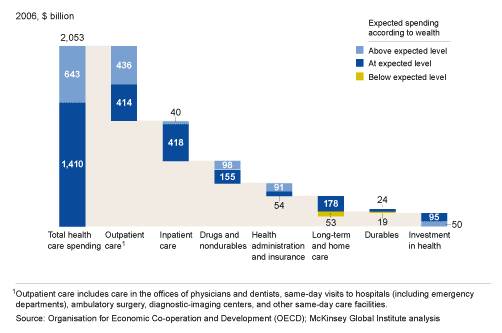
McKinsey research shows that the United States spends about $650 billion more than might be expected given its level of wealth and the experience of similar countries.

Here is a chart that breaks this down in a typically McKinsey framework (which I love BTW):

mckinsey-on-excess-hc-spending1

7 e-Patient Conclusions

Thanks to e-patient Dave’s reminder on the e-Patient blog

Here are 7 conclusions from the white paper that came out last year on this topic. Very important in diffusing some of the myths around the role of social networking in healthcare and the use of the Internet for information.

1. e-patients have become valuable contributors, and providers should recognize them as such.
“When clinicians acknowledge and support their patients’ role in self-management … they exhibit fewer symptoms, demonstrate better outcomes, and require less professional care.”

2. The art of empowering patients is trickier than we thought.
“We now know that empowering patients requires a change in their level of engagement, and in the absence of such changes, clinician-provided [information] has few, if any, positive effects.”

3. We have underestimated patients’ ability to provide useful online resources.
Fabulous story of the “best of the best” web sites for mental health, as determined by a doctor in that field, without knowing who runs them. Of the sixteen sites, it turned out that 10 were produced by patients, 5 by professionals, and 1 by a bunch of artists and researchers at Xerox PARC!

4. We have overestimated the hazards of imperfect online health information.
This one’s an eye-opener: in four years of looking for “death by googling,” even with a fifty-euro bounty for each reported death(!), researchers found only one possible case.

* “[But] the Institute of Medicine estimates the number of hospital deaths due to medical errors at 44,000 to 98,000 annually” … [and other researchers suggest more than twice as many]
* We can only conclude, tentatively, that adopting the traditional passive patient role … may be considerably more dangerous than attempting to learn about one’s medical condition on the Internet.” (emphasis added)

5. Whenever possible, healthcare should take place on the patient’s turf. (Don’t create a new platform they have to visit – take yourself wherever they’re already meeting online.)

6. Clinicians can no longer go it alone.

* Another eye-popper: “Over the past century, medical information has increased exponentially … but the capacity of the human brain has not. As Donald Lindberge, director of the National Library of Medicine, explains ‘If I read and memorized two medical journal articles every night, by the end of a year I’d be 400 years behind.”
* In contrast, when you or I have a desperate medical condition, we have all the time in the world to go deep and do every bit of research we can get our hands on. Think about that. What you expect of your doctor may shift – same for your interest in “participatory medicine.”

7. The most effective way to improve healthcare is to make it more collaborative.
“We cannot simply replace the old physician-centered model with a new patient-centered model… We must develop a new collaborative model that draws on the strengths of both systems. In the chapters that follow, we offer more suggestions on how we might accomplish this.”

Presentation Zen

presentation-zen-example
Have you read the book – Presentation Zen? If not, you can visit the blog to start to understand what Garr Reynolds talks about in his book. In general, one of the key points that I always try to relay to people is that slides are not your leave behind. Don’t put too much content on them. Don’t talk to them. Think about how to engage your audience in your story.

Take a look at a few of the slides he shares here. How does his presentation compare to your last presentations?

Walgreens Complete Care and Well-Being

Walgreens has just announced their offering to push into the on-site clinic market.  It is not completely new for them, but this is certainly a broader offering leveraging several assets they have acquired.

The program’s foundation is the pharmacy and health centers located on employer campuses or manufacturing facilities, along with Take Care’s in-store retail clinics and Walgreens nationwide pharmacies. Take Care’s employer health centers can offer complete pharmacy and health care services ranging from acute (e.g. strep throat) to primary care, occupational health, infusion services, specialty pharmacy, prescription mail services and disease management and are staffed by a combination of Walgreens clinicians including physicians, nurse practitioners, physician assistants, nurses, pharmacists and other health care professionals. Take Care Clinics, walk-in health care clinics open seven days a week and located at neighborhood Walgreens drugstores nationwide, are staffed by nurse practitioners and physician assistants who offer health care services built around a family’s needs.

I have always found this model to make a lot of sense, but it is hard to scale beyond massive employer sites.  In general, I think you have to have at least 1,000 people at one site to even begin to see this as a profitable investment (if I remember my analysis from years ago).

I am not really sure what the “all prices transparent to the employer” means in their press release.  Are they really going to reveal the acquisition cost of drugs?  The cost of their private label medications?  The cost of a clinic visit?  I am not sure that’s necessary.

Providing convenience without increasing costs should be enough.  Employees will love it.  Of course, I have heard that once you put it in that it is impossible to pull these out without very negative employee reaction.  And, I do believe that convenience (as it does with 90-day Rxs) can help improve adherence with mixed with the right education and counseling.

Follow-up On Physician’s Comments On PBMs

I talked about it in a few previous blog entries – Physicians versus PBMs and Physicians as Victims of System – and I am finally getting around to the source interview in AIS’s Drug Benefit News from October 31, 2008.

Here are a couple of additional thoughts after reading the entire interview with Toni Brayer:

  • She questions the value of PBMs (pharmacy benefit managers).
    • [It’s been well documented that PBMs can drive lower trend and have lowered prices.  This was well documented by third parties before PBMs were made central to the Medicare Part D benefit.  Additionally, reading any of the PBM trend reports will show you the money that can be saved by leveraging the trend programs that they offer.]
  • She talks about confusion between mail order pharmacies and PBMs.
    • [This is a good example of one thing that PBMs have driven which is mail order utilization which has driven down costs and allowed members to move from 30-day to 90-day prescriptions.  But, mail order is often a key component of the PBM offering.  People should think of them as two different entities – the PBM is focused on claims processing and the rules for benefit administration…the mail order is simply a pharmacy that uses automation to deliver medications to members from a centralized location.]
  • She says that PBMs contribute to the double digit increases in pharmacy costs that have occurred. 

    • [I think this has been disproven by many of the independent studies.  Additionally, the increases are driven by increased utilization, brand price increases, and new product introductions in most cases.  PBMs drive down reimbursement rates year-over-year, drive generic fill rates, and move members to lower cost channels such as mail order or specialty pharmacies.]
  • She talks about the hassle of PAs (prior authorizations).
    • [I completely understand the hassle here and am a little mixed in my opinion.  On the one hand, this is an effective trend management technique using evidence-based standards to manage inappropriate use of medications.  On the other hand, since in most cases, 95%+ of all PAs are approved (if the MD calls in), it does seem like an unnecessary burden.]
  • She also talks about confusion between brands and generics.
    • [This has become a bit of a challenge over the past few years as some branded products end up being cheaper than generics.  This has led to formulary tiers at a few companies reflecting more about drug price than brand versus generic.  And, I completely agree that physicians can’t be expected to understand formulary status…without electronic prescribing tools.]
  • She talks about pharmacies not automatically refilling prescriptions.
    • [I agree with her here with a few caveats.  Pharmacies should be reaching out to patients to remind them about refilling their medications.  They should be using a barrier survey to understand why they aren’t refilling and help them address these barriers or pushing them back to their physician when appropriate.  In my day job, this is definitely something that I talk with a lot of pharmacies (mail, retail, and specialty) about how to do this.]
  • She even talks about tamper-proof prescriptions being a hassle.
    • [In most cases, I think pharmacies offer patients either tamper-proof or standard prescription bottles as a choice.  Obviously the tamper-proof is to reduce the risk of children getting into medications and overdosing.  I don’t know the statistics, but I think it’s a legitimate concern.]
  • She compares pharmacies to the Department of Motor Vehicles.
    • [WOW!  I have certainly heard that some of the pharmacies in high density urban areas have ridiculous wait times, but I think this is a pretty bad slam.  The pharmacies that I go to take time to talk with the patients.  They are fairly quick on filling medications.  They use computer technology and automation to drive efficiencies.  We have a huge shortage of pharmacists in the US so there are some challenges.  That was one of the reasons I tried to go to market with a pharmacy kiosk solution.]
  • She says that she always considers cost when writing a prescription.
    • [This is great.  I know physicians generally do this for the medications they understand cost on…which are usually the outliers.  But, with over 10,000 medications on the market, I can’t imagine they can keep up with some of the idiocyncracies in the market.  Again, although I am not the biggest believer in electronic prescribing, this is one of the clear advantages here that it can show drug cost and member cost.]
  • She thinks that pharmacies are gouging patients by only dispensing 30-day supplies for chronic medications.
    • [This one I can talk about from several perspectives.  First, for new prescriptions, it is usually appropriate to only dispense 30-day prescriptions until the patient stabilizes on an Rx and strength.  Second, most patients have access to mail order where they can get a 90-day prescription…and some retailers offer this also.  Third, pharmacies generally make their money on the things people pick up while in the store…on many Rxs, pharmacy is a loss leader.  Fourth, to fix this issue, we would have to stabilize care so that only one insurer / employer paid since today people move around too much creating a disincentive to have one payor pay for a longer Rx only to have the patient leave before they use up their supply.  Fifth, since most people are non-compliant / non-adherent, there would be a lot of waste.]
  • She talks about hardly any medications costing under $40.
    • [Since most people have prescription drug coverage, this would only apply to 3rd tier drugs or specialty medications.  With all the $4 generics, patient assistance programs, and drug discount programs out there, patients don’t pay over $40 in many cases.  If she is talking about drug costs to the payor, then most brands certainly cost over $40 but that now represents just over 30% of all drugs dispensed.  I will let pharma make the arguement, but clearly the research required to bring a new drug to market justifies much of the cost.]
  • She suggests pricing brand drugs with no generic alternative lower.
    • [I am all for lowering healthcare costs and don’t think manufacturers should gouge patients, but in a capitalist society, why would I lower the cost of something that people need and have no alternative for?]

Sorry for the long rant, but there was soo much fun stuff to respond to in this interview…I never thought I would be a “defender” of the PBM model, but I really disagree with a lot of her comments.  PBMs do a lot of good things for clients and members even though they are in the “middle man” position.

Using Your FSA For Your Gym Membership

Maryland is working on a bill that will allow you to use your flexible spending account (i.e., pre-tax dollars) for things like gym memberships and sports equipment.  I am not sure I agree with the sports equipment since I could see a whole arbitrage opportunity of buying equipment with pre-tax dollars and then selling it on eBay.  But, I can see things like gym membership or even fees for a race qualifying.

I don’t have an opinion on the bill, but the concept sounds intriguing and sends the right message.

Views on Electronic Prescribing (eRx)

I worked on eRxing when I first joined Express Scripts back in 2001. At that time, it was a huge focus with the recent investment in RxHub with Medco and Caremark. Everybody was drawing these hockey stick projections on adoption.

So, what happened…

  • Physicians began to use the technology in limited numbers and most of them ended up with equipment that didn’t work or didn’t seem more efficient that writing a paper prescription.
  • Vendors came and went so there wasn’t much stability.
  • The technology focus shifted to EMRs (Electronic Medical Records) which might have some eRxing technology embedded in it.
  • According to one slide I saw at a recent conference, there are estimated to be about 22% of registered physicians with the technology by the end of 2008 and 10% who actively use it.

The problem was that there wasn’t much alignment of incentives. A problem that I don’t see getting solved anytime soon. There is some legislation now to help drive adoption. Physicians who use the technology can get bonus payments from CMS in 2009.

I am still a skeptic.

Let me provide some representative perspectives (as I see them):

  • Consumers:
    • Generally, very positive.
    • You mean my physician will route my prescription electronically to the pharmacy of my choice, and it should be ready for me to pick it up when I drive there in 20 minutes. That’s convenient. (Something made a lot easier when RxHub and Surescripts decided to combine efforts earlier this year.)
    • Less errors is a good thing. (The study To Err Is Human really began this focus several years ago and more recent estimates are that 1.5 million people are affected by pharmacy errors each year.)
    • Why is my physician staring at a computer when they should be talking to me.
    • If this was done electronically, why do I still show up at the pharmacy and find out my drug isn’t covered (or not on formulary). (About 40% of claims are blocked for some administrative or clinical reason today.)
  • Physicians:
    • If this is easy (and inexpensive), I am happy to use this.
    • Is this faster than just writing a prescription on a piece of paper?
    • How much additional revenue do I generate from CMS and what do I have to do to earn that?
    • Patients like to leave with a prescription in hand. (Something that was solved by creating a printed “receipt” while also sending it electronically to the pharmacy.)
    • Who’s going to support this when it goes down? (For a small practice or individual physician, there are no onsite IT resources.)
    • This doesn’t fit into my workflow. (A lot of this is a generational issue. Medical school students are used to using technology as part of the process.)
    • This is easy. I can write a macro that when I write for a certain diagnosis code it brings up my typical set of prescriptions. (The tech savvy physician’s response.)
    • I can’t remember all the different formularies (i.e., drug lists) so this will be a lot easier.
    • I get paid per visit so what will this do to increase my visits? (Even though they get hit with a lot of callbacks after prescribing, doctors don’t feel this pain today since it is handled by their staff.)
    • I hope there’s not a bunch of advertisements on this.
    • By telling me whether my patient is compliant with the prescription I gave them, you are giving me new insight. (This is a definite value add that I know companies like CVS Caremark are working on with their eRx solutions.)
  • PBMs:
    • If physicians actually use this, we can really manage trend at lower cost by pushing edits to the POP (point-of-prescribing).
    • What additional information can we provide the physician that will improve adherence? What will the consumer reaction be?
    • What additional information can we provide physicians about poly pharmacy or patients that get multiple prescriptions from different physicians? Who should take action on this?
    • How much will the physician do with the patient sitting right there? Will they check formulary status? Will they switch drugs if there is a step therapy or prior authorization required? Will they take the patient’s credit card down to send the prescription to mail order? Will they take care of the edits (I.e., Drug Utilization Review…drug-drug interactions) that the pharmacy does today?
  • Pharmacies:
    • Will we get clean prescriptions (i.e., no additional work required other than filling it)?
    • How do we let the patient know when to expect the prescription to be ready for pick-up? (This can vary from 10 minutes to ½ a day depending on how busy the pharmacy is.)
    • How will we handle a new patient where we need billing information and allergy data?
    • How does that change our job as a pharmacist? Are we relegated to simply filling Rxs and no longer helping the patient manage their benefit?
  • Pharma Companies:
    • Will PBMs and their clients (managed care plans, unions, government entities, employers, TPAs) be willing to adopt more aggressive plan designs that defeat our detailing and marketing efforts?
    • How does this change the importance of formulary positioning and rebating?
    • How does this change our marketing strategies? (There are a lot of bright people in this industry so it’s not going away.)
    • If they physicians really use these, can we push advertisements (or let’s call them virtual detailing sessions) to the device (PDA, computer)?
  • Other:
    • Can you believe the errors in the industry? This will fix everything.
    • Why won’t someone want to adopt this technology?

Nothing is ever simple. This is a case of great intentions with lots of money and expertise being spent to solve the problem. But, aligning incentives and changing behavior is hard.

Will it happen? Yes.

Let’s put it this way…if it takes over 15 years for best practices in medicine to be adopted, how long will it take for this to be adopted?

Design For Six Sigma (DFSS)

Getting it right from the start is always a critical issue when designing process-based solutions.  DFSS or Design For Six Sigma is an approach that companies are starting to use in applying the rigors of Six Sigma to their product management approach.  This allows them to leverage proven fundamentals using a DMAIC framework.  (DMAIC = Design, Measure, Analyze, Improve, Control)

DFSS is built around a couple of Six Sigma fundamentals such as the VOC (Voice of the Customer) and the CTQ (Critical to Quality) framework (example.  Understanding root cause of issues in your process allows you to start finding solutions for them.

And, however you approach this, it is critical to understand your value stream (i.e., where is value created) and have a statistically valid approach for capturing data and rigorously reviewing and improving the process (i.e., continuous improvement).

The other thing that all this Six Sigma talk makes me think of is an automation of process which can be seen in a lot of the BPMS (Business Process Management Systems) which exist.  These process based applications can be created as flexible tools that sit above (i.e., abstracted from your legacy systems) to run using an event-based architecture (i.e., data triggers) or SOA (service oriented architecture).

Why do you care as a member or patient reading this? Because you hate things that don’t flow smoothly.  This approach is supposed to begin with the customer, understand their needs, develop a process with minimal potential quality or failure points, measure and continuously improve the process, and then automate the process with the flexibility of making dynamic changes as the needs and market changes.

Why do you care as a healthcare enterprise? Quality is always an issue.  As the economic times squeeze everyone, it is going to be critical to find efficient ways of improving processes and automating processes to drive better results without sacrificing quality.

Joining The Board of Advisors at CareFlash

After learning more about CareFlash, I was excited to have the opportunity to join the Board of Advisors.  You can learn more about the company below, but what struck me was the examples of how this could be used by a family dealing with a complex medical situation where they needed help from their community of friends.  After seeing several families with kids in the ICU for prolong periods of time, I can only imagine their challenge in keeping everyone up to date on their child’s condition and seeking out help with errands without being overwhelmed.  CareFlash offers a simple, Health 2.0 type approach to solving that problem using blogging, a shared calendar, and 3D annimation of medical conditions. (See a video tour here.)

We deliver unprecedented healthcare advocacy and world class education to people in the richest circumstances imaginable, while offering unique philanthropic benefits to healthcare-related foundations, advocacy groups, religious institutions, etc. What CareFlash does is unique and unprecedented… and free.

When someone learns that they (or their loved one) have been diagnosed with a chronic healthcare challenge, a flurry of painful emotions appear ranging from fear and feelings of aloneness, to anxiety, uncertainty and even depression. As families begin the process of navigating through this experience together, it commonly becomes clear that people are unprepared and inexperienced at the realities of serving as a caretaker. CareFlash addresses these challenges, empowering our users to do the following:

Establish private and secure online communities around a loved one in order to share and facilitate updates, discussions and well-wishes

  • Update friends, family, coworkers and congregants through a ‘many-to-many’ communication tool. CareFlash streamlines the sharing of updates and well wishes
  • Educate the patient, caretaker and community on the specific disorder and treatment options at hand, using easy to understand 3-D medical animations narrated in plain everyday English, Spanish and other languages.  They range from pregnancy and neonatal issues to cancer, cardiovascular, ears/eyes, neurological, genetic, bladder/kidney, digestive/mouth, endocrine, blood/immune, respiratory, orthopedic, skin/cosmetic and hundreds of others.
  • Engage and organize involvement where help is needed… doing so in an unobtrusive, non-confrontational way through our easy-to-use iHelp Calendar
  • This is all offered to our users for free because our revenues are derived from advertising

In addition, CareFlash delivers unique philanthropic benefits to healthcare-related foundations and institutions, advocacy groups and religious institutions via alliance partnerships that provide them fundraising and marketing… never at any cost to them.

Another more lighthearted video about CareFlash is below.

This is a free service so I would encourage you to consider recommending this to families you know who could leverage this technology approach.  It is also a great tool for alumni groups (e.g., colleges, large institutions) or organizations who deal with families or patients to promote (e.g., specialty pharmacies).

Who’s Responsible For Healthcare Costs?

I was recently at the AHIP Business Forum Chicago and was in a session where Amy Holmes, CNN Political Analyst and Peter Beinart, Editor-at-Large of The New Republic held a discussion on Decision 2008 and What it Means for the Future of Health Care.  They are two of the sharpest people I have seen speak in a while and they hosted a very engaging discussion on the issues and what the Obama win means for healthcare from both sides of the political spectrum.  (They also had a very entertaining “He Said, She Said” style that captivated the audience.)

The big changes they felt were bound to happen were cuts in Medicare and an expansion of the SCHIP program, and there were others that they said would be debated including being able to sell insurance across state lines, the government offering coverage, individual coverage mandates and coverage for pre-existing conditions.  But the biggest part of the discussion was around healthcare costs.  Costs that are out of control, who pays for services, and where will the money come from.  While at an aggregate level talking about healthcare’s spiraling costs is simple, it is not the heart of the issue.

Isn’t the issue about how as an industry we get individuals to change their behaviors?

The most powerful force for changing the economics of healthcare is the healthcare consumer.  If the consumer changes behavior (even small changes) there are billion dollar impacts in cost.  Our research shows that if a plan the size of Aetna is able to improve adherence by 1% they could save $238M!  According to the Journal of Occupational and Environmental Medicine (JOEM), 70% of all healthcare expenses are lifestyle related.  This is not a new number but it translates to $1.4 trillion in healthcare costs that could be controlled simply by modifying healthcare behaviors. 

So if our lifestyles are “killing us” and destroying a system meant to improve our quality/length of life, why are we not talking about that at the national level as THE core issue?  How can we as industry professionals develop solutions that support consumers and facilitate the changes they need to make?

I was excited to see in the third Presidential debate that both candidates addressed responsibility being in the hands of the individual.  Next steps:  Let’s see some discussion on programs and policies that truly look to impact healthcare consumer behaviors.

(This is a guest post from Chuck Eberl, VP of Marketing, at Silverlink Communications.)

Off Label Drug Use

Once a drug is approved, it can be prescribed by physicians for any reason.  Those reasons can include conditions that were not studied by the manufacturer in the clinical trials.  And, those off-label uses are not things that can be marketed to the physican.

Some of this is controlled by prior authorizations (PAs) which require a physician to call into the managed care company or the pharmacy benefit management (PBM) company to justify the use of the medication.  This is often used on high cost medications with a high percentage of off-label prescribing.

For example, it is estimated that 76% of the prescriptions writen for Seroquel are for off-lable purposes.  (See article on this and other information here.)  This article also lays out the top drugs that are used off-label.

  • Bupropion (Wellbutrin) approved for depression, commonly used off-label for bipolar diaorder.
  • Sertraline (Zoloft) approved for depression, commonly used off-label for bipolar disorder.
  • Venlafaxine (Effexor) approved for depression, commonly used off-label for bipolar disorder.
  • Celecoxib (Celebrex) approved for joint sprain/strain, used off-label for fibromatosis — soft tissue tumors.
  • Lisinopril (Prinivil, Zestril) approved to treat high blood pressure, used off-label for coronary artery disease.
  • Duloxetine (Cymbalta) approved to treat depression, used off-label for anxiety.
  • Trazodone (Desyrel) approved to treat depression, used off-label for sleep disturbance.
  • Olanzapine (Zyprexa) approved to treat schizophrenia, used off-label for depression.
  • Epoetin alfa (Procrit, Epogen) approved to treat chronic renal failure, used off-label for anemia from chronic disease.

MD Rating Sites

(Getting a few things out here and off my desk)

This is a question I often wonder about.  I was glad to see that e-patients put a report online.  I haven’t read it yet, but I think it is something that many of you would want to know.

I think that the main issue Given hit upon in the report (but I’m not sure she recognizes as the primary challenge of doctor rating sites) is the numbers issue. With over 700,000 physicians in the U.S., a ratings database of 10,000 or even 20,000 is pitifully and woefully small.

Physicians Vs PBMs?

I shared one of Toni’s quotes the other day and have some follow-up information that she sent me.  I will have to try and read it and share later today.  In the meantime, I saw this quote this morning from the same interview that she gave.

PBMs would love to move toward some standards that the physicians had access to.  That is the whole objective of electronic prescribing.  Every time the physician chose a drug, it would tell them if it was on formulary; if there were drug interactions; if there were coverage issues; and what the copay was.  I am not sure most physicians want this.  This would push a lot of work into their already abreviated office visits.

Additionally, I am not sure it is all the PBMs issue.  Everyone has different perspectives on cost, drug coverage, benefit design, etc.  I don’t think we will get to a common benefit design in this country that would simplify the PBM’s job.  Customization is the number one driver of cost within the PBM.  It causes huge IT issues.  It causes huge training issues.  It requires all kinds of inefficiency.

I am not sure that Toni and the PBMs are far off in what they want, but the reality of implementing it is a long way off.

“Physicians deal with too many health plans and numerous PBMs, and from our view they have no consistency. We have no way of knowing the various protocols and regulations they operate with, and new product designs make it impossible to keep up. Formularies are cumbersome and change all the time, and it is unclear who controls the formulary. It appears that formularies are based on [achieving] optimal revenue, not evidence-based. The goal should be to reduce hassles for primary care physicians and lower costs to patients and purchasers of health care. Health plans and PBMs are seen as the problem, not the solution.”

— Toni Brayer, M.D., who has practiced internal medicine in San Francisco for more than 20 years, has served as president of the S.F. Medical Society, and is chief of staff at California Pacific Medical Center, told AIS’s Drug Benefit News.

An Example of Being Overmedicated

We all know that people have a lot of prescriptions.  Here is an interesting story about one individual and the process that her family went through to do essentially Medication Therapy Management (MTM) and find out the right mix of drugs.  I don’t know the person recommended in the story, but I certainly recommend making sure your physician and especially your pharmacist know all your drugs and talk with you to see about potentially having too many prescriptions (especially once you are above 10 different medications).

Each added prescription increases the likelihood not only of a problematic interaction but also of misuse. Studies show that half of older people sometimes fail to follow their Rx instructions. It’s no wonder. Consider my mom’s regimen: She took 32 pills a day, at five different times—some once a day, some twice, some three times, and some as needed. One pill had to be split in half for the morning dose but not for the evening dose. Some were taken with food, others on an empty stomach. She also used three different asthma inhalers plus a nebulizer, all on different schedules. I’m half her age, and I couldn’t keep that straight.

Today Show On Saving Money On Healthcare

Interested in seeing a clip from the Today Show on saving money – here it is[Sorry…you have to listen to a short advertisement first.  But, you should see a large video in the top right which will play a commercial and then bring up the interview of an executive from AARP.]

More On The Economic Impact On Healthcare

Deloitte just published the results of a survey they did which continues to hammer home the issue of how today’s economic times are affecting people’s health behaviors.  I am just getting ready to do my webinar on this.

Here are some of the results from Deloitte:

  • Only 6 percent of Americans surveyed believe their family is completely prepared to handle future health care costs.
  • More than half of respondents surveyed said that reducing costs (67 percent), increasing access (56 percent) and improving quality (57 percent) of health care are issues that are important to them in selecting a president.
  • Of the survey respondents who reported delaying or skipping care in the past 12 months, 27 percent said they did so because they could not afford the cost.
  • Nearly half (47 percent) said their household’s spending on health care products and services has increased during the past 12 months, and 63 percent said it limits their spending on other essentials.
  • Twenty-two percent said they have an outstanding medical bill that is more than 90 days past due.

So, I guess the question is “What are you doing for your members?”:

  • Are you helping them understand how to save money?
  • Are you encouraging them to stay compliant with their medications to avoid complications?
  • Are you encouraging them to be preventative (e.g., flu shot) to avoid ER visits?
  • Are you providing them with timely guidance on when to use Over-the-Counter (OTC) medications versus prescriptions?
  • Are you helping them split medications?
  • Are you moving them to mail order?
  • Are you encouraging 90-day prescriptions?
  • Are you offering them incentives for being healthy or managing their health – coupons, points?

We are seeing a lot more interest from members in this information.  They don’t know what they can do, but they want to do something.

Of course, the challenge is setting up these programs, personalizing the messaging, and getting results.  For those of you interested in these programs, contact me.  We have had some great results offering these as a turnkey service and driving the success rates up dramatically.  [2-5x improvement in 5 weeks]

No More “Robo-Calls”

This is a phrase you have probably heard several times this election period.  Somedays I think the same thing when I get 5-6 a day mostly from the Obama campaign.  It reminds me of some education I do with a lot of companies on the technology evolution around outbound calling.  Let me hit a few key points here.

First, everyone across industries is trying to figure out how to improve their access to customers (members).  How do they keep them up to date with relevant information in a timely, efficient, and effective manner.  Direct mail is a dying strategy.  E-mail is good sometimes, but you can’t push sensitive health information out via e-mail.  Text messaging has a role, but it’s not relevant for everyone.  So, automated calling has become a first-line solution rather than using call center representatives which are expensive (or more often as a complement to the call center representative making them more efficient).

Historically, call center representatives would “smile and dial” just trying to catch someone at home.  You might get lucky, but in most cases, you call 5-10 times just to get a person on the phone to talk with.  It’s not a good use of resources and time.

The next evolution was the dialer technology which calls out to people and once it hears a voice, it transfers the respondent to a call center agent.  But, the voice could be an answering machine in some cases or in many cases it might not be the right person.  These are the annoying calls you get where there is a delay after you say hello and before the person at the other end responds.  The technology is searching for an agent that’s not on the phone to connect you with.

People realized that using agents to call out wasn’t always necessary so they moved to “blast” or “robo-calls”.  These are non-intelligent calls that simply push a message out to someone.  As soon as you say hello, they start playing a recorded message and likely repeat it at the end in case it’s an answering machine they are “talking” to.  There is no interaction and no personalization.

But, that technology too has evolved.  You can now place highly personalized and interactive calls that leverage speech recognition technology.  The calls use your name and ask you to confirm that they are speaking with the right person.  The calls use the name of the company calling and potentially your employer.  The calls can also provide personalized information such as the drug you are taking or the health condition you have.  The voice is a recorded voice not a text-to-speech (TTS) solution.

The calls respond differently based on how you answer certain questions – i.e., different paths are dynamically generated.  And, the calls start to interact with other modes of communication – would you like to transfer to an agent to talk further?, would you like a copy of this offer sent to you in a letter or e-mail?, would you like a reminder sent to you as a text message?, or would you like us to fax your physician to get a new prescription for you?

The technology focuses on the interaction with the consumer and making it a pleasant experience.  In healthcare, people respond to this technology because of several factors:

  • It’s highly personalized to them.
  • It’s coming from a company they trust – their health insurer or pharmacy.
  • It’s interactive and conversational.
  • It’s important information – refill reminder, savings information, benefit change.
  • They have to authenticate themselves in order to receive sensitive information.
  • It adapts to them (e.g., please call me for future calls in the morning).
  • It offers them an opportunity to talk to an agent by transferring.

Now, I would say most companies are evolving from individual campaigns using different modes of communication (letter vs. calls) to an integrated communication strategy which has common messaging and is based on consumer preferences.  This approach allows for even better results and continues to drive personalization and customization based on historical learning and experiences with the individual.

But, mass customization does require technology and analysis.  Pulling in different data elements and looking at how to best deliver a message and get someone to listen and take action is complex work.  But, it’s a lot of fun watching success and outcomes improve as you move across the continuum.