Archive | Value Propositions RSS feed for this section

Highlights From The Prime Therapeutics Drug Trend Report

It’s been a busy year, and I’m getting a late start on reviewing the drug trend reports as I’ve done in the past. I’ll try to get to the CVS Caremark and Express Scripts reports next week.

As I mentioned last year, the Prime Therapeutics Drug Trend Report takes a more aggressive stand and how they compare to the competition. I’ll give a lot of that credit to Eric Elliot’s presence there as the CEO.

“Smart car buyers know that the actual cost of a car does not always align with the price on the window; the same is true for pharmacy benefits. Yet plan sponsors continually focus on “sticker price” measures such as brand-name discounts or manufacturer rebates — metrics that can be manipulated to make a deal look more attractive.”

The one thing which is noticeably different this year is that the document has more of a care management sound to some of the programs they talk about with an emphasis on total healthcare cost savings. Again, I attribute that to both being owned by the Blues and having several people in the management team that came from payers. Buried towards the back, they call themselves “total health focused” versus their competitors.

As always, here’s a few things that caught my attention:

  • A $4.73:$1 ROI for using the local pharmacist to address gaps-in-care.
  • 1.3% trend increase.
  • 74.7% generic fill rate.
  • 20.1% specialty trend increase.
  • 15.4% of client’s pharmacy spend is for specialty drugs which cost on average $2,654.
  • 0.4% of Rx claims processed are for specialty drugs.
  • Their Rxs PMPY have gone up to 12.4 which I think is closer to industry.
    • This is an interesting one. I pointed out a few years ago that they were below average which I wasn’t sure if this was due to plan design, member mix, or client mix.
    • They seem to be going up even though some industry data suggests a downturn in Rxs filled which again is something I can’t explain.
    • It could simply be more people >50 years old are staying in the insured mix…and they use more drugs.
  • Their average net costs per Rx were:
    • $165.33 brand
    • $17.95 generic
    • $57.53 combined
  • They breakdown specialty spend by category and also show how it’s growing and is projected to grow as a percentage of total drug spend.
  • Of course, another big piece of the specialty picture is how the spend breaks out between medical and pharmacy benefits. This is why blending data to understand the complete picture is important.
  • I thought the list of specialty drug management tools was a good starting point although I expected to see more here about how to integrate with the payers especially around categories like oncology and what BCBS of Florida is doing around an oncology ACO solution.


McKinsey Quarterly On B2B Social Media

The recent McKinsey Quarterly had an article called Demystifying Social Media which I thought was a good read with a good framework to use (see below). 

In short, today’s chief executive can no longer treat social media as a side activity run solely by managers in marketing or public relations. It’s much more than simply another form of paid marketing, and it demands more too: a clear framework to help CEOs and other top executives evaluate investments in it, a plan for building support infrastructure, and performance-management systems to help leaders smartly scale their social presence. Companies that have these three elements in place can create critical new brand assets (such as content from customers or insights from their feedback), open up new channels for interactions (Twitter-based customer service, Facebook news feeds), and completely reposition a brand through the way its employees interact with customers or other parties.


NY Law On Soda Is Simply A Nudge To Be Healthy

I know we can all complain about the government telling us what to do, but at the end of the day, they’re not saying we can’t drink soda.  As far as I know, you can still have unlimited refills in NY.  They are simply reframing one aspect of drinking soda to try to nudge us into being healthier.  Ultimately, this should be a good thing for us for several reasons.

  1. We eat or drink whatever is put in front of us.  Just look at this research.
  2. Soda and other sugary drinks are generally not good for us.  Just look at the infographic below.
  3. We have an obesity problem in this country (in case you didn’t know it).
  4. Obesity drives diabetes, kidney problems, hypertension, and many other problems that are driving up our healthcare costs and turning us into the first generation to potentially live shorter lives than our parents.
  5. Nudging people into behavior change works.

A Few Basics On Health Risk Assessments

Like many of you, I’ve heard a lot about HRAs (Health Risk Assessments) for years.  A few times I’ve even taken them.  And, depending on your employer, you may even get paid to complete one.  But, what are the basics about HRAs that you should know?

  1. What is a HRA?  An HRA is a series of questions that can be administered over the Internet or by the phone or by a nurse to help collect patient reported data to help screen patients for chronic conditions or risk of developing a chronic condition based on their behaviors or other data.  Additionally, they often lead to either immediate feedback on behaviors to address or lead to the patient being engaged into a program with a wellness, disease management, or case management. 
  2. Should employees be incented to take an HRA?  Incentives are basically used to increase response rates to the HRA.  Not surprisingly, several studies show that incentives work, but education about the need to take the HRA is also important.  In some cases, employers are even linking participation to premiums.  Additionally, here’s a list of the top incentives used based on a 2010 study. 
  3. How should an HRA be used?  An HRA is a key component of an overall care management strategy.  Like claims analysis, the objective of the HRA is a screening mechanism to identify patients who should be included in wellness, disease management, or care management program. 
  4. Are HRAs valuable?  There have been studies over the years that have shown a 2:1 or 3:1 ROI for wellness programs and a ROI for case management.  HRAs are valuable in identifying more patients who should be enrolled in these programs. 
  5. Should you combine biometrics with HRAs?  Here’s a good study that shows that blending lab work with HRA data significantly increases the likelihood of identifying patients with diseases especially kidney disease. 

Of course, no HRA is valuable if:

  • You can’t get enough members to actually take the HRA.
  • You don’t have an engagement strategy to get the members to participate in the program.
  • You don’t continue to follow-up and help the member manage their condition.
  • The member doesn’t get engaged in their healthcare. 

Will The GAO Doom Medicare Star Ratings?

I’ve talked about the Medicare Star Ratings several times before.  This is a critical framework for beginning the shift in payment from a fee-for-service world to a outcomes based system.  I’m sure there are many issues with it, but being in the trenches, I certainly noticed that many companies began to look differently at programs over the past 18 months.  So, from an attention getter, it worked.

We all know rates were getting cut in Medicare so this shifted some of that pain to make companies focus on what matters in terms of quality and outcomes.

Now, the GAO has put out a report that questions whether the expansion of the Star program to include 3 Star plans was a good idea.  (see Gorman’s comments here)  I think this is a fair question.  Should we reward mediocrity?  I think there are ways to do this.

  1. You could pay 3 and 3.5 star programs but only if they show improvement year-over-year.
  2. You could lower the payments or only reimburse them for investments made (i.e., no profit).
  3. You could do it for one year then move the line up to 3.5 stars and then move it to 4 stars to give plans some time to implement, learn, and improve.

Right now, very few plans earn 5 stars, but dropping it to include 3-star plans makes almost 90% of plans get bonuses.  Maybe this is a case for some time of GE program where the top 10% get the biggest bonus; the bottom 10% have to stop offering a program; and the remaining funds get divided up based on some time of rating system.

The key here is not to throw the baby out with the bathwater.  The framework is good.  It’s taking time to understand the program, implement changes, and see an impact.  But, let’s not reward people that can’t continue to innovate and improve and do it in a way that rewards members based on outcomes and satisfaction.

Discussing Oncology Prevention With Dr. Hawk From MD Anderson #WHCC12

Last week, I had a chance to sit down with Dr. Hawk right after his presentation at the World Health Care Congress (WHCC). Dr. Hawk is the Vice-President and Division Head for Cancer Prevention and Population Sciences at the University of Texas M. D. Anderson Cancer Center. He’s been there since late 2007 when he came from the National Cancer Institute.

My favorite point from talking to him was…

Cancer is a process not an event. Communication is critical.

In his presentation, he talked about several things:

So, after his formal presentation, we talked about several things.

  1. One of the big focus areas for MD Anderson is prevention. As we know from research, many cancers are preventable. And, the promise of personalize medicine and genetic testing is beginning to help us understand these cancers and their treatments even more.
    1. Primary – this would include lifestyle changes such as diet and smoking which help prevent the disease
    2. Secondary – this would include screening and detection to help slow the progression of the disease
    3. Tertiary – this would include the focus on the patient (not the tumor) for treatment and helping them with quality of life
  2. He talked about how cancer is really 200 different diseases to be understood and managed.
  3. He gave a great analogy about how CVD (cardio-vascular disease) evolved and talked about how all the individual risk factors became asymptomatic diseases which have led to all the “know your number” campaigns around lipids and blood pressure.
  4. We talked about cancer as a process which led us into the discussion about palliative care and shared decision making. He made another good analogy here about driving a car. We need to understand the value of wearing our seat belt and having insurance, but we have to make the final decision about whether to do that or not.
  5. We talked about personalized medicine including genomics and epigenetics. We talked about how this impacts dosing and understanding of the tumor. (Interesting in a conversation with another person in this field this week they were telling me about how tumors and viruses change over time and those implications on genetic test results.) We also talked about SNPs and the complications in getting validation in studies due to sample sizes. We wrapped up this topic with discussions on coordinated registries and work that companies like 23andMe are doing.
  6. Our final topic of discussion was around clinical practice algorithms and how evidence-based medicine (EBM) gets implemented. We talked about the use of guidelines and how those allow for monitoring the use of EBM standards. We also talked about the need for integrated EMRs that would allow for benchmarking and linking outcomes to use of guidelines.

This is a fascinating area. Cancer affects most of us either directly or through some family member or friend.

Costs Of Presenteeism and Absenteeism

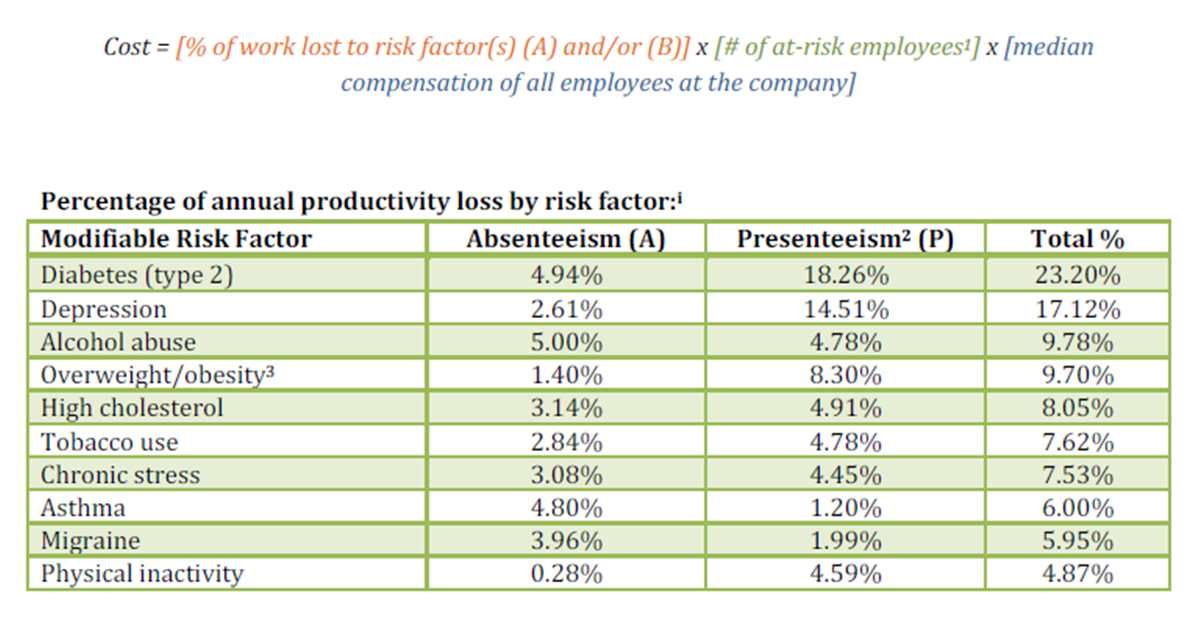
At the World Health Care Congress (WHCC), one of the presenters was making a great case for why employers want to continue to be involved in healthcare.  Their point was that the costs of presenteeism and absenteeism are significant and make health a bigger issue than simply the obvious medical and pharmacy claims costs.  (In one study, presenteeism costs alone were more than medical costs.)

While absenteeism costs are obvious as in sick days paid out, presenteeism is harder to estimate but can have significant costs.  Presenteeism occurs when people come to work sick and are not productive.

I’m sure there are numerous methodologies out there, but I found this one that seemed simple and gave me some data by condition on both factors.

Infographic: Decoding Your Medical Bills

Here’s a great infographic on costs.  This is another reason why you need a company monitoring your claims for cost savings opportunities and working with patients and physicians to implement evidence-based medicine and route patients to centers of excellence (better outcomes for lower costs).

Decoding Your Medical Bills
Created by: MedicalBillingAndCodingCertification.net

Eating Chocolate = Lower BMI!

Here’s a study that all of us with a sweet tooth should love…

In Time (4/9/12), they say:

Eating chocolate five or more times a week on a regular basis can translate to a one point drop in BMI on average, compared with those that don’t eat it.

It sounds too good to be true, but apparently chocolate can help the body absorb fewer calories from fat.

See the full study here.

(My question is why don’t I hear these messages from my health plan.)

And, for those of you that like salty snacks instead, the same page in Time talks about the fact that popcorn has more polyphenols by weight than fruits and vegetables. (Polyphenols can neutralize cancer causing free radicals.)

Changing Marketing Paradigms

Traditionally, consumer marketing has focused on the “young invincibles” as they are sometimes referred to in healthcare. Those are the 18-34 year olds that traditionally were the DINKs (dual income no kids) and younger population with more disposable income or focused on acquiring goods (as they bought homes and started careers).

Well, I think this quote by Sunil Gupta summarizes the issue:

If [young adults] have no money in their pockets, there is nothing to sell them.

With 46% of those age 18-24 unemployed and 20% of those 25-34 living at home, this group’s financial dynamics are very different. The focus on both those with money and those driving the healthcare costs have shifted to Baby Boomers. (Facts from Time article on page 16 in the 4/9/12 edition.)

At the same time, I read an article about marketing to women which continue to make majority of healthcare decisions both for themselves and their families. (and caregivers (often women) are less likely to be adherent to their own medications.)  Here were the recommended approaches:

  • Offer highly personalized formats
  • Provide complete anonymity
  • Eliminate the middle man
  • Understand self-perceptions
  • Consider the unique point of sale

And, some of these changes are driven by the economy. For example, according to NCH Marketing and Parks Associates, 81% of people are using coupons regularly and they redeemed them for 3.5B in 2011. (Of course, the jury is still out on the Groupon model…)

Some Facts On Palliative Care

In the book called Healthcare in 2020 by Steve Jacob, there is a chapter on End-of-Life Care. It provides some great data all sourced there (so not repeated here). I find this whole are of discussion especially around palliative care very interesting.

First, let’s define palliative care:

Palliative care (from Latin palliare, to cloak) is an area of healthcare that focuses on relieving and preventing the suffering of patients. Unlike hospice care, palliative medicine is appropriate for patients in all disease stages, including those undergoing treatment for curable illnesses and those living with chronic diseases, as well as patients who are nearing the end of life. Palliative medicine utilizes a multidisciplinary approach to patient care, relying on input from physicians, pharmacists, nurses, chaplains, social workers, psychologists, and other allied health professionals in formulating a plan of care to relieve suffering in all areas of a patient’s life. This multidisciplinary approach allows the palliative care team to address physical, emotional, spiritual, and social concerns that arise with advanced illness. (from Wikipedia)

The challenge of course is that most people don’t want to talk about dying, and physicians are taught to try everything to cure someone. After talking with a few people working in this area, the general scenario is where clinicians and other social workers are helping to enable to a patient to talk to their family and care team about their wishes. It’s not to make the decisions, but to give patients the tools to have an informed discussion.

Here were some of the interesting things from this chapter in the book:

  • Less that ¼ of physicians were familiar with the term in a survey
  • The American Society of Clinical Oncology has established a goal of integrating palliative care into its model of comprehensive cancer care by 2020.
  • A 2009 study of cancer patients found that palliative care improved patient satisfaction and eased pain, fatigue, nausea, insomnia, anxiety, and depression. And, increased appetite.
  • According to the Worldwide Palliative Care Alliance, more than 100M people worldwide would benefit annually from either palliative care or hospice…yet only 8% have access to it.
  • The average physician’s estimate of how long a patient will live was 530% too high.
  • Fewer than 40% of oncologists speak candidly with patients about end-of-life treatments.
  • Physicians equate suggesting hospice as “giving up”.
  • A 2008 published study showed that patient satisfaction was higher, more advance directives were completed, fewer ICU admissions were necessary, and medical costs were lower for patients in palliative care.
  • Patients with lung cancer that received palliative care lived 3 months longer than those with standard care (which compares to only getting 2-3 months of life from chemotherapy). [BTW – 1 in 5 cancer patients are still receiving chemotherapy in the last two weeks of life.]
  • A hospitalized palliative-care patient costs $279-$374 less per day.
  • In a Medicare study, patients who received palliative care cost $6,900 less during a hospital stay.

This seems like great data. Imagine that you can improve a patient’s experience in the last months of life and lower costs. To me, that’s a lot of what our healthcare system needs these days.

Employee Wellness Matters

If you look at the infographic below, it paints a sad picture of how work impacts our healthcare.  At the same time, we have lots of discussion about the benefits (or lack of) for disease management and wellness programs.

I think its critical for employers to play a role in helping engage and educate their employees about health and wellness.  I think this interview with MemorialCare Health System paints a good picture of why and how to approach this.

A University of Michigan study revealed health costs for a high-risk worker is three times that of a low-risk employee. American Institute of Preventive Medicine reports 87.5 percent of health claim costs are due to lifestyle. Companies implementing wellness activities save from $3.48 to $5.42 for every dollar spent and reduce absences 30 percent.

Work Is Murder
Created by: Online University

NACDS on George Paz Quote

Apparently George Paz, the CEO of Express Scripts, had the following quote the other day that has upset NACDS:

“At the end of the day … Nexium is Nexium, Lipitor is Lipitor, drugs are drugs, and it shouldn’t matter that much who’s counting to 30.”

Are you offended by this quote? If I reverse this, then I guess it doesn’t matter which specialty pharmacy a patient uses, but we all know that pharmacy is a lot more than pill counting (or should be).

I’ve talked about my vision of the future before which is where pharmacists can leverage technology more for prepackaged drugs (especially with low cost oral solids) and long-term patients while their expertise is leveraged in counseling and helping patients understand their drugs and conditions. This is crucial to the healthcare system.

So, while I can exploit the quote to drive an emotional response, isn’t the point that counting doesn’t matter but delivery of the medication and interaction with the patient does matter?

Bad Pitch

I was just reading an email pitch that I received from a healthcare social networking vendor talking about their system for engaging patients and physicians.

Maybe, it’s just me but that seems to imply some understanding of how to engage people and use social media. First, they didn’t use my name in the email. It just said “Hi ,”. Then, at no point in the pitch did they say anything about why they reached out to me. And finally, they then asked me to tweet specific pre-formatted tweets that they had created. If I wanted that, I would follow them and do a RT.

And to top it off, they don’t offer a way to follow-up to learn more. It was just shameless self-promotion. #Fail

My PCMA Presentation On Copay Cards

I’m giving my PCMA presentation in FL right now about copay cards. For those of you that can’t attend, here is my executive summary and a copy of some slides. (My actual slide deck was shorter for presentation but this gives more data to those of you looking online.)

I focused on three key points:

  1. Copay cards are a direct threat to the PBM model. They can run against the idea of copay differentials and formulary tiers. Since they’re not allowed at mail order, they create a disconnect there. And, eventually, I believe they will be in conflict with rebates (i.e., why pay for both).
  2. The cost numbers to the payer are huge ($32B according to Visante) although this is less than $1 per Rx over that 10 year time period. But, it’s concentrated on 3% of all scripts which makes it a big deal.
  3. There should be a win-win IF they are concentrated on specialty medications with a link to improved adherence and health outcomes.

There doesn’t seem to be clear data (although another article says it is available) but the general data shows that availability and use of copay cards is growing rapidly.

Investing in copay cards seems to be based on four myths:

  1. Cost is a large issue in non-adherence. It’s an issue but not the dominant issue.
  2. Costs will influence physician choice. The reality is that they don’t know the costs and see this as a pharmacist issue.
  3. Copay cards are a cost effective way to improve adherence. They get about a 10% improvement in MPR which sometimes produces a positive ROI. There are much lower cost ways to get a similar improvement.
  4. Copay cards can delay conversion to generics. This is still in the air with the Pfizer Lipitor program, but if it works, it will be a lightning rod for PBMs and payers to focus on.

This topic’s not going away. For now, the easy PBM response is to close down the formulary, move more scripts to mail, and implement prior authorization programs. I would expect this will happen more often unless there is more transparency here around what’s happening and the benefits. Things like ZQuiet can, indeed, help one to stop snoring when used correctly.

Reading Labels; Understanding Side Effects

We all know people don’t read labels on their medications or their over-the-counter (OTC) pills. If they did, their eyes would gloss over, and they would start to worry about all the side effects. Of course, this is a problem since some things can create drug-drug interactions or create an overdose.

I was reading an article in USA Today called “Read the labels because ‘all drugs have side effects’“. It lists out Tylenol, Advil, Motrin, Benadryl, Claritin, and Zantac as examples of OTC medications with overdose risks. It gives more details on these and provides several other examples. Here’s a quote from the article:

“It’s important for the public to realize that all drugs have side effects. It doesn’t matter if they’re prescription, over-the-counter, herbals or nutritional supplements. If they have active ingredients, they have side effects and can interfere with normal body functions.” Brian Strom, director of the Center for Clinical Epidemiology and Biostatistics and the University of Pennsylvania

The reality is that we’re making an unconscious choice about tradeoffs. Do the risks and probabilities of the side effects outweigh the probabilities of improvement?  Of course, in many situations, they do. 

I think this points to several things:

  • Document everything you take whether it’s an Rx, OTC, herbal, or supplement.
  • Read labels.
  • Tell your MD and Pharmacist what your taking especially if it’s regular and long-term.

Ideally, once we have broad use of PHRs (personal health records) which are tied into our grocery bills to track purchases and use then computer algorithms can look for risk factors. And, with personalized medicine, we might one day know which things to avoid based on our genes.

Stressed Out Workers Spend 2X On Healthcare

Are you stressed out? In today’s economy, many people are. Whether it’s being a caregiver, your job, or other concerns (like just paying the bills), have you ever thought about how much that costs you?

According to some data shared by Money Magazine, here are some examples of stress related ailments and their average annual costs:

  • Obesity – $2,600-$4,900
  • Back Pain – $1,300
  • Insomnia – $200-$1,200
  • Hypertension – $1,100
  • Teeth Grinding – $200-$1,100

That’s real money!

Some of their suggestions (other than going on a long vacation):

  1. Take advantage of the EAP (Employee Assistance Program) that your company might offer.
  2. Use the wellness programs that your employer might offer (since 74% of them do offer something).
  3. Go see a therapist and look into CBT (cognitive behavioral therapy).
  4. Workout.
  5. Take a break from e-mail (or your smartphone and constant Facebook updates).
  6. Stop multi-tasking.
  7. Meditate.

(Beat Stress For Less by Kate Ashford)

“Twight” (Twitter Fight) Between $ESRX and $WAG

This is either a massive validation of the perceived value of Twitter or a crazy distraction, but either way, it’s interesting to those of us who study the industry and/or study marketing and communications. 

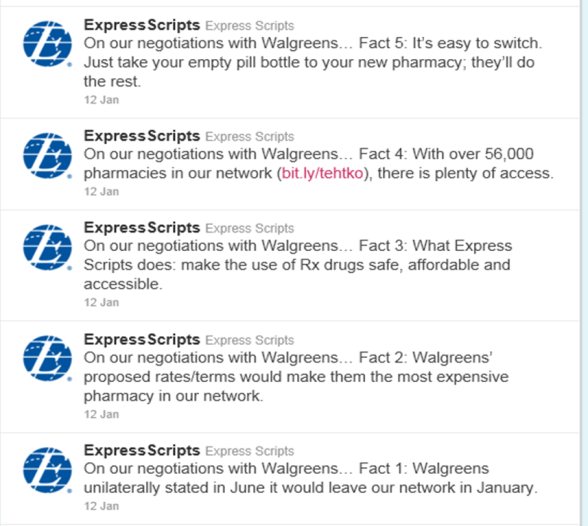
As part of the ongoing dispute between Walgreens and Express Scripts, Twitter has become one of the latest tools.  (see June post and September post)  In an effort to sway public opinion and thereby pressure Express Scripts and its clients, Walgreens turned to bloggers and Twitter to push their messaging…but these were in some case paid comments which was surprising.  They already have strong messaging in their IChooseWalgreens website and whitepapers on the Value of Walgreens.  I also thought they were demonstrating some success in converting people to their discount program which was part of their overall growth strategy shared at their shareholders meeting

After Walgreens (with almost 84,000 followers) created a promoted hashtag of #ILoveWalgreens, Express Scripts (with 1,645 followers) countered back with several Tweets about the dispute (see below).  I guess the question is whether with millions affected and decisions made by the businesses and not consumers…does this forum matter?  But, journalists and analysts follow them so it’s important to keep the messaging up.  (Other articles on this are here, here, and here.)

Conveniently, I found this infographic on how Twitter is changing healthcare.  At the same time, this is an interesting fight because it’s a blend of B2C and B2B crossing paths.  More to come since I’m sure this fight is long from over.

United HealthGroup At CES – Two Videos

This is Dr. Crounse from Microsoft talking about worldwide healthcare and using technology.

This is Dr. Reed Tuckson from United Healthcare talking about creating cost effective healthcare leveraging technology.

The Value of the Family Dinner

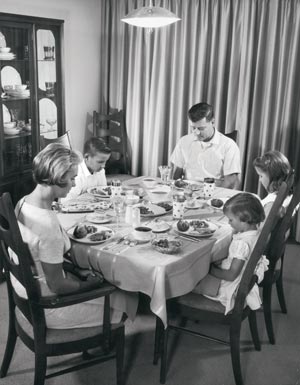
Studies have shown that kids who eat dinner with their families do better in school, feel more socially connected to their parents, have better peer relationships, and are less likely to try drugs and alcohol.

Wow! That quote from Grace Freedman at eatdinner.org certainly makes a compelling case. The article in Spirit magazine (Jan 2012) goes on to say that according to a 2010 Pew Research poll only about half of families make dinner a daily ritual and roughly 20% eat together only occasionally or never.

It certainly is a challenge with long workdays, commutes, travel, and kid activities.

Who’s the 1% in healthcare?

As we all have known, healthcare costs are driven by the minority. According to the Agency for Healthcare Research and Quality, the top 1% account for 22% of healthcare spending in the US or about $90,000 per year. (USA Today article)

So, what are the characteristics of these people:
– White, non-Hispanic
– Female
– In poor health
– Elderly
– Users of publicly funded healthcare

Only about 20% of the high cost consumers stay in that bucket for two straight years…which I think is good. But, I guess you have to look at what percentage die during that period since a lot of costs are concentrated at the end-of-life.

Obviously it’s critical to develop solutions to engage and manage these patients earlier in the process. As data gets better, our predictive algorithms around conditions will improve and we’ll be able to intervene and prevent or delay cost in the system. The key of course is doing that in a way that fully engages the healthcare team and the caregivers.

Mouthguards For Non-Contact Sports

I wore a mouthguard when I played lacrosse, but I’m not sure I could see myself putting in a mouthguard for running or playing tennis or golf.  Under Armour is pushing a series of mouthguards for any sport now (see brochure).  But, from a purely academic perspective, it’s interesting.

The material says that:

  • It improves airflow.
  • It reduces stress.
  • It improves strength.
  • It reduces lactic build-up.
  • It improves response time.
  • It reduces cortisol production.

It just makes me think that you’ll create this casual athlete with:

  • A mouthguard.
  • Nose strips to improve breathing.
  • Dark compression socks pulled up to the knee (perhaps with no bottom to allow for barefoot running).
  • Compression arm sleeves.
  • Heart rate monitor with GPS.
  • Googles to protect the eyes.
  • Magnetic band for strength and balance.

You get my point.  All of these things offer either some type of protection and some improvement in results, but it can go too far (IMHO).  Although on the flipside, the competitor inside me is anxious to try them out.

Presenting at PBMI in February

I am excited about the opportunity to present at PBMI in February.  I hope many of you will be there.  If you want to meet up, send me a quick note at gvanantwerp at mac dot com.  Thanks.

Here’s the description of my presentation:

The PBM industry continues to consolidate through mergers and acquisitions.  At the same time, new PBMs and niche PBMs continue to grow.  While the majority of the green space is gone, there is increasing focus on the individual market through exchanges and the Managed Medicaid market.  But, this maturing of the market has forced PBMs to look at more organic growth opportunities also.  How do you retain business?  How do you innovate?  How can you increase profitability per member?  With a few large market dynamics playing out in 2012, we’ll begin to look at what the future might hold and what we can learn from the past.  It is an interesting time for all PBMs, pharmacies, and manufacturers as they embrace the role of pharmacy in improving overall health outcomes.   

Will Patient Reported Data Augment Claims Based Models?

On the one hand, it seems fairly obvious that patient reported data (use of OTCs, exercise, food intake) is important in understanding their healthcare.  On the other hand, the historical bias has been to use historical claims to predict future costs.  At a minimum, I think that studies around tools like PAM (Patient Activation Measure) have shown that patient reported information is important in understanding their literacy and attitudes on healthcare.  This data is critical in designing effective healthcare engagement programs.  [One of the reasons that Silverlink has stressed our focus on using data for segmentation and personalization for years.] 

That’s why I found one of the latest studies by Kaiser to be really important.  They used both claims data and patient reported data to evaluate inpatient admission rates and costs.  And, as explained below, this data increased the predictive power of their model. 

The research determined that self-reported information about being in poorer health was a key determinant in predicting higher inpatient admissions and for being in the top tier for costs. Higher admission rates and costs were associated with patients who self-reported:

  • Lower score for general self-rated health
  • Yes to “do you need help with one or more activities of daily living?”
  • Yes to “do you have a bothersome health condition?”

The addition of this self-reported information to a claims history model explained an additional 2.8 percent of variance in admissions and 4 percent in cost.

RWJF Guest Post: Interprofessional Collaborative Care Will Be Key to Meeting Tomorrow’s Health Care Needs

Guest Post by Maryjoan Ladden, Ph.D., R.N., F.A.A.N., Robert Wood Johnson Foundation Senior Program Officer

Maryjoan Ladden, PhD, RN, FAAN, is a senior program officer at the Robert Wood Johnson Foundation.  A nurse practitioner whose work has focused on improving health care quality and safety through health professional collaboration, her work at the Foundation addresses: faculty recruitment and education to increase the capacity of nursing programs; developing collaborative partnerships to address local nursing issues; creating the next generation of academic nurse leaders; and building senior executive leaders in nursing. She also is senior editor for the Foundation’s quarterly publication, Charting Nursing’s Future.  (full bio here)

A little over a year ago, the Institute of Medicine’s landmark Future of Nursing: Leading Change, Advancing Health report put forward a series of recommendations for transforming the nation’s health care system. Among them was a call for a system in which “interprofessional collaboration and coordination are the norm.” That’s no simple assignment in a system that often operates in silos, from schooling through practice. But a number of innovators around the nation are already making headway.

Their work is the subject of a new policy brief from the Robert Wood Johnson Foundation, part of its Charting Nursing’s Future (CNF) series. The brief delves into what the IOM recommendation means for health care systems, offers case studies of several collaborative care models already in place, and examines the implications of the recommendation for how we train nurses and other health care professionals.

According to the brief, Implementing the IOM Future of Nursing Report–Part II: The Potential of Interprofessional Collaborative Care to Improve Safety and Quality, the “silo” approach must soon give way if we are to meet coming health care challenges. For example, chronic conditions are increasingly common—not surprising given an aging population. But the health care system is poorly structured to provide the sort of coordinated care and preventive services needed to give these patients quality care while reducing costs.

Some health care institutions are gearing up for the challenge.

  • In Boston, where Harvard Vanguard Medical Associates developed its Complex Chronic Care (CCC) program, primary care has become interprofessional, collaborative and noticeably more efficient. Each CCC patient is assigned a nurse practitioner (NP), a registered nurse with advanced education and clinical training. The NP consults with all the patient’s subspecialists and incorporates their guidance in a single plan of care. The NP then manages and coordinates that care, connecting patients to nutritionists, social workers, and other professionals as needed. The model is dynamic, allowing patients to meet more or less frequently with the NPs and their primary care physicians, who remain responsible for the patients’ overall care.
  • In New Jersey, the Camden Coalition of Health Care Providers is “revolutionizing health care delivery for Camden’s costliest patients,” according to the brief. These individuals, sometimes called super utilizers, typically rely on hospital emergency rooms for care. Not surprisingly, such patients account for an outsized share of local hospital costs, often with diagnoses that would have been more properly handled in a primary care setting. The Coalition developed its Care Management Project to reduce these unnecessary emergency room visits by treating patients where they reside, even when that means treating them on the street. A social worker, NP and bilingual medical assistant work as a team to help patients apply for government assistance, find temporary shelter, enroll in medical day programs and coordinate their primary and specialty care.

Training the Next Generation to Collaborate

Of course, the silo effect usually begins in school. In May 2011, six national education associations representing various health care professions formed the Interprofessional Education Collaborative (IPEC) and released a set of core competencies to help professional schools in crafting curricula that will prepare future clinicians to provide more collaborative, team-based care.

Such efforts are already under way at a number of institutions.

  • Maine’s University of New England has developed a common undergraduate curriculum for its health professions programs in nursing, dental hygiene, athletic training, applied exercise and science, and health, wellness and occupational studies. The curriculum includes shared learning in basic science prerequisites and four new courses aimed specifically at teaching interprofessional competencies.
  • In Nashville, Vanderbilt University is also pursuing an interprofessional education initiative that unites students from the medical and nursing schools with graduate students pursuing degrees in pharmacy and social work at nearby institutions. Students are assigned to interprofessional working-learning teams at ambulatory care facilities in the area.
     
  • The Veterans Health Administration (VHA) is piloting an interprofessional initiative, as well, focused on preparing medical residents and nursing graduate students for collaborative practice. As part of the initiative, five VHA facilities have been designated Centers of Excellence and received five-year grants from the U.S. Department of Veterans Affairs. Each VHA Center of Excellence is developing its own approach to preparing health professionals for patient-centered, team-based primary care.
     
  • In Aurora, Colorado, the University of Colorado built its new Anschutz Medical Campus with the explicit objective of creating an environment that promotes collaboration among its medical, nursing, pharmacy, dentistry and public health students. It features shared auditoriums and simulation labs, as well as student lounges and other dedicated spaces in which students from different professions can pursue common interests such as geriatrics in a collaborative fashion.

Such initiatives are clearly the wave of the future, if only because the pressures of caring for a larger, older and sicker population of patients in the years to come will drive efforts to identify efficiencies. In the words of Mary Wakefield, PhD, RN, head of the Health Resources and Services Administration, “As the health care community is looking for new strategies and new ways of organizing to optimize our efforts—teamwork is fundamental to the conversation.”

Sign up to receive future Charting Nursing’s Future policy briefs by email at www.rwjf.org/goto/cnf.


Smoking is an easy target for lowering healthcare costs

These statistics from the CDC really paint the picture…

– Smoking is estimated to cost businesses over $170 billion a year.
– Every smoker on the payroll is costing the company more than $3,500 annually in increased health insurance premiums, increased absenteeism and lost productivity.
– Smokers take, on average, 6.5 more sick leave days a year than non-smokers.
– Smokers cost 35-50% more to insure, a figure which is increasing rapidly as healthcare costs spiral.
– On average, up to 40 minutes of the working day is spent on smoking breaks, which equates to 21 working days of lost productivity per smoker per year.

This is certainly why you see companies trying to avoid hiring smokers. For those that show pictures of them smoking on Facebook or in other social media channels, this might be a risk (although I’m not sure if it’s legal to use that).

Live Longer By Being Optimistic!

While occasionally optimism can get you in trouble by being too trusting, I think it’s generally a better way to live. But, I still wonder why so many people can be overly optimistic about things like the lottery. Why do we all believe we can win when we’re more likely to get struck by lightning?

In healthcare, this means that we might overestimate our likelihood of getting better, not getting sick, or minimizing the risks of a surgery or medicine. “That will never happen to me.” According to an article about The Optimism Bias by Tali Sharot, people may get pessimistic about the broad economy but their private optimism stays very high.

For example, one study he mentions showed that cancer patients who were pessimistic were more likely to die within 8 months than optimistic patients. There was another article earlier this year about the impact of optimism on outcomes.

Another study talks about priming participants with key words such as smart and clever versus stupid and ignorant and comparing how they perform on a test. Guess what, the positive reinforcement led to better scores. (Why to pump your kids and co-workers up with positive self-esteem.) Perhaps, most importantly, the brains that expected to do poorly didn’t trigger responses to learn from their mistakes while the other participants did.

A few data points from the article:

  • 10% of Americans expect to live to be 100…while only 0.02% do
  • 0% of people getting married expect to divorce…but we know the numbers here
  • 93% of people believed they were in the top 50th percentile for their driving ability
  • www.bestautolenders.com

Cost and Outcomes Drive Better Use of Data

Overall, I would describe healthcare companies as trying to figure out how to drive the best outcomes at the lowest cost while maintaining a positive consumer experience.  This isn’t easy.  One area of opportunity that companies increasingly look at is how to use data to become smarter. 

  • Can I build a predictive model of response curves?  Who’s likely to respond?  Who’s likely to take action?
  • Can I develop a segmentation model that works?  How will I customize my communications after the segmentation?
  • Can I rank and prioritize my outreaches?  Should I do that based on risk or based on potential value? 

Ultimately, I think this is driving companies to be a lot smarter and to look at how they use both medical and pharmacy data.  For example, I’ll point to both CVS Caremark and Prime Therapeutics in press releases from earlier this year. 

“The ActiveHealth CareEngine offers evidence-based information that can be used to improve the health care of our members and enables us to take our programs to the next level by seamlessly incorporating medical data,” stated Troyen Brennan, EVP and chief medical officer of CVS Caremark. “This agreement will enhance our existing programs to identify issues related to gaps in care, potential drug-to-drug interactions and duplicative care — information that is important to bring to the attention of the member’s physician.”  (article that this is sourced from)

Smart use of medical and pharmacy data is one of the most powerful tools we have to improve outcomes and increase value for our members and clients,” said David Lassen, PharmD, Chief Clinical Officer at Prime. “Through ongoing partnership with health plan clients, Prime is uniquely positioned to view the entire spectrum of patient care, and we can leverage that information to help manage cost and to improve outcomes. We are very excited to collaborate with Corticon on the development of this clinical platform.” (press release)

The next step will be to integrate PRO (patient reported outcomes) from sources like connected devices and PHR (personal health records) that might show blood pressure, workouts, calories, or other data points that could help companies determine when to intervene and how to add value to drive an outcome.

Additionally, another key is continued work in the outcomes-based contracting world and bonus areas such as Star Ratings where the financial value is tied in the short-term to outcomes.  This creates a burning platform for smarter use of data and use of a broader set of data to understand and impact care.

Medicare Patients Save $1.5B on Rxs!!

Now, here’s a great story.  This may be one of the best government success that I’ve heard about in what I think of as a collaboration of the government with multiple businesses.  (Although I think this is a lot more of what HHS is doing these days under Todd Park’s guidance.)

According to USA Today this morning, more than 2.65M Medicare recipients have saved an average of $569 per person this year based on addressing the donut hole with a 50% discount on the brand drugs filled during this time.  And, the average premium for 2012 is actually LOWER than the premium in 2011 (by $0.76 per month). 

The other part of the article is about the potential value of preventative care and leveraging this as part of the Medicare benefit.  The key here is engagement of the participants to help them understand and take action on their healthcare.  The power of the consumer in driving healthcare costs and outcomes is significant which is a topic that I know was discussed by several people today at the mHealth event in DC.