Archive | Value Propositions RSS feed for this section

IDC On Personalized Medicine

I was reading the IDC Health Insights newsletter this morning where they had an article by Dr. Alan S. Louie on personalized medicine.  While this was a hot topic in the PBM world 12-18 months ago, I’ve heard much less about it lately.  I thought it made sense to share one paragraph from his article here.  I hope that his predictions for delivery of this evidence-based approach to care come true and can be delivered in a cost-effective way to consumers with physician buy-in and understanding about how and when to use this information.

“I believe that the FDA is likely to be significantly marginalized as a major player in the transformation to a more personalized care scenario. While still rigorous in their role as gatekeeper to ensure that drugs are safe and effective, the ability to apply growing genomics, EMR, and CDSS data and knowledge to routine medical treatment is likely to be executed outside of FDA purview. If the FDA decides to lay down the heavy hand and demand that all testing be FDA approved, then all bets are off and medical innovation will be delayed by at least 10 years or more. With payers, clinical laboratories, and others (e.g., PBMs) all buying genomics testing capabilities, it becomes increasingly possible to deliver the latest genomics insights to the point of care and amortized over large patient populations, recognizing that what are probabilities for the individual become real outcomes for portions of patient populations. Net improvements in patient outcomes become real and avoidances of treatment with little or no likelihood of success reduce both wasted efforts and unnecessary adverse drug exposure.”

Sarbanes Appeals To FTC Regarding Lipitor

Yesterday, Congressman John Sarbanes (D-MD) asked the FTC to take action against Pfizer based on the deals they are signing with PBMs that will prevent consumers from accessing generic versions of the cholesterol drug Lipitor.  (see Pharmalot story on this)

“This is a sweet deal for the drug companies at the great expense of consumers, employers and taxpayers,” said Congressman Sarbanes. “At a time when we should be doing more to slow the rising costs of prescription drugs, these types of practices should be prohibited. “

Assuming that this is about savings to the consumer which I think is what the FTC is focused on, I think he missed the point of the deals.  Pfizer is rebating the drug to cost less than the generic which is then prompting PBMs (and payers) to treat brand Lipitor as a generic.  The consumer would pay their generic copay (from what I’ve seen), and they can still go get Lipitor for less then their copay by using the copay card that Pfizer offers making brand Lipitor $4 a month.

This is a brilliant deal by Pfizer to extend the life of the drug (although I’d be upset if I was the authorized generic).  The only potential people losing in this are payers who might not see the impact of the rebate dollars (e.g., carve-in employers).  Most PBMs are sharing the majority of their rebate dollars these days.  The question is how those rebate dollars flow down from there.

Reprint: Getting Aligned For Consumer Engagement

(This just appeared in the publication by Frost  & Sullivan and McKesson called “Mastering the Art and Science of Patient Adherence“.  It was written by me so I’m sharing it here also for those of you that don’t get that publication.)

According to the 15th Annual NBGH/Towers Watson Health Survey, employees’ poor health habits are the number one issue for maintaining affordable benefits. Since studies have shown that 50-to-70 percent of healthcare costs are attributed to consumer choices and adherence is one of those issues, the topic of how to engage consumers isn’t going away.

The challenge is getting the healthcare industry to use analytics and technology tools when engaging the consumer in a way that works for each individual and builds on their proven success in other industries. Healthcare has an enormous amount of consumer data ranging from demographics to claims and behavior data. Consequently, there is great opportunity to use this data to engage consumers in their health to improve clinical outcomes. While on the one hand, it’s like motivating consumers to buy a good, the reality is that healthcare is both personal and local which complicates the standard segmentation models.

This is a dynamic time where people are experimenting with different strategies for engagement. For instance, in medication adherence, people are trying everything from teaming those who have chronic conditions with community pharmacists to make sure they are taking their medications correctly to technology that monitors when the pill actually enters your body. But, there are still fundamental gaps in the process which can be addressed using interactive technology to complement the pharmacist interventions.

Consumer engagement in healthcare is increasingly moving to new channels with 59 percent of adults in the U.S. looking for health information online and 9 percent using mobile health applications according to Pew Research Center. Additionally, there is more and more participation in social media or peer-to-peer healthcare applications. Modes like SMS, which companies are starting to leverage in programs like Text4Baby or the diabetes reminder program recently launched by Aetna, are gaining popularity. Companies like Walgreens have also begun exploring the use of SMS and Quick Response (QR) codes for medication refills.

At the end of the day, consumers want preference-based marketing where they can elect how to best engage them, but that doesn’t mean that’s the most likely channel to get them to take action.They want you to learn from their past responses to improve your future outreach, but they are also skeptic about how their data is used. You have to put yourself in their shoes to create the optimal consumer experience. You have to deliver the right message to the right consumer at the right time using the right sequence and combination of channels.This is not easy.

So, if you’re going to optimize your resources and build the best consumer experience, you need an approach which is dynamic and personalizes each experience. For example, we found that creating the right sequence and timing around direct mail and automated calls improved results by as much as 100 percent in a pharmacy program. Or, in another case, at Silverlink Communications, we found that using a male voice in an automated call to Latinos got an 89 percent better engagement rate around colonoscopies. We also know that using a peer pressure message does not work in motivating seniors to take action in both a retail-to-mail program and a cancer screening program, but does work for those younger than 55-years-old?

You have to make simple messaging relevant to them—why should I get a vaccination, why is medication adherence important, how can you address my barriers? Only an ongoing test and learn approach to consumer insights will suffice, and those that figure this out will become critical in the ongoing fight for mindshare and trust. But, this isn’t a stand-alone opportunity. We have to partner with providers to improve engagement, adherence, and ultimately outcomes in different forms. We have to offer them a platform for engagement that is built upon consumer insights and provides a unique consumer experience to them based on their disease, their demographic attributes, and their plan design. All of these factor into their behavior and are important in “nudging” them towards healthcare engagement and ultimately, better health.

“Code Lavender” – Focusing On The Patient Experience

If you don’t know it yet, the consumer “experience” is rapidly becoming the hot topic. I’ve talked about it a lot beginning with companies like Cigna that have hired and staffed a consumer experience team and Chief Experience Officer. But, as the WSJ pointed out earlier this week in their article “A Financial Incentive For A Better Bedside Manner“, this is getting quantified in the provider world. One might argue that experience has always mattered more in the provider world since it’s easier to switch hospitals or physicians than insurance companies, but that is likely to continue to change as the individual insurance world and Medicare continue to create competition for the individual.

For payers, you can already see this individual market playing out with the growth of retail stores which is where the experience begins. In other cases, the PBMs and payers have to rely on many cases on their call centers as the front-end of the consumer experience. Additionally, with pharmacy being the most used benefit, this is another critical area. And, we know that pharmacy satisfaction is highly correlated with overall payer satisfaction.

But, let me pull a few things that caught my attention in the WSJ article:

  • CMS will begin withholding 1% of their payments and tying payment to quality standards for medical care AND patient satisfaction surveys known as HCAHPS (Hospital Consumer Assessment of Healthcare Providers and Services). This will go up to 2% in 2017.
  • The survey is a 27-question survey sent to a random sample of discharged patients (about 25% of the 36M patients admitted in 2010 with a pretty low response rate of 7%). It asks about cleanliness, quiet, communications, and an overall satisfaction based on something similar to the Net Promoter Score (i.e., would you recommend the hospital to friends and family).
  • 67% of patients give their hospitals the top two ratings on a scale of 1-10 (which I actually think is pretty good).
  • Only 60% say that doctors and nurses always communicated well about medications (which was higher than I expected).

Cleveland Clinic Chief Executive Delos “Toby” Cosgrove, a heart surgeon by training, says he had an epiphany several years ago at a Harvard Business School seminar, where a young woman raised her hand and told him that despite the clinic’s stellar medical reputation, her grandfather had chosen to go elsewhere for surgery because “we heard you don’t have empathy.”

  • The Cleveland Clinic calls their program HEART—for hear the concern, empathize, apologize, respond and thank. They also use the term “Code Lavender” for patients or family members who need immediate comfort.

I look forward to watching how this transforms over time. I know I’ve seen this play out in the dentist’s offices for my kids. The waiting rooms have video games and other things to keep them and their siblings busy, but I do agree with the article that this may unfairly bias the wealthier hospitals.

Sustained Patient Engagement Around Hypertension: Silverlink and Aetna

At Silverlink, we had a great opportunity to work with one of our clients and publicize it. This morning, Aetna released a joint press release with us about our hypertension program.

As companies continue to look at new ways to use technology to engage patients around chronic diseases, solutions like this offer companies a unique way to blend multiple channels into an overall consumer experience that improves engagement and outcomes.

From the press release:

The program also achieved high levels of engagement, with nearly 60 percent of participants continuing to actively monitor their blood pressure by using a free blood pressure monitor and submitting readings on a monthly basis. The frequency of participants’ cholesterol (low-density lipoprotein (LDL) cholesterol) screening also improved 5 percent.

“By helping our Medicare members manage their high blood pressure, we are hoping to help prevent heart disease, strokes and even deaths,” says Randall Krakauer, MD, FACP, FACR, Aetna’s national Medicare medical director. “Our nurse case managers work closely with our members and do a tremendous job providing them with the information, tools and support they need to help them control and improve various chronic conditions, including hypertension. The results of our program with Silverlink demonstrate that an automated program can further support and engage members in managing their own health conditions.”

Retail Pharmacy Mobile Applications

I’ve talked before about some of the mobile PBM efforts, but what about the retail pharmacies. You should expect that the chains will have different mobile strategies than the grocery stores or the big box retailers. And, it will be interesting to see how the independents might collaborate on a shared platform.

Here’s a few things already out there:
Walmart new shopping application and Walmart’s page on mobile
CVS retail application
Walgreens has a mobile pharmacy app
Target also has a mobile pharmacy application

So what should or could pharmacies offer consumers in terms of mobile applications:
– A refill application is a minimum
– Education or drug information is another basic
– There are certainly some geographic options such as a store locator or clinic locator
– There are options for location based check-in using Foursquare
– Scheduling MTM consultations or vaccinations are a reasonable option
– What about promoting saving thru 90-day retail or generics?
– As retail pharmacies are in the specialty business, there could be opportunities to promote this channel and offer support.
– Telemonitoring is another option (e.g., FaceTime)
– Use of QR code is another part as is augmenting the shopping experience with augmented reality
– Of course, couponing will be part of the solution, but what I’d like is someone who would download my shopping receipts (from multiple companies) and provide me with relevant savings.
– Should it include Rx coupons? Unlike the PBMs, retailers want traffic and if coupons increase adherence then why not.
– There are other options like photos and integration with social networks and tools.

I think one of the key “killer apps” is secure rules based messaging. Imagine using data to identify when you need a vaccination or identifying a potential drug-food issue or having age based triggers. These could be sent directly to the consumer in a secure environment. Of course, we’re only at about 10% adoption and the key question is whether these are the key consumer that everyone wants to attract. Are they the high utilizers? Do they buy other goods?

More to come here. This is a rapidly evolving space.

One Challenge Of Medicare OEP – Satisfaction

We’re in the Medicare open enrollment period right now.  This is a highly competitive time for MA and PDP plans to compete for new members and to get members to switch to their plans.  I’ve talked about the Star Ratings process before.  I’ve talked a little about the limited network offerings before.

This time, I wanted to focus on a recent study by Medicare Today that was put out on satisfaction.  It shows:

  • 95% say their current Part D plan works well, with 94% saying it is easy to use.
  • 82% say their Part D plan offers good value.
  • 67% say they have lowered their prescription drug spending.
  • 34% say they used to skip or reduce their prescription medicine doses to save money, but now no longer have to do so.
  • Two of every three seniors said they are unlikely to shop around.
Those are impressive statistics.  They certain point to the battlegrounds being around new Medicare eligible participants and retention (not acquisition) for existing PDP or MAPD members.

Did You Know PhRMA Has A YouTube Channel?

I just ran across this, and I figured I would share it.  PhRMA is the Pharmaceuticals Research and Manufacturers of America.  They represent they pharma and biotech companies.

Here’s a few of the videos from the site.  One on Part D and one on adherence.

My Eight PBM Predictions For 2012

I recently heard one of the key CEOs in the PBM industry say that his crystal ball for 2012 was fuzzy, and he wasn’t sure what was going to happen.  (Not particularly reassuring.)  That being said…it’s an exciting time, and I’m going to take my pass at predictions anyways.

  1. The proposed Express Scripts acquisition of Medco will take place although they will be required to sell off some specialty assets.  This will create a new specialty player and will also trigger further consolidation and acquisitions.  You will also see many of the Medco people go to new healthcare companies throughout the industry to drive change.
  2. The contract dispute between Express Scripts and Walgreens will get resolved shortly after 1/1/12, but it will serve as the trigger for limited networks as multiple clients will keep Walgreens out of the network since they’ve addressed most of the disruption and achieved savings.  But, you will also see several companies quickly add Walgreens back into their network.
  3. Star Ratings will trigger a bigger focus on adherence across the industry and begin to create outcomes-based performance measures that the commercial business starts to see in their PBM contracts linking payment to performance.
  4. Lipitor will be a disruptive item throughout the year with aggressive Pfizer rebating, the overhang from it potentially going OTC, and the pricing of the initial generic.
  5. Innovation will finally begin to shift to the specialty space with this being the primary area of concern from a trend management and clinical perspective.  Clients will expect innovative ways of engaging patients and improving outcomes which will push closer links between pharma and PBMs around key drugs and complex conditions.  The focus on specialty spend in medical will continue, but the increasing percentage of infusion drugs will challenge this and push specialty to look for more ways of engaging with the physician.
  6. The “retailing of healthcare” through storefronts will manifest itself in different ways in pharmacy with greater focus on specialty at retail, pharmacists as part of the ACO/PCMH concept, MTM, and ultimately through exchange based partnerships with large payers.
  7. Integration of medical, pharmacy, and lab data will be a huge focus on PBMs create targeting algorithms and databases for segmentation, targeting, and ultimately engaging consumers around specific health behaviors.
  8. Telemedicine in the form of telemonitoring will link into the retail pharmacy clinic strategy as they extend their pharmacy relationship from an event based relationship to an ongoing monitoring relationship around key conditions like diabetes.

Two things that I expect to continue to be areas of focus will be the development and execution of a mobile strategy and continued exploration in the area of personalized medicine and genomics.

The one outlier which I’m not sure of yet is Medicaid pharmacy.  It’s been a hot topic lately, but I’m still unsure of whether that will radically change in 2012 or not.

[Interested in sharing your opinions on 2012 in a formal way?  I’m going to reach out to several companies and ask their thought leaders or executives to do an “interview” with me about their predictions for 2012.  Let me know if you’d like to participate.]

[And, don’t forget that you can sign up to have these posts e-mailed to you whenever I write them by signing up for my e-mail list on the right side of the blog.  Thanks for reading.]

Rent Your Workout Clothes

I’ve been waiting for a while for someone to invent a “bag” or something that I can put my used exercise clothes in while I’m traveling.  Sometimes after a few days on the road, these can be a stinky addition to my suitcase.  There must be some bag with a chemical in them that would dry them out and absorb the smell.

But, in the interim, I was intrigued to see that Fairmont Hotels and Resorts is offering their guest workout apparel and shoes.  What a great opportunity for Adidas and whoever else they partner with to let consumers test drive their clothes and shoes.  You pay a small fee to use them (unless your a top frequent travel with them) and you can buy them after that if you want.

Do You “Give A Spit”?

R.jpg

Have you seen this new campaign from BeTheMatch.org?

Only 2% of the US population is registered.  Are you one of them?  I am.

There are 10K people who need a transplant.  Whether you organize an event or just get yourself registered, you can help save a life!

Will The Stars Align To Drive Adherence?

We all know that adherence to prescriptions is a problem.  People don’t start on their medications.  People don’t stay on their medications.  But, another problem also exists which is finding the ROI on adherence.  While the ROI is clear to the manufacturer or even to the pharmacy, it’s often less clear to the payer.

This is not true in every category.  Diabetes and several other conditions have been shown to have an ROI associated with intervention programs that improve adherence.  But what about all the others.

In the short-term, I expect you’ll see the CMS Star Ratings and bonus payments drive behavior in three critical categories that are now measured in the 2012 for MAPD and PDP plans.  (see technical notes on 2012 measures)

If you’re not familiar with the Star Ratings system, you should read this.  In 2012, there were three new adherence measures added.  Not only are they now part of the evaluation process, but they were weighted more heavily than some of the operational measures.  A  good indication of focus on quality of care.

Getting more Stars is important since it is linked to bonus dollars that the plans can get.  And, there aren’t many Five Star Plans.  Only 9 plans received 5-Star Ratings for 2012 (see article).  [Interestingly, I think one of the unique assets that Express Scripts is buying in the proposed Medco acquisition is one of the 4 Five-Star PDP plans.]

“The Medicare star quality rating system encourages health plans to improve care and service, leading to better patient experiences across the board,” Jed Weissberg, a senior vice president at Kaiser Permanente.  (from 5-star article above)

The adherence measures focus on diabetes, high cholesterol, and hypertension and use Proportion of Days Covered (PDC) rather than MPR for their measurement.  Certainly, one of the things we’re seeing at Silverlink with our Star Power program is that many of these Star Measures can be influenced by communications.  Adherence is certainly one of those big areas of opportunity for plans to focus on.

While the benefit is obvious to the plan in terms of reimbursement, the big question is whether consumers care about Star Ratings or just focus on lowest price point and access to pharmacies or specific medications.  A Kaiser study that was done seems to indicate that the answer is no.

Conducted by Harris Interactive, the survey showed that only 18 percent of Medicare-eligible seniors said that they are familiar with the government’s rating system. Of those that are familiar, less than one-third have used the system to select their health plan. Moreover, only 2 percent of respondents were aware of how their current plans rates. 

Since we’re in open enrollment for Medicare right now (see Medicare.gov to evaluate options), perhaps we’ll get some data in early 2012.  2012 will also be the first year for the 5-Star plans to be able to market all year round and not be limited to the OEP (open enrollment period).

But, one of the things I found interesting as I looked on the Medicare.gov site to “select” a plan in my area is that there is an option to “Select Plan Ratings” but even I wasn’t sure what that was.  It’s not intuitive to the consumer that this is a quality rating for them to pay attention to.  And, it appears that the default order of options which is presented to you is based on price.

What Will Happen With Generic Lipitor (atorvastatin)?

Well, it finally looks like generic Lipitor will be on the market soon.  I think November 30th is still the date.

Of course, now the question is what will this mean to you (the consumer)?  Since atorvastatin will be distributed by only one manufacturer for the first six months after the patent expires, there will not be a significant price drop.  Therefore, I know at least one (and have heard two) PBMs will be blocking the generic drug during that time.  Consumers will be able to get Lipitor at a generic copay.

I’ve offered my opinion on scenarios like this before.  I think it’s confusing to the consumer.  It’s great for Pfizer and generally everyone wins since it’s the same out-of-pocket costs to the consumer and lower cost to the plan sponsor (employer) than the exclusive generic (due to rebates), BUT I think it sends a confusing message.  “You can and should use generics except for in some cases where the brand drug is cheaper.”  I’m not sure how this plays out in states where generic substitution is required by law.

Of course, your other option is to go use the Lipitor $4 coupon.  If I were the Pfizer brand manager for Lipitor, I would offer a $50 payment for a 1-year supply of Lipitor and lock people in for the year.  [A seperate discussion needs to be had about how cash and coupon claims which don’t necessarily get adjudicated affect adherence measures for bonus payments like Star Ratings…and yes, I know that coupons aren’t supposed to be used for Medicare members, but I don’t think that’s monitored well.]

So, you might go to get your generic Lipitor and leave with the brand at your generic copay.  On the other hand, I wouldn’t be surprised to see some PBM negotiate well enough to get a better price on the generic than Lipitor (net of rebate).  [Of course, these are the types of scenarios that cause friction in the supply chain.  Which drug can the retailer buy better?  Does the client get the rebates shared with them or not?]

I know this is what some companies like GoodRx are looking at with their application which compares drug prices across retailers.  It shows you if there’s a coupon available (see broader article on them).  It suggests savings like splitting the pill.  (No mail or 90-day promotion yet that I saw.)  Of course, this is from a cash paying customer perspective.  But, with atorvastatin, you may want to compare your plan design with the cash price with coupons.  You’ll want to know if it’s part of the $4 generics program or if you get a better price with the CVS or Walgreens discount card programs.

Here’s two examples from GoodRx.  One is for Lipitor which shows some variation (and has no generic today).  The other is for Prozac which has been available as a generic for a while.

Touch and Body Language in the Physician Encounter

I was watching this TED video the other day from a physician and writer Abraham Verghese.  It was interesting since his whole point was about the ability to relate to your patient through human touch and the power that has on the patient’s trust and experience.  As we move towards move EMRs and other technologies, we have to make sure we don’t over-engineer the patient experience.

I was reminded of this again when reading KevinMD’s blog where there was a post on using body language.  How many of us think about what our body language is saying?

Or do we think about our clothing selection?  While the white coat may create trust, does the tie create a sense of being aloof?  Or should you consider different color sections to seem more approachable?

Food for thought.

Did IOM Overlook Literacy and Prevention With Their EHB Recommendations?

“The ACA requires that certain insurance plans—including those participating in the state purchasing exchanges—cover a package of diagnostic, preventive, and therapeutic services and products that have been defined as “essential” by the Department of Health and Human Services (HHS).

This package—commonly referred to as a set of essential health benefits (EHB)—constitutes a minimum set of benefits that the plans must cover, but insurers may offer additional benefits. The EHB are intended to cover health care needs, to promote services that are medically effective, and to be affordable to purchasers.”

The Institute of Medicine (IOM) put out a report recently about Essential Health Benefits (EHBs). While I haven’t fully digested the report and its implications, I noticed two things:

  1. There was no one from the pharmacy community on the committee.
  2. They seem to overlook the value of health literacy.

While I know observation #2 is an opinion that could be heavily debated, let me share my logic here.

If you look at the criteria for EHB selection (see below), they call out that it must “be a medical service, not serving primarily a social or educational function.” I would argue that it is risky to ignore education and its correlation with health. There are many educational functions around prevention which are important. Additionally, there is a lot of research these days around the social value of different networks and tools and their relevance to overall health.

This is Health Literacy Month so you can go visit several sites to see more about this topic. You could also look at research on social aspects of health from Pew. Or, I might even draw upon research around pets and their value in healthcare.

I’m sure the panel didn’t mean it to be interpreted this way, but we know how our government works. These comments become “law” and hard to overcome. I would think some clarification to say something more like the following would be better.

“Be a medical service or a program whose educational or preventative objectives have been demonstrated to improve health outcomes.”

Other articles on the report include:

NCPA Announces “Simplify My Meds”

For patients with multiple prescriptions, it can be very annoying to have to constantly refill different medications on different cycles. This leads to waste (time) and forgetfulness around refills. It’s an age old problem.

The easy answer would be to work with the patient to consolidate the orders to refill on the same day of the month. This might involve a few split orders or short-fills to get them lined up. I’ve talked with multiple pharmacies about this over the years.

NCPA announced the other day that they were going to focus on this as part of their adherence program. This is great! If they can pull this off, I would expect the whole industry to try and follow.

“By coordinating exactly what day patient refills occur, the independent pharmacy staff’s workload is streamlined. Daily workloads become more predictable, labor costs go down, and staff stress levels decrease. Data analyzed from pharmacies using this model has shown as much as a 30 percent increase in prescription volume, a 50 percent decrease in labor costs, and $1.87 per script increase in gross margin.” (NCPA Press Release)

Words Matter: Doodling – We Should Foster It

As someone who was trained as an architect, I understand the value of sketches in the design process and have always “doodled” as I try to conceptualize what people are describing with words.  With that in mind, I really enjoyed this TED video and think it’s a good message for all of us in the communications field.

Coordinated Versus Integrated PBM

I’ve long held what would appear to be conflicting positions:

A. I believe that a standalone PBM offers the unique ability to be laser focused on pharmacy and should therefore optimize your benefits from a carve-out perspective.

B. I also believe that ideally that focus could be achieved within an integrated benefit where you could leverage pharmacy strategically to drive down the bigger overall area of costs – medical.

So, my initial reaction when I heard about the study below Anthem was that this finally showed a clear savings from the integrated PBM model.

According to a separate analysis Anthem conducted of members in its affiliated health plans, enrollees with both medical and pharmacy benefits managed by Anthem have medical costs that are $8 to $16 lower per employee per month compared with those without Anthem’s pharmacy program. (from Drug Benefit News)

I haven’t seen the original study which I’d like to read in more depth, but on the surface, this is interesting.  After further retrospect, I wonder if the issue isn’t necessarily integrated versus coordinated.

Can a standalone PBM act as an integrated PBM?  What would need to happen for that to be true?

  • They would need to coordinate benefit design across both areas (pharmacy and medical) which is easier when the managed care company is the buyer of PBM services not the individual employers.
  • There would need to be integration of pharmacy and medical benefits into a predictive model and an outcomes model.
  • The PBM would need to be tied to outcomes in some type of P4P model.
I’m sure there’s lots of PBMs out there on both sides of the fence who could (and will) argue this story better.  I’m just thinking through my initial reaction to think about what this study really means.

Pharmacy Adherence (Waste) And The Need for MD-RPh Collaboration

I spent the day today at the NEHI adherence event in DC. I pulled out a few of my takeaways below, but while I was riding on the plane to get here, a few things were running thru my head:

  • The focus on budget and the estimates that adherence costs us $290B a year here in the US.  (or as one person pointed out that’s $1.2T in a presidential term)
  • The recent report estimating that chronic conditions could cost us $47T worldwide over the 20 years which is leading to the UN talking about healthcare for only the second time ever.
  • The discussion by George Paz from Express Scripts the other day about how PBMs drive value by eliminating waste (see Drug Trend Report). A large piece of waste is adherence and certainly one of the forecasted benefits of the combined Express Scipts and Medco entity is the intersection of Consumerology with the Therapeutic Resource Centers (TRCs).
  • The ongoing dialogue around motivational interviewing, commercial MTM, and blending face to face interventions with technology to “nudge” behaviors.
  • The huge opportunity which I believe exists in leveraging technologies like Surescripts to create data exchanges with physicians around MPR and barriers.
  • The exciting fact that the new STAR measures for Medicare include more adherence metrics that are weighed more heavily than some of the operational metrics.

Fortunately, these were a lot of the topics that were discussed.  Here some of the discussion topics:

  • The fact that there’s no “easy button” for adherence.
  • How adherence is a foundational building block for quality.
  • The role of HIT in sharing data bi-directionally across the care team.
  • Upcoming evidence around VBID.
  • The role of the pharmacist and need for them to collaborate more with the physician to discuss and manage adherence.
  • The fact that the adherence solution has to be multi-factorial.
  • The need to optimize the drug regiment and individualize care (aka patient-centered care).
  • The role of the caregiver.
  • Opportunities around PCMH, readmissions, MTM, and eRx.
  • The need for patient engagement.
  • The need for the patient to believe in the therapy and that it will make them better.
  • Good discussion on the role of the PCMH (patient-centered medical home) versus the pharmacy as the foundation for adherence.
  • Discussion on whether physicians could address adherence if time wasn’t an issue.  Do they have the training and skills?
  • Social media as an emerging factor.
  • Reaching the consumer when they have time and are receptive to information.
  • Helping prepare the consumer for the encounter (i.e., checklist or list of questions).
  • What happens when the patient waits in line and then is rushed themselves in the encounter.
  • The role of technology in complementing the physician and patient.
  • How to share data across team members.
  • The need for ROI data on interventions.
  • The value of having a Dx on the Rx.
  • The need to vary incentives and not keep doing the same thing.
  • If prevention is long-term and adherence is short-term, should the physician focus more on adherence and less on screening and other preventative measures.
  • The need for – sufficient accountability, information, and skills.
  • Adherence as a solution that needs to be localized.
  • Patient centered or disease centered solutions.
  • The governments role in improving adherence via policy and funding demonstration projects through CMS.
  • STAR ratings and the bonus payments as an incentive to motivate research and programs in this area.

Overall, it was a good discussion with a very engaged panel and audience.  We didn’t come to any answers, but you certainly got to think about the topic, identify some projects that should be done, and identify some research questions. 

I look forward to pulling out a few of the topics in more depth.  They align well with the communications platform and intervention strategies that Silverlink provides for our clients around adherence.

Walgreens and Express Scripts: The Plot Thickens ($ESRX, $WAG)

Remember when this “conflict” was first announced a few months ago.  If you’re like me, you probably assumed this would be over in 30-days like the Walgreens – CVS Caremark dispute last year.  What’s different?  I’m not sure.  It seems like both sides are well dug in.  (From my poll a few days ago of 22 of the readers of this blog, 65% felt this would get resolved by 1/1 and 25% felt that it would never get resolved.)

Now, it seems like both sides are continuing to take significant steps towards no resolution.

Express Scripts has apparently launched a pilot program to move share from Walgreens stores now using coupons.  I believe the pilot was with Lowes and is about to expand to the Department of Defense.  Additionally, I’ve heard that Express Scripts has sent out letters to their clients preparing them for a limited network starting 1/1/12 without Walgreens.

On the flipside, I’ve heard that Walgreens has begun putting signage out encouraging consumers to talk to their plans about excluding them from the network and for Medicare members to chose plans that aren’t run by Express Scripts.  Walgreens also put out a whitepaper about what happens when you remove them from the network.  This has some really interesting data in it.

Key Statement: Excluding Walgreens from a pharmacy network will result in little to no savings for most sponsors and patients, and in some cases will raise costs, while causing significant patient disruption and risking gaps in care, and increasing administrative costs on plan sponsors.

  • As part of this document, they are encouraging payers to consider directly contracting with them and/or creating a custom network (if their PBM contracts allow for that).
  • They state that their costs are comparable to other retailers or within 2% of their costs.
  • They show some data from another PBM (not named) that modeled out network savings for them based on a limited network taking into account their drug costs, generic fill rate, and 90-day rates.  It shows a jump in costs versus savings.

  • They share data that their Generic Fill Rate (GFR) is 1.4% higher than the rest of the Express Scripts retail network which the paper says translates to $2 per Rx in cost.
  • They say that 90-day retail generates a 6-8% savings compared to 30-day retail based on the pricing that they offered to Express Scripts.

Ultimately, I still believe resolution will occur before the end of the year.  While both parties are dug in, I believe it’s a lose-lose situation for this to stay unresolved.  That being said, there are lots of things that could occur here:

  • This creates a wave of direct contracting between payers and pharmacies.
  • This validates the integrated model of CVS and Caremark.
  • This creates a large number of limited networks.
  • This creates greater use of the Walgreens discount card and/or cash business at Walgreens especially for lower cost generics.
  • Alienating Walgreens creates a disruptive force in the FTC review of the proposed Medco acquisition.
  • Another PBM jumps in to do a creative deal with Walgreens which limits their long-term ability to work with Express Scripts.
  • Express Scripts ends up in a shotgun relationship with CVS.
  • The terms of PBM contracts get changed going forward based on new terms regarding retailers.
  • Walgreens becomes a much more vocal voice in the retail world through NCPA and other organizations.

Between this and the proposed Express Scripts acquisition of Medco, the landscape in the PBM market could be radically different by early 2012.

[Note: As the stock market has dropped, I have continued to buy stock in the PBM industry including several of the specific companies mentioned in this post – MHS, ESRX, WAG and CVS.]

$47 Per Rx Guarantee From Prime Therapeutics

I think this is a good, bold move.  Prime Therapeutics has launched four new programs.  The most aggressive is called Reliance and guarantees your net spend per Rx at $47.  The easy way to do this would be to exclude specialty drugs and basically offer a generics-only formulary.  My quick read from their drug trend report and press release is that it includes specialty drugs.  It also includes a lot of utilization management programs, suggestions on plan design, encouragement for mail order, and other features.  I’ll be interested to see the adoption of the program or whether it’s just a great program to encourage clients to consider new, more aggressive plan designs.

“Our Reliance plan keeps costs predictable for plan sponsors,” said Michael Showalter, Prime Chief Marketing Officer. “The goal is to make pharmacy benefits easy, understandable and affordable. Through Reliance, there will be no surprises, allowing organizations to better plan for and manage their pharmacy costs and reduce overall health care costs, while providing excellent benefits. We provide a single number demonstrating the true cost of care – $47. We are the only PBM to back that up with a price guarantee and complete price transparency.”

Highlights From the Prime Therapeutics 2010 Drug Trend Report

I just finished reading the Prime Therapeutics Drug Trend Report. As I highlighted the other day, their overall drug trend was 2.9%. Like in the past few years, they have jumped up to offer a report comparable with the other big PBMs. And, as we saw with last year’s report, the new management team is aggressive in using this to highlight research, their competitive differentiation, and point out why they are a competitive force in the market.

More interesting that just their success in drug trend was their “adjusted drug trend” for the other PBMs. You don’t often see this in your face marketing in this space, but they clearly want to show not only that their trend was better but that their methodology is better. (I don’t have the time to compare methodologies at this point.)

Fortunately, they don’t stake the argument on trend since as I’ve pointed out before – trend can be misleading. Sometimes higher trend is good as when it indicates better Medication Possession Ratio or better success at reducing gaps-in-care. They focus on five things in the document:

  • Savings
  • Safety
  • Guidance
  • Satisfaction
  • Partnership

Their Generic Fill Rate (GFR) for 2010 was 69.2% which was lower than the 71% reported by Medco and the 71.5% reported by CVS Caremark. (I couldn’t find the Express Scripts numbers for whatever reason.)

The report focuses on some of the differences in the Prime model (client ownership, not public) and how that plays out in transparency and alignment.

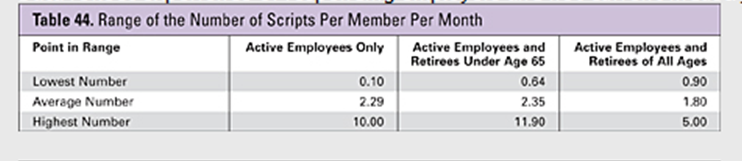
They are now at 12 Rxs PMPY which to me still seems a little low. (I’ve mentioned this is prior reviews, but I don’t understand why their population usage is different.) To validate my hypothesis, I looked at the PBMI report from last year which shows PMPM utilization ranges by respondents (not industry averages).

I do think their example around implementing a generics-formulary along with their new benefit plan guaranteeing cost at $47 per Rx are very interesting. They remind me of the GenericsWork product I launched at Express Scripts and should offer some clients a great way to save money. They key, as I learned, was really understanding how to manage member disruption and gain buy-in to the offering.  [Amazingly, a quick Google search led me to a cached image of the PDF from my product from 2004.]
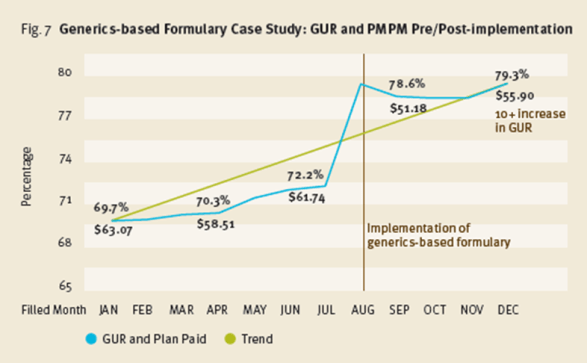
They give some good MTM numbers:

  • $1.29 in return for every $1 spent
  • $86 in savings to the payer over a 10 year period per MTM encounter

They also announce a new offering for 2012 which they call the GuidedHealth care engine. There’s a little information in the document, but it sounds intriguing.

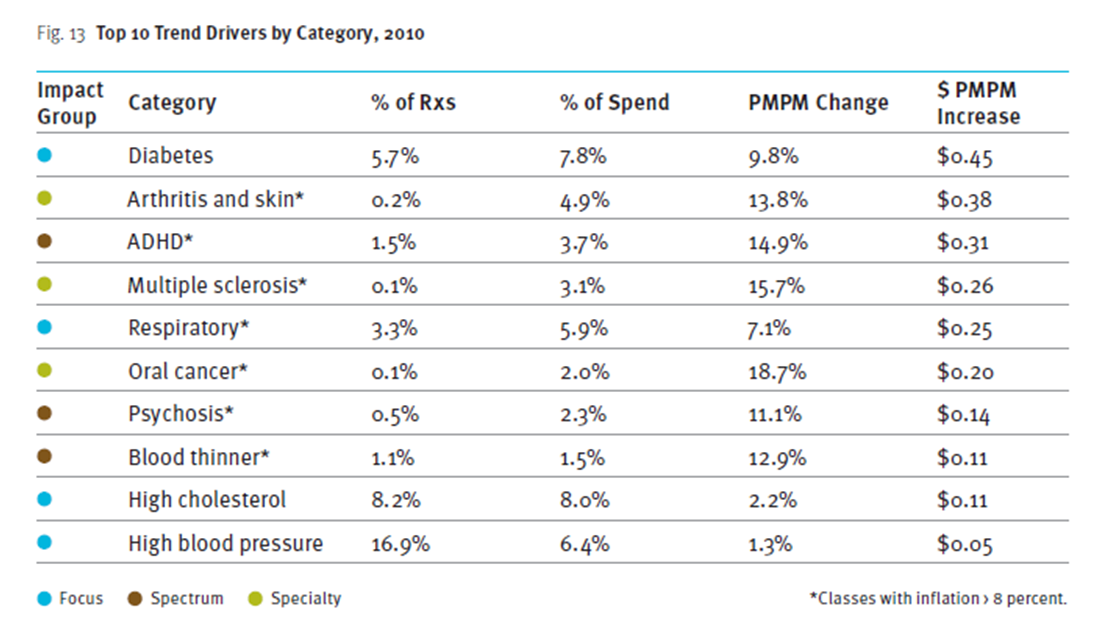
One of those typical charts that we all like to look at shows the drug classes that contributed most to driving trend.
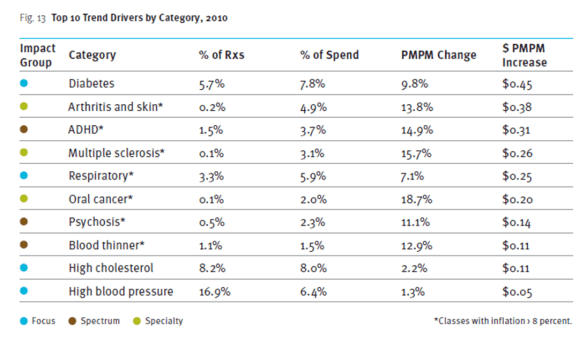
I think their equation about overall cost…

Optimal cost = (medical cost + pharmacy cost) x health outcomes

One of my favorite charts is below which recognizes that there are two cost curves to focus on. The one for the relatively healthy which is often highly pharmacy focused cost versus the chronically ill that drive the majority of overall costs and is heavily medical and specialty medications.

Another study they share in here looks at the likelihood of hospitalization tied to adherence. Very interesting.

$7.60 PMPY savings for a limited network. Those are big numbers that they share from a case study around a client limiting their retail network by excluding one chain.

Their drug trend report looks at another hot topic – 90-day prescriptions. They share their results of a statin study looking at waste in 90-day retail and mail and 30-day retail and estimate the cost impact of the waste.

Another hot topic is the mix of specialty drug spend between medical and pharmacy. They share a chart looking at several of the large specialty drug classes.
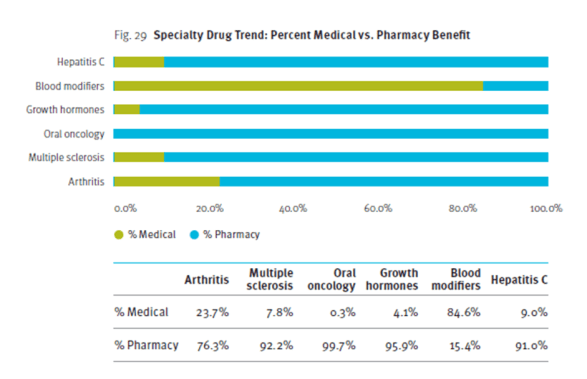
At the end of the report, they give suggestions to clients on a spectrum of management (low to high). They also predict a few things in the next five years:

  1. A return to double digit trend increases after this generic wave;
  2. A generic fill rate in excess of 90%;
  3. Specialty drugs accounting for 40% of spend;
  4. Healthcare spending will increase 8-10% per year;
  5. The role of genetic testing will be validated; and
  6. Up to 25% of employers will drop benefit coverage.

Pharmacy Satisfaction Report

If you haven’t read through the Pharmacy Satisfaction Pulse Report, you’re missing some great information.  There’s not a lot out there about consumer level expectations for pharmacies but this is a good start.  (Full site with other data)

Here’s four charts I pulled out of the report to get you started…These should help you frame messaging around retail-to-mail, 90-day, and pharmacy adherence programs.


Another Tip For Sleeping – A Cooling Cap

Here’s a new one.  People can sleep better when their head is cold.

So, how do you get your head cold…wear a cooling cap.  I’m not sure where you get them (although a Google search reveals several places), but it seems like an interesting alternative for people with sleep challenges who don’t want to talk sleeping pills.  (more on the topic)

According to data from a few years ago, about a quarter of people were using sleeping pills.  And, while I believe many of these pills were originally seen as acute, 2/3rds of patients have been taking them for an average of 5 years. 

Another study I find interesting is trying to map sleeping style to personality (see here).  Here’s the six positions that they categorized.

25% of MDs Tell Un-vaccinated Kids To “Get Lost”

Unfortunately, the issue of kids not getting vaccinated is not going away.  While only 1% of infants don’t get any vaccines, there are still 30% of kids who don’t get all the recommended vaccines.

So, what should a pediatrician do about families that don’t get their vaccines?  Should they continue to treat them?  The number that say it’s time to find a new provider has jumped to 25% in 2011 (compared to 18% in 2005) according to research reported in a Time Magazine article.  I’d bet that number might jump further as physicians bear risk or have more money tied up in performance bonuses.

It begs the question of what adults do…For example, with flu shots, do adults get them?  Based on a Consumer Reports study, it’s only about 50% of adults that do.

I have a few older posts on this general topic.  It’s also a very interesting topic in the pharmacy world as retailers focus on vaccinations both as a revenue source and a value-added service.

I also found this infographic on the topic which I thought I would share.

Medical Coding Career Guide
Created by: Medical Coding Career Guide

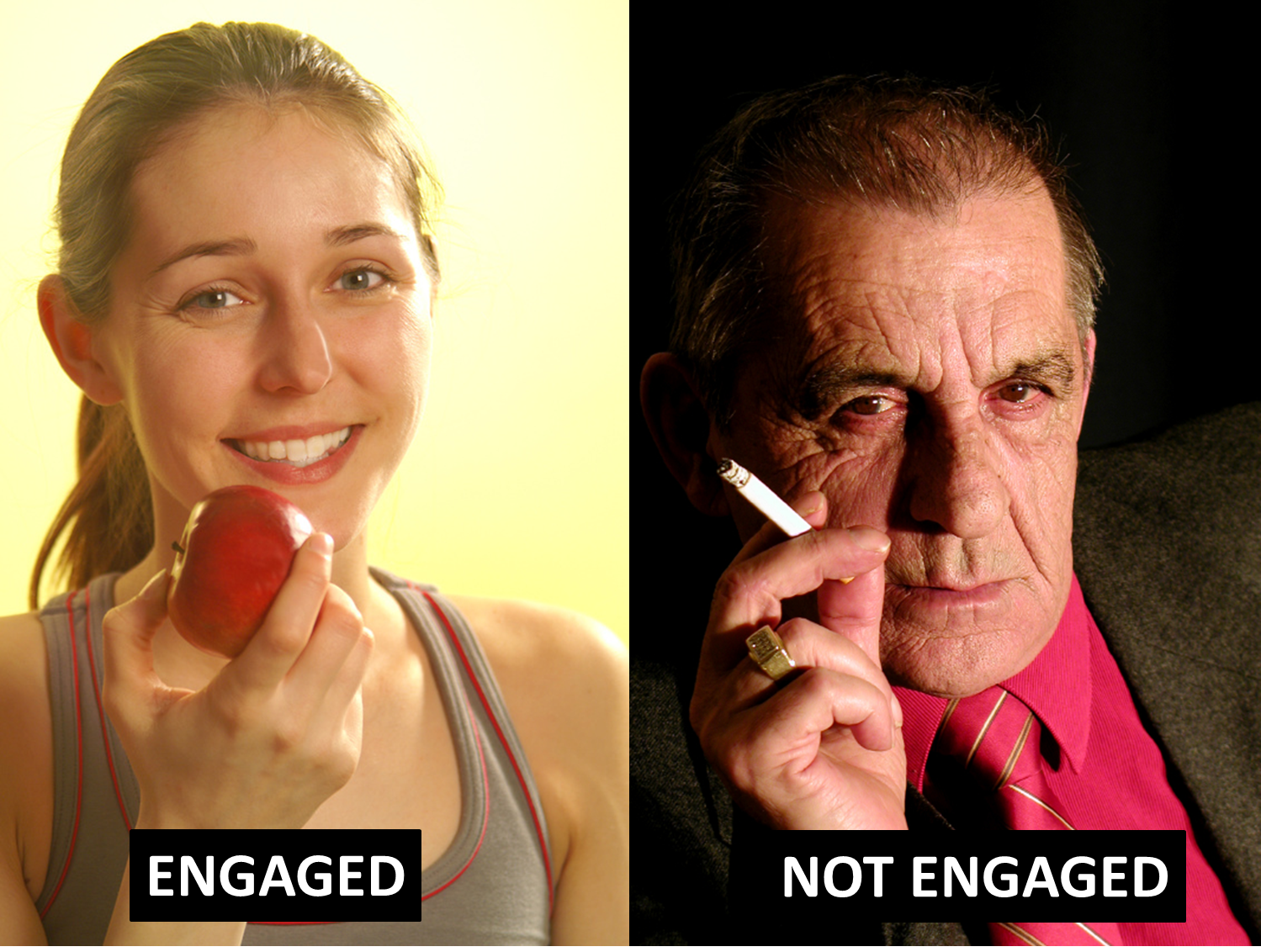
Engaging The Un-Engaged


One of the hot topics in a lot of healthcare conversations these days is engagement.  There’s the “easy” engagement for the e-patients that are actively involved in their healthcare.  Then there’s the much harder engagement of those that aren’t engaged.  And, finally, there’s the issue of chronic engagement.  I can easily get someone to engage a few times with an incentive or some other “trick”, but how do I get them to stay engaged over time.  It’s not easy.

This is one of the topics that will be discussed at the upcoming Forum 11 in San Francisco.  If you’re coming, look me up.  I’m presenting on Friday.

A New Life For Lipitor – OTC?

Are you surprised that Pfizer might have found a way to extend Lipitor?  You shouldn’t be.

As I talked about before, Lipitor is scheduled to go generic later this year.  Now, there are stories that Pfizer may try to take Lipitor over-the-counter (OTC).  As Ed Silverman (Pharmalot) points out, this has been tried before with Mevacor.  Has anything really changed since then?  I don’t know much about any outcomes from the UK’s allowance of Mevacor to be sold BTC (behind-the-counter), but it would be a good point of information.

The prior questions about consumer behavior with an OTC statin all still apply:

  • Will the right people use them?
  • Will there be over-use?
  • Will this create unnecessary risks?
  • Will people monitor themselves appropriately?

Since statins certainly have side effects, this is a real question.

IMHO – I would think an OTC strategy is a low likelihood unless there is some new data.

On the other hand, with home monitoring of cholesterol tests, there have been some changes.  This might be another source of data.  Who’s using these?  Have they impacted their use of medication?

Copay Cards: Don’t Throw The Baby Out With The Bathwater

Prescription Copay Cards continues to be a hot topic (see list of articles at the end here), but I see a lot of FUD (fear, uncertainty, and doubt) versus a lot of facts. At the end of the day, there are certainly a few stories about cases where costs have jumped up due to copay cards overcoming formulary positioning.

But, no one knows the total market impact. I’ve spoken with six different organizations that would be well positioned to know, but they don’t. It’s not tracked or easily available in the data. Reasonable estimates from Dr. Adam Fein over at DrugChannels put the market at about 100-125M Rxs which is about 3% of the total Rx market (assuming 3.3B Rxs/year) or 12% of the total brand market (assuming 75% GFR). [I validated those numbers with a specialty pharmacy that shared that they were seeing 13% of their claims come in with a copay card.] Certainly, the market has grown as IMS estimated in one recent article.

The question of course is whether these are good or bad and whether their use is malicious or not. My conclusions are based on talking with about 30 people in preparation for my AIS webinar on this topic today. What I concluded was:

  1. There is a win-win. Copay cards can improve adherence. Adherence can reduce total healthcare costs. There is a point at which the increased cost curve crosses the savings curve and is something to be considered.
  2. Today’s approach is a shotgun approach by which cards are available online (e.g., www.internetdrugcoupons.com) and by physicians. They’re not focused on patients with need or on patients with adherence barriers. They play into the misperception that cost is the primary barrier to adherence WHICH IT IS NOT. [Cost is an issue in <20% of the cases according to multiple barrier surveys.]
  3. Copay cards are really a CRM Trojan Horse for pharma to build a 1:1 patient relationship (or should be if they’re not thinking that way). Due to HIPAA, pharma doesn’t typically know who uses their drugs. If I were a brand manager, I would gladly trade some copay relief in return for increased adherence and the contact information for my patients.

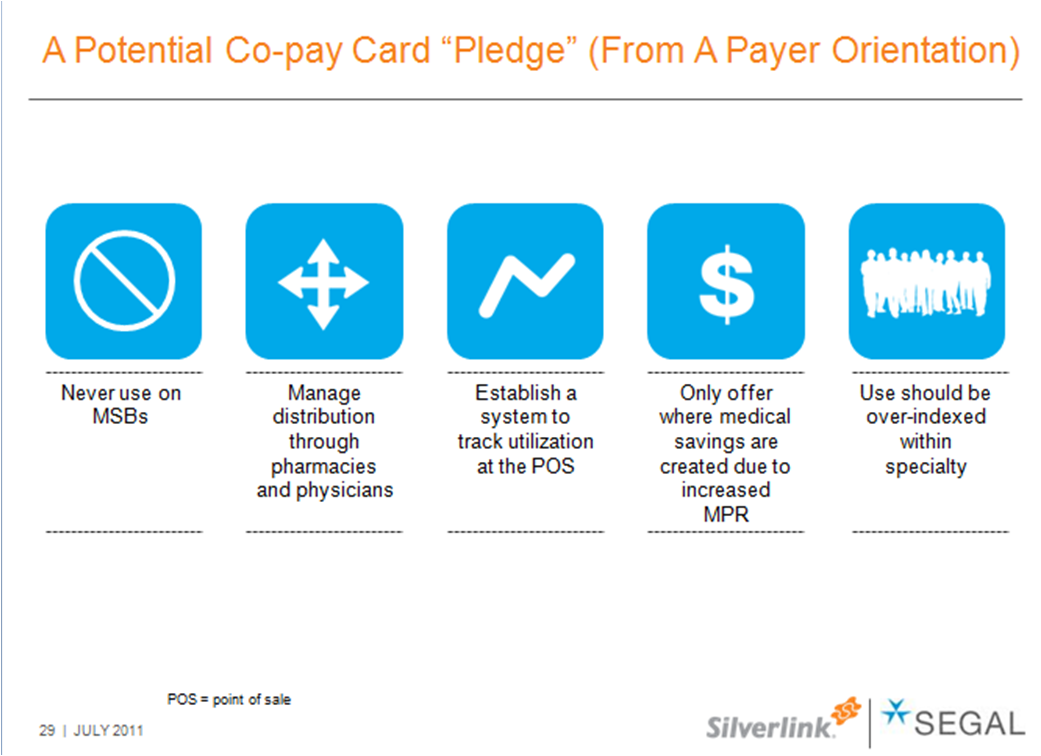
I think there are several ways that industry (especially pharmacies) should collaborate with pharma on how to leverage these copay cards at the POS with patients [call me to discuss]. But, to do that, I think the broader industry is going to require some type of rules which I am sharing shortly as a proposed “pledge”.


The other thing longer-term to watch is will this further change the PBM-Pharma relationship.  I think yes.  If the PBMs push for legislation on this marketing tactic or the manufacturers figure out that this is a better use of their spend than rebates, this will change the relationship. 

Additional Reading:

  1. Prescription Drug Coupons Bad for Patients
  2. Drug Firms Providing Kickbacks For Copays and Coinsurance
  3. DBN article – As Competitors Encroach, Pfizer Seizes A Few More Glory Days With Lipitor Promo
  4. Adam Fein blog posts
  5. Copayment Subsidies
  6. Coupons For Patients, But Higher Bills For Insurers