Archive | Weblogs RSS feed for this section

Links To A Few Other Blogs

Here are a few recent blog posts worth reviewing.

Now, just the other day, I commented that I did see much talk about YouTube in healthcare. In the past 24 hours, two things have come to my attention on this.

  • Allscripts posted a video on YouTube (see below).
  • Glen Beck, a conservative talk show host, had a bad experience at the hospital and put it on YouTube getting 800,000 hits, generating lots of press, and thousands of comments. (see below)

A Second Look – Eli Stone Controversy

I must admit when I saw there was controversy over the content for the premier of the new show Eli Stone that I was really surprised. My view was that it was a show with an interesting story line not a news report. I honestly didn’t realize that the topic of vaccines causing autism was a real topic. (Maybe I just haven’t paid attention.)

I saw several blog entries about it:

I think the quote from another About.com section sums it up pretty well from what I have read:

“I personally believe that the vast majority of people involved in this debate are telling the truth as they see it. But those truths are in direct conflict with one another. That’s where the writers of Eli Stone got it right: today, in the autism community, we are living through what feels almost like an epic battle. Whose truth is truer? Until some as-yet-undefined event provides absolute certainty one way or another, people will continue to take sides based on their beliefs and on the evidence – valid or not – of their own eyes.”

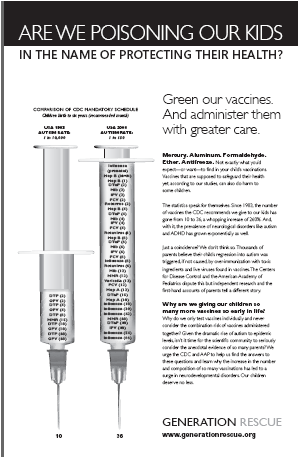
I am clearly not a clinician and haven’t done the research on this topic, but I find it interesting. I likely would have let it slip by me except when I picked up the USA Today on Tuesday I saw a full-page advertisement titled “Are we poisoning our kids in the name of protecting their health?”. It caught my attention so kudos to the designer. So, I read the advertisement and went to the website for Generation Rescue to learn more.

“We surveyed over 9,000 boys in California and Oregon and found that vaccinated boys had a 155% greater chance of having a neurological disorder like ADHD or autism than unvaccinated boys.” [see their study details here]

From the advertisement, it points out that the autism rate in the US in 1883 was 1 in 10,000 and in 2008 is 1 in 150. That is pretty scary. When I was a kid, I don’t remember knowing kids with autism or ADD/ADHD or peanut allergies or lots of other conditions. Today, I know and have friends with kids with each of these conditions. It certainly is more prevalent (or more diagnosed).

The point of the advertisement is that we have increased the number of vaccines we give our kids from 10 to 36 since 1983 and that the over-immunization with toxic ingredients (mercury, aluminum, formaldehyde, ether, antifreeze) and the live viruses have caused this. Of course, the Centers for Disease Control (CDC) and the American Academy of Pediatrics dispute this. I don’t know the answer, but I know that it’s not easily going to get resolved and no magic trial like the show is going to resolve it. It’s not different than many issues in healthcare where there isn’t great comparative data and things are not black and white.

Anyways, watch the show. It’s good. On what the right answer is. I don’t know.
generation-rescue.png

Is Pharmacy Volume An Issue?

Here is a recent headline from USA Today that is guaranteed to capture your attention. Is it sensationalism? The Angry Pharmacist certainly thinks so although I think he/she is being a little harse when they say things like:

If you read the article, it plays on the emotion of the poor kid who got the wrong medication, and the poor baby who got 5x the amount of amoxicillin and would ‘writhe in pain’ (give me a f**king break, a 16 day old baby isn’t even developed enough to know it even exists, let alone what pain is). Wah wah wah. The kid probably was colic or had some gas and was fussy.

Those of us with kids certainly would care and believe that our kids feel pain. I don’t think I would trivialize someone’s individual experience like that.

rx_med_topper.jpg

The USA Today article says that retail pharmacy error rates run less than 1% which seems lower than some numbers I have seen depending on what you count as an error. Is it errors reported to the state board? Is it errors that cause harm? Is it errors that are made by humans but caught by the computer system?

An Auburn University pharmacy study in 2003 projected the odds of getting a prescription with a serious, health-threatening error at about 1 in 1,000. That could amount to 3.7 million such errors a year, based on 2006 national prescription volume.

Obviously pharmacists are over-worked. I know the head pharmacist at my pharmacy works almost 80 hours a week year round. At some point, fatigue will influence a manual job. Additionally, I was shocked when I first realized that in many states all that is required to be a pharmacy technician is a high school diploma. They aren’t highly trained individuals although many with years of experience know a ton and are key pieces of the process. There are some efforts to require certification of technicians across states such as the Institute For The Certification Of Pharmacy Technicians.

Job stress for pharmacists has been documented numerous times and given their salaries, many pharmacies push them to drive down the cost to fill (i.e., the more scripts filled divided by the salary = less cost per Rx).

Daniel Hussar, a pharmacy professor at the University of the Sciences in Philadelphia, offers a more critical view. He says staffing policies have made pharmacy chains stressful workplaces. “The emphasis on speed is counterproductive. It’s an invitation for error,” says Hussar, editor of The Pharmacist Activist, an online newsletter.

The time expectations for the pharmacist are very tight as USA Today reports.

Walgreens’ budget guidelines for work hours, never previously publicized, say a pharmacist at a typical store might have as little as two minutes to verify the accuracy of a drug, its dosage and directions.  [And include counseling?]

With a huge shortage of pharmacists and utilization of drugs going up rapidly, this issue isn’t going away.

Data Power

Communications and data provide us with a valuable tool.  How to leverage facts and put them forward in a way that drives a response.  For some that is getting people to buy a magazine (e.g., 82% of Americans do X…read the article on pg X to learn more).  For others, it is to drive them to buy a product or to prove a claim. The power of statistics is magnified when you have someone who understands how to present information.

I have talked about some aspects of this before around Dark Data, Understanding Healthcare by Wurman, and a little in my entry around COB.

That being said, I found it interesting to read a blog post on Bad Science about “How To Lie With Statistics” which is apparently the best sold statistics book ever (and not even written by a statistician).   Here are a few examples.  Again, it just makes the point that you need to ask questions and understand how a metric is defined, who the survey population was, whether there was a bias, etc.  The data may still be very useful, but you need to understand it before you use it.

Post on The HealthCare Blog

In case there are any of you that read my blog and not Matthew Holt’s blog, he was generous enough to let me post on his blog – The Healthcare Blog (which is the #6 ranked healthcare blog).  I also posted the entry – Peeling the Healthcare Onion – on this blog a few days ago.

BTW – I had a post a few weeks ago where I talked about Andrew Sobol, but I could find his site.  Finally, I realized I spelled it wrong and it is Sobel.  His site is www.andrewsobel.com.  

Want A Blidget

Unfortunately, it doesn’t work with WordPress which is my blog tool, but here is a quick screenshot of a Blidget (Blog + Widget). If you’re interested in adding this to your website or your iGoogle, you can go to Widgetbox.

And, don’t forget to sign up for the e-mail updates if you are like me and want to get an updates e-mailed to you so you only check the blog occasionally without missing anything and can read the content offline.

blidget.jpg

10 Ways To Fix Healthcare (From LiveSmarter)

I am not sure whether this is a new blog or some content off a business site, but I think it is a good entry.  This lays out comments from a bunch of people in and outside the industry about how to fix the situation that we are in.

It includes comments like:

  • “encourage healthcare professionals to cooperate and develop a shared mission.” [Health 2.0]
  • “market forces bear no consequence on rising healthcare costs” [individualized health insurance]
  • “individuals rely on random health events like hospital stays and office visits for care.” [preventative care]
  • “Though preventive programs incorporating diet, exercise and stress management might cost more money upfront, overall costs will drop by 30 percent and may save the patient from going for tests and getting treatment with expensive machinery.” [low-hanging fruit exists]

Data Access Issue

For those of you that ever wonder how easy it is for big technology companies to get to internal data, the WSJ blog highlights an issue that Vioxx litigants are having with Express Scripts.  They want to charge for the data access since it will take 420 hours (or one person for over 10 weeks fulltime) to pull the data at a cost of $150/hr for a total cost of $63,000.  [Not a bad job for someone…$300K per year to run a bunch of queries.]

Generic Changes: Patient’s Confused

Typically these things play out behind closed doors or in court and don’t always impact the patient, but I think the latest Protonix saga will have a brief impact on patients.  Primarily causing some confusion.

The basic scenario:

  • Teva decided to challenge Wyeth’s patent and launches generic Protonix early (this means that they are going at risk and if they lose the patent fight that they owe Wyeth 3x the revenue collected from the product)
  • Teva ships about $300-$400M worth of generic Protonix in December and January
  • Wyeth fights them in court and decides to bring its own generic version of Protonix to market
  • Now, Teva has decided to stop shipping generic Protonix (see WSJ blog on this)

If you’re a United patient, you likely just got a letter telling you that they have moved the generic to the third tier (i.e., highest copay) and moved the brand to the first tier which is typically for generics.  They obviously worked a deal directly with Wyeth.  But, the consumer has to deal with issues such as state mandatory generic laws that require the pharmacy to fill a brand drug that has a chemically equivalent generic available with the generic unless the physician has checked DAW (dispense as written) for the brand drug.

Good business logic saving everyone money, but this may burden the consumer and the pharmacy and the physician.  Hopefully, they have an effective communication strategy to drive patient behavior.

So, your prescription history might look something like this (while staying on the same drug):

  • November – brand Protonix (2nd tier)
  • December – generic Protonix from Teva (1st tier)
  • January – generic Protonix from Teva (1st tier)
  • February – brand Protonix (1st tier)
  • March – generic Protonix from Wyeth (1st tier)

Diagnosis Code Plus Rx

In a WSJ Blog article about sound alike drugs, they have a potential solution about having the physician add information about why the drug is being used.  Obviously, the low hanging fruit here is to move to electronic prescribing where the clinical information (i.e., diagnosis code) is in the same file as the drug and technology can be utilized to look for potential issues.

In the short-term, adding the diagnosis code (aka ICD-9 code) to the prescription would have lots of benefits.

  • Avoid getting some point-of-sale rejects when a drug is used off label.  Or vice-versa, avoid off-label use by rejecting claims.
  • Avoid getting suggestions you change prescriptions only to find out that you should not do it given your diagnosis.
  • Development of proactive algorithms (e.g., macros) in the technology where whenever a doctor diagnosed diabetes then it would pull up their typical regiment of drugs based on formulary status and other inputs.
  • Better tailor / personalize information based on disease and drug to help the patient and their care team drive successful outcomes.

The issue of sound alike drug names is a real issue.  Obviously, any time you have multiple human handoffs in a process then you increase the likelihood of error.  As I think I have talked about before, I remember my MD prescribing an eye drop.  I picked up a prescription and the pharmacist clearly told me to put one drop in each eye twice a day.  At the end of the second day, I read the label in detail and realized that it said to put the drops in the ear only.  When I called them back, they talked to the MD and realized that they had heard the wrong name when they listened to his voicemail.

Predictions…Not Mine

Rather than rehash or even post my thoughts right now (still digging out from vacation)…I will simply point you to a good summary on the WorldHealthCareBlog about what people are predicting for 2008 and beyond around healthcare.

It is a summary from IBM, Deloitte, and many others talking about spend, technology, adoption, new drugs, etc.

Freakonomics on Pharma

The Freakonomics blog has an interesting piece on pharmaceuticals.  It basically asks five experts what is the best secret in the industry.  Here were a few of the quotes from the posting…

  1. “Events are revealing that many pharmaceutical companies, along with their consulting academic physicians, have engaged in practices that obscure or misrepresent information about their products.”
  2. “The United States is subsidizing prescription drug prices for the rest of the world.”
  3. “The obscene profits made on generic drugs by the large chain stores.”
  4. “While most people understand in a vague way that modern biomedical science is advancing at a remarkable pace, many people are less aware that we have been far less successful at translating science from the laboratory bench to the clinic. This is not to say that the pharmaceutical industry has been quiescent; total spending on health related research by the drug industry has increased from about $6 billion in 1980 to about $39 billion in 2004. During that period, basic science research has increased the number of potential drug targets (the biological site on which a drug is intended to act) from 500 to more than 3,000.”
  5. “Underpinning many of the marketing strategies of big drug companies is a very sophisticated and comprehensive plan to widen the boundaries of illness, and create an environment in which more and more formerly healthy people are defined as ‘sick.'”

Paying MDs to Switch

Another WSJ article that I caught on the plane ride home last night was about Doctors Paid To Prescribe Generic Pills. When I read the WSJ Health Blog about this, I was shocked by the comments. It would appear that the blog is followed by people that don’t believe generics make sense. That perspective is a little outdated now that most therapy classes have one of the most popular drugs available as a generic.

Yes, in some cases there have been minor improvements, but I don’t think anyone can (with a straight face) get up and talk about how Nexium is clinically superior to generic or OTC Prilosec (see general comments about category of PPIs). There has been numerous research showing that the probability of having success with any anti-depressant is the same regardless of what drug you begin therapy with (so why not start with a generic). And, generic drugs have been around for a long time so all their side effects and drug-drug issues are well known and documented. There has never been a generic drug pulled from the market.

Here was what I posted there.

Wow! There seem to be a lot of the glass is half-full people out here. What if the generic (which often was the most prescribed drug in the class before the patent expired) is clinically appropriate.

There are 10,000+ drugs out there. Physicians can’t be expected to know and monitor the comparisons on each one. That is what technology and pharmacists are focused on. So, if companies can identify a way to help the patient save money, what’s wrong with switching drugs.

The exact process of paying the physician seems suspect, but some incentive to reward them for their time (perhaps regardless of outcome) makes sense. You are asking them to pull the patient’s file, look at a different drugs and perhaps some clinical information provided by the payor, and determine if a switch makes sense.

Physicians today rarely have an incentive linked to drugs so why not prescribe the most expensive, most heavily sampled, most advertised drug. That’s the easy path.

I don’t disagree that more sharing of the benefits might make sense, but the market has changed. Generics and therapeutic conversions can make a lot of sense.

The issue of incentives is a broader one.  Paying physicians directly per switch seems a little suspect.  But, incenting them to save money for plans and patients makes a lot of sense.  But, like any incentive system, it has to be balanced.  Health outcomes balanced with cost management.  Patient satisfaction balanced with simplicity of the process.  I won’t get on my soapbox here.  Metrics are difficult, but the system today doesn’t always align the parties correctly.

Wal-Mart: New PBM?

Well.  I am back from vacation.  I grabbed a WSJ on my way home from Orlando and was surprised to see an article about Wal-Mart potentially going into the PBM businessNot a surprise that they would go into the business, but a surprise that they would build it organically.  (Although I don’t believe they have confirmed their exact intent.)

Of course, pre-stock market correction, the PBM stocks (Medco, Express Scripts, and Caremark) were all very expensive, but there are numerous smaller PBMs which could be bought and give Wal-Mart the adjudication systems, logic, and other processes to jumpstart the business.

Logically, Wal-Mart is strong at many of the core PBM functions – supply chain management, cost management, and distribution.  But, this is not a retail play.  There is no efficiency per square foot to compare to other functions.  And, you are selling primarily to the payor not the individual.  And, face facts, Wal-Mart hasn’t traditionally been recognized as the healthcare friendly company for many of its million workers.  Would employers face backlash trying to convince their employers that they were simply containing costs or actually engaging Wal-Mart to educate and help employees make good health decisions?

So, it bears the question of whether they see a broader trend.  Could consumerism spell the end of the traditional business-to-business PBM and drive a business-to-consumer PBM?  Since the Wal-Mart Bank idea never took off, could they get into the space through healthcare.  [The convergence of Health and Wealth has been written about numerous times.]

Obviously, CVS saw a strong play in the PBM space with its purchase of Caremark.  Walgreens already has their own PBM.  And, with Wal-Mart being the third largest retailer, it would seem like a logical trend to build out their PBM functions.  [I think they have some PBM services that they provide today, but mostly for their own employees.]

How Some People Feel About HealthComm

Healthcare Communications (HealthComm) are never what we run home to receive, but they are often important.  Unfortunately, it has lacked a focus historically.  Most of the focus was on claims systems and underwriting and network size.  Not that those areas work perfectly, but there is clearly a movement toward customer service, patient satisfaction, and communications (inbound/outbound, letter/call/e-mail/live agent).

Look at this blog entry on a very popular blog and some of the comments.  It is a big uphill battle.

Types of Business Blogs

I was looking at something that someone sent me from Paul Gillin’s Social Media Report about different types of blogs. I found it pretty interesting especially some of the examples.

First, he talks about company blogs including the CEO blog and the group blog. They definitely can be interesting, but it really is a question of momentum and interest. I also think blogging has to be from top of mind not from some carefully scripted public relations process. (I.e., there will be times that the blogger gets someone upset and stirs some discussion…which ultimately is a positive)

For example, I was really disappointed to see that Unica was unable to continue their blog. Now, on the other hand, I do think there is a definite role for topical blogs that have numerous participants from several companies. I used to syndicate my old process management blog through one of these sites and found it worked great. (Not to mention that I got 7,000 readers overnight.)

Paul talks about three other types of blogs – Executive Blog; Advice Blog; and Advocacy Blog. Here are a couple of examples that he gives:

For more on corporate blogs, you can go to his website or BlogWrite.

I have talked about why I blog before, but I often think about it as a modern journal and an alternative to e-mailing people with articles that I read. If it helps business…great. The reality is that I am passionate about what I do and talk about it all the time. I choose the job to emulate my passion. I would think that is the only way a corporate blog will work and be genuine.

A few quick links

Just a few quick things before I dash off to get some work done this morning…

Thanks to Guy Kawasaki’s blog I found a communication’s blog which features a few things such as this entry on the best and worse communicators and another one on presenting.  I will have to add it to my Google blog page.

A medical student in Australia has a collection of Medicine 2.0 thoughts and predictions collected on his website.

And, one final one as a follow-up to my entry on health goals is an entry on Brazen Careerist about achieving goals.

The Next Health 2.0 Conference

If you’re interested, the next Health 2.0 conference agenda has been released.  It looks like it will be even more interesting than the first conference.  From the agenda, you will see that Matthew and Indu have organized a good mix of large healthcare companies (McKesson, Kaiser, Regence) with new and rapidly growing healthcare companies (BeWell Mobile, Silverlink, ReliefInsite, Xoova) and one of my favorite companies IDEO.

If you work in healthcare, you should think about attending.  If you’re a patient, you will find some of the ideas and the new companies interesting.

Forrester on PHRs

In mid-November, Forrester put out a report titled “PHRs: From Evolution to Revolution” by Liz Boehm, their healthcare lead. It’s not my lead area so I didn’t spend the money to buy the report, but here is the executive summary.

Health plans, driven by employer demand and expectations of improved member satisfaction and reduced medical costs, are investing in payer-based personal health records. But consumers have not raced to adopt them. Health plan customer experience professionals are on the hook to not only drive adoption but also engineer low-cost, interactive health support programs that will help members make better choices and save costs. To maximize their chance of success, health plan customer experience professionals need to focus on four critical areas: data management, behavior change, interface best practices, and patient and provider recruitment. This focus will help drive near-term success and position plans to weather the coming changes in the personal health record (PHR) market.

What I found interesting was the list of companies that they interviewed (and who they didn’t talk to).

A few recent entries on other blogs

It is always important to see what others are writing about on their blogs. There are now almost 700 healthcare blogs tracked by eDrugSearch. (Just 6 months ago, I think it was only 400.) Here are a few recent posts worth reading.

The main value of transparency is not necessarily to enable easier consumer choice or to give a hospital a competitive edge. It is to provide creative tension within hospitals so that they hold themselves accountable. This accountability is what will drive doctors, nurses, and administrators to seek constant improvements in the quality and safety of patient care. So, even if we can’t compare hospital to hospital on several types of surgical procedures, we can still commend hospitals that publish their results as a sign that they are serious about self-improvement.

    • On DiabetesMine, there is a great summary of all the things that have happened around this disease in 2007.
    • It’s not healthcare specific, but Seth Godin’s entries are always interesting.  Read this one about what you did in the past and grabbing opportunity.  It should help you set a positive outlook for 2008.
    • A new blog that I recently started following is called Enterprise Decision Management.  Here is one entry on Business Intelligence 2.0.  He has lots of great entries that I will elaborate on later.  This approach is core to creating an intelligent healthcare communications strategy.
    • The Hospital Impact blog has a nice entry on 2007: A Year in Review.
    • On the Health Business Blog, David talks about “shopdropping” which is a retail activity where people leave things at stores (i.e., reverse shoplifting).  Interesting.
    • John quotes a study on the eHealth blog that says that 39% of physicians are e-mailing patients.  I find that amazing.  I have never heard of a physician doing this.
    • On Hospital Marketing, there is an entry on Hospitals in Facebook which makes the point about healthcare being behind and not thinking creatively about how to use new media.  I would like to see some discussion there on the topic, but there hasn’t been any yet.

    Just a few other blogs to check out.

      Passing on the costs of unhealthy behavior

      I mentioned it in a blog post a few days ago, but apparently, companies can now screen employees for something like smoking if they have a published policy.  [I don’t know all the details.]

      The Cleveland Clinic won’t hire anyone who smokes anymore and Scott’s gives you six months to quit smoking or you get fired.  (Based on the fact that it costs about $3,400 more per year to employ someone who smokes.)

      I asked a friend of mine at a large insurer this week who verified that they are getting lots of requests from employers around smoking.  Most companies are trying to figure out whether they discourage smoking or simply pass on the costs to the smoker.  This begs the obvious carrot or stick discussion in terms of motivation.

      It made me wonder what would be next.  Obesity would seem like the condition that companies would want to address since it is tied to so many diseases and drives so much cost.  Maybe a BMI sliding scale for healthcare costs.  Of course, you would need to have some type of test to exclude people who were genetically pre-disposed or medically not able to control their weight. 

      Whatever approach was taken, there is a lot to driving positive behavior.  A blog entry on Consumer Focused Care does a great job of talking about this.  He talks about how a group of maids became healthier simply by being told that their work (e.g., scrubbing floors) was equal to the recommended daily exercise.  There is a power in being positive and helping people realize what they can do to make a difference. 

      PHR as a Chip

      I am sure some people think of this as a crazy notion.  Would this ever happen?  What are the implications?  What is the value?

      People getting “chipped” seems scary to a lot of people.  But, an intelligent chip that could collect body information – weight, blood pressure, etc – and feed it to a PHR (personal health record) seems pretty interesting to me.  Even simply having a chip that could be read and used to identify you if you were unconscious or dead or unable to identify yourself seems valuable.

      I have seen John Halamka talk briefly about his chip live, but I was glad to see that he has a whole entry about it on his blog “Life as a Healthcare CIO“.  It is a good read of the pros and cons. 

      DTC Marketing Blog

      I just discovered a blog this morning on DTC (Direct to Consumer) marketing around pharma. I read a few of the posts which seem to provide a good perspective on some of the recent things going on in the industry.

      One that stuck out at me talked about the effectiveness of sales reps.

      75 percent of pharma rep sales calls don’t involve a face-to-face meeting with a doctor, according to research by Leerink Swann & Co.

      I never worked for big pharma doing detailing, but I had a brief chance to try it when I managed a small sales force detailing physicians on generic drugs, mail order, and electronic prescribing.  The reps seemed to have decent access to physicians especially once they built a relationship with the office staff and understood his/her busy times.  Of course, we were bringing a new topic to the table and in some cases were partnering with the local healthplan.

      One of my biggest takeaways from that was that it takes at least 7 times (with the same message) to make an impression.  The physician is so busy and has so much information coming at them that this is a long-term strategy.  I am honestly surprised the industry hasn’t moved to online detailing or even “books-on-tape” type of detailing where the physician can get the information they need at the time they need it.

      It was also interesting that some places were beginning to charge pharma or the reps for  access to the physician.  It would be interesting to really sit back and understand how reps can help physicians improve the safety, adherence, and wellness of their patients.  That is in everyone’s interest assuming the market will bear the correct price for value-added therapies [which I think specialty drugs prove out given their ability to price the drugs at a 10x+ multiple of normal oral solids].

      Are You Growing Your Vegetables

      I read this interesting analogy this morning about marketing and comparing it to gardening.  I think the author’s points are very relevant when you think about patient retention within healthcare.  A few of the points that come through in the blog entry are:

      1.  It takes effort.  (i.e., vegetables don’t just grow by themselves)
      2. You have to be consistent.  (i.e., you can’t overwater one day and not water for weeks)
      3. Not all vegetables are the same.  (e.g., some like more water or light than others)
      4. You do get better with practice. 
      5. There is lots of competition (e.g., bugs, animals), but it is healthy.  You can’t simply kill the competition with pesticide (i.e., price war).

      Two points that the author didn’t make which I think are relevant are:

      1. You can’t grow all vegetables at once.  (i.e., you have to focus on what will respond given your soil, environment, etc.)
      2. You have to plan long-term.  (e.g., some professional farmers rotate fields to optimize yield over multiple years)

      Would You Pay for Disease Management?

      After landing (I often blog on the plane), I posted the last post about the Medicare pilot.  When I looked at my iGoogle page that tracks many of the blogs I watch, I saw a new posting on the WorldHealthCareBlog about Disease Management.  It is a good discussion on the value (if any) and talks about the different types of value (i.e., absenteeism versus lowering medical spend).

      With such ambiguity, I think I would think differently.  If you had $X to spend per year and you were responsible for your total healthcare spend, would you (a consumer) spend money on DM?  At least intuitively, I would…assuming I had a chronic disease which was high cost and complicated.  Having someone push me information, coach me on how to get better and/or manage the disease, helping me find resources, navigating my benefits, etc., seems like something of value.

      Obviously, there are lots of challenges here, and I think the current models often use too high cost of channels and don’t leverage technology.  At the same time, patients don’t have the same incentives today so they don’t necessarily always do what’s best for them.  (Think of all the people that still smoke given all the research that shows how bad it is for you.)

      Staying Current – Blog Options

      Obviously none of us have time to stay current with everything. Remembering all the blogs you like, visiting them regularly, and reading all the e-mails, mail, and publications can be overwhelming. I can’t simplify it all, but I thought I would suggest two ways of staying informed if you find this or other blogs interesting.

      First, you can subscribe to the e-mail list. What this means is that any day there is a new post you will get an e-mail sent to you. Here are a few screen shots so you see what that means. It is an easy to read format sent by Feedburner. It has links to forward the article and unsubscribe at anytime. (But, you should know that you will get a confirmation e-mail from Feedburner after you register. Make sure it doesn’t get caught in your spam filter. I have about 10 people that have signed up to receive updates, but they have never confirmed.)

      I find this easy since I read a lot offline, and I visit when I need to not trying to time new posts.

      e-mail-start.pnge-mail-end.png

      The second option is to use a blog reader tool like iGoogle where you can have all your blogs. I use this as my start-up page in my browser so I can see what the world is talking about from traditional media to different bloggers.

      igoogle.png

      Healthcare Marketing

      I have talked about it a few times here.  Healthcare marketing lags the industry.  We don’t use technology creatively.  We don’t traditionally think outside the box.  We are risk adverse.  We are historically focused on business-to-business (B2B) not business-to-consumer (B2C) sales.  We don’t have sophisticated data mining.  This has certainly been validated for me when I go out to meet with payors and find out that the person I am meeting with just came from a consumer products company.

      Today, the World HealthCare Blog talks about a healthcare marketing model.   It talks about possible models to apply.  It suggests the automotive industry as one rather than financial services or service industry.  I think financial services is a good model since people view their financial data as confidential like their health data.  I think the service industry is relevant since it is about the experience and support which for many patients is how they experience healthcare.  The automotive industry doesn’t work for me.  It is generally a luxury good with lots of variability.

      The challenge in general is that healthcare marketing is selling a product that people don’t understand and don’t want to people who believe they are generally entitled to it.  Not any easy problem to solve.

      “Until providers expand their horizons to see their “products” in terms of life meaning and impact, health care marketing will be mired in myopia, focused on features and attributes, or rare and episodic encounter experiences.”

      Patient (Customer) Value – Social Dimension?

      I was reading an interesting entry on Forrester’s Marketing Blog about redefining the value of your customer away from ROI to something that reflects their social value.  The author defines social value as:

      1) A customer’s knowledge and involvement – in short, his level of expertise and interest in the category and brand. 

      2)  How he participates, and the value of his connections – what social activities is he involved with (both on and offline) and where (on what networks is he active).  The value refers to the value of the connections themselves:  are the communities more tightly-knit or diffused, are they public or more intimite.

      3) The number of contacts the customer has in each network. 

      It made me think about two things: (1) how would we value a patient in healthcare and (2) how do we drive and evaluate social value.

      Different constituents would value patients differently [these represent logical hypotheses but not fact]:

      • To a pharmacy, it is the high utilizer that they want.  And, they make the most money off a cash paying customer who buys generic drugs at something close to their AWP (Average Wholesale Price) which is about 70-90% too high.
      • To a PBM, it is the chronically sick patient who fills lots of drugs but is very active in their healthcare so they use the website, use mail, use generics, and don’t call customer service very often.
      • To a managed care company, their highest value customer (or patient) is the healthy individual who is insured so that they collect the premium but don’t actually pay anything out.
      • To the physician, their highest value patient is the sick consumer who needs specialized care which they have to provide (e.g., injections done by the physician).  In a capitated model, this is different because they want to create healthy patients and are incented to promote wellness.
      • To the hospital, their highest value patient is the insured patient who has a complex illness that requires lots of tests or who has an elongated hospital stay.

      Driving and evaluating social value is a different animal.  I do believe that providers and insurers should be promoting communities of care where people with diseases can share experiences and information.  That will be a powerful tool in promoting consumerism.  A managed care company (e.g., United, Humana, Wellpoint, BCBS) has enough scale that they could create an anonymous discussion area for their covered lives which was moderated by an expert.  (Not too dissimilar to the disease specific pharmacies that Medco is creating with their Therapeutic Resource Centers.)

      Assigning value is more difficult, but it could be a composite score of activity on the web, registration in certain groups, etc. It won’t be perfect, but it is clear that some people are outspoken advocates which can promote or hurt your brand.

      Comments to a Few Posts

      I went out to the Hospital Marketing Journal this morning and looked a few recents posts. 

      One entry is about “The Other CEO” which is the Chief Experience Officer.  I agree completely.  Healthcare is such an experiential business that we should be thinking about this from our process design through our architectural design.  There are many things that can be done physically to improve the experience not to mention service levels, communication techniques, and other levers that people could pull.

      The other entry which is about a topic I have struggled with several times is called “Just Put It On My Card” which is about a credit card for patients that can’t afford their out-of-pocket expenses.  On the one hand, great.  I would hate for money to push someone to not be compliant or miss a physician’s visit.  On the other hand, how sad.  We have to loan people money to afford their healthcare??  Do we offer to excuse the loan if they become sick and can’t work?  Are we charging them outrageous interest on the credit?

      For whatever reason, the social democrat in me finds the concept of loaning people money (which means they ultimately pay more with interest) for their basic healthcare costs a very slippery slope.