Shifting Trends

Anyone whose read my blog knows that I find Penelope Trunk’s insights both interesting and unique.  She cuts to the chase and talks about things very directly.  As always, I think you will find some of her comments about how the economy is changing our behavior interesting.

She lays out 5 items here and they talk about it being cool to be cheap and women earning more than men.

Is Choice Good?

In recent discussions, I was talking with some clients about helping members or consumers save money in healthcare.  On the one hand, you can educate them about all the different opportunities.  On the other hand, you can focus them on one or two opportunities.  Those could offer the most value, be the simplest to execute, be the easiest to understand, or have some other logic in prioritization.

The question in my mind was what would drive the best results.  If you look at the research around consumer products and 401K’s (for example), it is clear that choice is not always best.  When presented with more options, people don’t always make a decision.  They get overwhelmed.

So, think about focus and simplification.

Friends Don’t Let Friends

If they can use this concept for selling DirectTV over cable, why don’t we use this more in healthcare?

It could be…Friends Don’t Let Friends:

  • Pay too much for medication
  • Use brand drugs unnecessarily
  • Use retail for maintenance drugs
  • Call into the call center when the information is on the web
  • Go to the ER when they can call the nurse line
  • Pay too much for individual insurance

Maybe, in today’s economy, it will be time for healthcare companies to look for seriously at referral programs. 

  • Get a friend to come to mail order or the local CVS and get your next prescription copay waived.

Everyone is focused on saving money.  Social networking is all the rage.  People trust their friends.  

Now, I may not want to tell my friends that I am on cholesterol lowering medication so that may change it.  But, certainly people talk about higher level items like shopping for individual insurance.

A Few Quick Things

Found this new blog – Drug Channels.  Lots of good posts.

Ron Lyon unfortunately doesn’t blog a lot, but several of his recent posts are very interesting on the Pharmacy Rants and Raves blog.

Bruce Temkin from Forrester blogs at the Customer Experience Matters and has some great insights across industries.

McKinsey has jumped into the social networking fray with their McKinsey Quarterly which is available with a Facebook page and Twitter feed.

A report on Medicare spending on healthcare by the Kaiser Family Foundation.

A new eBook on Finding Dr. Right.

SPAM is Back!

spam_can_smallYes.  I am talking about SPAM, the food, not spam as in junk e-mail.  In this economy, their production is up dramatically to levels they haven’t seen since WWII.  But, according to the NY Times, there are lots of thrifty food items that are seeing increased success:

  • Macaroni and cheese
  • Jello
  • Instant potatoes
  • Velveeta
  • Rice
  • Beans
  • Kool-Aid
  • Vitamins
  • Beer

Probably not the right grocery list to create a balanced meal.

Personalized Medicine Webinar

I don’t have anything to do with this, but it sounds pretty interesting.  Medco and Regence are talking.  Here is the teaser.  (Click here for more info and registration.)

Personalized medicine is moving rapidly. The FDA in December considered requests to require genetic testing for the colon cancer drugs Vectibix and Erbitux. Approval of such labeling changes could pave the way for a slew of other personalized therapies and diagnostics now waiting in the wings. Stakeholders anticipate significant clinical and financial savings. Recently approved genetic testing for the blood thinner warfarin, for instance, is projected to avoid 85,000 serious bleeding events annually and save roughly $1.1 billion a year!

On the other hand, questions remain whether the model actually provides a favorable return on investment (ROI). A new study finds that genetic testing for warfarin does not appear to be cost-effective in certain patients. And health plans and PBMs are trying to sort out which of the numerous diagnostic tests on the market actually provide clinical utility and improved results. One large health plan, for example, says its costs for diagnostic testing are growing at nearly 20% a year.

So where does all of this leave Rx payers in February 2009?

Ix for Rx Management

Josh Seidman from the Center for Information Therapy today announced on their blog that the center is going to begin focusing on “Ix for Rx Management” that will look at adherence along with other critical issues.  As I talk about all the time, finding the right way to deliver information to people in a way that they can accept it and act upon it is critical.  Given that we use more and more medications, this is a critical area where the center’s leadership can help build awareness of the problems.

“Although awareness certainly is an important precursor, it may be the easiest step in the pathway that takes the average consumer along the road to information consumption, then knowledge accumulation, and ultimately leading to behavior change. We know there’s a large body of research that tells us that, in order to be successful, our Ix initiatives need to “meet people where they are.” More specifically, we need to target the information to the individual’s particular moment in care and tailor it to their particular needs and circumstances.”

The Young Invincibles

“I could have gone to a major university for a year. Instead, I went to the hospital for two days.”

The New York Times had a good article about young people without insurance.  According to the article, there are 13.2M within this group or 29% of the age bracket (which I believe is limited to people in their 20’s).  The article talks about borrowing medications, setting their own bones, and using the Internet to self-diagnose.

“We see people with urinary tract infections taking meds better suited for ear infections or pneumoniaDr. Barbie Gatton explained (ER doctor in NY) “Or they take pain medicine that masks the symptoms. And this allows the underlying problem to get worse and worse.” — the problem is, they haven’t really treated their illness, and they’re breeding resistance.”

My impression is that most people in this age group only act as “invincible” since they can’t afford coverage.  The article does talk about legislation that would allow people to be covered under their parents insurance until they are 29.  That certainly helps some, but it puts a burden on employers that may not be fair.

Seeing Significant Improvements With BPO

Business Process Outsourcing (BPO) or as I will sometimes call it CPO (Communications Process Outsourcing) is something we are definitely seeing a growing demand for in the market.  It blends technology, services, process management, consulting, and analytics.

Both IDC and Gartner have now talked about this in recent reports.

According to Janice Young, IDC program director, Payer IT Strategies, “we expect to see an increasing interest and likely investment in BPO in 2009 and 2010 for healthcare payers. Our recent results from our January 2009 healthcare payer survey of IT spending indicate that 45% of healthcare payers expect BPO investments to increase this year.” These trends are highlighted in IDC‘s U.S. Healthcare Payer 2009 Top 10 Predictions (January 2009).

Gartner research vice president, Joanne Galimi, reported on BPO services within health plans in a recent report entitled Healthcare Insurer Business Process Outsourcing Trends (January 2009). “Although things look gloomy for the larger economy, the potential for BPO to address immediate business pressures and long-term recovery goals for the health plans will be unprecedented,” says Galimi.

When I first came to Silverlink as a consultant in early 2007, this was exactly my vision.  I always talked about the “one throat to choke” model.  When you are in an operations role, it is always so difficult to coordinate modes, vendors, discrete data sources, and ultimately to get a holistic view of the member (or patient).  This is what I wanted to help build and is exactly what we have done.

Fortunately, we are now in a position where we can talk about how this service model has grown and how offering turnkey services for clients has driven results.  I love to focus on outcomes so this is exciting.  Here are a few from the press release we put out this morning:

  • Over a 300% improvement in retail-to-mail conversions for a large pharmacy benefit manager (PBM),
  • 54% increase in participation for a pharmacy program, representing between $150 and $175 per year per prescription in consumer savings,
  • 400% improvement in yield in a COB program, translating to over $20 million in cost savings to a major U.S. health plan, and
  • Up to an 82% increase in transfer rates for population health engagement for disease management, lifestyle management and treatment decision support programs.

Pharmacy Principles for Healthcare Reform

Several pharmacy groups have put out their principles for healthcare reform:

“Proper use of prescription medications helps improve quality of life and health outcomes. How ever, the health care system incurs more than $ 177 billion annually in mostly avoidable health care costs to treat adverse events from inappropriate medication use. T he proper use of medication becomes even more important as treatment of chronic disease costs the health care system $ 1.3 trillion annually, or about 7 5 cents of every health care dollar.”

The document goes on to talk about the importance of pharmacists in managing chronic diseases and helping patients.  A role that I completely support although I question the bandwidth of the pharmacists to do this given the massive shortage in the US.

The Principles are:

  1. Improve Quality and Safety of Medication Use
  2. Assure Patient Access to Needed Medications and Pharmacy Services
  3. Promote Pharmacy and Health Information Technology Interoperability

They are kind of like “No Child Left Behind” in that you can’t argue with the concepts.  At first read, the only thing that raised an eyebrow for me was some of the language around Principle 2.  I could interpret it to be a subtle play against some of the trend management tools that the PBMs use to help control prescription costs – e.g., mail order pharmacies.

Process…The Key to Success

“We get brilliant results from average people managing brilliant processes. We observe that our competitors often get average (or worse) results from brilliant people managing broken processes.”

Sources: “Decoding the DNA of the Toyota Production System,” Steven Spear and Kent Bowen, Harvard Business Review, September-October 1999

I think this is so important especially in times like this when we are all focused on doing more with less. It is critical to understand how your process works; how to apply automation; and how to learn and improve it over time.

I came across a presentation from a webinar I gave back in 2007 on Business Process Management (BPM) which made me think about this. (Some of the vendors in this space include Pega Systems, Lombardi, and Appian.)  It’s also very relevant given Gartner‘s recent report on Business Process Outsourcing (BPO) in the payor space.

“Healthcare insurers should view business process outsourcing as a means to achieve business transformation while minimizing risk. Therefore, using BPO for nondifferentiating business processes is an essential step toward achieving competitive success and business growth.” Joanne Galimi in Healthcare Insurers Business Process Outsourcing Trends (January 23, 2009).

Finding a business partner that can work with you to understand your processes, understand what measures matter, help you improve your approach, and that is willing to take risk based on your success is important.   I always encourage people to not think of companies as vendors but as partners that bring them innovative ideas and help them iterate to improve.  I don’t believe in the big bang theory that I can do it right the first time and never need to change.  That flies in the face of everything that has been observed in different industries.


Siftables: Very Cool Tools From TED

A friend shared this video this morning with me. Very cool. This is a presentation by David Merrill from MIT about Siftables. He has integrated new technologies with our traditional building blocks to build interactive, high tech blocks that can be used for spelling, math, music, and other ideas.

Imagine the ability to use these to teach people.

Walking Surveillance Device

There is always lots of debate on the issue of privacy.  Clearly, there are military reasons to collect data (with debates on appropriate use).  There are programs we willingly opt into (like when I sign up for an organizations e-mail list).  Within healthcare, we have HIPAA that tries to protect our personal data.  Then there is the constant paranoia about how much your employer monitors on your computer – what sites you visit, your keystrokes, what you say on the phone.  Then on the more debated side there is what information is it okay for a company to aggregate and use to push information to me that makes me healthier or saves me money.  I don’t expect this will get solved anytime soon.

I think this is why I found the story about Google’s G1 interesting in yesterday’s paper where it talks about how Google aggregates information from you to better target you with advertisements.

“It enables Google to field your search queries quickly when you’re on the run. It also gives Google access to your contact lists, IMs, e-mails, personal calendar, social networking and video downloading — the videos you’d fess up to publicly, as well as the ones you might not. As for all those “personal photos” swapped with pals on Facebook, MySpace and Twitter: Google can grab those, too.

Everything gets crammed into your personal “file,” so to speak, along with a lot of other stuff — such as where you bank, shop and cruise on the Web when you’re lonely, bored or just in the mood for a little fun.

Once your information has been collected and stored, there’s no way to get rid of it. You can’t see what’s been collected or have it expunged. It’s Google’s for as long as it wants to hold onto it.”

Obviously, more and more people use mobile devices and the mobile web.  It’s one thing to have your information aggregated when you use a service (i.e., Google search).  It seems another thing for them to pull information from your device and aggregate it.  I am not sure how this will play out, but I expect there will be a lot of discussion on blogs about this topic.

Cigna And Social Media

I usually hold Humana out as an innovator in the area of established health care companies using social media and other tools to drive awareness.  I was pleasantly surprised to find out more about Cigna’s activities on Facebook, MySpace, and Twitter along with their deployment of games (like Humana) from the World Healthcare Blog.

its_time_image_5

Focus On Chronic Diseases

People are always talking about where to focus to reduce costs in the US health care system…Here’s a hint from the January 2009 Health Affairs Health Policy Update:

“Now three-quarters of the $2 trillion-plus that we spend on U.S. health care each year goes to paying the bills for chronic illness:  cardiovascular and pulmonary disease, cancers, diabetes, arthritis, high blood pressure, depression.  Globally, the World Health Organization estimates, three out of every five deaths – four out of five in low- and middle-income countries – stem from chronic disease.”

Trendsspotting

You can find more out on the website, but I liked a few of their predictions for 2009+.

Explaining WOM and BUZZ

These are two marketing tactics that are related.  WOM = Word of Mouth.  Buzz should be fairly straightforward.

Are You A Registered Organ Donor?

According to one article, there are about 70M registered organ donors which is a number that has increased as 31 states now allow people to register online.  Considering the wait list for donations – just over 100,000 today according to The Organ Procurement and Transplantation Network – this is an important thing to consider.

Here is some of their data:

Marketing In A Recession

Most healthcare people hate the word marketing.  Well, you know what…that is a big piece of what healthcare is about especially with the rise of consumerism.  Individual marketing.  Medicare.  Getting people to make better choices.  It’s all about marketing.

One of the things I liked in the attached presentation is that it talks about tightening up your funnel.  One of the things I notice with lots of companies is that they don’t always take a rigorous process framework for thinking about members and communications.  Process matters.  You have to think about an integrated approach and how you optimize that process.

The Easiest $400+ You Can Save In Healthcare

In today’s economy, we are all looking for ways to save. And, it should be no surprise that pharmacy is the most frequently used benefit since, on average, people get fourteen 30-day prescriptions per year.

That being said, there are still hundreds of dollars that millions of us can save. Let’s take an easy example – Lipitor. Lipitor still has about $8B in sales here in the US. If you assume the monthly cost is $125 per 30-day supply and everyone on the drug filled it 12 times per year (which doesn’t happen but is a topic for another day), that means that each consumer on Lipitor represents $1,500 in revenue to Pfizer per year. Dividing the $8B by $1,500 tells me that there are about 5.3M consumers using Lipitor in the US.

On most formularies (or preferred drug lists), Lipitor is a 3rd tier drug meaning that consumers are paying $40-$50 per month for this drug. Considering the fact that Lipitor has a generic alternative which is called simvastatin (aka generic Zocor), consumers can often talk to their physician and use this drug as a lower cost alternative. Additionally, both of these drugs are maintenance drugs that can be filled at mail order which often represents a 30% savings to a consumer (based on average plan designs). And, finally, simvastatin is a drug which can be split according to many different companies.

Here is the math, but a consumer on Lipitor could talk to their physician to get started on simvastatin, split the pills, and after a few months move to mail. That would save them $400+ in many cases.

  • Assuming Lipitor is a 3rd tier drug with a $40-$50 monthly copay and the consumer fills the drug every month for a year, they would spend $480-$600 out-of-pocket.
  • Assuming they moved to simvastatin (with their MD’s approval) with a $10 copay, they would immediately drop their costs to $120.
  • Assuming they split their pills (i.e., got a higher dose of the medication and used a pill splitter to use ½ the pill each day), they would typically reduce their copays by 50% or drop their costs to $60 a year.
  • And, if they then moved the prescription to mail where they reduced a 90-day supply for the same price as a 60-day supply at retail, they would drop their out-of-pocket costs to $40 a year.

I don’t know about you, but that seems pretty easy. It’s clinically appropriate for most patients. The PBMs will typically help you with these programs by reaching out to your physician to get the new prescription.

Hopefully, you’ll be hearing from your PBM or managed care company about these savings. At Silverlink Communications, we are working with lots of them to design and execute these types of programs. It is always very rewarding to get in touch with consumers and bring them a message about how to save money.

If you are a health plan whose premiums are going up, this is a great way to reach out to your membership and provide them with a positive message about how you care and are responding to them in these tough economic times.

Government Takeover Of Healthcare

Since I very much believe in our capitalist society (even with all the mistakes that have taken us down this recession / depression path), I was a more than a little surprised that in a survey in yesterday’s USA Today 59% of the people surveyed thought government would do the same or better job than private health insurance companies.

Coupoing Back in Vogue

I don’t know what the statistics were before, but these statistics published this morning in the USA Today seem high.

    65% of people 18-39 examined mail more carefully for coupons versus six months earlier

    73% of people 40-49

    And, 57% of people 50+.

coupon

With unemployment expected to come out today at 7.5% (the highest in 17 years), we shouldn’t be expected, but it certainly puts new focus on using incentives to drive healthy behaviors.

Cooking With Google

This is an interesting thing that someone told me about a few weeks ago. They said that they come up with recipes by simply typing some ingredients into Google and then seeing what it produces. I tried it with a few random lists of items and came up with long lists of ideas.

Now, if we could just blend a personal coach, a personal chef, and an automated kitchen that tracked all my products by barcode, I would have a very cool “smart house” type of feature for helping me eat healthy.

cooking

Healthcare…The Growth Area In The Economy?

I keep reading that the growth in employment in the US is coming in healthcare. Since I have heard that Aetna, Cigna, and BCBSMI have all let go 1,000+ people, that seems hard to believe. Combine that with multiple large healthcare companies that have said they won’t pay bonuses this year and the fact that pharma has let go about 30,000 people.

My take is that we are seeing a shift from large companies to smaller companies in the healthcare industry much like I could argue has happened in manufacturing and other services. This plays to the concept of the Starbuck’s Economy and driving to subsegments of the population.

I also think you are going to get all these people with big company experience that go on to become entrepreneurial (as long as capital frees up).

Excess Healthcare Spending

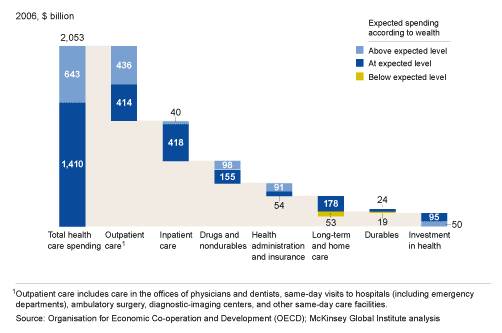
According to McKinsey

McKinsey research shows that the United States spends about $650 billion more than might be expected given its level of wealth and the experience of similar countries.

Here is a chart that breaks this down in a typically McKinsey framework (which I love BTW):

mckinsey-on-excess-hc-spending1

Will Plans Cover Genetic Testing?

I came across this fact the other day from Systemed Group, a division of Medco. According to the 300 health plans they surveyed, 38% of them said they will definitely (3%) or probably (35%) cover genetic testing within five years.

Interesting. What will this mean? What will these test consist of? What will they cost? How will they be used? Will they cover the drugs that are personalized based on genetic makeup?

Do $4 Generics Impact Mail Order and the PBM?

Some of you will remember that I wrote about this topic several months ago – The Brand Only PBM. As a follow-up to that article, I got interviewed by Neal Learner from Drug Benefit News about $4 generics. The interview got published today and is available here on page 6.

He asked about a few topics:
* How are PBMs and health plans reacting to the $4 generics programs?
* Are the programs used by people with insurance?
* How many generics could be offered at this price?
* Do they present a threat to the PBM?
* Will they impact the Rx Benefit?

BUT, what I find to be an interesting topic related to this is what happens if the USPS goes to 5-day a week mail service either closing on Saturdays or for some day during the week? How would this impact mail order and the PBM? I would think this would impact mail order by either delaying the distribution cycle or by forcing them to use FedEx or UPS which would be more costly. Another challenge to the primary profit driver?

7 e-Patient Conclusions

Thanks to e-patient Dave’s reminder on the e-Patient blog

Here are 7 conclusions from the white paper that came out last year on this topic. Very important in diffusing some of the myths around the role of social networking in healthcare and the use of the Internet for information.

1. e-patients have become valuable contributors, and providers should recognize them as such.
“When clinicians acknowledge and support their patients’ role in self-management … they exhibit fewer symptoms, demonstrate better outcomes, and require less professional care.”

2. The art of empowering patients is trickier than we thought.
“We now know that empowering patients requires a change in their level of engagement, and in the absence of such changes, clinician-provided [information] has few, if any, positive effects.”

3. We have underestimated patients’ ability to provide useful online resources.
Fabulous story of the “best of the best” web sites for mental health, as determined by a doctor in that field, without knowing who runs them. Of the sixteen sites, it turned out that 10 were produced by patients, 5 by professionals, and 1 by a bunch of artists and researchers at Xerox PARC!

4. We have overestimated the hazards of imperfect online health information.
This one’s an eye-opener: in four years of looking for “death by googling,” even with a fifty-euro bounty for each reported death(!), researchers found only one possible case.

* “[But] the Institute of Medicine estimates the number of hospital deaths due to medical errors at 44,000 to 98,000 annually” … [and other researchers suggest more than twice as many]
* We can only conclude, tentatively, that adopting the traditional passive patient role … may be considerably more dangerous than attempting to learn about one’s medical condition on the Internet.” (emphasis added)

5. Whenever possible, healthcare should take place on the patient’s turf. (Don’t create a new platform they have to visit – take yourself wherever they’re already meeting online.)

6. Clinicians can no longer go it alone.

* Another eye-popper: “Over the past century, medical information has increased exponentially … but the capacity of the human brain has not. As Donald Lindberge, director of the National Library of Medicine, explains ‘If I read and memorized two medical journal articles every night, by the end of a year I’d be 400 years behind.”
* In contrast, when you or I have a desperate medical condition, we have all the time in the world to go deep and do every bit of research we can get our hands on. Think about that. What you expect of your doctor may shift – same for your interest in “participatory medicine.”

7. The most effective way to improve healthcare is to make it more collaborative.
“We cannot simply replace the old physician-centered model with a new patient-centered model… We must develop a new collaborative model that draws on the strengths of both systems. In the chapters that follow, we offer more suggestions on how we might accomplish this.”

Presentation Zen

presentation-zen-example
Have you read the book – Presentation Zen? If not, you can visit the blog to start to understand what Garr Reynolds talks about in his book. In general, one of the key points that I always try to relay to people is that slides are not your leave behind. Don’t put too much content on them. Don’t talk to them. Think about how to engage your audience in your story.

Take a look at a few of the slides he shares here. How does his presentation compare to your last presentations?

Buyology: Teaser

I am just finishing up a book that has been a fascinating read…It’s called Buyology and is by Martin Lindstrom. I will post my notes shortly.