Retail Clinician Survey

Back when I visited a retail clinic (i.e., MinuteClinic, RediClinic, TakeCare), I grabbed a copy of the Retail Clinician magazine that they had. Finally, I am getting to the bottom of that reading pile to browse through it. It had a survey of 150 nurse practitioners that work in the clinics which revealed the following:

  • 57.2% of them work in clinics that are in chain drug stores
  • 63.7% of them came from a physician’s office or hospital / ER
  • 58.1% of them see more than 10 patients per day
  • Their busiest days are Mondays and Saturdays
  • 57.2% said that they write prescriptions for more than 70% of the patients they see
  • 53% said that they give OTC recommendations to less than 40% of their patients
  • 56.2% said that more than 40% of the patients they see don’t have a medical home (i.e., a primary care physician)
  • 21.2% of them saw their challenge as health care claims adjudication and 24.6% of them saw their challenge as public awareness
  • 79% said they would be receptive to handing out patient education materials
  • 67% said they would be willing to hand out product samples
  • 50% of them said that they consult the pharmacist 1-5 times per day for questions

I don’t have the data right now to compare this to physician’s practices, but it would be an interesting comparison in terms of percentage of times Rxs are written, etc. As I mentioned the first time I went to a clinic (I have been back since), I agree that this is a great avenue for information distribution. It is much less rushed than the physician’s office.


Employee Satisfaction – Drug Utilization

Over the past decade, colleges have had to reveal more information about crime statistics on campuses which creates a new way of comparing colleges. For some random reason, I was thinking earlier about how interesting it would be to see drug utilization by employer as a proxy metric for job satisfaction and culture. Imagine if you get see the utilization of anti-depressants or sleeping pills by employer. That might help you understand how people feel about the company and the amount of on-the-job stress.

I know that clinically someone is going to beat me up about depression being a serious disease, but this is not meant to make light of the disease. It is simply an acknowledgement that abstracted medical data could reveal interesting things about companies – number of worker’s compensation claims, use of diet drugs. Just like I would argue that knowing the BMI of company employees would tell you a lot about the role of diet and exercise in a company.

I can remember preparing for annual reviews with clients and looking at their top 10 therapy classes based on utilization. You could quickly tell things like average age and other attributes of the company.

Healthcare Costs vs. Wages and Inflation

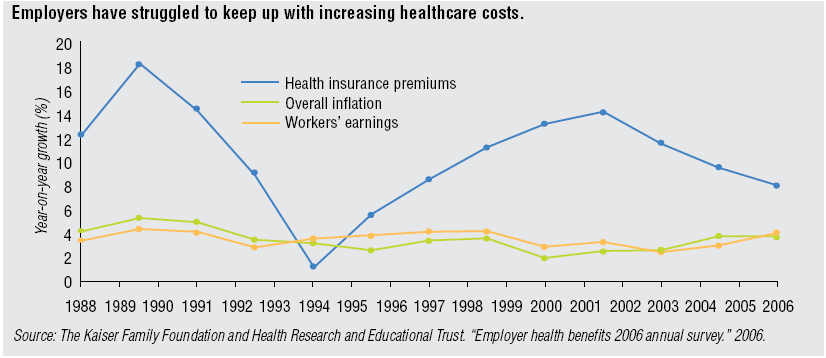
It is always interesting to compare wages to inflation to see if we are actually earning more in real dollars today than in the past.  But, that comparison is relatively tame year to year if you compare it to healthcare costs.  As I have mentioned before, those costs have started to slow down from double digit growth to single digit growth.  The last time that happened was in the mid-90s with a huge rise in tightly managed care programs.  (And, like the retirement argument, compounding is powerful so several years of double digit growth compounds very quickly to push costs out of whack with earnings growth.)

Here is a good chart I found yesterday which shows it.

insurance-v-inflation-and-wages.png

The Express Scripts Outcomes Conference

In my time at Express Scripts, one of the most interesting events was our Outcomes conference. We invited about 700 clients to come to beautiful St. Louis for 3 days to hear from our research group on trends and new programs to manage pharmacy benefits. All the large PBMs (Medco, Caremark, Express Scripts) put out annual publications on their research.

Express Scripts puts the publication along with the slides and audio out on the Internet. Here is a quick summary from 2007 which I took from the website.

  • Brand prices rose 6.9% in 2006, while generic prices fell 5.7%, which shows how generics continue to play a major role in managing prescription-drug trend.
  • 2006 drug trend of 5.9% – lowest in a decade.
  • More than $50 billion worth of brand drugs are scheduled to lose patent during the next five years. Important examples include Prevacid® in 2009 and Lipitor® in 2010.
  • Twenty percent of drug spend comes from specialty medications, but relatively few people use these types of drugs. This portion is projected to grow to 26% by 2010.
  • There are over 600 biopharmaceuticals products in the pipeline. This trend is being driven by the Human Genome Project, breakthroughs in the field of biopharmaceuticals, and a philosophical change in the pharmacy industry.
  • A growing number of members are becoming engaged in their decisions about prescription drugs, seeking information on drug-therapy alternatives and the prices of these alternatives. For example, 21% of the users on Express Scripts’ website used the Price Check feature during Q4 2006.
  • What Patients Don’t Know About Their Prescription-Drug Benefit
    • 64% could not correctly identify the type of pharmacy benefit plan they enrolled in.
    • 60% could not correctly identify the amount of their generic copayment.
    • 50% indicated their physician or pharmacist never or seldom talked to them about generics.
  • Several active ingredients work to influence the effectiveness of the information that plan sponsors provide to members:
    • Opportunity – Making sure you provide the information at the time in which the member is most engaged in the decision-making process.
    • Incentive – Members sometimes need an additional short-time incentive to choose the lower-cost option.
    • Assistance – Changing medications requires considerable assistance, which provides a barrier in making this adjustment.
  • The hypothesis was that Part D beneficiaries would take advantage of lower-cost generics to avoid hitting the donut hole. However, the reality is that many beneficiaries are hitting the donut hole unnecessarily and could take advantage of lower-cost generics.
  • Express Scripts’ research has shown that there is a direct correlation between a higher generic fill rate and the lower percentage of members reaching the donut hole.
  • The hypothesis from Wal-Mart was that low prices on selected generics would result in more volume of other generics and brands as well as increased nonpharmacy store sales. However, their market share increased by just 1% overall, which lead to a minimal market impact on prescription-drug use. Three reasons for this minor effect:
    • Members didn’t always save as much as advertised, and the payment was closer to $6 due to program limitations.
    • Members did not want to unbundle their prescriptions and use multiple pharmacies.
    • Many patients do not consider Wal-Mart a convenient choice.

Healthcare Marketing

I have talked about it a few times here.  Healthcare marketing lags the industry.  We don’t use technology creatively.  We don’t traditionally think outside the box.  We are risk adverse.  We are historically focused on business-to-business (B2B) not business-to-consumer (B2C) sales.  We don’t have sophisticated data mining.  This has certainly been validated for me when I go out to meet with payors and find out that the person I am meeting with just came from a consumer products company.

Today, the World HealthCare Blog talks about a healthcare marketing model.   It talks about possible models to apply.  It suggests the automotive industry as one rather than financial services or service industry.  I think financial services is a good model since people view their financial data as confidential like their health data.  I think the service industry is relevant since it is about the experience and support which for many patients is how they experience healthcare.  The automotive industry doesn’t work for me.  It is generally a luxury good with lots of variability.

The challenge in general is that healthcare marketing is selling a product that people don’t understand and don’t want to people who believe they are generally entitled to it.  Not any easy problem to solve.

“Until providers expand their horizons to see their “products” in terms of life meaning and impact, health care marketing will be mired in myopia, focused on features and attributes, or rare and episodic encounter experiences.”

Patient (Customer) Value – Social Dimension?

I was reading an interesting entry on Forrester’s Marketing Blog about redefining the value of your customer away from ROI to something that reflects their social value.  The author defines social value as:

1) A customer’s knowledge and involvement – in short, his level of expertise and interest in the category and brand. 

2)  How he participates, and the value of his connections – what social activities is he involved with (both on and offline) and where (on what networks is he active).  The value refers to the value of the connections themselves:  are the communities more tightly-knit or diffused, are they public or more intimite.

3) The number of contacts the customer has in each network. 

It made me think about two things: (1) how would we value a patient in healthcare and (2) how do we drive and evaluate social value.

Different constituents would value patients differently [these represent logical hypotheses but not fact]:

  • To a pharmacy, it is the high utilizer that they want.  And, they make the most money off a cash paying customer who buys generic drugs at something close to their AWP (Average Wholesale Price) which is about 70-90% too high.
  • To a PBM, it is the chronically sick patient who fills lots of drugs but is very active in their healthcare so they use the website, use mail, use generics, and don’t call customer service very often.
  • To a managed care company, their highest value customer (or patient) is the healthy individual who is insured so that they collect the premium but don’t actually pay anything out.
  • To the physician, their highest value patient is the sick consumer who needs specialized care which they have to provide (e.g., injections done by the physician).  In a capitated model, this is different because they want to create healthy patients and are incented to promote wellness.
  • To the hospital, their highest value patient is the insured patient who has a complex illness that requires lots of tests or who has an elongated hospital stay.

Driving and evaluating social value is a different animal.  I do believe that providers and insurers should be promoting communities of care where people with diseases can share experiences and information.  That will be a powerful tool in promoting consumerism.  A managed care company (e.g., United, Humana, Wellpoint, BCBS) has enough scale that they could create an anonymous discussion area for their covered lives which was moderated by an expert.  (Not too dissimilar to the disease specific pharmacies that Medco is creating with their Therapeutic Resource Centers.)

Assigning value is more difficult, but it could be a composite score of activity on the web, registration in certain groups, etc. It won’t be perfect, but it is clear that some people are outspoken advocates which can promote or hurt your brand.

It Seems So Simple…

In the CVS/Caremark 2007 TrendsRx report, they present a compelling yet simple story about people with chronic diseases.

“Increasing the effectiveness of adherence interventions may have a far greater impact on the health of the population than any improvement in specific medical treatments.” World Health Organization 2003 Special Report “Adherence to Long-Term Therapies: Evidence for Action

If every four people at risk for a chronic condition such as diabetes, hypertension or stroke:

  • One is unaware that he/she is sick
  • Of those who are diagnosed, one in three doesn’t get the prescription filled
  • Of the two who begin therapy, one stops taking medications within six months.
  • One is compliant with prescribed treatment

This clearly points to issues – the need for wellness programs and preventative medicine, the need to link compliance across MDs/Pharmacies/Patients, the need to drive adherence, and finally helping consumers understand why this important. It seems like simple problems to address, but if you’ve tried, you will realize it is a challenge and would be even if incentives were aligned.

[Sources: Caremark data combined with third-party references including the US Census, Centers for Medicare and Medicaid Services (CMS), the World Health Organization (WHO) among others.  Compiled by Jan Berger, MD, Chief Clinical Officer at Caremark.]

Teaching Kids About Health

Having kids makes you think about things differently. I was playing an online game with my kids this weekend when I started thinking about how it could be used to influence them. The game is called Webkinz. It is an interesting business model where kids buy stuffed animals which have a code. They go to the Webkinz website and use the code to register their “pet”. They then can work and play games to earn money. They have to feed and care for their pet to keep it happy. They pick the food.

My first take was how to use the tool to teach kids about good food (e.g., veggies and fruit) versus junk food. I didn’t study it intently, but I believe the “pets” are filled up better off the good food in the game. It also has little advertisements like the following:

webkinz-fruit.png

But, why not also use the game to teach the kids about exercise. If you don’t take the kid for a walk, it gains weight. Or, it already has a physician that you can visit, but why not improve that to give the kids preventative actions that they need to take for their pet. Since many people learn through action and experience, this could be a technique to start improving the next generation’s understanding of healthcare and wellness.

HC Stocks Over Time

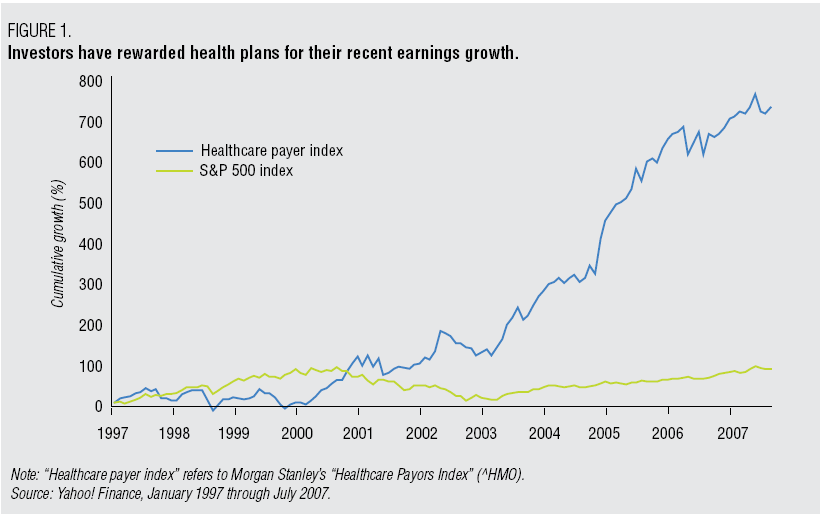
When you are in healthcare, all you ever hear about is how tight the margins are and how important it is to manage costs.  Obviously, healthcare has produced a lot of wealth over the years for a lot of people.  In my time at Express Scripts, the stock when from $37 in 2001 to (split adjusted) about $180 when I left in 2006.  (Not bad)

I thought this chart which I found in an IBM publication did a good job of portraying how the investment market has viewed and rewarded healthcare.  This is based on a payor (HMO) index.  The PBM index would probably be even higher over that same time period as Medco, Express Scripts, and Caremark have grown immensely over the past decade.

hc-stock-market-growth.png

Empty Every Chair

It takes a lot for an advertisement to catch my eye, but “empty every chair” made me think.  Especially, when I see the word health in the text.  The text goes on…

“Whose idea was it to build a room to house inefficiency?  The less time patients spend in the waiting room, the happier everyone will be.”

It’s an interesting view.  I couldn’t agree more.  The advertisement ends up being for PWC (PriceWaterhouseCoopers) and their healthcare consulting practice.  A link takes you to their site with publications on P4P, presidential plans for healthcare, wellness, and lots of other topics.

Do We Know What We Want?

In the November 2007 issue of Harvard Business Review, there is an article called Mapping Your Competitive Position by Richard A. D’Aveni.  From a general business perspective, it’s a good article which presents an interesting case about how you could have predicted that Apple would have dropped the price on the iPhone.  (Hint: Look at their behavior around the iPod and where the competition was and was predicted to go with the Razr.)

It made me wonder what the competitive map for healthcare would look like.  What are the market groupings for pharmacies, providers, PBMs, MCOs?  What is the price line and what would people pay for or not pay for?

“Most customers are unable to identify the features that determine the prices they are willing to pay for products or services, according to a 2004 survey by Strativity, a global research and consulting firm.  Worse, 50% of salespeople don’t know what attributes justify the prices of the products and services they sell.”

The article points out that most people involved in the process don’t know or fully understand the value proposition.  So…if we are going to try and redesign and improve healthcare, how can we do that?  Do consumers understand what matters?  Do the politicians?  Will we citizens understand who to vote for?

Comments to a Few Posts

I went out to the Hospital Marketing Journal this morning and looked a few recents posts. 

One entry is about “The Other CEO” which is the Chief Experience Officer.  I agree completely.  Healthcare is such an experiential business that we should be thinking about this from our process design through our architectural design.  There are many things that can be done physically to improve the experience not to mention service levels, communication techniques, and other levers that people could pull.

The other entry which is about a topic I have struggled with several times is called “Just Put It On My Card” which is about a credit card for patients that can’t afford their out-of-pocket expenses.  On the one hand, great.  I would hate for money to push someone to not be compliant or miss a physician’s visit.  On the other hand, how sad.  We have to loan people money to afford their healthcare??  Do we offer to excuse the loan if they become sick and can’t work?  Are we charging them outrageous interest on the credit?

For whatever reason, the social democrat in me finds the concept of loaning people money (which means they ultimately pay more with interest) for their basic healthcare costs a very slippery slope. 

CVS / Caremark / MinuteClinic Article and Comments

I will stick with Drug Store News (Nov. 12, 2007) for now.  They had a good long story on the CVS Caremark acquisition building momentum.  They also talk about MinuteClinic which was a separate acquisition by CVS.  As I have said for a while, I think this was a good move.  It creates a lot of opportunity.  The combined entity now has touch points at several stops along the care continuum.  The question (of course) is how to capitalize on this without compromising the core businesses and without making people feel to “controlled” along the path.

From a top down view, the biggest things that jump out at me are:

  • How to expand the care model at the retail pharmacy using MinuteClinic.
  • How to get patient’s to grant access to share data across business units (PBM, retail pharmacy, MinuteClinic).
  • How to provide Medicare Part D type services like MTM (medication therapy management) through MinuteClinic facilities (even if the pharmacist were coming over to use them).
  • How to “value” each patient and determine the optimal mix of services and facilities for them.  For example, if they don’t impulse buy, you might as well get them to use mail.  Or, if they have a lot of maintenance medications that are generic, but they tend to buy a lot of other goods at retail, you might want to pre-fill their prescriptions at mail and ship them to the retail store for pick-up.  Or, if they have kids, you may want to encourage them to use the CVS that is an extra 2 miles away because it has a clinic.

Here are a few things from the article:

  • “So far, the moves are paying off as the company already has realized $660 million of cost savings and continues to anticipate about $1 billion of revenue synergies to be achieved by the end of 2008, with the later coming primarily as it rolls out new PBM offerings” (from Lehman Brothers analyst Meredith Adler in a research note)
  • Chris Bodine was named president of CVS Health Services earlier this year which is where the PBM and MinuteClinic business report up through [by the name of the group it would imply that there are more things to come once they digest these deals].
  • There hasn’t been much about what these new PBM offerings will be, but Tom Ryan (President and CEO) talked about them actively working and trying things that are “integrating our PBM capabilities with our strong consumer connections through our retail business”.  A few opportunities mentioned in the article are:
    • Therapeutic Interchange[If the retail POS (point-of-sale) system can deliver formulary alternatives to the pharmacists, CVS should be able to help their PBM customers make different decisions to drive formulary compliance (rebated brands and generics) while lowering patient’s copayments.  This would be a big deal to plan sponsors and patients.]
    • Flexible Fulfillment – They talk about allowing traveling patients that use mail to get short fills at retail.  [I think some retail-at-mail solution here will be more creative.  They could do central fill which is a concept where scripts are filled at a mail order facility and delivered to the retail pharmacy for pick-up.  They could split scripts to fill a 7-day at retail and the remaining 83-days at mail (depending on their cost structure).  There are lots of trade-offs here around whether they want foot traffic (for cross-sell) or not.]
    • Specialty at Pharmacy – CVS retail stores fill about $3B worth of specialty prescriptions (think about injectible drugs and drugs that are very expensive).  But, most people want more support and move to a dedicated specialty pharmacy.  [I am not sure of the economics and logistics of storing specialty medications across a broad retail base versus simply using retail as a referal source for their specialty pharmacy.  Now, some specialty drugs are still shipped directly to MDs and billed under a different fee schedule on the medical side.  If they could use MinuteClinic as a dispensing location for specialty drugs, they could offer a convenient service to patients, lower costs for their clients, and gain visibility into drugs being coded as medical services.]
    • MinuteClinic is in the process of creating a pilot program to monitor health assessments and screen for illness just for PBM clients.  [If they could figure out a way to offer preventative care, they might be able to figure out how to take risk.  It would be a powerful story to offer clients a service that bore risk around spending, trend management, and overall care / outcomes.  With a few other acquisitions or partnerships, they could begin to look very different.]
    • Corporate Clinics are briefly mentioned.  [This is another interesting pitch for me.  If you put a MinuteClinic on-site at many of their large corporate clients and/or in areas where they have a dense population, they could provide health services and use the clinic to “steer” (as legally allowed) patients to CVS, mail-order, or their specialty pharmacy.  For companies, this increases their stickiness to CVS on the PBM side while reducing time away from work for their patients.]
    • One-third of their PBM business is up for renewal in 2009 [so they have about 6-months to demonstrate the uniqueness of this story to those clients to easily renew them without major price concession.  As I sure their competitors will be focused on conflicts of interest, too much turmoil, and other FUD (fear, uncertainty, and doubt).]
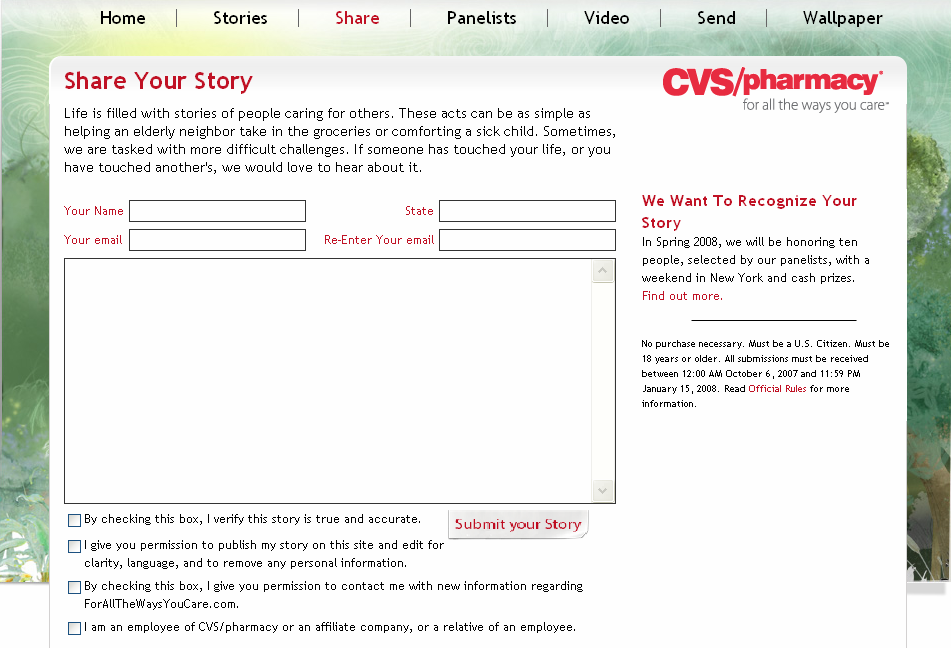
    • On a fairly different note, another article about CVS talks about their new advertising campaign focused on women as caregivers including a new website for people to share personal stories.  (www.ForAllTheWaysYouCare.com)   The initiative seems to have an impressive group of panelists.

 forallthewaysyoucare.png

Highest Spending at Independents

In the November 12, 2007 issue of Drug Store News, they have a Pharmacy Facts section.  This month’s fact is about how much pharmacy customers spend on prescription medicines per month at the different types of pharmacies.  This is based on a survey done by WilsonRx.

  1. Independent – $87
  2. Mass Merchant – $82 (e.g., Target)
  3. Food – $78
  4. Chain Drug Store – $75 (e.g., CVS or Walgreens)
  5. Mail / Online – $69
  6. Clinic – $40

Even being close to the data, I am not sure what this tells me:

  • Older patients (who have more Rxs and therefore higher spend) go to the independents?
  • People without insurance and who pay full-price go to the independents?
  • The independents aren’t as able to drive formulary compliance and/or generic utilization to help lower out-of-pocket costs for their patients?
  • That people that go to independents are less likely to divide their spending between multiple pharmacies (i.e., use retail and mail order)?

It is an interesting data point, but without context, I am not sure how anyone can do anything with it.  But, that is how data gets manipulated.  I could use it to support any theory above.

BAH on Demographic Changes

BAH (Booz Allen Hamilton) has a business publication called Strategy and Business which has some great research.  I found this recent article on the changing demographics worldwide to be interesting and relevant to what we see in the US (which has a big implication on healthcare).

Here are a couple of quotes and facts from the article:

“To prepare for the implications of aging populations, individuals, organizations, and society as a whole must confront assumptions that are no longer valid.”

  • According to United Nations projections, the proportion of the global population over 65 years old will triple between now and 2100, from 7 percent to 21 percent.
  • Assumption 1: We’ll work long enough to pay for our retirement. …But suveys show that, until the age of 75 or so, people consistently underestimate the length of their retirement and under-provide for it financially.
  • Assumption 2: As our society gets richer, we can afford to retire earlier. The basic flaw in this is that people are not taking into account increasing longevity and its associated higher costs.

  • Assumption 3: It is useful to retire people early, because there are not enough jobs for everyone.

  • Assumption 4: Income and status at work rise linearly, and people retire at their most senior position.

  • Assumption 5: We accumulate assets while working and spend them during retirement.

  • Assumption 6: During retirement we won’t change residences more than once.

  • Assumption 7: The state will provide social and health-care services for us in our later years, allowing our children to inherit a significant portion of our estate.

  • For a couple who reach the age of 65, there is a 50 percent chance one of them will survive to the age of 90, and a 17 percent chance that one will reach 100.

“Restricting compulsory retirement will foster — or force — changes in work culture and minimize ageism. Our mental model is already changing from one of a ‘cliff edge,’ with an abrupt change from work to retirement, to more of a ‘plateau.’ “

All of this will have big implications on how we pay for healthcare, what types of services are needed, how we interact with these groups, etc. 

Student Ideas

entrepreneur_2002_cover.jpgWhen I got my MBA at Washington University, we had a business plan competition.  [Which I won one year and took second the other year.]  It was fun and challenging.  You got to present to a group of CEOs at the end.  (Mine included Chuck Knight (Emerson Electric) and Andy Taylor (Enterprise Rent-a-Car)  But, it was more an exercise than starting a company.

As entrepreneurship has become a big focus in business school, this has taken on a life of its own.  Wash U, like many schools, has staff dedicated to this.  The business plan competition has corporate sponsors and now VCs come to look at the ideas.  Additionally, entrepreneurs give their ideas to students to work on for 6 months and flush them out for them. 

What I found interesting was the number of business plans written this year that had a healthcare focus.  They have a website called IdeaBounce where all of these are posted.  I took a few bullets from there to highlight here: [to see the specific ideas from this competition on IdeaBounce sort it based on programs [Olin Cup] on the right hand side of the screen]

  • Medi-bite is a medical device company that has developed technology to facilitate the recovery of people affected by temporomandibular (jaw) joint injury.   Temporomandibular joint injury affects 100,000 people in the U.S. annually. Injury makes eating difficult, interferes with speech, and often reduces one’s effectiveness on the job. The standard of care involves physical therapy sessions, and is often painful, inconvenient and insufficient to treat the condition fully. Medi-bite has developed technology to address these unmet needs.

  • Medobo is a company that provides services and tools for medical patients to holistically manage their health online. medobo retrieves medical records and consolidates them into an easy-to-use, secure, and private online personal health record (PHR). medobo also provides appointment and prescription management tools, a library of medical research, and a targeted medical web search engine.

  • Over 6,000,000 patients enter US emergency rooms annually complaining of abdominal pain. Current method of diagnosis of appendicitis is difficult because of considerable overlap with other clinical conditions, (15-40% error rate)! We are developing a blood test to accurately diagnose appendicitis within 5 minutes. Our company is working on identifying biomarkers from clinical samples. We hope to develop low cost, point-of-care, disposable diagnostic strips to clinicians in emergency room. We are an early stage company looking for financial, business & logistical support to execute our plan

  • You’re sick and at your doctor’s office – why not pick up your prescription while there? MedBox offers a Web-enabled, robotically controlled, videoconferenced dispensing pharmacy for doctor’s offices, run by local pharmacies. In the $200 billion prescription marketplace, where no company has more than 10% market share, this new paradigm places diagnosis and treatment in the same place – convenient for consumers. MedBox is easier for patients and doctors, attractive to insurance companies and profitable for pharmacies by streamlining an antiquated healthcare system.

  • Personal Pediatrics is a platform by which pediatricians in its network can dramatically take control of their practice. Physicians who adopt its retainer-based house call practice method provide HIPAA-compliant, boutique, patient-focused health care. Dr. Hodge has developed the Personal Pediatrics care model in her St. Louis practice for more than two years, tailoring offerings to consumer needs and designing technology solutions to replace high physician overhead.

Some of the biotech ideas were also impressive.  It has come a long way from where it was in the early 90s.

Insider’s View is Too Close

As I think it can be in any industry, a big challenge is immersing yourself in your field while at the same time maintaining and outside-in perspective.  The challenge of losing that perspective is (A) using language that people don’t understand or (B) creating elequoent solutions that aren’t practical.

(A) From a communication perspective, the issue of language is one where I am sure most of you could come up with examples.  There are numerous times when I have gotten something and had to read it a few times to understand whether it was an EOB (explanation of benefits) or a bill.  I remember trying to write letters to patients and having to re-write them numerous times to get them ready to be sent out.

For example, in the PBM world, we would talk about refills versus renewals.  (e.g. glossary) I don’t think many consumers know what a “renewal script” is…but that wasn’t intuitive to us.  [BTW – It means your prescription has no more refills left.]  We would talk about DAW prescriptions [aka Dispense As Written].  Even worlds like formulary caused people problems when we used it on the website or in a letter [preferred drug list sometimes worked better].  Another one that threw everyone off was saying “this drug is not covered”.  Did that mean the patient couldn’t get the drug?  Did that mean the patient had to pay cash for the drug, and if they did, did they receive the client’s negotiated discount at the pharmacy?  Did that mean it required a Prior Authorization? 

I think the point where this really threw people off was when we communicated to physicians.  In my job driving generics, I remember reviewing the physician letters and seeing that we always called the drugs by their generic name – omeprazole (Prilosec), fluoxetine (Prozac).  When I pointed out that physicians don’t always know the drug by its chemical name, people were shocked.  Sending a letter to a physician saying you should switch from Nexium to omeprazole was pretty ineffective if they didn’t know what drug we were recommending.  I always tried to get us to say “the generic version of Prilosec (omeprazole)”.
hmo_blue_card.gif

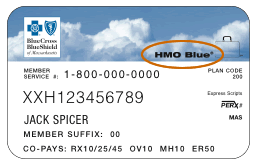
(B) On the side of an overly eloquent solution, I have been stymied by my insurance card.  It is a national coverage card from BCBSMA.  It may work great in Massachusetts, but in Missouri, the providers can’t find the group ID on the card.  This has happened everytime we use it.  If they hadn’t been a client at Express Scripts and I knew their group IDs by heart, then each provider would have to call them. 

The other challenge with the card is that they give you one for each person in the family.  So, if you have 5 kids, you would have 7 cards (which you are expected to carry).  At the doctor for our kids the day, we simply tried to give them the patient IDs for the kids.  They were upset since apparently they have a swipe card system for the BCBS cards and don’t know how to manually enter the patient ID. 

To me, this is a great example of something that has been totally reengineered and become less effective.  I am sure they were putting more information on the card and pushing the group number to a corner wasn’t a big deal.  I am sure individual cards is great for older kids that carry their own.  I am sure smart cards is a great thing.  Unfortunately, all it has done is make it harder not easier. 

On the positive, I like BCBSMA’s general approach, service model, and many other things so the card is a hassle but not likely to impact my overall satisfaction.

Patient as Googler

This story seems almost unbelievable to me, but I am sure it is true.  Time Magazine published this story “When the Patient is a Googler” on November 8th.

It is basically a physician’s perspective on an aggressive patient that uses the Internet to find out lots of information about him.  The patient treats the physician with total disregard (which is unacceptable in any situation).  The physician on the other hand rants about patients and doesn’t grab control of the situation but simply “punts” her to another doctor.

“A seasoned doc gets good at sizing up what kind of patient he’s got and how to adjust his communicative style accordingly. Some patients are non-compliant Bozos who won’t read anything longer than a headline. They don’t want to know what’s wrong with them, they don’t know what medicines they’re taking, they don’t even seem to care what kind of operation you’re planning to do on them. “Just get me better, doc,” is all they say.

At the other end of our spectrum are patients like Susan: They’re often suspicious and distrustful, their pressured sentences burst with misused, mispronounced words and half-baked ideas. Unfortunately, both types of patients get sick with roughly the same frequency.”

In my opinion, they are both wrong.  Patients should certainly do their research before and after meeting with a physician.  They also need to give the physician a chance to use their training and experience to help the patient.  Physicians need to be open to patients doing research and asking questions.  They should be willing to suggest sites to patients for research.  This is not a subject that will go away.

There are several other discussion streams out there about this article if interested:

Identifying Your Generation

This discussion of using texting in healthcare (and other new channels) reminded me of a posting from earlier this year on Penelope Trunk’s blog.  [A great blog if you’re interested in career type topics and work / life balance with a focus on Generation X and Generation Y.]

Penelope introduces a quick “test” to determine whether you are a Baby Boomer, Generation Jones, Generation X, or Generation Y.  It made me feel old, but it is a good reminder of how technology and communication has changed radically. 

A Thanksgiving Short (Kids and Shots)

I hope you are all having a good Thanksgiving and enjoy some time with your family.  We all have so much to be thankful for.  We often see the negative, but for the majority of us, simply living here in the US puts you in a position for which to be thankful.  Go tour a 3rd world country in a rural region, and you will see what I am talking about. 

Here are my two quick stories that I always use to remember how good we have it:

  • I was born in Brazil and on a visit there was amazed to see thousands of people basically living in cardboard boxes.  The next day the army had bulldozed the entire neighborhood into the ground. 
  • My father worked there for 10 years as a missionary, and he always talked about a man and woman who lived in the small down but were never together.  One night he invited them to come as a couple for dinner.  The man refused saying that they only had one pair of shoes and the mountain was too rough for the other one to come down barefoot.  Imagine that!

Anyways, I thought I would go with a light-hearted entry for the holiday.  Both my kids have recently gotten shots and like adults with the dentist, they were not happy about it.  My daughter slipped out of the exam room, past the receptionist, out the building, and into the parking structure screaming before anyone caught her.  My son was so worked up that after the shot he almost passed out as his blood pressure dropped.  [Something the doctor said was common in teenagers but not with young kids.]

But, to top this off, I was telling a neighbor about this when she mentioned that when she was a kid she had a fear of needles.  She said one visit that the nurse couldn’t restrain her so the doctor held her.  The nurse went to give her the shot [in her but] but she kicked so hard that the nurse’s arm went off course and stuck the needle right in the head of the physician who was bent over holding her down on his lap.  [Hard to top that one.]

Literacy Adds Additional Challenges

I have some other seniors statistics that I will add later, but this morning I was researching seniors and healthcare communications.  I was surprised to see some of the data around how literacy presents a big challenge for them.  Here are a few facts and some links for more information:

  • “People aged 70 years and older with limited literacy skills are one and one half [1.5x] to two [2x] times as likely to have poor health and poor health care access as people with adequate or higher reading ability, according to a study led by researchers at the San Francisco VA Medical Center and the University of California, San Francisco.” (source)
  • “One in four [seniors] had limited literacy. In practical terms, these elders ‘may have trouble reading basic health information or pill bottle instructions'” (source)
  • “Although only 12 percent of the U.S. population was age 65 and older in 2003, they accounted for one-third of all patients admitted to the nation’s community hospitals in that year – over 13 million hospital stays, according to the Agency for Healthcare Research…The elderly also accounted for 44 percent of all hospital charges  nearly $329 billion.” (source)

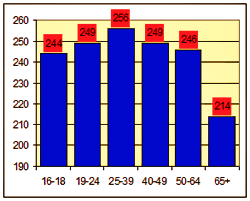
  • “Senior citizens (65+) scored far lower than younger people in a 2003 literacy test. The test had a maximum score of 500.” (source)

literacyhlth-6-09-12.gif

  • “Less than one out of six U.S. adults have “proficient” health literacy, according to the report released this week, but for seniors it is only about three out of a hundred.  A staggering 29% of senior citizens do not even have “basic” health literacy.” (source)

I think this is an interesting angle that you don’t hear much about.  We spend all this time trying to think about what to say and other creative aspects, but sometimes we have to simplify the story to get to the point of being usable.  Here are a few other links if interested in the topic:

Zyrtec to Go OTC

By now, everyone should be familiar with Claritin (loratadine) and Prilosec going OTC.  They were really the first two blockbuster drugs to go OTC (over-the-counter).  Motrin / Advil is available both as a prescription strength and OTC.  Zantac (ranitidine) is also available OTC.

From a personal perspective, I am happy.  I have two kids with allergies that are on Zyrtec (which is off formulary) and where I pay $50 / month per kid.  I also find this an interesting DTC (direct-to-consumer) challenge for managed care plans and PBMs.  I had the opportunity to run both of our programs (Claritin and Prilosec OTC) at Express Scripts for this which included coordinating with modeling and clinical teams, designing the communication strategy, talking with clients, and helping drive OTC utilization where clinically appropriate.

From some initial research, I found the following:

  • Zyrtec (5 and 10mg tablets and 5 and 10mg chewables) and Zyrtec-D (1mg syrup and extended release) were approved by the FDA to go OTC. (article)
  • McNeil Consumer Healthcare (subsidiary of J&J) will be responsible for the OTC products.
  • McNeil has said the products will be available in late January 2008 and will be less than 1/3 the price of the prescription.
  • Non-Sedating Antihistamines (NSAs) represent 7.8% of the commercial Rx market and Zyrtec had about 37% marketshare in 2006 (generics had greater than 50%) with a typical member using 3.65 Rxs per year (or 0.29 Rxs PMPY).  (per Express Scripts Drug Trend Report)

Taking common Rxs to OTC status makes a lot of sense, but also creates a lot of questions:

  • If there are interactions with the drug but it no longer shows up as a claim, does this create a DUR (drug utilization review) problem?
  • Do pharmacies make more money on the generic Allegra or on the OTC?
  • For PBMs that make spread on claims and/or get a claims administration fee, how do they align their incentives with their clients (employers, managed care) that would prefer to see the patient use the OTC?
  • Which costs less out-of-pocket…the generic Rx or the OTC?

So, what should you do?   If you’re a consumer, you will likely hear something from your employer, managed care company, PBM, or pharmacy.  If your a company, you need a creative plan to execute against.  Contact me to learn more about how we (Silverlink) are going to help our clients.  [I can’t give away all the secret sauce here.]

But, if you are generally interested in this topic, here are a few links for you:

WSJ on Texting in Healthcare

Obviously my entries about texting in healthcare are timely. Today’s WSJ includes an article (pg D1) by Rachel Zimmerman called “don’t 4get ur pills: Text messaging for Health”.

She points out several compliance type programs where this is being used (outside the US)…birth control pills (England), AIDS (Australia), psychological support for bulimics (Germany), and smoking cessation (New Zealand).

Apparently, the American Telemedicine Association is developing guidelines for the appropriate use of text messaging in healthcare (along with other new media). The executive director, Jonathan Linkous, was quoted as saying “There are obviously times when telemedicine is inappropriate. Texting someone to tell them they have cancer is one of them.” [I think we can all agree.]

Of course, with health costs being concentrated in a small percentage of the population which is typically older, can texting make a difference? It isn’t easy to type on those small mobile phones with arthritis. Lots of seniors don’t even carry mobile phones. Plus texting is a whole different message as the article points out. My kids will probably get it much better than me.

Plus, using condense information can be risky. We had this problem in sending messages to pharmacies where we had a finite amount of characters to say “Drug A is not covered but the following drugs are covered but if medically required then the physician has to call 800-xxx-xxxx to request a prior authorization”. Other than reminders or pushing them to a very specific action it may be a challenge.

I think sending links or phone numbers via text message could be helpful. For example, using co-browsing, a company could trigger a message a message suggesting the patient call-in for more information or also go to another site. [What is co-browsing…this is when a company (typically a call center agent) can see where an individual is on the web and what they are looking at to help them.]

She mentions a few companies:

There certainly is a need for something that is quick and ubiquitous around healthcare. For someone under 40, I think texting could work great. For people over 40 (an arbitrary line), I think automated voice is better. It is just as quick. It is ubiquitous. And, it can be personalized and change during the call versus going back and forth via text messages.

Reverse Auction for MDs / Hospitals

auction.jpgIn healthcare, you sometimes hear people talk about waiting (at the pharmacy, for an appointment) while other people seem to get right in.  A lot of this has to do with geography (remember ‘healthcare is local’) but it also has to do with cycles.  For example, Mondays are always busier after the weekends.  [I have heard ERs are often busier during a full moon, but I don’t have research on that (and didn’t look).]

Certainly, another driver of healthcare costs are some of the large capital purchases at hospitals for imaging or other diagnostics.  If every hospital has to have the latest and greatest but they are only use 20% of the time, that isn’t an efficient use of capital across the healthcare system.  If you have to spread that cost for the equipment across 1/5th of the potential patients, it means you are overcharging by 5x.

Reverse auctions wouldn’t be easy, but BidRx pulled it off in pharmacy.  [I am not sure how successfully.]  The reverse auction model would be consumerism at its best.  The consumer would post their needs – a CAT scan, a PCP, a neurosurgeon, open heart surgery.  Physicians or hospitals would bid on their business based on the parameters – timing, price, etc.

In a theoretical sense, it would be interesting to test and see if it would work.  But, my objective was not to sit in the ivory tower, but to look at a model that would improve healthcare capital efficiency by better utilizing fixed costs.  If hospitals and MDs could bid for patients to fill their slow times, wouldn’t the following be possible:

  • Less need for capital redundancy (i.e., every hospital would not need to have the same equipment)
  • Less wait times for patients since they would be slotted in to open times
  • Less peaks and valleys at doctor’s office and hospitals since they would be offering a “discount” for you to come on Wednesday versus everyone wanting to come on Monday

Participation wouldn’t be easy, but ultimately, changing our healthcare model won’t be easy.  Just an idea.  There is something here to make the system more efficient.

Mashing Two of My Posts

I was thinking about Google’s SMS service earlier today (see post on this).  Separately, I was thinking about my post on remembering health information (e.g., drugs, strength, previous lab values).

So I went to one of the Google Health Blogs to suggest the idea.  Unfortunately, the e-mail they list bounces back and you can’t leave comments…strange.  Why not combine the two comments from my earlier blogs was my suggestion?  Obviously, it only appeals to a piece of the population, but I would love to be able to text message my PHR (Personal Health Record) with “Rx name, strength” or “PCP name, phone” or “HCL scores and dates”.  [Look at myPHR, iHealthRecord, ActiveHealth, Microsoft, or Google for PHR solutions.]

It is always so difficult to remember that information, but if I could get it texted to me in a few seconds, it would be great.  I have to believe there is some unique code in my Blackberry that could serve as a unique identifier for security purposes.  Just a thought…

BTW – If you try to find Google blogs on health, you find out there are dozens of Google blogs:

“There’s all this hubub about what Google and Microsoft are doing,” Aetna CEO Ron Williams (pictured) said this afternoon on a visit to Health Blog HQ. “We’re perplexed by the fact that their vaporware gets all this attention and we get very little.” (comment on the WSJ Health Blog)

Don’t forget to add this blog to your reader or sign up for e-mail updates whenever a new entry is posted. 

New (to me) Blog – Consumer Focused Care

I found a new blog this morning called Consumer-Focused Healthcare written by an ex-McKinsey consultant which seems to have a very similar focus to my blog – “refocusing healthcare on serving consumer needs“.  [As a sidenote, the benefit here of LinkedIn was that I could quickly look him up and see that we have a mutual friend which instantly gives him some validation.]

Vijay has a lot of posts that I liked.  Here are a few exerpts:

  1. “the consumer often pays MORE for a visit to a retail clinic than a physician’s office. The implications are that they really prize the convenience and time taken far over the extra training provided by the physicians.”  In this blog entry, he shared some data about out-of-pocket expenses for clinic visits.
  2. “It is pretty clear that many doctors don’t know how to tell their patients that they have no idea”  In this blog entry, he talks about the inexact aspects of patient advice.  Determining a diagnosis or the right advice is very situational.
  3. “why are people willing to spend $3.50/ pill on sleep meds when they’re discouraged by $10 co-pays to take other, potentially life-saving medication?”  In this entry, he talks about consumerism.
  4. He also points out an assumption from Google that technology will push physicians to spend less time with patients which I think isn’t logical based on the work I did around e-prescribing.  I already put a comment in this blog entry this morning.

And, these are just his most recent entries.  I am interested to flow his blog more.

Tonik Health Insurance

I always smile when people ask about using SMS (or text) messaging to communicate with patients. Interesting. Perhaps even “cool”, but not real practical. You have limited message length. You have to have cell phones for people, and with all the privacy issues, can you control it.  There are a lot more opportunities to communicate better with patients than use SMS.

So, I was intrigued to find out about Tonik Health Insurance which is an offering by Wellpoint for the Generation X or Generation Y population. If you go to the site, you will see things like:

  • Edgy graphics
  • Slang / informal language (e.g., “Tonik offers three straight-up affordable health insurance plans to cover your A-Z
  • At one point, the site mentions Borat (not typical in a healthcare website)

I don’t know much about it, but it seems very interesting.  I am a little surprised to see it offered by such a mainstream company.
I even came across a publication called “NOT ur parents’ healthcare anymore: The 411 on selling health via new media” which is a 35-story report on targeting this young population. I have not read the report, but it sounds interesting. (Order Here)

Bing Blog – A Little Harse?

Stanley Bing has written for Fortune for a while and now has a blog.  One of his latest entries is about healthcare and insurance.  Obviously, we have problems with the system (as pointed out in Sicko), but I found some of the comments a little harse.

We can get better, but we should all be thankful for what we do have which allows us access to experts 24×7 using good technology.  We pay a lot per measure of clinical outcome but we have lots of options for how to get treated.  The system isn’t seamless, but it generally works.

I guess for all the criticism which is easy to lob sometimes it seems too harse when people focus only on the negative.  The more you work in healthcare the more you realize how difficult it is to find the right solution.  I don’t envy the politicians.

P4P Survey and Comments

The American College of Physician Executives did a survey on P4P.  Here are a few of the survey results (from over 900 participants):

  1.  Only about 40% of the organizations had a P4P program.
  2. 58% of those without a P4P program are considering it.
  3. 60% think P4P will be a permanent part of healthcare.

I found the comments even more interesting.  Here are a few:

  • It is sad to see some HMOs to put the programs (carrott) out there and then look for every loop hole to deny payment.
  • The challenge is defining the performance and quality improvment. Clearly rewards for volume through the office or RVU’s per month work, but the real issue is the quality of the outcome for a given patient. Defining the clinical outcome is the slippery slope. I think physicians are going to resist being told what they get to create for fear of being judged less than capable. So, the tendency will be to set the bar lower that what could be achieved.
  • In California the P4P program is working very well with significant improvement in outcomes.

payforperformance.gif

What Have You Failed At Today?

I caught this story on ABC last night about entrepreuners.  It made an interesting point about the need to fail and learn from your failure.  In summary, it was basically saying that people who took risks, failed, and spent the time to learn from their failures ended up more successful.

I think that is very relevant to the world of healthcare communications.  Any program should have a test plan of ideas that are constantly being varied to see what works best.  Each micro-niche of the population is going to respond differently.  If you aren’t out there trying different things, you won’t optimize the success of your programs.

Of course, this is easier said than done. You need a culture that believes in failure.  You need a way to learn from your mistakes.  You need people that are willing to admit they were wrong.  You need a measurement tool to document the success of one attempt versus the other.  And, you need to understand what can be varied to drive change.

Let’s take a simple example here.  In the world of automated voice communications, you can vary dozens of things:

  • Which voice should you use – gender, age, accent?
  • How should the voice speak – casually, formally, authoritarian, consultative?
  • What speed should the voice be at – normal pace, fast, slow?
  • What time of day should you call?
  • What day of the week should you call?
  • Should you leave a message or call back?
  • How many times should you attempt to reach the patient?  Within what window?
  • How long should the call be?
  • Should the call be complemented by letters or other outreach?
  • Should the call offer to connect them to a live agent?

I could go on, but I think you see the point.  Experimentation is key and makes a difference.  I am not even getting into the thousands of variables in the messages. 

So, go out and fail at some new program to communicate and engage with your patients.  Learning faster is your best way to succeed.