Archive | Books / Articles RSS feed for this section

Are Kid’s Backpacks Too Heavy?

I think the easy answer here is YES!  You should go weigh your kid’s backpack.  The experts say it shouldn’t weigh more than 10-15% of their weight.  So, if my kid weighs 80 lbs, they can only carry 8-12 lbs of books.  With the average textbook weighing 3-4 lbs, that’s not much. 

Studies at the Mayo Clinic and at other hospitals around the United States calculate that overpacked or improperly packed school backpacks account for more than 7,000 emergency room visits annually. And according to the American Occupational Therapy Association, over 50 percent of all students between the ages of 9 and 20 suffer from chronic back pain related to the way they wear their packs. (source)

So, what do you do?  I’d like to say that you don’t bring all you books back and forth and put everything online, but I don’t think that’s going to happen anytime soon.  A logical answer is that you give the kids bags with wheels that they pull around.  That seems easy enough. 

A few other links on this topic which include other points:

Guest Post: Addressing the Correlation Btwn Health Literacy & Mortality In the Elderly

Medication and health management strategies are integral parts of patient care, but if those who need medical help can’t understand their instructions perfectly, the right procedures are lost on them. Health literacy is a growing concern, and it refers to one’s ability to read, process, and implement directions related to personal health care. Both the context of health-related communication and the skill level of health care providers are strong factors in health literacy, but it ultimately describes the comprehension abilities of someone on the receiving end of health care. In a study conducted by Dr. David Baker, MPH, and a team of researchers, it was found that inadequate health literacy contributes significantly to mortality rates among the elderly.

Health Literacy and Mortality Findings

Baker and his team administered a shortened version of the Test of Functional Health Literacy in Adults to a pre-screened cohort of 3,260 Medicare managed-care enrollees. They then collected their data and categorized it into three sections: adequate, marginal, and inadequate health literacy. These results were then compared to all-cause and cause-specific mortality data from the National Death Index, 1997-2003. Although the category of elderly patients with adequate health literacy accounted for the majority of the cohort at 2,094 individuals, their mortality rate averaged only 18.9%. The group with marginal health literacy, which included 366 individuals, averaged a mortality rate of 28.7%, and the group with inadequate health literacy at 800 had a 39.4% mortality rate. Baker and his team found that the number of years of school completed by the subjects was barely associated with mortality, leaving reading and comprehension abilities as the main indicators in determining health literacy. A general lack of health-related knowledge, the ability to apply it, and wide variety of other “pathways” characterized those individuals with inadequate health literacy.

Ways to Address and Manage Health Literacy

According to health.gov, a page dedicated to the activities of the U.S. Department of Health and Human Services and other Federal departments and agencies, there are many ways to develop and deliver health information while maintaining awareness of health literacy. For example, information should be appropriate for the user audience and easy to use. It’s also important to speak clearly and listen carefully when communicating health-related information. The following are some strategies that may help pharmacists, doctors, and other health care professionals communicate information clearly to non-professionals and patients.

  • Be sure to identify a specific audience before you draft any health-related communication. Consider demographics, behavior, age, culture, communication capacities, and attitude, choosing materials and messages that address your audience’s characteristics.
  • Evaluate your communication by conducting usability testing. Test users before and after your information is delivered to see how much of it they can understand and repeat back to you.
  • Limit the number of messages you communicate at one time and use plain language that focuses on action. You can include pictures to help demonstrate important steps.
  • Improve the usability of information online. Make sure that patients know how to access the details of what you’re explaining by going to a specific webpage.  Be sure to use large font and uniform navigation to prevent confusion.
  • Ask open-ended questions and ask that your patients repeat the information back to you. You can also request that they act out a medication regimen in front of you before they have to do it on their own.

Baker, David W. et al. “Health Literacy and Mortality Among Elderly Persons.” Archives of Internal Medicine 167.14 (2007): 1503-1509.

Guest Blogger: Alexis Bonari is a freelance writer and blog junkie. She is currently a resident blogger at  First in Education, researching online college degrees. In her spare time, she enjoys square-foot gardening, swimming, and avoiding her laptop.

Increasing Flu Shots – Several Views

Let’s start with a few facts:

  • Health officials are recommending that everyone get a flu shot except those under 6 months and those with egg allergies.
  • Last year’s H1N1 killed 13,000 and made 60M sick in the US.
  • This year’s vaccine protects against the 2009 swine flu (H1N1) and two other flu strains that are out there this year.
  • 60% of Americans are viewed as susceptible to H1N1 (still).
  • There are 165M doses slated for use in the US.
  • At least 10% of the US is estimated to have trypanophobia (fear of needles).

Retailers (and likely others) are trying different things to drive flu shot volume:

This year, the competition for administering flu shots will be aggressive among retailers:

Walgreen says it administered 7.5 million H1N1 and seasonal flu shots last season, up from 1.2 million the year before. Walgreen’s figures represent about half of all the retailer-administered flu shots, says Mr. Miller, the analyst. He estimates retail pharmacies could administer 20 million to 30 million flu shots this season. Rite Aid, which doled out 250,000 shots last year, said it has ordered a million doses for this year.

Grocery chains with pharmacies also are pushing flu shots harder. Supervalu Inc., operator of the Jewel, Shaw’s and Albertson’s, says it expects to deliver 50% more flu shots this year in its 800 pharmacies. Kroger Co., the second largest food retailer by sales, says it will have flu vaccines available in all of its 1,900 pharmacies. (From WSJ)

The logical question would be why would the pharmacies care. Money. Flu shots are a profitable business and as long as you can administer them without disruption to your workforce…then your variable costs are limited. But, that also makes me wonder why everyone is taking a general marketing approach. There is lots of marketing, but very little targeted marketing that I’ve seen around flu shots (from the retail community).

On the flipside, managed care companies have a totally different reason to drive flu shots – it’s a HEDIS measure. [And, BTW…HEDIS is a big part of the STAR Ratings that CMS is using to pay incentives to Medicare plans.] They want to limit sickness, hospitalizations, and other medical costs.

This is one where everyone is aligned so that employers also want to drive flu shots to avoid absenteeism from sick employees. This article puts the value of a flu shot to the employer at $46.50. Since flu shots cost less than $30, why wouldn’t employers just give everyone a free flu shot. They’re getting a 50% return on their investment.

A more interesting debate is whether to mandate flu shots in certain cases. The biggest one which is debated is healthcare workers (although I would also lump in teachers and day care staff). The last thing you want is someone who is already at risk and sick to be exposed to the flu when they go to receive care.

Last January, a CDC survey found that just 37% of health care workers received swine flu vaccine and 35% received both seasonal and swine flu shots. On average, flu vaccination rates hover under 50%. (USA Today article)

So, I guess my net-net here is that flu shots are going to be pushed this year. I would think pharmacies and employers and pharmacies and MCOs would pair up to drive shots to specific locations. I think the general marketing and news will increase awareness, but the question is how to you reach the at risk population and drive them to your location and get them to get the shot early before they get exposed. I don’t think a build it and they will come strategy will “win” here.

[BTW – Every Google search I did around flu shots, brought back a Walgreens link at the top of the page.]

And, if you’re interested in what we’re doing or could do around flu shots at Silverlink Communications, let me know.  (Here’s an old article on results.)

Pharmacy Productivity (Rxs / Yr / Location)

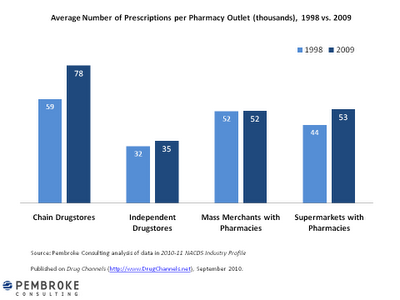
I found this on the DrugChannels.net blog.  A good visual of the data showing how “productivity” has improved per location by different types of pharmacies. 

What I think is interesting is that mass merchants have stayed flat.  With Target’s original couponing strategy and Wal-Mart’s $4 generics, you would have assumed those had an impact that would show up here.  I’m guessing the lift at independents could be explained away with increased utilization so the same number of patients go to the stores with just more scripts.

I’m not sure I have the time (or if the data is even available), but it would be interesting to look at patients per location and Rxs per pharmacist (and per pharmacy tech) by type of pharmacy.

Texting Trends Infographic

I remember a few years ago when I got my first text.  It was from the CTO at Accenture, and I had a phone that didn’t have SMS.  I had to click thru a link to a website to see the text.  I was totally flustered.  How was I supposed to respond?

Well…I’m past that now.  My brother and I send happy birthday via text.  I find it easier to send a quick text when in a loud spot like the airport than to try and call.  I’m sure my volume is still low.  My friend said their kid did 15,000 in one month (which seems impossible).  Another friend told me that their kids can text without looking.  They sneak a quick peak and then respond without even pulling it out of their pocket (when their supposed to be off the phone). 

We all know this is an emerging communication channel that will continue to evolve.  And, smart phone use and adoption is expanding rapidly.  So, here’s the infographic.

Book Review: Social Media Marketing

I just finished reading the book – Social Media Marketing: Strategies for Engaging in Facebook, Twitter, & Other Social Media by Liana “Li” Evans. It’s a good book especially for those who are new to the social media space. It’s an easy read with good examples. If you’ve been assigned the job of developing a social media strategy or are getting proposals from people in the space, you should read the book.

From her conclusion, let me pull a few things:

Important points to remember:

  • Not all companies are the same
  • You need to understand your audience
  • Cookie cutter solutions don’t exist
  • Don’t be afraid of the negative; embrace it as an opportunity
  • Measure what you’re doing

Her process is essentially:

  • Understand your market
  • Research where your audience is
  • Define your goals
  • Decide who owns what
  • Create your strategy
  • Implement and measure
  • Tweak, retweak, and stop if it’s not working

“Understanding that your audience and customers might not be where the media thinks they are (Twitter and Facebook, for example) is an important concept to grasp if you want to be successful.”

Reading her book definitely influenced my post from the other day on the 7 Myths of Social Media. Here are some other items from my review of my notes:

  • Types of social media
    • Social news sites
    • Social networking
    • Social bookmarking
    • Social sharing
    • Social events
    • Blogs
    • Microblogging
    • Wikis
    • Forums and message boards
  • Her 3rd chapter provides a good starting point of different metrics to think about.
  • She suggests several buzz-monitoring services:
  • She mentions Groundswell by Charlene Li and Josh Bernoff multiple times.
  • She gives an example about how Royal Caribbean managed an online situation.
  • If you’re giving away something, make sure it’s unique and special. Don’t just give the members of a community something they could get at any other place.
  • She talks about blogs as a “double-edged sword” where they can do whatever they want. I find it an interesting perspective since her PR company reached out to me and sent me the book to review. Did they do their background to see my prior book reviews? Did they know their pitch would appeal to me and they wouldn’t end up on the Bad Pitch Blog?

One question that I didn’t get answered was “What do you do with your content as your audience shifts from one technology to another?” I think this will be an issue as things move from (for example) MySpace to Facebook. What do you do with the old content? How do you keep things relevant without having to manage 20 different locations? (She suggests looking at Pete Cashmore’s Mashable site.)

  • She reinforces a key point several times which is that all your employees need to realize how their actions online affect the social media strategy that your company has.
  • Several times she reinforces the point that you can’t control the discussion.
  • She made an interesting observation that the Share This type applications that let you choose from multiple sharing services are actually a problem since they overwhelm people. (I guess this is like the concept of limiting choice as a way to help people decide.)

I wonder what it would be like if plans and PBMs were to share proposed plan designs with consumers via social media and engage them in dialogue. Would it change what was used?

She suggests Mike Grehan site – www.searchenginewatch.com – for information on search engines.

So, there is lots more in the book. I’d suggest you check it out.

When Should You Ask About Auto-Refill?

Auto-refill for prescriptions is all the focus lately.  Everyone from the big PBMs to the local pharmacies are encouraging this.  It helps with adherence (or at least with adherence calculations since you can’t force someone to take the pills just because they have them).  It addresses one of the common patient reported issues with adherence which was that they forgot.  They ran out of pills or didn’t know to refill the medication.  In some cases, a few days of pills may not be a big issue, but in other categories, this could be a problem. 

In general, professionals consider taking medication 80% of the time (or 80% medication possession ratio) to be adherent.

So, what is auto-refill?  You sign up to have your medication refilled when it’s time for a new bottle and then mailed to you or ready for you at your retail pharmacy. 

One question is whether this includes auto-renewal.  To most consumers, renewal means nothing, but it does in the pharmacy business.  When you get a script, it is only good for 12-months.  That could be twelve 30-day fills or four 90-day fills.  When you’re done, you need a new prescription from your physician.  That is called a “renewal”.  To most consumers, we just think of it as we ran out of refills.  So the critical question here is whether you include renewals in the auto-refill process.  I certainly advocate for yes.  If I run out of medication and expect my prescription to be refilled (because I signed up for auto-refill), I would want my pharmacy to reach out to my prescriber proactively.  Or, even if I’m just planning on refilling, I’d like my pharmacy to let me know in advance that I need a renewal or new Rx since I don’t have any refills remaining.  That can delay the process so without doing that you can create a gap in care.

That gap-in-care is one of the reasons why patients drop out of mail (which may happen to me).  In my case, I waited until I was down to 5 days supply of my medication imagining that my pharmacy would call me to remind me to refill.  They never did so I called to refill, but I was out of refills so a renewal is needed.  Getting in touch with my prescriber could take a few days so now I’m not sure what might happen.  Ideally, I would get a confirmation from them on when it’s coming, and I could go to a local pharmacy and get a 3-day “bridge supply” for a minimal fee.  We shall see.

But, what I recently found interesting (that took me down this path) was some research from CVS Caremark that was recently presented saying that

According to Keller, new research by CVS Caremark seeks to address the fact that many healthcare decisions unnecessarily are complicated by the lack of clear and plain language. In addition, choices for such programs as automatic refill of prescriptions or generic alternatives can be overlooked because those options are not readily transparent to the consumer, Keller noted.

“Through this research we are testing options presented through four different communications channels to see how consumers react to different scenarios,” Keller said. “One of our preliminary findings looking at consumers on the Web shows that if we reach out and present a decision to choose automatic refill in advance of renewing a prescription, they sign up at twice the rate of those who were passively presented an opt-in choice after receiving a prescription.”

For those of us in the communication space, this is interesting.  How you present information…when you present information…the language you use…All of these things are important as demonstrated here.

Pharmacy Factoids From Old SWOT Analysis

I found this on the Internet while looking for something else.  It’s a SWOT analysis (from about 2007) about Walgreens.  You can tell it was written by someone who doesn’t understand all the industry dynamics.  There’s no mention of mail order as a threat.  There’s no discussion of PBMs.  There’s no discussion of the value of specialty pharmacy.  It’s pretty focused on the pure play retail strategy.  Frankly, I’m pretty disappointed…BUT

What I did find interesting were some facts about the industry:

  • Walgreens fills an average of 256 Rxs / day per store (in 2006) versus 100 Rxs / day per independent and 180 Rxs per day per chain.
  • Walgreens (at the time) had drive-thru pharmacies at 80% of their stores and 30% of stores were open 24-hours per day.
  • Free-standing stores generate 30% more in sales than pharmacies located in strip malls.
  • 64% of Walgreen’s sales are generated by Rx (2005 analysis).
  • A customer spends 10 minutes in the store if including an Rx purchase; 8 minutes if no Rx purchase.
  • Only 30% of shoppers make impulse purchases.
  • The average non-pharmacy store purchase in 2001 was $19.38. 
  • The average American visits a grocery store 2.2x per week but a drugstore once a month.

In case you don’t know what a SWOT analysis is…

How Seniors Use Social Media (Pew)

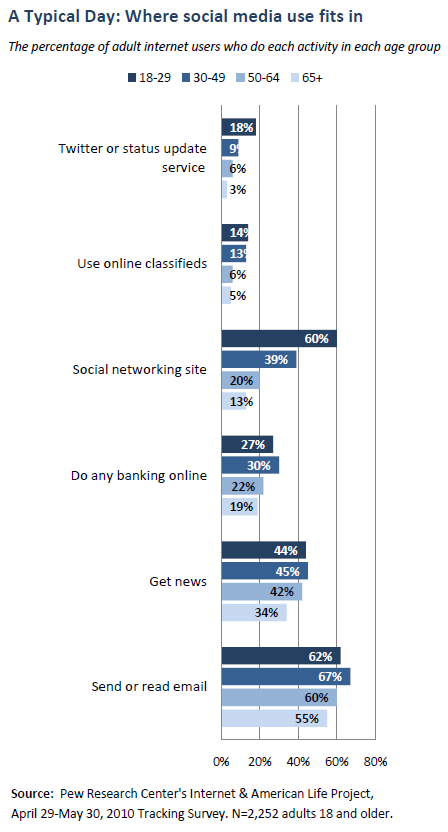
Not a big surprise…the Baby Boomers use technology.  Many of us have had their parents, uncles, grandparents, etc., send them a “friend invite” or talk to them about technology.  This will obviously continue as it’s more the norm and you have people that have been using technology for years age into retirement and look to connect with disparate friends and family.

Here are two charts from the recent report from Pew – Older Adults and Social Media.  Very interesting to watch the trends.

Complexity of Decision Making

In today’s world, the amount of information is overwhelming.  At the same time, we are constantly striving to practice DIY (do it yourself) medicine where we are reaching out to experts to help us sort thru information (especially when data is conflicting).  But, a lot of that assumes we know what we need or we know when to ask for help.

A study published recently in the Annals of Family Medicine looked a small group of diabetics and how they received information about their condition. 

They collected a nice long list of different sources used for information:

  • People
  • Physician
  • Nurse, nurse practitioner
  • Dietitian
  • Diabetes educator
  • Pharmacist
  • Dentist
  • Eye doctor, eye laser surgeon
  • Health care professional(s), specific role not indicated
  • Self, have had training as health professional or worked in medical field
  • Hospital-based diabetes center
  • Insurance company nurse, nurse, dietician, educator, wellness program personnel
  • Workplace nurse, health professional or wellness program
  • Family, including family members with diabetes
  • Friends, neighbors, coworkers, acquaintances, other patients, personal interaction, “word of mouth”
  • Classes or seminars
  • Support groups
  • Participation in research study
  • Comprehensive weight loss program
  • Health fair or similar event
  • Media
  • Internet (Web sites, search engines)
  • Information from organizations (eg, American Diabetes Association, American Kidney Foundation), other than from their Web sites
  • Books
  • Magazines (eg, Diabetes Forecast, Diabetes Self-Management, popular magazines—especially health/diet, cooking, women’s, African-American interest)
  • Television (eg, “D-Life,” news programs, talk shows, food-oriented shows)
  • Newspaper/newsmagazine articles
  • Booklets, brochures, etc, from clinic or health professionals
  • Booklets, brochures, newsletters, e-mail newsletters, etc, from miscellaneous sources (“in the mail”)
  • Information from pharmaceutical company, drugstore, medication supplier
  • Information from insurance company
  • Library
  • Bookstore
  • “Reading” or “studying” (type of material not specified)
  • “Media” or “articles” (not further specified)
  • Nutrition labels on food packages
  • Nutritional information pamphlet, fast foods
  • Product information (eg, Glucerna, information in insulin kit)
  • Atkins, South Beach diets
  • Reader’s Digest “Change One” program
  • Exercise videos
  • Printed reports of laboratory results

RESULTS Five themes emerged: (1) passive receipt of health information about diabetes is an important aspect of health information behavior; (2) patients weave their own information web depending on their disease trajectory; (3) patients’ personal relationships help them understand and use this information; (4) a relationship with a health care professional is needed to cope with complicated and sometimes conflicting information; and (5) health literacy makes a difference in patients’ ability to understand and use information.

CONCLUSIONS Patients make decisions about diabetes self-management depending on their current needs, seeking and incorporating diverse information sources not traditionally viewed as providing health information. Based on our findings, we have developed a new health information model that reflects both the nonlinear nature of health information-seeking behavior and the interplay of both active information seeking and passive receipt of information.

The Sandwich Generation

One of the things that I am surprised that we don’t hear more about is the sandwich generation.  These are people who are caring both for children along with their older parents.  According to Pew, 1 in every 8 people aged 40 to 60 fit into this category.

There are obvious implications in terms of managing health.

  1. Information challenges for these caregivers that have to manage information on their health, their kid’s health, and their parent’s health.
  2. Challenges in acting and coordinating this caregiver role while managing typical stresses of work, financial planning, and other things.

And, all of this puts a new requirement on health plans and health entities.  How do you engage the caregiver?  How do you track approval to send information to the caregiver instead of the patient? 

What about when the caregiver is remote and there is a surrogate?  How are decisions delegated?  How do you create information and send it to multiple parties?  Should the information be personalized to the individual knowing that perhaps my parents need certain information which I might need presented to me differently? 

Other resources on this topic include:

Express Scripts Drug Trend Highest Among Trend Reports

I am sure there is a project at Express Scripts right now to figure out how to position this in the industry. I personally would go for claiming better adherence drives up drug trend (see prior post).

With five major drug trend reports out (Express Scripts, CVS Caremark, Medco, Walgreens, and Prime Therapeutics), there is only one more that I expect – SXC. I’m sure someone else could come into the market with a report, but it’s a lot of work.

The trend numbers so far are:

  • 3.2% for Walgreens
  • 3.4% for Prime Therapeutics and CVS Caremark
  • 3.7% for Medco
  • 6.4% for Express Scripts

Does anyone really care? Should they?

On the one hand, it’s a good marker, but the companies each have different mixes of clients (Medicare, Medicaid, Employer, Managed Care, Government). They also have different mixes of clients by geography. All of these things matter.

I would personally argue that we need a different key metric for the industry. The one challenge Express Scripts faces is that they really drove this metric for years and were able to set the standard. Now, they may be caught up in that legacy.

Some of the metrics that are used to compare PBMs:

  • Generic fill rate – this is meaningful in that traditional PBMs make more money on generics but definitely subject to client mix
  • Mail order penetration – this is meaningful in that it drives several other metrics and is where PBMs make money
  • Drug trend – this is relevant in a traditional PBM sense that lower trend is better
  • Cost share – this has held pretty flat for years while the absolute value has gone up
  • Mail order satisfaction – this is generally a measure that everyone has as high and touts
  • Client retention – it seems like everyone has high marks here while clients obviously move around
  • Mail order fill accuracy – everyone’s at 99% plus so you get to differentiate at the six sigma versus two sigma level (which in scale matters)

I personally think average client cost per claim processed is a better measure. It takes into account drug mix (brand / generic). It takes into account rebates and rebates provided to clients. It takes into account retail mix (30 / 90 day) and mail order. It takes into account plan design.

I also think creating an average MPR (medication possession ratio) would be a relevant metric that more closely mapped to health outcomes and would still be within the PBMs sphere of influence. They can drive awareness and help with adherence programs thru the consumer, the pharmacy, and the prescriber.

I’m also a big fan of key metrics like:

  • 1st call resolution
  • Average inbound calls per claim processed (mail versus retail)
  • Web utilization – # of registrants AND average visits per registered member per year

The Power Of A Name

Believe it or not…Cows with names produce 68 more gallons of milk a year (according to Newcastle University in the UK).

So what does that mean for you?  Imagine how important it is to treat your customers as people…or your employees.  Think about that personal experience when you interact with a member.  If you’re the consumer, think about how it makes you feel when you get a general message from your healthcare provider.  Isn’t it better when it’s personalized to you?

Health Loyalty Lessons

Colloquy published a good article on Health Loyalty Lessons.  It pointed out 6 things that were important:

  1. Short-term incentives can mean long-term payoffs.
  2. Understand your objectives if you want to offer the right benefits.
  3. Communicate.  Communicate.  Then communicate some more.
  4. Strike a balance between hard and soft benefits.
  5. Stay relevant if you want consumers to stay motivated.
  6. Raise the bar.

These are good points (and more detail is in the article).  They’re relevant whether you’re doing a full blown loyalty or incentive program or simply focusing on the WIIFM principle (What’s In It For Me).  This is why healthcare communications is such a hot area right now. 

  • Who do I communicate with? (targeting)
  • When do I communicate with them?
  • How do I communicate with them? (letter, call, e-mail, text)
  • What message will drive them to act?
  • How do I measure success?
  • What’s worked before…for the individual or for people in the same segment as the individual (gender, age, condition, income, plan design)?

No “Pay-to-Delay” For Pharma

The Senate Appropriations Committee approved adding language to restrict this practice to a spending bill.  Will it ultimately pass?  I’m not sure.

What is it?  The way a generic drug comes to market is that generic manufacturers (e.g., Teva) will wait for a patent to expire and/or challenge the patent.  They do this by filing an ANDA (Abbreviated New Drug Application).  Manufacturers obviously want to enjoy the exclusivity of their patent(s) as long as possible.

My understanding is that “pay-to-delay” is when:

  • The brand manufacturer knows that someone is going to challenge their patent and try to get a generic to market before the patent expires.  They pay the generic manufacturer not to do this and in return might allow them to offer an “authorized generic” before the patent expires.

On the one hand, my reaction to this potential legislationis a “finally”.  On the other hand, this is a defeat for creative capitalism.  Does a company have to launch a product?

If Ford wanted to pay Toyota to delay the launch of a new car such that they both made more money, would the government step in and tell them they had to launch it.  Perhaps that’s apples to oranges.

The problem here is that while the brand manufacturer made more money and the generic manufacturer made money for doing nothing (other than getting the right to launch it) the public (i.e., consumers) and payers lost since they had to wait to save money.

A Collection Of Misc Articles

I’m in a clean-up mode in my e-mail and blog pile. For the first time in almost two years, I’m beginning to feel caught up. I have less than 250 e-mails (combined) in both my personal and work e-mail inboxes. This is a lot since once I open an e-mail I either (a) delete it; (b) respond immediately if possible; (c) file it in a folder on that topic; or (d) leave it in my inbox for future reading (i.e., it’s too much info to digest quickly) or for future response (i.e., it requires more time than I have).

It always begs the question of how late can you respond to something. Yesterday, I stumbled upon a e-mail from someone in Europe that wanted me to add their pharmaceutical site to my blogroll. I clicked on the link, reviewed the site, and added it. It took me less than 5 minutes, but the kicker was that he e-mailed me almost a year ago.

*****

  1. A study by Timothy Monk at the University of Pittsburgh concluded that keeping children on a stable schedule of activities can make them less anxious as they grow up.
  2. People with strong social connections are 50% more likely to live longer.
  3. People who regularly logged in to a weight-management website for 2 years lost 9-pounds (3x those that didn’t log in).
  4. Can a mouthguard make you a better athlete?
  5. A study in the July Health Affairs says that patients that use e-mail with their physicians have healthier outcomes.  (Lots of challenges here, but this should be key in health reform.)
  6. Digital Darwinism…you have to develop relevance, interactivity, and accountability.
  7. MyPressurePoints.com – a survey and website focused on African-Americans with diabetes.
  8. Generic drug videos from Teva.
  9. 9 Leading Trends in Rx Plan Management by Medco.
  10. Two low-cost generics used by Kaiser to reduce heart attacks and strokes.
  11. Managing with the Brain in Mind – neuroscience.
  12. AMA and Medco study about physicians and pharmacogenomic testing

More to come…

Back To The Future: The Role Of The Pharmacist

Between the focus on differentiation and the focus on adherence, we have seen (and will continue to see) greater use of them as a strategic asset. CVS Caremark is leveraging them in their Pharmacy Advisor solution. Walgreens continues to leverage them at the POS. Medco is using them in their Therapeutic Resource Centers. And, the independent pharmacists have stressed this story for years.

In Medicare, the Medication Therapy Management (MTM) process begins to recognize the power of pharmacists and actually rewards them for their efforts. I was quoted in Drug Benefit News today about this topic. Here were a few quotes:

“The pharmacist is an under-utilized resource today,” George Van Antwerp, vice president of the Solutions Strategy Group at Silverlink Communications, tells DBN. “They go to school to work with patients and often end up simply filling bottles.”

While the benefits of pharmacist intervention are undeniable, Van Antwerp says, the challenge is finding the right balance of face-to-face interaction and automation. Issues also include getting a good return on investment for such services by condition and the fact that only an estimated 60% of the people picking up prescriptions are the patients themselves. In addition, “the staffing model right now would be stressed if pharmacists were spending significant time on cognitive services,” he maintains.


Aetna To Outsource PBM Functions To CVS Caremark

While the market seems more mixed on this than me, I see this as a good thing for CVS Caremark. If played right, this could be a huge factor for 90-day retail and/or Maintenance Choice since Aetna (as the payer) will have huge incentives to take advantage of this.

I was a little surprised since most of the rumor had been that Medco was going down this path with Aetna and that this was what they had pitched to Wellpoint prior to the Express Scripts acquisition of the pharmacy business.

And, for those of you that have been around this space for a while, you might remember that Aetna did outsource some of their PBM business up until about 6 years ago when they insourced in from Express Scripts. I’d be interested to understand what changed (which might simply be in the finer points of this new agreement which doesn’t appear to sell assets but to leverage CVS Caremark’s scale).

It clearly points out that there are scale efficiencies in the PBM business something that I think will come to end in the near future (as predicted in my white paper a few years ago). So, I think the question a lot of people are asking is whether this move will accelerate different models to get to scale:

  • A roll-up strategy of smaller PBMs by the large PBMs.
  • A consolidation of smaller PBMs into coalitions and buying groups.
  • Smaller PBMs contracting with larger PBMs for core services.

Let’s look at some of the PBM functions to think thru what makes sense to consolidate and leverage (IMHO):

  1. Sales – independent
  2. Marketing – independent although some physician or consumer marketing could be consolidated
  3. Implementation (Client Set-Up) – independent
  4. Research – drug trend, research studies, and analytics could be consolidated
  5. Plan Design – could be consolidated but not likely large efficiencies
  6. Drug Acquisition – consolidation would drive the majority of value
  7. Procurement – consolidation could add value
  8. Rebating – another big opportunity for consolidation but requires coordination on formulary (P&T) and other areas
  9. Mail Fulfillment – should offer consolidation benefits
  10. Call Center – should offer consolidation benefits
  11. Claims Processing – limited but possible consolidation benefits
  12. Clinical Reviews – easy to consolidate but minimal savings

I think given Express Scripts and NextRx and now CVS Caremark and Aetna (although different relationships) that this puts the spotlight back to Medco for the next move. I think the likely focus areas would be on Cigna and Prescription Solutions (part of United Health Group). After those two, there are other less likely targets – Prime Therapeutics, Walgreens (PBM), and MedImpact.

Caremark iPhone App – Will Others Follow?

CVS Caremark announced today that they were releasing a Caremark iPhone application. First, I think it’s about time (for some PBM to do this). I would think the other PBMs will follow suit.

Second, I think this is a great opportunity for an expanded CVS Caremark iPhone application which expands the functionality of the app and is like Maintenance Choice in that it offers a benefit of the integrated company.

Today’s application is PBM centric and focused on ordering refills (I assume at mail only); checking prescription order history (I assume mail only); viewing prescription history; requesting a new prescription (retail-to-mail I believe); checking drug cost; and finding a nearby network pharmacy. Checking drug cost could be the coolest feature since it would give patients what they don’t have today – an ability to check the cost while they’re at the physician’s office. Finding a network pharmacy is an important tool if companies were to promote limited networks, but it’s only a nice to have if all the pharmacies are in the network.

So, of course the question that I would have is when will they add the retail components to request retail refills (at CVS stores or all locations); check status of prescriptions (e.g., prior auth required); request a renewal of an Rx; request a lower cost alternative; find a CVS with a MinuteClinic; or identify opportunities to save money (e.g., a generic alternative).

There are lots of other things to push out via the application, but I agree with the strategy of focusing on the core applications first. Caremark (or other PBMs) could push clinical suggestions; send adherence reminders; do satisfaction surveys; collect barrier data (why not adherent); and collect information (why not using generics). I also see it as a great way to push tools – e.g., 5 questions to ask your physician when you get a new Rx.

It would be interesting to see the statistics in a year – how many downloads of the app; how frequently is it used; patient satisfaction with the Caremark for those with the app (vs those without); adherence for those that use the application; what functions work best; savings versus other modes of communication; and effectiveness of their appliction versus other health applications.

ADHD Drugs – Long Term Effect

Given the frequency of use of medications in our society today, I think there is much to learn once we see what happens when people are on medications for chronic conditions for their entire life.

Although this study only looks at 10 years and was funded by drug manufacturers, I think it’s a promising study that shows that kids that take stimulants for ADHD may have an initial slowing in weight and height, but that over 10 years there was no difference.

How Much Do You Really Notice?

The Dateline NBC show “Did You See That” shows us just how little we see or how easily our minds are distracted. This is a real issue when we think about communicating information to patients who have hundreds of other things going on in their life.

Would you notice if the man who stopped to ask you directions on the street all of a sudden became a woman?

Would you notice a man walking thru a group of basketball players when you were focused on counting passes?

Would you notice when the talk show host’s shirt turned from blue to green?

Would you notice that the person helping you at the store was blond one minute and a brunette the next minute?

People in the videos on the show didn’t. It was amazing…scary…surprising.

It makes you think. It made me want to experience the tests. Would I notice?

Watch this video – http://www.msnbc.msn.com/id/21134540/vp/38287250#38287250.

10 Numbers You Need To Know For Mobile Health

I found this great list of statistics yesterday from RxEOB. I won’t repost them all here so you click thru to the original content, but I thought it was very helpful.

23%. Percent of American households who use only a mobile telephone, no land line. Another 15% of homes with landlines report they receive all calls to their mobile device.

32%. Percent of Americans whom have accessed the internet from their mobile phone as of 2009. (19% reported they did it “yesterday”). In total 56% of Americans have accessed the internet via some form or wireless device (e.g., phones, MP3 players, laptop, game consoles).

81%. Percent of physicians will own a smart phone by 2012. Physicians are one of the highest using Smartphone demographics overall.

5,820. The number of health apps that were available for download from the major online Smartphone app stores (as of a report published Q2 2010).

66%. Percent of Americans who are interested in receiving health related emails from their health insurance company… 52% would be open to receiving emails that provide them feedback on their health process.

Growing Horns, Turning To Stone, and Other Random Diseases

We can all be a hypochondriac at some point in our lifes. Now, there’s a handbook for you to make you think about all the completely random diseases which exist.

– Get addicted to carrots
– Unintentionally speak with a foreign accent
– Believing you’re dead (Cotard’s syndrome)
– Constantly shocking other people
Alien hand syndrome
– Stone man syndrome
– Guinea worm disease
Human botfly myiasis
Alice in Wonderland syndrome

Gender Bias – Postpartum Depression

We all know that females are different that males in terms of healthcare.  And, regardless of the data, we all have biases in terms of what we believe.  These biases can cause issues.  (As I often say…”When you assume, you make an ass out of u and me.”)

That being said, I found the study a few months ago interesting where it said that 14% of American men develop depression either during their partner’s pregnancies or in the first year after delivery (peaking when babies are 3-6 months old). 

This is important since depression is correlated with lots of health issues and has a family impact.  The article mentions that children of depressed fathers have more emotional and behavioral problems than other kids at age 3 and more psychiatric disorders by age 7. 

An interesting note was:

“Any healthy adult who goes without good sleep for a month is liable to become depressed.”

The big takeaway from the study is that physicians (and other healthcare entities) need to treat the family around birth.  This is probably also a great opportunity for social media to support fathers as much of today’s infrastructure is set up to support the mother.

5 Keys To Health Plan Survival

I thought I would re-post these from the Corporate Research Group.   

Bertolini outlined  five keys to surviving reform: 1. Payment reforms that shifts incentives from volume to outcomes; 2. Information technology that improves quality, lowers cost; 3. Wellness: engaging consumers with incentives and decision-support tools; 4. Transparency tools that provide information and improve accountability; 5. Revamped benefits and plan designs.

 These seem pretty logical and echo some of the things I brought up in my pharmacy white paper last year. 

1. The need to better engage the consumer in understanding their benefits and ultimately responsibility for their care;
2. The effort to automate and integrate data across a fragmented system and across siloed organizations; and
3. The shift from trend management to being responsible for outcomes.

New Health Insurance Ideas

Just two ideas that I was playing with for health insurance.

1. Complete transformation from group to individual

Why not change the entire market to be an individual purchase…There are obviously some reasons such as adverse selection and group buying power, but I would think those were things where the government could add value.  If individuals selected the health insurance companies and products that they liked, it would create a very different dynamic. 

You could then change the employment paradigm not to a provider of health insurance, but make it more a part of your compensation.  Company A might fund up to $5,000 per year in health insurance while Company B provides up to $7,200 for family coverage.

One of the big benefits of this (beyond making individuals into consumers with power) is that health insurance companies could start to invest in outcomes.  Today, they are hesitant to make long-term investments (i.e., if I do this for 5 years, it will reduce the cost of this individual in 20 years) because their membership turns over.  This is a real issue in my mind.

2. Free insurance for healthy people

There is obviously an issue with funding and hyperbolic discounting, but what if we simply said that people who maintain some set of health standards (BMI btwn 20-25; HDL less than 180; able to run a mile in under 8 minutes) got free health insurance.  Would that make a difference?  I think so.  Companies would be better off – less absenteeism.  The US healthcare costs would drop.

Of course, it would take it’s toll on the providers while being a boom for gyms.  But, it’s hard to find that win-win-win. 

I know there’s a big issue of funding, but I was thinking about some radical ideas of what the money being raised by Gates and Buffet could be used to do and how it could motivate people.

Obesity Rates Vs. Population Growth

The research correlating weight with your social network is out.  So, it makes me wonder as I look at the states with the highest rates of obesity whether they will build on themselves.  Will they continue to get more and more obese?  The logical next question is whether that will at some point affect things like the healthcare costs in these states, employment growth in these states, and population growth.

Given two options, would you move to a healthier state or do you believe that you’re above this social pressure which will lead to less exercise and higher weight? 

The states with the highest rates of obesity were:

  1. Mississippi (33.8%)
  2. Alabama
  3. Tennessee (tied for 2nd)
  4. West Virginia
  5. Louisiana
  6. Oklahoma
  7. Kentucky
  8. Arkansas
  9. South Carolina
  10. Michigan
  11. North Carolina (tied for 10th at 29.4%)

The fastest growing states (2008-2009) were:

  1. Wyoming
  2. Utah
  3. Texas
  4. Colorado
  5. Alaska
  6. Arizona
  7. Washington
  8. North Carolina
  9. Georgia
  10. South Carolina