Archive | Books / Articles RSS feed for this section

Is Your Conversation With The MD One-Sided?

USA Today had an article earlier this week called “Doctors Take Decider Role” which is about the fact that patients are often not asked about their opinions.  This is a problem on many fronts.  If you’re not discussing the pros and cons, you are not as likely to buy into the recommended treatment plan leading to lower compliance.

“In the real world, people agree to take drugs, have surgery and undergo tests after a much more one-sided process, new studies show. As a result, researchers say, too many people get care they don’t want or need and miss out on options that make more sense for them.”

In a scary example, the research showed the 69% of men heard the procs of taking a blood test for prostate cancer, but only 18% heard about the downside.  The research also showed that only 41% of patients were asked how they felt about taking blood pressure medications.  But, this obviously varies since 76% were asked to weigh in on their back surgery.

It begs the question of how aware doctors are of patients concerns and priorities.

Social Media Myths

This was a great article in Business Week.  It lays out nicely six myths to watch out for as you jump on the social media bandwagon.

  1. Social media is cheap if not free
  2. Anyone can do it
  3. You can make a big splash in a short time
  4. You can do it all in-house
  5. If you do something great, people will find it
  6. You can’t measure social media marketing results

Shifting Trends

Anyone whose read my blog knows that I find Penelope Trunk’s insights both interesting and unique.  She cuts to the chase and talks about things very directly.  As always, I think you will find some of her comments about how the economy is changing our behavior interesting.

She lays out 5 items here and they talk about it being cool to be cheap and women earning more than men.

Is Choice Good?

In recent discussions, I was talking with some clients about helping members or consumers save money in healthcare.  On the one hand, you can educate them about all the different opportunities.  On the other hand, you can focus them on one or two opportunities.  Those could offer the most value, be the simplest to execute, be the easiest to understand, or have some other logic in prioritization.

The question in my mind was what would drive the best results.  If you look at the research around consumer products and 401K’s (for example), it is clear that choice is not always best.  When presented with more options, people don’t always make a decision.  They get overwhelmed.

So, think about focus and simplification.

A Few Quick Things

Found this new blog – Drug Channels.  Lots of good posts.

Ron Lyon unfortunately doesn’t blog a lot, but several of his recent posts are very interesting on the Pharmacy Rants and Raves blog.

Bruce Temkin from Forrester blogs at the Customer Experience Matters and has some great insights across industries.

McKinsey has jumped into the social networking fray with their McKinsey Quarterly which is available with a Facebook page and Twitter feed.

A report on Medicare spending on healthcare by the Kaiser Family Foundation.

A new eBook on Finding Dr. Right.

SPAM is Back!

spam_can_smallYes.  I am talking about SPAM, the food, not spam as in junk e-mail.  In this economy, their production is up dramatically to levels they haven’t seen since WWII.  But, according to the NY Times, there are lots of thrifty food items that are seeing increased success:

  • Macaroni and cheese
  • Jello
  • Instant potatoes
  • Velveeta
  • Rice
  • Beans
  • Kool-Aid
  • Vitamins
  • Beer

Probably not the right grocery list to create a balanced meal.

Personalized Medicine Webinar

I don’t have anything to do with this, but it sounds pretty interesting.  Medco and Regence are talking.  Here is the teaser.  (Click here for more info and registration.)

Personalized medicine is moving rapidly. The FDA in December considered requests to require genetic testing for the colon cancer drugs Vectibix and Erbitux. Approval of such labeling changes could pave the way for a slew of other personalized therapies and diagnostics now waiting in the wings. Stakeholders anticipate significant clinical and financial savings. Recently approved genetic testing for the blood thinner warfarin, for instance, is projected to avoid 85,000 serious bleeding events annually and save roughly $1.1 billion a year!

On the other hand, questions remain whether the model actually provides a favorable return on investment (ROI). A new study finds that genetic testing for warfarin does not appear to be cost-effective in certain patients. And health plans and PBMs are trying to sort out which of the numerous diagnostic tests on the market actually provide clinical utility and improved results. One large health plan, for example, says its costs for diagnostic testing are growing at nearly 20% a year.

So where does all of this leave Rx payers in February 2009?

Seeing Significant Improvements With BPO

Business Process Outsourcing (BPO) or as I will sometimes call it CPO (Communications Process Outsourcing) is something we are definitely seeing a growing demand for in the market.  It blends technology, services, process management, consulting, and analytics.

Both IDC and Gartner have now talked about this in recent reports.

According to Janice Young, IDC program director, Payer IT Strategies, “we expect to see an increasing interest and likely investment in BPO in 2009 and 2010 for healthcare payers. Our recent results from our January 2009 healthcare payer survey of IT spending indicate that 45% of healthcare payers expect BPO investments to increase this year.” These trends are highlighted in IDC‘s U.S. Healthcare Payer 2009 Top 10 Predictions (January 2009).

Gartner research vice president, Joanne Galimi, reported on BPO services within health plans in a recent report entitled Healthcare Insurer Business Process Outsourcing Trends (January 2009). “Although things look gloomy for the larger economy, the potential for BPO to address immediate business pressures and long-term recovery goals for the health plans will be unprecedented,” says Galimi.

When I first came to Silverlink as a consultant in early 2007, this was exactly my vision.  I always talked about the “one throat to choke” model.  When you are in an operations role, it is always so difficult to coordinate modes, vendors, discrete data sources, and ultimately to get a holistic view of the member (or patient).  This is what I wanted to help build and is exactly what we have done.

Fortunately, we are now in a position where we can talk about how this service model has grown and how offering turnkey services for clients has driven results.  I love to focus on outcomes so this is exciting.  Here are a few from the press release we put out this morning:

  • Over a 300% improvement in retail-to-mail conversions for a large pharmacy benefit manager (PBM),
  • 54% increase in participation for a pharmacy program, representing between $150 and $175 per year per prescription in consumer savings,
  • 400% improvement in yield in a COB program, translating to over $20 million in cost savings to a major U.S. health plan, and
  • Up to an 82% increase in transfer rates for population health engagement for disease management, lifestyle management and treatment decision support programs.

Pharmacy Principles for Healthcare Reform

Several pharmacy groups have put out their principles for healthcare reform:

“Proper use of prescription medications helps improve quality of life and health outcomes. How ever, the health care system incurs more than $ 177 billion annually in mostly avoidable health care costs to treat adverse events from inappropriate medication use. T he proper use of medication becomes even more important as treatment of chronic disease costs the health care system $ 1.3 trillion annually, or about 7 5 cents of every health care dollar.”

The document goes on to talk about the importance of pharmacists in managing chronic diseases and helping patients.  A role that I completely support although I question the bandwidth of the pharmacists to do this given the massive shortage in the US.

The Principles are:

  1. Improve Quality and Safety of Medication Use
  2. Assure Patient Access to Needed Medications and Pharmacy Services
  3. Promote Pharmacy and Health Information Technology Interoperability

They are kind of like “No Child Left Behind” in that you can’t argue with the concepts.  At first read, the only thing that raised an eyebrow for me was some of the language around Principle 2.  I could interpret it to be a subtle play against some of the trend management tools that the PBMs use to help control prescription costs – e.g., mail order pharmacies.

Marketing In A Recession

Most healthcare people hate the word marketing.  Well, you know what…that is a big piece of what healthcare is about especially with the rise of consumerism.  Individual marketing.  Medicare.  Getting people to make better choices.  It’s all about marketing.

One of the things I liked in the attached presentation is that it talks about tightening up your funnel.  One of the things I notice with lots of companies is that they don’t always take a rigorous process framework for thinking about members and communications.  Process matters.  You have to think about an integrated approach and how you optimize that process.

Excess Healthcare Spending

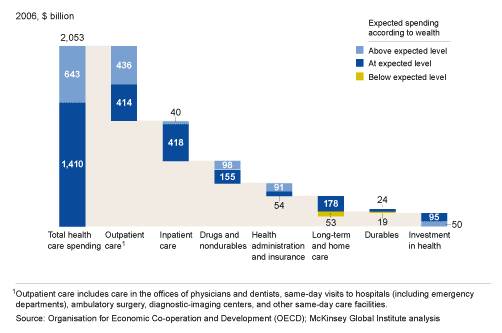
According to McKinsey

McKinsey research shows that the United States spends about $650 billion more than might be expected given its level of wealth and the experience of similar countries.

Here is a chart that breaks this down in a typically McKinsey framework (which I love BTW):

mckinsey-on-excess-hc-spending1

7 e-Patient Conclusions

Thanks to e-patient Dave’s reminder on the e-Patient blog

Here are 7 conclusions from the white paper that came out last year on this topic. Very important in diffusing some of the myths around the role of social networking in healthcare and the use of the Internet for information.

1. e-patients have become valuable contributors, and providers should recognize them as such.
“When clinicians acknowledge and support their patients’ role in self-management … they exhibit fewer symptoms, demonstrate better outcomes, and require less professional care.”

2. The art of empowering patients is trickier than we thought.
“We now know that empowering patients requires a change in their level of engagement, and in the absence of such changes, clinician-provided [information] has few, if any, positive effects.”

3. We have underestimated patients’ ability to provide useful online resources.
Fabulous story of the “best of the best” web sites for mental health, as determined by a doctor in that field, without knowing who runs them. Of the sixteen sites, it turned out that 10 were produced by patients, 5 by professionals, and 1 by a bunch of artists and researchers at Xerox PARC!

4. We have overestimated the hazards of imperfect online health information.
This one’s an eye-opener: in four years of looking for “death by googling,” even with a fifty-euro bounty for each reported death(!), researchers found only one possible case.

* “[But] the Institute of Medicine estimates the number of hospital deaths due to medical errors at 44,000 to 98,000 annually” … [and other researchers suggest more than twice as many]
* We can only conclude, tentatively, that adopting the traditional passive patient role … may be considerably more dangerous than attempting to learn about one’s medical condition on the Internet.” (emphasis added)

5. Whenever possible, healthcare should take place on the patient’s turf. (Don’t create a new platform they have to visit – take yourself wherever they’re already meeting online.)

6. Clinicians can no longer go it alone.

* Another eye-popper: “Over the past century, medical information has increased exponentially … but the capacity of the human brain has not. As Donald Lindberge, director of the National Library of Medicine, explains ‘If I read and memorized two medical journal articles every night, by the end of a year I’d be 400 years behind.”
* In contrast, when you or I have a desperate medical condition, we have all the time in the world to go deep and do every bit of research we can get our hands on. Think about that. What you expect of your doctor may shift – same for your interest in “participatory medicine.”

7. The most effective way to improve healthcare is to make it more collaborative.
“We cannot simply replace the old physician-centered model with a new patient-centered model… We must develop a new collaborative model that draws on the strengths of both systems. In the chapters that follow, we offer more suggestions on how we might accomplish this.”

Presentation Zen

presentation-zen-example
Have you read the book – Presentation Zen? If not, you can visit the blog to start to understand what Garr Reynolds talks about in his book. In general, one of the key points that I always try to relay to people is that slides are not your leave behind. Don’t put too much content on them. Don’t talk to them. Think about how to engage your audience in your story.

Take a look at a few of the slides he shares here. How does his presentation compare to your last presentations?

Did You “Catch” Your Obesity?

What if obesity were a virus that once you caught it you couldn’t manage it with simply diet and exercise?  That would be a very discouraging fact.

sneezeWell, some recent research is finding a link between a virus and obesity and claiming just that.  Of course, the primary issue is overeating especially with limited exercise, but this presents a new wrinkle in solving the obesity crisis.

So, to manage obesity, you need to sleep more and eat better.  Exercise has an impact, but it may not be the best way to try to lose weight (see article).

Walgreens Complete Care and Well-Being

Walgreens has just announced their offering to push into the on-site clinic market.  It is not completely new for them, but this is certainly a broader offering leveraging several assets they have acquired.

The program’s foundation is the pharmacy and health centers located on employer campuses or manufacturing facilities, along with Take Care’s in-store retail clinics and Walgreens nationwide pharmacies. Take Care’s employer health centers can offer complete pharmacy and health care services ranging from acute (e.g. strep throat) to primary care, occupational health, infusion services, specialty pharmacy, prescription mail services and disease management and are staffed by a combination of Walgreens clinicians including physicians, nurse practitioners, physician assistants, nurses, pharmacists and other health care professionals. Take Care Clinics, walk-in health care clinics open seven days a week and located at neighborhood Walgreens drugstores nationwide, are staffed by nurse practitioners and physician assistants who offer health care services built around a family’s needs.

I have always found this model to make a lot of sense, but it is hard to scale beyond massive employer sites.  In general, I think you have to have at least 1,000 people at one site to even begin to see this as a profitable investment (if I remember my analysis from years ago).

I am not really sure what the “all prices transparent to the employer” means in their press release.  Are they really going to reveal the acquisition cost of drugs?  The cost of their private label medications?  The cost of a clinic visit?  I am not sure that’s necessary.

Providing convenience without increasing costs should be enough.  Employees will love it.  Of course, I have heard that once you put it in that it is impossible to pull these out without very negative employee reaction.  And, I do believe that convenience (as it does with 90-day Rxs) can help improve adherence with mixed with the right education and counseling.

Regence Quote On Pharma Studies

I always find some great nuggets in the AIS daily news.  I thought I would pass on this one from the head of pharmacy at RegenceRx.

“Unfortunately, we find that only 15% to 20% of pharmaceutical studies are reliable. Our findings are not unusual. For example, Pitkin, R. et al (JAMA. 1999; 281:1110-11) found that 18% to 68% of abstracts in six top-tier medical journals contained information not verifiable in the body of the article. To assure Regence doesn’t disregard valid studies, we request full study information from pharmaceutical manufacturers in addition to reviewed published information. Unfortunately, it’s rare for manufacturers to provide information beyond what’s in the published study.”

— Helen Sherman, Pharm.D., senior director of pharmacy services and chief pharmacy officer at The Regence Group, which operates BCBS plans in the Northwest, told AIS’s DRUG BENEFIT NEWS.

Walgreen’s President On Recession Impact

In case you didn’t see it, Gregory Wasson (President and COO) from Walgreens did an interview with The New York Times on how the economy is impacting them and answered a few other questions about their strategy.

Q. How is the slowdown affecting purchases of prescription drugs and health and beauty aids?

A. We certainly are seeing a slowdown in prescription drugs. In this economy, patients are not seeing their doctors as frequently. There may be some cases they are skipping doses of medications to control costs. As far as over-the-counter items, we see consumers definitely looking for value. We’re also seeing a big increase in private label product. The consumer is willing to buy down.

To read the rest of the interview…click here.

Follow-up On Physician’s Comments On PBMs

I talked about it in a few previous blog entries – Physicians versus PBMs and Physicians as Victims of System – and I am finally getting around to the source interview in AIS’s Drug Benefit News from October 31, 2008.

Here are a couple of additional thoughts after reading the entire interview with Toni Brayer:

  • She questions the value of PBMs (pharmacy benefit managers).
    • [It’s been well documented that PBMs can drive lower trend and have lowered prices.  This was well documented by third parties before PBMs were made central to the Medicare Part D benefit.  Additionally, reading any of the PBM trend reports will show you the money that can be saved by leveraging the trend programs that they offer.]
  • She talks about confusion between mail order pharmacies and PBMs.
    • [This is a good example of one thing that PBMs have driven which is mail order utilization which has driven down costs and allowed members to move from 30-day to 90-day prescriptions.  But, mail order is often a key component of the PBM offering.  People should think of them as two different entities – the PBM is focused on claims processing and the rules for benefit administration…the mail order is simply a pharmacy that uses automation to deliver medications to members from a centralized location.]
  • She says that PBMs contribute to the double digit increases in pharmacy costs that have occurred. 

    • [I think this has been disproven by many of the independent studies.  Additionally, the increases are driven by increased utilization, brand price increases, and new product introductions in most cases.  PBMs drive down reimbursement rates year-over-year, drive generic fill rates, and move members to lower cost channels such as mail order or specialty pharmacies.]
  • She talks about the hassle of PAs (prior authorizations).
    • [I completely understand the hassle here and am a little mixed in my opinion.  On the one hand, this is an effective trend management technique using evidence-based standards to manage inappropriate use of medications.  On the other hand, since in most cases, 95%+ of all PAs are approved (if the MD calls in), it does seem like an unnecessary burden.]
  • She also talks about confusion between brands and generics.
    • [This has become a bit of a challenge over the past few years as some branded products end up being cheaper than generics.  This has led to formulary tiers at a few companies reflecting more about drug price than brand versus generic.  And, I completely agree that physicians can’t be expected to understand formulary status…without electronic prescribing tools.]
  • She talks about pharmacies not automatically refilling prescriptions.
    • [I agree with her here with a few caveats.  Pharmacies should be reaching out to patients to remind them about refilling their medications.  They should be using a barrier survey to understand why they aren’t refilling and help them address these barriers or pushing them back to their physician when appropriate.  In my day job, this is definitely something that I talk with a lot of pharmacies (mail, retail, and specialty) about how to do this.]
  • She even talks about tamper-proof prescriptions being a hassle.
    • [In most cases, I think pharmacies offer patients either tamper-proof or standard prescription bottles as a choice.  Obviously the tamper-proof is to reduce the risk of children getting into medications and overdosing.  I don’t know the statistics, but I think it’s a legitimate concern.]
  • She compares pharmacies to the Department of Motor Vehicles.
    • [WOW!  I have certainly heard that some of the pharmacies in high density urban areas have ridiculous wait times, but I think this is a pretty bad slam.  The pharmacies that I go to take time to talk with the patients.  They are fairly quick on filling medications.  They use computer technology and automation to drive efficiencies.  We have a huge shortage of pharmacists in the US so there are some challenges.  That was one of the reasons I tried to go to market with a pharmacy kiosk solution.]
  • She says that she always considers cost when writing a prescription.
    • [This is great.  I know physicians generally do this for the medications they understand cost on…which are usually the outliers.  But, with over 10,000 medications on the market, I can’t imagine they can keep up with some of the idiocyncracies in the market.  Again, although I am not the biggest believer in electronic prescribing, this is one of the clear advantages here that it can show drug cost and member cost.]
  • She thinks that pharmacies are gouging patients by only dispensing 30-day supplies for chronic medications.
    • [This one I can talk about from several perspectives.  First, for new prescriptions, it is usually appropriate to only dispense 30-day prescriptions until the patient stabilizes on an Rx and strength.  Second, most patients have access to mail order where they can get a 90-day prescription…and some retailers offer this also.  Third, pharmacies generally make their money on the things people pick up while in the store…on many Rxs, pharmacy is a loss leader.  Fourth, to fix this issue, we would have to stabilize care so that only one insurer / employer paid since today people move around too much creating a disincentive to have one payor pay for a longer Rx only to have the patient leave before they use up their supply.  Fifth, since most people are non-compliant / non-adherent, there would be a lot of waste.]
  • She talks about hardly any medications costing under $40.
    • [Since most people have prescription drug coverage, this would only apply to 3rd tier drugs or specialty medications.  With all the $4 generics, patient assistance programs, and drug discount programs out there, patients don’t pay over $40 in many cases.  If she is talking about drug costs to the payor, then most brands certainly cost over $40 but that now represents just over 30% of all drugs dispensed.  I will let pharma make the arguement, but clearly the research required to bring a new drug to market justifies much of the cost.]
  • She suggests pricing brand drugs with no generic alternative lower.
    • [I am all for lowering healthcare costs and don’t think manufacturers should gouge patients, but in a capitalist society, why would I lower the cost of something that people need and have no alternative for?]

Sorry for the long rant, but there was soo much fun stuff to respond to in this interview…I never thought I would be a “defender” of the PBM model, but I really disagree with a lot of her comments.  PBMs do a lot of good things for clients and members even though they are in the “middle man” position.

Using Your FSA For Your Gym Membership

Maryland is working on a bill that will allow you to use your flexible spending account (i.e., pre-tax dollars) for things like gym memberships and sports equipment.  I am not sure I agree with the sports equipment since I could see a whole arbitrage opportunity of buying equipment with pre-tax dollars and then selling it on eBay.  But, I can see things like gym membership or even fees for a race qualifying.

I don’t have an opinion on the bill, but the concept sounds intriguing and sends the right message.

Rx Spending Slows

In the USA Today, there was an article this morning about the slowing growth in the prescription drug market.  Growth was only 4.9% (in dollars) which is the lowest since 1963.  A lot of this is due to the increasing use of generics along with the trend toward $4 generics or even free generics.  They attribute some of it to safety warning which may have decreased utilization and certainly there have been multiple surveys talking about the dampening effect of the economy.

The article states that health care services overall rose 6.1% to $2.2 trillion in 2007 (or $7,421 per person) according to CMS’s Office of the Actuary.

They also state that generics now make up 67% of all prescriptions filled and that drug prices grew only 1.4% which was down from the 3.5% in 2006.

I was surprised by the statistic that the FDA issued at least 68 safety warnings in 2007.

In general, I didn’t agree with their observation that lower prescription drug cost increases contributed to holding overall health care spending increases down since prescriptions only make up about 10% of total healthcare costs.

Breaking Down The 2008 PBM Customer Satisfaction Report

PBMI (Pharmacy Benefit Management Institute) put out its 14th report on employer satisfaction with their PBMs. Here are some of the highlights from the report:

  • 275 employers representing 11.3M members responded.
  • The overall rating was an 8.0 out of 10.0. (up from 7.9 in 2007)
  • 6.7% of respondents perceived that their benefit costs were increasing more than others and ranked their PBMs lower. (perhaps a validation that trend management matters…hence the “battle” to show the lowest year-over-year trend to the street in the individual trend reports)
  • PBMs were ranked on three factors – overall service and performance, delivering promised savings, and delivering promised services.
  • For the overall score:
  • Aetna (6.6), Argus (4.8), Innoviant (8.7), MedImpact (8.0), NMHC (7.5), and Prime Therapeutics (9.0) also were part of the report but had limited profiles due to a lower number of surveys being received.
    • As far as I know, Prime doesn’t contract directly with employers but just through their BCBS owners. That would seem to disadvantage them in this survey.
  • Employers can contract directly with PBMs or thru a managed care entity or buying group. Those that contracted directly ranked their PBMs higher (8.2 versus 7.6) which makes sense since they are more involved and more likely to be actively managing trend and having lower costs.
  • This is validated by the fact that those with very aggressive intervention in benefit management rated their PBMs much higher (8.6 versus 7.1). About 33% considered themselves to be very aggressive.
  • PBMs were rated the worst (7.2) for their disease management programs.
  • When looking at factors that were correlated with satisfaction there were a few surprises and a few no-kidding variables:
    • I was surprised the member website, specialty pharmacy, and mail service pharmacy ranked low on the list of variables (i.e., less correlation).
    • I was not surprised that account management ranked high and retail pharmacy network was low. In many cases, the networks are pretty similar. I would be interested to see how large employers ranked PBMs versus smaller employers since they probably get different levels of service.
  • Looking at the overall scores from 2004-2008:
    • Caremark, Catalyst, Cigna, Express Scripts, and Medco all went up.
    • Walgreens and Wellpoint went down.

Looking at the ranking of key factors:

Highest Ranked Function(s)

Lowest Ranked Function(s)

Aetna Retail pharmacy network

ID card production

Mail service pharmacy

Disease mgmt programs

Argus Retail pharmacy network

ID card production

Formulary mgmt and rebates

Account mgmt

Catalyst Retail pharmacy network

Claims processing

Disease mgmt programs

Mail service pharmacy

Cigna Account mgmt

Member services

Delivering promised savings

Disease mgmt programs

CVS Caremark Retail pharmacy network

Claims processing

Formulary mgmt and rebates

Disease mgmt programs

Envision Overall service and performance

Account mgmt

Disease mgmt programs
Express Scripts Retail pharmacy network

ID card production

Member services

Formulary mgmt and rebates

Disease mgmt programs

Innoviant Formulary mgmt and rebates

Delivering promised savings

Utilization and benefit mgmt consulting

Member website

Medco Retail pharmacy network

ID card production

Utilization and benefit mgmt consulting

Mgmt reports

Disease mgmt programs

MedImpact ID card production

Claims processing

Retail network

Formulary mgmt and rebates

Drug utilization mgmt

Specialty pharmacy

Delivery promised services

NMHC Retail network

Plan implementation and changes

Specialty pharmacy

Mail service pharmacy

Disease Mgmt programs

Prime Therapeutics ID card production

Retail network

Disease Mgmt programs

Specialty pharmacy

Formulary mgmt and rebates

Walgreens Retail pharmacy network

Mail service pharmacy

Mgmt reports

ID card production

Member website

Wellpoint Retail pharmacy network

Claims processing

Acct mgmt

Disease mgmt programs

Mgmt reports

Utilization and benefit mgmt consulting

So…my overall assessment is that it is a good report. It is limited by response and limited by the fact that there aren’t major differences between PBM scores (with a few exceptions). But, it certainly would give me some clues on what to expect, where to push, and how I should evaluate my PBM.

100 Smart Choices – Optum Health

Optum Health, a part of United Healthcare, has released a book called 100 Smart Choices. It lays out tips, advice, and tools to help you take control of your health. Since 87.5% of health care costs are due to individual choices, this is a big deal.

We don’t need to create the most medicated generation, we need to find a way to eat better, exercise more, have less stress, and act preventatively.

“Individuals can feel healthier and happier, avoid unnecessary trips to the emergency room or a doctor’s office, and cut their health care expenses by tapping the information in this book,” said Dr. Michael Rosen, national medical director for OptumHealth Care Solutions and consultant on the book. “As we developed the book, we made sure that all of the content was consistent with evidence-based guidelines and assisted members in making informed health care decisions.”

10% of Older Men Taking Risky Combo of Drugs

A new study that came out looked at utilization of drugs by seniors and raises the flag that people are mixing drugs with other drugs or vitamins that may put them at risk. Since pharmacists and doctors don’t always know all the things their patients are taking, it is a lot harder to catch these issues than traditional drug-drug interactions which are caught at the pharmacy.

A couple of the most common combinations that they cite are:

Warfarin, a potent prescription clot-fighting drug, was often taken with aspirin. Both increase the risk of bleeding, so the odds are even higher when both drugs are taken. The researchers said these risks also occur when warfarin is taken with garlic pills, which some studies have suggested can benefit the heart and help prevent blood clots.

Aspirin taken with over-the-counter ginkgo supplements, increasing chances for excess bleeding.

Lisinopril, a blood pressure drug, taken with potassium, which combined can cause abnormal heart rhythms. Potassium is often prescribed to restore low levels of this important mineral caused by certain blood pressure drugs.

Prescription cholesterol drugs called statins [Lipitor, Crestor, Simvastatin/Zocor] taken with over-the-counter niacin, a type of vitamin B that also lowers cholesterol. This combination increases risks for muscle damage.

BCBSA On Consumer Driven Care

The BCBS Association released a study a few months ago on Consumer Driven Care.  Here is the presentation and a few highlights.  In general, it appears to show that it is working to save costs and get members engaged without negative side effects of them not using needed care.

  • CDHP enrollment is up 25%.
  • 10 percent more members said they would be careful about healthcare costs if they shared in the savings (incentives work)
  • 43% of those HSA (Health Savings Account) eligible with an open account use mail order pharmacy versus 30% of those with non-CDHP plans.  (Since overall mail use is around 18% this seems high, but the point is valid.)
  • 52% of those HSA eligible with an open account ask their MD about the cost of treatments
  • HSA eligibles are much more involved in tracking and estimating healthcare costs
  • HSA enrollees require more support from their plan – communications and service become more critical in driving their satisfaction.

Rare Scenarios

A few months ago, I heard a few amazing stories that I am finally getting time to capture.

The first was of the baby who was 3 years old and hadn’t slept.  Can you imagine?  I used to think that not sleeping would make you so productive (with some caffeine), but if you had to watch your kids 24×7 with them being cranky and never resting, you would go crazy.  According to the ABC News story, he has a rare condition called chiari malformation.

The other was of a woman who could remember almost every day of her life.  Again, this is something that seems like it would be so great, but she has written a book “The Woman Who Can’t Forget” and talks about being flooded with random memories all the time.

“It’s a split screen in my head.  I am in the present, like right now, doing what I am doing, but I am also seeing my life run through my head at the same time.  The memories are random and out of order, but they are always there.”  (Interview published in American Way magazine, May 15, 2008, pg. 86)

A Few Examples Of Technology Going Mainstream

Two things caught my attention this week on how technology (especially social networking) is making its way into the mainstream.

In today’s USA Today, they compare this year’s Heisman winner (Sam Bradford) with last year’s winner (Tim Tebow).  As it runs through their statistics – age, year, records, first place votes, one jumped out at me – Facebook friends.  They actually compared how many friends the two quarterbacks had in Facebook.  Really…how does that matter?

A few days ago, Michigan’s GOP Chairman Saul Anuzis announced his interest in leading the Republican Party via Twitter.  Who was subscribed to his Twitter feed would be my question?

“It would be suicide for the Republican Party and conservatives to not aggressively embrace technology,” said Matt Lewis, a writer for the conservative Web site Townhall.com. “The world is dramatically changing in the way people get their information and the way they communicate — the party needs to change with it.”

Both examples make the point that these technologies are here to stay and are revoluntionizing the way we think about communications, marketing, personal branding, etc.  Where is healthcare?  When is the last time you saw the CEO of a major insurance plan providing his Twitter feed to the members?  In most cases, you can’t even find contact information for a lot of companies anymore.

More Guns and Safes but Less Pregnancies

Some of you will remember my blogging about Microtrends and Kinney Zalesne’s participation in the Silverlink Think Different event.  (Kinney is one of the author’s of the book – Microtrends.)  Well, the authors of the book are now writing a weekly column for the Wall Street Journal.

The first one is about the new Mattress Stuffers.  As we saw recently with people over-subscribing to treasury bills at 0% interest, there is a demand for safe places to put their money.  People have lost faith in a lot of the institutions that our economy is built on – housing, automotive, banking, government.  Purchases of guns are up this year.  Purchases of safes are up this year.

“refraining from having kids is the ultimate consumer pull-back”

As part of this consumer pullback, they predict that there will be a dip in pregnancies nine months from now.  We are certainly entering a new age that will shape this generation much like the Depression shaped my parents generation.  Expectations will be reset.  The way people invest will change.  People’s view of money (e.g., cash versus credit) will change.

I have already seen thrifty being “cool” versus extravagence being “cool”.  It won’t happen in this first wave of change, but I do think this is a good thing for preventative health.  People will be more interested in planning forward and making smart decisions that pay off long term versus figuring they can fix it retrospectively with money.

Is Your MD Honest With You?

They are probably not intentionally deceptive, but there are some things that doctors don’t tell us (at least according to Dr. David Newman in his book Hippocrates’ Shadow: Secrets From The House Of Medicine).

  1. Physicians don’t know as much as you think they do.
  2. Doctors do know that many of the tests, drugs and procedures they order and prescribe either do not work or have not been proven to work.
  3. Doctors disagree about everything.
  4. Doctors like ordering tests better than they like listening to you.

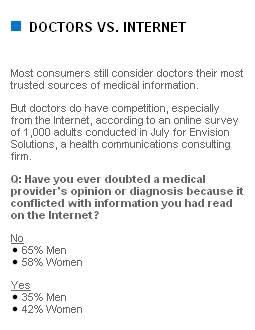
docs-v-internetIt’s a tough issue.  I talked about the placebo effect and the nocebo effect before.  That is exactly the type of things the USA Today article on this talks about.

Studies show half of patients who go to the doctor with a cold are prescribed an antibiotic.  Colds are caused by viruses; antibiotics kill only bacteria.

The idea that Americans get worse medical care that they realize- often because they get too many, not too few, tests, drugs, and procedures – is gaining ground.

The question still is whether you want to know everything.  Certainly, we should better arm physicians to talk about these gray areas and take them off the pedistal.  Part of that is addressing things like malpractice.  We will never control costs and improve care without eliminating the need for defensive medicine.