Archive | Consumerism RSS feed for this section

Physician as Coach: Patient as Player

I really like this analogy.  Dr. Field talks about it in his blog.

It is easy for me to understand the role of my physician as providing me with the details about my disease.  They can tell me what to do.  They can motivate me to do it.  BUT, ultimately, it depends upon me as the patient to actually deal with the condition and improve it.

Will Recession Kill Landlines

Every year there are more and more people who only use mobile phones.  A few months ago, you started seeing Sprint advertisements talking about how much you could save on their plan that gives you unlimited calls for $99 / mo.  Now, this morning on CNN’s new money segment, the recommendation was to ditch your landline.  They suggested that you could save $400+ per year doing this and who wouldn’t want that in today’s economy.

I think this is a great example of how the recession could fundamentally change our world by accelerating certain trends.

Using Your FSA For Your Gym Membership

Maryland is working on a bill that will allow you to use your flexible spending account (i.e., pre-tax dollars) for things like gym memberships and sports equipment.  I am not sure I agree with the sports equipment since I could see a whole arbitrage opportunity of buying equipment with pre-tax dollars and then selling it on eBay.  But, I can see things like gym membership or even fees for a race qualifying.

I don’t have an opinion on the bill, but the concept sounds intriguing and sends the right message.

Taking My Insurance Out For a Test Drive

I heard a commercial this morning talking about a “test drive” for drivers insurance. It made me think that with data standards this would be a pretty easy thing in healthcare.

Imagine that every year for open enrollment you would simply create a file of all your claims from the prior 12 months and upload them at some website “TestMyHealthInsurance.com”. That website would show your employer sponsored options along with individual insurance options and show you what your total out of pocket costs would be under each scenario (assuming the same claims).
We had an application like this at Express Scripts called ExpressChoice which allowed members to compare their next year’s pharmacy plan options based on the prior year’s claims. It was a very cool tool. Of course, there are limitations, but it’s much better than most of us have.

So, why not extrapolate that to a bigger market play and include health and pharmacy. Given all the exclusions and other small print in our policies, it is always impossible to compare.

Now, if you really wanted to blow people away, guarantee that the costs per claim for the same drug, treatment, etc. won’t deviate from the forecasted price by more than 10% year-over-year. I think you would capture some attention here.

What’s Your “Age”?

We were talking about this the other night at a New Years Party. There are now several ways of assessing your “real age”. Of course, you have the actual calendar showing days, months, and years that have passed since your birthday, but is that a fair assessment of how your body is really aging.

fr-time

Without getting philosophical, I think these are some fun tools that assess your age that give you some directional indication. [Hint…It’s always better to be younger!]

1 – Your RealAge is a test that looks at 125 different factors to assess how you are aging. It takes into account diet, exercise, relationship, stress, and lots of other facts. It is an interesting test. (I was 3 years below my calendar age.)

2 – Your Wii Age is an assessment on the Nintendo Wii that looks at your flexibility and a few other factors based on how you respond to a test you can do each day. (I have taken it several times, but at best, I got to 14 years below my calendar age.)

3 – Your BrainAge is a game that provides exercise for your brain. It is made for the Nintendo DS. (I have never played this.)

4 – Your LifeTime Fitness Age is based on free assessment they provide members. I just did it the other day where they looked at my heartrate on the treadmill, a strength test, a flexibility test, and looked at my weight and body fat. (Happily, I was 6 years below my calendar age.)

100 Smart Choices – Optum Health

Optum Health, a part of United Healthcare, has released a book called 100 Smart Choices. It lays out tips, advice, and tools to help you take control of your health. Since 87.5% of health care costs are due to individual choices, this is a big deal.

We don’t need to create the most medicated generation, we need to find a way to eat better, exercise more, have less stress, and act preventatively.

“Individuals can feel healthier and happier, avoid unnecessary trips to the emergency room or a doctor’s office, and cut their health care expenses by tapping the information in this book,” said Dr. Michael Rosen, national medical director for OptumHealth Care Solutions and consultant on the book. “As we developed the book, we made sure that all of the content was consistent with evidence-based guidelines and assisted members in making informed health care decisions.”

Insights From Mercer’s Annual Survey

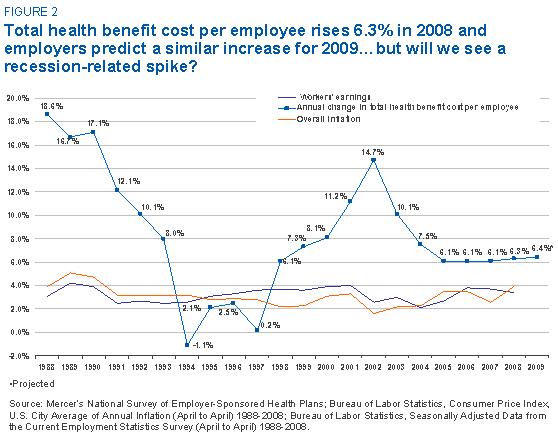
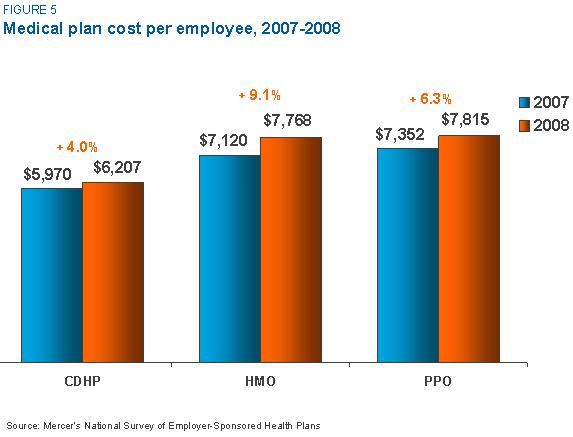
Here are a few insights from Mercer’s Annual Survey of Employee-Sponsored Health Plans:

1 – Less than 1% of all employers have provisions where smokers pay more (but 15% of employers with over 10,000 employees have such provisions).
2 – 32% of large employers off on-site or near-site clinics. (WOW! That surprised me.)
3 – 8% of large employers have provisions preventing coverage of spouses who have other coverage.
4 – A $1,000 health plan deductible is the norm.

mercer-cost-increase
mercer-cost-pmpy
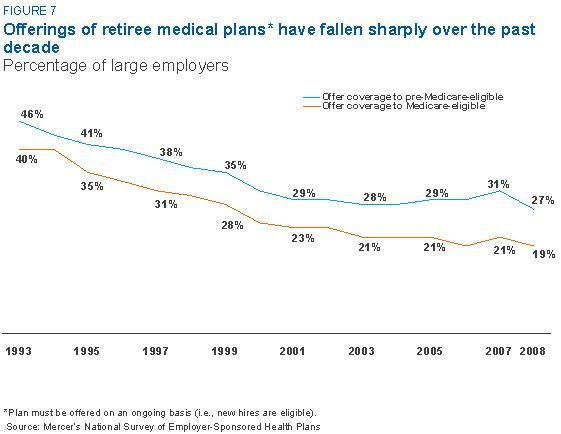
mercer-retiree-medical

Viral Marketing in Health: Humana Steps Up

I talked about Humana‘s innovation group a few days ago. They have done it again with two new games. One is on HumanaGames.com and the other is a Facebook application.

The Freewheelin Cycle Challenge is an online bicycle-racing videogame that matches you and a quirky virtual opponent. To make it to the finish line first, players energize their bicyclist and pick up speed by capturing nutritious snacks, such as nuts and oranges. They lose energy, however, by rolling over holiday junk food, including candy canes, cookies and other sugary snacks.

“The Battle of the Bulge” is an application that will be available at Facebook.com beginning Dec. 24. To participate, users go to “The Battle of the Bulge” Facebook page and answer a few questions about their lifestyle, including exercise and eating habits. Based on the responses, users are assigned a virtual waistline, affectionately called a “bellytar.” The goal of the game is to maintain an ideal weight.

But it won’t be easy. Other “friends of flab” can “fling fat” your way, making your bellytar’s pants literally bulge at the seams. In a worst-case scenario, you could be headed toward an online heart attack. To shape up, simply answer questions about exercise correctly and watch your bellytar shrink before your very eyes. Then answer questions about nutrition correctly to fling some fat of your own.

I find these to both be great examples of viral marketing which Seth Godin does a good job of explaining on his blog. Obviously, there is a long-term objective here which is driving healthy behaviors and positioning Humana as a leading edge company. They also hope to learn about human behavior and understand how tools like these can affect healthcare.

BCBSA On Consumer Driven Care

The BCBS Association released a study a few months ago on Consumer Driven Care.  Here is the presentation and a few highlights.  In general, it appears to show that it is working to save costs and get members engaged without negative side effects of them not using needed care.

  • CDHP enrollment is up 25%.
  • 10 percent more members said they would be careful about healthcare costs if they shared in the savings (incentives work)
  • 43% of those HSA (Health Savings Account) eligible with an open account use mail order pharmacy versus 30% of those with non-CDHP plans.  (Since overall mail use is around 18% this seems high, but the point is valid.)
  • 52% of those HSA eligible with an open account ask their MD about the cost of treatments
  • HSA eligibles are much more involved in tracking and estimating healthcare costs
  • HSA enrollees require more support from their plan – communications and service become more critical in driving their satisfaction.

Uproar Over “Reference-Based” Medicare Pricing – Please

Here is an overview of the issue on the WSJ Health Blog.

First off, I am not sure I would call it reference based pricing when the rest of the world calls it mandatory generics.  In many states, this is even a requirement where the pharmacy has to fill a multi-source brand (MSB) with the generic equivalent of the drug.

[In English, what this means is that once a brand drug has lost it’s patent and the drug is available as a generic then the generic (which is typically much lower cost) has to be dispensed.]

So, the issue is that apparently Medicare plans don’t always point out that if members choose the higher cost brand product (Prozac versus fluoxetine) that they will pay more..and often a lot more.  Brand manufacturers raise their prices on the brands after they lose patent since they know there are people out there who really want to purple pill and not the generic white pill (for example).

I don’t know if Medicare plans allow it, but I know a lot of clients who allowed members to get the brand name drug at their copay (not at the drug cost) if the physician wrote the prescription for DAW (dispense as written).  The problem is the physician might simply do this at the member’s request even if they don’t need it.  From everything I have ever seen, it should be less than 1% of members who really need the brand versus the A-B equivalent generic.  (Look here for the FDA information on generics.)

I don’t disagree that for the 1% that have an allergic reaction to the inactive ingredients (e.g., blue dye #17) that there should be an exception process BUT we can’t build for the exception and manage costs.  Too many people will choose the easy path and drive costs up significantly.

More Guns and Safes but Less Pregnancies

Some of you will remember my blogging about Microtrends and Kinney Zalesne’s participation in the Silverlink Think Different event.  (Kinney is one of the author’s of the book – Microtrends.)  Well, the authors of the book are now writing a weekly column for the Wall Street Journal.

The first one is about the new Mattress Stuffers.  As we saw recently with people over-subscribing to treasury bills at 0% interest, there is a demand for safe places to put their money.  People have lost faith in a lot of the institutions that our economy is built on – housing, automotive, banking, government.  Purchases of guns are up this year.  Purchases of safes are up this year.

“refraining from having kids is the ultimate consumer pull-back”

As part of this consumer pullback, they predict that there will be a dip in pregnancies nine months from now.  We are certainly entering a new age that will shape this generation much like the Depression shaped my parents generation.  Expectations will be reset.  The way people invest will change.  People’s view of money (e.g., cash versus credit) will change.

I have already seen thrifty being “cool” versus extravagence being “cool”.  It won’t happen in this first wave of change, but I do think this is a good thing for preventative health.  People will be more interested in planning forward and making smart decisions that pay off long term versus figuring they can fix it retrospectively with money.

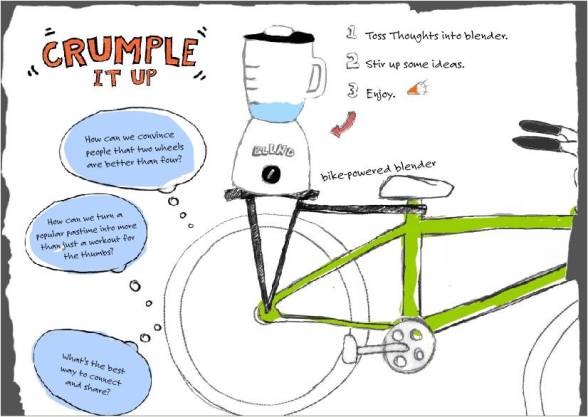
Humana is “Crumpling It Up”

I have given it away in the title, but would you have looked at the webpage below and imagined this was from Humana.

crumpleitupYou can go to their website CrumpleItUp to learn a little more about what they are doing with bikes called freewheelin and what they are doing around games and health.

They have a fascinating group there in Louisville that works on innovative ideas.  A lot of them don’t drive the core business of health insurance but they are related to improving the health of the general public or looking at interesting ways to use technology.

They have recently added a blog about this that you can see here.  Additionally, I had a chance to meet with Grant Harrison from this group at the WHCC and also hear him speak as part of a panel on innovation.  I was very impressed with him and a few of the other people in the group.

As John talked about over at Chilmark Research, it is refreshing to see someone focusing on this type of innovation.  When I talked about innovation with a reporter recently, I suggested that Humana would be one of the first groups that they should interview.

Is Your MD Honest With You?

They are probably not intentionally deceptive, but there are some things that doctors don’t tell us (at least according to Dr. David Newman in his book Hippocrates’ Shadow: Secrets From The House Of Medicine).

  1. Physicians don’t know as much as you think they do.
  2. Doctors do know that many of the tests, drugs and procedures they order and prescribe either do not work or have not been proven to work.
  3. Doctors disagree about everything.
  4. Doctors like ordering tests better than they like listening to you.

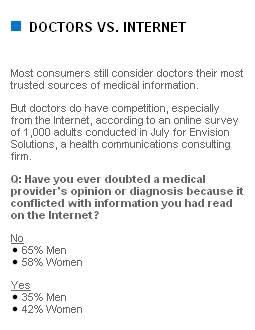
docs-v-internetIt’s a tough issue.  I talked about the placebo effect and the nocebo effect before.  That is exactly the type of things the USA Today article on this talks about.

Studies show half of patients who go to the doctor with a cold are prescribed an antibiotic.  Colds are caused by viruses; antibiotics kill only bacteria.

The idea that Americans get worse medical care that they realize- often because they get too many, not too few, tests, drugs, and procedures – is gaining ground.

The question still is whether you want to know everything.  Certainly, we should better arm physicians to talk about these gray areas and take them off the pedistal.  Part of that is addressing things like malpractice.  We will never control costs and improve care without eliminating the need for defensive medicine.

Black Is The New Pink

I am stealing this line from a tee shirt I saw the other day, but it immediately came to mind when reading an article about colors in the US Today. I was amazed when it talked about people buying new iPods (for example) since they wanted a new color. Just because I get tired of my green iPod…do I really go back and buy the red one (especially in today’s economy)?

“Bleak 2008 also happens to be the holiday season when shoppers may want their gifts to be colorful. Or at least, a different color from last year’s model.”

“When you add color to a product, you stimulate the consumer’s awareness that the version they already have is obselete.”

Some of the favorite colors were:

  • Blue, dark blue, dark green, and red (tomato) for men
  • Purple, blue, red (tomato), and blue-purple for women

It just makes me think about healthcare communications and what is the color switch that we need. Companies have talked about obesity, diabetes, preventative care, adherence, and many other actions for years. What is it that becomes different? How do we compel the consumer to act?

  • Is it a change in mode – direct mail to automated call?
  • Is it a change in tone of the message – caring to pushy?
  • Is it a change in message – qualitative to quantitative?
  • Is it a change in source – health plan to provider?

To manage healthcare costs in the US, we have to get individuals engaged in their care. The magic bullet is how to do this.

Want Senator Daschle To Come To Your HC Party

Obama’s team is leveraging the power of the people to solicit input.  You can go to their site www.change.gov to provide input. 

He is specifically asking for groups to meet on healthcare and document their thoughts.  Senator Daschle will attend at least one of these events personally.

It worked to get him elected so it will be interesting to see what they get and how they leverage this.

Great Presentation – Mktg in Recession

I came across this presentation and loved its simplicity.  It delivers a crisp message using few words and a lot of visuals.  Given the challenges in the economy (and more on topic with communicating efficiently), I thought I would share this.

Who’s Responsible For Healthcare Costs?

I was recently at the AHIP Business Forum Chicago and was in a session where Amy Holmes, CNN Political Analyst and Peter Beinart, Editor-at-Large of The New Republic held a discussion on Decision 2008 and What it Means for the Future of Health Care.  They are two of the sharpest people I have seen speak in a while and they hosted a very engaging discussion on the issues and what the Obama win means for healthcare from both sides of the political spectrum.  (They also had a very entertaining “He Said, She Said” style that captivated the audience.)

The big changes they felt were bound to happen were cuts in Medicare and an expansion of the SCHIP program, and there were others that they said would be debated including being able to sell insurance across state lines, the government offering coverage, individual coverage mandates and coverage for pre-existing conditions.  But the biggest part of the discussion was around healthcare costs.  Costs that are out of control, who pays for services, and where will the money come from.  While at an aggregate level talking about healthcare’s spiraling costs is simple, it is not the heart of the issue.

Isn’t the issue about how as an industry we get individuals to change their behaviors?

The most powerful force for changing the economics of healthcare is the healthcare consumer.  If the consumer changes behavior (even small changes) there are billion dollar impacts in cost.  Our research shows that if a plan the size of Aetna is able to improve adherence by 1% they could save $238M!  According to the Journal of Occupational and Environmental Medicine (JOEM), 70% of all healthcare expenses are lifestyle related.  This is not a new number but it translates to $1.4 trillion in healthcare costs that could be controlled simply by modifying healthcare behaviors. 

So if our lifestyles are “killing us” and destroying a system meant to improve our quality/length of life, why are we not talking about that at the national level as THE core issue?  How can we as industry professionals develop solutions that support consumers and facilitate the changes they need to make?

I was excited to see in the third Presidential debate that both candidates addressed responsibility being in the hands of the individual.  Next steps:  Let’s see some discussion on programs and policies that truly look to impact healthcare consumer behaviors.

(This is a guest post from Chuck Eberl, VP of Marketing, at Silverlink Communications.)

MD Rating Sites

(Getting a few things out here and off my desk)

This is a question I often wonder about.  I was glad to see that e-patients put a report online.  I haven’t read it yet, but I think it is something that many of you would want to know.

I think that the main issue Given hit upon in the report (but I’m not sure she recognizes as the primary challenge of doctor rating sites) is the numbers issue. With over 700,000 physicians in the U.S., a ratings database of 10,000 or even 20,000 is pitifully and woefully small.

Preaching To The Choir

On the Maritz healthcare blog, the author talks about segmenting the population to drive wellness behaviors.  I couldn’t agree more.  That’s what we always talk about.  Understand what motivates different people is critical.  Bob Nease talked about this the other day on the Express Scripts blog.  You have to help people feel confident and provide them with a motivating and personal message that compels them to take action.

The challenge is aggregating data and learning from prior interactions to understand how people respond, when they respond, what mode they respond to, and what motivates them.  (among other things)

That is why communications is both a science and an art.

All I Want For Christmas Is A Pre-Paid HC Gift Card

I am surprised more people aren’t offering this.  Last year, Highmark BCBS in Pennsylvania offered a $25-$5,000 pre-paid Visa gift card that people could use for health related expenses.

Of course, you can always buy a Visa or AMEX gift card and give it to someone, but I think there is a certain perceived value in giving it to someone with an intent for the purchase.  It would be an easy safety net for your kid at college or a nice surprise to give to someone at the holidays.

An Example of Being Overmedicated

We all know that people have a lot of prescriptions.  Here is an interesting story about one individual and the process that her family went through to do essentially Medication Therapy Management (MTM) and find out the right mix of drugs.  I don’t know the person recommended in the story, but I certainly recommend making sure your physician and especially your pharmacist know all your drugs and talk with you to see about potentially having too many prescriptions (especially once you are above 10 different medications).

Each added prescription increases the likelihood not only of a problematic interaction but also of misuse. Studies show that half of older people sometimes fail to follow their Rx instructions. It’s no wonder. Consider my mom’s regimen: She took 32 pills a day, at five different times—some once a day, some twice, some three times, and some as needed. One pill had to be split in half for the morning dose but not for the evening dose. Some were taken with food, others on an empty stomach. She also used three different asthma inhalers plus a nebulizer, all on different schedules. I’m half her age, and I couldn’t keep that straight.

Today Show On Saving Money On Healthcare

Interested in seeing a clip from the Today Show on saving money – here it is[Sorry…you have to listen to a short advertisement first.  But, you should see a large video in the top right which will play a commercial and then bring up the interview of an executive from AARP.]

Changing Behavior – Examples

On the Express Scripts Consumerology Blog, I noticed a new entry this morning from Bob Nease (Chief Scientist) about changing behavior.  It points to two things – motivation and self-efficacy.  (What’s in it for me and do I believe I can be successful.)

There is an interesting study from the University of Michigan that he discusses, and he also provides some detail on one of their web pilots.  What the web study showed is that a simpler message led to more “click throughs”.  This is very similar to what we see in the voice channel of communications.

If I call you and tell you there is an opportunity to save money with your health benefit, you are likely to go to the next step or transfer to hear more.  On the other hand, if I tell you a lot in the message, I might get a much lower click-through (or continuation or transfer) rate.

Since ultimately, I care about conversion in the claims data (i.e., did the patient really change behavior) these metrics are nice proxies but don’t mean much.  I care about did the patient and their physician actually act on the recommendation or the opportunity to save money.  I posted that as a comment on the blog so hopefully Bob can add that detail.

We have clearly seen this in some of our programs where we would rather qualify them on the phone and then transfer them leading to a higher close rate than simply drive up transfers.

Ix and Health 2.0

Yesterday, I had a brief (5 minute) opportunity to present on a webinar by the Center for Information Therapy (Ix).  Similar to the Health 2.0 conferences, they talked about some trends and then asked 5 companies to talk about how they were delivering information to patients/members.  The companies that presented were:

As one of the moderators observed, it is interesting to see how information is being delivered using different modes.  Certainly web is great if you get people there, but as I think I have spoken about before, one of the challenges is that some of the patients at the highest risk aren’t engaged so you have to have an outbound strategy to engage them.  You can’t depend upon them engaging without being prompted.

Health 3.0 Conference

I guess we shouldn’t be surprised.  The Health 2.0 movement has gotten lots of press and had great attendance at the conferences.  Now there is a Health 3.0 LinkedIn group and conference

I am not sure I know the difference yet.  I speculated on Health 3.0 after my first Health 2.0 conference to get a stake in the ground.  The one big thing that I notice is that the speakers are established companies talking about what they are doing which was one thing missing in the Spring Health 2.0 conference, but which seemed to have changed slightly in the more recent Health 2.0 conference in October.

Context Matters – Look at Gas Prices

As I saw gas prices locally fall below $1.80 yesterday, I thought about how different that context is versus having gas closer to $5.00 per gallon.  We all saw how quickly the auto companies moved to emphasize miles per gallon in their advertising.  [You could argue that they (and the public) should have been focused on this for years.]  I wonder if that will disappear and return to the more traditional advertising.

In another example, I noticed the Wal-Mart slogan the other day which is “Save Money.  Live Better.”  I don’t know if this is new, but it caught my attention in today’s economy.  They are trying to position themselves as improving your life through cost savings. 

I haven’t seen a lot of examples in healthcare where companies are seizing on this economic focus to change their messaging.  It should be a healthcare company with the Wal-Mart slogan helping drive Information Therapy (Ix) out to members to help them understand how to optimize their out-of-pocket spending.

I think it is so important both to understand messaging and how that varies across segments of the population, but to also understand the need to change that messaging to reflect the macro-forces which are present in society.

Physicians As Victims Of System?

I was reading this quote from Dr. Toni Brayer who writes a good blog called EverythingHealth which seems to paint the physician and patients as irrelevant in today’s market.  I am not sure it’s that bad, and certainly this will change with individual insurance products and more people having Medicare.

I guess the question is how much of a industry structure can be set by individuals versus the market.  Maybe, I need to ask her what the operations are that she wants to improve.

“Physicians are at the bottom of the food chain and do not have the ability to improve [the operation of the pharmacy benefit]. As I see it, PBM customers are the health plans and the pharmaceutical industry. Health plan customers are the employers or purchasers. Employer customers are the stockholders or company owners. Physician customers are the patient. Physicians and patients are out of the loop except as the user of the services. Since we are no one’s customer, in a free market we are irrelevant.”

— Toni Brayer, M.D., who has practiced internal medicine in San Francisco for more than 20 years, has served as president of the S.F. Medical Society, and is chief of staff at California Pacific Medical Center, told AIS’s Drug Benefit News.

More On The Economic Impact On Healthcare

Deloitte just published the results of a survey they did which continues to hammer home the issue of how today’s economic times are affecting people’s health behaviors.  I am just getting ready to do my webinar on this.

Here are some of the results from Deloitte:

  • Only 6 percent of Americans surveyed believe their family is completely prepared to handle future health care costs.
  • More than half of respondents surveyed said that reducing costs (67 percent), increasing access (56 percent) and improving quality (57 percent) of health care are issues that are important to them in selecting a president.
  • Of the survey respondents who reported delaying or skipping care in the past 12 months, 27 percent said they did so because they could not afford the cost.
  • Nearly half (47 percent) said their household’s spending on health care products and services has increased during the past 12 months, and 63 percent said it limits their spending on other essentials.
  • Twenty-two percent said they have an outstanding medical bill that is more than 90 days past due.

So, I guess the question is “What are you doing for your members?”:

  • Are you helping them understand how to save money?
  • Are you encouraging them to stay compliant with their medications to avoid complications?
  • Are you encouraging them to be preventative (e.g., flu shot) to avoid ER visits?
  • Are you providing them with timely guidance on when to use Over-the-Counter (OTC) medications versus prescriptions?
  • Are you helping them split medications?
  • Are you moving them to mail order?
  • Are you encouraging 90-day prescriptions?
  • Are you offering them incentives for being healthy or managing their health – coupons, points?

We are seeing a lot more interest from members in this information.  They don’t know what they can do, but they want to do something.

Of course, the challenge is setting up these programs, personalizing the messaging, and getting results.  For those of you interested in these programs, contact me.  We have had some great results offering these as a turnkey service and driving the success rates up dramatically.  [2-5x improvement in 5 weeks]

No More “Robo-Calls”

This is a phrase you have probably heard several times this election period.  Somedays I think the same thing when I get 5-6 a day mostly from the Obama campaign.  It reminds me of some education I do with a lot of companies on the technology evolution around outbound calling.  Let me hit a few key points here.

First, everyone across industries is trying to figure out how to improve their access to customers (members).  How do they keep them up to date with relevant information in a timely, efficient, and effective manner.  Direct mail is a dying strategy.  E-mail is good sometimes, but you can’t push sensitive health information out via e-mail.  Text messaging has a role, but it’s not relevant for everyone.  So, automated calling has become a first-line solution rather than using call center representatives which are expensive (or more often as a complement to the call center representative making them more efficient).

Historically, call center representatives would “smile and dial” just trying to catch someone at home.  You might get lucky, but in most cases, you call 5-10 times just to get a person on the phone to talk with.  It’s not a good use of resources and time.

The next evolution was the dialer technology which calls out to people and once it hears a voice, it transfers the respondent to a call center agent.  But, the voice could be an answering machine in some cases or in many cases it might not be the right person.  These are the annoying calls you get where there is a delay after you say hello and before the person at the other end responds.  The technology is searching for an agent that’s not on the phone to connect you with.

People realized that using agents to call out wasn’t always necessary so they moved to “blast” or “robo-calls”.  These are non-intelligent calls that simply push a message out to someone.  As soon as you say hello, they start playing a recorded message and likely repeat it at the end in case it’s an answering machine they are “talking” to.  There is no interaction and no personalization.

But, that technology too has evolved.  You can now place highly personalized and interactive calls that leverage speech recognition technology.  The calls use your name and ask you to confirm that they are speaking with the right person.  The calls use the name of the company calling and potentially your employer.  The calls can also provide personalized information such as the drug you are taking or the health condition you have.  The voice is a recorded voice not a text-to-speech (TTS) solution.

The calls respond differently based on how you answer certain questions – i.e., different paths are dynamically generated.  And, the calls start to interact with other modes of communication – would you like to transfer to an agent to talk further?, would you like a copy of this offer sent to you in a letter or e-mail?, would you like a reminder sent to you as a text message?, or would you like us to fax your physician to get a new prescription for you?

The technology focuses on the interaction with the consumer and making it a pleasant experience.  In healthcare, people respond to this technology because of several factors:

  • It’s highly personalized to them.
  • It’s coming from a company they trust – their health insurer or pharmacy.
  • It’s interactive and conversational.
  • It’s important information – refill reminder, savings information, benefit change.
  • They have to authenticate themselves in order to receive sensitive information.
  • It adapts to them (e.g., please call me for future calls in the morning).
  • It offers them an opportunity to talk to an agent by transferring.

Now, I would say most companies are evolving from individual campaigns using different modes of communication (letter vs. calls) to an integrated communication strategy which has common messaging and is based on consumer preferences.  This approach allows for even better results and continues to drive personalization and customization based on historical learning and experiences with the individual.

But, mass customization does require technology and analysis.  Pulling in different data elements and looking at how to best deliver a message and get someone to listen and take action is complex work.  But, it’s a lot of fun watching success and outcomes improve as you move across the continuum.