Archive | Healthcare RSS feed for this section

Why Not Make “Low Fat” Normal And Label Others “Full Fat”

One of the foods my kid loves comes in both normal and a low-fat version.  But, we’ve always bought the low-fat version.  One day, they were out so I bought the normal version.  I was surprised when he was upset.  Why did you buy me the full fat version he asked?

It got me thinking.  Like “loss aversion” would reversing the positioning of products work?  There’s always talk about the “fat tax“.  Why not try making low-fat the standard and requiring labeling that points out what products are full of fat?


Basic Attributes Of The 7B People In The World

There was an article in the 10/31/11 Time magazine about the global population.  I found this list of basic statistics interesting:

  • 19% of the world’s population lives in China.
  • 33% of the world’s population is Christian.
  • 50.4% of the world’s population is male.
  • 50.5% of the world’s population lives in a town or city.
  • 29 is the median age of the world’s population.
  • $10,290 is the per capita gross world income.
  • 73% of the world’s population does NOT use the Internet.

Should Health Companies Be Brutally Honest With Consumers?

I saw a statistic today that said that the Domino Pizza’s stock price has gone up by 233% since they began acknowledging that they had a reputation of a low-quality product.  Fascinating!

Would that work for health plans or PBMs or pharmaceutical manufacturers?  If they acknowledged the perception that consumers have for them, would that engage consumers?  Would consumers respond well to that?

Imagine messaging around prior authorization that sounded more like this…

“We’re calling to let you know that you need a prior authorization to get your [drug, service, device].  I know you think we’re just doing this to cut costs and override your physician’s decisions, but that’s not true.  We care deeply about you, but our physician team determined that there’s a chance for overuse of this [drug, service, device].  All we’re asking is for your physician to answer a few questions to validate the proper use.  We’ve even launched a web service so this can be done with minimal disruption.” 

Lots Of Consumers Looking For Generic Lipitor

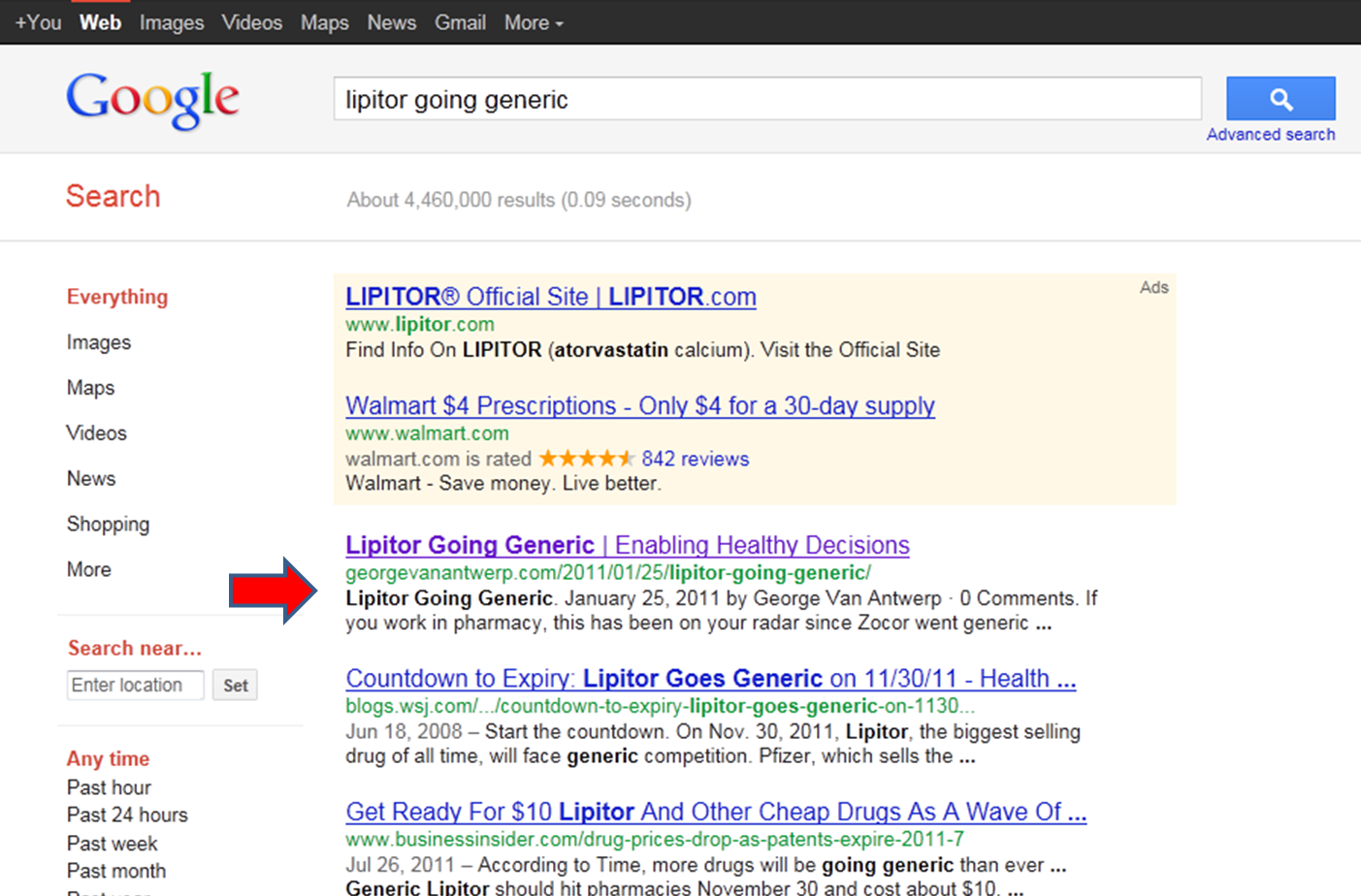
Assuming my blog volume is any indicator, it seems like consumers are increasingly looking for information on generic Lipitor.  My blog volume doubled last week.

If you type “Lipitor going generic” into Google, I’m the first page returned (after paid search).  [I always love finding these Search Engine Optimization (SEO) results.]

Do You “Give A Spit”?

R.jpg

Have you seen this new campaign from BeTheMatch.org?

Only 2% of the US population is registered.  Are you one of them?  I am.

There are 10K people who need a transplant.  Whether you organize an event or just get yourself registered, you can help save a life!

Will The Stars Align To Drive Adherence?

We all know that adherence to prescriptions is a problem.  People don’t start on their medications.  People don’t stay on their medications.  But, another problem also exists which is finding the ROI on adherence.  While the ROI is clear to the manufacturer or even to the pharmacy, it’s often less clear to the payer.

This is not true in every category.  Diabetes and several other conditions have been shown to have an ROI associated with intervention programs that improve adherence.  But what about all the others.

In the short-term, I expect you’ll see the CMS Star Ratings and bonus payments drive behavior in three critical categories that are now measured in the 2012 for MAPD and PDP plans.  (see technical notes on 2012 measures)

If you’re not familiar with the Star Ratings system, you should read this.  In 2012, there were three new adherence measures added.  Not only are they now part of the evaluation process, but they were weighted more heavily than some of the operational measures.  A  good indication of focus on quality of care.

Getting more Stars is important since it is linked to bonus dollars that the plans can get.  And, there aren’t many Five Star Plans.  Only 9 plans received 5-Star Ratings for 2012 (see article).  [Interestingly, I think one of the unique assets that Express Scripts is buying in the proposed Medco acquisition is one of the 4 Five-Star PDP plans.]

“The Medicare star quality rating system encourages health plans to improve care and service, leading to better patient experiences across the board,” Jed Weissberg, a senior vice president at Kaiser Permanente.  (from 5-star article above)

The adherence measures focus on diabetes, high cholesterol, and hypertension and use Proportion of Days Covered (PDC) rather than MPR for their measurement.  Certainly, one of the things we’re seeing at Silverlink with our Star Power program is that many of these Star Measures can be influenced by communications.  Adherence is certainly one of those big areas of opportunity for plans to focus on.

While the benefit is obvious to the plan in terms of reimbursement, the big question is whether consumers care about Star Ratings or just focus on lowest price point and access to pharmacies or specific medications.  A Kaiser study that was done seems to indicate that the answer is no.

Conducted by Harris Interactive, the survey showed that only 18 percent of Medicare-eligible seniors said that they are familiar with the government’s rating system. Of those that are familiar, less than one-third have used the system to select their health plan. Moreover, only 2 percent of respondents were aware of how their current plans rates. 

Since we’re in open enrollment for Medicare right now (see Medicare.gov to evaluate options), perhaps we’ll get some data in early 2012.  2012 will also be the first year for the 5-Star plans to be able to market all year round and not be limited to the OEP (open enrollment period).

But, one of the things I found interesting as I looked on the Medicare.gov site to “select” a plan in my area is that there is an option to “Select Plan Ratings” but even I wasn’t sure what that was.  It’s not intuitive to the consumer that this is a quality rating for them to pay attention to.  And, it appears that the default order of options which is presented to you is based on price.

Infographic: Word Of Mouth Advertising

As healthcare moves toward a more retail model, word of mouth advertising becomes more important.  This is already true in terms of physician’s influence on prescription use or in some cases distribution location.  It’s also important from a Medicare perspective.  But, this will continue to increase in importance in the future with health reform.

I also believe that clients will require satisfaction scores as part of their SLAs (service level agreements) in many cases in the future and/or tie bonus dollars to this.  Will you be prepared?  Do you understand your customers’ satisfaction with you?  Do you know how to impact it?

Managing Stress As One Of 65M Caregivers

65 million Americans are caregivers which can be a stressful job.  I think more and more companies that I consult with are looking at how to engage the caregivers as part of the overall health team.  With that in mind, I thought I would share this quote.  Managing stress as a caregiver is important so you don’t burn out.

“When you have a bad job in a toxic workplace, you feel trapped, but you can always try to find another job,” said Sharon Brothers, a veteran social worker who is now executive vice president of Caregiver Village (www.caregivervillage.com), an omnibus Internet community and resource hub for caregivers that includes expert forum hosts and even an online caregiver game. “Caregivers, however, can’t just find another role. They are caring for a loved one, so the stress they live with is real and the boss they report to is themselves. They feel trapped by their love and obligation to their family members, which makes it exponentially more difficult for them to get a break, because they feel guilty whenever they try to take one.  In fact, studies show that being a family caregiver is one of the most stressful ‘occupations’ in the country today.”

What Will Happen With Generic Lipitor (atorvastatin)?

Well, it finally looks like generic Lipitor will be on the market soon.  I think November 30th is still the date.

Of course, now the question is what will this mean to you (the consumer)?  Since atorvastatin will be distributed by only one manufacturer for the first six months after the patent expires, there will not be a significant price drop.  Therefore, I know at least one (and have heard two) PBMs will be blocking the generic drug during that time.  Consumers will be able to get Lipitor at a generic copay.

I’ve offered my opinion on scenarios like this before.  I think it’s confusing to the consumer.  It’s great for Pfizer and generally everyone wins since it’s the same out-of-pocket costs to the consumer and lower cost to the plan sponsor (employer) than the exclusive generic (due to rebates), BUT I think it sends a confusing message.  “You can and should use generics except for in some cases where the brand drug is cheaper.”  I’m not sure how this plays out in states where generic substitution is required by law.

Of course, your other option is to go use the Lipitor $4 coupon.  If I were the Pfizer brand manager for Lipitor, I would offer a $50 payment for a 1-year supply of Lipitor and lock people in for the year.  [A seperate discussion needs to be had about how cash and coupon claims which don’t necessarily get adjudicated affect adherence measures for bonus payments like Star Ratings…and yes, I know that coupons aren’t supposed to be used for Medicare members, but I don’t think that’s monitored well.]

So, you might go to get your generic Lipitor and leave with the brand at your generic copay.  On the other hand, I wouldn’t be surprised to see some PBM negotiate well enough to get a better price on the generic than Lipitor (net of rebate).  [Of course, these are the types of scenarios that cause friction in the supply chain.  Which drug can the retailer buy better?  Does the client get the rebates shared with them or not?]

I know this is what some companies like GoodRx are looking at with their application which compares drug prices across retailers.  It shows you if there’s a coupon available (see broader article on them).  It suggests savings like splitting the pill.  (No mail or 90-day promotion yet that I saw.)  Of course, this is from a cash paying customer perspective.  But, with atorvastatin, you may want to compare your plan design with the cash price with coupons.  You’ll want to know if it’s part of the $4 generics program or if you get a better price with the CVS or Walgreens discount card programs.

Here’s two examples from GoodRx.  One is for Lipitor which shows some variation (and has no generic today).  The other is for Prozac which has been available as a generic for a while.

There Is Never A Good Time To Be Sick

Whenever I get a cold or have to go to the physician’s office, I always complain about how busy I am or what else has to be done. We schedule our lives so tightly that there is rarely time for acute health needs much less preventative measures. (Or else I’m the exception.)

But, I was thinking about this when I read the Walgreen’s study the other day on the impact of the flu. It takes survey data and projects it forward, but I think it makes a big point about why to get a flu shot. You don’t want to be miss out on life’s events such as the estimated:

  • More than 600,000 graduations missed
  • More than 1 million weddings not attended
  • More than 3 million vacations canceled or interrupted
  • Nearly 5 million holiday celebrations missed
  • More than 5 million sporting events missed

And, the rest of us that are healthy don’t want the sick people coming and getting us sick!

“In addition to holidays and planned vacations, there may be other engagements and important dates that fall when flu is widely circulating. There’s no planning for an ill-timed illness, and these findings from last year’s typical flu season reinforce the importance of getting a flu shot each year.” (Dr. Cheryl Pegus, Chief Medical Officer, Walgreens in press release)

Touch and Body Language in the Physician Encounter

I was watching this TED video the other day from a physician and writer Abraham Verghese.  It was interesting since his whole point was about the ability to relate to your patient through human touch and the power that has on the patient’s trust and experience.  As we move towards move EMRs and other technologies, we have to make sure we don’t over-engineer the patient experience.

I was reminded of this again when reading KevinMD’s blog where there was a post on using body language.  How many of us think about what our body language is saying?

Or do we think about our clothing selection?  While the white coat may create trust, does the tie create a sense of being aloof?  Or should you consider different color sections to seem more approachable?

Food for thought.

Did IOM Overlook Literacy and Prevention With Their EHB Recommendations?

“The ACA requires that certain insurance plans—including those participating in the state purchasing exchanges—cover a package of diagnostic, preventive, and therapeutic services and products that have been defined as “essential” by the Department of Health and Human Services (HHS).

This package—commonly referred to as a set of essential health benefits (EHB)—constitutes a minimum set of benefits that the plans must cover, but insurers may offer additional benefits. The EHB are intended to cover health care needs, to promote services that are medically effective, and to be affordable to purchasers.”

The Institute of Medicine (IOM) put out a report recently about Essential Health Benefits (EHBs). While I haven’t fully digested the report and its implications, I noticed two things:

  1. There was no one from the pharmacy community on the committee.
  2. They seem to overlook the value of health literacy.

While I know observation #2 is an opinion that could be heavily debated, let me share my logic here.

If you look at the criteria for EHB selection (see below), they call out that it must “be a medical service, not serving primarily a social or educational function.” I would argue that it is risky to ignore education and its correlation with health. There are many educational functions around prevention which are important. Additionally, there is a lot of research these days around the social value of different networks and tools and their relevance to overall health.

This is Health Literacy Month so you can go visit several sites to see more about this topic. You could also look at research on social aspects of health from Pew. Or, I might even draw upon research around pets and their value in healthcare.

I’m sure the panel didn’t mean it to be interpreted this way, but we know how our government works. These comments become “law” and hard to overcome. I would think some clarification to say something more like the following would be better.

“Be a medical service or a program whose educational or preventative objectives have been demonstrated to improve health outcomes.”

Other articles on the report include:

Increasing The Value Of Your Refill Reminder Call

The other day, I got a refill reminder call from my pharmacy. The call came to my home number and simply stated that your prescription is ready.

Thanks…BUT what prescription. Mine? My wife’s? My kid’s?

If mine, was it the one I stopped taking? Or was it the second fill or an anti-biotic that we switched since it wasn’t working?

Did they even have the right phone number? (They never said anyone’s name in the message.)

I was confused and annoyed. I don’t think this type of message is helpful.

IMHO…the ideal refill reminder call should be something like the following:

  • This is pharmacy X calling for George Van Antwerp. Please have him call us back.
  • Thanks for calling back in. Please enter (or say) your prescription number or date of birth.
  • We have a prescription for drug X ready to refill for you. Will you be coming to pick it up in the next 2 days?
  • (If no) Do you intend to refill it?
    • (If no) Why not? (and then address the barrier)
    • (If yes) When should we call you back to remind you?

This would minimize me calling the pharmacy to follow-up on the call. It would cut down on abandonment. It would also address adherence by capturing and addressing any barriers in the interactive call.  [Of course, you have to manage HIPAA and several other constraints to achieve this, but it is possible.]

Creating an interactive and effective communication is the type of work we do at Silverlink (campaign design, scripting, segmentation, behavioral economics, communication execution, analytics). Like many others, we’re seeing refill reminders move from blast calls to interactive calls and expanding to SMS, mobile apps, and e-mail. Ultimately, it’s about figuring out the patient’s preference and the right way to “nudge” them to refill at the lowest cost per success. And, it works. You can see more at our adherence site – https://adherence.silverlink.com.

  • What voice should you use?
  • When should you call?
  • Should you e-mail then call?
  • Should you call then send a text?
  • Should you talk about their condition and stress the value of adherence?
  • What’s important to the patient about being adherent?
  • What is their previous pattern of refills?

Monitoring Your Health Thru Existing Devices – Convergence

Not a big surprise, but a company [and probably many more] is focused on applications that leverage the smart phone for remote monitoring.  They are looking at respiration, pulse, heart rhythm, and blood oxygen level.

This reminds me of the Ford announcement about monitoring air quality for allergies and considering a diabetes app within the car.

This idea of convergence isn’t new.  I think we’ve all seen how our smart phones now replace our cameras in many cases.

The one that I keep wondering about is when monitoring will happen through the toilet.  You could monitor your kids for drugs or alcohol.  Your urine could tell you about a urinary track infection or the color can tell you about dehydration.  Your feces color or smell could also provide health information.  This has been a topic on Dr. Oz before (but I couldn’t get the video to play and embed here).

Maybe the “smart toilet” will be the next big thing in preventative health.

Using Hypothetical Questions To Influence Decisions

Most people don’t realize how questions can be persuasive, according to new research from the University of Alberta. Hypothetical questions usually start with the word “if,” meaning the information may or may not be true. Our brains process that information like the “if” isn’t even there, says study author Sarah Moore, Ph.D., a marketing professor at Alberta’s School of Business. “As a result, people accept the data you present at the beginning of a question as fact,” Moore says.

This is from an article in Men’s Health.  It made me think about lots of ways that hypotheticals could be used to drive consumer behavior in healthcare:

  • If you were able to avoid having your kids home with the flu shot this year, would you take them to get a flu shot?
  • If you were able to save $50,000 in healthcare costs over your lifetime, would you make sure to take your medications everyday?
  • If you were able to spend more time with your family rather than waiting in line at the pharmacy, would you be more likely to use 90-day prescriptions?
  • If you didn’t have to take any sick days next year, would you go in for your annual physical exam?
  • If you decreased your likelihood of losing your foot to amputation due to diabetes, would you go get a foot exam every year?

This fits well with a lot of the behavioral economics frameworks that companies are using today.

Patient Reasons For Participating (or not) in Genetic Test

Medco just put out a study that I found very interesting since it shares data around patients opting-in to a genetic test around use of statins.

In the big picture, it showed that those got the genetic test were more adherent.  Perhaps this points to a better belief in the therapy post-genetic test (similar to the placebo effect).

But, what first grabbed my eye was data on the consumers:

  • 53.8% participated in the study since they believed in the utility of genetic testing
  • Only 6.7% of those that declined cited privacy issues
  • Only 8.8% of those that declined cited anxiety about the results

This could be very promising for something that is complex but is certainly part of the future of medicine.

Infographic: Patient Education

This is a topic I often bring up in discussing adherence with clients.  We have to partner with MDs as a pharmacy community to address this.  There are fundamental gaps at the beginning of the process where patients don’t understand their disease or their drug.  Without that, it’s hard to believe that taking your medication will make you better or to understand that this is a lifelong process in some cases.

Will Insurers Continue To Cover Avastin?

In case you haven’t seen the news about Genetech’s Avastin, here’s the quick summary:

This will be a hot topic.  While it only affects a relatively small group of patients (~17K), this is an emotional issue.  Many patients strongly believe in the drug.  I would expect companies to be getting lots of questions on the topic.
At the end of the day, if the panel and FDA agree that the drug is not effective, I find it hard to believe that many insurers will cover it or if they do, it will be tightly controlled with prior authorization.

Health, Wealth, and Education

I was reading the article “The Preschool Wars” by Kayla Webley, and I thought I would share some of the comments from it. It certainly plays into why we need to think about all of these issues together – poverty, literacy, education, health, and wealth. They are correlated.

  • Long-term studies show high-quality early-childhood education is particularly beneficial to low-income kids, helping them to avoid repeating grades in elementary school, stay on track to graduate from high school, earn more money as adults, and spend less time in jail or on welfare.
  • Only 9 states and DC are even trying to offer preschool programs to all children that want to attend and 10 don’t even have any state-funded programs.
  • You get a 60:1-300:1 ROI for each dollar spent on these programs in terms of increased earnings, crime reduction, and other benefits to society. [And, I would argue that as the government is and continues to be the primary payer in healthcare that there are savings possible here also.]
  • 1 in 5 children live below the poverty line today.
  • 1 in 4 third-graders who have lived in poverty and are not reading at grade level will drop out or fail to graduate by age 19 (6x more than the rate for proficient readers).

It creates some good food for thought. We need to continue to think about how we help people teach their kids. We need to think about how we introduce health into the conversations at home and at school much earlier in life. These things can make a difference.

Flu Shots, Myths, Appointments, and Public Health

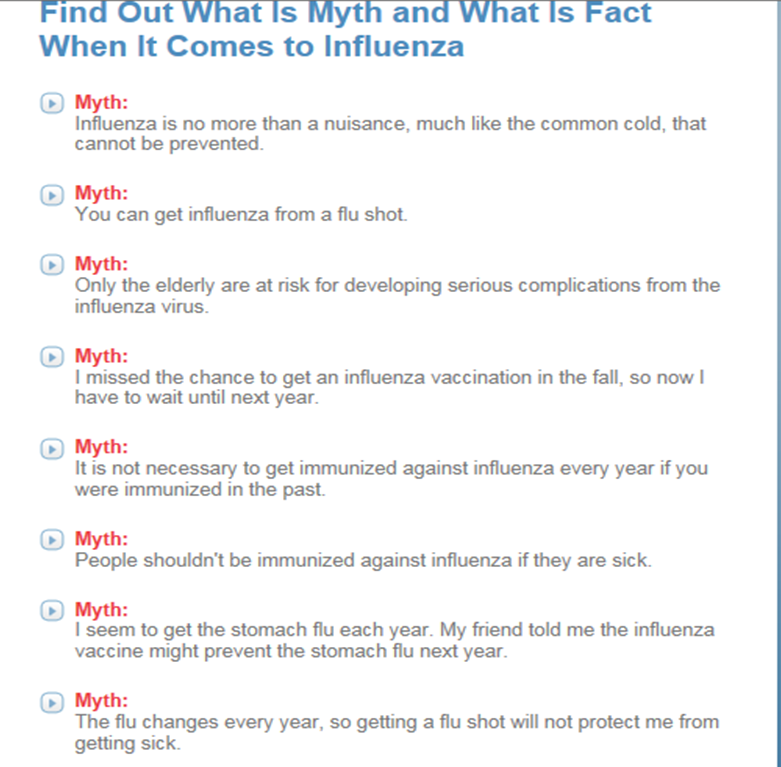
I talked about Flu Shots last week, but I came across a few other things when I was following up on the post.  One is a site called Faces Of Influenza by the American Lung Association.  It does a good job of making this public health concern personal by highlighting lots of personal stories.

They also provide a list of myths and address those.

The other thing that this got me thinking of is whether people want appointments.  In general, flu shots have become a walk-in, adhoc business.  Which is nice from a consumer perspective (as long as there’s not a wait), but I have to imagine it’s difficult for the pharmacy to plan their data around.

I know that CVS is now offering apointments as an option for flu shots.  It would be interesting to see what percentage of people choose this option and their demographic attributes.

Will Drought Eventually Push Us To Drink Toilet Water?

Not a hot topic! But, I think we all have seen the issues in Texas and other areas of the US this year around lack of water. Water is rapidly becoming a critical resource with McKinsey estimating that by 2030, the global water supplies will meet just 60% of demand. Basically, water supplies don’t go up while demand does due to population and new uses for land.

There is an interesting article called Droughtbusters by Anita Hamilton. One of the more disgusting but yet practical solutions in there is recycling toilet water which is being done in Namibia. I won’t pull you through the technology, but if Orange County, CA can begin treating sewage water and pouring it into its underground aquifiers than it’s not that far fetched.

To read more about water scarcity, you could go to http://thewaterproject.org/.

Have You “Roasted” Your Products Lately?

We all are looking for better ways to innovate and improve our product offerings. I found an example from 37signals in Inc Magazine (October 2011) to give an interesting example.

They put a cross-functional group together and walked through one of their software products. Everyone was encouraged to rip on the product in roast style. From this article, it sounds like they were able to accomplish this with no hard feelings and coming up with some productive next steps.

It made me wonder:

  • How would your adherence product survive a review?
  • What would people say about your benefit materials?
  • What about mail order or 90-day retail? How would people think about these offerings?

Of course, if you went down this path, I would suggest getting some clients (e.g., employers, payers) and some consumers involved. You need to create a “safe” place for them to criticize without people being defensive.

It makes me think of one adherence product I saw lately. I stopped by a company booth at a conference. I asked them how they addressed adherence. They showed me this pad of forms. They explained how patients could self-administer the form after picking it up in the physician’s office. They could then share it with the physician for which they had prepared a book on how to interpret the results. They shared some research with me to support the findings. I was dumbfounded.

  • I asked them if it was online…No.
  • I asked them if they called patients to administer it using automated calls…No.
  • I asked them if they really thought patients and physicians used this…Yes.

Somehow, I doubt it.

Why Should Pharmacies Disclose Profit?

In a resurgent of an old discussion, there are talks under Medicare of requiring the PBMs to disclose their spread made on pharmacy claims.

Let’s look at this in two different ways:

  1. PBM spread on non-owned pharmacies. PBMs create network contracts for their clients. They contract with pharmacies to dispense drugs at agreed upon rates. In many cases, they make spread (profit) on these transactions. They may charge Medicare $40 for a drug and pay the pharmacy $39 leading to $1 in spread. (The pharmacy is then making profit on the drug based on their payment by the PBM versus their acquisition cost of the drug.) Should the PBM profit be disclosed? IMHO…no. But, I could see disclosing average profit made from the network (which I think is disclosed in the PBM financials if you look at COGS).
  2. PBM spread at owned pharmacies. In the majority of cases, PBMs own mail order and specialty pharmacies that consumers are encouraged to use through plan design or other educational campaigns. They may charge Medicare $40 for the drug and buy the drug for $35 dollars leading to $5 in spread (profit). But, in these cases, the PBM is acting like the pharmacy. Rather than showing the $1 in spread from scenario one above, they are making that plus the difference in acquisition cost. Should the PBM profit relative to acquisition cost be disclosed? IMHO…no way! Is CMS asking every retail pharmacy to share their acquisition costs?

This gets to the heart of the American business model. People should be able to make money (yes…even in healthcare). Should government have the right (or any other buyer) to understand the costs for raw materials? I don’t see the government asking Ford to disclose the costs of each car component when they buy a police car to understand Ford’s profit. I don’t see the government requiring hospitals to disclose physician’s salaries when looking at the costs associated with billing codes.

Looking at averages and understanding the basic market dynamics is fine. But, requiring PBMs or pharmacies or any other entity to provide full transparency around their acquisition costs of raw materials is ridiculous to me.

I guess ultimately the PBMs could create separate “businesses” to have a wall between them and their owned pharmacies so that each business unit made its own profit, but I’m not sure if that would get around this.

Diabetes And Medicare Star Ratings

Do you know what the Medicare Star Ratings are?  If not, you might want to review the Kaiser Family Foundation brief from last year.

Basically, the star ratings provide individuals with a quality rating across numerous dimension on a Medicare plan.  And, they are helping to drive the pay-for-performance (P4P) focus across healthcare.  This year’s changes include several adherence metrics and have brought the total diabetes measures up to 7.  And, if you happen to be one of the few 5-star Medicare plans, you will be able to have open enrollment all year not simply during the AEP period from 10/15-12/7.

Here’s a quick summary of the seven (lots of opportunities to work with communications to improve ratings and outcomes):

Measure Summary
Cholesterol Screening Percentage of diabetics with an LDL  test
Eye Exam Percentage of diabetics with an eye exam
Kidney Disease Monitoring Percentage of diabetics with a kidney function test
Blood Sugar Controlled Percentage of diabetics with an A1c test showing their blood
sugar under control
Cholesterol Controlled Percentage of diabetics with an acceptable LDL value in their cholesterol test
Treatment Percentage of diabetics with both a diabetic medication and a hypertension medication that are getting an ACEI or an ARB
Adherence to Oral Rxs An average Proportion of Days Covered (PDC) greater than 80%

We all know the statistics on diabetes so hopefully this will help to improve outcomes.  If you’re interested in how Silverlink helps plans with Star Ratings – go here.

Do Medicare Participants Know Open Enrollment Period Has Changed? No.

A recent study showed that only 37% of Medicare participants knew that the AEP (Annual Enrollment Period) had changed. It now closes on 12/7 not 12/31. That could cost people money if they don’t review their ANOCs (Annual Notification of Changes) and take action.

Another article in US News & World report emphasizes that with some comments from Silverlink’s Chief Medical Officer (Dr. Jan Berger):

Berger breaks down the Medicare coverage decision into five steps, all of which are addressed in the annual statement:

1. What are the primary financial implications of your plan for 2012, including the premium, annual deductible, and co-pays?

2. How well does the plan accommodate your preferred medical providers? Are your doctors participating in the plan? Your preferred hospital?

3. What are the costs and availability of your medications in the plan?

4. How convenient is the plan in geographic terms? Are the participating doctors, medical facilities, and pharmacies nearby and easy for you to get to?

5. What is the star rating of your health plan, and how does it compare with other plans offered in your service area? Quality ratings of health plans ranging from one star (worst) to five stars (best) are relatively new. Medicare has been emphasizing them, and the health reform law has provisions that will penalize plans for substandard rankings. The current star rating process will go live on Medicare’s website on October 12, an agency spokesman says.

Here Come The Pharmacy Co-Branded MA/PDP Plans

In the past few days, I’ve seen two new announcements:

  1. Aetna partnering with CVS to launch a co-branded Medicare plan
  2. Coventry partnering with Walmart, Walgreens, and Target

I think we’re all familiar with the success that Humana has had in their Medicare offering with Walmart.

I think one could also say that the PBMs (i.e., mail order) getting into the Medicare business was also an effort to co-brand Medicare offerings between payers and pharmacies.

I wonder if we’ll see an NCPA offering.  I would think in certain regions that that would play well.


Could An Onsite Clinic Be In Your Future?

Traditionally, I think of on-site medical clinics as something reserved for large employers who have centralized campuses. This morning, I read about one for an employer with 100 employees. And, the numbers shared in the article in Inc Magazine (Oct 2011) were compelling looking at the year before and after they put the clinic on-site in 2009:


2008

2010

Employees covered

100

58

Annual Healthcare Costs

$750,000

$275,000

Annual Healthcare Costs per Employee

$12,476

$3,793

Annual Prescription Drug Costs per Employee

$1,241

$682

Costs of Emergency Claims

$225,000

$0


So, what did the clinic look like:

  1. The clinic was part-time (2 days per week).
  1. The clinic had a pharmacy, an MD, and a staff of 4 nurses and PAs.
  2. Visits , prescriptions, and lab work had no cost to the employees.
  3. The clinic cost the company $144K / year through WeCare TLC Onsite Clinics.
  4. Employees pay $50-$100 a week for coverage; copays for visits outside the clinic are $25; and copays for Rxs outside the clinic are $60.

BUT, ultimately, the key was soliciting other groups to co-share the clinic. They initially did it with the city and are now looking at another company.

Talk about leveraging a big-company idea for a small company. Assuming this approach could be duplicated, could this create a new model for physicians where they are splitting their time between multiple onsite facilities? Or would this type of model just exasperate the physician shortage?

Ultimately, one thing is for sure…this type of model will require better connectivity and access to information across multiple sites. But, it should leverage personalization and engagement and ultimately could be a huge opportunity for addressing preventative care.