Archive | Healthcare RSS feed for this section

Increasing Preferred Pharmacy Usage (1 of 3)

For my purposes, I’m going to define a preferred pharmacy as one of the following:

This is the first of three posts on new ideas for increasing usage:
  1. Driving preferred pharmacy usage from the employer site
  2. Using social media
  3. Borrowing from other industries
For today’s post, I’m going to focus on how a PBM (or retailer) could work with an employer to drive use of a preferred pharmacy.  There are the obvious ways:
  1. Plan design
  2. Incentives
  3. Interventions (letters, calls)
  4. Reminders on the intranet
But, let’s look at a little history of what’s been tried first outside the obvious:
  1. On-site collection boxes
  2. Kiosks
  3. On-site pharmacy
It’s my understanding that Medco used to (or maybe still does) have “drop boxes” at their large employer sites in the HR department for people to drop off prescriptions for mail order.  The employee would drop them off and then they would be FedEx’d to Medco each night.  It’s a nice convenience feature and if promoted probably serves as a good constant reminder.
Another attempt was made by Duane Reade in NY to put kiosks at employer sites and hospitals to capture new prescriptions and allow them to be couriered over to the consumer from their central fill.  It was a good idea, but it didn’t scale well and had limited upside outside NY.
I spent about a year looking at how to blend the Duane Reade model with Redbox to allow for kiosks that could leverage telemedicine and dispense the top 100 SKUs.  A few models of that concept have continued to grow (although slowly).  Instymeds now has 200 deployments (after almost a decade).  I’ve heard about a few others continuing to try also.
You then began to see a spike in on-site clinics where you could see a physician or another medical professional and get a prescription filled.  Again, this works like some of these others in high density areas where there is a population using lots of chronic medications and with the same PBM/insurer.
Now, with technology, is there an easier way?
Why not have a QR Code posted in your HR department or in the physician’s office or on the back of your ID card or some other place.  When the patient gets their new Rx, they can scan in the code and it can do any of the following:
  • Show them a message about considering mail order
  • Trigger an SMS asking someone to call them
  • Send an e-mail requesting a call back about the closest preferred pharmacy
  • Send them a map of the closest in-network pharmacy
  • Link them to a YouTube video on getting started with mail order
  • Or, in the Worker’s Compensation area, it could create a virtual card for the network
We all know that mobile apps in the pharmacy space are “all the rage” although adoption is surely in the 5-10% range (best case).  So, will this make a difference?  Perhaps not today, but it’s a low-cost way of learning about how consumers (especially those working in large, high-tech environments) might engage.  Right now, most companies are in a learning mode.

Why Do We Have Shortages Of Drugs?

The fact that more and more drugs (180 so far in 2011) are out-of-stock or have limited supply should seem crazy to most of us.  We all feel like we pay so much for healthcare and medication and the system is so intelligent that it should be able to estimate supply in a profitable way.

Obviously, something is broken.  (Here’s a good NYTimes article on the situation.)  And, if you need to be more offended yet capitalistically intrigued, you can read about people price gouging on these drugs when they do find them.  (You only hope that people didn’t buy up large supplies to create false shortages to then create high prices.)

While 1/2 the problems are from issues found during the inspection process, the other 1/2 appear to be from business model problems where there isn’t interest (read money) in producing the drug or not enough supply is produced (perhaps due to constant changing of suppliers or the race to the bottom in generics).

So, what will happen?

  • Will the government step in and do something?  [probably]
  • Will the government stockpile drugs?  [maybe]
  • Will the government require early notification of shortages?  [probably]
  • Will anyone address the business model problem?  [maybe but unlikely]
This isn’t different than some of the issues around vaccines.  As it became ultra-competitive and demand was unpredictable, it wasn’t worth being in the business.  (See 2002 report from the Manhattan Institute.)
To understand some of the regulatory reasons for the shortages, I think Alex Tabarrok does a good job here. Separately, you can read the FDA’s perspective on drug shortages here.  Another link is to ASHP where they track the current shortages.
It would be one thing if the shortages were happening around traditional drugs for chronic medications like high cholesterol where it’s easier to find an alternative, but a lot of the shortages are around oncology drugs which are harder to substitute.  And, at least one article I read on the topic talked about people finding difficulty getting the alternative covered.  IMHO – There should be a process by which an override occurs when a drug hits some national list for shortage so people can take an alternative and only have to worry about clinical outcomes or side effects not coverage issues also.

Another Tip For Sleeping – A Cooling Cap

Here’s a new one.  People can sleep better when their head is cold.

So, how do you get your head cold…wear a cooling cap.  I’m not sure where you get them (although a Google search reveals several places), but it seems like an interesting alternative for people with sleep challenges who don’t want to talk sleeping pills.  (more on the topic)

According to data from a few years ago, about a quarter of people were using sleeping pills.  And, while I believe many of these pills were originally seen as acute, 2/3rds of patients have been taking them for an average of 5 years. 

Another study I find interesting is trying to map sleeping style to personality (see here).  Here’s the six positions that they categorized.

TV Can Kill You

A recent JAMA meta-analysis leads to some interesting data.  Not surprisingly, watching more TV increases your probability of chronic conditions.  This should remind you of some of the Blue Zones work about how to live longer.

The correlation between sedentary activities like watching TV and health risks has long been known, but according to the JAMA study, more than two hours a day of TV increases the risk of diabetes and cardiovascular disease by a troubling 20 percent and 15 percent respectively. More than three hours a day raises the risk of premature death for all other conditions by 13 percent. “Beyond altering energy expenditure by displacing time spent on physical activities, TV viewing is associated with unhealthy eating (e.g., higher intake of fried foods, processed meat, and sugar-sweetened beverages and lower intake of fruits, vegetables, and whole grains) in both children and adults,” write authors Frank Hu and Anders Grøntved, who studied all relevant medical literature from 1970 to March 2011.

25% of MDs Tell Un-vaccinated Kids To “Get Lost”

Unfortunately, the issue of kids not getting vaccinated is not going away.  While only 1% of infants don’t get any vaccines, there are still 30% of kids who don’t get all the recommended vaccines.

So, what should a pediatrician do about families that don’t get their vaccines?  Should they continue to treat them?  The number that say it’s time to find a new provider has jumped to 25% in 2011 (compared to 18% in 2005) according to research reported in a Time Magazine article.  I’d bet that number might jump further as physicians bear risk or have more money tied up in performance bonuses.

It begs the question of what adults do…For example, with flu shots, do adults get them?  Based on a Consumer Reports study, it’s only about 50% of adults that do.

I have a few older posts on this general topic.  It’s also a very interesting topic in the pharmacy world as retailers focus on vaccinations both as a revenue source and a value-added service.

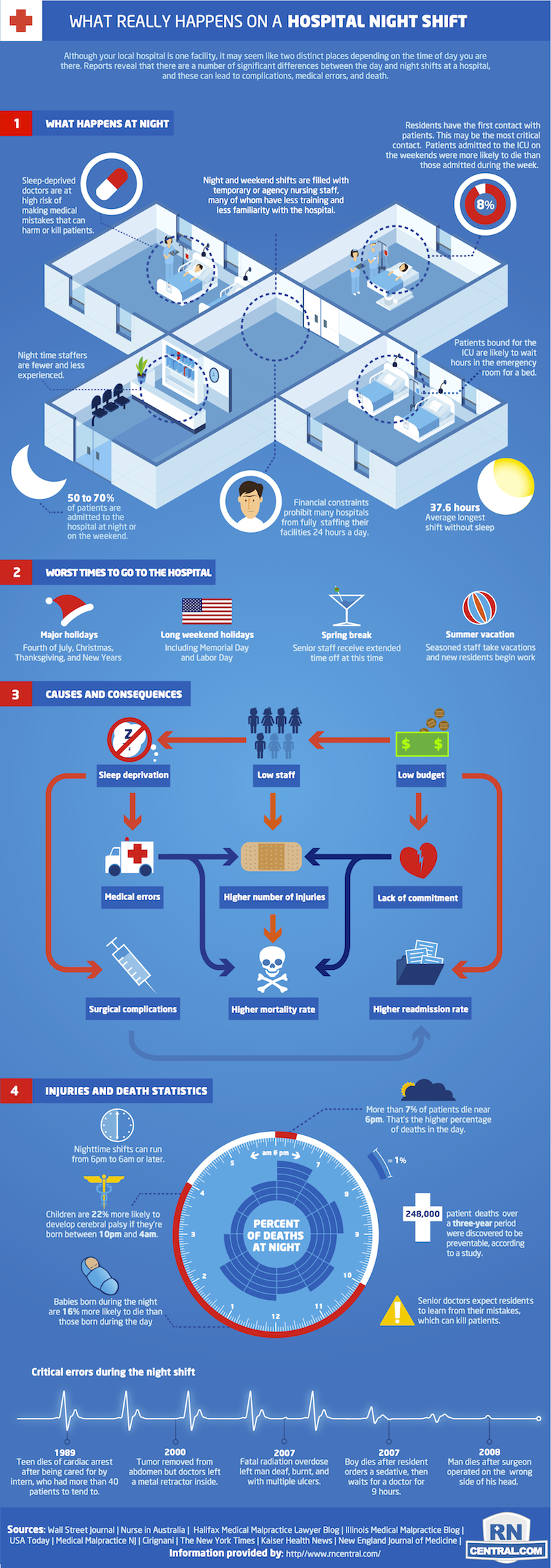
I also found this infographic on the topic which I thought I would share.

Medical Coding Career Guide
Created by: Medical Coding Career Guide

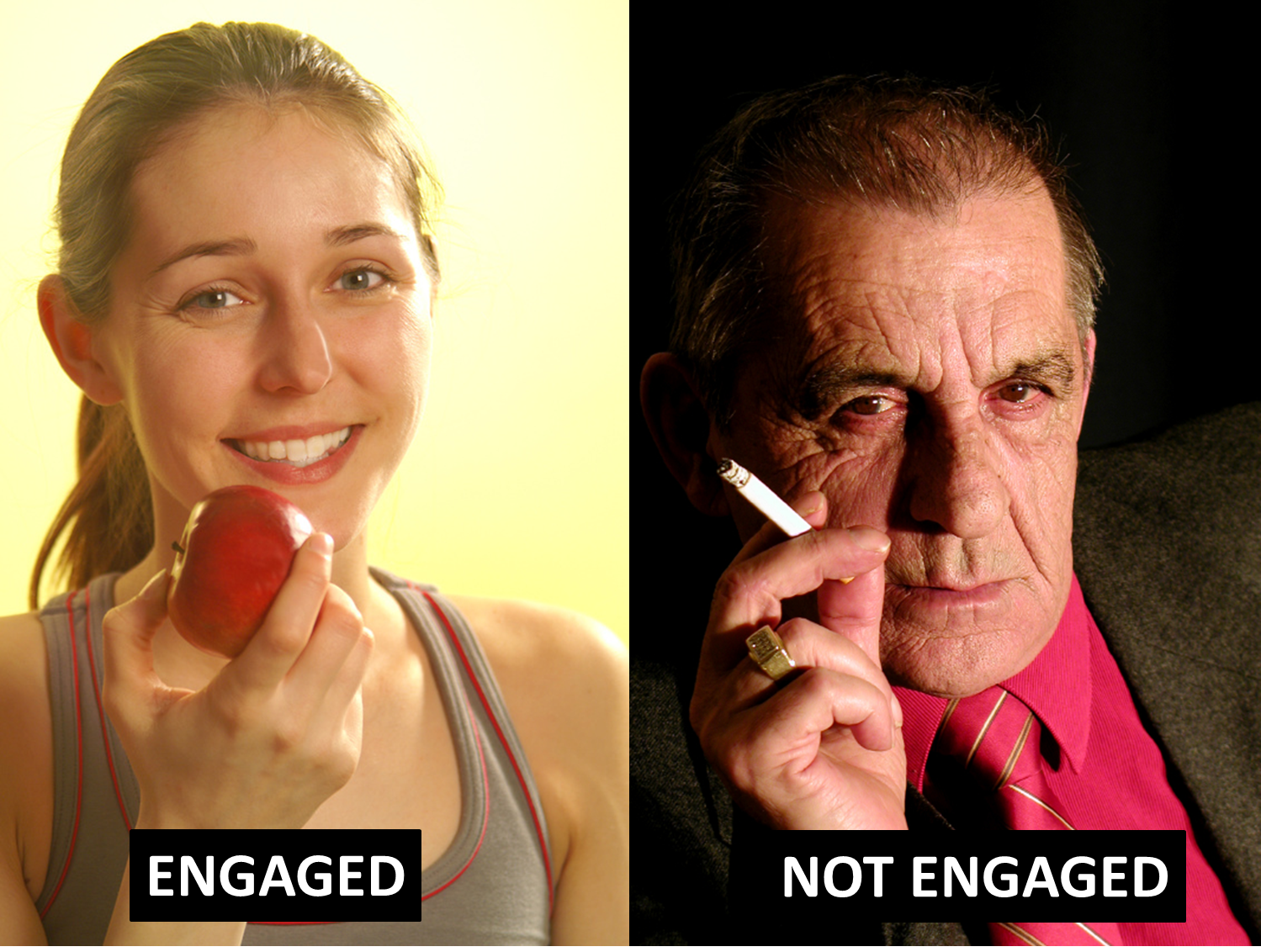
Engaging The Un-Engaged


One of the hot topics in a lot of healthcare conversations these days is engagement.  There’s the “easy” engagement for the e-patients that are actively involved in their healthcare.  Then there’s the much harder engagement of those that aren’t engaged.  And, finally, there’s the issue of chronic engagement.  I can easily get someone to engage a few times with an incentive or some other “trick”, but how do I get them to stay engaged over time.  It’s not easy.

This is one of the topics that will be discussed at the upcoming Forum 11 in San Francisco.  If you’re coming, look me up.  I’m presenting on Friday.

Large Employer PBM Survey From Barclays Capital

One of the analysts that I follow is Larry Marsh and his team from Barclays Capital.  They put out a lot of great data and information on the industry.  One report that I was reading earlier today is on an employer survey they did of 55 employers representing 1.75M lives.  Medco and CVS Caremark were the largest PBMs in that market segment followed by Express Scripts, Catalyst, and OptumRx.

I was a little surprised that only 76% of the respondents were satisfied or very satisfied with their current PBM.  That’s lower than many studies show.

On the other hand, less than 50% see the proposed Express Scripts / Medco acquisition as driving lower costs (which I generally agree with).

Also, not surprisingly, employer’s specialty trend has been high and 35% of them anticipate it will be higher in 2011.

And, finally, to beat a drum I often talk about…movement to plan designs that support mail or 90-day retail and more use of step therapy are the big changes being made and planned.

How To Use A Robot For Patient Support

While it’s unlikely that we’re going to get much empathy from robots in the near future, VGo Communications is definitely making the idea of tele-presence more believable.  What intrigued me when I first saw this was the ability for remote caregivers to participate in events.  For example, I could imagine my parents going to a physician’s visit in Detroit.  If I was able to log-in and join them using a VGo robot, it would be great.  It’s unlikely I would fly from St. Louis to Detroit to join them.

Now, cost would be an issue here, but I’m guessing someone can come up with a model that allows providers or hospitals to buy multiple robots and allow a remote, web-based log-in process.  (After some training by the user on controlling the robot.)

If we look at studies like the one presented by Kaiser years ago (see below), we know that there’s a huge gap between what the physician says and should say.  For example, this shows that only 34% of the time did the physician tell the patient the duration of therapy.  This play into what I’ve talked about before which is the gap between what the physician says and the patient hears and the questions that come up after the fact versus what questions come to mind during the office encounter.  Could a tele-presence by a third-party help that?  It’s an interesting concept.

New Running Challenge Coming To St. Louis – RunRuckus

For those of you that like running challenges but are tired of the treadmill or your typical neighborhood run, this might be just the challenge.  This is part of the new extreme sports trend, but on a manageable scale for people like you and I.  A good friend of mine is working with the company that is sponsoring Run Ruckus in St. Louis and several other places (Columbus, Boston, Kansas City, Pittsburgh, and more in 2012).

While I’ll admit that I’m a little nervous since my training has been slack here, a good race is always a motivator to step it up.  And, 4 miles in obstacles should be interesting.  Want to join me?  I may have a 2 free passes to the first people that reach out to join me.  Let me know.

In the meantime, take a look and consider signing up.

Penn And Teller On Vaccinations

This is a video that everyone should share.  It’s a funny, short, and blunt video on why to get your kid vaccinated.

There was a recent article in USA Today about vaccines which said:

Vaccines are widely available across the country, doctors say, and poor children can get them for free. The biggest impediment to vaccinating kids today is not cost, but fear, says William Schaffner, a spokesman for the Infectious Disease Society of America and professor at Vanderbilt University School of Medicine in Nashville. Around the world, millions of parents began skipping or delaying vaccines because of an infamous (and since retracted) 1998 study in the British medical journal The Lancet. The study’s author theorized that a combined measles-mumps-rubella shot caused autism.

It became one of the greatest myths in modern medicine, says Offit, author of Deadly Choices: How the Anti-Vaccine Movement Threatens Us All. He points to nearly two dozen studies showing no link between vaccines and autism. Last year, The Lancet issued the retraction after learning that information had been falsified. British health officials also stripped the study’s author of his ability to practice medicine in England because of professional misconduct.

NY Bill Continues To Stir The Pot – NCPA, FTC

The bill to restrict mail order utilization for pharmacy is not the first attempt, and it won’t be the last attempt by the independents to try to even the playing field with the PBMs through legislation (see comments about KS bill).  If limiting networks (retail, specialty, mail) can lower prices and save consumers and payers money, why shouldn’t they exist?  The payers should have this option in their toolkit.

Here’s the actual text from the bill:

SHALL PERMIT  EACH PARTICIPANT TO FILL ANY MAIL ORDER COVERED PRESCRIPTION, AT  HIS OR HER OPTION, AT ANY MAIL ORDER PHARMACY OR  NETWORK  PARTICIPATING  NON-MAIL  ORDER  RETAIL  PHARMACY  IF THE NETWORK PARTICIPATING NON-MAIL  ORDER RETAIL PHARMACY OFFERS TO ACCEPT A PRICE  THAT  IS  COMPARABLE  TO  THAT  OF THE MAIL ORDER PHARMACY. ANY POLICY WHICH PROVIDES COVERAGE FOR  PRESCRIPTION DRUGS SHALL NOT IMPOSE A CO-PAYMENT FEE OR OTHER  CONDITION  ON ANY INSURED WHO ELECTS TO PURCHASE DRUGS FROM A NETWORK PARTICIPATING  NON-MAIL  ORDER  RETAIL  PHARMACY  WHICH IS NOT ALSO IMPOSED ON INSUREDS ELECTING TO PURCHASE  DRUGS  FROM  A  DESIGNATED  MAIL  ORDER  PHARMACY

Let me make a few comments:

  1. Does this mean that Express Scripts has to let it’s members go to Caremark mail order if they meet their rates?
  2. What does “comparable” mean?  Why isn’t it the same?  Do the independents really want to go to mail order rates?
  3. No more copay differentials?  If this works, pharma should lobby for no more formularies.  (That might not be relevant today, but in the biologics or biosimilars world, they could say we’ll meet the price but you can’t have any copay differentials or utilization management restrictions…AND get it legislated!)

You can see some similar comments on this from Ed Silverman at Pharmalot and Adam Fein at Drug Channels.

As Adam points out, this may even be a leading indicator on how the FTC views the acquisition of Medco by Express Scripts (although the $MHS stock doesn’t reflect that right now).  Here’s what the FTC said in their letter:

FTC staff appreciate that A-5502-B seeks to enhance consumers’ ability to fill their prescriptions at the pharmacies of their choice. We are concerned, however, that the Bill impedes a fundamental prerequisite to consumer choice: healthy competition between retail and mail order pharmacies, which constrains costs and maximizes access to prescription drugs. We are concerned that, in the end, higher costs will lead to higher prices and fewer choices for New York health care consumers. For some consumers, increased costs may mean higher out-of-pocket prices for prescription drugs. For other consumers, it may mean that prescription drug benefits are curtailed or eliminated. Scaled-back drug benefits are likely to create pressing financial concerns for many consumers, and may even lead to additional health problems. As an article in ealth Affairs noted, “when costs are high, people who cannot afford something find substitutes or do without. The higher the cost of health insurance, the more people are uninsured. The higher the cost of pharmaceuticals, the more people skip doses or do not fill their prescriptions.”

As I mentioned in a Pharmacy Times article that I just wrote for their online version, this is a unique time for the independents to try to figure out what to do about consolidation in the industry.  If it’s not Express and Medco, it will be others.  This will look like the wholesaler market sooner rather than later.  It’s time to figure out how to make lemonade here and differentiate their pitch and value. 

In the end, I think you do yourself a long-term disservice to not allow for pricing differentiation within the network based on copays.  I would want to position myself as a higher service pharmacy with greater satisfaction, better medication possession ratio, better outcomes, and therefore become a preferred pharmacy within a limited retail network. 

Press Hits, Presentations, Writing YTD

I wanted to put together a quick summary of brand awareness so far in 2011.  It’s been a banner year already exceeding 2010 press hits (21).

  1. Drug Benefit News article in January around predictions for the industry
  2. Whitepaper on the future of the PBM/pharmacy industry
  3. Mention of my whitepaper in Adam Fein’s blog
  4. Barclays PBM Expert Call on 2/8/11
  5. Drug Benefit News article on Lipitor in February
  6. Managed Care Magazine on Lipitor
  7. Drug Benefit News article on coalition in February
  8. Drug Benefit News article on Walgreens PBM sale in March
  9. AIS Webinar on Copay Cards
  10. Drug Benefit News on Copay Cards
  11. Pharmacy Times on Mail Order
  12. Silverlink eBook we put out on healthcare communications
  13. AJPB July/August 2011 From the Editor
  14. Health Plan Weekly (8/1/11) on OptumRx moving away from Medco
  15. Pharmacy Technology Podcast in July
  16. Ten different appearances in the PCMA SmartBrief
  17. Five references on RxRoundtable.org
  18. A blog citation about extreme couponing
  19. Some discussion of my AIS webinar by David Williams
  20. A guest post on KevinMD about paying physicians for adherence
  21. Grand Rounds
  22. Drug Channels News Roundup
  23. A mention in DigiPharm
  24. HealthLeaders on Medco sale to Express Scripts
  25. HR Online about limited networks
  26. Drug Channels review of the Express Scripts Drug Trend Report

And, I have 5 things that I’ve actively provided comment and content to including my upcoming presentation at the Care Continuum Alliance on engaging the hard to engage with one of our clients – Aetna.

Yellow Dot and HIPAA

I’m confused.  We spend so much time and money in this country worried about HIPAA and patient privacy and now people are putting all their healthcare data on a piece of paper in their glovebox and putting a sticker on their car letting people know that it’s there.  The program is called Yellow Dot.  (see USA Today article)

Don’t get me wrong…I think it’s a great, low-cost strategy to give data to rescue workers in an emergency.  (Not that there shouldn’t be a much easier strategy using technology.)  I’m just amazed that no one seems to worry about privacy here.  Maybe, privacy is only an issue when data can be stolen in mass quantities and sold not when someone can break into your car at the grocery store and take all your information.

Am I alone on this or do others find these things difficult to reconcile?

Storytelling Is A Part of P2P Healthcare

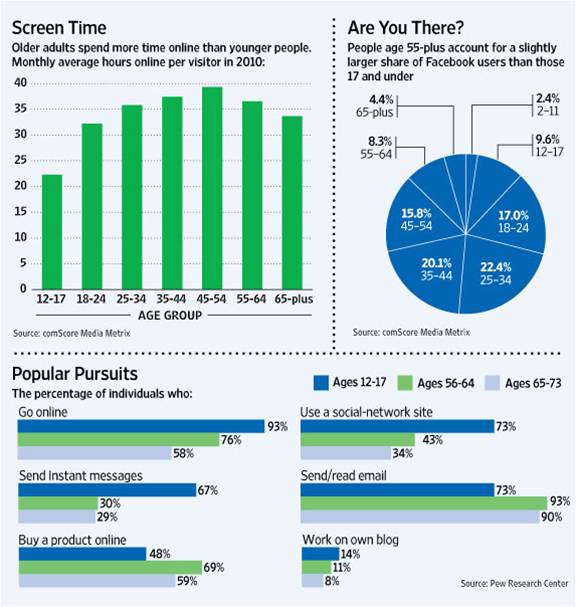
P2P (or peer-to-peer) is a popular topic in healthcare today.  It builds on both the social components of behavioral modification along with the social networking trends.

About one-third of Americans who go online to research their health currently use social networks to find fellow patients and discuss their conditions, and 36 percent of social network users evaluate and leverage other consumers’ knowledge before making health care decisions. Social networks hold considerable potential value for health care organizations because they can be used to reach stakeholders, aggregate information and leverage collaboration.  (from Deloitte study)

One of the biggest researchers out there in this space is Susannah Fox from the Pew Research Center.

Peer-to-peer healthcare acknowledges that patients and caregivers know things — about themselves, about each other, about treatments — and they want to share what they know to help other people. Technology helps to surface and organize that knowledge to make it useful for as many people as possible.  (from recent presentation from NIH – “Medicine: Mind the Gap”)

With that in mind, I found this study from a few months ago about storytelling very interesting.  Imagine the power of capturing stories in some form – DVD, YouTube, written – and sharing them with newly diagnosed patients across an expanded social network.  Imagine helping patients plug into a social network (ala – PatientsLikeMe).

Conclusion:  The storytelling intervention produced substantial and significant improvements in blood pressure for patients with baseline uncontrolled hypertension.

What has really surprised me is that I haven’t seen the large institutional healthcare organizations promoting the use of the social networks.  Maybe I’ve missed it, but I would think they would partner up with a few of these to encourage consumers to use them.  I understand on the one hand that that is “handing off” a patient to a different company, but rather than trying to build their own social networking application, I think they’re better served to leverage what exists.

Newly Diagnosed Diabetics

I was giving a presentation today on diabetes and used this quote from the American Diabetes Association.  I thought I would share it.  To me, this is why it’s so important for pharmacies, PBMs, MDs, payers, employers, etc. to focus on the consumer experience and help address what consumers are feeling when they’re newly diagnosed with diabetes, cancer, or some other condition.

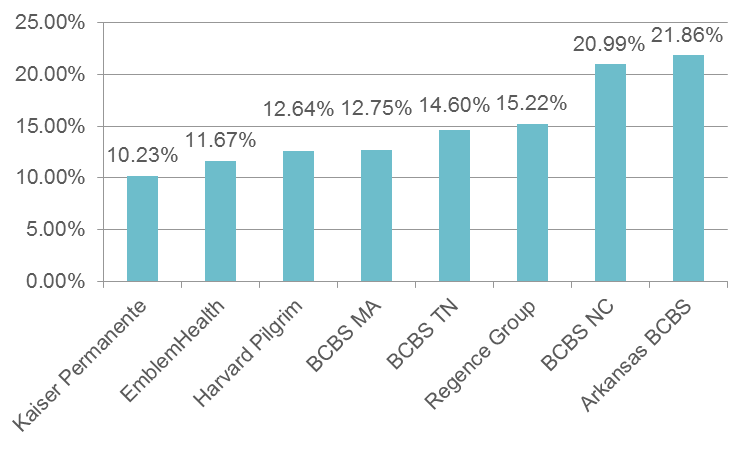
Pharmacy Costs As A Percentage Of Total Medical Spend

If you look at AIS, they track total annual pharmacy costs for leading health plans.  I pulled a few payers out from the table in the July 22, 2011 Drug Benefit News here to share.  If you exclude two very clear outliers on the low end, they ranged from a low of 9.70% to a high of 21.86%.

Here’s a sample:

A New Life For Lipitor – OTC?

Are you surprised that Pfizer might have found a way to extend Lipitor?  You shouldn’t be.

As I talked about before, Lipitor is scheduled to go generic later this year.  Now, there are stories that Pfizer may try to take Lipitor over-the-counter (OTC).  As Ed Silverman (Pharmalot) points out, this has been tried before with Mevacor.  Has anything really changed since then?  I don’t know much about any outcomes from the UK’s allowance of Mevacor to be sold BTC (behind-the-counter), but it would be a good point of information.

The prior questions about consumer behavior with an OTC statin all still apply:

  • Will the right people use them?
  • Will there be over-use?
  • Will this create unnecessary risks?
  • Will people monitor themselves appropriately?

Since statins certainly have side effects, this is a real question.

IMHO – I would think an OTC strategy is a low likelihood unless there is some new data.

On the other hand, with home monitoring of cholesterol tests, there have been some changes.  This might be another source of data.  Who’s using these?  Have they impacted their use of medication?

Should You Be Fair Or Powerful In Your Communications

I’ve always found the discussion of why people with certain characteristics are more likely to get ahead very interesting.  This recent article from Harvard Business Review talks about the fact that managers see respect and power as mutually exclusive.  I think most of us would agree that this is unfortunate from a leadership perspective.

So the question I would ask is whether consumers think the same thing in terms of physicians, pharmacists, and their health plans.  Are those that are respectful of the consumer seen as less powerful and therefore less likely to get their patients to be be compliant?

On the flipside, would consumers tolerate direct sometimes abrasive messaging that was clear with them about the risks?

Why The Express Scripts Medco Deal Is Good For CVS Caremark?

I think several people have talked about this, but I figured I would weigh in. There are several reasons why the people at CVS Caremark should be excited about this deal (recent WSJ story):

  1. DistractionExpress Scripts now has both the Walgreens contract and the Medco acquisition and then potentially integration to distract them for the next 18 months.  (Although Express Scripts is very good at integrations once approved.)
  2. Validation – The fact that Medco which was once the biggest PBM could suffer multiple losses and end up selling validates that a standalone PBM model faces real long-term challenges.  (Although Express Scripts continues to prove me wrong from a stock perspective.)
  3. FTC – IMHO this should decrease pressure on CVS Caremark since the FTC (and retailers) will be focused on this acquisition and if completed, would create a similar size entity to CVS Caremark.
  4. Walgreens – As long as there is a contentious relationship between Express Scripts and Walgreens, they need CVS Caremark as a negotiating option.
  5. Assets and Talent – Depending on how the acquisition plays out, there might be assets which are sold, and there certainly will be lots of talented people on the market (although some may just take the money and run). 

I guess the key question is whether scale will allow an Express Scripts / Medco combined entity to drive price down dramatically as some think.  I think scale will lower prices, but IMHO I think there is limited savings. The reimbursement rate to retailers can only go so low. The acquisition price from wholesalers and generic manufacturers can only go so low. The rebate dollars from pharma can only go so far before they pursue other options (i.e., copay cards).  [This is the point I made in my whitepaper back in January and in the previous one about commoditization of the industry.]

I think the CEO of Burchfield Group makes some relevant points in this YouTube video:


[Disclosure: I do own CVS Caremark shares that I have bought and held over the past 18 months.]

Two New Mail Order Pharmacy Studies

There were two new mail order pharmacy studies that were recently published.  If you’re in the PBM / pharmacy space, you’ll want to dig into both of these.

The first one is from Kaiser which looked at outcomes for patients on cholesterol lowering medications based on their use of mail order or retail pharmacies (both of which are part of Kaiser).  This study builds on their study last year which looked at medication possession ratio differences between mail order and retail.

After adjustment for demographic, clinical and socioeconomic characteristics, as well as for potential unmeasured differences between mail-order and in-person pharmacy users, 85 percent of patients who used the mail-order pharmacy achieved target cholesterol levels, compared to 74.2 percent of patients who only used the local Kaiser Permanente pharmacy.  

Separately, there was a study published on adherence based on whether mail order was a requirement or a choice.

Pharmacy benefit designs dictate pharmacy access, drug cost, and formulary coverage and thus are an important public health tool with the potential to improve population health. Offering a mail-service pharmacy option is an important benefit design tool that helps to control pharmacy costs and may facilitate medication adherence among those who successfully transition to 90-day-supply prescriptions. However, restricting pharmacy choice by requiring the transfer of prescriptions from retail to mail-service pharmacy causes some members to discontinue therapy early. When members choose to eschew therapy rather than switch to a lower cost alternative, the unintended consequence is a reduction in medication adherence and the potential for increased medical expenses.

While one might see a contradiction between the two and prior studies, I think the point is that 90-day prescriptions do appear to increase adherence even after adjusting for many factors.  BUT, if you require people to move to 90-day especially at mail, it’s important to have a clear transition path for them so that they (a) understand their benefit; (b) realize how to move; and (c) don’t end up simply missing refills or stopping therapy.

Largest PBMs By Covered Lives

The covered lives calculation is a little funny since a “life” can be counted by multiple PBMs.  For example, look at the Federal Employee Plan (FEP) contract which until recently was split between Medco and CVS Caremark and therefore counted by both (I assume).  But, it is a measure that is used none the less.  [Another way is based on claims processed.]

So, what I did is take the numbers from this chart on the PBMI website and make the following adjustments:

  1. I focused just on the large PBMs that provide a full suite of services (to my knowledge) and were on this original list which excludes some such as Navitus or WelldyneRx.
  2. I added the Express Scripts and Medco lives together.
  3. I subtracted 10M for the United Healthcare (UHG) contract at Medco and moved those to Prescription Solutions (now called OptumRx).  (acknowledging that this doesn’t happen yet)
  4. I subtracted 8M for the FEP loss for Medco recognizing that those don’t show up at CVS Caremark since they would already have been counted there on the retail contract.
  5. I added together the CatalystRx and Walgreens lives from their deal earlier this year.
  6. I noted that Humana’s lives are counted under the Argus number.
With that, I get the following lives count and percentage marketshare (of the companies listed).

Medco And Express Scripts Specialty Share Could Top 50%

Express Scripts buying Medco – This is still the big topic of discussion (see original comments with links added since I was on vacation last week with no wireless access).  The question of course begins to shift to the FTC approval.  According to one report out, one analyst estimated that the combined entity would have 30-35% of the PBM market in terms of script volume, and they estimated what the Herfindahl-Hirschman Index would say about market concentration post merger – heavily scrutinized but not a big issue.  I would agree from a claims perspective that this probably won’t be an issue.

I’ve only seen one analyst bring up the issue of mail order concentration which Medco has always led in.  I’m not sure this will be a sticking point since mail is still typically optional.  Where I would be interested in seeing the HHI would be in specialty.  Given that 28% of the time only one specialty pharmacy (SP) is contracted with and 57% of the time it’s 1-2 SPs, this seems like a bigger area of focus and potential control.  (per EMD Serono Specialty Digest)  It’s also clearly the future of the pharmacy and PBM market. 

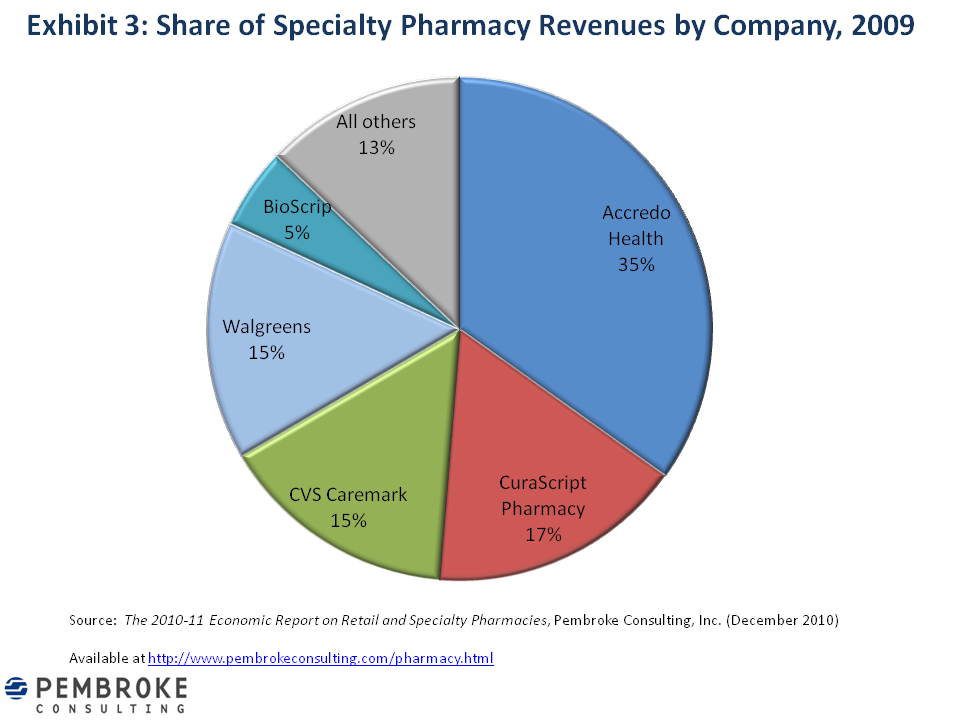
If you use Adam Fein’s estimates from his 2010-11 Economic Report on Retail and Specialty Pharmacies, the combined Curascript and Accredo market share would be somewhere around 52% which would seem high for one entity.  [I’m sure Walgreens or CVS (among others) would be happy to buy some of their specialty assets if that made the deal more likely.]  More to come as I catch up. 

Express Scripts (ESRX) to buy Medco (MHS) – WOW!!

In maybe even bigger news than the CVS acquisition of Caremark, Express Scripts announced this morning that they were merging (buying) Medco (for more information go to www.betterrxcare.com) . I’ve imagined a lot of scenarios for the industry, but this was not one.

You now have one big independent PBM with one owned by a retail and the third biggest owned by a payer. A big difference from a few years ago. The 3 models represent fundamentally different approaches.

I knew the United Healthcare decision would prompt something radical to happen in the industry, but I saw Medco driving that not being acquired. This brings a lot of things to mind:

1. What does this mean for the Walgreen’s negotiations with Express Scripts?  (original post)

2. What will the combined entity look like in terms of Consumerology + Therapeutic Resources Centers, International, Specialty, rebates, trend management, mail order operations, call center, and leadership?

3. There will be some serious consolidation over time of people and facilities. How long will this take?

4. Which system(s) will be used?

5. Will this accelerate other consolidation? I would think this puts other PBMs in play.

6. Will United build on their PBM by being an acquirer of other PBMs? How will CVS Caremark respond?

7. With the FEP decision re: Medco, will this impact DOD at Express Scripts?

8. Which of the executives survive? For example, much of David’s team (Medco CEO) has been together for a while. Do they have parachutes? Do they all leave?

9. This becomes a huge client for a wholesaler and other vendors. How will they throw their weight around and what does that mean for the competition?

10. How will they leverage unique components across companies (e.g., different approaches to Medicare, systemed, worker’s comp)?

Of course, all of this assumes the SEC approves this, but I assume the parties feel this is very likely. The industry will look like the wholesalers from a concentration perspective. Will this simply be the beginning of mass consolidation across healthcare – payer, hospital, pharma, technology?

And, at the end of the day, what will the combined entity’s culture be and how will other’s react? I’m sure you’ll see lots of lobbying against the combined entity.

And, in all this, I think people probably missed an analyst report on another PBM that said they thought two captive PBMs with an estimated value of $200-400M would be up for sale in the near future. Who could that be?

Other articles on this: