Archive | Innovation RSS feed for this section

A Great Communication Example

google-ad.png

Don’t get.  Don’t worry.  You’re probably not the target.  This is a Google recruiting advertisement that they put up a few years ago.  It led you to a website which had another puzzle for you to solve.

Why is this so great?  It’s targeted exactly to the niche of engineers that they wanted to have apply for the jobs.  It’s memorable (i.e., sticky).  It compels you to action (if you’re the person they are looking for).  It creates buzz.

It is a great single frame if you want to address segmented communications that are successful.

Healthcare Gift Cards, Memberships, and Futures

Gift cards have become the popular holiday gift.  [Here is the money I was going to spend on you but since I don’t know exactly what you want, please go spend it on yourself.]  As copayments go up and consumers own more of their healthcare spending, I wonder how long it will be before we get healthcare gift cards.  Or maybe discount clubs that you join and get preferred pricing (i.e., Sam’s Club).  Or maybe big ticket items could be like stocks where you can hedge your bets.  Gift cards are definitely a reasonable probability.  The others may be too far fetched.

  • A $50 gift card good at your local pharmacy.
  • A gift card good for 2 visits to the clinic.
  • A $100 gift card good for one visit to the ER.
  • A annual “membership” good for up to 5 preventative visits at any physician or hospital within a certain network.
  • An option to buy “futures”…purchase a transplant which costs $100,000 for $30,000 today based on your current health.

PHR as a Chip

I am sure some people think of this as a crazy notion.  Would this ever happen?  What are the implications?  What is the value?

People getting “chipped” seems scary to a lot of people.  But, an intelligent chip that could collect body information – weight, blood pressure, etc – and feed it to a PHR (personal health record) seems pretty interesting to me.  Even simply having a chip that could be read and used to identify you if you were unconscious or dead or unable to identify yourself seems valuable.

I have seen John Halamka talk briefly about his chip live, but I was glad to see that he has a whole entry about it on his blog “Life as a Healthcare CIO“.  It is a good read of the pros and cons. 

Forrester on Individual Health Market

It is a few months old, but Forrester put out a report called “The $115 Billion Individual Health Insurance Opportunity” back in October of this year that is packed with facts and a few interesting concepts. The key point is that established companies need to maintain success in the B2B world that we live in today while aggressively migrating processes, collateral, skills, and products to work in the B2C market.

I was definitely surprised by their statistic that 9% of today’s market is made up of individuals purchasing their own insurance and that 20% of the population is either in a high deductible or CDHC plan. Their data also says that 31% of the uninsured are actively investigating insurance. Obviously, this means a lot of people looking for health information and taking more responsibility for their care.

They offer 3 recommendations:

  1. Get ahead of the legislative curve. I would agree. Companies should be out testing models right now with the early adopters. [One of my favorite quotes from one of the founders of IDEO goes something like ‘fail early to succeed sooner’.]
  2. Develop and launch innovative plan designs. They talk about Prudential’s “pay-as-you-go” model in Europe and American Community Mutual Insurance in Michigan that has a buy-up plan that you can buy after you get sick. WOW!! I am not sure how you underwrite this, but it sounds very interesting.
  3. Invest in low cost distribution channels. They talk about Tonik which I mentioned before and the building of online presence. They also talk about outsourcing.

One of the big things that this will all require is some rebuilding of infrastructure to support different sales processes, personalization, claims set-up, and customer support. Companies should also be looking at data and how they can better use and mine data to learn and improve.

Applying Technology Trends to Healthcare

McKinsey recently put out their 8 technology trends article (access available with free registration). I thought I would translate those to the topic of healthcare communications. Hopefully, we don’t have to be hit by a bolt of lightning to change, but we realize and can document the ROI of acting now and improving our system by involving and reacting out to patients.

  1. Distributing Cocreation – This is the trend which is happening in many industries where consumers (patients) and suppliers (providers) are taking more involvement in product design and even advertising. New media and technology have enabled this to happen. This is a big opportunity for healthcare. In general, I see companies doing focus groups, but not letting product design be driven by the consumer. I don’t see competitions to design the next advertisement for a managed care company happening today.

“By distributing innovation through the value chain, companies may reduce their costs and usher new products to market faster by eliminating the bottlenecks that come with total control.”

  1. Using Consumers as Innovators – This conceptually seems similar to the first trend although there are likely more differences than semantics, but the value remains in letting consumers push healthcare. How do we capture what they want and the value associated with it? How do we create business models that allow companies to exist to provide that offering? It’s not easy for individuals to drive innovation since we are often tied to what we know.
  2. Tapping Into A World Of Talent – For the past few decades, many other industries have focused on getting their executives to gain multi-cultural experiences by working globally. There have also been studies that link innovation to diversity. With the exception of pharma, most healthcare companies aren’t global. Sure, all the big companies look outside the US for models and occasionally to sell to the government entities, but not much has taken off. The primary expansion in leadership that I have seen over the past five years is a lot more healthcare companies recruiting in executives from non-healthcare companies which will create some diversity and bring a new perspective to the table. Interestingly, I think this also is an issue in the patient outreach process. Are your communications taking into account the diversity of your patient population – e.g., language, messaging, channel, speed of voice?
  3. Extracting More Value From Interactions – This is very true for healthcare. I would bet that the majority of communications in healthcare are either reactive (you call them) or required by regulatory issues (e.g., explanation of benefits or annual notification of change). These programs were originally designed to cost as little as possible so that someone could check the box. Well, guess what. Over the past few years, companies are realizing that these communications are their best ability to influence patients. So, what are the “golden moments” that exist where an interaction can drive loyalty, satisfaction, wellness, etc. Companies need to figure out what the potential value is and how to capture it.
  4. Expanding The Frontiers Of Automation – Automation has been a focus for years. Healthcare is not an exception expect people struggle with how to provide care and a personalized experience while leveraging automation and technology. And, now with technologies such as web services, companies can be interlinked and automated which (when done right) can improve the consumer’s experience. Of course, the second challenge is that automation is best when it enables a process and people don’t often think, manage, or operate from a process perspective.
  5. Unbundling Production From Delivery – I think the whole concept of unbundling could be very interesting given consumerism. Unbundling has already happened for the corporate buyer…they can buy health insurance separate from pharmacy. So, could I (the consumer) one day buy long term insurance separate from prescription coverage separate from my provider network separate from customer support. Could I choose my disease management company? What would that mean for group discounts, bulk purchasing, underwriting models, etc.?
  6. Putting More Science Into Management – We are a lucky generation in that we have access to reams of data and information. Of course, the challenge is how to turn this into intelligence and use it. It is easy to get overwhelmed and frozen. But as managers, using information applying algorithms, linguistics, and neurosciences to it to create personalized communications that apply to each micro-segment of your population is a great opportunity. It translates success from luck to predictable outcomes.

“From “ideagoras” (eBay-like marketplaces for ideas) to predictive markets to performance-management approaches, ubiquitous standards-based technologies promote aggregation, processing, and decision making based on the use of growing pools of rich data.”

  1. Making Businesses From Information – Healthcare has long embraced this trend. There are numerous companies (e.g., IMS) which are built around information. There are clinical companies that produce drug monographs for use by clinicians. There are aggregators of information (e.g., ePocrates). The point is that companies not only create data exhaust, but as they apply decision sciences, they become consumers of more and more data.

“Creative leaders can use a broad spectrum of new, technology-enabled options to craft their strategies. These trends are best seen as emerging patterns that can be applied in a wide variety of businesses. Executives should reflect on which patterns may start to reshape their markets and industries next—and on whether they have opportunities to catalyze change and shape the outcome rather than merely react to it.”

These seem like reasonable trend predictions that are applicable generally and make a lot of sense form a healthcare perspective.

Wellpoint Investor Presentation

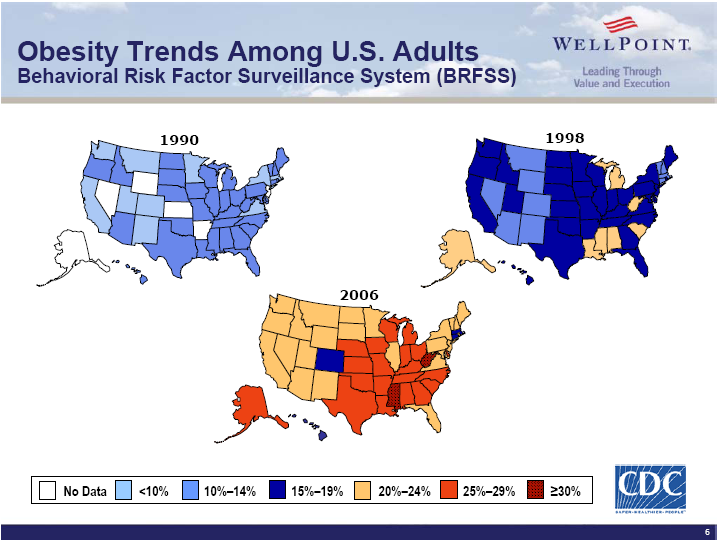
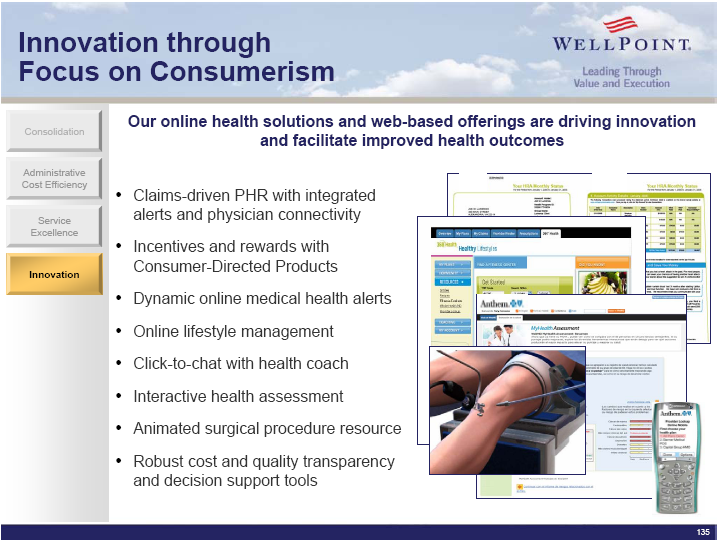
I was looking at a Wellpoint investor presentation and picked a few slides to pull out. It is definitely an interesting read to see all the things they are doing and how they approach the market. The first one talks about the prevalence of chronic diseases. The second about the obesity trend, and the third about some of their activities around consumerism.

wellpoint-chronic-disease.pngwellpoint-obesity.pngwellpoint-consumerism.png

IBM HC 2015 – Win-Win or Lose-Lose

I skimmed another IBM publication today which I thought was a great piece – IBM Healthcare 2015: Win-win or lose-lose?. (A little long at ~70 pages, but good with concise charts.) It talks about what healthcare has to do to survive and create a win-win model. It looks at it from multiple perspectives – payor, provider, consumer, and supplier. They also do a good job of describing several unique models around the world and talking about several trends here in the US.

Here are a few quotes, facts, and charts from the publication which should tempt you to go read it…(note: I am not going to show all their sources, but you can get them from their publication.)

“The United States spends 22 percent more than second-ranked Luxembourg, 49 percent more than third-ranked Switzerland on healthcare per capita, and 2.4 times the average of the other OECD countries. Yet, the World Health Organization ranks it 37th in overall health system performance.

In Ontario, Canada’s most populous province, healthcare will account for 50 percent of governmental spending by 2011, two-thirds by 2017, and 100 percent by 2026.

In China, 39 percent of the rural population and 36 percent of urban population cannot afford professional medical treatment despite the success of the country’s economic and social reforms over the past 25 years.

Approximately 80 percent of coronary heart disease, up to 90 percent of type 2 diabetes, and more than half of cancers could be prevented through lifestyle changes, such as proper diet and exercise.

Preventable medical errors kill the equivalent of more than a jumbo jet full of people every day in the US and about 25 people per day in Australia.”

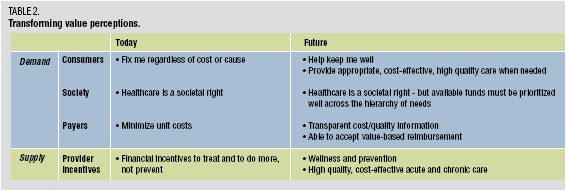
Table on IBM’s recommendations by stakeholder for what has to happen to transform to a value-based healthcare system (win-win).
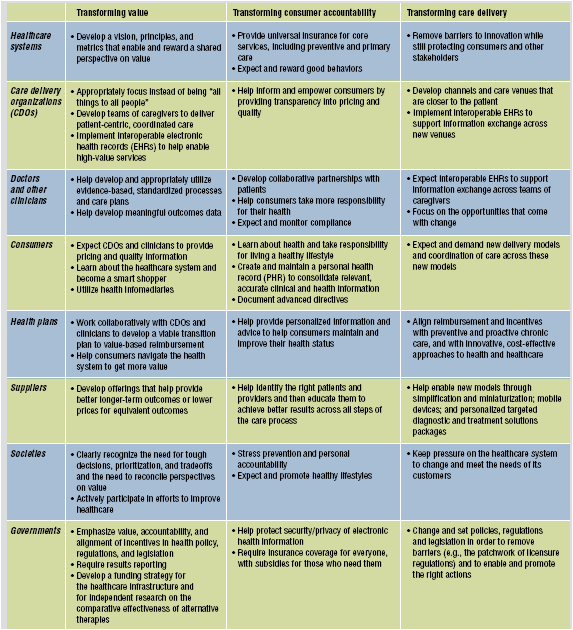
ibm-table-1-on-change.png

IBM chart pointing out the obesity issue’s growth
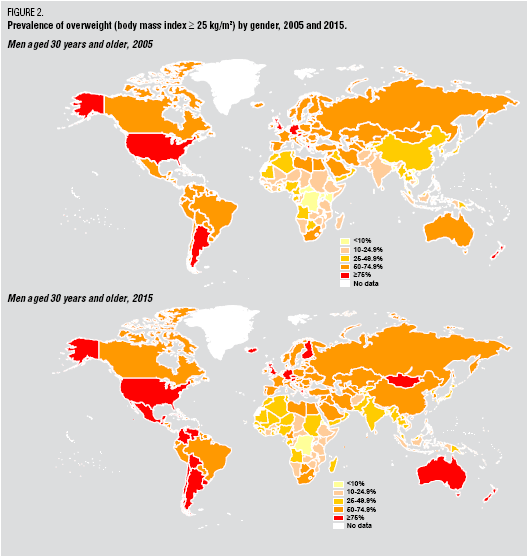
ibm-on-obesity-trend.png

They talk a lot about the current system’s focus on episodic care while the problem is chronic disease.
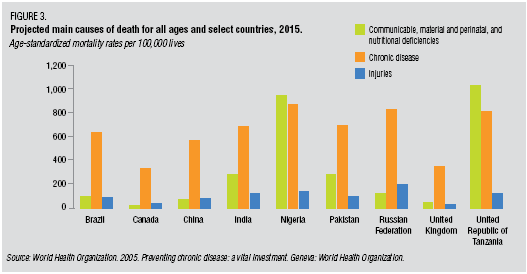
ibm-3-chronic-disease.png

You will see lots of the buzzwords we hear today (transparency, empowerment, consumerism, infomediary, value-based) throughout the article, but they are delivered with facts and anecdotes to support their perspective.

ibm-4-transforming-health.png

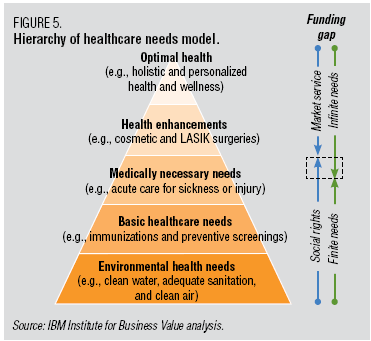
I could go on, but I will leave it with a nice adaptation of Maslow’s Hierarchy of Needs which they present around healthcare.

ibm-healthcare-hierarchy-of-needs.png

You will find information in here around telemedicine, retail medicine, health tourism, and they tee up some of the hard discussions about when is it too much. How much should we spend (individually or as a society)? What expectations should we have? A lot of it requires a different mindset for all the constituents. This would be a good read for the presidential candidates.

WSJ on the Future of Pharma

On 12/6/07, the WSJ had an article “Big Pharma Faces Grim Prognosis”. The manufacturers have been a good punching bag for a few years here as their creativity has slowed down (regardless of reality this is clearly the perception) and healthcare costs have become a front page issue. It is much easier to understand and compare drug prices than it is to look at provider costs. Now, with all the cost cutting at pharma, we will enter a new era.
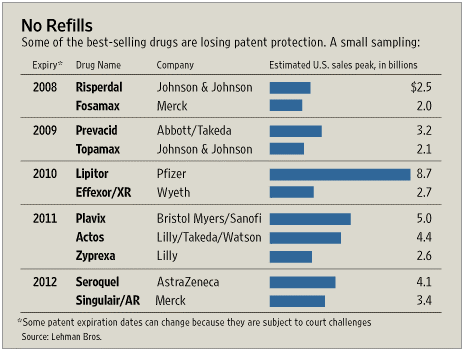
In the article, the authors (Barbara Martinez and Jacob Goldstein) predict that “over the next few years, the pharmaceutical business will hit a wall”. Their statistics on the movement to generics is even bigger than I remember. They say that roughly half of the manufacturer’s US sales are scheduled to lose patent between 2007 and 2012 (or more than 36 drugs representing $67B in annual US sales). (See charts from the article)

“The rise of generics wouldn’t matter so much if research labs were creating a stream of new hits. But that isn’t happening. During the five years from 2002 through 2006, the industry brought to market 43% fewer new chemical-based drugs than in the last five years of the 1990s, despite more than doubling research-and-development spending.”

“It has never been easy to take a drug from the lab, through animal testing and into human trials. The industry estimates only one out of every 5,000 to 10,000 candidates makes it to human trials. And many drugs that work beautifully in animals fail miserably in people.”

The article goes on to talk about regulation and the FDA and whether the lack of new products is their issue or some other issue such as the R&D organizational model. It also talks about the fact that not much has changed since the 1800s in terms of the framework for developing drugs. Obviously, this has been the driver for biotech where the drugs are made of proteins and there is no generic competition.
Of course, targeting niche patient groups with biogenerics creates very expensive drugs such as the $200,000 a year that Genzyme charges for Cerezyme to treat Gaucher disease. [If you’re total market size is smaller but your costs to develop and bring a product to market stay the same, prices have to go up or no one will develop the products. It is a problem.]
Given the focus on generics in the market and by the payors along with the battle between brands and generics, I always find it interesting that some of the big companies own generic companies (e.g., Novartis owns Sandoz and Pfizer owns Greenstone). I guess if you can’t beat them…join them.
It will be interesting to see how the companies react. As I have talked about with friends for years, it is relatively easy to be a successful executive in a wildly growing company and industry. It is hard to be a successful executive and leader in a cost oriented industry that is contracting and where the competitive pressures are great. Can these guys make the transition?

Stanford Study: Automated Calls

Stanford just published a report called “Computer calls can talk couch potatoes into walking” which is a great valuation of the automated call technology. The study compared calls by real people to automated calls encouraging sedentary adults to exercise.

It is interesting since it is conceptually similar to the technology which we provide at Silverlink Communications. They used Text to Speech (TTS) which can sound a little “computer-like” while we record our calls with voice talent. In their study, participants had to respond using the dial pad (e.g., press “1” if you have exercised today) while our calls respond to voice (e.g., say “one” if you have exercised today). We have studied the improvements in success rates on calls simply from using all recorded voice versus some TTS and seen a very positive lift. [It is obviously hard to record variable fields such as first and last name, but we have done some of that to improve results.] Additionally, given all the variables you can play with in a more sophisticated system – different voices, different speed of the message, dynamic paths, etc., it would be interesting to do that head to head comparison.

A couple of key takeaways from the article:

  • Many of the participants in the program were over 55. [Which are your primary users of healthcare services.]
  • Initially 80-85% of those in the program said that they preferred or needed a human after listening to the computer program. [What you hear from lots of people until they use it a few times.]
  • Participants who lacked confidence in their abilities to be successful and who were less comfortable interacting with people did better with the computer voice. [A client of ours in the specialty pharmacy space was emphasizing this for certain therapy classes recently.]
  • The computer voice was just as helpful for men and women.

“The goal was to get participants out walking at a brisk pace for 30 minutes most days of the week, or some other form of medium-intensity physical activity, for about 150 minutes a week, as recommended by the U.S. Surgeon General. They were divided into three groups: a control group that didn’t get calls, a group called by trained health educators and a group called by a computer delivering an interactive, individualized program similar to that being delivered by the health educators. Exercise levels were measured with the use of an accelerometer, which provides an estimate of physical activity amount as well as intensity.”

Biometrics – Role in HC – What About a Voice Print?

I have always found biometrics a fascinating topic (i.e., fingerprint recognition, retinal scans). Usually, you only see them employed in James Bond type movies or movies like The Bourne Identity. But, my first job out of undergraduate school was at SH&G which is a large architecture firm in Detroit. We designed US embassies and access to that area of the building was only through a retinal scanner.

Healthcare, much like financial services, is massively paranoid about security. [For good reason.] Just like you don’t want fraud on your credit card, you don’t want all your private healthcare information being shared with the world. One of the challenges in healthcare communications is therefore authentication. When you send a letter, technically it can’t be opened by anyone other than the recipient (without breaking the law). With the phone, you typically ask a question or questions – is this “John Smith” and/or “what is your member id”. The more questions (aka layers of authentication) or the more unique the question (e.g., give me the prescription refill number off your bottle) then the more sure you are of who are speaking with. Of course, as you make the questions more specific the questions or add more questions, you increase the difficulty for the consumer.

So, would consumers use a voice print? It is easier than fingerprinting or retinal scans in that you don’t need hardware at the patient’s location. You simply have to match an audio file against a prior file. It seems like an easy solution. Perhaps, once all computers are touchscreen, we could use handwriting recognition to send secure e-mail.

IBM on HC 2015 – Part II

I think the entry got too long.  I got a system error that made me think I should split this up.  So, continuing on my review of the IBM publication on the future of healthcare, here are some additional notes I took:

  • They envision the growth of a “health infomediary” that helps people navigate their benefits and options within the healthcare marketplace:
    • A “health coach” – expert in lifestyle and behavioral change
    • A “value coach” – expert in benefits, pricing options, and cost-quality tradeoffs
    • A “wealth coach” – expert in financial planning for health related needs
  • They say that health plans as well as physicians could step into this role (along with new players).
    • 80% say hospitals are “doing a good job”
    • 60% say health plans are “doing a bad job” [which may challenge them in some of these future roles]

“Today, healthcare delivery is overly focused on the episodic treatment of acute care.  However, the emphasis of the healthcare system will contine to expand from episodic acute care services to include prevention, chronic condition management and better care coordination.”

value-based-ibm.png

  • There is good discussion about the needed change in the healthcare system to be more focused on wellness and greater alignment of incentives.  They say “today, there is more variability at the point of contact with the consumer (that is, the point of care) than in virtually any other industry.”
  • If you read the report, figure 8 summaries the current state versus future state that they envision along numerous dimensions – sponsorship, competition, innovation, revenues, networks, etc.  The things that captured my eye were:
    • Competition being based on information access [and in my opinion…easy of use of these tools across multiple channels]
    • Competition being drives by targeted products and services [one of my favorite topics…microsegmentation]
    • A wellness ROI
    • Value-based reimbursement [which I am sure is much more than P4P]
  • They talk about the blending of product and service (i.e., the offering as I would call it).  This has been a topic in other industries for years.  [Look at the book Blur from 1999.]
  • They layout four different roles for health plans:
    1. Health / Wealth Service Advisors – personal health concierges
    2. Health Services Optimizers – guide individuals to wellness and through healthcare maze
    3. Applied Research Advisors – aggregate knowledge to help patients
    4. Transaction Processors – clearinghouse
  • I didn’t know that the top 6 healthplans cover 60% of all insured Americans while their are another 500 plans.
  • They go on to propose some questions and sample indicators of readiness for the new healthcare environment.  Here are a few indicators:
    • single view of the member across products and business partners
    • proactive contact center
    • real-time analytics regarding wellness calls
    • member loyalty
    • value-based arrangement with providers
    • consistent answers across multiple channels

Hopefully, this is a helpful summary and enough for you to read the document.  Is a quick 18 pages with good facts and realistic proposals for the future.

IBM on HC 2015 – Part I

I had a chance to catch up on a bunch of reading on the plane including an IBM brochure I picked up the other day on “Healthcare 2015 and US Health Plans“. I found it to be a good piece with several good frameworks although it doesn’t take any radical views on the future (which I would have liked to see).

Here were a few of the facts / takeaways from the brochure:

  • US healthcare expenditures per capita are 2.3 times higher than other developed countries and projected to increase 83% over the next 10 years
  • Medical errors cause between 48,000 and 98,000 patient deaths per year
  • Medication errors cost the US over $3.5B per year
  • On top of the 47M uninsured, there are 15.6M underinsured
  • There are five issues that will make change difficult for healthcare:
    • Funding constraints
    • Societal expectations and norms
    • Lack of aligned incentives
    • Inability to balance ST and LT perspectives
    • Inability to access and share information

    “We believe that the U.S. healthcare system will not achieve a comprehensive “win-win” transformation by 2015 because of political gridlock and inability of key stakeholders to work collaboratively to reach solutions for the ‘greater good’.”

  • They do predict that some form of universal coverage will be enacted by 2015 and will be focused on the individual not the employer to address the “job lock” challenge.
  • They see a key role for health plans and call upon them to lead the transformation to a “more patient-centric, value-based, accountable, affordable and sustainable U.S. healthcare system”.
  • They predict that employer-sponsored health benefits for family coverage will increase from $8,167 in 2005 to $17,362 in 2015.
  • In 2006, PPOs (preferred provider organizations) accounted for 60% of private insurance enrollees (up from 41% in 2000).
  • Employers offering coverage has dropped from 69% in 2000 to 61% in 2006 and is predicted to go below 50% by 2015.
  • They talked about employers putting a lifetime cap on retiree benefits which was a new concept to me, but they said that 49% of employers polled in 2005 had a cap (of which 59% of those on the plan had already hit the cap).
  • They talk about lifestyle choices impacting premiums which would lead to increased wellness and preventative programs.
  • There is some scary data about money needed post retirement. They say that half of all bankruptcies are in part due to medical expense. They also say that “a couple retiring in 2016 at 65 years of age would need US$560,000 if they lived an average lifespan. They would need US$1.05 million if they lived to 95 years.” This is specific savings for healthcare costs in addition to Medicare. WOW!! And, they say that 40% of people over 55 have $50,000 or less saved.

ibm-retirement-health-savings.png


“The health–wealth intersection is already taking shape. Players from each sector are experimenting with offerings that cross the boundary between the two, such as reverse mortgages to finance nursing-home costs and arrangements that let individuals tap into their life insurance policies to cover medical costs. But the new health–wealth business will evolve and change shape for at least the next couple of decades, as the retail health-care market coalesces and consumers take on more responsibility for their medical needs.”

HBR Health Consumer Segmentation

Harvard Business Review has an article “What Health Consumers Want” by Caroline Calkins and John Sviokla (both from Diamond Consultants) in the December 2007 issue.  I think they sum up one of the problems that I talk about with a couple of quick comments in the beginning:

“Yet the idea that companies might profit by segmenting customers to address their varied needs seems almost foreign to the health industry.”

“Companies can uncover areas of untapped value by analyzing patterns in demand for health products and services.”

They point out that looking at people from a health and wealth perspective at the same time is very revealing.  Which certainly makes sense as many people are predicting that these two markets will come together at some future stage.  Their research pulled out four consumer groups [with my summary of their text]:

  1. Healthy Worriers – receptive to new things, willing to change, look at dynamic between wage inflation and healthcare costs, look to employers for information, overwhelmed by choices
  2. Healthy, Wealthy, and Wise – fit, health conscious, financially confident, want choices, not scared of complexity, self-service tools important, service focused
  3. Unfit and Happy – manage own money but overconfident on health issues, don’t trust MDs, need tools and incentives to drive action
  4. Hapless Heavyweights – not particularly health or financially oriented, typically overweight, need support groups and penalties

Personally, I find it nice that they point out the fact that some groups want incentives and some need penalties.  I have blogged about this a couple times as one of the simplest examples of why segmentation and message flexibility is so key.  I think the first two have a nice opposite with simplicity versus choice.

PHR – Key for Improving Senior Care???

In the AHIP (America’s Health Insurance Plans) magazine Coverage (Sept+Oct 2007), there is an article on using Personal Health Records to improve healthcare for seniors. I am reading it as I type my commentary here, but I start with some skepticism.

  • Apparently CMS (Centers for Medicare & Medicaid Services) commissioned a 18-month pilot to help design a user-friendly PHR for Medicare beneficiaries.
  • The article gives a good, simple definition of PHR as being “designed for use by individual consumers and contain a core set of medical information that includes physician office visits, medications, lab results, and general health information.”
  • It talks about advance PHRs having a care alert which is a signal to consumers that they are due for a treatment of test. [I have talked with a few PHR vendors about this. I can’t agree more. It is great to have the data, but the systems need a proactive communication mechanism to push timely content to consumers so that they take action. (shameless plug…what a great opportunity for someone like Silverlink to offer an automated call program that takes automated triggers from the PHR and launches a pre-defined, personalized call to the consumer)]
  • It offers an interesting statistic that I haven’t seen before – 100M people (of the 249M insured) have at least one chronic disease.
  • CMS previously rolled out a bare-bones PHR at www.MyMedicare.gov which had 2M of the 42M Medicare beneficiaries register. [Of course, registration means nothing. How many actively log-in, update information, and use the information?]
  • Plans participating in the pilot include HIP of NY, Arkansas BCBS, BCBSLA, Humana, Kaiser Permanente, UPMC Health Plan, Aetna, and Medcore Health Plan.

“Health information technology will improve health outcomes and contain costs and help provide meaningful dialogue between members and providers so tests are not conducted unnecessarily.” (Laura Landry, Director of IT, BCBS Louisiana)

  • It talks about AHIP and the BCBSA (Blue Cross Blue Shield Association) collaborating to make PHRs transferable across plans which is vital for success.
  • Apparently, the groups have also collaborated to define a model PHR which would include physician encounters, names of clinicians and facilities, medications, lab results, family history, immunizations, health risk factors, advance directives, allergies, alerts, and physician directed plans of care.
  • The article also highlights another issue which is true for many solutions which is density of utilization by provider. For example, if the physician is expected to use a tool but only 5% of their patient base uses it, it will be hard to get them to change their workflow. If 90% of their patients use the same tool or a tool that provides a common interface to the physician, then they will be more likely to interact using the technology.
  • A representative from Humana says that seniors are using the data to enhance their dialogue with physicians. [I think this is a key point. I spearheaded the rollout of a “physician kit” at Express Scripts which was a set of forms that the patient could download to take to the physician’s office to discuss generics, mail order, and their condition. The key was that us communicating with either party was only so effective. We had to drive the two parties most involved in care to talk together with the facts in front of them.]
    • The article later talks about several of the demonstration projects that offer printouts for discussion or putting in the patient’s chart.
  • Humana members can also give access to family members and providers through their user names and eventually direct access.
  • Kaiser’s PHR allows the member to see when a lab was done, the results, and send questions to the physician directly through the tool.
  • It talks about one of the PHRs which automatically hides certain information from the provider but can be unhidden by the patient.
  • I thought the article was going to skip the subject of whether this population would adopt this technology, but towards the end it points out that according the US Census Bureau only 35% of people over age 65 have computers and only 29% have access to the Internet. [Of course, this will change as the Baby Boomers move into this phase of their life.]

senior-w-computer.jpgThe other critical component in my mind is that these things have to be automatically populated. The patient can contribute family history, allergies, and OTC utilization, but why should I have to type in my physician visits or prescriptions. That should all come directly into a system. There is a lot to prove here. The concepts are sound and rationale, but it’s a complex system with limited historical adoption of consistent technologies. People won’t stand for having to rebuild a new PHR every year as vendors and companies cycle through trying to settle on a few core products.

Patient (Customer) Value – Social Dimension?

I was reading an interesting entry on Forrester’s Marketing Blog about redefining the value of your customer away from ROI to something that reflects their social value.  The author defines social value as:

1) A customer’s knowledge and involvement – in short, his level of expertise and interest in the category and brand. 

2)  How he participates, and the value of his connections – what social activities is he involved with (both on and offline) and where (on what networks is he active).  The value refers to the value of the connections themselves:  are the communities more tightly-knit or diffused, are they public or more intimite.

3) The number of contacts the customer has in each network. 

It made me think about two things: (1) how would we value a patient in healthcare and (2) how do we drive and evaluate social value.

Different constituents would value patients differently [these represent logical hypotheses but not fact]:

  • To a pharmacy, it is the high utilizer that they want.  And, they make the most money off a cash paying customer who buys generic drugs at something close to their AWP (Average Wholesale Price) which is about 70-90% too high.
  • To a PBM, it is the chronically sick patient who fills lots of drugs but is very active in their healthcare so they use the website, use mail, use generics, and don’t call customer service very often.
  • To a managed care company, their highest value customer (or patient) is the healthy individual who is insured so that they collect the premium but don’t actually pay anything out.
  • To the physician, their highest value patient is the sick consumer who needs specialized care which they have to provide (e.g., injections done by the physician).  In a capitated model, this is different because they want to create healthy patients and are incented to promote wellness.
  • To the hospital, their highest value patient is the insured patient who has a complex illness that requires lots of tests or who has an elongated hospital stay.

Driving and evaluating social value is a different animal.  I do believe that providers and insurers should be promoting communities of care where people with diseases can share experiences and information.  That will be a powerful tool in promoting consumerism.  A managed care company (e.g., United, Humana, Wellpoint, BCBS) has enough scale that they could create an anonymous discussion area for their covered lives which was moderated by an expert.  (Not too dissimilar to the disease specific pharmacies that Medco is creating with their Therapeutic Resource Centers.)

Assigning value is more difficult, but it could be a composite score of activity on the web, registration in certain groups, etc. It won’t be perfect, but it is clear that some people are outspoken advocates which can promote or hurt your brand.

Teaching Kids About Health

Having kids makes you think about things differently. I was playing an online game with my kids this weekend when I started thinking about how it could be used to influence them. The game is called Webkinz. It is an interesting business model where kids buy stuffed animals which have a code. They go to the Webkinz website and use the code to register their “pet”. They then can work and play games to earn money. They have to feed and care for their pet to keep it happy. They pick the food.

My first take was how to use the tool to teach kids about good food (e.g., veggies and fruit) versus junk food. I didn’t study it intently, but I believe the “pets” are filled up better off the good food in the game. It also has little advertisements like the following:

webkinz-fruit.png

But, why not also use the game to teach the kids about exercise. If you don’t take the kid for a walk, it gains weight. Or, it already has a physician that you can visit, but why not improve that to give the kids preventative actions that they need to take for their pet. Since many people learn through action and experience, this could be a technique to start improving the next generation’s understanding of healthcare and wellness.

CVS / Caremark / MinuteClinic Article and Comments

I will stick with Drug Store News (Nov. 12, 2007) for now.  They had a good long story on the CVS Caremark acquisition building momentum.  They also talk about MinuteClinic which was a separate acquisition by CVS.  As I have said for a while, I think this was a good move.  It creates a lot of opportunity.  The combined entity now has touch points at several stops along the care continuum.  The question (of course) is how to capitalize on this without compromising the core businesses and without making people feel to “controlled” along the path.

From a top down view, the biggest things that jump out at me are:

  • How to expand the care model at the retail pharmacy using MinuteClinic.
  • How to get patient’s to grant access to share data across business units (PBM, retail pharmacy, MinuteClinic).
  • How to provide Medicare Part D type services like MTM (medication therapy management) through MinuteClinic facilities (even if the pharmacist were coming over to use them).
  • How to “value” each patient and determine the optimal mix of services and facilities for them.  For example, if they don’t impulse buy, you might as well get them to use mail.  Or, if they have a lot of maintenance medications that are generic, but they tend to buy a lot of other goods at retail, you might want to pre-fill their prescriptions at mail and ship them to the retail store for pick-up.  Or, if they have kids, you may want to encourage them to use the CVS that is an extra 2 miles away because it has a clinic.

Here are a few things from the article:

  • “So far, the moves are paying off as the company already has realized $660 million of cost savings and continues to anticipate about $1 billion of revenue synergies to be achieved by the end of 2008, with the later coming primarily as it rolls out new PBM offerings” (from Lehman Brothers analyst Meredith Adler in a research note)
  • Chris Bodine was named president of CVS Health Services earlier this year which is where the PBM and MinuteClinic business report up through [by the name of the group it would imply that there are more things to come once they digest these deals].
  • There hasn’t been much about what these new PBM offerings will be, but Tom Ryan (President and CEO) talked about them actively working and trying things that are “integrating our PBM capabilities with our strong consumer connections through our retail business”.  A few opportunities mentioned in the article are:
    • Therapeutic Interchange[If the retail POS (point-of-sale) system can deliver formulary alternatives to the pharmacists, CVS should be able to help their PBM customers make different decisions to drive formulary compliance (rebated brands and generics) while lowering patient’s copayments.  This would be a big deal to plan sponsors and patients.]
    • Flexible Fulfillment – They talk about allowing traveling patients that use mail to get short fills at retail.  [I think some retail-at-mail solution here will be more creative.  They could do central fill which is a concept where scripts are filled at a mail order facility and delivered to the retail pharmacy for pick-up.  They could split scripts to fill a 7-day at retail and the remaining 83-days at mail (depending on their cost structure).  There are lots of trade-offs here around whether they want foot traffic (for cross-sell) or not.]
    • Specialty at Pharmacy – CVS retail stores fill about $3B worth of specialty prescriptions (think about injectible drugs and drugs that are very expensive).  But, most people want more support and move to a dedicated specialty pharmacy.  [I am not sure of the economics and logistics of storing specialty medications across a broad retail base versus simply using retail as a referal source for their specialty pharmacy.  Now, some specialty drugs are still shipped directly to MDs and billed under a different fee schedule on the medical side.  If they could use MinuteClinic as a dispensing location for specialty drugs, they could offer a convenient service to patients, lower costs for their clients, and gain visibility into drugs being coded as medical services.]
    • MinuteClinic is in the process of creating a pilot program to monitor health assessments and screen for illness just for PBM clients.  [If they could figure out a way to offer preventative care, they might be able to figure out how to take risk.  It would be a powerful story to offer clients a service that bore risk around spending, trend management, and overall care / outcomes.  With a few other acquisitions or partnerships, they could begin to look very different.]
    • Corporate Clinics are briefly mentioned.  [This is another interesting pitch for me.  If you put a MinuteClinic on-site at many of their large corporate clients and/or in areas where they have a dense population, they could provide health services and use the clinic to “steer” (as legally allowed) patients to CVS, mail-order, or their specialty pharmacy.  For companies, this increases their stickiness to CVS on the PBM side while reducing time away from work for their patients.]
    • One-third of their PBM business is up for renewal in 2009 [so they have about 6-months to demonstrate the uniqueness of this story to those clients to easily renew them without major price concession.  As I sure their competitors will be focused on conflicts of interest, too much turmoil, and other FUD (fear, uncertainty, and doubt).]
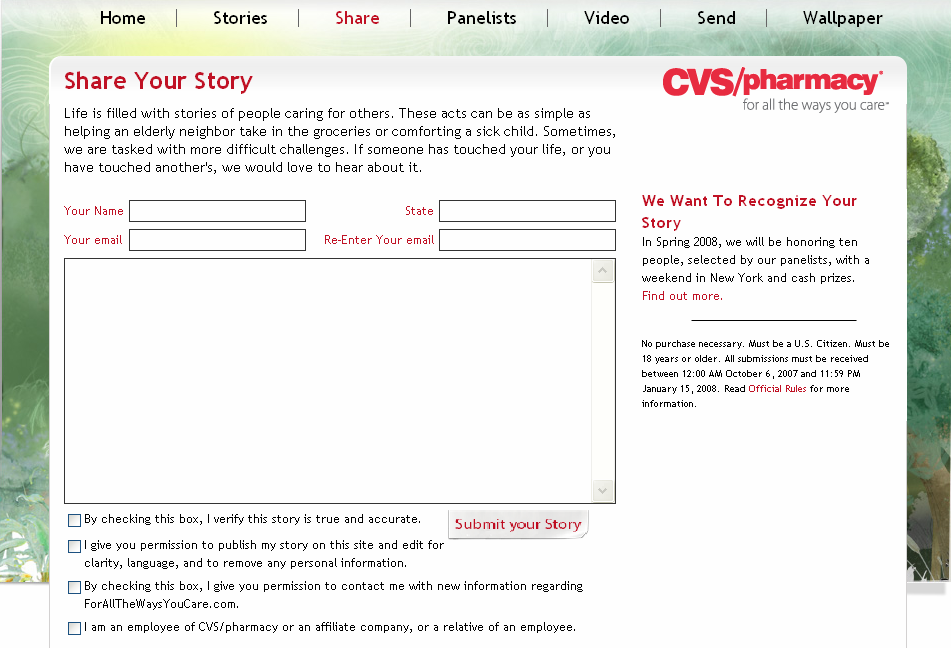
    • On a fairly different note, another article about CVS talks about their new advertising campaign focused on women as caregivers including a new website for people to share personal stories.  (www.ForAllTheWaysYouCare.com)   The initiative seems to have an impressive group of panelists.

 forallthewaysyoucare.png

Student Ideas

entrepreneur_2002_cover.jpgWhen I got my MBA at Washington University, we had a business plan competition.  [Which I won one year and took second the other year.]  It was fun and challenging.  You got to present to a group of CEOs at the end.  (Mine included Chuck Knight (Emerson Electric) and Andy Taylor (Enterprise Rent-a-Car)  But, it was more an exercise than starting a company.

As entrepreneurship has become a big focus in business school, this has taken on a life of its own.  Wash U, like many schools, has staff dedicated to this.  The business plan competition has corporate sponsors and now VCs come to look at the ideas.  Additionally, entrepreneurs give their ideas to students to work on for 6 months and flush them out for them. 

What I found interesting was the number of business plans written this year that had a healthcare focus.  They have a website called IdeaBounce where all of these are posted.  I took a few bullets from there to highlight here: [to see the specific ideas from this competition on IdeaBounce sort it based on programs [Olin Cup] on the right hand side of the screen]

  • Medi-bite is a medical device company that has developed technology to facilitate the recovery of people affected by temporomandibular (jaw) joint injury.   Temporomandibular joint injury affects 100,000 people in the U.S. annually. Injury makes eating difficult, interferes with speech, and often reduces one’s effectiveness on the job. The standard of care involves physical therapy sessions, and is often painful, inconvenient and insufficient to treat the condition fully. Medi-bite has developed technology to address these unmet needs.

  • Medobo is a company that provides services and tools for medical patients to holistically manage their health online. medobo retrieves medical records and consolidates them into an easy-to-use, secure, and private online personal health record (PHR). medobo also provides appointment and prescription management tools, a library of medical research, and a targeted medical web search engine.

  • Over 6,000,000 patients enter US emergency rooms annually complaining of abdominal pain. Current method of diagnosis of appendicitis is difficult because of considerable overlap with other clinical conditions, (15-40% error rate)! We are developing a blood test to accurately diagnose appendicitis within 5 minutes. Our company is working on identifying biomarkers from clinical samples. We hope to develop low cost, point-of-care, disposable diagnostic strips to clinicians in emergency room. We are an early stage company looking for financial, business & logistical support to execute our plan

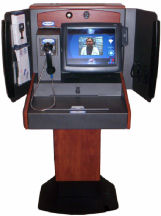
  • You’re sick and at your doctor’s office – why not pick up your prescription while there? MedBox offers a Web-enabled, robotically controlled, videoconferenced dispensing pharmacy for doctor’s offices, run by local pharmacies. In the $200 billion prescription marketplace, where no company has more than 10% market share, this new paradigm places diagnosis and treatment in the same place – convenient for consumers. MedBox is easier for patients and doctors, attractive to insurance companies and profitable for pharmacies by streamlining an antiquated healthcare system.

  • Personal Pediatrics is a platform by which pediatricians in its network can dramatically take control of their practice. Physicians who adopt its retainer-based house call practice method provide HIPAA-compliant, boutique, patient-focused health care. Dr. Hodge has developed the Personal Pediatrics care model in her St. Louis practice for more than two years, tailoring offerings to consumer needs and designing technology solutions to replace high physician overhead.

Some of the biotech ideas were also impressive.  It has come a long way from where it was in the early 90s.

WSJ on Texting in Healthcare

Obviously my entries about texting in healthcare are timely. Today’s WSJ includes an article (pg D1) by Rachel Zimmerman called “don’t 4get ur pills: Text messaging for Health”.

She points out several compliance type programs where this is being used (outside the US)…birth control pills (England), AIDS (Australia), psychological support for bulimics (Germany), and smoking cessation (New Zealand).

Apparently, the American Telemedicine Association is developing guidelines for the appropriate use of text messaging in healthcare (along with other new media). The executive director, Jonathan Linkous, was quoted as saying “There are obviously times when telemedicine is inappropriate. Texting someone to tell them they have cancer is one of them.” [I think we can all agree.]

Of course, with health costs being concentrated in a small percentage of the population which is typically older, can texting make a difference? It isn’t easy to type on those small mobile phones with arthritis. Lots of seniors don’t even carry mobile phones. Plus texting is a whole different message as the article points out. My kids will probably get it much better than me.

Plus, using condense information can be risky. We had this problem in sending messages to pharmacies where we had a finite amount of characters to say “Drug A is not covered but the following drugs are covered but if medically required then the physician has to call 800-xxx-xxxx to request a prior authorization”. Other than reminders or pushing them to a very specific action it may be a challenge.

I think sending links or phone numbers via text message could be helpful. For example, using co-browsing, a company could trigger a message a message suggesting the patient call-in for more information or also go to another site. [What is co-browsing…this is when a company (typically a call center agent) can see where an individual is on the web and what they are looking at to help them.]

She mentions a few companies:

There certainly is a need for something that is quick and ubiquitous around healthcare. For someone under 40, I think texting could work great. For people over 40 (an arbitrary line), I think automated voice is better. It is just as quick. It is ubiquitous. And, it can be personalized and change during the call versus going back and forth via text messages.

Reverse Auction for MDs / Hospitals

auction.jpgIn healthcare, you sometimes hear people talk about waiting (at the pharmacy, for an appointment) while other people seem to get right in.  A lot of this has to do with geography (remember ‘healthcare is local’) but it also has to do with cycles.  For example, Mondays are always busier after the weekends.  [I have heard ERs are often busier during a full moon, but I don’t have research on that (and didn’t look).]

Certainly, another driver of healthcare costs are some of the large capital purchases at hospitals for imaging or other diagnostics.  If every hospital has to have the latest and greatest but they are only use 20% of the time, that isn’t an efficient use of capital across the healthcare system.  If you have to spread that cost for the equipment across 1/5th of the potential patients, it means you are overcharging by 5x.

Reverse auctions wouldn’t be easy, but BidRx pulled it off in pharmacy.  [I am not sure how successfully.]  The reverse auction model would be consumerism at its best.  The consumer would post their needs – a CAT scan, a PCP, a neurosurgeon, open heart surgery.  Physicians or hospitals would bid on their business based on the parameters – timing, price, etc.

In a theoretical sense, it would be interesting to test and see if it would work.  But, my objective was not to sit in the ivory tower, but to look at a model that would improve healthcare capital efficiency by better utilizing fixed costs.  If hospitals and MDs could bid for patients to fill their slow times, wouldn’t the following be possible:

  • Less need for capital redundancy (i.e., every hospital would not need to have the same equipment)
  • Less wait times for patients since they would be slotted in to open times
  • Less peaks and valleys at doctor’s office and hospitals since they would be offering a “discount” for you to come on Wednesday versus everyone wanting to come on Monday

Participation wouldn’t be easy, but ultimately, changing our healthcare model won’t be easy.  Just an idea.  There is something here to make the system more efficient.

Mashing Two of My Posts

I was thinking about Google’s SMS service earlier today (see post on this).  Separately, I was thinking about my post on remembering health information (e.g., drugs, strength, previous lab values).

So I went to one of the Google Health Blogs to suggest the idea.  Unfortunately, the e-mail they list bounces back and you can’t leave comments…strange.  Why not combine the two comments from my earlier blogs was my suggestion?  Obviously, it only appeals to a piece of the population, but I would love to be able to text message my PHR (Personal Health Record) with “Rx name, strength” or “PCP name, phone” or “HCL scores and dates”.  [Look at myPHR, iHealthRecord, ActiveHealth, Microsoft, or Google for PHR solutions.]

It is always so difficult to remember that information, but if I could get it texted to me in a few seconds, it would be great.  I have to believe there is some unique code in my Blackberry that could serve as a unique identifier for security purposes.  Just a thought…

BTW – If you try to find Google blogs on health, you find out there are dozens of Google blogs:

“There’s all this hubub about what Google and Microsoft are doing,” Aetna CEO Ron Williams (pictured) said this afternoon on a visit to Health Blog HQ. “We’re perplexed by the fact that their vaporware gets all this attention and we get very little.” (comment on the WSJ Health Blog)

Don’t forget to add this blog to your reader or sign up for e-mail updates whenever a new entry is posted. 

New (to me) Blog – Consumer Focused Care

I found a new blog this morning called Consumer-Focused Healthcare written by an ex-McKinsey consultant which seems to have a very similar focus to my blog – “refocusing healthcare on serving consumer needs“.  [As a sidenote, the benefit here of LinkedIn was that I could quickly look him up and see that we have a mutual friend which instantly gives him some validation.]

Vijay has a lot of posts that I liked.  Here are a few exerpts:

  1. “the consumer often pays MORE for a visit to a retail clinic than a physician’s office. The implications are that they really prize the convenience and time taken far over the extra training provided by the physicians.”  In this blog entry, he shared some data about out-of-pocket expenses for clinic visits.
  2. “It is pretty clear that many doctors don’t know how to tell their patients that they have no idea”  In this blog entry, he talks about the inexact aspects of patient advice.  Determining a diagnosis or the right advice is very situational.
  3. “why are people willing to spend $3.50/ pill on sleep meds when they’re discouraged by $10 co-pays to take other, potentially life-saving medication?”  In this entry, he talks about consumerism.
  4. He also points out an assumption from Google that technology will push physicians to spend less time with patients which I think isn’t logical based on the work I did around e-prescribing.  I already put a comment in this blog entry this morning.

And, these are just his most recent entries.  I am interested to flow his blog more.

What Have You Failed At Today?

I caught this story on ABC last night about entrepreuners.  It made an interesting point about the need to fail and learn from your failure.  In summary, it was basically saying that people who took risks, failed, and spent the time to learn from their failures ended up more successful.

I think that is very relevant to the world of healthcare communications.  Any program should have a test plan of ideas that are constantly being varied to see what works best.  Each micro-niche of the population is going to respond differently.  If you aren’t out there trying different things, you won’t optimize the success of your programs.

Of course, this is easier said than done. You need a culture that believes in failure.  You need a way to learn from your mistakes.  You need people that are willing to admit they were wrong.  You need a measurement tool to document the success of one attempt versus the other.  And, you need to understand what can be varied to drive change.

Let’s take a simple example here.  In the world of automated voice communications, you can vary dozens of things:

  • Which voice should you use – gender, age, accent?
  • How should the voice speak – casually, formally, authoritarian, consultative?
  • What speed should the voice be at – normal pace, fast, slow?
  • What time of day should you call?
  • What day of the week should you call?
  • Should you leave a message or call back?
  • How many times should you attempt to reach the patient?  Within what window?
  • How long should the call be?
  • Should the call be complemented by letters or other outreach?
  • Should the call offer to connect them to a live agent?

I could go on, but I think you see the point.  Experimentation is key and makes a difference.  I am not even getting into the thousands of variables in the messages. 

So, go out and fail at some new program to communicate and engage with your patients.  Learning faster is your best way to succeed. 

Would You Use a Pharmacy Kiosk?

Another question from a few years ago that I thought I would throw out here [while I wait for my connecting flight in Charlotte]. Would you use a pharmacy kiosk to drop off your prescription and pick up your prescription as long as you had access to a pharmacist via video conference?

This was an idea that I worked on for about a year. The concept was the following:

  1. Develop a kiosk that had the following functionality:
    • A scanner for you to scan in your paper prescription, insurance card, and identification;
    • A video conference connection for you to talk to a pharmacist who was located remotely using a phone receiver for privacy;
    • A credit card swipe for payment; and
    • Stock the top 200 drugs which could be picked and labeled via robotics and dispensed real-time after your claim was adjudicated and copay collected.
  2. The technology was going to be a blend of what Duane Reade had piloted in NY and what RedBox had created in the DVD space.

redbox_kiosk_1_300.jpg + dr-kiosk.jpg

These kiosks could then be used by the different constituents in the following way:

  • Retail pharmacies to serve as an afterhours pharmacist for certain drugs
  • PBMs as a way to serve employers by putting a kiosk on-site for employees to get acute drugs or short-fills for movement to mail order
  • FDA as a secure way of managing behind-the-counter drugs such as Sudafed where dispensing could be tracked electronically across pharmacies
  • Grocery stores or other retailers as a low-cost customer service play of offering their customers access to drugs without having to invest in inventory and physical assets

I had lots of debate with pharmacists about this.  The pushback of course was whether I was trying to replace or dis-intermediate them.  That was not the objective but rather trying to find a way to allow them to focus on truly providing counseling to patients who needed it while allowing patients filling maintenance drugs or simple acute drugs to get them delivered at the lowest cost.

Given the pharmacist shortage, this seemed like a logical solution to me.  Who knows.  There might be an adoption of this.  It is probably like automated grocery store lines.  I remember seeing them about 10 years ago at a few places and just within the past 2 years they have taken off everywhere.

instymeds.jpg 

The one company that had a similar concept, raised funding, and seems to be getting a little progress is Instymeds.  They have focused on using the technology for rural hospitals where pharmacist staffing and afterhours pharmacy access is difficult.  When I spoke with their CEO, they had raised over $10M, had very patient VCs that were willing to wait out the changes needed in the regulatory environment, and had millions from previous successes in the entrepreneurial space.  I wish them luck.

Here is my older entry on some basics around kiosks in healthcare.

Some Pharmacy Statistics

statistics.jpgWhen I worked on my start-up, I collected a bunch of data that I used in my business plan and pitch documents.  I thought they would make an interesting read for many of you.

  1. Size – The prescription drug market is enormous and growing every year. Current estimates put the market size at $221B, and it is projected to grow to $520B by 2014 .
  2. Marketshare – In 2004, according to the National Association of Chain Drug Stores (NACDS), the pharmacy market share was divided as follows traditional chains (41%), mass merchants (9.7%), supermarkets (12.2%), independents (18.3%) and mail order (18.7%). Walgreens had 14% market share.
  3. Cost Pressures – The economic situation for pharmacies is complicated by several forces putting pressure on them:
    • The growth of the Pharmacy Benefit Management (PBM) company has increased the concentration of insured lives within a few Fortune 100 companies forcing the pharmacies to accept lower reimbursement rates;
    • There are now more than 55,000 retail pharmacies in the US and an overcapacity of mail order pharmacies which is more than can be profitably supported;
    • The largest companies such as Walgreens are rapidly leveraging innovative technologies to allow them to fill drugs at a much lower cost while others are clinging to a high touch, convenience model that is not sustainable; and
    • A shortage of thousands of pharmacists in the US has driven starting salaries for pharmacists above $100,000 in some markets.
  4. Growth – The cost pressures facing pharmacies are mitigated by two things – inflation and utilization. Both continue to go up year over year and have dulled the effect of economic pressure. According to Express Scripts 2004 Drug Trend Report, Per Member Per Year (PMPY) utilization is 13.1 prescriptions for insured patients. Assuming a 6% annual growth in prescription utilization, that means that the average insured consumer would use 18.6 prescriptions PMPY by 2010.
  5. Pharmacist Staffing – A recent article estimated that the current pharmacist shortage in the US of 4,000 to 8,000 open positions will increase to 157,000 by 2020. This staffing crunch combined with the payor’s move to consumer driven healthcare where the patient has greater responsibility for their healthcare dollars will put incredible stress on the system. Just as patients need the trusted pharmacist to play counselor or coach, the workload will have increased to the point where they do not have the time to spend with them. In 2005, these issues led Walgreens pharmacists to briefly strike noting the risk to patient safety.
  6. New Models – An increasing number of employers are building on-site pharmacies, and several companies are piloting “vending machine” type solutions for pick-up of dispensed medications. In late 2005, the Department of Defense issued an RFI to explore a telepharmacy solution to replace their Military Treatment Facilities (MTFs) . Some states such as North Dakota are piloting a telepharmacy solution which is a model allowed in several states where a pharmacy technician can dispense while being monitored remotely by a pharmacist.
  7. Patient Satisfaction – Although studies show that pharmacy patients are generally satisfied, 56% of household consumers report that they use more than one pharmacy to fill prescriptions according to the WilsonRx Report 2005. And, according to NACDS, 68% of people choose a pharmacy based on location.
  8. Loyalty – Even though location is a huge influencer, a Morgan Stanley report showed that the willingness to switch to mail was highest at big chains – Walgreens (44%), Wal-Mart (41%), and CVS (35%). Given the concentration of marketshare in these stores and their growth forecasts, it seems logical that the marketshare could be re-distributed to locations that are already visited like grocery stores. According to the Food Marketing Institute (FMI) shoppers make and average of 2.2 visits to the grocery store each week.
  9. Consumer Driven Healthcare (CDHC) – CDHC is used to refer to a lot of different scenarios in which the burden for managing cost is pushed to the patient. This includes high deductible plans, Health Reimbursement Arrangements (HRAs), Health Savings Accounts (HSAs) and Flexible Spending Accounts (FSAs). One of the biggest issues is that this is similar to the movement to 401K plans, but in healthcare, there is no decision support infrastructure. Initial estimates are that 40% of employers will offer this type of plan design over the next few years. This will put pressure on the pharmacist to act as this decision support resource.
  10. Aging of the Population – With the ongoing aging of the population and forecasted growth in people age 65+, this growth in prescription drug use will continue. Based on the Medical</a Expenditure Survey from 2002, the differences in utilization of prescriptions increases dramatically as people age. For example, people 35 to 44 use 7 prescriptions per year while those 45 to 54 use 12 prescriptions per year and those 65 to 74 use 24 prescriptions per year.

Where are the generic only pharmacies?

A few years ago when there was all the debate around Canadian reimportation of drugs, I had the opportunity to write the position paper for Express Scripts on this topic and work with our internal and external counsel to summarize our position with our clients.  At the time, payors and patients were very interested in getting branded drugs filled outside the US and shipped back to them.  [Or, in some cases, driving across the border to get the prescriptions filled.]

In working on that project, I learned that the government control that worked to keep brand prices low – at a simple level think one buyer – had the opposite effect on generics.  Generic drugs actually cost more outside the US where there is massive competition for the drugs.

As I have talked about before, consumers who pay cash pay a ridiculous mark-up on generic drugs even in the US.  Given those two facts, I remember talking with a friend of mine about opening generic only pharmacies just inside the US border to attract Canadian citizens.  Problematic legally I am sure, but the concept seemed like a genius move pre-Medicare Part D.  You could save the uninsured and seniors massive amounts of money.

I haven’t had the time to do the research, but I still have to believe there is an opportunity for a highly efficient pharmacy which offers generics closer to cost.  I would see it more like a membership.  You pay $100 per year to belong and you get your prescriptions for the pennies that they cost rather than your copay or the cash price.  Everyone wins.

But, here we are four or five years later and to the best of my knowledge no one has done it.

Mashup Idea – Twitter + Telemedicine + Second Opinion

I spoke a little on Mashups the other day in my Geekipedia entry, and I was thinking about it yesterday while I ran.

Here are the concepts that could come together:

  • Realtime blogging through Twitter
  • Telemedicine especially around remote monitoring and access to experts
  • The need for quality assurance in healthcare for complex or even routine procedures
  • Transparency and the need to expose more to the patient
  • Voice to text
  • Intelligent data mining and algorithms

The specific example that came to my mind was when a complex surgery is being done by a surgical team with little experience and where the procedure takes hours.  The team could talk through the process and a voice to text program could document all of what they said.  The text could then run through an algorithm looking for key words or phrases.  Depending on what was being said, it could be sent to a team for QA or to provide a second opinion real-time.  Additionally, it could be sent to the family to keep them up-to-date on progress.

There would need to be a lot to build this out, but I could see a lot of advantages to it.  Just a thought.

Time to Change

Do you ever wonder why you have to change?  Things are going well.  We are making money.  Healthcare is recession proof.  We’ve been doing this for 20 years.

Well…the world is changing.  This deck is a good reminder of what happens outside the US and how fast things will change.

Intelligent Paper

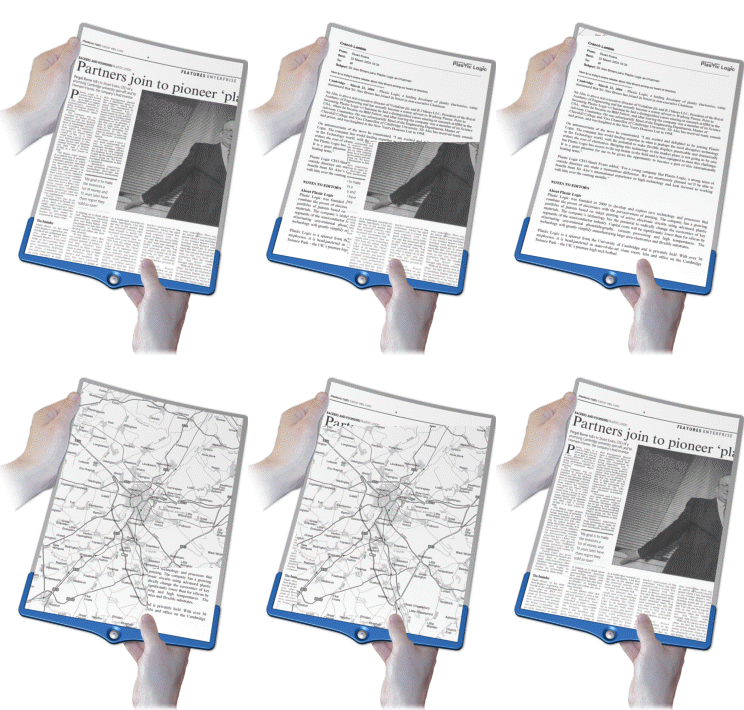
As healthcare is such a paper centric industry (as is financial services), I often wonder why we can’t get to the point of having intelligent paper.  I looked around a little and have never found anything so let me describe what I envision.

A regular paper that is embedded with intelligence such as RFID and the ability to receive and deliver text and/or graphical messages to the consumer.

digital-newspaper.jpgImagine for example a label on a prescription bottle which changed colors when it was time to refill and offered the consumer the ability to request a refill by pressing a digital button that was only available after the refill-too-soon (RTS) edit was passed (typically after 66% of the days supply dispensed should have been used).  Or, imagine new patient registration forms at the physicians office where you filled out one piece of paper that was auto-populated with information from your personal health record (PHR) based on your fingerprint.  All the forms could be brought up one at a time on the digital paper and your answers immediately pulled into the system of record.

Less paper.  More consistency.  Easier communications.  Better quality information.  Less costs associated with data entry. Fewer HIPAA risks.   

epaper_product.gif

Scary or Interesting Technology

After my post the other night about analyzing your writing, I had a chance to talk with a technology company about how they digest and use text from things like letters, e-mails, and call recordings.  It was fascinating.  They were describing to me a system they developed for the military which is now available commercially.

They can take all these communications and use them as part of a segmentation or targeting model that is based on patient behavior.  How great (and scary) would that be?  (Big Brother is always watching.)  Imagine that you have a model that tries to identify how to best incent a person to improve their health.  If you could input any e-mails or letters they have sent into your company and input any call recordings using speech to text, you would have all types of indicators about personality and interests along with communication modes, time of day that they respond to information, etc.

big-brother.gif

Obviously, a patient-centric healthcare model means really understanding things about people.  To do that, we have to get multi-dimensional and think differently.  Rather than simply focusing on moving people to mail order from retail, shouldn’t you focus on attracting the people that are most likely to stay with it and not move right back?  If you are going to offer an incentive for taking a Health Risk Assessment, don’t you want to offer it only to the people that will act on the results?

Compliance with prescriptions or testing is a great example.  There are certain people that are more inclined to stay compliant.  But, it is also important to understand what message will motivate them to stay compliant – not dying, seeing their kids get married, saving money, not missing work, etc.

And, because we are in healthcare, there are some legal constraints about when you can make different offers within the same or similar populations.