Archive | Managed Care RSS feed for this section

Health Transformation 2.0: Follow-up

The other day, I provided a few comments on this book (manifesto) that I picked up, and I reached out to the author. He got back to me last night and was kind enough to provide the PDF of the publication.

In his words:

“These are simply my thoughts and thoughts inspired by a community of friends. It’s written as a kind of manifesto with the hope to inspire more good minds to tackle a very major challenge facing our society.”

I would encourage you to reach out to him if interested. (E-mail Scott Danielson – author)

Here is the book for you to view. I hope you will enjoy the hard work his community put in both in terms of content and graphic design.

Don’t forget to sign up for e-mail updates or put the blog in your reader. Thanks.

Value Based – Impact on Pharma

Kip has a good posting about the impact of value-based benefit design on the manufacturers.  He doesn’t allow comments so I will post some thoughts here.

For many firms, this will require a significant, even scary change in thinking and tactics; payor-centric communications; comfort with a massive increase in transparency; and a greater willingness to partner. Therefore, while the financial risks of moving to a value-based world are daunting, ultimately the greatest challenges are intellectual.

Value-based drug benefit designs will pose the greatest challenges to manufacturers with product lines (or pipelines) dominated “me too” drugs; rigid, risk-adverse organizational silos; and out-dated, prescriber-centric communications.

While I certainly think the industry has been tip-toeing towards value based benefits for a while, it still will beg several key questions:  [Note: When I think about value based, I think about a grid showing outcomes mapped out versus costs similar to a quality over price analysis.]

  1. How do you value certain things – less pain, convenience, minor variations in outcomes, extension of life?
  2. How does genomics play in here when you realize that a drug may be better for one patient but worse for another?
  3. How do you communicate this to patients without making benefits more difficult to understand?
  4. Can patients “buy-up” to pay the difference to allow them to get an alternative that keeps the company neutral?
  5. Will we ever get standards and clean data?  We can’t even agree about whether anti-depressants work.

I agree it’s a key trend and one to watch, but I think the implemented reality will be radically different than the solutions out there.

Health Transformation 2.0

I grabbed this little book off the table at Health 2.0.  I am finally getting around to flipping through it (rather than sleeping).

I can’t figure out if it’s associated with a company.  If yes, they have done a great job of disguising it.  [For what purpose, I don’t know.]  It is very well laid out with great graphics and is called:

Health Transformation 2.0
Can A Better Healthcare Operating System Make Us Healthier?

The author’s name (Scott Danielson) and e-mail are in the cover so I have shot him a note to see if I could add it here as a flash or some other visual.  Here are a few of the comments from the book:

  •  Healthcare 2.0 uses emerging technologies to transform an archaic, disease-treating system into a progressive health-enhancing one.
  • In the past 4 years, healthcare costs have doubled.  Are we twice as healthy?
  • Today, we have the ability to create a set of tools, a healthcare operating system that will help people find and manage information, research and control costs, and get and/or stay healthy.
  • Connected.  Helpful.  Secure.  Organized.  Informed.
  • Personal + Health + Power = Personalized Health Empowerment

Non-PC: Is Recession Good For HealthCare?

I am sure this is not a politically correct topic to discuss, but the thought crossed my mind.  Since 75% of the US thinks we are in a recession, I think we can assume that people will act as if we are in a recession.  Never mind the economist definition of whether it’s a recession.

So, what are the implications for healthcare:

  • If I am cost conscious, I should be more willing to accept generics and mail. (pro)
  • If I am cost conscious, I may be more willing to go to a clinic versus a physician or urgent care.  (neutral)
  • If I am cost conscious, I may be more likely to skip doses or not refill my medications. (con)
  • If I am cost conscious, I may not join a gym but instead workout outside.  (neutral)
  • If I am cost conscious, I may not be preventative in my care.  (con)
  • If I am cost conscious, I may be more willing to accept free services offered through my employer or plan. (pro)
  • If I am cost conscious, I may take advantage of all the web tools and member portals which exists.  (pro)

In the big picture, there is a chance that a recession could push individual health insurance faster.  Just like Medicare Part D was a catalyst, a recession could change the employer sponsored healthcare paradigm and drive people to find insurance for themselves.  Making that happen quickly will be an issue.

Blinded By The Voice

I heard an interesting arguement the other day.  Someone was saying that the only thing that matters in the automated voice space is the voice.  They suggested listening to a call and thinking about what the patient heard.

This reminds me of advice from business school that the paper on which your resume was written makes all the difference.  Or that the font or color on your marketing materials is the key thing to get right.  It certainly matters.  But different people want different voices.  Ultimately, it’s about how you deliver that 1:1 personalized communication to the patient based on their preferences, their historical interaction pattern, and a blend of their claims and demographic data.

The other thing that surprised me was the implication that voice was more important than reporting and technology.  If I have a great patient interaction, but I can’t mine the data and I can’t easily modify the program to be better than I am blind to the success.

One of the things that I experienced when I ran campaigns is the need for in-flight modifications.  I may predict that I get a 20% response rate to a particular copay waiver program, but if I only get 5%, I rather stop it day one and tweak a few things rather than wait 30 days and miss a lot of opportunity.  On the other hand, if I get a 40% response rate, I may want to dial down the volume to manage my transfer rate to my call center and not mess up my ASA (Average Seconds to Answer) which probably has some SLAs tied to it.

Think about your communications solution from every angle…the interaction, set-up, ease of change, flexibility, reporting.

Another Good IDC Quote

We have been out talking to the analysts to get their feedback on the market and share some of our new ideas.  I mentioned a good quote a few weeks ago from IDC, but I was even more excited by their publication last week (see 1/2 way through the document).

The story is called “Communications Technologies – the Industry Step Child to the PHR?” and is by Janice Young.

“Amidst the market hoopla last week at HIMSS of Google’s formal entry into the healthcare market with the GoogleHealth PHR were other significant announcements focusing on what may are considered more mundane healthcare initiatives – consumer communication strategies. In particular, Silverlink Communications released two announcements in the past two weeks reflecting the next generation of healthplan investment in communications technologies.”

“The successes and opportunities of new communications tools from Silverlink, Varolii and others are largely unheralded, yet good cost/benefit studies exist. Health plans have found the return on investment and report that automated communications programs improve prescription drug cost management and increase COB information to health plans.”

“Targeted multi-channel communications tools can both improve healthplan costs and quality in the short term and also provide insight into consumer segmentation and behaviors that will be invaluable to managing the emerging consumer communications and information management platform, include PHR deployment and adoption”

Comparing our announcements to that of Google was impressive, and she clearly gets the power of the solution.

Guest: On Price/Placebo Effect

Frederick Navarro is a research psychologist who, over the past 20 years, has focused his efforts on understanding people and the factors that shape their attention to health and care seeking. He has developed a unique model that approaches health care consumer behavior from a different angle than other models today. Over the past 10 years he has done considerable work with health plans and his findings often fly in the face of conventional thinking. He posted a long comment on my post the other day about Price and Placebo effect that I thought I would post here as a “guest post”.

On the issue of predictable irrationality and perception, what about the situation where a group of people rate their health status much better than another group of people, but the first group generates nearly twice the level of medical claims as the poorer health status group. That’s counter to the current belief that health status drives claims. So, what’s going on?

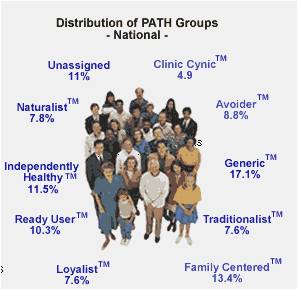
[His methodology divides people into PATH ( Profiles of Activities and Attitudes Toward Healthcare) Groups as shown below.]

path-groups.jpg

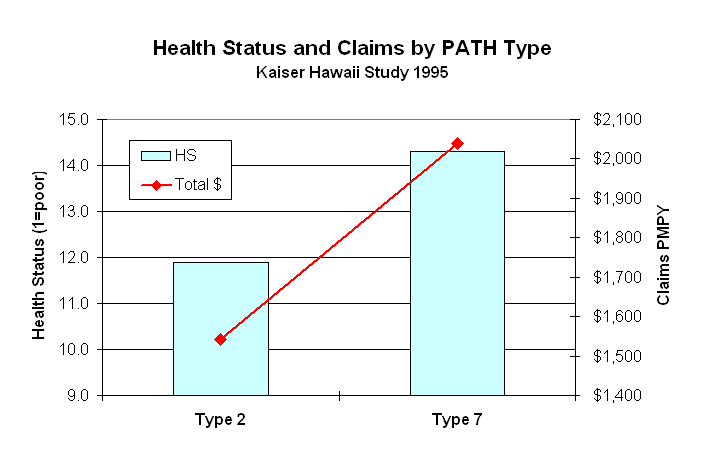
Well, the difference is how each group of people judge when it is time to seek care. When do they say, it is time to go to the doctor? Type 2 people only go to the doctor when problems are serious. They ignore their health and are apathetic towards it. They have health problems, but they just live with them. Type 7 people go to the doctor at the first sign of a problem. They monitor their health and are very proactive about it. If something appears, they seek care for it. These are the types of people it seems the health industry wants to build more of to reduce costs.

In a 1995 study of Kaiser members in Hawaii, the Type 2 members rated their health status 11.9 (SF-12 scale) and Type 7 members rated their health status at 14.3. The Type 2 group had avg claims pmpy of $1,541; the Type 2 group had avg claims pmpy of $2,040. Whoops! The higher health status Type 7’s had nearly twice the claims as the lower health status Type 2.

healthstatus_kaiser.gif

Let’s bring things closer to present time. In 2004/2005 year long study of Cigna members in a DM program the same patterns were there. At the baseline, the Type 2 group reported avg health status of 3.26 (1 to 5 scale) and the Type 7 group reported avg health status of 3.45. Type 7 were higher again! Type 2 avg claims pmpy were $6,176. Type 7 avg claims pmpy were $9,910. Whoops again! After a year, the DM intervention did not change this. At the end of the study, Type 2 people reported health status at 3.3 (a touch better), and the Type 7 people reported health status at 3.54 (a touch better again). The Type 2 group’s claims went down to $4,750 pmpy. That’s over a $1,400 drop. The Type 7 groups claims after 1 year of DM intervention dropped to $9,017 pmpy (almost a $800 drop). The Type 7 higher health status group still had claims that were nearly twice the level of Type 2.

The moral to this story is that the predisposition to seek care is a huge driver of health care costs. In some groups of people it overrides their perception of their health. In the 1995 study and the 2004/2005 study, the reason why the Type 7 people had higher claims is because they came in demanding care. That’s all. And the doctors are happy to see them!

This all harkens back to an earlier blog where you discussed the Dutch study and how preventive care did not lower health care costs. Providers have convinced everybody that the cure to lower health care costs is to encourage more people to become like Type 7 and to make care more accessible and affordable.

Predictable irrationality?

Looks like it to me.

healthstatus_dm_1year.gifhealthstatus_dm_baseline.gif

Does Price Have a Placebo Effect?

I mentioned it yesterday in the post about Drug Benefit News, and I think I have talked about it early last year. The question is how do people view price as influencing their decisions about drugs.

  • Does free influence perception of value?
  • Does paying 10% of a $100 drug sound better than paying 10% of a $30 drug?

USA Today had an article the other day on this topic. They talk about a study in which subjects were given sugar pills. They were all told that it was a new pain drug. Some were told that it costs $2.50 per pill and some were told that it costs $0.10 per pill. A series of shocks were then administered to the patients. 85% who were told that it cost more (versus 61%) said that they felt less pain after the pill. (The Placebo Effect)

“What we experience is partially reality and partially what we expect to experience,” says the senior letter author, Dan Ariely, a Duke University behavioral economist whose new book, Predictably Irrational, explores why people make the choices they do.

pills2.jpgThey go on to say that this might explain why some of the Cox-IIs (i.e., Vioxx, Celebrex) were so successful and could explain why people don’t think generics are working as well as the same brand drug they were taking. They also say this could convince people to be less compliant since they don’t see as much value in the generics. [There must be a study out there that shows compliance of generics versus brands.]

This should influence how you interact with patients and present information to them to convince them of value.

You can see some additional information from one of the study authors on his blog.

Comments On Drug Benefit News

From a pharmacy benefit perspective, Drug Benefit News puts out one of the better and more focused publications. Unfortunately, it costs a lot, and I don’t always agree with the author’s opinions.

I was just reading the February 15th publication and had a few observations / comments:

  • It says you could save 10-30% of your drug costs by using a standard RFP process recommended by a consultant. [I find this very hard to believe unless you have pricing from 10 years ago. If you improve your brand discount by 2% and got a 5% improvement in generic discount and got a $1.00 more in rebates per brand Rx, you still are only around 5% in savings. Savings comes from plan design and behavioral changes. You might pay more for a consultant than you will save by using them.]
  • It says that many consulting firms are collecting large amounts of money from certain PBMs. [That may be true but is an easy thing to ask about. You should always understand what’s in it for them (or your financial advisor for that matter).]
  • It says people ask for information that can’t be verified. [That is a simple measurement issue. I definitely agree that people should spend more time on defining and understanding metrics to create Service Level Agreement (SLAs) that work. But, the smaller the company, the less likely the PBM is going to change their model to meet their specific needs.]
  • The most ridiculous thing is suggesting the mail order and specialty pharmacies give pass-through (i.e., acquisition pricing) to their clients. Come on. I don’t see them asking retailers like CVS or Walgreens to provide their acquisition price. I don’t know many companies in any industry (other than maybe non-profit) that provide their cost of goods per unit to their customers. There is tons of readily accessible data about average prices so that companies know what they should be at to be getting a reasonable price.

There was a good breakdown of marketshare in the PBM industry by lives. One thing it shows (or makes me question) is lack of movement. Express Scripts had 50M lives when I went there in 2001 which is the same number they report in 2007.

  1. CVS / Caremark 16%
  2. Medco 11%
  3. Express Scripts 9%
  4. ICORE Healthcare 7% (who??)
  5. Wellpoint 7%
  6. Pharmacare 6% (isn’t this already in the CVS number??)
  7. MedImpact 5%
  8. Argus 5%
  9. HealthTrans 3%
  10. ACS 3%
  11. Other vendors 28%

I must admit I continue to be surprised that there isn’t more consolidation. (Of course, they track 550M lives which is bigger than the US population.)

There were several good points in the specialty pharmacy story:

  • They make a good point about the shift in specialty from being focused on life threatening and rare illnesses to dealing with more chronic, life-long conditions. [Which is interesting since one of the points made at PBMI was that manufacturers are looking to get a drug to market at a higher price as a specialty drug and then expand the conditions it treats.]
  • By 2010, it is estimated that 1/2 of all drug approvals will be for “chronic biologics”.
  • This long term use combined with the cost of these drugs and their side effects makes compliance a bigger issue which combined with the challenge of self-injection should drive an increased push for patient education.
  • Biologics can cost up to $400,000 per patient per year. [Imagine what that does to the budget for a small self-insured company.]
  • 70% of products in the pipeline require “clinical insight” (versus self-injection).
  • Prime Therapeutics talks about it’s new “dynamic support model” which will vary the support based on drug and condition.

“You want to make sure you provide an appropriate amount of support, but that you don’t over support where there is no value.”  [Tom Solberg, AVP, Specialty Pharmacy, Prime Therapeutics]

Then there was a story about zero-copay generics and that getting traction.  The pros are likely more compliance and more generics.  The cons are possibly more utilization and probably no ROI.  I think the quote in the article by Tom Tran, Sr. Director of Pharmacy at HCSC is a good one:

“The value of that drug will be diminished, because anything free in the long run will have little value.”

“If the member feels that the medication they are taking is essential, you could raise [copays] $4, $10, and they’ll still see the benefit of taking my drug.  I’d rather pay $10 a month than to have my diabetes worsen and I lose my vision and I lose my feelings in my legs and [have] my big toe amputated.”

That seems like more good endorsement around the issue of patient education.

But, let me try to do the math for those of you still thinking or wanting to have your generic drugs for free.

  • Assume you have 10,000 covered lives who use 14 Rxs PMPY (per member per year)
  • Assume you have a 50% GFR (generic fill rate) with a $9 copay (per 30-day supply)
  • Assume you save $50 for every brand claim that moves to a generic
  • If you reduce your copays to $0 for generics, you will lose $9 on each of the 70,000 generic claims (10,000 x 14 x 50%) or $630,000 in patient contribution
  • To replace that, you will have to improve your generic fill rate by 9 percentage points ($630,000 / $50) which is a 20% improvement over the existing 50% GFR  [Good luck!]
  • Now, you might see benefits from improved compliance but you might also see more utilization.

Health 2.0: My Notes

I am just flying back from the Health 2.0 conference out in San Diego. I feel like there is a ton of information that I want to share so kudos to Matthew and Indu for the great job. (And, if you make it to the end of this post, you must really like the topic.)

I decided the best way to do this is in three posts: (1) Notes; (2) Companies; and (3) Observations. [Some people were doing live blogging which I just couldn’t do and keep focused.]

Here are a few of the other blog postings about the event:

So, let me begin here with my notes from the conference which began Monday with some informal sessions (user driven) and a deep-dive on a new vendor American Well. [I missed this event since it was so packed that it was standing room only in the hallway, and I was 5 minutes late getting off a conference call. That being said, they were in there for 3 hours so there must be something pretty interesting.] Tuesday was pretty much packed from breakfast (7:00) until I got back from dinner (11:00).

Matthew Holt:

  • Talked about his Health 2.0 picture of search, social networks, and tools. And, at the end of the conference, he showed a preliminary sketch of the model for the fall Health 2.0 conference where each of these are blown out into smaller segments.
  • Talked about the challenge of wrapping context around transitions. [In a side conversation, I thought someone else made a great point of saying that one of the biggest challenges will be how to drive change.]
  • Talked about the four stages of Health 2.0. I was soaking it in versus scribbling notes madly so all I got were phase 1 (user-generated content) and phase 2 (users as providers). But, I believe the later phases do (or should) show these models integrating into the establishment.

Susannah Fox (Pew Internet & American Life Project):
[Who by the way was a very good speaker and refreshingly gave a 30-minute presentation w/o any slides.]

  • Talked about an early 2000/2001 quote from the AMA on not trusting the Internet and a push to the physician. [That seems to have softened a bit over the years.]
  • Said that 40% of adults in America have a high school education or less which gets right to the issue of health literacy.
  • Talked about validity of online data. Researchers want to see date and source, but patients don’t look for that.
  • Talked about an article in a cancer magazine about misinformation which said the most highly correlated factor was a discussion around alternative medicine. Those sites often had misinformation on them.
  • She set the tone for the day by using the concept of a seven word expression to summarize your talk. Her’s was “Go Online. Use Common Sense. Be Skeptical.”
  • Pointed out that only 3% of e-patients report bad outcomes based on online data. [I think this whole discussion around what patients want in terms of research versus experiential data from their peers is very interesting.]
  • Talked about the white space between a “physican is omnipotent model” (my words) versus a “patient self-diagnosis world”. That is where we have to find a solution.
    • [A person from Europe who I talked with said that not only is their model different but the fact that they hold the physician on a pedestal makes some of these things impractical there.]
  • Talked about a new term for me – “participatory medicine”.
  • Said that Pew had classified people into three groups not on the concept of do you own a mobile device (for example) but on how you use it (e.g., do you feel like the device interrupts your life when it buzzes you, do you require help in setting up your devices).
    • 1/3 of Americans are “elite tech users” who own lots of devices
  • There is still minority distrust of some of these online tools. Some of this is generational.
    • The memory of the syphilis experiment is failing.
    • There is limited discussion of faith in these discussion areas which is important.
    • The older generation typically has less technical skills.
  • Her next seven word expression was “Recruit Docs. Let E-Patients Lead. Go Mobile.”
  • She described African American and Latino users of mobile devices as leveraging it as a Swiss Army knife versus a spoon. [I hope I use it more as a spork…which I assume is evolutionary over the spoon.] They use it more than TV or computers.

Patient Videos:

  • One of the most engaging segments was a series of video clips from patients.
    • The founder of i2y.org (I’m Too Young For This) spoke about being diagnosed with cancer at an early age and how he overcame the physical challenges and has become a go to destination for people about cancer.
    • The founder of Heron Sanctuary in Second Life talked about how she has limited mobility in real-life and her ability to create a world in second life where she can help people and gave examples of how people are using this virtual reality tool.
    • A young woman with RSD talked about how she has used ReliefInsite to manage her disease and pain. She also had the same issue of being “too young” to have RSD and the challenges of finding a physician to help her and believe her.

The format for most of the day was to have 3-4 founders or executives from companies get up and talk for 4 minutes on their company. Then a panel of people would comment and questions would get asked. On the one hand, it was a compelling, fast-based approach that kept your attention. [No nodding off at this conference.] On the other hand, it was heavy on marketing and light on really drilling down on the problem. [Although I am not sure that was the purpose or even achievable without making this a multi-day conference.]

So…here were a few of my quick notes on some of the companies. I will post another one trying to look at some screen shots and other observations. If you didn’t get mentioned here, it’s likely because I was simply watching or distracted. Hopefully, I catch everyone on the Health 2.0 Company post.

  • WEGO Health – allows consumers to rank content…i.e., directed search…gave example of search for some health topic that returned 98,000 links on Google, but only 50 here…option to score after consumer uses the link
    • Seems interesting. How often is it updated? How do you build awareness? Can it be part of a broader search engine? Seems like a likely acquisition to be another option like images or desktop from a search criteria within Google.
  • HealthCentral – biggest brand you don’t know (or something to that effect)…have 40+ sites around specific disease states…6M unique visits per month…new VC money…100 “expert patients” found to create initial communities…ability to create inspirational cartoons that summarize your story…good GUI
    • I really liked some of the features they demonstrated (in 5 minutes). They talked about creating micro-communities (e.g., spouses of people with a disease).
    • The idea of “recruiting” 100 “expert patients” to build an active community was one of the best I saw.

In preparation for discussion on patient-MD solutions, someone shared that only 2-3% of MDs allow appointments to be booked online. There was discussion that patients don’t really look to the Internet to find a physician or hospital. They look at what’s in-network and they ask their friends. There was an example given for Yelp which is used to rank restaurants, but allows people to review the physician. [A comment I heard later was when will we see a site ranking the sites that rank physicians.]

  • Carol (company name) – talked about mall concept in that people shop for something like a physical or allergy test not necessarily a specific type of MD…provide cash prices and insured prices
    • Seemed interesting. I will have to think more about how I search.
  • Vitals.com – I talked about this company on the blog a few weeks ago…still like the graphics…saw a few other features that I hadn’t noticed such as customizing the search criteria and using slider bars so that you get weighted recommendations

I thought there was a good discussion on why would an MD participate in a ranking site.

  • Help them sub-specialize (i.e., I want to treat knee pain not neck pain).
  • Allow them to attract the right type of patient that matches their style and focus.
  • Ego…allowing them to manage comments.

IDEO, the famous industrial design, company facilitated a lunch workshop and talked at the conference. For simplicity, I will blend both notes here. (see old post about IDEO book)

  • Talked about user-centric design which is key. At lunch asked us to come up with a solution to address the problems of diabetes patients. Showed us four interviews with diabetics. But the stress was not on solving what we thought was their problem, but trying to actually listen to what they say and do in order to find something. Key point.
  • Talked about empathic research showing that we don’t say what we think, do what we should logically do an online car loan, or even do what we think we do.
  • Talked about a book called Thoughtless Acts.
  • Gave examples of project with Bank of America that showed how most people round up their credit card payments so they started a “Keep the Change” campaign which allowed them to attract 2M new members.
  • Walked through an example of creating the Humalog pen for Eli Lilly.
  • Talked about creating a new bike design.
  • All of them were common in the framework they use and their focus on the person/user/patient/member.
  • Lunch was an interesting workshop where you listened to the videos, identified issues, brainstormed solutions, picked a solution to “pitch”, and then shared your idea with your neighbor. At our table…
    • Saw problem largely as educational / informational
      • Don’t know what to expect
      • Don’t know where to get information
      • Don’t understand lifecycle and treatment plan options
      • Don’t know what to do with the pump
    • Talked about everything from portal to device solutions
    • Settled on an iPump concept that would blend an iPod with an insulin pump and foster a community around it to develop cases (e.g., a belt that it fit into as part of a formal dress), videos to download to it on education, connectivity to trigger auto-refills, etc.

Then we had several discussions by physicians that were blending the old model of house calls with technology. Seems very cool (for those that can afford it). Although one example was relevant, it missed the masses. One showed a trader who was too busy to leave the trading floor, but he had a sore throat so the physician came to his office, took a culture, and gave him an antibiotic.

  • One great point that they made was the benefit of seeing the patient’s environment (i.e., home) in helping them manage a disease.
  • I loved the fact that they would send me an e-mail with my notes from the visit rather than trying to scribble things down while they are talking.
    • Of course, this begs the question of literacy and teaching physicians how to communicate in simple, non-medical language.
  • Another great point was the issue of technology as a good unidirectional solution. For example, if the physician wants to know whether something works, an e-mail is very efficient if it does. Leaving a voicemail so that you play tag back and forth only to realize the patient is feeling better is a waste of time.
  • Jay Parkinson referred to himself as the “Geek Squad” for healthcare (think Best Buy computer technicians). Great analogy. He also showed this seemingly very intuitive and easy to use EMR called Myca which I believe he has built.
  • Somebody tied this back to the physician ranking discussion by asking how this new flexibility of business model would be captured and tracked on those sites (e.g., does MD respond to e-mail).
  • I can remember if I jotted this down or one of them said it but I have “More Time. Save Money. Less Costs.” I think this was in response to a question I e-mailed in about how these new models were affecting the compensation and lifestyle of the physicians.

Phreesia talked about their tablet solution (i.e., electronic clipboard) for the physician’s office. They had an interesting statistic that 49M Americans move each year so address data is constantly changing. (Not to mention plan coverage, drug use, etc.) They are getting 200-300 new MDs a month to sign-up for this.

I don’t see myself using it, but this is an interesting option. Organized Wisdom talked about their product LiveWisdom which allows users to leverage a live person (I assume MD or RPh or RN.) via chat to address questions they might otherwise contact their MD about. They pay $1.99 per minute.

  • As they admitted, they are limited in scope and often have to refer the patient to an MD. They seemed to me limiting, but creating an opportunity to partner with American Well who helps you find an MD, sees if they have time to talk, and launches an interactive video session and chat session with the MD right then for a pre-agreed upon rate.

There were two patients there that were involved in lots of feedback sessions. The first was a woman who has lost 144 pounds (w/o going on The Biggest Loser) and has become an online advocate and support mechanism for lots of people using DailyStrength. The second was Amy Tenderich who is a very active diabetic and blogs at DiabetesMine.

Amy’s story was great. Her blog is very engaging and as Matthew said it is “thought by many to be the #1 blog for patients“. I had a chance to talk with her and her husband and heard a lot about how it started and the response. It is a great story, and she is very knowledgeable and was willing to really push the patient-centric agenda at the conference.

Someone made the point about linking patient costs to compliance with their care plan which I have blogged about before. I completely agree that the patient should be rewarded for using self-service options (web vs. live agent) and for staying compliant.

ReliefInsite talked about their solution and shared that 1 in 6 Americans suffer from chronic pain. No matter what the CEO said, he couldn’t do better than the opening patient video which used their solution. (Which he said was a surprise to him.)…seemed like a good, interactive tools with nice reporting.

Emmi Solutions showed their online educational tool which had videos built in a conversational tone and used animation to help people understand procedures and their disease. Seemed great. Said that informed patients are less likely to sue.

MedEncentive is one that I will have to spend more time looking at. It plays to the incentive question and rewarding patients and MDs. They talked about a 10:1 ROI and said the medically literate patients have less hospital visits.

[Completely off topic, but from the conference, I heard someone talking about CouchSurfing which is apparently a “network” where you allow people (that you don’t know) to come sleep on your couch. I thought that died with hitchhiking in the 60s.]

A consultant from Mercer commented that some large employers with physicians on staff are more effective [at health and cost management] than small health plans. Not sure if that was a complement to employers or an insult to health plans.

BenefitFocus which automates the set-up of your benefits (imagine no more paperwork to enroll) had a great video showing the future with personal consultants (via hologram), biometric signature, and other cool things. [I have heard good things about them for years although they never returned my phone calls several years ago even with name dropping one of their biggest investors.]

Virgin Healthmiles was there and talked about their pedometer which is tracked online. They also have an employer kiosk for tracking weight and body fat. Offline, he also told me that they are rolling out connections which will be on the treadmills and other machines at participating gyms. I am a big fan of what they are doing. I believe he said they recommend 7,000 steps a day per person (and think he told me that 2500 is a mile).

Stan Nowak (my boss) presented the Silverlink story talking about using technology to engage patients, the importance of capturing data, extreme personalization, and showed recent success improving compliance by 3x by rapidly doing a series of pilots.

  • I am not sure I have figured out our seven word description but here’s a few attempts:
    • Patients Are Different. Personalization Matters. Be Proactive.
    • Preference Based Communications Engage Patients & Drive ROI.
    • Segment. Learn. Interact. Empower. Use Communications Appropriately.

iMetrikus talked about their solution which connects over 50 biometric devices today into backend healthcare systems. They charge $3 PMPM which caused me to raise an eyebrow. It is a great solution and integration is a nightmare, but that seems like a lot of money. But, I am all about ROI. If I can get better return on this than on another project and it exceeds my cost of capital, why wouldn’t I do it.

iConecto didn’t present but had a booth and introduced a section. But, I love the concept of using play (e.g., Wii) to drive health.

To be fair, I will even include my notes about Eliza Corporation (our competition). Their CEO and our CEO did a podcast with Matthew the weekend before which you can listen to here. The messaging is fairly similar (although I have a strong bias about why us). She talked about tailoring [of messaging] being the new black. She talked about using clinical and demographic data to drive programs. They are a good company, and it was well done. [I was even flattered that several of their employees said that they read my blog.] Both companies commented on how they feel old (~7 years) compared to a lot of the companies presenting here (~2 years).

  • One thing that I find strange is for two companies that pretty evenly split the healthcare marketplace for Strategic HealthComm is that we are located within 10 miles of each other near Boston.

At one point, there was a discussion around ROI especially on new technologies and how to get that first big project. One of the panelists said that a 1:1 ROI over two years would be sufficient. [Not true for any company that I have worked at or consulted to.]

The final panel discussion and closing statements had a lot of good content:

  • Discussion of the patient as a provider and what that could mean.
  • Discussion of importance of sharing information across solutions.
  • The concept of citizen (European) versus patient.
  • From the Wired magazine participant, discussion around fidelity versus flexibility:
    • Disk versus MP3
    • HDTV versus Tivo
    • Microsoft versus Google
  • Importance of moving upstream in care
    • Disease management
    • Wellness
    • Prevention
    • Diet
  • As part of upstream discussion, talked about involving the food companies and used the analogy of inviting the oil companies to a green conference. [I wondered where the MCOs were, the hospital networks, and the politicians.]
  • The author of the book “Demanding Medical Excellence” (who I believe is part of the Health 2.0 staff talked about “random acts of doctoring” and the issue of solving healthcare for the few or the masses.
  • Indu talked about building a new system versus extending and improving the existing system. [A great question]
  • I think it was Matthew that brought up the issue of designing for credibility.

Wow! If you made it through this thesis, good for you. I hope it’s helpful. It is certainly easier than me trying to find my notes two months from now or sending a bunch of e-mails to people on sections they might find interesting.

Healthcare Costs Continue To Rise

No big surprise here. Costs up. Incomes down. Sicker people. More treatment options. More technology. More access. More costs. Administratively complex system. Frustrated patients.

Maybe the only big surprise that I think exists is the disparity between spending across the country (i.e., how much they spend to treat a condition in one state versus another) and the disparity in outcomes between the US and other countries.

But, the facts are important and certainly drive the focus on this within the election.

Here are a few things from a recent article about HC spending doubling by 2017:

  • One of every $5 spent in the US will go to health care by 2017 (more than $4 trillion/year).
  • 6.7% annual increase (3x inflation) is driven by increased demand, higher prices, larger population, and aging population.
  • Government will be responsible for 49% of the costs (versus 46% in 2006) over the next decade.
  • Average spending per person will go from $7,026 (2006) to $13,101 (2017E).

“Health is projected to consume an expanding share of the economy, which means that policymakers, insurers and the public will face increasingly difficult decisions about the way health care is delivered and paid for,” CMS economists said. (source)

Links To A Few Other Blogs

Here are a few recent blog posts worth reviewing.

Now, just the other day, I commented that I did see much talk about YouTube in healthcare. In the past 24 hours, two things have come to my attention on this.

  • Allscripts posted a video on YouTube (see below).
  • Glen Beck, a conservative talk show host, had a bad experience at the hospital and put it on YouTube getting 800,000 hits, generating lots of press, and thousands of comments. (see below)

Webinar: Prescription Trend Mgmt Through Communications

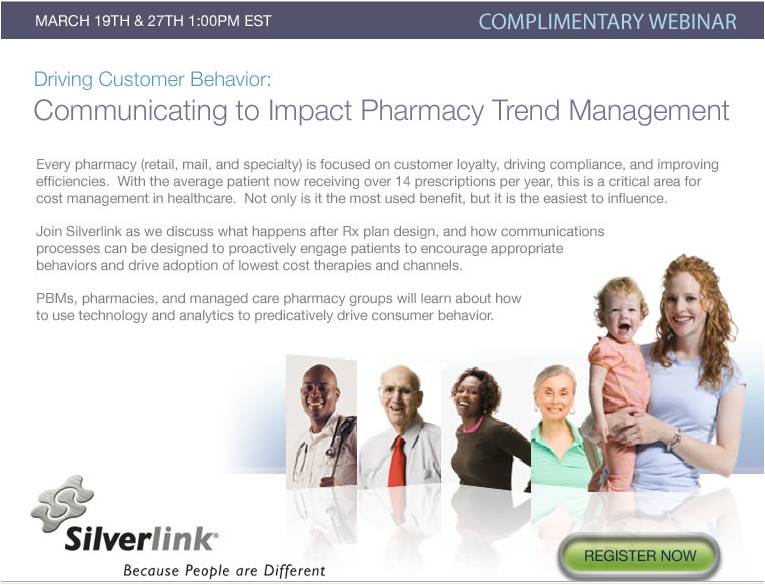
I must admit that one of my favorite things to do is give presentations. I used to do a lot of webinars at Express Scripts and have done a few others as a consultant. So, with that, I am really excited to schedule my first webinar as a Silverlink employee which I am going to do on my favorite topic – pharmacy trend management (i.e., brand-to-generic, retail-to-mail, utilization management).

So, if you’re a managed care company, PBM, or pharmacy that is interested, sign up for the event. I will talk about some of the common myths in driving patient behavior, talk about how to use speech recognition technology, and share some lessons learned and results and ROI examples.

I can’t post HTML here so the link below won’t work, but you can click here to register. Thanks.

webinar-pharmacy.jpg

PBMI Day One Notes

Just getting back from the first day of my first PBMI conference. Very pleased.

Here are some notes / observations:

  • PBMI was bought in the past 2 years by PSG (Pharmaceutical Strategies Group) which interestingly has numerous ex-Express Scripts people working there.
  • Great opening speaker (E. Kinney Zalesne) who is the co-author of Microtrends (a few blog comments about it). Fascinating set of facts about small (and often influential) groups within the US. You can learn more at their website www.microtrending.com. [Note: I have not read the book yet.]
    • Compared today’s Starbucks economy (everything customized) to the Ford Economy
      • How you look ($12B cosmetic surgery market)
      • Who you marry
      • How you pray
      • Your gender
    • Talked about moving from Megatrends to Tipping Points to Microtrends (versus fads)
    • Said we drink 10x more water today than in 1980 BUT at the same time, the fastest growing beverage segment is energy drinks
    • There are 2-3 new religions formed everyday
    • There are 5M people over 65 working today…which will have huge benefit implications
    • Talked about DIY (do it yourself) Doctors as a group of people who use the Internet to self-diagnose and treat MDs as an ATM (here’s is what I need from you). Described the group as mostly woman and typically younger. Linked the growth in OTCs from $2B to $15B to this trend.
    • Said 3/5 people worry about hospital errors.
    • Good quote: “Better we understand people; the better we can serve them.”
    • Said young people today think of being on prescriptions as normal.
    • Talked about the “30 Winkers” or 16% of adults that get less than 6 hours of sleep a night.
      • 2/10 adults say lack of sleep has led them to make an error at work
      • Sleeping only 6 hours a night increases your probability of being obese by 23% and if you only sleep 4 hours then it goes up to 70+%.
    • Talked about looking for microtrends versus fads.
    • Said they might have a microtrend spotting competition on their website soon.
  • There was a VP of HR who talked about the importance of communications around benefit information.
    • Repeat the message but change it so you don’t de-sensitize the audience.
  • Matt Gibb (Chief Clinical Officer) from Medco presented on Extreme Generic Dispensing with several interesting comments:
    • Talked about how insulin and coumadin are the top two drugs that drive HR admissions
    • Called Therapeutic MAC a “draconian” benefit structure.
      • Therapeutic MAC means that the plan covers $X for a class.  (E.g., you have $30 per month for cholesterol lowering drugs.)
    • Showed a sliding scale of programs which a company could use to influence trend ranging from low impact on consumers and low savings potential to high on both.  Here are a few from low to high.
      • Decision support tools
      • Copay waivers
      • Coupon mailing
      • Maintenance medication program
      • Generous generics (which I guess is a benefit plan with a low copay for generics)
      • 3-tier
      • Co-insurance with POS rebates
      • Brand only deductible
      • Mandatory generics (which I can’t believe is this far up)
      • Mandatory mail
      • PA
      • ST
      • High Performing Formulary (which sounds a lot like the product I ran at Express Scripts called High Performance Formulary)
      • Therapeutic MAC / Reference-Based Pricing / Reverse Copay
    • Showed their 2006 generic fill rate at 58% with the remaining 42% being broken into 4 categories:
      • 17.4% where there was a brand with no generic alternative
      • 4.5% where the brand is less expensive than the generic alternative
      • 11.1% where the brand has a generic alternative (i.e., you should be at 68% GFR today)
      • 9.0% where there will be a generic alternative by 2009 (i.e., you should be at 77% GFR in 2009)
    • I must admit I was confused / surprised when he revealed that their “emerging solutions” for driving generics included the following which I think of as basic programs:
      • Mandatory generics
      • Co-pay waivers
      • Generic step therapy
      • Co-insurance
    • I did think their idea of a benefit design where generics and mail order prescriptions don’t count against your deductible was interesting.
    • I was a little surprised when he mentioned (without discouraging) clients offering generics at $0.
      • The economics (every time I modeled it for clients) don’t work since you have 50% of people getting generics and paying a copay which you just lost.  You would have to improve generics significantly to even breakeven.
    • I (and many people I asked) was surprised with his response to the question of what was a “significant” difference in copays between brand and generic to drive behavior.  His answer was $15-$20 which he said was based on what pharma believes is important to get rebates.
    • I did like the fact that they had clients fund a free first fill of OTC Zyrtec to promote moving to the OTC rather than another Rx.
    • He walked through some of the great statistics they have had from their MyRxChoices web tool.
      • Versus a control group, those that got a letter encouraging them to go to the web and used the website.  58% more likely to change to lower cost drug or channel.  51% conversions from brand-to-generic.
    • He also talked about the importance of rebates in PBM pricing which seemed out of place in the generic discussion.

Several things that came to mind listening to the presentations and perhaps for another post were:

  • Would / could we ever get to an individualized benefit which allocated X dollars and allowed the patient to choose what was included (e.g., tatoos)?
  • What would be the implication for recruiting / hiring if we could create a healthcare cost index similar to a credit score that didn’t tell potential employers what your medical conditions were but gave them an estimate of your medical costs?
  • What are the implications of driving consumerism to web tools which patients use at work when more and more companies use monitoring tools to track keystrokes and web visits?  Will they accidentally learn about private healthcare information?

More Debate On AntiDepressant Effectiveness

I think this is pretty big news. The study that came out over the past few days in the UK has gotten lots of attention. I listened to Dr. Gupta talk about this on CNN this morning validating it although with caveats about drilling into the data. I also talked with a retail pharmacist last night about it. Obviously, with something like 100M antidepressant prescriptions per year, this should be a big deal.

Full study details.

The study showed that for those without severe depression a placebo had the same effect as an antidepressant. I know some pharmacists that used to joke about simply telling patients to walk around the block, but their point was that exercise can also have a positive effect on those with depression. This will be an interesting one to see how it plays out.

Obviously, if you take an antidepressant, don’t stop without talking to your physician.

And, I am sure this isn’t done. The manufacturers aren’t going to let this go away.

BTW – The WSJ Health Blog has a good dialog of comments going about this study.

Are You Using Your Clickstream Data?

Healthcare companies have spent millions (maybe even 10s of millions) of dollars building out self-service platforms on the web. Based on data from the Service and Support Professional’s Organization, only 44% of the time that customers use self-service are they successful. That is of course of the individuals who try the self-service. A Harris Interactive poll found that 89% had difficulty with web self-service.

That seems pretty pathetic to me. There are lots of different solutions. For example, you could use a virtual agent (e.g., CodeBaby) to help guide the individual through the process. You could use NLP (Natural Language Processing) technologies to make the website more intuitive (e.g., Knova).

In most healthcare companies, web utilization is okay. I don’t think I have met one with over 20% registration (much less utilization). Of course, we know that isn’t because patients aren’t using the web for healthcare. Just look at all the tools out there and the massive investments by WebMD and RevolutionHealth.

But, I have yet to meet a large healthcare organization that can tell me much about their web utilizers and that has integrated that data into a total CRM (Customer Relationship Management) approach.

  • How does web utilization map against your high cost patients?
  • If a patient researches a topic, do you reach out to them to close the loop? (e.g., I saw that you were researching alternative therapies. Did you know that we cover up to 6 visits to an acupuncture center?)
  • For patients that are constant web utilizers, do you push them to the website rather than send them printed materials?

And, one of my favorite questions and pet peeves is whether the CSRs (Customer Service Representatives) have the ability to co-browse. For example, if I am stuck on the website, can they see where I am and help me get to the right section. In some cases, the CSRs don’t even have Internet access and have never been on the website. Hard to drive self-service if the agents aren’t on board.

Another thing I have looked at before…why not offer a different cost structure to employers or others if they achieve a certain rate of self-service? Your costs as a MCO or PBM would be lower. Your ability to influence behavior would be lower.

It seems like there was a huge push to drive adoption when this was new, but I don’t see it as much now. Where is the campaign to drive adoption with the incentives? The economics haven’t changed and companies continue to invest, improve, and have spent real money on these very cool and often helpful technologies (even if not necessarily intuitive).

From a KMWorld July/August 2007 article/advertisement about eGain, their CEO, Ashutosh Roy, gives a list of several best practices and makes the point that “customer service has emerged as one of the few sustainable differentiators in today’s hyper-competitive markets.” How true that is in the healthcare world.

  1. Take a proactive approach to customer service.
  2. Provide value-based customer service.
  3. Leverage online channels as part of a unified customer interaction hub.
  4. Empower your agents and customers with knowledge.
  5. Align metrics with goals and business strategy.

ATDM: Automated Telephone Disease Management

No. It’s not my term or even a company term. I am not sure who came up with it, but it was actually used in a published study from 2001.

“Impact of Automated Calls With Nurse Follow-Up on Diabetes Treatment Outcomes in a Department of Veterans Affairs Health Care System.”
Diabetes Care 24:202-208
2001
John D. Piette, PHD, Morris Weinberger, PHD, Frederic B. Kraemer, MD, and Stephen J. McPhee, MD
Contact John Piette (jpiette@stanford.edu) for more information (Center for Health Care Evaluation)

“Findings from multiple studies indicate that chronically ill patients will participate in ATDM and that the information they report during ATDM assessments is at least as reliable as information obtained via structured clinical interviews or medical record reviews. Indeed, some patients are more inclined to report health problems during an automated assessment than directly to a clinician.”

Obviously, given Silverlink’s historical focus, these kind of external validations are important. I cited the one on exercise from Stanford a few months ago.

Here were a few highlights from the article:

  • Obj: evaluate ATDM with telephone nurse follow-up to improve diabetes treatment and outcomes in Department of Veterans Affairs
  • Design: 272 diabetes patients using hypoglycemic medications in randomized 1-year study. Bi-weekly ATDM health assessment and self-care education calls. Nurse educator followed up based on assessment reports. Automated survey measured self-care, symptoms, and satisfaction. Outpatient service use was captured. Glycemic control was measured.
  • Results: intervention patients reported more frequent glucose self-monitoring and foot inspections. Intervention patients were more likely to be seen in specialty clinics and have had a cholesterol test. Intervention patients reported fewer symptoms of poor glycemic control and greater satisfaction with their healthcare.
  • Conclusion: intervention improved the quality of VA diabetes care.
  • Description of the intervention:
    • Structured messages using statements and queries
    • Recorded human voice
    • Outbound
    • 5-8 minute calls
    • Used touch-tone keypad to report information (now you would use speech recognition to collect the data)
    • Offered an optional health promotion message at the end of the call
    • Each week the nurse reviewed the data and followed up with patients based on established protocol
  • Intervention process:
    • Average patient received 15 ATDM calls over the 12 months
    • 50% were very satisfied (31% moderately satisfied)
    • 97% said the messages were mostly or always easy to understand
    • 76% said the calls made them feel like their MD knew how they were doing
    • 67% said the calls reminded them to engage in self-care activities
    • 79% said they would be more satisfied with their healthcare if they got such calls
    • 73% said they would personally choose to receive such calls

Obviously, if you’re very interested in the topic, you should read the article to get all the finer points.

My takeaways are that if this technology worked in 2000 then it should be even more effective now. There have been lots of improvements. Additionally, we all know the costs of diabetes (and many other diseases) and the cost of using nurses as the primary means of follow-up.

The PBM in 2010

Health Strategies Group is a good analyst group that focuses on healthcare. They produce good quality reports primarily for pharma.

In 2004, they put out one about the PBM in 2010. While I am on my way to the PBMI conference, I thought I would revisit it to see some of the interesting points and what has come true. They presented several scenarios (based on input from a panel of people from the industry) so some observations will run opposite each other. Panelists were from ACS State Healthcare, Caremark, Express Scripts, Medco Health Solutions, MedImpact, NMHCRx, Prescription Solutions, and RxAmerica.

  1. Payers may increase their use of cost-control strategies regardless of consumer desires.
  2. Improved market conditions my decrease focus on cost and trend management and shift focus to outcome quality.
  3. Changes in power, skyrocketing costs, or inadequate funding my move Medicare from a public/private partnership to a government run program.
  4. Consumers may reject their new role of taking on more healthcare responsibility due to lack of interest, cost, confusion, or a perception that it is the employer’s responsibility.
  5. The scenarios they present are:
    1. Enlightened Health Improvement
      1. Quality over cost management
      2. Drug approval focuses on safety, efficacy, and value
      3. PBMs focus on health and disease management
      4. PBM market splinters to claims processers and formulary only PBMs
    2. Status Quo
      1. Continued increase in cost management
      2. Costs shift to consumers
      3. CDHPs grows slowly with only 10% of lives by 2010
      4. Fewer manufacturers and PBMs
    3. Race to the Bottom
      1. Economic downturn makes it even more of a cost decision
      2. Drive to generic formularies and mail service
      3. Reduction in staff at PBMs
      4. Diversification into long-term care and other areas
    4. Government as Primary Healthcare Payer
      1. Government administrator makes decisions and contracts directly with pharma
      2. Government influences drug pricing and development
      3. PBMs are tightly managed by government
  6. How they interpret this for pharma:
    1. PBMs are here to stay
    2. Drug costs are important
    3. Value based decisions are not certain
    4. New players will emerge (Provider Synergies, ScripSolutions, Systems Xcellence, CatalystRx, ACS State Healthcare, First Health Services, and Innoviant)
  7. They layout a few economic indicators to watch for:
    1. Unemployment
    2. CPI increases
    3. Health plan financials
    4. Specialty trend
    5. Drug trend
    6. Medicare Part D success and costs
    7. Marketshare movement to non-traditional PBMs
    8. CDHP adoption
    9. Rate of adoption of EMR and ERx

I think a key quote at the end about PBMs (which was a sign of the times) is as follows regarding segmenting the population. The segments proposed were Outcome Seekers, Lifestyle Optimizers, Cost Managers, and Non-Users. I think this has changed over the past few years.

“While PBMs believe they can segment consumers into these categories, they see little value in doing so; they do not identify consumers as a target segment.”

The Imperfect Mind

I think a great parallel for healthcare consumerism is the shift to 401Ks. People had to take new responsibility. People had to begin to understand the markets. People had to think long-term. And, a certain percentage of those people failed. (At least that’s what I call it when I hear people are retiring with less than 2 years income in savings, no pension, and are therefore dependent on social security – see study from a few years ago.)

Obviously, we can risk a nation of people who fail at their healthcare and end up bankrupt, sick, and dependent on the government to bail them out.

So, I found a brief article in Money Magazine (Sept. 2007, pg 113) about Daniel Kahneman who won a Nobel Prize for explaining why people make the wrong decisions time after time about investing or spending money. He is a psychologist not an economist. Here were a few things from his interview (I paraphrased when not in quotes):

  • It’s unrealistic to believe people are rational and use all available information to make consistent decisions.
  • People respond to how things are positioned. (E.g., “An investment said to have a 80% chance of success sounds far more attractive than one with a 20% chance of failure.)
  • We need to make fewer decisions. He says there are two that matter: (1) “how much of your wealth you want to put at risk” and (2) “how much risk you want to take with it”.
    • I am sure there is a healthcare parallel here. What type of lifestyle do you want to have? And, how much work are you willing to put in to achieve that? (Not sure that’s it, but I think it can be simplified and a framework applied to let us make consistent decisions with long-term implications.)

Later, in the same magazine, Jason Zweig has an article titled “Your Money and Your Brain” which is excerpted from the book by the same name ©2007.

  • “Your investing brain often drives you to do things that make no logical sense – but make perfect emotional sense.”
  • “Scientists in the emerging field of ‘neuroeconomics’ – a hybrid of neuroscience, economics, and psychology – are making stunning discoveries about how the brain evaluates rewards, sizes up risks and calculates probabilities.”
  • He talks about the thrill of the chase. Our mind is more excited anticipating a profit than when we get one. (Think about this in terms of the need for constant reinforcement and rewards to drive behavior over time.)
  • He talks about the implications on long-term memory and an experiment showing that people were more likely to remember things that were associated with a reward than those that weren’t. (Think about this in terms of health education.)
  • I think a great quote is “we tend to judge the probability of an event by the ease with which we can call it to mind.”
  • He talks about the peer pressure impact on your brain. (We all saw this with the study last year on obesity linked to who your friends are.)

IDC Quote

In our recent press release, we had a quote from IDC that I think is relevant to all of you that read this.

“IDC’s research projects that actionable information, interactivity and communications to better manage consumer behavior will be a leading spend category for healthcare plans through 2010,” said Janice Young, Director, Healthcare Payer Strategies, Health Industry Insights, a subsidiary of IDC. “This will be critically important to health plans, not only to improve member satisfaction and retention but also to significantly lower costs.”

Managed Healthcare Executive Article

There is a nice article that appeared in the latest Managed Healthcare Executive magazine about non-compliance with a focus on behavioral health. Mari Edlin is the author and has written numerous articles for them.

I bring it up both because I talked to Mari and got a good quote from her in the article, but also because I think it is such a great example of why patient communications are so important. Although we would all like to believe that we pay attention to all the details of the product information (i.e., side effects), the reality is that we become much more aware of the medication once we start taking it. I believe some compliance issues could be addressed by quick follow-up with the patient.

  • For drugs which take time to take effect, right after the patient begins therapy, reach out to them and remind them that it can take time for the effects of the drug to take place.
  • Or, if it is a drug with significant side effects, reach out to them and remind them of the benefits of sticking with therapy so that they don’t give up due to the side effects.
  • Or, in other cases, they may need to titrate to a different dosage so reach out to them and capture some information about how their feeling on the medication.

From the facts I pulled from PharmacySatisfaction.com a while ago, the number one reason for non-compliance was “I forgot”. Combine that with the Caremark report showing that only 25% of people with a disease actually end up on the medication, and you have a real issue for us to address. I think for people with depression, ADD, bi-polar disease, and other behavioral health issues this has the added complexity of using controlled substances and medications that ultimately are affecting your mind.

“Medication adherence is driven by two significant factors,” says George Van Antwerp, vice president, outsourcing and professional services, Silverlink Communications Inc., a Boston-based company providing outreach to patients in their homes. “First is the patients’ view of prescriptions and belief in their ability to improve their health. Second, there are the experiential impacts of the regimen, such as realizing an immediate gain in health, the complexity of the therapy, the magnitude of the side effects and the cost to the patient.

“Since diagnosis of behavioral health conditions is not an exact science and the use of the medications can affect an individual’s behavior in different ways, several new complexities join the adherence discussion,” Van Antwerp continues. “Some patients with depression who have been prescribed an antidepressant, for example, may be thinking they should be feeling better very quickly. This is the kind of situation in which a patient can be reminded that it often takes a few weeks for the medication to begin working.”

If you like this post and are interested in the topics here, don’t forget to sign up for my e-mail updates or add the RSS feed from the blog to your reader.

Prime Therapeutics Drug Trend Insights 2006

As you may know, Prime Therapeutics is a PBM headquartered in Minneapolis that is owned by a group of BCBS plans. I just had a chance to read their Drug Report this past week. As I have talked about Caremark, Express Scripts, and Medco, I thought I would share a few comments and highlights here.

First, I thought it was interesting in that it took a slightly broader perspective (perhaps the BCBS influence) on the industry dynamics. It mentioned the war and YouTube (for example). [I don’t think I have seen many other people in healthcare even acknowledging YouTube.]

I was surprised by a 2004 Rand and BCBSA study they quoted saying that “approximately 70 percent of survey respondents cited the Internet as their main source of health information” thereby supplanting the role of the personal physician as the primary source.

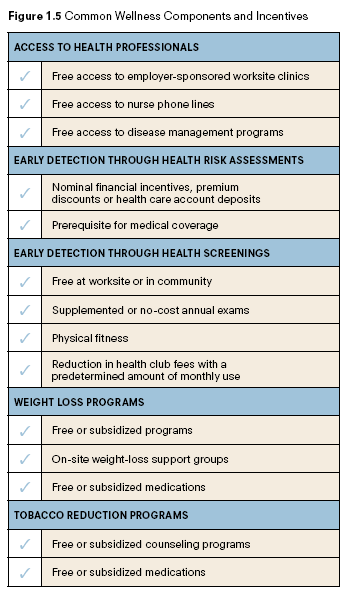
Given the focus on wellness across the industry, I found their list of common components and incentives that are used in creating a wellness program to be a good, quick checklist.

I couldn’t figure out two things that were either “corporate DNA” opportunities or something different about their pricing and plan designs.

  1. They say that plans that transition to Prime from other PBMs save 4.5 percent. (Which is significant.)
  2. They also said that their utilization was only 10.65 in 2006 which would be lower than most numbers that I have seen.

They do a good job of explaining some of the generic scenarios in the industry as people try to get that small advantage.

At-Risk Launches

Several generic companies launched their products ‘at-risk’, which means that the FDA has granted approval to their product prior to the expiration of a patent that is contested in court, but after all applicable exclusivity periods have ended. These ‘at risk’ generics, including generics of Biaxin®, Plavix®, Toprol XL® and Wellbutrin XL®, are subject to large penalties payable to the brand-name drug manufacturer if they lose pending lawsuits. Citizen Petitions Brand drug manufacturers, or their agents, frequently use Citizen Petitions in attempt to slow down the approval of generics. These are not legal proceedings in the typical sense, as they usually do not involve specific protection of a patent. The FDA must make a ruling on a Citizen Petition before it approves a generic, and this frequently takes a significant amount of time. These products are currently involved in Citizen Petitions: Lovenox®, Concerta®, Catapres TTS®, Skelaxin®, Vancocin®, Miacalcin® and Flovent®.

Authorized Generics

With authorized generics, the brand-name drug manufacturer makes its own generic version of its own brand-name drug. By doing this, they can reduce the profit a first-to-file generic company reaps during generic exclusivity periods, which could discourage generic companies from entering the market.

Agreements Between Brand and Generic Companies

Another pressing issue, which has also been around for several years, involves agreements between brand and generic companies. These agreements end litigation and keep generics off the market for a period of time, but still may allow generics on the market before all patents have expired. Sometimes these agreements involve payments to generic drug manufacturers in an effort to delay the release of the generic product.

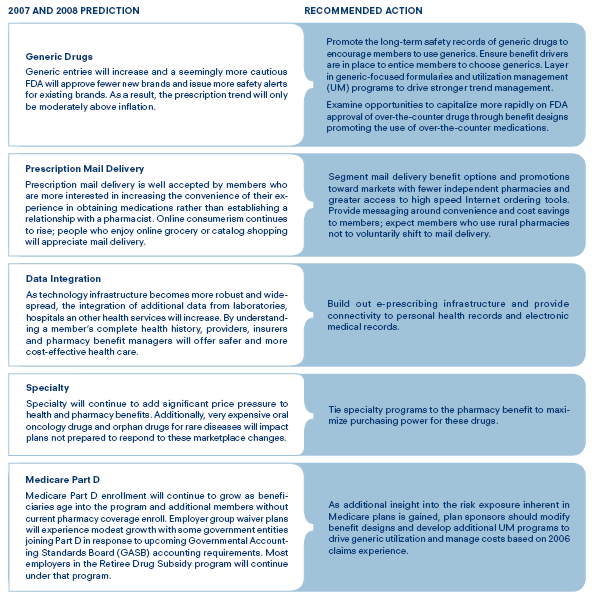
The other thing that I thought was a good summary in their document was their predictions for 2007 and 2008.

prime-predictions.png

If you like this post and are interested in the topics here, don’t forget to sign up for my e-mail updates or add the RSS feed from the blog to your reader.

Medicare COB Conference

If you are a Medicare provider, you might be interested in a conference Silverlink is hosting on Coordination of Benefits (COB). It is open to potential clients only, but here is the general information. If you are a potential provider, here is the basic information about the event.

Medicare Compliance: Strategies & Tactics for Complying with Medicare COB/Working Aged Survey Requirements

  • Wednesday, February 27, 2008 at 1:00 EST or
    Thursday, March 13, 2008 at 1:00 EST
  • 1 Hour

With Medicare requiring annual surveys of all members on alternative insurance coverage by September 1st, Medicare Advantage and PD plans need to develop their strategies now. These COB and Working Aged Surveys can be complex and lengthy for the member and operationally challenging for plans due to specific data formats CMS mandates. Learn how Silverlink and industry leaders are handling these requirements through active data management and proactive comprehensive communications campaigns that deliver measureably better results.

If you’re interested, here is a link to submit your information.

Drug Mix – Saving You $300

You can go and buy the AIS audio conference on drug mix for $300, or I will give you my executive summary of what you likely would hear.  (Note: I did not listen but used to do these presentations.)

Here is what they say they will address:

  • How an optimal drug mix can result in significant savings
    • Brand drug = $100 less network discount plus dispensing fee less copay less rebates…let’s call it$60.
    • Generic drug = $40 less network discount plus dispensing fee less copay…let’s call $5.
    • You save $55 for each prescription you move to a generic.
    • Each 1% improvement in generic fill rate = 0.75% – 1.00% reduction in pharmacy spend.
    • 14 Rxs PMPY * $50 average cost per Rx = $700 PMPY
    • 1% of $700 = $7 PMPY for a 1% improvement in generic fill rate
    • 100,000 member plan saves $700K per year
    • And, inflation on generics is much less than inflation on brands year-over-year
  • How drug mix has become a  factor in selecting a pharmacy benefit manager
    • First, I have to say that this is great positioning.  For years, we tried to convince clients and consultants to weigh this in proposals with limited luck.  So, change it to imply that it is what’s done.
    • You would much prefer a PBM that guaranteed you that it would improve your generic fill rate by X points that simply getting a slightly better discount.
  • What PBMs and plans must do — and NOT do — to develop the best drug mix
    • Make sure you have at least a $15 difference between your generic copay and brand copay
    • Lower your generic copay to less than $10
    • Have a mandatory generic plan in place (i.e., the patient pays the difference if they want the chemically equivalent brand…unless they can prove they have a rare allergy to the dye)
    • Use a 3-tier formulary
    • Reach out to patients and tell them when they should discuss generic alternatives within the class with their physician
    • Offer to waive the patient’s copay if they switch to the generic (Don’t just drop your generic copays to $0…you’re just wasting money.)
    • Consider implementing a step therapy program which requires generics as first line agents
    • Drive web utilization of tools that show patients how they can save money
  • What types of member incentives are most effective in driving optimal drug mix
    • You’re saving $50 times all their refills…share some of it – points, coupons, copay waivers, gift certificates
  • How plan sponsors can evaluate drug mix
    • Not easy.  There are no apples to apples.
  • How contractual mechanisms can ensure accountability for achieving drug-mix goals
    • Look for a trend guarantee or a GFR guarantee tied to beating the overall market
    • Or look for an average price per Rx guarantee holding your copays constant
  • How other factors, including drug pricing and discounts, must be evaluated by plans and PBMs at the same time as drug mix
    • Discounts are important
    • Rebate share is important…at this point you should be getting 100% of rebates
    • Understand how your PBM makes money

I am not in the business anymore so I don’t have all my traditional back-up slides to cover it, but there are some simple tools that will really drive your savings.  Set-up the right plan design and then communicate and promote the lowest cost solution to your patients in a convincing way that they take action.

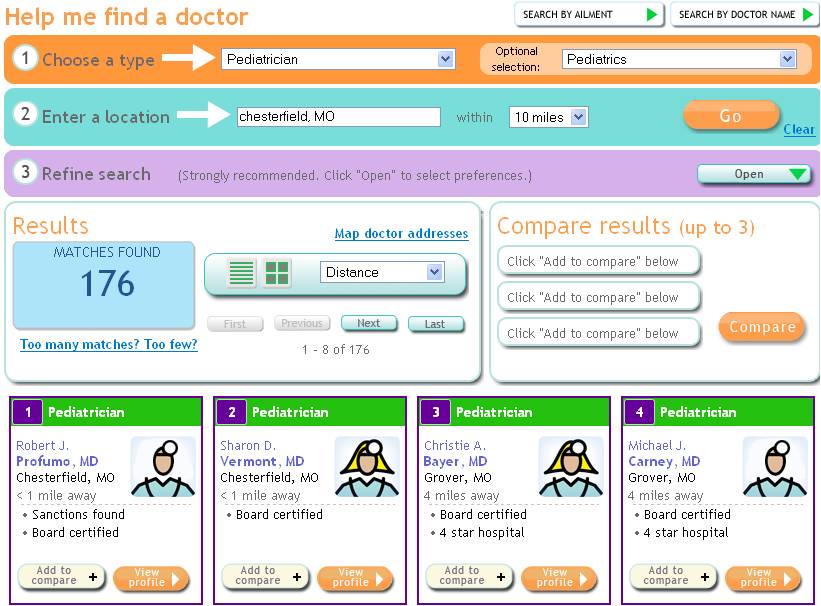
New Physician Site – Vitals.com

I have played with lots of these sites as they come out. The all want to help you find a physician, compare physicians, rank physicians, etc.

I received an e-mail about this new site – Vitals.com. I was skeptical at first that it would just be another me-too site. But, I was impressed at first glance. Here is a Fox Business article about them.

  1. It is easy to use.
  2. The graphics are intuitive.
  3. The information was easy to assimilate. (name, age, gender, specialty, addresses, certified, hospital affiliations, education, residence, fellowship, patient rankings, and disciplinary action)
  4. And, my favorite part is that you can compare physicians.

Here are a couple of screen shots. The first two show just comparing MDs. The third is the MD find and compare feature. The fourth is the rankings that they use plus an option to include free text comments.

(BTW – What I find interesting also is that this is the second time a PR agency has contacted me on behalf of their client. One was for a F100 company that I talked about and this is obviously a start-up, but managing the online brand has obviously become a full-time job.)

vitals-md-info-1.jpgvitals-md-info-2.jpgvitals-find-md.jpgvitals-rankings.jpg

Sweating The Small Stuff and Corporate DNA

Although I agree with the book on Don’t Sweat The Small Stuff for your personal life, I would disagree from a patient communication perspective. I believe most healthcare people dislike the word marketing. They don’t want to think about communications as marketing (which of course has some HIPAA implications if they did). But, the fact is that you are competing for mindshare and trying to get the patient’s attention to do something (otherwise you are just communicating to fulfill some checkbox).

Let’s just think about a few key points in communications:

  1. Choosing the right word. There are lots of examples of how industries and/or companies have reshaped a single word or phrase to have new meaning and new positioning. It matters. Telling stories that evoke emotion and create a call to action have power. There are the classic bad examples such as calling a car a Nova which when exported to Spanish speaking countries means “no go”. And, traditionally, a lot of our health care terms are more negative such as prior authorization or only mean something to someone in the industry such as network.
    • Used cars have become pre-owned vehicles.
    • Online forums have become communities.
    • Generics have become unadvertised brands.
    • Mail order has become home delivery.
    • Employees have become associates.
    • Members have become patients.
    • Is formulary better than preferred drug list?
  2. Determining when to communicate. Depending on your family and your conditions, it is possible that you get at least one communication per month (if not more) from some entity within the healthcare process – managed care, hospital, primary care, specialist, retail pharmacy, mail pharmacy, specialty pharmacy, pharmacy benefit manager, employer, disease management company. The reality is that you are going to pay the most attention to a communication when it is timely. For example, telling me that some group of physicians will no longer be in my network doesn’t matter to me if I don’t go to them today. When I go to choose an allergist and find out that the best one in the state is no longer in network, then it matters, but I have long forgotten that communication.
  3. Coordinating multiple channels. Thinking through a communication and where people will look for information – website, inbound IVR, live agents, employer. It is important (to optimize success) to think about how patients receive and digest information and coordinating information. Nothing is more frustrating than hearing one thing but getting a different answer in another mode of communication.
  4. Using personalized preferences. You make yourself “sticky” and create loyalty by learning about your patients…and using that in how you interact with them. What do they do with information? How do they use information? How do they use healthcare? When do they respond to calls? Do they use the Internet?

It’s not easy, but it is essential. From a healthcare perspective, the industry continues to march down a path where differentiation is going to be in the way the company treats and interacts with the members and patients. Which brings me to the question of corporate DNA.

Are there things embedded into the culture of a company that all things being equal make the experience or outcomes with one company different from that with another? It is an important but difficult to prove question. We did a lot of analysis at Express Scripts to try and prove this. For example, if plan design and population was exactly the same, would a company have a different generic fill rate with us than another PBM?

This is where the small stuff matters. How people answer the phones at the call center. How patients perceive the company and the type of experience they have. How logic is coded in the system. Additionally, this is where I think you see the link between corporate culture and company results. Positive cultures where people love their work, enjoy coming to work, and want to make the company successful have a spillover effect on the customers.

Will eRx Reach The Tipping Point

The concept of the tipping point made famous by Malcolm Gladwell’s book is (in my words) the inflection point at which the market begins to adopt something and everyone jumps on the bandwagon.

So, with CMS saying that eRx (electronic prescribing) could eliminate as many as 2M prescribing errors per year, and Congress considering a bill to link Medicare payments to use of technology, will it make a difference.  (I am pulling a few of these facts from Medco’s recent announcement about launching a Medicare Part D eRx initiative.)  Only 3% of physicians use the technology today, and from my experience working with the vendors and physicians, there are still several big issues.  Maybe this will address some of them.

  1. Standards – Will all the payors and PBMs share some standard such that a physician can move from system to system or from office to hospital without having to relearn a new application?  Can they write prescriptions for the majority of their patients from one system or have to keep using different applications?
  2. Stability – Is there a vendor that they can trust?  There have been several great concepts that were either before their time or had a flawed model.  Time and money wasted on a system that isn’t supported leaves a bad taste in their mouth.
  3. Workflow – Does the system fit into their current office workflow?  If not, why should they change behavior?  Is it less expensive and disruptive for them to have the pharmacy or PBM contact their staff to address the issues after the fact?  What percentage of the 2M errors wouldn’t be caught further upstream?
  4. Incentives – What’s in it for the physician?  You are asking them to do more.
  5. Division of Labor  – Who has what responsibility?  For the PBMs, MCOs, and pharmacies, it is great to resolve issues at the point-of-care (POC) with the physician.  Drug-drug interactions.  Formulary issues.  Brand to generic opportunities.  Retail to mail opportunities.  The physician could easily get overwhelmed with all the requests and go from a quick process to a difficult process.
  6. Support – What IT responsibilities come with the system?  Who is supporting it?  Does it impact the rest of their practice?  Does it integrate with their practice management system?  If they come to depend on the solution, what happens when it goes down?
  7. Cost – Who pays – physician, MCO, PBM, pharma (not likely these days)?

I know many of these are addressed in different ways today.  I think we may be able to systemically force some of this into the office, but in general, until there is a generational transition in the physicians office (i.e., those in their 30s today are the high prescribers), I don’t think wide spread adoption will happen.

The value is clearly there.  Even looking at the pilot statistics from the Medco pilot in Michigan, you see that there are issues and opportunities which can be addressed.  These don’t even take into account the handwriting issues and other safety issues which occur.

  • A severe or moderate drug-to-drug alert was sent to physicians for more than 1 million prescriptions (33 percent), resulting in nearly 423,000 (41 percent) of those prescriptions being changed or canceled by the prescribing doctor;

  • More than 100,000 medication allergy alerts were presented, of which more than 41,000 (41 percent) were acted upon; and

  • When a formulary alert was presented, 39 percent of the time the physician changed the prescription to comply with formulary requirements.

I personally think one of the most interesting opportunities will be to see who received a prescription and didn’t fill it and subsequently determining which of those estimated 30% of people should be filling the claim.  The value of driving that initial compliance should be significant in avoiding more costly issues down the line.

Peeling The Healthcare Onion

I think an onion is the right analogy for healthcare for three reasons: (1) it can make you cry; (2) every time you pull off a layer you learn more; and (3) what you see from the outside is a lot different than what you see from the inside.

    • It can make you cry.

      onion1.jpgWhen you have the Congressional Budgeting Office projecting the healthcare costs will be 49% of GDP by 2082, you know things have to change. This is a front page topic almost everyday across the country. But, like an onion, if we don’t handle this right, it will make you cry out of frustration and pain. Change is not easy especially in a complex system that we have today. Finding the right mix of push and pull is going to be important.

      Quality is still an issue across the system. Biting a bad onion or having a quality issue with your care can make you cry. Look at the USA Today article from the other day about Too Many Prescriptions, Too Few Pharmacies or an entry on my blog about the Institute for Healthcare Improvement.

      • Every time you pull off a layer you learn more.

      This applies so many ways to healthcare given our system, but I think of this from two perspectives – data / information and process. We have so much data in healthcare, but without the right model to make it into information, it just sits there. And, as we layer data (e.g., medical plus pharmacy plus lab) or integrate healthcare data with demographic data, we can learn so much more about our patients and how to care for them. This ranges from simple questions such as how to motivate behavior (e.g., cost savings versus loss avoidance) to how to deliver information based on their learning style.

      Every question you ask (or layer you pull off) reveals a new set of data that can be transformed into information while at the same time creating new questions. Does the relationship you found in the data simply indicate correlation or is there actual causality there? I look at the data that CVS/Caremark presented around saving 30% of healthcare costs by driving compliance and adherence and wonder why people aren’t jumping up and down trying to capture this savings.

      • What you see from the outside is very different than what you see from the inside.

      There is a concept in Six Sigma about designing the process from the outside-in. Imagine sitting in the middle of the onion…all you see is onion all around you. That is a common pitfall when solving problems in the industry that we work in. We are too close to the problem and the historical solution. If all we see is the onion, those on the outside (our patients / members / employees) see the onion in relation to other food options. Their expectations for healthcare are produced by other companies that they interact with. They expect web solutions that work. They expect excellent service. They expect to be valued as a customer and of course need the power to walk away and chose another option.

      onion2.jpgThis is a common problem in healthcomm (healthcare communications). We present information in a channel that we believe is effective based on our experience and paradigm (i.e., written, verbal, kinetic). We use language that we think is helpful. A few of my favorite examples from my PBM days are:

      (1) Telling patients that they need a renewal (prescription). They don’t know what that means. It means they need a new refill since their original prescription refills have run out.

      (2) Telling a physician to consider prescribing lisinopril and giving them sample bottles that say lisinopril. [Because, of course, they would know the chemical name for Zestril.]

      But, this happens all the time. Telling a person that wants all the facts a lot of qualitative information will fall on deaf ears. Providing a person with lots of options when their looking for an expert opinion will frustrate them. One way to frame this is based on personality type. (Of course, that information isn’t sitting in a database somewhere for us to tap into.)

      The reality is that people are different. As you think about your healthcare process, try to be the patient. As one of my bosses used to say, give it to your grandmother and see what she thinks. Can she understand it? Can she make sense of the process?

      It’s not easy finding the right amount of onion to use in your recipe, but it is important to continue trying to improve.

      Total Value; Total Return

      I came across a new website today for the Center for Value Based Health Management.  Their definition of Value-Based Health Management is below.

      “The planning, design, implementation, administration, and evaluation of health management practices that are grounded in evidence-based guidelines across the healthcare continuum.”

      It is a great concept.  The question always is how to do this without confusing the patient.  There are lots of plan designs out there that could be used, but become so confusing that patients don’t know how to meet the payor’s goals while minimizing their out-of-pocket spend.

      The site also talks about a publication called Total Value Total Return which has seven rules for developing a value-based solution for your employees.  They seem like good fundamentals:

      1. The Health of Your Organization Begins with Your People.
      2. To Realize Total Value, You Must Understand Total Costs.
      3. Higher Costs Don’t Always Mean Higher Value.
      4. Health Begins and Ends with the Individual.
      5. Avoid Barriers to Effective Treatment.
      6. Carrots Are Valued Over Sticks.
      7. Total Value Demands Total Teamwork.

      The Carrots Over Sticks comment made me think of all the press about forcing wellness down the throats of employees.  I have a recent article on that that I will post on later.

      10 Ways To Fix Healthcare (From LiveSmarter)

      I am not sure whether this is a new blog or some content off a business site, but I think it is a good entry.  This lays out comments from a bunch of people in and outside the industry about how to fix the situation that we are in.

      It includes comments like:

      • “encourage healthcare professionals to cooperate and develop a shared mission.” [Health 2.0]
      • “market forces bear no consequence on rising healthcare costs” [individualized health insurance]
      • “individuals rely on random health events like hospital stays and office visits for care.” [preventative care]
      • “Though preventive programs incorporating diet, exercise and stress management might cost more money upfront, overall costs will drop by 30 percent and may save the patient from going for tests and getting treatment with expensive machinery.” [low-hanging fruit exists]