Archive | Managed Care RSS feed for this section

Using the “Placebo Effect” in New to Therapy Situations

I was reading a book about trust which pointed out the concept of “remembered wellness“.  This concept is similar to the “placebo effect” in that it shows that patients who trust their physicians and their course of therapy are more likely to have better outcomes (e.g., HIV study).  WOW!!

I’ve talked before about the gap that exists when patients leave their physician’s office with a new diagnosis and we all know that health literacy is a big issue.

So…what are you doing to address this?  I’ve been talking a lot lately about “primary adherence” (i.e., getting people to start therapy) and about engaging patients when they first get a new prescription or a new diagnosis.  This concept of trust only makes this a more pressing issue.

Here’s your worse case scenario:

  • Patient is newly diagnosed with a chronic condition and given a new prescription.
  • They don’t have a great relationship with the physician and/or have limited understanding of the condition (due to literacy, fear, or other issues).
  • They fill the prescription once and stop taking the medication after a few days.

How can you step in here?

  • You can trigger an outreach based on diagnosis code.
  • You can assess their understanding of the condition and help them learn more by addressing their barriers.
  • You can engage them when they fill their first script.
  • You can follow-up with them after the first few days to make sure they stay on therapy.
  • You can enroll them in an adherence program.
  • You can enroll them in a condition management program.

But, the point here is that you need to be doing something that reinforces the decision to manage the therapy and help them to understand and believe in that course of treatment.  If they don’t believe and have trust, they are less likely to get to a successful outcome.

How To Select What Pharmacies Are In Your Network?

This seems to be the “meta-question” that everyone is talking around. 

  • Should every pharmacy be in the network?
  • Should mail be allowed?  Should I do mandatory mail?
  • How do I design a limited network?  Is it ok?
  • What about any willing provider?  [should that just be about cost]

Let’s start with the basics…You want a network that meets access standards, has high quality, improves outcomes, keeps members happy, and offers you the best price.

So, how do you build your network to decide who is in or out (ideally)?

  1. Select the minimum number of local pharmacies required to meet access standards for acute medications (this is your baseline)
  2. Look at your best price to add more pharmacies into the network – who will meet your price for generics, brands, 90-day, specialty
  3. Evaluate your tradeoffs – will you get a lower price if you exclude certain pharmacies?  will that impact access?  will that impact care?  will that impact satisfaction?  can you manage the disruption?
  4. Look at difference in satisfaction between pharmacies – should you take a lower priced pharmacy if the satisfaction is less?
  5. Look at difference in outcomes between pharmacies – should you take a pharmacy that has a lower generic fill rate (on an adjusted population) or a lower adherence rate (on an adjusted population) at the same price? 

Network design should look like formulary design.  You have to look at the value versus the cost.  You might include a higher priced pharmacy in the network if it gives you access, better outcomes, or lower net cost (i.e., better GFR).  You might exclude a lower priced pharmacy if it can’t prove any of this or if consumers who go there are dissatisfied. 

At some point, I would think we’ll see more metrics beyond price be used to measure pharmacies – discounts, GFR, safety (quality), medication possession ratio, satisfaction.  That would make this a lot easier with some standards. 

This would make it easier to have discussions about access in NY (for example) as PCMA is doing.  It would make it easier to have discussions about the Department of Defense (for example) as NACDS and NCPA are doing. 

The DoD is a good example here…Since the military (government) buys drugs better than anyone, I can’t imagine how much better some of these metrics would have to be to justify paying the additional costs at retail for fulfillment.  The base pharmacies and the mail order pharmacy all get their drugs from the government contracts.  At mail, the supply is managed separately so that they are replenished under those contracts.  I bet the cost is $10+ on average more for a drug at retail (non-replenishment) than it is elsewhere.  How do you justify that?  In my mind, retail should figure out how to replenish and segregate their inventory to stay in the network rather than fighting the shift away to mail.

PBMs and Star Ratings

Finally, I’m hearing more talk about PBMs and their role in Star Ratings for Medicare. It seemed like this was a subtlety at the end of last year when I raised it as a 2011 priority.

Drug Benefit News had a story about it in their March 4, 2011 edition with examples from HealthTrans and PerformRx.

In general, there are opportunities to help impact Star Ratings by:

  • Blending pharmacy and medical data
  • Helping monitor patients on long-term medications
  • Increase cholesterol screening
  • Increase use of flu shots
  • Controlling blood pressure
  • Addressing physician communication gaps
  • Improving Customer service
  • Prior authorization process
  • Churn
  • Time on hold
  • Appeal process
  • Accuracy of information provided by customer service
  • Managing complaints
  • Helping with access issues
  • Timely information about the drug plan
  • Monitoring use of drugs with a high risk
  • Making sure diabetics us hypertension drugs

Since pharmacy is the most used benefit, it can have a very direct impact on the overall satisfaction. It can drive calls. It can be complicated. It can affect perception. And, it can lead to churn.

PBMs need to be working to proactively engage consumers. They need to use data to personalize the experience. They need to use clinical data to identify gaps in care. They need to drive adherence.

I personally hope that the Star “concept” becomes a more normal set of metrics outside of Medicare for measuring success and ultimately leads to a performance-based contracting framework.

Improving Your Call Center Without Just Adding People

In today’s economy, the last thing we want to do is scale up a company by simply adding people. Technology has to play a central role in allowing you to grow your company more efficiently.

At the same time, you want to grow without dropping your level of service. You want to improve the consumer experience.

And, to further complicate matters, you have to manage quality both to make sure that you comply with regulatory oversight and achieve goals around first call resolution. With our rapidly changing healthcare environment and legacy systems in many places, finding, training, and retaining good staff that can continue to keep up with the changes and understand the semantics between plan designs isn’t easy.

So, how do you do that? You’re in a balancing act between cost, quality, and experience.

This is one of the big areas where I’ve seen Silverlink Communications play a role. (Note: There are certainly other efforts which you can undertake in terms of single desktop and process reengineering, but I usually refer in some people I trust for those projects.)

Some people call our technology a “smart dialer”, but there is a difference. If you ever get a call at home from a call center using a dialer, you hear that silence after you say “hello”. The technology is looking for an agent to connect you with. On the flipside, if you’re an agent, you’re being connected with someone or even an answering machine that might not be the right person. That’s what a dialer does.

In our case, Silverlink is using mass personalization, voice detection technology, and speech recognition technology to screen the recipient for the call center. You hear the message right after you pick up the phone. It’s a message that has been carefully crafted using behavioral sciences and health literacy. It asks for you by name and identifies who’s calling for you. It then confirms your identity, and depending on what information is being used in the call, it may have to use multiple forms of authentication to verify who you are. Once we’ve assessed who you are (based on your responses), we’re able to deliver a personalized message to you about your healthcare. That personalized message is scripted in such a way to engage you in a conversation. During that conversation, we can then determine:

  • Are you interested in learning more?
  • Is this a good time for you to talk?
  • Would you like to talk to an agent or hear more now?
  • Would you like us to send you information in an e-mail, SMS, or snail mail?
  • Would you like a URL to go to for more information?

Occasionally, people ask about authentication. When you send a piece of direct mail, it’s a federal offense to open it if you’re not the intended recipient, but you have no proof that they did that unless your “nanny cam” picks it up. When you call someone, you have a record of when the call was made and what they person who picked up the phone said to authenticate themselves. This certainly seems better to me than any other channel.

Of course, this begs the question of recording all the calls. I’ve heard a few people tell me that they do this with other companies. I find that hard to believe since 12 states have consent laws which would require people to consent to being recorded when they were called. That would limit the effectiveness of the program, or if you didn’t do it, it would open you up to a big lawsuit.

So, how does Silverlink add value to a call center:

  1. Improving agent productivity. Automating standard questions. Connecting with the right person at the right time.
  2. Improving consumer engagement. Using behavioral sciences and health literacy to engage people and route them to the right agent based on skill set.
  3. Improving quality and consistency of experience. Personalizing the experience to engage the consumer but doing it in a way that addresses the clinical guidelines, regulatory requirements, and custom client requests in a consistent manner.
  4. Improving agent satisfaction. Your agents would rather talk to pre-qualified people or people who have an issue.
  5. Learning new information. In some cases, patients feel judged when people ask them questions (why aren’t you taking your medications). They may reveal more or other information in an automated environment.

Of course, automated calls aren’t the answer for everyone (although they work better than any other mode other than people…and sometimes beat them also). But, multi-channel coordination is a post for another day.

Rules Based Communications

After working with data warehouses, configuration engines, and workflow management systems, I’m a big believer in embedding rules into a process. Communications is no different.

Let’s look at a few rules:

  • Don’t communicate with someone more than X times per week.
  • Don’t call these people.
  • Use Spanish for people with that language preference.
  • Send a text message to people who have provided their mobile number and opted in to the program.
  • When applicable, use a preferred method of communication for reaching out to someone.
  • If a caregiver is identified and permission is on file, send the caregiver a copy of all communications to the patient.
  • Call the patient if the amount being billed for their prescription is greater than $75.
  • For patients between these ages, use the following messaging.
  • If the patient hasn’t opened the e-mail after 48 hours, then call them.
  • For clinical information, use this channel of communications.
  • For John Smith, only call them on Tuesdays between 5-6 pm ET.
  • For Medicare recipients, use this font in all letters.
  • For Hispanic consumers, use this particular voice in all call programs.
  • If the patient doesn’t respond after two attempts, send a fax to their physician.
  • For patients with an e-mail on file, send them an e-mail after you leave them a voicemail.
  • For patients who are supported by Nurse Smith, only call them when she is on duty and use her name in the caller ID.

I could go on. But, the point is that communications, like healthcare, is a personalized experience. We have to use data to become smarter (historical behavior, segmentation, preferences). We have to use customization to create the right experience. AND, probably the most difficult thing for lots of companies, we have to coordinate communications across modes (i.e., e-mail, direct mail, SMS, automated call, call center, web).

Ultimately, I believe consumers will get to a point where they can help set these rules themselves to create a personalized profile for what they want to know, how they want it delivered, and ultimately provide some perspective on how to frame information to best capture their attention.

To learn more, you should reach out to us at Silverlink Communications.

Physicians Want A Long-Term Patient Relationship

In a recent survey by Consumer Reports, 76% of physicians say that a longer-term relationship with their patients would be very helpful.

Is that feasible in today’s environment with consumers more likely to move cities and states?

Assuming it is, this would seem to make EMRs more important especially as they could act as a CRM system for the physician. The average physician probably supports about 2,000 active patients (“physician panel“). It would be difficult for them to remember and personalize their experiences without some mechanism for capturing notes about the patient. Certainly this can and has been done on paper for years, but technology would make this much more efficient.

“A primary-care doctor should be your partner in overall health, not just someone you go to for minor problems or a referral to specialty care,” said Kevin Grumbach, M.D., professor and chair of the department of family and community medicine at the University of California at San Francisco.

The article says that there is research that supports the fact that patients who stick with one physician over time have less healthcare issues and lower healthcare costs. I would assume that it therefore holds that patients who like their physician begin to trust their physician and therefore stay with their physician longer.

Physicians said that respect was the second thing that could help patients get better care. Does that mean that disrespect causes you to get worse care or simply that you’re less likely to engage the physician in a dialogue and understand their recommendation?

There were lots of surprises to me in the data:

  • 33% of patients track their changes and activity between visits. I’m guessing those are the chronically ill patients with complex diseases not the average patient.
  • 80% of MDs thought that patients would be better off with a family member or friend joining them for the visit…but only 28% of patients have someone with them.
  • Only 8% of MDs thought that online research was very helpful with the majority of them thinking it provided little to no value.
  • 9% of patients had e-mailed their physician in the past year.
  • ¼ of patients indicated some level of discomfort with their physician’s willingness to prescribe medications.

The Cost Of Chronic Pain

The March 7th edition of Time Magazine has a whole section on chronic pain including a fascinating timeline of how pain has been managed over the years.  It’s just in recent history that pain has moved from being a side effect to being a condition to be management.

An article by Dr. Oz provides some statistics on pain:

  • The annual price tag of chronic pain is $50B.
  • Lower-back pain is one of the most common complaints affecting 70-85% of adults at some point.
  • 7M people are either partially or severely disabled because of their back pain.
  • Lower-back pain accounts for 93M lost workdays every year and consumes over $5B in costs.
  • 40M Americans suffer from arthritis pain.
  • 45M Americans suffer from chronic headaches.
  • People with chronic pain are twice as likely to suffer from depression and anxiety.

One of his key suggestions – if you’ve worked with your physician for six months and its not resolved – go see a specialist.

He also points you to the American Chronic Pain Association for communication tools in helping you verbalize your pain.

In his article and in the other articles, it talks about stretching as a way to alleviate pain.  Obviously, there are medications that can help with pain relief although some of them can be abused and addictive.  And, both Dr. Oz and the other articles mention acupuncture as a potential solution.

You can also go to the American Chronic Pain Association to learn more.

From a management space, one of the areas where chronic pain is a big area of focus is in Worker’s Compensation.  For more about this space, you can follow Joe Paduda’s blog.  You can also follow some of the Worker’s Compensation PBMs such as:

Pharmacy Benefit Data From PBMI

I had a chance to read through the new 2010-2011 Prescription Drug Benefit Cost and Plan Design Report that PBMI puts out and is sponsored by Takeda Pharmaceuticals. Here are some of my highlights:

  • Percentage of the pharmacy claims costs paid by the beneficiary
    • Retail = 25.3%
    • Mail = 20.1%
    • Specialty = 15.9%
  • Average difference between retail and mail copayments (see chart):
    • Non-preferred brands = $18.38
    • Preferred brands = $7.15
    • Generics = $3.61
  • 5.1% of employers are covering genetic tests to improve drug therapy management
    • 68.8% of them are covered under the medical benefit
  • 43.0% of employers are restricting maintenance medication dispensing to select pharmacies (retail or mail) [much higher than I expected]
  • They give examples of the percentage of respondents using the following value-based tools:
    • 31.7% – reduced copayments in select classes
    • 19.7% – incentives to motivate behavior change
  • I was surprised to see a significant drop in the percentage of clients requiring specialty medications to be dispensed at their PBM’s specialty pharmacy.
    • 2009 = 53.8%
    • 2010 = 40.0%
  • There was a similar drop from 15.7% to 11.5% of employers restricting coverage of specialty drugs under the medical plan.
  • Given all the focus on medication adherence, I was disappointed to see that only 24.2% of employers were focused on maximizing compliance in specialty. [Maybe they haven’t seen all the studies on this topic.]
  • They have some nice comments on Personalized Medicine and the critical questions to address.
  • I was also surprised that less than 1% of employers were using onsite pharmacies or pharmacists.
  • They provided the following data on average copayments for 3-tier plan designs with dollar copayments:
    • Generics at retail = $9.45
    • Generics at mail = $19.06
    • Preferred at retail = $25.93
    • Preferred at mail = $53.63
    • Non-preferred at retail = $46.43
    • Non-preferred at mail = $98.25
  • The average pharmacy discounts (based off AWP) were:
    • Retail brand = 17.5%
    • Retail generic = 46.6%
    • Retail 90-day = 19.8%
    • Mail brand = 23.3%
    • Mail generic = 53.5%
    • Specialty = 18.7%
  • The one number that seemed off to me was the Rxs PMPM which they had as 2.29 for active employees. That would mean 27.48 PMPY which seems closer to Medicare. [I typically use 12 Rxs PMPY for commercial and 30 Rxs PMPY for Medicare as a quick proxy.]
  • For the first time, they showed the percentage of employers excluding coverage of non-sedating antihistamines (e.g., OTC Claritin) and proton pump inhibitors (e.g., Prilosec OTC). Both classes have had lots of blockbuster drugs go OTC (over the counter) so it makes sense to exclude coverage.
    • NSAs = 44.7%
    • PPIs = 30.6%
  • They provide a nice summary of how employers are using UM (utilization management) tools.

The report has tons of data on different scenarios, different plan designs, rebates, and many other topics. I’d encourage you to go online and read thru it.

BTW – The respondent group of employers included 372 employers representing 5.8M lives including both active and retired. The average group size (active only) was 9,736 which is a decent size employer group. And, 12% of the respondents were part of a union bargaining agreement.

Grand Rounds (volume 7: number 17): Engagement Is Multi-Faceted

The concept of “engagement” in healthcare is a difficult one. Traditionally, we’ve had a build it and they will come approach that didn’t encourage preventative care. It also didn’t openly acknowledge the challenges that consumers have in dealing with medication adherence and even understanding the system or their physician’s instructions.

In this week’s edition of Grand Rounds, I looked at submissions and recent posts from several angles on this issue.

One of the most engaging was from the healthAGEnda blog where Amy tells her personal story about being diagnosed with Stage IV inflammatory breast cancer and trying to work though the system. Her focus on patient-centered care and support for the Campaign for Better Care make you want to jump out of your seat and shake the physician she talks about.

“It doesn’t matter if care is cutting-edge and technologically advanced; if it doesn’t take the patient’s goals into account, it may not be worth doing.”

Another submission from the ACP Hospitalist blog tells a great story about how to use the “explanatory model” to engage the patient when it’s not apparent what the problem is. I think this focus on understanding that physician’s don’t always have the answer is an important one, and one that Joe Paduda talks about when he addresses guidelines as both an art and science. Dr. Pullen also talks about this from a different perspective by describing some examples of “Wicked Bad” medicine on his blog.

One of the common focus areas today from patient engagement is around adherence. Ryan from the ACP Internist blog talks about the recent CVS Caremark study which looks at how total healthcare costs are lowered with adherence. He goes on to point out the fact that understanding the reasons for non-adherence is important so that you can – simplify, explain, and involve.

Interestingly, my old boss from Express Scripts recently started her own blog and also talked about this same study but from a different perspective.

And, Dan Ariely briefly touched on this topic also when he shared a letter he got from a reader on getting their child to take their medications.

While I think a lot of us believe HIT might save the day, the Freakonomics blog mentions a few points about HIT to consider. And, Amy Tenderich (of DiabetesMine) who I think of as a great e-patient gives a more practical example when she talks about what diabetics need to do to stay prepared in the winter. (What’s the basic “survival kit” and where can you go to get one.) I think this has a lot of general applicability to how we plan our days and weeks and try to stay healthy. One physician I know who travels a lot always talks about the need to be prepared with healthy food on the road and at the airports.

On the flipside, we hear a lot about genomics and social networking as ways to engage the consumer and to understand their personal health decisions. To that affect, I liked Elizabeth Landau’s post on how your friend’s genes might affect you.

Of course, there are lots of other considerations. Louise from the Colorado Health Insurance Insider talks about the fact that we are so focused on health insurance reform rather than health care reform. She goes on to point out the lack of connectivity between the consumer and the true cost.

And, Henry from the InsureBlog points out a change in the NHS to look more like the US system and cut out one of the steps for cancer patients. Will it help?

But, at the end of the day, I think we have to address the systemic barriers while simultaneously figuring out how to better engage consumers. Julie Rosen at the Schwartz Center for Compassionate Healthcare talks about Patient and Family Advisor Councils. This was a new concept to me, but it makes a lot of sense that engaging the family in the patient’s care will lead to better outcomes and a better experience. I also heard from Will Meek from the Vancouver Counselor blog who talks about how dreams can be used as part of therapy, and Dr. Johnson who presents a story of woe about her challenges as a physician.

And, since many of us “experience” healthcare thru pharmacy and pharmacy thru DTC, I thought I would also include John Mack’s Pharmacy Marketing Highlights from 2010.

Next week’s Grand Rounds will be hosted by 33 charts.

Get Wellness Article in Time – Silverlink, Aetna, Hypertension

The recent issue of Time magazine includes an article called “Get Wellness” about wellness.  It talks about having MDs “prescribe” wellness (think Information Therapy or Ix) and the fact that Medicare enrollees will be eligible for wellness visits begining 1/1/11. 

The new wellness benefit tasks doctors with creating “personalized prevention plans,” which ideally will be tailored to each patient’s daily routine, psyche and family life. And if that sounds more like a nanny-state mandate than medicine, consider that some 75% of the $2.47 trillion in annual U.S. health care costs stems from chronic diseases, many of which can be prevented or delayed by lifestyle choices.
The article goes on to talk about the challenge this may create for physicians.  Can they act as nutritionists?  Can they change behavior? 
 
Of course, MDs won’t be the only one’s focusing here (although some of that could change with ACOs and PCMHs).  Disease management companies and managed care companies have focused here for a long time.  The focus in many ways these days is how to reduce costs in these traditionally nurse-centric programs with technology but without impacting outcomes and participation.  There is one example in the article from some work we are doing at Silverlink around hypertension
 
Some firms, in trying to bring down health care costs, have hired health coaches to reach out to the sedentary or overweight to get them moving more. Others use interactive voice-response systems to keep tabs on participants’ progress. In a study, Aetna set out to see whether it could reduce hypertension — and the attendant risks of stroke, heart attack and kidney failure — among its Medicare Advantage members. More than 1,100 participants were given automated blood-pressure cuffs and told to call in with readings at least monthly. They also got quarterly reminders to dial in. When they did so, an automated system run by Silverlink Communications provided immediate feedback, explaining what the readings meant and where to call for further advice. Alerts were also sent to nurse managers when readings were dangerously high. The result: of the 217 people who started out with uncontrolled hypertension and stuck with the program for a year or so, nearly 57% got their blood pressure under control.

Looking Back – 1999 MCO Web Survey

Back in 1999, I was working at Ernst & Young LLP helping MCOs (managed care organizations) figure out what they should do about the Internet as “eCommerce” was all the buzz.

I came across an old presentation this morning.  In it was a survey we did of how companies were using their websites at the time (n=64):

  • 84% had a provider directory online
  • 82% had job postings online
  • 72% had health links on their website
  • 63% allowed you to e-mail customer service
  • 48% allowed you to e-mail provider relations
  • 45% provided member services news
  • 35% provided provider relations news
  • 25% provided their formulary
  • 20% provided clinical guidelines
  • 18% allowed you to verify coverage
  • 18% allowed you to check claims status
  • 15% allowed you to verify benefits

(Note: Exact values are approximate as the chart only showed increments of 10%.)

I’m not sure, but I would hope that this was 100% on all of these by now.

Humana and Concentra

I’d forgotten about this deal until someone sent me a note about 2010 earnings for Humana and the fact that this was Humana’s 11th acquisition over the past 5 years.  (Can you name them all?)

Given the push for ACOs and PCMHs and clinics, I think the acquisition of Concentra which owns 300 clinics and almost 250 on-site facilities is an interesting one.  It will give Humana another tactic for managing care and creating stickiness with employers.  I also think that clinics have a lot of opportunity to coordinate with pharmacy and improve adherence, therapeutic conversion, and use of mail order.  (See some of Joe Paduda’s comments here.)

With the Concentra staff, I’d be interested in seeing a deal with American Well or another company where they could be leveraged further in a virtual consultation setting with the option of driving them to a physical facility for follow-up. 

The other potential here is to leverage the clinics to improve HEDIS scores and STAR ratings

I think there is more to come here and with similar deals.

Managed Care Digest – HMO PPO Rx Digest

A friend sent me a link to this earlier today (HMO PPO Rx Digest).  I haven’t read thru the whole report yet, but they have some slides you can download and see the graphs.  I downloaded them and posted them on Slideshare for others to easily view.  Here you go. 

Wal-Mart and Humana for Medicare Part D

Again, I’m a little late on this story (too much work), but I was thinking about it after the CMS news recently that they were going allow plans with a 5-star rating to have an open enrollment season all year round.  That’s a huge deal. 

(If you’re don’t know what the Star Ratings are about,  see the Kaiser Family Foundation piece on What’s In The Stars or if you’re working on improving your Star Ratings, you can see Silverlink’s Star Power solution.)

Humana Walmart-Preferred Rx Plan

If you missed it earlier this year, Humana announced that they were partnering with Wal-Mart to offer the lowest national plan premium for 2011 for standalone PDP plans (see details).  Consumers who select the plan will get a lower copayment when they use Wal-Mart pharmacies.  (I’ve talked about limited networks before so it will be interesting to see if this gets more to be offered in the marketplace.)

“The basics of the preferred network – tight formulary and a low premium – offer an affordable value proposition for patients.”  William Fleming, Vice President of Humana Pharmacy Solutions (from Drug Benefit News on 10/8/10)

This creates a network with 4,200 preferred pharmacies and 58,000 non-preferred pharmacies.  Personally, I’m still surprised more people haven’t gone to the $0 copay for prescriptions at mail which Humana offers in this plan (for tier-one and tier-two).  United Healthcare has recently rolled out a program called Pharmacy Saver which has some similar attributes to the Humana plan. 

So, has it made a difference?  We won’t know yet.  I would expect it would.  The economy is still tight.  Seniors are budget conscious.  Humana has good brand equity.  Wal-Mart, especially in certain geographies, is frequented heavily by this population.

Medicare open enrollment is from November 15th thru December 31st.  This certainly caught everyone’s attention when it launched.  (You can see some of Adam Fein’s comments when it first was announced and here’s a more recent AP article on the topic.)  In a few months, we will know a lot more.

Legitimate Online Prescribers

From an article in USA Today, it sounds like tele-prescribing or virtual prescribing is making some steps forward.  It’s no longer a scam business set up to allow people to skirt the system but a legitimate set of online companies leveraging technology to make it easier for patients.  It will be interesting to see how this plays out.

With big companies and start-ups working in this space, it will likely take the same route as the clinics have taken in getting physician support although most of these described in the article seem to have physician involvement.  Will they protest their peers?

Eventually, this won’t even be a debate as we can use home monitoring devices that plug into our computer or smartphone or iPad app to tell temperature, blood pressure, and other key statistics.  I can see some cool scenarios being explored about how to allow the physician to do a virtual physical exam to complement the patient reported data.  I can also believe that an online record of the patient’s symptoms will be easier to pull into an EMR / PHR than the physician’s notes.

The one thing the article doesn’t bring up is why the physician isn’t accessing a PHR (personal health record) to conduct the exam.  I would think that should be a requirement for patients to use this.  Make them go thru the step of pulling their history into an online tool and adding data about OTCs and allergies.  Then, the virtual consultation would have a physician with all (most) of the data readily available.

You match that with some specific symptoms, some realtime data, and you have a recipe for improved care.

The three companies that the article mentions are:


Some Medicare Survey Data

The Medicare Part D prescription drug coverage has been a great validation for the PBM industry. It has shown the ability of the traditional tools to manage spend and provide an affordable benefit.

With that said, a new survey conducted on behalf of the Medicare Today coalition shows more reinforcing data:

  • 84% of beneficiaries are satisfied with their coverage.
  • 80% said their Part D premiums and co-pays are affordable
  • 94% said that they understand how their plan works and know how to use it
  • 65% said that they don’t feel a need to shop for a new plan during open enrollment
  • Only 20% were aware of the new discounts on brand-name medications that are available when they hit the donut hole next year [If I was pharma, I would make the PDP plans educate consumers on this.]

“The Medicare Part D program continues to defy its doubters,” said Mary R. Grealy, president of the Healthcare Leadership Council and co-chair of Medicare Today. “At its outset, critics said health plans wouldn’t participate in Part D, but today seniors have ample choices of affordable plans. They said the program would cost too much, but the last Medicare trustees report reported costs are 41 percent below initial expectations. And they said seniors would find the program too confusing, but it remains enormously popular.”

Stop By The Silverlink Booth At The Forum 2010 (DMAA)

Next week in DC is The Forum 2010 which is the annual event for The Care Continuum Alliance (formerly known as The Disease Management Association of America).  If you’re there, you should stop by the Silverlink booth and attend the presentations that we’re giving with some of our clients and other industry leaders. 

  Aligning Employee, Employer & Provider Research to Maximize Value-Based Benefits
October 13, 1:00 – 2:00 p.m.
Jan Berger, MD, MJ, Chief Medical Officer, Silverlink Communications
Cheryl Larson, Vice President, Midwest Business Group on Health (MGBH)
   
  Improving Statin Adherence through Interactive Voice Technology & Barrier-Breaking Communications
October 13, 2:15 – 3:15 p.m.
Ananda Nimalasuriya, MD, Chief of Endocrinology & Complete Care, Kaiser Riverside
George Van Antwerp, MBA, General Manager, Pharmacy Solutions, Silverlink Communications
   
  Addressing Colorectal Screening Disparities in Ethnic Populations
October 14, 12:30 – 1:30 p.m.
R. Reid Kiser, MS, National Director, Clinical Excellence Special Projects and Reporting, UnitedHealthcare
Jack Newsom, MBA, MS, ScD, Vice President, Analytics, Silverlink Communications
   
  Addressing an Epidemic – Improving Diabetes Care with Personalized Communications
October 14, 3:00 – 4:00 p.m.
Jan Berger, MD, MJ, Chief Medical Officer, Silverlink Communications
William Shrank, MD, MSHS, Instructor, Harvard Medical School and Associate Physician, Division of Pharmacoepidemiology and Pharmacoeconomics, Brigham and Women’s Hospital

Managed Care Companies Should Offer Free Shoppers

Someone almost stole my idea today so I better post it while I can seem somewhat original. 

We know that consumers (us) don’t make the best decisions (in general) when we shop.  We also know that small differences can add up.  (An extra 100 calories a day = 10 lbs per year.)  We know that being overweight drives lot of health conditions.  We know that it’s costly to treat multiple conditions.  We know that the complexity of care impacts people’s ability to follow a care plan.  And on and on…

So, why don’t the health plans partner with the grocery stores to offer free shopping services.  I can send in my list of have a shopper help me make decisions to pick the healthy bread.  To learn how to prepare my pork chops versus my steaks.  This seems to be a great opportunity to localize healthcare and make a tactical difference.

A Few Healthcare Factoids

I saw these in Money magazine (Oct 2010 pg 16) and thought they were worth sharing:

  • Estimated increase in 2011 healthcare benefit costs = 8.9%
  • Employee share of premium (for a family plan) in 2010 = $3,997
  • Percentage of companies planning to increase cost sharing in the next 3-5 years = 43%
  • Average family deductible  = $1,518
  • Employers rewarding workers who fill out health risk questionaires = 63%
  • Percentage of employers penalizing employees for smoking and other health risks = 18% (29% plan to do it in the next 3-5 years)
  • Percentage of companies that offer flexible spending accounts = 85%
  • Percentage of workers that contribute to the FSAs = 22%

Increasing Flu Shots – Several Views

Let’s start with a few facts:

  • Health officials are recommending that everyone get a flu shot except those under 6 months and those with egg allergies.
  • Last year’s H1N1 killed 13,000 and made 60M sick in the US.
  • This year’s vaccine protects against the 2009 swine flu (H1N1) and two other flu strains that are out there this year.
  • 60% of Americans are viewed as susceptible to H1N1 (still).
  • There are 165M doses slated for use in the US.
  • At least 10% of the US is estimated to have trypanophobia (fear of needles).

Retailers (and likely others) are trying different things to drive flu shot volume:

This year, the competition for administering flu shots will be aggressive among retailers:

Walgreen says it administered 7.5 million H1N1 and seasonal flu shots last season, up from 1.2 million the year before. Walgreen’s figures represent about half of all the retailer-administered flu shots, says Mr. Miller, the analyst. He estimates retail pharmacies could administer 20 million to 30 million flu shots this season. Rite Aid, which doled out 250,000 shots last year, said it has ordered a million doses for this year.

Grocery chains with pharmacies also are pushing flu shots harder. Supervalu Inc., operator of the Jewel, Shaw’s and Albertson’s, says it expects to deliver 50% more flu shots this year in its 800 pharmacies. Kroger Co., the second largest food retailer by sales, says it will have flu vaccines available in all of its 1,900 pharmacies. (From WSJ)

The logical question would be why would the pharmacies care. Money. Flu shots are a profitable business and as long as you can administer them without disruption to your workforce…then your variable costs are limited. But, that also makes me wonder why everyone is taking a general marketing approach. There is lots of marketing, but very little targeted marketing that I’ve seen around flu shots (from the retail community).

On the flipside, managed care companies have a totally different reason to drive flu shots – it’s a HEDIS measure. [And, BTW…HEDIS is a big part of the STAR Ratings that CMS is using to pay incentives to Medicare plans.] They want to limit sickness, hospitalizations, and other medical costs.

This is one where everyone is aligned so that employers also want to drive flu shots to avoid absenteeism from sick employees. This article puts the value of a flu shot to the employer at $46.50. Since flu shots cost less than $30, why wouldn’t employers just give everyone a free flu shot. They’re getting a 50% return on their investment.

A more interesting debate is whether to mandate flu shots in certain cases. The biggest one which is debated is healthcare workers (although I would also lump in teachers and day care staff). The last thing you want is someone who is already at risk and sick to be exposed to the flu when they go to receive care.

Last January, a CDC survey found that just 37% of health care workers received swine flu vaccine and 35% received both seasonal and swine flu shots. On average, flu vaccination rates hover under 50%. (USA Today article)

So, I guess my net-net here is that flu shots are going to be pushed this year. I would think pharmacies and employers and pharmacies and MCOs would pair up to drive shots to specific locations. I think the general marketing and news will increase awareness, but the question is how to you reach the at risk population and drive them to your location and get them to get the shot early before they get exposed. I don’t think a build it and they will come strategy will “win” here.

[BTW – Every Google search I did around flu shots, brought back a Walgreens link at the top of the page.]

And, if you’re interested in what we’re doing or could do around flu shots at Silverlink Communications, let me know.  (Here’s an old article on results.)

NCPDP Nov 2010 Event: The New Economy And …

On November 2nd, NCPDP is hosting an educational event called “The New Economy and It’s Impact on Healthcare, Pharmacy, and the Patient.” Sounds pretty cool! It’s a topic we all talk about.

What does the new sense of frugality mean? What will new forms of insurance mean? How will pharmacy evolve? Will MTM work? Will MTM become a product for commercial? How is the consumer’s behavior changing relative to information and compliance?

The agenda includes yours truly along with people from:
* Kaiser
* Walgreens
* AARP
* Sanofi-Aventis
* North Carolina Association of Pharmacists
* Eaton Apothecary
* American Society of Consultant Pharmacists
* RegenceRx

The Sandwich Generation

One of the things that I am surprised that we don’t hear more about is the sandwich generation.  These are people who are caring both for children along with their older parents.  According to Pew, 1 in every 8 people aged 40 to 60 fit into this category.

There are obvious implications in terms of managing health.

  1. Information challenges for these caregivers that have to manage information on their health, their kid’s health, and their parent’s health.
  2. Challenges in acting and coordinating this caregiver role while managing typical stresses of work, financial planning, and other things.

And, all of this puts a new requirement on health plans and health entities.  How do you engage the caregiver?  How do you track approval to send information to the caregiver instead of the patient? 

What about when the caregiver is remote and there is a surrogate?  How are decisions delegated?  How do you create information and send it to multiple parties?  Should the information be personalized to the individual knowing that perhaps my parents need certain information which I might need presented to me differently? 

Other resources on this topic include:

Choices: Grande Skim Mocha With Whip @ 140 Degrees

Choices.  We can all become overwhelmed with them.  As several studies have shown, more choices are not better…they paralyze us and limit our ability to make a decision. 

So what do we do with this.  Choice is a double-edged sword.  On the one hand, you want to offer choice to everyone.  On the other hand, this can make implementation very difficult. 

Like my Starbucks example.  I can customize almost everything off a pretty basic menu…even the temperature.  (BTW – they suggested using 140 degrees rather than saying kiddy temperature)  But that makes it more difficult to standardize and should increase the risk of error.  Imagine doing this efficiently and in scale.

Mass customization has been a challenge for years. 

People can have the Model T in any color – as long as it’s black.  (Henry Ford)

While technology allows this to a certain degree, it all has to be moderated.  Let’s take communications.  I could let every consumer tell me their preferences and other facts about them.

I want you to send me automated calls unless the information is clinical in which case I want a letter than I can share with my physician.  I’d like the calls made to my home number between 5-7 pm or on Saturday’s between 10-4.  I’d like you to leave a message and don’t call back unless I don’t act for seven days.  If I interact with the call, please text me the URL or phone number for follow-up.  I like to be addressed by my first name.  I’m an INTJ so please use that as for framing the message. 

You get the point.  Where do you stop?  And, do you really think that I know what’s best.  I tell almost everyone to e-mail me, but depending on when it comes in, it could be days before I respond or even read the e-mail.  That’s if it passes the spam filter. 

I’m sure if I asked 10 people whether they wanted automated calls then 7 of them would say no, BUT you know what…good calls work (voice recorded, speech recognition, personalized).  The vast majority of people interact with good, automated calls (some for 10+ minutes).  Most people think about those annoying robocalls that use TTS (text to speech) we all get around the elections.  But, good technology with a relevant message from a relevant party get people to care.  It’s all about WIIFM (what’s in it for me).   The other half of the equation is being able to coordinate the multiple modes.  (e.g., I missed you so I’m sending you a letter.  Let me text you the URL.)

So, should I let the consumer pick their preferences?  Sure for certain things.  But, what about a drug recall (for example)?  Do I have to wait a week to get a letter?   What can I personalize versus what should the company own.  I pay for them to “manage” my health.  Why don’t I let them?

There is no perfect system.  You need a series of things to be successful. 

  • A database to track consumers – demographic data, claims data, preferences, interaction history, …
  • A workflow engine with embedded business rules to manage communication programs with rules about what to do when certain situations arise
  • Reporting to track basic metrics
  • Analytics to understand and analyze programs

And, of course all this requires expertise to interpret and leverage the data for continuous improvement.

Are you doing all that?  I doubt it…but you can be.

DMAA Client Presentations

We (Silverlink Communications) are very excited to see three of our clients get selected to present at DMAA this year.  That is a tribute to all their hard work, creativity, inspiration, and willingness to leverage technology to improve outcomes.

Here are the presentation summaries from online:

Reducing Blood Pressure in Seniors with Hypertension Using Personalized Communications
CONTINUUM OF CARE SERIES
Wednesday, Oct. 13, 1-2 p.m.

  • Examine how an integrated communications program that utilizes remote monitoring and interactive voice response components combine for an easily scalable, cost-effective solution to reduce hypertension.
  • Review a program where 18 percent of participants transitioned their hypertension from out-of-control to well or adequate control.
  • Identify best practices for how personalized, automated, interactive communications can be leveraged to control hypertension in a scalable manner.
  • Evaluate how high blood pressure readings alerted patients with immediate feedback and education to help them better manage hypertension.

Improving Statin Adherence through Interactive Voice Technology and Barrier-Breaking Communications
Wednesday, Oct. 13, 2:15-3:15 p.m.

  • Examine how interactive voice response (IVR) and barrier-breaking communications can measurably improve statin adherence.
  • Review key barriers to statin adherence, including several barriers that are more significant than cost.
  • Identify best practices for using IVR technology to improve statin adherence by addressing specific barriers.
  • Evaluate how continuous quality improvement processes were used to drive higher response rates to IVR prescription refill reminder calls.

Addressing Colorectal Screening Disparities in Ethnic Populations
Thursday, Oct. 14, 12:30-1:30 p.m.

  • Examine how interactive voice response (IVR) technology and personalized messaging improves the rate of colorectal cancer screening for different populations.
  • Review the impact of ethnic-specific messaging on colorectal cancer screening rates and how this differs by ethnicity.
  • Examine how engagement is influenced by the gender of the voice in communications outreach.
  • Identify how to use predictive algorithms to project race and ethnicity to support tailored communications.

Member ID Card Application on iPhone

Priority Health (which I find to be a well run and progressive managed care plan) announced their new iPhone application.  I suspect many will follow. It’s simple today, but imagine all the information you can put there – copays, drug history, lab values.

5 Keys To Health Plan Survival

I thought I would re-post these from the Corporate Research Group.   

Bertolini outlined  five keys to surviving reform: 1. Payment reforms that shifts incentives from volume to outcomes; 2. Information technology that improves quality, lowers cost; 3. Wellness: engaging consumers with incentives and decision-support tools; 4. Transparency tools that provide information and improve accountability; 5. Revamped benefits and plan designs.

 These seem pretty logical and echo some of the things I brought up in my pharmacy white paper last year. 

1. The need to better engage the consumer in understanding their benefits and ultimately responsibility for their care;
2. The effort to automate and integrate data across a fragmented system and across siloed organizations; and
3. The shift from trend management to being responsible for outcomes.

Pay For Full Service

In several industries (e.g., travel), you pay when you access a customer service representative.  That forces you to use the self-service options of the Internet and/or the automated call line.  Could this work in healthcare?

I doubt that people would be so directive as to penalize people for talking to a representative or a clinical person especially on such a sensitive and personal a topic as healthcare.

BUT, on the other hand, a disproportionate amount of calls are for mundane issues or questions would could be solved using other channels.  The fact is that these channels have to be efficient and easy to navigate (which they aren’t always today).  But, technology continues to become more ubiquitous so it’s not unreasonable to expect people to self-service more often.

One idea that I tried to sell years ago at Express Scripts was more around incentives for self-service.  Why not offer large employers a discount if their use of the call center decreased?  They have some opportunities to influence this.  They could put a link to the website on their intranet.  They could leverage their e-mail network to push out messaging.  They could encourage people to use the PBM (or health plan) website.

On thing that several CFOs told me years ago was that they would frame the problem differently for their employees.  It wasn’t  about just saving money to reduce cost, but it was about re-directing funds to cover more things.  For example, one company had to cut $10M in expenses.  They were looking at plan designs to accomplish some of that.  But, they also thought they were going to have cut on-site daycare.  We looked at one strategy that might save them $15M so they could achieve their savings and actually grow both the daycare program and their 401K matching program. 

What great positioning to the employees!  Here are two things we are going to give you…all you have to do is help us shift costs from point A to point B by taking the following actions.

New Health Insurance Ideas

Just two ideas that I was playing with for health insurance.

1. Complete transformation from group to individual

Why not change the entire market to be an individual purchase…There are obviously some reasons such as adverse selection and group buying power, but I would think those were things where the government could add value.  If individuals selected the health insurance companies and products that they liked, it would create a very different dynamic. 

You could then change the employment paradigm not to a provider of health insurance, but make it more a part of your compensation.  Company A might fund up to $5,000 per year in health insurance while Company B provides up to $7,200 for family coverage.

One of the big benefits of this (beyond making individuals into consumers with power) is that health insurance companies could start to invest in outcomes.  Today, they are hesitant to make long-term investments (i.e., if I do this for 5 years, it will reduce the cost of this individual in 20 years) because their membership turns over.  This is a real issue in my mind.

2. Free insurance for healthy people

There is obviously an issue with funding and hyperbolic discounting, but what if we simply said that people who maintain some set of health standards (BMI btwn 20-25; HDL less than 180; able to run a mile in under 8 minutes) got free health insurance.  Would that make a difference?  I think so.  Companies would be better off – less absenteeism.  The US healthcare costs would drop.

Of course, it would take it’s toll on the providers while being a boom for gyms.  But, it’s hard to find that win-win-win. 

I know there’s a big issue of funding, but I was thinking about some radical ideas of what the money being raised by Gates and Buffet could be used to do and how it could motivate people.

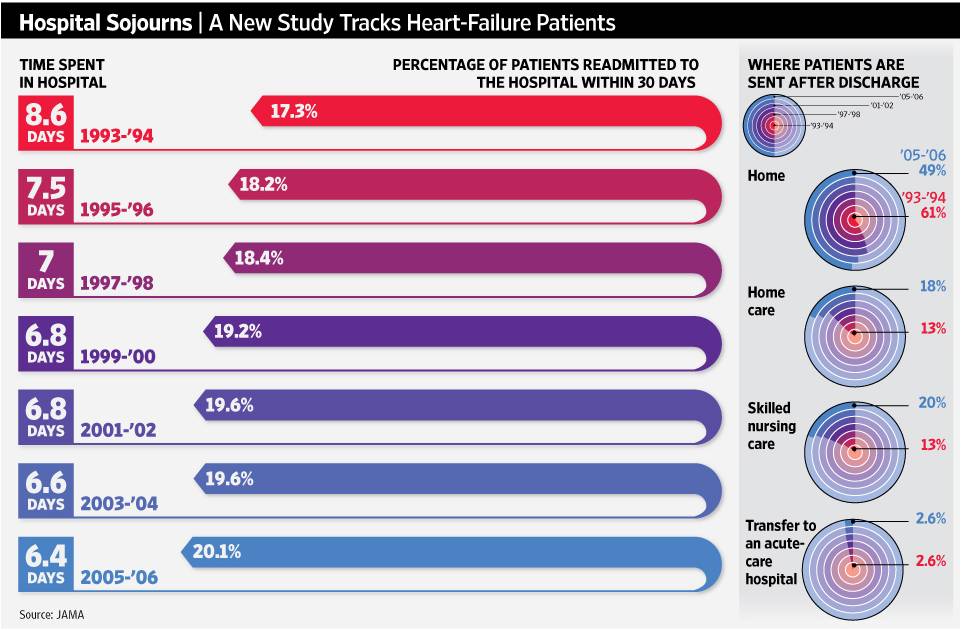
Less Time in Hospital Correlated to More Readmissions

We all want to get out of the hospital as quickly as possible.  A recent study from JAMA that appeared in the WSJ showed that while days in the hospital dropped from 8.6 days in ’93-’94 to 6.4 days in ’05-’06 the readmission rate (within 30 days) went up from 17.3% to 20.1%.  I’d love to see the economics around this. 

  • Do the hospitals make more money in this case? 
  • Do the plans save more money? 
  • Are patients happier?  [Remember that the majority of them got out sooner.]

“From a societal point of view, dollars spent on health care likely increased.”  Harlan Krumholz, Yale University cardiologist and senior author of the study. 

The study author echos a point that we [Silverlink] often make to our clients which is that hospitals (or payers) need to invest more effort and resources to make sure the transition to outpatient status in seamless.  Do they understand what the doctor’s instructions were?  Do they have someone caring for them?  Did they pick up their medications?

Another key lesson learned here is that it’s important to measure what matters and that what’s measured gets improved.