Archive | Marketing / Communications RSS feed for this section

Did You Know PhRMA Has A YouTube Channel?

I just ran across this, and I figured I would share it.  PhRMA is the Pharmaceuticals Research and Manufacturers of America.  They represent they pharma and biotech companies.

Here’s a few of the videos from the site.  One on Part D and one on adherence.

My Eight PBM Predictions For 2012

I recently heard one of the key CEOs in the PBM industry say that his crystal ball for 2012 was fuzzy, and he wasn’t sure what was going to happen.  (Not particularly reassuring.)  That being said…it’s an exciting time, and I’m going to take my pass at predictions anyways.

  1. The proposed Express Scripts acquisition of Medco will take place although they will be required to sell off some specialty assets.  This will create a new specialty player and will also trigger further consolidation and acquisitions.  You will also see many of the Medco people go to new healthcare companies throughout the industry to drive change.
  2. The contract dispute between Express Scripts and Walgreens will get resolved shortly after 1/1/12, but it will serve as the trigger for limited networks as multiple clients will keep Walgreens out of the network since they’ve addressed most of the disruption and achieved savings.  But, you will also see several companies quickly add Walgreens back into their network.
  3. Star Ratings will trigger a bigger focus on adherence across the industry and begin to create outcomes-based performance measures that the commercial business starts to see in their PBM contracts linking payment to performance.
  4. Lipitor will be a disruptive item throughout the year with aggressive Pfizer rebating, the overhang from it potentially going OTC, and the pricing of the initial generic.
  5. Innovation will finally begin to shift to the specialty space with this being the primary area of concern from a trend management and clinical perspective.  Clients will expect innovative ways of engaging patients and improving outcomes which will push closer links between pharma and PBMs around key drugs and complex conditions.  The focus on specialty spend in medical will continue, but the increasing percentage of infusion drugs will challenge this and push specialty to look for more ways of engaging with the physician.
  6. The “retailing of healthcare” through storefronts will manifest itself in different ways in pharmacy with greater focus on specialty at retail, pharmacists as part of the ACO/PCMH concept, MTM, and ultimately through exchange based partnerships with large payers.
  7. Integration of medical, pharmacy, and lab data will be a huge focus on PBMs create targeting algorithms and databases for segmentation, targeting, and ultimately engaging consumers around specific health behaviors.
  8. Telemedicine in the form of telemonitoring will link into the retail pharmacy clinic strategy as they extend their pharmacy relationship from an event based relationship to an ongoing monitoring relationship around key conditions like diabetes.

Two things that I expect to continue to be areas of focus will be the development and execution of a mobile strategy and continued exploration in the area of personalized medicine and genomics.

The one outlier which I’m not sure of yet is Medicaid pharmacy.  It’s been a hot topic lately, but I’m still unsure of whether that will radically change in 2012 or not.

[Interested in sharing your opinions on 2012 in a formal way?  I’m going to reach out to several companies and ask their thought leaders or executives to do an “interview” with me about their predictions for 2012.  Let me know if you’d like to participate.]

[And, don’t forget that you can sign up to have these posts e-mailed to you whenever I write them by signing up for my e-mail list on the right side of the blog.  Thanks for reading.]

Tiny Tower Retail Pharmacy Missed Branding Opportunity

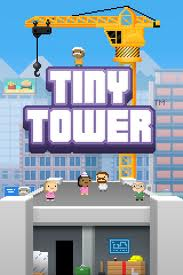
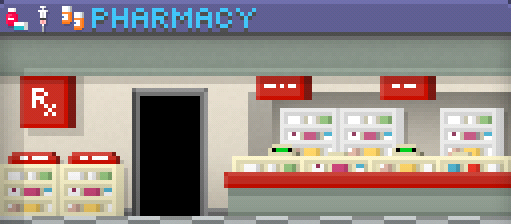
Tiny Tower is a simple yet addictive game you can play on your iPhone or iPad.  My kids figured out the other day that you could re-name the floors.  For example, one of the floors is a pharmacy.

So, instead of saying “pharmacy” this could say Walgreens or CVS or Express Scripts.  What a missed opportunity.  I’ve talked about this before, but I think the pharmacy industry in general has missed integrating themselves into Hollywood and gaming.  When’s the last movie or TV show you saw where the primary actor was a pharmacist or worked at a PBM or even worked at a health insurance company (and was shown in a positive light)?

Here’s an easy branding opportunity.  It also seems like an easy revenue source for the Tiny Tower founders.  Why not have companies pay them to brand these?  Why not have people playing the game earn points to buy up from McDonalds to Red Robin?

Three Pillars of Adherence (NEHI)

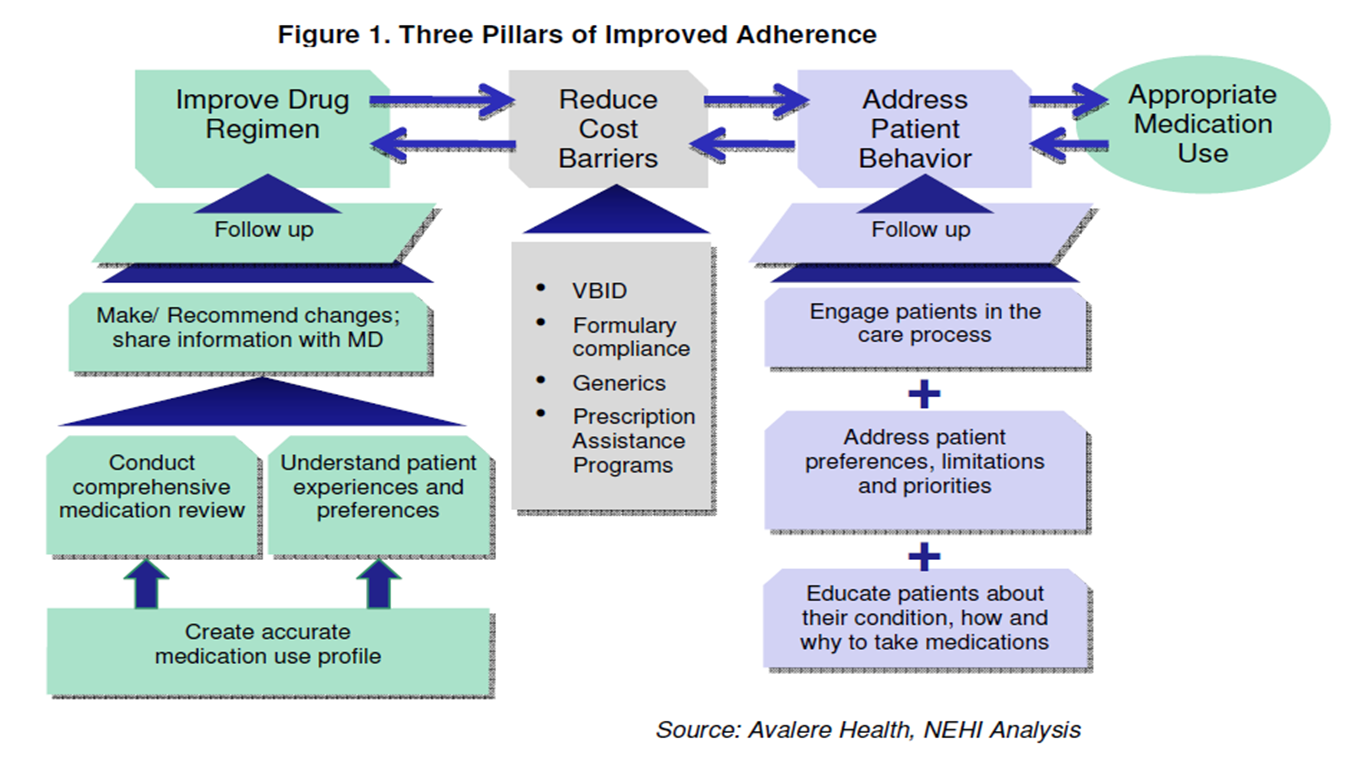
I was digging through some adherence materials, and I stopped on the NEHI graphic from their report “Thinking Outside The Pillbox” which first quantified the impact of non-adherence at $290B (a number which everyone uses now).

I don’t remember every posting it on the blog so I’m sharing it now.  I think it hits on the key topics that we all talk about:

  1. We have to get it right from the beginning with the drug regiment.
  2. Cost can be an issue so if possible address it.
  3. But, the biggest issues are with understanding (literacy), side effects, creating a habit, and many other things that require education and ongoing intervention and support for the patient.

[Note: NEHI has now releasesdd their roadmap on Medication Adherence which I’ll review in a subsequent post.]

Why Don’t Physicians Use More Information Therapy

My PCP is very good about giving me information to read every time I visit him.  (Never mind that it sits in a pile on my desk.)  But, I believe this is under-utilized in today’s information rich society.

I was reading an article this morning from PharmaVOICE about physicians not using certain medications or treatments because they didn’t have the time to spend with patients explaining them.  Therefore, they default to the “easier” solution which requires less explaining.  Is this prevalent?  I don’t know.

The article talked about a survey from Sermo and Aetna Health which revealed that almost 2/3rds of the 1,000 MDs surveyed felt that “the current health care environment is detrimental to the delivery of care”.  And, less than 1/5th felt that “they could make clinical decisions based on the what was best for the patient, rather than on what the payers are willing to cover”.  Pretty scary and sad.

Imagine if the physician was using an electronic interface during the encounter.  They could pre-create several information packets around certain diseases, drugs, and/or treatments.  When the patient was diagnosed and a treatment plan agreed to, they could e-mail the package to the patient.  It might include written information, links to websites, YouTube videos, or other assets.  I would imagine this could be very powerful and address the common gaps that exist between what the physician says and the patient hears.

[The article was “Is the Business of Health Care Getting in the Way of Providing Good Health Care? by Ken Ribotsky in PharmaVOICE from October 2011.]

Predicting Medication Adherence

Is there a secret sauce?  (Hint: past behavior)

It always important to be skeptical, but there are certainly attributes like the number of Rxs, gender, condition, copay amount, and other factors that contribute to the likelihood of a consumer being adherent.

But, one of the big discussions is around how to use other variables.  FICO, the company that creates credit scores, has created an adherence score.  In today’s WSJ, they shared this image about predicting adherence.  Interesting…

Why Not Make “Low Fat” Normal And Label Others “Full Fat”

One of the foods my kid loves comes in both normal and a low-fat version.  But, we’ve always bought the low-fat version.  One day, they were out so I bought the normal version.  I was surprised when he was upset.  Why did you buy me the full fat version he asked?

It got me thinking.  Like “loss aversion” would reversing the positioning of products work?  There’s always talk about the “fat tax“.  Why not try making low-fat the standard and requiring labeling that points out what products are full of fat?


Should Health Companies Be Brutally Honest With Consumers?

I saw a statistic today that said that the Domino Pizza’s stock price has gone up by 233% since they began acknowledging that they had a reputation of a low-quality product.  Fascinating!

Would that work for health plans or PBMs or pharmaceutical manufacturers?  If they acknowledged the perception that consumers have for them, would that engage consumers?  Would consumers respond well to that?

Imagine messaging around prior authorization that sounded more like this…

“We’re calling to let you know that you need a prior authorization to get your [drug, service, device].  I know you think we’re just doing this to cut costs and override your physician’s decisions, but that’s not true.  We care deeply about you, but our physician team determined that there’s a chance for overuse of this [drug, service, device].  All we’re asking is for your physician to answer a few questions to validate the proper use.  We’ve even launched a web service so this can be done with minimal disruption.” 

Lots Of Consumers Looking For Generic Lipitor

Assuming my blog volume is any indicator, it seems like consumers are increasingly looking for information on generic Lipitor.  My blog volume doubled last week.

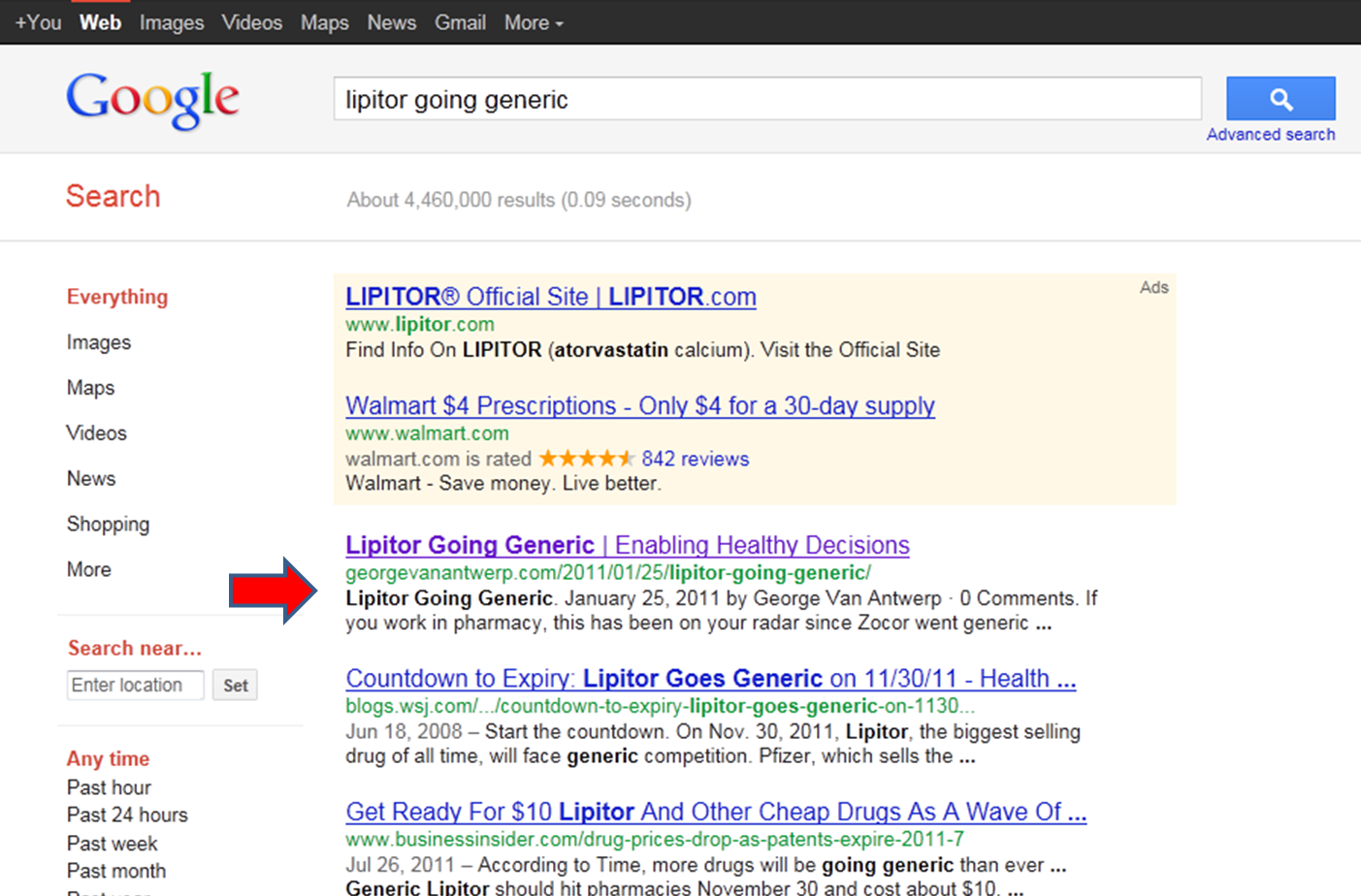
If you type “Lipitor going generic” into Google, I’m the first page returned (after paid search).  [I always love finding these Search Engine Optimization (SEO) results.]

Will The Stars Align To Drive Adherence?

We all know that adherence to prescriptions is a problem.  People don’t start on their medications.  People don’t stay on their medications.  But, another problem also exists which is finding the ROI on adherence.  While the ROI is clear to the manufacturer or even to the pharmacy, it’s often less clear to the payer.

This is not true in every category.  Diabetes and several other conditions have been shown to have an ROI associated with intervention programs that improve adherence.  But what about all the others.

In the short-term, I expect you’ll see the CMS Star Ratings and bonus payments drive behavior in three critical categories that are now measured in the 2012 for MAPD and PDP plans.  (see technical notes on 2012 measures)

If you’re not familiar with the Star Ratings system, you should read this.  In 2012, there were three new adherence measures added.  Not only are they now part of the evaluation process, but they were weighted more heavily than some of the operational measures.  A  good indication of focus on quality of care.

Getting more Stars is important since it is linked to bonus dollars that the plans can get.  And, there aren’t many Five Star Plans.  Only 9 plans received 5-Star Ratings for 2012 (see article).  [Interestingly, I think one of the unique assets that Express Scripts is buying in the proposed Medco acquisition is one of the 4 Five-Star PDP plans.]

“The Medicare star quality rating system encourages health plans to improve care and service, leading to better patient experiences across the board,” Jed Weissberg, a senior vice president at Kaiser Permanente.  (from 5-star article above)

The adherence measures focus on diabetes, high cholesterol, and hypertension and use Proportion of Days Covered (PDC) rather than MPR for their measurement.  Certainly, one of the things we’re seeing at Silverlink with our Star Power program is that many of these Star Measures can be influenced by communications.  Adherence is certainly one of those big areas of opportunity for plans to focus on.

While the benefit is obvious to the plan in terms of reimbursement, the big question is whether consumers care about Star Ratings or just focus on lowest price point and access to pharmacies or specific medications.  A Kaiser study that was done seems to indicate that the answer is no.

Conducted by Harris Interactive, the survey showed that only 18 percent of Medicare-eligible seniors said that they are familiar with the government’s rating system. Of those that are familiar, less than one-third have used the system to select their health plan. Moreover, only 2 percent of respondents were aware of how their current plans rates. 

Since we’re in open enrollment for Medicare right now (see Medicare.gov to evaluate options), perhaps we’ll get some data in early 2012.  2012 will also be the first year for the 5-Star plans to be able to market all year round and not be limited to the OEP (open enrollment period).

But, one of the things I found interesting as I looked on the Medicare.gov site to “select” a plan in my area is that there is an option to “Select Plan Ratings” but even I wasn’t sure what that was.  It’s not intuitive to the consumer that this is a quality rating for them to pay attention to.  And, it appears that the default order of options which is presented to you is based on price.

Infographic: Word Of Mouth Advertising

As healthcare moves toward a more retail model, word of mouth advertising becomes more important.  This is already true in terms of physician’s influence on prescription use or in some cases distribution location.  It’s also important from a Medicare perspective.  But, this will continue to increase in importance in the future with health reform.

I also believe that clients will require satisfaction scores as part of their SLAs (service level agreements) in many cases in the future and/or tie bonus dollars to this.  Will you be prepared?  Do you understand your customers’ satisfaction with you?  Do you know how to impact it?

Managing Stress As One Of 65M Caregivers

65 million Americans are caregivers which can be a stressful job.  I think more and more companies that I consult with are looking at how to engage the caregivers as part of the overall health team.  With that in mind, I thought I would share this quote.  Managing stress as a caregiver is important so you don’t burn out.

“When you have a bad job in a toxic workplace, you feel trapped, but you can always try to find another job,” said Sharon Brothers, a veteran social worker who is now executive vice president of Caregiver Village (www.caregivervillage.com), an omnibus Internet community and resource hub for caregivers that includes expert forum hosts and even an online caregiver game. “Caregivers, however, can’t just find another role. They are caring for a loved one, so the stress they live with is real and the boss they report to is themselves. They feel trapped by their love and obligation to their family members, which makes it exponentially more difficult for them to get a break, because they feel guilty whenever they try to take one.  In fact, studies show that being a family caregiver is one of the most stressful ‘occupations’ in the country today.”

Communications: Get To The Point

I got to catch up with one of my first bosses tonight.  He taught me a lot about strategy, consulting, and people.

One of the lessons I never forgot was about communicating.  I don’t always do it, but he used to tell me two things:

  1. If you’re going to leave me a voicemail, tell me the key points in the first 30 seconds.
  2. If you send me an e-mail, make sure you get to the point in the first few sentences.  I’m only going to look at what I see in the window in outlook and won’t open it.
What did I learn?
  • Think ahead about what I’m going to say.
  • Layout my key points and why to listen to the rest of the message (or read the entire e-mail)
  • Just provide enough information to justify a call or meeting
I’m always surprised at how people talk on and on in voicemails and e-mails.  I’m sure I do sometimes also, but I’ve tried to continue to practice what I learned years ago.

What Will Happen With Generic Lipitor (atorvastatin)?

Well, it finally looks like generic Lipitor will be on the market soon.  I think November 30th is still the date.

Of course, now the question is what will this mean to you (the consumer)?  Since atorvastatin will be distributed by only one manufacturer for the first six months after the patent expires, there will not be a significant price drop.  Therefore, I know at least one (and have heard two) PBMs will be blocking the generic drug during that time.  Consumers will be able to get Lipitor at a generic copay.

I’ve offered my opinion on scenarios like this before.  I think it’s confusing to the consumer.  It’s great for Pfizer and generally everyone wins since it’s the same out-of-pocket costs to the consumer and lower cost to the plan sponsor (employer) than the exclusive generic (due to rebates), BUT I think it sends a confusing message.  “You can and should use generics except for in some cases where the brand drug is cheaper.”  I’m not sure how this plays out in states where generic substitution is required by law.

Of course, your other option is to go use the Lipitor $4 coupon.  If I were the Pfizer brand manager for Lipitor, I would offer a $50 payment for a 1-year supply of Lipitor and lock people in for the year.  [A seperate discussion needs to be had about how cash and coupon claims which don’t necessarily get adjudicated affect adherence measures for bonus payments like Star Ratings…and yes, I know that coupons aren’t supposed to be used for Medicare members, but I don’t think that’s monitored well.]

So, you might go to get your generic Lipitor and leave with the brand at your generic copay.  On the other hand, I wouldn’t be surprised to see some PBM negotiate well enough to get a better price on the generic than Lipitor (net of rebate).  [Of course, these are the types of scenarios that cause friction in the supply chain.  Which drug can the retailer buy better?  Does the client get the rebates shared with them or not?]

I know this is what some companies like GoodRx are looking at with their application which compares drug prices across retailers.  It shows you if there’s a coupon available (see broader article on them).  It suggests savings like splitting the pill.  (No mail or 90-day promotion yet that I saw.)  Of course, this is from a cash paying customer perspective.  But, with atorvastatin, you may want to compare your plan design with the cash price with coupons.  You’ll want to know if it’s part of the $4 generics program or if you get a better price with the CVS or Walgreens discount card programs.

Here’s two examples from GoodRx.  One is for Lipitor which shows some variation (and has no generic today).  The other is for Prozac which has been available as a generic for a while.

Touch and Body Language in the Physician Encounter

I was watching this TED video the other day from a physician and writer Abraham Verghese.  It was interesting since his whole point was about the ability to relate to your patient through human touch and the power that has on the patient’s trust and experience.  As we move towards move EMRs and other technologies, we have to make sure we don’t over-engineer the patient experience.

I was reminded of this again when reading KevinMD’s blog where there was a post on using body language.  How many of us think about what our body language is saying?

Or do we think about our clothing selection?  While the white coat may create trust, does the tie create a sense of being aloof?  Or should you consider different color sections to seem more approachable?

Food for thought.

Did IOM Overlook Literacy and Prevention With Their EHB Recommendations?

“The ACA requires that certain insurance plans—including those participating in the state purchasing exchanges—cover a package of diagnostic, preventive, and therapeutic services and products that have been defined as “essential” by the Department of Health and Human Services (HHS).

This package—commonly referred to as a set of essential health benefits (EHB)—constitutes a minimum set of benefits that the plans must cover, but insurers may offer additional benefits. The EHB are intended to cover health care needs, to promote services that are medically effective, and to be affordable to purchasers.”

The Institute of Medicine (IOM) put out a report recently about Essential Health Benefits (EHBs). While I haven’t fully digested the report and its implications, I noticed two things:

  1. There was no one from the pharmacy community on the committee.
  2. They seem to overlook the value of health literacy.

While I know observation #2 is an opinion that could be heavily debated, let me share my logic here.

If you look at the criteria for EHB selection (see below), they call out that it must “be a medical service, not serving primarily a social or educational function.” I would argue that it is risky to ignore education and its correlation with health. There are many educational functions around prevention which are important. Additionally, there is a lot of research these days around the social value of different networks and tools and their relevance to overall health.

This is Health Literacy Month so you can go visit several sites to see more about this topic. You could also look at research on social aspects of health from Pew. Or, I might even draw upon research around pets and their value in healthcare.

I’m sure the panel didn’t mean it to be interpreted this way, but we know how our government works. These comments become “law” and hard to overcome. I would think some clarification to say something more like the following would be better.

“Be a medical service or a program whose educational or preventative objectives have been demonstrated to improve health outcomes.”

Other articles on the report include:

Increasing The Value Of Your Refill Reminder Call

The other day, I got a refill reminder call from my pharmacy. The call came to my home number and simply stated that your prescription is ready.

Thanks…BUT what prescription. Mine? My wife’s? My kid’s?

If mine, was it the one I stopped taking? Or was it the second fill or an anti-biotic that we switched since it wasn’t working?

Did they even have the right phone number? (They never said anyone’s name in the message.)

I was confused and annoyed. I don’t think this type of message is helpful.

IMHO…the ideal refill reminder call should be something like the following:

  • This is pharmacy X calling for George Van Antwerp. Please have him call us back.
  • Thanks for calling back in. Please enter (or say) your prescription number or date of birth.
  • We have a prescription for drug X ready to refill for you. Will you be coming to pick it up in the next 2 days?
  • (If no) Do you intend to refill it?
    • (If no) Why not? (and then address the barrier)
    • (If yes) When should we call you back to remind you?

This would minimize me calling the pharmacy to follow-up on the call. It would cut down on abandonment. It would also address adherence by capturing and addressing any barriers in the interactive call.  [Of course, you have to manage HIPAA and several other constraints to achieve this, but it is possible.]

Creating an interactive and effective communication is the type of work we do at Silverlink (campaign design, scripting, segmentation, behavioral economics, communication execution, analytics). Like many others, we’re seeing refill reminders move from blast calls to interactive calls and expanding to SMS, mobile apps, and e-mail. Ultimately, it’s about figuring out the patient’s preference and the right way to “nudge” them to refill at the lowest cost per success. And, it works. You can see more at our adherence site – https://adherence.silverlink.com.

  • What voice should you use?
  • When should you call?
  • Should you e-mail then call?
  • Should you call then send a text?
  • Should you talk about their condition and stress the value of adherence?
  • What’s important to the patient about being adherent?
  • What is their previous pattern of refills?

NCPA Announces “Simplify My Meds”

For patients with multiple prescriptions, it can be very annoying to have to constantly refill different medications on different cycles. This leads to waste (time) and forgetfulness around refills. It’s an age old problem.

The easy answer would be to work with the patient to consolidate the orders to refill on the same day of the month. This might involve a few split orders or short-fills to get them lined up. I’ve talked with multiple pharmacies about this over the years.

NCPA announced the other day that they were going to focus on this as part of their adherence program. This is great! If they can pull this off, I would expect the whole industry to try and follow.

“By coordinating exactly what day patient refills occur, the independent pharmacy staff’s workload is streamlined. Daily workloads become more predictable, labor costs go down, and staff stress levels decrease. Data analyzed from pharmacies using this model has shown as much as a 30 percent increase in prescription volume, a 50 percent decrease in labor costs, and $1.87 per script increase in gross margin.” (NCPA Press Release)

Using Hypothetical Questions To Influence Decisions

Most people don’t realize how questions can be persuasive, according to new research from the University of Alberta. Hypothetical questions usually start with the word “if,” meaning the information may or may not be true. Our brains process that information like the “if” isn’t even there, says study author Sarah Moore, Ph.D., a marketing professor at Alberta’s School of Business. “As a result, people accept the data you present at the beginning of a question as fact,” Moore says.

This is from an article in Men’s Health.  It made me think about lots of ways that hypotheticals could be used to drive consumer behavior in healthcare:

  • If you were able to avoid having your kids home with the flu shot this year, would you take them to get a flu shot?
  • If you were able to save $50,000 in healthcare costs over your lifetime, would you make sure to take your medications everyday?
  • If you were able to spend more time with your family rather than waiting in line at the pharmacy, would you be more likely to use 90-day prescriptions?
  • If you didn’t have to take any sick days next year, would you go in for your annual physical exam?
  • If you decreased your likelihood of losing your foot to amputation due to diabetes, would you go get a foot exam every year?

This fits well with a lot of the behavioral economics frameworks that companies are using today.

Patient Reasons For Participating (or not) in Genetic Test

Medco just put out a study that I found very interesting since it shares data around patients opting-in to a genetic test around use of statins.

In the big picture, it showed that those got the genetic test were more adherent.  Perhaps this points to a better belief in the therapy post-genetic test (similar to the placebo effect).

But, what first grabbed my eye was data on the consumers:

  • 53.8% participated in the study since they believed in the utility of genetic testing
  • Only 6.7% of those that declined cited privacy issues
  • Only 8.8% of those that declined cited anxiety about the results

This could be very promising for something that is complex but is certainly part of the future of medicine.

Infographic: Patient Education

This is a topic I often bring up in discussing adherence with clients.  We have to partner with MDs as a pharmacy community to address this.  There are fundamental gaps at the beginning of the process where patients don’t understand their disease or their drug.  Without that, it’s hard to believe that taking your medication will make you better or to understand that this is a lifelong process in some cases.

Flu Shots, Myths, Appointments, and Public Health

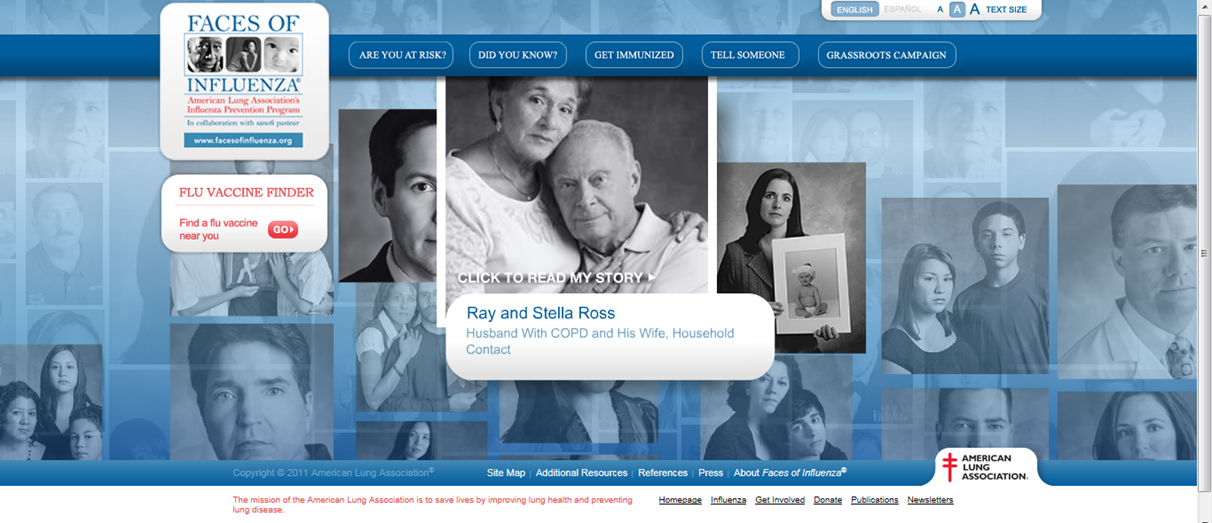
I talked about Flu Shots last week, but I came across a few other things when I was following up on the post.  One is a site called Faces Of Influenza by the American Lung Association.  It does a good job of making this public health concern personal by highlighting lots of personal stories.

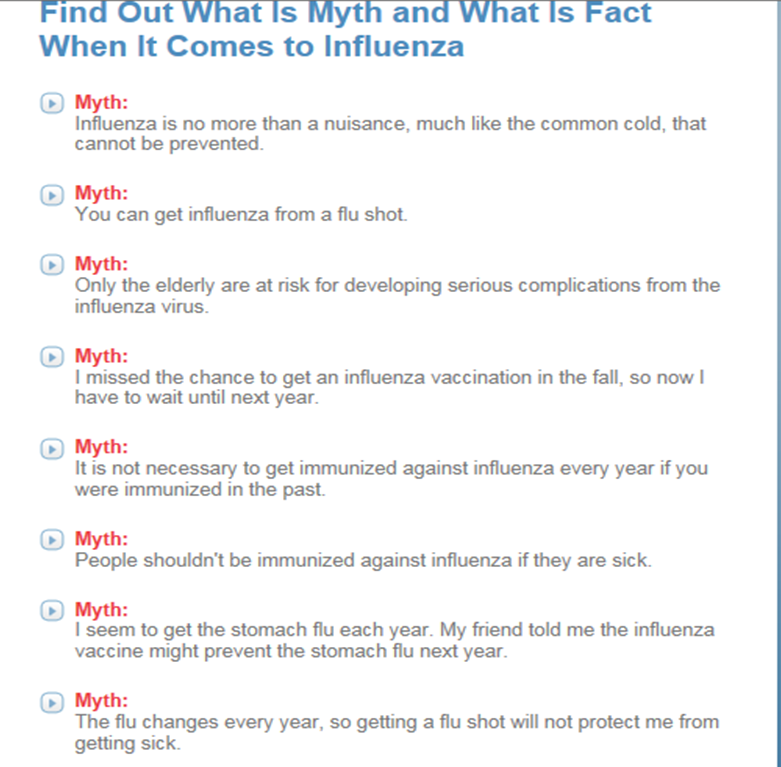
They also provide a list of myths and address those.

The other thing that this got me thinking of is whether people want appointments.  In general, flu shots have become a walk-in, adhoc business.  Which is nice from a consumer perspective (as long as there’s not a wait), but I have to imagine it’s difficult for the pharmacy to plan their data around.

I know that CVS is now offering apointments as an option for flu shots.  It would be interesting to see what percentage of people choose this option and their demographic attributes.

Diabetes And Medicare Star Ratings

Do you know what the Medicare Star Ratings are?  If not, you might want to review the Kaiser Family Foundation brief from last year.

Basically, the star ratings provide individuals with a quality rating across numerous dimension on a Medicare plan.  And, they are helping to drive the pay-for-performance (P4P) focus across healthcare.  This year’s changes include several adherence metrics and have brought the total diabetes measures up to 7.  And, if you happen to be one of the few 5-star Medicare plans, you will be able to have open enrollment all year not simply during the AEP period from 10/15-12/7.

Here’s a quick summary of the seven (lots of opportunities to work with communications to improve ratings and outcomes):

Measure Summary
Cholesterol Screening Percentage of diabetics with an LDL  test
Eye Exam Percentage of diabetics with an eye exam
Kidney Disease Monitoring Percentage of diabetics with a kidney function test
Blood Sugar Controlled Percentage of diabetics with an A1c test showing their blood
sugar under control
Cholesterol Controlled Percentage of diabetics with an acceptable LDL value in their cholesterol test
Treatment Percentage of diabetics with both a diabetic medication and a hypertension medication that are getting an ACEI or an ARB
Adherence to Oral Rxs An average Proportion of Days Covered (PDC) greater than 80%

We all know the statistics on diabetes so hopefully this will help to improve outcomes.  If you’re interested in how Silverlink helps plans with Star Ratings – go here.

Do Medicare Participants Know Open Enrollment Period Has Changed? No.

A recent study showed that only 37% of Medicare participants knew that the AEP (Annual Enrollment Period) had changed. It now closes on 12/7 not 12/31. That could cost people money if they don’t review their ANOCs (Annual Notification of Changes) and take action.

Another article in US News & World report emphasizes that with some comments from Silverlink’s Chief Medical Officer (Dr. Jan Berger):

Berger breaks down the Medicare coverage decision into five steps, all of which are addressed in the annual statement:

1. What are the primary financial implications of your plan for 2012, including the premium, annual deductible, and co-pays?

2. How well does the plan accommodate your preferred medical providers? Are your doctors participating in the plan? Your preferred hospital?

3. What are the costs and availability of your medications in the plan?

4. How convenient is the plan in geographic terms? Are the participating doctors, medical facilities, and pharmacies nearby and easy for you to get to?

5. What is the star rating of your health plan, and how does it compare with other plans offered in your service area? Quality ratings of health plans ranging from one star (worst) to five stars (best) are relatively new. Medicare has been emphasizing them, and the health reform law has provisions that will penalize plans for substandard rankings. The current star rating process will go live on Medicare’s website on October 12, an agency spokesman says.

Here Come The Pharmacy Co-Branded MA/PDP Plans

In the past few days, I’ve seen two new announcements:

  1. Aetna partnering with CVS to launch a co-branded Medicare plan
  2. Coventry partnering with Walmart, Walgreens, and Target

I think we’re all familiar with the success that Humana has had in their Medicare offering with Walmart.

I think one could also say that the PBMs (i.e., mail order) getting into the Medicare business was also an effort to co-brand Medicare offerings between payers and pharmacies.

I wonder if we’ll see an NCPA offering.  I would think in certain regions that that would play well.


Sandwiches and Caregivers During AEP

October 1st marked the beginning of the Medicare marketing period leading into the enrollment period known at AEP (Annual Enrollment Period) which begins on 10/15. [For more on how Silverlink is helping clients with AEP – click here.] More to come on this topic, but for right now, I was just reading an article about the sandwich generation which made me think about this.

Traditionally, we think of sandwich generation as those that have young kids and parents to care for. Increasingly, that “young kids” age is getting stretched out as kids move back in post-college or even as they lose their jobs later in their career.

Perhaps, some of this will be good as we go through more integration of multiple generations into single households as other cultures experience, but it certainly is creating financial stress for the baby boomers. As you think about your marketing, this is just another wrinkle.

For example, according to Strategic Business Insights’ MacroMonitor, 39% of households headed by 60-64 year olds had primary mortgages compared with 22% in 1994. And, as we know, it’s often harder to get out of those houses these days as many people are unwater or can’t sell their homes.

How does this change our caregiver strategy as a healthcare provider? (assuming you even have a caregiver strategy)

On this caregiver point, here are some statistics from the National Family Caregivers Association:

More than 65 million people, 29% of the U.S. population, provide care for a chronically ill, disabled or aged family member or friend during any given year and spend an average of 20 hours per week providing care for their loved one.
Caregiving in the United States;
National Alliance for Caregiving in collaboration with AARP; November 2009
The value of the services family caregivers provide for “free,” when caring for older adults, is estimated to be $375 billion a year. That is almost twice as much as is actually spent on homecare and nursing home services combined ($158 billion).
Evercare Survey of the Economic Downturn and Its Impact on Family Caregiving;
National Alliance for Caregiving and Evercare. March 2009
The typical family caregiver is a 49-year-old woman caring for her widowed 69-year-old mother who does not live with her. She is married and employed. Approximately 66% of family caregivers are women. More than 37% have children or grandchildren under 18 years old living with them.
Caregiving in the United States;
National Alliance for Caregiving in collaboration with AARP. November 2009
1.4 million children ages 8 to 18 provide care for an adult relative; 72% are caring for a parent or grandparent; and 64% live in the same household as their care recipient. Fortunately, most are not the sole caregiver.
National Alliance for Caregiving and the United Hospital Fund, Young Caregivers in the U.S., 2005.
51% of care recipients live in their own home, 29% live with their family caregiver, and 4% live in nursing homes and assisted living.
Caregiving in the United States;
National Alliance for Caregiving in collaboration with AARP. November 2009
36% of family caregivers care for a parent and 7 out of 10 caregivers are caring for loved ones over 50 years old.
Caregiving in the United States;
National Alliance for Caregiving in collaboration with AARP. November 2009

Do You Have A Communications Waterfall?

For those of us that have ever worked in IT, the idea of a waterfall based design always implies a less than optimal strategy.  But, I’m beginning to see an applicability of this framework for communications.

Let’s look at a scenario for a prescription refill where you’re trying to optimize for the lowest cost intervention.

  • Identify targets for an intervention
  • First push a message to all those that have downloaded your mobile application (~10%)
  • Second push a message to all those that have opted into your SMS reminder system (~6% with some overlap)
  • Third push a reminder to those that you have an e-mail address on file
  • Fourth send a reminder using an automated outbound call with the option to refill during the call
  • Fifth (maybe) use agents to reach out to the patient
As you go through this “communications waterfall”, there are several things to think about:
  1. How do you leverage permission-based or preference-based marketing here?
  2. How do you integrate your channels so that if you send an e-mail which isn’t opened after 48 hours (and the message is important) that it automatically escalates to the next channel?
  3. How do you cross-promote across channels to drive greater use of the self-service channel?
  4. What permissions do you need to use each channel?
  5. What are the HIPAA / PHI limitations within each channel?
  6. What is the correlation between preferences and behavior?
  7. If you know that certain segmentation and messaging increase the likelihood of action, how do those insights manifest themselves in each channel and does that change your interest in using a particular channel?
  8. What data do you want and can you get from each channel to understand the response curves?

Words Matter: Doodling – We Should Foster It

As someone who was trained as an architect, I understand the value of sketches in the design process and have always “doodled” as I try to conceptualize what people are describing with words.  With that in mind, I really enjoyed this TED video and think it’s a good message for all of us in the communications field.