Archive | PBM / Pharmacy RSS feed for this section

Transparency…Transparency – Enough

I was reading the NCPA blog this morning on PBM Transparency and the CVS Caremark Conundrum (more on that another time) and had to comment.  [Certainly not an unbiased blog.]

They talk about government intervention and transparency as:

“Small step toward reining in egregious and costly PBM practices like spread pricing (paying the pharmacy one price then quietly billing health plans much more) and rebate abuse (pocketing huge sums from drug makers before giving plan sponsors what’s left).”

Come on.  How many PBM clients don’t know that they have spread pricing?  Plus, don’t the retailers have spread pricing.  I’m pretty sure that consumers don’t know the acquisition cost of their drug compared to what they pay for it.  (There have been plenty of stories about the gouging at retail to cash patients using generics.)  There are plenty of PBM contracts today that are pass-through pricing meaning that the payor pays the PBM what they reimburse the retail pharmacy.  (I get so tired of people using arguements from the 1990’s and early 2000’s as fact.)

Then, let’s talk about rebates.  How many clients of PBMs today don’t know that rebates exist and don’t get most of the rebates passed on to them?  A lot of this data is available in general reports about the industry, from consultants, and thru surveys.  There aren’t a whole lot of mysteries in the PBM world.

The reality is that people get bitter because the PBMs continue to make money in a bad economy.  I don’t see what’s wrong with that.  They make money as they save clients money. 

  • More generics = more client savings and more PBM profit. 
  • More mail order = more client savings and more PBM profit. 
  • Lower trend (i.e., cost increases year-over-year) = more client savings and more PBM profit.

Some PBMs even take risk to put their money where their mouth is.  There have been numerous government and independent studies showing the value of PBMs.  There have also been enough “transparency” contracts out there from traditional PBMs and PBAs (Pharmacy Benefit Administrators) that there is proof that transparency doesn’t save money. 

I’ll talk more about why I think the CVS Caremark deal is good later.

H1N1 – Trying To Match Supply And Demand

When there was a large demand several months ago, there wasn’t any supply.  Now there is adequate supply, but the demand has gone down.  Will there be another spike in demand in the Spring? 

With all the retail pharmacies and clinics having supply, we are now going to see the competition for the consumer.  (See WSJ story)

Some Foods And Drugs Don’t Mix

Without getting into all the clinical rules, I’ve always looked for a cut-to-the-chase consumer list of when to avoid what specific foods if you take certain medications.

Finally, in Real Simple magazine (pg. 74, Jan 2010), I found one.  Here it is:

  • Avoid grapefruit [including juice] if you’re taking a cholesterol lowering drug or a prescription sleep aid.
  • Avoid chocolate if your using an MAO-inhibiting antidepressant.
  • Avoid black licorice if you’re on heart medication.

I’m not sure of the science here, but I’m assuming that it’s real.  I’ve heard the grapefruit advice before, but never the others.  Do physicians and/or pharmacists tell you this?

The story also goes on to recommend a few foods:

  • Shiitake Mushrooms – help boost the immune system and prevent the growth of cancer cells
  • Brazil Nuts – may ward off colon, lung, and prostate cancer
  • Horseradish – increase the liver’s ability to fight carcinogens and suppress growth of cancerous tumors…and may help avoid urinary tract infections.
  • Walnuts – help reduce cholesterol and inflamation that may lead to high blood pressure and heart disease
  • Black rasperries – may retard the growth of precancerous cells

So…watch what you eat!

Why Didn’t I Know There Was A Generic Version

I got this question e-mailed to me today.  The patient has been using the same drug for years and it lost it’s patent about 6 months ago.  They just found out that they could have saved a lot of money and wondered who should have told them.  Here’s my thoughts.

  1. It’s the member’s responsibility ultimately to search for ways to save money and ask for generics.
  2. A lot of managed care companies and PBMs won’t reach out when patents expire because 90% of the time the drug is switched to the generic within 90-days by the pharmacy.
  3. The key players who would communicate are aligned – the pharmacy / PBM makes more money when generics are used and the managed care plan saves more money.
  4. BUT, sometimes managed care plans or individual employers (groups) will opt-out or never sign up for communication programs so their members don’t hear about ways to save money.
  5. BUT, sometimes consumers opt-out of communications from the PBM or managed care company and therefore miss out on opportunities.
  6. BUT, sometimes physicians won’t allow the prescription to be switched to the generic drug (even when chemically equivalent) and will write the prescription DAW (Dispense As Written) or say no substitution allowed.
  7. BUT, there have been a few instances when due to exclusivity on the generic that it actually costs more than the brand during the initial 6-months and people don’t move to the generic.

So, with lots of nuances, my reply was that no one had a legal obligation to tell her, but they all had good incentives to do it.  I suggest talking to the physician and/or the pharmacist.

Brand Drugs That Might Lose Patent In 2010

Here’s a short list of the big drugs that might lose patent protection (i.e., have a chemically equivalent generic become available) in 2010.  This is always subject to change and is based on data from PBMI which is summarized from presentations at the AMCP

2010 Aricept® donepezil Alzheimer’s disease
  Cozaar® losartan High blood pressure
  Effexor XR® venlafaxine Depression, panic disorder
  Flomax® tamsulosin Benign prostatic hypertropy
  Hyzaar® hydrochlorothiazide and losartan High blood pressure

FDA “Listed” Drugs – A New Hassle

As of 1/1/2010, Medicare beneficiares will face a new hassle at the pharmacy.  How big of a deal will this be?  I honestly don’t know.

But, from their site:

Starting January 1, 2010, if your pharmacy tries to sell you a version of a drug that isn’tlisted with the FDA, your Medicare drug plan might not pay for it. This means you mightgo to the pharmacy where you regularly get your Medicare-covered prescriptions filled, andif the pharmacy stocks only a version of the drug that isn’t listed (and, therefore, your planwon’t cover), the pharmacy may not be able to fill your prescription that day.

Since there are multiple manufacturers of a generic medication, multiple forms (capsule, tablet), and sometimes repackagers, this could complicate things for patients simply trying to fill their medications.  I’m not sure I understand what’s being addressed here.

How will PBMs be affected by current trends?

You can certainly see the piece of the PBM world that I’m wrapped up in right now, but these seem to be important trends.

What are the most likely developments/trends that could affect pharmacy benefit executives in the year ahead? Why?

While healthcare reform or market consolidation could impact the industry, we don’t see either as having a material impact in 2010.  We expect several trends.  There will continue to be a focus on mail order utilization, specialty pharmacy market share, and generic fill rate, and the sophistication of those programs will continue to evolve.  PBMs will look at how to predict responses by patients to offers such as retail-to-mail and subsequently segment the market using variables such as condition, age, and plan design.  PBMs will continue to develop strategies to address programs like $4 generics, 90-day retail, and pharmacy to employer direct contracting.  We have also seen a huge focus on adherence which will take several forms – automated refill programs, physician focused programs, and pharma-funded programs.  Additionally, there will continue to be efforts to create a single view of the member in a longitudinal view of their claims and intervention history.  PBMs will begin to think and act more like consumer companies employing techniques like motivational interviewing and behavioral economics.

How might pharmacy benefit executives most effectively prepare for these important trends?

Executives should be developing processes with an inside-out perspective that focuses on how the consumer experiences the PBM not how the PBM optimizes their process.  They should be looking at how they blend claims data, lab data, communications data, and event data (e.g., website visits) to have a holistic view of the patient.  Additionally, PBMs need to have a rapid testing strategy for how they evaluate consumer hypotheses and rapidly improve programs while capturing insights about their population.

What are the biggest challenges facing pharmacy benefit executives in 2010?

Another question from the recent Drug Benefit News where I was interviewed with several other experts on the industry.  My answer…

  • How to continue to grow (top line, bottom line, marketshare, functionality, internationally)?
  • How to avoid commoditization within specialty and how to scale specialty operations with a lower FTE to Rx ratio without impacting outcomes?
  • How to prevent “churn” from mail whether due to non-adherence or movement to $4 generic type programs?
  • How to simplify consumer messaging and drive health outcomes?
  • How to develop restrictive benefits that drive behavior with minimal disruption?
  • How to structure client and pharma financial relationships that reward them for better outcomes?

Other thoughts?

Will there be more PBM acquisitions in 2010?

My response to this question…

The Express Scripts acquisition of Wellpoint’s NextRx certainly put several captive PBMs in play, but that appears to have died down.  There may be small acquisitions, but the big 3 appear focused on expansion into more health services and internationally more than buying new lives. 

Other opinions?

Should Rx Data Be Used By Pharma?

This is a great question as posed by numerous people (see WSJ blog).  Now, the one reality that most people don’t realize is that the data is only directionally correct.  Not everyone sells their data to the aggregators so depending on pharmacy (or PBM) marketshare the data could be close to significantly off.

Perhaps, that’s not the issue.  The question is whether pharma should have a right to see prescription data by physician to understand their behavior.  It’s not patient specific data so that alleviates what I think should be the big issue.

Between patients visiting healthcare sites, registering for coupons, buying disease specific publications or supplies, the individual data is probably a lot easier to get and use…and probably more accurate (at least at the household level). 

Assuming no one says that pharma can’t communicate with physicians, I think the data is relevant.  Certainly, they have an agenda – drive marketshare of their drugs.  I think we have to assume that physicians aren’t just guppies that hear the pharma rep talk and do whatever they say.  Physicians are smart, well-trained professionals that should be able to hear messaging about drug pros and cons; look at the research; talk to their peers; talk to their patients; and appropriately prescribe. 

I think the prescription data probably creates a more efficient system.  Physicians that use a drug frequently are visited less often by the rep and don’t spend time away from patients.  Physicians that don’t prescribe a drug frequently (and prescribe a high volume of competitive drugs) probably get more visits…BUT they have the choice of saying don’t come. 

[I’m taking a little extreme of a view here since nothing is black and white, but I’m not sure I see the privacy issue here.]

Lance Armstrong And Diabetes

Lance has decided to focus some of his passion and conviction on diabetes.  I think this is great.  Certainly, this is a condition which affects a lot of Americans and continues to get worse with the obesity epidemic. 

Given the focus on the pharmacies (CVS, Walgreens) and the PBMs (Caremark, Medco, Express Scripts) on management of this condition, I wonder who (if anyone) will get Lance Armstrong to be their sponsor or public face.  For the PBMs that traditional don’t have a consumer brand, I would think this is a great opportunity.  I compare it to Medco having Amy Tendrich from DiabetesMine promoting Liberty Medical.  While Amy might not be a household name, she is certainly a name in the diabetes community.

Why Keep Covering PPIs?

I’m not a clinician so I’m sure there are some clinical exceptions to this general comment.  [For example, look at Aetna’s PPI Medicare information.]

But, with Prilosec available OTC (Over The Counter) both as a brand product and as a generic (omeprazole) and now Prevacid will also be available OTC, I wonder why PBMs and plan sponsors don’t stop covering this class of drugs.  [See here for CVS Caremark’s overview on this.]

BTW – PPIs (or Proton Pump Inhibitors) are generally used for acid reflux and some people can simply use other OTCs such as H2 Antagonists (e.g., Tagamet, Pepcid, Zantac).  [Consumers might also read Consumer Reports Best Buy Drugs report on PPIs.]

Traditionally, PPIs represented one of the higher cost drug categories (and also one of the most highly rebated).  In CVS Caremark’s BOB (book-of-business), it represented 7.3% of their spend according to their TrendsRx 2009 publication.

Plans have stopped covering NSA (non-sedating antihistamines) once Claritin went OTC.  This seems like the next natural category with perhaps some formulary override option for certain medical exceptions.

PBM Market Share

I was looking for something the other day and stumbled upon this survey from earlier this year. I modified it to add the Wellpoint NextRx lives to the Express Scripts lives, but I wasn’t sure how to reconcile the Walgreens numbers (they are listed twice) and didn’t see any lives for RxAmerica which is now part of CVS Caremark.

Company

Rx Covered Lives

Market Share

Express Scripts / CuraScript / Wellpoint NextRx

90,049,000

13.20%

CVS/Caremark Rx, Inc.

82,000,000

12.02%

Walgreens-OptionCare

75,000,000

10.99%

ICORE Healthcare, Inc.

60,000,000

8.79%

Medco Health Solutions, Inc.

60,000,000

8.79%

NovoLogix (formerly Ancillary Care Management)

40,000,000

5.86%

Argus Health Systems, Inc.

28,600,000

4.19%

MedImpact Healthcare Systems, Inc.

27,000,000

3.96%

HealthTrans

15,300,000

2.24%

Prime Therapeutics, LLC

14,700,000

2.15%


The other thing to note here that we always joke about is how 70% of the market is equal to almost 500M lives (more than the US population). It has to do with people who have mail with one PBM, specialty with another PBM, and claims processing with another PBM (for example).

It is an interesting space right now. Two of the top 10 PBMs are actively looking for a CEO/President – CVS Caremark and Prime Therapeutics. You have seen lots of press releases recently from companies like Express Scripts, Medco, and CVS Caremark on new partnerships and technologies that they are working with. I also think you’ve seen a shift in research from Express Scripts to Medco which has been publishing a lot more recently. And, you’ve also seen several Medco alumni go to CVS Caremark at very senior positions.

Employers Use of Utilization Management Tools

Based on study by the Pharmacy Benefit Management Institute (PBMI) of 417 employers, here is a ranked list of Utilization Management (UM) tools used in 2009 for overall plan design.  The survey breaks it down further by class.

  • Refill Too Soon Supply Limit – 90%
  • Quantity Limits – 89%
  • Prior Authorization – 81%
  • Disease Management – 69%
  • Step Therapy – 59%
  • Therapeutic Substitution – 55%
  • Retrospective Drug Utilization Review (RDUR) – 47%
  • Outbound Telephone Calls – 44%
  • Dose Optimization – 44%
  • Face-to-Face Pharmacist Consults – 36%
  • Pill Splitting – 29%
  • Prescriber Profiling – 23%
  • Copayment Relief or Waivers – 20%
  • Generic Sampling – 16%
  • Academic Detailing of Prescribers – 11%

What I think would be interesting to know is which of these is provided by their PBM or managed care company versus which ones are they directly sourcing?

Pharma Couponing

Using copay coupons in place of real samples is both cost effective and allows pharmaceutical manufacturers to get more patient specific information (since patients typically have to register to get the coupons). They can be short-term or long-term. The primary site to go to is InternetDrugCoupons.com.

Here’s my slides from the conference call I did the other day. Some of the quotes from the event are in the recent Drug Benefit News (11/13/09).

24 Hour Pharmacy – Yes or No

It’s interesting to watch one of the local Walgreens pharmacies go back and forth on this issue.  For years, it was a 24-hour pharmacy and a place that I admitted used several times at random hours.  It then went to normal pharmacy hours for less than 6 months.  It is now back to a 24-hour site.

I’d love to see the analysis on that.

  • Did customers complain?
  • How many scripts really get filled after hours?
  • Does it pay to stay open or is it a marketing strategy?
  • Alternatively, can they use it as a “central fill” and fill scripts to ship to other Walgreens that aren’t open overnight thereby reducing their workload during the day?
  • What percentage of their stores will be open 24-hours?
  • How many other stores did they convert from 24-hours?  Are they all moving back to 24-hours also?

Top Drivers of Health Care Costs 2010

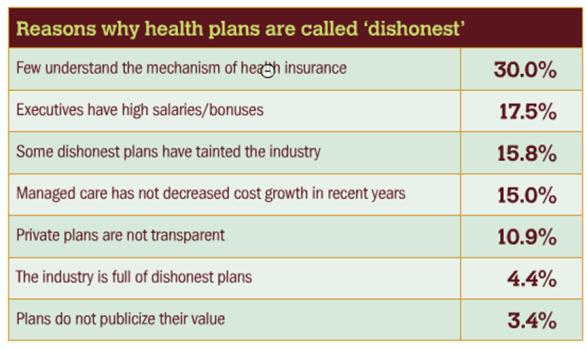
A recent Managed Healthcare Executive article (Oct 2009) provides survey data from 650 people at health plans, PBMs, disease management companies, and hospitals.  [As a side note, I was really surprised at how far off this group’s estimates were relative to the impact of prescription costs…which are generally in the 10-12% of total healthcare costs.]

Top Drivers of Cost 2010

Another survey I found interesting in the article was why health plans are perceived as dishonest.

Why Healthplans Perceived DishonestAnother part of the survey had 7.8% of people saying that patients (consumers) are less interested in health and that the primary reasons for lack of engagement were:
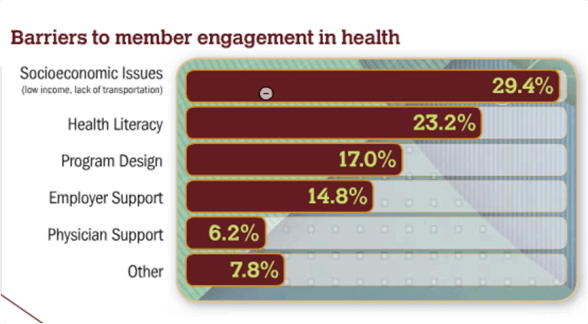


Barriers to mbr engagement

Get Ready To Pay More For Healthcare

As expected, employers are going to push more cost to employees (those lucky to still have coverage) in 2010.  Everyone should have been expecting this.  In an article on CNNMoney.com, a consultant from Watson Wyatt predicts 10-20% increased cost.  A consultant from Mercer says the catch phrase will be “taking responsibility”.

If anything, this should help Obama and health reform.  Having a huge cost burden pushed to you in one of the worse economies will force people to make tougher decisions and could have a negative impact on overall health.  Additionally, it will push more people into high-deductible plans which require more transparency around cost and quality which while better these days still isn’t there for the masses.

broken piggy bank

Oncology Specialty Spend Hits 5% (Medco)

A few weeks ago, Medco Health Solutions released some compelling (or scary) statistics on oncology spend:

  • Equals 5% of overall prescription costs
  • Grew at rate of 15.1% last year (trailing only autoimmune and multiple sclerosis within specialty drug spend)
  • Expected sales to be $80B by 2012
  • More than 800 drugs in the pipeline
  • 1.48M new diagnoses expected in 2009
  • Costs are typically more than $20,000 for a 12-week therapy and sometimes $10,000 per month

The good news is that people are living longer with the American Cancer Society saying that the 5-year survival rate is up to 66% for all cancers (1996-2004) versus 50% (1975-1977).

BUT, the treatments have lots of side effects which is creating an ancillary market around “supportive care therapies” to manage the side effects.  (Drugs to treat drugs…I understand it but it still seems wrong.)

Will Paying You To Be Adherent Matter

It’s an interesting question.  If I pay you $30 to take your medications every month, will you be more likely to actually take them or will you be more likely to tell me that you took them?  I was talking to someone about their program yesterday, and a lot of it comes down to measurement.  If, for example, I get paid if I open the pill bottle every day and that data is stored somewhere, I’m surely going to open it regardless of whether I take the drug.  (At least I think that’s what human nature would do.)

80% From Mandatory Mail – No Way

A PBM executive called me last week to ask about some information they got from one of the big strategy firms.  The PBM is trying to improve their mail order utilization.  They strategy firm said that 80% of mail order utilization is from mandatory mail…PLEASE.  I almost choked since I know the cost of that bad advice was more than they paid us last year to do some of these programs.  I was happy to help them understand the basic dynamics of how to encourage consumers to chose mail order and what factors contribute to utilization.

Wrong Way

Mail Order Pharmacy – Good or Bad (Two Surveys)

I love when two parties (both with their own agenda) publish data that clearly shows that they are right.  Now, in this case, one quotes a 3rd party so I do give them more credibility.  And, the other (as I will show below) seems to not take the patient’s responsibility in mind.

First, PCMA (Pharmaceutical Care Management Association) publishes research from JD Power on pharmacy satisfaction.  It shows that insured and non-insured patients are generally satisfied with their pharmacy experience.  Mail order clearly came out on top of all types of pharmacies.  (Given that only 12% of people know the name of their pharmacist, I would expect them to be more closely clustered together.)

The J.D. Power and Associates study measured customer satisfaction with the pharmacy experience across major national retail drug store chains, mass merchandisers and supermarket stores, and mail-order channels. The study examines seven factors that contribute to consumer satisfaction with brick-and-mortar pharmacies and five factors that determine satisfaction with mail-order pharmacies. The average overall satisfaction index for each of the pharmacy distribution channels were:

  • Mail-order pharmacies: 834
  • Supermarket pharmacies: 820
  • Mass merchandiser pharmacies: 801
  • Retail chain pharmacies: 798

Then (no big surprise here) NCPA (National Community Pharmacy Association) puts out a survey of 400 patients showing how dissatisfied they are with mail order.

  • They are unhappy being forced to use a lower cost pharmacy.  (GVA – get used to it as part of healthcare reform)
  • They complain that their prescriptions don’t arrive on time (which could impact adherence).  (GVA – did they call in time or wait for the last minute…were they adherent to begin with)
  • They complain about their medications changing (i.e., titrating to a different strength).  (GVA – they shouldn’t move to mail until they’ve stabilized and any mandatory plan I’ve ever seen required at least 2 months as the same strength before requiring movement to mail)
  • They complain about getting different medications than what they ordered.  (GVA – I bet most of that was people getting the chemically equivalent generic.)

This isn’t something that will easily get solved.  The FUD (fear, uncertainty, and doubt) out there rules in many cases and statistical anomolies are what get discussed.  I would love to compare complaint rates, error rates, and satisfaction for patients that use both channels (retail and mail).

Mail Order Retention (or Churn)

It is fascinating how life comes full circle.  I remember when I worked on the Sprint Data Warehousing project back in the 90’s.  At the time, it was the first 1 terrabyte warehouse being built, and we were using some very cool technology from Microstrategy which offered the first web-based DSS (decision support system).  One of the key components of the reporting solution and business driver model we created was churn (or retention).  You can look at it either way.

But, this is a classic example of focusing on the right metric and that you have to measure what matters (to throw out a few oldies but goodies).  Retention is a pretty new concept within the pharmacy world especially within mail order pharmacy.  Growth has been pretty constant for the past decade until the past 18 months.  Now, everyone is trying to figure out what’s happening and why.

  • Are people going to Wal-Mart and paying cash?  (Or other similar card programs at Walgreen’s and CVS?)
  • Are people simply filling less prescriptions?
  • Are people skipping doses and doing other things to stretch out their prescriptions?
  • Are people trying over-the-counter medications or using samples?

There are lots of questions that matter here.  And, you have to think through the mail order process.  How do patients experience it?  Why do they leave?  There’s lot of research that’s been done by the different PBMs here.

I had a chance to talk with Drug Benefit News about this the other day.  You can read the story here.  Here’s a piece of what we discussed:

Depending on the payer, mail-order customer retention rates vary from 75% to 95%, according to Van Antwerp. “Very few people left because of service issues,” he explains. “The majority left because of refill issues. They got to the point where they forgot to refill an important medication and couldn’t get it within a 24-hour time period…or it was up for renewal and they needed to get the next prescription written.”

To address that, some PBMs are working to develop better refill-reminder programs, including moving some customers to auto-refill, Van Antwerp says. “When you look at refill patterns, some people chronically refill too early so they hit that ‘refill too soon’ reject ,” he explains. “Others chronically refill too late.”

“Secondarily, we look at the channel that they’re using to fill,” he adds. “Some people still mail in their refill via ‘snail mail.’ Others use IVR [i.e., an interactive voice-response system].” His firm is working with some PBMs to help them understand each enrollee’s historical behavior, and then customize a response that helps improve mail-order retention while moving the member to the lowest-cost channel for ordering refills — either IVR or the member portal, Van Antwerp says.

22:1 ROI on Specialty Refills / Adherence

I always get very skeptical when an ROI goes above 3:1 so I was a little shocked to do some retrospective analysis with one of our Specialty Pharmacy clients at Silverlink and come up with an ROI that was 22:1 (or 2,200% ROI).  And, this was based on a pretty simple application.  (Of course it helps that specialty drugs are expensive and have a reasonable margin in some cases.)

But, for those of you interested, here are a few factoids:

  • A simple refill reminder program saved $12K per month in agents by automating the process
  • The program accelerated the refill timing within a 30-day period leading to less gaps-in-care
  • The program had almost a 20 percentage point jump in refill rates (a proxy for adherence)

It also validated a few things for us and the client:

  • As observed nationally, adherence has gone down over time (even on specialty medications) during this recession.
  • “I forgot” is still a common issue around adherence and solutions to address that should be the first thing that companies do.

Of course, the work doesn’t stop there.  We obviously want to continue our work on longitudinal analysis to look at MPR (Medication Possession Ratio) over time.  We also are working with them on addressing the other barriers on these medications (e.g., cost, side effects) by customizing communications by condition and based on the individual patient attributes.

If you’re interested in hearing more about how Silverlink works with clients on adherence (or tactically on refill automation), please feel free to reach out to me.

Cosmetic Neurology

Not surprising…students using ADD/ADHD drugs to help them perform better.  Probably not a good thing.  This shows how badly overwhelmed or overstimulated our population is.  We can’t focus on one thing at a time to get it done w/o some drugs.  Could it really be 20% of college students using these drugs?  There is certainly some dependency risks.

From a blog posting on this:

I got most of my Adderall information from a great article in the New Yorker by Margot Talbot titled Brain Gain: The underground world of neuroenhancing drugs. In it, Sean Esteban McCabe, from the University of Michigan’s Substance Abuse Research Center says that at some universities, up to 20% of the population is using these drugs: “White male undergraduates at highly competitive schools—especially in the Northeast—are the most frequent collegiate users of neuro-enhancers.”

Anjan Chatterjee, a neurologist at the University of Pennsylvania , coined the term “cosmetic neurology” to describe the trend of taking drugs to enhance ordinary cognition. He says, “Many sectors of society have winner-take-all conditions in which small advantages produce disproportionate rewards.”

Good cartoon to sum this up.

The Impact Of Cash Rxs…No One’s Talking About

I’m only somewhat surprised that no one is talking about this since it can be a touchy subject with little data easily accessible.

The question is what is the clinical impact of the “$4 Generics” type of programs that Wal-Mart has championed and others have followed.  The most obvious potential issue is DUR (Drug Utilization Review) which looks for things like drug-drug interactions.

Let’s look at a few of the issues / challenges here:

  1. Is the number of Rxs really going down like IMS and others report?  Who knows.  Wal-Mart (to the best of my knowledge) doesn’t provide IMS with data…so, if their market share is going up, this would skew the market data.
  2. Are people moving from using their pharmacy benefit to paying cash?  Again, who knows…the PBMs can’t tell since they don’t process cash transactions.  This makes it hard to know the impact of non-adherence.
  3. Are there more drug-drug interactions due to more Rxs being processed as cash?  Again, who knows…are the retailers that process cash transactions pulling in a full profile of all the members other drugs?  Does the member even know all their other drugs?  (Here’s some data on drug-drug interactions)

So, what I would be asking for in the market is an independent study that looked at all data (covered and cash) for a series of patients and see how many drug-drug interactions were missed and what the resulting hospitalizations were attributed to this new poly-pharmacy issue.

Poll On Cost Of Treatment For Life Extension

A hot topic is how much is an additional day / month of life is worth.  With some costs for a medication rising to $50,000 or more, this is something that we need to grapple with.  I’m interested in your thoughts on the following questions:

  • What would you pay for an additional day / month of life?
  • What would you expect your employer to pay for you to have an additional day / month of life?
  • What would you expect your insurance company to pay for you to have an additional day / month of life?
  • What would you pay if there was a 1 in 1,000 chance that the additional month turned into an additional year?
  • Does that change if there is significant pain involved in the extension of life (i.e., you aren’t comfortable during your additional days/months)?

Deloitte 2009 Survey of Health Care Consumers

This is based on a Deloitte web-survey of 4,001 Americans in October 2008.

  • 73% are confused about how the US healthcare system works
  • Over 1/2 believe that 50% or more of healthcare dollars are wasted
  • 7 of 8 Americans believe themselves to be in good health
  • 1 in 3 are interested in working with a health “coach” to help them create and stick to a plan
  • 68% are interested in home monitoring devices that would check their condition and send results to their MD
  • 3 in 5 say financial penalties would improve their adherence
  • Only 1 in 3 Rx users say they compared treatment options
  • 22% say they looked or asked for information about a health insurance plan in the last 12 months
  • 9% have a PHR
  • Physicians who are more prescriptive (paternal) were preferred by a ratio of 2:1
  • 8 in 10 say they would consider switching from a physician recommended Rx if a pharmacist (RPh) indicated a cheaper alternative was available
  • Only 12% said they understood the term – biologics (should they?)
  • 35% are willing to accept a smaller provider network for a reduced premium and lower copayments
  • Only 25% favor increasing taxes to help cover the uninsured

Their major conclusions were:

  1. Health care is a consumer market
  2. The health care market is not homogeneous
  3. Cost concerns are changing behaviors
  4. Consumers want holistic care and resources to pursue wellness and healthy living
  5. Consumers embrace innovations that enhance self-care, convenience, personalization, and control of their personal health information