Archive | PBM / Pharmacy RSS feed for this section

Would / Should Express Scripts Overpay For Wellpoint’s PBM?

This was a question I was asked yesterday.  If you assume the final bidders come down to Express Scripts and Medco, would Express Scripts overpay for Wellpoint?

  • Strategically, this would be an important acquisition for them.  They lost Caremark to CVS.  Losing Wellpoint to Medco would make them a distant third.
  • Financially, they run a very smart company.  George Paz (CEO and ex-CFO) would be unlikely to pay more for an acquisition than he thought it was worth financially.  Which is a good thing for shareholders.
  • The questions of course that the due diligence team would be asking is what costs can be cut and when.   Is there slack in the current operations or does this address capacity needs?  Are there economies of scale?  And, as I talked about the other day, what is the lock-in on lives?

It will be interesting to see, but it is a hot topic of discussion these days.

Fake Research – Ridiculous

Sometimes, I just can’t believe certain things.  The fact that people fake drug studies.  Come on.

Baystate Medical Center in Springfield, Mass., has asked several anesthesiology journals to retract the studies, which appeared between 1996 and 2008, the WSJ reports. The hospital says its former chief of acute pain, Scott S. Reuben, faked data used in the studies.

Wellpoint PBM for Sale

Not that it wasn’t known, but the rumor is now out on the street.  Wellpoint is putting their PBM on the market.

How do you value it…It’s difficult. The question is how long of a contract will Wellpoint sign with the acquirer and will they plan to keep any of their assets – mail pharmacies, call centers, claims systems, etc.  But that’s not it.  You also have to understand how many of their contracts are going to be up for renewal and when.  PBM contracts with payors are usually 2-3 years so that would likely be much less time than Wellpoint would commit to.

Who will buy them? Everyone seems to think CVS Caremark, Medco, or Express Scripts.  Why not Walgreens, Wal-Mart, or Prime Therapeutics?

I can’t imagine CVS Caremark buying them after the Longs and RxAmerica acquisition.  Medco doesn’t usually buy PBM lives.  And, both of them are more focused on building out a healthcare solution than growing the traditional PBM offering.  So, of the top 3, I would have to predict my old employer – Express Scripts.  I guess that’s a way to grow quickly.

An acquisition by Prime who is owned by the non-profit BCBS plans would be interesting to begin to consolidate the payors under one PBM, but I doubt that’s the likely suitor.  It will be interesting to see how this plays out.

Saving Money On Rxs

Are you interested in saving your members money?  There are a lot of things you can do.  Pill splitting is an easy solution with a quick impact.  Using generics and moving to mail order are others.  I am going to do a webinar on this in a few weeks. [March 10th and March 12th at 1:00 ET]

Even if you’re not specifically interested, I think you would be fascinated to see how we use a multi-modal approach to drive behavior.  It is modeled on what PBMs have been doing around mail order conversion for years.

Lots of people talk about multi-modal coordination.  We can and have done it.  Gartner is talking about Business Process Outsourcing (BPO) in healthcare and has mentioned Silverlink in their last two reports as one of the few vendors doing this.

I hope you can join us! REGISTER HERE.

Medco Therapeutic Resource Centers and Mail Tour

This is obviously a marketing piece, but I thought it was an interesting video to show how things work behind the scenes at Medco.  The first half of the video is about their TRCs (Therapeutic Resource Centers) and the second half is about their automated mail pharmacy.

Limited Networks

I was reading Charlie Baker’s post on Narrow Networks, and it made me think about this concept from a pharmacy perspective.

In general, this is a default solution for mail pharmacy.  You can’t chose between Medco’s mail pharmacy and Express Scripts.  You have one or the other.

And, Mandatory Mail is an expansion on this.  It not only limits the network size, but it forces you to use the network in certain ways (i.e., if you have a maintenance drug you have to fill it at the lowest cost location).

In specialty pharmacy, this has certainly been the trend.  More and more companies are limiting the choice of specialty pharmacies that you can choose from.  In some cases, this is dictated by the manufacturer who limits distribution of their drug to only certain pharmacies.  And, then Mandatory Specialty will drive you to a specific mail site for your specialty medications.

Within the retail network, this has been tried a few times, but without much adoption.  That being said, I found retailers very willing to offer lower prices to clients if they were part of a limited network (where they expected to get more marketshare).  Another option is to treat the network like a formulary (or drug list) with tiers and where members pay more to use certain pharmacies (which likely are higher cost or offer lower quality / service).

In this economy, I have to believe that we will see this take off.  Of course, consumers don’t like it, but it’s better than losing your benefit all together.  It seems like a logical change to the benefit…you limit choice without impacting outcomes in order to save money.  There are some times when it may not make sense.  For example, excluding CVS from the retail network in Boston would be a very difficult sell.  It’s all a question of marketshare, options, and ultimately the savings per disrupted (or upset) member.

Of course, the pharmacy network is very different than physicians.  I would think you could basically have any primary care physician, but everything else could be limited short of emergency care.

Script Growth Especially At Mail Continue To Slow

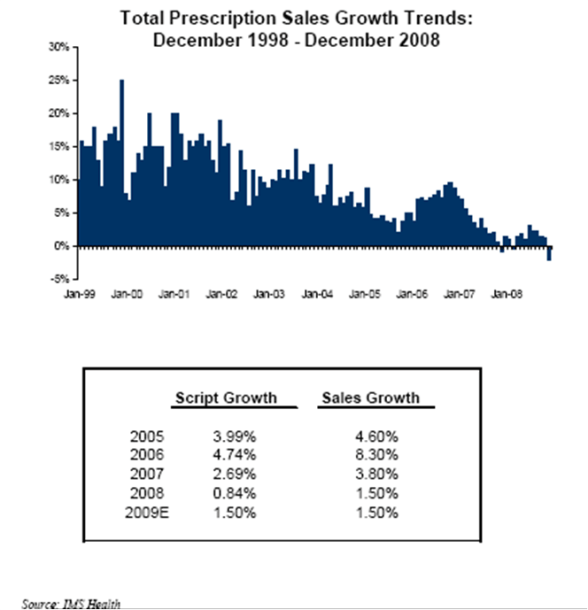
Based on IMS data, prescription growth continues to slow especially at mail order where it’s negative.  Interestingly, in a report by Barclay’s Capital, they estimate that Caremark will grow mail by 10% next year, Express Scripts will lose mail scripts by about 0.5%, and Medco will only grow by 0.8%.

Medco is easy to understand since they are currently the market leader in terms of mail order penetration.  The Express Scripts number requires some additional analysis.  Is it due to client loss?  Is mail just not growing?  The Caremark growth is meaningful.

ims-script-growth-barclaysims-mail-growth-barclays

Time To Sell?

There is always debate about captive PBMs (i.e., those owned by a managed care company).  In theory, I have always argued that they should have a leg up.  But, since pharmacy represents only 10% of total healthcare spend, the majority of the strategic focus is typically on the health insurance side of the business.  [BTW – The 3 largest captive PBMs are Wellpoint, Aetna, and Cigna.]

So, if you look at the stock charts below, you can see that while the PBMs (Express Scripts, Medco, and CVS Caremark) have all held up pretty well the managed care stocks (Aetna, Cigna, United Healthcare, Humana, and Wellpoint) have not held up as well.

If I owned a captive PBM, would this be the time for me to consider selling?  I have heard this debate a lot more recently than in recent years.

PBM 5-Year Stock Chart

express-medco-cvs-caremark-5-yearManaged Care 5-Year Stock Chart

wellpoint-cigna-aetna-united-humana-5-year[As I have disclosed before, I do not hold any individual stocks.]

Friends Don’t Let Friends

If they can use this concept for selling DirectTV over cable, why don’t we use this more in healthcare?

It could be…Friends Don’t Let Friends:

  • Pay too much for medication
  • Use brand drugs unnecessarily
  • Use retail for maintenance drugs
  • Call into the call center when the information is on the web
  • Go to the ER when they can call the nurse line
  • Pay too much for individual insurance

Maybe, in today’s economy, it will be time for healthcare companies to look for seriously at referral programs. 

  • Get a friend to come to mail order or the local CVS and get your next prescription copay waived.

Everyone is focused on saving money.  Social networking is all the rage.  People trust their friends.  

Now, I may not want to tell my friends that I am on cholesterol lowering medication so that may change it.  But, certainly people talk about higher level items like shopping for individual insurance.

Personalized Medicine Webinar

I don’t have anything to do with this, but it sounds pretty interesting.  Medco and Regence are talking.  Here is the teaser.  (Click here for more info and registration.)

Personalized medicine is moving rapidly. The FDA in December considered requests to require genetic testing for the colon cancer drugs Vectibix and Erbitux. Approval of such labeling changes could pave the way for a slew of other personalized therapies and diagnostics now waiting in the wings. Stakeholders anticipate significant clinical and financial savings. Recently approved genetic testing for the blood thinner warfarin, for instance, is projected to avoid 85,000 serious bleeding events annually and save roughly $1.1 billion a year!

On the other hand, questions remain whether the model actually provides a favorable return on investment (ROI). A new study finds that genetic testing for warfarin does not appear to be cost-effective in certain patients. And health plans and PBMs are trying to sort out which of the numerous diagnostic tests on the market actually provide clinical utility and improved results. One large health plan, for example, says its costs for diagnostic testing are growing at nearly 20% a year.

So where does all of this leave Rx payers in February 2009?

Ix for Rx Management

Josh Seidman from the Center for Information Therapy today announced on their blog that the center is going to begin focusing on “Ix for Rx Management” that will look at adherence along with other critical issues.  As I talk about all the time, finding the right way to deliver information to people in a way that they can accept it and act upon it is critical.  Given that we use more and more medications, this is a critical area where the center’s leadership can help build awareness of the problems.

“Although awareness certainly is an important precursor, it may be the easiest step in the pathway that takes the average consumer along the road to information consumption, then knowledge accumulation, and ultimately leading to behavior change. We know there’s a large body of research that tells us that, in order to be successful, our Ix initiatives need to “meet people where they are.” More specifically, we need to target the information to the individual’s particular moment in care and tailor it to their particular needs and circumstances.”

Seeing Significant Improvements With BPO

Business Process Outsourcing (BPO) or as I will sometimes call it CPO (Communications Process Outsourcing) is something we are definitely seeing a growing demand for in the market.  It blends technology, services, process management, consulting, and analytics.

Both IDC and Gartner have now talked about this in recent reports.

According to Janice Young, IDC program director, Payer IT Strategies, “we expect to see an increasing interest and likely investment in BPO in 2009 and 2010 for healthcare payers. Our recent results from our January 2009 healthcare payer survey of IT spending indicate that 45% of healthcare payers expect BPO investments to increase this year.” These trends are highlighted in IDC‘s U.S. Healthcare Payer 2009 Top 10 Predictions (January 2009).

Gartner research vice president, Joanne Galimi, reported on BPO services within health plans in a recent report entitled Healthcare Insurer Business Process Outsourcing Trends (January 2009). “Although things look gloomy for the larger economy, the potential for BPO to address immediate business pressures and long-term recovery goals for the health plans will be unprecedented,” says Galimi.

When I first came to Silverlink as a consultant in early 2007, this was exactly my vision.  I always talked about the “one throat to choke” model.  When you are in an operations role, it is always so difficult to coordinate modes, vendors, discrete data sources, and ultimately to get a holistic view of the member (or patient).  This is what I wanted to help build and is exactly what we have done.

Fortunately, we are now in a position where we can talk about how this service model has grown and how offering turnkey services for clients has driven results.  I love to focus on outcomes so this is exciting.  Here are a few from the press release we put out this morning:

  • Over a 300% improvement in retail-to-mail conversions for a large pharmacy benefit manager (PBM),
  • 54% increase in participation for a pharmacy program, representing between $150 and $175 per year per prescription in consumer savings,
  • 400% improvement in yield in a COB program, translating to over $20 million in cost savings to a major U.S. health plan, and
  • Up to an 82% increase in transfer rates for population health engagement for disease management, lifestyle management and treatment decision support programs.

Pharmacy Principles for Healthcare Reform

Several pharmacy groups have put out their principles for healthcare reform:

“Proper use of prescription medications helps improve quality of life and health outcomes. How ever, the health care system incurs more than $ 177 billion annually in mostly avoidable health care costs to treat adverse events from inappropriate medication use. T he proper use of medication becomes even more important as treatment of chronic disease costs the health care system $ 1.3 trillion annually, or about 7 5 cents of every health care dollar.”

The document goes on to talk about the importance of pharmacists in managing chronic diseases and helping patients.  A role that I completely support although I question the bandwidth of the pharmacists to do this given the massive shortage in the US.

The Principles are:

  1. Improve Quality and Safety of Medication Use
  2. Assure Patient Access to Needed Medications and Pharmacy Services
  3. Promote Pharmacy and Health Information Technology Interoperability

They are kind of like “No Child Left Behind” in that you can’t argue with the concepts.  At first read, the only thing that raised an eyebrow for me was some of the language around Principle 2.  I could interpret it to be a subtle play against some of the trend management tools that the PBMs use to help control prescription costs – e.g., mail order pharmacies.

The Easiest $400+ You Can Save In Healthcare

In today’s economy, we are all looking for ways to save. And, it should be no surprise that pharmacy is the most frequently used benefit since, on average, people get fourteen 30-day prescriptions per year.

That being said, there are still hundreds of dollars that millions of us can save. Let’s take an easy example – Lipitor. Lipitor still has about $8B in sales here in the US. If you assume the monthly cost is $125 per 30-day supply and everyone on the drug filled it 12 times per year (which doesn’t happen but is a topic for another day), that means that each consumer on Lipitor represents $1,500 in revenue to Pfizer per year. Dividing the $8B by $1,500 tells me that there are about 5.3M consumers using Lipitor in the US.

On most formularies (or preferred drug lists), Lipitor is a 3rd tier drug meaning that consumers are paying $40-$50 per month for this drug. Considering the fact that Lipitor has a generic alternative which is called simvastatin (aka generic Zocor), consumers can often talk to their physician and use this drug as a lower cost alternative. Additionally, both of these drugs are maintenance drugs that can be filled at mail order which often represents a 30% savings to a consumer (based on average plan designs). And, finally, simvastatin is a drug which can be split according to many different companies.

Here is the math, but a consumer on Lipitor could talk to their physician to get started on simvastatin, split the pills, and after a few months move to mail. That would save them $400+ in many cases.

  • Assuming Lipitor is a 3rd tier drug with a $40-$50 monthly copay and the consumer fills the drug every month for a year, they would spend $480-$600 out-of-pocket.
  • Assuming they moved to simvastatin (with their MD’s approval) with a $10 copay, they would immediately drop their costs to $120.
  • Assuming they split their pills (i.e., got a higher dose of the medication and used a pill splitter to use ½ the pill each day), they would typically reduce their copays by 50% or drop their costs to $60 a year.
  • And, if they then moved the prescription to mail where they reduced a 90-day supply for the same price as a 60-day supply at retail, they would drop their out-of-pocket costs to $40 a year.

I don’t know about you, but that seems pretty easy. It’s clinically appropriate for most patients. The PBMs will typically help you with these programs by reaching out to your physician to get the new prescription.

Hopefully, you’ll be hearing from your PBM or managed care company about these savings. At Silverlink Communications, we are working with lots of them to design and execute these types of programs. It is always very rewarding to get in touch with consumers and bring them a message about how to save money.

If you are a health plan whose premiums are going up, this is a great way to reach out to your membership and provide them with a positive message about how you care and are responding to them in these tough economic times.

Will Plans Cover Genetic Testing?

I came across this fact the other day from Systemed Group, a division of Medco. According to the 300 health plans they surveyed, 38% of them said they will definitely (3%) or probably (35%) cover genetic testing within five years.

Interesting. What will this mean? What will these test consist of? What will they cost? How will they be used? Will they cover the drugs that are personalized based on genetic makeup?

Walgreens Complete Care and Well-Being

Walgreens has just announced their offering to push into the on-site clinic market.  It is not completely new for them, but this is certainly a broader offering leveraging several assets they have acquired.

The program’s foundation is the pharmacy and health centers located on employer campuses or manufacturing facilities, along with Take Care’s in-store retail clinics and Walgreens nationwide pharmacies. Take Care’s employer health centers can offer complete pharmacy and health care services ranging from acute (e.g. strep throat) to primary care, occupational health, infusion services, specialty pharmacy, prescription mail services and disease management and are staffed by a combination of Walgreens clinicians including physicians, nurse practitioners, physician assistants, nurses, pharmacists and other health care professionals. Take Care Clinics, walk-in health care clinics open seven days a week and located at neighborhood Walgreens drugstores nationwide, are staffed by nurse practitioners and physician assistants who offer health care services built around a family’s needs.

I have always found this model to make a lot of sense, but it is hard to scale beyond massive employer sites.  In general, I think you have to have at least 1,000 people at one site to even begin to see this as a profitable investment (if I remember my analysis from years ago).

I am not really sure what the “all prices transparent to the employer” means in their press release.  Are they really going to reveal the acquisition cost of drugs?  The cost of their private label medications?  The cost of a clinic visit?  I am not sure that’s necessary.

Providing convenience without increasing costs should be enough.  Employees will love it.  Of course, I have heard that once you put it in that it is impossible to pull these out without very negative employee reaction.  And, I do believe that convenience (as it does with 90-day Rxs) can help improve adherence with mixed with the right education and counseling.

Regence Quote On Pharma Studies

I always find some great nuggets in the AIS daily news.  I thought I would pass on this one from the head of pharmacy at RegenceRx.

“Unfortunately, we find that only 15% to 20% of pharmaceutical studies are reliable. Our findings are not unusual. For example, Pitkin, R. et al (JAMA. 1999; 281:1110-11) found that 18% to 68% of abstracts in six top-tier medical journals contained information not verifiable in the body of the article. To assure Regence doesn’t disregard valid studies, we request full study information from pharmaceutical manufacturers in addition to reviewed published information. Unfortunately, it’s rare for manufacturers to provide information beyond what’s in the published study.”

— Helen Sherman, Pharm.D., senior director of pharmacy services and chief pharmacy officer at The Regence Group, which operates BCBS plans in the Northwest, told AIS’s DRUG BENEFIT NEWS.

Potentially Ridiculous Decision

I’m trapped in Boston waiting to get home due to the snow storm last night.  While I am waiting, the guy sitting a few chairs away from me was talking on the phone to a reporter.  If what he said is true, it’s a massive step backwards.

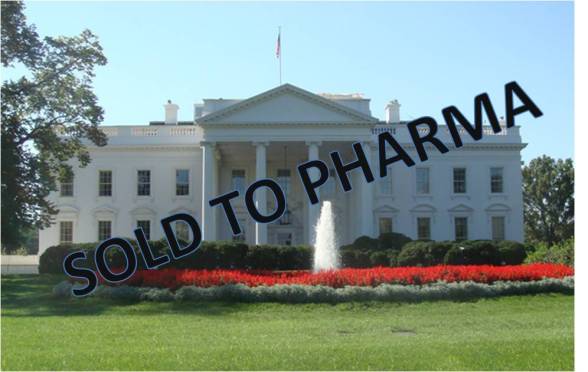
He said that CMS is no longer going to allow Medicare Part D plans to charge more for multi-source brands (MSBs).  These are brand drugs that have a generic equivalent (i.e., they are the same drugs based on active ingredients).  This would be a massive win for pharma since the manufacturers typically drive the price up after patent expiration so that they can make as much money as possible on the people that continue to use these drugs.

In most cases, these drugs are immediately moved to the 3rd tier of the formulary while the generic version is placed on the first tier.  This allows people to get them, but they have to pay more.  If CMS doesn’t allow this anymore, it will create lots of potential waste and be a big step backwards for all the progress we have made around generics.

sold-to-pharma

Walgreen’s President On Recession Impact

In case you didn’t see it, Gregory Wasson (President and COO) from Walgreens did an interview with The New York Times on how the economy is impacting them and answered a few other questions about their strategy.

Q. How is the slowdown affecting purchases of prescription drugs and health and beauty aids?

A. We certainly are seeing a slowdown in prescription drugs. In this economy, patients are not seeing their doctors as frequently. There may be some cases they are skipping doses of medications to control costs. As far as over-the-counter items, we see consumers definitely looking for value. We’re also seeing a big increase in private label product. The consumer is willing to buy down.

To read the rest of the interview…click here.

Follow-up On Physician’s Comments On PBMs

I talked about it in a few previous blog entries – Physicians versus PBMs and Physicians as Victims of System – and I am finally getting around to the source interview in AIS’s Drug Benefit News from October 31, 2008.

Here are a couple of additional thoughts after reading the entire interview with Toni Brayer:

  • She questions the value of PBMs (pharmacy benefit managers).
    • [It’s been well documented that PBMs can drive lower trend and have lowered prices.  This was well documented by third parties before PBMs were made central to the Medicare Part D benefit.  Additionally, reading any of the PBM trend reports will show you the money that can be saved by leveraging the trend programs that they offer.]
  • She talks about confusion between mail order pharmacies and PBMs.
    • [This is a good example of one thing that PBMs have driven which is mail order utilization which has driven down costs and allowed members to move from 30-day to 90-day prescriptions.  But, mail order is often a key component of the PBM offering.  People should think of them as two different entities – the PBM is focused on claims processing and the rules for benefit administration…the mail order is simply a pharmacy that uses automation to deliver medications to members from a centralized location.]
  • She says that PBMs contribute to the double digit increases in pharmacy costs that have occurred. 

    • [I think this has been disproven by many of the independent studies.  Additionally, the increases are driven by increased utilization, brand price increases, and new product introductions in most cases.  PBMs drive down reimbursement rates year-over-year, drive generic fill rates, and move members to lower cost channels such as mail order or specialty pharmacies.]
  • She talks about the hassle of PAs (prior authorizations).
    • [I completely understand the hassle here and am a little mixed in my opinion.  On the one hand, this is an effective trend management technique using evidence-based standards to manage inappropriate use of medications.  On the other hand, since in most cases, 95%+ of all PAs are approved (if the MD calls in), it does seem like an unnecessary burden.]
  • She also talks about confusion between brands and generics.
    • [This has become a bit of a challenge over the past few years as some branded products end up being cheaper than generics.  This has led to formulary tiers at a few companies reflecting more about drug price than brand versus generic.  And, I completely agree that physicians can’t be expected to understand formulary status…without electronic prescribing tools.]
  • She talks about pharmacies not automatically refilling prescriptions.
    • [I agree with her here with a few caveats.  Pharmacies should be reaching out to patients to remind them about refilling their medications.  They should be using a barrier survey to understand why they aren’t refilling and help them address these barriers or pushing them back to their physician when appropriate.  In my day job, this is definitely something that I talk with a lot of pharmacies (mail, retail, and specialty) about how to do this.]
  • She even talks about tamper-proof prescriptions being a hassle.
    • [In most cases, I think pharmacies offer patients either tamper-proof or standard prescription bottles as a choice.  Obviously the tamper-proof is to reduce the risk of children getting into medications and overdosing.  I don’t know the statistics, but I think it’s a legitimate concern.]
  • She compares pharmacies to the Department of Motor Vehicles.
    • [WOW!  I have certainly heard that some of the pharmacies in high density urban areas have ridiculous wait times, but I think this is a pretty bad slam.  The pharmacies that I go to take time to talk with the patients.  They are fairly quick on filling medications.  They use computer technology and automation to drive efficiencies.  We have a huge shortage of pharmacists in the US so there are some challenges.  That was one of the reasons I tried to go to market with a pharmacy kiosk solution.]
  • She says that she always considers cost when writing a prescription.
    • [This is great.  I know physicians generally do this for the medications they understand cost on…which are usually the outliers.  But, with over 10,000 medications on the market, I can’t imagine they can keep up with some of the idiocyncracies in the market.  Again, although I am not the biggest believer in electronic prescribing, this is one of the clear advantages here that it can show drug cost and member cost.]
  • She thinks that pharmacies are gouging patients by only dispensing 30-day supplies for chronic medications.
    • [This one I can talk about from several perspectives.  First, for new prescriptions, it is usually appropriate to only dispense 30-day prescriptions until the patient stabilizes on an Rx and strength.  Second, most patients have access to mail order where they can get a 90-day prescription…and some retailers offer this also.  Third, pharmacies generally make their money on the things people pick up while in the store…on many Rxs, pharmacy is a loss leader.  Fourth, to fix this issue, we would have to stabilize care so that only one insurer / employer paid since today people move around too much creating a disincentive to have one payor pay for a longer Rx only to have the patient leave before they use up their supply.  Fifth, since most people are non-compliant / non-adherent, there would be a lot of waste.]
  • She talks about hardly any medications costing under $40.
    • [Since most people have prescription drug coverage, this would only apply to 3rd tier drugs or specialty medications.  With all the $4 generics, patient assistance programs, and drug discount programs out there, patients don’t pay over $40 in many cases.  If she is talking about drug costs to the payor, then most brands certainly cost over $40 but that now represents just over 30% of all drugs dispensed.  I will let pharma make the arguement, but clearly the research required to bring a new drug to market justifies much of the cost.]
  • She suggests pricing brand drugs with no generic alternative lower.
    • [I am all for lowering healthcare costs and don’t think manufacturers should gouge patients, but in a capitalist society, why would I lower the cost of something that people need and have no alternative for?]

Sorry for the long rant, but there was soo much fun stuff to respond to in this interview…I never thought I would be a “defender” of the PBM model, but I really disagree with a lot of her comments.  PBMs do a lot of good things for clients and members even though they are in the “middle man” position.

Rx Spending Slows

In the USA Today, there was an article this morning about the slowing growth in the prescription drug market.  Growth was only 4.9% (in dollars) which is the lowest since 1963.  A lot of this is due to the increasing use of generics along with the trend toward $4 generics or even free generics.  They attribute some of it to safety warning which may have decreased utilization and certainly there have been multiple surveys talking about the dampening effect of the economy.

The article states that health care services overall rose 6.1% to $2.2 trillion in 2007 (or $7,421 per person) according to CMS’s Office of the Actuary.

They also state that generics now make up 67% of all prescriptions filled and that drug prices grew only 1.4% which was down from the 3.5% in 2006.

I was surprised by the statistic that the FDA issued at least 68 safety warnings in 2007.

In general, I didn’t agree with their observation that lower prescription drug cost increases contributed to holding overall health care spending increases down since prescriptions only make up about 10% of total healthcare costs.

Breaking Down The 2008 PBM Customer Satisfaction Report

PBMI (Pharmacy Benefit Management Institute) put out its 14th report on employer satisfaction with their PBMs. Here are some of the highlights from the report:

  • 275 employers representing 11.3M members responded.
  • The overall rating was an 8.0 out of 10.0. (up from 7.9 in 2007)
  • 6.7% of respondents perceived that their benefit costs were increasing more than others and ranked their PBMs lower. (perhaps a validation that trend management matters…hence the “battle” to show the lowest year-over-year trend to the street in the individual trend reports)
  • PBMs were ranked on three factors – overall service and performance, delivering promised savings, and delivering promised services.
  • For the overall score:
  • Aetna (6.6), Argus (4.8), Innoviant (8.7), MedImpact (8.0), NMHC (7.5), and Prime Therapeutics (9.0) also were part of the report but had limited profiles due to a lower number of surveys being received.
    • As far as I know, Prime doesn’t contract directly with employers but just through their BCBS owners. That would seem to disadvantage them in this survey.
  • Employers can contract directly with PBMs or thru a managed care entity or buying group. Those that contracted directly ranked their PBMs higher (8.2 versus 7.6) which makes sense since they are more involved and more likely to be actively managing trend and having lower costs.
  • This is validated by the fact that those with very aggressive intervention in benefit management rated their PBMs much higher (8.6 versus 7.1). About 33% considered themselves to be very aggressive.
  • PBMs were rated the worst (7.2) for their disease management programs.
  • When looking at factors that were correlated with satisfaction there were a few surprises and a few no-kidding variables:
    • I was surprised the member website, specialty pharmacy, and mail service pharmacy ranked low on the list of variables (i.e., less correlation).
    • I was not surprised that account management ranked high and retail pharmacy network was low. In many cases, the networks are pretty similar. I would be interested to see how large employers ranked PBMs versus smaller employers since they probably get different levels of service.
  • Looking at the overall scores from 2004-2008:
    • Caremark, Catalyst, Cigna, Express Scripts, and Medco all went up.
    • Walgreens and Wellpoint went down.

Looking at the ranking of key factors:

Highest Ranked Function(s)

Lowest Ranked Function(s)

Aetna Retail pharmacy network

ID card production

Mail service pharmacy

Disease mgmt programs

Argus Retail pharmacy network

ID card production

Formulary mgmt and rebates

Account mgmt

Catalyst Retail pharmacy network

Claims processing

Disease mgmt programs

Mail service pharmacy

Cigna Account mgmt

Member services

Delivering promised savings

Disease mgmt programs

CVS Caremark Retail pharmacy network

Claims processing

Formulary mgmt and rebates

Disease mgmt programs

Envision Overall service and performance

Account mgmt

Disease mgmt programs
Express Scripts Retail pharmacy network

ID card production

Member services

Formulary mgmt and rebates

Disease mgmt programs

Innoviant Formulary mgmt and rebates

Delivering promised savings

Utilization and benefit mgmt consulting

Member website

Medco Retail pharmacy network

ID card production

Utilization and benefit mgmt consulting

Mgmt reports

Disease mgmt programs

MedImpact ID card production

Claims processing

Retail network

Formulary mgmt and rebates

Drug utilization mgmt

Specialty pharmacy

Delivery promised services

NMHC Retail network

Plan implementation and changes

Specialty pharmacy

Mail service pharmacy

Disease Mgmt programs

Prime Therapeutics ID card production

Retail network

Disease Mgmt programs

Specialty pharmacy

Formulary mgmt and rebates

Walgreens Retail pharmacy network

Mail service pharmacy

Mgmt reports

ID card production

Member website

Wellpoint Retail pharmacy network

Claims processing

Acct mgmt

Disease mgmt programs

Mgmt reports

Utilization and benefit mgmt consulting

So…my overall assessment is that it is a good report. It is limited by response and limited by the fact that there aren’t major differences between PBM scores (with a few exceptions). But, it certainly would give me some clues on what to expect, where to push, and how I should evaluate my PBM.

Taking My Insurance Out For a Test Drive

I heard a commercial this morning talking about a “test drive” for drivers insurance. It made me think that with data standards this would be a pretty easy thing in healthcare.

Imagine that every year for open enrollment you would simply create a file of all your claims from the prior 12 months and upload them at some website “TestMyHealthInsurance.com”. That website would show your employer sponsored options along with individual insurance options and show you what your total out of pocket costs would be under each scenario (assuming the same claims).

We had an application like this at Express Scripts called ExpressChoice which allowed members to compare their next year’s pharmacy plan options based on the prior year’s claims. It was a very cool tool. Of course, there are limitations, but it’s much better than most of us have.

So, why not extrapolate that to a bigger market play and include health and pharmacy. Given all the exclusions and other small print in our policies, it is always impossible to compare.

Now, if you really wanted to blow people away, guarantee that the costs per claim for the same drug, treatment, etc. won’t deviate from the forecasted price by more than 10% year-over-year. I think you would capture some attention here.

10% of Older Men Taking Risky Combo of Drugs

A new study that came out looked at utilization of drugs by seniors and raises the flag that people are mixing drugs with other drugs or vitamins that may put them at risk. Since pharmacists and doctors don’t always know all the things their patients are taking, it is a lot harder to catch these issues than traditional drug-drug interactions which are caught at the pharmacy.

A couple of the most common combinations that they cite are:

Warfarin, a potent prescription clot-fighting drug, was often taken with aspirin. Both increase the risk of bleeding, so the odds are even higher when both drugs are taken. The researchers said these risks also occur when warfarin is taken with garlic pills, which some studies have suggested can benefit the heart and help prevent blood clots.

Aspirin taken with over-the-counter ginkgo supplements, increasing chances for excess bleeding.

Lisinopril, a blood pressure drug, taken with potassium, which combined can cause abnormal heart rhythms. Potassium is often prescribed to restore low levels of this important mineral caused by certain blood pressure drugs.

Prescription cholesterol drugs called statins [Lipitor, Crestor, Simvastatin/Zocor] taken with over-the-counter niacin, a type of vitamin B that also lowers cholesterol. This combination increases risks for muscle damage.

And We Have Two Winners??

In looking at recent investor decks from both Medco and Express Scripts, I was surprised to find almost identical charts each claiming victory on drug trend management.  Here are the two charts…you can judge for yourself.

(Express Script’s from Credit Suisse Healthcare Conference 11/13/08)

(Medco’s from 2008 Analyst Day 11/21/08)

medco-drug-trendesrx-drug-trend

Uproar Over “Reference-Based” Medicare Pricing – Please

Here is an overview of the issue on the WSJ Health Blog.

First off, I am not sure I would call it reference based pricing when the rest of the world calls it mandatory generics.  In many states, this is even a requirement where the pharmacy has to fill a multi-source brand (MSB) with the generic equivalent of the drug.

[In English, what this means is that once a brand drug has lost it’s patent and the drug is available as a generic then the generic (which is typically much lower cost) has to be dispensed.]

So, the issue is that apparently Medicare plans don’t always point out that if members choose the higher cost brand product (Prozac versus fluoxetine) that they will pay more..and often a lot more.  Brand manufacturers raise their prices on the brands after they lose patent since they know there are people out there who really want to purple pill and not the generic white pill (for example).

I don’t know if Medicare plans allow it, but I know a lot of clients who allowed members to get the brand name drug at their copay (not at the drug cost) if the physician wrote the prescription for DAW (dispense as written).  The problem is the physician might simply do this at the member’s request even if they don’t need it.  From everything I have ever seen, it should be less than 1% of members who really need the brand versus the A-B equivalent generic.  (Look here for the FDA information on generics.)

I don’t disagree that for the 1% that have an allergic reaction to the inactive ingredients (e.g., blue dye #17) that there should be an exception process BUT we can’t build for the exception and manage costs.  Too many people will choose the easy path and drive costs up significantly.

Views on Electronic Prescribing (eRx)

I worked on eRxing when I first joined Express Scripts back in 2001. At that time, it was a huge focus with the recent investment in RxHub with Medco and Caremark. Everybody was drawing these hockey stick projections on adoption.

So, what happened…

  • Physicians began to use the technology in limited numbers and most of them ended up with equipment that didn’t work or didn’t seem more efficient that writing a paper prescription.
  • Vendors came and went so there wasn’t much stability.
  • The technology focus shifted to EMRs (Electronic Medical Records) which might have some eRxing technology embedded in it.
  • According to one slide I saw at a recent conference, there are estimated to be about 22% of registered physicians with the technology by the end of 2008 and 10% who actively use it.

The problem was that there wasn’t much alignment of incentives. A problem that I don’t see getting solved anytime soon. There is some legislation now to help drive adoption. Physicians who use the technology can get bonus payments from CMS in 2009.

I am still a skeptic.

Let me provide some representative perspectives (as I see them):

  • Consumers:
    • Generally, very positive.
    • You mean my physician will route my prescription electronically to the pharmacy of my choice, and it should be ready for me to pick it up when I drive there in 20 minutes. That’s convenient. (Something made a lot easier when RxHub and Surescripts decided to combine efforts earlier this year.)
    • Less errors is a good thing. (The study To Err Is Human really began this focus several years ago and more recent estimates are that 1.5 million people are affected by pharmacy errors each year.)
    • Why is my physician staring at a computer when they should be talking to me.
    • If this was done electronically, why do I still show up at the pharmacy and find out my drug isn’t covered (or not on formulary). (About 40% of claims are blocked for some administrative or clinical reason today.)
  • Physicians:
    • If this is easy (and inexpensive), I am happy to use this.
    • Is this faster than just writing a prescription on a piece of paper?
    • How much additional revenue do I generate from CMS and what do I have to do to earn that?
    • Patients like to leave with a prescription in hand. (Something that was solved by creating a printed “receipt” while also sending it electronically to the pharmacy.)
    • Who’s going to support this when it goes down? (For a small practice or individual physician, there are no onsite IT resources.)
    • This doesn’t fit into my workflow. (A lot of this is a generational issue. Medical school students are used to using technology as part of the process.)
    • This is easy. I can write a macro that when I write for a certain diagnosis code it brings up my typical set of prescriptions. (The tech savvy physician’s response.)
    • I can’t remember all the different formularies (i.e., drug lists) so this will be a lot easier.
    • I get paid per visit so what will this do to increase my visits? (Even though they get hit with a lot of callbacks after prescribing, doctors don’t feel this pain today since it is handled by their staff.)
    • I hope there’s not a bunch of advertisements on this.
    • By telling me whether my patient is compliant with the prescription I gave them, you are giving me new insight. (This is a definite value add that I know companies like CVS Caremark are working on with their eRx solutions.)
  • PBMs:
    • If physicians actually use this, we can really manage trend at lower cost by pushing edits to the POP (point-of-prescribing).
    • What additional information can we provide the physician that will improve adherence? What will the consumer reaction be?
    • What additional information can we provide physicians about poly pharmacy or patients that get multiple prescriptions from different physicians? Who should take action on this?
    • How much will the physician do with the patient sitting right there? Will they check formulary status? Will they switch drugs if there is a step therapy or prior authorization required? Will they take the patient’s credit card down to send the prescription to mail order? Will they take care of the edits (I.e., Drug Utilization Review…drug-drug interactions) that the pharmacy does today?
  • Pharmacies:
    • Will we get clean prescriptions (i.e., no additional work required other than filling it)?
    • How do we let the patient know when to expect the prescription to be ready for pick-up? (This can vary from 10 minutes to ½ a day depending on how busy the pharmacy is.)
    • How will we handle a new patient where we need billing information and allergy data?
    • How does that change our job as a pharmacist? Are we relegated to simply filling Rxs and no longer helping the patient manage their benefit?
  • Pharma Companies:
    • Will PBMs and their clients (managed care plans, unions, government entities, employers, TPAs) be willing to adopt more aggressive plan designs that defeat our detailing and marketing efforts?
    • How does this change the importance of formulary positioning and rebating?
    • How does this change our marketing strategies? (There are a lot of bright people in this industry so it’s not going away.)
    • If they physicians really use these, can we push advertisements (or let’s call them virtual detailing sessions) to the device (PDA, computer)?
  • Other:
    • Can you believe the errors in the industry? This will fix everything.
    • Why won’t someone want to adopt this technology?

Nothing is ever simple. This is a case of great intentions with lots of money and expertise being spent to solve the problem. But, aligning incentives and changing behavior is hard.

Will it happen? Yes.

Let’s put it this way…if it takes over 15 years for best practices in medicine to be adopted, how long will it take for this to be adopted?

Express Scripts Data Breach

By now, many people have heard about the data breach that happened at Express Scripts.  They have now set up a website to provide people with information about their investigation with the FBI and are also offering support for people whose identity has been stolen.  Given their focus (like all other healthcare companies) on keeping this data secure, I can only imagine how difficult this is for them.  I know that George Paz and the executive team will be doing everything they can to try to find the root cause and help any affected clients or members.

To find out more, visit www.esisupports.com.

Off Label Drug Use

Once a drug is approved, it can be prescribed by physicians for any reason.  Those reasons can include conditions that were not studied by the manufacturer in the clinical trials.  And, those off-label uses are not things that can be marketed to the physican.

Some of this is controlled by prior authorizations (PAs) which require a physician to call into the managed care company or the pharmacy benefit management (PBM) company to justify the use of the medication.  This is often used on high cost medications with a high percentage of off-label prescribing.

For example, it is estimated that 76% of the prescriptions writen for Seroquel are for off-lable purposes.  (See article on this and other information here.)  This article also lays out the top drugs that are used off-label.

  • Bupropion (Wellbutrin) approved for depression, commonly used off-label for bipolar diaorder.
  • Sertraline (Zoloft) approved for depression, commonly used off-label for bipolar disorder.
  • Venlafaxine (Effexor) approved for depression, commonly used off-label for bipolar disorder.
  • Celecoxib (Celebrex) approved for joint sprain/strain, used off-label for fibromatosis — soft tissue tumors.
  • Lisinopril (Prinivil, Zestril) approved to treat high blood pressure, used off-label for coronary artery disease.
  • Duloxetine (Cymbalta) approved to treat depression, used off-label for anxiety.
  • Trazodone (Desyrel) approved to treat depression, used off-label for sleep disturbance.
  • Olanzapine (Zyprexa) approved to treat schizophrenia, used off-label for depression.
  • Epoetin alfa (Procrit, Epogen) approved to treat chronic renal failure, used off-label for anemia from chronic disease.