Archive | PBM / Pharmacy RSS feed for this section

Is Your Adherence Program Leveraging Segmentation?

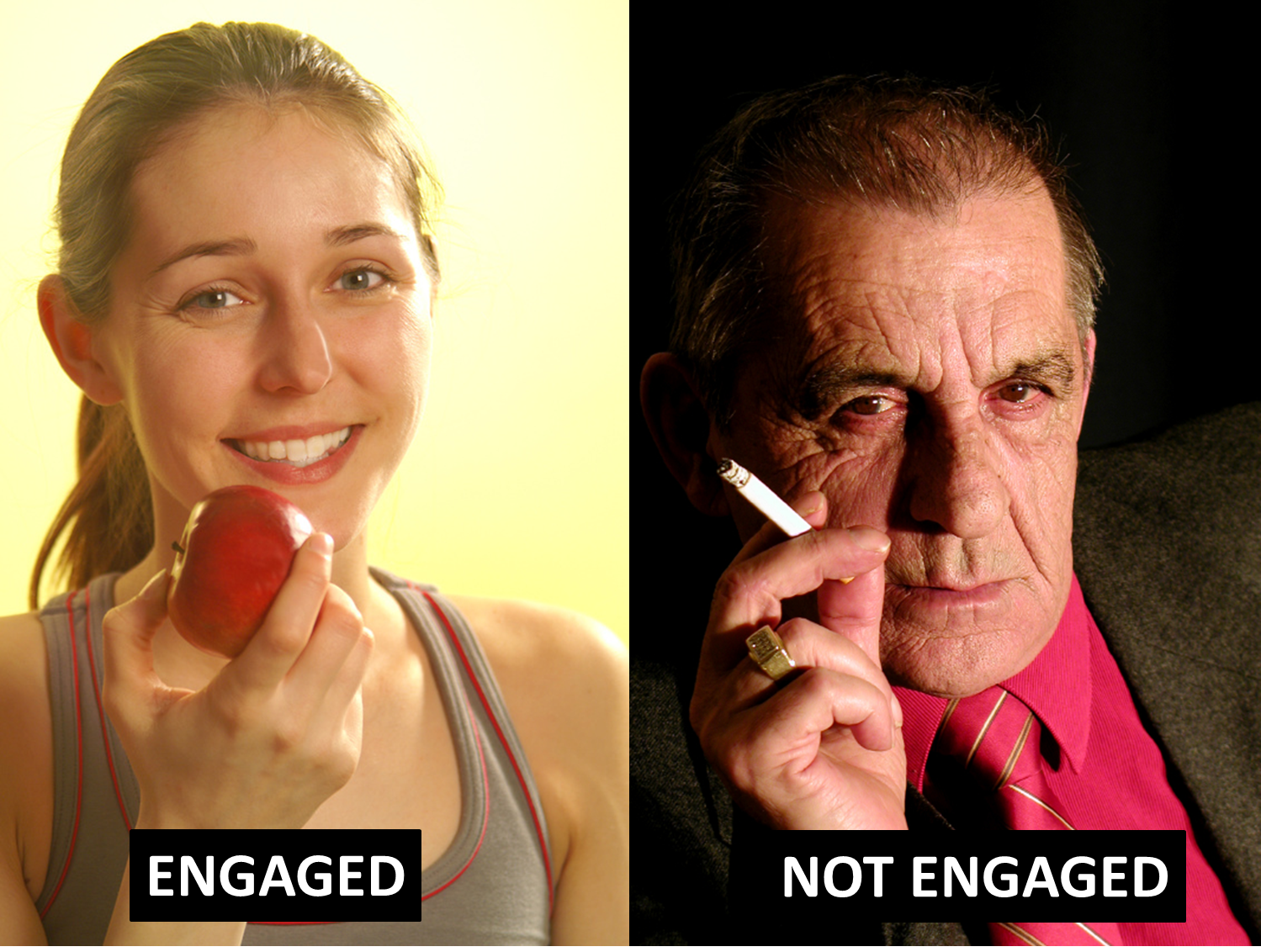
I was just finalizing a new marketing piece with our marketing team on Silverlink’s adherence services.  I love this picture because it drives home the point of understanding the consumer.

If you don’t understand the factors that drive behavior and leverage those attributes in segmentation and personalization of your adherence program, you may be leaving opportunities on the table.

State By State Use of Rxs per Capita, Age, and Gender

(Note: This is retail only data so it’s not comprehensive, but it should be directionally accurate.)

The Kaiser Family Foundation puts out lots of data.  One of their sites shows state by state analysis.  Here is a map of utilization by state. 

As you can see on the site, the top 5 states are (i.e., highest utilizers of prescription drugs):

  • WV
  • KY
  • AL
  • TN
  • MS

The bottom 5 are:

  • AK
  • CO
  • UT
  • NM
  • WA

For age breakdown, the data showed:

  • 0-18 = 3.8 average Rxs
  • 19-64 = 11.3
  • 65+ = 31.1

For gender, the averages were 9.5 Rxs for males and 14.4 Rxs for females. 

Note: All this data is available online at http://www.statehealthfacts.org/

CxO Roles In Pharmacy: A Quick Scan

I always find it interesting to see the senior roles created within organizations. While pharmacy doesn’t have many radical titles like Chief Executive Bear (aka Maxine Clark at Build-A-Bear), I did find the following looking at company websites, LinkedIn, and some quick Google searches:

  • Chief Innovation Officer – Walgreens
  • Chief Experience Officer – Walgreens
  • Chief Supply Chain Officer – Express Scripts
  • Chief Pharmacy Officer – Aetna, PartnersRx, Cigna, US Oncology, Tricare, United, Wellpoint, Excellus, CatalystRx
  • Chief Sales Officer – PTRx
  • Chief Strategy & Innovation Officer – OptumRx
  • SVP Imagineering & Innovation – Medco
  • Chief Trade Relations Officer – Express Scripts
  • Chief Clinical Research & Development Officer – Medco
  • Chief Healthcare Strategy & Marketing Officer – CVS Caremark
  • Chief Scientist – Express Scripts
  • Chief Strategy Officer – American Healthcare, Walgreens
  • Chief Actuary – OptumRx
  • Chief Branding Officer – Medco

Of course, there are always the obvious – CEO, COO, CFO, CIO, CTO, CMO (Marketing), CCO (Clinical), CMO (Medical), CCO (Compliance), and CAO (Accounting).

My takeaways from this list (which is likely incomplete) are:

  • I would expect to see more Chief Innovation and Chief Experience Officers in the years to come.
  • I continue to be surprised that there aren’t more Chief Pharmacy Officers.

Do you have others you’ve seen or companies that have these roles that my quick scan missed? Thanks.

Primary Adherence – Technology, Kaiser Study, and EHRs

I think we all know that primary adherence is a real issue.  Depending on what you read, you see that anywhere from 20-30% (or more) of patients don’t start therapy.  They are prescribed a drug, but they never fill it.  This is due to lots of reasons:

  • They get a sample.
  • The drug costs too much leading to abandonment.
  • They don’t feel like they need the prescription.
  • They feel better.
  • The doctor tells them only to fill it if something else doesn’t work.

These issues vary based on whether it’s an acute drug or a maintenance drug.  It also varys by drug class. 

I’ve always been surprised that pharmaceutical manufacturers focus so much on ongoing refills leading to improved MPR rather than focusing on primary adherence which would grow their market significantly.  One of the big reasons for this has been visibility.  Without electronic prescriptions and mapping those to claims data, it was hard to identify who had a prescription and didn’t fill it.  You could do something with data out of the PPMS (Physician Practice Management System) or through more complicated processes to get data out of their notes, but it wasn’t easy. 

So, this new study by Kaiser caught my attention. 

If you are a diabetic, have high cholesterol, or high blood pressure and you receive medical care at an integrated healthcare system that has electronic health records (EHRs) linked to its own pharmacy, then you are more likely to collect your new prescriptions than people who receive care in a non-integrated system, a Kaiser Permanente study shows.

That’s a strong sell for an integrated model, but perhaps more realistically for the use of EHRs.  You can also see some of the data from Surescripts around this topic of electronic prescriptions and adherence

This creates a great opportunity for pharmacies, PBMs, payers, and pharmaceutical manufacturers to leverage technology to improve primary adherence.  By identifying people who don’t fill a prescription they receive, companies can help determine which of those are intentional and which of those should be addressed.  This should help address the overall costs attributed to non-adherence and be a business driver for all these entities. 

[Note: If you’re interested in working on primary adherence, let me know.  We have several approaches for this at Silverlink.]

Walgreens and Express Scripts: The Plot Thickens ($ESRX, $WAG)

Remember when this “conflict” was first announced a few months ago.  If you’re like me, you probably assumed this would be over in 30-days like the Walgreens – CVS Caremark dispute last year.  What’s different?  I’m not sure.  It seems like both sides are well dug in.  (From my poll a few days ago of 22 of the readers of this blog, 65% felt this would get resolved by 1/1 and 25% felt that it would never get resolved.)

Now, it seems like both sides are continuing to take significant steps towards no resolution.

Express Scripts has apparently launched a pilot program to move share from Walgreens stores now using coupons.  I believe the pilot was with Lowes and is about to expand to the Department of Defense.  Additionally, I’ve heard that Express Scripts has sent out letters to their clients preparing them for a limited network starting 1/1/12 without Walgreens.

On the flipside, I’ve heard that Walgreens has begun putting signage out encouraging consumers to talk to their plans about excluding them from the network and for Medicare members to chose plans that aren’t run by Express Scripts.  Walgreens also put out a whitepaper about what happens when you remove them from the network.  This has some really interesting data in it.

Key Statement: Excluding Walgreens from a pharmacy network will result in little to no savings for most sponsors and patients, and in some cases will raise costs, while causing significant patient disruption and risking gaps in care, and increasing administrative costs on plan sponsors.

  • As part of this document, they are encouraging payers to consider directly contracting with them and/or creating a custom network (if their PBM contracts allow for that).
  • They state that their costs are comparable to other retailers or within 2% of their costs.
  • They show some data from another PBM (not named) that modeled out network savings for them based on a limited network taking into account their drug costs, generic fill rate, and 90-day rates.  It shows a jump in costs versus savings.

  • They share data that their Generic Fill Rate (GFR) is 1.4% higher than the rest of the Express Scripts retail network which the paper says translates to $2 per Rx in cost.
  • They say that 90-day retail generates a 6-8% savings compared to 30-day retail based on the pricing that they offered to Express Scripts.

Ultimately, I still believe resolution will occur before the end of the year.  While both parties are dug in, I believe it’s a lose-lose situation for this to stay unresolved.  That being said, there are lots of things that could occur here:

  • This creates a wave of direct contracting between payers and pharmacies.
  • This validates the integrated model of CVS and Caremark.
  • This creates a large number of limited networks.
  • This creates greater use of the Walgreens discount card and/or cash business at Walgreens especially for lower cost generics.
  • Alienating Walgreens creates a disruptive force in the FTC review of the proposed Medco acquisition.
  • Another PBM jumps in to do a creative deal with Walgreens which limits their long-term ability to work with Express Scripts.
  • Express Scripts ends up in a shotgun relationship with CVS.
  • The terms of PBM contracts get changed going forward based on new terms regarding retailers.
  • Walgreens becomes a much more vocal voice in the retail world through NCPA and other organizations.

Between this and the proposed Express Scripts acquisition of Medco, the landscape in the PBM market could be radically different by early 2012.

[Note: As the stock market has dropped, I have continued to buy stock in the PBM industry including several of the specific companies mentioned in this post – MHS, ESRX, WAG and CVS.]

$47 Per Rx Guarantee From Prime Therapeutics

I think this is a good, bold move.  Prime Therapeutics has launched four new programs.  The most aggressive is called Reliance and guarantees your net spend per Rx at $47.  The easy way to do this would be to exclude specialty drugs and basically offer a generics-only formulary.  My quick read from their drug trend report and press release is that it includes specialty drugs.  It also includes a lot of utilization management programs, suggestions on plan design, encouragement for mail order, and other features.  I’ll be interested to see the adoption of the program or whether it’s just a great program to encourage clients to consider new, more aggressive plan designs.

“Our Reliance plan keeps costs predictable for plan sponsors,” said Michael Showalter, Prime Chief Marketing Officer. “The goal is to make pharmacy benefits easy, understandable and affordable. Through Reliance, there will be no surprises, allowing organizations to better plan for and manage their pharmacy costs and reduce overall health care costs, while providing excellent benefits. We provide a single number demonstrating the true cost of care – $47. We are the only PBM to back that up with a price guarantee and complete price transparency.”

Highlights From the Prime Therapeutics 2010 Drug Trend Report

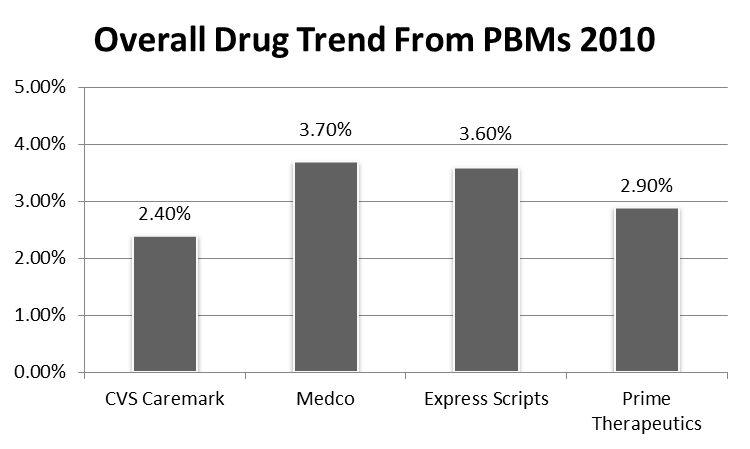
I just finished reading the Prime Therapeutics Drug Trend Report. As I highlighted the other day, their overall drug trend was 2.9%. Like in the past few years, they have jumped up to offer a report comparable with the other big PBMs. And, as we saw with last year’s report, the new management team is aggressive in using this to highlight research, their competitive differentiation, and point out why they are a competitive force in the market.

More interesting that just their success in drug trend was their “adjusted drug trend” for the other PBMs. You don’t often see this in your face marketing in this space, but they clearly want to show not only that their trend was better but that their methodology is better. (I don’t have the time to compare methodologies at this point.)

Fortunately, they don’t stake the argument on trend since as I’ve pointed out before – trend can be misleading. Sometimes higher trend is good as when it indicates better Medication Possession Ratio or better success at reducing gaps-in-care. They focus on five things in the document:

  • Savings
  • Safety
  • Guidance
  • Satisfaction
  • Partnership

Their Generic Fill Rate (GFR) for 2010 was 69.2% which was lower than the 71% reported by Medco and the 71.5% reported by CVS Caremark. (I couldn’t find the Express Scripts numbers for whatever reason.)

The report focuses on some of the differences in the Prime model (client ownership, not public) and how that plays out in transparency and alignment.

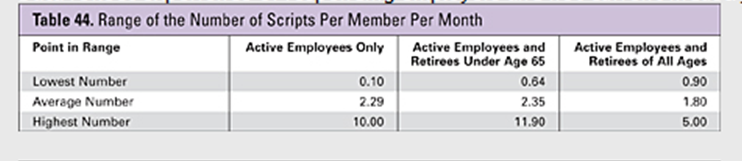
They are now at 12 Rxs PMPY which to me still seems a little low. (I’ve mentioned this is prior reviews, but I don’t understand why their population usage is different.) To validate my hypothesis, I looked at the PBMI report from last year which shows PMPM utilization ranges by respondents (not industry averages).

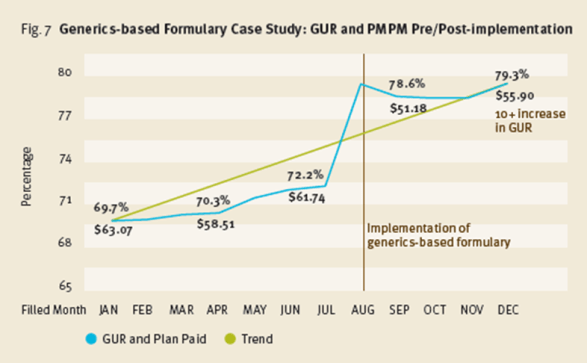
I do think their example around implementing a generics-formulary along with their new benefit plan guaranteeing cost at $47 per Rx are very interesting. They remind me of the GenericsWork product I launched at Express Scripts and should offer some clients a great way to save money. They key, as I learned, was really understanding how to manage member disruption and gain buy-in to the offering.  [Amazingly, a quick Google search led me to a cached image of the PDF from my product from 2004.]
They give some good MTM numbers:

  • $1.29 in return for every $1 spent
  • $86 in savings to the payer over a 10 year period per MTM encounter

They also announce a new offering for 2012 which they call the GuidedHealth care engine. There’s a little information in the document, but it sounds intriguing.

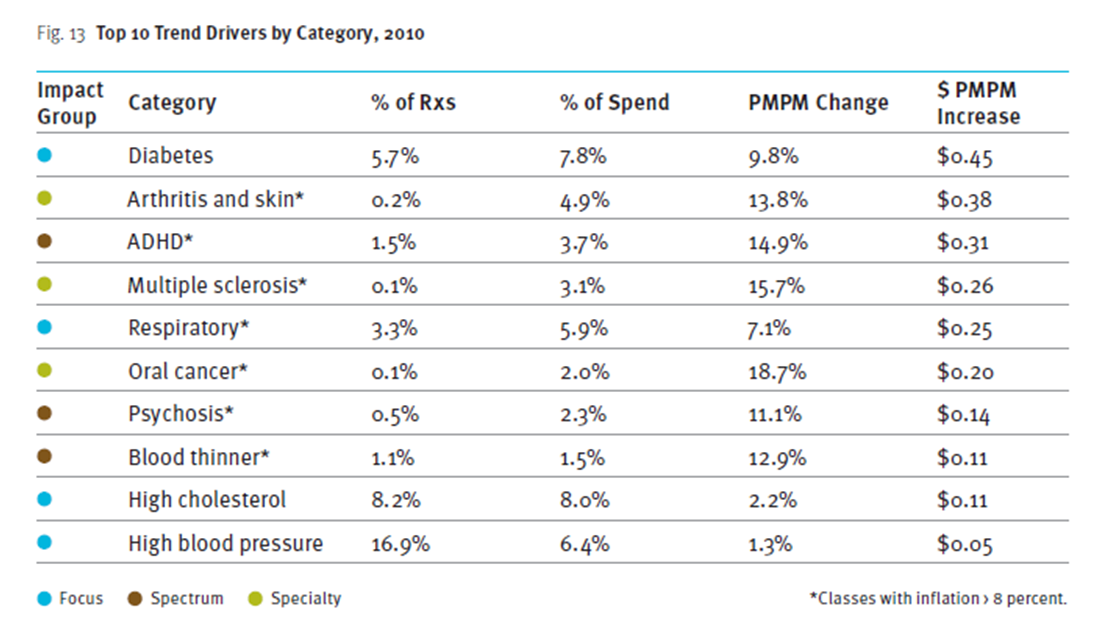
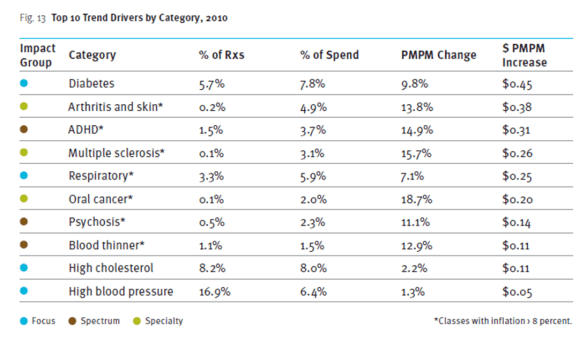
One of those typical charts that we all like to look at shows the drug classes that contributed most to driving trend.
I think their equation about overall cost…

Optimal cost = (medical cost + pharmacy cost) x health outcomes

One of my favorite charts is below which recognizes that there are two cost curves to focus on. The one for the relatively healthy which is often highly pharmacy focused cost versus the chronically ill that drive the majority of overall costs and is heavily medical and specialty medications.

Another study they share in here looks at the likelihood of hospitalization tied to adherence. Very interesting.

$7.60 PMPY savings for a limited network. Those are big numbers that they share from a case study around a client limiting their retail network by excluding one chain.

Their drug trend report looks at another hot topic – 90-day prescriptions. They share their results of a statin study looking at waste in 90-day retail and mail and 30-day retail and estimate the cost impact of the waste.

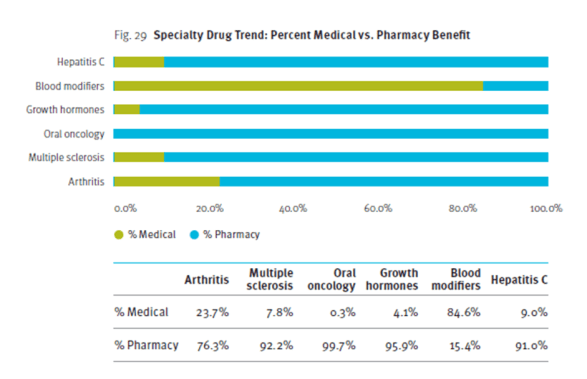
Another hot topic is the mix of specialty drug spend between medical and pharmacy. They share a chart looking at several of the large specialty drug classes.
At the end of the report, they give suggestions to clients on a spectrum of management (low to high). They also predict a few things in the next five years:

  1. A return to double digit trend increases after this generic wave;
  2. A generic fill rate in excess of 90%;
  3. Specialty drugs accounting for 40% of spend;
  4. Healthcare spending will increase 8-10% per year;
  5. The role of genetic testing will be validated; and
  6. Up to 25% of employers will drop benefit coverage.

Walgreens Quote From NACDS As “Community Pharmacy”

While many of us would consider Walgreens as one of the two models of chain pharmacy (with CVS), this quote from one of their executives from the NACDS conference in Boston right now makes it sound like they consider themselves more of a community pharmacy.

“There is no greater value in healthcare delivery than community pharmacy.  When I talk of value, I am not talking just about all that community pharmacists do everyday to help reduce drug spend.  Though that is important, pharmacy’s value goes so much deeper.  It is about community pharmacy – and the expertise of pharmacists – as a true partner in a comprehensive and collaborative approach to healthcare.  It is about improving patient health, while delivering part of the solution to driving down health costs across the spectrum by preventing more costly forms of care.”  Walgreen Co. Divisional Vice President, Government and Community Relations, and 2011 National Association of Chain Drug Stores (NACDS) Pharmacy & Technology Conference Chairman Debbie B. Garza, RPh

Maybe this has been their long-term positioning, but I also wonder if a few events haven’t pushed them from being a mediator in the middle of the industry to taking a more hardline approach:

  • CVS (their competition) buys Caremark changing their retail perspective
  • Walgreens jumping into the direct-to-employer model at Caterpillar with Walmart
  • CVS Caremark and Walgreens network dispute in 2010
  • Walgreens sells their PBM to CatalystRx
  • Walgreens and Express Scripts ongoing dispute

Given the traditional angst between the independents and the PBMs, will Walgreens harden their position to be closer to the independents and what will that mean for the overall industry?

Pharmacy Satisfaction Report

If you haven’t read through the Pharmacy Satisfaction Pulse Report, you’re missing some great information.  There’s not a lot out there about consumer level expectations for pharmacies but this is a good start.  (Full site with other data)

Here’s four charts I pulled out of the report to get you started…These should help you frame messaging around retail-to-mail, 90-day, and pharmacy adherence programs.


Summary Of Drug Trends (Prime’s Report’s Out)

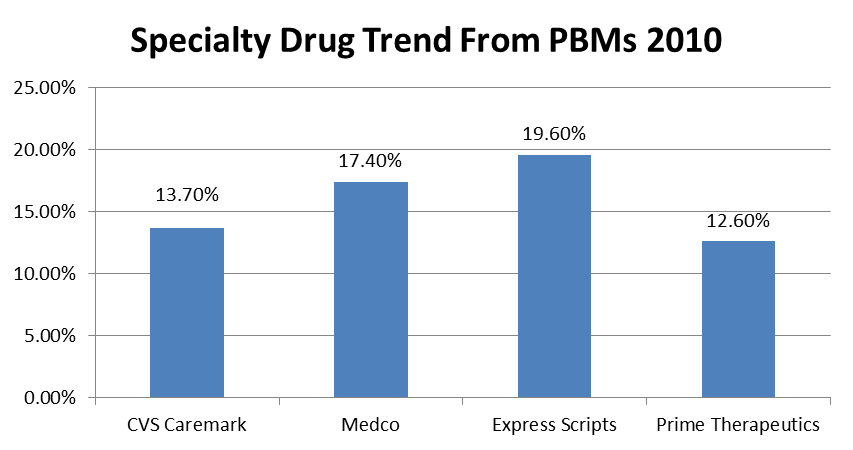
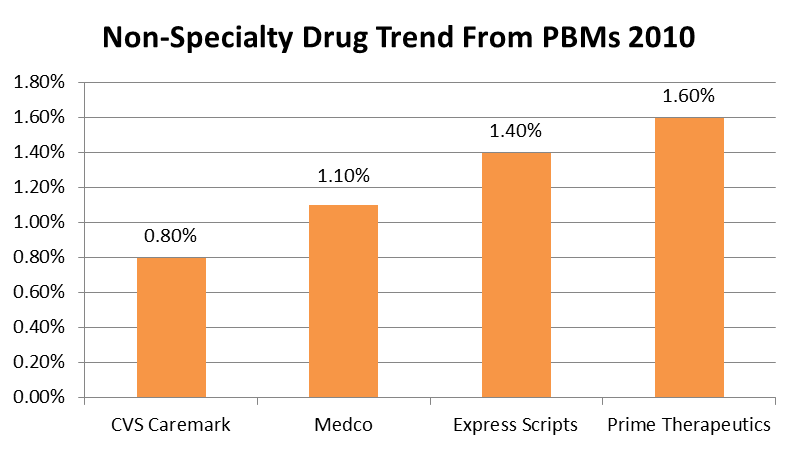
Prime Therapeutics published their Drug Trend Report yesterday.  I haven’t had time to read it yet, but I pulled their total trend numbers and aggregated them into charts with the previously reported numbers from other PBMs.  (As always, you can see detailed summary’s from Adam Fein and I on most of the reports.)

Additionally, here’s a summary from last year.  AND, as always, don’t forget that these aren’t apples to apples.

(NOTE: Lower trend is better implying that the PBM is doing a better job at managing costs for their clients although as I’ve argued there may be some clinical reasons for trend going up that are good – e.g., improved adherence, identification of pre-diabetics, addressing primary adherence.)


Increasing Preferred Pharmacy Usage (3 of 3)

This is the third of three posts on new ideas for increasing usage:
  1. Driving preferred pharmacy usage from the employer site
  2. Using social media
  3. Borrowing from other industries

The idea in all of these was to look at new ways that builds on the standard approach that we work with many clients on today.  And, if you believe that the Express Scripts / Walgreens dispute won’t get resolved, we’re going to see a lot of people using limited or preferred networks very soon.  This is also something that Adam Fein talked about in highlighting some of the progress Wal-Mart is making in this area.

So what are some examples of things we could borrow from other industries?

Referral Program:  Why not offer incentives for people who refer their friends and family into the pharmacy? Wouldn’t this play into the social network or peer-to-peer trends out there?

Satisfaction Surveys:  Why isn’t there more monitoring of the customer satisfaction to look for improvement opportunities?  [Note: I know there is some, but I think it’s under-utilized as a tool.]

Tiered Service Levels:  Frequent travelers get different levels of customer service.  Why don’t high utilizers with lots of co-morbidities and Rxs get a better level of service?

Points:  Why aren’t there more incentive systems and “points” that are used to reward consumers based on share-of-wallet or other metrics?  [I think there may be some legal issues here.]

Online Order Tracking:  Why can’t I watch my prescription being filled and track it around the system online?

Pharmacy Ratings:  Why isn’t there a consumer and business system that ranks pharmacies based on wait time, friendliness of staff, error rates, generic fill rates, overall satisfaction, or other metrics that can then be pushed to the consumers?

Incentives / Coupons: Certainly these have been tried and there are limits here especially in government funded benefits, but it’s still few and far between.

MD Programs: Physicians can certainly influence this decision.  Why isn’t there more effort to differentiate a pharmacy (mail, retail, specialty) by building relationships with high prescribers?

Check-in / Preferences: Why don’t the forms in the physician’s office (or applications) have you select a preferred pharmacy or have a pop-up with a preferred pharmacy in it to drive you there?

Credit: For some people, it’s an issue to front the money for the 90-day supply.  Why haven’t the mail order pharmacies partnered with a credit card company to allow for installment payment?

If you’re going to “win” at this game, you have to think differently.  You have to test and learn.  You have to capture insights from your customers and translate them into product offerings.  It’s not easy.

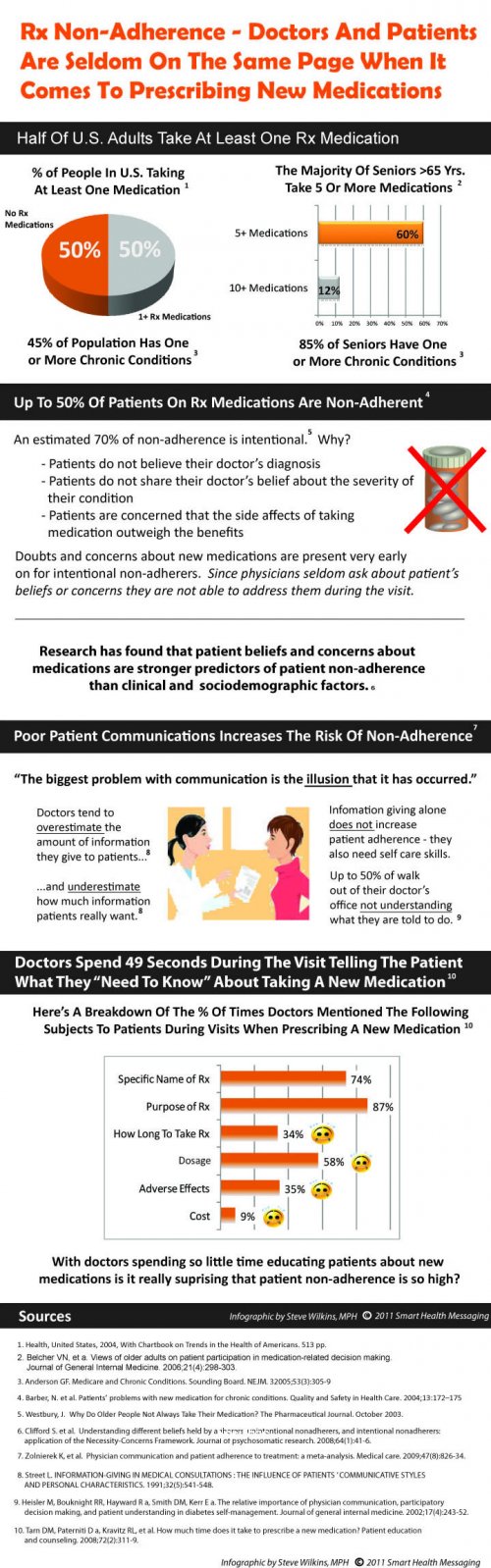
Infographic: MD-Pt Communication Link To Non-Adherence

Within the payer / pharmacy / PBM world, we tend to think of adherence as something that can be addressed by us. What if the problem is more systemic than that? I’m not talking about clinical issues like side effects or even cultural biases.

I’m talking about process related issues that stem from physician and patient interactions. If the patient doesn’t believe the drug will help them and doesn’t understand their condition and their medication, they’re set up to fail.

With that in mind, I appreciated the infographic that Stephen Wilkins (@HealthyMessaging) sent to me earlier today (see below):

Increasing Preferred Pharmacy Usage (1 of 3)

For my purposes, I’m going to define a preferred pharmacy as one of the following:

This is the first of three posts on new ideas for increasing usage:
  1. Driving preferred pharmacy usage from the employer site
  2. Using social media
  3. Borrowing from other industries
For today’s post, I’m going to focus on how a PBM (or retailer) could work with an employer to drive use of a preferred pharmacy.  There are the obvious ways:
  1. Plan design
  2. Incentives
  3. Interventions (letters, calls)
  4. Reminders on the intranet
But, let’s look at a little history of what’s been tried first outside the obvious:
  1. On-site collection boxes
  2. Kiosks
  3. On-site pharmacy
It’s my understanding that Medco used to (or maybe still does) have “drop boxes” at their large employer sites in the HR department for people to drop off prescriptions for mail order.  The employee would drop them off and then they would be FedEx’d to Medco each night.  It’s a nice convenience feature and if promoted probably serves as a good constant reminder.
Another attempt was made by Duane Reade in NY to put kiosks at employer sites and hospitals to capture new prescriptions and allow them to be couriered over to the consumer from their central fill.  It was a good idea, but it didn’t scale well and had limited upside outside NY.
I spent about a year looking at how to blend the Duane Reade model with Redbox to allow for kiosks that could leverage telemedicine and dispense the top 100 SKUs.  A few models of that concept have continued to grow (although slowly).  Instymeds now has 200 deployments (after almost a decade).  I’ve heard about a few others continuing to try also.
You then began to see a spike in on-site clinics where you could see a physician or another medical professional and get a prescription filled.  Again, this works like some of these others in high density areas where there is a population using lots of chronic medications and with the same PBM/insurer.
Now, with technology, is there an easier way?
Why not have a QR Code posted in your HR department or in the physician’s office or on the back of your ID card or some other place.  When the patient gets their new Rx, they can scan in the code and it can do any of the following:
  • Show them a message about considering mail order
  • Trigger an SMS asking someone to call them
  • Send an e-mail requesting a call back about the closest preferred pharmacy
  • Send them a map of the closest in-network pharmacy
  • Link them to a YouTube video on getting started with mail order
  • Or, in the Worker’s Compensation area, it could create a virtual card for the network
We all know that mobile apps in the pharmacy space are “all the rage” although adoption is surely in the 5-10% range (best case).  So, will this make a difference?  Perhaps not today, but it’s a low-cost way of learning about how consumers (especially those working in large, high-tech environments) might engage.  Right now, most companies are in a learning mode.

Why Do We Have Shortages Of Drugs?

The fact that more and more drugs (180 so far in 2011) are out-of-stock or have limited supply should seem crazy to most of us.  We all feel like we pay so much for healthcare and medication and the system is so intelligent that it should be able to estimate supply in a profitable way.

Obviously, something is broken.  (Here’s a good NYTimes article on the situation.)  And, if you need to be more offended yet capitalistically intrigued, you can read about people price gouging on these drugs when they do find them.  (You only hope that people didn’t buy up large supplies to create false shortages to then create high prices.)

While 1/2 the problems are from issues found during the inspection process, the other 1/2 appear to be from business model problems where there isn’t interest (read money) in producing the drug or not enough supply is produced (perhaps due to constant changing of suppliers or the race to the bottom in generics).

So, what will happen?

  • Will the government step in and do something?  [probably]
  • Will the government stockpile drugs?  [maybe]
  • Will the government require early notification of shortages?  [probably]
  • Will anyone address the business model problem?  [maybe but unlikely]
This isn’t different than some of the issues around vaccines.  As it became ultra-competitive and demand was unpredictable, it wasn’t worth being in the business.  (See 2002 report from the Manhattan Institute.)
To understand some of the regulatory reasons for the shortages, I think Alex Tabarrok does a good job here. Separately, you can read the FDA’s perspective on drug shortages here.  Another link is to ASHP where they track the current shortages.
It would be one thing if the shortages were happening around traditional drugs for chronic medications like high cholesterol where it’s easier to find an alternative, but a lot of the shortages are around oncology drugs which are harder to substitute.  And, at least one article I read on the topic talked about people finding difficulty getting the alternative covered.  IMHO – There should be a process by which an override occurs when a drug hits some national list for shortage so people can take an alternative and only have to worry about clinical outcomes or side effects not coverage issues also.

25% of MDs Tell Un-vaccinated Kids To “Get Lost”

Unfortunately, the issue of kids not getting vaccinated is not going away.  While only 1% of infants don’t get any vaccines, there are still 30% of kids who don’t get all the recommended vaccines.

So, what should a pediatrician do about families that don’t get their vaccines?  Should they continue to treat them?  The number that say it’s time to find a new provider has jumped to 25% in 2011 (compared to 18% in 2005) according to research reported in a Time Magazine article.  I’d bet that number might jump further as physicians bear risk or have more money tied up in performance bonuses.

It begs the question of what adults do…For example, with flu shots, do adults get them?  Based on a Consumer Reports study, it’s only about 50% of adults that do.

I have a few older posts on this general topic.  It’s also a very interesting topic in the pharmacy world as retailers focus on vaccinations both as a revenue source and a value-added service.

I also found this infographic on the topic which I thought I would share.

Medical Coding Career Guide
Created by: Medical Coding Career Guide

Engaging The Un-Engaged


One of the hot topics in a lot of healthcare conversations these days is engagement.  There’s the “easy” engagement for the e-patients that are actively involved in their healthcare.  Then there’s the much harder engagement of those that aren’t engaged.  And, finally, there’s the issue of chronic engagement.  I can easily get someone to engage a few times with an incentive or some other “trick”, but how do I get them to stay engaged over time.  It’s not easy.

This is one of the topics that will be discussed at the upcoming Forum 11 in San Francisco.  If you’re coming, look me up.  I’m presenting on Friday.

Large Employer PBM Survey From Barclays Capital

One of the analysts that I follow is Larry Marsh and his team from Barclays Capital.  They put out a lot of great data and information on the industry.  One report that I was reading earlier today is on an employer survey they did of 55 employers representing 1.75M lives.  Medco and CVS Caremark were the largest PBMs in that market segment followed by Express Scripts, Catalyst, and OptumRx.

I was a little surprised that only 76% of the respondents were satisfied or very satisfied with their current PBM.  That’s lower than many studies show.

On the other hand, less than 50% see the proposed Express Scripts / Medco acquisition as driving lower costs (which I generally agree with).

Also, not surprisingly, employer’s specialty trend has been high and 35% of them anticipate it will be higher in 2011.

And, finally, to beat a drum I often talk about…movement to plan designs that support mail or 90-day retail and more use of step therapy are the big changes being made and planned.

Penn And Teller On Vaccinations

This is a video that everyone should share.  It’s a funny, short, and blunt video on why to get your kid vaccinated.

There was a recent article in USA Today about vaccines which said:

Vaccines are widely available across the country, doctors say, and poor children can get them for free. The biggest impediment to vaccinating kids today is not cost, but fear, says William Schaffner, a spokesman for the Infectious Disease Society of America and professor at Vanderbilt University School of Medicine in Nashville. Around the world, millions of parents began skipping or delaying vaccines because of an infamous (and since retracted) 1998 study in the British medical journal The Lancet. The study’s author theorized that a combined measles-mumps-rubella shot caused autism.

It became one of the greatest myths in modern medicine, says Offit, author of Deadly Choices: How the Anti-Vaccine Movement Threatens Us All. He points to nearly two dozen studies showing no link between vaccines and autism. Last year, The Lancet issued the retraction after learning that information had been falsified. British health officials also stripped the study’s author of his ability to practice medicine in England because of professional misconduct.

NY Bill Continues To Stir The Pot – NCPA, FTC

The bill to restrict mail order utilization for pharmacy is not the first attempt, and it won’t be the last attempt by the independents to try to even the playing field with the PBMs through legislation (see comments about KS bill).  If limiting networks (retail, specialty, mail) can lower prices and save consumers and payers money, why shouldn’t they exist?  The payers should have this option in their toolkit.

Here’s the actual text from the bill:

SHALL PERMIT  EACH PARTICIPANT TO FILL ANY MAIL ORDER COVERED PRESCRIPTION, AT  HIS OR HER OPTION, AT ANY MAIL ORDER PHARMACY OR  NETWORK  PARTICIPATING  NON-MAIL  ORDER  RETAIL  PHARMACY  IF THE NETWORK PARTICIPATING NON-MAIL  ORDER RETAIL PHARMACY OFFERS TO ACCEPT A PRICE  THAT  IS  COMPARABLE  TO  THAT  OF THE MAIL ORDER PHARMACY. ANY POLICY WHICH PROVIDES COVERAGE FOR  PRESCRIPTION DRUGS SHALL NOT IMPOSE A CO-PAYMENT FEE OR OTHER  CONDITION  ON ANY INSURED WHO ELECTS TO PURCHASE DRUGS FROM A NETWORK PARTICIPATING  NON-MAIL  ORDER  RETAIL  PHARMACY  WHICH IS NOT ALSO IMPOSED ON INSUREDS ELECTING TO PURCHASE  DRUGS  FROM  A  DESIGNATED  MAIL  ORDER  PHARMACY

Let me make a few comments:

  1. Does this mean that Express Scripts has to let it’s members go to Caremark mail order if they meet their rates?
  2. What does “comparable” mean?  Why isn’t it the same?  Do the independents really want to go to mail order rates?
  3. No more copay differentials?  If this works, pharma should lobby for no more formularies.  (That might not be relevant today, but in the biologics or biosimilars world, they could say we’ll meet the price but you can’t have any copay differentials or utilization management restrictions…AND get it legislated!)

You can see some similar comments on this from Ed Silverman at Pharmalot and Adam Fein at Drug Channels.

As Adam points out, this may even be a leading indicator on how the FTC views the acquisition of Medco by Express Scripts (although the $MHS stock doesn’t reflect that right now).  Here’s what the FTC said in their letter:

FTC staff appreciate that A-5502-B seeks to enhance consumers’ ability to fill their prescriptions at the pharmacies of their choice. We are concerned, however, that the Bill impedes a fundamental prerequisite to consumer choice: healthy competition between retail and mail order pharmacies, which constrains costs and maximizes access to prescription drugs. We are concerned that, in the end, higher costs will lead to higher prices and fewer choices for New York health care consumers. For some consumers, increased costs may mean higher out-of-pocket prices for prescription drugs. For other consumers, it may mean that prescription drug benefits are curtailed or eliminated. Scaled-back drug benefits are likely to create pressing financial concerns for many consumers, and may even lead to additional health problems. As an article in ealth Affairs noted, “when costs are high, people who cannot afford something find substitutes or do without. The higher the cost of health insurance, the more people are uninsured. The higher the cost of pharmaceuticals, the more people skip doses or do not fill their prescriptions.”

As I mentioned in a Pharmacy Times article that I just wrote for their online version, this is a unique time for the independents to try to figure out what to do about consolidation in the industry.  If it’s not Express and Medco, it will be others.  This will look like the wholesaler market sooner rather than later.  It’s time to figure out how to make lemonade here and differentiate their pitch and value. 

In the end, I think you do yourself a long-term disservice to not allow for pricing differentiation within the network based on copays.  I would want to position myself as a higher service pharmacy with greater satisfaction, better medication possession ratio, better outcomes, and therefore become a preferred pharmacy within a limited retail network. 

Storytelling Is A Part of P2P Healthcare

P2P (or peer-to-peer) is a popular topic in healthcare today.  It builds on both the social components of behavioral modification along with the social networking trends.

About one-third of Americans who go online to research their health currently use social networks to find fellow patients and discuss their conditions, and 36 percent of social network users evaluate and leverage other consumers’ knowledge before making health care decisions. Social networks hold considerable potential value for health care organizations because they can be used to reach stakeholders, aggregate information and leverage collaboration.  (from Deloitte study)

One of the biggest researchers out there in this space is Susannah Fox from the Pew Research Center.

Peer-to-peer healthcare acknowledges that patients and caregivers know things — about themselves, about each other, about treatments — and they want to share what they know to help other people. Technology helps to surface and organize that knowledge to make it useful for as many people as possible.  (from recent presentation from NIH – “Medicine: Mind the Gap”)

With that in mind, I found this study from a few months ago about storytelling very interesting.  Imagine the power of capturing stories in some form – DVD, YouTube, written – and sharing them with newly diagnosed patients across an expanded social network.  Imagine helping patients plug into a social network (ala – PatientsLikeMe).

Conclusion:  The storytelling intervention produced substantial and significant improvements in blood pressure for patients with baseline uncontrolled hypertension.

What has really surprised me is that I haven’t seen the large institutional healthcare organizations promoting the use of the social networks.  Maybe I’ve missed it, but I would think they would partner up with a few of these to encourage consumers to use them.  I understand on the one hand that that is “handing off” a patient to a different company, but rather than trying to build their own social networking application, I think they’re better served to leverage what exists.

Pharmacy Costs As A Percentage Of Total Medical Spend

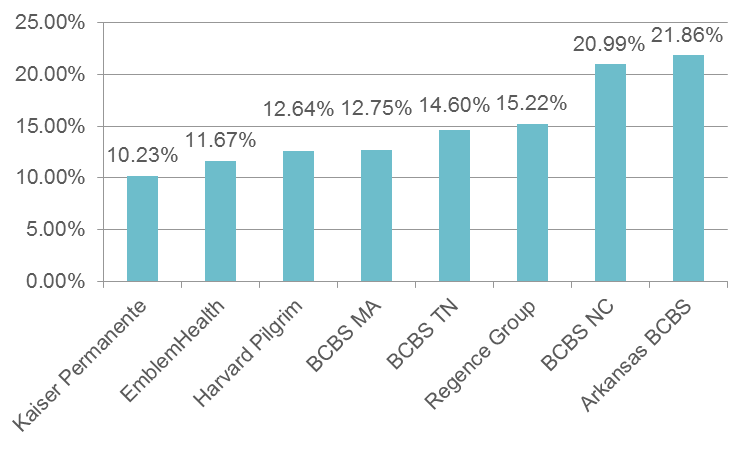
If you look at AIS, they track total annual pharmacy costs for leading health plans.  I pulled a few payers out from the table in the July 22, 2011 Drug Benefit News here to share.  If you exclude two very clear outliers on the low end, they ranged from a low of 9.70% to a high of 21.86%.

Here’s a sample:

A New Life For Lipitor – OTC?

Are you surprised that Pfizer might have found a way to extend Lipitor?  You shouldn’t be.

As I talked about before, Lipitor is scheduled to go generic later this year.  Now, there are stories that Pfizer may try to take Lipitor over-the-counter (OTC).  As Ed Silverman (Pharmalot) points out, this has been tried before with Mevacor.  Has anything really changed since then?  I don’t know much about any outcomes from the UK’s allowance of Mevacor to be sold BTC (behind-the-counter), but it would be a good point of information.

The prior questions about consumer behavior with an OTC statin all still apply:

  • Will the right people use them?
  • Will there be over-use?
  • Will this create unnecessary risks?
  • Will people monitor themselves appropriately?

Since statins certainly have side effects, this is a real question.

IMHO – I would think an OTC strategy is a low likelihood unless there is some new data.

On the other hand, with home monitoring of cholesterol tests, there have been some changes.  This might be another source of data.  Who’s using these?  Have they impacted their use of medication?

Why The Express Scripts Medco Deal Is Good For CVS Caremark?

I think several people have talked about this, but I figured I would weigh in. There are several reasons why the people at CVS Caremark should be excited about this deal (recent WSJ story):

  1. DistractionExpress Scripts now has both the Walgreens contract and the Medco acquisition and then potentially integration to distract them for the next 18 months.  (Although Express Scripts is very good at integrations once approved.)
  2. Validation – The fact that Medco which was once the biggest PBM could suffer multiple losses and end up selling validates that a standalone PBM model faces real long-term challenges.  (Although Express Scripts continues to prove me wrong from a stock perspective.)
  3. FTC – IMHO this should decrease pressure on CVS Caremark since the FTC (and retailers) will be focused on this acquisition and if completed, would create a similar size entity to CVS Caremark.
  4. Walgreens – As long as there is a contentious relationship between Express Scripts and Walgreens, they need CVS Caremark as a negotiating option.
  5. Assets and Talent – Depending on how the acquisition plays out, there might be assets which are sold, and there certainly will be lots of talented people on the market (although some may just take the money and run). 

I guess the key question is whether scale will allow an Express Scripts / Medco combined entity to drive price down dramatically as some think.  I think scale will lower prices, but IMHO I think there is limited savings. The reimbursement rate to retailers can only go so low. The acquisition price from wholesalers and generic manufacturers can only go so low. The rebate dollars from pharma can only go so far before they pursue other options (i.e., copay cards).  [This is the point I made in my whitepaper back in January and in the previous one about commoditization of the industry.]

I think the CEO of Burchfield Group makes some relevant points in this YouTube video:


[Disclosure: I do own CVS Caremark shares that I have bought and held over the past 18 months.]

Two New Mail Order Pharmacy Studies

There were two new mail order pharmacy studies that were recently published.  If you’re in the PBM / pharmacy space, you’ll want to dig into both of these.

The first one is from Kaiser which looked at outcomes for patients on cholesterol lowering medications based on their use of mail order or retail pharmacies (both of which are part of Kaiser).  This study builds on their study last year which looked at medication possession ratio differences between mail order and retail.

After adjustment for demographic, clinical and socioeconomic characteristics, as well as for potential unmeasured differences between mail-order and in-person pharmacy users, 85 percent of patients who used the mail-order pharmacy achieved target cholesterol levels, compared to 74.2 percent of patients who only used the local Kaiser Permanente pharmacy.  

Separately, there was a study published on adherence based on whether mail order was a requirement or a choice.

Pharmacy benefit designs dictate pharmacy access, drug cost, and formulary coverage and thus are an important public health tool with the potential to improve population health. Offering a mail-service pharmacy option is an important benefit design tool that helps to control pharmacy costs and may facilitate medication adherence among those who successfully transition to 90-day-supply prescriptions. However, restricting pharmacy choice by requiring the transfer of prescriptions from retail to mail-service pharmacy causes some members to discontinue therapy early. When members choose to eschew therapy rather than switch to a lower cost alternative, the unintended consequence is a reduction in medication adherence and the potential for increased medical expenses.

While one might see a contradiction between the two and prior studies, I think the point is that 90-day prescriptions do appear to increase adherence even after adjusting for many factors.  BUT, if you require people to move to 90-day especially at mail, it’s important to have a clear transition path for them so that they (a) understand their benefit; (b) realize how to move; and (c) don’t end up simply missing refills or stopping therapy.

Largest PBMs By Covered Lives

The covered lives calculation is a little funny since a “life” can be counted by multiple PBMs.  For example, look at the Federal Employee Plan (FEP) contract which until recently was split between Medco and CVS Caremark and therefore counted by both (I assume).  But, it is a measure that is used none the less.  [Another way is based on claims processed.]

So, what I did is take the numbers from this chart on the PBMI website and make the following adjustments:

  1. I focused just on the large PBMs that provide a full suite of services (to my knowledge) and were on this original list which excludes some such as Navitus or WelldyneRx.
  2. I added the Express Scripts and Medco lives together.
  3. I subtracted 10M for the United Healthcare (UHG) contract at Medco and moved those to Prescription Solutions (now called OptumRx).  (acknowledging that this doesn’t happen yet)
  4. I subtracted 8M for the FEP loss for Medco recognizing that those don’t show up at CVS Caremark since they would already have been counted there on the retail contract.
  5. I added together the CatalystRx and Walgreens lives from their deal earlier this year.
  6. I noted that Humana’s lives are counted under the Argus number.
With that, I get the following lives count and percentage marketshare (of the companies listed).

Medco And Express Scripts Specialty Share Could Top 50%

Express Scripts buying Medco – This is still the big topic of discussion (see original comments with links added since I was on vacation last week with no wireless access).  The question of course begins to shift to the FTC approval.  According to one report out, one analyst estimated that the combined entity would have 30-35% of the PBM market in terms of script volume, and they estimated what the Herfindahl-Hirschman Index would say about market concentration post merger – heavily scrutinized but not a big issue.  I would agree from a claims perspective that this probably won’t be an issue.

I’ve only seen one analyst bring up the issue of mail order concentration which Medco has always led in.  I’m not sure this will be a sticking point since mail is still typically optional.  Where I would be interested in seeing the HHI would be in specialty.  Given that 28% of the time only one specialty pharmacy (SP) is contracted with and 57% of the time it’s 1-2 SPs, this seems like a bigger area of focus and potential control.  (per EMD Serono Specialty Digest)  It’s also clearly the future of the pharmacy and PBM market. 

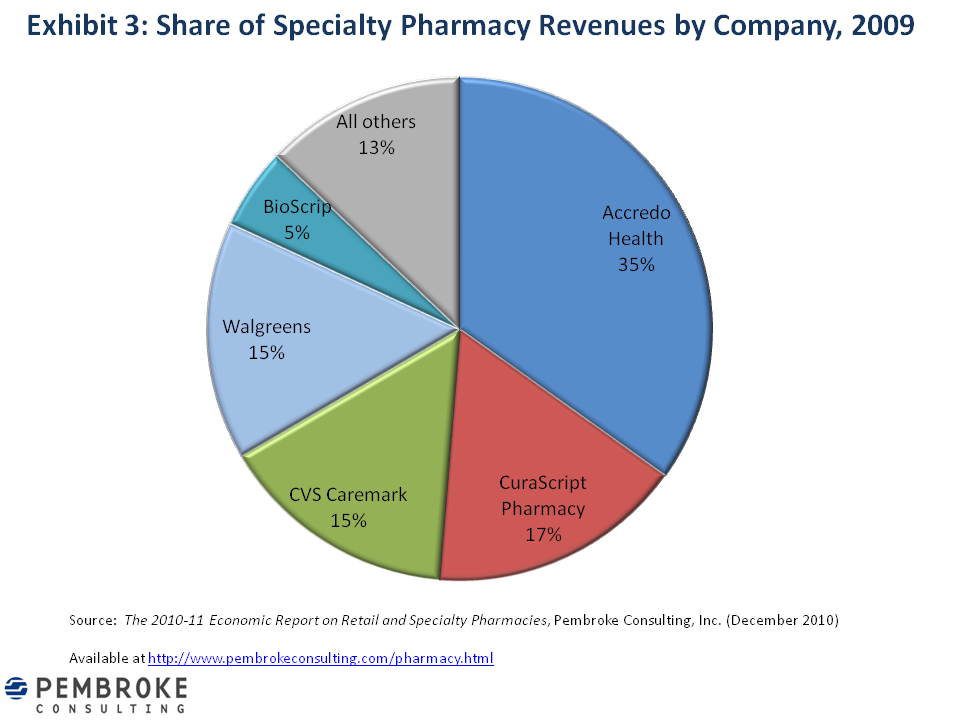
If you use Adam Fein’s estimates from his 2010-11 Economic Report on Retail and Specialty Pharmacies, the combined Curascript and Accredo market share would be somewhere around 52% which would seem high for one entity.  [I’m sure Walgreens or CVS (among others) would be happy to buy some of their specialty assets if that made the deal more likely.]  More to come as I catch up.