Archive | Research RSS feed for this section

The Value of the Family Dinner

Studies have shown that kids who eat dinner with their families do better in school, feel more socially connected to their parents, have better peer relationships, and are less likely to try drugs and alcohol.

Wow! That quote from Grace Freedman at eatdinner.org certainly makes a compelling case. The article in Spirit magazine (Jan 2012) goes on to say that according to a 2010 Pew Research poll only about half of families make dinner a daily ritual and roughly 20% eat together only occasionally or never.

It certainly is a challenge with long workdays, commutes, travel, and kid activities.

Who’s the 1% in healthcare?

As we all have known, healthcare costs are driven by the minority. According to the Agency for Healthcare Research and Quality, the top 1% account for 22% of healthcare spending in the US or about $90,000 per year. (USA Today article)

So, what are the characteristics of these people:
– White, non-Hispanic
– Female
– In poor health
– Elderly
– Users of publicly funded healthcare

Only about 20% of the high cost consumers stay in that bucket for two straight years…which I think is good. But, I guess you have to look at what percentage die during that period since a lot of costs are concentrated at the end-of-life.

Obviously it’s critical to develop solutions to engage and manage these patients earlier in the process. As data gets better, our predictive algorithms around conditions will improve and we’ll be able to intervene and prevent or delay cost in the system. The key of course is doing that in a way that fully engages the healthcare team and the caregivers.

Only 2 of the top 25 “Companies for Leaders” from Healthcare

I don’t know about you but given the focus on healthcare and the percentage of our GDP that it consumes I had hoped this would be higher. 

According to Fortune’s rankings (published 11/21/11), the top 5 companies were:

  1. IBM
  2. General Mills
  3. P&G
  4. Colgate-Palmolive
  5. McDonald’s

Eli Lilly was ranked 12th, and UnitedHealth Group was ranked 20th.

Medicare and Medicaid Social Media Use For Healthcare

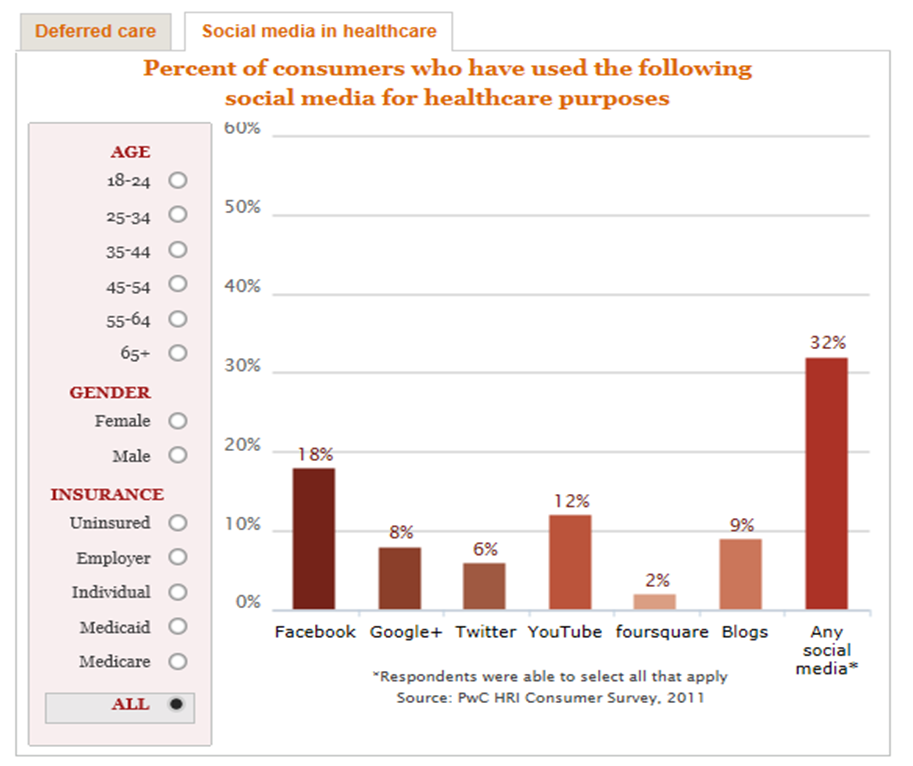
As people look at ways to engage the Medicare and Medicaid populations, I continue to talk about the facts from the Pew research that shows how these demographics use technology.  I was glad to see some research from PWC that also reinforced this.  As you can see in the three charts below, the Medicare population uses technology similar to the average respondent while the Medicaid population uses social media for healthcare more. 

Why We Need Recess At Work

More exercise = higher GPAs

More activities = better grades especially in math, English, and reading

Exercise = greater productivity and less sick days

Physical activity = increased blood flow to the brain fueling memory, attention, and creativity

Physical activity = hormones that improve mood and suppress stress

Any more information needed?

I was reading an article about research into why recess is important for kids in school.  I couldn’t agree more, but it got me wondering about the need for running clubs and other fitness breaks within the corporate work day.  I’m pretty sure  working through lunch and eating at your desk doesn’t help.  On the flipside, I’m not sure if fuzzball tables and other “dotcom” activities meet the activity level.

Food for thought…and of course this doesn’t account for potential hard dollar savings associated with better health and lower healthcare costs.

Will Patient Reported Data Augment Claims Based Models?

On the one hand, it seems fairly obvious that patient reported data (use of OTCs, exercise, food intake) is important in understanding their healthcare.  On the other hand, the historical bias has been to use historical claims to predict future costs.  At a minimum, I think that studies around tools like PAM (Patient Activation Measure) have shown that patient reported information is important in understanding their literacy and attitudes on healthcare.  This data is critical in designing effective healthcare engagement programs.  [One of the reasons that Silverlink has stressed our focus on using data for segmentation and personalization for years.] 

That’s why I found one of the latest studies by Kaiser to be really important.  They used both claims data and patient reported data to evaluate inpatient admission rates and costs.  And, as explained below, this data increased the predictive power of their model. 

The research determined that self-reported information about being in poorer health was a key determinant in predicting higher inpatient admissions and for being in the top tier for costs. Higher admission rates and costs were associated with patients who self-reported:

  • Lower score for general self-rated health
  • Yes to “do you need help with one or more activities of daily living?”
  • Yes to “do you have a bothersome health condition?”

The addition of this self-reported information to a claims history model explained an additional 2.8 percent of variance in admissions and 4 percent in cost.

Good Health Is More Than Skin Deep

In the July 11th Time Magazine, there was a small article which I think made a great point – you can be lean and still be at risk for heart disease and diabetes due to fat.  What you can’t tell by weight and appearance is the person’s genetics.  Apparently, international researchers have found a specific variant of a gene that regulates where and how fat is stored.  People with the “lean gene” were storing fat deeper in the body around organs and in tissues.  This visceral fat is more dangerous and can impair bodily functions. 

So…the key point is that even healthy looking people need to monitor their cholesterol and glucose levels.  (I guess those advertisements for high cholesterol drugs were right!)

Infographic: New Year’s Resolutions

I’m not a big New Year’s Eve fan.  I much rather start the new year refreshed and beginning to think about my goals for the next year.  While I used to do a very rigorous 1, 3, 5, and 10-year plan every New Year’s Day, I’ve been a little slack lately.  I’m going to try to be better this week and at least get some 1 and 5-year personal and professional goals captured. 

With that being said, I liked this infographic from visual.ly.  It’s relevant if you think in terms of prescription adherence. 

RWJF Guest Post: Interprofessional Collaborative Care Will Be Key to Meeting Tomorrow’s Health Care Needs

Guest Post by Maryjoan Ladden, Ph.D., R.N., F.A.A.N., Robert Wood Johnson Foundation Senior Program Officer

Maryjoan Ladden, PhD, RN, FAAN, is a senior program officer at the Robert Wood Johnson Foundation.  A nurse practitioner whose work has focused on improving health care quality and safety through health professional collaboration, her work at the Foundation addresses: faculty recruitment and education to increase the capacity of nursing programs; developing collaborative partnerships to address local nursing issues; creating the next generation of academic nurse leaders; and building senior executive leaders in nursing. She also is senior editor for the Foundation’s quarterly publication, Charting Nursing’s Future.  (full bio here)

A little over a year ago, the Institute of Medicine’s landmark Future of Nursing: Leading Change, Advancing Health report put forward a series of recommendations for transforming the nation’s health care system. Among them was a call for a system in which “interprofessional collaboration and coordination are the norm.” That’s no simple assignment in a system that often operates in silos, from schooling through practice. But a number of innovators around the nation are already making headway.

Their work is the subject of a new policy brief from the Robert Wood Johnson Foundation, part of its Charting Nursing’s Future (CNF) series. The brief delves into what the IOM recommendation means for health care systems, offers case studies of several collaborative care models already in place, and examines the implications of the recommendation for how we train nurses and other health care professionals.

According to the brief, Implementing the IOM Future of Nursing Report–Part II: The Potential of Interprofessional Collaborative Care to Improve Safety and Quality, the “silo” approach must soon give way if we are to meet coming health care challenges. For example, chronic conditions are increasingly common—not surprising given an aging population. But the health care system is poorly structured to provide the sort of coordinated care and preventive services needed to give these patients quality care while reducing costs.

Some health care institutions are gearing up for the challenge.

  • In Boston, where Harvard Vanguard Medical Associates developed its Complex Chronic Care (CCC) program, primary care has become interprofessional, collaborative and noticeably more efficient. Each CCC patient is assigned a nurse practitioner (NP), a registered nurse with advanced education and clinical training. The NP consults with all the patient’s subspecialists and incorporates their guidance in a single plan of care. The NP then manages and coordinates that care, connecting patients to nutritionists, social workers, and other professionals as needed. The model is dynamic, allowing patients to meet more or less frequently with the NPs and their primary care physicians, who remain responsible for the patients’ overall care.
  • In New Jersey, the Camden Coalition of Health Care Providers is “revolutionizing health care delivery for Camden’s costliest patients,” according to the brief. These individuals, sometimes called super utilizers, typically rely on hospital emergency rooms for care. Not surprisingly, such patients account for an outsized share of local hospital costs, often with diagnoses that would have been more properly handled in a primary care setting. The Coalition developed its Care Management Project to reduce these unnecessary emergency room visits by treating patients where they reside, even when that means treating them on the street. A social worker, NP and bilingual medical assistant work as a team to help patients apply for government assistance, find temporary shelter, enroll in medical day programs and coordinate their primary and specialty care.

Training the Next Generation to Collaborate

Of course, the silo effect usually begins in school. In May 2011, six national education associations representing various health care professions formed the Interprofessional Education Collaborative (IPEC) and released a set of core competencies to help professional schools in crafting curricula that will prepare future clinicians to provide more collaborative, team-based care.

Such efforts are already under way at a number of institutions.

  • Maine’s University of New England has developed a common undergraduate curriculum for its health professions programs in nursing, dental hygiene, athletic training, applied exercise and science, and health, wellness and occupational studies. The curriculum includes shared learning in basic science prerequisites and four new courses aimed specifically at teaching interprofessional competencies.
  • In Nashville, Vanderbilt University is also pursuing an interprofessional education initiative that unites students from the medical and nursing schools with graduate students pursuing degrees in pharmacy and social work at nearby institutions. Students are assigned to interprofessional working-learning teams at ambulatory care facilities in the area.
     
  • The Veterans Health Administration (VHA) is piloting an interprofessional initiative, as well, focused on preparing medical residents and nursing graduate students for collaborative practice. As part of the initiative, five VHA facilities have been designated Centers of Excellence and received five-year grants from the U.S. Department of Veterans Affairs. Each VHA Center of Excellence is developing its own approach to preparing health professionals for patient-centered, team-based primary care.
     
  • In Aurora, Colorado, the University of Colorado built its new Anschutz Medical Campus with the explicit objective of creating an environment that promotes collaboration among its medical, nursing, pharmacy, dentistry and public health students. It features shared auditoriums and simulation labs, as well as student lounges and other dedicated spaces in which students from different professions can pursue common interests such as geriatrics in a collaborative fashion.

Such initiatives are clearly the wave of the future, if only because the pressures of caring for a larger, older and sicker population of patients in the years to come will drive efforts to identify efficiencies. In the words of Mary Wakefield, PhD, RN, head of the Health Resources and Services Administration, “As the health care community is looking for new strategies and new ways of organizing to optimize our efforts—teamwork is fundamental to the conversation.”

Sign up to receive future Charting Nursing’s Future policy briefs by email at www.rwjf.org/goto/cnf.


Smoking is an easy target for lowering healthcare costs

These statistics from the CDC really paint the picture…

– Smoking is estimated to cost businesses over $170 billion a year.
– Every smoker on the payroll is costing the company more than $3,500 annually in increased health insurance premiums, increased absenteeism and lost productivity.
– Smokers take, on average, 6.5 more sick leave days a year than non-smokers.
– Smokers cost 35-50% more to insure, a figure which is increasing rapidly as healthcare costs spiral.
– On average, up to 40 minutes of the working day is spent on smoking breaks, which equates to 21 working days of lost productivity per smoker per year.

This is certainly why you see companies trying to avoid hiring smokers. For those that show pictures of them smoking on Facebook or in other social media channels, this might be a risk (although I’m not sure if it’s legal to use that).

Live Longer By Being Optimistic!

While occasionally optimism can get you in trouble by being too trusting, I think it’s generally a better way to live. But, I still wonder why so many people can be overly optimistic about things like the lottery. Why do we all believe we can win when we’re more likely to get struck by lightning?

In healthcare, this means that we might overestimate our likelihood of getting better, not getting sick, or minimizing the risks of a surgery or medicine. “That will never happen to me.” According to an article about The Optimism Bias by Tali Sharot, people may get pessimistic about the broad economy but their private optimism stays very high.

For example, one study he mentions showed that cancer patients who were pessimistic were more likely to die within 8 months than optimistic patients. There was another article earlier this year about the impact of optimism on outcomes.

Another study talks about priming participants with key words such as smart and clever versus stupid and ignorant and comparing how they perform on a test. Guess what, the positive reinforcement led to better scores. (Why to pump your kids and co-workers up with positive self-esteem.) Perhaps, most importantly, the brains that expected to do poorly didn’t trigger responses to learn from their mistakes while the other participants did.

A few data points from the article:

  • 10% of Americans expect to live to be 100…while only 0.02% do
  • 0% of people getting married expect to divorce…but we know the numbers here
  • 93% of people believed they were in the top 50th percentile for their driving ability
  • www.bestautolenders.com

Barrett Toan To Speak At PBMI Spring Conference

Barrett Toan who was the motivating force behind building Express Scripts has been gone for since 2006 when he stepped down as Chairman of the board.  He is now the chairman of Sigma Aldrich here in St. Louis and active in other pursuits.  I was excited yesterday when I heard from Brenda Motheral, the Executive Director at PBMI, that Barrett had agreed to speak at their conference (register here). 

While I never got to work with Barrett as closely as I would have liked to, I was on several projects with him.  I was always amazed by both his passion for the industry and the patient along with his ability to move from both the macro-vision to digging down into the details.  It should be fascinating to hear his view on where the industry is today and all the changes that have happened.

And, that should add to the agenda they already have which includes Gilbert Welch, the author of Overdiagnosed, Kjel Johnson from Magellan, Stacy Dow from Whirlpool, and Dr. Troy Brennan from CVS Caremark

The focus of the agenda this year is on specialty which is obviously front and center for all of us.  The one concern that I have had in the past was around attendee mix.  It always seemed like the PBMs talking to each other, but Brenda told me that so far ~75% of the registrants are plan sponsors and that the actual number of plan sponsors registered already exceeds last year.  This would be a big and very positive change. 

Brenda also mentioned several other key topics – 340B, MTM, eRx, generics, consumerism, OTC, and Rx and Dx integration.  Of course, I’m sure there will be discussion from their survey which I reviewed earlier, and they will be releasing their new specialty survey at the event.  I’m planning to attend, and I hope to see you there.

Cost and Outcomes Drive Better Use of Data

Overall, I would describe healthcare companies as trying to figure out how to drive the best outcomes at the lowest cost while maintaining a positive consumer experience.  This isn’t easy.  One area of opportunity that companies increasingly look at is how to use data to become smarter. 

  • Can I build a predictive model of response curves?  Who’s likely to respond?  Who’s likely to take action?
  • Can I develop a segmentation model that works?  How will I customize my communications after the segmentation?
  • Can I rank and prioritize my outreaches?  Should I do that based on risk or based on potential value? 

Ultimately, I think this is driving companies to be a lot smarter and to look at how they use both medical and pharmacy data.  For example, I’ll point to both CVS Caremark and Prime Therapeutics in press releases from earlier this year. 

“The ActiveHealth CareEngine offers evidence-based information that can be used to improve the health care of our members and enables us to take our programs to the next level by seamlessly incorporating medical data,” stated Troyen Brennan, EVP and chief medical officer of CVS Caremark. “This agreement will enhance our existing programs to identify issues related to gaps in care, potential drug-to-drug interactions and duplicative care — information that is important to bring to the attention of the member’s physician.”  (article that this is sourced from)

Smart use of medical and pharmacy data is one of the most powerful tools we have to improve outcomes and increase value for our members and clients,” said David Lassen, PharmD, Chief Clinical Officer at Prime. “Through ongoing partnership with health plan clients, Prime is uniquely positioned to view the entire spectrum of patient care, and we can leverage that information to help manage cost and to improve outcomes. We are very excited to collaborate with Corticon on the development of this clinical platform.” (press release)

The next step will be to integrate PRO (patient reported outcomes) from sources like connected devices and PHR (personal health records) that might show blood pressure, workouts, calories, or other data points that could help companies determine when to intervene and how to add value to drive an outcome.

Additionally, another key is continued work in the outcomes-based contracting world and bonus areas such as Star Ratings where the financial value is tied in the short-term to outcomes.  This creates a burning platform for smarter use of data and use of a broader set of data to understand and impact care.

Medicare Patients Save $1.5B on Rxs!!

Now, here’s a great story.  This may be one of the best government success that I’ve heard about in what I think of as a collaboration of the government with multiple businesses.  (Although I think this is a lot more of what HHS is doing these days under Todd Park’s guidance.)

According to USA Today this morning, more than 2.65M Medicare recipients have saved an average of $569 per person this year based on addressing the donut hole with a 50% discount on the brand drugs filled during this time.  And, the average premium for 2012 is actually LOWER than the premium in 2011 (by $0.76 per month). 

The other part of the article is about the potential value of preventative care and leveraging this as part of the Medicare benefit.  The key here is engagement of the participants to help them understand and take action on their healthcare.  The power of the consumer in driving healthcare costs and outcomes is significant which is a topic that I know was discussed by several people today at the mHealth event in DC.

Is “Gluten Free” A Diet?

We’ve all seen it over the past few years. More and more foods have the label “gluten free” on them. For the 1% of the population with celiac disease and others with some gluten sensitivity, this is great. But, since only 8-12% of the purchases of these products are made by people with gluten intolerance, what’s the reason for the purchase?

46% of people bought them because they thought they were healthier and 30% bought them to help them manage their weight. And, with this being a $2.6B market, everyone is jumping on the bandwagon.

The key question is whether this lives up to expectations. It seems the short answer is no.

“If you avoid only gluten, you will likely be getting more calories with few nutrients.” Dr. Stefano Guandalini, founder and director of the Celiac Disease Center (Time Magazine article)

You can see more about the FDA’s proposed labeling on gluten free here.

Managed Care Digest Sample Diabetes Reports

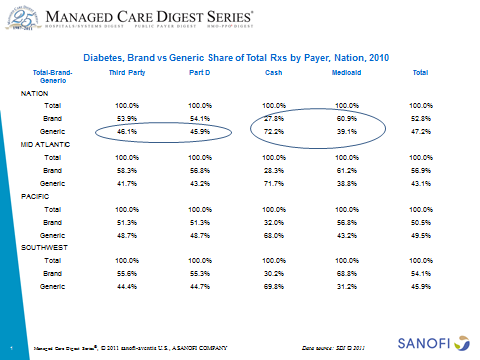
Sanofi sponsors the Managed Care Digest Series.  I was looking at some of their data last night, and I thought I’d share two sample reports looking at diabetes retail pharmacy claims.  A few things that this quick use of the tool shows you are:

Looking at the Brand and Generic mix of diabetes drugs based on payer, I notice 3 things:

  • No significant geographic variance based on looking at a few regions
  • People who pay cash are much more likely to choose generics while those with limited difference in copays (Medicaid) are more likely to choose brands
  • Not a significant difference between Medicare and Commercial

In another view of the data, I looked at the brand and generic mix by age.  Interestingly, it shows differences by geography especially in the younger ages.  It also shows a clear correlation of age and generic utilization.

Text4Baby Learnings About Flu Shots And More

Here’s a slide presentation from the Text4Baby team that they presented yesterday.  This has been one of the biggest SMS programs in the country and has gotten a lot of press.  They did a survey of people about their plans to get flu shots and also share some other data and plans.

IDC On Personalized Medicine

I was reading the IDC Health Insights newsletter this morning where they had an article by Dr. Alan S. Louie on personalized medicine.  While this was a hot topic in the PBM world 12-18 months ago, I’ve heard much less about it lately.  I thought it made sense to share one paragraph from his article here.  I hope that his predictions for delivery of this evidence-based approach to care come true and can be delivered in a cost-effective way to consumers with physician buy-in and understanding about how and when to use this information.

“I believe that the FDA is likely to be significantly marginalized as a major player in the transformation to a more personalized care scenario. While still rigorous in their role as gatekeeper to ensure that drugs are safe and effective, the ability to apply growing genomics, EMR, and CDSS data and knowledge to routine medical treatment is likely to be executed outside of FDA purview. If the FDA decides to lay down the heavy hand and demand that all testing be FDA approved, then all bets are off and medical innovation will be delayed by at least 10 years or more. With payers, clinical laboratories, and others (e.g., PBMs) all buying genomics testing capabilities, it becomes increasingly possible to deliver the latest genomics insights to the point of care and amortized over large patient populations, recognizing that what are probabilities for the individual become real outcomes for portions of patient populations. Net improvements in patient outcomes become real and avoidances of treatment with little or no likelihood of success reduce both wasted efforts and unnecessary adverse drug exposure.”

Visiting With My Relative With Alzheimer’s & Some Disease Facts

I remember when my relative first started to show signs of having Alzheimer’s.  It was 1996, and I was visiting them while I was interviewing for a job.  I hadn’t been around a lot of people with Alzheimer’s at the time, and I remember calling my parents to discuss what I thought was strange behavior for someone who was relatively young (late 50’s).

Since then, I’ve known several other people with Alzheimer’s.  This year, I drove my relative home from Thanksgiving dinner, and it was the first time that I’d heard her discuss Alzheimer’s with me.  I know there are a lot of caregivers out there who deal with this everyday, but it gave me a brief appreciation for the challenge.

She’s on a pretty short loop where she would ask me about where she was (my parent’s house), where they live, where I live, and whether I have any kids (who are in the car).  This cycle repeats every three minutes for about 40 minutes.  On the one hand, I’m amazed that she hasn’t gotten too bad after 16 years with the disease.  I’m also amazed that she always recognizes me.  I was initially afraid that she would panic halfway through the ride and not know who I was.

On the flipside, while you can have a brief conversation, you know that it will repeat itself shortly.  I guess I always hoped that as the disease progressed that the patient would be oblivious to it.  Then, she started talking about her disease and how she’s prayed to God for years to take her before the condition got any worse.  That was hard to hear.  It’s sad to hear someone talk like that, but I know her quality of life has to be much different than it once was.

It made me appreciate the day-to-day challenges of caring fulltime for someone with Alzeimer’s and the need for us to find a cure or even a way to prevent or slow the disease.

Additionally, after visiting the Alzheimer’s Association website, I thought I’d share a few of their facts:

  • Today, 5.4 million Americans are living with Alzheimer’s disease – 5.2 million aged 65 and over; 200,000 with younger-onset Alzheimer’s. By 2050, as many as 16 million Americans will have the disease.
  • Two-thirds of those with the disease – 3.4 million – are women.
  • Of Americans aged 65 and over, 1 in 8 has Alzheimer’s, and nearly half of people aged 85 and older have the disease.
  • Another American develops Alzheimer’s disease every 69 seconds. In 2050, an American will develop the disease every 33 seconds.
  • Most people survive an average of four to eight years after an Alzheimer’s diagnosis, but some live as long as 20 years with the disease.

What’s A PAM Score?

PAMTM is the Patient Activation Measure which was developed by Dr. Hibbard, Dr. Bill Mahoney, and colleagues. It helps you gauge how much people feel in charge of their healthcare. To find out more, you can go to InsigniaHealth’s website.

Given the focus on health engagement across the industry these days, I think this is an important tool to consider. It’s been used broadly and has been validated in a lot of published studies. The questions lead people to be assigned to one of four different activation levels.


You can collect and use the PAM score for segmentation, developing customized messaging, measuring program success, and/or identifying at risk populations.

A few other interesting points from one of their FAQ documents were:

  • Patients who are more activated are more likely to adopt positive behaviors regardless of plan design.
  • People with higher activation levels are more likely to choose consumer directed plans.
  • People with low activation often feel overwhelmed with the task of taking care of themselves.
  • You increase the level of success in by breaking down change into smaller steps where the consumer has a greater likelihood of success.

Which PBMs Have The Highest Mail Order Penetration?

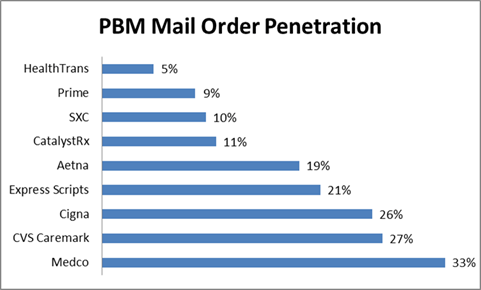
I was looking at some data from earlier this year (Q1 – 2011) from the AIS quarterly survey of PBMs. I thought this was a nice summary of mail order penetration by PBM. As you can see, it identifies some areas of opportunity:

  • Will Express Scripts’ mail penetration go up with the potential acquisition of Medco? Or, will Medco’s go down?
  • Will anyone be able to match the Medco mail penetration?
  • Will Aetna’s mail penetration go up to the CVS Caremark penetration rate?
  • How will Prime Therapeutics, SXC, and CatalystRx increase their mail penetration?

Overall, the mail penetration of the industry has dropped to 16.3% which is the lowest it’s been since 2004 when it was 12.9% (according to AIS). [Note: These are based on adjusted Rxs.]

HPV Shots Are Not Just For Girls

HPV (human Papillomavirus) infects 6M people a year.  Based on a chart from USA Today on 10/26/11, the annual cases of HPV-related cancers are:

  • 12,200 Cervical
  • 7,100 Throat / Tongue / Tonsil
  • 4,200 Anal
  • 1,500 Vulvar
  • 500 Vaginal
  • 400 Penile

About a month ago, a federal advisory panel recommended that all 11-12 year old girls AND boys should be routinely vaccinated against HPV.  This requires 3 shots which cost about $100-$130 each.

Based on data from the article, only 44% of girls have received the first shot and only 27% have received all three shots.  Only 1.5% of boys have historically been vaccinated according to the CDC.

You can find out more on the Kaiser site about HPV.  This is an educational issue, a compliance issue, and ultimately there is a need to get people who start the vaccination process to finish the process.

Reprint: Getting Aligned For Consumer Engagement

(This just appeared in the publication by Frost  & Sullivan and McKesson called “Mastering the Art and Science of Patient Adherence“.  It was written by me so I’m sharing it here also for those of you that don’t get that publication.)

According to the 15th Annual NBGH/Towers Watson Health Survey, employees’ poor health habits are the number one issue for maintaining affordable benefits. Since studies have shown that 50-to-70 percent of healthcare costs are attributed to consumer choices and adherence is one of those issues, the topic of how to engage consumers isn’t going away.

The challenge is getting the healthcare industry to use analytics and technology tools when engaging the consumer in a way that works for each individual and builds on their proven success in other industries. Healthcare has an enormous amount of consumer data ranging from demographics to claims and behavior data. Consequently, there is great opportunity to use this data to engage consumers in their health to improve clinical outcomes. While on the one hand, it’s like motivating consumers to buy a good, the reality is that healthcare is both personal and local which complicates the standard segmentation models.

This is a dynamic time where people are experimenting with different strategies for engagement. For instance, in medication adherence, people are trying everything from teaming those who have chronic conditions with community pharmacists to make sure they are taking their medications correctly to technology that monitors when the pill actually enters your body. But, there are still fundamental gaps in the process which can be addressed using interactive technology to complement the pharmacist interventions.

Consumer engagement in healthcare is increasingly moving to new channels with 59 percent of adults in the U.S. looking for health information online and 9 percent using mobile health applications according to Pew Research Center. Additionally, there is more and more participation in social media or peer-to-peer healthcare applications. Modes like SMS, which companies are starting to leverage in programs like Text4Baby or the diabetes reminder program recently launched by Aetna, are gaining popularity. Companies like Walgreens have also begun exploring the use of SMS and Quick Response (QR) codes for medication refills.

At the end of the day, consumers want preference-based marketing where they can elect how to best engage them, but that doesn’t mean that’s the most likely channel to get them to take action.They want you to learn from their past responses to improve your future outreach, but they are also skeptic about how their data is used. You have to put yourself in their shoes to create the optimal consumer experience. You have to deliver the right message to the right consumer at the right time using the right sequence and combination of channels.This is not easy.

So, if you’re going to optimize your resources and build the best consumer experience, you need an approach which is dynamic and personalizes each experience. For example, we found that creating the right sequence and timing around direct mail and automated calls improved results by as much as 100 percent in a pharmacy program. Or, in another case, at Silverlink Communications, we found that using a male voice in an automated call to Latinos got an 89 percent better engagement rate around colonoscopies. We also know that using a peer pressure message does not work in motivating seniors to take action in both a retail-to-mail program and a cancer screening program, but does work for those younger than 55-years-old?

You have to make simple messaging relevant to them—why should I get a vaccination, why is medication adherence important, how can you address my barriers? Only an ongoing test and learn approach to consumer insights will suffice, and those that figure this out will become critical in the ongoing fight for mindshare and trust. But, this isn’t a stand-alone opportunity. We have to partner with providers to improve engagement, adherence, and ultimately outcomes in different forms. We have to offer them a platform for engagement that is built upon consumer insights and provides a unique consumer experience to them based on their disease, their demographic attributes, and their plan design. All of these factor into their behavior and are important in “nudging” them towards healthcare engagement and ultimately, better health.

“Code Lavender” – Focusing On The Patient Experience

If you don’t know it yet, the consumer “experience” is rapidly becoming the hot topic. I’ve talked about it a lot beginning with companies like Cigna that have hired and staffed a consumer experience team and Chief Experience Officer. But, as the WSJ pointed out earlier this week in their article “A Financial Incentive For A Better Bedside Manner“, this is getting quantified in the provider world. One might argue that experience has always mattered more in the provider world since it’s easier to switch hospitals or physicians than insurance companies, but that is likely to continue to change as the individual insurance world and Medicare continue to create competition for the individual.

For payers, you can already see this individual market playing out with the growth of retail stores which is where the experience begins. In other cases, the PBMs and payers have to rely on many cases on their call centers as the front-end of the consumer experience. Additionally, with pharmacy being the most used benefit, this is another critical area. And, we know that pharmacy satisfaction is highly correlated with overall payer satisfaction.

But, let me pull a few things that caught my attention in the WSJ article:

  • CMS will begin withholding 1% of their payments and tying payment to quality standards for medical care AND patient satisfaction surveys known as HCAHPS (Hospital Consumer Assessment of Healthcare Providers and Services). This will go up to 2% in 2017.
  • The survey is a 27-question survey sent to a random sample of discharged patients (about 25% of the 36M patients admitted in 2010 with a pretty low response rate of 7%). It asks about cleanliness, quiet, communications, and an overall satisfaction based on something similar to the Net Promoter Score (i.e., would you recommend the hospital to friends and family).
  • 67% of patients give their hospitals the top two ratings on a scale of 1-10 (which I actually think is pretty good).
  • Only 60% say that doctors and nurses always communicated well about medications (which was higher than I expected).

Cleveland Clinic Chief Executive Delos “Toby” Cosgrove, a heart surgeon by training, says he had an epiphany several years ago at a Harvard Business School seminar, where a young woman raised her hand and told him that despite the clinic’s stellar medical reputation, her grandfather had chosen to go elsewhere for surgery because “we heard you don’t have empathy.”

  • The Cleveland Clinic calls their program HEART—for hear the concern, empathize, apologize, respond and thank. They also use the term “Code Lavender” for patients or family members who need immediate comfort.

I look forward to watching how this transforms over time. I know I’ve seen this play out in the dentist’s offices for my kids. The waiting rooms have video games and other things to keep them and their siblings busy, but I do agree with the article that this may unfairly bias the wealthier hospitals.

Sustained Patient Engagement Around Hypertension: Silverlink and Aetna

At Silverlink, we had a great opportunity to work with one of our clients and publicize it. This morning, Aetna released a joint press release with us about our hypertension program.

As companies continue to look at new ways to use technology to engage patients around chronic diseases, solutions like this offer companies a unique way to blend multiple channels into an overall consumer experience that improves engagement and outcomes.

From the press release:

The program also achieved high levels of engagement, with nearly 60 percent of participants continuing to actively monitor their blood pressure by using a free blood pressure monitor and submitting readings on a monthly basis. The frequency of participants’ cholesterol (low-density lipoprotein (LDL) cholesterol) screening also improved 5 percent.

“By helping our Medicare members manage their high blood pressure, we are hoping to help prevent heart disease, strokes and even deaths,” says Randall Krakauer, MD, FACP, FACR, Aetna’s national Medicare medical director. “Our nurse case managers work closely with our members and do a tremendous job providing them with the information, tools and support they need to help them control and improve various chronic conditions, including hypertension. The results of our program with Silverlink demonstrate that an automated program can further support and engage members in managing their own health conditions.”

Branded Drug Prices Up Again (c/o Barclays)

As we’ve seen over the past few years, branded drug prices continue to go up YOY (year-over-year).  So far in 2011, based on analysis by Barclay’s Capital, the prices have gone up 7.2%.  You can see that this is the highest it’s been.

Given that brand drugs are typically only 20-30% of the oral solid market, this effect is dampened by the generic prices which typically go down.  At the same time, this can have a major impact on specialty drugs which are estimated to become about 40% of your spend by 2015.

Infographic: The United States of Drug Addicts

I’m sure some people will disagree about including alcohol or smoking on here (or maybe even medical marijuana), but I think this provides some interesting statistics especially around the abuse of prescription drugs which is an ongoing problem.

The United States of Drug Addicts
Via: Guide to Criminal Justice Careers