Archive | Social Media RSS feed for this section

Who Is Dr. Obvious?

As someone pointed out to me today, there is now a character called Dr. Obvious which is featured on the Medco site – www.medcopharmacy.com.  He’s also on Twitter and Facebook.  So, who is he?  What’s the twist here? What’s the Institute for the Incredibly Obvious?

You might get some idea by watching the video on Facebook or some of the videos on YouTube.

Here’s one on automated refills (which is the push for most pharmacies – retail and mail).


The Facebook and iPod Generation

When I think of the current generation that is coming into the workforce, I think of people who:

  • Grew up with social media all around and are less concerned about privacy
  • Grew up with the ubiquity of technology having an iPod always on and being in constant communication with their mobile phone
  • Grew up with the US in a constant state of war – 9/11, Iraq, Afghanistan
  • Grew up with the idea of constant stimulus – portable video games, TVs in the car
  • Grew up with periods of market instability – technology bubble, 9/11, housing bubble
  • Grew up with a likelihood of living at home after college [and think that’s ok]
  • Grew up with more global awareness via CNN and the Internet
  • Grew up with allergies and general paranoia – no more leaving home as a kid and coming back when the sun set or eating peanut butter at school


I think the more typical perception of many of them is an overly privileged generation who can’t focus on one thing, expect everything (money, position, title, responsibility) regardless of whether they deserve it, don’t follow basic protocols (like a thank you after an interview), have been coddled their whole life, and have no respect for what others have done.  But I think every generation thinks that of the next generation.

I guess the official definitions are: (see good presentation)

  • Traditionalists – born before 1946
  • Baby Boomers – born btwn 1946 and 1964
  • Generation X – born between 1965 and 1981
  • Millennials – born 1982 to 2000

The Millennials are also called Generation Y, GenNext, the Google Generation, the Echo Boom, or the Tech Generation and are 76M strong. With immigration they are likely to surpass the Baby Boom generation in the 2010 census. [Note – Comments derived from reading an exerpt of The M Factor by Lynne Lancaster and David Stillman in the May 2010 Delta Sky Magazine.]


Their book – The M Factor – is focused on this generation. They talk about the fact that this generation is talking about and searching for “meaning” in their work. They’ve been raised by working parents that struggled with life balance and want more out of work for their kids. They see how work has become so engrained in our lives with Blackberries and other tools.

More than 90% of US Millenials said having opportunities to give back thru their company was somewhat to very important when considering joining an organization.

51% of young workers surveyed as part of the Kelly Global Workforce Index were prepared to accept a lower wage or lesser role if their work contributes to something “more important or meaningful”.

The question that a lot of this drives at is how do you leverage the passion and tech savvy Millenials as part of your workforce. They are going to drive changes. They are going to be innovators. And, they’re not going anywhere. Here’s a good blog on Generation Y.

It reminds me of some mock interviews I did a few years ago at my business school. I was stunned by some of the accomplishments of these people. They had founded companies and businesses. They had volunteered in the community. They were well read and had passion for things that I didn’t care about at their age. I was glad to have made it thru school with my peers. But, on the flipside, I talked with my friends who are the Dean of the School and run the Career Center to point out that not one of those people wrote me a thank you or sent me an e-mail. None of them ever asked me to help them find a job leveraging my network.

The article talks about this Millenial generation growing up at a time when the divorce rate had dropped and parents spent more time with their kids and transformed from authority figures to mentors and friends of their kids. This whole concept of “helicopter parents” has been explored in other areas and still amazes me. [Are you a helicopter parent test.] For example, 11% of US Millenials said they would feel comfortable involving their parents in salary negotiations. [If I had the option legally and a parent showed up with their kid for a salary negotiation, I would rescind the offer. If they can’t do that by themselves, how can I trust them to drive my business in pressure situations?]

In healthcare, the best example I always use for a company focusing on this generation or the “Young Invincibles” is Tonik Health which is a Wellpoint brand. I’m always surprised how few people know them. Take a look at their website (below) – the colors, the words, and the positioning is all so different than how most of us think about our health insurer. Here’s a good blog entry on the “millennial patient“.

Why is this relevant to my healthcare communications blog – because segmentation is so key to effective messaging. You have to understand this generation and how to engage them and drive them to take care of their health. Traditional language, modes, techniques, and messages may not work. The article (from the book) talks about their focus on feedback and scoring. They are used to constant [positive] stroking and having a score to evaluate success. They grew up being rewarded for everything. How does that manifest itself in a wellness system that tracks their good deeds (exercise, diet, preventative actions), provides them with rewards, frames their effort as contributing to the greater good, and integrates technology (e.g., connect devices)?

Only 3% of the people they surveyed said that Millenials handled negative feedback well. They haven’t been allowed to fail. This makes me think about one of my favorite quotes from IDEOFail Often To Succeed Sooner. You have to understand how to try, fail, learn, and try again to make improvements.

Here’s some recent research we’d done at Silverlink on the “young invincibles” and “Why I Have Health Insurance”:

HealthEngagement Barometer 2010

Edelman recently published the results of a survey of over 15,000 people across 11 countries.

The study is interesting in terms of people’s opinions. Here’s a few highlights.

  • More than 50% of people believe businesses are doing a poor job of engaging in health.
  • 73% say it’s as important to protect the public’s health as it is to protect the environment.
  • 61% believe they need to do a better job of taking charge of their own and their family’s health.
  • Only the UK reads and shares less information than the US. 41% of people read health information weekly and 33% share health information weekly.

So, what do people mean by how businesses should engage?

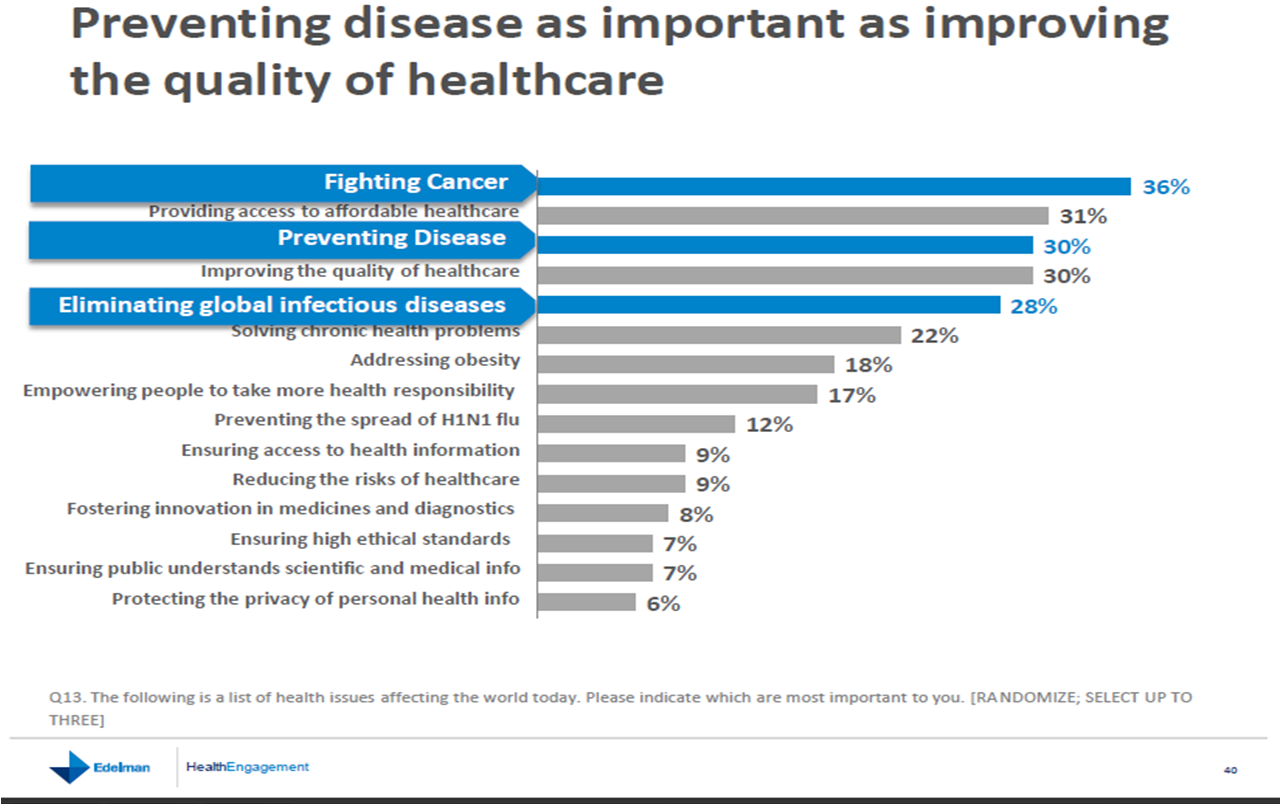
One of the things that interested me was the slide about what motivates people to get active in their health.

While 58% of people use some form of digital media to research health, the majority use Google or some search engine. 34% of them (globally) use health company websites. [If this were limited to health plan or PBM websites in the US, that would seem high.]

I wasn’t surprised that fighting cancer was the most important issue, but I was surprised that privacy of information was the least important.

CVS Caremark, Behavioral Economics, Social Media, and Adherence

Yesterday, CVS Caremark announced an expansion on their research partnership with Harvard to include three people focused on behavioral economics and social media.  The focus of both these efforts is around prescription compliance (an almost $300B problem).

The work is going to be focused on three areas:

  • Providing Appropriate Incentives: Research how appropriate financial incentives – in the form of lower copays and immediate up-front rewards – motivate consumer decisions to help improve health care behavior.
  • Developing education tools: Determine how education materials and programs targeting consumers can be applied to persuade positive behavior that will affect meaningful change for patients.
  • Tailoring Communications: Studying how specific messages resonate with individuals to promote improved health outcomes, adherence and personal care.

The Maturing of Social Media

I found some of the new stats from Pew very interesting.

  • Drop in blogging for people <30 and a rise above 30.  [Maturing?]
  • 47% of online adults now use social media sites – Facebook is the most common.

Maybe I’m reading too much into it, but as you look at the stats, it seems to me that some of the hype around things like Twitter and other uses have stabilized with usage outside of the teen groups.  I suspect a lot of that is the corporate world embracing some of these modes.

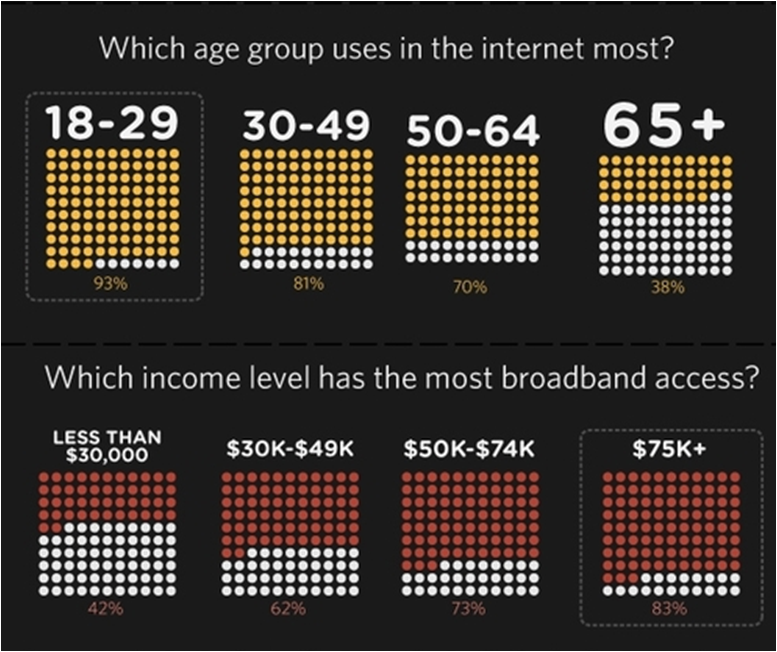
And, if you haven’t seen Paul Boag’s great graphics on Internet use (see example below), you should.

Does Technology Make You More Efficient?

If you’re like me the answer is “of course”, but I realize that it isn’t always true for people.  Look at the people who get sucked into things like SecondLife or people who play games for hours on Facebook.  That certainly isn’t efficient time.

An article “The Internet Ruined My Life” by Pat Regnier in Money Magazine (Jan/Feb 2010) makes some good suggestions.

“When work got stressful – pretty often in this economy – it was all to easy to click over to Facebook.”

He points out that for Americans working over 50 hours per week:

  • 56% say technology has increased their job stress (27% by a lot).
  • 47% say technology has made it harder to focus at work (14% by a lot).
  • 66% say technology has made it harder to forget about work at home and on the weekends (37% by a lot).

I’d say what about the fact that it’s easier to multi-task and watch your kids soccer game during the week and stay in touch.

He makes a few suggestions (all relevant for getting into the new year):

  • Check out the 43folders.com blog.
  • Break the circuit – stop checking Facebook for a week and see if it’s still that important.
  • Be smarter about e-mail.  The more you send; the more you get.  Create better subject lines.  He suggests the book “The Tyranny of E-mail”.
  • Focus on your job (which isn’t to check e-mail…by the way).  He suggests checking e-mail just a few times a day [which is very hard but very efficient].
  • Stay offline in front of the kids [which is hard to do when you work from home].

Blending Social Media and Healthcare

There is certainly lots of talk in healthcare around incentives.  What incentives will drive people to behave healthier – peer pressure, cash, non-monetary incentives, competitions (e.g., The Biggest Loser), or lower copays and deductibles.

There is also lots of talk about social media.  There have been lots of studies showing the power of your friends to influence your behavior – smoking, weight loss. 

Separately, I continue to hear more and more stories about agencies and lawyers using social media to find out about what people are really doing.  For example, my friend’s mom was recently on a jury of someone suing a physician for malpractice.  She claimed she had limited use of her legs.  But, the physician’s lawyer accessed her facebook page and saw her talking about all the stuff she was doing now that she felt better.  Oops.

Before I paint my future scenario, let me toss out one example that really got me thinking.  Burger King recently created the “Whopper Sacrifice” application for Facebook.  You received a free Whopper if you would delete 10 of your friends from your Facebook account.  23,000 users did it before they took it down.

So, if people would “sacrifice” their friends for a Whopper, what would people do for a 10% reduction in their premiums [or some siginificant savings on healthcare]?  Could companies get people [and use social media to track it] to spend more time with their thin friends that don’t drink or smoke and regularly exercise and get 8 hours of sleep a night?  Assuming the research is true, this would dramatically reduce costs and make those people healthier. 


Telling The World Your Status

Will the habit of “status updates” be a good thing for healthcare?  We are encouraged to keep food journals, to track medication, to track facts about our conditions, and to report on many other aspects of our life.  Those things can be very helpful for patients in their discussions with their physicians.

So, as people increasingly become used to track and reporting what their doing, will that make it more normal to track these healthcare statistics?

Here’s some recent facts from a Pew report on Twitter and Status Updating:

  • 19% of Internet users now do some type of status reporting
  • The more devices you own (laptop, Internet enabled phone, Kindle) the more likely you are to update your status…39% of those with four devices.
  • The average age of people using the following (and trend versus last year):

Twitter Experiments

I’ve been playing with this medium now for a while.  While I was originally a skeptic, I’m becoming a convert.  Here’s a few things I’ve tried recently:

  1. Following a conference virtually.  Today, I’m flying into SFO for the Health 2.0 conferenceAmerican Airlines offers WiFi on the plane so I can use the hashtag #health2con to follow postings from other Twitterers and stay up-to-date before I get there (late).
  2. Reporting a service issue.  I tried doing this with my satellite TV provider (DirectTV) who has a twitter account, but I didn’t get a reply.  Probably not surprising.
  3. Finding info.  I’ve done this a few times with mixed results.  I think it depends a lot upon your number of followers and the time of day you post.

“Insights” Gone Wrong

There is a great “cartoon” at the end of the recent Fast Company magazine that gives an example of how using information can lead you to a wrong decision.  It’s one of the reasons that I always point out the difference between someone who has provided services to an industry and someone who has worked in an industry.  It’s not the same.  Sometimes, you need to truly understand the nuances and how decisions are made.

It also made me think of a great Facebook example of how using social connections can lead to bad business decisions.  Given all the talk about making peer-to-peer recommendations based on your social network, this is a slippery slope to watch.  We are still new to this area and mistakes will happen.  One of the bigger ones that I have heard occurred in Facebook where they allowed advertisers to use member’s pictures.  Well, how do you think people felt when they saw the advertisements that say “Meet Singles In Your Neighborhood” with a picture of their spouse.  It didn’t go over well.

Great idea.  Interesting technology.  Bad application.

This will happen in healthcare.  The question is who will be first to stub their toe in the new world.

Nature’s Rules For Healthcare

I found this article – Nature’s 10 Simple Rules for Survival – on biomechanics and biomimicry interesting (Fast Company article).  It looks at how nature has survived all these years and translates that to lessons for business.  This is worth more pondering, but my Saturday morning thoughts on applying this to healthcare are in brackets.

  1. Diversify across generations.  [We need different strategies for different segments.  One size will not fit all.]
  2. Adapt to the changing environment — and specialize.  [We need a US centric healthcare model not a model from Canada or the UK.]
  3. Celebrate transparency. Every species knows which species will eat it and which will not.  [Be clear on incentives and roles.  Set up a win-win not a win-lose.  Don’t try to get government to run an efficient business which it never has.]
  4. Plan and execute systematically, not compartmentally. Every part of a plant contributes to its growth.  [A technology infrastructure and shared decision making across a care continuum is important.  The medical home concept has merit.]
  5. Form groups and protect the young. Most animals travel in flocks, gaggles, and prides. Packs offer strength and efficacy.  [Social networking and leveraging peer-to-peer education and support will improve health outcomes.]
  6. Integrate metrics. Nature brings the right information to the right place at the right time. When a tree needs water, the leaves curl; when there is rain, the curled leaves move more water to the root system.  [We need home monitoring and predictive metrics for preventative care.  Using genomics and other measures should save lives by allowing us to act early.]
  7. Improve with each cycle. Evolution is a strategy for long-term survival.  [Big bang improvement to the system won’t work.  Pick one problem at a time – e.g., un-insured – and solve for it.]
  8. Right-size regularly, rather than downsize occasionally. If an organism grows too big to support itself, it collapses; if it withers, it is eaten.  [Healthcare is inherently local.]
  9. Foster longevity, not immediate gratification. Nature does not buy on credit and uses resources only to the level that they can be renewed.  [We need to address the issue of hyperbolic discounting.  People want immediate value, but lots of healthcare improvements take time personally and systemically.]
  10. Waste nothing, recycle everything. Some of the greatest opportunities in the 21st century will be turning waste — including inefficiency and underutilization — into profit.  [Don’t overcomplicate the solution.  Sometimes the obvious can improve the difficult.]

Nick Jonas And His “Diabetes Buddies”

I was with my kids at the Jonas Brothers concert in St. Louis the other night. They put on a great show, but my healthcare takeaway for the night was that Nick Jonas has diabetes and is a great spokesperson on the topic.

As seems to be more and more common these days, he (as a public figure) is out talking about his health and management of his condition. I think this is a great way to help kids learn about diabetes from someone they adore. It also normalizes the condition so patients don’t feel they are alone.

I also like his concept of giving guitar picks to his “diabetes buddies” or people he meets. I could see a Facebook application where you can get a virtual guitar pick from Nick Jonas.

“To newly diagnosed kids with diabetes, Nick would say, ‘Don’t let it slow you down at all.  I made a promise to myself on the way to the hospital that I wouldn’t let this thing slow me down and I’d just keep moving forward, and that’s what I did. Just keep a positive attitude and keep moving forward with it. Don’t be discouraged.’ ” (article)

During the concert, they stop to let him do a piano solo to the following lyrics from their song “Don’t Know What You Got Till It’s Gone”. During the song, he pauses to talk about how he made a promise to not let it hold him back and all the things he has accomplished since being diagnosed.

Got the news today
Doctor said I had to stay
A little bit longer
And I’d be fine
When I thought it’d all be done
When I thought it’d all been said
A little bit longer
And I’ll be fine

But you don’t know what you got
Till it’s gone
And you don’t know what it’s like
To feel so low
And every time you smile or laugh you glow
You don’t even know
No, no
You don’t even know

All this time goes by
Still no reason why
A little bit longer
And I’ll be fine
Waitin’ on a cure
But none of them are sure
A little bit longer
And I’ll be fine

But you don’t know what you got
Til it’s gone
You don’t know what it’s like
To feel so low
And every time you smile or laugh you glow
You don’t even know
No, no
You don’t even know
No, no
You don’t even know
No, no

Yeah

But you don’t know what you got
Til it’s gone.
Don’t know what it’s like
To feel so low, yeah
And every time you smile or laugh you glow
You don’t even know
Yeah oh
Yeah oh
Yeah yeah
You don’t even know
No, no

So I’ll wait ’til kingdom come
All the highs and lows are gone
A little bit longer
And I’ll be fine
I’ll be fine

The 5 Questions (Regence Group)

Regence Group recently put out an interesting website – www.whatstherealcost.org.  It takes an unorthodox (for a health plan) approach to delivering several important points.  It reminds me of what Wellpoint has done with Tonik or some of the things Humana is doing at HumanaGames.

One of the things I found interesting and very straightforward for patients to think about were their 5 questions:

  1. How much does that cost?
  2. Is that really necessary?
  3. Is there a cheaper option?
  4. Is there a generic for that?
  5. Has anyone out there had this before?

Imagine if every time we were asked to take a test or start a new therapy that we (patients) asked these five questions of our provider.

Life In A Six Word World

A friend of mine just formed a new group in LinkedIn which I found interesting…”Life in a Six Word World“.

From the group description: A friend recently asked if I could describe myself in 6 words. I couldn’t… Could you? Could you describe your business value in 6 words? Well in our new Twitter society you just may have too. This group is about sharing your Six Word “whatever” as well as asking for help and discussing how communication is changing.

I am not sure I can come up with one, but here are some:

  • Overall: Enjoying Life.  Love Family.  Work’s Great.
  • Work: Learning.  Doing.  Planning.  Innovating.  Challenging.  Enjoying.
  • Personal: Love Kids & Spouse.  Crazy Relaxing.

Communication Strategy Regarding H1N1 (Swine) Flu

“There is a lot of media, a lot of news, a lot of rumor – the sooner you can get correct and accurate information to consumers, the better – otherwise people will look to other sources that may not always be accurate.”  (Jan Berger, President of Health Intelligence Partners on podcast)

We have been hearing a few things from our clients and have put some information up on the Silverlink website.  Some of the comments have been:

  1. I have seen a spike in call center volume about this topic.
  2. Clients want to change plan design to make sure Relenza and Tamiflu are covered and don’t require a prior authorization or have a quantity level limit on them.
  3. We want to proactively reach out to at risk populations – children, seniors, or people with a compromised immune system.
  4. We want to be able to flexibly target certain geographies.
  5. We want to remind people not to panic, drive them to quality information sources, and make sure they know the basics – wash your hands.

At a minimum, everyone is adding information to their websites.  Many consumers are Googling the topic or following updates from @CDCEmergency (on Twitter).

Healthplans, PBMs, and population health companies are at the heart of this.  They need a coordinated strategy to inform people appropriately as this issue continues to be top of mind.

We recorded a podcast last night with the Medical Director from Healthwise and Jan Berger who is the former Chief Medical Officer from CVS Caremark and is now president of Health Intelligence Partners.  In here, they answer some general questions about the situation and what companies should be doing to educate members.

The two standard solutions Silverlink is offering clients are:

  1. Offer an inbound FAQ (Frequently Asked Questions) line with CDC content and specifics about their plans.  This can help with overflow from their call center and/or be used as a direct line from their website or outbound communications.
  2. Selectively target populations (age, zip code, disease state) with a brief message reminding them to wash their hands and telling them where to get qualified information.

As with all our communications offerings, these can be customized (messaging, channel, targeting, etc.) to meet client requirements.  Additionally, since one of our technology advantages over others in the space is our flexibility, we can work with clients to keep these messages up-to-date as the situation changes and as new information has to be added.

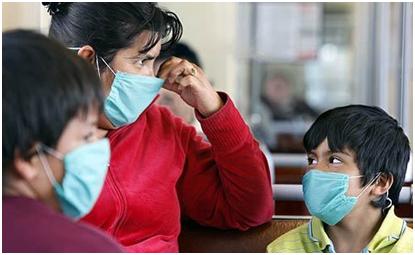
Swine Flu (H1N1) Continues To Top News

(picture from http://www.myfox8.com/lifestyle/health/la-sciw-swine-masks28-2009apr28,0,4461177.story)

It’s amazing how this has dominated traditional media and blown away the online media.

I few things that stick out for me:

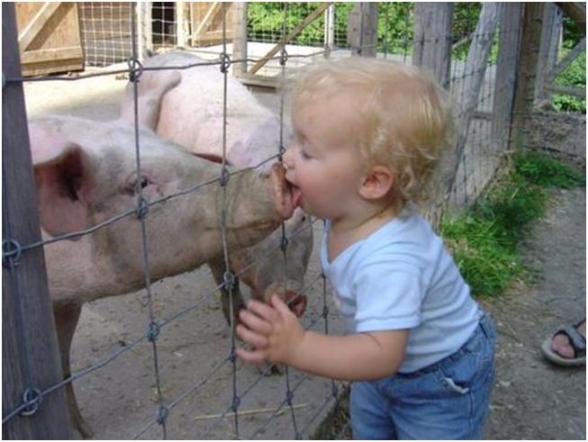
One of my favorite pictures that goes right to the health literacy issue is the following.

NOTE: This is not what H1N1 flu is about…hence the dropping of the “swine flu” term.

(picture from http://cuteoverload.com/)

Communication Evolution

I was thinking this morning about how communications evolve. Here are a few examples from the past few years:

1. Caller-ID replacing voicemail.
2. E-mails replacing memos (and getting much longer).
3. SMS and Twitter replacing e-mail.
4. Scanning replacing faxing.
5. Facebook replacing online photo albums.
6. Evite replacing invitations (with mixed success).
7. Twitter beginning to replace news clipping services.
8. Craigslist replacing newpaper listings.
9. Websites replacing brochures.
10. Virtual conferences eroding attendance at physical conferences.

To “Tweet” Or Not To Tweet – Wrong Question

I have been a skeptic (and am changing my tune), but for all of you out there that think “what can I share in 140 characters”, I suggest you frame the question differently.

Ask – Should I have a Twitter account?

Even if you don’t want to tweet about yourself, you should have a Twitter account to serve as a news feed. As I saw from the WHCC 2009 and the Health 2.0/Ix Therapy conference, you can learn a lot by using Twitter simply to follow people. And, with more and more companies jumping on board, it’s a great way to keep up with information.

If you find the right reporters, news sources, companies, and bloggers, you can use this as a news summary of relevant events.

(Obviously, I am not the only one struggling with this as another media as evidenced by Josh Seidman’s post the other day.)

Whitepaper: The Future of the PBM (Pharmacy)

As we have been working with a lot of PBMs over the past year, the question has come up many times – “where do you see the industry going?” After bouncing some ideas off a few of you, we have pulled together a whitepaper with the Silverlink Communications perspective. Certainly, each area of the whitepaper could have been its own chapter, but rather than turn this into a thesis, we are publishing it.

As I have said in a few recent articles including the one in HCPro, I think the Express Scripts acquisition of NextRx will likely accelerate a few of our predictions here.

The executive summary of the whitepaper is below. The final whitepaper is available here.

I would welcome any comments you have…

Executive Summary

In the next several years, we believe that three changes will drive the pharmacy marketplace and ultimately change the business model for PBMs. These changes will be accelerated by the current financial crisis which may drive further consolidation in the short-term. Consolidation which we believe will accelerate the “race to the bottom” where the traditional model of scale has been maxed out with parity achieved among the large PBMs.

1. The need to better engage the consumer in understanding their benefits and ultimately responsibility for their care;
2. The effort to automate and integrate data across a fragmented system and across siloed organizations; and
3. The shift from trend management to being responsible for outcomes.

Consumer Engagement
The industry-wide movement to consumerism will continue to affect plan design, but it will also thrust PBMs and pharmacies into the critical path of member engagement. With pharmacy being the most used benefit as well as the volume and accessibility of retail pharmacies, they will play a critical role in driving adherence and helping consumers understand healthcare. This will renew the focus on cognitive skills, medication therapy management and ultimately drive the desire for a more traditional “corner store” approach that can be scaled using technology.

Combining this with the macro-economic forces that are driving ubiquity of technology through mobile media and the evolution of the Internet from a pull media to a push media will also challenge the PBMs and pharmacies to innovate. They will be required to look outside of healthcare models to identify the right communications to drive behavior. PBM’s and pharmacies will have to leverage behavioral economics and personalization technology to get the right message to the right consumer at the right time through the right medium.
Automation and Integration
The consumer engagement challenges will only exasperate some ongoing challenges within the PBM and pharmacy community. This will include the lack of staff to provide more cognitive services and the general fragmentation of data across organizations and functional silos. Figuring out an overall “single view of the patient” which shows all the touch points and offers a coordinated multi-channel strategy for inbound and outbound communications will become a major focus.

In addition, in order to make these solutions efficient, the development of predictive models, much like the clinical and underwriting solutions being used today, will become the norm across the industry. As these models are fine tuned and the promise of e-prescribing becomes more of a reality, the channel for engaging physicians in the member’s care will finally exist. PBMs and pharmacies will be able to use data to allow physicians to understand when patients aren’t being compliant and when there is an opportunity to drive change.

From Trend Management to Outcomes
The traditional business model for the PBMs has been based on large scale negotiations to drive rebates and efficiencies within mail service – cost to fill and acquisition costs. At the same time as those efficiencies reach a maximum discount, the traditional tools for managing trend will have run their course. Although plan design won’t “die”, comparative effectiveness may reduce (or eliminate) the need for formularies, and in general, the ability to shift cost to the consumer above the 25-30% level will be difficult.

Both of these challenges will push the PBMs and pharmacies into a role where they are focused on driving health outcomes and being part of the bigger solution across the industry. They have a strong footprint to drive this change and as theranostics (or personalized medicine) evolves there will be an opportunity to find cost effective solutions to change the prescription landscape.

WHCC 09 Interview with Ed Batchelor (Humana)

I had an opportunity to sit down with Ed Batchelor from Humana yesterday.  He has an interesting role driving the Stay Smart / Stay Healthy program for them as part of his Corporate Web Strategy role.  From what I could tell, it’s a program done for the greater good of educating consumers about key healthcare topics.  To accomplish that, Ed has a direct reporting relationship to the operating committee at Humana and was brought in from outside the industry.

Here is an example of one of the videos that they are pushing out on YouTube.  I really like the whiteboard communication approach.

Some of the big takeaways from my discussion were:

  1. You have to meet the consumers where they are – Facebook, YouTube, Blogs.
  2. If you create a neutral educational message, consumers will trust information (even from health plans).
  3. You can only deliver information in “bits”.  Don’t overwhelm them.
  4. Fun is good.
  5. Regardless of what many (including myself) might think, seniors don’t all shy away from these social media.  [20% of the 1.1M views on YouTube have been from people over 55 years old]
  6. Success on YouTube doesn’t translate to blogs.

One question that I had was how to get away from the “healthcare speak” so that consumers could actually understand it.  He talked about 3 things:

  1. Bringing in an external person
  2. Using focus groups
  3. Using an outside agency

The other thing we talked about is that pull through that they are getting around employers and brokers.  They are pulling the videos in (like here) and re-using them.

This was a program they were highlighting in their booth and one of the public areas here so I appreciated the opportunity to sit down and learn more.

Giving Twitter One More Try

I have not been a big fan of Twitter from the perspective of using it to provide a reality show on my life.  And, I have struggled a little to find the productive use of it as a business tool.  Blogging has fit much better.  That being said, I see it being used so much more by people so I am going to give it one more try.  I have a few ideas on how to use it.  I have added my feed to the blog page on the right, and I am going to give it a month to see if it is interesting or not.