Archive | Technology RSS feed for this section

Electronic Device Evolution – What’s Next

The question of ubiquity around consumer electronics is an interesting one.  Will the Kindle replace the laptop?  Will home computers and TVs combine with gaming systems?

While you’re thinking about that, you might enjoy this evolutionary chart which was in the latest Fast Company (July/Aug 2009).  It’s a nice history reminder although you could add a lot more on any path and really have a very interesting discussion.  The funny thing is that I can remember most of these things, but I bet there are kids today that have no idea of a 8-track tape, a walkman, the Commodore 64 (or PC Jr), or the big mobile phone bags.

CVS Caremark TrendsRx Report 2009

This is one of my favorite times of year. After working on the Drug Trend Report at Express Scripts for several years, I love to get all the trend reports from the PBMs and read them. The first one that I have had a chance to review is the one from CVS Caremark. I found it an easy to read document with good case studies and a mix of strategy and tactics.

Here are some of my highlights and observations:

  • 3 out of 4 clients cited “reducing health care costs” as their primary measure of PBM success…AND 2 out of 3 prioritized “plan participant behavior change” as the way to reach that goal. [Maybe the plan design bigot is finally dead.]
  • With pharmacy spend approaching $1,000 PMPY, I found their chart on potential cost reduction a simple way of pointing people to things they should think about.
    cvs_caremark_savings-opportunities-09
  • A 10% improvement in diabetes adherence can save $2,000 in annual health care costs. [I assume this is based on improving MPR and would definitely like to learn more on how the health care costs are quantified.]
  • They layout three objectives – improve use of lower cost drugs, improve adherence, and get people to take better care of their health. [Similar to the concept I laid out in my white paper of needing to be broader than just Rx benefit management.]
  • They talk about two of their solutions:
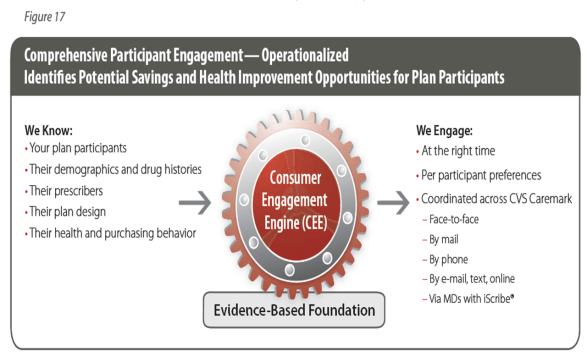
    • Consumer Engagement Engine (CEE) which is very similar to what Silverlink does and provides business logic for targeting the right member at the right time with the right message.

      consumer-engagement-engine

    • Proactive Pharmacy Care is their “medical neighborhood” concept to stitch together their entities – Mail Order, CVS retail, Specialty, MinuteClinic, and their disease management company.
  • Their trend was 3.9% PMPM in 2008 (or 2.8% excluding specialty drugs).
  • Medicare Part D utilization was up 4.1% compared to 0.8% for the rest of their BOB (book of business).
  • Their GDR (generic dispensing rate) averaged 65.1% for 2008 and was 66.3% in December 2008.
    • Best in class employers = 68.2%
    • Best in class health plans = 73.4%
  • As they remind you, a 1% increase in GDR is roughly equal to a 1% reduction in pharmacy spend.
    • [What I would like to see is improvements in GDR from new drugs coming to market in 2008 versus improvements that came from clients implementing plan design.]
  • They say [which I preach all the time} – “proactive consumer engagement improves results and lowers the risk of disruption. For best results, provide personalized actionable information at a range of touchpoints.”
  • I saw a few interesting things in one of the case studies they share about their “Generous Generics” program. [Does that name get used with consumers? What’s their reaction to it?]
    • $0 generic copay at mail [that should drive volume]
    • 10% coinsurance penalty for not shifting to mail after the second fill [similar in concept (I believe) to the Medco “retail buy-up” concept]
  • Top Ten Therapeutic categories (53% of spend):
    • Antihyperlipidemics
    • Ulcer drugs
    • Antidiabetics
    • Antidepressants
    • Antiasthmatics
    • Antihypertensives
    • Analgesics, Anti-inflamatory
    • Anticonvulsants
    • Analgesics, Opioid
    • Endocrine and Metabolic Agents
  • They state that the population of diagnosed diabetics is growing by roughly 1M a year.
  • They state that a generic for Lipitor is now expected in Q4 2011 [which I think is about a year later than originally expected]
  • They show some data from their Maintenance Choice program which I think has a lot of opportunity.
    • This is where you can get a 90-day Rx from either mail or a CVS store for the same copay. [The key here is for them to understand member profitability and for CVS Caremark to understand how to drive consumers to the preferred channel.]
    • [I would really need to understand their profitability by channel because if I read the chart in here right, it would appear that given the choice 45% of those at mail would choose 90-day at retail…a scary concept for mail order pharmacy.]
      maintenance-choice
  • They give a case on Maintenance Choice which leaves me looking for a key fact. They state that a recent implementation has a goal of 70% of the client’s day’s supply will go through the preferred network (CVS) or mail and that 20% of it goes through mail today. [What percentage goes through CVS today? If it’s a client in Boston, that one scenario. If it’s a client in Chicago, that would be another feat.]
  • Specialty pharmacy trend was 13.5%.
  • They say that pharmacogenomic testing is being used more frequently for specialty drugs. [I would love to know more…how often? For what drugs? Has it improved outcomes? Are their clients covering it? How are they playing in this space?]
  • They talk about adherence which continues to be one of the hottest areas in the Rx arena today. They give stats showing 15-48% improvement across different metrics and up to $142 in cost avoidance in one case. [Are these again control groups? What was the cost / benefit analysis or ROI? Is this improvement in average MPR (Medication Possession Ratio) or improvement in the % of people with an MPR of >80%?]
  • They talk about 88% of heart failure patients maintaining optimal prescription adherence compared to a norm of less than 50%. [My questions here (which isn’t apparent) is whether this was an opt-in program so the 88% is for engaged and active participants or whether it was across all targeted members.]
  • They provide a quick list of factors that will impact drug trend:
    • Driving costs:
      • Aging
      • Obesity
      • Diabetes
      • Specialty pipeline
      • More aggressive treatment guidelines and earlier diagnosis [which hopefully would lower total healthcare costs]
      • DTC advertising
    • Reducing costs:
      • Economy – reduced utilization and improved GDR
      • Increased availability of generics
      • FDA safety reform
      • Lackluster non-specialty drug pipeline
      • Utilization and formulary management
      • Consumer price transparency

Communication Evolution

I was thinking this morning about how communications evolve. Here are a few examples from the past few years:

1. Caller-ID replacing voicemail.
2. E-mails replacing memos (and getting much longer).
3. SMS and Twitter replacing e-mail.
4. Scanning replacing faxing.
5. Facebook replacing online photo albums.
6. Evite replacing invitations (with mixed success).
7. Twitter beginning to replace news clipping services.
8. Craigslist replacing newpaper listings.
9. Websites replacing brochures.
10. Virtual conferences eroding attendance at physical conferences.

Whitepaper: The Future of the PBM (Pharmacy)

As we have been working with a lot of PBMs over the past year, the question has come up many times – “where do you see the industry going?” After bouncing some ideas off a few of you, we have pulled together a whitepaper with the Silverlink Communications perspective. Certainly, each area of the whitepaper could have been its own chapter, but rather than turn this into a thesis, we are publishing it.

As I have said in a few recent articles including the one in HCPro, I think the Express Scripts acquisition of NextRx will likely accelerate a few of our predictions here.

The executive summary of the whitepaper is below. The final whitepaper is available here.

I would welcome any comments you have…

Executive Summary

In the next several years, we believe that three changes will drive the pharmacy marketplace and ultimately change the business model for PBMs. These changes will be accelerated by the current financial crisis which may drive further consolidation in the short-term. Consolidation which we believe will accelerate the “race to the bottom” where the traditional model of scale has been maxed out with parity achieved among the large PBMs.

1. The need to better engage the consumer in understanding their benefits and ultimately responsibility for their care;
2. The effort to automate and integrate data across a fragmented system and across siloed organizations; and
3. The shift from trend management to being responsible for outcomes.

Consumer Engagement
The industry-wide movement to consumerism will continue to affect plan design, but it will also thrust PBMs and pharmacies into the critical path of member engagement. With pharmacy being the most used benefit as well as the volume and accessibility of retail pharmacies, they will play a critical role in driving adherence and helping consumers understand healthcare. This will renew the focus on cognitive skills, medication therapy management and ultimately drive the desire for a more traditional “corner store” approach that can be scaled using technology.

Combining this with the macro-economic forces that are driving ubiquity of technology through mobile media and the evolution of the Internet from a pull media to a push media will also challenge the PBMs and pharmacies to innovate. They will be required to look outside of healthcare models to identify the right communications to drive behavior. PBM’s and pharmacies will have to leverage behavioral economics and personalization technology to get the right message to the right consumer at the right time through the right medium.
Automation and Integration
The consumer engagement challenges will only exasperate some ongoing challenges within the PBM and pharmacy community. This will include the lack of staff to provide more cognitive services and the general fragmentation of data across organizations and functional silos. Figuring out an overall “single view of the patient” which shows all the touch points and offers a coordinated multi-channel strategy for inbound and outbound communications will become a major focus.

In addition, in order to make these solutions efficient, the development of predictive models, much like the clinical and underwriting solutions being used today, will become the norm across the industry. As these models are fine tuned and the promise of e-prescribing becomes more of a reality, the channel for engaging physicians in the member’s care will finally exist. PBMs and pharmacies will be able to use data to allow physicians to understand when patients aren’t being compliant and when there is an opportunity to drive change.

From Trend Management to Outcomes
The traditional business model for the PBMs has been based on large scale negotiations to drive rebates and efficiencies within mail service – cost to fill and acquisition costs. At the same time as those efficiencies reach a maximum discount, the traditional tools for managing trend will have run their course. Although plan design won’t “die”, comparative effectiveness may reduce (or eliminate) the need for formularies, and in general, the ability to shift cost to the consumer above the 25-30% level will be difficult.

Both of these challenges will push the PBMs and pharmacies into a role where they are focused on driving health outcomes and being part of the bigger solution across the industry. They have a strong footprint to drive this change and as theranostics (or personalized medicine) evolves there will be an opportunity to find cost effective solutions to change the prescription landscape.

Promotion vs. Nudging vs. Mandatory Mail

Although there is always a dialogue about the lifecycle of mail order, I think some of the work out of the Consumerology group at Express Scripts is interesting.  The frameworks that they apply internally are very similar to the technology and approach that Silverlink uses with the rest of the market.  [Kudos to Sean Donnelly and Bob Nease for their work on this new approach.]

The traditional ways of driving mail order have been:

  • Over a copay incentive (and hope)
  • Letter and calls encouraging member to convert
  • Providing a call center to facilitate the conversion to mail (from an inbound call or from a transfer on an automated outbound call)
  • Mandatory mail – requiring the member to use mail or pay the full cash price for the drug
  • Retail buy-up – allowing the member to keep getting the maintenance drug at retail (after 2 fills typically) but requiring them to pay a penalty for choosing a higher cost channel

Now, “Select Home Delivery” uses the 401K approach of opt-out vs. opt-in to drive participation.  As behavioral economics would suggest, inertia will carry the momentum and by getting the member signed up in mail and moving them to mail will drive success versus requiring them to take an action. The idea here is to “nudge” the member versus force them or leave it up to them to take action.

Select Home Delivery optimizes the use of cost-saving Home Delivery, requiring members to opt out of the program rather than the traditional approach of requiring members to opt in.  The program is based on the psychological principle of hyperbolic discounting, which says immediate events (for example, the hassles of signing up for Home Delivery) loom large compared to downstream benefits (such as a lower overall copayment and receiving a 90-day supply).  Dr. David Laibson, an economics professor at Harvard and member of the Center’s advisory board, conducted research showing that applying this principle to 401(k) programs dramatically improved participation rates.

“Opt-out and active decision programs for 401(k) enrollment dramatically improved low employee participation rates. We wanted to explore whether these tools could also solve healthcare challenges,” Laibson said. “This is one of the first marketplace adaptations that successfully applies behavioral economics to improve healthcare.”  [quotes from Consumerology blog]

I think the new results from their blog (below) are impressive.  [BTW – If you’re a member at Lowe’s or another client which has used this, I would love to hear your reactions.]

select-home-delivery

Tipping Point for eRx

David Snow said that Medco had achieved over 10% of Rxs being electronic a few months ago.  Now Walgreens put out a press release that in March they had 15% of all their Rxs sent in electronically.  Perhaps we are reaching the “tipping point”.

Walgreens pharmacies filled 3.1 million electronic prescriptions in March, a 211% increase over the same period a year ago. Still, that represents only about 15% of all eligible prescriptions.

Walgreens estimates it will fill more than 40 million electronic prescriptions in 2009, compared with 15 million last year.

So…Google Was Indicative

I talked earlier about Google searches relative to the NextRx sale.  In the 3 days before the acquisition was announced, the majority of the searches (by far) that I could see and brought people to my site were about Express Scripts (or ESRX) and Wellpoint (or NextRx).  So, I am not sure if that was PR people looking for things to respond to or insiders doing some analysis, but it seems like Google searches could tell us something.

Again…the power of data.  Now, if I was a stock trader and had access to all of the Google search data, perhaps I would have a way to beat the market.

Sprint: What’s Happening Now

I am not sure how this helps Sprint sell more phones and/or services, but I enjoyed the advertisement. The concept of leveraging data to understand consumer behavior is essential. This is a topic we [Silverlink] are constantly working with our healthcare clients to address.

  • How do you know what members or patients are doing?
  • Do you understand their preferences?
  • What have they historically done?
  • Can you predict how they will act in the future?
  • What data is needed to do analysis and create a predictive algorithm?
  • How do you leverage that to create interactive and compelling communications?
  • How do you study their behavior change?  (e.g., did they get a flu shot after being reminded)

The Inbound Only Landline

I heard about an interesting service today which is being offered by one of the telecommunication companies. They are rolling out a landline for $5 a month that receives inbound calls, but you can only call 911 for outbound calls. Very interesting.

phone

What’s Your Blog’s Personality?

I found this an interesting “blog analyzer“.  You put in your blog’s URL and it tells you the Myers-Briggs personality type of the author.  Mine was right on – INTJ.  I guess it shouldn’t be too surprising, but I can imagine all the opportunities to use that information in scale in the future.  As blogs, Twitter, Facebook, and other sites become the norm, an analyzer like this could categorize people’s personality types.

If a service could be created, communications could be tweaked based on personality to best get people to respond.

E-Mail No-No’s

While I am sitting on the plane doing hundreds of e-mails (finally catching up), I flipped thru the American Way magazine. It has an article on e-mail etiquette with a list of “The Top 10 E-mail Turnoffs” (March 15, 2009, pg. 16). [BTW – Only a frequent traveler quotes airline magazines.] I think it’s a good list and hits a lot of mistakes that you see. The other key that they talk about in the text is that increased probability of someone misreading your intentions when they don’t have a voice or actions to provide more context. (A problem with text messaging professionally also.)

10 – Get overly cutesy or slang-happy in a professional e-mail.

9 – Skimp on the subject line.

8 – Miss the Mr. or Mrs. mark.

7 – Send it off without running a spell check.

6 – Sprinkle your message with flowery language.

5 – CC: for all to see.

4 – Send an irate, angry, or potentially embarrassing message.

3 – Use your work e-mail for personal time (read: racy)

2 – Go all willy-nilly with the wingdings.

1 – Hit reply all.

[On a related travel note, I need to come up with some “term” for days where I eat each meal in a different state and time zone. Had another “opportunity” to do it this week, but I only hit two time zones.]

Using Twitter For Health Care

Last week, I talked with a reporter about using Twitter for health care.  It can add a new dimension to communications, but I am not sold on it replacing current communications.

Some of my jumbled thoughts on this:

  • I like the one to many concept of Twitter with the opt-in concept (preference-based marketing), but it doesn’t personalize to the individual the way the information is delivered.
  • It definitely provides a stream of consciousness which is interesting.  I see a lot of application for a reality show type of health tools…like Biggest Loser via Twitter.
  • I like the idea of posting a question to a broad audience for quick response – Does anyone have research showing the impact of statins on asthma patients?
  • I don’t see this helping with patient to provider communications.  Do I really want my blood sugar posted to Twitter and sent to my physician from my smart device?  Do I (the physician) really want to see all that real-time data?  No.  What about HIPAA…from what I know Twitter is not meant to contain confidential information.  There are plenty of rules engines which can be used to capture data; look for things outside the norm; and then send an alert.
  • A lot of healthcare information has caveats and requires more than 140 characters to get across the message.  Most clinical things couldn’t be send this way.
  • As with most inbound things (i.e., I have to register or search it out), Twitter feeds get those that know what they are interested in and are active in their health management.  It still doesn’t help to drive action from those that aren’t engaged in their healthcare.
  • I can certainly see it as an alert to information, but since one tip to productivity is to batch things, do I really want them broken out during the day in a bunch of Twitter feeds.  I would rather get a daily synopsis from a website (which might be created by Twitter feeds).

Some things I found when looking on the web about this topic:

Here is a presentation on Twitter (they even have one of my old posts in there…which was a pleasant surprise to me) around healthcare.

So, my general perspective is that there is some value in pushing basic information out, reality show type of healthcare (Twitter surgery), capturing feedback, and developing community, but it’s not a tool for the corporate to individual communications that I typically deal with.

Personal E-mail Replaced By Social Networks

This plays into my post earlier about changes in communication patterns…

I certainly have begun to see more of my social (personal) online communications moving from e-mail to social networking tools like Facebook, LinkedIn, and Plaxo.  I almost never trade e-mails with my siblings any more.

So, it wasn’t a big surprise when I saw the blurb in the USA Today which said that “social networks and blogs” have moved ahead of personal e-mail as the most popular online activities (per Nielsen report).

A few facts:

  • 1 of every 11 minutes is spent on these social networking and blogging sites.
  • Time spent on the sites is growing 3x faster than overall Internet usage.
  • 2/3rds of the world’s online population visit these sites.
  • The US was third (after Brazil and Spain) with 67% of the population visiting these sites.
  • Facebook is visited by 3 in 10 people monthly.
  • 10.6M people in the US access these sites through their mobile devices.

More Lies In E-mail

A pair of recent studies suggest that e-mail is the most deceptive form of communications in the workplace–even more so than more traditional kinds of written communications, like pen-and-paper.

More surprising is that people actually feel justified when lying using e-mail, the studies show.

“There is a growing concern in the workplace over e-mail communications, and it comes down to trust,” says Liuba Belkin, co-author of the studies and an assistant professor of management at Lehigh University. “You’re not afforded the luxury of seeing non-verbal and behavioral cues over e-mail. And in an organizational context, that leaves a lot of room for misinterpretation and, as we saw in our study, intentional deception.”[See article]

This certainly raises a few flags as letters become a “historical tool” for communicating and everything becomes more about technology.  This certainly says a lot for virtual teams and remote management.  You can’t rely just on e-mail.  You need to pick up the phone and talk.  You need to visit face-to-face (F2F).

Does this mean that MDs shouldn’t trust e-mails from patients?

Does this mean that deals shouldn’t be negotiated through e-mails?

What’s In A Voice?

In the most recent copy of AHIP’s Coverage Magazine (JAN+FEB.09), there is a nice feature called “What’s In A Voice?” which talks about Silverlink Communications. You can find the whole article (“Motivating Change“) here, but I pulled out a few quotes:

“When the phone rings, it takes just the right voice to motivate a member to overcome the tendency to put off receiving preventative care.”

“Silverlink calls allow us to communicate with our members in a really personalized way without incurring the costs associated with hiring and training additional customer service representatives.” Linda Lyle, Cariten Healthcare Vice President of Operations

“This mammography campaign contained scripting that allowed the members to respond, [indicating] whether or not they had had a mammogram. We received a large number of ‘yes’ responses that we will pursue for HEDIS improvement, as well as to identify gaps in our data collection. This method of collecting data about our members is unique to telephone outreach. We are anxious to explore our findings.” ” We know how many listened to the message and how many hung up. We know how many people we actually reach.” Michael Bryne, Assistant Director of Quality Management at EmblemHealth.

The article also talks about using non-professional voices such as the Chief Medical Officer or a customer service representative who was really good with members. In one example, Eleanor Sorrentino, the Managing Director of Quality Management at EmblemHealth, talks about getting 50 calls from members thanking her for the automated call which was recorded in her voice.

A few other items talked about include the use of data and reporting which is available real-time to make decisions along with the use of natural sounding voices to drive a conversational experience which leverages internal and professional scripting resources to develop the best content.

Personalized Medicine Webinar

I don’t have anything to do with this, but it sounds pretty interesting.  Medco and Regence are talking.  Here is the teaser.  (Click here for more info and registration.)

Personalized medicine is moving rapidly. The FDA in December considered requests to require genetic testing for the colon cancer drugs Vectibix and Erbitux. Approval of such labeling changes could pave the way for a slew of other personalized therapies and diagnostics now waiting in the wings. Stakeholders anticipate significant clinical and financial savings. Recently approved genetic testing for the blood thinner warfarin, for instance, is projected to avoid 85,000 serious bleeding events annually and save roughly $1.1 billion a year!

On the other hand, questions remain whether the model actually provides a favorable return on investment (ROI). A new study finds that genetic testing for warfarin does not appear to be cost-effective in certain patients. And health plans and PBMs are trying to sort out which of the numerous diagnostic tests on the market actually provide clinical utility and improved results. One large health plan, for example, says its costs for diagnostic testing are growing at nearly 20% a year.

So where does all of this leave Rx payers in February 2009?

Seeing Significant Improvements With BPO

Business Process Outsourcing (BPO) or as I will sometimes call it CPO (Communications Process Outsourcing) is something we are definitely seeing a growing demand for in the market.  It blends technology, services, process management, consulting, and analytics.

Both IDC and Gartner have now talked about this in recent reports.

According to Janice Young, IDC program director, Payer IT Strategies, “we expect to see an increasing interest and likely investment in BPO in 2009 and 2010 for healthcare payers. Our recent results from our January 2009 healthcare payer survey of IT spending indicate that 45% of healthcare payers expect BPO investments to increase this year.” These trends are highlighted in IDC‘s U.S. Healthcare Payer 2009 Top 10 Predictions (January 2009).

Gartner research vice president, Joanne Galimi, reported on BPO services within health plans in a recent report entitled Healthcare Insurer Business Process Outsourcing Trends (January 2009). “Although things look gloomy for the larger economy, the potential for BPO to address immediate business pressures and long-term recovery goals for the health plans will be unprecedented,” says Galimi.

When I first came to Silverlink as a consultant in early 2007, this was exactly my vision.  I always talked about the “one throat to choke” model.  When you are in an operations role, it is always so difficult to coordinate modes, vendors, discrete data sources, and ultimately to get a holistic view of the member (or patient).  This is what I wanted to help build and is exactly what we have done.

Fortunately, we are now in a position where we can talk about how this service model has grown and how offering turnkey services for clients has driven results.  I love to focus on outcomes so this is exciting.  Here are a few from the press release we put out this morning:

  • Over a 300% improvement in retail-to-mail conversions for a large pharmacy benefit manager (PBM),
  • 54% increase in participation for a pharmacy program, representing between $150 and $175 per year per prescription in consumer savings,
  • 400% improvement in yield in a COB program, translating to over $20 million in cost savings to a major U.S. health plan, and
  • Up to an 82% increase in transfer rates for population health engagement for disease management, lifestyle management and treatment decision support programs.

Process…The Key to Success

“We get brilliant results from average people managing brilliant processes. We observe that our competitors often get average (or worse) results from brilliant people managing broken processes.”

Sources: “Decoding the DNA of the Toyota Production System,” Steven Spear and Kent Bowen, Harvard Business Review, September-October 1999

I think this is so important especially in times like this when we are all focused on doing more with less. It is critical to understand how your process works; how to apply automation; and how to learn and improve it over time.

I came across a presentation from a webinar I gave back in 2007 on Business Process Management (BPM) which made me think about this. (Some of the vendors in this space include Pega Systems, Lombardi, and Appian.)  It’s also very relevant given Gartner‘s recent report on Business Process Outsourcing (BPO) in the payor space.

“Healthcare insurers should view business process outsourcing as a means to achieve business transformation while minimizing risk. Therefore, using BPO for nondifferentiating business processes is an essential step toward achieving competitive success and business growth.” Joanne Galimi in Healthcare Insurers Business Process Outsourcing Trends (January 23, 2009).

Finding a business partner that can work with you to understand your processes, understand what measures matter, help you improve your approach, and that is willing to take risk based on your success is important.   I always encourage people to not think of companies as vendors but as partners that bring them innovative ideas and help them iterate to improve.  I don’t believe in the big bang theory that I can do it right the first time and never need to change.  That flies in the face of everything that has been observed in different industries.


Siftables: Very Cool Tools From TED

A friend shared this video this morning with me. Very cool. This is a presentation by David Merrill from MIT about Siftables. He has integrated new technologies with our traditional building blocks to build interactive, high tech blocks that can be used for spelling, math, music, and other ideas.

Imagine the ability to use these to teach people.

Walking Surveillance Device

There is always lots of debate on the issue of privacy.  Clearly, there are military reasons to collect data (with debates on appropriate use).  There are programs we willingly opt into (like when I sign up for an organizations e-mail list).  Within healthcare, we have HIPAA that tries to protect our personal data.  Then there is the constant paranoia about how much your employer monitors on your computer – what sites you visit, your keystrokes, what you say on the phone.  Then on the more debated side there is what information is it okay for a company to aggregate and use to push information to me that makes me healthier or saves me money.  I don’t expect this will get solved anytime soon.

I think this is why I found the story about Google’s G1 interesting in yesterday’s paper where it talks about how Google aggregates information from you to better target you with advertisements.

“It enables Google to field your search queries quickly when you’re on the run. It also gives Google access to your contact lists, IMs, e-mails, personal calendar, social networking and video downloading — the videos you’d fess up to publicly, as well as the ones you might not. As for all those “personal photos” swapped with pals on Facebook, MySpace and Twitter: Google can grab those, too.

Everything gets crammed into your personal “file,” so to speak, along with a lot of other stuff — such as where you bank, shop and cruise on the Web when you’re lonely, bored or just in the mood for a little fun.

Once your information has been collected and stored, there’s no way to get rid of it. You can’t see what’s been collected or have it expunged. It’s Google’s for as long as it wants to hold onto it.”

Obviously, more and more people use mobile devices and the mobile web.  It’s one thing to have your information aggregated when you use a service (i.e., Google search).  It seems another thing for them to pull information from your device and aggregate it.  I am not sure how this will play out, but I expect there will be a lot of discussion on blogs about this topic.

Cooking With Google

This is an interesting thing that someone told me about a few weeks ago. They said that they come up with recipes by simply typing some ingredients into Google and then seeing what it produces. I tried it with a few random lists of items and came up with long lists of ideas.

Now, if we could just blend a personal coach, a personal chef, and an automated kitchen that tracked all my products by barcode, I would have a very cool “smart house” type of feature for helping me eat healthy.

cooking

7 e-Patient Conclusions

Thanks to e-patient Dave’s reminder on the e-Patient blog

Here are 7 conclusions from the white paper that came out last year on this topic. Very important in diffusing some of the myths around the role of social networking in healthcare and the use of the Internet for information.

1. e-patients have become valuable contributors, and providers should recognize them as such.
“When clinicians acknowledge and support their patients’ role in self-management … they exhibit fewer symptoms, demonstrate better outcomes, and require less professional care.”

2. The art of empowering patients is trickier than we thought.
“We now know that empowering patients requires a change in their level of engagement, and in the absence of such changes, clinician-provided [information] has few, if any, positive effects.”

3. We have underestimated patients’ ability to provide useful online resources.
Fabulous story of the “best of the best” web sites for mental health, as determined by a doctor in that field, without knowing who runs them. Of the sixteen sites, it turned out that 10 were produced by patients, 5 by professionals, and 1 by a bunch of artists and researchers at Xerox PARC!

4. We have overestimated the hazards of imperfect online health information.
This one’s an eye-opener: in four years of looking for “death by googling,” even with a fifty-euro bounty for each reported death(!), researchers found only one possible case.

* “[But] the Institute of Medicine estimates the number of hospital deaths due to medical errors at 44,000 to 98,000 annually” … [and other researchers suggest more than twice as many]
* We can only conclude, tentatively, that adopting the traditional passive patient role … may be considerably more dangerous than attempting to learn about one’s medical condition on the Internet.” (emphasis added)

5. Whenever possible, healthcare should take place on the patient’s turf. (Don’t create a new platform they have to visit – take yourself wherever they’re already meeting online.)

6. Clinicians can no longer go it alone.

* Another eye-popper: “Over the past century, medical information has increased exponentially … but the capacity of the human brain has not. As Donald Lindberge, director of the National Library of Medicine, explains ‘If I read and memorized two medical journal articles every night, by the end of a year I’d be 400 years behind.”
* In contrast, when you or I have a desperate medical condition, we have all the time in the world to go deep and do every bit of research we can get our hands on. Think about that. What you expect of your doctor may shift – same for your interest in “participatory medicine.”

7. The most effective way to improve healthcare is to make it more collaborative.
“We cannot simply replace the old physician-centered model with a new patient-centered model… We must develop a new collaborative model that draws on the strengths of both systems. In the chapters that follow, we offer more suggestions on how we might accomplish this.”

Texting Versus Raising Your Hand

I heard this story on CNN this morning about the smartboards that schools are using these days to replace chalkboards.  They talked about how easy it was for kids to respond and ask questions using text messaging versus raising their hands.

Is this a good thing?  I definitely feel a little torn.  On the one hand, this is great for the shy kids who might not otherwise participate in class.  On the other hand, these kids won’t survive in the real world without being able to speak up and talk in front of others.  They can’t sit in a meeting and just text their response.