Do Women Make 80% Of Healthcare Decisions? And Are They More Adherent?

Despite all the articles about the changing gender roles, there is still the common belief that 80% of healthcare decisions are made by women. I guess I would assume that men would be more involved in their healthcare which either points out a major engagement issue or something more systemic (or just a self-perpetuating myth).

The She-Conomy site reinforces this fact, and I also saw it in a PharmaVOICE article (9/12) recently which highlighted the report – Seven Lenses for Marketing Health to Women.

That article had several interesting facts in it. One which caught my attention was the following…

“30% of Facebook users in this study said receiving brand messages from a pharmaceutical company via Facebook would be a good way to communicate with them.” (That seems really high to me.)

On the flipside, I tend to believe the data point that 78% of respondents would feel more in control of their health with a mobile app to provide information…making the case for Happtique even more important.

I found the following in a Kaiser Family Foundation report. (KFF often being a source of truth for me.)

Women are the health care leaders for their families. Women take charge of the vast majority of routine health care decisions and responsibilities for their children, and on top of their everyday family obligations, over one in 10 women care for a sick or aging relative. Meeting these multiple obligations is demanding and leaves many women concerned about meeting all their family and work commitments as well as managing their own health.

  • Eight in 10 mothers/guardians say they take on chief responsibility for choosing their children’s doctors (79%), taking them to appointments (84%), and ensuring they receive follow-up care (78%). Mothers are also primarily responsible for decisions about their children’s health insurance (57%).
  • Similar to men, one in four women feel a lot of stress from career (24%) and financial concerns (23%). Women are significantly more likely than men to be very stressed about managing their own health needs and those of their parents.
  • One in 10 women (12%), compared to 8% of men, cares for a sick or aging relative, often an ill parent. The majority of caregivers report that they perform a range of tasks, including housework (91%), transportation (83%), and various financial decisions (66%). Many also assist with medical and physical care, such as administering medicines or shots (58%), as well as routine activities such as bathing and dressing (42%).
  • Caregivers themselves contend with a host of health challenges. Four in 10 are low-income, nearly half (46%) have a chronic health condition of their own, and one in five non-elderly caregivers are uninsured.
  • A sizable share (29%) of caregivers provide assistance full-time, spending more than 40 hours per week as a caregiver. This is even more common among low-income caregivers, 44% of whom report assisting their relative for over 40 hours weekly.

Interestingly, this ties into a discussion I was having the other night about whether men or women are more adherent to their medications and whether that is a relevant segmentation factor in designing an intervention strategy. The data I’ve seen says women are less likely to be adherent than men, but the company I was talking to believed their data pointed the other way. Here’s a few articles on the topic:

And from the CVS Caremark 2008 Trends Rx Report

72M Uninsured Under Romney Plan…That Would Be A Problem

I know lots of people are skeptical or against healthcare reform.

A report that just came out says that Romney’s plan would lead to 72M uninsured by 2022. I have no idea if that’s a reasonable analysis, but any more uninsured should be a problem for us as a country. They wait to get care leading to bigger long term issues under Medicaid and Medicare. They over-utilize the emergency room. And, as a first world country, we should want to have everyone getting a basic level of preventative care to prevent long-term issues and higher costs and improve out quality of life.

I’ll admit that I was initially a skeptic of healthcare reform, but I think it’s a reasonable solution. Not perfect. As I’ve argued for a while, it only focused on quality and access but not cost. I would have started with access first. But there are several very positive parts of healthcare reform regardless of what some people believe.

  • Support for technology
  • Support for preventative care
  • Accountable Care Organizations
  • No lifetime limits
  • No denial of coverage due to pre-existing conditions
  • Pharma reimbursement during the donut hole
  • At least 85% of what you pay for healthcare must be spent on medical costs (not administrative)
  • No single payer

Infographic: Inactivity Pandemic

I always love a good infographic with good data elements on a topic I care about.

Inactivity Infographic

Would MDs Recommend SMS Based Adherence Programs? 87% Would…

WorldOne Interactive has some interesting data from provider surveys on their website. This one jumped out at me.

  • 87% of MDs polled would recommend a text message based adherence solution to their patients

At the same time, I also thought this one was really important since the question is always whether the physicians want to know adherence data or not. Based on my old post, I didn’t think that MDs would want this type of data since they generally don’t seem to value PBM interventions.

  • 80% of MDs polled would find it useful to get periodic e-mail reports about their patients therapy compliance.

How Many Patients Does A Physician See Per Day? And Other MD Factoids

I thought this was an interesting factoid which I got today and is from The Physician’s Foundation report.

Here are a few other findings…

  • In the next one to three years, over 50 percent of physicians plan to cut back on patients, work part-time, switch to concierge medicine, retire or take other steps that would reduce patient access to their services.
  • Over 59 percent of physicians indicate passage of the Patient Protection and Affordable Care Act (i.e., “health reform”) has made them less positive about the future of healthcare in America.
  • Over 82 percent of physicians believe doctors have little ability to change the healthcare system.
  • Close to 92 percent of physicians are unsure where the health system will be or how they will fit into it three to five years from now.
  • Over 62 percent of physicians said Accountable Care Organizations (ACOs) are either unlikely to increase healthcare quality and decrease costs or that that any quality/cost gains will not be worth the effort.
  • Physicians are divided on the efficacy of medical homes, and many (37.9 percent) remain uncertain about their structure and purpose.
  • Over 47 percent have significant concerns that EMR poses a risk to patient privacy

Why LinkedIn Is Not Like A Video Game

I get about 3-4 requests to connect in LinkedIn each week. Maybe one of them is from someone I know. It seems like a lot of people attribute the number of contacts you have to value while the reality is that it’s the value of your relationships which matters. And, while you might be limited to a theoretical maximum of real friends, I think you can have an expanded professional network which is larger but doesn’t include anyone and everyone who can spell your name.

That being said, I’ve worked in several industries and several parts of the country (and tend to enjoy networking) so I have a big network in LinkedIn (>1,000). But, I constantly review it to see if things are getting old or if the person that I worked with on a deal has simply faded away. In the last year, I’ve dropped over 300 people that I had previously connected with.

So, like I’ve done with the blog and Twitter and Facebook, I figured I would post on how and why I use LinkedIn.

I joined LinkedIn very early since I had two friends who knew the founder. My personal uses for it have been:

  • To stay in contact with past colleagues
  • To share information from a work perspective
  • To share contacts for networking
  • To help find resources or people for projects
  • To network for sales and/or jobs

The keys to using it are:

  • Have a complete profile
  • Get recommendations
  • Give recommendations
  • Provide updates
  • Use keywords
  • Connect it with things like Slideshare or your blog (no longer Twitter)
  • Join groups (easiest way to expand your reach within the tool)

But, there are lots of professionals out there who will tell you how to optimize its use. For corporate purposes, I think Hubspot puts out a lot of great information and data.

The key for me is believing that if I reach out to someone in my network they will know who I am and be willing to respond or help the person I’m routing to them.

So…If you’re going to reach out to me in LinkedIn, tell me why you want to connect, and expect to get the following response…

“Thanks for your offer to connect. My rule is that we have to connect IRL (in real life) first. If you want to do that, you can call or e-mail me.”

Politics, Healthcare, and The Economy – My Hints For Obama & Romney

Whether you’re a political junkie or not, if you’re in the healthcare industry, the political landscape has become increasingly important over the past decade.

And, with the government being the primary payer, they have the ability to drive trickle down changes through everyone’s care. So, even if you don’t work in the industry, but you’re a patient, you should care. What happens in DC will change healthcare which will affect you either today or in the future.

At the same time, I think most people in Washington DC are living in Disneyland. Government salaries continue to go up. Employment continues to go up. They have pension plans. They have robust health insurance offerings. Real estate has stayed strong. They don’t really understand what the rest of country is experiencing.

So, if I were coaching either campaign, I would point out that it’s always about finding simple messages that convey very strong points. That’s not easy, but I think we all want some basic things:

  1. A financially stable country in which we have a legitimate chance to be economically successful.
  2. An infrastructure which provides education for our kids and the overall workforce.
  3. A safe neighborhood and country in which to live and where our rights as outlined in the Declaration of Independence are protected.
  4. Leaders who use our tax money as if it was their own money when making decisions.
  5. A country where hard work is rewarded and there’s a safety net to protect us when we get sick.

So, I guess you could ask what that has to do with healthcare…

BUT, I do think there is macro-economic element here some of which is done differently in other countries (if you believe there is something to learn from them).

Of course, all my practical business friends would tell me that this would kill our global competitiveness. And, my skeptical friends would point out that this would create more time, but we wouldn’t use that time to improve our health. Others of you would point out that companies would just look for more productive workers not hire more people.

But, I would argue that if we plan to differentiate ourselves on innovation and creativity then health is very important. Health already represents more of the cost of a car then the steel and more of the cost of coffee than the beans. The WHO has now said that obesity is the number one healthcare issue to tackle globally. It impact presenteeism. It impact absenteeism. And, your creativity is limited when you don’t sleep due to stress or other healthcare issues which is often magnified in the sandwich generation.

All of these things impact us in many ways. Of course, I think this would make a great campaign discussion…

“I’ll decrease unemployment and improve our economy by increasing use of vacation time, limiting work hours, and creating tax incentives to drive down obesity and improve our overall satisfaction with life. Doing this will make us a more innovative country and drive sustained competitive advantage within a global marketplace.”

More And More Work For The PCP

We always hear about how little time the average primary care physician (PCP) spends with a patient although some research shows it’s actually going up. At the same time, there is a debate about whether healthcare reform will push us into a massive physician shortage which seems to exist in some areas already. I keep hearing about more and more things that the PCP should be doing during this encounter.

  • They should be counseling on medication adherence.
  • They should be addressing gaps-in-care.
  • They should be handling prior authorizations real-time using a computer system.
  • They should provide the patient with Ix (information therapy) steering them to apps and articles for them to understand their treatment.
  • They should be coordinating with the patient’s care manager.
  • They should be screening everyone for obesity.
  • They should be screening everyone for alcohol abuse.

It was the last two that were recent recommendations for the US Preventative Services Task Force that prompted me to comment here. I’ve heard everything from about 8 minutes to 15 minutes per patient encounter and complaints about the amount of time spent on documentation and administration continuing to go up. So, how does a physician add in all these different tasks into this already short time window when patient already leave confused and not remembering most of what the physician told them.

Of course, concierge medicine and other physician practices are trying to change this in certain pockets. And, ideally Accountable Care Organizations (ACOs) or Patient Centered Medical Homes (PCMHs) where the focus is less on volume and more on outcomes have a chance to change this.

I guess the question in my mind is whether the physician is this gatekeeper or whether chronically ill patients need a care manager / patient navigator to help them understand their benefits, take advantage of the resources available to them, leverage their care team, and understand their disease and clinical options.

Guest Post: Treat Your Health Like Your Finances

I am a big believer that we need to change our approach to how individuals manage their health. After a dinner with a financial planner friend of mine, it got me thinking what if we helped individuals plan for a long healthy life the same way we help them plan their careers or their finances. We have whole industries dedicated to helping people make smarter investment decisions for their retirement and job choices for their careers, but when it comes to our health we are rarely proactive.

According to Morgan Stanley, 90% of Americans think financial planning is important. Why? Three of the top reasons people undertake financial planning include:

  • Making sure your money will last during retirement or rolling over a retirement plan
  • Being prepared for a financial crisis such as a serious illness
  • Caring for aging parents or a disabled child

The common thread through all of these reasons is personal health. Whether concerned directly about illness, both our own and that of our loved ones, or about our ability to enjoy our retirement to its fullest, personal health is a key component of a well-planned retirement.

The reality is life expectancy has increased dramatically. We may live 30 years in retirement. I would argue the quality of that retirement is even more dependent upon our health than our finances. Yet no one hires a “personal health coach” or creates a “personal health plan.”

It is about time we stop neglecting our future health. You can take control of your future health by developing a personal health plan. These simple steps can help you get started:

Step 1: Conduct a Personal Health Audit. Before you can build a plan you need to understand your base-line. You can’t map directions to your destination until you know where you are. When you meet with a financial planner the first thing they want to know is how much money you have saved for retirement. Your personal health plan is the same way. Do you suffer from any chronic illness? What is your height & weight? How much exercise to you get? What are your eating habits? Do you have any family history of disease? What type of pain do you suffer from? How is your mental health your relationship with your spouse and children? Capture everything and identify areas that need attention or improvement.

Step 2: Define Success. What does a healthy future look like? The second question a financial planner will ask you is how much monthly income will you need in retirement to live the lifestyle you want? The same is true for health. When do you plan on retiring? What hobbies do you have that you would like to pursue? Do you plan on having grandchildren? How will bad or good health impact all of these plans? Does your family history require you to focus on preventing cancer or heart disease or Alzheimer’s? The ability to visualize your health in the future both good health and your health if you let yourself go is a strong motivator for change. A point of note: Thinking about health 30 or 40 years into the future can be very abstract; I suggest breaking down your definition of success into annual targets is more manageable and motivating.

Step 3: Know your Personal Health Indicators of PHIs. By this point in the process you should have a sense of what measurements are most critical to your health. Develop a method for capturing your PHIs on a regularly basis. For some like weight you might update your PHI daily, weekly or monthly. For others like a PSA level for men at risk for prostate cancer, you might update it annually. I detail some of the more common PHIs here: http://www.billpaquin.com/do-you-know-your-phis/.

Step 4: Engage your Health Partners. Now that you have completed your audit, defined success and developed your most important PHIs it’s time for you to engage all of the people in your life who help you manage your health. This will include your family, your physician or other healthcare professionals; maybe you have a nutritionist, acupuncturist or other complimentary practitioner that you frequent. Inform them of your personal health plan and get their feedback and buy in. The more people who are on your side the greater the likelihood of success and the more people that know your health, the greater the likelihood you will have a plan that fits you and your goals.

Step 5: Build and implement your Plan. Building the right plan takes an understanding of what you learned in steps 1-4. By way of example, if you have a family history of colon cancer, you need to understand what behaviors help reduce your chances of getting this cancer, what preventative screening you should be getting and when you should be getting them. All of our plans should include a path to maintaining an ideal Body Mass Index that includes some form of daily exercise and nutrition plan, but we are all unique and will have plans specific to our health situations and desired goals. I do think it’s important to understand that no one is perfect 100% of the time, if you deviate from your plan for a day, week or even month, you are only one day from starting again.

Step 6: Review & Measure your progress. You can’t manage what you can’t measure. At some pre-planned interval you should step back and take stock of your progress. Use your annual physical or dental cleaning as a reminder to sit down and review your health plan. Personally I like to review different elements weekly or monthly, but find what works for you and stick with it. Like the stock market, it won’t be a straight line, but as long as the trend continues up over time you will be alright.

No one is responsible for your health but you. We all need to take a proactive approach to our health. Developing a personal health plan is a great way to insure you live a long, healthy and happy life.

About the Author

Bill Paquin is the Chief Executive Officer at Vertical Health, a publisher focused on improving patient care associated with back pain and endocrine disorders such as diabetes. He is a husband, father and writer who is passionate about and supports the creative destruction of our current healthcare system.

Recent Research Around Health Consumers And Wellness ROI

I keep seeing so many articles that I don’t always have time to research them and write them up. With that in mind, I thought I would share some quick summaries and links here.

  1. Harris Survey data about customer satisfaction with their healthcare experience and how things compare between technologies they have access to and technologies they want. http://www.prnewswire.com/news-releases/patient-choice-an-increasingly-important-factor-in-the-age-of-the-healthcare-consumer-169140306.html
  2. Ernst & Young report on collaboration within healthcare as part of patient-centric system. http://www.prnewswire.com/news-releases/ernst–young-llp-health-care-report-explores-collaboration-as-key-to-a-patient-centric-system-169447336.html
  3. NEJM article on the business of health. http://www.nejm.org/doi/full/10.1056/NEJMp1206862
  4. Medication Therapy Management (MTM) as key part of patient care and emerging role of pharmacist. http://drugtopics.modernmedicine.com/drugtopics/Modern+Medicine+Now/MTM-opens-door-to-direct-patient-care/ArticleStandard/Article/detail/787897?contextCategoryId=40159
  5. New obesity report. http://healthyamericans.org/report/100/
  6. Aetna survey on difficulty of selecting healthcare benefits. http://www.aetna.com/news/newsReleases/2012/0917-Aetna-Empowered-Health-Index.html
  7. United survey and consumers beginning to shop online for healthcare service information and pricing. http://www.businesswire.com/news/home/20120918005229/en/Consumers-Starting-Comparison-Shop-Health-Care-Services-Treatments
  8. Question on another blog about relevance of ongoing use of the term e-patient. http://t.co/DaODAPpK
  9. Humana and Walmart partnership. http://t.co/v27XNRXr
  10. A list of 71 ideas from a brainstorming meeting. http://medcitynews.com/2012/09/71-out-of-the-box-ideas-the-healthcare-industry-would-consider-if-it-controlled-healthcare-reform/
  11. Benefit cuts are worker’s top worry. http://ebn.benefitnews.com/news/benefits-cuts-reductions-gallup-2727060-1.html
  12. Encouraging empathy over efficiency in healthcare. http://articles.boston.com/2012-07-15/health-wellness/32682736_1_medical-care-medical-error-patient-care
  13. Report on mobile health app growth. http://www.kaloramainformation.com/about/release.asp?id=2841
  14. HRAs offer best ROI in wellness programs. http://www.hrmorning.com/top-6-roi-producing-wellness-initiatives/
  15. Analysis of 56 wellness studies shows big ROI. http://www.hrmorning.com/massive-study-shows-true-wellness-roi/
  16. 600% wellness program ROI and facts in infographic. http://ehstoday.com/health/infographic-state-corporate-wellness-programs-america
  17. Consumer Reports survey on cost savings activities by consumers to pay for prescriptions. http://www.webmd.com/health-insurance/news/20120913/more-people-cutting-corners-pay-medications
  18. United study showing that quality can be 14% cheaper. http://www.unitedhealthgroup.com/newsroom/news.aspx?id=d5c1e465-c2b3-4c01-a856-bee676381ecb
  19. Linking wellness incentives to outcomes. http://ebn.benefitnews.com/news/employers-link-wellness-incentives-aon-hewitt-2726732-1.html
  20. 12 facts about patient engagement. http://www.dorlandhealth.com/case_management/trends/12-Surprising-Facts-About-Patient-Engagement_2405_p2.html

Absenteeism And Presenteeism Costs > Medical Costs

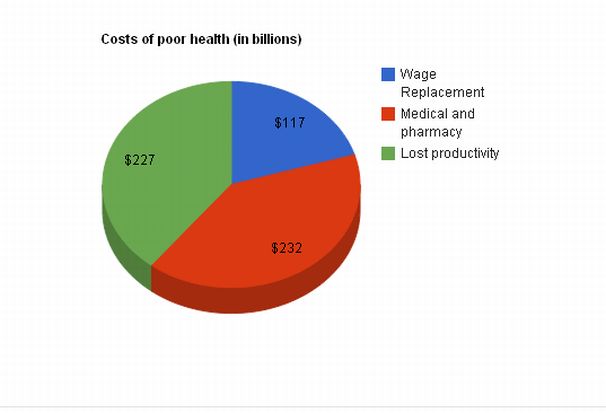
I always hear people talk about ROI around population health programs.  The problem is that most people struggle to estimate the absenteeism and presenteeism costs associated with poor health.  Various studies continue to reinforce that these costs actually exceed the medical and pharmacy cost savings.

Consumer Engagement Technology In Healthcare

Another big piece of my discussion with a consultant about consumer engagement in healthcare was from a technology perspective. Ultimately, there are three questions here:

  1. How should I think about and structure the landscape?
  2. Who are some example companies in each area?
  3. Which ones are the best to use (and for what segment of the population)?

I’m going to skip the 3rd question for now since there are business cases for any of these tools. The question is more about understanding your population and what your objectives are.

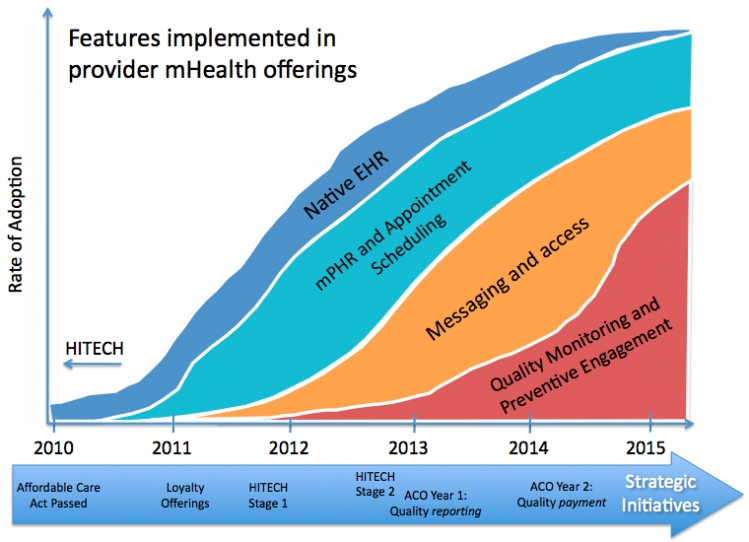
Here’s a quick model from Accenture to begin this…

But, here’s what I laid out for questions one and two. (BTW – This is my impression. There was no science here. I welcome comments and additions of companies are areas to put on the map.)

Examples of companies that I mentioned that I’ve seen, talked to, monitored, or heard of doing interesting work were:

And, ultimately, I told them what I tell many people…To see who the new companies are in these spaces look at the list of sponsors to Health 2.0, the presenters, and who’s recently gotten VC funding. This is going to capture some of the ones that are off the radar.

They had a great question to try to wrap this up which was how does this information get to the patient. That last mile is one of the big issues today. A few of the things I pointed out are:

  • Some companies like Happtique are trying to play here. This builds on some of the concepts from the Center For Information Therapy. (Prescribing information or applications)
  • As far as I know, the EMR and practice management systems aren’t doing much here – Epic, Cerner, Allscripts. Although Athena did buy a small player in this space years ago.
  • There are some companies trying to do this as part of their jump into the ACO space (e.g., Lumeris with NaviNet).

I thought I’d wrap up with this image from Chillmark Research.

Infographic On Using Twitter To Track Health Trends

I was looking up some information on using Twitter in healthcare prompted by the announcement around MappyHealth winning the HHS innovation award and found this that I thought I would share.

Who Cares About Patient Engagement In Health?

I got a call today from a consultant who was researching the topic of patient engagement in healthcare. I found their questions interesting and really got me thinking about the topic. I’m going to turn my thoughts into a few blog posts this week.

The first one was to look at how different constituents think about engaging the consumer and why. This is changing a lot with the shift to Patient Centered Medical Homes (PCMH) and ACOs, but in general, companies were very transactional about this in the past where it was something to be done. Now, everyone is tracking this and cares about:

  1. How successful are you at engaging patients?
  2. How successful are you at changing their behavior?
  3. What insights about the population can you provide me?

The ultimate strategy is one that:

  • Predicts who to target (the at risk patients)
  • Focuses only on the patients that are likely to change behavior
  • Segments the population
  • Delivers personalized communications to them
  • Delivers the messages at the best time to engage them
  • Tracks key metrics
  • Dynamically adjusts the process
  • Captures learnings
  • And…does this in a cost effective and scalable manner

With that set-up, here’s my someone skeptical view of who cares by constituent.

Group

Traditionally

Emerging

Patient

Someone will tell me what to do – physician, employer, insurance company

I need to be more responsible for my care and spend my dollars wisely (driving transparency tools and e-patient efforts)

Physician

My job is to diagnose, write a prescription, and/or provide immediate care…I assume the patient is compliant with everything I tell them

I need to understand the patient, how to change their behavior, and what’s most likely to drive their best outcome (but I still don’t have the time to do it)

Hospital

People come to us because they have to and it’s all about location

Chronically ill patients use resources disproportionately and should be catered to; plus we have to improve outcomes (or get penalized by CMS or get low quality rankings)

Employer

I evaluate the options from my managed care company and select a program; they really cater to me

I want something better and customized to my employees; I can probably improve engagement and need to as I shift first dollar responsibility to them

Managed Care

Consumers don’t pay the bills; the best model is a gatekeeper model; regardless, engagement is only important to avoid losing money

Employers want to see results which requires patient engagement; how can I do this cost effectively?

Pharmacy

We have to increase productivity at the counter to make money; patients will buy other front end goods

There’s a big opportunity for me to collaborate with managed care and employers to improve outcomes

PBM

I’m in the B2B business; just make sure consumers know what they’re supposed to do

No one really wants to use hard blocks all the time; they want to drive behavior change through information and interventions

Pharmaceutical Manufacturers

Convince the physicians and the patients will follow; if not, advertise on TV

I really need to understand the consumer’s experience with the disease and my drugs so I can influence outcomes

Technology Companies

Can I make money off consumer health apps? Enterprise software is the focus

Everyone is jumping into this space; how do I make myself relevant and improve satisfaction and use of my apps

Why Your Healthcare Underwriter Wants Your Mobile Data

As mobile devices get smarter and smarter, there is an ongoing debate about all the data they collect and how that data is used. (For those of you that love conspiracy theories, you’ll love my line of thinking today.)

For example, imagine that the application can predict where you will be 24 hours later to within 65 feet.

Your phone can give me a pretty good proxy for all of these:

  • How much do you sleep?
  • How much time are you in a car?
  • How much time do you spend sitting?
  • How much time are you walking? How far do you walk?
  • How social are you?
  • Are you in a relationship?

And, the more you do certain things, the better these proxies are:

And, in the not too distant future, it will become a digital wallet and begin to track purchase patterns.

Skeptical? In response to a request from Representative Ed Markey, major cell phone carriers revealed that they had received more than 1.3M requests for cell-phone tracking data from federal, state, and local law enforcement officials in 2011. (Time article – The Phone Knows All) They are using your phone data to solve crimes. If you’re not a criminal, this is probably good. It takes an average of 2 days for the Marshalls Service to find a fugitive these days versus 42 days in the past.

And, unless you’re a significant anomaly, you’re not reading all the data privacy data for all the apps we’re downloading. (30B apps have been downloaded.)

The article talks about apps that collect your photos, your texts, and your contacts.

“No app is free…you pay for them with your privacy.” (Time article)

But, from a healthcare perspective, especially as we move into an individual market, this data would be invaluable to an underwriter. Just like underwriters for car insurance want to track miles driven, average speed, and other data points, healthcare underwriters would love to understand your behavior.

Heck. We already see increased accidents attributed to people walking and interacting with their smart phone.

Maybe someday that will be a requirement to get a lower rate on healthcare. Maybe the younger generation won’t care. People continue to tell me that people in their 20’s just assume that everything is public and don’t see this “Big Brother” type of use of data as invasive.

The same Time issue (9/27/12) goes on to share some interesting global statistics on mobile phones. Here’s a few highlights:

  • 84% of people have their phone next to their bed (68%) or in the bedroom (16%) at night
  • 1/3rd of Americans use their mobile device while driving a car, playing with their children, attending a party, and eating at a restaurant.
  • 65% of parents believe their devices make them better parents (I’m not sure I get this one at all)
  • Americans use their mobile devices least of the six countries studied to do each of the following:
    • Send text messages
    • Browse the Internet
    • Listen to music
    • Search the web
    • Read news
    • Take pictures
    • Visit social networks
    • Shop
    • Receive payments
  • 29% said their wireless device is always the first and last thing they look at every day (which is 15 points below the international average)
  • 26% of respondents feel guilty if they don’t promptly respond to work related messages outside normal hours


The Transtheoretical Model And Setting Goals

There’s a good article in Time (9/17/12) called “Goal Power” by Dr. Oz.  I found it interesting on a few fronts.

“Getting people to make meaningful changes in their lives is much more complicated than explaining to them what to eat for dinner, how often to exercise and which kinds of tests they should get from their doctors.  The psychology of health is every bit as complex as the biology, and to create seismic shifts in behavior, we have to probe the subconscious.”

1. The topic of goals and objectives and their importance relative to healthcare behavior change is a repeating theme.

  • A month ago, I was at a presentation by Dr. Victor Strecher who founded HealthMedia.  He was talking about the importance of getting people to articulate their goals or objectives for changing.  (E.g., I want to become healthy to see my daughter get married.)
  • I had a pharmacy client who was looking into this as part of an adherence program a few years ago.

2. The topic of behavior change and behavioral economics has been a very popular theme with Nudge and many other publications and programs over the past few years.

3. Obesity, which is part of the focus of his article, is widely becoming recognized as the greatest public healthcare challenge of the 21st century.  And, it is a very complex issue tied to sleep, stress, social network, and many other factors.

4. He introduces the transtheoretical model (also known as the Prochastka model or the Stages of Change), which is widely known in the academic and health areas, into the public domain which surprised me.

(Here’s the abstract from what one widely quoted paper on this.)

The transtheoretical model posits that health behavior change involves progress through six stages of change: precontemplation, contemplation, preparation, action, maintenance, and termination. Ten processes of change have been identified for producing progress along with decisional balance, self-efficacy, and temptations. Basic research has generated a rule of thumb for at-risk populations: 40% in precontemplation, 40% in contemplation, and 20% in preparation. Across 12 health behaviors, consistent patterns have been found between the pros and cons of changing and the stages of change. Applied research has demonstrated dramatic improvements in recruitment, retention, and progress using stage-matched interventions and proactive recruitment procedures. The most promising outcomes to data have been found with computer-based individualized and interactive interventions. The most promising enhancement to the computer-based programs are personalized counselors. One of the most striking results to date for stage-matched programs is the similarity between participants reactively recruited who reached us for help and those proactively recruited who we reached out to help. If results with stage-matched interventions continue to be replicated, health promotion programs will be able to produce unprecedented impacts on entire at-risk populations.

5. He references two of the big studies that looked at social pressure an its influence on health.  Something that peer-to-peer healthcare and social network tools can create for us by developing support communities and “buddies” to support our change.

  • 2012 study in the journal Obesity about weight loss.
  • 2008 study in the NEJM about smoking

6. He references Dr. Nicholas Chrisakis who co-authored the book Connected which is being manifest in the company called Activate Networks.

Overall, for those of us that work in the healthcare field, these are all critical topics that we constantly talk about.  It’s nice to see it brought to the “popular press”.

Infographic: Why Recess Is Important

I think this info graphic goes well with the other one on exercise and academic performance.  I’m a big believer in the value of recess to build social skills, take a break from the classroom, and provide kids with exercise.

The Importance of Recess
Brought to you by: OnlineDegrees.org

My Visit To The Express Script’s Lab

The topic of innovation labs in healthcare is an interesting one (see other post). The other day, I had the chance to go and visit the Express Script’s Lab here in St. Louis.

This is a newer facility built back in November 2010 and has 26 scientists working there. It’s where some of the research team that I worked with years ago still is, but it now has a big focus as both a showcase facility and a hub for managing pilots.

There are a few key things in the facility:

  1. An open floor plan for collaboration with a giant whiteboard and chalkboard and several meeting rooms.
  2. The large screen you can see above which shows different metrics and can have any section expanded to drill down on current pilots or other activities.
  3. An interactive board in one area for a more intimate client discussion looking at their data.

There are now some people on the research team from Franklin Lakes (i.e., Medco). It will be interesting to see how they incorporate some of their research studies. Someone had recently told me about some cool work they had done using technology on the bottle (similar to my augmented reality idea).

A big focus of the team is on predictive modeling drawing from work in the financial services industry. They are looking at things like fraud and abuse, re-admissions, and adherence.

Like the team has always done, they use a champion / challenger approach to evaluating pilots. I thought the example they showed me on the big screen was interesting. It looked at both linguistics changes (i.e., words) and graphical changes on the web to evaluate consumer behavior. They carve out 10% of the population to randomly get these different scenarios and compare their success to the “champion” which is the existing strategy.

I had a chance to then see the interactive client board which focused a lot on network, generics, mail, and predicting adherence. They have some very cool mapping software to break all this data down to the block level and let you see how things compare. For example, they showed me claims based adherence on the map versus predicted adherence. This is important to think about where you focus resources especially when you understand that a majority of non-adherence (according to their studies) is due to procrastination. They are thinking about and treating adherence like you would a disease. How can you act preventively?

Right now, their ScreenRxSM solution is focused on 9 different conditions and uses their model to identify and trigger tailored interventions based on patient identified barriers or obstacles. As I’ve talked about before, while most people think it’s cost…it’s only about 16% (according to their research). Therefore, you can focus your more expensive interventions on the patients with cost and clinical barriers versus simply waiving copays for everyone (for example).

Where’s Your Healthcare Innovation Lab

This past week, Aetna announced their innovation lab (see press release). This adds to several other labs out there including the Express Scripts lab, the Humana Innovation lab, and the two Kaiser facilities (Garfield and the Center For Total Health). I’m sure there are more.

It made me think about this as a tool for driving innovation. Based on my limited experience visiting 3 of these 4, it seems like they fall into a few types:

  1. An operational prototype for showing how innovation can affect process and experience.
  2. A showcase for demonstrating technology and new ideas.
  3. A demonstration center for showcasing research and the pilot process.

This makes me think of visiting the Domino’s Pizza facility years ago where they had different pizzas being served and tried there to see how employees reacted. In other cases, you see companies like Walgreens rollout new locations and test the consumer response as a type of living lab.

How And Why I Use Twitter

I often get stopped by people I know who say things like:

  • I see a lot of your tweets in LinkedIn.
  • You use Twitter. Why? I don’t really want to tell people that I’m going to eat dinner or some other miscellaneous fact.
  • Can you really get anything out of 140 characters?

So…let me share my perspective on how my use of Twitter has evolved and what I get out of it.

It took me a few tries before I found out how to use Twitter effectively.

  1. First, I tried just using it to share thoughts or opinions across a variety of topics. I didn’t find that valuable and wondered why anyone would follow me to know that.
  2. Second, I tried using it to pose questions about healthcare topics that I was interested in. That worked ok because it synched with LinkedIn, but I didn’t have enough Twitter followers for that to make a difference.
  3. Finally, I decided to just use it as a “notebook” to capture facts while I read or to bookmark articles that I found interesting. (Of course, some of this became possible as every web article now offers a “share” feature.) This works especially great when you’re at a conference and is even a good way to follow a conference that you miss.

The next thing that I had to figure out was just understanding the technology.

  1. Reading things in Twitter is ok, but a lot of people post links. Often times, it’s not that effective to be constantly going out to the links to see what they say. In comes Flipboard to save the day. (see older post here)
  2. To make things more searchable, you have to use hashtags where you put a “#” in front of a key expression or search term.
  3. Most people don’t get a lot of followers although you hear about all the celebrities with millions of followers. (see HubSpot presentation below for general Twitter statistics)

I figure it must be working for me now. I have over 1,000 followers which according to this site is true for less than 1% of people on Twitter. But, I don’t think followers is the best indication (especially since almost ½ of followers might be bots and you can buy followers). I know that it’s working for now since I can post a question and sometimes get an answer. I can connect with companies and meet people. I’ve even heard from people at conferences that they follow my feed. Probably my best experience was when I read an article early in the morning, posted a quick summary, and then had a national reporter call me to ask me for the source so he could write an AP article…all before 8 am.

Just to check, I went out to the StatusPeople application which tells you how many of your followers are bots versus simply inactive. I was pleased with the results.

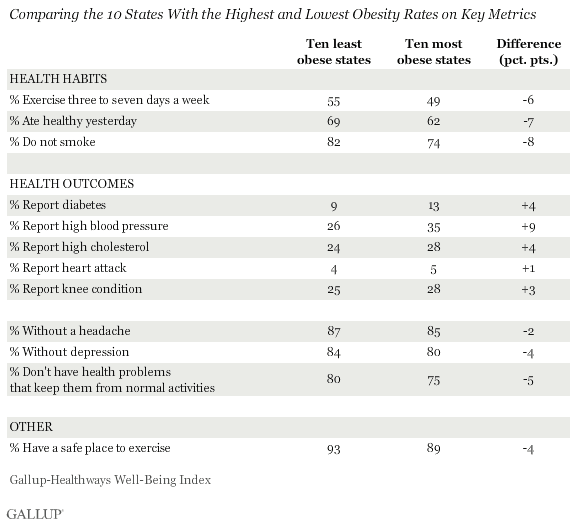
Comparing Obese States With Less Obese States

You can’t really call any state “non-obese” these days with every state having at least 20% of their population considered obese and 12 states having over 30% of their population obese.


But, in a separate study, I found it interesting to compare some metrics from the most obese to least obese states.  Not surprising.


One of the things that I do always find interesting is whether people consider themselves to be obese.  People generally don’t.  I’ve spoken about it before, but I sometimes think healthcare providers need to be more direct with people to let them know that they are obese and this in going to increase their chances of dying sooner (2x more likely to die prematurely) and having other health problems.

Infographic: Patient Education

I’ve talked about this before.  The gap between what patients should hear and remember and what they do hear and remember is huge.  It’s one of those root cause issues that are hard to address.

Mindset List For The Class Of 2016

Let me highlight a few of the things from this annual list by Beloit College. It’s put together to help highlight the mindset of incoming college freshman. Generally, in healthcare, these are the healthy people that don’t get much focus, but increasingly, it will be important to understand them for preventative services, caregiver engagement, and exchanges. (Note: numbering below reflects original numbers from the list)

Ultimately, this will change the way we support and provide healthcare information.

2. They have always lived in cyberspace, addicted to a new generation of “electronic narcotics.”

4. Michael Jackson’s family, not the Kennedys, constitutes “American Royalty.”

7. Robert De Niro is thought of as Greg Focker’s long-suffering father-in-law, not as Vito Corleone or Jimmy Conway.

8. Bill Clinton is a senior statesman of whose presidency they have little knowledge.

9. They have never seen an airplane “ticket.”

14. There has always been football in Jacksonville but never in Los Angeles.

15. While still fans of music on radio, they often listen to it on their laptops or replace it with music downloaded onto their MP3s and IPods.

21. A significant percentage of them will enter college already displaying some hearing loss.

23. Women have always piloted war planes and space shuttles.

27. Outdated icons with images of floppy discs for “save,” a telephone for “phone,” and a snail mail envelope for “mail” have oddly decorated their tablets and smart phone screens.

28. Star Wars has always been just a film, not a defense strategy.

32. Newt Gingrich has always been a key figure in politics, trying to change the way America thinks about everything.

34. Billy Graham is as familiar to them as Otto Graham was to their parents.

35. Probably the most tribal generation in history, they despise being separated from contact with their similar-aged friends.

47. Before they purchase an assigned textbook, they will investigate whether it is available for rent or purchase as an e-book.

49. There has always been a World Trade Organization.

67. Chronic Fatigue Syndrome has always been officially recognized with clinical guidelines.

68. They watch television everywhere but on a television.

74. Genomes of living things have always been sequenced.

Do Employees Really Engage During Open Enrollment?

Human Resources professionals, consultants, and healthcare companies spend a lot of time trying to figure out what benefits packages to offer, how to frame those out to employees, and then how to get them to choose the right package for them. The key question is whether this works and whether employees care?

A recent survey from the Aflac WorkForces Report would indicate that the answer is no.

  • 56% estimate that they waste up to $750 a year because they make mistakes with their health benefits.
  • Only 16% are confident about their decisions on healthcare benefits.
  • 52% say that their company doesn’t communicate with them at all about open-enrollment.
  • 89% say they simply elect the same options every year.
  • 47% say they rarely or never exceed their deductibles.
  • 16% contribute the right amounts to their flexible spending accounts.

All of this while benefits are getting more complicated and consumers are being expected to pay more of the bill.

More People Have Had A General Physical Than A Dental Exam In The Last Year?

I found this study on health exams interesting. It was done by KRC Research for Bausch & Lomb. According to their data, only 52% of adults surveyed have been to the dentist in the past 12 months. That by itself isn’t that surprising, but the fact that it was fourth on a list of five exams was very surprising to me.

(Note: This data was from a graphic that appeared in the USA Today this past week. I could not find the original source in a Google search.)