And We Have Two Winners??

In looking at recent investor decks from both Medco and Express Scripts, I was surprised to find almost identical charts each claiming victory on drug trend management.  Here are the two charts…you can judge for yourself.

(Express Script’s from Credit Suisse Healthcare Conference 11/13/08)

(Medco’s from 2008 Analyst Day 11/21/08)

medco-drug-trendesrx-drug-trend

BCBSA On Consumer Driven Care

The BCBS Association released a study a few months ago on Consumer Driven Care.  Here is the presentation and a few highlights.  In general, it appears to show that it is working to save costs and get members engaged without negative side effects of them not using needed care.

  • CDHP enrollment is up 25%.
  • 10 percent more members said they would be careful about healthcare costs if they shared in the savings (incentives work)
  • 43% of those HSA (Health Savings Account) eligible with an open account use mail order pharmacy versus 30% of those with non-CDHP plans.  (Since overall mail use is around 18% this seems high, but the point is valid.)
  • 52% of those HSA eligible with an open account ask their MD about the cost of treatments
  • HSA eligibles are much more involved in tracking and estimating healthcare costs
  • HSA enrollees require more support from their plan – communications and service become more critical in driving their satisfaction.

Social Media Presentation

When looking for some information on social media and innovation, I found these two presentations which I thought I would share.

Rare Scenarios

A few months ago, I heard a few amazing stories that I am finally getting time to capture.

The first was of the baby who was 3 years old and hadn’t slept.  Can you imagine?  I used to think that not sleeping would make you so productive (with some caffeine), but if you had to watch your kids 24×7 with them being cranky and never resting, you would go crazy.  According to the ABC News story, he has a rare condition called chiari malformation.

The other was of a woman who could remember almost every day of her life.  Again, this is something that seems like it would be so great, but she has written a book “The Woman Who Can’t Forget” and talks about being flooded with random memories all the time.

“It’s a split screen in my head.  I am in the present, like right now, doing what I am doing, but I am also seeing my life run through my head at the same time.  The memories are random and out of order, but they are always there.”  (Interview published in American Way magazine, May 15, 2008, pg. 86)

Uproar Over “Reference-Based” Medicare Pricing – Please

Here is an overview of the issue on the WSJ Health Blog.

First off, I am not sure I would call it reference based pricing when the rest of the world calls it mandatory generics.  In many states, this is even a requirement where the pharmacy has to fill a multi-source brand (MSB) with the generic equivalent of the drug.

[In English, what this means is that once a brand drug has lost it’s patent and the drug is available as a generic then the generic (which is typically much lower cost) has to be dispensed.]

So, the issue is that apparently Medicare plans don’t always point out that if members choose the higher cost brand product (Prozac versus fluoxetine) that they will pay more..and often a lot more.  Brand manufacturers raise their prices on the brands after they lose patent since they know there are people out there who really want to purple pill and not the generic white pill (for example).

I don’t know if Medicare plans allow it, but I know a lot of clients who allowed members to get the brand name drug at their copay (not at the drug cost) if the physician wrote the prescription for DAW (dispense as written).  The problem is the physician might simply do this at the member’s request even if they don’t need it.  From everything I have ever seen, it should be less than 1% of members who really need the brand versus the A-B equivalent generic.  (Look here for the FDA information on generics.)

I don’t disagree that for the 1% that have an allergic reaction to the inactive ingredients (e.g., blue dye #17) that there should be an exception process BUT we can’t build for the exception and manage costs.  Too many people will choose the easy path and drive costs up significantly.

A Few Examples Of Technology Going Mainstream

Two things caught my attention this week on how technology (especially social networking) is making its way into the mainstream.

In today’s USA Today, they compare this year’s Heisman winner (Sam Bradford) with last year’s winner (Tim Tebow).  As it runs through their statistics – age, year, records, first place votes, one jumped out at me – Facebook friends.  They actually compared how many friends the two quarterbacks had in Facebook.  Really…how does that matter?

A few days ago, Michigan’s GOP Chairman Saul Anuzis announced his interest in leading the Republican Party via Twitter.  Who was subscribed to his Twitter feed would be my question?

“It would be suicide for the Republican Party and conservatives to not aggressively embrace technology,” said Matt Lewis, a writer for the conservative Web site Townhall.com. “The world is dramatically changing in the way people get their information and the way they communicate — the party needs to change with it.”

Both examples make the point that these technologies are here to stay and are revoluntionizing the way we think about communications, marketing, personal branding, etc.  Where is healthcare?  When is the last time you saw the CEO of a major insurance plan providing his Twitter feed to the members?  In most cases, you can’t even find contact information for a lot of companies anymore.

Views on Electronic Prescribing (eRx)

I worked on eRxing when I first joined Express Scripts back in 2001. At that time, it was a huge focus with the recent investment in RxHub with Medco and Caremark. Everybody was drawing these hockey stick projections on adoption.

So, what happened…

  • Physicians began to use the technology in limited numbers and most of them ended up with equipment that didn’t work or didn’t seem more efficient that writing a paper prescription.
  • Vendors came and went so there wasn’t much stability.
  • The technology focus shifted to EMRs (Electronic Medical Records) which might have some eRxing technology embedded in it.
  • According to one slide I saw at a recent conference, there are estimated to be about 22% of registered physicians with the technology by the end of 2008 and 10% who actively use it.

The problem was that there wasn’t much alignment of incentives. A problem that I don’t see getting solved anytime soon. There is some legislation now to help drive adoption. Physicians who use the technology can get bonus payments from CMS in 2009.

I am still a skeptic.

Let me provide some representative perspectives (as I see them):

  • Consumers:
    • Generally, very positive.
    • You mean my physician will route my prescription electronically to the pharmacy of my choice, and it should be ready for me to pick it up when I drive there in 20 minutes. That’s convenient. (Something made a lot easier when RxHub and Surescripts decided to combine efforts earlier this year.)
    • Less errors is a good thing. (The study To Err Is Human really began this focus several years ago and more recent estimates are that 1.5 million people are affected by pharmacy errors each year.)
    • Why is my physician staring at a computer when they should be talking to me.
    • If this was done electronically, why do I still show up at the pharmacy and find out my drug isn’t covered (or not on formulary). (About 40% of claims are blocked for some administrative or clinical reason today.)
  • Physicians:
    • If this is easy (and inexpensive), I am happy to use this.
    • Is this faster than just writing a prescription on a piece of paper?
    • How much additional revenue do I generate from CMS and what do I have to do to earn that?
    • Patients like to leave with a prescription in hand. (Something that was solved by creating a printed “receipt” while also sending it electronically to the pharmacy.)
    • Who’s going to support this when it goes down? (For a small practice or individual physician, there are no onsite IT resources.)
    • This doesn’t fit into my workflow. (A lot of this is a generational issue. Medical school students are used to using technology as part of the process.)
    • This is easy. I can write a macro that when I write for a certain diagnosis code it brings up my typical set of prescriptions. (The tech savvy physician’s response.)
    • I can’t remember all the different formularies (i.e., drug lists) so this will be a lot easier.
    • I get paid per visit so what will this do to increase my visits? (Even though they get hit with a lot of callbacks after prescribing, doctors don’t feel this pain today since it is handled by their staff.)
    • I hope there’s not a bunch of advertisements on this.
    • By telling me whether my patient is compliant with the prescription I gave them, you are giving me new insight. (This is a definite value add that I know companies like CVS Caremark are working on with their eRx solutions.)
  • PBMs:
    • If physicians actually use this, we can really manage trend at lower cost by pushing edits to the POP (point-of-prescribing).
    • What additional information can we provide the physician that will improve adherence? What will the consumer reaction be?
    • What additional information can we provide physicians about poly pharmacy or patients that get multiple prescriptions from different physicians? Who should take action on this?
    • How much will the physician do with the patient sitting right there? Will they check formulary status? Will they switch drugs if there is a step therapy or prior authorization required? Will they take the patient’s credit card down to send the prescription to mail order? Will they take care of the edits (I.e., Drug Utilization Review…drug-drug interactions) that the pharmacy does today?
  • Pharmacies:
    • Will we get clean prescriptions (i.e., no additional work required other than filling it)?
    • How do we let the patient know when to expect the prescription to be ready for pick-up? (This can vary from 10 minutes to ½ a day depending on how busy the pharmacy is.)
    • How will we handle a new patient where we need billing information and allergy data?
    • How does that change our job as a pharmacist? Are we relegated to simply filling Rxs and no longer helping the patient manage their benefit?
  • Pharma Companies:
    • Will PBMs and their clients (managed care plans, unions, government entities, employers, TPAs) be willing to adopt more aggressive plan designs that defeat our detailing and marketing efforts?
    • How does this change the importance of formulary positioning and rebating?
    • How does this change our marketing strategies? (There are a lot of bright people in this industry so it’s not going away.)
    • If they physicians really use these, can we push advertisements (or let’s call them virtual detailing sessions) to the device (PDA, computer)?
  • Other:
    • Can you believe the errors in the industry? This will fix everything.
    • Why won’t someone want to adopt this technology?

Nothing is ever simple. This is a case of great intentions with lots of money and expertise being spent to solve the problem. But, aligning incentives and changing behavior is hard.

Will it happen? Yes.

Let’s put it this way…if it takes over 15 years for best practices in medicine to be adopted, how long will it take for this to be adopted?

More Guns and Safes but Less Pregnancies

Some of you will remember my blogging about Microtrends and Kinney Zalesne’s participation in the Silverlink Think Different event.  (Kinney is one of the author’s of the book – Microtrends.)  Well, the authors of the book are now writing a weekly column for the Wall Street Journal.

The first one is about the new Mattress Stuffers.  As we saw recently with people over-subscribing to treasury bills at 0% interest, there is a demand for safe places to put their money.  People have lost faith in a lot of the institutions that our economy is built on – housing, automotive, banking, government.  Purchases of guns are up this year.  Purchases of safes are up this year.

“refraining from having kids is the ultimate consumer pull-back”

As part of this consumer pullback, they predict that there will be a dip in pregnancies nine months from now.  We are certainly entering a new age that will shape this generation much like the Depression shaped my parents generation.  Expectations will be reset.  The way people invest will change.  People’s view of money (e.g., cash versus credit) will change.

I have already seen thrifty being “cool” versus extravagence being “cool”.  It won’t happen in this first wave of change, but I do think this is a good thing for preventative health.  People will be more interested in planning forward and making smart decisions that pay off long term versus figuring they can fix it retrospectively with money.

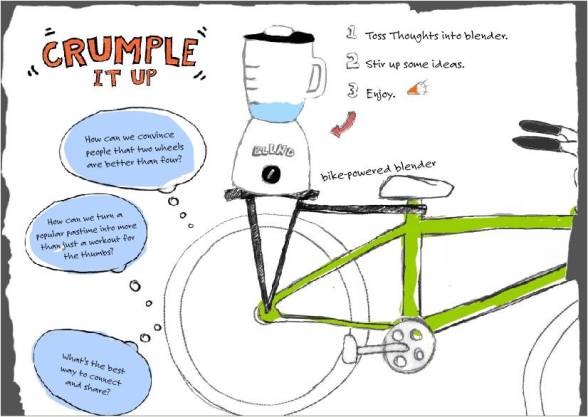
Humana is “Crumpling It Up”

I have given it away in the title, but would you have looked at the webpage below and imagined this was from Humana.

crumpleitupYou can go to their website CrumpleItUp to learn a little more about what they are doing with bikes called freewheelin and what they are doing around games and health.

They have a fascinating group there in Louisville that works on innovative ideas.  A lot of them don’t drive the core business of health insurance but they are related to improving the health of the general public or looking at interesting ways to use technology.

They have recently added a blog about this that you can see here.  Additionally, I had a chance to meet with Grant Harrison from this group at the WHCC and also hear him speak as part of a panel on innovation.  I was very impressed with him and a few of the other people in the group.

As John talked about over at Chilmark Research, it is refreshing to see someone focusing on this type of innovation.  When I talked about innovation with a reporter recently, I suggested that Humana would be one of the first groups that they should interview.

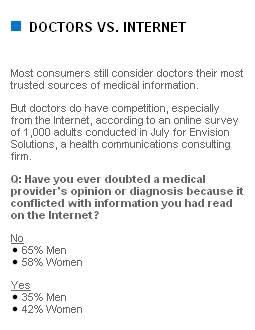
Is Your MD Honest With You?

They are probably not intentionally deceptive, but there are some things that doctors don’t tell us (at least according to Dr. David Newman in his book Hippocrates’ Shadow: Secrets From The House Of Medicine).

  1. Physicians don’t know as much as you think they do.
  2. Doctors do know that many of the tests, drugs and procedures they order and prescribe either do not work or have not been proven to work.
  3. Doctors disagree about everything.
  4. Doctors like ordering tests better than they like listening to you.

docs-v-internetIt’s a tough issue.  I talked about the placebo effect and the nocebo effect before.  That is exactly the type of things the USA Today article on this talks about.

Studies show half of patients who go to the doctor with a cold are prescribed an antibiotic.  Colds are caused by viruses; antibiotics kill only bacteria.

The idea that Americans get worse medical care that they realize- often because they get too many, not too few, tests, drugs, and procedures – is gaining ground.

The question still is whether you want to know everything.  Certainly, we should better arm physicians to talk about these gray areas and take them off the pedistal.  Part of that is addressing things like malpractice.  We will never control costs and improve care without eliminating the need for defensive medicine.

Spend Time With Your Positive Friends

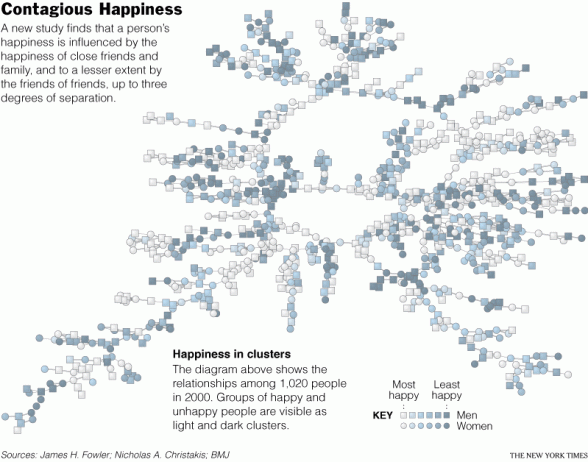
Earlier in the year, there was a study that showed how your friends and social network can affect your weight loss.  I blogged about this and quiting smoking as part of your network earlier.  Now, in Penelope Trunk’s blog, she talks about how your friends can make you happy and that happiness is linked to better health.  Interesting, she also says that if you say you are happy then you get the same benefits.

“optimism, a trait shown to be associated with good physical health, less depression and mental illness, longer life and, yes, greater happiness”  Time Magazine article

It brings me to two thoughts:

  1. You should tell yourself that you are happy and you’ll feel better.
  2. Member communications should stress happiness and help people understand how they can be happy by taking certain actions.

happy

Black Is The New Pink

I am stealing this line from a tee shirt I saw the other day, but it immediately came to mind when reading an article about colors in the US Today. I was amazed when it talked about people buying new iPods (for example) since they wanted a new color. Just because I get tired of my green iPod…do I really go back and buy the red one (especially in today’s economy)?

“Bleak 2008 also happens to be the holiday season when shoppers may want their gifts to be colorful. Or at least, a different color from last year’s model.”

“When you add color to a product, you stimulate the consumer’s awareness that the version they already have is obselete.”

Some of the favorite colors were:

  • Blue, dark blue, dark green, and red (tomato) for men
  • Purple, blue, red (tomato), and blue-purple for women

It just makes me think about healthcare communications and what is the color switch that we need. Companies have talked about obesity, diabetes, preventative care, adherence, and many other actions for years. What is it that becomes different? How do we compel the consumer to act?

  • Is it a change in mode – direct mail to automated call?
  • Is it a change in tone of the message – caring to pushy?
  • Is it a change in message – qualitative to quantitative?
  • Is it a change in source – health plan to provider?

To manage healthcare costs in the US, we have to get individuals engaged in their care. The magic bullet is how to do this.

5 Myths of Health Care

Charlie Baker, the CEO of Harvard Pilgrim, has a post on his blog about the Five Myths of Healthcare. It’s worth a read as is his blog.

1) America has the best healthcare in the world.

2) Somebody else is paying for your health insurance.

3) We would save a lot if we could cut the administrative waste of private insurance.

4) Health care reform is going to cost a bundle.

5) Americans aren’t ready for an overhaul of the health care system.

Malcolm Gladwell Video

In case you don’t know Malcolm Gladwell, he is the author of Blink and The Tipping Point. He has now published Outliers. Here is an interview of him about Outliers.

You can also see him in an older video presenting at TED.

It is worth reading his books and understanding his principles. I have seen him present live once. He was very good.

Want Senator Daschle To Come To Your HC Party

Obama’s team is leveraging the power of the people to solicit input.  You can go to their site www.change.gov to provide input. 

He is specifically asking for groups to meet on healthcare and document their thoughts.  Senator Daschle will attend at least one of these events personally.

It worked to get him elected so it will be interesting to see what they get and how they leverage this.

Great Presentation – Mktg in Recession

I came across this presentation and loved its simplicity.  It delivers a crisp message using few words and a lot of visuals.  Given the challenges in the economy (and more on topic with communicating efficiently), I thought I would share this.

Six Steps To Innovation

Futurist Leanne Kaiser Carlson presented at the 2008 AHIP Business Forum.

Health is a growth field, Ms. Carlson explained, not only because of the amount of money spent on it but also its importance to everyone and the unique confluence of technologies that are on the cusp of revolutionizing health. Ms. Carlson showed examples of how computing, nanotech, neurotech, and genomics are coalescing to enhance human performance, human life, and human health from thought-controlled bionic limbs to artificial legs that are faster then human legs.

She presented six things that companies should be doing to innovate:

1. Pay attention to what is going on around you.

2. Create an innovation imperative.

3. Begin a specific fund for innovation and development.

4. Understand the landscape of innovation.

5. Create a culture of rapid prototyping.

6. Break competitive boundaries.

Healthcare Reform Proposal

AHIP (American Health Insurance Plans)  put out a plan for healthcare reform.  You can learn more about it at the website they set up.  Here are the key things that they are talking about.

ahip-principles

Design For Six Sigma (DFSS)

Getting it right from the start is always a critical issue when designing process-based solutions.  DFSS or Design For Six Sigma is an approach that companies are starting to use in applying the rigors of Six Sigma to their product management approach.  This allows them to leverage proven fundamentals using a DMAIC framework.  (DMAIC = Design, Measure, Analyze, Improve, Control)

DFSS is built around a couple of Six Sigma fundamentals such as the VOC (Voice of the Customer) and the CTQ (Critical to Quality) framework (example.  Understanding root cause of issues in your process allows you to start finding solutions for them.

And, however you approach this, it is critical to understand your value stream (i.e., where is value created) and have a statistically valid approach for capturing data and rigorously reviewing and improving the process (i.e., continuous improvement).

The other thing that all this Six Sigma talk makes me think of is an automation of process which can be seen in a lot of the BPMS (Business Process Management Systems) which exist.  These process based applications can be created as flexible tools that sit above (i.e., abstracted from your legacy systems) to run using an event-based architecture (i.e., data triggers) or SOA (service oriented architecture).

Why do you care as a member or patient reading this? Because you hate things that don’t flow smoothly.  This approach is supposed to begin with the customer, understand their needs, develop a process with minimal potential quality or failure points, measure and continuously improve the process, and then automate the process with the flexibility of making dynamic changes as the needs and market changes.

Why do you care as a healthcare enterprise? Quality is always an issue.  As the economic times squeeze everyone, it is going to be critical to find efficient ways of improving processes and automating processes to drive better results without sacrificing quality.

Express Scripts Data Breach

By now, many people have heard about the data breach that happened at Express Scripts.  They have now set up a website to provide people with information about their investigation with the FBI and are also offering support for people whose identity has been stolen.  Given their focus (like all other healthcare companies) on keeping this data secure, I can only imagine how difficult this is for them.  I know that George Paz and the executive team will be doing everything they can to try to find the root cause and help any affected clients or members.

To find out more, visit www.esisupports.com.

Managing Stress

With all the turmoil in the markets and economy, I thought it made some sense to pull an article on stress management.  I have one from a physician that was in The Green Magazine in July/August 2008 that I had ripped out which seems to offer some practical hints.

  • Be realistic
  • Make yourself a priority
  • Shed the superhero suit
  • Do not look too far ahead
  • Add regular exercise to your daily to-do
  • Eat a well-balanced diet
  • Explore prayer and meditation

Since stress can caus physical and psychological problems, these are all things we should take into account in managing our lives.  And, importantly, these are things we should pass on to our children and our team members.

Although living close to that line of being too stressed out can motivate some people, in general it is a problem.  It has been linked to lots of issues which can limit people’s productivity.

So, don’t get stressed out.  Go out for a walk.  Drink some water, and take some time to reflect on life.

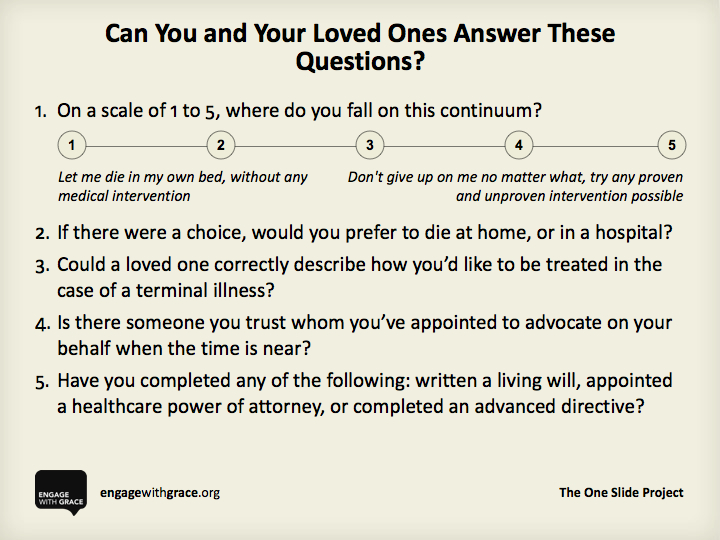
Are You Prepared For Your Last Days?

Obviously this is a conversation most of us avoid. It’s a difficult conversation for many. But, from a healthcare cost perspective, it is where significant money is spent.

I have struggled with the concept of inter-mingling this conversation with a work conversation, but I think the concept on a personal level is right. Alexandra Drane and Matthew Holt have created Engage With Grace to push this conversation to the forefront by boiling it down to five simple questions. You can visit the website to learn more.

theoneslide

Free Heroin To Addicts In Switzerland

Maybe someone out there can explain this to me, but it makes no sense to me. The Swiss apparently have had a program since 1994 (that they just voted to make permanent) which helps addicts satisfy their craving for heroin rather than try to end their addiction.

Is this just easier? I don’t understand.

Sampling: Good or Bad?

There is a good article in the USA Today about pharmaceutical sampling with some relevant statistics. The issue at heart here is whether pharmaceutical manufacturers providing free samples to physicians is a good or bad thing.

  1. There are no generic samples (generally speaking) so this may drive more brand use than appropriate. [I say generally speaking since both Medco and Express Scripts have tried generic sampling and MedVantx offers a generic sampling automated solution to physicians where the plan pays for the samples.]
  2. Doctors may be inclined to start you on a medication because they have a sample rather than pick the best drug for you.
  3. The sampled drug may not be covered by your insurance so you may have to pay a lot out-of-pocket or change drugs after the sample supply is used.
  4. In general, samples are not tracked appropriately where most physicians could not tell you what patients received what samples.

A few of the facts from the article:

  • An estimated $16B in free drug samples were handed out in 2004.
  • More than 90% of US physicians receive free samples.
  • More than ½ of older patients report getting at least one sample per year.
  • In a study, physicians were 3x more likely to prescribe generics to uninsured patients once they lost their sample closet.
  • Several studies have shown that more samples go to insured patients than to uninsured patients where cost is a bigger issue.

No Prescribing Data For Detailing?

Detailing physicians and providing them with samples has been the cornerstone of the pharmaceutical industries marketing efforts for years. Over the past few years, there have been changes where physicians don’t allow detail reps to meet with them or even physician groups that charge them for the meetings.

There have also been attempts to move to eDetailing where physicians log-in to virtual detailing sessions on their own time or attempts to push advertising or other drug information into the software solutions that prescribers use (electronic prescribing, practice management, electronic medical record).

One of the critical components for detailing is knowing doctor’s prescribing behaviors. How many prescriptions do they write? What drugs do they write for? This allows the pharma companies to focus their reps on the high prescribers that prescribe their competitors products or generics disproportionately.

So, if I interpret the recent decision from the New Hamshire District Court, it would appear that they are upholding an initial decision to prohibit companies from using this prescribing data for detailing. This is a big enough issue that I am sure it will get appealed again, but it would be a game changer if it is upheld.

Joining The Board of Advisors at CareFlash

After learning more about CareFlash, I was excited to have the opportunity to join the Board of Advisors.  You can learn more about the company below, but what struck me was the examples of how this could be used by a family dealing with a complex medical situation where they needed help from their community of friends.  After seeing several families with kids in the ICU for prolong periods of time, I can only imagine their challenge in keeping everyone up to date on their child’s condition and seeking out help with errands without being overwhelmed.  CareFlash offers a simple, Health 2.0 type approach to solving that problem using blogging, a shared calendar, and 3D annimation of medical conditions. (See a video tour here.)

We deliver unprecedented healthcare advocacy and world class education to people in the richest circumstances imaginable, while offering unique philanthropic benefits to healthcare-related foundations, advocacy groups, religious institutions, etc. What CareFlash does is unique and unprecedented… and free.

When someone learns that they (or their loved one) have been diagnosed with a chronic healthcare challenge, a flurry of painful emotions appear ranging from fear and feelings of aloneness, to anxiety, uncertainty and even depression. As families begin the process of navigating through this experience together, it commonly becomes clear that people are unprepared and inexperienced at the realities of serving as a caretaker. CareFlash addresses these challenges, empowering our users to do the following:

Establish private and secure online communities around a loved one in order to share and facilitate updates, discussions and well-wishes

  • Update friends, family, coworkers and congregants through a ‘many-to-many’ communication tool. CareFlash streamlines the sharing of updates and well wishes
  • Educate the patient, caretaker and community on the specific disorder and treatment options at hand, using easy to understand 3-D medical animations narrated in plain everyday English, Spanish and other languages.  They range from pregnancy and neonatal issues to cancer, cardiovascular, ears/eyes, neurological, genetic, bladder/kidney, digestive/mouth, endocrine, blood/immune, respiratory, orthopedic, skin/cosmetic and hundreds of others.
  • Engage and organize involvement where help is needed… doing so in an unobtrusive, non-confrontational way through our easy-to-use iHelp Calendar
  • This is all offered to our users for free because our revenues are derived from advertising

In addition, CareFlash delivers unique philanthropic benefits to healthcare-related foundations and institutions, advocacy groups and religious institutions via alliance partnerships that provide them fundraising and marketing… never at any cost to them.

Another more lighthearted video about CareFlash is below.

This is a free service so I would encourage you to consider recommending this to families you know who could leverage this technology approach.  It is also a great tool for alumni groups (e.g., colleges, large institutions) or organizations who deal with families or patients to promote (e.g., specialty pharmacies).

Who’s Responsible For Healthcare Costs?

I was recently at the AHIP Business Forum Chicago and was in a session where Amy Holmes, CNN Political Analyst and Peter Beinart, Editor-at-Large of The New Republic held a discussion on Decision 2008 and What it Means for the Future of Health Care.  They are two of the sharpest people I have seen speak in a while and they hosted a very engaging discussion on the issues and what the Obama win means for healthcare from both sides of the political spectrum.  (They also had a very entertaining “He Said, She Said” style that captivated the audience.)

The big changes they felt were bound to happen were cuts in Medicare and an expansion of the SCHIP program, and there were others that they said would be debated including being able to sell insurance across state lines, the government offering coverage, individual coverage mandates and coverage for pre-existing conditions.  But the biggest part of the discussion was around healthcare costs.  Costs that are out of control, who pays for services, and where will the money come from.  While at an aggregate level talking about healthcare’s spiraling costs is simple, it is not the heart of the issue.

Isn’t the issue about how as an industry we get individuals to change their behaviors?

The most powerful force for changing the economics of healthcare is the healthcare consumer.  If the consumer changes behavior (even small changes) there are billion dollar impacts in cost.  Our research shows that if a plan the size of Aetna is able to improve adherence by 1% they could save $238M!  According to the Journal of Occupational and Environmental Medicine (JOEM), 70% of all healthcare expenses are lifestyle related.  This is not a new number but it translates to $1.4 trillion in healthcare costs that could be controlled simply by modifying healthcare behaviors. 

So if our lifestyles are “killing us” and destroying a system meant to improve our quality/length of life, why are we not talking about that at the national level as THE core issue?  How can we as industry professionals develop solutions that support consumers and facilitate the changes they need to make?

I was excited to see in the third Presidential debate that both candidates addressed responsibility being in the hands of the individual.  Next steps:  Let’s see some discussion on programs and policies that truly look to impact healthcare consumer behaviors.

(This is a guest post from Chuck Eberl, VP of Marketing, at Silverlink Communications.)

Happy Thanksgiving! Enjoy The Turducken

I must admit that one of the foods I have been fascinated with (but have never eaten) is the Turducken.  It is a turkey stuffed with a duck stuffed with a chicken stuffed with stuffing or sausage.  Regardless of what you eat tomorrow, enjoy the day.

If you’re healthy, reflect on how lucky you are since more than 50% of the US population is on some chronic medication.

If you’re sick, reflect on how lucky you are that there are researchers and companies trying to find cures for your disease. 

If you’re frustrated by the costs of the US healthcare system, focus on the positive which is the access we have compared to many other people around the world. 

If you work in healthcare, reflect on how lucky you are to be in a stable part of the US economy. 

Enjoy your family and the day!