Archive | Books / Articles RSS feed for this section

30% of MDs Believe They Will Save Healthcare

“It has become increasingly apparent that doctors have to work with other people and share the care of patients with other professions, whether they are nutritionists, pharmacists, or nurse practitioners.  You’ve got to be more collaborative, work as a team.  There’s a different mind-set.”  (Michael Dacey, SVP for Medical Affairs and CHMO, Kent Hospital)

I think this quote a recent article in Health Leaders (In Search of the Team Player, Feb 2012) makes a great point.  Healthcare is changing.  While I think we are seeing the pendulum swing back towards being more physician centric, the new model will be very different with quality measures and new technologies and the empowered patient.

The article shares some survey data that I found interesting.  For example, while only 10% of physicians blame themselves for the “healthcare industry mess”, 30% of them believe they are the ones that will save healthcare.  Certainly, physicians by themselves can’t change the model.  We need payment reform and many other constituents with different agendas involved.

The article also shared a data point that 58% of physicians had ordered a test or procedure in the past year for purely defensive medicine reasons which is a sad reality.  At the same time, I know that many of us when faced with those tough decisions for ourselves want to jump through hoops to do everything possible even if it doesn’t offer a good ROI. 

The issue of the impending physician shortage (see Washington Post blog) can be mitigated by engaging these other professions in a care team strategy, but will physician’s embrace this.  26% of physicians surveyed thought that increasing the scope of care for nurses would worsen the quality of care and 13% say that abuse or disrespect of nurses is common.  Fortunately, everyone wants the same thing which is cost-effective care that improves outcomes and the quality of life.  The challenge is finding a solution to do that.
Reading Labels; Understanding Side Effects

We all know people don’t read labels on their medications or their over-the-counter (OTC) pills. If they did, their eyes would gloss over, and they would start to worry about all the side effects. Of course, this is a problem since some things can create drug-drug interactions or create an overdose.

I was reading an article in USA Today called “Read the labels because ‘all drugs have side effects’“. It lists out Tylenol, Advil, Motrin, Benadryl, Claritin, and Zantac as examples of OTC medications with overdose risks. It gives more details on these and provides several other examples. Here’s a quote from the article:

“It’s important for the public to realize that all drugs have side effects. It doesn’t matter if they’re prescription, over-the-counter, herbals or nutritional supplements. If they have active ingredients, they have side effects and can interfere with normal body functions.” Brian Strom, director of the Center for Clinical Epidemiology and Biostatistics and the University of Pennsylvania

The reality is that we’re making an unconscious choice about tradeoffs. Do the risks and probabilities of the side effects outweigh the probabilities of improvement?  Of course, in many situations, they do. 

I think this points to several things:

  • Document everything you take whether it’s an Rx, OTC, herbal, or supplement.
  • Read labels.
  • Tell your MD and Pharmacist what your taking especially if it’s regular and long-term.

Ideally, once we have broad use of PHRs (personal health records) which are tied into our grocery bills to track purchases and use then computer algorithms can look for risk factors. And, with personalized medicine, we might one day know which things to avoid based on our genes.

90 Day Rxs Get Better Adherence

I think we can all agree now that 90-day prescriptions are correlated with better adherence (and the percentage of retail 90-day scripts is going up).  The latest study here is from Walgreens.

A new Walgreens study analyzing relative medication adherence of patients filling 90-day supplies of maintenance medications using retail and mail order channels over a one-year period concluded that patients who fill prescriptions via retail have as high or slightly higher adherence levels than those utilizing mail (77 percent vs. 76 percent). The study, “Medication Adherence for 90-Day Quantities of Medication Dispensed Through Retail and Mail Order Pharmacies,” was recently released in the November issue of The American Journal of Managed Care.

This reflects other studies from CVS Caremark, Express Scripts, Kaiser, and BCBSNC.  (Although sometimes it shows mail order as better and sometimes retail.)

Of course, the data is slightly different in either case, but the general consensus is the same.  So, the question is what’s next.  How should you compare the two channels?

  • Generic fill rate
  • Overall health literacy and health outcomes
  • Patient experience / satisfaction
  • Payer cost
  • Cost to fill

This issue won’t go away so it’s going to be important to continue to find ways to compare the channels and find populations that are similar for comparison or remove the bias.


NYT Article On ACOs Replacing Health Insurers

I think it’s a bold (maybe foolish) prediction that is made in the NY Times article saying that ACOs (Accountable Care Organizations) will be the end of health insurers.  We don’t even know that ACOs will work yet.  You can even see some debate on this topic in this blog post on Why ACOs Won’t Work.

But, I’m not an ACO expert so let me focus on what I found interesting in the NYT article.  It points out a few things:

  1. The focus on preventative care
  2. The fact that some managed care organizations are changing (and others will too)
  3. The fact that “ACOs” (in whatever form they take) will need a platform

This is what I find interesting.

I think the concept of an ACO (or Patient Centered Medical Home) where care becomes localized and there is greater focus on prevention and wellness not just sick-care is great.  We should all want that to happen in some form.

But, in all cases, this changes the data needs and role of the physician.  They need to be empowered with new information and tools.  How do they manage their panel of diabetics?  Will some database track them and monitor their screenings and blood sugar?

When the field of medicine is constantly changing with new drugs and new studies, how will physicians have the best practices pulled into their practice?  They won’t want to wait the 16 years it takes for things to work their way through the system.  They’ll actually want to embrace the best solutions and see more comparative effectiveness information.

I see a huge opportunity here for someone to create an ACO “platform” that embeds business rules, tele-monitoring, consumer engagement, and reporting into a way to create the “i-physician” (informed physician) of the future.

Medicare Enrollment Up 1.2M (9.5%) in 2012

Based on new data from CMS as shared by CSFB in a report, the enrollment in Medicare Advantage through January 12th is up 1.2M to 13.3M.  This is 27% penetration into the Medicare market.  PDP enrollment was up to 19.69M a similar gain of 1.2M. 

A quick summary of the big winners are:

  • For Medicare Advantage (by percentage)
    • Humana +13.5%
    • Amerigroup +13.3%
    • Coventry +12.2%
  • For Medicare Advantage (by membership)
    • Humana +262K
    • United +132K
    • Aetna +35K
  • For PDP (by percentage)
    • Coventry +25.3%
    • Cigna +14.8%
    • Humana +12.3%
  • For PDP (by membership)
    • Humana +312K
    • Coventry +291K
    • Cigna +80K

This is also interesting in light of Kermit Crawford (CEO of Walgreens) comment yesterday:

“Based on our preliminary analysis of the Centers for Medicare and Medicaid Services (CMS) data, Medicare Part D plans with Walgreens in their network gained market share in the aggregate, while those without Walgreens lost market share. Importantly, we were very pleased to see that those plans that included Walgreens grew nearly twice as fast as those Medicare Part D plans without Walgreens. In fact, several health plans that partnered with Walgreens grew significantly faster. For example, Coventry, who partnered with Walgreens and introduced a low cost Medicare Part D option, grew five times faster than the overall market.”

The one obvious account that he’s talking about is Wellpoint which lost 2,000 (0.3%) members in MA and 73,000 (11.6%) members in PDP.

Uping The RxAnte: An Adherence Predictive Model

Those of you that have heard me speak know that I look at this topic of predicting adherence both from an area of fascination along with the eye of a skeptic.  While I love the concept of predicting someone’s adherence and therefore determining how to best support them from an intervention approach, I also believe that the general predictors are pretty straightforward:

  1. Number of medications
  2. Plan design (i.e., cost)
  3. Gender
  4. Health literacy and engagement (see PAM score research)

And, this is a hot topic (see post on FICO adherence score).  You can see my prior posts on some different studies, on the Merck Estimator, and some notes from the NEHI event on this topic.  It generated a good dialogue on Kevin MD’s blog when I talked about paying MD for adherence.

I had a chance to talk with Josh Benner the CEO of RxAnte the other day.  It sounds very interesting, and they have an impressive team assembled.  In general, they’re focused on:

  • Predictive modeling
  • Decision rules
  • Monitoring and managing claims to track adherence
  • Evaluating effectiveness of interventions
  • And creating a learning system

There are definitely some correlations to the work we do at Silverlink Communications around adherence.  We’re helping clients determine a communication strategy that might include call center agents, direct mail, automated calls, e-mail, SMS, mobile, or web solutions.  We’re looking at segmentation and prioritization.  We’re looking at past behavior and messaging.  The goal is how to best spend resources to drive health outcomes from primary adherence to sustaining adherence.  This is a challenge, and we all need to build upon the work that each other is doing to improve in this area.  We have a huge problem globally with adherence.

Why People Under 35 Are Stressed

This is a great list from what Beth Braverman calls “The Beaten Generation” looking at what’s happened since 2005:

  • Their home equity has dropped 51%
  • Their net worth is down 55%.
  • Their student debt is up 19%.
  • Unemployment for college grads is up 64%.
  • Their income is down 4.5%
  • 31% more are living with their parents.
  • The birth rate is down 7.1%.
  • 22% less think they’ll be able to retire by age 65.

And, we wonder why they’re pessimistic…

Stressed Out Workers Spend 2X On Healthcare

Are you stressed out? In today’s economy, many people are. Whether it’s being a caregiver, your job, or other concerns (like just paying the bills), have you ever thought about how much that costs you?

According to some data shared by Money Magazine, here are some examples of stress related ailments and their average annual costs:

  • Obesity – $2,600-$4,900
  • Back Pain – $1,300
  • Insomnia – $200-$1,200
  • Hypertension – $1,100
  • Teeth Grinding – $200-$1,100

That’s real money!

Some of their suggestions (other than going on a long vacation):

  1. Take advantage of the EAP (Employee Assistance Program) that your company might offer.
  2. Use the wellness programs that your employer might offer (since 74% of them do offer something).
  3. Go see a therapist and look into CBT (cognitive behavioral therapy).
  4. Workout.
  5. Take a break from e-mail (or your smartphone and constant Facebook updates).
  6. Stop multi-tasking.
  7. Meditate.

(Beat Stress For Less by Kate Ashford)

Be Happier To Be Healthier

Since happiness is correlated with better health, I thought this article in Money Magazine was relevant in the hints it gave about becoming happier. (Jan/Feb 2012 article by Donna Rosato)

  1. Spend a little a lot of the time. (multiple, small indulgences are better than less, large indulgences)
  2. Free yourself from credit card debt. (less satisfied in your relationship when have debt)
  3. Focus on having a rainy day fund. (best predictor of financial satisfaction)
  4. Find a new job. (if you’re not happy)
  5. Give more to charity.
  6. Use your vacation days. (even anticipation of a vacation increases happiness)

Here are a few more articles on happiness and health:

The New Post-Recession Consumer

I’m always fascinated by segmentation, and I think understanding how market events like the Great Recession have changed the fundamentals of the game is important. In November 2011, Money Magazine shared some data from a survey they did. Here are some of the results.

  • 53% of Americans aren’t sure their kids will better off then they are.
  • 67% are worked their quality of life will suffer in retirement.
  • 80% say they’re eating at home more.
  • 75% say time with family is more important than ever.

“Big periods of economic upheaval can define a generation. Not so much because of the depth of this recession, but because of its prolonged nature, it will have lasting impact.” Paul Flatters, Managing Director of Trajectory Partnership. (How The Economy Changed You by Dan Kadlec)

  • 85% spend more time looking for deals before they buy. (hence the couponing craze)
  • 57% are building an emergency fund.
  • 51% are pessimistic about the US economy in the next 12 months.
  • 61% are pessimistic about government officials spurring growth.

I don’t know about you, but I see a ton of nuggets in here about positioning generic drugs, preventative health, adherence, mail order, and many other cost savings actions in healthcare.

52% Of Patients Who Had A Second Opinion Had Changes

I don’t know about you, but this seems a little surprising to me. We know that it’s hard to figure everything out in the 8-15 minutes we have with the physician so perhaps a deep focus on key claims and key procedures is a necessary process. But, I think many of us worry that our physician will think we don’t trust them.

“Someone who has your best interest in mind will welcome that conversation.” Is what Dr. Jeffrey Cain, president-elect of the American Academy of Family Physicians says about telling your physician that you’re getting a second opinion

So, according to an article in Money Magazine, here’s what you do:

  1. Check your coverage. You may be covered if you get a second opinion. If not, you might be able to appeal that decision.
  2. Find the right doctor. The article suggests getting multiple names and finding MDs that work at different hospitals (to avoid group think).
  3. Get your documents together. Make sure the physician has all the documentation before you go or bring it with you.

(Get More From A Second Opinion by Anne Lee)

Pharmacy Needs A Neuromarketing Study

I was reading this article in Fast Company about neuromarketing with a focus on the CEO of NeuroFocus. Companies like PepsiCo, Intel, CBS, ESPN, and eBay have used them and many others are trying work in this area. But, I’ve never heard of a healthcare company doing anything in this space. I’ve talked about this before in my article about the book Buyology. It’s fascinating, and the mobile tool that NeuroFocus has created could create new ways of capturing data.

One interesting example he talked about was the expression of a person on a poster (for example). If the expression is too easy to decipher, we simply move on…BUT if it’s hard to decipher, it causes us to pause and think.

He also talks about always putting images on the left hand side of the screen and words on the right. (Seems applicable to direct mail and maybe my next slide presentation.)

Another example is that the brain loves curves not sharp edges.

Given the shifting pharmacy marketplace, I would think this is a study that the industry needs. The PBMs should better understand what the consumer thinks about when they hear the word mail order. Manufacturers should understand the reaction to brand names or copay cards. The retailers should think about how brand equity plays into choice. There are endless opportunities here. (A business opportunity perhaps!)

(They Have Hacked Your Brain by Adam Penenberg)

Percentage You Pay For Prescriptions In Medicare

I thought this was a nice summary which Money shared based on CMS data. It shows you what percentage of cost for your prescriptions you pay based on total dollars spent on prescriptions during that calendar year.

  • For the first $320, you pay 100% of the costs.
  • For the next $2,610, you pay 25% of the costs.
  • For the next $3,727 (the donut hole), you pay 50% of the costs for the brand drugs and 86% of the costs of the generic drugs.
  • For everything above $6,658, you pay 5% of the costs.

Wellpoint Quote On Drug Copay Cards

This topic seems to be heating back up based on several posts on Adam Fein’s blog (Lipitor, adherence) and an article in Drug Benefit News where this quote appeared along with an AIS blog post questioning the PBM’s dislike of copay cards (from the same article that Adam mentioned).

“Copay offset programs [offered by brand-name drugmakers to compete with generics] mitigate the effectiveness of our tiered benefit design programs and [are] going against what we’re trying to accomplish for our members’ health and for employers.”

— Peter Clagett, vice president of pharmaceutical strategies and PBM oversight for WellPoint, Inc.


Speaking at the upcoming PCMA Event

I just got added to the agenda for the February PCMA event so look me up if you’ll be there.  I’ve spoken on the topic of copay cards a few times for AIS in the past.  Since then, there have been a few significant events:

  • The Pfizer Lipitor strategy and push around a copay card.
  • The PCMA study on the impact of copay cards.
  • CVS Caremark’s changes to their formulary of which some were attributed to the existence of copay cards.

As always, I welcome comments, articles, suggestions, or data to support this discussion.  It is certainly one where there is limited data or facts.  Thanks.

“Twight” (Twitter Fight) Between $ESRX and $WAG

This is either a massive validation of the perceived value of Twitter or a crazy distraction, but either way, it’s interesting to those of us who study the industry and/or study marketing and communications. 

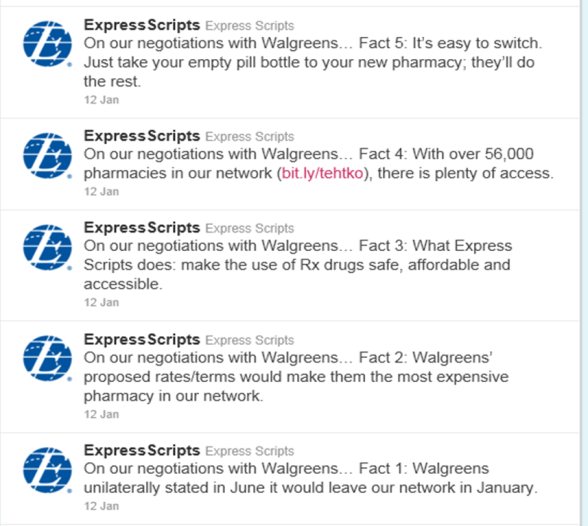
As part of the ongoing dispute between Walgreens and Express Scripts, Twitter has become one of the latest tools.  (see June post and September post)  In an effort to sway public opinion and thereby pressure Express Scripts and its clients, Walgreens turned to bloggers and Twitter to push their messaging…but these were in some case paid comments which was surprising.  They already have strong messaging in their IChooseWalgreens website and whitepapers on the Value of Walgreens.  I also thought they were demonstrating some success in converting people to their discount program which was part of their overall growth strategy shared at their shareholders meeting

After Walgreens (with almost 84,000 followers) created a promoted hashtag of #ILoveWalgreens, Express Scripts (with 1,645 followers) countered back with several Tweets about the dispute (see below).  I guess the question is whether with millions affected and decisions made by the businesses and not consumers…does this forum matter?  But, journalists and analysts follow them so it’s important to keep the messaging up.  (Other articles on this are here, here, and here.)

Conveniently, I found this infographic on how Twitter is changing healthcare.  At the same time, this is an interesting fight because it’s a blend of B2C and B2B crossing paths.  More to come since I’m sure this fight is long from over.

The Value of the Family Dinner

Studies have shown that kids who eat dinner with their families do better in school, feel more socially connected to their parents, have better peer relationships, and are less likely to try drugs and alcohol.

Wow! That quote from Grace Freedman at eatdinner.org certainly makes a compelling case. The article in Spirit magazine (Jan 2012) goes on to say that according to a 2010 Pew Research poll only about half of families make dinner a daily ritual and roughly 20% eat together only occasionally or never.

It certainly is a challenge with long workdays, commutes, travel, and kid activities.

Who’s the 1% in healthcare?

As we all have known, healthcare costs are driven by the minority. According to the Agency for Healthcare Research and Quality, the top 1% account for 22% of healthcare spending in the US or about $90,000 per year. (USA Today article)

So, what are the characteristics of these people:
– White, non-Hispanic
– Female
– In poor health
– Elderly
– Users of publicly funded healthcare

Only about 20% of the high cost consumers stay in that bucket for two straight years…which I think is good. But, I guess you have to look at what percentage die during that period since a lot of costs are concentrated at the end-of-life.

Obviously it’s critical to develop solutions to engage and manage these patients earlier in the process. As data gets better, our predictive algorithms around conditions will improve and we’ll be able to intervene and prevent or delay cost in the system. The key of course is doing that in a way that fully engages the healthcare team and the caregivers.

Only 2 of the top 25 “Companies for Leaders” from Healthcare

I don’t know about you but given the focus on healthcare and the percentage of our GDP that it consumes I had hoped this would be higher. 

According to Fortune’s rankings (published 11/21/11), the top 5 companies were:

  1. IBM
  2. General Mills
  3. P&G
  4. Colgate-Palmolive
  5. McDonald’s

Eli Lilly was ranked 12th, and UnitedHealth Group was ranked 20th.

Medicare and Medicaid Social Media Use For Healthcare

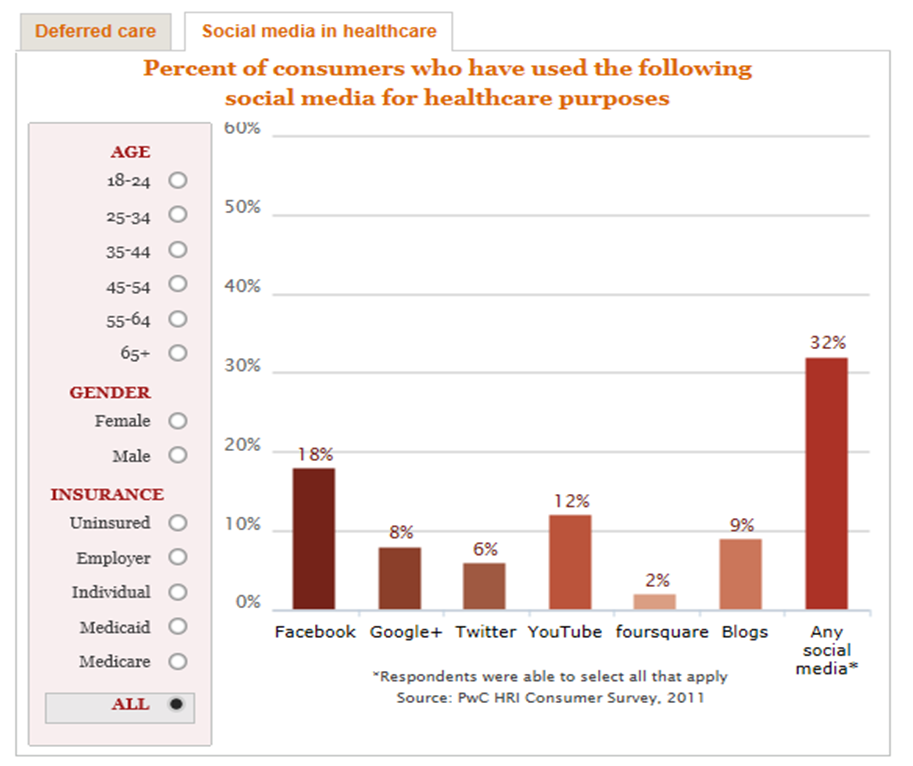
As people look at ways to engage the Medicare and Medicaid populations, I continue to talk about the facts from the Pew research that shows how these demographics use technology.  I was glad to see some research from PWC that also reinforced this.  As you can see in the three charts below, the Medicare population uses technology similar to the average respondent while the Medicaid population uses social media for healthcare more. 

Mouthguards For Non-Contact Sports

I wore a mouthguard when I played lacrosse, but I’m not sure I could see myself putting in a mouthguard for running or playing tennis or golf.  Under Armour is pushing a series of mouthguards for any sport now (see brochure).  But, from a purely academic perspective, it’s interesting.

The material says that:

  • It improves airflow.
  • It reduces stress.
  • It improves strength.
  • It reduces lactic build-up.
  • It improves response time.
  • It reduces cortisol production.

It just makes me think that you’ll create this casual athlete with:

  • A mouthguard.
  • Nose strips to improve breathing.
  • Dark compression socks pulled up to the knee (perhaps with no bottom to allow for barefoot running).
  • Compression arm sleeves.
  • Heart rate monitor with GPS.
  • Googles to protect the eyes.
  • Magnetic band for strength and balance.

You get my point.  All of these things offer either some type of protection and some improvement in results, but it can go too far (IMHO).  Although on the flipside, the competitor inside me is anxious to try them out.

Why We Need Recess At Work

More exercise = higher GPAs

More activities = better grades especially in math, English, and reading

Exercise = greater productivity and less sick days

Physical activity = increased blood flow to the brain fueling memory, attention, and creativity

Physical activity = hormones that improve mood and suppress stress

Any more information needed?

I was reading an article about research into why recess is important for kids in school.  I couldn’t agree more, but it got me wondering about the need for running clubs and other fitness breaks within the corporate work day.  I’m pretty sure  working through lunch and eating at your desk doesn’t help.  On the flipside, I’m not sure if fuzzball tables and other “dotcom” activities meet the activity level.

Food for thought…and of course this doesn’t account for potential hard dollar savings associated with better health and lower healthcare costs.

PBMs As A Short-Term Story…I’m Doubtful

While I certainly think the PBM market is going to evolve with increased use of generics, the Express Scripts acquisition of Medco, and the growth in specialty pharmacy, I have to disagree with Matthew Herper from Forbes and Richard Evans of Sovereign & Sector who talk about them as a short-term solution that will struggle (see point 5 in this article). 

I think Mark Merritt from PCMA did a nice job of talking about this when I interviewed him last year about how PBMs have continued to change and will continue to evolve over time.  I also think that Per Lofberg’s comments from earlier today reflect this.  There is still a lot of opportunity around specialty spend.  Certainly, the market dynamics put pressure on the traditional margin areas of generics and mail order for oral solids, but these companies are here to stay and I believe valuations will stabilize even if not at the highs of 5 years ago.  

And, while in general specialty management has been a stagnant space for innovation over the past 5 years, I expect that to change.  I think we’ll see more collaboration with manufacturers both around REMS programs and outcomes-based contracting.  I think we’ll see continued evolution in the area of genetic testing and clinical support.  I think we’ll see the traditional utilization management programs and formulary management programs show value with the growth of competitive products and bio-similars.  I also believe that understanding how to help patients manage their condition and start to take a broader role in overall condition management will and should create PBM opportunities.

2011 Blog Overview and Press Hits Update!

2011 was a great year for the blog with over 120,000 visits and 365 new posts (conveniently averaging 1 per day).  You can see the top posts here.  The blog led to several new opportunities at Silverlink, and it generated numerous press opportunities. 

The blog now has over 400 people who get an e-mail every time a new post is published.  The content is then syndicated to the 930 people who follow me on Twitter and to my 1252 contacts in LinkedIn.  I’m happy with this for something I do in my spare time.

In August, I shared my press hits YTD which numbered 25 times.  Since then, I’ve had 27 more which are listed below:

  1. Dec 26th issue of Health Plan Week about Express Scripts and Walgreens
  2. Jan 1st issue of Managed Healthcare Executive on limited networks
  3. Dec 2nd issue of Drug Benefit News on Lipitor
  4. Dec 2nd issue of Drug Benefit News on Prime Therapeutics Retail MTM solution
  5. Dec 2nd issue of Drug Benefit News on PBM Deal Making
  6. November Frost & Sullivan newsletter on consumer engagement
  7. PBMI Report
  8. Nov 11th issue of Drug Benefit News on Pfizer’s Lipitor strategy
  9. Nov 11th issue of Drug Benefit News on the PBMI Report
  10. Oct 28th issue of Drug Benefit News on OptumRx
  11. Oct 28th issue of Drug Benefit News on CVS Caremark case study
  12. AIS webinar on copay cards / coupons
  13. AIS webinar on PBM outsourcing
  14. Oct 7th issue of Drug Benefit News on Outcomes-Based Contracting
  15. PCMA Smart Brief on Oct 5th regarding PBM disclosure of profits
  16. Sept 23rd issue of Drug Benefit News on Mobile Apps
  17. Sept 23rd issue of Drug Benefit News on Anthem study
  18. Drug Channels mention of my post on the Prime Therapeutics Trend Report
  19. PCMA Smart Brief on Aug 11th re: NY bill
  20. Sept 9th issue of Drug Benefit News on the Prime Therapeutics Trend Report
  21. Sept 9th issue of Drug Benefit News on the proposed Express Scripts acquisition of Medco
  22. Sept 9th issue of Drug Benefit News on Generics
  23. Aug 22nd issue of Health Plan Week on Generics
  24. Aug 24th Reuters article on the proposed Express Scripts acquisition of Medco
  25. Aug 19th mention in Health Reform Watch
  26. Aug 19th issue of Drug Benefit News on Part D
  27. Presentation with Aetna at the Care Continuum Alliance on engaging the hard to engage

Will Patient Reported Data Augment Claims Based Models?

On the one hand, it seems fairly obvious that patient reported data (use of OTCs, exercise, food intake) is important in understanding their healthcare.  On the other hand, the historical bias has been to use historical claims to predict future costs.  At a minimum, I think that studies around tools like PAM (Patient Activation Measure) have shown that patient reported information is important in understanding their literacy and attitudes on healthcare.  This data is critical in designing effective healthcare engagement programs.  [One of the reasons that Silverlink has stressed our focus on using data for segmentation and personalization for years.] 

That’s why I found one of the latest studies by Kaiser to be really important.  They used both claims data and patient reported data to evaluate inpatient admission rates and costs.  And, as explained below, this data increased the predictive power of their model. 

The research determined that self-reported information about being in poorer health was a key determinant in predicting higher inpatient admissions and for being in the top tier for costs. Higher admission rates and costs were associated with patients who self-reported:

  • Lower score for general self-rated health
  • Yes to “do you need help with one or more activities of daily living?”
  • Yes to “do you have a bothersome health condition?”

The addition of this self-reported information to a claims history model explained an additional 2.8 percent of variance in admissions and 4 percent in cost.

Should You Be An “Imovator”?

Innovation has been a hot buzz word for the past few years.  The question is always whether to be on the bleeding edge (i.e., an innovator) or a fast follower.  I like the word “imovator” from a July 10th, 2010 Time article on the two business books – Different versus Copycats. 

Many people will tell you that we’ve tried that before or list all the reasons why something won’t work.  It’s never easy to be innovative.  At the same time, you don’t want to be innovative without a purpose.  There has to be a business value to justify the time and investment. 

One easy way to do this is to monitor your competition and simply make what they do better and less expensive.  This fast follower strategy has worked for many people.  They let the competition come up with an idea than execute on it better without having all the upfront investment. 

One of the examples in the article was Walmart.  Sam Walton didn’t invent the discount store, but he certainly figured out how to do it better and scale it.  So, as you think about 2012, what are your strategies for innovation and imovation? 

I personally find focusing on the whitespace between different products to create opportunities.  Look at how consumers use your products.  Look at the choices in the market.  There are often niches which can be grown to create opportunities.  The key is identifying those and creating something that is sustainable in terms of differentiation.

Good Health Is More Than Skin Deep

In the July 11th Time Magazine, there was a small article which I think made a great point – you can be lean and still be at risk for heart disease and diabetes due to fat.  What you can’t tell by weight and appearance is the person’s genetics.  Apparently, international researchers have found a specific variant of a gene that regulates where and how fat is stored.  People with the “lean gene” were storing fat deeper in the body around organs and in tissues.  This visceral fat is more dangerous and can impair bodily functions. 

So…the key point is that even healthy looking people need to monitor their cholesterol and glucose levels.  (I guess those advertisements for high cholesterol drugs were right!)

Does Duration Of Team Matter In Business As In Sports?

One thing that I often think about is the amount of change in the teams within rapidly growing companies (e.g., many PBMs). Does this have an effect on internal knowledge, productivity, and therefore success? It’s a great question. With that in mind, I found the infographic below very interesting.

At the same time, I looked back a few years to see how much change there has been in the management teams at each of the largest PBMs (Medco, Express Scripts, and CVS Caremark).  [Honestly, it was less change than I had expected, and I didn’t look at average age since I’m not sure that’s a great proxy in business while it may be in sports.]

  • At Express Scripts, 7 of the 10 people listed on the website have been there that entire time.  Most of them in their current roles. 
  • At CVS Caremark, 6 of the 10 people listed on the website have been there that entire time althought there has been more movement across roles. 
  • At Medco, 14 of the 16 people listed on the website have been with Medco that entire time and the two others might have also but their start date wasn’t listed in their bio. 

So maybe more change is needed?  Certainly with the changes in the market dynamics, there is always a need for bringing in a fresh perspective…at the same time, the PBM industry is complex and continuity given long-term contracts is important. 


by visually via