Archive | Books / Articles RSS feed for this section

Basic Attributes Of The 7B People In The World

There was an article in the 10/31/11 Time magazine about the global population.  I found this list of basic statistics interesting:

  • 19% of the world’s population lives in China.
  • 33% of the world’s population is Christian.
  • 50.4% of the world’s population is male.
  • 50.5% of the world’s population lives in a town or city.
  • 29 is the median age of the world’s population.
  • $10,290 is the per capita gross world income.
  • 73% of the world’s population does NOT use the Internet.

Will The Stars Align To Drive Adherence?

We all know that adherence to prescriptions is a problem.  People don’t start on their medications.  People don’t stay on their medications.  But, another problem also exists which is finding the ROI on adherence.  While the ROI is clear to the manufacturer or even to the pharmacy, it’s often less clear to the payer.

This is not true in every category.  Diabetes and several other conditions have been shown to have an ROI associated with intervention programs that improve adherence.  But what about all the others.

In the short-term, I expect you’ll see the CMS Star Ratings and bonus payments drive behavior in three critical categories that are now measured in the 2012 for MAPD and PDP plans.  (see technical notes on 2012 measures)

If you’re not familiar with the Star Ratings system, you should read this.  In 2012, there were three new adherence measures added.  Not only are they now part of the evaluation process, but they were weighted more heavily than some of the operational measures.  A  good indication of focus on quality of care.

Getting more Stars is important since it is linked to bonus dollars that the plans can get.  And, there aren’t many Five Star Plans.  Only 9 plans received 5-Star Ratings for 2012 (see article).  [Interestingly, I think one of the unique assets that Express Scripts is buying in the proposed Medco acquisition is one of the 4 Five-Star PDP plans.]

“The Medicare star quality rating system encourages health plans to improve care and service, leading to better patient experiences across the board,” Jed Weissberg, a senior vice president at Kaiser Permanente.  (from 5-star article above)

The adherence measures focus on diabetes, high cholesterol, and hypertension and use Proportion of Days Covered (PDC) rather than MPR for their measurement.  Certainly, one of the things we’re seeing at Silverlink with our Star Power program is that many of these Star Measures can be influenced by communications.  Adherence is certainly one of those big areas of opportunity for plans to focus on.

While the benefit is obvious to the plan in terms of reimbursement, the big question is whether consumers care about Star Ratings or just focus on lowest price point and access to pharmacies or specific medications.  A Kaiser study that was done seems to indicate that the answer is no.

Conducted by Harris Interactive, the survey showed that only 18 percent of Medicare-eligible seniors said that they are familiar with the government’s rating system. Of those that are familiar, less than one-third have used the system to select their health plan. Moreover, only 2 percent of respondents were aware of how their current plans rates. 

Since we’re in open enrollment for Medicare right now (see Medicare.gov to evaluate options), perhaps we’ll get some data in early 2012.  2012 will also be the first year for the 5-Star plans to be able to market all year round and not be limited to the OEP (open enrollment period).

But, one of the things I found interesting as I looked on the Medicare.gov site to “select” a plan in my area is that there is an option to “Select Plan Ratings” but even I wasn’t sure what that was.  It’s not intuitive to the consumer that this is a quality rating for them to pay attention to.  And, it appears that the default order of options which is presented to you is based on price.

Infographic: Word Of Mouth Advertising

As healthcare moves toward a more retail model, word of mouth advertising becomes more important.  This is already true in terms of physician’s influence on prescription use or in some cases distribution location.  It’s also important from a Medicare perspective.  But, this will continue to increase in importance in the future with health reform.

I also believe that clients will require satisfaction scores as part of their SLAs (service level agreements) in many cases in the future and/or tie bonus dollars to this.  Will you be prepared?  Do you understand your customers’ satisfaction with you?  Do you know how to impact it?

Managing Stress As One Of 65M Caregivers

65 million Americans are caregivers which can be a stressful job.  I think more and more companies that I consult with are looking at how to engage the caregivers as part of the overall health team.  With that in mind, I thought I would share this quote.  Managing stress as a caregiver is important so you don’t burn out.

“When you have a bad job in a toxic workplace, you feel trapped, but you can always try to find another job,” said Sharon Brothers, a veteran social worker who is now executive vice president of Caregiver Village (www.caregivervillage.com), an omnibus Internet community and resource hub for caregivers that includes expert forum hosts and even an online caregiver game. “Caregivers, however, can’t just find another role. They are caring for a loved one, so the stress they live with is real and the boss they report to is themselves. They feel trapped by their love and obligation to their family members, which makes it exponentially more difficult for them to get a break, because they feel guilty whenever they try to take one.  In fact, studies show that being a family caregiver is one of the most stressful ‘occupations’ in the country today.”

Touch and Body Language in the Physician Encounter

I was watching this TED video the other day from a physician and writer Abraham Verghese.  It was interesting since his whole point was about the ability to relate to your patient through human touch and the power that has on the patient’s trust and experience.  As we move towards move EMRs and other technologies, we have to make sure we don’t over-engineer the patient experience.

I was reminded of this again when reading KevinMD’s blog where there was a post on using body language.  How many of us think about what our body language is saying?

Or do we think about our clothing selection?  While the white coat may create trust, does the tie create a sense of being aloof?  Or should you consider different color sections to seem more approachable?

Food for thought.

Did IOM Overlook Literacy and Prevention With Their EHB Recommendations?

“The ACA requires that certain insurance plans—including those participating in the state purchasing exchanges—cover a package of diagnostic, preventive, and therapeutic services and products that have been defined as “essential” by the Department of Health and Human Services (HHS).

This package—commonly referred to as a set of essential health benefits (EHB)—constitutes a minimum set of benefits that the plans must cover, but insurers may offer additional benefits. The EHB are intended to cover health care needs, to promote services that are medically effective, and to be affordable to purchasers.”

The Institute of Medicine (IOM) put out a report recently about Essential Health Benefits (EHBs). While I haven’t fully digested the report and its implications, I noticed two things:

  1. There was no one from the pharmacy community on the committee.
  2. They seem to overlook the value of health literacy.

While I know observation #2 is an opinion that could be heavily debated, let me share my logic here.

If you look at the criteria for EHB selection (see below), they call out that it must “be a medical service, not serving primarily a social or educational function.” I would argue that it is risky to ignore education and its correlation with health. There are many educational functions around prevention which are important. Additionally, there is a lot of research these days around the social value of different networks and tools and their relevance to overall health.

This is Health Literacy Month so you can go visit several sites to see more about this topic. You could also look at research on social aspects of health from Pew. Or, I might even draw upon research around pets and their value in healthcare.

I’m sure the panel didn’t mean it to be interpreted this way, but we know how our government works. These comments become “law” and hard to overcome. I would think some clarification to say something more like the following would be better.

“Be a medical service or a program whose educational or preventative objectives have been demonstrated to improve health outcomes.”

Other articles on the report include:

NCPA Announces “Simplify My Meds”

For patients with multiple prescriptions, it can be very annoying to have to constantly refill different medications on different cycles. This leads to waste (time) and forgetfulness around refills. It’s an age old problem.

The easy answer would be to work with the patient to consolidate the orders to refill on the same day of the month. This might involve a few split orders or short-fills to get them lined up. I’ve talked with multiple pharmacies about this over the years.

NCPA announced the other day that they were going to focus on this as part of their adherence program. This is great! If they can pull this off, I would expect the whole industry to try and follow.

“By coordinating exactly what day patient refills occur, the independent pharmacy staff’s workload is streamlined. Daily workloads become more predictable, labor costs go down, and staff stress levels decrease. Data analyzed from pharmacies using this model has shown as much as a 30 percent increase in prescription volume, a 50 percent decrease in labor costs, and $1.87 per script increase in gross margin.” (NCPA Press Release)

Monitoring Your Health Thru Existing Devices – Convergence

Not a big surprise, but a company [and probably many more] is focused on applications that leverage the smart phone for remote monitoring.  They are looking at respiration, pulse, heart rhythm, and blood oxygen level.

This reminds me of the Ford announcement about monitoring air quality for allergies and considering a diabetes app within the car.

This idea of convergence isn’t new.  I think we’ve all seen how our smart phones now replace our cameras in many cases.

The one that I keep wondering about is when monitoring will happen through the toilet.  You could monitor your kids for drugs or alcohol.  Your urine could tell you about a urinary track infection or the color can tell you about dehydration.  Your feces color or smell could also provide health information.  This has been a topic on Dr. Oz before (but I couldn’t get the video to play and embed here).

Maybe the “smart toilet” will be the next big thing in preventative health.

Using Hypothetical Questions To Influence Decisions

Most people don’t realize how questions can be persuasive, according to new research from the University of Alberta. Hypothetical questions usually start with the word “if,” meaning the information may or may not be true. Our brains process that information like the “if” isn’t even there, says study author Sarah Moore, Ph.D., a marketing professor at Alberta’s School of Business. “As a result, people accept the data you present at the beginning of a question as fact,” Moore says.

This is from an article in Men’s Health.  It made me think about lots of ways that hypotheticals could be used to drive consumer behavior in healthcare:

  • If you were able to avoid having your kids home with the flu shot this year, would you take them to get a flu shot?
  • If you were able to save $50,000 in healthcare costs over your lifetime, would you make sure to take your medications everyday?
  • If you were able to spend more time with your family rather than waiting in line at the pharmacy, would you be more likely to use 90-day prescriptions?
  • If you didn’t have to take any sick days next year, would you go in for your annual physical exam?
  • If you decreased your likelihood of losing your foot to amputation due to diabetes, would you go get a foot exam every year?

This fits well with a lot of the behavioral economics frameworks that companies are using today.

Patient Reasons For Participating (or not) in Genetic Test

Medco just put out a study that I found very interesting since it shares data around patients opting-in to a genetic test around use of statins.

In the big picture, it showed that those got the genetic test were more adherent.  Perhaps this points to a better belief in the therapy post-genetic test (similar to the placebo effect).

But, what first grabbed my eye was data on the consumers:

  • 53.8% participated in the study since they believed in the utility of genetic testing
  • Only 6.7% of those that declined cited privacy issues
  • Only 8.8% of those that declined cited anxiety about the results

This could be very promising for something that is complex but is certainly part of the future of medicine.

Will Insurers Continue To Cover Avastin?

In case you haven’t seen the news about Genetech’s Avastin, here’s the quick summary:

This will be a hot topic.  While it only affects a relatively small group of patients (~17K), this is an emotional issue.  Many patients strongly believe in the drug.  I would expect companies to be getting lots of questions on the topic.
At the end of the day, if the panel and FDA agree that the drug is not effective, I find it hard to believe that many insurers will cover it or if they do, it will be tightly controlled with prior authorization.

Health, Wealth, and Education

I was reading the article “The Preschool Wars” by Kayla Webley, and I thought I would share some of the comments from it. It certainly plays into why we need to think about all of these issues together – poverty, literacy, education, health, and wealth. They are correlated.

  • Long-term studies show high-quality early-childhood education is particularly beneficial to low-income kids, helping them to avoid repeating grades in elementary school, stay on track to graduate from high school, earn more money as adults, and spend less time in jail or on welfare.
  • Only 9 states and DC are even trying to offer preschool programs to all children that want to attend and 10 don’t even have any state-funded programs.
  • You get a 60:1-300:1 ROI for each dollar spent on these programs in terms of increased earnings, crime reduction, and other benefits to society. [And, I would argue that as the government is and continues to be the primary payer in healthcare that there are savings possible here also.]
  • 1 in 5 children live below the poverty line today.
  • 1 in 4 third-graders who have lived in poverty and are not reading at grade level will drop out or fail to graduate by age 19 (6x more than the rate for proficient readers).

It creates some good food for thought. We need to continue to think about how we help people teach their kids. We need to think about how we introduce health into the conversations at home and at school much earlier in life. These things can make a difference.

Will Drought Eventually Push Us To Drink Toilet Water?

Not a hot topic! But, I think we all have seen the issues in Texas and other areas of the US this year around lack of water. Water is rapidly becoming a critical resource with McKinsey estimating that by 2030, the global water supplies will meet just 60% of demand. Basically, water supplies don’t go up while demand does due to population and new uses for land.

There is an interesting article called Droughtbusters by Anita Hamilton. One of the more disgusting but yet practical solutions in there is recycling toilet water which is being done in Namibia. I won’t pull you through the technology, but if Orange County, CA can begin treating sewage water and pouring it into its underground aquifiers than it’s not that far fetched.

To read more about water scarcity, you could go to http://thewaterproject.org/.

Diabetes And Medicare Star Ratings

Do you know what the Medicare Star Ratings are?  If not, you might want to review the Kaiser Family Foundation brief from last year.

Basically, the star ratings provide individuals with a quality rating across numerous dimension on a Medicare plan.  And, they are helping to drive the pay-for-performance (P4P) focus across healthcare.  This year’s changes include several adherence metrics and have brought the total diabetes measures up to 7.  And, if you happen to be one of the few 5-star Medicare plans, you will be able to have open enrollment all year not simply during the AEP period from 10/15-12/7.

Here’s a quick summary of the seven (lots of opportunities to work with communications to improve ratings and outcomes):

Measure Summary
Cholesterol Screening Percentage of diabetics with an LDL  test
Eye Exam Percentage of diabetics with an eye exam
Kidney Disease Monitoring Percentage of diabetics with a kidney function test
Blood Sugar Controlled Percentage of diabetics with an A1c test showing their blood
sugar under control
Cholesterol Controlled Percentage of diabetics with an acceptable LDL value in their cholesterol test
Treatment Percentage of diabetics with both a diabetic medication and a hypertension medication that are getting an ACEI or an ARB
Adherence to Oral Rxs An average Proportion of Days Covered (PDC) greater than 80%

We all know the statistics on diabetes so hopefully this will help to improve outcomes.  If you’re interested in how Silverlink helps plans with Star Ratings – go here.

Here Come The Pharmacy Co-Branded MA/PDP Plans

In the past few days, I’ve seen two new announcements:

  1. Aetna partnering with CVS to launch a co-branded Medicare plan
  2. Coventry partnering with Walmart, Walgreens, and Target

I think we’re all familiar with the success that Humana has had in their Medicare offering with Walmart.

I think one could also say that the PBMs (i.e., mail order) getting into the Medicare business was also an effort to co-brand Medicare offerings between payers and pharmacies.

I wonder if we’ll see an NCPA offering.  I would think in certain regions that that would play well.


Sandwiches and Caregivers During AEP

October 1st marked the beginning of the Medicare marketing period leading into the enrollment period known at AEP (Annual Enrollment Period) which begins on 10/15. [For more on how Silverlink is helping clients with AEP – click here.] More to come on this topic, but for right now, I was just reading an article about the sandwich generation which made me think about this.

Traditionally, we think of sandwich generation as those that have young kids and parents to care for. Increasingly, that “young kids” age is getting stretched out as kids move back in post-college or even as they lose their jobs later in their career.

Perhaps, some of this will be good as we go through more integration of multiple generations into single households as other cultures experience, but it certainly is creating financial stress for the baby boomers. As you think about your marketing, this is just another wrinkle.

For example, according to Strategic Business Insights’ MacroMonitor, 39% of households headed by 60-64 year olds had primary mortgages compared with 22% in 1994. And, as we know, it’s often harder to get out of those houses these days as many people are unwater or can’t sell their homes.

How does this change our caregiver strategy as a healthcare provider? (assuming you even have a caregiver strategy)

On this caregiver point, here are some statistics from the National Family Caregivers Association:

More than 65 million people, 29% of the U.S. population, provide care for a chronically ill, disabled or aged family member or friend during any given year and spend an average of 20 hours per week providing care for their loved one.
Caregiving in the United States;
National Alliance for Caregiving in collaboration with AARP; November 2009
The value of the services family caregivers provide for “free,” when caring for older adults, is estimated to be $375 billion a year. That is almost twice as much as is actually spent on homecare and nursing home services combined ($158 billion).
Evercare Survey of the Economic Downturn and Its Impact on Family Caregiving;
National Alliance for Caregiving and Evercare. March 2009
The typical family caregiver is a 49-year-old woman caring for her widowed 69-year-old mother who does not live with her. She is married and employed. Approximately 66% of family caregivers are women. More than 37% have children or grandchildren under 18 years old living with them.
Caregiving in the United States;
National Alliance for Caregiving in collaboration with AARP. November 2009
1.4 million children ages 8 to 18 provide care for an adult relative; 72% are caring for a parent or grandparent; and 64% live in the same household as their care recipient. Fortunately, most are not the sole caregiver.
National Alliance for Caregiving and the United Hospital Fund, Young Caregivers in the U.S., 2005.
51% of care recipients live in their own home, 29% live with their family caregiver, and 4% live in nursing homes and assisted living.
Caregiving in the United States;
National Alliance for Caregiving in collaboration with AARP. November 2009
36% of family caregivers care for a parent and 7 out of 10 caregivers are caring for loved ones over 50 years old.
Caregiving in the United States;
National Alliance for Caregiving in collaboration with AARP. November 2009

Coordinated Versus Integrated PBM

I’ve long held what would appear to be conflicting positions:

A. I believe that a standalone PBM offers the unique ability to be laser focused on pharmacy and should therefore optimize your benefits from a carve-out perspective.

B. I also believe that ideally that focus could be achieved within an integrated benefit where you could leverage pharmacy strategically to drive down the bigger overall area of costs – medical.

So, my initial reaction when I heard about the study below Anthem was that this finally showed a clear savings from the integrated PBM model.

According to a separate analysis Anthem conducted of members in its affiliated health plans, enrollees with both medical and pharmacy benefits managed by Anthem have medical costs that are $8 to $16 lower per employee per month compared with those without Anthem’s pharmacy program. (from Drug Benefit News)

I haven’t seen the original study which I’d like to read in more depth, but on the surface, this is interesting.  After further retrospect, I wonder if the issue isn’t necessarily integrated versus coordinated.

Can a standalone PBM act as an integrated PBM?  What would need to happen for that to be true?

  • They would need to coordinate benefit design across both areas (pharmacy and medical) which is easier when the managed care company is the buyer of PBM services not the individual employers.
  • There would need to be integration of pharmacy and medical benefits into a predictive model and an outcomes model.
  • The PBM would need to be tied to outcomes in some type of P4P model.
I’m sure there’s lots of PBMs out there on both sides of the fence who could (and will) argue this story better.  I’m just thinking through my initial reaction to think about what this study really means.

State By State Use of Rxs per Capita, Age, and Gender

(Note: This is retail only data so it’s not comprehensive, but it should be directionally accurate.)

The Kaiser Family Foundation puts out lots of data.  One of their sites shows state by state analysis.  Here is a map of utilization by state. 

As you can see on the site, the top 5 states are (i.e., highest utilizers of prescription drugs):

  • WV
  • KY
  • AL
  • TN
  • MS

The bottom 5 are:

  • AK
  • CO
  • UT
  • NM
  • WA

For age breakdown, the data showed:

  • 0-18 = 3.8 average Rxs
  • 19-64 = 11.3
  • 65+ = 31.1

For gender, the averages were 9.5 Rxs for males and 14.4 Rxs for females. 

Note: All this data is available online at http://www.statehealthfacts.org/

Primary Adherence – Technology, Kaiser Study, and EHRs

I think we all know that primary adherence is a real issue.  Depending on what you read, you see that anywhere from 20-30% (or more) of patients don’t start therapy.  They are prescribed a drug, but they never fill it.  This is due to lots of reasons:

  • They get a sample.
  • The drug costs too much leading to abandonment.
  • They don’t feel like they need the prescription.
  • They feel better.
  • The doctor tells them only to fill it if something else doesn’t work.

These issues vary based on whether it’s an acute drug or a maintenance drug.  It also varys by drug class. 

I’ve always been surprised that pharmaceutical manufacturers focus so much on ongoing refills leading to improved MPR rather than focusing on primary adherence which would grow their market significantly.  One of the big reasons for this has been visibility.  Without electronic prescriptions and mapping those to claims data, it was hard to identify who had a prescription and didn’t fill it.  You could do something with data out of the PPMS (Physician Practice Management System) or through more complicated processes to get data out of their notes, but it wasn’t easy. 

So, this new study by Kaiser caught my attention. 

If you are a diabetic, have high cholesterol, or high blood pressure and you receive medical care at an integrated healthcare system that has electronic health records (EHRs) linked to its own pharmacy, then you are more likely to collect your new prescriptions than people who receive care in a non-integrated system, a Kaiser Permanente study shows.

That’s a strong sell for an integrated model, but perhaps more realistically for the use of EHRs.  You can also see some of the data from Surescripts around this topic of electronic prescriptions and adherence

This creates a great opportunity for pharmacies, PBMs, payers, and pharmaceutical manufacturers to leverage technology to improve primary adherence.  By identifying people who don’t fill a prescription they receive, companies can help determine which of those are intentional and which of those should be addressed.  This should help address the overall costs attributed to non-adherence and be a business driver for all these entities. 

[Note: If you’re interested in working on primary adherence, let me know.  We have several approaches for this at Silverlink.]

Walgreens and Express Scripts: The Plot Thickens ($ESRX, $WAG)

Remember when this “conflict” was first announced a few months ago.  If you’re like me, you probably assumed this would be over in 30-days like the Walgreens – CVS Caremark dispute last year.  What’s different?  I’m not sure.  It seems like both sides are well dug in.  (From my poll a few days ago of 22 of the readers of this blog, 65% felt this would get resolved by 1/1 and 25% felt that it would never get resolved.)

Now, it seems like both sides are continuing to take significant steps towards no resolution.

Express Scripts has apparently launched a pilot program to move share from Walgreens stores now using coupons.  I believe the pilot was with Lowes and is about to expand to the Department of Defense.  Additionally, I’ve heard that Express Scripts has sent out letters to their clients preparing them for a limited network starting 1/1/12 without Walgreens.

On the flipside, I’ve heard that Walgreens has begun putting signage out encouraging consumers to talk to their plans about excluding them from the network and for Medicare members to chose plans that aren’t run by Express Scripts.  Walgreens also put out a whitepaper about what happens when you remove them from the network.  This has some really interesting data in it.

Key Statement: Excluding Walgreens from a pharmacy network will result in little to no savings for most sponsors and patients, and in some cases will raise costs, while causing significant patient disruption and risking gaps in care, and increasing administrative costs on plan sponsors.

  • As part of this document, they are encouraging payers to consider directly contracting with them and/or creating a custom network (if their PBM contracts allow for that).
  • They state that their costs are comparable to other retailers or within 2% of their costs.
  • They show some data from another PBM (not named) that modeled out network savings for them based on a limited network taking into account their drug costs, generic fill rate, and 90-day rates.  It shows a jump in costs versus savings.

  • They share data that their Generic Fill Rate (GFR) is 1.4% higher than the rest of the Express Scripts retail network which the paper says translates to $2 per Rx in cost.
  • They say that 90-day retail generates a 6-8% savings compared to 30-day retail based on the pricing that they offered to Express Scripts.

Ultimately, I still believe resolution will occur before the end of the year.  While both parties are dug in, I believe it’s a lose-lose situation for this to stay unresolved.  That being said, there are lots of things that could occur here:

  • This creates a wave of direct contracting between payers and pharmacies.
  • This validates the integrated model of CVS and Caremark.
  • This creates a large number of limited networks.
  • This creates greater use of the Walgreens discount card and/or cash business at Walgreens especially for lower cost generics.
  • Alienating Walgreens creates a disruptive force in the FTC review of the proposed Medco acquisition.
  • Another PBM jumps in to do a creative deal with Walgreens which limits their long-term ability to work with Express Scripts.
  • Express Scripts ends up in a shotgun relationship with CVS.
  • The terms of PBM contracts get changed going forward based on new terms regarding retailers.
  • Walgreens becomes a much more vocal voice in the retail world through NCPA and other organizations.

Between this and the proposed Express Scripts acquisition of Medco, the landscape in the PBM market could be radically different by early 2012.

[Note: As the stock market has dropped, I have continued to buy stock in the PBM industry including several of the specific companies mentioned in this post – MHS, ESRX, WAG and CVS.]

$47 Per Rx Guarantee From Prime Therapeutics

I think this is a good, bold move.  Prime Therapeutics has launched four new programs.  The most aggressive is called Reliance and guarantees your net spend per Rx at $47.  The easy way to do this would be to exclude specialty drugs and basically offer a generics-only formulary.  My quick read from their drug trend report and press release is that it includes specialty drugs.  It also includes a lot of utilization management programs, suggestions on plan design, encouragement for mail order, and other features.  I’ll be interested to see the adoption of the program or whether it’s just a great program to encourage clients to consider new, more aggressive plan designs.

“Our Reliance plan keeps costs predictable for plan sponsors,” said Michael Showalter, Prime Chief Marketing Officer. “The goal is to make pharmacy benefits easy, understandable and affordable. Through Reliance, there will be no surprises, allowing organizations to better plan for and manage their pharmacy costs and reduce overall health care costs, while providing excellent benefits. We provide a single number demonstrating the true cost of care – $47. We are the only PBM to back that up with a price guarantee and complete price transparency.”

Highlights From the Prime Therapeutics 2010 Drug Trend Report

I just finished reading the Prime Therapeutics Drug Trend Report. As I highlighted the other day, their overall drug trend was 2.9%. Like in the past few years, they have jumped up to offer a report comparable with the other big PBMs. And, as we saw with last year’s report, the new management team is aggressive in using this to highlight research, their competitive differentiation, and point out why they are a competitive force in the market.

More interesting that just their success in drug trend was their “adjusted drug trend” for the other PBMs. You don’t often see this in your face marketing in this space, but they clearly want to show not only that their trend was better but that their methodology is better. (I don’t have the time to compare methodologies at this point.)

Fortunately, they don’t stake the argument on trend since as I’ve pointed out before – trend can be misleading. Sometimes higher trend is good as when it indicates better Medication Possession Ratio or better success at reducing gaps-in-care. They focus on five things in the document:

  • Savings
  • Safety
  • Guidance
  • Satisfaction
  • Partnership

Their Generic Fill Rate (GFR) for 2010 was 69.2% which was lower than the 71% reported by Medco and the 71.5% reported by CVS Caremark. (I couldn’t find the Express Scripts numbers for whatever reason.)

The report focuses on some of the differences in the Prime model (client ownership, not public) and how that plays out in transparency and alignment.

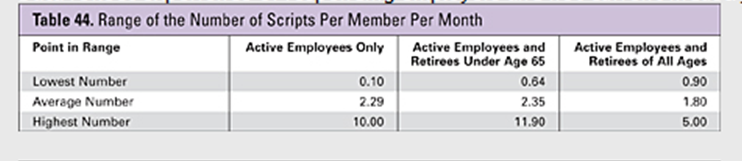
They are now at 12 Rxs PMPY which to me still seems a little low. (I’ve mentioned this is prior reviews, but I don’t understand why their population usage is different.) To validate my hypothesis, I looked at the PBMI report from last year which shows PMPM utilization ranges by respondents (not industry averages).

I do think their example around implementing a generics-formulary along with their new benefit plan guaranteeing cost at $47 per Rx are very interesting. They remind me of the GenericsWork product I launched at Express Scripts and should offer some clients a great way to save money. They key, as I learned, was really understanding how to manage member disruption and gain buy-in to the offering.  [Amazingly, a quick Google search led me to a cached image of the PDF from my product from 2004.]
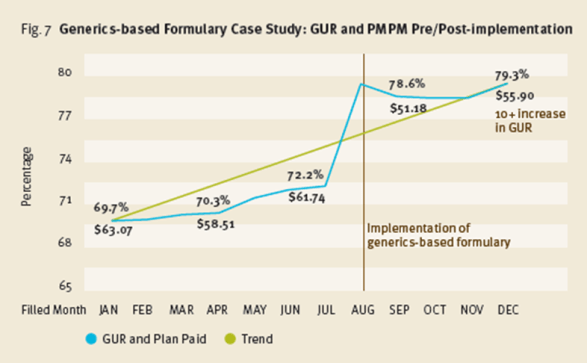
They give some good MTM numbers:

  • $1.29 in return for every $1 spent
  • $86 in savings to the payer over a 10 year period per MTM encounter

They also announce a new offering for 2012 which they call the GuidedHealth care engine. There’s a little information in the document, but it sounds intriguing.

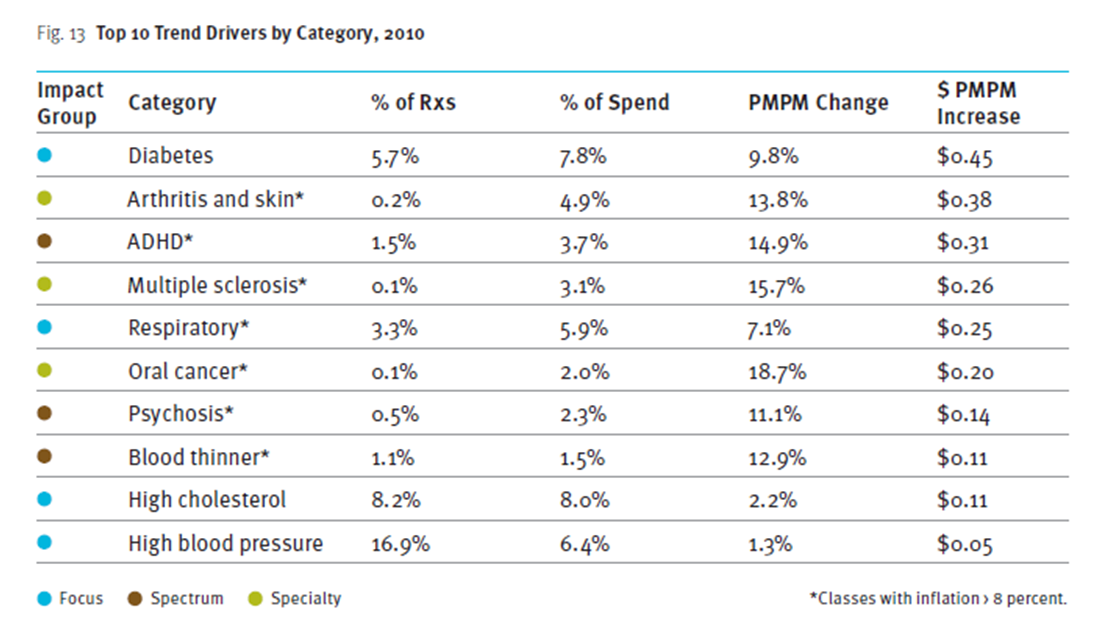
One of those typical charts that we all like to look at shows the drug classes that contributed most to driving trend.
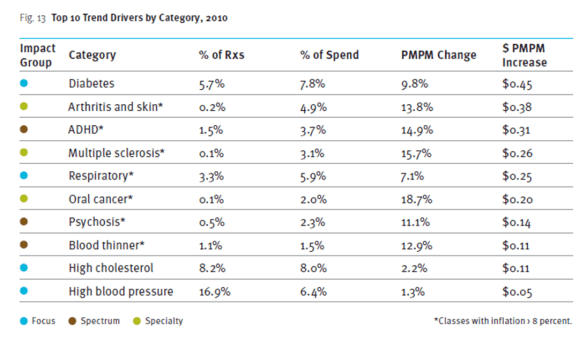
I think their equation about overall cost…

Optimal cost = (medical cost + pharmacy cost) x health outcomes

One of my favorite charts is below which recognizes that there are two cost curves to focus on. The one for the relatively healthy which is often highly pharmacy focused cost versus the chronically ill that drive the majority of overall costs and is heavily medical and specialty medications.

Another study they share in here looks at the likelihood of hospitalization tied to adherence. Very interesting.

$7.60 PMPY savings for a limited network. Those are big numbers that they share from a case study around a client limiting their retail network by excluding one chain.

Their drug trend report looks at another hot topic – 90-day prescriptions. They share their results of a statin study looking at waste in 90-day retail and mail and 30-day retail and estimate the cost impact of the waste.

Another hot topic is the mix of specialty drug spend between medical and pharmacy. They share a chart looking at several of the large specialty drug classes.
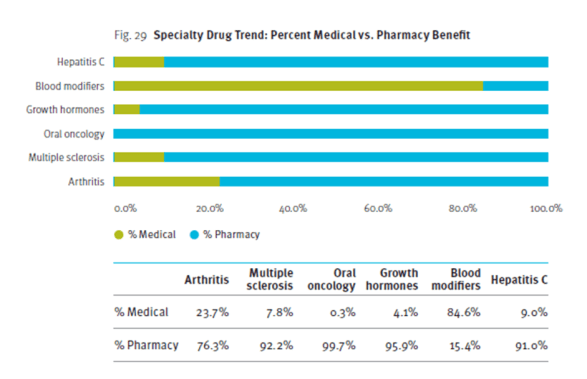
At the end of the report, they give suggestions to clients on a spectrum of management (low to high). They also predict a few things in the next five years:

  1. A return to double digit trend increases after this generic wave;
  2. A generic fill rate in excess of 90%;
  3. Specialty drugs accounting for 40% of spend;
  4. Healthcare spending will increase 8-10% per year;
  5. The role of genetic testing will be validated; and
  6. Up to 25% of employers will drop benefit coverage.

Pharmacy Satisfaction Report

If you haven’t read through the Pharmacy Satisfaction Pulse Report, you’re missing some great information.  There’s not a lot out there about consumer level expectations for pharmacies but this is a good start.  (Full site with other data)

Here’s four charts I pulled out of the report to get you started…These should help you frame messaging around retail-to-mail, 90-day, and pharmacy adherence programs.


Summary Of Drug Trends (Prime’s Report’s Out)

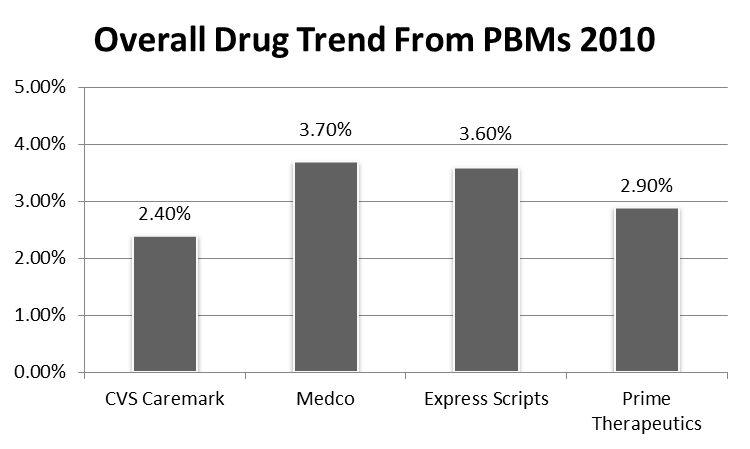
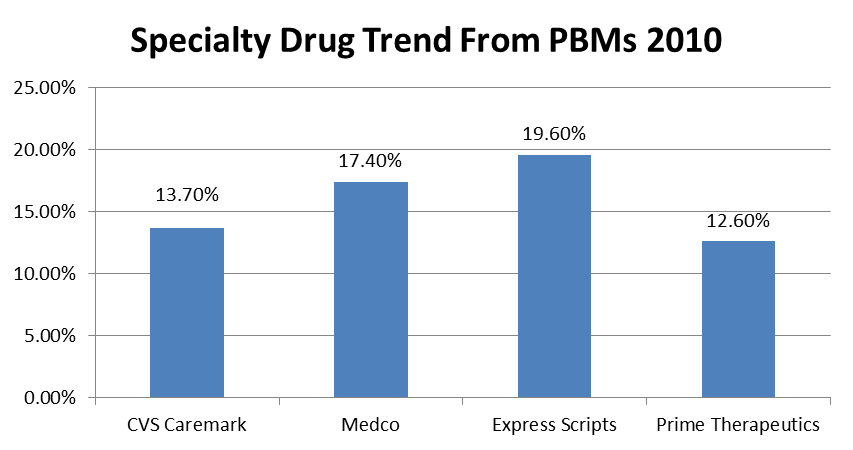
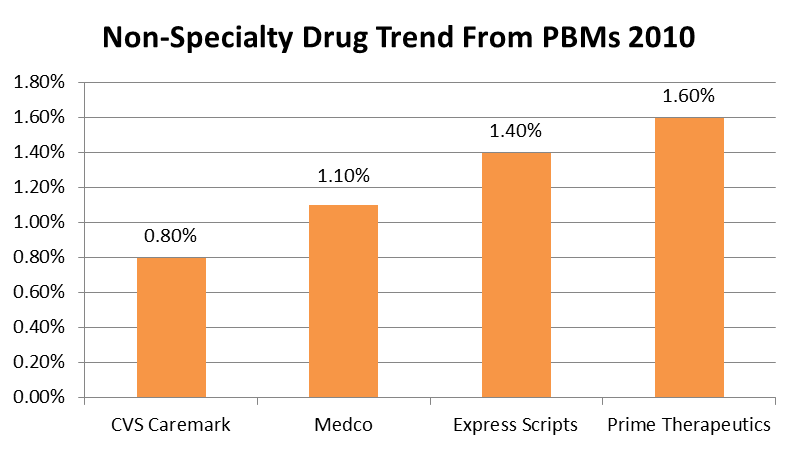
Prime Therapeutics published their Drug Trend Report yesterday.  I haven’t had time to read it yet, but I pulled their total trend numbers and aggregated them into charts with the previously reported numbers from other PBMs.  (As always, you can see detailed summary’s from Adam Fein and I on most of the reports.)

Additionally, here’s a summary from last year.  AND, as always, don’t forget that these aren’t apples to apples.

(NOTE: Lower trend is better implying that the PBM is doing a better job at managing costs for their clients although as I’ve argued there may be some clinical reasons for trend going up that are good – e.g., improved adherence, identification of pre-diabetics, addressing primary adherence.)


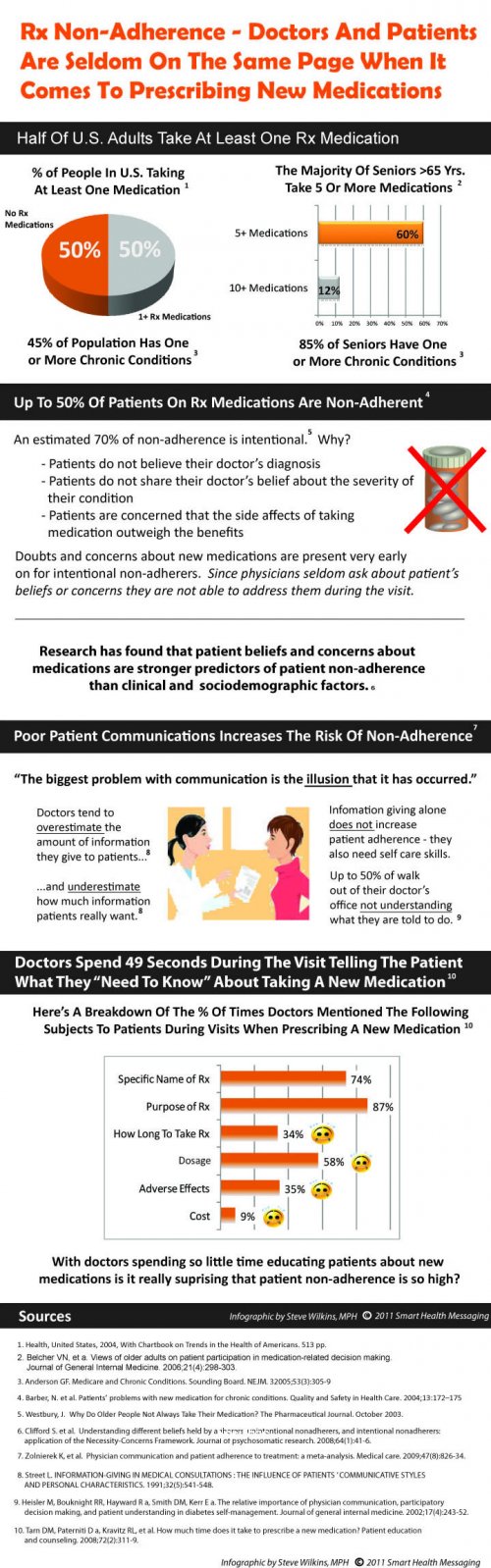
Infographic: MD-Pt Communication Link To Non-Adherence

Within the payer / pharmacy / PBM world, we tend to think of adherence as something that can be addressed by us. What if the problem is more systemic than that? I’m not talking about clinical issues like side effects or even cultural biases.

I’m talking about process related issues that stem from physician and patient interactions. If the patient doesn’t believe the drug will help them and doesn’t understand their condition and their medication, they’re set up to fail.

With that in mind, I appreciated the infographic that Stephen Wilkins (@HealthyMessaging) sent to me earlier today (see below):

Increasing Preferred Pharmacy Usage (1 of 3)

For my purposes, I’m going to define a preferred pharmacy as one of the following:

This is the first of three posts on new ideas for increasing usage:
  1. Driving preferred pharmacy usage from the employer site
  2. Using social media
  3. Borrowing from other industries
For today’s post, I’m going to focus on how a PBM (or retailer) could work with an employer to drive use of a preferred pharmacy.  There are the obvious ways:
  1. Plan design
  2. Incentives
  3. Interventions (letters, calls)
  4. Reminders on the intranet
But, let’s look at a little history of what’s been tried first outside the obvious:
  1. On-site collection boxes
  2. Kiosks
  3. On-site pharmacy
It’s my understanding that Medco used to (or maybe still does) have “drop boxes” at their large employer sites in the HR department for people to drop off prescriptions for mail order.  The employee would drop them off and then they would be FedEx’d to Medco each night.  It’s a nice convenience feature and if promoted probably serves as a good constant reminder.
Another attempt was made by Duane Reade in NY to put kiosks at employer sites and hospitals to capture new prescriptions and allow them to be couriered over to the consumer from their central fill.  It was a good idea, but it didn’t scale well and had limited upside outside NY.
I spent about a year looking at how to blend the Duane Reade model with Redbox to allow for kiosks that could leverage telemedicine and dispense the top 100 SKUs.  A few models of that concept have continued to grow (although slowly).  Instymeds now has 200 deployments (after almost a decade).  I’ve heard about a few others continuing to try also.
You then began to see a spike in on-site clinics where you could see a physician or another medical professional and get a prescription filled.  Again, this works like some of these others in high density areas where there is a population using lots of chronic medications and with the same PBM/insurer.
Now, with technology, is there an easier way?
Why not have a QR Code posted in your HR department or in the physician’s office or on the back of your ID card or some other place.  When the patient gets their new Rx, they can scan in the code and it can do any of the following:
  • Show them a message about considering mail order
  • Trigger an SMS asking someone to call them
  • Send an e-mail requesting a call back about the closest preferred pharmacy
  • Send them a map of the closest in-network pharmacy
  • Link them to a YouTube video on getting started with mail order
  • Or, in the Worker’s Compensation area, it could create a virtual card for the network
We all know that mobile apps in the pharmacy space are “all the rage” although adoption is surely in the 5-10% range (best case).  So, will this make a difference?  Perhaps not today, but it’s a low-cost way of learning about how consumers (especially those working in large, high-tech environments) might engage.  Right now, most companies are in a learning mode.

Why Do We Have Shortages Of Drugs?

The fact that more and more drugs (180 so far in 2011) are out-of-stock or have limited supply should seem crazy to most of us.  We all feel like we pay so much for healthcare and medication and the system is so intelligent that it should be able to estimate supply in a profitable way.

Obviously, something is broken.  (Here’s a good NYTimes article on the situation.)  And, if you need to be more offended yet capitalistically intrigued, you can read about people price gouging on these drugs when they do find them.  (You only hope that people didn’t buy up large supplies to create false shortages to then create high prices.)

While 1/2 the problems are from issues found during the inspection process, the other 1/2 appear to be from business model problems where there isn’t interest (read money) in producing the drug or not enough supply is produced (perhaps due to constant changing of suppliers or the race to the bottom in generics).

So, what will happen?

  • Will the government step in and do something?  [probably]
  • Will the government stockpile drugs?  [maybe]
  • Will the government require early notification of shortages?  [probably]
  • Will anyone address the business model problem?  [maybe but unlikely]
This isn’t different than some of the issues around vaccines.  As it became ultra-competitive and demand was unpredictable, it wasn’t worth being in the business.  (See 2002 report from the Manhattan Institute.)
To understand some of the regulatory reasons for the shortages, I think Alex Tabarrok does a good job here. Separately, you can read the FDA’s perspective on drug shortages here.  Another link is to ASHP where they track the current shortages.
It would be one thing if the shortages were happening around traditional drugs for chronic medications like high cholesterol where it’s easier to find an alternative, but a lot of the shortages are around oncology drugs which are harder to substitute.  And, at least one article I read on the topic talked about people finding difficulty getting the alternative covered.  IMHO – There should be a process by which an override occurs when a drug hits some national list for shortage so people can take an alternative and only have to worry about clinical outcomes or side effects not coverage issues also.

Another Tip For Sleeping – A Cooling Cap

Here’s a new one.  People can sleep better when their head is cold.

So, how do you get your head cold…wear a cooling cap.  I’m not sure where you get them (although a Google search reveals several places), but it seems like an interesting alternative for people with sleep challenges who don’t want to talk sleeping pills.  (more on the topic)

According to data from a few years ago, about a quarter of people were using sleeping pills.  And, while I believe many of these pills were originally seen as acute, 2/3rds of patients have been taking them for an average of 5 years. 

Another study I find interesting is trying to map sleeping style to personality (see here).  Here’s the six positions that they categorized.