Archive | Healthcare RSS feed for this section

What Is Population Health Management? Or Medical Management? Or Disease Management?

This is one of those terms that is thrown around a lot just like Medical Management or Disease Management.

I thought it would be helpful to define the 3.

Population Health Management (PHM) is…

“Programs targeted to a defined population that use a variety of individual, organizational, and societal interventions to improve health outcomes” (Mathematica Policy Research Issue Brief, August 2011)

Medical Management (MM) is…

“The general term often applied to the practices of utilization management (UM), case management (CM), and disease management (DM), alone or in combination with each other.” (Trends and Practices in Medical Management: 2001 Industry Profile)

Disease Management (DM) is…

“An approach to healthcare that teaches patients how to manage a chronic disease.” (Disease Management on About.com)

Is that clear as mud?

In today’s world, everything is patient-centric so that doesn’t differ between the three. Obviously, DM is a part of MM, but I rarely hear people talk about MM as a part of PHM which it seems to be to me. But, I don’t think of most MM type programs taking on the macro level change that PHM implies to me. PHM implies things like public health or broad programs like BlueZones. It implies looking at things like plan design, incentives, social trends, workplace culture, and other aspects of change that are necessary to create change and sustain change.

Here’s the Care Continuum Alliance’s full description of PHM (or as they call it here – population health improvement):

Key components of the population health improvement model include:

  • Population identification strategies and processes;
  • Comprehensive needs assessments that assess physical, psychological, economic, and environmental needs;
  • Proactive health promotion programs that increase awareness of the health risks associated with certain personal behaviors and lifestyles;
  • Patient-centric health management goals and education which may include primary prevention, behavior modification programs, and support for concordance between the patient and the primary care provider;
  • Self-management interventions aimed at influencing the targeted population to make behavioral changes;
  • Routine reporting and feedback loops which may include communications with patient, physicians, health plan and ancillary providers;
  • Evaluation of clinical, humanistic, and economic outcomes on an ongoing basis with the goal of improving overall population health.

The population health improvement model:

  • Encourages patients to have a provider relationship where they receive ongoing primary care in addition to specialty care;
  • Complements the physician/practitioner and patient relationship and plan of care across all stages, including wellness, prevention, chronic, acute and end-of-life care;
  • Assists unpaid caregivers, such as family and friends, by providing relevant information and care coordination;
  • Offers physicians additional resources to address gaps in patient health care literacy, knowledge of the health care system, and timeliness of treatment;
  • Assists physicians in collecting, coordinating and analyzing patient specific information and data from multiple members of the health care team including the patients themselves;
  • Assists physicians in analyzing data across entire patient populations;
  • Addresses cultural sensitivities and preferences of individuals from disparate backgrounds;
  • Promotes complementary care settings and techniques such as group visits, remote patient monitoring, telemedicine, telehealth, and behavior modification and motivation techniques for appropriate patient populations.

And, if you read articles about PHM, these macro issues don’t seem to be the focus. The focus seems to be mostly on the technology to accomplish PHM. There are obvious challenges and key success factors there. (Recent commentary on PHM.)

Only 66% Of Medicare Beneficiaries Used Their Free Preventative Care In 2011

Medicare offers people free preventative care which includes a variety of things:

(This list is from http://www.medicare.gov/coverage/preventive-and-screening-services.html.)

Now, while HHS says that over 32M people used these services in 2011, this is only 66% of Medicare beneficiaries. This varies by state with 48.1% of people in Wyoming taking advantage of this benefit while 71.1% of people in Delaware take advantage of the benefit.

I’m not sure of the root cause, but I suspect a lot of it has to do with education. Beneficiaries don’t understand what’s free. They don’t understand how to take advantage of the benefit, and physicians aren’t reinforcing this.

Different Ways To Represent The Same Data

I was just watching the Verizon advertisement where they show data in a few ways. While their charts are all basically the same, it made me think about different ways of representing the same data. We all know that this is an important thing as we evaluate the effectiveness of different programs.

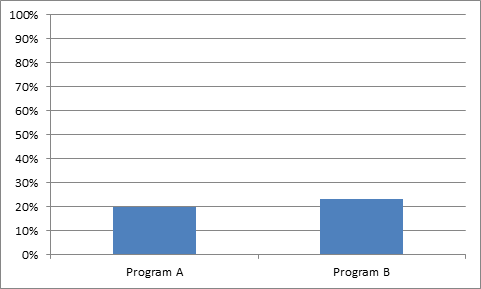
Let me highlight four different ways of representing two data elements. In this case, I’m comparing two programs. The first program (A) had a yield of 20% and the second program (B) had a yield of 23%.

  • I could say that Program B was 3 percentage points better than Program A.
  • I could say that Program B was 15% better than Program A.

I could show the data in two different charts where I simply change the y-axis.

What’s Possible With Healthcare Technology – Infographic and Health 2.0

I love where the future of healthcare technology is going.  If you missed the Health 2.0 Conference this week, you can see a lot of the presentations now online for FREE!  It’s very cool.

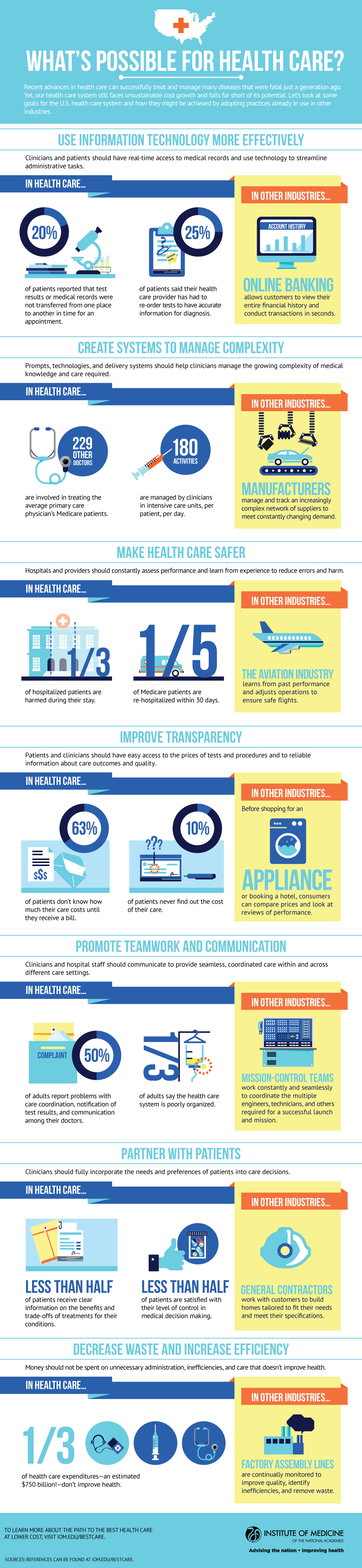
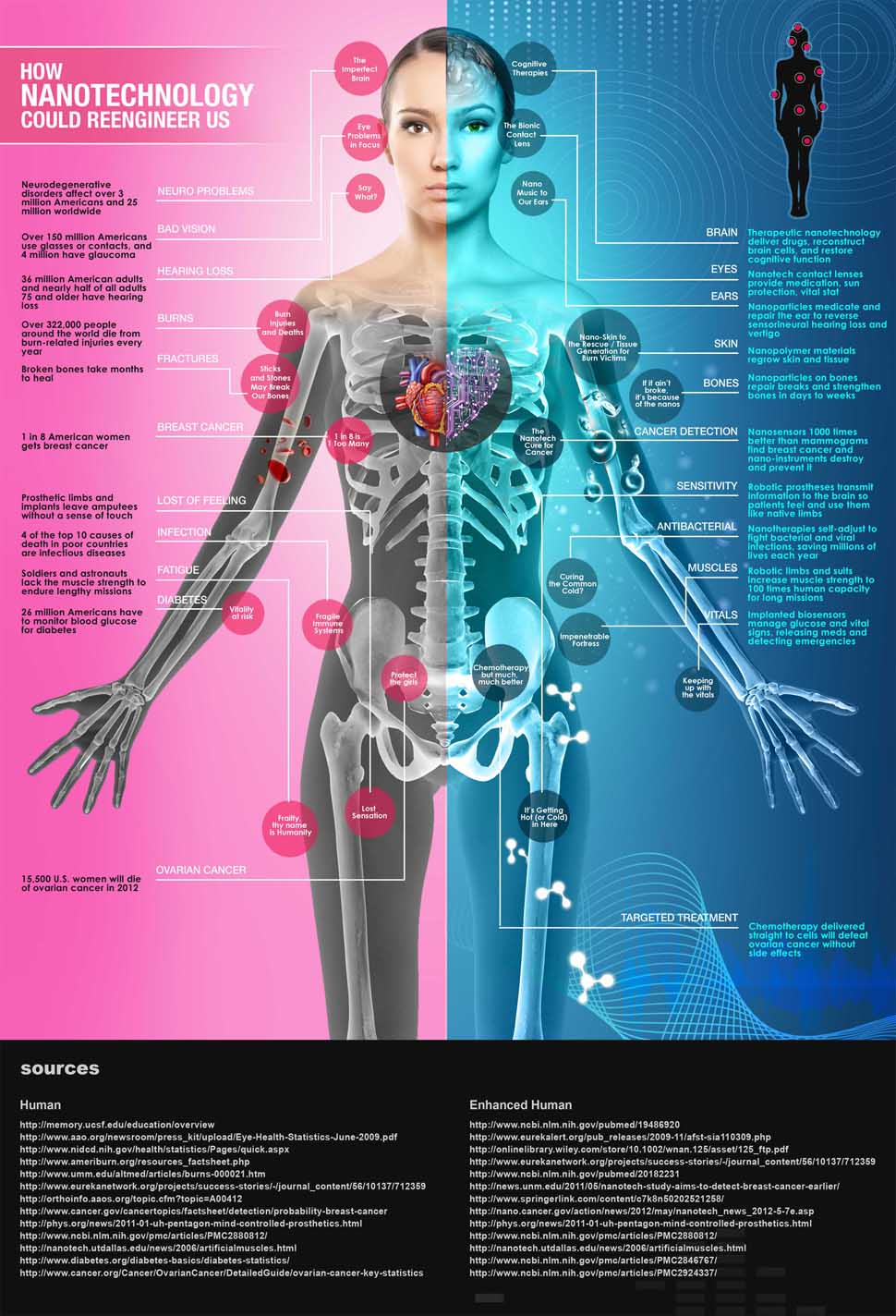
At the same time, I think this infographic from the Institute of Medicine reinforces some of the key points.

Big Bird Comment From Romney Is Relevant To Healthcare

I keep seeing buzz about the Big Bird comment about PBS from the Presidential Debate from last week. As always, I interpret things differently. To me, this shows Romney’s willingness to make tough and perhaps unpopular decisions (like raising taxes for the Middle Class). At some point, these things may be critical.

Sure…the PBS budget may be small, but at some point, we as a country need to focus on how we cut costs to reduce our deficit. (See US debt clock.)

This reminds me a lot of the discussions we used to have to have as a PBM with employers or labor unions about their benefits. It goes back to the basic framework of “you can’t have your cake and eat it too”. Everyone wants to have a broad network of providers. Everyone wants to have an open formulary. Everyone wants to have the broadest benefits at the lowest cost without increasing their contribution every year.

Just by cutting a drug or a provider from your benefit may seem small, but the savings add up. (Like Big Bird or PBS.)

But, this is the problem we have in healthcare. How do we make enough small decisions to add up to real savings? How do we do this without upsetting everyone and impacting satisfaction (or is that simply life)?

The Future Of Population Health Is Mobile

The statistic that I like to point out is that more people have access to mobile devices than people who have access to toothbrushes. I know that sounds crazy to us Americans, but that’s apparently a global reality (in so much as statistics don’t lie). And, people seem lost without their smartphones so they have them within a few feet of them almost 24 hours a day.

Combine that with several trends, and you can begin to understand why Qualcomm Life predicts that by 2020 there will be 160 million Americans who will be monitored and treated for medical conditions remotely.

  1. There will be a shortage of doctors (at least in certain geographies).
  2. Technology continues to be more and more ubiquitous. (Just look at this amazing video)
  3. Telemedicine is becoming more normal.
  4. Big data continues to be a huge focus with lower data costs, greater integration, and ultimately more and more predictive models to interpret real-time data.

So, as I pointed out the other day about the value of the mobile data for a healthcare underwriter, that same data can be used to create a systemic intervention system for monitoring and intervening with consumers to drive behavior change. AND, since the data and delivery method is mobile, the interventions can be highly personalized based on when, how, what channel, etc. to improve engagement rates. I can even know who influences your behavior change and how to get them to encourage you to change behavior (peer pressure) or who you monitor and can influence you based on their recommendations.

I’m not sure I’m ready to go as far as Dr. Ron Loeppke from US Preventative Medicine who said

“These mobile apps that are emerging are going to be a predominant part of how health care is delivered going forward.” (Smartphones Take Wellness Engagement To New Levels by Elizabeth Galentine)

BUT, I do believe that over time that this will become the increasingly dominant channel for interventions and behavior change. Ultimately, your mobile phone number may be a more valued data point than your Social Security number.

New Drug Epidemic Causing 3x Deaths Of Cocaine Epidemic

There are so many attention grabbing ways of beginning this post…

  • Millions of parents deal drugs to their kids
  • 44% of teens have friends who abuse drugs
  • An increase in free drugs
  • Kids are stealing their parents drugs stashes
  • 200M pounds of drugs left in the open for kids to find
  • 10 deaths per 100,000 people from drugs

Would you have guessed that all of these are talking about prescription drugs?

The Medicine Abuse Project (at www.drugfree.org) is trying to get this word out and find a way to change this. The basic points of their messaging:

  1. Safeguard your medications…lock them up and throw extra ones away.
  2. Talk to your kids about drugs and the risk of abusing legal and illegal drugs.

Will You Be Charged More For Not Participating In Wellness Programs?

Thus, the major factors that insurance companies traditionally use to charge higher premiums – such as health status, the use of health services, and gender – will no longer be allowed under the ACA. However, the ACA does permit employment-based health plans to charge employees up to 30 percent more on their premiums (and potentially up to 50 percent more) if they fail to participate in a wellness program or meet specified health goals.  [From Kaiser document]

Traditionally, health plans and employers have rewarded consumers for taking some basic action (e.g., $100 for completing an HRA)…although some companies prefer penalties versus incentives.

At that same time, there is some evolution happening here with companies moving from simply paying for an action to requiring participation in a program (e.g., disease management).  The next step that a few companies are engaging in is actually incenting or penalizing consumers based on health outcomes.  This will certainly open some doors for legal challenges where people will argue that they are genetically pre-disposed to some factor that limits their ability to lose weight or lower their cholesterol or some other measure of health.

But, in one of the first legal challenges in FL, the court recently upheld the idea of rewarding (or penalizing) consumers based on taking a specific action (like completing a biometric screening).  With that, I expect companies will be more empowered to take advantage of the fact that under health reform they can charge consumers up to 30% more for their healthcare for either not participating or not achieving a specific health outcome.

With an average monthly premium of $468 per month of single person coverage and consumers paying an average of 21% of their healthcare costs (or $97 per month), this means that a consumer could pay an additional $29 per month (or $349 per year).  [If I interpret all of this correctly…if it’s 30% of the total health premium (not just the consumer’s share), then this jumps up dramatically.]

Not surprisingly, employees aren’t real excited about this.  In a survey by the National Business Group on Health, 62% oppose charging employees more for health coverage if they do not participate in wellness programs.  And, 68% oppose requiring employees to participate in a wellness program in order to qualify for health insurance.

And, according to the survey, the most effective cost control tactic was believed to be Consumer Driven Health Plans by 43% and wellness programs by 19% while 60% of employers plan to increase the premium paid by employees (i.e., cost shifting).

But, if companies throw out a life preserver (i.e., wellness program) to a drowing individual (i.e., unhealthy individual), why isn’t it a reasonable expectation that the individual has to grab it (i.e., participate in the program)?

Do Women Make 80% Of Healthcare Decisions? And Are They More Adherent?

Despite all the articles about the changing gender roles, there is still the common belief that 80% of healthcare decisions are made by women. I guess I would assume that men would be more involved in their healthcare which either points out a major engagement issue or something more systemic (or just a self-perpetuating myth).

The She-Conomy site reinforces this fact, and I also saw it in a PharmaVOICE article (9/12) recently which highlighted the report – Seven Lenses for Marketing Health to Women.

That article had several interesting facts in it. One which caught my attention was the following…

“30% of Facebook users in this study said receiving brand messages from a pharmaceutical company via Facebook would be a good way to communicate with them.” (That seems really high to me.)

On the flipside, I tend to believe the data point that 78% of respondents would feel more in control of their health with a mobile app to provide information…making the case for Happtique even more important.

I found the following in a Kaiser Family Foundation report. (KFF often being a source of truth for me.)

Women are the health care leaders for their families. Women take charge of the vast majority of routine health care decisions and responsibilities for their children, and on top of their everyday family obligations, over one in 10 women care for a sick or aging relative. Meeting these multiple obligations is demanding and leaves many women concerned about meeting all their family and work commitments as well as managing their own health.

  • Eight in 10 mothers/guardians say they take on chief responsibility for choosing their children’s doctors (79%), taking them to appointments (84%), and ensuring they receive follow-up care (78%). Mothers are also primarily responsible for decisions about their children’s health insurance (57%).
  • Similar to men, one in four women feel a lot of stress from career (24%) and financial concerns (23%). Women are significantly more likely than men to be very stressed about managing their own health needs and those of their parents.
  • One in 10 women (12%), compared to 8% of men, cares for a sick or aging relative, often an ill parent. The majority of caregivers report that they perform a range of tasks, including housework (91%), transportation (83%), and various financial decisions (66%). Many also assist with medical and physical care, such as administering medicines or shots (58%), as well as routine activities such as bathing and dressing (42%).
  • Caregivers themselves contend with a host of health challenges. Four in 10 are low-income, nearly half (46%) have a chronic health condition of their own, and one in five non-elderly caregivers are uninsured.
  • A sizable share (29%) of caregivers provide assistance full-time, spending more than 40 hours per week as a caregiver. This is even more common among low-income caregivers, 44% of whom report assisting their relative for over 40 hours weekly.

Interestingly, this ties into a discussion I was having the other night about whether men or women are more adherent to their medications and whether that is a relevant segmentation factor in designing an intervention strategy. The data I’ve seen says women are less likely to be adherent than men, but the company I was talking to believed their data pointed the other way. Here’s a few articles on the topic:

And from the CVS Caremark 2008 Trends Rx Report

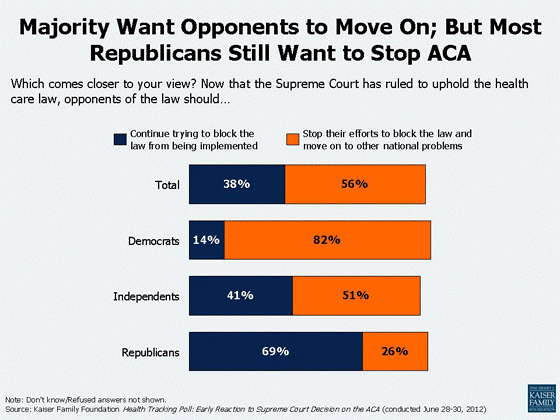
72M Uninsured Under Romney Plan…That Would Be A Problem

I know lots of people are skeptical or against healthcare reform.

A report that just came out says that Romney’s plan would lead to 72M uninsured by 2022. I have no idea if that’s a reasonable analysis, but any more uninsured should be a problem for us as a country. They wait to get care leading to bigger long term issues under Medicaid and Medicare. They over-utilize the emergency room. And, as a first world country, we should want to have everyone getting a basic level of preventative care to prevent long-term issues and higher costs and improve out quality of life.

I’ll admit that I was initially a skeptic of healthcare reform, but I think it’s a reasonable solution. Not perfect. As I’ve argued for a while, it only focused on quality and access but not cost. I would have started with access first. But there are several very positive parts of healthcare reform regardless of what some people believe.

  • Support for technology
  • Support for preventative care
  • Accountable Care Organizations
  • No lifetime limits
  • No denial of coverage due to pre-existing conditions
  • Pharma reimbursement during the donut hole
  • At least 85% of what you pay for healthcare must be spent on medical costs (not administrative)
  • No single payer

Would MDs Recommend SMS Based Adherence Programs? 87% Would…

WorldOne Interactive has some interesting data from provider surveys on their website. This one jumped out at me.

  • 87% of MDs polled would recommend a text message based adherence solution to their patients

At the same time, I also thought this one was really important since the question is always whether the physicians want to know adherence data or not. Based on my old post, I didn’t think that MDs would want this type of data since they generally don’t seem to value PBM interventions.

  • 80% of MDs polled would find it useful to get periodic e-mail reports about their patients therapy compliance.

How Many Patients Does A Physician See Per Day? And Other MD Factoids

I thought this was an interesting factoid which I got today and is from The Physician’s Foundation report.

Here are a few other findings…

  • In the next one to three years, over 50 percent of physicians plan to cut back on patients, work part-time, switch to concierge medicine, retire or take other steps that would reduce patient access to their services.
  • Over 59 percent of physicians indicate passage of the Patient Protection and Affordable Care Act (i.e., “health reform”) has made them less positive about the future of healthcare in America.
  • Over 82 percent of physicians believe doctors have little ability to change the healthcare system.
  • Close to 92 percent of physicians are unsure where the health system will be or how they will fit into it three to five years from now.
  • Over 62 percent of physicians said Accountable Care Organizations (ACOs) are either unlikely to increase healthcare quality and decrease costs or that that any quality/cost gains will not be worth the effort.
  • Physicians are divided on the efficacy of medical homes, and many (37.9 percent) remain uncertain about their structure and purpose.
  • Over 47 percent have significant concerns that EMR poses a risk to patient privacy

Why LinkedIn Is Not Like A Video Game

I get about 3-4 requests to connect in LinkedIn each week. Maybe one of them is from someone I know. It seems like a lot of people attribute the number of contacts you have to value while the reality is that it’s the value of your relationships which matters. And, while you might be limited to a theoretical maximum of real friends, I think you can have an expanded professional network which is larger but doesn’t include anyone and everyone who can spell your name.

That being said, I’ve worked in several industries and several parts of the country (and tend to enjoy networking) so I have a big network in LinkedIn (>1,000). But, I constantly review it to see if things are getting old or if the person that I worked with on a deal has simply faded away. In the last year, I’ve dropped over 300 people that I had previously connected with.

So, like I’ve done with the blog and Twitter and Facebook, I figured I would post on how and why I use LinkedIn.

I joined LinkedIn very early since I had two friends who knew the founder. My personal uses for it have been:

  • To stay in contact with past colleagues
  • To share information from a work perspective
  • To share contacts for networking
  • To help find resources or people for projects
  • To network for sales and/or jobs

The keys to using it are:

  • Have a complete profile
  • Get recommendations
  • Give recommendations
  • Provide updates
  • Use keywords
  • Connect it with things like Slideshare or your blog (no longer Twitter)
  • Join groups (easiest way to expand your reach within the tool)

But, there are lots of professionals out there who will tell you how to optimize its use. For corporate purposes, I think Hubspot puts out a lot of great information and data.

The key for me is believing that if I reach out to someone in my network they will know who I am and be willing to respond or help the person I’m routing to them.

So…If you’re going to reach out to me in LinkedIn, tell me why you want to connect, and expect to get the following response…

“Thanks for your offer to connect. My rule is that we have to connect IRL (in real life) first. If you want to do that, you can call or e-mail me.”

Politics, Healthcare, and The Economy – My Hints For Obama & Romney

Whether you’re a political junkie or not, if you’re in the healthcare industry, the political landscape has become increasingly important over the past decade.

And, with the government being the primary payer, they have the ability to drive trickle down changes through everyone’s care. So, even if you don’t work in the industry, but you’re a patient, you should care. What happens in DC will change healthcare which will affect you either today or in the future.

At the same time, I think most people in Washington DC are living in Disneyland. Government salaries continue to go up. Employment continues to go up. They have pension plans. They have robust health insurance offerings. Real estate has stayed strong. They don’t really understand what the rest of country is experiencing.

So, if I were coaching either campaign, I would point out that it’s always about finding simple messages that convey very strong points. That’s not easy, but I think we all want some basic things:

  1. A financially stable country in which we have a legitimate chance to be economically successful.
  2. An infrastructure which provides education for our kids and the overall workforce.
  3. A safe neighborhood and country in which to live and where our rights as outlined in the Declaration of Independence are protected.
  4. Leaders who use our tax money as if it was their own money when making decisions.
  5. A country where hard work is rewarded and there’s a safety net to protect us when we get sick.

So, I guess you could ask what that has to do with healthcare…

BUT, I do think there is macro-economic element here some of which is done differently in other countries (if you believe there is something to learn from them).

Of course, all my practical business friends would tell me that this would kill our global competitiveness. And, my skeptical friends would point out that this would create more time, but we wouldn’t use that time to improve our health. Others of you would point out that companies would just look for more productive workers not hire more people.

But, I would argue that if we plan to differentiate ourselves on innovation and creativity then health is very important. Health already represents more of the cost of a car then the steel and more of the cost of coffee than the beans. The WHO has now said that obesity is the number one healthcare issue to tackle globally. It impact presenteeism. It impact absenteeism. And, your creativity is limited when you don’t sleep due to stress or other healthcare issues which is often magnified in the sandwich generation.

All of these things impact us in many ways. Of course, I think this would make a great campaign discussion…

“I’ll decrease unemployment and improve our economy by increasing use of vacation time, limiting work hours, and creating tax incentives to drive down obesity and improve our overall satisfaction with life. Doing this will make us a more innovative country and drive sustained competitive advantage within a global marketplace.”

More And More Work For The PCP

We always hear about how little time the average primary care physician (PCP) spends with a patient although some research shows it’s actually going up. At the same time, there is a debate about whether healthcare reform will push us into a massive physician shortage which seems to exist in some areas already. I keep hearing about more and more things that the PCP should be doing during this encounter.

  • They should be counseling on medication adherence.
  • They should be addressing gaps-in-care.
  • They should be handling prior authorizations real-time using a computer system.
  • They should provide the patient with Ix (information therapy) steering them to apps and articles for them to understand their treatment.
  • They should be coordinating with the patient’s care manager.
  • They should be screening everyone for obesity.
  • They should be screening everyone for alcohol abuse.

It was the last two that were recent recommendations for the US Preventative Services Task Force that prompted me to comment here. I’ve heard everything from about 8 minutes to 15 minutes per patient encounter and complaints about the amount of time spent on documentation and administration continuing to go up. So, how does a physician add in all these different tasks into this already short time window when patient already leave confused and not remembering most of what the physician told them.

Of course, concierge medicine and other physician practices are trying to change this in certain pockets. And, ideally Accountable Care Organizations (ACOs) or Patient Centered Medical Homes (PCMHs) where the focus is less on volume and more on outcomes have a chance to change this.

I guess the question in my mind is whether the physician is this gatekeeper or whether chronically ill patients need a care manager / patient navigator to help them understand their benefits, take advantage of the resources available to them, leverage their care team, and understand their disease and clinical options.

Guest Post: Treat Your Health Like Your Finances

I am a big believer that we need to change our approach to how individuals manage their health. After a dinner with a financial planner friend of mine, it got me thinking what if we helped individuals plan for a long healthy life the same way we help them plan their careers or their finances. We have whole industries dedicated to helping people make smarter investment decisions for their retirement and job choices for their careers, but when it comes to our health we are rarely proactive.

According to Morgan Stanley, 90% of Americans think financial planning is important. Why? Three of the top reasons people undertake financial planning include:

  • Making sure your money will last during retirement or rolling over a retirement plan
  • Being prepared for a financial crisis such as a serious illness
  • Caring for aging parents or a disabled child

The common thread through all of these reasons is personal health. Whether concerned directly about illness, both our own and that of our loved ones, or about our ability to enjoy our retirement to its fullest, personal health is a key component of a well-planned retirement.

The reality is life expectancy has increased dramatically. We may live 30 years in retirement. I would argue the quality of that retirement is even more dependent upon our health than our finances. Yet no one hires a “personal health coach” or creates a “personal health plan.”

It is about time we stop neglecting our future health. You can take control of your future health by developing a personal health plan. These simple steps can help you get started:

Step 1: Conduct a Personal Health Audit. Before you can build a plan you need to understand your base-line. You can’t map directions to your destination until you know where you are. When you meet with a financial planner the first thing they want to know is how much money you have saved for retirement. Your personal health plan is the same way. Do you suffer from any chronic illness? What is your height & weight? How much exercise to you get? What are your eating habits? Do you have any family history of disease? What type of pain do you suffer from? How is your mental health your relationship with your spouse and children? Capture everything and identify areas that need attention or improvement.

Step 2: Define Success. What does a healthy future look like? The second question a financial planner will ask you is how much monthly income will you need in retirement to live the lifestyle you want? The same is true for health. When do you plan on retiring? What hobbies do you have that you would like to pursue? Do you plan on having grandchildren? How will bad or good health impact all of these plans? Does your family history require you to focus on preventing cancer or heart disease or Alzheimer’s? The ability to visualize your health in the future both good health and your health if you let yourself go is a strong motivator for change. A point of note: Thinking about health 30 or 40 years into the future can be very abstract; I suggest breaking down your definition of success into annual targets is more manageable and motivating.

Step 3: Know your Personal Health Indicators of PHIs. By this point in the process you should have a sense of what measurements are most critical to your health. Develop a method for capturing your PHIs on a regularly basis. For some like weight you might update your PHI daily, weekly or monthly. For others like a PSA level for men at risk for prostate cancer, you might update it annually. I detail some of the more common PHIs here: http://www.billpaquin.com/do-you-know-your-phis/.

Step 4: Engage your Health Partners. Now that you have completed your audit, defined success and developed your most important PHIs it’s time for you to engage all of the people in your life who help you manage your health. This will include your family, your physician or other healthcare professionals; maybe you have a nutritionist, acupuncturist or other complimentary practitioner that you frequent. Inform them of your personal health plan and get their feedback and buy in. The more people who are on your side the greater the likelihood of success and the more people that know your health, the greater the likelihood you will have a plan that fits you and your goals.

Step 5: Build and implement your Plan. Building the right plan takes an understanding of what you learned in steps 1-4. By way of example, if you have a family history of colon cancer, you need to understand what behaviors help reduce your chances of getting this cancer, what preventative screening you should be getting and when you should be getting them. All of our plans should include a path to maintaining an ideal Body Mass Index that includes some form of daily exercise and nutrition plan, but we are all unique and will have plans specific to our health situations and desired goals. I do think it’s important to understand that no one is perfect 100% of the time, if you deviate from your plan for a day, week or even month, you are only one day from starting again.

Step 6: Review & Measure your progress. You can’t manage what you can’t measure. At some pre-planned interval you should step back and take stock of your progress. Use your annual physical or dental cleaning as a reminder to sit down and review your health plan. Personally I like to review different elements weekly or monthly, but find what works for you and stick with it. Like the stock market, it won’t be a straight line, but as long as the trend continues up over time you will be alright.

No one is responsible for your health but you. We all need to take a proactive approach to our health. Developing a personal health plan is a great way to insure you live a long, healthy and happy life.

About the Author

Bill Paquin is the Chief Executive Officer at Vertical Health, a publisher focused on improving patient care associated with back pain and endocrine disorders such as diabetes. He is a husband, father and writer who is passionate about and supports the creative destruction of our current healthcare system.

Recent Research Around Health Consumers And Wellness ROI

I keep seeing so many articles that I don’t always have time to research them and write them up. With that in mind, I thought I would share some quick summaries and links here.

  1. Harris Survey data about customer satisfaction with their healthcare experience and how things compare between technologies they have access to and technologies they want. http://www.prnewswire.com/news-releases/patient-choice-an-increasingly-important-factor-in-the-age-of-the-healthcare-consumer-169140306.html
  2. Ernst & Young report on collaboration within healthcare as part of patient-centric system. http://www.prnewswire.com/news-releases/ernst–young-llp-health-care-report-explores-collaboration-as-key-to-a-patient-centric-system-169447336.html
  3. NEJM article on the business of health. http://www.nejm.org/doi/full/10.1056/NEJMp1206862
  4. Medication Therapy Management (MTM) as key part of patient care and emerging role of pharmacist. http://drugtopics.modernmedicine.com/drugtopics/Modern+Medicine+Now/MTM-opens-door-to-direct-patient-care/ArticleStandard/Article/detail/787897?contextCategoryId=40159
  5. New obesity report. http://healthyamericans.org/report/100/
  6. Aetna survey on difficulty of selecting healthcare benefits. http://www.aetna.com/news/newsReleases/2012/0917-Aetna-Empowered-Health-Index.html
  7. United survey and consumers beginning to shop online for healthcare service information and pricing. http://www.businesswire.com/news/home/20120918005229/en/Consumers-Starting-Comparison-Shop-Health-Care-Services-Treatments
  8. Question on another blog about relevance of ongoing use of the term e-patient. http://t.co/DaODAPpK
  9. Humana and Walmart partnership. http://t.co/v27XNRXr
  10. A list of 71 ideas from a brainstorming meeting. http://medcitynews.com/2012/09/71-out-of-the-box-ideas-the-healthcare-industry-would-consider-if-it-controlled-healthcare-reform/
  11. Benefit cuts are worker’s top worry. http://ebn.benefitnews.com/news/benefits-cuts-reductions-gallup-2727060-1.html
  12. Encouraging empathy over efficiency in healthcare. http://articles.boston.com/2012-07-15/health-wellness/32682736_1_medical-care-medical-error-patient-care
  13. Report on mobile health app growth. http://www.kaloramainformation.com/about/release.asp?id=2841
  14. HRAs offer best ROI in wellness programs. http://www.hrmorning.com/top-6-roi-producing-wellness-initiatives/
  15. Analysis of 56 wellness studies shows big ROI. http://www.hrmorning.com/massive-study-shows-true-wellness-roi/
  16. 600% wellness program ROI and facts in infographic. http://ehstoday.com/health/infographic-state-corporate-wellness-programs-america
  17. Consumer Reports survey on cost savings activities by consumers to pay for prescriptions. http://www.webmd.com/health-insurance/news/20120913/more-people-cutting-corners-pay-medications
  18. United study showing that quality can be 14% cheaper. http://www.unitedhealthgroup.com/newsroom/news.aspx?id=d5c1e465-c2b3-4c01-a856-bee676381ecb
  19. Linking wellness incentives to outcomes. http://ebn.benefitnews.com/news/employers-link-wellness-incentives-aon-hewitt-2726732-1.html
  20. 12 facts about patient engagement. http://www.dorlandhealth.com/case_management/trends/12-Surprising-Facts-About-Patient-Engagement_2405_p2.html

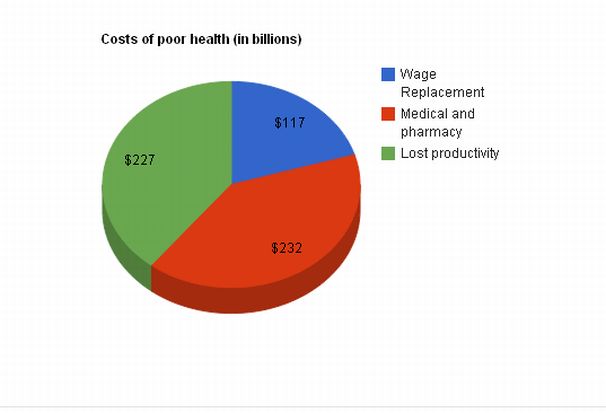
Absenteeism And Presenteeism Costs > Medical Costs

I always hear people talk about ROI around population health programs.  The problem is that most people struggle to estimate the absenteeism and presenteeism costs associated with poor health.  Various studies continue to reinforce that these costs actually exceed the medical and pharmacy cost savings.

Consumer Engagement Technology In Healthcare

Another big piece of my discussion with a consultant about consumer engagement in healthcare was from a technology perspective. Ultimately, there are three questions here:

  1. How should I think about and structure the landscape?
  2. Who are some example companies in each area?
  3. Which ones are the best to use (and for what segment of the population)?

I’m going to skip the 3rd question for now since there are business cases for any of these tools. The question is more about understanding your population and what your objectives are.

Here’s a quick model from Accenture to begin this…

But, here’s what I laid out for questions one and two. (BTW – This is my impression. There was no science here. I welcome comments and additions of companies are areas to put on the map.)

Examples of companies that I mentioned that I’ve seen, talked to, monitored, or heard of doing interesting work were:

And, ultimately, I told them what I tell many people…To see who the new companies are in these spaces look at the list of sponsors to Health 2.0, the presenters, and who’s recently gotten VC funding. This is going to capture some of the ones that are off the radar.

They had a great question to try to wrap this up which was how does this information get to the patient. That last mile is one of the big issues today. A few of the things I pointed out are:

  • Some companies like Happtique are trying to play here. This builds on some of the concepts from the Center For Information Therapy. (Prescribing information or applications)
  • As far as I know, the EMR and practice management systems aren’t doing much here – Epic, Cerner, Allscripts. Although Athena did buy a small player in this space years ago.
  • There are some companies trying to do this as part of their jump into the ACO space (e.g., Lumeris with NaviNet).

I thought I’d wrap up with this image from Chillmark Research.

Who Cares About Patient Engagement In Health?

I got a call today from a consultant who was researching the topic of patient engagement in healthcare. I found their questions interesting and really got me thinking about the topic. I’m going to turn my thoughts into a few blog posts this week.

The first one was to look at how different constituents think about engaging the consumer and why. This is changing a lot with the shift to Patient Centered Medical Homes (PCMH) and ACOs, but in general, companies were very transactional about this in the past where it was something to be done. Now, everyone is tracking this and cares about:

  1. How successful are you at engaging patients?
  2. How successful are you at changing their behavior?
  3. What insights about the population can you provide me?

The ultimate strategy is one that:

  • Predicts who to target (the at risk patients)
  • Focuses only on the patients that are likely to change behavior
  • Segments the population
  • Delivers personalized communications to them
  • Delivers the messages at the best time to engage them
  • Tracks key metrics
  • Dynamically adjusts the process
  • Captures learnings
  • And…does this in a cost effective and scalable manner

With that set-up, here’s my someone skeptical view of who cares by constituent.

Group

Traditionally

Emerging

Patient

Someone will tell me what to do – physician, employer, insurance company

I need to be more responsible for my care and spend my dollars wisely (driving transparency tools and e-patient efforts)

Physician

My job is to diagnose, write a prescription, and/or provide immediate care…I assume the patient is compliant with everything I tell them

I need to understand the patient, how to change their behavior, and what’s most likely to drive their best outcome (but I still don’t have the time to do it)

Hospital

People come to us because they have to and it’s all about location

Chronically ill patients use resources disproportionately and should be catered to; plus we have to improve outcomes (or get penalized by CMS or get low quality rankings)

Employer

I evaluate the options from my managed care company and select a program; they really cater to me

I want something better and customized to my employees; I can probably improve engagement and need to as I shift first dollar responsibility to them

Managed Care

Consumers don’t pay the bills; the best model is a gatekeeper model; regardless, engagement is only important to avoid losing money

Employers want to see results which requires patient engagement; how can I do this cost effectively?

Pharmacy

We have to increase productivity at the counter to make money; patients will buy other front end goods

There’s a big opportunity for me to collaborate with managed care and employers to improve outcomes

PBM

I’m in the B2B business; just make sure consumers know what they’re supposed to do

No one really wants to use hard blocks all the time; they want to drive behavior change through information and interventions

Pharmaceutical Manufacturers

Convince the physicians and the patients will follow; if not, advertise on TV

I really need to understand the consumer’s experience with the disease and my drugs so I can influence outcomes

Technology Companies

Can I make money off consumer health apps? Enterprise software is the focus

Everyone is jumping into this space; how do I make myself relevant and improve satisfaction and use of my apps

Why Your Healthcare Underwriter Wants Your Mobile Data

As mobile devices get smarter and smarter, there is an ongoing debate about all the data they collect and how that data is used. (For those of you that love conspiracy theories, you’ll love my line of thinking today.)

For example, imagine that the application can predict where you will be 24 hours later to within 65 feet.

Your phone can give me a pretty good proxy for all of these:

  • How much do you sleep?
  • How much time are you in a car?
  • How much time do you spend sitting?
  • How much time are you walking? How far do you walk?
  • How social are you?
  • Are you in a relationship?

And, the more you do certain things, the better these proxies are:

And, in the not too distant future, it will become a digital wallet and begin to track purchase patterns.

Skeptical? In response to a request from Representative Ed Markey, major cell phone carriers revealed that they had received more than 1.3M requests for cell-phone tracking data from federal, state, and local law enforcement officials in 2011. (Time article – The Phone Knows All) They are using your phone data to solve crimes. If you’re not a criminal, this is probably good. It takes an average of 2 days for the Marshalls Service to find a fugitive these days versus 42 days in the past.

And, unless you’re a significant anomaly, you’re not reading all the data privacy data for all the apps we’re downloading. (30B apps have been downloaded.)

The article talks about apps that collect your photos, your texts, and your contacts.

“No app is free…you pay for them with your privacy.” (Time article)

But, from a healthcare perspective, especially as we move into an individual market, this data would be invaluable to an underwriter. Just like underwriters for car insurance want to track miles driven, average speed, and other data points, healthcare underwriters would love to understand your behavior.

Heck. We already see increased accidents attributed to people walking and interacting with their smart phone.

Maybe someday that will be a requirement to get a lower rate on healthcare. Maybe the younger generation won’t care. People continue to tell me that people in their 20’s just assume that everything is public and don’t see this “Big Brother” type of use of data as invasive.

The same Time issue (9/27/12) goes on to share some interesting global statistics on mobile phones. Here’s a few highlights:

  • 84% of people have their phone next to their bed (68%) or in the bedroom (16%) at night
  • 1/3rd of Americans use their mobile device while driving a car, playing with their children, attending a party, and eating at a restaurant.
  • 65% of parents believe their devices make them better parents (I’m not sure I get this one at all)
  • Americans use their mobile devices least of the six countries studied to do each of the following:
    • Send text messages
    • Browse the Internet
    • Listen to music
    • Search the web
    • Read news
    • Take pictures
    • Visit social networks
    • Shop
    • Receive payments
  • 29% said their wireless device is always the first and last thing they look at every day (which is 15 points below the international average)
  • 26% of respondents feel guilty if they don’t promptly respond to work related messages outside normal hours


The Transtheoretical Model And Setting Goals

There’s a good article in Time (9/17/12) called “Goal Power” by Dr. Oz.  I found it interesting on a few fronts.

“Getting people to make meaningful changes in their lives is much more complicated than explaining to them what to eat for dinner, how often to exercise and which kinds of tests they should get from their doctors.  The psychology of health is every bit as complex as the biology, and to create seismic shifts in behavior, we have to probe the subconscious.”

1. The topic of goals and objectives and their importance relative to healthcare behavior change is a repeating theme.

  • A month ago, I was at a presentation by Dr. Victor Strecher who founded HealthMedia.  He was talking about the importance of getting people to articulate their goals or objectives for changing.  (E.g., I want to become healthy to see my daughter get married.)
  • I had a pharmacy client who was looking into this as part of an adherence program a few years ago.

2. The topic of behavior change and behavioral economics has been a very popular theme with Nudge and many other publications and programs over the past few years.

3. Obesity, which is part of the focus of his article, is widely becoming recognized as the greatest public healthcare challenge of the 21st century.  And, it is a very complex issue tied to sleep, stress, social network, and many other factors.

4. He introduces the transtheoretical model (also known as the Prochastka model or the Stages of Change), which is widely known in the academic and health areas, into the public domain which surprised me.

(Here’s the abstract from what one widely quoted paper on this.)

The transtheoretical model posits that health behavior change involves progress through six stages of change: precontemplation, contemplation, preparation, action, maintenance, and termination. Ten processes of change have been identified for producing progress along with decisional balance, self-efficacy, and temptations. Basic research has generated a rule of thumb for at-risk populations: 40% in precontemplation, 40% in contemplation, and 20% in preparation. Across 12 health behaviors, consistent patterns have been found between the pros and cons of changing and the stages of change. Applied research has demonstrated dramatic improvements in recruitment, retention, and progress using stage-matched interventions and proactive recruitment procedures. The most promising outcomes to data have been found with computer-based individualized and interactive interventions. The most promising enhancement to the computer-based programs are personalized counselors. One of the most striking results to date for stage-matched programs is the similarity between participants reactively recruited who reached us for help and those proactively recruited who we reached out to help. If results with stage-matched interventions continue to be replicated, health promotion programs will be able to produce unprecedented impacts on entire at-risk populations.

5. He references two of the big studies that looked at social pressure an its influence on health.  Something that peer-to-peer healthcare and social network tools can create for us by developing support communities and “buddies” to support our change.

  • 2012 study in the journal Obesity about weight loss.
  • 2008 study in the NEJM about smoking

6. He references Dr. Nicholas Chrisakis who co-authored the book Connected which is being manifest in the company called Activate Networks.

Overall, for those of us that work in the healthcare field, these are all critical topics that we constantly talk about.  It’s nice to see it brought to the “popular press”.