Archive | Healthcare RSS feed for this section

How Many Formulary Tiers Is Enough?

Just this week, I’ve seen two things about creating more formulary tiers.  One was talking about splitting generics into two tiers.  The other mentioned that CMS said a sixth tier could be used in certain circumstances.  It sounds like this could get out of control.

Will we end up with something like this:

  • Low-cost generics (i.e., $4)
  • Generics
  • Formulary brands (non-specialty)
  • Non-formulary brands (non-specialty)
  • Lifestyle drugs
  • Specialty biosimilars
  • Formulary specialty drugs
  • Non-formulary specialty drugs

It seems reasonable that we could end up with 8 tiers!  That is a patient nightmare.  It’s difficult enough to understand today.  Maybe, I’ll finally become a believer in a percentage copay model with just two or three tiers of cost share with maximums.

Summary Of Big 3 PBM Drug Trend Numbers

All of the big 3 PBMs have now reported their drug trend for 2010.  How do they compare?  [acknowledging that methodologies are different]

  1. CVS Caremark = 2.4% (0.8% without specialty)
  2. Express Scripts = 3.6% (1.4% without specialty)
  3. Medco = 3.7% (1.1% without specialty)

Now, I’ll reiterate my points from the past which are:

The Medco Drug Trend Report Is Out

Medco just released their Drug Trend Report this morning. For the second year, I got invited to their press call, but unfortunately, I had to miss the call. I sent in four questions:

  1. ADHD trend continues to increase.  With the new DSM-5 proposal, it looks like there will be more teens and adults diagnosed with adult ADD.  Do you see this accelerating the trend in this category even more?
  2. As generics get closer to 80%, the remaining brand drugs will have to try new strategies to sustain utilization.  One of the growing tactics is copay coupons or cards.  Do you see this as an issue?  Are there tactics that you intend to use to address these through POS programs or other programs?
  3. You talk about clients spending less PMPM on members age 0-18 which seems to run counter to the focus from last year on more, younger patients using maintenance drugs.  What do you attribute that drop in spending to?
  4. You bring up biologics.  It’s unlikely that biologics will generate large price drops as we’ve seen from generics.  What do you estimate will be the savings associated with biologics and will we see therapeutic interchange programs or will you manage the biologics more like a step therapy program?


Here are a few of the key highlights from the report:

  • Overall drug trend in 2010 remained low at 3.7%.
  • 2010 spending on specialty drugs accounted for 16.3% of plan costs but was responsible for a remarkable 70.1% of drug trend.
  • At 16.7%, diabetes was the therapeutic category that contributed most to trend.
  • The cost of cancer care is projected to rise from $124.6 billion to as much as $207 billion by 2020.

The report has a large focus on specialty which is really where the industry is going. I’ll dig into the report when I have some additional time.

Why Aren’t We More Focused On Rx-OTC Interactions?

The pharmacy system in the US does a good job of catching drug-drug interactions at the POS (point-of-sale) when the claims are all processed by a PBM or all the drugs are filled within the same pharmacy.  But, with 68% of adults taking both a prescription drug and either an OTC (over-the-counter) or dietary supplement (per JAMA Jan 2009), do we need a broader safety net to catch all those?

I was looking at an old Medco deck from last year.  It estimated that there are 30B combinations if you look at 80,000 prescription doses, 300,000 OTC products, and 75,000 dietary supplements. 

Of course, when you go to the pharmacy, you fill out some basic information.  You do the same at your physician.  But, how often are those updated?  Do you have an easy way to register new products you’re trying? 

On the flipside, the question is what percentage of these 30B combinations are important versus just noise?

There are some significant examples here…

For example, Proton Pump Inhibitors (PPIs) increase the risk of major cardiovascular events by more than 50% for patients taking Plavix, but you can now buy several PPIs over-the-counter.  How would the pharmacy or PBM know?

Your Refill Logic Has To Be Dynamic

I signed up for an auto-refill program recently.  It quickly made me realize how stockpiling happens.  (Stockpiling is where a patient ends up with a large supply of their medication over time…typically due to refilling too soon.)

Imagine the following:

  • I get a 90-day supply of a medication.
  • At day 75, I get a refill of the medication.  (I have 105 days left at this point.)
  • 75 days later, I get my next refill.  (I now have 120 days left at this point.)
  • 75 days later, I get my next refill.  (I now have 135 days left at this point.)
The problem here is what I would call “static refill logic”.  The auto-refill program is triggered to fill the drug 75 days after it was last filled.
What is needed is “dynamic refill logic” which calculated days supply on hand.  This isn’t easy, but it makes a lot of sense.  The risk (if I’m a mail pharmacy) is that without this, I get gaps-in-care and/or create a short-term retention issue.
Imagine the following:
  • You ask me to refill, but I have 30 days on hand so I say no.
  • Now I forget to refill on time and I have a choice – (a) skip my medication for a few days or (b) go back to retail.  Neither is ideal for the mail pharmacy.
BUT, all of this could have been fixed if the logic was dynamic and they called to confirm my refill when I had just a few weeks left (i.e., enough to be thinking about refilling but also enough to have time to get it shipped to me).

How Health “Improvements” Make You Worry

I was just at the grocery store.  Now, they offer you disposable cleaning wipes to wipe down your cart handle and avoid germs.  Seems like a good idea, but it makes you wonder if this has been a problem for years.

A few weeks ago, I was at the dentist.  When they went to take a picture of my teeth they covered me in the standard protective “blanket”, but this time they also gave me a new cover for my throat.  Again, this made me wonder whether I’ve been exposed for years and at risk.

Of course, we get smarter over time, but I found it interesting that it makes us (me) more aware of issues that have existed as they make these improvements to the process.

Are Limited Distribution Deals Good For Patients?

People with complex conditions such as RA, cancer, hemophilia, MS, HepC, and other diseases that are treated with specialty drugs (often injectibles) are subject to several unique complexities in filling their prescriptions:

  • Potentially significant cost burdens
  • Limited locations at which to fill their medications
  • Prior authorization requirements
  • Scheduling complexities for delivery or home infusion or coordination with their physician’s office
But, there can also be another complexity called “limited distribution” which is where the manufacturer has only allowed the drug to be filled by a select list of pharmacies.  So, imagine the following situation:
  • You are a patient with multiple co-morbidities.
  • You have several chronic oral medications along with several specialty drugs that you have to fill.
  • You fill one of your chronic medications at retail since you forgot to refill it in time one month at mail and just haven’t gone back since the saving is minimal (as it’s a generic).
  • You have two other oral, chronic medications that you fill at mail order.
  • You fill two of your specialty medications at the preferred specialty pharmacy under your benefit (i.e., limited network).
  • You fill your last two specialty medications at two other specialty pharmacies since both of them are limited distribution products neither of which have contracts with the preferred specialty pharmacy in your network.
You now have to coordinate between five pharmacies.  What ever happened to people worrying about poly-pharmacy?  Is it an issue?
Now, this is important since complexity of therapy (# of drugs and # of pharmacies) appears to be a key factor influencing likelihood of adherence, but I never hear anyone worry about it anymore.
So, I ask…are the limited distribution deals which limit access to a specific specialty drug an undo burden on the patient or is the value of specialized care and monitoring more valuable to the patient?

No Plans To Split Up CVS Caremark

I’m glad to see Larry Merlo come out in the CVS Caremark earnings call and talk about them not splitting up the company (see Adam Fein’s post).  I’ve been talking about this for a while (see old post).  I think that they have the right combination of assets to do something really significant. 

They followed that up with a press release this morning:

Speaking at the Annual Meeting of Stockholders for the first time as CVS Caremark CEO, Merlo said, “The fact is no one else can match our combination of assets — a leading PBM, one of the largest retail pharmacy chains, a leading specialty pharmacy, a growing Medicare Part D business, and the largest and fastest-growing network of retail health clinics. CVS Caremark is using these combined assets to develop and implement innovative programs and offerings, such as Pharmacy Advisor and Maintenance Choice, which should drive long term value for shareholders.”

The rumors and stories of increased value of splitting the company up were getting to be too much noise.  Employees, clients, customers, investors, and everyone else needed them to come out and set the record straight.  Of course, anything can be debated and changed over time, but you need a clear direction.  I’m glad to see them stand up and reiterate their strategy and vision around creating a unique set of assets to derive unique value. 

[Disclosure: As I’ve shared before, CVS Caremark stock is one of a few individual stocks that I own.]

How To Improve Use Of A Preferred Pharmacy

One of the key questions from PBMs, pharmacies, specialty pharmacies, and payers is…
 

How can we drive utilization of a preferred channel (retail, mail order, specialty)?

 
I’ve worked on 15+ different “retail-to-mail” type programs (or even just 30-day to 90-day).  They typically follow a pretty standard profile:
  • Identify who to target
    • Plan design (does the member save?  the payer?)
    • Maintenance drugs
    • Categories (is titration an issue?)
  • Score individuals for prioritized outreach
    • Likelihood to convert (drug, prior experience, costs)
  • Create personalized messaging
    • What’s In It For Me (WIIFM) – cost, convenience
  • Create business rules
    • What’s the best channel?
    • What’s the best time to call or e-mail? 
  • Engage people and quickly transfer them to an agent who can answer their questions
    • How do I get started?
    • How much will I save?
    • Why should I do this?
    • Who are you?
  • Make the process easy…call or fax their provider and get a new prescription for the new pharmacy
  • Implement a process of continuous improvement
    • What works?
    • What could be better?
    • Are their differences within certain sub-segments?
    • How can I test and validate my assumptions?

At the end of the day, this approach can also be used for formulary support and many other programs.  The important things are:

  1. Engage the consumer in a dialogue about their options
  2. Be clear about the value of change
  3. Make the process easy
  4. Answer their questions

15 Things You Should Know About Prescription Non-Adherence

One question I frequently get is “what should I know about adherence”. This is then followed by “so what should I do about it”.

Here’s my starter list of what you need to understand about medication adherence.

  1. It’s a $290B problem.
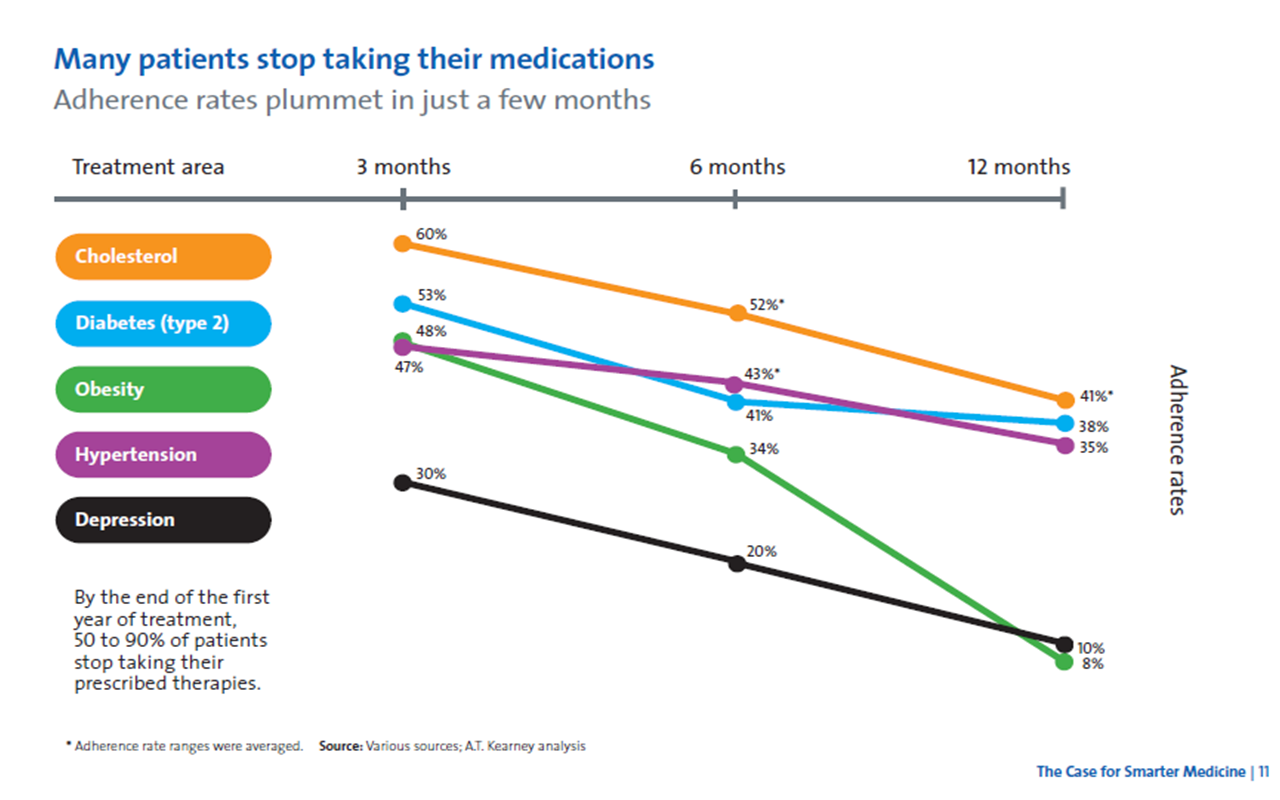
  2. Patients fall off therapy quickly.
  3. There are a lot of reasons for non-adherence…it’s not just about reducing out of pocket spend. AND, to make it more complex, there are variations by gender, culture, medication, condition, trust, copay levels, etc.
  4. There are lots of predictors of non-adherence (old study, Express Scripts, Merck tool), but generally the best predictor is past behavior.
  5. Interventions can improve adherence (CVS Caremark study, Express Scripts study, Silverlink data). BUT, physicians generally don’t see non-adherence as an issue they can address. (see also White Coat adherence)
  6. Patients don’t think they’re non-adherent (see “Rx Adherence Hits The Ignorance Wall” by Forrester that says only 8% of people think they are regularly non-adherent).
  7. Adherence reduces total healthcare costs (CVS Caremark study, Sokol study).
  8. Communications matter (misperceptions, physician-patient gap, health literacy, what physicians tell patients).
  9. There are lots of cool technologies that will work for different people (talking bottles, monitoring devices, iPhone reminders, websites, pill boxes). BUT, improved labeling and bottle design may not be the answer (analysis of Target improvements).
  10. Starting on generics (or lower cost drugs) improves the probability of adherence.
  11. Pharmacist involvement is key and impactful (CVS Caremark study, Ashville).
  12. 90-day prescriptions lead to better medication possession ratio (Walgreens study, CVS Caremark study, Kaiser study, Express Scripts study).
  13. Complexity of therapy (e.g., number of prescriptions) increases the likelihood for non-adherence.
  14. Electronic prescribing gives us new visibility into primary adherence and should also create opportunities to improve this issue.
  15. It’s an area where everyone wins and there’s lots of research…but there’s no silver bullet.

Should You Pay Physicians For Medication Adherence?

I’d love to hear some physician perspectives on this. It’s a question that comes up every once in a while.

Let’s start with a few facts:

The question of course is what to do about that. Most of the programs focus on consumer or patient interventions.

  • Refill reminders
  • Gaps-in-care
  • Off-therapy reminders
  • Auto-refill programs
  • POS consultations by the pharmacist

But, interestingly, I’ve seen a few other studies recently that show that prescription programs targeting physicians can influence behavior (example here). I’ve also heard a few companies talk about paying physicians to keep patients adherent.

There are a few arguments that happen here:

  • Should the physician play a role in adherence?
  • Does the physician know if a patient is adherent? Should they get this data? From whom?
  • If the physician asks the patient, will they tell them to truth or will it simply be a case of “white coat” adherence?
  • Should this be a performance metric in a pay-for-performance environment?
  • Will PCMHs and ACOs structures change this and make adherence a critical issue for discussion between the patient and physician?

In general, I think most people believe that physicians (as indicated in studies like this one) don’t see prescription adherence as a big issue that they can or should influence. Is that true? Would “incentives” change that?

Of course, the debate isn’t limited to paying physicians as multiple companies are paying consumers to be adherent. Here’s a post from last year from another blogger called “Paying Patients To Take Their Medications Is Stupid” which is similar to one of my posts from last year.

Another Reason To Lose Weight – Memory

In case you (or me) need another reason to lose weight…A study in Surgery for Obesity and Related Diseases showed improvements in scores for recall and attention after patients lost weight with bariatric surgery. 

Why would body weight have anything to do with brain function? It turns out that obesity works on a number of different metabolic pathways that can affect the way we process information. “Obesity affects a number of physiological mechanisms that can have an adverse effect on the brain,” says [John] Gunstad. “Hypertension, Type 2 diabetes, sleep apnea, all of which are consequences of being overweight, are all bad for the brain.”  (source)

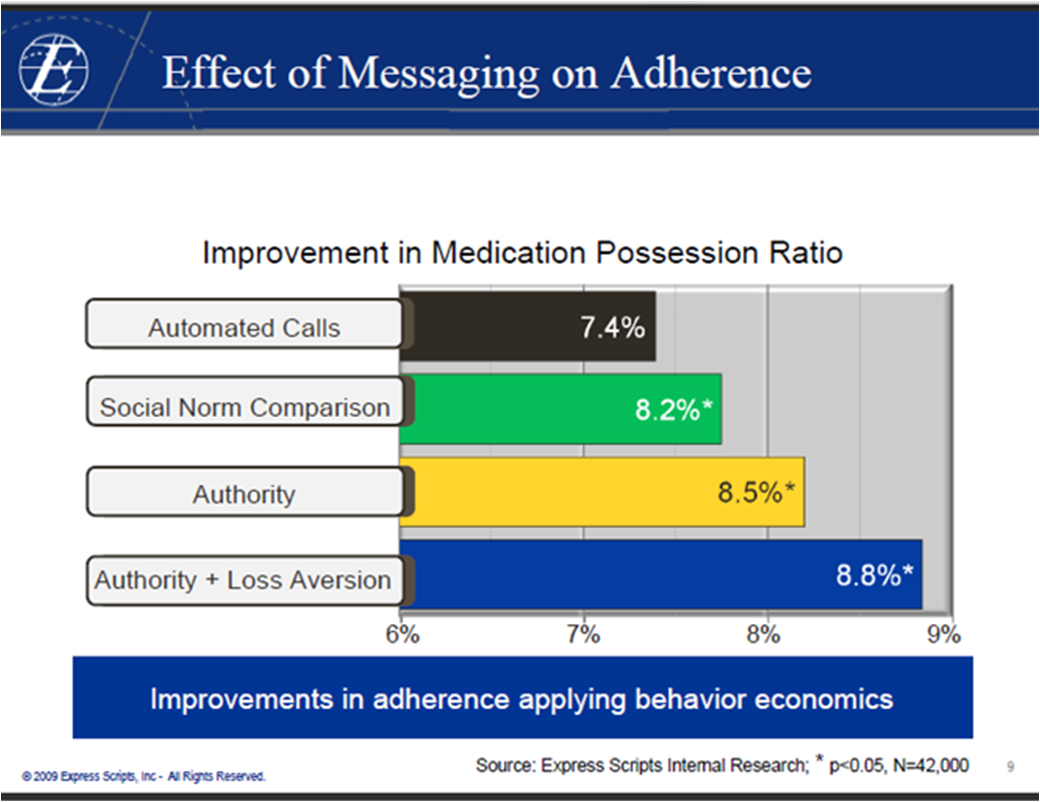
Automated Calls And Messaging Impact MPR

One of the big questions I’m often asked is how automated calls can impact Medication Possession Ratio (MPR).  This is both a technology question, but also a messaging question.  I was happy when I recalled this image from an Express Scripts investor presentation.

Looking Forward To The Silverlink Client Event – RESULTS2011

One of my favorite events every year is the Silverlink Communications client event in May in Boston.  Our marketing team does a great job of pulling together a mix of clients and external speakers to really motivate and challenge the audience.  It’s not much of a sales event, but it does a great job of pushing a lot of key topics for discussion.  (See prior posts – last year’s event, notes from RESULTS2010, and notes from RESULTS2009.)

This event was one of the things that originally convinced me to join Silverlink back in 2007.  Sitting and talking with clients about their experiences with the company, their shared passion for results and outcomes, and their interest in collaborating to improve outcomes for consumers was motivating.

This year should be no different.  This year’s theme is – “Seeing Healthcare Through The Eyes Of The Consumer“.  There are presentations on sustaining engagement, obesity, diabetes, health literacy, social media in healthcare, adherence, loyalty and retention, health reform, STAR, HEDIS, and many other topics.

Some of the speakers include:

  1. Dr. Atul Gawande (Harvard, The New Yorker, Author)
  2. Thomas Goetz (WIRED Magazine)
  3. Dan Buettner (Author, The Blue Zones)
  4. Mark Merritt (PCMA)
  5. Dr. Will Shrank (Harvard)
  6. Jim Wilson (WilsonRx)
And many other executives from across healthcare.
It promises to be another banner event.  I’ll share some summarizes as time allows via Twitter and eventually after the event.
I guess with attendance maxed out and the hotel sold out it’s time for me to buckle down and work on my presentation!

The Royal Wedding Symbolism For Healthcare

This is a day most of us will remember.  I still remember the wedding of Princess Diana.  Regardless of how you feel about the monarchy, it is a joyous celebration of life.

It made me think of several words that are key to healthcare – trust, passion, and engagement.  (Another great example here is the real Patch Adams.)

Let’s start with trust.  You have to trust your physician.  You have to trust that the course of treatment will work.  You have to trust that your actions can make a difference.  Those are fundamentals to getting better. 

Passion is another critical element (even if the royal couple was light on the PDA).  Healthcare runs the risk of becoming a “hot industry” with sustainable business which draws people towards it to be employed and get paid well.  That’s very different from the traditional people who were in healthcare because they felt passion for curing people.  I talked with one researcher recently that mentioned one of his client had to increase their staffing by over 10% to get the same jobs done.  They attributed that to a lack of passion for the job.  (On the flipside, healthcare needs those from outside the industry to help reform ourselves.  Change has to be a mix of internal and external.)

Engagement is a word I use often.  The idea here of the long-term engagement process, transition into being a royal, and the commitment the royal couple feels is very different than the quick engagement and wedding of Princess Diana.  I see that as very similar to the need for long-term solutions that engagement people around intrinsic motivators not the short-term boosts we see from things like financial rewards or quick diets.  Healthcare is a change.  Engagement is a process NOT an event.

The people over at Seduce Health pulled out a few other lessons from the wedding which I agree with. 

So…engage your employees, your family, your members, and your patients.  Build up their passion for life and health and help them believe that they can be successful.

Should You Worry About The Drug Dealer Or Your Prescriptions?

Drug abuse has been an issue for years. I think the advertisement on TV that has a drug dealer talking about getting less calls makes a point that I hear more and more – patients selling their prescription drugs to make money.  Some of this is intentional, but some of this is opportunistic.  You don’t have to go far to hear about seniors being arrested for selling their prescriptions to make money to pay bills (recent article). 

And, recreational use or overuse of controlled substances is a growing problem.

“Unintentional drug overdose is a growing epidemic in the U.S. and is now the leading cause of injury death in 17 states,” Center for Disease Control Director Dr. Thomas Frieden was quoted as saying in a statement from the White House’s Office of National Drug Control Policy. (source)

There are lots of stories about kids using prescriptions drugs for ADHD recreationally to help them study.  There has probably been a switch over the years from stealing liquor from parents liquor cabinet to borrowing a few of their prescriptions (see story on 5 drugs kids steal most often).  It’s a scary thought.  (Or, this article says that 20% of the time adults are asking kids if they can use their ADHD medicine.)

The Partnership For a Drug-Free America‘s latest survey has 61 percent of teens reporting prescription drugs are easier to get than illegal drugs, up significantly from 56 percent in 2005. And 41 percent of teens mistakenly believe abuse of medicines is less dangerous than abuse of illegal street drugs.

Provider Satisfaction From ACSI

The American Customer Satisfaction Index (ACSI) is out with their new data.

One area they track is providers. In that group, satisfaction has generally continued to rise over the past 15 years Here’s what they found:

– patient satisfaction is 78.4 overall
– satisfaction for ambulatory care including visits to MDs and dentists is 80
– ER satisfaction is a drag on the sector at 72 which is up 13%

“Improvements in ER wait times and the quality of inpatient care, combined with a trend toward more outpatient treatments and shorter hospital stays, appear to have contributed to a better overall experience for patients.”

When Lifestyle Changes Aren’t Enough…

A story in the Lifetime Fitness publication focused on the this line which you often hear in pharmaceutical advertisements “When lifestyle changes aren’t enough . . . ”  But, obviously, their pitch is that changing your life can and does work with a blend of diet and exercise.

In fact, research shows that basic shifts in nutrition, activity, stress and other lifestyle factors can be more effective than drug protocols in treating inflammatory health conditions — dramatically improving overall health and fitness in the process.

They provide a nice summary of articles in a PDF that I thought were worth sharing.  It includes articles on the following suggestions:

  1. Eliminate processed carbs
  2. Avoid sugars and alcohol
  3. Emphasize healthy fats
  4. Pack in phytonutrients
  5. Get more food-based fiber
  6. Aim for a blend of activity — high and low
  7. Get plenty of rest
  8. Set boundaries around work
  9. Meditate regularly
  10. Manage stress
  11. Minimize inflammation

Does Changing Drugs Erode Trust

One of the big tools that PBMs use to manage drug trend and improve generic fill rate is step therapy. Another one is therapeutic substitution. Both of them rely upon the patient to change medications.

Based on a study published last year, one of the issues identified for adherence was the patient’s belief or trust in their physician. Switching medications (I.e., trial and error) was viewed as eroding that trust.

It creates an interesting question about these tools. Do they erode trust? Do they impact adherence? I think the standard perception would be that lower cost medications would improve adherence. I know research by Shrank has shown that starting on generics leads to better MPR. Is that true for patients that start on a brand and move to a generic?

On the other hand, the research points to the need for the physician to explain to the patient about the plan for care which might include “trial and error”. Certainly personalized medicine may change this need in the long-term, but in the interim, does this create a chance for PBMs to support MDs in a new way by providing this context to the patient?

More questions here than anwers, but an interesting topic.

Patient Educ Couns. 2010 Jul 30.
“Practicing medicine”: Patient perceptions of physician communication and the process of prescription.
Ledford CJ, Villagran MM, Kreps GL, Zhao X, McHorney C, Weathers M, Keefe B.
George Mason University, Fairfax, VA, USA.

Abstract
OBJECTIVE: This study explores patient perceptions of physician communication regarding prescription medications and develops a theory of the effects of perceived physician communication on the patient decision-making process of medication taking.

METHODS: Using a grounded theory approach, this study systematically analyzed patient narratives of communication with physicians regarding prescription medications and the patient’s resulting medication taking and adherence behavior.

RESULTS: Participants described concern about side effects, lack of perceived need for medications, and healthcare system factors as barriers to medication adherence. Overall, participants seemed to assess the utility of communication about these issues based on their perceptions of their physician as the source of the message.

CONCLUSION: The theory generated here includes patient assessments of their physician’s credibility (trustworthiness and expertise) as a critical influence in how chronically-ill patients process information about the need for prescribed therapy. Trial and error to find appropriate medications seemed to deteriorate patients’ perceptions of their physicians’ credibility.

PRACTICE IMPLICATIONS: A practical application of this theory is the recommendation for physicians to increase perceived expertise by clearly outlining treatment processes at the outset of treatment, presenting efficacy and timeline expectations for finding appropriate medications.

More Generics = Slower Rx Cost Growth

I’m not really sure if this surprises anyone, but it seems to be making news. Generics drug prices increase much slower than brand drug prices, and with the huge increase in GFR over the past 5-10 years, trend has slowed down.

The total 2010 spend on prescriptions was $307B. This was up just 2.3% from 2009.

The interesting point in this recent data from IMS is that the utilization growth rate for Rxs has slowed to historically low levels also.

One might attribute some of this to saturation although I think we’re far from that. Others might see a backlash against medicine and a search for more natural remedies. But, the key fact that they talk about is the drop in MD visits which can certainly be correlated to the economy. In 2010, there were 1.54B office visits…a decline of 4.2%.

The research also said

“Pharmacies filled 0.5 percent fewer prescriptions in 2010 than in 2009 for pills, capsules and nasal spray medications — about 60 percent of total spending on medications. For medicines that are injected or infused, total volume rose even less, just 0.2 percent.”

IVR: Beep or Barge-In

Here’s a common question in the voice services world – should I use a “chime” or beep, no sound, or let people barge-in?

What do I mean?  When you get an automated call or call into an IVR system, how do you know when to respond?  For example:

If the question is “Is this George Van Antwerp?  Please say yes or no.”

  • In the first instance, you would say “please say yes or no after the beep”.
  • In the second instance, you wouldn’t add anything but you couldn’t reply until the system is done talking and starts listening.
  • In the third instance, you would be able to respond as soon as you knew what to say (i.e., barge-in).

Of course, intuitively, you want the third scenario, but it creates a series of issues:

  • If there’s background noise, the system can be very clunky…you keep hearing “I’m sorry, but I don’t understand you.  Can you please say yes or no?”
  • You can get false positives
  • You can get people who respond too quickly missing some or all of the question

I personally prefer a window of time to respond where I left with some finite parameters in which to respond (i.e., no barge-in).

Could CVS Caremark Become A Kaiser?

I know the popular opinion is to talk about CVS Caremark splitting up.  Let me go radically in the other extreme. 

I think everyone has an appreciation for what Kaiser has created – insurer, provider, pharmacy, …  They’ve created an integrated system with impressive outcomes, passionate consumers, and a connected technology backbone.  There are a few other organizations that have had regional success doing the same – HealthPartners, Geisinger, … 

The question I would have is who is in the best position to build themselves into an integrated system.  The two companies that jump out at you are United Healthcare and CVS Caremark.  Of course, neither of them have the provider (aka hospital) assets. 

But, I think the point here is that most people I talk to agree that an integrated model is the right model “on paper”.  It can (in theory) offer the best patient experience.  It can drive the best integrated data.  It can coordinate across business lines to accomplish the best outcomes. 

So, it makes me wonder why we let Wall Street dictate the strategy here.  In many cases, structural changes take time.  If building an integrated model is the right concept, why isn’t the talk about CVS Caremark buying a health plan and subsequently jumping into the provider space with ACO models?  Why isn’t the discussion about United Healthcare buying up hospitals and physician groups?

Maybe I’m just trying to present a different scenario or maybe I have rose-colored glasses on, but I think it’s an interesting question to ponder.

(Note: As I’ve disclosed before, I both own CVS Caremark stock and have a business relationship with them.)

Prescriptions – Good or Bad?

I think we all buy into the fact that medications work.  That’s why we’re the most medicated generation.  So, what happens when someone challenges that assumption.  Aren’t these drugs rigorously tested and approved by the FDA?  Isn’t this why we have clinical trials?  Isn’t everyone using many of these drugs?

I get confused and I work in the business.

Here’s an article from the LifeTime Fitness magazine that talks about drugs for high cholesterol, hypertension, and acid reflux.  I’ll let you make your own decisions, but I think this is just another example of the contradictory information that consumers have to struggle with.

Three common classes of prescription drugs in the United States — statins for reducing cholesterol, angiotensin II antagonists for lowering blood pressure, and proton pump inhibitors for reducing stomach acid — can all cause side effects worse than the problems they aim to treat. And the symptoms caused by one drug may necessitate the use of the others.

For large numbers of people with questionable risk factors, these drugs deliver little or no benefit, but that hasn’t stopped pharmaceutical manufacturers from aggressively marketing them as preventive treatments. Underlying their marketing strategy is a host of scientific studies that “exaggerate positive results and bury negative ones,” says Shannon Brownlee, author of Overtreated: Why Too Much Medicine Is Making Us Sicker and Poorer (Bloomsbury USA, 2007). “The science on which so much of prescribing is based is biased, shaky, over-marketed and misinterpreted. These are excellent drugs when used on the right people. The problem comes when they’re marketed to everyone on the planet. There’s benefit to a few people, but when you start giving them to everybody, they may do more harm than good.”

Interview With Dr. Victor Strecher (Founder of HealthMedia) From #WHCC11

While I didn’t get to meet Victor at the World Healthcare Congress in DC, I got a chance to do a phone interview with him last week. For those of you that don’t know who he is, here’s a quick bio:

Victor J. Strecher, PhD, MPH
Professor, Health Behavior & Health Education; Director, Health Media Research Laboratory; Director, Cancer Prevention and Control, University of Michigan School of Public Health;
Chairman & Founder, HealthMedia, Inc.
Dr. Victor J. Strecher graduated in 1983 with an M.P.H. and Ph.D. in Health Behavior & Health Education from the University of Michigan. After positions as Assistant and Associate Professor in the School of Public Health at the University of North Carolina, Dr. Strecher moved back to the University of Michigan, where he became Professor of Health Behavior & Health Education and Director of Cancer Prevention and Control in the University of Michigan’s Comprehensive Cancer Center.

Dr. Strecher also founded the University of Michigan’s Center for Health Communications Research (CHCR): a multidisciplinary team of behavioral scientists, physicians, computer engineers, instructional designers, graphic artists, and students from a wide variety of disciplines. For over a decade, Dr. Strecher’s center has conducted research studies and demonstration projects of computer-tailoring and interactive multimedia programs.

In 1998, Dr. Strecher founded HealthMedia, Inc.– a company designed to create interactive health communications solutions for medical care, employer, pharmaceutical, and government settings. The intention of HealthMedia, Inc. is to bring the highest quality science, operational capabilities and creativity to the marketplace.

My key takeaways from the conversation were:

  1. We have to focus on intrinsic motivators in healthcare.
  2. A little help at the right time is a lot better than a lot of help at the wrong time.
  3. Selecting physicians based on organic chemistry scores without weighing empathy may be a issue.
  4. You have to listen to the patient, assess their needs, and provide them with tailored information.
  5. Social media has to embrace “collaborative filtering”.
  6. Most behavior change companies are hitchhikers while some like PBMs are tollbooths. It’s better to be a tollbooth.
  7. Choice has to expand over time.

Intrigued? You should be. Dr. Strecher was a fascinating person to talk with (see some of his insights). We only spent 30 minutes together, but I could easily imagine sitting with him in at my alma mater (University of Michigan) and talking for hours about healthcare communications and how this can impact the country and our outcomes.

We started off by talking about the shift in focus to the consumer over the past decade and how even while this has happened we (healthcare companies) have been guilty of seeing the patient from our perspective not from their perspective. This took us down the path of talking about motivation and what gets people to take action. We focused on the fact that health (in and of itself) isn’t a big motivator, but being healthy to see your kids or grandkids certainly is. We talked about how financial rewards aren’t the right (or only answer) and how there is a need to really understand and articulate intrinsic motives (see write-up on Drive by Daniel Pink).

We talked about his company HealthMedia (owned by Johnson & Johnson) and what they do to collect information on motivation. We talked about the use of stories (a topic that keeps coming up) and providing the right amount of help at the right time. He talked about how HealthMedia monitors consumers, provides them with coaching, and continuously evaluates their goals. He also talked about how they use online technology and mobile technology to get the right connection at the right time.

This led us into a discussion about how important behavior is in health outcomes. He mentioned that 70% of cancers are related to behavior – scary. But, at the same time, we don’t chose candidates for medical school based on their abilities to engage patients or show empathy. We choose them based on their organic chemistry scores. (As a physician, he could say that while I’d probably get tomatoes thrown at me for that comment.)

At this point, I really wanted to understand what HealthMedia has learned to get people off the couch and engaged. It all sounded a little too theoretical to me. He talked about their core process:

  1. Listen to the issues. Assess the patient using branching technology and feedback to them.
  2. Try to figure out what they need using a software algorithm.
  3. Tailor information to them based on what you’ve learned (e.g., if they are concerned about gaining weight when quiting smoking, help them with that). And, I thought a key point here was to help them prioritize their actions rather than giving them a laundry list of things to do.

But, one of the keys in getting them to engage is to work through their intermediaries – employers and payers. For example, while you might encourage consumers to take an HRA for a financial reward, you may need a “health champion” at the employer site to really motivate people at a personal level. Or in another example, he talked about how Kaiser uses Epic and how HealthMedia integrates there. This creates an opportunity for “information therapy” which can be given to the consumer as a follow-up action from their encounter.

We went on to talk about social media which is one of those big topics in healthcare today. Obviously, there is lots of research that talks about the “peer pressure” effect on weight and smoking and other topics. (He mentioned the book Connected here.) But, how to you build trust (see recent post on this) and route consumers to the relevant information. He brought up a concept which was new to me called “collaborative filtering”. My interpretation of this is essentially having an expert monitor and guide consumers to relevant information within the social media realm. You want to find relevance in the data which means it has to be from “friends” who have experience with the topic.

I was asking him about the challenge of building trust given how many companies are out there and the amount of information which consumers are bombarded with. This is when he created the great visual of most companies as being hitchhikers in the behavior change world while others like PBMs are tollbooths. The tollbooths create a pause in the process which is triggered around an event. This event is an opportunity to get the consumer engaged. Of course, in general, these “golden moments” (my phrase) aren’t taken advantage of as much as they could be.

But, if they were, consumers would understand what they want and how a particular behavior maps to those desires. This would lead to improvements in adherence and other outcomes.

We wrapped up by talking about preference-based marketing and the impact of choice. He had some great points here which is an area of interest for me since there’s not much research. He pointed out that choice is instrumental since it appeals to autonomy. BUT, not everyone wants autonomy. Too much choice can be overwhelming. In summary, he suggested that less choice is best early on when the consumer is overwhelmed (e.g., newly diagnosed), but as they become more of an engaged patient over time, more choice is better.

QR Codes – The Ultimate Opt-In Tool

You probably are starting to see them more (those 2D barcode boxes).  They’re called QR codes.  Here’s a few articles about them:

I find this a fascinating area.  Imagine a few examples here:

  1. You want to get a member to opt-in to a program (e.g., auto-refill).  You can put a QR code on their invoice.
  2. You want to offer an educational video about a condition.  You can put a QR code on the Rx label.
  3. You want to get consumers to opt-in to a SMS program.  You can put a QR code on a mailing.
  4. You want to offer a physician access to the clinical studies about a drug.  You can fax them some information with QR codes on it. 
  5. You want a patient to learn more about a condition.  You could put up DTC materials in the provider’s office with QR codes. 

I think you get the point.  I expect this will grow rapidly especially as the smart phone market grows and more and more people have cameras in their phones (devices). 

One of the biggest uses right now in pharmacy is from Walgreens where they allow you to order a refill by scanning the QR code on their bottles using their mobile app.

Can (Should) Generic Rx Companies Differentiate Themselves?

With the traditional brand market getting smaller every year, generic pharmaceutical companies are filling the majority of the billions of prescriptions filled here in the US.  Right now, there is a premium paid if they are first to market with a new generic, but that’s it.  The rest of the market is essentially a “how low of a price point can I maintain”.  At Express Scripts, we did a blind, reverse-auction process for generics that rewarded the company that could (would) sell their generics at the lowest price.

We’ve certainly seen commodity products like potatoes being branded.  We’ve seen fish and beef get branded. 

So, why not generic drugs?  I would certainly want to escape the “race to the bottom”.  It’s the opposite of the specialty discussion from the other day about justifying their premium, but I think one solution is the same. 

How can you wrap services around your generic that makes people want to pay a premium for it?  (That’s likely much less expensive that trying to build a consumer brand so people ask for Dr. Reddy’s generics or Teva’s generics.)  But, in this case, you don’t have the specialty dollars to fund a complex offering.  You want something simple, scalable, low-cost, and effective.  It’s not easy.

Has anyone tried this?  Do you think it’s feasible?