Archive | Healthcare RSS feed for this section

How Does Optimism Bias Affect Us in Healthcare?

The optimism bias means people are less likely to believe that bad events will happen to them.  They overestimate their likelihood of success.  What are some probable implications in healthcare?

  • Don’t believe they will get cancer or some other disease and not act preventatively.
  • Believe they can improve their cholesterol by exercise and that they will exercise.
  • Don’t believe that the extra calories will add on pounds.
  • Don’t believe smoking will kill them.
  • Don’t believe they need insurance because they won’t get sick or hurt.

glasshalffull1

Is glass half-full or half-empty?

Negotiating Health Care Is Normal

Sure, most of us with employer sponsored care haven’t dealt with this but providers (MD, hospitals, labs) have been negotiating with plans for years.  With over $34B in uncompensated care in 2007 (a number which will certainly go up), your physician would rather get something than nothing.  Talk to them like a professional (not a used car dealer) and see if they can give you a break on the costs.  This article in Patient Money provides some additional thoughts.

Another good article in this area is “Advice To The Jobless On Getting Health Coverage“.

Using Twitter For Health Care

Last week, I talked with a reporter about using Twitter for health care.  It can add a new dimension to communications, but I am not sold on it replacing current communications.

Some of my jumbled thoughts on this:

  • I like the one to many concept of Twitter with the opt-in concept (preference-based marketing), but it doesn’t personalize to the individual the way the information is delivered.
  • It definitely provides a stream of consciousness which is interesting.  I see a lot of application for a reality show type of health tools…like Biggest Loser via Twitter.
  • I like the idea of posting a question to a broad audience for quick response – Does anyone have research showing the impact of statins on asthma patients?
  • I don’t see this helping with patient to provider communications.  Do I really want my blood sugar posted to Twitter and sent to my physician from my smart device?  Do I (the physician) really want to see all that real-time data?  No.  What about HIPAA…from what I know Twitter is not meant to contain confidential information.  There are plenty of rules engines which can be used to capture data; look for things outside the norm; and then send an alert.
  • A lot of healthcare information has caveats and requires more than 140 characters to get across the message.  Most clinical things couldn’t be send this way.
  • As with most inbound things (i.e., I have to register or search it out), Twitter feeds get those that know what they are interested in and are active in their health management.  It still doesn’t help to drive action from those that aren’t engaged in their healthcare.
  • I can certainly see it as an alert to information, but since one tip to productivity is to batch things, do I really want them broken out during the day in a bunch of Twitter feeds.  I would rather get a daily synopsis from a website (which might be created by Twitter feeds).

Some things I found when looking on the web about this topic:

Here is a presentation on Twitter (they even have one of my old posts in there…which was a pleasant surprise to me) around healthcare.

So, my general perspective is that there is some value in pushing basic information out, reality show type of healthcare (Twitter surgery), capturing feedback, and developing community, but it’s not a tool for the corporate to individual communications that I typically deal with.

BioGenerics, Text Analysis, and Transparency

Here are a couple of blog posts from other blogs worth reading:

  • David Williams on the “Folly of BioGenerics” which talks about why they won’t be just like generic drugs.
  • James Taylor on Text Analysis which if ever figured out would be very helpful in taking inbound e-mails, letters, and call center notes and using them for customer relationship management.
  • Gilles Frydman on “Opaque Inc.” and how difficult it is to understand the US healthcare system.

Why Did The PBMs Get Into Specialty?

Thanks for all the questions lately.  I love to answer them (although I get backlogged sometimes with the real job).

Someone asked me why the PBMs got into specialty pharmacy over the past 5+ years.

  • Commoditization
  • Money
  • Opportunity

As the traditional PBM business continued to get squeezed and “transparency” was being pushed, there was a fear of commoditization.  That fear caused the PBMs to look more aggressively at what companies like CVS had been doing in the specialty pharmacy world.

The PBMs have typically been very financially motivated.  If you look at the basics, there is clear financial opportunity.

  • The value of an average specialty script is $1,200+ versus $80 for a normal script.
  • The majority of the scripts traditionally were filled outside the pharmacy network on the medical side creating lots of opportunity for cost management (and therefore spread).
  • Some specialty drugs have limited distribution meaning that you can be the only pharmacy (or one of a few) that stock the drug driving immediate marketshare.

Finally, to a lesser extent, I believe specialty created an opportunity for them to showcase more “care management” types of activities.  They could work more actively with the patient (member) to save them money and help them deal with their chronic condition.

Walgreen’s vs. CVS PBM Ownership

Another question I got yesterday was on retailers (specifically Walgreen’s versus CVS) owning PBMs.  The question was since they make so much money on foot traffic and selling non-pharmacy items why would they want to be in the PBM business.  DATA!

They both have similar fundamental concepts which are aggregating patient touchpoints – PBM, Clinic, Retail, Specialty.  If they can figure out how to aggregate and mine the data to better serve the patients and the plan sponsors, they can be a key influencer in driving health outcomes.  

The follow on question was what’s different.  Without getting into behind the scenes, the one thing that I think is publicly different is the CVS ExtraCare program.  They have a loyalty program that gives them visibility into the non-medical behavior of members.  Why is that important?  From a PBM perspective, it’s important because they can make sure to focus on channel optimization.  By that I mean that people that go to the pharmacy and shop at a CVS are people they want to keep in the stores.  But, patients that simply pick up prescriptions are probably people they want to move to mail.  Mail order is a lower cost fulfillment option for them and if those consumers aren’t buying other stuff, then they should look to convert them to mail.

Kaiser Family Foundation: Medicare 101 Webinar

I thought this sounded interesting so I thought I would post it for those of you that are interested…

********

On Monday, March 16 at 12:15 p.m. ET, the Kaiser Family Foundation and the Alliance for Health Reform will co-host a briefing with a panel of experts discussing the Medicare program. Medicare covers nearly 45 million beneficiaries, including 38 million seniors and 7 million younger adults with permanent disabilities. The program is expected to cost the federal government approximately $477 billion in 2009, accounting for 13 percent of federal spending and 19 percent of total national health expenditures.

Panelists will address questions such as:

  • Whom does Medicare serve and what services does it cover?
  • What are Medicare Parts A, B, C and D?
  • How is it structured and financed?
  • What drives Medicare’s costs?
  • How does Medicare reimburse providers and hospitals?
  • What future challenges face the program?

A live webcast of the discussion will be provided by kaisernetwork.org.

WHO: Ed Howard, JD, executive vice president of the Alliance for Health Reform and Diane Rowland, ScD, executive vice president, Kaiser Family Foundation and executive director, Kaiser Commission on Medicaid and the Uninsured will co-moderate the discussion with panelists:

  • Juliette Cubanski, PhD, principal policy analyst, Kaiser Family Foundation
  • Marilyn Moon, PhD, vice president and director, American Institutes for Research
  • Tom Gustafson, PhD, senior policy advisor, Arnold & Porter LLC

Wellpoint PBM for Sale

Not that it wasn’t known, but the rumor is now out on the street.  Wellpoint is putting their PBM on the market.

How do you value it…It’s difficult. The question is how long of a contract will Wellpoint sign with the acquirer and will they plan to keep any of their assets – mail pharmacies, call centers, claims systems, etc.  But that’s not it.  You also have to understand how many of their contracts are going to be up for renewal and when.  PBM contracts with payors are usually 2-3 years so that would likely be much less time than Wellpoint would commit to.

Who will buy them? Everyone seems to think CVS Caremark, Medco, or Express Scripts.  Why not Walgreens, Wal-Mart, or Prime Therapeutics?

I can’t imagine CVS Caremark buying them after the Longs and RxAmerica acquisition.  Medco doesn’t usually buy PBM lives.  And, both of them are more focused on building out a healthcare solution than growing the traditional PBM offering.  So, of the top 3, I would have to predict my old employer – Express Scripts.  I guess that’s a way to grow quickly.

An acquisition by Prime who is owned by the non-profit BCBS plans would be interesting to begin to consolidate the payors under one PBM, but I doubt that’s the likely suitor.  It will be interesting to see how this plays out.

Pre-Existing Conditions

I completely agree that we need to find a health care solution for the country that doesn’t deny coverage for people based on pre-existing conditions. There are obviously issues of how to do this fairly without driving companies out of business. BUT, I completely disagree with one concept that I read about which would require coverage but allow people to enroll in a plan after they get sick. This is why a mandate for coverage has to be required.

  • I can’t wait until I get in a car accident to buy car insurance.
  • I can’t wait until my house floods to buy flood insurance.

There is no sustainable business model where the only people paying into insurance are those that are drawing out of the insurance. That makes no sense.

Optional Coverage

Do you believe that uninsured people will buy health insurance if there is no mandate to require this?

Why would they? Don’t you think most people would like to have coverage today if they could either (a) afford it or (b) be convinced they need it (i.e., young invincible) or (c) get coverage at a reasonable cost due to pre-existing conditions?

In my opinion, it is naïve to believe we can achieve universal coverage in this country in the president’s first term (as he stated last year) or that it can be achieved without some mandate.

What’s In A Voice?

In the most recent copy of AHIP’s Coverage Magazine (JAN+FEB.09), there is a nice feature called “What’s In A Voice?” which talks about Silverlink Communications. You can find the whole article (“Motivating Change“) here, but I pulled out a few quotes:

“When the phone rings, it takes just the right voice to motivate a member to overcome the tendency to put off receiving preventative care.”

“Silverlink calls allow us to communicate with our members in a really personalized way without incurring the costs associated with hiring and training additional customer service representatives.” Linda Lyle, Cariten Healthcare Vice President of Operations

“This mammography campaign contained scripting that allowed the members to respond, [indicating] whether or not they had had a mammogram. We received a large number of ‘yes’ responses that we will pursue for HEDIS improvement, as well as to identify gaps in our data collection. This method of collecting data about our members is unique to telephone outreach. We are anxious to explore our findings.” ” We know how many listened to the message and how many hung up. We know how many people we actually reach.” Michael Bryne, Assistant Director of Quality Management at EmblemHealth.

The article also talks about using non-professional voices such as the Chief Medical Officer or a customer service representative who was really good with members. In one example, Eleanor Sorrentino, the Managing Director of Quality Management at EmblemHealth, talks about getting 50 calls from members thanking her for the automated call which was recorded in her voice.

A few other items talked about include the use of data and reporting which is available real-time to make decisions along with the use of natural sounding voices to drive a conversational experience which leverages internal and professional scripting resources to develop the best content.

Newspapers In Trouble

I think it’s a shame that our kids won’t have the same experience of sitting back with a newspaper and reading it. It seems like such a classic icon of Americana. That being said, I am a big user of technology and clearly understand why they are in trouble.

But, what I wonder is if they aren’t in bigger trouble than we believe. The only time I read papers is at the airport or when I am in a hotel. What if you eliminated all the papers sold through those two sources? I can’t believe that individual (home or business) subscriptions could support many (any) of the newspapers in the US.

Tripping Over The Dollar To Get The Penny

I am borrowing this phrase from a friend of mine, but it is how he described their organizational culture and made me think of several things.

  • Why do people become so myopic on one type of savings that they don’t realize the entire cost of the process?
    • E.g., Driving miles to save pennies on gasoline.
    • E.g., Paying less for clothes that don’t last as long as a slightly higher priced item.
    • E.g., Buying things “on sales” even though they don’t like them as much and won’t get much use out of them.
    • E.g., Paying a consultant to help them drive down costs in an RFP when the cost savings are less than the consultant’s fees.
    • E.g., Focusing on one “square” in an RFP when the effectiveness of the solution is much higher with the slightly higher vendor such that the cost per conversion is less.
    • E.g., Buying one solution that requires them to make other organizational changes that cost money and aren’t factored in.
  • Why do companies charge more when they think they have “power” only to limit their lifetime value of the customer?
    • E.g., Sprint recently told me that to synch my e-mail on my Blackberry with an Enterprise Server would require another $20 per month (never mind that they have been doing it for two years for free). After 14 years as a customer, I was annoyed. A one-time charge – maybe. A recurring charge for them to do basically nothing is ridiculous.

I remember that I once wrote a business case on limiting e-mail size which I think gets to this point. At that company, we had a limit of 20MB of e-mail storage. After being there more than a year, even if you were diligent at cleaning e-mails, you would likely begin to have problems. I got to the point where I was spending 4 hours per week cleaning my e-mail box so that I could send e-mails. I didn’t know the exact cost of storage, but if I multiplied 4 hours times thousands of corporate employees times their average salaries, it was a lot of money being wasted.

Semantics Matter At The End Of Life

I know many of you that follow the blog and work with me will say I am preaching to the choir, but the intricacies of language are so important around healthcare.

And, how do you know what works…TEST, TEST, and RETEST. Do you think credit card companies have stopped trying new strategies? Of course not.

So, what’s the latest example…

“Do Not Resuscitate” vs. “Natural Death”

USA Today has an article today about these two phrases. It has real life examples from several hospitals that have changed their language when talking to families. It also talks about a study last year that was published in the Journal of Medical Ethics that showed nurses, student nurses, and people with no health care backgrounds reporting a greater likelihood to forgo resuscitation if “allow natural death” was the phrase used.

“Our greatest responsibility is to listen to the person and find the language that is best understood by them.” Samira Beckwith, CEO, Hope Hospice in Fort Myers, FL.

Short Term Realities: Long Term Effects

Although I want to, I will try not to get engaged in a bunch of politics. Let’s focus on the disastrous effect that the economy is having on healthcare in the country.

According to a recent study by the Kaiser Family Foundation:

  • 1 in 4 Americans put off needed health care in the past year because of cost including 16% who postponed surgery of a doctor’s visit for a chronic condition.
  • 53% said they cut back on health care in some way.
    • Over the counter medications
    • Self-diagnosis
    • Skipped the dentist
    • Postponed a test
    • Didn’t fill a prescription
  • 15% split their pills or skipped doses of medication.

This is scary. Maybe this is what the $600B is for over the next 10 years in the budget since I thought reforming healthcare was going to save money.

In another report, it talks about people sleeping less due to stress over their financial situation.

Another report I saw talked about how cheap foods like McDonalds were seeing huge growth while fresh vegetables and fruits were more expensive.

COBRA vs. Individual Insurance

With all the layoffs these days, this is a real issue that many people are facing. According to the Kaiser Family Foundation, the average premiums for 2008 were:


Worker Contribution

Employer Contribution

Total

Single

$721

$3,983

$4,704

Family

$3,354

$9,325

$12,679


COBRA allows laid workers to continue their former health insurance for up to 18 months at the full cost plus a 2% administrative fee. That’s approximately $400 for an individual per month or over $1,000 for a family per month. For many people, these amounts eat up a large amount of their monthly income from unemployment or severance or savings so it becomes a tough decision.

I guess a ray of good news is that in the “stimulus package” people will have 65% of their COBRA premiums subsidized if they were laid off between 9/1/08 and 12/31/09. (Remember that you have 60 days to sign up for COBRA after you receive a notice from your employer about eligibility…which should happen shortly after you lose your job.)

Your other option is to go to your health insurer or someplace like eHealthInsurance.com to buy an individual policy. Most health plans now offer an individual plan although they don’t do a good job of selling it to people leaving the plan. The subsidy may change the economics a little, but my understanding is that it is generally less expensive to get the individual insurance than COBRA. BUT, I have two caveats:

  • Several company have announced large increases in their premiums for their individual plans (as much as 30%+). These will be tough for a lot of people to swallow.
  • If you have a pre-existing condition, don’t drop your COBRA until you have found another plan.

As long as you are continuously covered, insurers can’t deny you coverage under the Health Insurance Portability and Accountability Act (my understanding and stated in a USA Today article on this topic).

What I do think is unreasonable is that when you lose your job, you have to stay with the same plan under COBRA. You can’t switch to a lower cost plan that your employer might have offered. Why shouldn’t you be able to? Now, USA Today says that if you’re eligible for the subsidy then your employer might let you switch – why now…is the employer paying for the subsidy?

Saving Money On Rxs

Are you interested in saving your members money?  There are a lot of things you can do.  Pill splitting is an easy solution with a quick impact.  Using generics and moving to mail order are others.  I am going to do a webinar on this in a few weeks. [March 10th and March 12th at 1:00 ET]

Even if you’re not specifically interested, I think you would be fascinated to see how we use a multi-modal approach to drive behavior.  It is modeled on what PBMs have been doing around mail order conversion for years.

Lots of people talk about multi-modal coordination.  We can and have done it.  Gartner is talking about Business Process Outsourcing (BPO) in healthcare and has mentioned Silverlink in their last two reports as one of the few vendors doing this.

I hope you can join us! REGISTER HERE.

Debate And Real-Time Changes

As he typically does, e-patient Dave has started a very interesting discussion on sites like Medpedia and the concept of participatory medicine. As Dave and others have shown, information flows slowly such that physicians (or others) cannot digest all of it and be constantly up to date on everything. Patients facing a chronic or life-threatening condition are motivated to do a deep dive on one topic.

Finding, sharing, and having access to information that is relevant, timely, and peer-reviewed (by patients and professionals) is critical.

“Participatory medicine is a phenomenon similar to citizen/network journalism where everyone, including the professionals and their target audiences, works in partnership to produce accurate, in-depth & current information items. It is not about patients or amateurs vs. professionals. Participatory medicine is, like all contemporary knowledge-building activities, a collaborative venture. Medical knowledge is a network.” (Wikipedia)

The posting and comments are interesting and demonstrate the power of web 2.0 where the founder of Medpedia comments and even makes some real-time changes to address the patients and professionals weighing in on the discussion.

Limited Networks

I was reading Charlie Baker’s post on Narrow Networks, and it made me think about this concept from a pharmacy perspective.

In general, this is a default solution for mail pharmacy.  You can’t chose between Medco’s mail pharmacy and Express Scripts.  You have one or the other.

And, Mandatory Mail is an expansion on this.  It not only limits the network size, but it forces you to use the network in certain ways (i.e., if you have a maintenance drug you have to fill it at the lowest cost location).

In specialty pharmacy, this has certainly been the trend.  More and more companies are limiting the choice of specialty pharmacies that you can choose from.  In some cases, this is dictated by the manufacturer who limits distribution of their drug to only certain pharmacies.  And, then Mandatory Specialty will drive you to a specific mail site for your specialty medications.

Within the retail network, this has been tried a few times, but without much adoption.  That being said, I found retailers very willing to offer lower prices to clients if they were part of a limited network (where they expected to get more marketshare).  Another option is to treat the network like a formulary (or drug list) with tiers and where members pay more to use certain pharmacies (which likely are higher cost or offer lower quality / service).

In this economy, I have to believe that we will see this take off.  Of course, consumers don’t like it, but it’s better than losing your benefit all together.  It seems like a logical change to the benefit…you limit choice without impacting outcomes in order to save money.  There are some times when it may not make sense.  For example, excluding CVS from the retail network in Boston would be a very difficult sell.  It’s all a question of marketshare, options, and ultimately the savings per disrupted (or upset) member.

Of course, the pharmacy network is very different than physicians.  I would think you could basically have any primary care physician, but everything else could be limited short of emergency care.

Struggles Of A Working Family Report

The Kaiser Family Foundation has released a report and video that they did on several families looking at their struggles to pay bills and survive.

The report, Snapshots from the Kitchen Table: Family Budgets and Health Care, is based on interviews with 27 families from six cities across the U.S.. It finds pervasive uncertainty over job security and households teetering on the financial brink, stretching to pay for basics such as food and housing and ill-equipped to cope with unexpected costs for things such as a medical emergency or a necessary home repair.

Health care costs were of particular concern, with many families forgoing doctor visits, skipping prescription medications and postponing needed care. Even those with health insurance reported delaying care in order to avoid co-payments, rising deductibles and out-of-pocket expenses for uncovered services.  Despite barely being able to meet the cost of basic needs, many families did not qualify for public programs like Medicaid and the Children’s Health Insurance Program.

Is Your Conversation With The MD One-Sided?

USA Today had an article earlier this week called “Doctors Take Decider Role” which is about the fact that patients are often not asked about their opinions.  This is a problem on many fronts.  If you’re not discussing the pros and cons, you are not as likely to buy into the recommended treatment plan leading to lower compliance.

“In the real world, people agree to take drugs, have surgery and undergo tests after a much more one-sided process, new studies show. As a result, researchers say, too many people get care they don’t want or need and miss out on options that make more sense for them.”

In a scary example, the research showed the 69% of men heard the procs of taking a blood test for prostate cancer, but only 18% heard about the downside.  The research also showed that only 41% of patients were asked how they felt about taking blood pressure medications.  But, this obviously varies since 76% were asked to weigh in on their back surgery.

It begs the question of how aware doctors are of patients concerns and priorities.

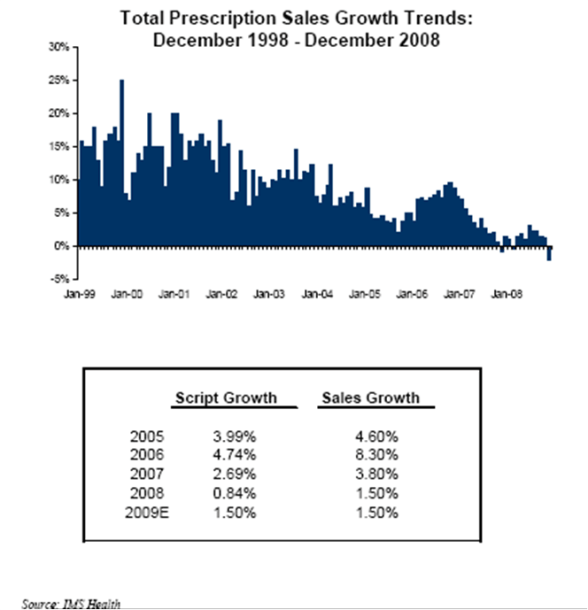
Script Growth Especially At Mail Continue To Slow

Based on IMS data, prescription growth continues to slow especially at mail order where it’s negative.  Interestingly, in a report by Barclay’s Capital, they estimate that Caremark will grow mail by 10% next year, Express Scripts will lose mail scripts by about 0.5%, and Medco will only grow by 0.8%.

Medco is easy to understand since they are currently the market leader in terms of mail order penetration.  The Express Scripts number requires some additional analysis.  Is it due to client loss?  Is mail just not growing?  The Caremark growth is meaningful.

ims-script-growth-barclaysims-mail-growth-barclays

Time To Sell?

There is always debate about captive PBMs (i.e., those owned by a managed care company).  In theory, I have always argued that they should have a leg up.  But, since pharmacy represents only 10% of total healthcare spend, the majority of the strategic focus is typically on the health insurance side of the business.  [BTW – The 3 largest captive PBMs are Wellpoint, Aetna, and Cigna.]

So, if you look at the stock charts below, you can see that while the PBMs (Express Scripts, Medco, and CVS Caremark) have all held up pretty well the managed care stocks (Aetna, Cigna, United Healthcare, Humana, and Wellpoint) have not held up as well.

If I owned a captive PBM, would this be the time for me to consider selling?  I have heard this debate a lot more recently than in recent years.

PBM 5-Year Stock Chart

express-medco-cvs-caremark-5-yearManaged Care 5-Year Stock Chart

wellpoint-cigna-aetna-united-humana-5-year[As I have disclosed before, I do not hold any individual stocks.]

Trickle Down Healthcare

Many of us know the term “trickle-down economics” which is generally associated with Ronald Reagan.  (Obviously not a concept bought into by the current administration.)  I was thinking about this today from the concept of workplace culture around healthcare.

I have not seen any research to this point, but it would seem to make sense that companies where the senior executive team is focused on exercising – running, triathalons, tennis, etc. – would generally be healthier companies.  As we have seen multiple times, peer pressure works.  So, does it work from a top-down perspective also?

I know one healthcare company where they were refining what was served at the cafeteria and what was in the vending machines.  Obviously, there are ways to control diet through what the company “encourages”.  Do they have bowls of fruit or bowls of chocolate?

Is Choice Good?

In recent discussions, I was talking with some clients about helping members or consumers save money in healthcare.  On the one hand, you can educate them about all the different opportunities.  On the other hand, you can focus them on one or two opportunities.  Those could offer the most value, be the simplest to execute, be the easiest to understand, or have some other logic in prioritization.

The question in my mind was what would drive the best results.  If you look at the research around consumer products and 401K’s (for example), it is clear that choice is not always best.  When presented with more options, people don’t always make a decision.  They get overwhelmed.

So, think about focus and simplification.

Friends Don’t Let Friends

If they can use this concept for selling DirectTV over cable, why don’t we use this more in healthcare?

It could be…Friends Don’t Let Friends:

  • Pay too much for medication
  • Use brand drugs unnecessarily
  • Use retail for maintenance drugs
  • Call into the call center when the information is on the web
  • Go to the ER when they can call the nurse line
  • Pay too much for individual insurance

Maybe, in today’s economy, it will be time for healthcare companies to look for seriously at referral programs. 

  • Get a friend to come to mail order or the local CVS and get your next prescription copay waived.

Everyone is focused on saving money.  Social networking is all the rage.  People trust their friends.  

Now, I may not want to tell my friends that I am on cholesterol lowering medication so that may change it.  But, certainly people talk about higher level items like shopping for individual insurance.

A Few Quick Things

Found this new blog – Drug Channels.  Lots of good posts.

Ron Lyon unfortunately doesn’t blog a lot, but several of his recent posts are very interesting on the Pharmacy Rants and Raves blog.

Bruce Temkin from Forrester blogs at the Customer Experience Matters and has some great insights across industries.

McKinsey has jumped into the social networking fray with their McKinsey Quarterly which is available with a Facebook page and Twitter feed.

A report on Medicare spending on healthcare by the Kaiser Family Foundation.

A new eBook on Finding Dr. Right.

Personalized Medicine Webinar

I don’t have anything to do with this, but it sounds pretty interesting.  Medco and Regence are talking.  Here is the teaser.  (Click here for more info and registration.)

Personalized medicine is moving rapidly. The FDA in December considered requests to require genetic testing for the colon cancer drugs Vectibix and Erbitux. Approval of such labeling changes could pave the way for a slew of other personalized therapies and diagnostics now waiting in the wings. Stakeholders anticipate significant clinical and financial savings. Recently approved genetic testing for the blood thinner warfarin, for instance, is projected to avoid 85,000 serious bleeding events annually and save roughly $1.1 billion a year!

On the other hand, questions remain whether the model actually provides a favorable return on investment (ROI). A new study finds that genetic testing for warfarin does not appear to be cost-effective in certain patients. And health plans and PBMs are trying to sort out which of the numerous diagnostic tests on the market actually provide clinical utility and improved results. One large health plan, for example, says its costs for diagnostic testing are growing at nearly 20% a year.

So where does all of this leave Rx payers in February 2009?

Ix for Rx Management

Josh Seidman from the Center for Information Therapy today announced on their blog that the center is going to begin focusing on “Ix for Rx Management” that will look at adherence along with other critical issues.  As I talk about all the time, finding the right way to deliver information to people in a way that they can accept it and act upon it is critical.  Given that we use more and more medications, this is a critical area where the center’s leadership can help build awareness of the problems.

“Although awareness certainly is an important precursor, it may be the easiest step in the pathway that takes the average consumer along the road to information consumption, then knowledge accumulation, and ultimately leading to behavior change. We know there’s a large body of research that tells us that, in order to be successful, our Ix initiatives need to “meet people where they are.” More specifically, we need to target the information to the individual’s particular moment in care and tailor it to their particular needs and circumstances.”