Archive | Healthcare RSS feed for this section

Google’s Health Advisory Board

I use Google all the time.  I have been very interested to see pieces of information around Google Health.  Will it compete with WebMD and Revolution?  Will it create new tools like a PHR?  How will it leverage its technology to improve healthcare?

I found their announcement of their board several months ago interesting.  A good mix of people – MDs, employers, academic facilities, researchers.  I didn’t notice many technologists which surprised me.  There are numerous start-ups with MDs or RPhs or other health professionals running them.   

More to come, but a company with great resources that understands how to innovate and seems to have a social conscience could make a big difference here.  You can go read a speech by Adam Bosworth at Google about this.

Consumer Voices for Coverage

The Robert Wood Johnson Foundation has funded something called the Consumer Voices for Coverage which begins in 2008. 

The need from the project comes from the publication of Consumer Health Advocacy: A View from 16 States by Community Catalyst in October of 2006.  This calls for consumers to be active in protecting and expanding healthc are access.  In order to be effective, consumers need to organize into  state advocacy networks with the ability to:

  1. analyze complex legal and policy issues in order to develop achievable policy alternatives;
  2. build a strong grassroots base of support;
  3. design and implement communications strategies to build timely public and political support for reform;
  4. build and sustain strong broad-based coalitions and maintain strategic alliances with other stakeholders;
  5. develop and implement strategic health policy campaigns; and
  6. generate resources from diverse sources to build organizational infrastructure.

I must admit to never being much of an activist, but I certainly support the concept of people being active to support their cause.  And, of the many causes out there, access and care for people is a good one.  In a wealthy country like the US, it is a shame to see people dying and in pain for simple reasons like lack of access. 

Unfortunately, many Americans probably don’t realize how good we have it here.  Even those without have TVs and clothes.  Go to a 3rd world country and spend some time with the poor.  It will radically change your opinion. 

Life Expectancy

I find it interesting that all the financial magazines I read talk about how life expectancy is going up in the US.  They talk about the need to plan for 30+ years of retirement money. 

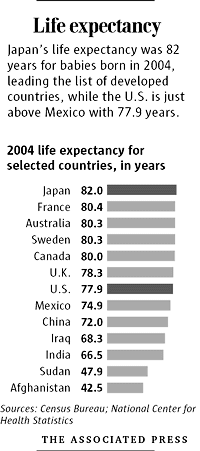
At the same time, all the healthcare articles I read talk about life expectancy in the US (although at an all-time high) dramatically lags behind 41 other countries…even though we spend the most on healthcare.  You can read the AP article here.  It makes some interesting points blaming the difference on obesity (2/3 of Americans are overweight), the fact that we have 47M uninsured Americans, and our horrible rate of infant mortality (6.8 out of 1,000).

Here is the chart from the article:

Life Expectancy - AP

Pharmacists on Prescriptions (and OTCs, etc.)

I was pleasantly surprised this morning to learn about RxWiki.com.  This is a website by pharmacists to provide consumer information about drugs, OTCs, and other products.  Certainly, for those practicing pharmacy (versus in the ivory tower), they should have some good first hand experiences to share with patients.

I think about when I first started seeing advertisements for Alli (diet drug).  When I asked a pharmacist about it, he said it was great as long as you eat no fat.  He said you couldn’t make it from taking one bite of a McDonald’s hamburger in your car into the bathroom at McDonald’s fast enough to avoid an accident.  Doesn’t sound appealing to me.  Why not just give up fat?

I wonder if we will ever see a MDWiki (somebody already has the URL).  These collaborative tools are great for allowing people to share information with the general public.  Hopefully, they have the right disclaimers so they don’t ever have some frivolous lawsuit because I think consumerism is only going to take off when information is generally available with some quality assurance process.  We need to trust the information but have it relayed to us in straightforward, non-legalese.

Calls vs. Letters

The more I learn about automated call technology the more I wonder why people don’t use it as much as letters.  Obviously, there are telemarketing laws.  And, I think many people think of calls as only being done by humans and being expensive.

But, imagine the following differences and benefits:

  1. Lower cost then letters
  2. Able to customize the messaging (think e-mail personalization)
  3. Able to change your campaign real-time (i.e., our response rate is lower than expected, let’s change the messaging to say this)
  4. Able to track lots of data – who picks up, when they pick up, how much of the message they listen to
  5. Able to collect data immediately
  6. Able to interact with the participant (e.g., give me your BMI…that is 10% higher than last time…are you following your diet)

Obviously, e-mail is the cheapest medium, but our culture is rapidly becoming overwhelmed with e-mail.  You have some of the same benefits, but you can’t modify during the interaction.  And, in healthcare, there is limited information you can push to a patient.  In most cases, you are asking them to click through a link to go to a secure website to receive information.  With letters, you assume it is secure since it is addressed to them.  With automated calls, you have them verify who they are based on a few points of reference (name, DOB, member ID).

Cultural Communications

In the spirit of advocating for the patient, I think one of the key things missing at many companies is culturally specific communications.  The simplest solution here is multi-lingual.  Now that nearly 1 in 10 counties in the US have a majority of minorities, this is important (USA Today 8/9/07).

Of course, I always hear the question back of how do I track this.  Will people self-identify into a cultural group?  It depends.  Do you have anything to offer them?  Can you articulate value to them?

If I speak a different language as my primary language and you offer me communications in my native tongue, I would likely be happy to request it.  Can you track it when I request it?  Aquent appears to be a company focused on this within the healthcare space.

This can also manifest itself in color selection.  For different cultures, a certain color can mean different things which might affect your brochure creation.  (see article)   Of course, you need to be able to do mass customization of your brochure rather than print 7M in one run.

With hispanics expected to represent 21% of the US population by 2020, it will be important to understand this segment and how to communicate with them.  Here is a good article on this.  I have seen studies that show they respond at a higher rate than other segments to both letters and direct calls.  Shouldn’t that be important?

The point here is that if you really care about the patient and their health wouldn’t you want to push information to them in a language they care about; using colors that evoke action and emotion; and using words and frameworks that they understand.

Data Sources

There are a few places that I always go for information.  I thought I would share them:

  1. For general Rx data, I use the NACDS website.
  2. For prescription trend information, the PBMs have good trend reports.  I helped with ESI’s report so I know it well, but Medco and Caremark also put out good reports.
  3. General government health data
  4. Rand
  5. Kaiser Foundation
  6. CDC (e.g., publication)
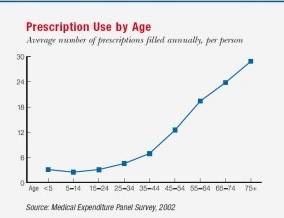
  7. RevolutionHealth or WebMd (e.g., look at this scary obesity chart)
  8. DrugDigest
  9. Consumer Reports on Prescriptions

More to come, but I found myself going to the same site multiple times today and jotted down a few URLs that I find as common tools.

Organs and Medical Tourism

I find the whole concept of Medical Tourism fascinating.  The fact that it can be less expensive for someone in the US to fly to a foreign country and get an operation done is logical while also amazing.  When I was trying my start-up, one of my board members had a friend raising $2B to develop a medical center in Asia to bring people there for long-term surgery and recovery periods.

Business 2.0 had an article about medical tourism that predicted it would be a $40B market by 2010.  A great opportunity?

Example from the article “GlobalChoice sent a patient to Punjab for a hip replacement that cost about $13,000, including airfare and a 20-day hotel stay. The estimated cost in the United States for the surgery alone? $40,000.”

I also found it interesting in a April 2007 Wired article called “Organs for Sale” to see the prices for transplants overseas (with much higher availability also).

  • $15,000 – $145,000 for a kidney
  • $150,000 – $290,000 for a lung
  • $25,000 – $290,000 for a liver
  • $110,000 – $140,000 for a pancreas
  • $90,000 – $290,000 for a heart

My key point with blog (other than just interest) is that there is a market for companies to provide these services, insure the patient, manage the quality of care, and offer incentives (even for insured people) to get this care.

Clothes for Wellness

So what does BodyMedia have in mind…If you read this article from a few years ago, I think they are on to something.  Can you put sensors in people’s clothes without changing the comfort of the clothes – probably?  Can you link those sensors to data driven models to help drive behavior – sure?  Will people wear the clothes, use the data, and change behavior – who knows?

The concept is right.  Embedding technology into everything we do and using that data to push information to us at the right time is critical to changing behavior and driving technology enabled wellness.  I love the picture below of their reporting.  I get this from my GPS watch.  I definitely intend to learn more about what they are doing.

Wellness Incentives

Can incentives actually drive wellness? Why not? Why?

Incentives are powerful tools once you understand the healthcare consumer and how they react. Is the incentive a lower copay? Is it a free service? Lots of interesting models are going to come up. It has worked in other industries but can it work here.

I think a lot will depend on the segment of the market and what you are asking them to do. A old person (i.e., a MD worshipper) is unlikely to challenge their doctor and push for certain action. A younger person in good health (i.e., a Living for Today) is unlikely to respond to messaging about pre-screening and general check-ups.

Here are a couple of the things out there:

Another model which will be interesting is existing companies like Maritz which do loyalty programs and incentive programs for other industries.  As they apply their skills to the healthcare market, it should allow this to take off faster.

Prescribing Information (Ix)

I think the Information Therapy concept is a great way to think about consumerism and information in the healthcare space.  I was recently reviewing a presentation by Healthwise which pointed out 3 Simple Rules:

  1. Self Care Rule – helping people do as much for themselves as possible
  2. Guideline Rule – helping people ask for the care they need…giving them the guidelines
  3. Veto Rule – helping people say “no” to care they don’t need

Another place where you can learn more about this concept is at the Center for Information Therapy.  From a health plan perspective, here is one of their white papers which will help you begin to conceptualize this.

The key here is that we should be able to use data to trigger information events that are personalized to people.  This obviously needs to be actionable information that is in a format and uses terminology that patients can understand.  There is a huge difference between data and information.  Lots of data is sent to patients along with a typical “barfing” of information with no context or prioritization.

It is a great opportunity.  Lots of healthplans and consumer sites are embracing this.  As this gets refined and becomes mainstream, it can help drive wellness and a change in ownership for healthcare where consumers really feel responsible and can act responsibly for their care.

You can also look at Josh’s blog for more ongoing dialogue.

Web 2.0 – Healthcare

Rather than recreate this, I liked John’s list of sites from a meeting at work. Got to his blog to see the list of links for Web 2.0 sites around healthcare.

As we all know, technology is changing every industry. Healthcare will be no different. It will be fascinating as new generations of physicians, nurses, pharmacists, and others who have grown up around web technology become the leaders of our companies.

I can still remember in the late 90s presenting to a healthplan CEO about creating an e-business strategy for him only to find out that he didn’t even use a PC.

Healthcare Blogs

What a list!  I just came across the list of top Healthcare Blogs.  I am not on there yet, but I just submitted myself to be tracked.  This is a great resource for those of you that get lots of feeds or use Google Reader to track blogs.

URAC PBM Accredidation

So, URAC has decided to focus on accrediting PBMs. This caught my eye especially when one of the press releases I saw mentioned communications. With 70% of Americans receiving their pharmacy benefits through PBMs, perhaps this could have an impact. If you go look at the expectations for accreditation, I saw several interesting things:

  1. There has to be a continuous improvement plan around quality (is that Six Sigma, Lean, BPM, or just a general plan?)…any option is good.
  2. Does the PBM have the capability to disclose and educate members on costs and optimizing their benefit? (what about whether they do it…but key capability)
  3. Is the member information at the right reading level and culturally sensitive? It would seem like you would want to require at least some multi-lingual capabilities in letters or via the call center.
  4. How is over / under utilization monitored? Does this mean how do they drive compliance which is very complicated…but again a good objective?
  5. Does the PBM have a medication therapy management (MTM) process? WOW. This would be great to offer beyond the Medicare Part D. Expensive to help members manage their total set of drugs and provide counseling from a pharmacist.

Overall, I think it has the right objectives. A lot of it is dependent upon communications. How does the PBM mine their information? When and how should they communicate with patients? What information do they push to them? What information do they provide for them? What channels do they use? How do they make a difference?

If taken to the next level, this could be a huge driver of consumerism in the pharmacy space by giving “points” (i.e., accreditation) to those that do it. Hopefully, it is more than simply having the ability to do it, but actually executing successfully on that capability. Then, some of the work I have been doing around data mining, optimization, and channel management of communications will be critical path.

Genomics and Personalized Shoes

A product of one is something that is starting to become a reality.  You have been able to get clothes tailored to your specific body shape for years, but only at the high end locations or overseas.  You are now starting to see mass customization of shoes, jeans, and other items.

At the same time, we have the whole field of genomics which could lead to personalized prescriptions that are customized to your specific condition, genes, and other parameters.

So, with all of this technology available, why can’t we get mass produced health benefits that are customized to the individual and based on their income, family history, personal medical situation, etc.  It would seem possible to say to someone that based on their medical history and family history they are likely to spend $X the following year.  In addition, people of their similar age and geography have a Y probability of getting injured.  Therefore, based on their family and economic status, this is the right plan to minimize their out-of-pocket dollars while managing their probability of a catastrophic health event.

I am sure there is a reason, but I would love to see someone try.  Just a thought.  I saw an advertisement this morning about personalized shoes and began to wonder why we can’t personalize people’s health benefits.   And, I don’t mean simply the ability to buy a pre-defined healthcare plan as an individual, but the ability to provide inputs which custom designs a plan for you using some predictive intelligence.

HealthIQ

I came across a new blog with a great entry on a healthcare IQ. Apparently, the physician who blogs here has used it before. It is worth a look.

As the principle for this blog, I disagree with his hypothesis about engaging patients since I think that someone other than the primary care provider needs to play this role. You can see a few of my thoughts in the comment to his entry.

Healthcare Transparency

If you don’t read The Healthcare Blog, you should.  It is certainly one of the best collections of information out there.  I constantly monitor it to see what interviews or opinions they have.

This morning I found a link to another blog which talked about Healthcare Transparency.  This is a fascinating topic especially since we talked a lot about this in the PBM world.  Brian Klepper (the blogger) presents a good discussion around a couple of key points (said in my words below):

  1. Transparency is only legitimate if everyone understands what’s in the black box whether that is a quality calculation, outcomes data, cost information or any other issue.
  2. We have to be pushing for data access so that people can make informed decisions and drive volume to the best value providers (quality/cost) that meet the standards of care.

There has always been a lot of push back from the large companies or individuals about revealing quality information or cost information.  That is what consumerism is about.  Think about mutual funds.  You know their positions, why they make decisions, their objectives, how much the fund manager is paid, etc.

Benefits and Behavior

I found another interesting thing recently when I was looking at Guardian. It is a report called “Benefits and Behavior: The Voice of American Business Owners and Benefit Decision Makers Today” (register and download here). It has some interesting facts about how companies of different sizes look at wellness and benefits.

“82% of small employers, 90% of midsize employers and 99% of large employers see value in implementing wellness programs. Yet only 57% of the small businesses that value wellness programs have implemented some type of plan. This is compared to greater adoption in larger companies: 79% of the midsize businesses and 90% of large businesses that value wellness programs have one in place.”

“68% of small employers, 78% of midsize employers and 69% of large employers want their insurance carriers to play a role in helping their company implement wellness and prevention programs to help reduce absenteeism and healthcare costs.”

“Larger companies (82%) widely believe that it is important to tailor their benefits package to meet the needs of individual employees. However, small (59%) and midsize (55%) companies are significantly less likely to agree.”

“Small (41%) and midsize (45%) employers are significantly more likely to accept the idea of a one size fits all benefits package, compared to larger companies (17%).”

“When asked to rate the seriousness of various business challenges, controlling medical costs was rated the biggest challenge by all business sizes — small businesses gave an average rating of 7.3 on a ten-point scale, mid size business averaged 7.6 and large businesses averaged an 8.2.”

Health Balance Sheet

I was doing some research on Guardian the other day when I ran across one of their products called “The Living Balance Sheet”.  This is a web-based, dynamic tool to help you organize, simplify and monitor your financial life.

This made me think…why not have this for healthcare.  In one sense, the Personal Health Record is meant to do this.  (I like the example from ActiveHealth).  In another sense, that only covers the organizing and simplifying part.  I don’t think that PHRs (myPHR, ihealthrecord, Misys, etc.) are meant to mine the data and push information to you.  Their original objective was not to be a virtual coach (from my understanding).

But, this is the opportunity.  Put lots of data in one place.  Add inteligence.  Add the ability to learn.  Blend in best practices.  Begin to weigh options based on costs and quality and possibly impact on your quality of life.

Wouldn’t it be great to log in somewhere and see how you were doing?  Are you making good choices?  How do you compare to your peers?  How can you improve?  Eventually, this could even link into clothes or other objects that push data real-time to the system.

SCENARIO: John – Thanks for logging in.  It appears your blood sugar is high.  You normally have a 10% spike every day at this time, but today you spiked 20%.  We have pulled together a personalized diet plan for you.  This should give you the nutrients required while also keeping your blood sugar low.  Some other options you might evaluate are…  And, if interested, we have benchmarked your  experience with diabetes versus others within your age group.  This can be sorted by geography, income, and other metrics if interested. 

Understanding what to do and its impact on your overall health would be great.  I remember using an interactive tool years ago that told you how old you were based on exercise, smoking, etc.  It was called RealAge.  Having a “score” about your health (e.g., BMI) would be a great Health Balance Sheet.

Consumerism – My View on the Basics

So, how does one define consumerism from a pharmacy perspective?  Let’s first look at the objective.  The objective of consumerism is to put information, choice, and responsibility in the hands of the patient.  To do this successfully, several things have to be addressed – knowledge, awareness, incentives.

The benefit of pharmacy is the timeliness of the data (real-time).

I believe  consumerism is made up of several different things:

  1. Plan designs which include high deductibles and have Health Savings Accounts (HSA)s.
  2. Content and tools that helps consumers make choices.  This includes information on plan design, on disease states, on drugs, on quality, on cost, and mostly on their options.  This is for pharmacy, providers, and general healthcare services.  The options here with all the consumer-driven healthcare vendors and the Web 2.0 technologies are significant.
  3. Communications to educate and remind them.  I think of this as an event driven architecture where information is pushed to consumers around events when they need or want information.  Doing this effectively and in a timely manner is the key challenge.
  4. Incentives and rewards to align the interests of the parties.  If you stay healthy and spend less resources, you should share in the savings.  It is a simple pitch to me.
  5. A focus on prevention versus simply treatment.  This includes wellness programs and disease management.

Everyone is trying different things which is what makes this such a dynamic space right now.  Here are a few of the players:

  1. WebMD
  2. RevolutionHealth
  3. ActiveHealth
  4. DestinationRx
  5. Definity Health
  6. Metavante
  7. ConnectYourCare
  8. CareGain
  9. Healthways
  10. Lumenos
  11. Amisys
  12. PrecisionRx
  13. RxEOB
  14. Subimo
  15. iBenefit
  16. HealthEnvelope

I could go on, but there are numerous companies embracing disease management, wellness, HSAs, VBID, and many of the other concepts that are part of consumerism.  I welcome you to add other vendors to the list.  Thanks.

Libratto – Blog

Bob Nease is an executive at Express Scripts that I worked with.  Great guy.  Very smart.  Unfortunately, he hasn’t had time to keep up his blog so some of the comments are outdated, but he provides an intelligent dialogue on his blog at Libratto

Viral Marketing in Wellness?

A study in the New England Journal of Medicine by James Fowler and Nicholas Christakis found some staggering results:

  1. When people become obese, the risk of their closest friends becoming obese over the next 2-4 years increases by 171%; risk for casual friends increases by 57%; siblings by 40%; and spouse by 37%.
  2. The reverse is true about shedding weight.
  3. The weight gain/loss has a more direct affect on friends and siblings of the same gender.

This should teach us all something (or at least give us a hypothesis upon which to start) for marketing wellness and promoting change in the US.  As companies do when they want to drive change in the business community, focus on the influencers and let them drive behavior.  Now the question is whether this works for smoking cessation and other healthcare issues.  But, obesity is correlated with lots of problems – diabetes, heart disease, etc.

The power of social or viral marketing is strong.  Thinking through this as we look to how we help patients is important.

Communication Accountability

You can tell I am on the road since I am reading USToday. But, it always has some great pieces.

Yesterday (7/25/07) there is an article titled “Communication is now part of the cure” by Erin Donaghue. It has several great points:

  1. It talks about a true patient advocacy organization called Bedside Advocates. They help guide patients through the system. (much needed)
  2. It talks about the fact that many people are afraid to ask their doctor questions. I think this is much more prevalent in the 65+ age group where they were taught to respect doctors versus younger generations that are more willing to challenge those in a position of authority.
  3. It talks about the National Institute for Patient Rights and a book called 3 Secrets Hospitals Don’t Want You to Know: How to Empower Patients.
  4. The fact that CMS is linking a portion of funding to patient satisfaction scores as part of the Hospital Consumer Assessment of Health Providers and Systems which will begin to make them accountable for communications. (For example…”During this hospital stay, how often did doctors listen carefully to you?”)

This all seems like a good first step. Communications are a challenge in any industry, but healthcare has lots of people providing you with carefully reviewed information as to avoid lawsuits. Navigating that requires information and lots of questions. This is where the industry will begin to change, but it is both systemic and cultural. Neither are simple.

Loyalty Programs in Healthcare

I know several people working on this, and I think it will be an interesting challenge.  As I have been pushing for a while, healthcare needs to embrace ideas from outside the industry.  Loyalty is an good one.  But, healthcare has an issue.  For example, how do you reward use of pharmacy without incenting inappropriate utilization.  Or, how do you give points for using an ER without encouring “emergencies”.

The right answer is to encourage wellness, but the question is who pays for this program…the employer is the best option.  Managed care could pay for this, but the question is what is the likelihood of that patient staying covered by the same insurer.  Here is an opportunity for some universal solution where wellness costs were allocated over time to the insurers which owned the patient (e.g., like a depreciating asset where you pay for the initial years even though it may continue to hold some value).

But wellness is not loyalty.  If I am a pharmacy, I want you to continue coming back.  If I am a hospital who keeps building specialty centers, I want to get all of your healthcare dollars.  Probably (if it was possible to get), a loyalty program tied to share of wallet would be right.  For example, if 80% of your pharmacy dollars are at my store, I will give you 1,000 points.  If 90%, then 1,500 points.  Etc.  You would probably need a grid system so that those with the most Rx had the base point system multiplied otherwise someone with one Rx gets the same points as someone with 10 which doesn’t make financial sense.

As mentioned in US Today (July 24, 2007 pg. B1), membership in reward programs is significant across several industries (see the snapshot of reward membership in the US based on data from Colloquy below).

  • 254.4M in airlines
  • 238.7 in financial services
  • 137.4 in specialty retail
  • 124.3 in grocery
  • 107.9 in department stores

A reward system is needed badly in healthcare.  We have plenty of sticks but very few carrots.  Both are necessary in any environment.

As companies like Maritz which have worked in the Loyalty space within other industries increase their focus on healthcare, I think we will see some evolving models.  Stay tuned.

Health Literacy Issue

Tuesday’s (7/24/07) USA Today had an article on page 8D talking about Health Literacy.  Based on a study of 3,260 Medicare beneficiaries, the authors of an article published in the Archives of Internal Medicine found that “those with inadequate health literacy were 52% more likely to have died than those with adequate health literacy”.

This gets right to the point of healthcare communications.  It is critical to understand how to deliver information and what words to use.  Unfortunately, this applies to people even with health literacy such as physicians.  I have seen healthcare communications to go to doctors talking about fluoxetine and lovastatin (for example).  Since many doctors don’t know all the chemical names of drugs, they might not know that this was talking about Prozac (fluoxetine) and Mevacor (lovastatin).  When we provided generic samples to physicians, some of them didn’t use our first batch because it only had the generic name on it, and they couldn’t be 100% sure of what it was.

So, with patients this is even more critical.  When you are wrapped up in healthcare, it is easy to think that everyone thinks like you.  For example, a patient doesn’t understand what a renewal prescription is.  This is the term for a refill when there are no open refills on your prescription.  You can’t simply refill.  You have to get your physician to write you a new Rx (i.e., a renewal).

So, literacy has a micro issue which is clarity of terminology and simplicity of messaging to deliver valuable and timely information which consumers can take action on.  It also has a macro issue which is driving literacy in general such that labels, physician’s instructions, and other information is understood.

This could certainly be an argument for voice based communications for which I am a big advocate.  This could also be an argument for multi-lingual communications so you can avoid issues like once a day being interpreted as 11 per day (since once means 11 in Spanish).

Comment and Consumerism

Yesterday, I got a comment from someone who was upset that I named the blog – The Patient Advocate. They don’t like the PBM system here in the US. And, they didn’t think this blog represented consumerism. I thought I would spend a minute responding publicly to him.

My perspective on naming the blog was simply that unless those of us within the healthcare system begin thinking about change from a patient perspective we won’t have much of a chance for change (radical or incremental). So, my hope here is to begin thinking about how patients can best receive information and be part of the process. But, yes, I am thinking about it from within the system. I am not here to take an ivory tower look at how to develop a new system.

Relative to defining consumerism, I could probably argue that all day long. My perspective is that consumerism in healthcare is largely about information and transparency. Information is easier in that there is lots of it. They question is how to get it to the patient in a timely and easily digestible manner. Transparency is harder but is happening. This requires change and helping patients to understand the rules and logic (clinical and business) behind healthcare and to get access to treatment and quality data. Both of these are necessary for people to make fact-based decisions about how and when to spend their healthcare dollars.

None of this is or will be easy. Moving responsibility for retirement funds from a defined plan to 401Ks where the responsibility is with the individual has been great for many, but not everyone has done well here. We will be in a transitionary period while this transformation happens. My hope is to be part of it and make it happen as well as possible.

Here are a few things on consumerism in healthcare:

  1. Aetna’s perspective
  2. Managed consumerism article
  3. Good blog and discussion on The Health Care Blog
  4. Forrester on healthcare consumerism
  5. Galen Institute study

Costs of Healthcare

For today, let’s stick with the consumer costs of healthcare.  Wired Magazine has a very cool graphic in their August 2007 publication (pg. 52) which shows how consumer spending breaks out.  (Note this is for an average household expenditure of $46,408 which obviously ignores the poor and working poor.)

The focus is on technology which they get down into single dollar expenditures.  But, I thought the healthcare data was interesting – $1,361 (3%) on health insurance and $405 (1%) on prescription drugs.  Both seem staggering low to me especially at a household level.  I think we spend $200-$300 per month on prescription copays in my family (and we are pretty healthy).

But, this is the type of data we need to understand and if you are targetting consumers, it is helpful to know how they prioritize their spending based on where it goes.  More to come to spending.  (And then we will have to look at the employer costs.)

Warranty on Surgery

Now here is a novel idea. I was shocked to see this little one liner in my Money magazine over the weekend. It didn’t say much else, but there is plenty of information available online.  Basically, Geisinger Health System is offering a 90-day warranty that covers all the follow-up (including re-admission) for heart surgery.

Even if some of this has been done before in healthcare, it is a key step in driving consumerism.  Translating common consumer practices (warranties) into healthcare is an easy model for us to understand.

The WSJ Blog on Healthcare

NY Times Article

The Doctor Weighs In Blog

Automated Calling Technology

I have had the chance to work with one of my previous vendors on their PBM strategy.  I find it to be a fascinating space – automated call technology.  They are at the heart of the consumerism push and work for 45 healthcare companies today.

Since a call center is often too expensive and often the turnover a killer for quality, that can be a difficult strategy for communications.  Letters are great from the fact that they can be perfectly scripted.  But, letters aren’t dynamic and aren’t real-time.  E-mail is good, but with HIPAA restrictions and other privacy issues, it can be constrained.

Everyone has a phone.  Using push technology with personalization and a dynamic engine for changing messaging has great potential.  We used this technology to drive brand to generic switching when Zocor was losing patent.  We used this to help people who got rejected at the Point-of-Sale understand their plan design (call avoidance).  And, we used this as a complement to our letters trying to move people from retail pharmacy to mail order.  It works.

I am working on the numbers now, but I suspect there is a few billion dollars worth of opportunity sitting on the table if healthcare fully embraces this technology.  By reducing inbound calls and using intelligent messaging to predict events and push information to patients, you can drive changes in behavior and make a difference.

Much more to come here…