Archive | Leadership RSS feed for this section

WHCC 09 Interview with Ed Batchelor (Humana)

I had an opportunity to sit down with Ed Batchelor from Humana yesterday.  He has an interesting role driving the Stay Smart / Stay Healthy program for them as part of his Corporate Web Strategy role.  From what I could tell, it’s a program done for the greater good of educating consumers about key healthcare topics.  To accomplish that, Ed has a direct reporting relationship to the operating committee at Humana and was brought in from outside the industry.

Here is an example of one of the videos that they are pushing out on YouTube.  I really like the whiteboard communication approach.

Some of the big takeaways from my discussion were:

  1. You have to meet the consumers where they are – Facebook, YouTube, Blogs.
  2. If you create a neutral educational message, consumers will trust information (even from health plans).
  3. You can only deliver information in “bits”.  Don’t overwhelm them.
  4. Fun is good.
  5. Regardless of what many (including myself) might think, seniors don’t all shy away from these social media.  [20% of the 1.1M views on YouTube have been from people over 55 years old]
  6. Success on YouTube doesn’t translate to blogs.

One question that I had was how to get away from the “healthcare speak” so that consumers could actually understand it.  He talked about 3 things:

  1. Bringing in an external person
  2. Using focus groups
  3. Using an outside agency

The other thing we talked about is that pull through that they are getting around employers and brokers.  They are pulling the videos in (like here) and re-using them.

This was a program they were highlighting in their booth and one of the public areas here so I appreciated the opportunity to sit down and learn more.

$2.3T on Healthcare and 47M Uninsured – National Disgrace

Kaiser Permanente recently launched a series of advertisements that drive this message around health disparities home. It is (or should be) a concern for most of us.  Health outcomes and especially preventative care is driven by health literacy, our attitudes towards health, and our access to the healthcare system.  We should all be working with our families, our communities, and our country to try to make this better.

I am a firm believer that one of the best ways to start to manage cost is to find a viable strategy to get universal coverage.  The costs of emergency care and absenteeism all get passed on to us in one way or another.  And, as the government is the dominant payor of healthcare (Medicare, Medicaid), long term costs are a significant issue for our economy.  If there is a systemic way of improving it, we should seek that out.

So, a cause that is both moral and economical…what more do you need?

Today, more than 50 percent of Americans and 75 percent of Californians without health care coverage are people of color.  Uninsured men, women, and children are far more likely to get sick and forego care simply because they lack coverage.  This is a national disgrace. We spend 2.3 trillion dollars on care in this country. Securing health care coverage for every American is the next great civil rights issue of our time. We can and should achieve universal coverage.

kaiser-ad

Some of the facts highlighted on their new website about disparities include:

  1. Disparities in health and health care impact everyone. African Americans, American Indians, Alaska Natives, Asians, Pacific Islanders, and Hispanics are most affected.

  2. 27% of adults report having no usual source of care. African-American (28%), Hispanic (51%), and Asian (23%) adults are all more likely to report not having a usual doctor.

  3. Uninsured adults are disproportionately, young, and minorities; 82% are between 19-49 years of age, and 41% identified themselves as black, Hispanic, or other.

  4. American Indian and Alaskan Native death rates from sudden infant death syndrome are the highest of any population groups.

  5. Asian Americans have the highest tuberculosis case rates of any racial and ethnic population.

  6. During 1996-2000, Native Hawaiians were 2.5 times more likely to be diagnosed with diabetes than non-Hispanic white residents of Hawaii of similar age.

  7. In 2005, African Americans accounted for 18,121 (49%) of the estimated 37,331 new HIV/AIDS diagnoses in a national poll which encompassed 33 states.

  8. 21.9% of U.S. children live in poverty, far and away the worst in the industrialized world. Comparable figures for the Nordic countries are 4.2% and less.

  9. Adults who have not finished high school are almost two times more likely than college graduates to be obese.

To learn more about the topic, you can go to their community of information.

Buyology: Best Book of 2009

I am finally getting around to writing this up. I mentioned the book – Buyology – a few weeks ago. It is definitely the best book I have read this year. It is by Martin Lindstrom and is all about neuromarketing.

For those of you that don’t think it’s relevant to healthcare, think again. Healthcare is all about compelling individuals to take action and become responsible for their health. That is about understanding how they interpret information and what drives them.

Here are some of my notes from the book:

  • One of the processes used was fMRI (functional Magnetic Resonance Imaging) which measures the amount of oxygenated blood throughout the brain. Scientists can see what part of the brain is working at any given time.
  • The other process used was SST (steady-state typography) which tracks rapid brain waves in real time.
  • One of his first studies looked at the effect of cigarette warning labels and found that they not only failed to deter smoking but activated the nucleas accumbens.
  • What people say on surveys and in focus groups does not reliably affect how they behave. [although it is often the best we have]
  • Brand matters…He re-conducted the Pepsi Challenge and showed that if people knew what they were drinking they preferred Coke to Pepsi. When they didn’t know, 50% of people liked Coke. When they knew, 75% of people liked Coke.
  • He showed that consumers have no memory of brands that don’t play an integral part in the storyline of a program. Just putting something in the movie, TV show, or video game isn’t enough to get you mindshare. AND, those successful placements also weaken our ability to remember other brands.

“Our irrational minds, flooded with cultural biases rooted in our tradition, upbringing, and a whole lot of other subconscious factors, assert a powerful but hidden influence over the choices we make.”

  • In the Smiling Study that he references, they revealed that people are far more positive and have a better attitude toward the business when the person they are dealing with is smiling. [Maybe a key thing for avatars and real agents as they talk to people over the computer and/or phone.]
  • Our mirror neutrons allow us to get pleasure just by observing or reading about people doing something that would give us pleasure – e.g., opening a present with a new Wii in it. [You can go to www.unbox.it.com or www.unboxing.com to enjoy this.]
  • Logos are dead. They showed that images that are associated with smoking (for example) were far more potent in creating a reaction in the brain than the logo.
  • “Secret Ingredients” matter…he shared several examples of how things sold differently when there were non-existent things listed on the label.
  • When people viewed images associated with strong brands – iPod, Harley-Davidson, Ferrari – their brains registered the same activity as when they saw religious images.
  • They studied and showed that odor can activate the same brain response as the sight of the product. He talked about an interesting study that showed that “feminine scents” such as vanilla were sprayed in women’s clothing sections, sales of female apparel actually doubled.
  • Sex, extreme beauty, or a celebrity in an advertisement can hijack attention away from the information in the advertisement.

“I predict that soon, more and more companies (at least those who can afford it) will be trading in their pencils for SST caps. That traditional market research – questionnaires, surveys, focus groups, and so on – will gradually take on a smaller and smaller role, and neuromarketing will become the primary tool companies use to predict the success or failure of their products.”

Some interesting facts:

  • 300 million people, including 60% of male doctors, in China smoke.
  • 8 out of 10 new product launches fail within 3 months.
  • In 2005, 156,000 new products debuted globally (or one product every 3 minutes).
  • In 1965, a typical consumer could recall 34% of advertisements from TV. In 1990, that number dropped to 8%. In 2007, consumers could only remember 2.21 advertisements from all advertisements they had ever seen. [Talk about saturation.]
  • We walk almost 10 faster than we do a decade ago. 3.5 mph
  • A study in Denmark showed that people talked 20% faster than they did a decade ago.
  • And, if you don’t believe that culture matters…In Asian cultures, four is an unlucky number and one researcher found that heart attacks among US residents of Chinese descent spiked as much as 13% on the fourth day of each month.
  • Children that experience social difficulties in school are more likely to be preoccupied with collecting.
  • Both J&J and Play-Doh have lost their original fragrances and haven’t been able to replicate it.
  • When classical music was piped over loudspeakers in the London Underground, robberies, assaults, and vandalism dropped by over 25%.

Some of the interesting companies mentioned:

I thought he had a great story about a rock. If I gave it to you for your birthday, you’d be offended until I told it was from the Berlin Wall. And then when I told you it was from the moon, you would be even more impressed.

For more information, there is also a neuroscience blog.

Trickle Down Healthcare

Many of us know the term “trickle-down economics” which is generally associated with Ronald Reagan.  (Obviously not a concept bought into by the current administration.)  I was thinking about this today from the concept of workplace culture around healthcare.

I have not seen any research to this point, but it would seem to make sense that companies where the senior executive team is focused on exercising – running, triathalons, tennis, etc. – would generally be healthier companies.  As we have seen multiple times, peer pressure works.  So, does it work from a top-down perspective also?

I know one healthcare company where they were refining what was served at the cafeteria and what was in the vending machines.  Obviously, there are ways to control diet through what the company “encourages”.  Do they have bowls of fruit or bowls of chocolate?

Personalized Medicine Webinar

I don’t have anything to do with this, but it sounds pretty interesting.  Medco and Regence are talking.  Here is the teaser.  (Click here for more info and registration.)

Personalized medicine is moving rapidly. The FDA in December considered requests to require genetic testing for the colon cancer drugs Vectibix and Erbitux. Approval of such labeling changes could pave the way for a slew of other personalized therapies and diagnostics now waiting in the wings. Stakeholders anticipate significant clinical and financial savings. Recently approved genetic testing for the blood thinner warfarin, for instance, is projected to avoid 85,000 serious bleeding events annually and save roughly $1.1 billion a year!

On the other hand, questions remain whether the model actually provides a favorable return on investment (ROI). A new study finds that genetic testing for warfarin does not appear to be cost-effective in certain patients. And health plans and PBMs are trying to sort out which of the numerous diagnostic tests on the market actually provide clinical utility and improved results. One large health plan, for example, says its costs for diagnostic testing are growing at nearly 20% a year.

So where does all of this leave Rx payers in February 2009?

Ix for Rx Management

Josh Seidman from the Center for Information Therapy today announced on their blog that the center is going to begin focusing on “Ix for Rx Management” that will look at adherence along with other critical issues.  As I talk about all the time, finding the right way to deliver information to people in a way that they can accept it and act upon it is critical.  Given that we use more and more medications, this is a critical area where the center’s leadership can help build awareness of the problems.

“Although awareness certainly is an important precursor, it may be the easiest step in the pathway that takes the average consumer along the road to information consumption, then knowledge accumulation, and ultimately leading to behavior change. We know there’s a large body of research that tells us that, in order to be successful, our Ix initiatives need to “meet people where they are.” More specifically, we need to target the information to the individual’s particular moment in care and tailor it to their particular needs and circumstances.”

Seeing Significant Improvements With BPO

Business Process Outsourcing (BPO) or as I will sometimes call it CPO (Communications Process Outsourcing) is something we are definitely seeing a growing demand for in the market.  It blends technology, services, process management, consulting, and analytics.

Both IDC and Gartner have now talked about this in recent reports.

According to Janice Young, IDC program director, Payer IT Strategies, “we expect to see an increasing interest and likely investment in BPO in 2009 and 2010 for healthcare payers. Our recent results from our January 2009 healthcare payer survey of IT spending indicate that 45% of healthcare payers expect BPO investments to increase this year.” These trends are highlighted in IDC‘s U.S. Healthcare Payer 2009 Top 10 Predictions (January 2009).

Gartner research vice president, Joanne Galimi, reported on BPO services within health plans in a recent report entitled Healthcare Insurer Business Process Outsourcing Trends (January 2009). “Although things look gloomy for the larger economy, the potential for BPO to address immediate business pressures and long-term recovery goals for the health plans will be unprecedented,” says Galimi.

When I first came to Silverlink as a consultant in early 2007, this was exactly my vision.  I always talked about the “one throat to choke” model.  When you are in an operations role, it is always so difficult to coordinate modes, vendors, discrete data sources, and ultimately to get a holistic view of the member (or patient).  This is what I wanted to help build and is exactly what we have done.

Fortunately, we are now in a position where we can talk about how this service model has grown and how offering turnkey services for clients has driven results.  I love to focus on outcomes so this is exciting.  Here are a few from the press release we put out this morning:

  • Over a 300% improvement in retail-to-mail conversions for a large pharmacy benefit manager (PBM),
  • 54% increase in participation for a pharmacy program, representing between $150 and $175 per year per prescription in consumer savings,
  • 400% improvement in yield in a COB program, translating to over $20 million in cost savings to a major U.S. health plan, and
  • Up to an 82% increase in transfer rates for population health engagement for disease management, lifestyle management and treatment decision support programs.

7 e-Patient Conclusions

Thanks to e-patient Dave’s reminder on the e-Patient blog

Here are 7 conclusions from the white paper that came out last year on this topic. Very important in diffusing some of the myths around the role of social networking in healthcare and the use of the Internet for information.

1. e-patients have become valuable contributors, and providers should recognize them as such.
“When clinicians acknowledge and support their patients’ role in self-management … they exhibit fewer symptoms, demonstrate better outcomes, and require less professional care.”

2. The art of empowering patients is trickier than we thought.
“We now know that empowering patients requires a change in their level of engagement, and in the absence of such changes, clinician-provided [information] has few, if any, positive effects.”

3. We have underestimated patients’ ability to provide useful online resources.
Fabulous story of the “best of the best” web sites for mental health, as determined by a doctor in that field, without knowing who runs them. Of the sixteen sites, it turned out that 10 were produced by patients, 5 by professionals, and 1 by a bunch of artists and researchers at Xerox PARC!

4. We have overestimated the hazards of imperfect online health information.
This one’s an eye-opener: in four years of looking for “death by googling,” even with a fifty-euro bounty for each reported death(!), researchers found only one possible case.

* “[But] the Institute of Medicine estimates the number of hospital deaths due to medical errors at 44,000 to 98,000 annually” … [and other researchers suggest more than twice as many]
* We can only conclude, tentatively, that adopting the traditional passive patient role … may be considerably more dangerous than attempting to learn about one’s medical condition on the Internet.” (emphasis added)

5. Whenever possible, healthcare should take place on the patient’s turf. (Don’t create a new platform they have to visit – take yourself wherever they’re already meeting online.)

6. Clinicians can no longer go it alone.

* Another eye-popper: “Over the past century, medical information has increased exponentially … but the capacity of the human brain has not. As Donald Lindberge, director of the National Library of Medicine, explains ‘If I read and memorized two medical journal articles every night, by the end of a year I’d be 400 years behind.”
* In contrast, when you or I have a desperate medical condition, we have all the time in the world to go deep and do every bit of research we can get our hands on. Think about that. What you expect of your doctor may shift – same for your interest in “participatory medicine.”

7. The most effective way to improve healthcare is to make it more collaborative.
“We cannot simply replace the old physician-centered model with a new patient-centered model… We must develop a new collaborative model that draws on the strengths of both systems. In the chapters that follow, we offer more suggestions on how we might accomplish this.”

Walgreen’s President On Recession Impact

In case you didn’t see it, Gregory Wasson (President and COO) from Walgreens did an interview with The New York Times on how the economy is impacting them and answered a few other questions about their strategy.

Q. How is the slowdown affecting purchases of prescription drugs and health and beauty aids?

A. We certainly are seeing a slowdown in prescription drugs. In this economy, patients are not seeing their doctors as frequently. There may be some cases they are skipping doses of medications to control costs. As far as over-the-counter items, we see consumers definitely looking for value. We’re also seeing a big increase in private label product. The consumer is willing to buy down.

To read the rest of the interview…click here.

100 Smart Choices – Optum Health

Optum Health, a part of United Healthcare, has released a book called 100 Smart Choices. It lays out tips, advice, and tools to help you take control of your health. Since 87.5% of health care costs are due to individual choices, this is a big deal.

We don’t need to create the most medicated generation, we need to find a way to eat better, exercise more, have less stress, and act preventatively.

“Individuals can feel healthier and happier, avoid unnecessary trips to the emergency room or a doctor’s office, and cut their health care expenses by tapping the information in this book,” said Dr. Michael Rosen, national medical director for OptumHealth Care Solutions and consultant on the book. “As we developed the book, we made sure that all of the content was consistent with evidence-based guidelines and assisted members in making informed health care decisions.”

Need A Brady Bunch Show About Health Plans

This is a thought that I have had multiple times. Think about what The Brady Bunch did for architecture. Subconsciously or consciously, I believe it created a positive impression about architecture in the minds of millions of people growing up. I don’t think this was something that architectural associations thought up, but it would have been a good idea.

So, why doesn’t AHIP, the organization that represents the health insurance plans, come up with a way to fund or collaborate with hollywood to create a web story, a sitcom, or a movie in which the hero is an executive at a health plan. By day they are running the company and by night they are moonlighting at a free clinic helping improve health.

Maybe I am crazy, but I really believe this positive imagery would help the industry. In it’s place, the only thing we have are negative images from the movie Sicko or from stories about people being denied care or from our first hand experience with our benefit costs going up. This may not matter as the health industry changes, but I think it will be a long-time before we every really move to a single-payor system or something that radically eliminates the current structure.

Viral Marketing in Health: Humana Steps Up

I talked about Humana‘s innovation group a few days ago. They have done it again with two new games. One is on HumanaGames.com and the other is a Facebook application.

The Freewheelin Cycle Challenge is an online bicycle-racing videogame that matches you and a quirky virtual opponent. To make it to the finish line first, players energize their bicyclist and pick up speed by capturing nutritious snacks, such as nuts and oranges. They lose energy, however, by rolling over holiday junk food, including candy canes, cookies and other sugary snacks.

“The Battle of the Bulge” is an application that will be available at Facebook.com beginning Dec. 24. To participate, users go to “The Battle of the Bulge” Facebook page and answer a few questions about their lifestyle, including exercise and eating habits. Based on the responses, users are assigned a virtual waistline, affectionately called a “bellytar.” The goal of the game is to maintain an ideal weight.

But it won’t be easy. Other “friends of flab” can “fling fat” your way, making your bellytar’s pants literally bulge at the seams. In a worst-case scenario, you could be headed toward an online heart attack. To shape up, simply answer questions about exercise correctly and watch your bellytar shrink before your very eyes. Then answer questions about nutrition correctly to fling some fat of your own.

I find these to both be great examples of viral marketing which Seth Godin does a good job of explaining on his blog. Obviously, there is a long-term objective here which is driving healthy behaviors and positioning Humana as a leading edge company. They also hope to learn about human behavior and understand how tools like these can affect healthcare.

Humana is “Crumpling It Up”

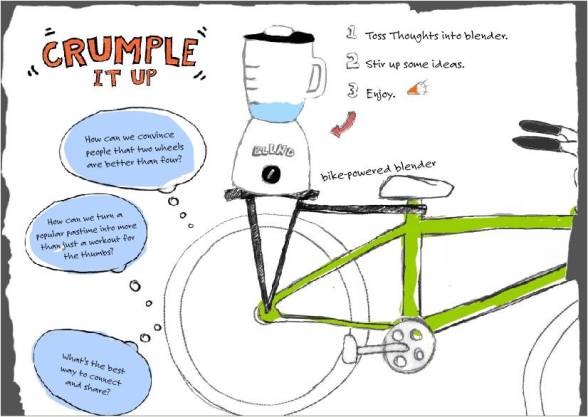
I have given it away in the title, but would you have looked at the webpage below and imagined this was from Humana.

crumpleitupYou can go to their website CrumpleItUp to learn a little more about what they are doing with bikes called freewheelin and what they are doing around games and health.

They have a fascinating group there in Louisville that works on innovative ideas.  A lot of them don’t drive the core business of health insurance but they are related to improving the health of the general public or looking at interesting ways to use technology.

They have recently added a blog about this that you can see here.  Additionally, I had a chance to meet with Grant Harrison from this group at the WHCC and also hear him speak as part of a panel on innovation.  I was very impressed with him and a few of the other people in the group.

As John talked about over at Chilmark Research, it is refreshing to see someone focusing on this type of innovation.  When I talked about innovation with a reporter recently, I suggested that Humana would be one of the first groups that they should interview.

5 Myths of Health Care

Charlie Baker, the CEO of Harvard Pilgrim, has a post on his blog about the Five Myths of Healthcare. It’s worth a read as is his blog.

1) America has the best healthcare in the world.

2) Somebody else is paying for your health insurance.

3) We would save a lot if we could cut the administrative waste of private insurance.

4) Health care reform is going to cost a bundle.

5) Americans aren’t ready for an overhaul of the health care system.

Want Senator Daschle To Come To Your HC Party

Obama’s team is leveraging the power of the people to solicit input.  You can go to their site www.change.gov to provide input. 

He is specifically asking for groups to meet on healthcare and document their thoughts.  Senator Daschle will attend at least one of these events personally.

It worked to get him elected so it will be interesting to see what they get and how they leverage this.

Who’s Responsible For Healthcare Costs?

I was recently at the AHIP Business Forum Chicago and was in a session where Amy Holmes, CNN Political Analyst and Peter Beinart, Editor-at-Large of The New Republic held a discussion on Decision 2008 and What it Means for the Future of Health Care.  They are two of the sharpest people I have seen speak in a while and they hosted a very engaging discussion on the issues and what the Obama win means for healthcare from both sides of the political spectrum.  (They also had a very entertaining “He Said, She Said” style that captivated the audience.)

The big changes they felt were bound to happen were cuts in Medicare and an expansion of the SCHIP program, and there were others that they said would be debated including being able to sell insurance across state lines, the government offering coverage, individual coverage mandates and coverage for pre-existing conditions.  But the biggest part of the discussion was around healthcare costs.  Costs that are out of control, who pays for services, and where will the money come from.  While at an aggregate level talking about healthcare’s spiraling costs is simple, it is not the heart of the issue.

Isn’t the issue about how as an industry we get individuals to change their behaviors?

The most powerful force for changing the economics of healthcare is the healthcare consumer.  If the consumer changes behavior (even small changes) there are billion dollar impacts in cost.  Our research shows that if a plan the size of Aetna is able to improve adherence by 1% they could save $238M!  According to the Journal of Occupational and Environmental Medicine (JOEM), 70% of all healthcare expenses are lifestyle related.  This is not a new number but it translates to $1.4 trillion in healthcare costs that could be controlled simply by modifying healthcare behaviors. 

So if our lifestyles are “killing us” and destroying a system meant to improve our quality/length of life, why are we not talking about that at the national level as THE core issue?  How can we as industry professionals develop solutions that support consumers and facilitate the changes they need to make?

I was excited to see in the third Presidential debate that both candidates addressed responsibility being in the hands of the individual.  Next steps:  Let’s see some discussion on programs and policies that truly look to impact healthcare consumer behaviors.

(This is a guest post from Chuck Eberl, VP of Marketing, at Silverlink Communications.)

Example of Misalignment

One of the points in George Halvorson’s book Health Care Reform Now! is about misalignment of incentives.  Providers are not paid for better outcomes.  They are paid per activity (i.e., to keep people coming back).  It’s a key point which deserves a much longer discussion.  That being said, I couldn’t help but think of this when reading yesterday’s WSJ article “Flu Economy Takes Unexpected Turn“.  A few quotes that it mentions include:

  • CEO of Walgreens at shareholder meeting – “If attendees of the meeting needed to cough, he joked, they should leave the room and ‘go to a movie theater or on a bus’ to spread their germs. ‘We’re really hoping for a very strong flu season’.”
  • “Unfortunately, people have not been getting sick at a rate that we would all like yet.” P&G CEO
  • “On the pediatric side, young kids coming into the hospital, that’s a nice margin for us, as well.” CFO of LifePoint Hospitals

Now, the easy discussion here would be to criticize these executives for being insensitive, but that’s not the problem.  The problem is that we have incented our healthcare system so that people make money when people are sick.  To my earlier post, this doesn’t mean people shouldn’t make money, but it means we should find a way to incent them to make people better.  We have decades of benchmark data (somewhere).

Convergence: The White Space Between Ford and Starbucks

I recently read a great book called Microtrends. If you haven’t seen it, I highly recommend it for its interesting analysis of trends and the way it makes you think. For example, it talks about how people are drinking more water and more caffeine drinks. It talks about how people have much shorter attention spans yet there is a rise in knitting and books are getting longer. It talks about obesity and young vegans. It plays on the power to see small trends (i.e., 1% of the population) and how they can impact the overall framework. (You can read my detailed notes here.)

One of the frameworks that the authors use is to compare the world as moving from a Ford economy (one choice) to a Starbucks economy (personalization). As healthcare typically lags other industries, I think we this analogy works to show where healthcare was and where we are going over time. Historically (at least in the modern era), we had one choice for healthcare coverage which was offered through our employer. Over time, that has changed to where most people have more than one option for healthcare coverage from their employer. And now, more and more people are losing coverage and the fastest growing segment is individual health insurance.

We have evolved to personal healthcare, but we aren’t yet to personalized healthcare which I think will be largely driven by genomics and some radical change to our healthcare system. Unfortunately, I think we are stuck somewhere in between right now where to personalize your healthcare you need to go to a series of providers or tools which aren’t integrated. There are a few scenarios out there where there is some integration of medical, pharmacy, lab, and other data (Kaiser jumps to mind). But, even in an integrated environment, they haven’t yet fully digitized the offering and created a seamless patient experience (to the best of my knowledge).

As George Halvorson says in his latest book, Health Care Reform Now!, “We have an expensive plethora of uncoordinated, unlinked, economically segregated, operationally limited Microsystems, each performing in ways that too often create suboptimal performance both for the overall health care infrastructure and for individual patients.”

In a likely scenario, you have the following for a sick patient who is actively managing their health:

  • A primary care physician and their staff to interact with
  • A specialist and their staff to interact with
  • A pharmacist (or likely multiple pharmacists)
  • A specialty pharmacy and their nurse
  • A managed care company (and possibly Medicare) which offers a member portal and tools
  • A PBM which offers a member portal and tools
  • A disease management company and their health coach
  • Health portals or information sites (e.g., WebMD, RevolutionHealth)
  • A gym and potentially a trainer
  • A series of vitamins and OTCs that no one has visibility to (other than maybe their grocery frequent buyer card program)
  • One or more disease specific communities that they participate in (i.e., some of the Health 2.0 companies)
  • Blogs and news feeds they subscribe to for information on their disease

The reality is that they have to go out and build a series of interactions to create this semi-personalized offering with no hope of the data being integrated, getting consistent messages, or any true learnings being generated. Each party has a 1:1 relationship with them (best case) and knows a piece of the puzzle. Without an integrated infrastructure, aligned incentives, and a mechanism to engage each patient according to their preferences, we have a very difficult challenge (as an industry) and each patient bears the brunt of this.

Until we can create physical or virtual convergence (i.e., integration of data and tools into one framework), we won’t be able to move from buying coffee at one store and skim milk at another store and our muffin at another store to a Starbucks world where we have one interface to select and personalize our healthcare experience. I wish I had the answer. Unfortunately, as more and more people are talking about, it seems like we have to make a radical change to be successful. Evolution from the status quo will likely not work. Much like GE had a program in the dotcom days called DestroyYourBusiness.com where they encouraged their leadership to figure out how to develop a new model, that is what healthcare needs with the support to initiate the skunkworks organization which might eventually become the norm.

Facebook Application To Drive Blood Donations

I must admit I am pretty conservative so it was with some reluctance that I finally joined Facebook.  After the Health 2.0 conference formed a group out there, I decided to join earlier this week.  First, my brother reached out to me.  Then, a roommate of mine from college who I hadn’t talked to in almost 20 years contacted me.

Then, I became mildly interested.  So, I spent a few hours early this morning playing around.  But, I was most interested to find a post on Vijay’s Consumer Focused Healthcare blog about a non-profit using Facebook as a way to drive blood donations.  Will it work?  I don’t know, but it is a worthy cause and an interesting use of social technology.

When a patient is in need of blood that isn’t available, it becomes a life and death situation. Historically the Red Cross will make efforts to alert the public during a shortage. But there may be a better way – leverage the social networks to get the word out. If shortages of a certain type of blood occur in a certain zip code, having a database of willing donors in that zip code to contact may be the most efficient way to solve the problem quickly.

That’s where Takes All Types (TAT), a non-profit organization, comes in. Users install their just-released Facebook application, tell it their location and blood type, and say how often they are willing to be contacted to donate blood (maximum is every 57 days). If a shortage occurs, they’ll contact you via the methods that you authorize (Facebook, email, text message, etc.)

Health Transformation 2.0: Follow-up

The other day, I provided a few comments on this book (manifesto) that I picked up, and I reached out to the author. He got back to me last night and was kind enough to provide the PDF of the publication.

In his words:

“These are simply my thoughts and thoughts inspired by a community of friends. It’s written as a kind of manifesto with the hope to inspire more good minds to tackle a very major challenge facing our society.”

I would encourage you to reach out to him if interested. (E-mail Scott Danielson – author)

Here is the book for you to view. I hope you will enjoy the hard work his community put in both in terms of content and graphic design.

Don’t forget to sign up for e-mail updates or put the blog in your reader. Thanks.

Health Transformation 2.0

I grabbed this little book off the table at Health 2.0.  I am finally getting around to flipping through it (rather than sleeping).

I can’t figure out if it’s associated with a company.  If yes, they have done a great job of disguising it.  [For what purpose, I don’t know.]  It is very well laid out with great graphics and is called:

Health Transformation 2.0
Can A Better Healthcare Operating System Make Us Healthier?

The author’s name (Scott Danielson) and e-mail are in the cover so I have shot him a note to see if I could add it here as a flash or some other visual.  Here are a few of the comments from the book:

  •  Healthcare 2.0 uses emerging technologies to transform an archaic, disease-treating system into a progressive health-enhancing one.
  • In the past 4 years, healthcare costs have doubled.  Are we twice as healthy?
  • Today, we have the ability to create a set of tools, a healthcare operating system that will help people find and manage information, research and control costs, and get and/or stay healthy.
  • Connected.  Helpful.  Secure.  Organized.  Informed.
  • Personal + Health + Power = Personalized Health Empowerment

Savings From Wal-Mart Program

I must admit that the $4 generics programs across the country cause me to have a mixed reaction.  On the one hand, it’s great.  It saves patients money.  In theory, it should encourage compliance.  On the other hand, if they get processed as cash transactions, I worry about them not showing up as claims which could limit the effectiveness of the POS (point-of-sale) DUR (drug utilization review) process.  [DUR includes things like drug-drug interactions.]

But, I was very interested to see some of the Wal-Mart data being published.

“While $1 billion in savings is an astonishing achievement, the real savings to America – and its health care system – are even larger. That’s because many of our competitors have also lowered their prices.  [Four dollar] prescriptions now represent approximately 40 percent of all filled prescriptions at Wal-Mart. Nearly 30 percent of $4 prescriptions are filled without insurance – significantly higher than the 10 percent industry trend.”  Dr. John Agwunobi, Wal-Mart‘s senior vice president and president of health and wellness

You can go drill down on some of the data (e.g., state by state savings) here.  Some of the top states were:

  • Texas ($132,628,224)
  • Florida ($72,443,467)
  • North Carolina ($48,241,530)
  • Georgia ($42,279,383)
  • Missouri ($40,213,963)

It is also great to see that 30% of all the $4 generics are being filled by people without insurance.   It was also good to see that they are focusing on bringing new generics into this group faster which was another historical criticism that I had.

Health 2.0: My Notes

I am just flying back from the Health 2.0 conference out in San Diego. I feel like there is a ton of information that I want to share so kudos to Matthew and Indu for the great job. (And, if you make it to the end of this post, you must really like the topic.)

I decided the best way to do this is in three posts: (1) Notes; (2) Companies; and (3) Observations. [Some people were doing live blogging which I just couldn’t do and keep focused.]

Here are a few of the other blog postings about the event:

So, let me begin here with my notes from the conference which began Monday with some informal sessions (user driven) and a deep-dive on a new vendor American Well. [I missed this event since it was so packed that it was standing room only in the hallway, and I was 5 minutes late getting off a conference call. That being said, they were in there for 3 hours so there must be something pretty interesting.] Tuesday was pretty much packed from breakfast (7:00) until I got back from dinner (11:00).

Matthew Holt:

  • Talked about his Health 2.0 picture of search, social networks, and tools. And, at the end of the conference, he showed a preliminary sketch of the model for the fall Health 2.0 conference where each of these are blown out into smaller segments.
  • Talked about the challenge of wrapping context around transitions. [In a side conversation, I thought someone else made a great point of saying that one of the biggest challenges will be how to drive change.]
  • Talked about the four stages of Health 2.0. I was soaking it in versus scribbling notes madly so all I got were phase 1 (user-generated content) and phase 2 (users as providers). But, I believe the later phases do (or should) show these models integrating into the establishment.

Susannah Fox (Pew Internet & American Life Project):
[Who by the way was a very good speaker and refreshingly gave a 30-minute presentation w/o any slides.]

  • Talked about an early 2000/2001 quote from the AMA on not trusting the Internet and a push to the physician. [That seems to have softened a bit over the years.]
  • Said that 40% of adults in America have a high school education or less which gets right to the issue of health literacy.
  • Talked about validity of online data. Researchers want to see date and source, but patients don’t look for that.
  • Talked about an article in a cancer magazine about misinformation which said the most highly correlated factor was a discussion around alternative medicine. Those sites often had misinformation on them.
  • She set the tone for the day by using the concept of a seven word expression to summarize your talk. Her’s was “Go Online. Use Common Sense. Be Skeptical.”
  • Pointed out that only 3% of e-patients report bad outcomes based on online data. [I think this whole discussion around what patients want in terms of research versus experiential data from their peers is very interesting.]
  • Talked about the white space between a “physican is omnipotent model” (my words) versus a “patient self-diagnosis world”. That is where we have to find a solution.
    • [A person from Europe who I talked with said that not only is their model different but the fact that they hold the physician on a pedestal makes some of these things impractical there.]
  • Talked about a new term for me – “participatory medicine”.
  • Said that Pew had classified people into three groups not on the concept of do you own a mobile device (for example) but on how you use it (e.g., do you feel like the device interrupts your life when it buzzes you, do you require help in setting up your devices).
    • 1/3 of Americans are “elite tech users” who own lots of devices
  • There is still minority distrust of some of these online tools. Some of this is generational.
    • The memory of the syphilis experiment is failing.
    • There is limited discussion of faith in these discussion areas which is important.
    • The older generation typically has less technical skills.
  • Her next seven word expression was “Recruit Docs. Let E-Patients Lead. Go Mobile.”
  • She described African American and Latino users of mobile devices as leveraging it as a Swiss Army knife versus a spoon. [I hope I use it more as a spork…which I assume is evolutionary over the spoon.] They use it more than TV or computers.

Patient Videos:

  • One of the most engaging segments was a series of video clips from patients.
    • The founder of i2y.org (I’m Too Young For This) spoke about being diagnosed with cancer at an early age and how he overcame the physical challenges and has become a go to destination for people about cancer.
    • The founder of Heron Sanctuary in Second Life talked about how she has limited mobility in real-life and her ability to create a world in second life where she can help people and gave examples of how people are using this virtual reality tool.
    • A young woman with RSD talked about how she has used ReliefInsite to manage her disease and pain. She also had the same issue of being “too young” to have RSD and the challenges of finding a physician to help her and believe her.

The format for most of the day was to have 3-4 founders or executives from companies get up and talk for 4 minutes on their company. Then a panel of people would comment and questions would get asked. On the one hand, it was a compelling, fast-based approach that kept your attention. [No nodding off at this conference.] On the other hand, it was heavy on marketing and light on really drilling down on the problem. [Although I am not sure that was the purpose or even achievable without making this a multi-day conference.]

So…here were a few of my quick notes on some of the companies. I will post another one trying to look at some screen shots and other observations. If you didn’t get mentioned here, it’s likely because I was simply watching or distracted. Hopefully, I catch everyone on the Health 2.0 Company post.

  • WEGO Health – allows consumers to rank content…i.e., directed search…gave example of search for some health topic that returned 98,000 links on Google, but only 50 here…option to score after consumer uses the link
    • Seems interesting. How often is it updated? How do you build awareness? Can it be part of a broader search engine? Seems like a likely acquisition to be another option like images or desktop from a search criteria within Google.
  • HealthCentral – biggest brand you don’t know (or something to that effect)…have 40+ sites around specific disease states…6M unique visits per month…new VC money…100 “expert patients” found to create initial communities…ability to create inspirational cartoons that summarize your story…good GUI
    • I really liked some of the features they demonstrated (in 5 minutes). They talked about creating micro-communities (e.g., spouses of people with a disease).
    • The idea of “recruiting” 100 “expert patients” to build an active community was one of the best I saw.

In preparation for discussion on patient-MD solutions, someone shared that only 2-3% of MDs allow appointments to be booked online. There was discussion that patients don’t really look to the Internet to find a physician or hospital. They look at what’s in-network and they ask their friends. There was an example given for Yelp which is used to rank restaurants, but allows people to review the physician. [A comment I heard later was when will we see a site ranking the sites that rank physicians.]

  • Carol (company name) – talked about mall concept in that people shop for something like a physical or allergy test not necessarily a specific type of MD…provide cash prices and insured prices
    • Seemed interesting. I will have to think more about how I search.
  • Vitals.com – I talked about this company on the blog a few weeks ago…still like the graphics…saw a few other features that I hadn’t noticed such as customizing the search criteria and using slider bars so that you get weighted recommendations

I thought there was a good discussion on why would an MD participate in a ranking site.

  • Help them sub-specialize (i.e., I want to treat knee pain not neck pain).
  • Allow them to attract the right type of patient that matches their style and focus.
  • Ego…allowing them to manage comments.

IDEO, the famous industrial design, company facilitated a lunch workshop and talked at the conference. For simplicity, I will blend both notes here. (see old post about IDEO book)

  • Talked about user-centric design which is key. At lunch asked us to come up with a solution to address the problems of diabetes patients. Showed us four interviews with diabetics. But the stress was not on solving what we thought was their problem, but trying to actually listen to what they say and do in order to find something. Key point.
  • Talked about empathic research showing that we don’t say what we think, do what we should logically do an online car loan, or even do what we think we do.
  • Talked about a book called Thoughtless Acts.
  • Gave examples of project with Bank of America that showed how most people round up their credit card payments so they started a “Keep the Change” campaign which allowed them to attract 2M new members.
  • Walked through an example of creating the Humalog pen for Eli Lilly.
  • Talked about creating a new bike design.
  • All of them were common in the framework they use and their focus on the person/user/patient/member.
  • Lunch was an interesting workshop where you listened to the videos, identified issues, brainstormed solutions, picked a solution to “pitch”, and then shared your idea with your neighbor. At our table…
    • Saw problem largely as educational / informational
      • Don’t know what to expect
      • Don’t know where to get information
      • Don’t understand lifecycle and treatment plan options
      • Don’t know what to do with the pump
    • Talked about everything from portal to device solutions
    • Settled on an iPump concept that would blend an iPod with an insulin pump and foster a community around it to develop cases (e.g., a belt that it fit into as part of a formal dress), videos to download to it on education, connectivity to trigger auto-refills, etc.

Then we had several discussions by physicians that were blending the old model of house calls with technology. Seems very cool (for those that can afford it). Although one example was relevant, it missed the masses. One showed a trader who was too busy to leave the trading floor, but he had a sore throat so the physician came to his office, took a culture, and gave him an antibiotic.

  • One great point that they made was the benefit of seeing the patient’s environment (i.e., home) in helping them manage a disease.
  • I loved the fact that they would send me an e-mail with my notes from the visit rather than trying to scribble things down while they are talking.
    • Of course, this begs the question of literacy and teaching physicians how to communicate in simple, non-medical language.
  • Another great point was the issue of technology as a good unidirectional solution. For example, if the physician wants to know whether something works, an e-mail is very efficient if it does. Leaving a voicemail so that you play tag back and forth only to realize the patient is feeling better is a waste of time.
  • Jay Parkinson referred to himself as the “Geek Squad” for healthcare (think Best Buy computer technicians). Great analogy. He also showed this seemingly very intuitive and easy to use EMR called Myca which I believe he has built.
  • Somebody tied this back to the physician ranking discussion by asking how this new flexibility of business model would be captured and tracked on those sites (e.g., does MD respond to e-mail).
  • I can remember if I jotted this down or one of them said it but I have “More Time. Save Money. Less Costs.” I think this was in response to a question I e-mailed in about how these new models were affecting the compensation and lifestyle of the physicians.

Phreesia talked about their tablet solution (i.e., electronic clipboard) for the physician’s office. They had an interesting statistic that 49M Americans move each year so address data is constantly changing. (Not to mention plan coverage, drug use, etc.) They are getting 200-300 new MDs a month to sign-up for this.

I don’t see myself using it, but this is an interesting option. Organized Wisdom talked about their product LiveWisdom which allows users to leverage a live person (I assume MD or RPh or RN.) via chat to address questions they might otherwise contact their MD about. They pay $1.99 per minute.

  • As they admitted, they are limited in scope and often have to refer the patient to an MD. They seemed to me limiting, but creating an opportunity to partner with American Well who helps you find an MD, sees if they have time to talk, and launches an interactive video session and chat session with the MD right then for a pre-agreed upon rate.

There were two patients there that were involved in lots of feedback sessions. The first was a woman who has lost 144 pounds (w/o going on The Biggest Loser) and has become an online advocate and support mechanism for lots of people using DailyStrength. The second was Amy Tenderich who is a very active diabetic and blogs at DiabetesMine.

Amy’s story was great. Her blog is very engaging and as Matthew said it is “thought by many to be the #1 blog for patients“. I had a chance to talk with her and her husband and heard a lot about how it started and the response. It is a great story, and she is very knowledgeable and was willing to really push the patient-centric agenda at the conference.

Someone made the point about linking patient costs to compliance with their care plan which I have blogged about before. I completely agree that the patient should be rewarded for using self-service options (web vs. live agent) and for staying compliant.

ReliefInsite talked about their solution and shared that 1 in 6 Americans suffer from chronic pain. No matter what the CEO said, he couldn’t do better than the opening patient video which used their solution. (Which he said was a surprise to him.)…seemed like a good, interactive tools with nice reporting.

Emmi Solutions showed their online educational tool which had videos built in a conversational tone and used animation to help people understand procedures and their disease. Seemed great. Said that informed patients are less likely to sue.

MedEncentive is one that I will have to spend more time looking at. It plays to the incentive question and rewarding patients and MDs. They talked about a 10:1 ROI and said the medically literate patients have less hospital visits.

[Completely off topic, but from the conference, I heard someone talking about CouchSurfing which is apparently a “network” where you allow people (that you don’t know) to come sleep on your couch. I thought that died with hitchhiking in the 60s.]

A consultant from Mercer commented that some large employers with physicians on staff are more effective [at health and cost management] than small health plans. Not sure if that was a complement to employers or an insult to health plans.

BenefitFocus which automates the set-up of your benefits (imagine no more paperwork to enroll) had a great video showing the future with personal consultants (via hologram), biometric signature, and other cool things. [I have heard good things about them for years although they never returned my phone calls several years ago even with name dropping one of their biggest investors.]

Virgin Healthmiles was there and talked about their pedometer which is tracked online. They also have an employer kiosk for tracking weight and body fat. Offline, he also told me that they are rolling out connections which will be on the treadmills and other machines at participating gyms. I am a big fan of what they are doing. I believe he said they recommend 7,000 steps a day per person (and think he told me that 2500 is a mile).

Stan Nowak (my boss) presented the Silverlink story talking about using technology to engage patients, the importance of capturing data, extreme personalization, and showed recent success improving compliance by 3x by rapidly doing a series of pilots.

  • I am not sure I have figured out our seven word description but here’s a few attempts:
    • Patients Are Different. Personalization Matters. Be Proactive.
    • Preference Based Communications Engage Patients & Drive ROI.
    • Segment. Learn. Interact. Empower. Use Communications Appropriately.

iMetrikus talked about their solution which connects over 50 biometric devices today into backend healthcare systems. They charge $3 PMPM which caused me to raise an eyebrow. It is a great solution and integration is a nightmare, but that seems like a lot of money. But, I am all about ROI. If I can get better return on this than on another project and it exceeds my cost of capital, why wouldn’t I do it.

iConecto didn’t present but had a booth and introduced a section. But, I love the concept of using play (e.g., Wii) to drive health.

To be fair, I will even include my notes about Eliza Corporation (our competition). Their CEO and our CEO did a podcast with Matthew the weekend before which you can listen to here. The messaging is fairly similar (although I have a strong bias about why us). She talked about tailoring [of messaging] being the new black. She talked about using clinical and demographic data to drive programs. They are a good company, and it was well done. [I was even flattered that several of their employees said that they read my blog.] Both companies commented on how they feel old (~7 years) compared to a lot of the companies presenting here (~2 years).

  • One thing that I find strange is for two companies that pretty evenly split the healthcare marketplace for Strategic HealthComm is that we are located within 10 miles of each other near Boston.

At one point, there was a discussion around ROI especially on new technologies and how to get that first big project. One of the panelists said that a 1:1 ROI over two years would be sufficient. [Not true for any company that I have worked at or consulted to.]

The final panel discussion and closing statements had a lot of good content:

  • Discussion of the patient as a provider and what that could mean.
  • Discussion of importance of sharing information across solutions.
  • The concept of citizen (European) versus patient.
  • From the Wired magazine participant, discussion around fidelity versus flexibility:
    • Disk versus MP3
    • HDTV versus Tivo
    • Microsoft versus Google
  • Importance of moving upstream in care
    • Disease management
    • Wellness
    • Prevention
    • Diet
  • As part of upstream discussion, talked about involving the food companies and used the analogy of inviting the oil companies to a green conference. [I wondered where the MCOs were, the hospital networks, and the politicians.]
  • The author of the book “Demanding Medical Excellence” (who I believe is part of the Health 2.0 staff talked about “random acts of doctoring” and the issue of solving healthcare for the few or the masses.
  • Indu talked about building a new system versus extending and improving the existing system. [A great question]
  • I think it was Matthew that brought up the issue of designing for credibility.

Wow! If you made it through this thesis, good for you. I hope it’s helpful. It is certainly easier than me trying to find my notes two months from now or sending a bunch of e-mails to people on sections they might find interesting.

Making Good Decisions

This is a classic article that I have reused several times.  The article “Great Escapes” by Michael Useem and Jerry Useem appeared in Fortune (6/27/05) on pg. 97.  It is about thing to use to avoid typical decision making problems.

These are all relevant for anyone in business or healthcare, but with the massive amount of change required in healthcare, it seems like these will be relevant at the macro level.

  1. Problem: Analysis paralysis
    Solution: 70% solution
    “A less than ideal action, swiftly executed, stands a chance of success, whereas no action stands no chance.”
  2. Problem: Sunk-cost syndrome
    Solution: Burn the boat
    “There is no such thing as timeless perfection, only obsolescence.”
  3. Problem: Yes-man echoes
    Solution: Voice question not opinions
    This one is pretty obvious, but if you have a strong personality or executive in the room, once they state their opinion you will get a much different level of interaction.
  4. Problem: Anxiety overload
    Solution: Look at the clock
    “A panicked mind stops processing new information, reverts to tried-and-true responses, and is prone to snap decisions that make things worse.”
    It talks about fighter pilots looking at the calm clock while things are spinning on their gauges.  The idea of finding a calming point to focus on.
  5. Problem: Warring camps
    Solution: Let the battle rage
    “Political infighting can be destructive, but battles over substance, managed well, can be constructive.”
    This reminds me of a boss who taught me that it was critical to have a close team where people could share opinions openly to drive value.
  6. Problem: A wily adversary
    Solution: Clone your opponent
    “Assigning a person (or a group) to think like your competitor can expose flaws that, identified early, are less likely to be fatal.”
  7. Problem: To be?  Or not to be?
    Solution: Go with the omen
    I am not so sure about this, but the point is that sometimes your mind is made up and allowing an event to trigger a decision may make sense.
  8. Problem: Inexperience
    Solution: Educate your instincts
    “Blind instincts cannot be trusted, but they can be educated.”  (Think flight simulator as preparing you for different situations.)
  9. Problem: Self-interested thinking
    Solution: What would Sara Lee do?
    Harder to use advice, but they suggest imagining that the company is a person with rational desires – security, growth, good relationships, respect, and a sense of purpose.  Then thinking about how they would react.  (Or our test at Express Scripts was what would Barbara Martinez say.  She is a journalist on the topic for the WSJ.)

Henry Ford said, “My advice to young men is to be ready to revise any system, scrap any methods, abandon any theory if the success of the job demands it.”

Where Are The Evidologists?

After one of their team posted a comment on my site, I went to Bazian‘s website.  Very interesting.  They are a UK based company that focuses on providing evidence-based healthcare information to publishers, governments and insurers.  Sounds promising.  This is an important issue across the world as companies and practitioners look at how to embed intelligence into process and technology to deliver the best outcomes.  Here is a presentation that they have for download on their website.  In it, they propose a new healthcare role of the evidologist and draw a nice parallel to the radiologist.

“In late 2005, Bazian gave a presentation about putting evidence into practice – a much discussed topic in the world of evidology.  It summarised 10 years of experience in evidence-based medicine, and draws conclusions about who should be putting evidence into practice, when, and what has to really happen for evidence to become a routine part of medical practice.”

Ev·i·do·l·o·gy n.

A new medical specialty that enables medical research to be incorporated systematically into clinical practice [Latin videre to discern, comprehend; evideri to appear plainly]  

Working With Clients: Some General Thoughts

One of the best discussions I have heard for account management was by Andrew Sobel. I was digging through some files today and came across some of my notes. I thought I would share a few of my takeaways which I think are good general advice.

  • It is essentially to be trusted.The four attributes of trust that he discussed were Empathy, Generalist, Synthesis, and Integrity.
  • Be an Advisor not an Expert.Experts are afraid to learn anything new.
  • An Expert’s mind believes that there are few options that make sense. A beginner’s mind is open to many options.
  • At 5-years old, we ask about 200 questions per day. By age 20, we only ask about 20 questions a day. Ask more questions. [Reminds me of another piece of advice that said that to “ass-u-me” is to make an “ass out of you and me”.]
  • Perceived competence leads to trust.
  • Empathy means listening, know your own biases, and having humility.
  • Reflection leads to creativity.

He also suggested acting as if you were independently wealthy. [Not always easy, but not worrying about the politics and other issues frees you up to speak your mind.]

He (or his company) laid out the following comparison on their key point which was “Be an Advisor not an Expert”.

sobol.png

It is easy to play the expert. It is much harder to play the role of advisor.

    Medical Mistakes

    •  Wash hands with soap.  Check.
    • Clean patient’s skin with antiseptic.  Check.
    • Wear sterile mask, gown, and gloves.  Check.
    • Put sterile drapes over  entire patient.  Check.

    And that’s all it takes to reduce common infections from medical tubing by 2/3rds.  (12/28/06 study in the New England Journal of Medicine looking at 108 ICUs in Michigan hospitals)  Seems pretty simple.checkup.jpg

    Do you remember when the Institute of Medicine put out their study in 1999 that said that 100,000 people died annually from preventable hospital errors?  People were shocked.  The medical profession thought the numbers were too high.  So, I find it more that a little interesting that the Institute for Healthcare Improvement (which includes 3,000 of the 5,000 hospitals in the US) put out a report in 2006 on saying that they had saved over 120,000 lives.  [If that was for 3/5th of the hospitals, I guess that means that about 200,000 people were dying per year in the US due to preventable hospital errors.]

    So, it is with mixed emotion that I look at their latest campaign which is the 5M lives campaign to reduce deaths, injuries, and near misses in US hospitals.  Now, I am being a little sensationalistic.  The fact that hospitals are collaborating, sharing information, being transparent, looking for best practices, and trying to improve is great.  Sometimes, it is just shocking what has been going on.  [Imagine the error rates in some 3rd world countries.]

    Here is an article from today in the LA Times about this.

    Pharmacy Satisfaction: Communication is Key

    It’s always great when you find research that clearly reinforces one of the things you always talk about – communications. At PharmacySatisfaction.com which is a website sponsored by WilsonRx and Boehringer Ingelheim, it lists the 10 steps to customer satisfaction for a pharmacy. A few key items that I think are relevant to a lot of what I talk about and do with customers in pharmacy and healthcare in general:

    1. Know your customer (database marketing / management)
    2. Speak up (you’re the expert…help them)
    3. Educate the customer (reach out to them proactively and help them with information)
    4. People skills (understand that different people respond to different messages, mediums, voices, times of day, etc)
    5. Address compliance (refill reminders)

    It also made me think about two topics which I think are relevant to communications success – Linguistics and Nuerosciences. As you might expect, there are lots of blogs on both. Here is a list of blogs and some definitions:

    Linguistics is the study of the nature, structure, and variation of language, including phonetics, phonology, morphology, syntax, semantics, sociolinguistics, and pragmatics (per The American Heritage Dictionary of the English Language).


    Neuroscience is a branch (as neurophysiology) of the life sciences that deals with the anatomy, physiology, biochemistry, or molecular biology of nerves and nervous tissue and especially their relation to behavior and learning (per Merriam-Webster’s Medical Dictionary).

    Book by Kaiser CEO

    George Halvorson, the Chairman and CEO of Kaiser Foundation Health Plan and Kaiser Foundation Hospitals, has just published a book called “Health Care Reform Now! A Prescription for Change”. A news clipping service I have sent me a summary from Business Insurance. It is published by John Wiley & Sons and is $27.95. It sounds quite interesting. Here are a few things which the article highlighted.

    He says that the US does not have a health care system in place but has a “plethora of uncoordinated, unlinked, economically segregated, operationally limited microsystems…a nonsystem of care.”

    He talks about the concentration of spending (based on Kaiser Permanente data):

    • 1% of the US population uses more than 35% of health care dollars
    • 5% uses 60%
    • 10% spends 70%

    He talks about the fact that five chronic diseases are responsible for upwards of 70% of the health care costs in the US:

    • Asthma
    • Diabetes
    • Congestive heart failure
    • Coronary artery disease
    • Depression

    He talks about the problems that arise when there is no communication between health care silos of care which leads to drug interactions and costly hospitalizations.

    I haven’t read it yet, but the article says that he offers solutions for each problem and talks in a conversational and occasionally funny way. He proposes using insurance records to create a type of Electronic Medical Record rather than waiting for the long-term solution of integrated systems. He also proposes using computerized medical records to track quality issues.