Archive | Methodology RSS feed for this section

Humanizing Healthcare Thru Science

I was getting ready for a presentation last week and thought that the right way to position technology was as “science” that helps to humanize an overly complex healthcare system that overwhelms most people.  In thinking about that, I stumbled upon the UnitedHealthcare concept of “Health in Numbers“.

Another example of this is the WSJ article this morning on using data. The question is how to find the right mix of data to use and understanding what data applies when. Healthcare isn’t like consumer products. People change segments over time. The segment they fit in for adherence is different than the segment they might fit in for retention programs.

Stop By The Silverlink Booth At The Forum 2010 (DMAA)

Next week in DC is The Forum 2010 which is the annual event for The Care Continuum Alliance (formerly known as The Disease Management Association of America).  If you’re there, you should stop by the Silverlink booth and attend the presentations that we’re giving with some of our clients and other industry leaders. 

  Aligning Employee, Employer & Provider Research to Maximize Value-Based Benefits
October 13, 1:00 – 2:00 p.m.
Jan Berger, MD, MJ, Chief Medical Officer, Silverlink Communications
Cheryl Larson, Vice President, Midwest Business Group on Health (MGBH)
   
  Improving Statin Adherence through Interactive Voice Technology & Barrier-Breaking Communications
October 13, 2:15 – 3:15 p.m.
Ananda Nimalasuriya, MD, Chief of Endocrinology & Complete Care, Kaiser Riverside
George Van Antwerp, MBA, General Manager, Pharmacy Solutions, Silverlink Communications
   
  Addressing Colorectal Screening Disparities in Ethnic Populations
October 14, 12:30 – 1:30 p.m.
R. Reid Kiser, MS, National Director, Clinical Excellence Special Projects and Reporting, UnitedHealthcare
Jack Newsom, MBA, MS, ScD, Vice President, Analytics, Silverlink Communications
   
  Addressing an Epidemic – Improving Diabetes Care with Personalized Communications
October 14, 3:00 – 4:00 p.m.
Jan Berger, MD, MJ, Chief Medical Officer, Silverlink Communications
William Shrank, MD, MSHS, Instructor, Harvard Medical School and Associate Physician, Division of Pharmacoepidemiology and Pharmacoeconomics, Brigham and Women’s Hospital

Decisions When Running A Race

For the first time in a year, I ran a race yesterday.  It was a half-marathon.  I didn’t train that hard so I didn’t have huge expectations.

But, as I was preparing and running, I thought about all the things that go thru my mind and figured I’d share that.

  1. When do I buy a new pair of shoes?  I’ve had the same style of New Balance for years.  But, I make sure I don’t end up running a pair into the ground right before a race and have to switch to a new pair.
  2. Do I carry a drink or use the race drinks?  I prefer to carry a drink and save the time of slowing down during the drink stations.
  3. Should I walk to drink or run through the drink?  I’ve tried both.  I like to walk on the full marathon, but run through in all the other races.
  4. Should I listen to my iPod?  Yes for me since that’s how I train.
  5. Should I run with someone?  I’ve tried it a few times.  It works well if you have a similar pace and goal.  I think it’s important to do training especially long runs with people.  My old training group helped me get a lot faster in the past.
  6. What should I eat the night before?  Pasta and carbs.
  7. Where should I start?  I’ve started at the frontline (for a 5K) with my average pace group and with other groups.  I think this is somewhat mental.  If I start with people that are too fast, I run the risk of trying to keep up and burning out.  If you start too fast, you also have people passing you which can be psychologically frustrating.  If you start with a slower group, you might have to do more navigating to get to run fast, BUT I do like being able to pass people.  It’s a good feeling.
  8. What types of splits should I do?  The debate is whether to start fast, run all your miles at the same rate, or start slow and get faster.  I personally like to start slower and keep getting faster.
  9. Do I wear clothes to shed or start the race cold?  I always try to wear shorts (although yesterday was under 40 degrees), and I put Icy Hot on my legs which seems to keep them warm early in the race.  I’ve worn a long sleeve shirt to toss away, but yesterday, I wore a light coat the whole time.
  10. Do I bring gel (or beans) or take what they give you?  I always bring my own because you know the flavor you like.
  11. How much sleep should I get?  I try to get two good nights of sleep before I race (7 hours).
  12. When do I go to the bathroom?  Believe it or not, this is important.  You’ll wait 20+ minutes in line for a portapotty, but you want to hydrate before the race.  I hear that the hard core people just pee down their leg while they run, but I’m just not there.  If I really have to go, I stop during the race.
  13. Do I wear the race shirt?  I personally don’t like to wear the race shirt for the race.  It feels amateur to me (as if you don’t have any other shirt to wear).
  14. Where should I put my race number?  My friends (who run a lot) told me to put it on the front of your shirt and to put it low so it’s basically just above your waist. 

That’s a quick list.  I’m sure there’s more.  What amazed me was the amount of planning for this.  I know I do a lot of planning for presentations (logistics, clothes, sleep, run in the am, etc), but I’m sure that others plan a lot more for their recreation than they do for work.

JD Power Pharmacy Satisfaction Study

The study came out yesterday. I pulled the data from the executive summary into a powerpoint for all you visual people like me. Some interesting statistics on the value of pharmacy satisfaction and retention. Maybe this will create the business case for more tracking and focus on impacting satisfaction in pharmacy. I think we’ve seen that over the past few years for managed care with individual insurance.

Before you peek, who (pharmacy type) do you think gets the highest average ranking in satisfaction?

Mobile / Social Media Stats c/o HubSpot

I’ve never met the people over at HubSpot, but I like the information that they’re making available.  (Thanks SF for the suggestion.)

Here’s a few graphics from a recent post on their blog about mobile infographics.  (BTW – I love infographics)

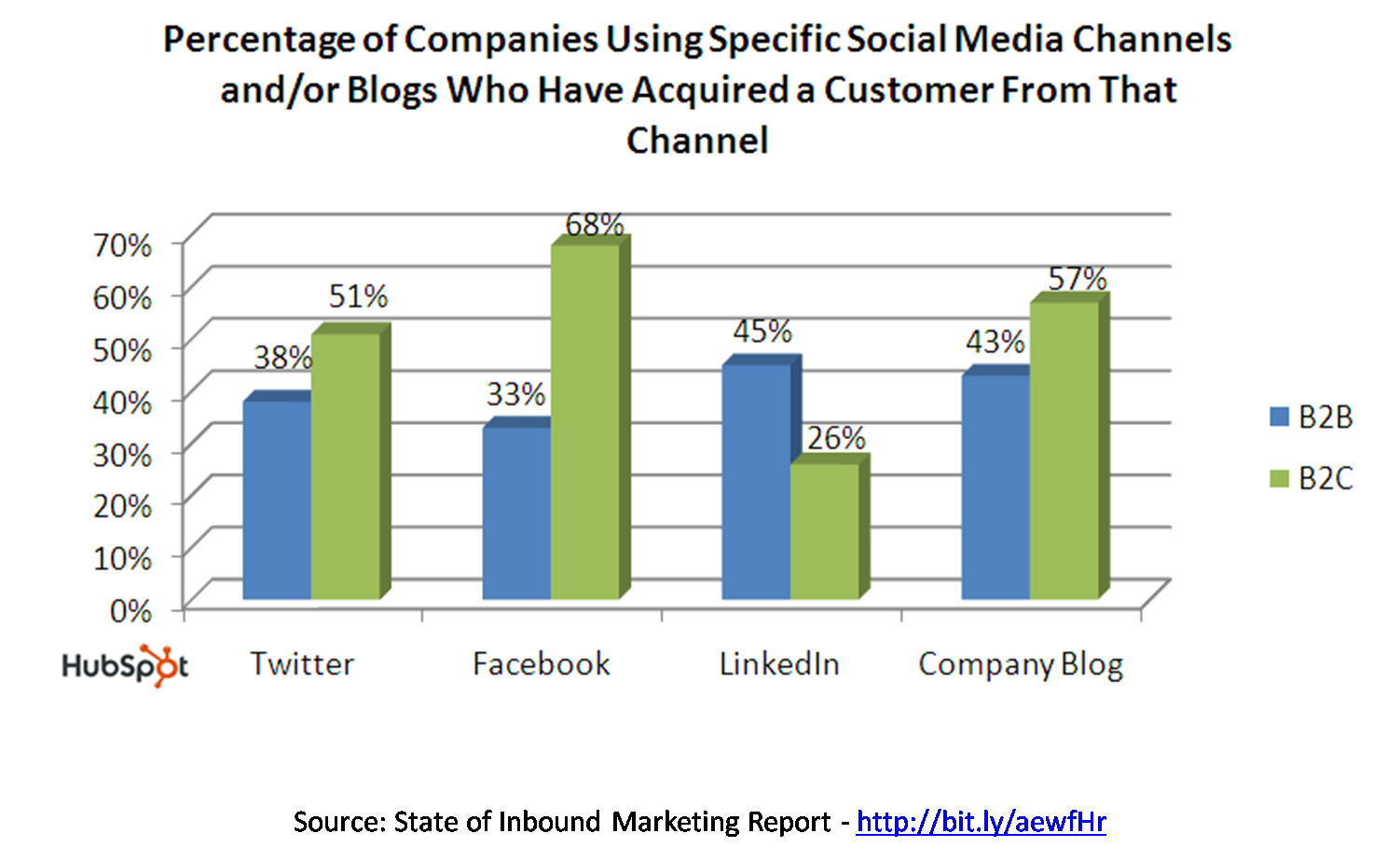
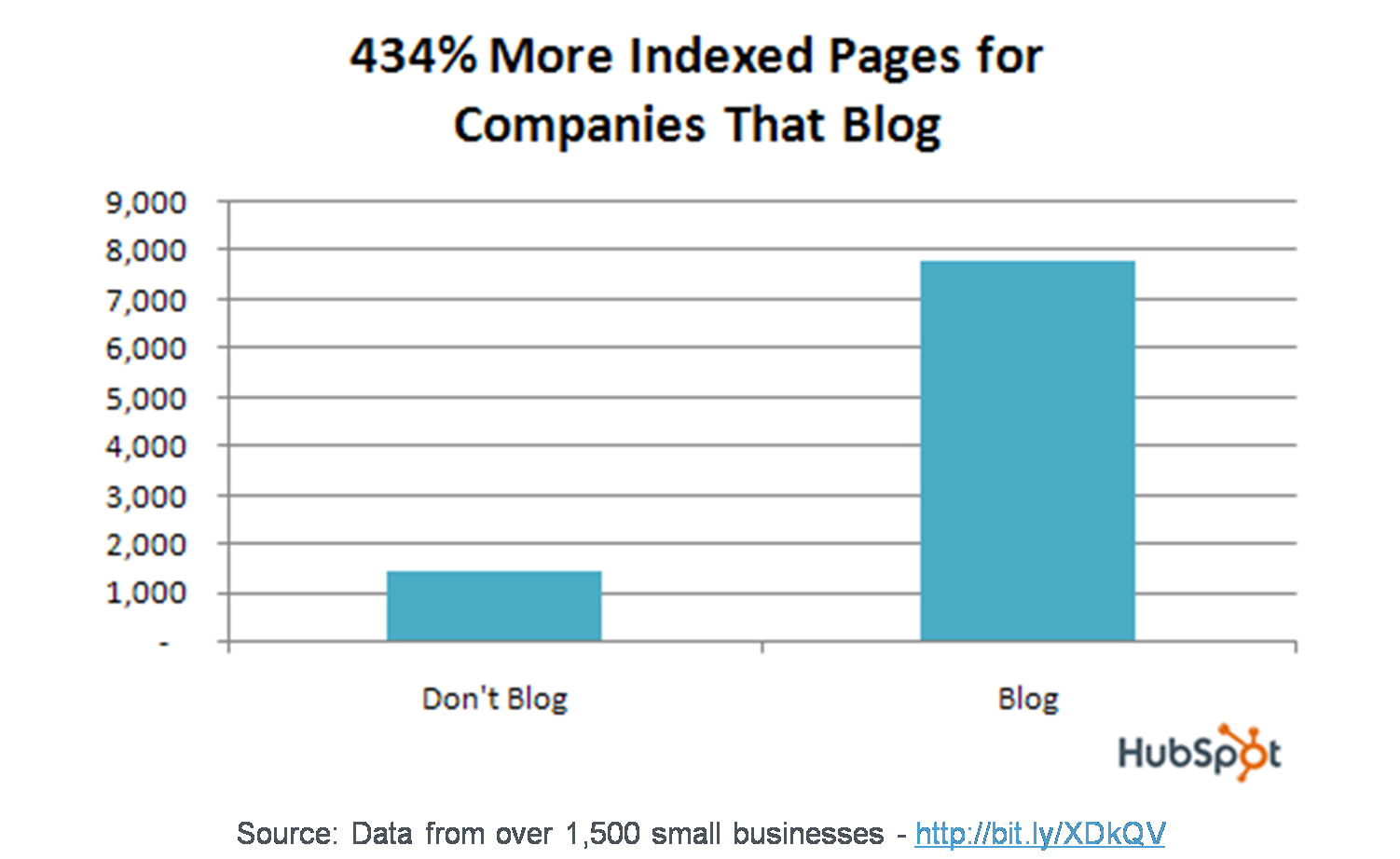
In another area of their site, they have some interesting data on how blogging and social media drives leads.  Here are three of them that I found interesting.

When Should You Ask About Auto-Refill?

Auto-refill for prescriptions is all the focus lately.  Everyone from the big PBMs to the local pharmacies are encouraging this.  It helps with adherence (or at least with adherence calculations since you can’t force someone to take the pills just because they have them).  It addresses one of the common patient reported issues with adherence which was that they forgot.  They ran out of pills or didn’t know to refill the medication.  In some cases, a few days of pills may not be a big issue, but in other categories, this could be a problem. 

In general, professionals consider taking medication 80% of the time (or 80% medication possession ratio) to be adherent.

So, what is auto-refill?  You sign up to have your medication refilled when it’s time for a new bottle and then mailed to you or ready for you at your retail pharmacy. 

One question is whether this includes auto-renewal.  To most consumers, renewal means nothing, but it does in the pharmacy business.  When you get a script, it is only good for 12-months.  That could be twelve 30-day fills or four 90-day fills.  When you’re done, you need a new prescription from your physician.  That is called a “renewal”.  To most consumers, we just think of it as we ran out of refills.  So the critical question here is whether you include renewals in the auto-refill process.  I certainly advocate for yes.  If I run out of medication and expect my prescription to be refilled (because I signed up for auto-refill), I would want my pharmacy to reach out to my prescriber proactively.  Or, even if I’m just planning on refilling, I’d like my pharmacy to let me know in advance that I need a renewal or new Rx since I don’t have any refills remaining.  That can delay the process so without doing that you can create a gap in care.

That gap-in-care is one of the reasons why patients drop out of mail (which may happen to me).  In my case, I waited until I was down to 5 days supply of my medication imagining that my pharmacy would call me to remind me to refill.  They never did so I called to refill, but I was out of refills so a renewal is needed.  Getting in touch with my prescriber could take a few days so now I’m not sure what might happen.  Ideally, I would get a confirmation from them on when it’s coming, and I could go to a local pharmacy and get a 3-day “bridge supply” for a minimal fee.  We shall see.

But, what I recently found interesting (that took me down this path) was some research from CVS Caremark that was recently presented saying that

According to Keller, new research by CVS Caremark seeks to address the fact that many healthcare decisions unnecessarily are complicated by the lack of clear and plain language. In addition, choices for such programs as automatic refill of prescriptions or generic alternatives can be overlooked because those options are not readily transparent to the consumer, Keller noted.

“Through this research we are testing options presented through four different communications channels to see how consumers react to different scenarios,” Keller said. “One of our preliminary findings looking at consumers on the Web shows that if we reach out and present a decision to choose automatic refill in advance of renewing a prescription, they sign up at twice the rate of those who were passively presented an opt-in choice after receiving a prescription.”

For those of us in the communication space, this is interesting.  How you present information…when you present information…the language you use…All of these things are important as demonstrated here.

Seven Myths Of Social Media

I’m just finishing up a book on social media (book review to come shortly). As I was reading it and based on my experience, I came up with a few myths:

  1. You have to be everywhere.  It’s impossible.  There are so many sites out there.  You have to know your audience and determine where to spend your effort.  You MIGHT have to stake your claim to avoid someone else using it and provide information for consumers to reach you, but you can’t actively contribute and add value across the social media spectrum.
  2. Set it and forget it.  Social media is about dialogues and continuous information.  You can’t put up static content like a website and come back every week, month, year and update it.  The best companies respond (for example) to a Twitter comment about them in 24-hours while some never respond. 
  3. Build it and they will come.  There is a constant dialogue about whether you have to “own” the community or simply participate in it.  There is certainly reason to create content (i.e., blog posts, tweets), but you have to find a non-marketing environment to interact with your customers and influencers and understand their needs.  In many cases, that environment might already exist and you need to join it.  Additionally, you can’t simply launch something or join something without pushing out information about it.  For example, if you have a Facebook page, you need to have a link on your website, put it in your LinkedIn profile, include it in your press releases, etc.
  4. Marketing should own social media.  Traditional marketing has been about the controlled message.  Social media is about participatory messages.  There’s a big difference.  Additionally, social media can be and needs to include any employees who are actively engaged in social media.  We’ve seen numerous examples of employees who comment inappropriately only to jeopardize their job.  (I’ll agree that there are issues here to still be defined regarding privacy versus freedom of speech.)  Marketing can’t reply real-time about operational issues.  Ownership is a collective effort.
  5. You can outsource your social media.  This is a big mistake.  There are lots of consultants who will tell you what you want to hear.  They will talk about some channel or channels that work (e.g., Twitter experts, Facebook experts).  They’ll talk about search engine optimization (SEO) and what to do.  They’ll tell you that you need an iPhone app or a YouTube channel.  The reality is for your solution to be genuine and timely that it needs to be someone(s) who understands the company, feels passionate, and is empowered to do something quickly.
  6. Tell me..tell me…tell me.  This works great for presentations.  But, you’re now a part of the audience (although an informed member with an agenda).  You need to tailor your objectives to what the audience wants / needs.  In a community, they’re there for a reason.  They are discussing a topic and sharing their thoughts.  They want you to add value not sell your products or agenda.  They want to be valued.
  7. You can avoid it.  This is an obvious one.  With 500M users on Facebook and YouTube being the second most popular search engine, you have to understand how people find you on the Internet.  Google is a verb.  Current generations will grow up with theses modes, smart phones, and be uninhibited by our sense of privacy.  Technology is and will continue to be more ubiquitous.  The way people learn about companies is changing.  The way people learn about people is changing.  Relationships between people are changed based on technology.  Companies have to understand what’s being said about them and embrace it not run from it. 

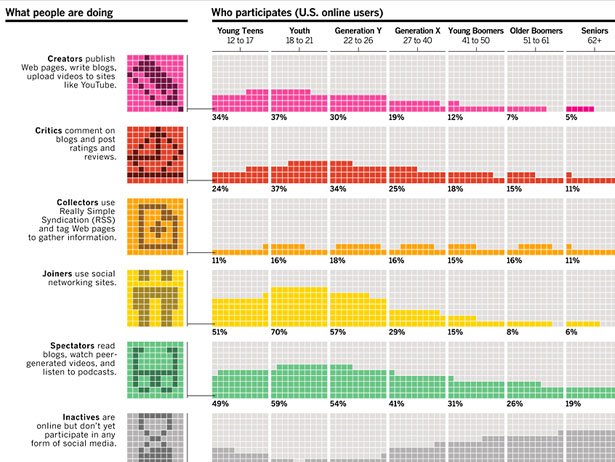
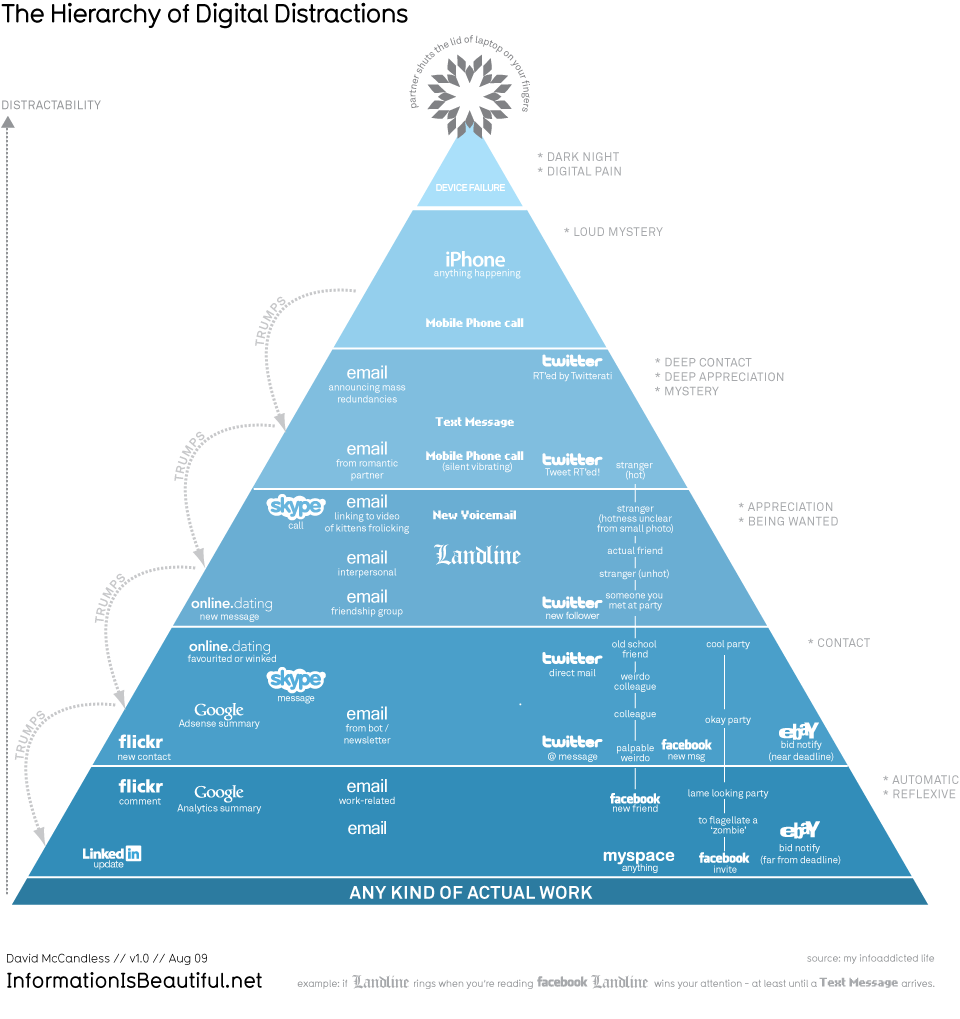
There are tons of infographics out there that symbolize some of this.  I pulled a few of my favorites together here, but you can find more.

Choices: Grande Skim Mocha With Whip @ 140 Degrees

Choices.  We can all become overwhelmed with them.  As several studies have shown, more choices are not better…they paralyze us and limit our ability to make a decision. 

So what do we do with this.  Choice is a double-edged sword.  On the one hand, you want to offer choice to everyone.  On the other hand, this can make implementation very difficult. 

Like my Starbucks example.  I can customize almost everything off a pretty basic menu…even the temperature.  (BTW – they suggested using 140 degrees rather than saying kiddy temperature)  But that makes it more difficult to standardize and should increase the risk of error.  Imagine doing this efficiently and in scale.

Mass customization has been a challenge for years. 

People can have the Model T in any color – as long as it’s black.  (Henry Ford)

While technology allows this to a certain degree, it all has to be moderated.  Let’s take communications.  I could let every consumer tell me their preferences and other facts about them.

I want you to send me automated calls unless the information is clinical in which case I want a letter than I can share with my physician.  I’d like the calls made to my home number between 5-7 pm or on Saturday’s between 10-4.  I’d like you to leave a message and don’t call back unless I don’t act for seven days.  If I interact with the call, please text me the URL or phone number for follow-up.  I like to be addressed by my first name.  I’m an INTJ so please use that as for framing the message. 

You get the point.  Where do you stop?  And, do you really think that I know what’s best.  I tell almost everyone to e-mail me, but depending on when it comes in, it could be days before I respond or even read the e-mail.  That’s if it passes the spam filter. 

I’m sure if I asked 10 people whether they wanted automated calls then 7 of them would say no, BUT you know what…good calls work (voice recorded, speech recognition, personalized).  The vast majority of people interact with good, automated calls (some for 10+ minutes).  Most people think about those annoying robocalls that use TTS (text to speech) we all get around the elections.  But, good technology with a relevant message from a relevant party get people to care.  It’s all about WIIFM (what’s in it for me).   The other half of the equation is being able to coordinate the multiple modes.  (e.g., I missed you so I’m sending you a letter.  Let me text you the URL.)

So, should I let the consumer pick their preferences?  Sure for certain things.  But, what about a drug recall (for example)?  Do I have to wait a week to get a letter?   What can I personalize versus what should the company own.  I pay for them to “manage” my health.  Why don’t I let them?

There is no perfect system.  You need a series of things to be successful. 

  • A database to track consumers – demographic data, claims data, preferences, interaction history, …
  • A workflow engine with embedded business rules to manage communication programs with rules about what to do when certain situations arise
  • Reporting to track basic metrics
  • Analytics to understand and analyze programs

And, of course all this requires expertise to interpret and leverage the data for continuous improvement.

Are you doing all that?  I doubt it…but you can be.

Back To The Future: The Role Of The Pharmacist

Between the focus on differentiation and the focus on adherence, we have seen (and will continue to see) greater use of them as a strategic asset. CVS Caremark is leveraging them in their Pharmacy Advisor solution. Walgreens continues to leverage them at the POS. Medco is using them in their Therapeutic Resource Centers. And, the independent pharmacists have stressed this story for years.

In Medicare, the Medication Therapy Management (MTM) process begins to recognize the power of pharmacists and actually rewards them for their efforts. I was quoted in Drug Benefit News today about this topic. Here were a few quotes:

“The pharmacist is an under-utilized resource today,” George Van Antwerp, vice president of the Solutions Strategy Group at Silverlink Communications, tells DBN. “They go to school to work with patients and often end up simply filling bottles.”

While the benefits of pharmacist intervention are undeniable, Van Antwerp says, the challenge is finding the right balance of face-to-face interaction and automation. Issues also include getting a good return on investment for such services by condition and the fact that only an estimated 60% of the people picking up prescriptions are the patients themselves. In addition, “the staffing model right now would be stressed if pharmacists were spending significant time on cognitive services,” he maintains.


DMAA Client Presentations

We (Silverlink Communications) are very excited to see three of our clients get selected to present at DMAA this year.  That is a tribute to all their hard work, creativity, inspiration, and willingness to leverage technology to improve outcomes.

Here are the presentation summaries from online:

Reducing Blood Pressure in Seniors with Hypertension Using Personalized Communications
CONTINUUM OF CARE SERIES
Wednesday, Oct. 13, 1-2 p.m.

  • Examine how an integrated communications program that utilizes remote monitoring and interactive voice response components combine for an easily scalable, cost-effective solution to reduce hypertension.
  • Review a program where 18 percent of participants transitioned their hypertension from out-of-control to well or adequate control.
  • Identify best practices for how personalized, automated, interactive communications can be leveraged to control hypertension in a scalable manner.
  • Evaluate how high blood pressure readings alerted patients with immediate feedback and education to help them better manage hypertension.

Improving Statin Adherence through Interactive Voice Technology and Barrier-Breaking Communications
Wednesday, Oct. 13, 2:15-3:15 p.m.

  • Examine how interactive voice response (IVR) and barrier-breaking communications can measurably improve statin adherence.
  • Review key barriers to statin adherence, including several barriers that are more significant than cost.
  • Identify best practices for using IVR technology to improve statin adherence by addressing specific barriers.
  • Evaluate how continuous quality improvement processes were used to drive higher response rates to IVR prescription refill reminder calls.

Addressing Colorectal Screening Disparities in Ethnic Populations
Thursday, Oct. 14, 12:30-1:30 p.m.

  • Examine how interactive voice response (IVR) technology and personalized messaging improves the rate of colorectal cancer screening for different populations.
  • Review the impact of ethnic-specific messaging on colorectal cancer screening rates and how this differs by ethnicity.
  • Examine how engagement is influenced by the gender of the voice in communications outreach.
  • Identify how to use predictive algorithms to project race and ethnicity to support tailored communications.

How Do You Pull, Push, and Pay?

I was reading something on Healthwise this morning.  We recently had Don Kemper (CEO) present at our client event in May.  He was talking about “Billion Dollar Decisions: Right Tools, Right People, Right Time”.  A few key things from the overview:

  • Today’s healthcare crisis can’t be solved with out helping everyone do more for themselves.
  • People need to ask for the care they need and avoid care that’s not right.  (a huge information and health literacy challenge)
  • Every year people make 300M major healthcare decisions, 50M surgeries, 100M medical tests, and 150M+ major medication changes.
  • Patient decision aids are key – http://ipdas.ohri.ca.

The summary was that to get people to uses decision aids you have to employ pull, push, and pay strategies.

Pull: Consumers pull the decision aids from the Web.

Push: Providers and payers push contextually relevant decision aids to consumers when they need them.  (What Silverlink does!)

Pay: Providers and payers create incentives to encourage the use of decision aids. 

2010 Medco Drug Trend Report

I can’t believe it’s taken me a few weeks to catch up on my notes from a conference call with David Snow and Dr. Rob Epstein from Medco Health Solutions about their 2010 Drug Trend Report. I captured some of Dr. Epstein’s comments in a quick blog post, but I have a lot of respect for David Snow and wanted to capture a few of his comments here and pull out some of the interesting data from the Drug Trend Report.

David Snow mentioned a few things:

  • Reform has to address all three legs of the stool – Access, Quality, and Cost. Right now, it’s focused on access.
  • Of the $2.4T we spend in the US on healthcare, $1T of it was unproductive.
  • One of the big issues in the system is poorly designed systems for the people that deliver care.
  • Pharmacy is ahead of the curve since it’s already wired and uses evidence-based care.
  • We have to focus on the chronic conditions. 96% of the pharmacy spend and 75% of the medical spend is here.
  • Prescriptions are used as first line solutions 90% of the time. (See my comments on why trend shouldn’t matter.)
  • $350B of the waste is due to poor management of chronic solutions.
  • We still have to address medical liability and defensive medicine.

He also answered questions. A few of my notes from the Q&A:

  • Patent expiration doesn’t fully explain the increase in brand pharmaceutical costs. (Traditionally these drug costs go up once the patent expires.) You can correlate the tax on pharma (in reform) to the increase in prices. (Not dis-similar to the increases around Part D if memory serves me.)
  • Adherence is a key issue. The Therapeutic Resource Centers (TRCs) are their answer to this. They drive adherence in the classes that matter and we report to clients on this. (While I think a lot of people viewed the TRCs as marketing strategies when they first came out, I believe they have demonstrated a clinical focus with some case studies and clinical leads over the past 18 months.)
  • The pathway to biosimilars is very fair to the innovator.
  • Class competition in specialty is increasing.

His most interesting comment which I’ll repeat from my earlier post was that if the FDA really understood true adherence they might make different decisions on approving drugs whose effect is tied to a person staying on a medication over time.

I won’t repeat some of the core data elements from my prior post, but here are some new ones from reading the document:

  • Mail order penetration was 34.2% (which I believe is industry leading for the PBM sector with only Walgreens showing a 90-day utilization number that’s higher).
  • Interestingly, they show trend for clients with over 50% mail use (and clients with less than 50% mail use). [Most PBMs would love to have any clients with over 50% mail use.]
    • 0.1% for those with over 50% versus 5.3% of those under 50%

Reported trends are based on 2 years’ data on pharmaceutical spending. Drug trend percent includes 201 clients representing approximately 65% of consolidated drug spending. The sample comprises clients who offer integrated (mail-order and retail) pharmacy benefit options for members. Clients with membership enrollment changes > 50% were excluded from the analysis. Plan spending is reported on a per-eligible per-month (PEPM) basis, unless otherwise specified. An “eligible” is a household, which may include multiple members who are covered under the same plan. Plan spending comprises the net cost to plan sponsors less discounts, rebates, subsidies, and member cost share. Generic dispensing rates and mail-order penetration rates represent the total consolidated Medco client base.


  • Diabetes is obviously a critical category for everyone. I found it interesting that they saw fewer patients filing claims for diabetes but more drugs per patient in 2009.
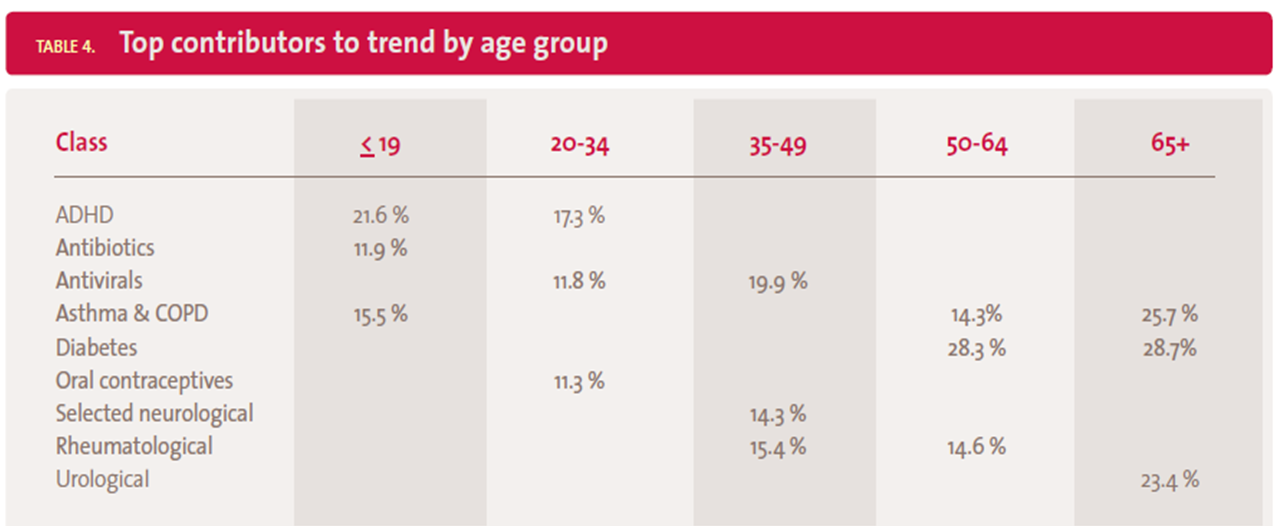
  • Respiratory therapies (driven by those <19 years old) jumped in contribution to trend from 8th to 2nd.
  • In patients aged 35 to 49, antiviral drugs are the greatest contributors to cost – 8.3% of plan pharmacy costs. [Some of this driven by flu although this is not the at risk age group.]  

Antiviral drugs (Formulary Guide Chapter 1.8) include oral treatments for HIV/AIDS, influenza, herpes, hepatitis C, hepatitis B, and injectable treatments for respiratory syncytial virus (RSV), and cytomegalovirus.

  • Utilization growth for ADHD drugs for those age 20-34 grew 21.2%. [Is this for people not diagnosed as kids, people who have adult-onset ADD (if that exists), or just an over-diagnosis of the condition?]
  • Specialty drugs…I’m always surprised that all the PBMs still have to caveat the fact that they only adjudicate some of the claims since some specialty drugs are filled and billed under the medical benefit. That seems like something that should / could be fixed, but I know it’s been tried and is hard since people are making money off them being billed elsewhere.  


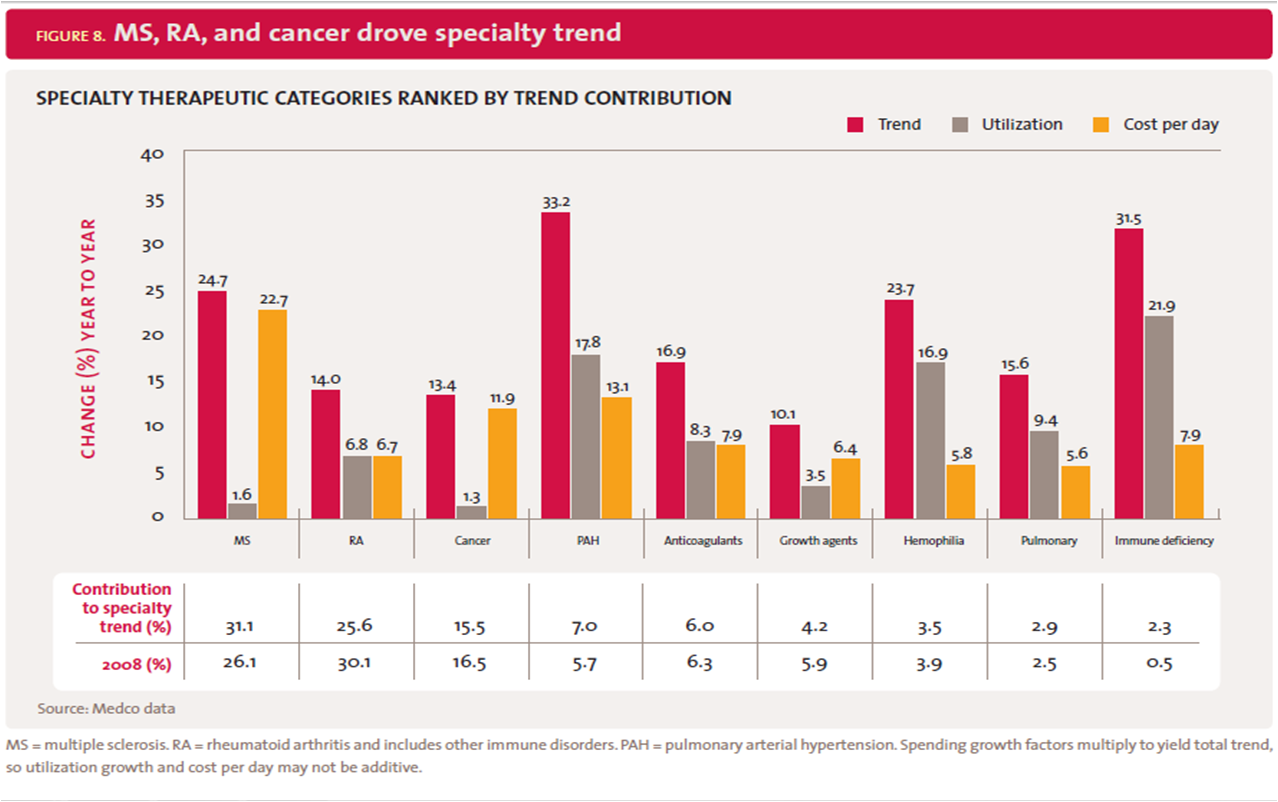
  • Cancer is already a huge driver of specialty costs AND:
    • Much of the spending is still under medical;
    • Most drugs approved in the past 4 years costs over $20,000 for a 12-week course; and
    • There are over 800 drugs in the pipeline.


Spending growth has outpaced spending for nonspecialty, or traditional medications because:

  • A high proportion of newly approved drugs are designated as specialty.
  • Unique manufacturing processes make specialty drugs expensive to develop.
  • Fewer drugs within a therapeutic category limit competition.
  • There may be only one specialty treatment for an orphan condition.
  • Few drugs are therapeutically equivalent to others in the category, reducing interchange and related cost savings opportunities.
  • It is more difficult to transition existing patients from one specialty drug to another preferred specialty drug because often these drugs are large, unique proteins that are not considered interchangeable.
  • Most small-molecule specialty drugs are relatively new with few generic alternatives.
  • No defined approval pathway exists for follow-on biologics (also known as biosimilars).
  • Drugs used to treat cancer represent a large portion of new drugs in both the pipeline and marketplace; most are specialty drugs and some can cost more than $20,000 for a 12-week therapy course.
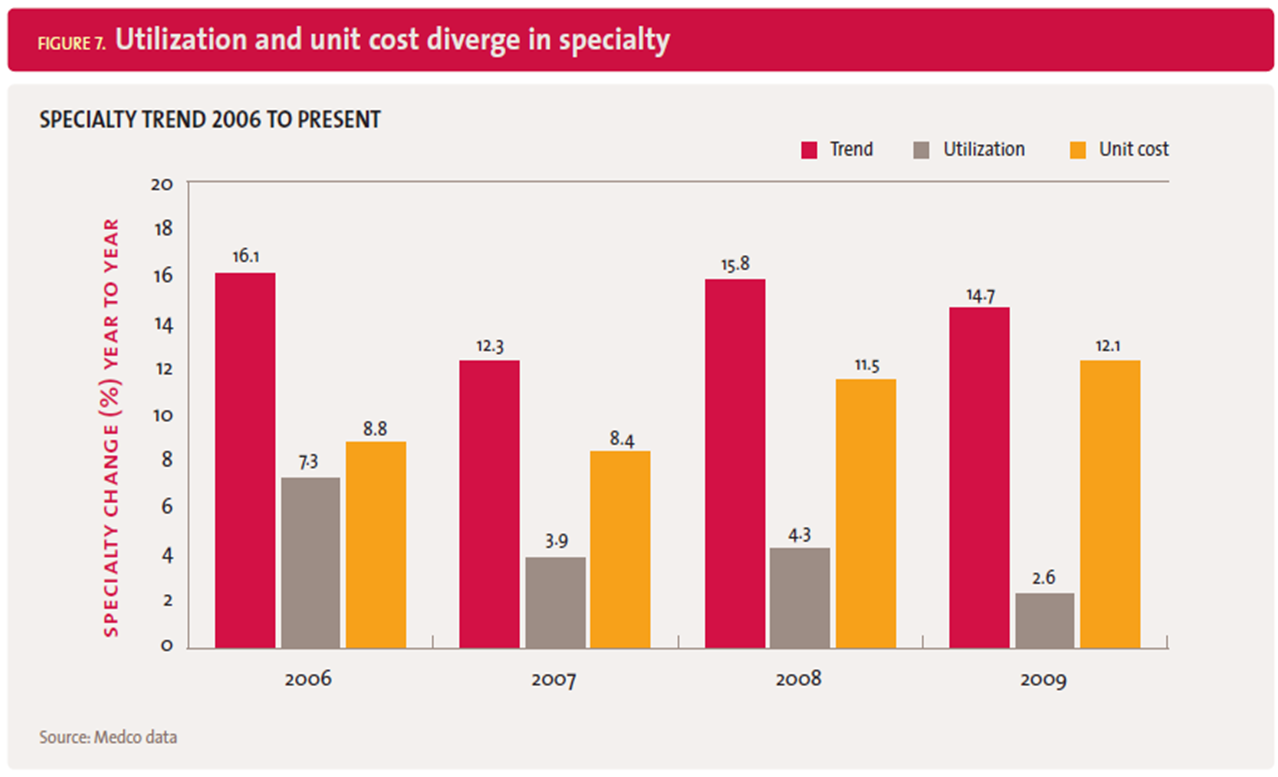
  • It was the first time I noticed anyone caveating the specialty trend. They proactively addressed different calculation methods to point out that their method yielded a 14.7% specialty trend, but if you did things differently (as I assume others must), then their trend would have been 12.1%.


  • Trend in children exceeded trend in other age groups for the second year in a row. (I think this is an interesting perspective and a scary indicator for the future health of our country.)
  • They provided some examples of drugs that had new indications for younger patients approved:
    • WelChol, Crestor—for low-density lipoprotein cholesterol (LDL-C) reduction in children aged 10 to 17 with heterozygous familial hypercholesterolemia.
    • Atacand—for hypertension in children aged 1 to 17.
    • Axert—for acute treatment of pediatric migraine.
    • Protonix—for erosive esophagitis in patients aged 5+.
    • Abilify—for irritability associated with autistic disorder in children aged 6 to 17.
    • Seroquel—for schizophrenia in children aged 13 to 17, and for acute manic episodes in children aged 10 to 17 with bipolar I disorder.
    • Zyprexa—for schizophrenia and for acute mania (bipolar I) in children aged 13 to 17.


  • An interesting perspective that I’ve talked about many times (without the research capabilities to analyze) is the correlation between sleep and chronic disease. They looked at this across states based on drug utilization and found a correlation (not necessarily causation).


So what do they say to watch:

  • Continued inflation in brand drug prices.
  • Majority of trend will come from specialty – oncology, orphan conditions.
  • Personalized medicine.
  • Biosimilars.
  • Generic pipeline.
  • Obesity epidemic.


  • They bring up an interesting issue relative to OTC (over-the-counter) product which is DUR (drug utilization review) which looks for drug-drug type interactions. They talk about the Medco Health Store integrating that data to monitor patients. [Do plans care? Do patients care? Should retail OTC purchases be integrated? How great are the interactions?]
  • They talk a little about obesity although I would love to understand more about how a plan sponsor should manage this.
    • 68% of adults are overweight; 34% obese
    • 32% of children are overweight; 17% obese
    • Medical spending on obesity related conditions is $147B
    • 19.5M adults (24-85) have diagnosed diabetes and other 4.25M are undiagnosed
    • Diabetic medical claims are forecasted to grow from $113B to $336B over the next 25 years.
  • I’m not going to spend a lot of time on personalized medicine here.  (A recent post of mine on this topic.)  They’ve been very active in this space for years talking about it. I think one of their interesting points in the Drug Trend Report is how Comparative Effectiveness will dovetail with Personalized Medicine.
  • Almost 2/3rds of people at risk for CHD in the next 10 years and eligible for lipid lowering drugs (e.g., Lipitor) were still not using them. (A common gap-in-care program run by many companies is to target these people (e.g., diabetics).)
  • Only 29% of patients treated for high cholesterol reach their cholesterol goal.
  • They have a section on wiring healthcare which David Snow has talked about for a while. It’s a critical area to address and has lots of opportunity.
  • They also talk about the concept of collaborative care (aka medical home…aka accountable care organizations).
  • I’m a big believer that poly-pharmacy creates issues (as does poly-physician). I don’t hear much talk about it. I was glad to see them talk about a study they did which identified poly-pharmacy issues, talked to MDs, and ended up with 24% of cases where medications were changed.


A Medco survey reported that 81% of participants with a new diagnosis, who received services at a traditional retail pharmacy, either did not receive counseling or were dissatisfied with the prescription drug counseling they received. When given the opportunity to speak with a Medco Specialist Pharmacist, 75% of these patients accepted the offer of immediate telephone support.


  • I thought it was really interesting to see a screen shot of their application used by the TRCs to create their Health Action Plans for consumers.


  • I was also interested in their focus on women’s health and some data on caregivers and the gender differences in healthcare. One of their TRCs is dedicated to addressing these differences.


Some of my notes from RESULTS2010

This week was our [Silverlink Communication’s] annual client event – RESULTS2010 (click here to see the final agenda). I’ve talked about this before as one of the best events.  It was great! Educational. Fun. Good networking.  

Here’s a few of my notes along with a summary of the twitter feed (using hashtag #results2010). Unfortunately, the two of us twittering were also fairly involved so there are some gaps in coverage. And, my notes are sporadic due to the same issue.

Overall themes:

  • Communications are critical to driving behavior change.
  • We have to address cost and quality.
  • Reform creates opportunity.
  • Systemic problems require systemic solutions.
  • Measure, measure, measure.
  • Automated calls – while not the whole solution – work in study after study.
  • People are different.
  • There is a gap in physician – patient interactions. 

Notes:

  • Reform basics – guarantee issue, requirements for coverage, income related subsidy.
  • Independent payment advisory board has an aggressive goal – get Medicare spending to equal GDP growth + 1% each year.
  • ½ of the $1 trillion needed to pay for health reform comes from Medicare savings / reform…the rest from taxes.
  • Everyone’s fear is that MCOs become “regulated utilities” that just process claims…unlikely.
  • Need to address underuse, misuse, overuse, and limited coverage.
  • Need to measure quality and cost at the person level.
  • CMS pilots around shared savings are working – outcomes improved.
  • Medicare Part D only got one complaint per thousand for therapeutic interchange programs / drug switching.
  • The decision around defining MLR (medical loss ratio) and what fits in there is critical.
  • Healthcare is like anything else…it’s not great and needs to change, but don’t touch mine cause it works ok. [frog in the pot]
  • How do we make each healthcare decision an informed decision.
  • Decision aids.
  • Pull, push, or pay – 3 ways to drive awareness.
  • Moving from information about your care to information being care.
  • The incentive rebound effect…what happens when you take away an incentive.
  • Social interaction affects our behavior.
  • Solving for how to change consumer behavior cost effectively and in a sustainable manner is a good challenge to work on.
  • How do we move people from desires to action? From “I’d like to exercise” to actually doing it.
  • The fact that some European programs take 3-5 years to see an impact makes me wonder what that means for our US investment strategy given the member churn across plans.
  • Great examples of ethnographic interviews
  • Good McKinsey data on people’s perceptions – Annual Retail Healthcare Consumer Survey.
  • Inform / Enable / Influence / Incentivize / Enforce
  • One way of categorizing – willingness to change versus barriers to change (rational, emotional, psychological).
  • Attitudinal segmentation – cool…but how to scale?
  • Provider staffs attitudes are important.
  • Design – delivery – measurement
  • Readiness to coach
  • A culture of health
  • Have to mix up your tools (incentives, channels)
  • “Communication Cures”
  • The chief experience officer is a new role in plans and PBMs.
  • The only experience you have with health insurance is via communications. Make it count.
  • Loyalty is a result of cumulative experiences.
  • People have to trust you so they listen to your message
  • Communication maturity model
  • Price is what you pay; value is what you get. (Warren Buffett quote…he wasn’t there)
  • Shifting paradigms:
    • Consumption to sustainability
    • Possessions to purpose
    • Retirement to employment
    • Trading up to trading off
    • Perceived value to real value
  • Simple…less is more
    • 1/3 of people feel their lives are out of control.
  • Inflamation causes 80% of diseases (really)?
  • If only 10% of outcomes are driven by costs, why do we spend 100% of our time trying to fix that problem. [tail wagging the dog] [It’s the same point on adherence.]
  • There are 45M sick days per year from 5 conditions – hypertension, heart disease, diabetes, depression, and asthma.
  • Have to look at clinical efficacy and elasticity of demand.
  • Commitment, concern, and cost.
  • Five components – plan design, program, community, communication, and provider engagement.
  • Need a multi-faceted approach to create a culture of health.
  • MDs much more likely to talk about pros than cons.
  • There would be 25% less invasive procedures if patients fully understood the risks.
  • Foundation of Informed Decision Making
  • Huge gaps in patient view versus physician views around breast cancer.
  • Preference-sensitive care
  • Dartmouth Atlas
  • Genomics tells you the probability of being on a disease curve, but not where you are in the potential severity.
  • Only 60-70% of women get at least one mammogram their entire life.
  • Statin study – barriers to adherence:
    • 37% didn’t know to stay on the Rx
    • 27% side effects
    • 15% convenience
    • 15% MD instructions
    • 11% cost
  • In healthcare, we’re all taught to speak a language that no one else understands.
  • It takes a village.
  • Challenge – Use communications to cure cancer.
  • Collaboration. Innovation. Evaluation.
  • Adherence is a great example of where everyone’s interests are aligned.
  • There is no magic bullet for adherence.
  • You need a multi-factorial approach to address adherence…Physicians are rather ineffective at addressing adherence.
  • Evidence-based plan design works to impact adherence (although I think another speaker said no).
  • You have to think about operant conditioning. (Look at dog training manuals and kid training manuals – very similar)
  • Think about all the failure points in the process.
  • What is the relative value to the patient.
  • Reward system has to reward at the failure points not just at the end of the process.
  • Using a point system successfully increased the use of a select (on-site) pharmacy by 57% at one employer.
  • 75% of PBM profits are from dispensing generics…that’s why Wal-Mart was able to be a threat to the industry.
  • Drugs only work in 20-80% of people.
  • There are people with a gene that doesn’t break down caffeine.
  • 3% of people are ultrafast metabolizers of codeine (which turns to morpheine in the body)…that can be a problem.
  • Epigenetics – turning DNA switches on and off.

“Tweets”

Rebecca from ProjectHEALTH closes #results2010 with a remarkable talk on this crucial program; they work with 5,000 families/year.

Reid Kielo, UnitedHealth: 93% of members validated ethnicity data for HEDIS-related program using automated telephony #results2010

25% of Medco pt take a drug with pharmacogenetic considerations. Robert Epstein, CMO Medco #results2010

Bruce Fried: the “California model” of physician groups facilitate efficiencies that improve delivery; an oppty for M’care #results2010

Bruce Fried on Medicare: 5 star ratings have strategic econ. importance, med. mgt. and cust serv. key #results2010

Fred Karutz: members who leave health plans have MLRs 2 standard deviations below the population. #results2010

Fred Karutz: Market reform survival – retain the young and healthy #results2010

Poly-pharmacy has negative impact on adherence. #cvscaremark
#results2010

1 in 3 boys and 2 in 5 girls born today will develop diabetes in their life. SCARY! #results2010

20% of all HC costs associated with diabetes. #results2010. What are you doing to manage that?

Messages to prevent discontinuation of medication therapy far more effective than messages after discontinuation. CVS #results2010

25-30% of people who start on a statin don’t ever refill. #CVSCaremark
#results2010

Maintenace of optimal conditions for respiratory patients increased 23.4% with evidence-based plan design. Julie Slezak, CVS. #results2010

Value-based benefits help control for cost sensitivity for medications; every 10% increase in cost = 2% – 6% reduction on use. #results2010

Pharmacists who inform patients at the point of dispensing are highly influental in improving adherence. William Shrank #results2010

The game of telephone tag in HC is broken. Pt – MD communications. #results2010

37% of Pts were nonadherent because they didn’t know they were supposed to keep filling Rx. #results2010

Last mile: 12% of Americans are truly health-literate; they can sufficiently understand health information and take action. #results2010

Only 12% of people can take and use info shared with them. #healthliteracy
#results2010
#DrJanBerger.

We need to improve the last mile in healthcare… clear, effective conmunication. Jan Berger #results2010

#McClellan used paying drug or device manu based on outcomes as example of “accountable care”. #results2010

72% of those with BMI>30 believe their health is good to excellent; as do 67% of those w/ chronic condition. #McKinsey
#results2010

Are incentive systems more likely to reward those that would have taken health actions anyways (i.e., waste)? #McKinsey
#results2010

Only 36% of boomers rate their health as good to excellent. #results2010

27% of people believe foods / beverages can be used in place of prescriptions. #NaturalMarketingInstitute
#results2010

Why do we spend so much time on impacting health outcomes thru the system when that only explains 10%. #Dr.JackMahoney #results2010

Using auto calls vs letters led to 12% less surgeries & 16% lower PMPM costs in study for back pain. #Wennberg
#HealthDialog
#results2010

MDs are much more likely to discuss pros with patients than cons. #Wennberg
#HealthDialog
#results2010

Should physicians be rewarded as much for not doing surgery? How do economics influence care decisions? #results2010

Physicians were 3x as concerned with aesthetics than breast cancer patients in DECISIONS study. #results2010

Fully-informed patients are more risk-averse; 25% fewer of informed pts in Ontario choose angioplasty. #results2010

Patients trust physicians over any other source (media, social connections) but only receive 50% of key knowledge. #results2010

Informing Patients, Improving Care. 90% of adults 45 or older initiate discussions about medication for high BP or cholesterol. #results2010

What is #results2010? #Silverlink client event.

#results2010#Aetna Medicare hypertension program leads to 18% moved from out of control to in control using auto calls (#Silverlink) …

About 2 of 3 medicare pts have hypertension. #results2010

John Mahoney describes how he connects payors, providers, and care via research. #results2010

As information becomes commoditized in healthcare, sustainability enters the vernacular. #results2010

Segmentation innovations of today will be tomorrow’s commodities. Measurement and learning must be “last mile” IDC insights #results2010

Plans are strategically investing in bus. intel to reach wide population for wellness, not just the low-hanging fruit. #results2010

The single most significant future market success factor is measurable results. Janice Young, IDC Insights. #results2010

Knowing our attendees’ preferences could have fueled segmented, precise invitations to #results2010. Dennis Callahan from Nielsen Media.

Drivers of those sereking alternative therapies: stress, lack of sleep and energy, anxiety, inflammation. #results2010

Only 2% of people don’t believe it’s important to lead a healthy lifestyle. Their behavior could’ve fooled me. #results2010

Are purity and simplicity the new consumption? Steve French of Natural Marketing Institute explores. #results2010

Gen Y is the most stressed out generation. #results2010

Less is more. 54% say having fewer material possessions is more satisfying. Natural Mktg Institute #results2010

Loyalty is a result of a cumulative set of experiences. Individual intervention ROI is sometimes difficult. #results2010

Sundiatu Dixon-Fyle of McKinsey; understand how beliefs shape an individual’s ability to change behavior. #results2010

Don Kemper: each of 300M HC decisions made each year need to be informed. #silverlink
#results2010

Medicare Part D: 40% lower cost than projected, seniors covered through tiered coverage powered by communication. #silverlink
#results2010

Mark McClellan: Brookings is engaging private insurers to pool data to understand quality of care. #silverlink
#results2010

Mark McClellan at RESULTS2010; bend the curves, provide quality care efficiently. HC reform >> insurance reform. #silverlink
#results2010

Medco 2010 Drug Trend Report

Today, Medco Health Solutions released their 2010 Drug Trend Report (which looks at 2009 data). I haven’t had time to read the entire report, but here are a few highlights and comments from a conference call:

  • Overall drug trend was 3.7%. [They use their top 200 clients for analysis.]
    • Trend was 0.1% for clients with greater than 50% spend at mail.
    • Trend was 1.7% for Medicare.
    • [I still point out here that the question is whether trend is good or bad.] Dr. Epstein and David Snow pointed out that they work with clients on this to track metrics on adherence at the TRCs (Therapeutic Resource Centers) and report on this. The key here is knowing what classes show measurable impact to overall costs and outcomes by improving adherence and increasing costs.
    • Another point I thought was interesting was a comment that if the FDA saw the actual adherence on some drugs that require sustained utilization to achieve an outcome that they might make different decisions about drug approvals.
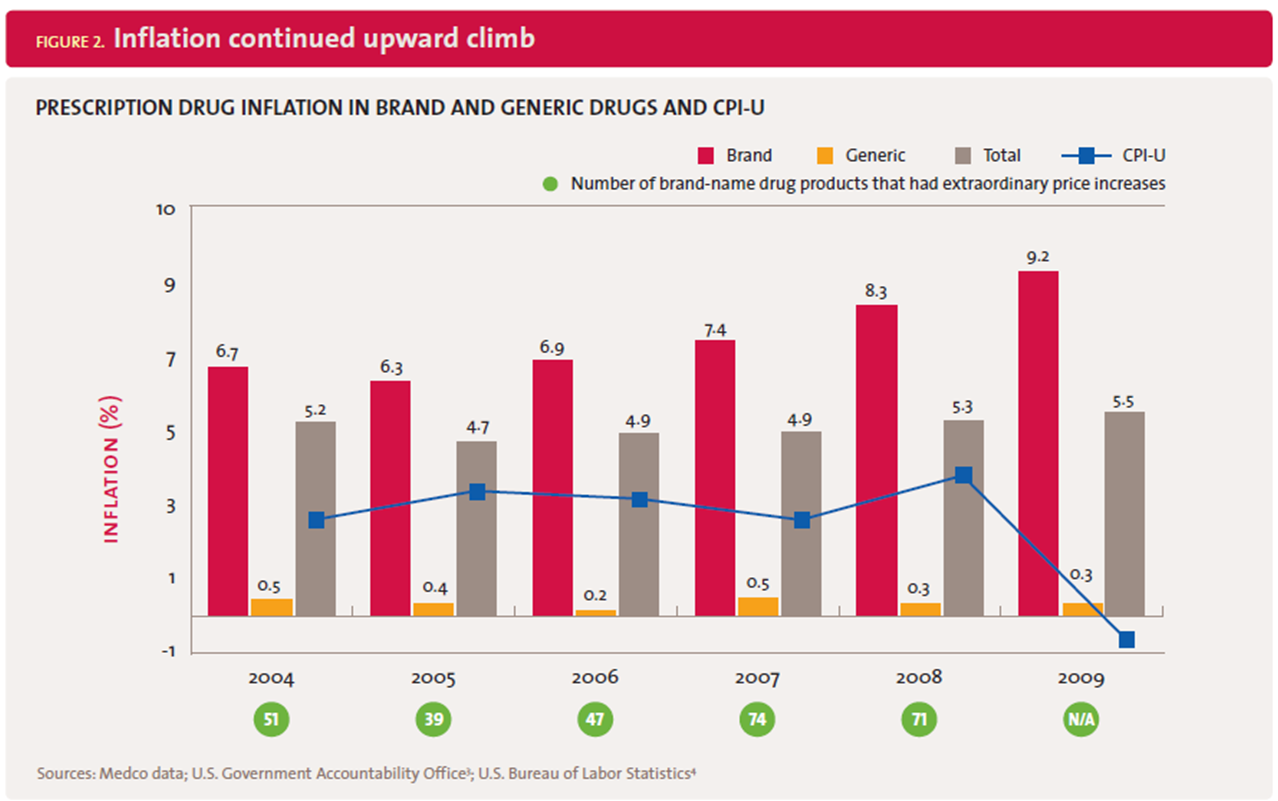
  • Inflation for branded drugs was 9.2% which was the highest in a decade. Generic inflation was 0.3%.
    • On a conference call, David Snow validated that this was associated with the tax on brand pharma so yes the high inflation on brand drugs was tied to reform. Someone asked a question about patent expiration (which historically drives prices up), but that doesn’t explain all the inflation here.
  • They saw a 3.4% increase in generic utilization.
  • Prescription utilization was up a minor 1.3%.
    • 5% for children 0-19.
    • 0.2% for seniors.
  • Specialty drug spending continued its rapid growth with a 14.7% increase including a 2.6% utilization increase.
  • Diabetes continues to be the largest driver of drug trend representing 16.7% of all drug spending and grew by 11.1%. [We can expect to see this continue to grow as more pre-diabetics are diagnosed.]
  • H1N1 drove up antiviral spending by 15.7%.
  • Pediatric use of medications grew faster than other groups.
  • 1 in 4 insured kids now take a medication for a chronic condition.
  • Increased utilization in kids occurred in diabetes, asthma, antivirals, ADHD, cancer, and rheumatology drugs.
    • There was a huge increase in diabetes over the decade (5x the adult population) and this was especially true with adolescent girls.
    • It’s amazing to me that you now have kids on lipids (high cholesterol), but it’s clearly an indication of the obesity issue. [We’re just at the tip of iceberg.]

  • ADHD surged for those under 35 – 9.1% increase in use leading to a 23.8% increase in spending.
    • The CDC says that 5M kids age 3-17 have and ADHD diagnosis.
    • [The other issue here is abuse of ADHD drugs.]
  • They also mention Nuvigil as a drug that could gain popularity for treating jet lag.
  • They forecast the drug trend will rise 18% thru 2012 driven largely by diabetes, oncology, and rheumatology.
  • About $46B in brand drug sales are scheduled to go generic by 2012.
  • They don’t expect biosimilars to impact the market until after 2012.
  • Not surprisingly, they showed a high correlation between states with frequent sleep deprivation and high drug utilization. As I’ve talked about many times, lack of sleep drives obesity which is highly correlated with many conditions. They also found a notable overlap of the use of Provigil (as stimulant used to treat daytime sleepiness associated with sleep apnea). [Seems like a drug that could get abused by college students like ADHD.]

“While H1N1 caused a spike in antiviral use among children last year, the far more alarming trend since the beginning of the decade is the increasing use of medications taken by children on a regular basis and in some cases, for conditions that we don’t often associate with youth, such as type 2 diabetes,” said Dr. Robert S. Epstein, Medco’s chief medical officer and president of the Medco Research Institute.  “The fact that one-in-three adolescents are being treated for a chronic condition points to the need for additional health education and lifestyle changes that can address the obesity issue that is likely a driving force behind such conditions as type 2 diabetes and even asthma.”

If you’d like to get updates whenever I post on the blog, you can sign-up for e-mail updates here. 

Don’t Believe The Hype – Copay Waivers

Don’t believe the hype – its a sequel
As an equal, can I get this through to you
 

I talk about it all the time as most people do…non-adherence to prescription drugs is a real issue.  People don’t fill their initial script.  People who do fill their first script drop off after the first several fills.  By 12-18 months after a patient starts therapy, less than 50% of them are still taking their medications.  Here’s a few key articles on this: 

Common barriers to adherence are under the patient’s control, so that attention to them is a necessary and important step in improving adherence. In responses to a questionnaire, typical reasons cited by patients for not taking their medications included forgetfulness (30 percent), other priorities (16 percent), decision to omit doses (11 percent), lack of information (9 percent), and emotional factors (7 percent); 27 percent of the respondents did not provide a reason for poor adherence to a regimen.  Physicians contribute to patients’ poor adherence by prescribing complex regimens, failing to explain the benefits and side effects of a medication adequately, not giving consideration to the patient’s lifestyle or the cost of the medications, and having poor therapeutic relationships with their patients.  (NEJM article) 

Depending on what study you look at cost is certainly an issue, but it typically isn’t the primary issue.  I typically see cost as being a factor in 5-15% of the cases.  I think if you look at how Merck weighs cost in their Adherence Estimator that it is only a small factor.  A lot of this plays out in VBID (Value Based Insurance Design) which while not purely about copay waivers that certainly is an element of most solutions.  

A few friends of mine formed their own company (CareScientific) and had a paper published in AMCP recently.  From that article: 


VBID is receiving attention as a tool to increase medication adherence and lower medical costs. However, applying a “plausibility calculation” method to data generated from a recent VBID study involving reduction of drug copayments, this evaluation found that health plan sponsors are highly unlikely to experience net savings by implementing VBID programs, even under generous assumptions, for 2 reasons. First, the price elasticities of medications are too low to generate meaningful increases in medication adherence when copayments are lowered. Second, the potential reductions in the avoidable hospitalization and ER utilization rates across a commercially insured population with varying risk levels are generally not large enough to offset the additional plan costs of lowering copayments to increase medication adherence. 

I would also suggest looking at some of their tools that they’ve developed

So, getting back to how I’m tying in my reference to Public Enemy (rap musicians)… 

When I look at the upside for pharmaceutical manufacturers to grow the pie (get more Rxs through adherence), I often wonder why one of the default solutions is to fund copay waivers.  That happens by employers, health plans, and even the manufacturers.  There are many less expensive ways to get that lift by addressing things like reminders and tailoring information to individuals based on their personalized barriers. 

There are lots of high cost solutions that will make an impact.  The question is how to triage those resources to focus them on the right people.  It’s important to identify adherence risks (pro-active intervention) and adherence gaps (retrospective) and intervene with the patient.  

Here are a few of my other posts on this: 


Should Pharmacy Trend Go Up or Down?

As we enter the “drug trend report” season and we get to see everyone pull out their rules (not always equal) to show that their smaller, a friend asked me a good question the other night.  Is lower trend better?

It’s an interesting discussion.  We always assume that lower trend means the PBM is doing a better job shifting utilization to generics, moving people to mail order, driving specialty claims to the specialty pharmacy, implementing utilization management programs, etc.

BUT, if the PBM improves adherence, the trend’s going to go up.

If the PBM does a better job of moving specialty claims from medical to pharmacy, the trend’s going to go up.

If the PBM does a better job of making sure people get a claim after a step therapy reject, the trend’s going to go up.

If the PBM does a better job of getting people to fill their initial claims, the trend’s going to go up.

If the PBM does a better job of closing gaps in care, the trend’s going to go up.

I think this is one of the big reasons why a captive PBM (i.e., owned by the managed care company) should be viewed differently and has a unique opportunity.  They can make a convincing case that the trend should go up and be offset by lower medical costs.  That’s much harder for a standalone PBM to make.

The Best Healthcare Conference

In today’s budget conscious economy, people are constantly evaluating where to spend their time and money from a conference perspective.  Some conferences are good networking events.  Some of requirements to work in an industry.  Some are educational.  Some give you new ideas on how to run your business.  Some are in great fun locations with fun events.  Very few fit all of those.

I think our Silverlink Communications client event called RESULTS2010 does all of those.  [Hint – the conference is called RESULTS since that’s what we focus on with our customers.]  It takes on all the key issues we see in the market.  It brings in industry experts and clients to talk about what they are doing to address these issues.  Those problems are framed out by our industry experts that have line experience with these roles.  [Our leadership team comes from places such as Express Scripts, CVS Caremark, Gorman, and HCSC and our team includes people from McKesson, Humana, United Healthcare, IMS, DigitasHealth, Medco, and WebMD.  I challenge anyone to find a more knowledgeable vendor team.]  It gives people a chance to network and talk to their peers.  And, there’s some fun mixed in there.

This year’s event is focused on THE HEALTH CONSUMER.  I’m pretty sure it’s the only conference focused on communicating with consumers in healthcare.  The objective is to provide clients with ideas about how to educate, support, and motivate consumers to take actions which support health outcomes. 

Honestly, it was the original event that convinced me to come to Silverlink.  I was a consultant at my first event working with the company.  I met 75 users who were passionate about the company and had great first hand experience using the technology to make a difference in their companies.  I was able to ask them about the competition and understand why they choose Silverlink for their member communication partner.

So, what does this year’s event have in store:

  1. An amazing list of external speakers including Mark McClellan, David Wennberg, Don Kemper, Jack Mahoney, and Janice Young.
  2. A long list of client case studies – 14 so far.
  3. Specific tracks to cover our different client groups and allow for smaller discussion versus formal presentations – Pharmacy, Population Health, Medicare, and Managed Care.
  4. Industy experts on key topics such as consumer engagement, use of data in healthcare, consumer data, behavior change models and incentives, pharmacy economics, pharmacogenomics, medicare market dynamics, and the evolving retail healthcare model.
  5. Adherence experts such as Dr. Will Shrank from Harvard and Valerie Fleishman who led the NEHI adherence study that is widely quoted.
  6. Several fun events including golf, morning runs, and a few special sports related surprises.

There are several more speakers who you would know and I’m very excited to have come and speak…BUT, I want to leave something inside the package for you to want to rip it open and learn more.

How much does it cost?  Nothing (as long as you’re a Silverlink client).

Where is it?  Boston (a great city).

How do I learn more?  Well…if you work for a large managed care company, a population health company, or a pharmacy / PBM, you may already be a client.  We have over 80 clients today.  So, if you’re not on our invite list, think you might be a client, and want to learn more, let me know.  I’m at gvanantwerp at silverlink dot com.  [spelling it out avoids spam]

This year’s event is in late May so I hope to see many of you there!

The Adherence Estimator by Merck

Merck did research that was published last year showing that their 3-question Adherence Estimator (TM) was 86% accurate in identifying patients at risk for nonadherence.  Pretty impressive. 

A copy of the questions are below and were on the Tuft’s website which also shows the scoring mechanism.  This is something patients can take to determine their risk or plans, PBMs, pharmacies, MDs, disease management companies, or others could use. 

Ingrid Lindberg, Chief Experience Officer, Cigna

This was definitely my favorite and most interesting presentation and discussion from the World Health Care Congress in DCIngrid presented and subsequently spent some time talking with me.  She has what I would consider one of the coolest jobs – transforming a large company to be consumer centric and radically changing the way they think, speak, and act. 

From her presentation, here were a few notes:

  • There are 337 languages spoken in the US today. (health literacy issue?)
  • Only 23% of people understand what their health insurance policy means.
  • Most patients appear to be unaware of their lack of understanding in physician instructions and are inappropriately confident.
  • 35% of consumers spend less than 30 minutes reading their health benefit information.
  • Only 7% of people trust their insurer.
  • Trust translates to loyalty and satisfaction.
  • It’s a mix of quantitative and qualitative research.
  • They spent time monitoring sites like – www.pissedconsumer.com.  (do you?)
  • Their senior staff has to spend time listening to member calls each week.
  • They spent lots of time on ethographic research and identified 6 personas that they use for defining products – Busy Mom, Skeptic, CareGiver, Controller, Athlete, and Bargain Shopper.
  • They identified the #1 dissatisfier was language.  Plans talk to them in a language they don’t understand.  (For example, consumers think of providers as the insurer not a physician.)
  • Consumers didn’t want to be called members since it’s not a health club.  They didn’t want anyone other than their physician to call them patient.  They’ve elected to go with “customer”.
  • She talked a lot about how they’ve changed their EOB (explanation of benefits) and their plan overview to address things like what’s not covered.  She talked about how customers think of the EOB as the “this is not a bill form”.
  • They identified 10,000 separate letters that could go out to a customer.  They’ve re-written 9,000 of them. 
  • She talked about changing their call centers to 24/7 and the fact that they’ve now taken their 1M call in what used to be considered “after hours”.
  • She talked about re-designing their IVR to offer you a self-service option (press 1) or a talk to agent option.
  • She talked about their website and YouTube channel – www.ItsTimeToFeelBetter.com.
  • She talked about their understanding level being around 70% while the industry average is around 15% [of communications sent out].
  • This was in a 15 minute presentation and summarized only 2 years of work. 
  • She also shared some metrics that they use and improvements such as a 8 point improvement in one year of “values me as a customer”. 

And, they’ve shared some of this information in their press kit.  There is also an IBM white paper about some of the technology they’ve implemented.

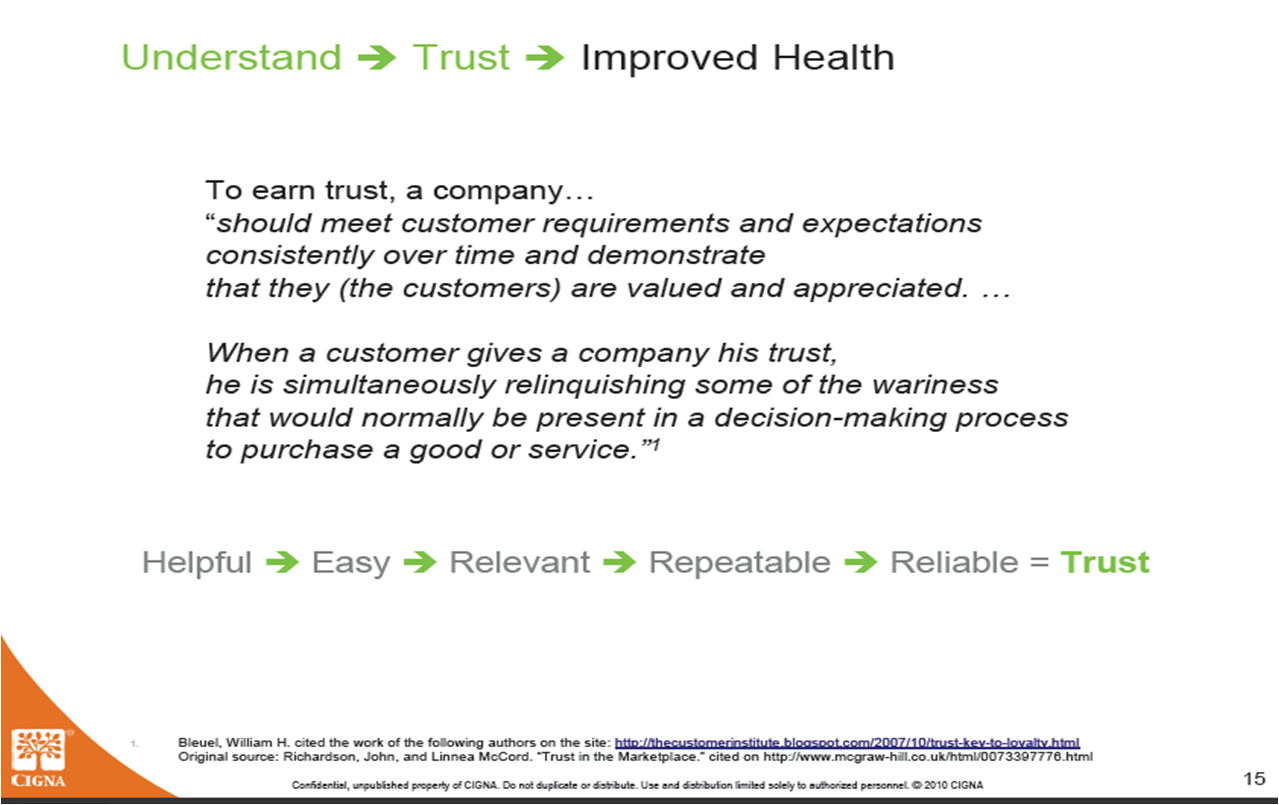
I think the following slide from her deck sums it up well.

Then I sat down with Ingrid to talk with her.  I had a thousand questions which I limited to about 10.  This is a topic I love and is why I love what I do – work with companies to help them develop consumer communication strategies and implement those strategies to improve the consumer experience and drive better health outcomes

  1. How long did it take?  This is about a 3-5 year effort which is complicated by the fact that people in these types of roles typically only last about 28 months.
  2. Did you do it all internally?  No.  They worked with Peppers & Rogers on a Touchpoint Map and used an IBM tool called Moment of Truth.  They also worked with IBM on a new desktop solution.  BUT, she was quick to talk about the fact that those were enablers while the majority of work had to be done by internal change agents since this is a cultural change.  She said that now almost 80% of Cigna people are using their recommended language and are aware of the changes made by her group.
  3. Why haven’t others followed?  It’s hard work. 
  4. How do you deal with consumer preferences?  This is one of my favorite topics to debate.  Should you offer consumers options on how you communicate even if you know that they might not pick one that is the most effective.  For example, I might say to send me an e-mail, but they get lost, they can’t contain PHI, etc.  She said that you have to ask but you have to navigate the path.  She seemed to agree with me that there are some communications where you want to ask (e.g., order status at mail) and others where you want the right to contact them (e.g., drug-drug interaction).  She talked about the fact that it’s all in the framing (e.g., if we have a message for you that could affect your safety, is it okay if we ignore your do not call request?).
  5. Are you changing Cigna’s physician communications also?  Yes.  The changes have become the “language of Cigna”.  Physicians are people, and they are also trying to educate physicians on what they’ve learned about how to communicate with customers.  She mentioned that the most difficult groups to change were the people that were knee deep in this healthcare language – internal people and consultants. 
  6. Based on my discussion with Andy Webber, I asked her if she thought that today’s fragmented environment would allow for a coordinated consumer experience.  She agreed that it’s difficult and that the consumer sees everything as their benefit.  They don’t see the piecemeal parts.  She mentioned that one of their clients had held a “vendor fair” to kickoff the plan year where she presented their learnings and all the vendors were told to use them immediately.  [Maybe that’s part of the solution.]

We then bounced around on a couple of interesting topics:

  • We talked about the fact that lots of companies are hiring non-healthcare people to help them better understand the consumer.  These include consultants, database people, marketing people, and innovators.  My personal opinion is that you need people that have worked in or around healthcare AND outside healthcare.  They also need to have consulting and line management experience.
  • She talked about their war room (she used another term) where they had a current state and future state (of patient experience) and showed all the 10,000 current communications as a waterfall. 
  • We talked a little about some of the things we’d done at Express Scripts when I was there including changing the way we referred to members at the call center to patients and the impact that had. 
  • I shared with her that our biggest difficulty was making web changes at Express Scripts which I thought would be the easiest to do.  She shared that changes on the web were one area where they were lagging and is difficult. 
  • She talked about trying to get innovation from customers by understanding what they want and giving it to them.

Voice Personality Is A Powerful Lever To Motivate Health Behavior

This article appeared in HealthLeaders (3/3/10) by two of my co-workers based on some very interesting work they’ve been doing.  

It’s not what you say, but how you say it that matters. The “how” includes a number of specific voice attributes, such as inflection, rate of speech, and intonation—all of which contribute to an overall perceived “voice personality.” 

Voice is a powerful lever in the ability to effectively communicate your message to ultimately motivate behavior. Would you be more apt to trust the voice of James Earl Jones or the voice of your local car dealer? How do you perceive these voices overall? Which voice personality most effectively delivers a message? The answers, of course, depend on the listener, what is being communicated, and the behavior you’re trying to motivate. 

In healthcare, individuals are educated and supported in the decisions they make about their health through communications. This article highlights a recent study of the impact of voice in healthcare communications and how individuals perceive voice as it relates to health messaging. 

Specifically, this research analyzes voice selection for interactive automated calls, an effective outreach channel widely used in healthcare to reach and motivate individuals. 

Subjectivity in Voice Selection
If you put a small group of people in a room and ask them to describe the voice they hear, the answers will be wildly different: “This voice sounds too perky.” “That one sounds robotic.” “This voice sounds friendly and cheerful.” Reaching a final conclusion about which voice is “best” often is a highly subjective process. 

While we don’t consciously listen to an individual’s voice attributes, we do subconsciously assess the voice’s characteristics and create inferences about the speaker. Over the telephone or on the radio, when voice is the focus, we paint a picture of how someone looks, what kind of person they are, their age, gender, and generally whether or not you trust them. 

We’re sometimes surprised in the end at how different the person is when we meet him or her face-to-face. By itself, voice impacts our perceptions, which affect how well we understand a particular message. 

In healthcare, it is a common belief that people prefer a female voice when receiving messages about their health. Perhaps this is because female voices are perceived as more nurturing and caring; and women are often the caregivers in the home. 

But is a female voice equally effective when communicating to all people, of every age, in every region, and for every type of health related behavior? For instance, is a female voice as effective for people of poor health status hearing a message about an important health screening? What about seniors hearing a reminder to take their cholesterol-lowering medications? 

Voice Research
To answer these questions, we created a framework to map specific voice attributes with voice personality. We conducted an attitudinal study to learn how people of different age, gender, and region perceive and respond to different voices. We surveyed 3,000 people across the country, in a statistically representative sample of the commercially insured U.S. population. 

Participants heard the same short informational wellness message spoken by several different voices representing a variety of ages, gender, and unique voice characteristics. Survey responders were asked to provide their opinions on the following: 

  • Is the voice perceived negatively or positively overall?
  • Which attributes do people generally use to describe a particular voice? (e.g., rate, volume, and age)
  • Is the voice perceived as introverted, extroverted, formal, or conversational?
  • Is the voice perceived as coming from someone who is more caring and sincere, or someone who is trying to sell something?
  • Do people believe and trust the voice?

The survey results provide a powerful depiction of how different voices are perceived by different segments of a population. 

What’s in a Voice?
High trust and care/sincerity ratings are important factors when trying to motivate healthcare behaviors. Medication adherence, for example, is associated with the quality of relationship between the patient and the physician. When people trust the voice they hear, and feel that the person speaking to them is sincere, they are more likely to change their behavior. 

There are many interesting attitudinal findings from our study including: 

  • Both men and women across all age groups preferred a male voice to a female voice overall.
  • Voices described as fast paced, young, highly extroverted, perky, and animated rated poorly in the trustworthy and caring categories.
  • Voices described as moderately paced, middle-aged, and well-spoken/educated, were rated most trustworthy and caring.
  • Seniors (those 65+ years old) aren’t as sensitive to voice age as other groups and don’t perceive older voices as necessarily older sounding. By contrast, younger groups perceive “older” voices more negatively.
  • Seniors aren’t as sensitive to the rate of speech as younger populations; therefore, slowing the pace may not be as impactful as was once thought for older populations.
  • Younger people (18- to 34-year-olds) are significantly more sensitive to voice age and rate of speech, which means very careful selection of voices for young audiences is important to drive behavior.,/li>
  • Young people showed stronger opinions overall between men and women when rating the voice gender they prefer. In other age groups, there is general agreement on voice gender preferences. Gender selection is therefore a more important factor for the 18-to-34-year-old age group.

The use of voice to motivate health decisions
The results of this study provide us insight into how people of varying gender, age, region, and health status perceive the voices they hear. Our goal is to validate how specific voices can be used as a lever to change behavior. 

Voice, like other communications levers, such as messages and timing, can be selected based on the demographics, purpose, tone, and intent of communication, as well as how voice supports brand identity. By validating attitudinal voice responses against behavioral activity, voice can ultimately become a measurable behavioral best practice in healthcare communications. 

While the bulk of our experience supports the conventional wisdom that a woman’s voice is more effective for healthcare communications, our voice research suggests that there are opportunities to use a male voice to measurably move health behavior. A recent outreach program to educate individuals about the importance of colorectal cancer screenings supports our attitudinal research. 

The outreach asked if the individual had received a screening during the past two years, and if they planned to schedule a consultation with their doctor. The same message was delivered by a male and a female voice. All population segments, including men, women, Caucasians, Hispanics, and Asians, answered the survey at a higher rate when a male voice was used versus when a female voice was used. 

Conclusion
By applying science and measurement, we can determine the voice qualities that are the most impactful for a specific health behavior and for a group of people. There are measurable patterns in overall voice preference. Communications programs aimed at driving individual behavior should include voice analysis. 

By measuring and understanding perceived voice personality, our research sheds light on an objective way to effectively apply voice in healthcare communications to ultimately impacts behavior change. 


Jack Newsom, ScD, is vice president of analytics at Silverlink Communications, and Ryan Robbins is voice production manager at Silverlink Communications.

Addressing Hospital Readmission Rates

High hospital readmission rates are a real source of concern for health plans, from both a quality and cost perspective. With 20% of Medicare patients being readmitted within 30 days of discharge, health plans and their partners have a significant opportunity to reduce readmission rates across all populations. Even just a half-point drop in readmissions for a Medicare plan with 1 million members can yield $10 to $15 million in annual medical cost savings.

In a new podcast, Dr. Jan Berger, Silverlink’s Chief Medical Officer, discusses how health plans can address this costly, growing issue affecting our healthcare system. Dr. Berger offers best practices for reducing readmissions such as:
• Expanding outreach to entire discharged population
• Reaching out within 24-72 hours of discharge
• Coordinating communications among members, physicians and care managers
• Identifying members at risk for readmissions

Download this podcast and visit our new Post Hospital Discharge Microsite to access other valuable resources on this important healthcare topic.

Interview with Cyndy Nayer from the Center for Health Value Innovation

I had a chance yesterday to sit down and talk with Cyndy Nayer (President, CEO, and co-founder) from the Center For Health Value Innovation. For some of you, this is a new buzzword for others it has been around a while. I remember back in the early 2000s when stories of Pitney Bowes kept popping up and then working with a few of our clients (like Marriott) when I was at Express Scripts on what were being called “value-based designs”. [I even had an offer to go to ActiveHealth (now part of Aetna) and work on their Value Based offerings several years ago.]

And, it’s a small world. Several people from my past are involved: (1) Peter Hayes was a client at Express Scripts and (2) Roy Lamphier played soccer with me in high school.

What is the Center For Health Value Innovation?

The center is an “information exchange” for value based design which as she points out is much more than just a prescription benefit and not simply giving people free drugs to make them more compliant. [If only it were that easy!]

What do you mean by Information Exchange?

A place where people can share stories, trends, info, and research. They see their job as getting information out there and providing support around modeling, analysis, and identifying gaps. [And, I know they do a lot of education as you can see Cyndy at many conferences.] She talked about educating the marketplace on an “actionable format” for implementing value-based design.

Can you describe Value Based Design?

Value Based Design is a suite of insurance design, incentives, and disincentives that support prevention and wellness, chronic care management, and care delivery. It is focused on linking stakeholders across the care continuum and developing structures like outcomes-based contracting where all stakeholders benefit from better health outcomes.

She mentioned that in an upcoming edition of the Journal of Benefits and Compensation that there will be a paper that builds on some adherence concepts to discuss the 5 Cs of Value Based Design: [Noting that the first 3 come from some work from Merck.]

  • Commitment
  • Concern
  • Cost
  • Communication
  • Community

We talked about the need for communications to be multi-directional and include the patient, the physician, the pharmacy, and other caregivers. We talked about community needing to expand on that to include family, the employer, and other entities. [As we all know, health care is local and value based design is no different.]

We spent a little time here talking about community, and the need for this to happen at a community level. [Much like e-prescribing and other things have found out that localized momentum is important.] One question in my mind is who is the catalyst – the hospitals, the physicians, the local managed care companies, employers, grocery stores, wellness companies, pharmacies.

We talked about the fact that this isn’t the same as Accountable Care Organizations, but like that concept, this has to be developed as part of the fabric of the community not imposed on the community.

Being from Detroit, I asked if this was a model for them to help develop around. That is an area of focus and there has been some work done in the Battle Creek, Michigan area.

Why are employers so interested in Value Based Design?

Originally, employers were interested since it was something new, but the recession forced them to look at this more seriously. But, this is a long-term process and something which they benefit from. Better health lowers absenteeism, and businesses need health communities and healthy workers for growth.

Why don’t companies implement Value Based Design programs?

Companies don’t implement them because they’re not prepared for the amount of work needed to get started and it’s not a cheap fix. [If you want to save money, just drop the benefits…not that anyone really advocates that.] We talked about that lots of people react to the urban legends of just giving out free drugs [which isn’t Value Based Design] which would be easy. Companies need to realize there is work to be done to communicate this, design it, and manage the implementation across the community. BUT, once it’s installed, it’s completely sustainable.

Is there a certification (i.e., URAC) for value-based design?

She told me that nothing exists today and that it would be hard to do. Today, there isn’t alignment in the marketplace around incentives and a standard model. They spend a lot of time working with different groups to drive education and training to link health and productivity measurement with value and functional performance.

What’s next for 2010?

In 2010, they will be bringing much more information forward on how to support and extend the work done in the 1st book (Leveraging Health…which Dr. Jan Berger, Silverlink’s Chief Medical Officer co-authored with the Center) and the decision matrix that they recently published. They will continue to serve more as a guide helping interested parties in private, invitation only events to design solutions and then bring those solutions to market.

How does someone learn more about Value Based Design?

The simple answer is to go to the Center For Health Value Innovation website. They have a whole library of information there.

New Clinical Webinars – HEDIS, Adherence, Engagement

In June, we are offering three complimentary webinars to our clients and prospects on key topics of discussion.

Increasing the Effectiveness of Population Health Program Engagement
June 16th | 1:00 PM ET

Getting consumers to take charge of their healthcare behaviors and choices is critical to controlling costs and improving outcomes. Successfully welcoming and engaging consumers in DM and health management programs can be the toughest road for health plans and population health organizations. Strategies that motivate participatory engagement are key – but it takes more than a friendly voice and the right script.

Join Silverlink for a complimentary webinar where we will discuss the challenges of moving health behaviors and effective strategies organizations can implement to get ahead of the behavior change curve.

In addition, learn how to:

  • Leverage tailored messaging to drive high engagement rates
  • Enable continued engagement over time
  • Maximize buy-in and acceptance of health coaching
  • Combine multichannel approaches to elicit engagement and re-engagement
  • Optimize engagement campaigns through predictive analytics to drive results

Drive Positive Health Behaviors and Improve HEDIS Results

June 23rd | 1:00 PM ET

Whether your focus is on the HEDIS measures for women’s health, the diabetes metrics or a broad range of effectiveness of care measures, Silverlink can design communications strategies that increase your reach, motivate member action and improve HEDIS results.

With the backdrop of the economic slowdown, communicating with members about the importance of key preventive screenings is more critical than ever. Explore the many routes to break through health prevention challenges by tailoring communications interventions that work for your populations.

Join Silverlink for a complimentary webinar where we will present the results and lessons learned over several years in supporting HEDIS screenings including a recent campaign aimed at reducing health disparirities in African American and Hispanic populations related to colorectal cancer screenings.

In addition, learn how to:

  • Use a flexible framework that supports national teams in delivering effective outreach in local markets
  • Drive performance on high-profile HEDIS measures where plan performance has hit a plateau
  • Segment your membership to deliver highly personal messages using multiple levers
  • Design and target messages to help reduce health disparities
  • Combine multiple messages to support members with more than one gap
  • Leverage multichannel campaigns to maximize reach and action

Rethinking Medication Adherence

June 30th | 1:00 PM ET

More than 50% of consumers become nonadherent around their maintenance medications within the first 12 months of therapy. And, today’s economy is putting even more pressure on people to make economic tradeoffs that threaten their health. Several studies have shown that more people are skipping doses or not refilling medications. Non-adherence leads to $177B in direct and indirect costs to the healthcare system per year.

Silverlink provides a comprehensive suite of communications services to drive medication adherence from targeting and messaging to multi-channel campaign management and execution. Join Silverlink where we will discuss some of the common myths around and key strategies related to medication adherence.

In addition, you will learn about:

  • Critical success factors in designing adherence solutions
  • Important conditions to focus on for adherence
  • Success metrics and key measurements
  • Comprehensive solutions for all phases of the patient’s therapy from initiation through long term maintenance

Express Scripts 2009 Drug Trend Report

I always enjoyed being part of the team that put the Drug Trend Report out when I was at Express Scripts from 2001-2006. With that in mind, I do await anxiously to see what new information they will share each year. I will say that the core fundamentals (as always) were very strong in the 2009 report, but I missed not having any client case studies in the document.

They reported drug trend of 1.5% (without specialty) and 3% with specialty.

Specialty drug trend was 15.4%.

Patients paid an average of $12.82 per Rx.

They say that more patients converted to Home Delivery (aka mail order). [I have to check this. My recollection is that mail volume was relatively flat and this would be hard to achieve unless they had more people filling less drugs on average at mail.]

They reported PMPY utilization of 14.32 Rxs.

Their members paid 29% of the generic drug costs; 19.6% of the brand costs; and 22.3% overall for traditional drugs. For specialty drugs, they paid 2.3% (or 20.2% for all drugs including specialty).

They have a section on compliance (which is rapidly becoming a key discussion point in the PBM world). I was a little surprised they didn’t call it adherence which is more common these days. But, they revealed some surprisingly high MPR (medication possession ratio) numbers for antidiabetics, antihypertensives, and lipid-lowering drugs. Considering adherence is where a member has an MPR of greater than 80%, they showed 77%, 83%, and 83% respectively. Since we know that 50% of people (on average) drop therapy within 12-months, this seems improbable on a book-of-business basis. (Maybe I’m just becoming a cynic in my old age.) The only reason I could find to explain this example was that this was not based on new starts (i.e., NRxs) unless they came in the first quarter. Therefore, there might be some selection bias in that they are taking MPR on people that started the year on the medication and may therefore have been people who were more likely to be adherent. I would rather see this done on a rolling 12-month basis.

As I often use, they define waste in the system and give you a potential GFR (generic fill rate) goal for the top therapy classes.

ESI Estimated Savings GFR 2009

Their analysis shows that 55% of the costs for specialty drugs were billed through the medical benefit rather than the pharmacy benefit.

55% of their members are in plans with at least one step therapy module.

They talk about a few studies they have published showing that targeted and framed messages are more effective than general messages. And, that those messages are more effective with mail order users than people at retail.

Again, there might be some selection bias here as people at Home Delivery may simply be more active in managing their healthcare. The other question I have had for a few of my friends there has been whether we are comparing apples-to-apples. Since I ran a few of the programs before I left, I know we did a lot more interventions (web, inbound IVR, outbound calls, messaging on the invoice, letters, POS rejects) than we did for retail (letters and outbound IVR). If they’ve adjusted for that, than this is clear. If not, I would want to see that adjustment made.

As anyone who reads the blog knows, I am a big supporter of the theory behind their Consumerology story. I think Larry Zarin and Bob Nease have done a great job putting together their advisory board, creating case studies, and using behavioral economics. I always talk with our clients about these theories, and our analytics team is constantly helping clients define test plans that use these.

  • Social comparison
  • Hyperbolic discounting
  • Loss aversion

In comparing adherence at retail and mail, one thing that came into my mind was whether a driver of better adherence was a longer time window to refill. Typically, you have a refill-too-soon (RTS) edit in place until 2/3rds of the medication has been used (based on days supply dispensed from dispense date). At retail, that means you have about 10 days. At mail, that means you have about 30 days (less the 7 days for shipping). Does that make a difference?

I was also surprised under the methodology section that they now include rebates in calculating costs. It’s a quick one-line comment but how did that effect trend or other metrics here…and if so, how significantly?

As always, I love the therapy class reviews in the back that give you great numbers like:

  • Cost PMPY
  • # Rxs PMPY
  • Prevalence of Use
  • Average Cost / Rx
  • # Rxs / User / Year

7 Points in 7 Minutes

In looking at the Ix Therapy blog about the conference they just had with Health 2.0, I found this note which I found very interesting…

  • James Hereford made 7 fabulous points in 7 minutes about building Ix into the delivery system:
    • You have to deliver what patients want (doesn’t matter how cool the technology is).
    • It has to make sense for clinicians from a clinical perspective.
    • It has to make sense for from a clinical workflow perspective.
    • Focus processes on the value proposition for the patient (I may have mangled this one a bit).
    • Information needs to be common, ubiquitous, and well-designed.
    • Health care is all about trust; whatever we do needs to enhance trust in the patient-provider relationship.
    • Incentives are critical.

    Seeing Significant Improvements With BPO

    Business Process Outsourcing (BPO) or as I will sometimes call it CPO (Communications Process Outsourcing) is something we are definitely seeing a growing demand for in the market.  It blends technology, services, process management, consulting, and analytics.

    Both IDC and Gartner have now talked about this in recent reports.

    According to Janice Young, IDC program director, Payer IT Strategies, “we expect to see an increasing interest and likely investment in BPO in 2009 and 2010 for healthcare payers. Our recent results from our January 2009 healthcare payer survey of IT spending indicate that 45% of healthcare payers expect BPO investments to increase this year.” These trends are highlighted in IDC‘s U.S. Healthcare Payer 2009 Top 10 Predictions (January 2009).

    Gartner research vice president, Joanne Galimi, reported on BPO services within health plans in a recent report entitled Healthcare Insurer Business Process Outsourcing Trends (January 2009). “Although things look gloomy for the larger economy, the potential for BPO to address immediate business pressures and long-term recovery goals for the health plans will be unprecedented,” says Galimi.

    When I first came to Silverlink as a consultant in early 2007, this was exactly my vision.  I always talked about the “one throat to choke” model.  When you are in an operations role, it is always so difficult to coordinate modes, vendors, discrete data sources, and ultimately to get a holistic view of the member (or patient).  This is what I wanted to help build and is exactly what we have done.

    Fortunately, we are now in a position where we can talk about how this service model has grown and how offering turnkey services for clients has driven results.  I love to focus on outcomes so this is exciting.  Here are a few from the press release we put out this morning:

    • Over a 300% improvement in retail-to-mail conversions for a large pharmacy benefit manager (PBM),
    • 54% increase in participation for a pharmacy program, representing between $150 and $175 per year per prescription in consumer savings,
    • 400% improvement in yield in a COB program, translating to over $20 million in cost savings to a major U.S. health plan, and
    • Up to an 82% increase in transfer rates for population health engagement for disease management, lifestyle management and treatment decision support programs.

    Communications As Trend Mgmt Tool for Pharmacy: Cliff Notes

    Here are a few points from my recent webinar on this topic. If you are interested and a potential client, I would be happy to share the detailed content with you offline.

    [Since all our competitors tried to sign up to listen in, I won’t give away everything here.]

    1. Talked about all the value sitting on the table that could be captured (>$30B per year).
    2. Talked about how communications can both be the trend management tool and enable utilization of other trend management tools (e.g., utilization management).
    3. Talked about things like loss aversion versus cost savings, the placebo / price correlation, and the transition from the Ford framework to the Starbucks framework in the healthcare industry.
    4. Talked about how people are different and the need for a systemic approach to dynamically optimizing program success using a scalable model.
    5. Talked about some frameworks for retail-to-mail and brand-to-generic along with the importance of asking the right questions in program design and measuring ROI.
    6. Finally, we talked about some results and the different levers to play with to impact results.

    Next Webinar – Retention

    The webinar I did last month on using patient communications to drive pharmacy trend went very well. We are continuing our educational series. I also have the honor of giving the next one on a topic I have discussed here a little, but one which I feel very strongly about. Here it is below. [I will try to post some notes that give some of the highlights without disclosing any “secret sauce”.]

    If you are a pharmacy, PBM, managed care company, PDP, disease management company, or other provider of care to a group of patients, I would encourage you to sign up.

    How Communications Can Influence Member Satisfaction, Loyalty, and Ultimately Retention

    When: April 15th & 24th, 1:00 PM EST

    We’ve all been told for years that it costs five times as much to win a new member as it does to retain an existing one. With the big focus on consumerism in healthcare, the continuing evolution in Medicare Part D and new growth and innovation happening in support of individual markets, it is time for the science of member communications to take center stage within healthcare companies.

    Join Silverlink as we discuss ways of addressing this opportunity through comprehensive communications solutions that connect with your members and increase their advocacy for your insurance product.

    We’ll look at some non-healthcare examples and some leading edge ideas in healthcare, while grounding it all with short-term actions that you can implement to achieve measurably better results.

    Register now >