Archive | Methodology RSS feed for this section

Compliance / Persistency / MPR

Non-compliance is a significant issue in healthcare.  You have the issue of whether people fill the prescriptions that their physician writes; whether they use them once they pick them up; and whether they continue to refill them and stay compliance over time.

You will hear several terms used:

  • Compliance is “the extent to which a patient acts in accordance with the prescribed interval and dose of a dosing regimen”. (source)
  • Medication Possession Ratio is the days supply of medication divided by the days between refills.
  • Persistence or length of therapy (LOT) is the number of days elapsed between the date of the first claim and the date when the days supply of the last claim is depleted.
  • Medication Possession Ratio (MPR) is the days supply of all fills minus days supply of last fill / days elapsed between first and last fill.
  • Adherence to therapy can be defined as being both compliant and persistant.
  • The medication ownership ratio (MOR) is calculated as the proportion
    of patients on each initial prescription on a given day. It was
    used to describe the percentage of patients within a treatment cohort
    who had the medication in their possession on any given day.

Here are a few good sources for information:

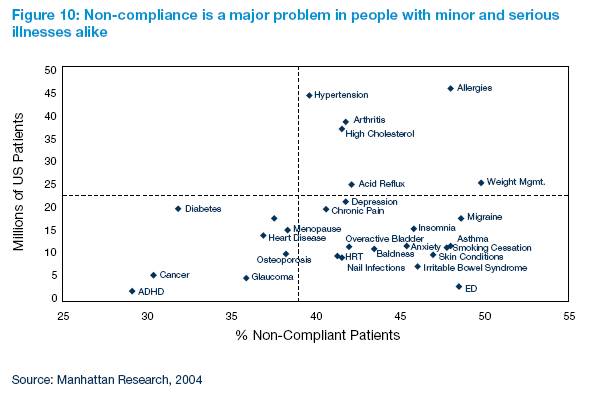
I found the following chart in PWC’s publication Pharma 2020: The Vision a good graphic.

noncompliance-pwc2020.jpg

Guest: On Price/Placebo Effect

Frederick Navarro is a research psychologist who, over the past 20 years, has focused his efforts on understanding people and the factors that shape their attention to health and care seeking. He has developed a unique model that approaches health care consumer behavior from a different angle than other models today. Over the past 10 years he has done considerable work with health plans and his findings often fly in the face of conventional thinking. He posted a long comment on my post the other day about Price and Placebo effect that I thought I would post here as a “guest post”.

On the issue of predictable irrationality and perception, what about the situation where a group of people rate their health status much better than another group of people, but the first group generates nearly twice the level of medical claims as the poorer health status group. That’s counter to the current belief that health status drives claims. So, what’s going on?

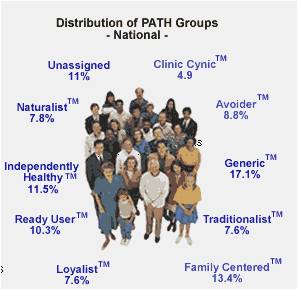
[His methodology divides people into PATH ( Profiles of Activities and Attitudes Toward Healthcare) Groups as shown below.]

path-groups.jpg

Well, the difference is how each group of people judge when it is time to seek care. When do they say, it is time to go to the doctor? Type 2 people only go to the doctor when problems are serious. They ignore their health and are apathetic towards it. They have health problems, but they just live with them. Type 7 people go to the doctor at the first sign of a problem. They monitor their health and are very proactive about it. If something appears, they seek care for it. These are the types of people it seems the health industry wants to build more of to reduce costs.

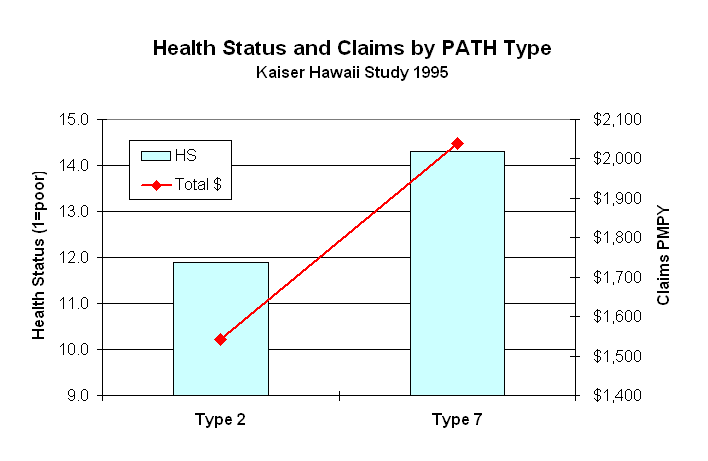
In a 1995 study of Kaiser members in Hawaii, the Type 2 members rated their health status 11.9 (SF-12 scale) and Type 7 members rated their health status at 14.3. The Type 2 group had avg claims pmpy of $1,541; the Type 2 group had avg claims pmpy of $2,040. Whoops! The higher health status Type 7’s had nearly twice the claims as the lower health status Type 2.

healthstatus_kaiser.gif

Let’s bring things closer to present time. In 2004/2005 year long study of Cigna members in a DM program the same patterns were there. At the baseline, the Type 2 group reported avg health status of 3.26 (1 to 5 scale) and the Type 7 group reported avg health status of 3.45. Type 7 were higher again! Type 2 avg claims pmpy were $6,176. Type 7 avg claims pmpy were $9,910. Whoops again! After a year, the DM intervention did not change this. At the end of the study, Type 2 people reported health status at 3.3 (a touch better), and the Type 7 people reported health status at 3.54 (a touch better again). The Type 2 group’s claims went down to $4,750 pmpy. That’s over a $1,400 drop. The Type 7 groups claims after 1 year of DM intervention dropped to $9,017 pmpy (almost a $800 drop). The Type 7 higher health status group still had claims that were nearly twice the level of Type 2.

The moral to this story is that the predisposition to seek care is a huge driver of health care costs. In some groups of people it overrides their perception of their health. In the 1995 study and the 2004/2005 study, the reason why the Type 7 people had higher claims is because they came in demanding care. That’s all. And the doctors are happy to see them!

This all harkens back to an earlier blog where you discussed the Dutch study and how preventive care did not lower health care costs. Providers have convinced everybody that the cure to lower health care costs is to encourage more people to become like Type 7 and to make care more accessible and affordable.

Predictable irrationality?

Looks like it to me.

healthstatus_dm_1year.gifhealthstatus_dm_baseline.gif

Webinar: Prescription Trend Mgmt Through Communications

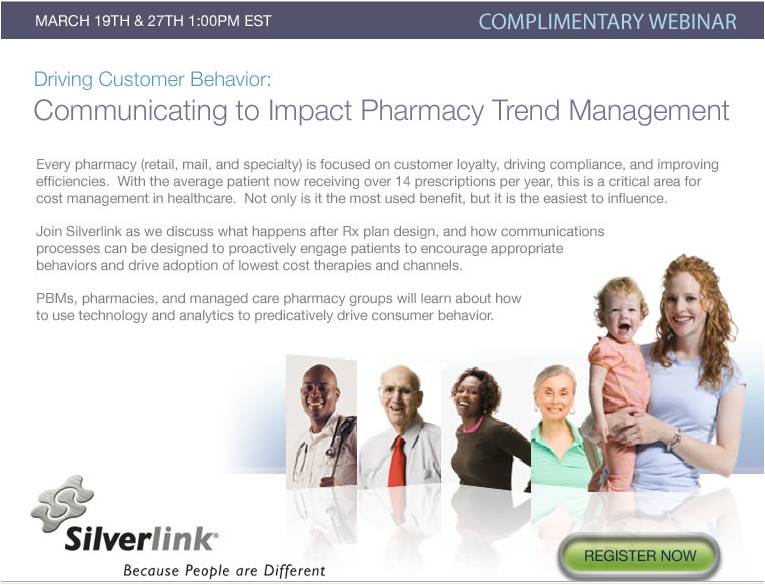
I must admit that one of my favorite things to do is give presentations. I used to do a lot of webinars at Express Scripts and have done a few others as a consultant. So, with that, I am really excited to schedule my first webinar as a Silverlink employee which I am going to do on my favorite topic – pharmacy trend management (i.e., brand-to-generic, retail-to-mail, utilization management).

So, if you’re a managed care company, PBM, or pharmacy that is interested, sign up for the event. I will talk about some of the common myths in driving patient behavior, talk about how to use speech recognition technology, and share some lessons learned and results and ROI examples.

I can’t post HTML here so the link below won’t work, but you can click here to register. Thanks.

webinar-pharmacy.jpg

ATDM: Automated Telephone Disease Management

No. It’s not my term or even a company term. I am not sure who came up with it, but it was actually used in a published study from 2001.

“Impact of Automated Calls With Nurse Follow-Up on Diabetes Treatment Outcomes in a Department of Veterans Affairs Health Care System.”
Diabetes Care 24:202-208
2001
John D. Piette, PHD, Morris Weinberger, PHD, Frederic B. Kraemer, MD, and Stephen J. McPhee, MD
Contact John Piette (jpiette@stanford.edu) for more information (Center for Health Care Evaluation)

“Findings from multiple studies indicate that chronically ill patients will participate in ATDM and that the information they report during ATDM assessments is at least as reliable as information obtained via structured clinical interviews or medical record reviews. Indeed, some patients are more inclined to report health problems during an automated assessment than directly to a clinician.”

Obviously, given Silverlink’s historical focus, these kind of external validations are important. I cited the one on exercise from Stanford a few months ago.

Here were a few highlights from the article:

  • Obj: evaluate ATDM with telephone nurse follow-up to improve diabetes treatment and outcomes in Department of Veterans Affairs
  • Design: 272 diabetes patients using hypoglycemic medications in randomized 1-year study. Bi-weekly ATDM health assessment and self-care education calls. Nurse educator followed up based on assessment reports. Automated survey measured self-care, symptoms, and satisfaction. Outpatient service use was captured. Glycemic control was measured.
  • Results: intervention patients reported more frequent glucose self-monitoring and foot inspections. Intervention patients were more likely to be seen in specialty clinics and have had a cholesterol test. Intervention patients reported fewer symptoms of poor glycemic control and greater satisfaction with their healthcare.
  • Conclusion: intervention improved the quality of VA diabetes care.
  • Description of the intervention:
    • Structured messages using statements and queries
    • Recorded human voice
    • Outbound
    • 5-8 minute calls
    • Used touch-tone keypad to report information (now you would use speech recognition to collect the data)
    • Offered an optional health promotion message at the end of the call
    • Each week the nurse reviewed the data and followed up with patients based on established protocol
  • Intervention process:
    • Average patient received 15 ATDM calls over the 12 months
    • 50% were very satisfied (31% moderately satisfied)
    • 97% said the messages were mostly or always easy to understand
    • 76% said the calls made them feel like their MD knew how they were doing
    • 67% said the calls reminded them to engage in self-care activities
    • 79% said they would be more satisfied with their healthcare if they got such calls
    • 73% said they would personally choose to receive such calls

Obviously, if you’re very interested in the topic, you should read the article to get all the finer points.

My takeaways are that if this technology worked in 2000 then it should be even more effective now. There have been lots of improvements. Additionally, we all know the costs of diabetes (and many other diseases) and the cost of using nurses as the primary means of follow-up.

Medicare COB Conference

If you are a Medicare provider, you might be interested in a conference Silverlink is hosting on Coordination of Benefits (COB). It is open to potential clients only, but here is the general information. If you are a potential provider, here is the basic information about the event.

Medicare Compliance: Strategies & Tactics for Complying with Medicare COB/Working Aged Survey Requirements

  • Wednesday, February 27, 2008 at 1:00 EST or
    Thursday, March 13, 2008 at 1:00 EST
  • 1 Hour

With Medicare requiring annual surveys of all members on alternative insurance coverage by September 1st, Medicare Advantage and PD plans need to develop their strategies now. These COB and Working Aged Surveys can be complex and lengthy for the member and operationally challenging for plans due to specific data formats CMS mandates. Learn how Silverlink and industry leaders are handling these requirements through active data management and proactive comprehensive communications campaigns that deliver measureably better results.

If you’re interested, here is a link to submit your information.

Data Power

Communications and data provide us with a valuable tool.  How to leverage facts and put them forward in a way that drives a response.  For some that is getting people to buy a magazine (e.g., 82% of Americans do X…read the article on pg X to learn more).  For others, it is to drive them to buy a product or to prove a claim. The power of statistics is magnified when you have someone who understands how to present information.

I have talked about some aspects of this before around Dark Data, Understanding Healthcare by Wurman, and a little in my entry around COB.

That being said, I found it interesting to read a blog post on Bad Science about “How To Lie With Statistics” which is apparently the best sold statistics book ever (and not even written by a statistician).   Here are a few examples.  Again, it just makes the point that you need to ask questions and understand how a metric is defined, who the survey population was, whether there was a bias, etc.  The data may still be very useful, but you need to understand it before you use it.

Peeling The Healthcare Onion

I think an onion is the right analogy for healthcare for three reasons: (1) it can make you cry; (2) every time you pull off a layer you learn more; and (3) what you see from the outside is a lot different than what you see from the inside.

    • It can make you cry.

      onion1.jpgWhen you have the Congressional Budgeting Office projecting the healthcare costs will be 49% of GDP by 2082, you know things have to change. This is a front page topic almost everyday across the country. But, like an onion, if we don’t handle this right, it will make you cry out of frustration and pain. Change is not easy especially in a complex system that we have today. Finding the right mix of push and pull is going to be important.

      Quality is still an issue across the system. Biting a bad onion or having a quality issue with your care can make you cry. Look at the USA Today article from the other day about Too Many Prescriptions, Too Few Pharmacies or an entry on my blog about the Institute for Healthcare Improvement.

      • Every time you pull off a layer you learn more.

      This applies so many ways to healthcare given our system, but I think of this from two perspectives – data / information and process. We have so much data in healthcare, but without the right model to make it into information, it just sits there. And, as we layer data (e.g., medical plus pharmacy plus lab) or integrate healthcare data with demographic data, we can learn so much more about our patients and how to care for them. This ranges from simple questions such as how to motivate behavior (e.g., cost savings versus loss avoidance) to how to deliver information based on their learning style.

      Every question you ask (or layer you pull off) reveals a new set of data that can be transformed into information while at the same time creating new questions. Does the relationship you found in the data simply indicate correlation or is there actual causality there? I look at the data that CVS/Caremark presented around saving 30% of healthcare costs by driving compliance and adherence and wonder why people aren’t jumping up and down trying to capture this savings.

      • What you see from the outside is very different than what you see from the inside.

      There is a concept in Six Sigma about designing the process from the outside-in. Imagine sitting in the middle of the onion…all you see is onion all around you. That is a common pitfall when solving problems in the industry that we work in. We are too close to the problem and the historical solution. If all we see is the onion, those on the outside (our patients / members / employees) see the onion in relation to other food options. Their expectations for healthcare are produced by other companies that they interact with. They expect web solutions that work. They expect excellent service. They expect to be valued as a customer and of course need the power to walk away and chose another option.

      onion2.jpgThis is a common problem in healthcomm (healthcare communications). We present information in a channel that we believe is effective based on our experience and paradigm (i.e., written, verbal, kinetic). We use language that we think is helpful. A few of my favorite examples from my PBM days are:

      (1) Telling patients that they need a renewal (prescription). They don’t know what that means. It means they need a new refill since their original prescription refills have run out.

      (2) Telling a physician to consider prescribing lisinopril and giving them sample bottles that say lisinopril. [Because, of course, they would know the chemical name for Zestril.]

      But, this happens all the time. Telling a person that wants all the facts a lot of qualitative information will fall on deaf ears. Providing a person with lots of options when their looking for an expert opinion will frustrate them. One way to frame this is based on personality type. (Of course, that information isn’t sitting in a database somewhere for us to tap into.)

      The reality is that people are different. As you think about your healthcare process, try to be the patient. As one of my bosses used to say, give it to your grandmother and see what she thinks. Can she understand it? Can she make sense of the process?

      It’s not easy finding the right amount of onion to use in your recipe, but it is important to continue trying to improve.

      Myers-Briggs in Healthcare: Part 2 of X

      I was looking for a book the other day to read on some of my flights and came across Health Care Communication Using Personality Type by Judy Allen and Susan A. Brock. I have just started reading it, but I related very well to their key assumptions:

      1. People prefer to communicate in different ways.
      2. Most people have a preferred style of communication.
      3. It is easier to communicate with some people than it is with others.
      4. A system exists which provides a simple framework for understanding these differences.

      As I have mentioned before, I think that Myers-Briggs is a good framework for understanding people. I often pull up my notes about my personality type and can see that I respond as predicted to certain situations.

      Applying some of their initial thoughts with my perspective, it would seem like there are some basic hypotheses that you could make in talking with patients.

      • Extraversion: People that like to talk things out. Probably more likely to respond to verbal outreach.
      • Intraversion: People that like to think things through. Probably more likely to respond to print (e.g., letter or web).
      • Sensing: People that like the specifics and the details. Probably more responsive to a detailed message (e.g., you can save exactly $X by doing this). Probably want to see the path of exactly who needs to do what.
      • Intuition: People that see the big picture. Probably more responsive to a communication that helps them understand the impact of their decision on overall healthcare trend. Probably want to understand their options versus being guided down a path.
      • Thinking: People who are very logical. They should respond well to automation and would want an if/then type of message.
      • Feeling: People that are more emotional. They would likely respond best to live agents where they could empathize with them and potentially even respond to a “peer pressure” type of message (e.g., most people are now using generic prescription drugs).
      • Judging: People that are organized, punctual, and focused on getting things done. They would likely respond to messages about how to save time and money delivered in the quickest format possible.
      • Perceiving: People that are flexible, don’t plan ahead, and are often more disorganized. They would likely respond to a just-in-time message, a compliance reminder, and a communication process that did everything for them (e.g., you should go in for a colonoscopy…would you like us to schedule that for you).

      Obviously, one framework doesn’t solve everything, but I expect that there is a lot more to gain from this book as I read through it. I was just so excited after the first section given my interests that I wanted to post this quick entry.

      Information Latency: Why Don’t We Change?

      I have had this note to self for a while so I am finally going to put a quick entry out here on the topic.

      The issue is data latency or more appropriately information latency.  The data often exists right away, but the challenge is how to you get the data into a usable form, with context, and with enough data to make decisions.

      In communications, this manifests itself in healthcare in two ways that immediately jump to mind:

      1. In a traditional letter program:
        • You send a letter to a patient (7-10 days from data targeting to mailbox)
        • Patient opens the letter and has to contact their physician (if they choose to do anything)
        • Patient trades messages with physician and/or has to schedule an appointment
        • Patient meets with physician who (for example) writes them a new prescription
        • Patient waits for medication to run out then refills with new drug (e.g., generic, on-formulary drug)
        • Claims get aggregated and reports run
        • Best case – 30+ days to see if program had any effect (most likely 6 months)
      2. In a traditional survey:
        • Company prints a survey and mails it to 10,000 people hoping for a 10% response rate to get a statistically valid sample size of 1,000
        • Patients fill out the survey over the next month and mail them to a data entry company
        • Data entry company manually enters them, aggregates the data, and creates a report
        • 45-60 days later the company has information from the survey

      Of course, the issue with both of these is that you have lost a huge window of time especially if you need to make changes to your program or the survey tells you that you need to gather more information.

      Why don’t more companies talk about on-the-fly program changes and how to use modern technology to get real-time feedback for programs where they can pause the program, make change (e.g., change the message, add a new question), and then continue the program?

      Single Answer or Multiple Answers

      I was having an interesting discussion yesterday about how to solve a problem.  The two opinions were whether there is a best answer or whether there are multiple best answers.  It’s a great question.

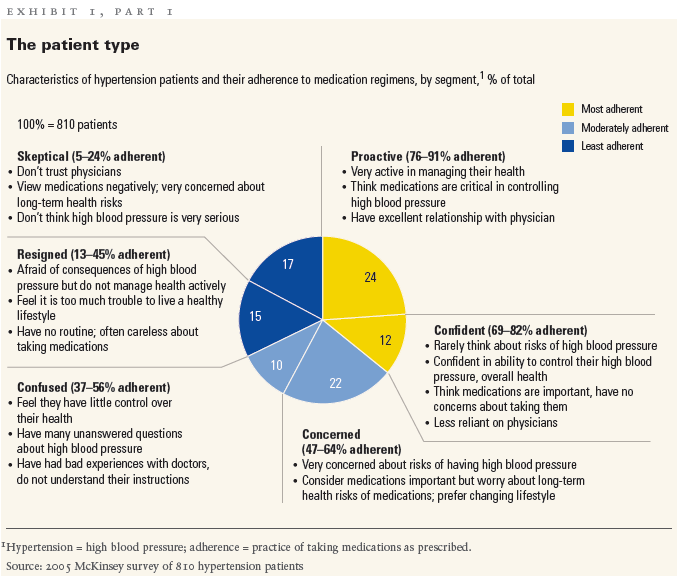
      Let’s frame it this way.  Is there a message that is most likely to drive compliance for a group?  I gave them the benefit of the doubt that they aren’t crazy enough to suggest that one message works generally with no segmentation.  (McKinsey‘s article “Getting Patients To Take Their Medication” has some good research around creating segments and showing how some of the segments vary in what they want.)

      The other person was presenting a case that they could do lots of research on linguistics and other topics and suggest one optimal message that would work across broad segments of the population.  I was of the opposite opinion that a personalized message that had certain core research but varied by geography, condition, age, income, benefit type, prior interactions, etc. was better.  And, that what is good today may change both generally and individually over time.

      I would rather get all the micro-niches of people to their highest compliance and adherence level versus getting a better average across all group. 

      Basically, my position is that there are multiple optimal solutions to the problem not just one.  It triggered a memory for me of when I first went to business school.  In architecture school, design is somewhat subjective.  (There are some logical rules such as the Fibonacci Sequence which serve as guiding principles of scale…for example.)   We were taught to always bring three solutions to our initial presentations to let the judges decide which one we should push to finalize.  We had to pick one for a deliverable, but it was always a tradeoff.  In business school and the hard sciences, there is often only one answer that is valid.  (1+1 always equals 2.)

      But, for communications, marketing, and other things, it seems obvious to me that companies are best served by dynamic flexibility that allows them to bring multiple solutions to the market in parallel that adapt to different patients and change over time to respond to the market and the patient.

      Here is a quick snapshot of the segmentation from the McKinsey report…

      mckinsey-hypertension-segmentation.png

      Diagnosis Code Plus Rx

      In a WSJ Blog article about sound alike drugs, they have a potential solution about having the physician add information about why the drug is being used.  Obviously, the low hanging fruit here is to move to electronic prescribing where the clinical information (i.e., diagnosis code) is in the same file as the drug and technology can be utilized to look for potential issues.

      In the short-term, adding the diagnosis code (aka ICD-9 code) to the prescription would have lots of benefits.

      • Avoid getting some point-of-sale rejects when a drug is used off label.  Or vice-versa, avoid off-label use by rejecting claims.
      • Avoid getting suggestions you change prescriptions only to find out that you should not do it given your diagnosis.
      • Development of proactive algorithms (e.g., macros) in the technology where whenever a doctor diagnosed diabetes then it would pull up their typical regiment of drugs based on formulary status and other inputs.
      • Better tailor / personalize information based on disease and drug to help the patient and their care team drive successful outcomes.

      The issue of sound alike drug names is a real issue.  Obviously, any time you have multiple human handoffs in a process then you increase the likelihood of error.  As I think I have talked about before, I remember my MD prescribing an eye drop.  I picked up a prescription and the pharmacist clearly told me to put one drop in each eye twice a day.  At the end of the second day, I read the label in detail and realized that it said to put the drops in the ear only.  When I called them back, they talked to the MD and realized that they had heard the wrong name when they listened to his voicemail.

      Communications

      I can never stress the value of communication skills to anyone I met regardless of the path they want to go down in life.  I have had the luxury from an early age of public speaking beginning with something called Model United Nations (MUN) where you represent a country in mock-simulations of the UN process.  [We even won a national championship at my high school…and it really isn’t as geeky as it sounds.]

      In graduate school, I participated in Toastmasters for a while which I think is great for someone who needs a casual setting to practice and get feedback.  I can even remember using one of the techniques from there (counting “ums”) when my sister told me she was going to be a lay minister in the Catholic church and be giving sermons.  [Note: Feedback on presentation skills isn’t always well received by people not seeking it out.]

      I found a couple of presentations on the topic that I thought might be interesting to some of you.  Additionally, you might research the Minto Pyramid Principle which is a structured approach to communicating by an ex-McKinsey consultant.  (It was required reading/training at Ernst & Young years ago.)

      This one is a little basic, but I have seen so many bad powerpoint presentations that obviously many people could use the primer.

      One last one before getting back to work…Here is one on marketing which obviously has communications at its core.

      Where Are The Evidologists?

      After one of their team posted a comment on my site, I went to Bazian‘s website.  Very interesting.  They are a UK based company that focuses on providing evidence-based healthcare information to publishers, governments and insurers.  Sounds promising.  This is an important issue across the world as companies and practitioners look at how to embed intelligence into process and technology to deliver the best outcomes.  Here is a presentation that they have for download on their website.  In it, they propose a new healthcare role of the evidologist and draw a nice parallel to the radiologist.

      “In late 2005, Bazian gave a presentation about putting evidence into practice – a much discussed topic in the world of evidology.  It summarised 10 years of experience in evidence-based medicine, and draws conclusions about who should be putting evidence into practice, when, and what has to really happen for evidence to become a routine part of medical practice.”

      Ev·i·do·l·o·gy n.

      A new medical specialty that enables medical research to be incorporated systematically into clinical practice [Latin videre to discern, comprehend; evideri to appear plainly]  

      Increasing GDR

      I love reading healthcare articles which have acronyms that not everyone knows. (Maybe it was defined earlier, but I didn’t see it.)

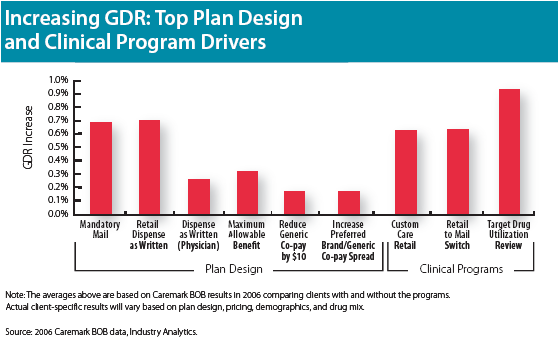
      Another nugget from the Caremark trend report is on programs and plan design components to drive generic dispensing rate (GDR) which is the number of prescriptions filled as generics divided by the total number of prescriptions filled. (Versus generic substitution rate which is the number of prescriptions filled as generics divided by the total number of prescriptions filled for which a chemically equivalent generic is available. I can’t remember whether we used only A-B rated generics or all generics, but that is a technical discussion for another time.)

      caremark-driving-gdr.png

      This is great. It tells you the impact (on average) of implementing a plan design or some of their clinical programs on your GDR. (BTW…a good rule of thumb is that an increase of 1% in GDR is worth about 0.75-1.5% savings in your overall prescription spend.)

      US News and World Report Health Links

      If you haven’t been there, US News and World Report has a good site for healthcare rankings and other information. Here are a few of the things you will find there:

      1. A link to Healthline where you can get help with Medicare Part D
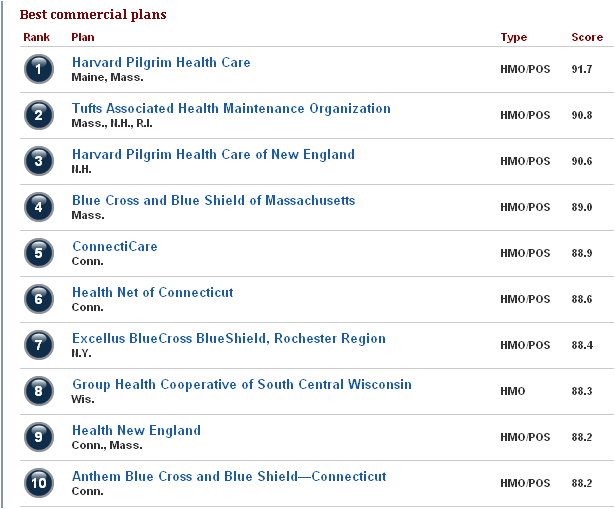
      2. A list of the top plans according to rankings by NCQA (National Committee for Quality Assurance)
      3. Risk assessment tools on things like heart disease
      4. Links to health centers on topics like Asthma

      Of course, the ranking are the most unique feature since the other health information is probably available on lots of other sites.  You can see some of the things that NCQA looked at in the rankings on the site also.

      us-news-rankings-of-plans.png

      Sticky Messaging

      We used to talk a lot about stickiness of websites and eyeballs back in the late 1990s. The word still has some attraction and is a key point in the recent McKinsey interview with Chip Heath. Chip is a professor of Organizational Behavior at Stanford University’s Graduate School of Business.

      “The key to effective communication: make it simple, make it concrete, and make it surprising.”

      Although the article is primarily around what executives need to do to make their messaging and ideas stick with diverse audiences, it has a lot of relevance for healthcare.

      “A sticky idea is one that people understand when they hear it, that they remember later on, and that changes something about the way they think or act.”

      Think about all the things you want to tell your patients or members or employees (or vice-versa all the things you patients want your healthcare companies to tell you):

      • There has been a change to your X (copay, formulary, network).
      • You have an opportunity to save money by doing X.
      • We are missing X data that will delay your coverage.
      • We see that X happened and wanted to gather data on your experience or proactively address your question.
      • Welcome to our plan. Have you registered on the website? Have you received your ID card?
      • Please take this Health Risk Assessment.
      • Your credit card has expired. Would you like to update it?
      • Your order is delayed. If this is an emergency, please do X?
      • We see you were on the website. Did you find what you needed?
      • Do you need a copy of your X (formulary, provider directory)?
      • You have not yet picked a Primary Care Physician. Would you like to do that now?
      • Did you receive the information that we sent you?
      • Are you following your physicians orders? Did you do X? Why or why not?
      • Our records show us that you are due for a X. (Flu shot, screening)
      • Are you using any over-the-counter products that we should have in our database to identify drug-drug interactions?
      • Please remember to refill your medication?
      • Are you having any side effects or complications associated with your recent medication or procedure?
      • Have you enrolled yet in our disease management (or incentive) program? Would you like more information?
      • Welcome to the plan.
      • We know it is time for open enrollment. We hope you will renew with us. We are offering a local meeting to help you learn more about your benefits. Would you like to attend?
      • X has changed with your drug, condition, etc. There is new information available at Y.
         

        Getting back to the article…He offers several good examples of sticky messages which are primarily what I would call rallying calls for organizations. In healthcare, the key is to find these simple messages that compel people to act. So, bottom lining it, he gives six basic traits:

      1. Simplicity – short and deep
      2. Unexpectedness – uncommon sense messages generate interest and curiosity
      3. Concreteness – his example is don’t say “seize leadership in the space race” but say “get an American on the moon in this decade”
      4. Credibility – this should be so easy in healthcare if you leverage all the people and stories out there
      5. Emotions
      6. Stories

      He has a few great stories such as:

      • A Nordstrom’s person wrapping something bought at Macy’s just to make the customer happy. [And probably without point it out.]
      • A FedEx driver who forgot the key to a box simply unbolting the box from the ground and throwing it in the truck so they weren’t late.

      These things reinforce the message while becoming a type of urban legend that stay with people. They evoke emotion in a simple way.

      One good example I have from Express Scripts was around trying to motivate people to change from one drug to another. When Zocor was going generic, we decided to launch a huge multi-modal campaign to drive down Lipitor marketshare and move people to Zocor so that when it went generic everyone would win. [Clients would save; patients would save; and we would make more money.] It worked. But, prior to the program, we worked with linguists and others to design and test a set of messages. The one that resided best was “we have a secret that can save you money”. People were intrigued and listened. They felt like they were being let in on something that was important. We ended up positioning it similar to a Consumer Reports Best Buy. It worked.

      Prioritization Framework

      I was cleaning out some files over the weekend and came across an old prioritization matrix that we used at Ernst & Young when I was a consultant there. I found it to be relatively easy to use and understand so I thought I would share it. Ever person I know always struggles with how to select which project to do using a consistent framework that takes into account more than simply financial ROI.

      We ranked each of the following on a scale of 1-5 and weighted each category to total 100%:

      • Potential Value
        • Strategic alignment (5 = enterprise sustaining and helps build learning organization vs. 1 = tactical)
        • Financial impact (5 = high ROI, lowers costs, and is growth oriented vs. 1 = lowers costs)
        • Customer satisfaction impact (5 = affects all constituents, builds loyalty, and creates differentiation vs. 1 = affects only one constituent)
        • Competitive status (5 = used by all traditional and evolving competitors vs. 1 = used by no competitors)
      • Ability to Execute
        • Organizational readiness (5 = requires minimal cultural, process, or technical change vs. 1 = requires new systems, business model, and staff)
        • Proven technology ( 5 = implemented at multiple sites with proven value proposition vs. 1 = concept only, no proven value proposition)
        • Time and resources required to implement ( 5 = resources easily accessible and can be broken into 3-6 month deliverables vs. 1 = scarce resources and no deliverables until after 12 months)

      Patient (Customer) Value – Social Dimension?

      I was reading an interesting entry on Forrester’s Marketing Blog about redefining the value of your customer away from ROI to something that reflects their social value.  The author defines social value as:

      1) A customer’s knowledge and involvement – in short, his level of expertise and interest in the category and brand. 

      2)  How he participates, and the value of his connections – what social activities is he involved with (both on and offline) and where (on what networks is he active).  The value refers to the value of the connections themselves:  are the communities more tightly-knit or diffused, are they public or more intimite.

      3) The number of contacts the customer has in each network. 

      It made me think about two things: (1) how would we value a patient in healthcare and (2) how do we drive and evaluate social value.

      Different constituents would value patients differently [these represent logical hypotheses but not fact]:

      • To a pharmacy, it is the high utilizer that they want.  And, they make the most money off a cash paying customer who buys generic drugs at something close to their AWP (Average Wholesale Price) which is about 70-90% too high.
      • To a PBM, it is the chronically sick patient who fills lots of drugs but is very active in their healthcare so they use the website, use mail, use generics, and don’t call customer service very often.
      • To a managed care company, their highest value customer (or patient) is the healthy individual who is insured so that they collect the premium but don’t actually pay anything out.
      • To the physician, their highest value patient is the sick consumer who needs specialized care which they have to provide (e.g., injections done by the physician).  In a capitated model, this is different because they want to create healthy patients and are incented to promote wellness.
      • To the hospital, their highest value patient is the insured patient who has a complex illness that requires lots of tests or who has an elongated hospital stay.

      Driving and evaluating social value is a different animal.  I do believe that providers and insurers should be promoting communities of care where people with diseases can share experiences and information.  That will be a powerful tool in promoting consumerism.  A managed care company (e.g., United, Humana, Wellpoint, BCBS) has enough scale that they could create an anonymous discussion area for their covered lives which was moderated by an expert.  (Not too dissimilar to the disease specific pharmacies that Medco is creating with their Therapeutic Resource Centers.)

      Assigning value is more difficult, but it could be a composite score of activity on the web, registration in certain groups, etc. It won’t be perfect, but it is clear that some people are outspoken advocates which can promote or hurt your brand.

      Myers Briggs for Healthcare (1 of X)

      I have been a big fan of Myers Briggs for years.  Every since I took the test and realized that it described me to a tee.  I even took an elective in graduate school to drill down on the testing and look at ways to use it in team development and other activities.

      The purpose of the Myers-Briggs Type Indicator® (MBTI) personality inventory is to make the theory of psychological types described by C. G. Jung understandable and useful in people’s lives. The essence of the theory is that much seemingly random variation in the behavior is actually quite orderly and consistent, being due to basic differences in the ways individuals prefer to use their perception and judgment. (source)

      If you haven’t taken the test, here is a site where you can answer a page of questions.  I took it and it matched my end result from numerous testings.  So why bring it up here?  And, why is this entry 1 of X?

      First, I am a big believer in trying to categorize individuals to make some assumptions about how to deliver healthcare information to them.  This is one theoretical attempt to do this.  Second, I am certainly not going to solve this tonight so I will layout a few thoughts and likely pick the topic up again.

      The first category is Introvert (I) or Extravert (E).  For me a healthcare introvert is someone who doesn’t talk about their family history or their individual ailments.  If they feel sick, they will research it before making an appointment.  Additionally, they may read online discussion groups but won’t participate.  The extravert will ask everyone’s opinion about their condition.  They want to tell you their cholesterol.  If they feel bad, they go right to the ER or Urgent Care.  And, if they have a chronic condition, they are active in online or physical groups.

      The second variable is Sensing (S) or Intuitive (N).  For me, the sensing healthcare person has a deep memory of their condition.  They can tell you (and may even record) all the facts about their experience with a provider, drug, or disease.  The intuitive healthcare person remembers the general patterns (e.g., every time I eat after taking my pill) and speculates on what this might mean.  They aren’t focused on the specifics but more on the possibilities.

      The third variable is Thinking (T) versus Feeling (F).  The thinking healthcare person is consumed by the facts.  They want to read the medical research and debate with their providers the treatment plan based on an article in the New England Journal of Medicine.  The feeling person is much more driven by experience.  If the placebo is helping them, they are willing to stick with it.  Or, if their neighbor says that generics are not good, then they won’t buy generics. 

      The final category is Judging (J) or Perceiving (P).  The judging patient is planning their care path or wellness.  They participate in disease management.  They go to preventive clinics.  They get the flu shot even if they never get the flu.  The perceiving person reacts to the events.  They don’t have regular check-ups unless they are in pain.  They don’t participate in any programs unless they are sick.

      These are some initial thoughts, but we all know that figuring out a healthcare segmentation model that would predict behavior is significant.  I don’t have the answer, but I think there is something here. 

      If you know your type and want to learn more, here is a good site I found. (http://typelogic.com/)

      Is Marketing a Process?

      Is marketing a process or really a bunch of sub-processes that are part of other end-to-end processes?  I was looking at how to automate the different marketing functions (new product development, product management, pricing, research, marketing communications, and voice of the customer) and realized that most of these are simply part of a bigger process.

      The process that consumes most of these is the lifecycle from idea through sales through billing.

      Here is a quick picture I came up with to describe the marketing function from a subprocess view.

      Marketing_overviewPerhaps you wonder why this matters?  Architecturally, it matters if you are building a system and want to connect processes.

      Technology-wise, it matters if you want to focus on a SOA (service oriented architecture) approach where you can re-use components.

      Organizationally, it matters to understand how data and tasks flow and how to optimize your investment.

      Process-wise, it matters to understand best practices.

      As I have talked about several times, the fear with any improvement is sub-optimization which often happens when you focus on a subsection of the entire process.

      Here is a article to read on sub-processes (a little technical for some of you)

      http://www.bpmenterprise.com/content/c070212a.asp

      Picture is worth a thousand words (at least)

      As a former architect, I am a big believer that pictures have significant value in the business world.  I have been asked dozens of times to take complex ideas and simplify them down to a single-frame image that people can post in their cube or use in a meeting.  These images can be powerful.

      At Express Scripts, we choose to take on the battle of moving market share from Lipitor to Zocor a few years ago.  This was set up to save clients and patients billions of dollars as the Zocor patent expired.  We had a list of 50 ideas which we paired down to 30.  The challenge was how to get people to think about and rally around the 30.  I came up with what was initially called the “bubble chart” which showed the 30 ideas in swim lanes and then time-mapped horizontally against key milestones.  This became used everywhere and even presented to the street.

      This is important to BPM in several ways:

      1. If BPM is to be transformational, you need a future state vision that can be captured and disseminated across the company.
      2. If process mapping is part of your communication strategy, a simple to understand process map is critical.

      I started thinking about this when I received an e-mail newsletter from BentonsEdge which is a company that helps you frame out your value proposition.  I have met with Dan Davison, the CEO, several times.  He seems to have a great process and good understanding of helping clients get to a simple story about their value proposition.

      One example is below.  It is a little busy, but it captures all the complexities of raising capital in a one-page slide which is amazing.

      http://www.tellingyourstory.com/content_library/files/whitepapers/RaisingCapital.pdf

      Bentonsedge_startup

      Continue reading

      BPM Lessons Learned

      So…many of you thought I was going to offer some BPM lessons learned the other day.  Here they are:

      1. If you jump right to technology, you will go backwards and have to do process mapping and/or reengineering.  Additionally, your project will take longer because you don’t understand your metrics and the business side.
      2. BPM done right will cause organizational pushback.  Your adoption strategy is important.  This is traditionally overlooked in most technology implementations but here (whether you do this on paper or in a system) you are telling people how to do things that may have been fairly unstructured before.  You need to think through this.
      3. Don’t throw out the baby with the bathwater.  What I mean by this is don’t abandon what has worked for you in the past.  If you have application development, project management, release management, or change management practices that work, don’t ignore them just because BPM is new.
      4. Real-time ongoing JAD doesn’t work.  I have seen a few companies try to do real-time application development where the users are looking over the shoulders of the developers and trying to make changes.  Just because you can do this – don’t.
      5. Take action and divide your objectives into bite-size chunks of work.  Don’t take on an end-to-end process that spans the globe and touches 5,000 people.  Understand the big picture and fix the key pain points in the process.
      6. BPM technology will make you think about SOA (Service Oriented Architecture).  And, having SOA will make BPM easier.
      7. Just because there is a better way is not a reason to change.  Focus on the business case…document the current state…and capture the actual results.
      8. Find an internal evangelist at a high enough level to support your efforts.  (always a good thing)
      9. No one (vendor or consultant) can provide everything you need.
      10. Simulation doesn’t exist (that I have seen demonstrated to show value).

      BPR vs BPM: What’s Different?

      I had the opportunity last week to debrief Michelle Cantara (VP at Gartner) about Talisen. We had met at the Gartner BPM conference, and she was intrigued by our offerings around BPM which include several fixed fee projects. In talking with her about BPM and sharing with her our methodology and typical sales pitch, I was flattered when she saw the table below and suggested that she might re-use it.This shows the difference between BPR (Business Process Reengineering) and BPM (Business Process Management). Bpr_vs_bpm_2

      The McKinsey Way

      You can certainly never go wrong looking at McKinsey. Their consultants are usually very top notch and their process of thinking and root cause analysis is great. Although this post is more about how you analyze a problem (i.e., business process innovation), it also makes a point about how important process and methodology is. The only way of delivering consistent, high-quality advice worldwide is to have a process of training and consulting that leverages smart people and delivers them to clients.

      (Never mind the fact that McKinsey once told me that they only interview people with a 4.0 or people with a 3.8 and above from a top 5 business school. I didn’t fit the bill, but I have several good friends who were there. I have lots of respect for them.)

      The McKinsey Way is actually a book so you can see some insight into the company. I have read the book and recommend it. Rather than re-type all my notes, I found comments about the book at MeansBusiness and on blog called Brian Groth’s Life at Microsoft and looked at notes on MECE (mutually exclusive, collectively exhaustive) from a book review on The McKinsey Mind.

      My old boss who worked for McKinsey was a genius at asking the probing questions. She knew how to get to root cause better than anyone I worked for. This is essential in diagnosing any problem not least of which are process problems. (Since I assume you only look at BPM to drive value where you have some type of problem.)

      So MECE, as Brian states in his blog, it suggests you should do the following:

      1. Identify the problem using a mutually exclusive, collectively exhaustive framework and then map the problem out using some type of logic tree (see example).
      2. Create a hypothesis (or hypotheses) about the solution…this drives your analysis.
      3. Analyze the data…remember that the only thing that is right is data (assuming some data integrity).
      4. Repeat steps 3 & 4 until you find a fact-based solution that makes sense.

      From the book, some of the other key points are:

      1. “The most brilliant solution, backed up by libraries of data and promising billions in extra profits, is useless if your client or business can’t implement it.”
      2. “Most business problems resemble each other more than they differ.”
      3. “If you get your facts together and do you analyses, the solution will come to you.”
      4. “If you keep your eyes peeled for examples of 80/20 in your business, you will come up with ways to improve it.”
      5. “Know your solution so thoroughly that you can explain it clearly and precisely to your client in 30 seconds.”
      6. “It’s much better to get to first base consistently than to try to hit a home run and strike out 9 times out of 10.”
      7. “Just as you shouldn’t accept I have no idea from others, so you shouldn’t accept it from yourself, or expect others to accept it from you. This is the flip side of I don’t know.”
      8. “When you’re picking people’s brains, ask questions and then let them do the talking. Keep the interview on track by breaking in when necessary.”

      Lesson From The Apprentice

      As one of my favorite shows, I was glad to see another good lesson in this week’s episode of The Apprentice with Donald Trump.  One of the three teams just completely bombed the assignment because they had no theme.

      As you approach process work or BPM, it is critical to make sure you understand your current state metrics; what is important to drive the business; and how to make a difference.  Too many people want to jump right in without understanding the so what (i.e., the theme) of their effort.  Finishing a project that missed the mark is as bad as not finishing the project.

      Power Facilitation

      Back at E&Y, we had a process called the Accelerated Solution Environment (ASE).  For $250,000, we took clients through an amazing 2-3 day facilitated event that got months worth of work done with creative thinking and fostered huge buy-in across the groups.  Tons of clients did it, but it was expensive.

      I lost touch with the group, but I just found them the other day.  They are now a standalone entity called Wildworks Group which offers a portable environment at a fraction of the cost…but with the same results and amazingly quick product.

      This is great for rapid requirements gathering, strategic visioning, project kickoffs, or other activities that require cross-functional participation and buy-in.

      Process Opportunity Prioritization

      As you get your BPM project(s) to production, you will quickly see the tangible benefits and numerous opportunities will come to the surface.  How do you move to prioritize those?

      There are several approaches including simple 2×2 quadrants that rank projects based on percent automation versus frequency of use.  Companies can also use the Kano Model from Six Sigma.  The Kano Model looks at how different attributes relate to customer satisfaction and help companies drive for “delighting” their customer.

      Another framework from my E&Y days that I like lays out attributes based on potential value and ability to execute.  Each of these attributes (see below) is then rated on a 1-5 scale which can be weighted.  The projects are then ranked base on total score.  Some of the attributes in these two areas include:

      1. Strategic alignment
      2. Financial impact
      3. Customer satisfaction impact
      4. Competitive status
      5. Organizational readiness
      6. Proven technology
      7. Time and resources required

      Identifying the right attributes for a company should be driven by an understanding of the corporate strategy and the metrics that drive that strategy.

      Change Management

      One of the areas of project implementation most overlooked across the board is organizational change management.  This “soft” area often scares people away, but anyone who has done a major implementation of a complex project will tell you the importance of this.  Every constituent has a WIIFM (What’s In It For Me) attitude, and they see the project through the impact that it has on them.

      I was reading some other sites about project management, and they stressed the importance of the PMO or COE (Center of Excellence) in managing the change.  But, a lot of people don’t understand the tangible deliverables of an organizational change management plan.  Some of the typical deliverables include:

      1. Implementation readiness – understanding the implications, creating a strategy, and assessing the leadership readiness to support the change
      2. Stakeholder management – identifying the stakeholders, lining up leadership support and change agents, capturing risks and benefits, and building commitment
      3. Communication – communication strategy, communication plan (audience, medium, message, frequency, author), and execution
      4. HR strategy – identification of future state and changes (e.g., new skills needed), pay and performance management, competency development, and staffing plan
      5. Team effectiveness – clear project charter, shared vision, and understood business case

      E&Y, Accenture, and many of the large consulting companies have build competencies in this area.  In my time at E&Y, I worked with many clients in the data warehousing and performance management areas regarding change management.  It is not easy, but it is very important to get right.

      Center of Excellence

      After you have your first few BPM projects complete, it is natural to begin looking at sustainability and best practices.  A typical way to approach this is to build a Center of Excellence (COE), but companies have to avoid the PMO (Program Management Office) trap.  Corporate level PMOs were set up to do the same thing, but only a few have been successful.  Keeping your COE (or PMO) lean and focused is key.  A good strategy is making it a rotational role so it doesn’t become an ivory tower and make sure that it is composed of cross-functional people with line experience.

      What does a COE do?  It serves as the knowledge repository for the organization on BPM strategy, methodology, tools, market changes, processes, business cases, templates, etc.  The team should be versed in multiple approaches to process management (e.g., BPR, BPMG training, Six Sigma, Lean) and should understand system development with experiences with BPMS, BI, DW, and EAI.  Essentially, they are acting as internal consultants to evaluate projects, create the business case, recommend the right approach, and make sure teams are successful.

      The COE is going to answer questions like: How long should this take?  Are their re-usable sub-processes or services that we should link into?  Is this the right BPMS?  How do we integrate with our existing data warehouse or document management system?  How do you analyze our processes? What works well?  What doesn’t work?

      A few articles on this:

      • Moving On Growing the Team’s BPM Capabilities – key points include conduct benchmarking, evaluate different approaches, take an iterative approach, build experience on the right types of projects, address governance early.
      • Infosys Presentation – key points include building standards, doing market analysis, linking efforts, and knowledge management.
      • IT Toolbox Blog –  talks about the process culture which become critical as you move from functional focus to process focus and address the issue of governance.
      • Allstate Article – this is an old article (2002) but it talks about Allstate’s Process COE that they built in 1997.  some of the key points are building models and templates, linking projects to the enterprise vision, and moving to process stewardship.

      This is a key topic so I will continue to add to this, but it is an important part of your roadmap as you embrace BPM.