Archive | Value Propositions RSS feed for this section

Some Foods And Drugs Don’t Mix

Without getting into all the clinical rules, I’ve always looked for a cut-to-the-chase consumer list of when to avoid what specific foods if you take certain medications.

Finally, in Real Simple magazine (pg. 74, Jan 2010), I found one.  Here it is:

  • Avoid grapefruit [including juice] if you’re taking a cholesterol lowering drug or a prescription sleep aid.
  • Avoid chocolate if your using an MAO-inhibiting antidepressant.
  • Avoid black licorice if you’re on heart medication.

I’m not sure of the science here, but I’m assuming that it’s real.  I’ve heard the grapefruit advice before, but never the others.  Do physicians and/or pharmacists tell you this?

The story also goes on to recommend a few foods:

  • Shiitake Mushrooms – help boost the immune system and prevent the growth of cancer cells
  • Brazil Nuts – may ward off colon, lung, and prostate cancer
  • Horseradish – increase the liver’s ability to fight carcinogens and suppress growth of cancerous tumors…and may help avoid urinary tract infections.
  • Walnuts – help reduce cholesterol and inflamation that may lead to high blood pressure and heart disease
  • Black rasperries – may retard the growth of precancerous cells

So…watch what you eat!

Why Didn’t I Know There Was A Generic Version

I got this question e-mailed to me today.  The patient has been using the same drug for years and it lost it’s patent about 6 months ago.  They just found out that they could have saved a lot of money and wondered who should have told them.  Here’s my thoughts.

  1. It’s the member’s responsibility ultimately to search for ways to save money and ask for generics.
  2. A lot of managed care companies and PBMs won’t reach out when patents expire because 90% of the time the drug is switched to the generic within 90-days by the pharmacy.
  3. The key players who would communicate are aligned – the pharmacy / PBM makes more money when generics are used and the managed care plan saves more money.
  4. BUT, sometimes managed care plans or individual employers (groups) will opt-out or never sign up for communication programs so their members don’t hear about ways to save money.
  5. BUT, sometimes consumers opt-out of communications from the PBM or managed care company and therefore miss out on opportunities.
  6. BUT, sometimes physicians won’t allow the prescription to be switched to the generic drug (even when chemically equivalent) and will write the prescription DAW (Dispense As Written) or say no substitution allowed.
  7. BUT, there have been a few instances when due to exclusivity on the generic that it actually costs more than the brand during the initial 6-months and people don’t move to the generic.

So, with lots of nuances, my reply was that no one had a legal obligation to tell her, but they all had good incentives to do it.  I suggest talking to the physician and/or the pharmacist.

Because People Are Different

I’ll borrow our tagline from Silverlink Communications Because People Are Different – to follow-up on my post on direct mail from yesterday.  The first commentor makes a good point.  Certainly e-mail doesn’t work for everyone.  Nor does the phone (although it is generally ubiquitous today). 

The reality is that different segments require different modes of communication.  The question is how to figure that out. 

  • Do you ask people for their preferences…realizing that many times people don’t know what they want or need?
  • Do you look at historical behavior to predict what will work best for people like them…realizing that healthcare is intensely personal and while predictive may not be indicative…and people’s healthcare behaviors change over time?
  • Do you pursue a cluster approach – i.e., send multiple modes simultaneously…realizing that this isn’t very cost effective?
  • Do you pursue a strategy of sequencing – i.e., call then e-mail then letter – and which pattern works best…and what spacing between modes works best?  (This will vary by message, objective, and audience.)

And, the question that I surprisingly don’t hear many people ask is why is there so much direct mail when we as a culture are generally more interested in being environmentally aware than ever (although we still have a long way to go).  Why kill a tree when other modes are more effective, less expensive, and offer better consumer insights?

Should Rx Data Be Used By Pharma?

This is a great question as posed by numerous people (see WSJ blog).  Now, the one reality that most people don’t realize is that the data is only directionally correct.  Not everyone sells their data to the aggregators so depending on pharmacy (or PBM) marketshare the data could be close to significantly off.

Perhaps, that’s not the issue.  The question is whether pharma should have a right to see prescription data by physician to understand their behavior.  It’s not patient specific data so that alleviates what I think should be the big issue.

Between patients visiting healthcare sites, registering for coupons, buying disease specific publications or supplies, the individual data is probably a lot easier to get and use…and probably more accurate (at least at the household level). 

Assuming no one says that pharma can’t communicate with physicians, I think the data is relevant.  Certainly, they have an agenda – drive marketshare of their drugs.  I think we have to assume that physicians aren’t just guppies that hear the pharma rep talk and do whatever they say.  Physicians are smart, well-trained professionals that should be able to hear messaging about drug pros and cons; look at the research; talk to their peers; talk to their patients; and appropriately prescribe. 

I think the prescription data probably creates a more efficient system.  Physicians that use a drug frequently are visited less often by the rep and don’t spend time away from patients.  Physicians that don’t prescribe a drug frequently (and prescribe a high volume of competitive drugs) probably get more visits…BUT they have the choice of saying don’t come. 

[I’m taking a little extreme of a view here since nothing is black and white, but I’m not sure I see the privacy issue here.]

RoadID for your athlete

Here’s a simple, yet valuable gift for your athletic spouse, friend, co-worker – RoadID

This is something you can wear or put on your shoes so that if you get into an accident while you’re working out (i.e., road running, biking, hiking) people can contact someone for you.  I think it’s great.  I was skeptical of the need for it for a while, but I realize that accidents do happen.

They’ve now come out with RoadID interactive.  I have mixed impressions.  It’s great in that you can log information into an online profile – addresses, contacts, physicians, medical information, insurance coverage, etc.  If you’re in a horrible accident, all of that would be good to have.  And, the reality is that you control how much is there.  But, I’m still a generally paranoid person so I would worry about someone stealing my shoes and all of a sudden having access to my information.

[Too bad you couldn’t make it so that it was only enabled if some of your vitals signs were off and transmitted via a sensor to the site to unlock the information.  That would be cool!]

Band-Aid To Monitor Your Heart

Let’s stick with today’s examples that can be extrapolated to the future.  [Good Sunday am thinking]

I was reading in Fast Company [Dec 09 / Jan 10] about Corventis’ PiiX monitor. 

It’s a “wireless, water-resistant sensor that sticks to a patient’s chest like a large Band-Aid and monitors heart rate, respiratory rate, bodily fluids, and overall activity.”

Interesting!   I see an immediate use for this in team sports like the Tour de France where it can be monitored by a team manager and used to push fluids or encourage a change in pattern.  But, as the company talks about, imagine the power of using predictive algorithms here to know when someone may be in danger of a heart attack or some other medical issue. 

As devices like this become standard and are used to monitor our key bodily statistics and used, will we become healthier?  Again, will companies be able to use these to help guide our decisions through incentives – lower health care costs, lower life insurance costs?

I think as the data from these get transmitted electronically and populate PHRs and EMRs and get used by clinicians it will be very interesting to see how they change outcomes.

Blending Social Media and Healthcare

There is certainly lots of talk in healthcare around incentives.  What incentives will drive people to behave healthier – peer pressure, cash, non-monetary incentives, competitions (e.g., The Biggest Loser), or lower copays and deductibles.

There is also lots of talk about social media.  There have been lots of studies showing the power of your friends to influence your behavior – smoking, weight loss. 

Separately, I continue to hear more and more stories about agencies and lawyers using social media to find out about what people are really doing.  For example, my friend’s mom was recently on a jury of someone suing a physician for malpractice.  She claimed she had limited use of her legs.  But, the physician’s lawyer accessed her facebook page and saw her talking about all the stuff she was doing now that she felt better.  Oops.

Before I paint my future scenario, let me toss out one example that really got me thinking.  Burger King recently created the “Whopper Sacrifice” application for Facebook.  You received a free Whopper if you would delete 10 of your friends from your Facebook account.  23,000 users did it before they took it down.

So, if people would “sacrifice” their friends for a Whopper, what would people do for a 10% reduction in their premiums [or some siginificant savings on healthcare]?  Could companies get people [and use social media to track it] to spend more time with their thin friends that don’t drink or smoke and regularly exercise and get 8 hours of sleep a night?  Assuming the research is true, this would dramatically reduce costs and make those people healthier. 


Diabetes Facts From The ADA

November is Diabetes Month from the American Diabetes Association. You can learn more at www.stopdiabetes.com.

From their fact sheet, here are some key facts.

Prevalence

  • Nearly 24 million people have type 1 or type 2 diabetes.
  • Another 57 million people have pre-diabetes and are at risk for developing type 2 diabetes.
  • One out of every 3 children will face a future with diabetes if current trends continue.

The Toll on Health

  • The death rate from diabetes continues to climb. Since 1987, the death rate due to diabetes has increased by 45%, while the death rates due to cancer, heart disease, and stroke have declined.
  • About 60-70% of people with diabetes have mild to severe forms of nerve damage that could result in pain in the feet or hands, slowed digestion, sexual dysfunction, and other nerve problems.
  • The rate of amputation for people with diabetes is 10 times higher than for people without diabetes.
  • Two out of three people with diabetes die from heart disease or stroke.
  • Diabetes is the leading cause of new cases of blindness among adults.
  • Diabetes is the leading cause of kidney failure.

Cost of Diabetes

  • The total national cost of diagnosed diabetes in the United States is $174 billion.
  • Direct medical costs reach $116 billion, and the average medical expenditure among people with diabetes is 2.3 times higher than those without the disease.
  • Indirect costs amount to $58 billion (disability, work loss, premature mortality).
  • The cost of caring for someone with diabetes is $1 out of every $5 in total healthcare costs.

24 Hour Pharmacy – Yes or No

It’s interesting to watch one of the local Walgreens pharmacies go back and forth on this issue.  For years, it was a 24-hour pharmacy and a place that I admitted used several times at random hours.  It then went to normal pharmacy hours for less than 6 months.  It is now back to a 24-hour site.

I’d love to see the analysis on that.

  • Did customers complain?
  • How many scripts really get filled after hours?
  • Does it pay to stay open or is it a marketing strategy?
  • Alternatively, can they use it as a “central fill” and fill scripts to ship to other Walgreens that aren’t open overnight thereby reducing their workload during the day?
  • What percentage of their stores will be open 24-hours?
  • How many other stores did they convert from 24-hours?  Are they all moving back to 24-hours also?

Patient Choice in Health IT

If you don’t follow Susannah Fox‘s research and presentations, you should.  She works for the Pew Internet and American Life Project.  Here is a recent post about a recent presentation on Patient Choice in Health Information Technology (HIT).  Just pulling a few facts from it…

Our surveys find that the internet is increasingly helpful to American adults seeking health information.

  • 60% of e-patients (or 42% of all adults) say they or someone they know has been helped by following medical advice or health information found on the internet. That’s an increase from 2006 when 31% of e-patients (25% of all adults) said that.
  • 3% of e-patients say they or someone they know has been harmed by following medical advice or health information found on the internet, a number that has remained stable since 2006.

BUT, she also points out…

“There is no evidence that the internet is replacing health professionals, or Dr. Mom, but rather it is enabling a new way to connect to information and resources.”

“Insights” Gone Wrong

There is a great “cartoon” at the end of the recent Fast Company magazine that gives an example of how using information can lead you to a wrong decision.  It’s one of the reasons that I always point out the difference between someone who has provided services to an industry and someone who has worked in an industry.  It’s not the same.  Sometimes, you need to truly understand the nuances and how decisions are made.

It also made me think of a great Facebook example of how using social connections can lead to bad business decisions.  Given all the talk about making peer-to-peer recommendations based on your social network, this is a slippery slope to watch.  We are still new to this area and mistakes will happen.  One of the bigger ones that I have heard occurred in Facebook where they allowed advertisers to use member’s pictures.  Well, how do you think people felt when they saw the advertisements that say “Meet Singles In Your Neighborhood” with a picture of their spouse.  It didn’t go over well.

Great idea.  Interesting technology.  Bad application.

This will happen in healthcare.  The question is who will be first to stub their toe in the new world.

Mail Order Pharmacy – Good or Bad (Two Surveys)

I love when two parties (both with their own agenda) publish data that clearly shows that they are right.  Now, in this case, one quotes a 3rd party so I do give them more credibility.  And, the other (as I will show below) seems to not take the patient’s responsibility in mind.

First, PCMA (Pharmaceutical Care Management Association) publishes research from JD Power on pharmacy satisfaction.  It shows that insured and non-insured patients are generally satisfied with their pharmacy experience.  Mail order clearly came out on top of all types of pharmacies.  (Given that only 12% of people know the name of their pharmacist, I would expect them to be more closely clustered together.)

The J.D. Power and Associates study measured customer satisfaction with the pharmacy experience across major national retail drug store chains, mass merchandisers and supermarket stores, and mail-order channels. The study examines seven factors that contribute to consumer satisfaction with brick-and-mortar pharmacies and five factors that determine satisfaction with mail-order pharmacies. The average overall satisfaction index for each of the pharmacy distribution channels were:

  • Mail-order pharmacies: 834
  • Supermarket pharmacies: 820
  • Mass merchandiser pharmacies: 801
  • Retail chain pharmacies: 798

Then (no big surprise here) NCPA (National Community Pharmacy Association) puts out a survey of 400 patients showing how dissatisfied they are with mail order.

  • They are unhappy being forced to use a lower cost pharmacy.  (GVA – get used to it as part of healthcare reform)
  • They complain that their prescriptions don’t arrive on time (which could impact adherence).  (GVA – did they call in time or wait for the last minute…were they adherent to begin with)
  • They complain about their medications changing (i.e., titrating to a different strength).  (GVA – they shouldn’t move to mail until they’ve stabilized and any mandatory plan I’ve ever seen required at least 2 months as the same strength before requiring movement to mail)
  • They complain about getting different medications than what they ordered.  (GVA – I bet most of that was people getting the chemically equivalent generic.)

This isn’t something that will easily get solved.  The FUD (fear, uncertainty, and doubt) out there rules in many cases and statistical anomolies are what get discussed.  I would love to compare complaint rates, error rates, and satisfaction for patients that use both channels (retail and mail).

Phone Calls Improve Quality of Life

“Asking nurses to reach out to people who have advanced cancer – even if only by phone – can improve patients’ mood and quality of life” – Study in Journal of the American Medical Association

This program used nurses trained in palliative care and compared people with regular follow-up care with those that received these phone based interventions.  The nurses discussed issues such as coping, communication with their MD, finding support, managing symptoms, and planning for the end-of-life.

Again, a great reinforcement of the value of communications in healthcare.

My Healthcare Strategy For Obama

So, this is getting messy quickly.  Support is waning.  The public is confused.  It’s time to do something.

If I put myself in your shoes [President Obama] here’s how I would have proceeded:

  1. Make 2009 about the uninsured.  Focus on one problem which is achievable – coverage for all.  You would have people rallying around you.  And, if the numbers that I have seen are right, the net costs to the insured population would be the same.  Right now, they pay for the uninsured through higher bills from the providers who ultimately have to cover their bad debt. 
    • Challenge – getting the providers to agree to lower their rates once their bad debt dropped.
    • Financing – short-term coverage of the 12-18 month lag between coverage and rates dropping.  long-term mandate with costs covered by taxes for those who can’t pay.
  2. In 2010-2011, I would take on the issue of evidence-based medicine, comparative effectiveness, and health IT.  I would save health reform for my second term (if I got one). 

    Everyone knows the system is broken.  BUT, I would stop talking about a trillion dollars in cost to fix the system.  Think like when we stretched to put a man on the moon. 

    Set a goal of “designing a healthcare system in which the total cost per individual is no more in 2020 than it is in 2010.” 

    Now, you can get people to rally around your efforts to save a trillion dollars and get us out of debt as a country. 

    The goal of keeping everyone happy and taxing the rich plays well on TV, but it’s not reality.  People can’t have their cake and eat it to.  People are going to have to give up some of the luxuries in the healthcare system.  We can’t have defensive medicine.  We have to have some limits on litigation.  We have to have health IT to push evidence-based medicine.  We have to reward people for actively managing their health. 

One of the winning strategies for you in the campaign was a simple focus on change.  You can’t change everything at once.  People have limited capacity.  Think like a program manager – phased implementations; goals people call rally around; simple wins.  People don’t understand what a trillion dollars is.  People can’t focus on 10 year plans. 

Healthcare is complex.  Focus on making it simplier:

  • Get universal coverage.
  • Establish standards of care which are driven by technology.
  • Hold costs flat.

22:1 ROI on Specialty Refills / Adherence

I always get very skeptical when an ROI goes above 3:1 so I was a little shocked to do some retrospective analysis with one of our Specialty Pharmacy clients at Silverlink and come up with an ROI that was 22:1 (or 2,200% ROI).  And, this was based on a pretty simple application.  (Of course it helps that specialty drugs are expensive and have a reasonable margin in some cases.)

But, for those of you interested, here are a few factoids:

  • A simple refill reminder program saved $12K per month in agents by automating the process
  • The program accelerated the refill timing within a 30-day period leading to less gaps-in-care
  • The program had almost a 20 percentage point jump in refill rates (a proxy for adherence)

It also validated a few things for us and the client:

  • As observed nationally, adherence has gone down over time (even on specialty medications) during this recession.
  • “I forgot” is still a common issue around adherence and solutions to address that should be the first thing that companies do.

Of course, the work doesn’t stop there.  We obviously want to continue our work on longitudinal analysis to look at MPR (Medication Possession Ratio) over time.  We also are working with them on addressing the other barriers on these medications (e.g., cost, side effects) by customizing communications by condition and based on the individual patient attributes.

If you’re interested in hearing more about how Silverlink works with clients on adherence (or tactically on refill automation), please feel free to reach out to me.

Cosmetic Neurology

Not surprising…students using ADD/ADHD drugs to help them perform better.  Probably not a good thing.  This shows how badly overwhelmed or overstimulated our population is.  We can’t focus on one thing at a time to get it done w/o some drugs.  Could it really be 20% of college students using these drugs?  There is certainly some dependency risks.

From a blog posting on this:

I got most of my Adderall information from a great article in the New Yorker by Margot Talbot titled Brain Gain: The underground world of neuroenhancing drugs. In it, Sean Esteban McCabe, from the University of Michigan’s Substance Abuse Research Center says that at some universities, up to 20% of the population is using these drugs: “White male undergraduates at highly competitive schools—especially in the Northeast—are the most frequent collegiate users of neuro-enhancers.”

Anjan Chatterjee, a neurologist at the University of Pennsylvania , coined the term “cosmetic neurology” to describe the trend of taking drugs to enhance ordinary cognition. He says, “Many sectors of society have winner-take-all conditions in which small advantages produce disproportionate rewards.”

Good cartoon to sum this up.

The Impact Of Cash Rxs…No One’s Talking About

I’m only somewhat surprised that no one is talking about this since it can be a touchy subject with little data easily accessible.

The question is what is the clinical impact of the “$4 Generics” type of programs that Wal-Mart has championed and others have followed.  The most obvious potential issue is DUR (Drug Utilization Review) which looks for things like drug-drug interactions.

Let’s look at a few of the issues / challenges here:

  1. Is the number of Rxs really going down like IMS and others report?  Who knows.  Wal-Mart (to the best of my knowledge) doesn’t provide IMS with data…so, if their market share is going up, this would skew the market data.
  2. Are people moving from using their pharmacy benefit to paying cash?  Again, who knows…the PBMs can’t tell since they don’t process cash transactions.  This makes it hard to know the impact of non-adherence.
  3. Are there more drug-drug interactions due to more Rxs being processed as cash?  Again, who knows…are the retailers that process cash transactions pulling in a full profile of all the members other drugs?  Does the member even know all their other drugs?  (Here’s some data on drug-drug interactions)

So, what I would be asking for in the market is an independent study that looked at all data (covered and cash) for a series of patients and see how many drug-drug interactions were missed and what the resulting hospitalizations were attributed to this new poly-pharmacy issue.

Poll On Cost Of Treatment For Life Extension

A hot topic is how much is an additional day / month of life is worth.  With some costs for a medication rising to $50,000 or more, this is something that we need to grapple with.  I’m interested in your thoughts on the following questions:

  • What would you pay for an additional day / month of life?
  • What would you expect your employer to pay for you to have an additional day / month of life?
  • What would you expect your insurance company to pay for you to have an additional day / month of life?
  • What would you pay if there was a 1 in 1,000 chance that the additional month turned into an additional year?
  • Does that change if there is significant pain involved in the extension of life (i.e., you aren’t comfortable during your additional days/months)?

Impact on Life Expectancy

I’ll stay with the same theme here for a minute…

I found this one page graphic in the back of Newsweek (6/22/09) which caught my eye.  It was titled “Can You Cheat Death”.  It had some interesting facts from Livingto100.com, Archives of Internal Medicine, PLOS Medicine, and the Journal of the American Board of Family Medicine.

  • Life expectancy for the average American man = 75.2 years (80.4 for a woman).
  • Positive impacts:
    • +10 years if you have a blood relative who has lived to be 95 or older
    • +5 years if you regularly play puzzles like Scrabble or Sudoku
    • +5 years if you’re a married man
    • +5 years if you take 81mg of aspirin a day
    • +3 years if you eat 5 daily servings of fruits / vegetables
    • +2 years if you floss daily
    • +1.7 years if you go to church regularly
  • Negative impacts:
    • -0.5 years if you drink more than 5 cups of coffee a day
    • -1 year if you get less than 6-8 hours of sleep a night
    • -1 year if you have a family history of diabetes
    • -2.5 years if you don’t wear sunscreen and are outside a lot
    • -5 years if you are slowly putting on weight
    • -5 years if you regularly feel stressed out
    • -5 years if you eat red meat more than 2x per week
    • -5 years if you have less than 12 years of education
    • -7 years if you engage in unprotected sex with multiple partners
    • -15 years if you smoke
    • -15 years if you use IV drugs

Obviously, these are only average so you’re not doomed, but I view them as reasonable indicators of how you might influence your length of life.

Regarding House Bill 458 (MO) On PBMs

To Whom It May Concern:

You should be embarrassed to produce this bill. It’s obviously based on a one-sided view of the world regarding Pharmacy Benefit Managers which is generated by sensationalist journalists, jilted employees, independent pharmacists who have lost marketshare to chain drugstores, and pharma manufacturers who have seen their marketshare decline. This type of legislation will only serve to drive up healthcare costs and is exactly the reason why a government run plan won’t work in this country. They’ll focus on lobbyist interests and not the true interests of the consumer.

Let’s go point by point through your legislation and point out some flaws – (see bill here)

1 – Why would a PBM have to tell a consumer what they pay the pharmacy? That’s like Best Buy being required to tell the consumer what they pay for a TV. Most PBMs and/or pharmacies often print on the receipt what the consumer’s payor (employer, managed care company) paid for the drug (i.e., your insurance saved you $100).

2 – Why is the government telling businesses how to do their job? As an HR manager, if I can get a better discount for my employees on their prescription drugs by limiting the pharmacy network, why shouldn’t I have that option. We have preferred vendors in most companies. Why shouldn’t that be true in pharmacy? There are ~60,000 pharmacies in the US which is more than enough.

3 – Again, why is the government interfering in pharmacy law and telling me (the consumer) what I can or can’t do? Why can’t I move my prescription from one pharmacy to another based on discount, convenience, service, or other issues? All you are doing is creating a consumer burden and physician burden with no benefit to anyone.

4 – Now you want to take away my ability to manage drug coverage. There are plenty of circumstances where limiting or denying coverage makes sense due to inappropriate utilization, availability of lower cost options, abuse, and other issues.

5 – I’m completely confused here. You want to tell the insurance companies that they can’t increase the percentage of costs that the member pays (which is really a benefit design issue for the employer) unless the drug prices go up.

6 – This topic has been discussed a lot around switching medications. Of course, the communications should be clear. The patient should understand their choices. They physician should be in the loop (which they are since they have to write the new prescription). You hopefully realize that these are done to lower healthcare costs AND that physicians neither discuss costs with patients (generally) nor do they believe it’s their job to do this.

7 – Do you really believe that the dispensing physician who is focused on caring for their patients has the time to keep up with all the medical literature that a Pharmacy & Therapeutics (P&T) Committee reviews in determining protocols around step therapy? Look at the research…it shows that it takes 17 years for evidence-based standards to become standard practice. I personally don’t want to rely on my individual physician (who does a damn good job) to understand all the latest literature (w/o an EMR). And, I would hope no MD would willingly write an Rx that causes harm. All step therapy programs offer a prior authorization override to the MD and the PBM systems look for drug-drug and other types of interactions.

So, I guess the question is why are you (the legislation) trying to force me (the consumer) to have more administrative headaches, higher costs, and be treated with outdated protocols? And, at the same time, you’re going to force my employer to have higher costs and likely have to stop offering healthcare. And, you’re going to put more administrative burden on my physician who is already overworked and potentially underpaid.

Oh, wait, I get it…If you make the existing companies unable to run their business and unable to use evidence-based standards to lower costs then a government run experiment in socialized medicine will look much better. I hope that the Obama camp recognizes you for your hard work in advocating for them.

Gov’t Reduce HC Costs: Rx Decisions Say No

I have nothing against the pharmaceutical companies.  We need medications.  Development of medications costs money.  There are lots of failures to find one that works.  They deserve to make money.

That being said…they are smart and apparently the administration is inappropriately (IMHO) paying attention to what they suggest is right.

  • For Medicare PDP, the plans can no longer require the member to pay more when they choose a brand drug which is available as a generic.  WHY NOT?  It’s the same drug.  There may be a few exceptions called Narrow Therapeutic Index (NTI) drugs, but just make them exceptions.  This was a bad decision which will cost us taxpayers money.  (See prior posts – Potentially Ridiculous Decision and Uproar Over “Reference-Based”…)
  • Now, they jump on the savings that are offered for members who hit the “donut hole” and stay on the brand medication.  Why not just require MDs to give out samples?  Of course this will effect behavior and drive brand utilization.  Pharma is not stupid.  This is another decision which will cost us taxpayers money.

On the one decision where they go against pharma – drug reimportation, they make a bad decision.  Why import drugs?  Why not implement a therapeutic MAC (maximum allowable cost)?  This will definitely impact drug costs AND generic drugs (which make up almost 70% of the claims filled) are cheaper in the US.

This is the government that we want to manage the costs of our healthcare system when they can’t even make the logical decisions that anyone close the business could make.  Come on!

[IMHO = In My Humble Opinion]

Sold to Pharma

Expanding the Role of the Clinic

I think the fact that Walgreen’s and CVS Caremark are expanding the role that the clinics can play in healthcare is a positive thing.  There will be lots of debates about how much can be handled at the clinics versus the physician’s office, but I think the key point should be that today’s model doesn’t work.  Chronic diseases are not managed.  We provide sick care not well care.

Launched over the last four years to care for such simple ailments as ear and sinus infections, strep throat or pinkeye, retail clinic operators now are training nurses to do specialized injections for such chronic conditions as osteoporosis and asthma.

In addition, they are offering treatments for advanced skin conditions that include removal of warts and skin tags or closing minor wounds. Care for minor “sprains and strains” also is being offered at some retailers, and pilot projects are underway for breathing treatments and special infusions of drugs derived from biotechnology.

We need to figure out how to lower the costs, make the system more accessible, get patients engaged, and drive people to preventative care.  I don’t know if the clinics can do this, but if they can, we should embrace them.  I think both companies are very well positioned to drive change with their breadth of services.  They touch the consumer on a regular basis and have the ability to use data, technology, and localized care to engage patients.

Should MDs Make Less Since Work Is Fulfilling?

It’s an interesting question, and one I had never thought about.  But, this is how I would summarize Penelope Trunk’s post.

Why do doctors need to make so much money? The non-financial rewards for being a doctor are larger than almost any other profession. Except teaching.

Can’t I have a good job that I like; make a difference in society; AND make a lot of money.  Is that too much to ask?

I guess it’s like saying why can’t I balance work and family AND make a lot of money.  It can happen, but it’s rare and hard. 

I’m not sure I buy her hypothesis about lowering standards to create more MDs which would drive down costs, but it’s an interesting perspective.

CareScientific: MythBusters

A few former co-workers and friends of mine (Brenda Motheral and Steve Melnick) have formed a new company called CareScientific.  This is a follow-up to Brenda’s paper a few months ago on Disease Management.  You can now go to their site and see more about what they are doing:

  • Custom program evaluation
  • Provide a proprietary algorithm for selecting cost-effective patients for intervention

They also offer a Disease Management (DM) plausability and VBID plausability calculator to help you assess whether the saving you need are rational expectations.

I had a chance to see them officially launch this a few months ago at a conference.  Here were a few of my notes and some of their slides from the event:

  • To reduce healthcare costs, you can look at pricing, disease management, and utilization management.  If you’re looking at DM, you need to focus on outcomes from both a quality and an ROI perspective.
  • The early models for DM were much more multi-disciplinary.
  • In a recent care coordination project, only 1 in 15 people showed a reduction in hospitalization…none showed an ROI.
  • Hewitt says that less than 40% of plan sponsors are satisfied with DM.
  • In 20 CMS studies, not one has shown an improvement in Rx adherence.
  • Most DM savings are simply regression to the mean.
  • Key things to focus on:
    • Behaviors that save money
    • Improving collaboration – where it matters
    • Rigorous evaluation
    • Determine savings plausability
  • There are 3 concentric circles of focus.  At the middle is cost savings then cost-effective and then clinically appropriate.  Most programs are clinically appropriate, but only 20% show cost savings.

Why Does WSJ Villanize CVS Caremark?

I was so annoyed when I read the WSJ this morning about CVS Caremark charging more for members that go outside the CVS store or mail order.  Come on guys.  This is a basic tiered network design.  It’s not unlike tiered formularies or preferred drug lists.

First, it’s a plan design that was created and offered to clients.  Some clients choose it.  That’s not CVS Caremark’s issue.  Anyone could do this and offer it.

Second, what’s different between this an mandatory mail or retail buy-up.  If you choose a higher cost location, you have to pay more.  You’re getting the same drug at a higher cost facility.

What frustrates me the most here is that we will never reform healthcare and drive out costs if people want to have their cake and eat it too.  You think you can have total flexibility and manage costs.  We have to make some hard decisions and push people to drugs, locations, treatments, etc. that offer similar quality at a lower cost.  That’s not going to be easy.

cake

Have a Swine Flu Party?

dancing-pig

I must admit that it never even crossed my mind, and I don’t plan on running out to get infected.  But, I find the debate and discussion very interesting.

In case you have missed it, the NYTimes had an article today about this.  The key concept in question is whether getting the disease today with a potentially milder strain will prevent you from a more dangerous strain which could come later.

“I think it’s totally nuts,” Dr. Moscona said. “I can’t believe people are really thinking of doing it. I understand the thinking, but I just fear we don’t know enough about how this virus would react in every individual. This is like the Middle Ages, when people deliberately infected themselves with smallpox. It’s vigilante vaccination — you know, taking immunity into your own hands.”

CVS Caremark TrendsRx Report 2009

This is one of my favorite times of year. After working on the Drug Trend Report at Express Scripts for several years, I love to get all the trend reports from the PBMs and read them. The first one that I have had a chance to review is the one from CVS Caremark. I found it an easy to read document with good case studies and a mix of strategy and tactics.

Here are some of my highlights and observations:

  • 3 out of 4 clients cited “reducing health care costs” as their primary measure of PBM success…AND 2 out of 3 prioritized “plan participant behavior change” as the way to reach that goal. [Maybe the plan design bigot is finally dead.]
  • With pharmacy spend approaching $1,000 PMPY, I found their chart on potential cost reduction a simple way of pointing people to things they should think about.
    cvs_caremark_savings-opportunities-09
  • A 10% improvement in diabetes adherence can save $2,000 in annual health care costs. [I assume this is based on improving MPR and would definitely like to learn more on how the health care costs are quantified.]
  • They layout three objectives – improve use of lower cost drugs, improve adherence, and get people to take better care of their health. [Similar to the concept I laid out in my white paper of needing to be broader than just Rx benefit management.]
  • They talk about two of their solutions:
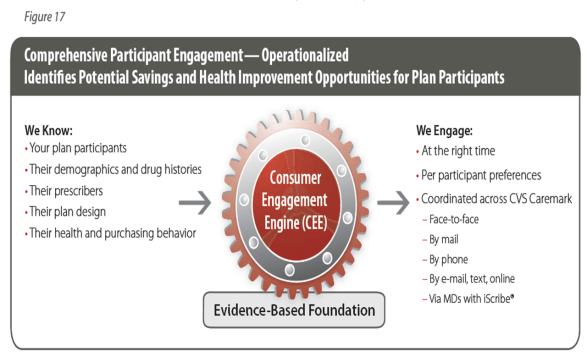
    • Consumer Engagement Engine (CEE) which is very similar to what Silverlink does and provides business logic for targeting the right member at the right time with the right message.

      consumer-engagement-engine

    • Proactive Pharmacy Care is their “medical neighborhood” concept to stitch together their entities – Mail Order, CVS retail, Specialty, MinuteClinic, and their disease management company.
  • Their trend was 3.9% PMPM in 2008 (or 2.8% excluding specialty drugs).
  • Medicare Part D utilization was up 4.1% compared to 0.8% for the rest of their BOB (book of business).
  • Their GDR (generic dispensing rate) averaged 65.1% for 2008 and was 66.3% in December 2008.
    • Best in class employers = 68.2%
    • Best in class health plans = 73.4%
  • As they remind you, a 1% increase in GDR is roughly equal to a 1% reduction in pharmacy spend.
    • [What I would like to see is improvements in GDR from new drugs coming to market in 2008 versus improvements that came from clients implementing plan design.]
  • They say [which I preach all the time} – “proactive consumer engagement improves results and lowers the risk of disruption. For best results, provide personalized actionable information at a range of touchpoints.”
  • I saw a few interesting things in one of the case studies they share about their “Generous Generics” program. [Does that name get used with consumers? What’s their reaction to it?]
    • $0 generic copay at mail [that should drive volume]
    • 10% coinsurance penalty for not shifting to mail after the second fill [similar in concept (I believe) to the Medco “retail buy-up” concept]
  • Top Ten Therapeutic categories (53% of spend):
    • Antihyperlipidemics
    • Ulcer drugs
    • Antidiabetics
    • Antidepressants
    • Antiasthmatics
    • Antihypertensives
    • Analgesics, Anti-inflamatory
    • Anticonvulsants
    • Analgesics, Opioid
    • Endocrine and Metabolic Agents
  • They state that the population of diagnosed diabetics is growing by roughly 1M a year.
  • They state that a generic for Lipitor is now expected in Q4 2011 [which I think is about a year later than originally expected]
  • They show some data from their Maintenance Choice program which I think has a lot of opportunity.
    • This is where you can get a 90-day Rx from either mail or a CVS store for the same copay. [The key here is for them to understand member profitability and for CVS Caremark to understand how to drive consumers to the preferred channel.]
    • [I would really need to understand their profitability by channel because if I read the chart in here right, it would appear that given the choice 45% of those at mail would choose 90-day at retail…a scary concept for mail order pharmacy.]
      maintenance-choice
  • They give a case on Maintenance Choice which leaves me looking for a key fact. They state that a recent implementation has a goal of 70% of the client’s day’s supply will go through the preferred network (CVS) or mail and that 20% of it goes through mail today. [What percentage goes through CVS today? If it’s a client in Boston, that one scenario. If it’s a client in Chicago, that would be another feat.]
  • Specialty pharmacy trend was 13.5%.
  • They say that pharmacogenomic testing is being used more frequently for specialty drugs. [I would love to know more…how often? For what drugs? Has it improved outcomes? Are their clients covering it? How are they playing in this space?]
  • They talk about adherence which continues to be one of the hottest areas in the Rx arena today. They give stats showing 15-48% improvement across different metrics and up to $142 in cost avoidance in one case. [Are these again control groups? What was the cost / benefit analysis or ROI? Is this improvement in average MPR (Medication Possession Ratio) or improvement in the % of people with an MPR of >80%?]
  • They talk about 88% of heart failure patients maintaining optimal prescription adherence compared to a norm of less than 50%. [My questions here (which isn’t apparent) is whether this was an opt-in program so the 88% is for engaged and active participants or whether it was across all targeted members.]
  • They provide a quick list of factors that will impact drug trend:
    • Driving costs:
      • Aging
      • Obesity
      • Diabetes
      • Specialty pipeline
      • More aggressive treatment guidelines and earlier diagnosis [which hopefully would lower total healthcare costs]
      • DTC advertising
    • Reducing costs:
      • Economy – reduced utilization and improved GDR
      • Increased availability of generics
      • FDA safety reform
      • Lackluster non-specialty drug pipeline
      • Utilization and formulary management
      • Consumer price transparency

Communication Strategy Regarding H1N1 (Swine) Flu

“There is a lot of media, a lot of news, a lot of rumor – the sooner you can get correct and accurate information to consumers, the better – otherwise people will look to other sources that may not always be accurate.”  (Jan Berger, President of Health Intelligence Partners on podcast)

We have been hearing a few things from our clients and have put some information up on the Silverlink website.  Some of the comments have been:

  1. I have seen a spike in call center volume about this topic.
  2. Clients want to change plan design to make sure Relenza and Tamiflu are covered and don’t require a prior authorization or have a quantity level limit on them.
  3. We want to proactively reach out to at risk populations – children, seniors, or people with a compromised immune system.
  4. We want to be able to flexibly target certain geographies.
  5. We want to remind people not to panic, drive them to quality information sources, and make sure they know the basics – wash your hands.

At a minimum, everyone is adding information to their websites.  Many consumers are Googling the topic or following updates from @CDCEmergency (on Twitter).

Healthplans, PBMs, and population health companies are at the heart of this.  They need a coordinated strategy to inform people appropriately as this issue continues to be top of mind.

We recorded a podcast last night with the Medical Director from Healthwise and Jan Berger who is the former Chief Medical Officer from CVS Caremark and is now president of Health Intelligence Partners.  In here, they answer some general questions about the situation and what companies should be doing to educate members.

The two standard solutions Silverlink is offering clients are:

  1. Offer an inbound FAQ (Frequently Asked Questions) line with CDC content and specifics about their plans.  This can help with overflow from their call center and/or be used as a direct line from their website or outbound communications.
  2. Selectively target populations (age, zip code, disease state) with a brief message reminding them to wash their hands and telling them where to get qualified information.

As with all our communications offerings, these can be customized (messaging, channel, targeting, etc.) to meet client requirements.  Additionally, since one of our technology advantages over others in the space is our flexibility, we can work with clients to keep these messages up-to-date as the situation changes and as new information has to be added.

To “Tweet” Or Not To Tweet – Wrong Question

I have been a skeptic (and am changing my tune), but for all of you out there that think “what can I share in 140 characters”, I suggest you frame the question differently.

Ask – Should I have a Twitter account?

Even if you don’t want to tweet about yourself, you should have a Twitter account to serve as a news feed. As I saw from the WHCC 2009 and the Health 2.0/Ix Therapy conference, you can learn a lot by using Twitter simply to follow people. And, with more and more companies jumping on board, it’s a great way to keep up with information.

If you find the right reporters, news sources, companies, and bloggers, you can use this as a news summary of relevant events.

(Obviously, I am not the only one struggling with this as another media as evidenced by Josh Seidman’s post the other day.)

Pharma Rx Costs Tied To Outcomes

Given our opinion that the PBM industry would be moving to more outcome based pricing, the articles today about Merck and Cigna‘s deal on pricing based on outcomes is very timely.  I “tweeted” about it early in the AM, but I have got the article sent to me by a lot of people.  So, here are a few of the things being said:

WSJ Blog

Now Merck and Cigna have announced what they’re calling a “performance-based contract” for Merck’s diabetes drug Januvia. But the deal is actually the reverse the pay-for-performance ideal: Merck will get paid less per pill, not more, if the drug works well.

Under the deal, Cigna will get a discount on the drug if patients’ blood sugar falls. Cigna will get additional discounts if patients faithfully take the drug when they’re supposed to. (These two variables often go together — taking the drug faithfully helps keep blood sugar down.)

Cigna PR

“Merck should be recognized as the first major pharmaceutical company to offer increased discounts on its oral anti-diabetic products, supporting CIGNA’s efforts to reduce A1C levels for individuals with diabetes, regardless of what medication they may be taking,” said Eric Elliott, president of CIGNA Pharmacy Management. “Improving people’s health comes first for both CIGNA and Merck. We hope this agreement will become a model in the industry.”

So…it seems like an aligned deal.  Merck and Cigna want adherence.  Employers want lower costs and better outcomes.