Would / Should Express Scripts Overpay For Wellpoint’s PBM?

This was a question I was asked yesterday.  If you assume the final bidders come down to Express Scripts and Medco, would Express Scripts overpay for Wellpoint?

  • Strategically, this would be an important acquisition for them.  They lost Caremark to CVS.  Losing Wellpoint to Medco would make them a distant third.
  • Financially, they run a very smart company.  George Paz (CEO and ex-CFO) would be unlikely to pay more for an acquisition than he thought it was worth financially.  Which is a good thing for shareholders.
  • The questions of course that the due diligence team would be asking is what costs can be cut and when.   Is there slack in the current operations or does this address capacity needs?  Are there economies of scale?  And, as I talked about the other day, what is the lock-in on lives?

It will be interesting to see, but it is a hot topic of discussion these days.

Kaiser Family Foundation: Medicare 101 Webinar

I thought this sounded interesting so I thought I would post it for those of you that are interested…

********

On Monday, March 16 at 12:15 p.m. ET, the Kaiser Family Foundation and the Alliance for Health Reform will co-host a briefing with a panel of experts discussing the Medicare program. Medicare covers nearly 45 million beneficiaries, including 38 million seniors and 7 million younger adults with permanent disabilities. The program is expected to cost the federal government approximately $477 billion in 2009, accounting for 13 percent of federal spending and 19 percent of total national health expenditures.

Panelists will address questions such as:

  • Whom does Medicare serve and what services does it cover?
  • What are Medicare Parts A, B, C and D?
  • How is it structured and financed?
  • What drives Medicare’s costs?
  • How does Medicare reimburse providers and hospitals?
  • What future challenges face the program?

A live webcast of the discussion will be provided by kaisernetwork.org.

WHO: Ed Howard, JD, executive vice president of the Alliance for Health Reform and Diane Rowland, ScD, executive vice president, Kaiser Family Foundation and executive director, Kaiser Commission on Medicaid and the Uninsured will co-moderate the discussion with panelists:

  • Juliette Cubanski, PhD, principal policy analyst, Kaiser Family Foundation
  • Marilyn Moon, PhD, vice president and director, American Institutes for Research
  • Tom Gustafson, PhD, senior policy advisor, Arnold & Porter LLC

Fake Research – Ridiculous

Sometimes, I just can’t believe certain things.  The fact that people fake drug studies.  Come on.

Baystate Medical Center in Springfield, Mass., has asked several anesthesiology journals to retract the studies, which appeared between 1996 and 2008, the WSJ reports. The hospital says its former chief of acute pain, Scott S. Reuben, faked data used in the studies.

Personal E-mail Replaced By Social Networks

This plays into my post earlier about changes in communication patterns…

I certainly have begun to see more of my social (personal) online communications moving from e-mail to social networking tools like Facebook, LinkedIn, and Plaxo.  I almost never trade e-mails with my siblings any more.

So, it wasn’t a big surprise when I saw the blurb in the USA Today which said that “social networks and blogs” have moved ahead of personal e-mail as the most popular online activities (per Nielsen report).

A few facts:

  • 1 of every 11 minutes is spent on these social networking and blogging sites.
  • Time spent on the sites is growing 3x faster than overall Internet usage.
  • 2/3rds of the world’s online population visit these sites.
  • The US was third (after Brazil and Spain) with 67% of the population visiting these sites.
  • Facebook is visited by 3 in 10 people monthly.
  • 10.6M people in the US access these sites through their mobile devices.

How The Recession Could Impact Communications Forever

This recession (or depression) has the potential to systemically impact how people communicate.  Some potential impacts:

  • Death of newspapers (discussed last week)
  • Death of the land line (everyone has a mobile phone)
  • Death of magazines (similar to the newspaper issue – drop in advertisements)
  • Reduction in mail (as costs go up and if service were dropped to 5 days a week)
  • Short-term reduction in use of high speed Internet (save money)
  • Short-term reduction in use of text messaging (save money)
  • Less use of cable (being replaced by online TV shows)
  • Move to digital coupons

I think some of these will also be affected by the green movement where printing massive amounts of paper and sending those to people (who can get the same information online) will become important.  [Although this has been talked about for years, costs may finally make it a reality.]

Some other things that could change:

  • Reduction in the value of co-branding information as the employer relationship becomes less long-term and more fragile [Traditionally, this has been an important strategy in direct mail from health plans and PBMs where using the employer has improved response rates.]
  • Improvement in use of online tools (Health 2.0) as people move away from print
  • Increased use of virtual meetings and further loss of face-to-face contact as companies move to virtual offices and cut travel budgets

If you combine cost driven changes with environmental driven changes with likely technology changes, I suspect that the way we communicate and interact with people over the next 10 years will dramatically change.  In the short-term, we may even see an increased number of new Luddites (people who shun technology to save money and over frustration with our overall economic situation).

More Lies In E-mail

A pair of recent studies suggest that e-mail is the most deceptive form of communications in the workplace–even more so than more traditional kinds of written communications, like pen-and-paper.

More surprising is that people actually feel justified when lying using e-mail, the studies show.

“There is a growing concern in the workplace over e-mail communications, and it comes down to trust,” says Liuba Belkin, co-author of the studies and an assistant professor of management at Lehigh University. “You’re not afforded the luxury of seeing non-verbal and behavioral cues over e-mail. And in an organizational context, that leaves a lot of room for misinterpretation and, as we saw in our study, intentional deception.”[See article]

This certainly raises a few flags as letters become a “historical tool” for communicating and everything becomes more about technology.  This certainly says a lot for virtual teams and remote management.  You can’t rely just on e-mail.  You need to pick up the phone and talk.  You need to visit face-to-face (F2F).

Does this mean that MDs shouldn’t trust e-mails from patients?

Does this mean that deals shouldn’t be negotiated through e-mails?

Every 2 Weeks A Language Disappears

According to Ethnologue, there are 6,912 languages in the world.  Lots of these are at risk of being lost.  It is estimated that one “disappears” every two weeks as the last person who can speak the language dies.

The Living Tongue Institute for Endangered Languages is rapidly trying to capture and document them before they disappear.

Wellpoint PBM for Sale

Not that it wasn’t known, but the rumor is now out on the street.  Wellpoint is putting their PBM on the market.

How do you value it…It’s difficult. The question is how long of a contract will Wellpoint sign with the acquirer and will they plan to keep any of their assets – mail pharmacies, call centers, claims systems, etc.  But that’s not it.  You also have to understand how many of their contracts are going to be up for renewal and when.  PBM contracts with payors are usually 2-3 years so that would likely be much less time than Wellpoint would commit to.

Who will buy them? Everyone seems to think CVS Caremark, Medco, or Express Scripts.  Why not Walgreens, Wal-Mart, or Prime Therapeutics?

I can’t imagine CVS Caremark buying them after the Longs and RxAmerica acquisition.  Medco doesn’t usually buy PBM lives.  And, both of them are more focused on building out a healthcare solution than growing the traditional PBM offering.  So, of the top 3, I would have to predict my old employer – Express Scripts.  I guess that’s a way to grow quickly.

An acquisition by Prime who is owned by the non-profit BCBS plans would be interesting to begin to consolidate the payors under one PBM, but I doubt that’s the likely suitor.  It will be interesting to see how this plays out.

Brand Companies Make Generics

People are always surprised when I point out that 50% of generics are made by brand manufacturers.  And, the company that has been most aggressive against generics – Pfizer – has recently made several deals to strengthen their generic subsidiary – Greenstone.

Pre-Existing Conditions

I completely agree that we need to find a health care solution for the country that doesn’t deny coverage for people based on pre-existing conditions. There are obviously issues of how to do this fairly without driving companies out of business. BUT, I completely disagree with one concept that I read about which would require coverage but allow people to enroll in a plan after they get sick. This is why a mandate for coverage has to be required.

  • I can’t wait until I get in a car accident to buy car insurance.
  • I can’t wait until my house floods to buy flood insurance.

There is no sustainable business model where the only people paying into insurance are those that are drawing out of the insurance. That makes no sense.

Optional Coverage

Do you believe that uninsured people will buy health insurance if there is no mandate to require this?

Why would they? Don’t you think most people would like to have coverage today if they could either (a) afford it or (b) be convinced they need it (i.e., young invincible) or (c) get coverage at a reasonable cost due to pre-existing conditions?

In my opinion, it is naïve to believe we can achieve universal coverage in this country in the president’s first term (as he stated last year) or that it can be achieved without some mandate.

What’s In A Voice?

In the most recent copy of AHIP’s Coverage Magazine (JAN+FEB.09), there is a nice feature called “What’s In A Voice?” which talks about Silverlink Communications. You can find the whole article (“Motivating Change“) here, but I pulled out a few quotes:

“When the phone rings, it takes just the right voice to motivate a member to overcome the tendency to put off receiving preventative care.”

“Silverlink calls allow us to communicate with our members in a really personalized way without incurring the costs associated with hiring and training additional customer service representatives.” Linda Lyle, Cariten Healthcare Vice President of Operations

“This mammography campaign contained scripting that allowed the members to respond, [indicating] whether or not they had had a mammogram. We received a large number of ‘yes’ responses that we will pursue for HEDIS improvement, as well as to identify gaps in our data collection. This method of collecting data about our members is unique to telephone outreach. We are anxious to explore our findings.” ” We know how many listened to the message and how many hung up. We know how many people we actually reach.” Michael Bryne, Assistant Director of Quality Management at EmblemHealth.

The article also talks about using non-professional voices such as the Chief Medical Officer or a customer service representative who was really good with members. In one example, Eleanor Sorrentino, the Managing Director of Quality Management at EmblemHealth, talks about getting 50 calls from members thanking her for the automated call which was recorded in her voice.

A few other items talked about include the use of data and reporting which is available real-time to make decisions along with the use of natural sounding voices to drive a conversational experience which leverages internal and professional scripting resources to develop the best content.

Newspapers In Trouble

I think it’s a shame that our kids won’t have the same experience of sitting back with a newspaper and reading it. It seems like such a classic icon of Americana. That being said, I am a big user of technology and clearly understand why they are in trouble.

But, what I wonder is if they aren’t in bigger trouble than we believe. The only time I read papers is at the airport or when I am in a hotel. What if you eliminated all the papers sold through those two sources? I can’t believe that individual (home or business) subscriptions could support many (any) of the newspapers in the US.

Tripping Over The Dollar To Get The Penny

I am borrowing this phrase from a friend of mine, but it is how he described their organizational culture and made me think of several things.

  • Why do people become so myopic on one type of savings that they don’t realize the entire cost of the process?
    • E.g., Driving miles to save pennies on gasoline.
    • E.g., Paying less for clothes that don’t last as long as a slightly higher priced item.
    • E.g., Buying things “on sales” even though they don’t like them as much and won’t get much use out of them.
    • E.g., Paying a consultant to help them drive down costs in an RFP when the cost savings are less than the consultant’s fees.
    • E.g., Focusing on one “square” in an RFP when the effectiveness of the solution is much higher with the slightly higher vendor such that the cost per conversion is less.
    • E.g., Buying one solution that requires them to make other organizational changes that cost money and aren’t factored in.
  • Why do companies charge more when they think they have “power” only to limit their lifetime value of the customer?
    • E.g., Sprint recently told me that to synch my e-mail on my Blackberry with an Enterprise Server would require another $20 per month (never mind that they have been doing it for two years for free). After 14 years as a customer, I was annoyed. A one-time charge – maybe. A recurring charge for them to do basically nothing is ridiculous.

I remember that I once wrote a business case on limiting e-mail size which I think gets to this point. At that company, we had a limit of 20MB of e-mail storage. After being there more than a year, even if you were diligent at cleaning e-mails, you would likely begin to have problems. I got to the point where I was spending 4 hours per week cleaning my e-mail box so that I could send e-mails. I didn’t know the exact cost of storage, but if I multiplied 4 hours times thousands of corporate employees times their average salaries, it was a lot of money being wasted.

Semantics Matter At The End Of Life

I know many of you that follow the blog and work with me will say I am preaching to the choir, but the intricacies of language are so important around healthcare.

And, how do you know what works…TEST, TEST, and RETEST. Do you think credit card companies have stopped trying new strategies? Of course not.

So, what’s the latest example…

“Do Not Resuscitate” vs. “Natural Death”

USA Today has an article today about these two phrases. It has real life examples from several hospitals that have changed their language when talking to families. It also talks about a study last year that was published in the Journal of Medical Ethics that showed nurses, student nurses, and people with no health care backgrounds reporting a greater likelihood to forgo resuscitation if “allow natural death” was the phrase used.

“Our greatest responsibility is to listen to the person and find the language that is best understood by them.” Samira Beckwith, CEO, Hope Hospice in Fort Myers, FL.

Short Term Realities: Long Term Effects

Although I want to, I will try not to get engaged in a bunch of politics. Let’s focus on the disastrous effect that the economy is having on healthcare in the country.

According to a recent study by the Kaiser Family Foundation:

  • 1 in 4 Americans put off needed health care in the past year because of cost including 16% who postponed surgery of a doctor’s visit for a chronic condition.
  • 53% said they cut back on health care in some way.
    • Over the counter medications
    • Self-diagnosis
    • Skipped the dentist
    • Postponed a test
    • Didn’t fill a prescription
  • 15% split their pills or skipped doses of medication.

This is scary. Maybe this is what the $600B is for over the next 10 years in the budget since I thought reforming healthcare was going to save money.

In another report, it talks about people sleeping less due to stress over their financial situation.

Another report I saw talked about how cheap foods like McDonalds were seeing huge growth while fresh vegetables and fruits were more expensive.

COBRA vs. Individual Insurance

With all the layoffs these days, this is a real issue that many people are facing. According to the Kaiser Family Foundation, the average premiums for 2008 were:


Worker Contribution

Employer Contribution

Total

Single

$721

$3,983

$4,704

Family

$3,354

$9,325

$12,679


COBRA allows laid workers to continue their former health insurance for up to 18 months at the full cost plus a 2% administrative fee. That’s approximately $400 for an individual per month or over $1,000 for a family per month. For many people, these amounts eat up a large amount of their monthly income from unemployment or severance or savings so it becomes a tough decision.

I guess a ray of good news is that in the “stimulus package” people will have 65% of their COBRA premiums subsidized if they were laid off between 9/1/08 and 12/31/09. (Remember that you have 60 days to sign up for COBRA after you receive a notice from your employer about eligibility…which should happen shortly after you lose your job.)

Your other option is to go to your health insurer or someplace like eHealthInsurance.com to buy an individual policy. Most health plans now offer an individual plan although they don’t do a good job of selling it to people leaving the plan. The subsidy may change the economics a little, but my understanding is that it is generally less expensive to get the individual insurance than COBRA. BUT, I have two caveats:

  • Several company have announced large increases in their premiums for their individual plans (as much as 30%+). These will be tough for a lot of people to swallow.
  • If you have a pre-existing condition, don’t drop your COBRA until you have found another plan.

As long as you are continuously covered, insurers can’t deny you coverage under the Health Insurance Portability and Accountability Act (my understanding and stated in a USA Today article on this topic).

What I do think is unreasonable is that when you lose your job, you have to stay with the same plan under COBRA. You can’t switch to a lower cost plan that your employer might have offered. Why shouldn’t you be able to? Now, USA Today says that if you’re eligible for the subsidy then your employer might let you switch – why now…is the employer paying for the subsidy?

Biggest Loser…Losing Credibility

In one of those classic examples of why do smart people do stupid things, the show The Biggest Loser on NBC shows one of their recent contestants completing a marathon in under 4 hours while weighing close to 300 pounds.  I saw the show and was amazed.  I haven’t been able to do that on 3 tries and wondered what the heck I was doing wrong.

Well…come to find out that he didn’t run the marathon unaided.  Depending on which report you believe, he got a van ride for 3-6 miles toward the end and was crossing the finish line at just under 6 hours.  I just don’t get why the show would be so stupid. 

It’s a show about inspiring people with amazing transformations.  Having him run a half-marathon or even completing a full 26.2 miles at a slow time would have been a great story.  Instead you ruin it and cast down on some of the things that the contestants do.  

Story in the Detroit News about it.

You can read the official statements from Dane (the contestant), the show, and NBC in The LA Times.

“I always intended to run the full marathon. At the 17th mile, I knew I would not make it in time to cross the finish line before it closed at 6 hours, so I then received a ride from the field producer, who wanted to show me crossing the finish line. He drove me for three miles, and then I ran the rest of the way. After all the filming was done I went back and finished the last 3 miles later that day with my wife and cousin Blaine. I apologize for stating that I ran the entire marathon before I actually ran the whole 26 miles. I am proud of the feat of just running 26 miles in one day.”

Saving Money On Rxs

Are you interested in saving your members money?  There are a lot of things you can do.  Pill splitting is an easy solution with a quick impact.  Using generics and moving to mail order are others.  I am going to do a webinar on this in a few weeks. [March 10th and March 12th at 1:00 ET]

Even if you’re not specifically interested, I think you would be fascinated to see how we use a multi-modal approach to drive behavior.  It is modeled on what PBMs have been doing around mail order conversion for years.

Lots of people talk about multi-modal coordination.  We can and have done it.  Gartner is talking about Business Process Outsourcing (BPO) in healthcare and has mentioned Silverlink in their last two reports as one of the few vendors doing this.

I hope you can join us! REGISTER HERE.

Medco Therapeutic Resource Centers and Mail Tour

This is obviously a marketing piece, but I thought it was an interesting video to show how things work behind the scenes at Medco.  The first half of the video is about their TRCs (Therapeutic Resource Centers) and the second half is about their automated mail pharmacy.

Debate And Real-Time Changes

As he typically does, e-patient Dave has started a very interesting discussion on sites like Medpedia and the concept of participatory medicine. As Dave and others have shown, information flows slowly such that physicians (or others) cannot digest all of it and be constantly up to date on everything. Patients facing a chronic or life-threatening condition are motivated to do a deep dive on one topic.

Finding, sharing, and having access to information that is relevant, timely, and peer-reviewed (by patients and professionals) is critical.

“Participatory medicine is a phenomenon similar to citizen/network journalism where everyone, including the professionals and their target audiences, works in partnership to produce accurate, in-depth & current information items. It is not about patients or amateurs vs. professionals. Participatory medicine is, like all contemporary knowledge-building activities, a collaborative venture. Medical knowledge is a network.” (Wikipedia)

The posting and comments are interesting and demonstrate the power of web 2.0 where the founder of Medpedia comments and even makes some real-time changes to address the patients and professionals weighing in on the discussion.

Buyology: Best Book of 2009

I am finally getting around to writing this up. I mentioned the book – Buyology – a few weeks ago. It is definitely the best book I have read this year. It is by Martin Lindstrom and is all about neuromarketing.

For those of you that don’t think it’s relevant to healthcare, think again. Healthcare is all about compelling individuals to take action and become responsible for their health. That is about understanding how they interpret information and what drives them.

Here are some of my notes from the book:

  • One of the processes used was fMRI (functional Magnetic Resonance Imaging) which measures the amount of oxygenated blood throughout the brain. Scientists can see what part of the brain is working at any given time.
  • The other process used was SST (steady-state typography) which tracks rapid brain waves in real time.
  • One of his first studies looked at the effect of cigarette warning labels and found that they not only failed to deter smoking but activated the nucleas accumbens.
  • What people say on surveys and in focus groups does not reliably affect how they behave. [although it is often the best we have]
  • Brand matters…He re-conducted the Pepsi Challenge and showed that if people knew what they were drinking they preferred Coke to Pepsi. When they didn’t know, 50% of people liked Coke. When they knew, 75% of people liked Coke.
  • He showed that consumers have no memory of brands that don’t play an integral part in the storyline of a program. Just putting something in the movie, TV show, or video game isn’t enough to get you mindshare. AND, those successful placements also weaken our ability to remember other brands.

“Our irrational minds, flooded with cultural biases rooted in our tradition, upbringing, and a whole lot of other subconscious factors, assert a powerful but hidden influence over the choices we make.”

  • In the Smiling Study that he references, they revealed that people are far more positive and have a better attitude toward the business when the person they are dealing with is smiling. [Maybe a key thing for avatars and real agents as they talk to people over the computer and/or phone.]
  • Our mirror neutrons allow us to get pleasure just by observing or reading about people doing something that would give us pleasure – e.g., opening a present with a new Wii in it. [You can go to www.unbox.it.com or www.unboxing.com to enjoy this.]
  • Logos are dead. They showed that images that are associated with smoking (for example) were far more potent in creating a reaction in the brain than the logo.
  • “Secret Ingredients” matter…he shared several examples of how things sold differently when there were non-existent things listed on the label.
  • When people viewed images associated with strong brands – iPod, Harley-Davidson, Ferrari – their brains registered the same activity as when they saw religious images.
  • They studied and showed that odor can activate the same brain response as the sight of the product. He talked about an interesting study that showed that “feminine scents” such as vanilla were sprayed in women’s clothing sections, sales of female apparel actually doubled.
  • Sex, extreme beauty, or a celebrity in an advertisement can hijack attention away from the information in the advertisement.

“I predict that soon, more and more companies (at least those who can afford it) will be trading in their pencils for SST caps. That traditional market research – questionnaires, surveys, focus groups, and so on – will gradually take on a smaller and smaller role, and neuromarketing will become the primary tool companies use to predict the success or failure of their products.”

Some interesting facts:

  • 300 million people, including 60% of male doctors, in China smoke.
  • 8 out of 10 new product launches fail within 3 months.
  • In 2005, 156,000 new products debuted globally (or one product every 3 minutes).
  • In 1965, a typical consumer could recall 34% of advertisements from TV. In 1990, that number dropped to 8%. In 2007, consumers could only remember 2.21 advertisements from all advertisements they had ever seen. [Talk about saturation.]
  • We walk almost 10 faster than we do a decade ago. 3.5 mph
  • A study in Denmark showed that people talked 20% faster than they did a decade ago.
  • And, if you don’t believe that culture matters…In Asian cultures, four is an unlucky number and one researcher found that heart attacks among US residents of Chinese descent spiked as much as 13% on the fourth day of each month.
  • Children that experience social difficulties in school are more likely to be preoccupied with collecting.
  • Both J&J and Play-Doh have lost their original fragrances and haven’t been able to replicate it.
  • When classical music was piped over loudspeakers in the London Underground, robberies, assaults, and vandalism dropped by over 25%.

Some of the interesting companies mentioned:

I thought he had a great story about a rock. If I gave it to you for your birthday, you’d be offended until I told it was from the Berlin Wall. And then when I told you it was from the moon, you would be even more impressed.

For more information, there is also a neuroscience blog.

Limited Networks

I was reading Charlie Baker’s post on Narrow Networks, and it made me think about this concept from a pharmacy perspective.

In general, this is a default solution for mail pharmacy.  You can’t chose between Medco’s mail pharmacy and Express Scripts.  You have one or the other.

And, Mandatory Mail is an expansion on this.  It not only limits the network size, but it forces you to use the network in certain ways (i.e., if you have a maintenance drug you have to fill it at the lowest cost location).

In specialty pharmacy, this has certainly been the trend.  More and more companies are limiting the choice of specialty pharmacies that you can choose from.  In some cases, this is dictated by the manufacturer who limits distribution of their drug to only certain pharmacies.  And, then Mandatory Specialty will drive you to a specific mail site for your specialty medications.

Within the retail network, this has been tried a few times, but without much adoption.  That being said, I found retailers very willing to offer lower prices to clients if they were part of a limited network (where they expected to get more marketshare).  Another option is to treat the network like a formulary (or drug list) with tiers and where members pay more to use certain pharmacies (which likely are higher cost or offer lower quality / service).

In this economy, I have to believe that we will see this take off.  Of course, consumers don’t like it, but it’s better than losing your benefit all together.  It seems like a logical change to the benefit…you limit choice without impacting outcomes in order to save money.  There are some times when it may not make sense.  For example, excluding CVS from the retail network in Boston would be a very difficult sell.  It’s all a question of marketshare, options, and ultimately the savings per disrupted (or upset) member.

Of course, the pharmacy network is very different than physicians.  I would think you could basically have any primary care physician, but everything else could be limited short of emergency care.

Struggles Of A Working Family Report

The Kaiser Family Foundation has released a report and video that they did on several families looking at their struggles to pay bills and survive.

The report, Snapshots from the Kitchen Table: Family Budgets and Health Care, is based on interviews with 27 families from six cities across the U.S.. It finds pervasive uncertainty over job security and households teetering on the financial brink, stretching to pay for basics such as food and housing and ill-equipped to cope with unexpected costs for things such as a medical emergency or a necessary home repair.

Health care costs were of particular concern, with many families forgoing doctor visits, skipping prescription medications and postponing needed care. Even those with health insurance reported delaying care in order to avoid co-payments, rising deductibles and out-of-pocket expenses for uncovered services.  Despite barely being able to meet the cost of basic needs, many families did not qualify for public programs like Medicaid and the Children’s Health Insurance Program.

Is Your Conversation With The MD One-Sided?

USA Today had an article earlier this week called “Doctors Take Decider Role” which is about the fact that patients are often not asked about their opinions.  This is a problem on many fronts.  If you’re not discussing the pros and cons, you are not as likely to buy into the recommended treatment plan leading to lower compliance.

“In the real world, people agree to take drugs, have surgery and undergo tests after a much more one-sided process, new studies show. As a result, researchers say, too many people get care they don’t want or need and miss out on options that make more sense for them.”

In a scary example, the research showed the 69% of men heard the procs of taking a blood test for prostate cancer, but only 18% heard about the downside.  The research also showed that only 41% of patients were asked how they felt about taking blood pressure medications.  But, this obviously varies since 76% were asked to weigh in on their back surgery.

It begs the question of how aware doctors are of patients concerns and priorities.

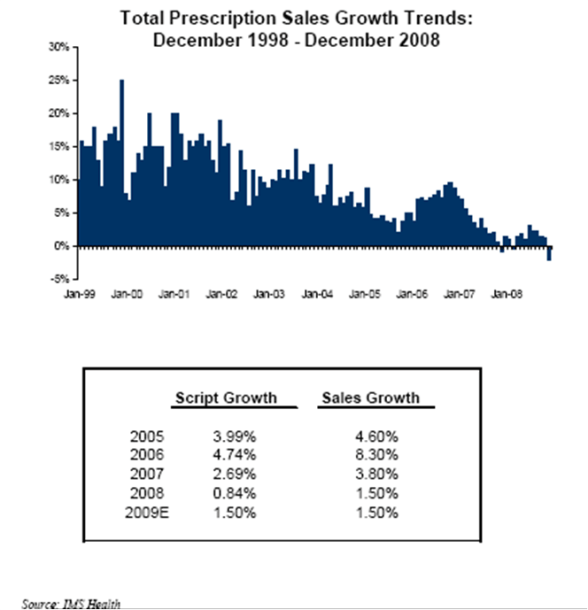
Script Growth Especially At Mail Continue To Slow

Based on IMS data, prescription growth continues to slow especially at mail order where it’s negative.  Interestingly, in a report by Barclay’s Capital, they estimate that Caremark will grow mail by 10% next year, Express Scripts will lose mail scripts by about 0.5%, and Medco will only grow by 0.8%.

Medco is easy to understand since they are currently the market leader in terms of mail order penetration.  The Express Scripts number requires some additional analysis.  Is it due to client loss?  Is mail just not growing?  The Caremark growth is meaningful.

ims-script-growth-barclaysims-mail-growth-barclays

Time To Sell?

There is always debate about captive PBMs (i.e., those owned by a managed care company).  In theory, I have always argued that they should have a leg up.  But, since pharmacy represents only 10% of total healthcare spend, the majority of the strategic focus is typically on the health insurance side of the business.  [BTW – The 3 largest captive PBMs are Wellpoint, Aetna, and Cigna.]

So, if you look at the stock charts below, you can see that while the PBMs (Express Scripts, Medco, and CVS Caremark) have all held up pretty well the managed care stocks (Aetna, Cigna, United Healthcare, Humana, and Wellpoint) have not held up as well.

If I owned a captive PBM, would this be the time for me to consider selling?  I have heard this debate a lot more recently than in recent years.

PBM 5-Year Stock Chart

express-medco-cvs-caremark-5-yearManaged Care 5-Year Stock Chart

wellpoint-cigna-aetna-united-humana-5-year[As I have disclosed before, I do not hold any individual stocks.]

Trickle Down Healthcare

Many of us know the term “trickle-down economics” which is generally associated with Ronald Reagan.  (Obviously not a concept bought into by the current administration.)  I was thinking about this today from the concept of workplace culture around healthcare.

I have not seen any research to this point, but it would seem to make sense that companies where the senior executive team is focused on exercising – running, triathalons, tennis, etc. – would generally be healthier companies.  As we have seen multiple times, peer pressure works.  So, does it work from a top-down perspective also?

I know one healthcare company where they were refining what was served at the cafeteria and what was in the vending machines.  Obviously, there are ways to control diet through what the company “encourages”.  Do they have bowls of fruit or bowls of chocolate?

Happy Paczki Day

Do you know what a Paczki is?  It is a Polish donut that is traditionally eaten on the Thursday before lent, but here in the US is usually eaten on Fat Tuesday (today).

The concept of indulging before being good in Lent is very counterproductive to good health.  It’s always better to eat consistently well and never over eat or starve yourself.  I had one friend who was on a “diet” which was strict all week, but they could eat anything on the weekends.  Do you really think that works?

I compare it to Aitkens where as long as you stick with it you lose weight, but as soon as you stop, you bloat back up.

Ultimately, it’s simply about calories in and calories burned.  Watch what you eat and exercise.

Social Media Myths

This was a great article in Business Week.  It lays out nicely six myths to watch out for as you jump on the social media bandwagon.

  1. Social media is cheap if not free
  2. Anyone can do it
  3. You can make a big splash in a short time
  4. You can do it all in-house
  5. If you do something great, people will find it
  6. You can’t measure social media marketing results