Archive | Books / Articles RSS feed for this section

Express Scripts 2009 Drug Trend Report

I always enjoyed being part of the team that put the Drug Trend Report out when I was at Express Scripts from 2001-2006. With that in mind, I do await anxiously to see what new information they will share each year. I will say that the core fundamentals (as always) were very strong in the 2009 report, but I missed not having any client case studies in the document.

They reported drug trend of 1.5% (without specialty) and 3% with specialty.

Specialty drug trend was 15.4%.

Patients paid an average of $12.82 per Rx.

They say that more patients converted to Home Delivery (aka mail order). [I have to check this. My recollection is that mail volume was relatively flat and this would be hard to achieve unless they had more people filling less drugs on average at mail.]

They reported PMPY utilization of 14.32 Rxs.

Their members paid 29% of the generic drug costs; 19.6% of the brand costs; and 22.3% overall for traditional drugs. For specialty drugs, they paid 2.3% (or 20.2% for all drugs including specialty).

They have a section on compliance (which is rapidly becoming a key discussion point in the PBM world). I was a little surprised they didn’t call it adherence which is more common these days. But, they revealed some surprisingly high MPR (medication possession ratio) numbers for antidiabetics, antihypertensives, and lipid-lowering drugs. Considering adherence is where a member has an MPR of greater than 80%, they showed 77%, 83%, and 83% respectively. Since we know that 50% of people (on average) drop therapy within 12-months, this seems improbable on a book-of-business basis. (Maybe I’m just becoming a cynic in my old age.) The only reason I could find to explain this example was that this was not based on new starts (i.e., NRxs) unless they came in the first quarter. Therefore, there might be some selection bias in that they are taking MPR on people that started the year on the medication and may therefore have been people who were more likely to be adherent. I would rather see this done on a rolling 12-month basis.

As I often use, they define waste in the system and give you a potential GFR (generic fill rate) goal for the top therapy classes.
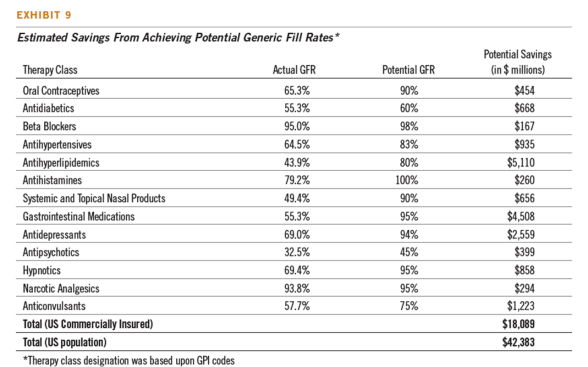
ESI Estimated Savings GFR 2009

Their analysis shows that 55% of the costs for specialty drugs were billed through the medical benefit rather than the pharmacy benefit.

55% of their members are in plans with at least one step therapy module.

They talk about a few studies they have published showing that targeted and framed messages are more effective than general messages. And, that those messages are more effective with mail order users than people at retail.

Again, there might be some selection bias here as people at Home Delivery may simply be more active in managing their healthcare. The other question I have had for a few of my friends there has been whether we are comparing apples-to-apples. Since I ran a few of the programs before I left, I know we did a lot more interventions (web, inbound IVR, outbound calls, messaging on the invoice, letters, POS rejects) than we did for retail (letters and outbound IVR). If they’ve adjusted for that, than this is clear. If not, I would want to see that adjustment made.

As anyone who reads the blog knows, I am a big supporter of the theory behind their Consumerology story. I think Larry Zarin and Bob Nease have done a great job putting together their advisory board, creating case studies, and using behavioral economics. I always talk with our clients about these theories, and our analytics team is constantly helping clients define test plans that use these.

  • Social comparison
  • Hyperbolic discounting
  • Loss aversion

In comparing adherence at retail and mail, one thing that came into my mind was whether a driver of better adherence was a longer time window to refill. Typically, you have a refill-too-soon (RTS) edit in place until 2/3rds of the medication has been used (based on days supply dispensed from dispense date). At retail, that means you have about 10 days. At mail, that means you have about 30 days (less the 7 days for shipping). Does that make a difference?

I was also surprised under the methodology section that they now include rebates in calculating costs. It’s a quick one-line comment but how did that effect trend or other metrics here…and if so, how significantly?

As always, I love the therapy class reviews in the back that give you great numbers like:

  • Cost PMPY
  • # Rxs PMPY
  • Prevalence of Use
  • Average Cost / Rx
  • # Rxs / User / Year

Have a Swine Flu Party?

dancing-pig

I must admit that it never even crossed my mind, and I don’t plan on running out to get infected.  But, I find the debate and discussion very interesting.

In case you have missed it, the NYTimes had an article today about this.  The key concept in question is whether getting the disease today with a potentially milder strain will prevent you from a more dangerous strain which could come later.

“I think it’s totally nuts,” Dr. Moscona said. “I can’t believe people are really thinking of doing it. I understand the thinking, but I just fear we don’t know enough about how this virus would react in every individual. This is like the Middle Ages, when people deliberately infected themselves with smallpox. It’s vigilante vaccination — you know, taking immunity into your own hands.”

CVS Caremark TrendsRx Report 2009

This is one of my favorite times of year. After working on the Drug Trend Report at Express Scripts for several years, I love to get all the trend reports from the PBMs and read them. The first one that I have had a chance to review is the one from CVS Caremark. I found it an easy to read document with good case studies and a mix of strategy and tactics.

Here are some of my highlights and observations:

  • 3 out of 4 clients cited “reducing health care costs” as their primary measure of PBM success…AND 2 out of 3 prioritized “plan participant behavior change” as the way to reach that goal. [Maybe the plan design bigot is finally dead.]
  • With pharmacy spend approaching $1,000 PMPY, I found their chart on potential cost reduction a simple way of pointing people to things they should think about.
    cvs_caremark_savings-opportunities-09
  • A 10% improvement in diabetes adherence can save $2,000 in annual health care costs. [I assume this is based on improving MPR and would definitely like to learn more on how the health care costs are quantified.]
  • They layout three objectives – improve use of lower cost drugs, improve adherence, and get people to take better care of their health. [Similar to the concept I laid out in my white paper of needing to be broader than just Rx benefit management.]
  • They talk about two of their solutions:
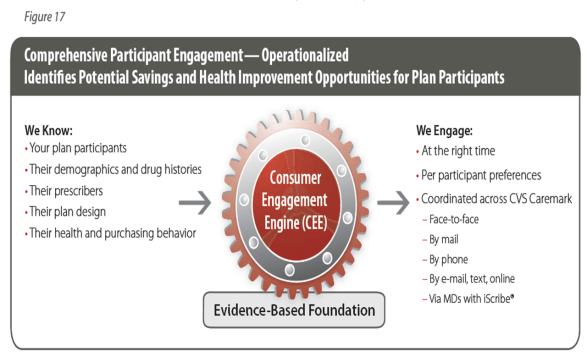
    • Consumer Engagement Engine (CEE) which is very similar to what Silverlink does and provides business logic for targeting the right member at the right time with the right message.

      consumer-engagement-engine

    • Proactive Pharmacy Care is their “medical neighborhood” concept to stitch together their entities – Mail Order, CVS retail, Specialty, MinuteClinic, and their disease management company.
  • Their trend was 3.9% PMPM in 2008 (or 2.8% excluding specialty drugs).
  • Medicare Part D utilization was up 4.1% compared to 0.8% for the rest of their BOB (book of business).
  • Their GDR (generic dispensing rate) averaged 65.1% for 2008 and was 66.3% in December 2008.
    • Best in class employers = 68.2%
    • Best in class health plans = 73.4%
  • As they remind you, a 1% increase in GDR is roughly equal to a 1% reduction in pharmacy spend.
    • [What I would like to see is improvements in GDR from new drugs coming to market in 2008 versus improvements that came from clients implementing plan design.]
  • They say [which I preach all the time} – “proactive consumer engagement improves results and lowers the risk of disruption. For best results, provide personalized actionable information at a range of touchpoints.”
  • I saw a few interesting things in one of the case studies they share about their “Generous Generics” program. [Does that name get used with consumers? What’s their reaction to it?]
    • $0 generic copay at mail [that should drive volume]
    • 10% coinsurance penalty for not shifting to mail after the second fill [similar in concept (I believe) to the Medco “retail buy-up” concept]
  • Top Ten Therapeutic categories (53% of spend):
    • Antihyperlipidemics
    • Ulcer drugs
    • Antidiabetics
    • Antidepressants
    • Antiasthmatics
    • Antihypertensives
    • Analgesics, Anti-inflamatory
    • Anticonvulsants
    • Analgesics, Opioid
    • Endocrine and Metabolic Agents
  • They state that the population of diagnosed diabetics is growing by roughly 1M a year.
  • They state that a generic for Lipitor is now expected in Q4 2011 [which I think is about a year later than originally expected]
  • They show some data from their Maintenance Choice program which I think has a lot of opportunity.
    • This is where you can get a 90-day Rx from either mail or a CVS store for the same copay. [The key here is for them to understand member profitability and for CVS Caremark to understand how to drive consumers to the preferred channel.]
    • [I would really need to understand their profitability by channel because if I read the chart in here right, it would appear that given the choice 45% of those at mail would choose 90-day at retail…a scary concept for mail order pharmacy.]
      maintenance-choice
  • They give a case on Maintenance Choice which leaves me looking for a key fact. They state that a recent implementation has a goal of 70% of the client’s day’s supply will go through the preferred network (CVS) or mail and that 20% of it goes through mail today. [What percentage goes through CVS today? If it’s a client in Boston, that one scenario. If it’s a client in Chicago, that would be another feat.]
  • Specialty pharmacy trend was 13.5%.
  • They say that pharmacogenomic testing is being used more frequently for specialty drugs. [I would love to know more…how often? For what drugs? Has it improved outcomes? Are their clients covering it? How are they playing in this space?]
  • They talk about adherence which continues to be one of the hottest areas in the Rx arena today. They give stats showing 15-48% improvement across different metrics and up to $142 in cost avoidance in one case. [Are these again control groups? What was the cost / benefit analysis or ROI? Is this improvement in average MPR (Medication Possession Ratio) or improvement in the % of people with an MPR of >80%?]
  • They talk about 88% of heart failure patients maintaining optimal prescription adherence compared to a norm of less than 50%. [My questions here (which isn’t apparent) is whether this was an opt-in program so the 88% is for engaged and active participants or whether it was across all targeted members.]
  • They provide a quick list of factors that will impact drug trend:
    • Driving costs:
      • Aging
      • Obesity
      • Diabetes
      • Specialty pipeline
      • More aggressive treatment guidelines and earlier diagnosis [which hopefully would lower total healthcare costs]
      • DTC advertising
    • Reducing costs:
      • Economy – reduced utilization and improved GDR
      • Increased availability of generics
      • FDA safety reform
      • Lackluster non-specialty drug pipeline
      • Utilization and formulary management
      • Consumer price transparency

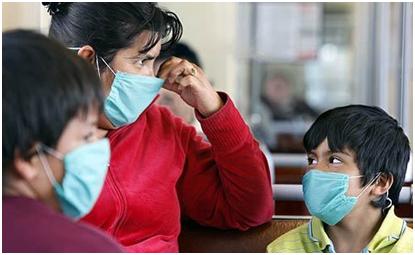
Swine Flu (H1N1) Continues To Top News

(picture from http://www.myfox8.com/lifestyle/health/la-sciw-swine-masks28-2009apr28,0,4461177.story)

It’s amazing how this has dominated traditional media and blown away the online media.

I few things that stick out for me:

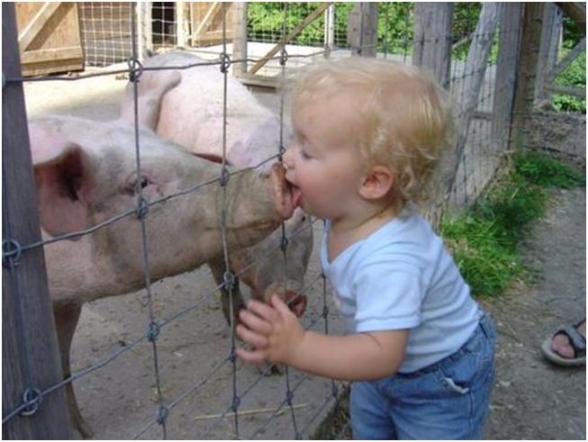
One of my favorite pictures that goes right to the health literacy issue is the following.

NOTE: This is not what H1N1 flu is about…hence the dropping of the “swine flu” term.

(picture from http://cuteoverload.com/)

Who’s Killing Independent Pharmacy?

This is a great question.

  1. Has it been the big mail order pharmacies?
  2. Has it been the PBM’s and their negotiating leverage?
  3. Was the final straw Medicare Part D and the loss of the cash patient?
  4. Is it other retail chains and their operating efficiencies?
  5. Was it just a natural evolution?
  6. Is it the fact that money isn’t made on the Rx anymore but on the candy bars and soda?
  7. Is it technology and the capital investments required?

Here is a quote from Jennifer Luddy, spokeswoman for Medco Health Solutions, (from AIS Drug Benefit News):

“The facts show that it is not mail-order [pharmacy], but rather chain pharmacies that are presenting a threat to independent pharmacies. According to national data from the pharmacy industry itself, for every independent pharmacy that closes, 25 chain and big-box retail pharmacies open.”

Healthcare Entities in the Fortune 500

I always find it interesting to see who the largest healthcare companies are in the annual Fortune 500 list. Here they are:

  • McKesson #15
  • Cardinal #18
  • CVS Caremark #19
  • UnitedHealth Group #21
  • AmerisourceBergen #26
  • Johnson & Johnson #29
  • Wellpoint #32
  • Walgreens #36
  • Medco Health Solutions #45
  • Pfizer #46
  • Aetna #77
  • Abbott Laboratories #80
  • Humana #85
  • HCA #88
  • Merck #103
  • Wyeth #110
  • Express Scripts #115
  • Bristol-Myers Squibb #120
  • Eli Lilly #122
  • Cigna #132
  • Schering-Plough #138
  • HealthNet #165
  • Amgen #168
  • Medtronic #196
  • Baxter International #219
  • Coventry Healthcare #226
  • Community Health Systems #243
  • Tenet Healthcare #283
  • Boston Scientific #320
  • Owens & Minor #339
  • Quest Diagnostics #341
  • Becton Dickinson #347
  • Stryker #375
  • Wellcare Health Plans #381
  • Henry Schein #389
  • Omnicare #392
  • Davita #433
  • Gilead Sciences #444
  • Mylan #462
  • Universal Health Services #467
  • Universal American #494

If you look at the lists of best investments or most bank for the buck, the company that appears the most is Express Scripts (ESRX).

Gov Leavitt On Gov’t Trojan Horse For Healthcare

In a piece that was posted on the AmericaSpeakOn.org website this morning and which I heard Governor Leavitt talk through last night, he lays out some of the illusions that we have around government run healthcare and reminds us that Medicare isn’t a model to emulate (in case you didn’t know that).  A few of the quotes from the piece:

  • Advocates of government-run health care suffer under the illusion that Medicare operates more efficiently than the private sector.
  • The efficiency of a health-care system isn’t measured by the volume of checks it issues, but the value it generates.  Medicare’s uncoordinated, quality-indifferent, more-more-more structure is moving it rapidly toward bankruptcy, and taking our nation with it.
  • Since 1970, the cost of these flagship government-run health-care programs has risen more than two-and-a-half times as much as the cost of all other health care in the United States, the vast majority of which is run by the private sector.
  • Medicare’s budget is projected to double within ten years, topping $1 trillion annually.  The number of workers per beneficiary will soon drop from almost four to just over two and a half.
  • This is like treating chronic obesity with a perpetual regimen of double calories.
  • Inevitably, government-run systems cut costs by cutting access to services.

There is another answer.  The government needs to promote value — to empower consumers to pursue the highest-quality care at the lowest-possible prices.  Strong government action is needed to organize an efficient market where consumers can choose insurance plans and medical practitioners who offer the best value.  What is not needed is to replace the private market with a government-run system in which only the truly rich have a choice.

Pharma Rx Costs Tied To Outcomes

Given our opinion that the PBM industry would be moving to more outcome based pricing, the articles today about Merck and Cigna‘s deal on pricing based on outcomes is very timely.  I “tweeted” about it early in the AM, but I have got the article sent to me by a lot of people.  So, here are a few of the things being said:

WSJ Blog

Now Merck and Cigna have announced what they’re calling a “performance-based contract” for Merck’s diabetes drug Januvia. But the deal is actually the reverse the pay-for-performance ideal: Merck will get paid less per pill, not more, if the drug works well.

Under the deal, Cigna will get a discount on the drug if patients’ blood sugar falls. Cigna will get additional discounts if patients faithfully take the drug when they’re supposed to. (These two variables often go together — taking the drug faithfully helps keep blood sugar down.)

Cigna PR

“Merck should be recognized as the first major pharmaceutical company to offer increased discounts on its oral anti-diabetic products, supporting CIGNA’s efforts to reduce A1C levels for individuals with diabetes, regardless of what medication they may be taking,” said Eric Elliott, president of CIGNA Pharmacy Management. “Improving people’s health comes first for both CIGNA and Merck. We hope this agreement will become a model in the industry.”

So…it seems like an aligned deal.  Merck and Cigna want adherence.  Employers want lower costs and better outcomes.

Consumers Don’t Care About Wellness

Here’s a good provacative quote from Forrester…are all the wellness efforts doomed or are incentives the minimum requirement to play?

“Health plans keep saying that they have to improve consumer engagement and that one of the best ways to do this is by engaging them in wellness initiatives. The data tell me that consumers don’t care about wellness. Employers do. But while most employees may hear the [wellness] message, they also ignore it….”

— Carl Doty, VP and research director at Forrester Research, told AIS’s INSIDE CONSUMER-DIRECTED CARE.

Whitepaper: The Future of the PBM (Pharmacy)

As we have been working with a lot of PBMs over the past year, the question has come up many times – “where do you see the industry going?” After bouncing some ideas off a few of you, we have pulled together a whitepaper with the Silverlink Communications perspective. Certainly, each area of the whitepaper could have been its own chapter, but rather than turn this into a thesis, we are publishing it.

As I have said in a few recent articles including the one in HCPro, I think the Express Scripts acquisition of NextRx will likely accelerate a few of our predictions here.

The executive summary of the whitepaper is below. The final whitepaper is available here.

I would welcome any comments you have…

Executive Summary

In the next several years, we believe that three changes will drive the pharmacy marketplace and ultimately change the business model for PBMs. These changes will be accelerated by the current financial crisis which may drive further consolidation in the short-term. Consolidation which we believe will accelerate the “race to the bottom” where the traditional model of scale has been maxed out with parity achieved among the large PBMs.

1. The need to better engage the consumer in understanding their benefits and ultimately responsibility for their care;
2. The effort to automate and integrate data across a fragmented system and across siloed organizations; and
3. The shift from trend management to being responsible for outcomes.

Consumer Engagement
The industry-wide movement to consumerism will continue to affect plan design, but it will also thrust PBMs and pharmacies into the critical path of member engagement. With pharmacy being the most used benefit as well as the volume and accessibility of retail pharmacies, they will play a critical role in driving adherence and helping consumers understand healthcare. This will renew the focus on cognitive skills, medication therapy management and ultimately drive the desire for a more traditional “corner store” approach that can be scaled using technology.

Combining this with the macro-economic forces that are driving ubiquity of technology through mobile media and the evolution of the Internet from a pull media to a push media will also challenge the PBMs and pharmacies to innovate. They will be required to look outside of healthcare models to identify the right communications to drive behavior. PBM’s and pharmacies will have to leverage behavioral economics and personalization technology to get the right message to the right consumer at the right time through the right medium.
Automation and Integration
The consumer engagement challenges will only exasperate some ongoing challenges within the PBM and pharmacy community. This will include the lack of staff to provide more cognitive services and the general fragmentation of data across organizations and functional silos. Figuring out an overall “single view of the patient” which shows all the touch points and offers a coordinated multi-channel strategy for inbound and outbound communications will become a major focus.

In addition, in order to make these solutions efficient, the development of predictive models, much like the clinical and underwriting solutions being used today, will become the norm across the industry. As these models are fine tuned and the promise of e-prescribing becomes more of a reality, the channel for engaging physicians in the member’s care will finally exist. PBMs and pharmacies will be able to use data to allow physicians to understand when patients aren’t being compliant and when there is an opportunity to drive change.

From Trend Management to Outcomes
The traditional business model for the PBMs has been based on large scale negotiations to drive rebates and efficiencies within mail service – cost to fill and acquisition costs. At the same time as those efficiencies reach a maximum discount, the traditional tools for managing trend will have run their course. Although plan design won’t “die”, comparative effectiveness may reduce (or eliminate) the need for formularies, and in general, the ability to shift cost to the consumer above the 25-30% level will be difficult.

Both of these challenges will push the PBMs and pharmacies into a role where they are focused on driving health outcomes and being part of the bigger solution across the industry. They have a strong footprint to drive this change and as theranostics (or personalized medicine) evolves there will be an opportunity to find cost effective solutions to change the prescription landscape.

Express Scripts Outcomes Conference Begins

As with each annual Outcomes conference, Express Scripts (ESRX) has released their annual trend numbers. Here are a few of the highlights from the press release:

  • Overall pharmacy trend = 3.0% (down from 5.5% in 2007)
  • Estimate consumers and employers are paying $42B too much in 13 therapy classes by not optimizing generics.
  • On average, a generic drug is over $90 cheaper than a brand name drug.
  • Generic drug usage increased by 7.5 percent, while utilization of brand name medications decreased 11 percent.
  • 67.3 percent of all prescriptions that Express Scripts filled were for generic drugs by the end of 2008. [I didn’t like the comparison which was an average across the 12 months ending in Sept 2008 from IMS of 63.7%…not apples to apples.]
  • In 2009, at least 20 branded drugs are expected to become available generically.
  • Over the next five years, more than $66 billion worth of branded drugs are expected to lose patent exclusivity.

“Using generic drugs that are safe and effective can help lower costs while still driving value for patients and employers,” said Steven Miller, MD, senior vice president and chief medical officer at Express Scripts. “Our results indicate that cost control is achievable through careful management of appropriate use of drugs and delivery channels, without shifting costs to consumers. Although the trend is the lowest it has been in over a decade, significant opportunity to lower spending still exists.”

“Finding ways to reduce spending without compromising health outcomes is the top priority for healthcare reform, as the Obama administration recognizes,” said Alan Garber, MD, PhD, Henry J. Kaiser Professor and director of the Center for Health Policy at Stanford University. “We have long used financial incentives to try to eliminate waste. Now we’re finding that tools that build upon the insights of behavioral economics and psychology can have powerful, positive effects.”

“In today’s economy, we are not only tracking wasteful spending across the country but developing strategies to reduce it,” said George Paz, chief executive officer at Express Scripts. “By applying the principles of behavioral economics we are helping consumers make better and more cost-effective healthcare decisions. We understand we cannot eliminate waste alone and we are committed to working alongside likeminded organizations, such as the Federal Coordinating Council for Comparative Effectiveness Research, to continue to identify strategies to improve our healthcare system.”

“Studies have repeatedly shown that people work much harder to avoid losses than to pursue gains,” said Bob Nease, PhD, the company’s chief scientist. “This suggests that a ‘stop wasting money’ message is more effective than a message focused on potential savings. In addition, by applying evidence-based segmentation, we have practical insight into which members are likely to be most sensitive to loss aversion. One size does not fit all.”

The Innovator’s Prescription – Christensen Book

I haven’t had the chance to read the book yet, but for those of you interested, I thought I would point you to the review from a few months ago on The Health Care Blog.

The book is mistitled. It should have been titled “The Innovator’s Diagnosis”. The book does a fantastic job at diagnosis (Dx) of problems in the U.S. health care system. It presents many new, innovative analytical frameworks and lenses through which to view the U.S. health system.

However, it’s weak on prescription (Rx): many of the proposed solutions are speculative, ungrounded, and/or defy political reality.

Waxman at the AMA

I am finally catching up on some notes from Rep. Henry Waxman (D-CA) when he spoke to the AMA in March 2009.  (From “The Pink Sheet”, March 16, 2009, pg. 27)

“We all know we have to get costs under control, but the way to do that is not to tell physicians what they can and cannot do or put them in a position where they cannot put the needs of their patient first.”

“I am not interested in trying to put a public plan in place that would drive out competition.  I believe we must have a significant role for private insurers.  We must allow them a fair opportunity to compete.”

“We have to reward quality and outcomes, not just reward volume.”

The $40B HealthCare Opportunity Around Retention

It’s obvious to anyone close to it, but harder to align the goals to take advantage of it.  With people “aging-out” from group plans to Medicare and people leaving their employer coverage to go to the individual market, managed care has a huge opportunity to retain that business by providing them a transition path.  According to McKinsey (and from what we see), that’s generally not happening.

A few facts from their report:

  • 68 percent of all members aged 60 to 64 have never been approached by their current insurers to discuss retirement options.
  • more than 80 percent of respondents aged 60 to 64 said they would consider purchasing an individual product from their current carrier if they left their jobs or retired.
  • Only 33 percent of 60- to 64-year-olds thought that their insurers offered Medicare products, for example, when in fact almost all major carriers do.

It’s also a simple economic problem.  They are less expensive to retain and convert while their a member than once they are on the open market.  You may even save on broker fees.  Developing a data driven approach to create timely and personalized communications along with a service to transition them should be a priority.

mckinsey-conversion-opp

Selling NextRx to Express Scripts

I was hoping I might get a chance to sit down with Angela Braly (CEO at Wellpoint) at the WHCC 2009 in DC to talk about the sale they announced yesterday NextRx to Express Scripts).  I think it’s a very logical decision, and I think they got a good price.  For my old team at ESI, there is a huge opportunity for them to drive mail volume.

In her keynote discussion this morning, she briefly mentioned the sale saying that they sold it to help lower healthcare costs.  While I completely agree in the short-term (i.e., rebate contracting, network negotiations), I remain mixed in my long-term view.

I talked briefly with Les Masterson about this yesterday for the article he just published – “PBM Sale Highlights Dilemna for Health Plans“.  I do expect this will push for the development of a new business model which will highlight automation, member engagement, and a greater role in driving outcomes.

George Van Antwerp, vice president, solutions strategy, at Silverlink Communications, Inc., in Burlington, MA, says health plans can benefit from having their own PBMs if they use them properly.

“I think that it’s beneficial to plans to own their own PBM if they can integrate data and create a better member experience; make the tradeoff between increased pharmacy spend and lower medical loss ratio; and manage to get most of the economies of scale in terms of operations and negotiation. That has proven hard to do within health plans, and therefore, there will be short-term interest in capitalizing on the valuation of the PBM business,” says Van Antwerp.

With three large PBMs left after the pending purchase, Van Antwerp says the trio will “race to the bottom in terms of negotiating scale leverage.” Van Antwerp predicts the remaining PBMs will ultimately try to differentiate themselves by offering healthcare management through member engagement, greater transparency, and a renewed focus on health outcomes.

X-Ray Vision Carrots

Behavioral economics can apply in many instances.  It is the “hot” discussion topic in healthcare about how to understand how members (consumers / patients) make decisions and what factors influence their decisions.

In this article in Newsweek about getting kids to eat healthy, they talk about three things:

  1. Verbal encouragement
  2. Descriptive labels
  3. Improved access

Rather than calling them carrots, they talk about calling them “x-ray vision carrots”.  These 3 “principles” are relevant to a lot of communications.  You have to be proactive and provide encouragement to members to get a flu shot or do other preventative health actions.  You then need to find a way to describe the action in a way that is compelling.  And, finally, you have to make the action easy.

Impact of Rising Health Care Costs

These are straight from the National Coalition on Health Care (NCHC), but they represent a sobering view of the impact of our rising costs. For the broader list of facts, you can go to their website.

  • In 2008, health care spending in the United States reached $2.4 trillion, and was projected to reach $3.1 trillion in 2012.1 Health care spending is projected to reach $4.3 trillion by 2016.1
  • Premiums for employer-based health insurance rose by 5.0 percent in 2008. In 2007, small employers saw their premiums, on average, increase 5.5 percent. Firms with less than 24 workers, experienced an increase of 6.8 percent.2
  • Health care spending is 4.3 times the amount spent on national defense.3
  • Health insurance expenses are the fastest growing cost component for employers. Unless something changes dramatically, health insurance costs will overtake profits by the end of 2008.4
  • The percentage of Americans under age 65 whose family-level, out-of-pocket spending for health care, including health insurance, that exceeds $2,000 a year, rose from 37.3 percent in 1996 to 43.1 percent in 2003 – a 16 percent increase.5
  • A recent study by Harvard University researchers found that the average out-of-pocket medical debt for those who filed for bankruptcy was $12,000. The study noted that 68 percent of those who filed for bankruptcy had health insurance. In addition, the study found that 50 percent of all bankruptcy filings were partly the result of medical expenses.6 Every 30 seconds in the United States someone files for bankruptcy in the aftermath of a serious health problem.
  • A new survey shows that more than 25 percent said that housing problems resulted from medical debt, including the inability to make rent or mortgage payments and the development of bad credit ratings.7
  • About 1.5 million families lose their homes to foreclosure every year due to unaffordable medical costs. 8
  • A survey of Iowa consumers found that in order to cope with rising health insurance costs, 86 percent said they had cut back on how much they could save, and 44 percent said that they have cut back on food and heating expenses.9

Notes

  1. Keehan, S. et al. “Health Spending Projections Through 2017, Health Affairs Web Exclusive W146: 21 February 2008.
  2. The Henry J. Kaiser Family Foundation. Employee Health Benefits: 2008 Annual Survey. September 2008.
  3. California Health Care Foundation. Health Care Costs 101 — 2005. 02 March 2005.
  4. McKinsey and Company. The McKinsey Quarterly Chart Focus Newsletter, “Will Health Benefit Costs Eclipse Profits,” September, 2004.
  5. Agency for Heathcare Research and Quality. Out-of-Pocket Expenditures on Health Care and Insurance Premiums Among the Non-elderly Population, 2003, March 2006.
  6. Himmelstein, D, E. Warren, D. Thorne, and S. Woolhander, “Illness and Injury as Contributors to Bankruptcy, ” Health Affairs Web Exclusive W5-63, 02 February , 2005.
  7. The Access Project. Home Sick: How Medical Debt Undermines Housing Security. Boston, MA, November 2005.
  8. Robertson, C.T., et al. “Get Sick, Get Out: The Medical Causes of Home Mortgage Foreclosures,” Health Matrix, 2008
  9. Selzer and Company Inc. Department of Public Health 2005 Survey of Iowa Consumers, September 2005.

Marathon / Triathalon Deaths Per Million

An article that came out yesterday points out that there is a much higher risk of heart problems in the triathalon especially around jumping into the cold water for the open swim.  It puts the deaths per million participants at 15 compared to 4-8 deaths per million marathon participants.  Certainly, if you are jumping into either sport, you should train appropriately and talk with your physician about any concerns or ideally get checked out for any potential heart complications.

But, I think it’s also important to put these in perspective.  According to FARS (Fatality Analysis Reporting System), the statistics on fatalities from car accidents are:

  • 13.61 per 100,000 people
  • 16.05 per 100,000 registered vehicles
  • 19.96 per 100,000 licensed drivers

Some of The Worse Lunches

This whole article on restaurants is worth reading to show you just how bad some meals are for you.  Let me pull out a few of the scariest meals:

QUIZNO’S

Large Prime Rib Cheesesteak Sub

  • 1,490 calories
  • 92 g fat (22.5 g saturated, 2 g trans)
  • 2,620 mg sodium
  • Fat equivalent: Like eating four Dunkin Donuts cheese danishes!

CHILI’S

Crispy Sweet Chile Glazed Chicken Crispers

  • 1,930 calories
  • 112 g fat (17 g saturated)
  • 4,190 mg sodium
  • Calorie equivalent: Like eating an entire medium Pizza Hut 12″

PANERA

Italian Combo on Ciabatta sandwich

  • 1,050 calories
  • 47 g fat (18 g saturated, 1 g trans)
  • 3,050 mg of sodium
  • Fat equivalent: Like eating 6 slices of Papa John’s cheese pizza!

HARDEE’S

2/3-lb Monster Thickburger

  • 1,420 calories
  • 108 g fat (43 g saturated)
  • 2,770 mg sodium
  • Saturated fat equivalent: Like eating 43 strips of Oscar Mayer bacon!

BURGER KING

Triple Whopper Sandwich with cheese and mayo

  • 1,250 calories
  • 84 g fat (32 g saturated, 2.5 g trans)
  • 1,600 mg sodium
  • Fat equivalent: Like eating 10 slices of Papa John’s cheese pizza!

Correlation or Causality

This is a typical mistake that many people make.  They see correlation and mistake it for causality.

From Dictionary.com:

  • Correlation = the degree to which two or more attributes or measurements on the same group of elements show a tendency to vary together.
  • Causality = the principle of or relationship between cause and effect.

I see the difference as correlation shows two things that appear to be related (i.e., I ate a strawberry and had a rash the next day therefore I must be allergic.)  Causality is a direct relationship that is proven where one clearly causes the other (i.e., I went to the allergist and had a bunch of studies done.  I am allergic to strawberries).

There was an article in USA Today called “Many think they have drug allergies” on March 9, 2009.  Apparently many people think they have allergies when they don’t.  In one study discussed in the article, 90% of those people who said they were allergic to penicillin where not when a skin test was done to check.

  • People often mistake side effects with allergic reactions. (e.g., stomach ache)
  • People trust their mothers (i.e., relying on hearsay versus facts).
  • People trust their doctors (when tests may not have been conducted).
  • People grow out of some allergies.

The point of all this is that you need to rely on facts and isolate them to prove causality.  Don’t just look for things that happen at the same time.

How Easy It Is To Overeat

This is a good article that I saw on MSN this morning talking about calories in pizza, ice cream, orange juice, rice, and other foods and how quickly we overeat by simply not managing portions.

How many of us eat one slice of pizza for a meal (for example)?

$2.3T on Healthcare and 47M Uninsured – National Disgrace

Kaiser Permanente recently launched a series of advertisements that drive this message around health disparities home. It is (or should be) a concern for most of us.  Health outcomes and especially preventative care is driven by health literacy, our attitudes towards health, and our access to the healthcare system.  We should all be working with our families, our communities, and our country to try to make this better.

I am a firm believer that one of the best ways to start to manage cost is to find a viable strategy to get universal coverage.  The costs of emergency care and absenteeism all get passed on to us in one way or another.  And, as the government is the dominant payor of healthcare (Medicare, Medicaid), long term costs are a significant issue for our economy.  If there is a systemic way of improving it, we should seek that out.

So, a cause that is both moral and economical…what more do you need?

Today, more than 50 percent of Americans and 75 percent of Californians without health care coverage are people of color.  Uninsured men, women, and children are far more likely to get sick and forego care simply because they lack coverage.  This is a national disgrace. We spend 2.3 trillion dollars on care in this country. Securing health care coverage for every American is the next great civil rights issue of our time. We can and should achieve universal coverage.

kaiser-ad

Some of the facts highlighted on their new website about disparities include:

  1. Disparities in health and health care impact everyone. African Americans, American Indians, Alaska Natives, Asians, Pacific Islanders, and Hispanics are most affected.

  2. 27% of adults report having no usual source of care. African-American (28%), Hispanic (51%), and Asian (23%) adults are all more likely to report not having a usual doctor.

  3. Uninsured adults are disproportionately, young, and minorities; 82% are between 19-49 years of age, and 41% identified themselves as black, Hispanic, or other.

  4. American Indian and Alaskan Native death rates from sudden infant death syndrome are the highest of any population groups.

  5. Asian Americans have the highest tuberculosis case rates of any racial and ethnic population.

  6. During 1996-2000, Native Hawaiians were 2.5 times more likely to be diagnosed with diabetes than non-Hispanic white residents of Hawaii of similar age.

  7. In 2005, African Americans accounted for 18,121 (49%) of the estimated 37,331 new HIV/AIDS diagnoses in a national poll which encompassed 33 states.

  8. 21.9% of U.S. children live in poverty, far and away the worst in the industrialized world. Comparable figures for the Nordic countries are 4.2% and less.

  9. Adults who have not finished high school are almost two times more likely than college graduates to be obese.

To learn more about the topic, you can go to their community of information.

E-Mail No-No’s

While I am sitting on the plane doing hundreds of e-mails (finally catching up), I flipped thru the American Way magazine. It has an article on e-mail etiquette with a list of “The Top 10 E-mail Turnoffs” (March 15, 2009, pg. 16). [BTW – Only a frequent traveler quotes airline magazines.] I think it’s a good list and hits a lot of mistakes that you see. The other key that they talk about in the text is that increased probability of someone misreading your intentions when they don’t have a voice or actions to provide more context. (A problem with text messaging professionally also.)

10 – Get overly cutesy or slang-happy in a professional e-mail.

9 – Skimp on the subject line.

8 – Miss the Mr. or Mrs. mark.

7 – Send it off without running a spell check.

6 – Sprinkle your message with flowery language.

5 – CC: for all to see.

4 – Send an irate, angry, or potentially embarrassing message.

3 – Use your work e-mail for personal time (read: racy)

2 – Go all willy-nilly with the wingdings.

1 – Hit reply all.

[On a related travel note, I need to come up with some “term” for days where I eat each meal in a different state and time zone. Had another “opportunity” to do it this week, but I only hit two time zones.]

Fake Research – Ridiculous

Sometimes, I just can’t believe certain things.  The fact that people fake drug studies.  Come on.

Baystate Medical Center in Springfield, Mass., has asked several anesthesiology journals to retract the studies, which appeared between 1996 and 2008, the WSJ reports. The hospital says its former chief of acute pain, Scott S. Reuben, faked data used in the studies.

Personal E-mail Replaced By Social Networks

This plays into my post earlier about changes in communication patterns…

I certainly have begun to see more of my social (personal) online communications moving from e-mail to social networking tools like Facebook, LinkedIn, and Plaxo.  I almost never trade e-mails with my siblings any more.

So, it wasn’t a big surprise when I saw the blurb in the USA Today which said that “social networks and blogs” have moved ahead of personal e-mail as the most popular online activities (per Nielsen report).

A few facts:

  • 1 of every 11 minutes is spent on these social networking and blogging sites.
  • Time spent on the sites is growing 3x faster than overall Internet usage.
  • 2/3rds of the world’s online population visit these sites.
  • The US was third (after Brazil and Spain) with 67% of the population visiting these sites.
  • Facebook is visited by 3 in 10 people monthly.
  • 10.6M people in the US access these sites through their mobile devices.

More Lies In E-mail

A pair of recent studies suggest that e-mail is the most deceptive form of communications in the workplace–even more so than more traditional kinds of written communications, like pen-and-paper.

More surprising is that people actually feel justified when lying using e-mail, the studies show.

“There is a growing concern in the workplace over e-mail communications, and it comes down to trust,” says Liuba Belkin, co-author of the studies and an assistant professor of management at Lehigh University. “You’re not afforded the luxury of seeing non-verbal and behavioral cues over e-mail. And in an organizational context, that leaves a lot of room for misinterpretation and, as we saw in our study, intentional deception.”[See article]

This certainly raises a few flags as letters become a “historical tool” for communicating and everything becomes more about technology.  This certainly says a lot for virtual teams and remote management.  You can’t rely just on e-mail.  You need to pick up the phone and talk.  You need to visit face-to-face (F2F).

Does this mean that MDs shouldn’t trust e-mails from patients?

Does this mean that deals shouldn’t be negotiated through e-mails?

What’s In A Voice?

In the most recent copy of AHIP’s Coverage Magazine (JAN+FEB.09), there is a nice feature called “What’s In A Voice?” which talks about Silverlink Communications. You can find the whole article (“Motivating Change“) here, but I pulled out a few quotes:

“When the phone rings, it takes just the right voice to motivate a member to overcome the tendency to put off receiving preventative care.”

“Silverlink calls allow us to communicate with our members in a really personalized way without incurring the costs associated with hiring and training additional customer service representatives.” Linda Lyle, Cariten Healthcare Vice President of Operations

“This mammography campaign contained scripting that allowed the members to respond, [indicating] whether or not they had had a mammogram. We received a large number of ‘yes’ responses that we will pursue for HEDIS improvement, as well as to identify gaps in our data collection. This method of collecting data about our members is unique to telephone outreach. We are anxious to explore our findings.” ” We know how many listened to the message and how many hung up. We know how many people we actually reach.” Michael Bryne, Assistant Director of Quality Management at EmblemHealth.

The article also talks about using non-professional voices such as the Chief Medical Officer or a customer service representative who was really good with members. In one example, Eleanor Sorrentino, the Managing Director of Quality Management at EmblemHealth, talks about getting 50 calls from members thanking her for the automated call which was recorded in her voice.

A few other items talked about include the use of data and reporting which is available real-time to make decisions along with the use of natural sounding voices to drive a conversational experience which leverages internal and professional scripting resources to develop the best content.

Biggest Loser…Losing Credibility

In one of those classic examples of why do smart people do stupid things, the show The Biggest Loser on NBC shows one of their recent contestants completing a marathon in under 4 hours while weighing close to 300 pounds.  I saw the show and was amazed.  I haven’t been able to do that on 3 tries and wondered what the heck I was doing wrong.

Well…come to find out that he didn’t run the marathon unaided.  Depending on which report you believe, he got a van ride for 3-6 miles toward the end and was crossing the finish line at just under 6 hours.  I just don’t get why the show would be so stupid. 

It’s a show about inspiring people with amazing transformations.  Having him run a half-marathon or even completing a full 26.2 miles at a slow time would have been a great story.  Instead you ruin it and cast down on some of the things that the contestants do.  

Story in the Detroit News about it.

You can read the official statements from Dane (the contestant), the show, and NBC in The LA Times.

“I always intended to run the full marathon. At the 17th mile, I knew I would not make it in time to cross the finish line before it closed at 6 hours, so I then received a ride from the field producer, who wanted to show me crossing the finish line. He drove me for three miles, and then I ran the rest of the way. After all the filming was done I went back and finished the last 3 miles later that day with my wife and cousin Blaine. I apologize for stating that I ran the entire marathon before I actually ran the whole 26 miles. I am proud of the feat of just running 26 miles in one day.”

Buyology: Best Book of 2009

I am finally getting around to writing this up. I mentioned the book – Buyology – a few weeks ago. It is definitely the best book I have read this year. It is by Martin Lindstrom and is all about neuromarketing.

For those of you that don’t think it’s relevant to healthcare, think again. Healthcare is all about compelling individuals to take action and become responsible for their health. That is about understanding how they interpret information and what drives them.

Here are some of my notes from the book:

  • One of the processes used was fMRI (functional Magnetic Resonance Imaging) which measures the amount of oxygenated blood throughout the brain. Scientists can see what part of the brain is working at any given time.
  • The other process used was SST (steady-state typography) which tracks rapid brain waves in real time.
  • One of his first studies looked at the effect of cigarette warning labels and found that they not only failed to deter smoking but activated the nucleas accumbens.
  • What people say on surveys and in focus groups does not reliably affect how they behave. [although it is often the best we have]
  • Brand matters…He re-conducted the Pepsi Challenge and showed that if people knew what they were drinking they preferred Coke to Pepsi. When they didn’t know, 50% of people liked Coke. When they knew, 75% of people liked Coke.
  • He showed that consumers have no memory of brands that don’t play an integral part in the storyline of a program. Just putting something in the movie, TV show, or video game isn’t enough to get you mindshare. AND, those successful placements also weaken our ability to remember other brands.

“Our irrational minds, flooded with cultural biases rooted in our tradition, upbringing, and a whole lot of other subconscious factors, assert a powerful but hidden influence over the choices we make.”

  • In the Smiling Study that he references, they revealed that people are far more positive and have a better attitude toward the business when the person they are dealing with is smiling. [Maybe a key thing for avatars and real agents as they talk to people over the computer and/or phone.]
  • Our mirror neutrons allow us to get pleasure just by observing or reading about people doing something that would give us pleasure – e.g., opening a present with a new Wii in it. [You can go to www.unbox.it.com or www.unboxing.com to enjoy this.]
  • Logos are dead. They showed that images that are associated with smoking (for example) were far more potent in creating a reaction in the brain than the logo.
  • “Secret Ingredients” matter…he shared several examples of how things sold differently when there were non-existent things listed on the label.
  • When people viewed images associated with strong brands – iPod, Harley-Davidson, Ferrari – their brains registered the same activity as when they saw religious images.
  • They studied and showed that odor can activate the same brain response as the sight of the product. He talked about an interesting study that showed that “feminine scents” such as vanilla were sprayed in women’s clothing sections, sales of female apparel actually doubled.
  • Sex, extreme beauty, or a celebrity in an advertisement can hijack attention away from the information in the advertisement.

“I predict that soon, more and more companies (at least those who can afford it) will be trading in their pencils for SST caps. That traditional market research – questionnaires, surveys, focus groups, and so on – will gradually take on a smaller and smaller role, and neuromarketing will become the primary tool companies use to predict the success or failure of their products.”

Some interesting facts:

  • 300 million people, including 60% of male doctors, in China smoke.
  • 8 out of 10 new product launches fail within 3 months.
  • In 2005, 156,000 new products debuted globally (or one product every 3 minutes).
  • In 1965, a typical consumer could recall 34% of advertisements from TV. In 1990, that number dropped to 8%. In 2007, consumers could only remember 2.21 advertisements from all advertisements they had ever seen. [Talk about saturation.]
  • We walk almost 10 faster than we do a decade ago. 3.5 mph
  • A study in Denmark showed that people talked 20% faster than they did a decade ago.
  • And, if you don’t believe that culture matters…In Asian cultures, four is an unlucky number and one researcher found that heart attacks among US residents of Chinese descent spiked as much as 13% on the fourth day of each month.
  • Children that experience social difficulties in school are more likely to be preoccupied with collecting.
  • Both J&J and Play-Doh have lost their original fragrances and haven’t been able to replicate it.
  • When classical music was piped over loudspeakers in the London Underground, robberies, assaults, and vandalism dropped by over 25%.

Some of the interesting companies mentioned:

I thought he had a great story about a rock. If I gave it to you for your birthday, you’d be offended until I told it was from the Berlin Wall. And then when I told you it was from the moon, you would be even more impressed.

For more information, there is also a neuroscience blog.

Struggles Of A Working Family Report

The Kaiser Family Foundation has released a report and video that they did on several families looking at their struggles to pay bills and survive.

The report, Snapshots from the Kitchen Table: Family Budgets and Health Care, is based on interviews with 27 families from six cities across the U.S.. It finds pervasive uncertainty over job security and households teetering on the financial brink, stretching to pay for basics such as food and housing and ill-equipped to cope with unexpected costs for things such as a medical emergency or a necessary home repair.

Health care costs were of particular concern, with many families forgoing doctor visits, skipping prescription medications and postponing needed care. Even those with health insurance reported delaying care in order to avoid co-payments, rising deductibles and out-of-pocket expenses for uncovered services.  Despite barely being able to meet the cost of basic needs, many families did not qualify for public programs like Medicaid and the Children’s Health Insurance Program.