Archive | Events RSS feed for this section

Father’s Day Numerology

While the male family member has not traditionally been the dominant healthcare figure, will that change over time? 

According to a Numerology page in Fast Company (June 2010) on Father’s Day:

  • There are 66M fathers in the US.
  • There are an estimated 158K stay-at-home dads.  (or 0.2% of all fathers)
  • 7 of the top 15 TV dads come from programs in the 50s and 60s (does that tell us something?).
  • 1 in 4 dads spend less than an hour a day with their kids.
  • 38% of working dads say they’d take a pay cut for more time with their kids.
  • 13% of US companies offer paid maternity leave.
  • There are at least 2M father-son businesses in the US.
  • 10% of the 29M ties sold per year are for Father’s Day…but they are still the least-popular Father’s Day gift (just 1% give ties).
  • Consumers spent an average of $91 on Father’s Day in 2009.

We know that our friends drive our health…we exercise if our friends exercise…we lose weight if our friends lose weight.  I’ve never seen a study comparing “friends” versus family in terms of social influence around healthcare.  But, I certainly believe that you build a culture of health at home.  Parents are important in doing that.  What you eat.  If you exercise.

Walgreens and CVS Caremark – Coming to Blows

I’m surprised this took the 3 years to play out. I talked about this back in 2007. Today, Walgreens announced that they would no longer participate with CVS Caremark networks for new networks and renewals. (See the CVS Caremark response here.)

Personally, I’m a little surprised they didn’t limit it just to the Maintenance Choice contracts which is where they have issues (like Mandatory Mail). Walgreens has fought for years against PBMs that implement models that limit choice.

I guess one of the big questions here is whether CVS Caremark allows Walgreens into their Maintenance Choice network. Walgreens (for example) has multiple 90-day networks. One which is just with Walgreens and one that includes other retailers.

Other questions I would have are:
1. Will CVS Caremark pull out of the Walgreen’s PBM network or their 90-day networks?
2. Will other retailers pull out of the CVS network?
3. Will Walgreens be more aggressive with other PBMs or can they only “fight” one at a time?
4. Will this help CVS Caremark focus their retail acquisition strategy to areas where Walgreens is stronger than them really creating a retail battle and less of a PBM battle?

I’m sure in some geographies (e.g., St. Louis, NYC) this may present some challenges where the CVS presence is not as strong, but in the end, most consumers have access to more retail pharmacies than they need and most PBM decisions are heavily influenced by price. If CVS Caremark can offer a price point that takes into account the disruption to the member base of not having Walgreens in the network, they can win. If that hurts them too much or they can’t do it, they’ll have to figure out how to make nice with Walgreens.

It will be interesting!

Some of my notes from RESULTS2010

This week was our [Silverlink Communication’s] annual client event – RESULTS2010 (click here to see the final agenda). I’ve talked about this before as one of the best events.  It was great! Educational. Fun. Good networking.  

Here’s a few of my notes along with a summary of the twitter feed (using hashtag #results2010). Unfortunately, the two of us twittering were also fairly involved so there are some gaps in coverage. And, my notes are sporadic due to the same issue.

Overall themes:

  • Communications are critical to driving behavior change.
  • We have to address cost and quality.
  • Reform creates opportunity.
  • Systemic problems require systemic solutions.
  • Measure, measure, measure.
  • Automated calls – while not the whole solution – work in study after study.
  • People are different.
  • There is a gap in physician – patient interactions. 

Notes:

  • Reform basics – guarantee issue, requirements for coverage, income related subsidy.
  • Independent payment advisory board has an aggressive goal – get Medicare spending to equal GDP growth + 1% each year.
  • ½ of the $1 trillion needed to pay for health reform comes from Medicare savings / reform…the rest from taxes.
  • Everyone’s fear is that MCOs become “regulated utilities” that just process claims…unlikely.
  • Need to address underuse, misuse, overuse, and limited coverage.
  • Need to measure quality and cost at the person level.
  • CMS pilots around shared savings are working – outcomes improved.
  • Medicare Part D only got one complaint per thousand for therapeutic interchange programs / drug switching.
  • The decision around defining MLR (medical loss ratio) and what fits in there is critical.
  • Healthcare is like anything else…it’s not great and needs to change, but don’t touch mine cause it works ok. [frog in the pot]
  • How do we make each healthcare decision an informed decision.
  • Decision aids.
  • Pull, push, or pay – 3 ways to drive awareness.
  • Moving from information about your care to information being care.
  • The incentive rebound effect…what happens when you take away an incentive.
  • Social interaction affects our behavior.
  • Solving for how to change consumer behavior cost effectively and in a sustainable manner is a good challenge to work on.
  • How do we move people from desires to action? From “I’d like to exercise” to actually doing it.
  • The fact that some European programs take 3-5 years to see an impact makes me wonder what that means for our US investment strategy given the member churn across plans.
  • Great examples of ethnographic interviews
  • Good McKinsey data on people’s perceptions – Annual Retail Healthcare Consumer Survey.
  • Inform / Enable / Influence / Incentivize / Enforce
  • One way of categorizing – willingness to change versus barriers to change (rational, emotional, psychological).
  • Attitudinal segmentation – cool…but how to scale?
  • Provider staffs attitudes are important.
  • Design – delivery – measurement
  • Readiness to coach
  • A culture of health
  • Have to mix up your tools (incentives, channels)
  • “Communication Cures”
  • The chief experience officer is a new role in plans and PBMs.
  • The only experience you have with health insurance is via communications. Make it count.
  • Loyalty is a result of cumulative experiences.
  • People have to trust you so they listen to your message
  • Communication maturity model
  • Price is what you pay; value is what you get. (Warren Buffett quote…he wasn’t there)
  • Shifting paradigms:
    • Consumption to sustainability
    • Possessions to purpose
    • Retirement to employment
    • Trading up to trading off
    • Perceived value to real value
  • Simple…less is more
    • 1/3 of people feel their lives are out of control.
  • Inflamation causes 80% of diseases (really)?
  • If only 10% of outcomes are driven by costs, why do we spend 100% of our time trying to fix that problem. [tail wagging the dog] [It’s the same point on adherence.]
  • There are 45M sick days per year from 5 conditions – hypertension, heart disease, diabetes, depression, and asthma.
  • Have to look at clinical efficacy and elasticity of demand.
  • Commitment, concern, and cost.
  • Five components – plan design, program, community, communication, and provider engagement.
  • Need a multi-faceted approach to create a culture of health.
  • MDs much more likely to talk about pros than cons.
  • There would be 25% less invasive procedures if patients fully understood the risks.
  • Foundation of Informed Decision Making
  • Huge gaps in patient view versus physician views around breast cancer.
  • Preference-sensitive care
  • Dartmouth Atlas
  • Genomics tells you the probability of being on a disease curve, but not where you are in the potential severity.
  • Only 60-70% of women get at least one mammogram their entire life.
  • Statin study – barriers to adherence:
    • 37% didn’t know to stay on the Rx
    • 27% side effects
    • 15% convenience
    • 15% MD instructions
    • 11% cost
  • In healthcare, we’re all taught to speak a language that no one else understands.
  • It takes a village.
  • Challenge – Use communications to cure cancer.
  • Collaboration. Innovation. Evaluation.
  • Adherence is a great example of where everyone’s interests are aligned.
  • There is no magic bullet for adherence.
  • You need a multi-factorial approach to address adherence…Physicians are rather ineffective at addressing adherence.
  • Evidence-based plan design works to impact adherence (although I think another speaker said no).
  • You have to think about operant conditioning. (Look at dog training manuals and kid training manuals – very similar)
  • Think about all the failure points in the process.
  • What is the relative value to the patient.
  • Reward system has to reward at the failure points not just at the end of the process.
  • Using a point system successfully increased the use of a select (on-site) pharmacy by 57% at one employer.
  • 75% of PBM profits are from dispensing generics…that’s why Wal-Mart was able to be a threat to the industry.
  • Drugs only work in 20-80% of people.
  • There are people with a gene that doesn’t break down caffeine.
  • 3% of people are ultrafast metabolizers of codeine (which turns to morpheine in the body)…that can be a problem.
  • Epigenetics – turning DNA switches on and off.

“Tweets”

Rebecca from ProjectHEALTH closes #results2010 with a remarkable talk on this crucial program; they work with 5,000 families/year.

Reid Kielo, UnitedHealth: 93% of members validated ethnicity data for HEDIS-related program using automated telephony #results2010

25% of Medco pt take a drug with pharmacogenetic considerations. Robert Epstein, CMO Medco #results2010

Bruce Fried: the “California model” of physician groups facilitate efficiencies that improve delivery; an oppty for M’care #results2010

Bruce Fried on Medicare: 5 star ratings have strategic econ. importance, med. mgt. and cust serv. key #results2010

Fred Karutz: members who leave health plans have MLRs 2 standard deviations below the population. #results2010

Fred Karutz: Market reform survival – retain the young and healthy #results2010

Poly-pharmacy has negative impact on adherence. #cvscaremark
#results2010

1 in 3 boys and 2 in 5 girls born today will develop diabetes in their life. SCARY! #results2010

20% of all HC costs associated with diabetes. #results2010. What are you doing to manage that?

Messages to prevent discontinuation of medication therapy far more effective than messages after discontinuation. CVS #results2010

25-30% of people who start on a statin don’t ever refill. #CVSCaremark
#results2010

Maintenace of optimal conditions for respiratory patients increased 23.4% with evidence-based plan design. Julie Slezak, CVS. #results2010

Value-based benefits help control for cost sensitivity for medications; every 10% increase in cost = 2% – 6% reduction on use. #results2010

Pharmacists who inform patients at the point of dispensing are highly influental in improving adherence. William Shrank #results2010

The game of telephone tag in HC is broken. Pt – MD communications. #results2010

37% of Pts were nonadherent because they didn’t know they were supposed to keep filling Rx. #results2010

Last mile: 12% of Americans are truly health-literate; they can sufficiently understand health information and take action. #results2010

Only 12% of people can take and use info shared with them. #healthliteracy
#results2010
#DrJanBerger.

We need to improve the last mile in healthcare… clear, effective conmunication. Jan Berger #results2010

#McClellan used paying drug or device manu based on outcomes as example of “accountable care”. #results2010

72% of those with BMI>30 believe their health is good to excellent; as do 67% of those w/ chronic condition. #McKinsey
#results2010

Are incentive systems more likely to reward those that would have taken health actions anyways (i.e., waste)? #McKinsey
#results2010

Only 36% of boomers rate their health as good to excellent. #results2010

27% of people believe foods / beverages can be used in place of prescriptions. #NaturalMarketingInstitute
#results2010

Why do we spend so much time on impacting health outcomes thru the system when that only explains 10%. #Dr.JackMahoney #results2010

Using auto calls vs letters led to 12% less surgeries & 16% lower PMPM costs in study for back pain. #Wennberg
#HealthDialog
#results2010

MDs are much more likely to discuss pros with patients than cons. #Wennberg
#HealthDialog
#results2010

Should physicians be rewarded as much for not doing surgery? How do economics influence care decisions? #results2010

Physicians were 3x as concerned with aesthetics than breast cancer patients in DECISIONS study. #results2010

Fully-informed patients are more risk-averse; 25% fewer of informed pts in Ontario choose angioplasty. #results2010

Patients trust physicians over any other source (media, social connections) but only receive 50% of key knowledge. #results2010

Informing Patients, Improving Care. 90% of adults 45 or older initiate discussions about medication for high BP or cholesterol. #results2010

What is #results2010? #Silverlink client event.

#results2010#Aetna Medicare hypertension program leads to 18% moved from out of control to in control using auto calls (#Silverlink) …

About 2 of 3 medicare pts have hypertension. #results2010

John Mahoney describes how he connects payors, providers, and care via research. #results2010

As information becomes commoditized in healthcare, sustainability enters the vernacular. #results2010

Segmentation innovations of today will be tomorrow’s commodities. Measurement and learning must be “last mile” IDC insights #results2010

Plans are strategically investing in bus. intel to reach wide population for wellness, not just the low-hanging fruit. #results2010

The single most significant future market success factor is measurable results. Janice Young, IDC Insights. #results2010

Knowing our attendees’ preferences could have fueled segmented, precise invitations to #results2010. Dennis Callahan from Nielsen Media.

Drivers of those sereking alternative therapies: stress, lack of sleep and energy, anxiety, inflammation. #results2010

Only 2% of people don’t believe it’s important to lead a healthy lifestyle. Their behavior could’ve fooled me. #results2010

Are purity and simplicity the new consumption? Steve French of Natural Marketing Institute explores. #results2010

Gen Y is the most stressed out generation. #results2010

Less is more. 54% say having fewer material possessions is more satisfying. Natural Mktg Institute #results2010

Loyalty is a result of a cumulative set of experiences. Individual intervention ROI is sometimes difficult. #results2010

Sundiatu Dixon-Fyle of McKinsey; understand how beliefs shape an individual’s ability to change behavior. #results2010

Don Kemper: each of 300M HC decisions made each year need to be informed. #silverlink
#results2010

Medicare Part D: 40% lower cost than projected, seniors covered through tiered coverage powered by communication. #silverlink
#results2010

Mark McClellan: Brookings is engaging private insurers to pool data to understand quality of care. #silverlink
#results2010

Mark McClellan at RESULTS2010; bend the curves, provide quality care efficiently. HC reform >> insurance reform. #silverlink
#results2010

The Best Healthcare Conference

In today’s budget conscious economy, people are constantly evaluating where to spend their time and money from a conference perspective.  Some conferences are good networking events.  Some of requirements to work in an industry.  Some are educational.  Some give you new ideas on how to run your business.  Some are in great fun locations with fun events.  Very few fit all of those.

I think our Silverlink Communications client event called RESULTS2010 does all of those.  [Hint – the conference is called RESULTS since that’s what we focus on with our customers.]  It takes on all the key issues we see in the market.  It brings in industry experts and clients to talk about what they are doing to address these issues.  Those problems are framed out by our industry experts that have line experience with these roles.  [Our leadership team comes from places such as Express Scripts, CVS Caremark, Gorman, and HCSC and our team includes people from McKesson, Humana, United Healthcare, IMS, DigitasHealth, Medco, and WebMD.  I challenge anyone to find a more knowledgeable vendor team.]  It gives people a chance to network and talk to their peers.  And, there’s some fun mixed in there.

This year’s event is focused on THE HEALTH CONSUMER.  I’m pretty sure it’s the only conference focused on communicating with consumers in healthcare.  The objective is to provide clients with ideas about how to educate, support, and motivate consumers to take actions which support health outcomes. 

Honestly, it was the original event that convinced me to come to Silverlink.  I was a consultant at my first event working with the company.  I met 75 users who were passionate about the company and had great first hand experience using the technology to make a difference in their companies.  I was able to ask them about the competition and understand why they choose Silverlink for their member communication partner.

So, what does this year’s event have in store:

  1. An amazing list of external speakers including Mark McClellan, David Wennberg, Don Kemper, Jack Mahoney, and Janice Young.
  2. A long list of client case studies – 14 so far.
  3. Specific tracks to cover our different client groups and allow for smaller discussion versus formal presentations – Pharmacy, Population Health, Medicare, and Managed Care.
  4. Industy experts on key topics such as consumer engagement, use of data in healthcare, consumer data, behavior change models and incentives, pharmacy economics, pharmacogenomics, medicare market dynamics, and the evolving retail healthcare model.
  5. Adherence experts such as Dr. Will Shrank from Harvard and Valerie Fleishman who led the NEHI adherence study that is widely quoted.
  6. Several fun events including golf, morning runs, and a few special sports related surprises.

There are several more speakers who you would know and I’m very excited to have come and speak…BUT, I want to leave something inside the package for you to want to rip it open and learn more.

How much does it cost?  Nothing (as long as you’re a Silverlink client).

Where is it?  Boston (a great city).

How do I learn more?  Well…if you work for a large managed care company, a population health company, or a pharmacy / PBM, you may already be a client.  We have over 80 clients today.  So, if you’re not on our invite list, think you might be a client, and want to learn more, let me know.  I’m at gvanantwerp at silverlink dot com.  [spelling it out avoids spam]

This year’s event is in late May so I hope to see many of you there!

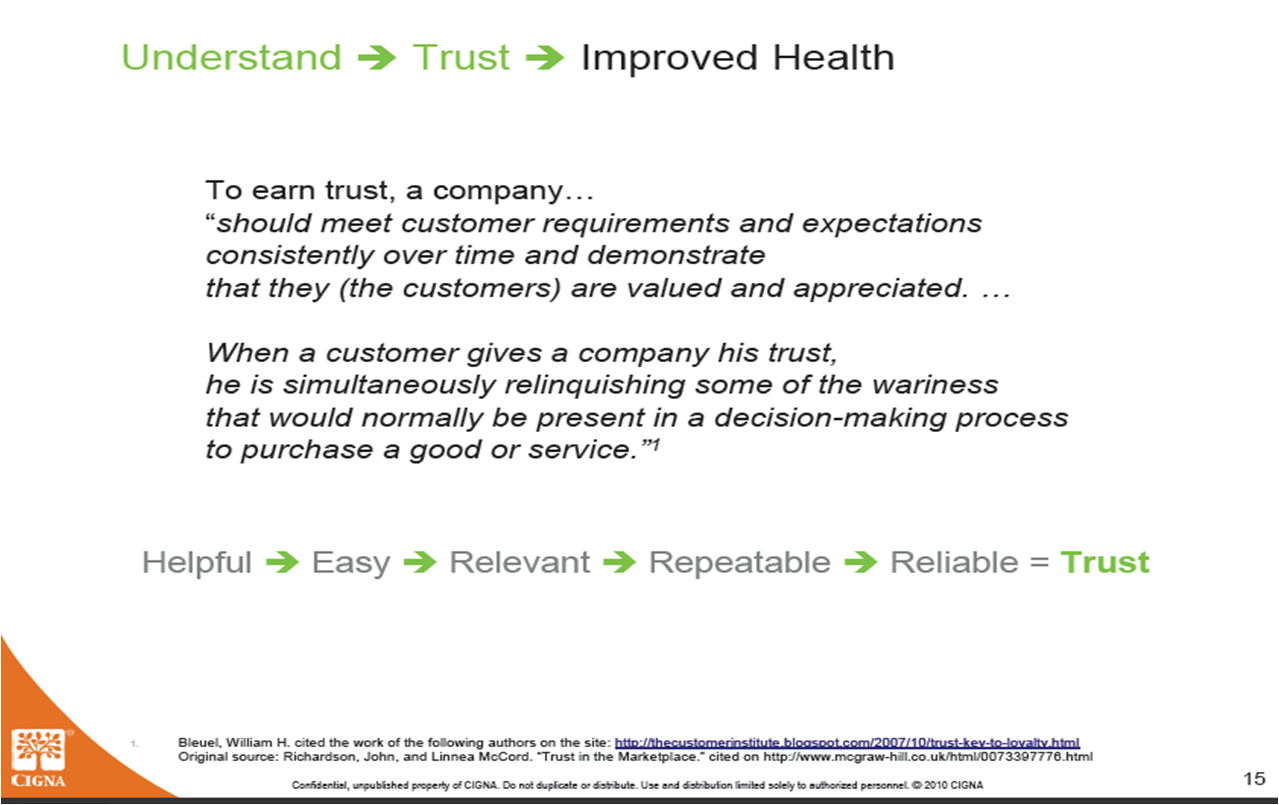
Ingrid Lindberg, Chief Experience Officer, Cigna

This was definitely my favorite and most interesting presentation and discussion from the World Health Care Congress in DCIngrid presented and subsequently spent some time talking with me.  She has what I would consider one of the coolest jobs – transforming a large company to be consumer centric and radically changing the way they think, speak, and act. 

From her presentation, here were a few notes:

  • There are 337 languages spoken in the US today. (health literacy issue?)
  • Only 23% of people understand what their health insurance policy means.
  • Most patients appear to be unaware of their lack of understanding in physician instructions and are inappropriately confident.
  • 35% of consumers spend less than 30 minutes reading their health benefit information.
  • Only 7% of people trust their insurer.
  • Trust translates to loyalty and satisfaction.
  • It’s a mix of quantitative and qualitative research.
  • They spent time monitoring sites like – www.pissedconsumer.com.  (do you?)
  • Their senior staff has to spend time listening to member calls each week.
  • They spent lots of time on ethographic research and identified 6 personas that they use for defining products – Busy Mom, Skeptic, CareGiver, Controller, Athlete, and Bargain Shopper.
  • They identified the #1 dissatisfier was language.  Plans talk to them in a language they don’t understand.  (For example, consumers think of providers as the insurer not a physician.)
  • Consumers didn’t want to be called members since it’s not a health club.  They didn’t want anyone other than their physician to call them patient.  They’ve elected to go with “customer”.
  • She talked a lot about how they’ve changed their EOB (explanation of benefits) and their plan overview to address things like what’s not covered.  She talked about how customers think of the EOB as the “this is not a bill form”.
  • They identified 10,000 separate letters that could go out to a customer.  They’ve re-written 9,000 of them. 
  • She talked about changing their call centers to 24/7 and the fact that they’ve now taken their 1M call in what used to be considered “after hours”.
  • She talked about re-designing their IVR to offer you a self-service option (press 1) or a talk to agent option.
  • She talked about their website and YouTube channel – www.ItsTimeToFeelBetter.com.
  • She talked about their understanding level being around 70% while the industry average is around 15% [of communications sent out].
  • This was in a 15 minute presentation and summarized only 2 years of work. 
  • She also shared some metrics that they use and improvements such as a 8 point improvement in one year of “values me as a customer”. 

And, they’ve shared some of this information in their press kit.  There is also an IBM white paper about some of the technology they’ve implemented.

I think the following slide from her deck sums it up well.

Then I sat down with Ingrid to talk with her.  I had a thousand questions which I limited to about 10.  This is a topic I love and is why I love what I do – work with companies to help them develop consumer communication strategies and implement those strategies to improve the consumer experience and drive better health outcomes

  1. How long did it take?  This is about a 3-5 year effort which is complicated by the fact that people in these types of roles typically only last about 28 months.
  2. Did you do it all internally?  No.  They worked with Peppers & Rogers on a Touchpoint Map and used an IBM tool called Moment of Truth.  They also worked with IBM on a new desktop solution.  BUT, she was quick to talk about the fact that those were enablers while the majority of work had to be done by internal change agents since this is a cultural change.  She said that now almost 80% of Cigna people are using their recommended language and are aware of the changes made by her group.
  3. Why haven’t others followed?  It’s hard work. 
  4. How do you deal with consumer preferences?  This is one of my favorite topics to debate.  Should you offer consumers options on how you communicate even if you know that they might not pick one that is the most effective.  For example, I might say to send me an e-mail, but they get lost, they can’t contain PHI, etc.  She said that you have to ask but you have to navigate the path.  She seemed to agree with me that there are some communications where you want to ask (e.g., order status at mail) and others where you want the right to contact them (e.g., drug-drug interaction).  She talked about the fact that it’s all in the framing (e.g., if we have a message for you that could affect your safety, is it okay if we ignore your do not call request?).
  5. Are you changing Cigna’s physician communications also?  Yes.  The changes have become the “language of Cigna”.  Physicians are people, and they are also trying to educate physicians on what they’ve learned about how to communicate with customers.  She mentioned that the most difficult groups to change were the people that were knee deep in this healthcare language – internal people and consultants. 
  6. Based on my discussion with Andy Webber, I asked her if she thought that today’s fragmented environment would allow for a coordinated consumer experience.  She agreed that it’s difficult and that the consumer sees everything as their benefit.  They don’t see the piecemeal parts.  She mentioned that one of their clients had held a “vendor fair” to kickoff the plan year where she presented their learnings and all the vendors were told to use them immediately.  [Maybe that’s part of the solution.]

We then bounced around on a couple of interesting topics:

  • We talked about the fact that lots of companies are hiring non-healthcare people to help them better understand the consumer.  These include consultants, database people, marketing people, and innovators.  My personal opinion is that you need people that have worked in or around healthcare AND outside healthcare.  They also need to have consulting and line management experience.
  • She talked about their war room (she used another term) where they had a current state and future state (of patient experience) and showed all the 10,000 current communications as a waterfall. 
  • We talked a little about some of the things we’d done at Express Scripts when I was there including changing the way we referred to members at the call center to patients and the impact that had. 
  • I shared with her that our biggest difficulty was making web changes at Express Scripts which I thought would be the easiest to do.  She shared that changes on the web were one area where they were lagging and is difficult. 
  • She talked about trying to get innovation from customers by understanding what they want and giving it to them.

Pharma Couponing

Using copay coupons in place of real samples is both cost effective and allows pharmaceutical manufacturers to get more patient specific information (since patients typically have to register to get the coupons). They can be short-term or long-term. The primary site to go to is InternetDrugCoupons.com.

Here’s my slides from the conference call I did the other day. Some of the quotes from the event are in the recent Drug Benefit News (11/13/09).

How to communicate with your members on flu 2010?

With H1N1 and the regular flu vaccines this fall, who really knows what to do?  Consumers are going to be looking for information and calling many of their providers and insurance carriers to ask the question.  Combine that management issue with the fact that only 40% of those that should get flu shots typically do, and you have a dilemna.  To hear more from Silverlink’s Chief Medical Officer (Dr. Jan Berger) and our lead for our Population Health solutions (Margot Walthall), clients and potential clients can attend our upcoming webinar on the topic.

Flu Program

New Clinical Webinars – HEDIS, Adherence, Engagement

In June, we are offering three complimentary webinars to our clients and prospects on key topics of discussion.

Increasing the Effectiveness of Population Health Program Engagement
June 16th | 1:00 PM ET

Getting consumers to take charge of their healthcare behaviors and choices is critical to controlling costs and improving outcomes. Successfully welcoming and engaging consumers in DM and health management programs can be the toughest road for health plans and population health organizations. Strategies that motivate participatory engagement are key – but it takes more than a friendly voice and the right script.

Join Silverlink for a complimentary webinar where we will discuss the challenges of moving health behaviors and effective strategies organizations can implement to get ahead of the behavior change curve.

In addition, learn how to:

  • Leverage tailored messaging to drive high engagement rates
  • Enable continued engagement over time
  • Maximize buy-in and acceptance of health coaching
  • Combine multichannel approaches to elicit engagement and re-engagement
  • Optimize engagement campaigns through predictive analytics to drive results

Drive Positive Health Behaviors and Improve HEDIS Results

June 23rd | 1:00 PM ET

Whether your focus is on the HEDIS measures for women’s health, the diabetes metrics or a broad range of effectiveness of care measures, Silverlink can design communications strategies that increase your reach, motivate member action and improve HEDIS results.

With the backdrop of the economic slowdown, communicating with members about the importance of key preventive screenings is more critical than ever. Explore the many routes to break through health prevention challenges by tailoring communications interventions that work for your populations.

Join Silverlink for a complimentary webinar where we will present the results and lessons learned over several years in supporting HEDIS screenings including a recent campaign aimed at reducing health disparirities in African American and Hispanic populations related to colorectal cancer screenings.

In addition, learn how to:

  • Use a flexible framework that supports national teams in delivering effective outreach in local markets
  • Drive performance on high-profile HEDIS measures where plan performance has hit a plateau
  • Segment your membership to deliver highly personal messages using multiple levers
  • Design and target messages to help reduce health disparities
  • Combine multiple messages to support members with more than one gap
  • Leverage multichannel campaigns to maximize reach and action

Rethinking Medication Adherence

June 30th | 1:00 PM ET

More than 50% of consumers become nonadherent around their maintenance medications within the first 12 months of therapy. And, today’s economy is putting even more pressure on people to make economic tradeoffs that threaten their health. Several studies have shown that more people are skipping doses or not refilling medications. Non-adherence leads to $177B in direct and indirect costs to the healthcare system per year.

Silverlink provides a comprehensive suite of communications services to drive medication adherence from targeting and messaging to multi-channel campaign management and execution. Join Silverlink where we will discuss some of the common myths around and key strategies related to medication adherence.

In addition, you will learn about:

  • Critical success factors in designing adherence solutions
  • Important conditions to focus on for adherence
  • Success metrics and key measurements
  • Comprehensive solutions for all phases of the patient’s therapy from initiation through long term maintenance

Have a Swine Flu Party?

dancing-pig

I must admit that it never even crossed my mind, and I don’t plan on running out to get infected.  But, I find the debate and discussion very interesting.

In case you have missed it, the NYTimes had an article today about this.  The key concept in question is whether getting the disease today with a potentially milder strain will prevent you from a more dangerous strain which could come later.

“I think it’s totally nuts,” Dr. Moscona said. “I can’t believe people are really thinking of doing it. I understand the thinking, but I just fear we don’t know enough about how this virus would react in every individual. This is like the Middle Ages, when people deliberately infected themselves with smallpox. It’s vigilante vaccination — you know, taking immunity into your own hands.”

Communication Strategy Regarding H1N1 (Swine) Flu

“There is a lot of media, a lot of news, a lot of rumor – the sooner you can get correct and accurate information to consumers, the better – otherwise people will look to other sources that may not always be accurate.”  (Jan Berger, President of Health Intelligence Partners on podcast)

We have been hearing a few things from our clients and have put some information up on the Silverlink website.  Some of the comments have been:

  1. I have seen a spike in call center volume about this topic.
  2. Clients want to change plan design to make sure Relenza and Tamiflu are covered and don’t require a prior authorization or have a quantity level limit on them.
  3. We want to proactively reach out to at risk populations – children, seniors, or people with a compromised immune system.
  4. We want to be able to flexibly target certain geographies.
  5. We want to remind people not to panic, drive them to quality information sources, and make sure they know the basics – wash your hands.

At a minimum, everyone is adding information to their websites.  Many consumers are Googling the topic or following updates from @CDCEmergency (on Twitter).

Healthplans, PBMs, and population health companies are at the heart of this.  They need a coordinated strategy to inform people appropriately as this issue continues to be top of mind.

We recorded a podcast last night with the Medical Director from Healthwise and Jan Berger who is the former Chief Medical Officer from CVS Caremark and is now president of Health Intelligence Partners.  In here, they answer some general questions about the situation and what companies should be doing to educate members.

The two standard solutions Silverlink is offering clients are:

  1. Offer an inbound FAQ (Frequently Asked Questions) line with CDC content and specifics about their plans.  This can help with overflow from their call center and/or be used as a direct line from their website or outbound communications.
  2. Selectively target populations (age, zip code, disease state) with a brief message reminding them to wash their hands and telling them where to get qualified information.

As with all our communications offerings, these can be customized (messaging, channel, targeting, etc.) to meet client requirements.  Additionally, since one of our technology advantages over others in the space is our flexibility, we can work with clients to keep these messages up-to-date as the situation changes and as new information has to be added.

Swine Flu (H1N1) Continues To Top News

(picture from http://www.myfox8.com/lifestyle/health/la-sciw-swine-masks28-2009apr28,0,4461177.story)

It’s amazing how this has dominated traditional media and blown away the online media.

I few things that stick out for me:

One of my favorite pictures that goes right to the health literacy issue is the following.

NOTE: This is not what H1N1 flu is about…hence the dropping of the “swine flu” term.

(picture from http://cuteoverload.com/)

7 Points in 7 Minutes

In looking at the Ix Therapy blog about the conference they just had with Health 2.0, I found this note which I found very interesting…

  • James Hereford made 7 fabulous points in 7 minutes about building Ix into the delivery system:
    • You have to deliver what patients want (doesn’t matter how cool the technology is).
    • It has to make sense for clinicians from a clinical perspective.
    • It has to make sense for from a clinical workflow perspective.
    • Focus processes on the value proposition for the patient (I may have mangled this one a bit).
    • Information needs to be common, ubiquitous, and well-designed.
    • Health care is all about trust; whatever we do needs to enhance trust in the patient-provider relationship.
    • Incentives are critical.

    Express Scripts Outcomes Conference Begins

    As with each annual Outcomes conference, Express Scripts (ESRX) has released their annual trend numbers. Here are a few of the highlights from the press release:

    • Overall pharmacy trend = 3.0% (down from 5.5% in 2007)
    • Estimate consumers and employers are paying $42B too much in 13 therapy classes by not optimizing generics.
    • On average, a generic drug is over $90 cheaper than a brand name drug.
    • Generic drug usage increased by 7.5 percent, while utilization of brand name medications decreased 11 percent.
    • 67.3 percent of all prescriptions that Express Scripts filled were for generic drugs by the end of 2008. [I didn’t like the comparison which was an average across the 12 months ending in Sept 2008 from IMS of 63.7%…not apples to apples.]
    • In 2009, at least 20 branded drugs are expected to become available generically.
    • Over the next five years, more than $66 billion worth of branded drugs are expected to lose patent exclusivity.

    “Using generic drugs that are safe and effective can help lower costs while still driving value for patients and employers,” said Steven Miller, MD, senior vice president and chief medical officer at Express Scripts. “Our results indicate that cost control is achievable through careful management of appropriate use of drugs and delivery channels, without shifting costs to consumers. Although the trend is the lowest it has been in over a decade, significant opportunity to lower spending still exists.”

    “Finding ways to reduce spending without compromising health outcomes is the top priority for healthcare reform, as the Obama administration recognizes,” said Alan Garber, MD, PhD, Henry J. Kaiser Professor and director of the Center for Health Policy at Stanford University. “We have long used financial incentives to try to eliminate waste. Now we’re finding that tools that build upon the insights of behavioral economics and psychology can have powerful, positive effects.”

    “In today’s economy, we are not only tracking wasteful spending across the country but developing strategies to reduce it,” said George Paz, chief executive officer at Express Scripts. “By applying the principles of behavioral economics we are helping consumers make better and more cost-effective healthcare decisions. We understand we cannot eliminate waste alone and we are committed to working alongside likeminded organizations, such as the Federal Coordinating Council for Comparative Effectiveness Research, to continue to identify strategies to improve our healthcare system.”

    “Studies have repeatedly shown that people work much harder to avoid losses than to pursue gains,” said Bob Nease, PhD, the company’s chief scientist. “This suggests that a ‘stop wasting money’ message is more effective than a message focused on potential savings. In addition, by applying evidence-based segmentation, we have practical insight into which members are likely to be most sensitive to loss aversion. One size does not fit all.”

    Waxman at the AMA

    I am finally catching up on some notes from Rep. Henry Waxman (D-CA) when he spoke to the AMA in March 2009.  (From “The Pink Sheet”, March 16, 2009, pg. 27)

    “We all know we have to get costs under control, but the way to do that is not to tell physicians what they can and cannot do or put them in a position where they cannot put the needs of their patient first.”

    “I am not interested in trying to put a public plan in place that would drive out competition.  I believe we must have a significant role for private insurers.  We must allow them a fair opportunity to compete.”

    “We have to reward quality and outcomes, not just reward volume.”

    Upcoming Book By George Halvorson From Kaiser

    I had the privledge of previewing George Halvorson‘s new book “Health Care Will Not Reform Itself” this week.  My book cover quote would go something like this:

    “Opinions supported by facts all wrapped up in a narrative.  It’s like a fireside chat with one of the greatest leaders in healthcare.”

    I won’t pull things from the book yet, but I found it a logical follow-up to his other book “Health Care Reform Now! A Prescription For Change“.  He talks about the need for bold goals and a clear set of metrics to drive change.  He talks about why healthcare costs go up and the fact that we need universal coverage.  And, he also hits on what seems to be the key theme of the day – reducing costs while improving outcomes.

    While I was at the WHCC09, I got to sit down with George Halvorson and talk about healthcare for an hour.  It was a great privledge that I enjoyed a lot, and I could have talked for hours.  We hit on a bunch of topics so let me share some of them.

    • We talked about him writing books.  I was commenting on how much I like his writing style and was intrigued to learn that he said some professors don’t like using his books because they’re “too easy to read”.
    • We had a fascinating discussion around leadership and diversity and how he has created a very diverse leadership team at Kaiser.  I was also impressed to hear that one member of team does an international fellowship each year where they spend time abroad learning about how healthcare is delivered and managed in other countries.  [very progressive]
    • We talked about how healthcare was going to change.  He spent a lot of time on the need to create aggressive goals especially around the 10-20% of things that drive 80% of the costs.  For example, he asked why we don’t try to reduce asthma attacks or congestive heart failure by 90%.  And, he pointed out the fact that we don’t have a common set of goals that allows enterprises to reverse engineer the process and identify points of variance.  Without that process analysis and a specific goal, it is hard to drive improvements.

    “We need to change our expectations of what is possible.”

    • We talked a little bit about where innovation will come from.  He talked about how Deming, a statistician, revolutionized manufacturing as a lead into the point that innovation will likely come from outside the industry.  [I think this is interesting as I have seen more and more executives at healthcare companies that are coming from outside of healthcare.  I also think things like the X-Prize may attract others to try their ideas.]
    • He gave some great examples of how Kaiser has deployed their 30 black belts.  The one I quickly jotted down had to do with how nurses change shifts.  This shift change is where all the information was exchanged about different patients and when accidents sometimes happened.  By changing the process, they dropped the accident rate and reduced the communication time from 40 minutes per shift to 12 minutes per shift.
    • We also talked about HIT (Healthcare Information Technology) and the need not only to drive utilization but to mandate system integration.  This tied in with an earlier conversation where we spoke about coordinated care versus uncoordinated care and the need to create a “virtual Kaiser”.  I think there is a lot to learn from the Kaiser model and some of the things they are doing with technology to drive care.  [I was pleasantly surprised that he believes physicians will embrace technology as a tool to help them standardize care.  I think that is critical path to successfully reducing costs while improving outcomes.]
    • I couldn’t jot down all the statistics fast enough, but he talked about how they were testing different “panel systems” in different geographies to see what the best process and technology solution would be.  They had had some great results.  [One fact he shared that jumped out at me was that 25% of people over 65 that break a bone die within a year.]
    • The last thing we talked about was probably the most insightful to me.  Given the amount of money spent in the last months of people’s lives, I was interested in his global perspective on whether that was a cultural issue.  He said that he thinks it is mostly that the care system in the US lacks honesty or the ability to be brutally honest.  We talked about one scenario where people who do nothing live an average of 140 days and those that get invasive surgery live an average of 100 days…but they are hoping to be that 1 in a 1,000 that live an extra year.  [Is it worth all that pain, surgery, and medicine for the last few months?]  We also talked about the new $100,000 breast surgery drug which extends the patient’s life on average for 1 month.  [Again, is that an appropriate use of money?  Would we spend it if it came out of our pockets?]

    When the book comes out, I will try to pull out some of the key points, but I would recommend you pick it up and read it for yourself.  I think you will really enjoy it.

    Selling NextRx to Express Scripts

    I was hoping I might get a chance to sit down with Angela Braly (CEO at Wellpoint) at the WHCC 2009 in DC to talk about the sale they announced yesterday NextRx to Express Scripts).  I think it’s a very logical decision, and I think they got a good price.  For my old team at ESI, there is a huge opportunity for them to drive mail volume.

    In her keynote discussion this morning, she briefly mentioned the sale saying that they sold it to help lower healthcare costs.  While I completely agree in the short-term (i.e., rebate contracting, network negotiations), I remain mixed in my long-term view.

    I talked briefly with Les Masterson about this yesterday for the article he just published – “PBM Sale Highlights Dilemna for Health Plans“.  I do expect this will push for the development of a new business model which will highlight automation, member engagement, and a greater role in driving outcomes.

    George Van Antwerp, vice president, solutions strategy, at Silverlink Communications, Inc., in Burlington, MA, says health plans can benefit from having their own PBMs if they use them properly.

    “I think that it’s beneficial to plans to own their own PBM if they can integrate data and create a better member experience; make the tradeoff between increased pharmacy spend and lower medical loss ratio; and manage to get most of the economies of scale in terms of operations and negotiation. That has proven hard to do within health plans, and therefore, there will be short-term interest in capitalizing on the valuation of the PBM business,” says Van Antwerp.

    With three large PBMs left after the pending purchase, Van Antwerp says the trio will “race to the bottom in terms of negotiating scale leverage.” Van Antwerp predicts the remaining PBMs will ultimately try to differentiate themselves by offering healthcare management through member engagement, greater transparency, and a renewed focus on health outcomes.

    Medicaid Communications

    Interested in hearing more about this topic.  You can hear Margot Walthall from my team talking about this on an upcoming webinar.

    The Medicaid Communications Lifecycle:  From Onboarding through Redetermination
    April 28, 2009 | 1:00 PM ET | 10:00 AM PT

    Introducing your Medicaid members to your plan’s benefits as well as their responsibilities is critical to developing a successful member / health plan relationship. Sustaining positive impressions over the course of the member’s eligibility is equally important to retaining Medicaid members.

    Silverlink has developed a broad set of communications outreach programs that have yielded strong results for Medicaid and CHIP populations. Join us for this complimentary webinar where we will explore how Silverlink can help you cost-efficiently support:

    • The Medicaid onboarding process with welcome/HRA outreach
    • Targeted messages about health screenings to drive HEDIS results
    • Communications approaches that can reduce health disparities
    • Effective methods for educating members about the redetermination process that can inspire loyalty

    Register Here

    Kaiser Family Foundation: Medicare 101 Webinar

    I thought this sounded interesting so I thought I would post it for those of you that are interested…

    ********

    On Monday, March 16 at 12:15 p.m. ET, the Kaiser Family Foundation and the Alliance for Health Reform will co-host a briefing with a panel of experts discussing the Medicare program. Medicare covers nearly 45 million beneficiaries, including 38 million seniors and 7 million younger adults with permanent disabilities. The program is expected to cost the federal government approximately $477 billion in 2009, accounting for 13 percent of federal spending and 19 percent of total national health expenditures.

    Panelists will address questions such as:

    • Whom does Medicare serve and what services does it cover?
    • What are Medicare Parts A, B, C and D?
    • How is it structured and financed?
    • What drives Medicare’s costs?
    • How does Medicare reimburse providers and hospitals?
    • What future challenges face the program?

    A live webcast of the discussion will be provided by kaisernetwork.org.

    WHO: Ed Howard, JD, executive vice president of the Alliance for Health Reform and Diane Rowland, ScD, executive vice president, Kaiser Family Foundation and executive director, Kaiser Commission on Medicaid and the Uninsured will co-moderate the discussion with panelists:

    • Juliette Cubanski, PhD, principal policy analyst, Kaiser Family Foundation
    • Marilyn Moon, PhD, vice president and director, American Institutes for Research
    • Tom Gustafson, PhD, senior policy advisor, Arnold & Porter LLC

    Saving Money On Rxs

    Are you interested in saving your members money?  There are a lot of things you can do.  Pill splitting is an easy solution with a quick impact.  Using generics and moving to mail order are others.  I am going to do a webinar on this in a few weeks. [March 10th and March 12th at 1:00 ET]

    Even if you’re not specifically interested, I think you would be fascinated to see how we use a multi-modal approach to drive behavior.  It is modeled on what PBMs have been doing around mail order conversion for years.

    Lots of people talk about multi-modal coordination.  We can and have done it.  Gartner is talking about Business Process Outsourcing (BPO) in healthcare and has mentioned Silverlink in their last two reports as one of the few vendors doing this.

    I hope you can join us! REGISTER HERE.

    Personalized Medicine Webinar

    I don’t have anything to do with this, but it sounds pretty interesting.  Medco and Regence are talking.  Here is the teaser.  (Click here for more info and registration.)

    Personalized medicine is moving rapidly. The FDA in December considered requests to require genetic testing for the colon cancer drugs Vectibix and Erbitux. Approval of such labeling changes could pave the way for a slew of other personalized therapies and diagnostics now waiting in the wings. Stakeholders anticipate significant clinical and financial savings. Recently approved genetic testing for the blood thinner warfarin, for instance, is projected to avoid 85,000 serious bleeding events annually and save roughly $1.1 billion a year!

    On the other hand, questions remain whether the model actually provides a favorable return on investment (ROI). A new study finds that genetic testing for warfarin does not appear to be cost-effective in certain patients. And health plans and PBMs are trying to sort out which of the numerous diagnostic tests on the market actually provide clinical utility and improved results. One large health plan, for example, says its costs for diagnostic testing are growing at nearly 20% a year.

    So where does all of this leave Rx payers in February 2009?

    Where Are My Land Legs

    I just got back from our “annual” Disney Cruise realizing that this vacation of 8 nights was the longest vacation I have ever taken.  Anyways, less that 24 hours later, I was back on a plane and jumping into meetings.  I still haven’t quite got my land legs  back.

    But, I am anxious to share lots of things with you so hopefully, I will find some time this week to catch up on blogging.

    A few things from vacation:

    1. It is amazing the redundancy and rigor that a company like Disney has.  We love the cruises.  I was amazed to learn that for the stage productions they put on on the boat that they have 2 microphones and 2 batteries for each actor.  And, if that’s not enough, they have their voices recorded for each part so they could lip synch if everything failed.  Why don’t we have that type of redundancy (without adding cost) in the healthcare system?
    2. I always lose faith in the healthcare system when I see the advertisement at the airport showing a physician signing the foot on which surgery is going to be performed.  Is that the best way we have of ensuring no mistakes are made?
    3. On the boat, you have to wash your hands before you enter any restaurant.  It would certainly take away from the ambiance, but should that be a more regular practice on land?
    4. They have a nice gym on board that I used 3 times.  They even run a 5K now at their island (on some not all cruises).  It made me wonder what percentage of the people on board worked out and whether that was a similar ratio to typical life and society.  If so, it reinforces one of our major challenges.
    5. How about some healthy food at airports?  I am surprised I haven’t ranted about this before.  It is getting better at a few airports where you can find a few things, but it is genuinely difficult to travel and eat healthy.

    Who’s Responsible For Healthcare Costs?

    I was recently at the AHIP Business Forum Chicago and was in a session where Amy Holmes, CNN Political Analyst and Peter Beinart, Editor-at-Large of The New Republic held a discussion on Decision 2008 and What it Means for the Future of Health Care.  They are two of the sharpest people I have seen speak in a while and they hosted a very engaging discussion on the issues and what the Obama win means for healthcare from both sides of the political spectrum.  (They also had a very entertaining “He Said, She Said” style that captivated the audience.)

    The big changes they felt were bound to happen were cuts in Medicare and an expansion of the SCHIP program, and there were others that they said would be debated including being able to sell insurance across state lines, the government offering coverage, individual coverage mandates and coverage for pre-existing conditions.  But the biggest part of the discussion was around healthcare costs.  Costs that are out of control, who pays for services, and where will the money come from.  While at an aggregate level talking about healthcare’s spiraling costs is simple, it is not the heart of the issue.

    Isn’t the issue about how as an industry we get individuals to change their behaviors?

    The most powerful force for changing the economics of healthcare is the healthcare consumer.  If the consumer changes behavior (even small changes) there are billion dollar impacts in cost.  Our research shows that if a plan the size of Aetna is able to improve adherence by 1% they could save $238M!  According to the Journal of Occupational and Environmental Medicine (JOEM), 70% of all healthcare expenses are lifestyle related.  This is not a new number but it translates to $1.4 trillion in healthcare costs that could be controlled simply by modifying healthcare behaviors. 

    So if our lifestyles are “killing us” and destroying a system meant to improve our quality/length of life, why are we not talking about that at the national level as THE core issue?  How can we as industry professionals develop solutions that support consumers and facilitate the changes they need to make?

    I was excited to see in the third Presidential debate that both candidates addressed responsibility being in the hands of the individual.  Next steps:  Let’s see some discussion on programs and policies that truly look to impact healthcare consumer behaviors.

    (This is a guest post from Chuck Eberl, VP of Marketing, at Silverlink Communications.)

    Our First Think Different Event

    Today was our first Think Different event in Boston. This is a road show we are doing around our new positioning and how health care companies need to get outside the box to improve the effectiveness of their communications. It has four external speakers plus our CEO.

    [Spoiler Alert: If you are attending an upcoming session, I may reveal some of the content here.]

    I missed ½ the session today due to a client call, but I will be at 3 of the other 5 events. In listening to the first two speakers, I jotted down a few thoughts.

    From Kinney Zalesne:

    • She spoke about moving to the Starbucks economy and how we have much more choice today in what we do, who we love, religion, and our gender. Everyone immediately thinks of gender meaning sex change operations, but the point here is that there is a group of people who don’t want to be forced to select a gender identity. Before you discount it, you should know that 100 corporations, 75 colleges, and 8 states now ban discrimination based on gender identity. This was a bit of a surprise to me, but when I was talking with a large health plan about this, they informed me that their new EMR (electronic medical record) allowed for 5 possible gender options.
    • She talked about people basically starving themselves to focus on the theory that has been demonstrated in animals, but not yet in humans which says that by eating 30% less calories you can extend your life by 40%. (Not something I will be doing.)
    • She talked about the Do-It-Yourself (DIY) Doctors which are the people who use the Internet to self-diagnose and treat the MD as an ATM for drugs (i.e., I need a prescription for simvastatin can you please write it for me). I have heard a lot of talk recently about the changing perception of physicians. I haven’t seen the statistics, but one person said that they have lost the most respect over the past 20 years than any other profession. I think Kinney’s point is more about them moving from being a supervisor role (i.e., you should do this) to an advisor role (i.e., thanks for your opinion…I will take it into consideration).
    • Her statistics about 5M working retired (i.e., >65 years old) and 2M working teens (i.e., using the Internet to make money before they leave high school) says a lot about how benefit design will need to change. The implications on needs and flexibility (e.g., imagine two primary addresses for snowbirds) could be significant.
    • In her talk about micro-targeting, my mind drifted to a few thoughts:
      • How has gas prices changed our opinion of other costs? A $15 copay used to be equal to 7 gallons of gas. When it only equals 3 gallons of gas, do we view the $15 differently? [Have you caught yourself saying gas is only $3.75 at this one station near my house?]
      • Just like your segmentation can change in healthcare, it is important to consider the macro-economic and political environment when communicating. Have you listened to all the car advertisements lately…they all talk about gas mileage?
      • If you need a simple example of why personalization matters, think about buying a car. I am not a mechanical person so if I came in and someone talked to me about horsepower and cylinders then I would be turned off. I care about comfort and low maintenance.
      • Finally, getting back to health, I thought about how difficult it is to be successful. Let’s assume there were 10 primary reasons for non-adherence and 3 primary channels for delivering information (live, letter, automated call). In this case, you have 10% chance of hitting the right message and a 33% chance of using the right channel (i.e., a 3% chance to be successful).

    From Liz Boehm:

    • She shared a lot of great facts about patient awareness of technology and how adherent they are.
    • She points out a scary fact that while our health care needs are going up with the boomers we simultaneously have an issue with health care workers retiring which will only make things worse in the short term.
    • She showed that 47% of people had visited their health plan’s website. [I will have to push her on this data since I believe they visited, but I think the percentage that log-in and use the site has to be very small. I would estimate 10-15%.]
    • She talked about use of social media and gave an example of a MySpace group on diabetes.
    • I found the discussion on wellness very interesting where she pointed out that things like chocolate, riding an elevator, or for some smoking gives you an immediate positive feeling while dropping your cholesterol by 10 points or even trying to lose 1 pound per week is pretty abstract.
    • I have talked about loss aversion several times, and she talks a lot about it. Using it to make a link to why incentives matter in health care.
    • Talking about motivation, I like her point that it isn’t a reasonable suggestion if you can’t achieve it. It may make good clinical sense to have a BMI of <25, but for someone with a BMI of 31, perhaps setting a goal of 28 is more reasonable and not as discouraging.
    • In her talk about trust, it made me wonder how many people that work for managed care companies and pharmacy benefit management companies reveal that fact at cocktail parties. I am not talking about professional networking events, but your neighborhood events. Do you say who you work for and address their comments about service and/or coverage issues?

    I finished my client meeting in time to hear Stan Nowak, our CEO and co-founder, speak and tie together the different points of view with some potential actions that people could take. As he often does, he talked a lot about the power of data and the fact that what’s new to health care is often old in other industries. We are an industry with the most data about people, but the least ability to use it effectively.

    It’s also interesting to hear him talk about some of the “data exhaust” that is created by the analysis that the team does. These are facts that get revealed which may be surprising and may be things you never even thought to look for. For example:

    • Patients with emphysema are 40% more likely to engage in a communications program related to additional coverage than patients with migraines.
    • Patients with uncommon names are 18% more likely to complete a healthcare survey than those with common names.
    • Males with depression are 83% less likely to do pill splitting than females with depression.

    Facts About The Uninsured

    The Robert Woods Johnson Foundation has a project called Cover The Uninsured.  As we all know, this is a major issue which is only getting more pressing with the economy the way it is today.  With food going up and gas going up, it is putting more and more economic pressure on people.

    Granted…not all the uninsured are uninsured due to their economic condition, but even those that think they are invincible would be better off with some safety net.

    I point this out since this is Cover the Uninsured Week (April 27, 2008 – May 3, 2008).

    Here is a slideshow of data from their website:

    Silverlink Coming To A City Near You

    I am really excited about a new initiative at work.  We have pulled together a great set of speakers and are doing a road show around the country.

    The speakers include:

    The topic of the event is Healthcare Communications: Think Differently and is about how to engage the new healthcare consumer and drive behaviors in scale.  Very much like what a lot of the talks were about at the World Healthcare Congress.  It’s not simply getting data and information, but it is about making that information actionable.  That is exactly what this 1/2 day session will be about.

    The meetings will be in Boston, NY, Hartford, Minneapolis, Oakland, and Westlake (CA).  Click here to find out more information and to get registered.  We hope to see you there.

    Upcoming Webinars

    If you missed it last week, I am giving a repeat performance of my webinar on retention.  I am going to talk about driving customer satisfaction and building loyalty to improve retention which is and should be a hot topic for everyone in healthcare. (Sign up here for the 23rd at 1:00 EDT)

    Additionally, my peers are giving a webinar on closing the adherence gap which should be another hot topic for many of you.  (Sign up here for their sessions on April 30th and May 22nd)

    Next Webinar – Retention

    The webinar I did last month on using patient communications to drive pharmacy trend went very well. We are continuing our educational series. I also have the honor of giving the next one on a topic I have discussed here a little, but one which I feel very strongly about. Here it is below. [I will try to post some notes that give some of the highlights without disclosing any “secret sauce”.]

    If you are a pharmacy, PBM, managed care company, PDP, disease management company, or other provider of care to a group of patients, I would encourage you to sign up.

    How Communications Can Influence Member Satisfaction, Loyalty, and Ultimately Retention

    When: April 15th & 24th, 1:00 PM EST

    We’ve all been told for years that it costs five times as much to win a new member as it does to retain an existing one. With the big focus on consumerism in healthcare, the continuing evolution in Medicare Part D and new growth and innovation happening in support of individual markets, it is time for the science of member communications to take center stage within healthcare companies.

    Join Silverlink as we discuss ways of addressing this opportunity through comprehensive communications solutions that connect with your members and increase their advocacy for your insurance product.

    We’ll look at some non-healthcare examples and some leading edge ideas in healthcare, while grounding it all with short-term actions that you can implement to achieve measurably better results.

    Register now >