Archive | Healthcare RSS feed for this section

Nature’s Rules For Healthcare

I found this article – Nature’s 10 Simple Rules for Survival – on biomechanics and biomimicry interesting (Fast Company article).  It looks at how nature has survived all these years and translates that to lessons for business.  This is worth more pondering, but my Saturday morning thoughts on applying this to healthcare are in brackets.

  1. Diversify across generations.  [We need different strategies for different segments.  One size will not fit all.]
  2. Adapt to the changing environment — and specialize.  [We need a US centric healthcare model not a model from Canada or the UK.]
  3. Celebrate transparency. Every species knows which species will eat it and which will not.  [Be clear on incentives and roles.  Set up a win-win not a win-lose.  Don’t try to get government to run an efficient business which it never has.]
  4. Plan and execute systematically, not compartmentally. Every part of a plant contributes to its growth.  [A technology infrastructure and shared decision making across a care continuum is important.  The medical home concept has merit.]
  5. Form groups and protect the young. Most animals travel in flocks, gaggles, and prides. Packs offer strength and efficacy.  [Social networking and leveraging peer-to-peer education and support will improve health outcomes.]
  6. Integrate metrics. Nature brings the right information to the right place at the right time. When a tree needs water, the leaves curl; when there is rain, the curled leaves move more water to the root system.  [We need home monitoring and predictive metrics for preventative care.  Using genomics and other measures should save lives by allowing us to act early.]
  7. Improve with each cycle. Evolution is a strategy for long-term survival.  [Big bang improvement to the system won’t work.  Pick one problem at a time – e.g., un-insured – and solve for it.]
  8. Right-size regularly, rather than downsize occasionally. If an organism grows too big to support itself, it collapses; if it withers, it is eaten.  [Healthcare is inherently local.]
  9. Foster longevity, not immediate gratification. Nature does not buy on credit and uses resources only to the level that they can be renewed.  [We need to address the issue of hyperbolic discounting.  People want immediate value, but lots of healthcare improvements take time personally and systemically.]
  10. Waste nothing, recycle everything. Some of the greatest opportunities in the 21st century will be turning waste — including inefficiency and underutilization — into profit.  [Don’t overcomplicate the solution.  Sometimes the obvious can improve the difficult.]
How Teeth Are Like Trees

I was at my dentist the other day, and he spent the whole time using analogies to explain things to me.  He began by asking me if I was really sick when I was about 4 years old.  I was a little confused, but he pointed out that I have a white spot on the back of one of my teeth.  He said that teeth are like trees and like the rings in trees you can learn things from your teeth and date them.  Apparently, that spot would indicate high antibiotic use or malnutrition right during the period of development.

He later went on to explain the surface of the teeth and how a round object that hits the ground is less likely to break than a square object.  He was talking about how the tops of teeth get ground down over time and the risk that it creates to the stability of the tooth.

Nick Jonas And His “Diabetes Buddies”

I was with my kids at the Jonas Brothers concert in St. Louis the other night. They put on a great show, but my healthcare takeaway for the night was that Nick Jonas has diabetes and is a great spokesperson on the topic.

As seems to be more and more common these days, he (as a public figure) is out talking about his health and management of his condition. I think this is a great way to help kids learn about diabetes from someone they adore. It also normalizes the condition so patients don’t feel they are alone.

I also like his concept of giving guitar picks to his “diabetes buddies” or people he meets. I could see a Facebook application where you can get a virtual guitar pick from Nick Jonas.

“To newly diagnosed kids with diabetes, Nick would say, ‘Don’t let it slow you down at all.  I made a promise to myself on the way to the hospital that I wouldn’t let this thing slow me down and I’d just keep moving forward, and that’s what I did. Just keep a positive attitude and keep moving forward with it. Don’t be discouraged.’ ” (article)

During the concert, they stop to let him do a piano solo to the following lyrics from their song “Don’t Know What You Got Till It’s Gone”. During the song, he pauses to talk about how he made a promise to not let it hold him back and all the things he has accomplished since being diagnosed.

Got the news today
Doctor said I had to stay
A little bit longer
And I’d be fine
When I thought it’d all be done
When I thought it’d all been said
A little bit longer
And I’ll be fine

But you don’t know what you got
Till it’s gone
And you don’t know what it’s like
To feel so low
And every time you smile or laugh you glow
You don’t even know
No, no
You don’t even know

All this time goes by
Still no reason why
A little bit longer
And I’ll be fine
Waitin’ on a cure
But none of them are sure
A little bit longer
And I’ll be fine

But you don’t know what you got
Til it’s gone
You don’t know what it’s like
To feel so low
And every time you smile or laugh you glow
You don’t even know
No, no
You don’t even know
No, no
You don’t even know
No, no

Yeah

But you don’t know what you got
Til it’s gone.
Don’t know what it’s like
To feel so low, yeah
And every time you smile or laugh you glow
You don’t even know
Yeah oh
Yeah oh
Yeah yeah
You don’t even know
No, no

So I’ll wait ’til kingdom come
All the highs and lows are gone
A little bit longer
And I’ll be fine
I’ll be fine

Cosmetic Neurology

Not surprising…students using ADD/ADHD drugs to help them perform better.  Probably not a good thing.  This shows how badly overwhelmed or overstimulated our population is.  We can’t focus on one thing at a time to get it done w/o some drugs.  Could it really be 20% of college students using these drugs?  There is certainly some dependency risks.

From a blog posting on this:

I got most of my Adderall information from a great article in the New Yorker by Margot Talbot titled Brain Gain: The underground world of neuroenhancing drugs. In it, Sean Esteban McCabe, from the University of Michigan’s Substance Abuse Research Center says that at some universities, up to 20% of the population is using these drugs: “White male undergraduates at highly competitive schools—especially in the Northeast—are the most frequent collegiate users of neuro-enhancers.”

Anjan Chatterjee, a neurologist at the University of Pennsylvania , coined the term “cosmetic neurology” to describe the trend of taking drugs to enhance ordinary cognition. He says, “Many sectors of society have winner-take-all conditions in which small advantages produce disproportionate rewards.”

Good cartoon to sum this up.

The 5 Questions (Regence Group)

Regence Group recently put out an interesting website – www.whatstherealcost.org.  It takes an unorthodox (for a health plan) approach to delivering several important points.  It reminds me of what Wellpoint has done with Tonik or some of the things Humana is doing at HumanaGames.

One of the things I found interesting and very straightforward for patients to think about were their 5 questions:

  1. How much does that cost?
  2. Is that really necessary?
  3. Is there a cheaper option?
  4. Is there a generic for that?
  5. Has anyone out there had this before?

Imagine if every time we were asked to take a test or start a new therapy that we (patients) asked these five questions of our provider.

Google Voice, Mail Order, Depression, & Linguistic Profiling

I have a whole pile of articles that I’ve meant to blog about. I’m going to try to clear out some of these with a bunch of quick mentions here.

USA Today Gallup Poll (7/14/09)

  • Majority say controlling costs should be legislation’s top goal regarding healthcare, but more than 9 in 10 oppose limits on getting whatever tests or treatments they and their doctors think are necessary.
  • 26% of those polled say that Congress passing a major health care reform bill this year is extremely important – 24% say it’s very important; 22% somewhat important; and 25% say not important.

Google Rolls Out Google Voice

  • You can use one new phone number to tie together your various numbers – cell phone, home phone, and business line.
  • People call one number which rings all the numbers. You can switch back and forth between lines. Voicemail flows to all of the phones and you get free transcription.

Linguistic Profiling (Washington University alumni magazine, Summer 2009)

  • Interesting article on the work by John Baugh, professor of psychology, linguistics, English, education, and anthropology.
  • He first documented the “discrimination based on the sound of someone’s voice”.

Article “A Battle Over Mail Order Drugs” (Boston Globe, 2/2/09)

  • Owners of mail-service pharmacies (i.e., PBMs) say Medicare could save billions if more people used mail. Right now it’s only 10% of all Medicare recipients who use mail according to the PCMA.
    • The PBMs estimate that the savings is $1B over 10 years for every 1% of patients that move to mail…or $40B over the next decade.
  • Community pharmacists see mail orders as “shady operations”.
  • David Snow, CEO of Medco, says about PBMs – “The real truth is, we’re an intensive clinical company with thousands of pharmacists who take care of patients each and every day in a very advanced way.”


Good article “The Importance Of Deciphering Your Insurance” (WSJ, 6/4/09)

  • The most surprising statement in the article – “researchers at Georgetown University found that several health plans required consumers to inform the insurers when they reached their out-of-pocket totals.” Is that really possible??


Article “Depression, Anxiety Pass From Parents To Kids” (USA Today, 6/3/09)

  • Group therapy was able to break the cycle.
  • Depressed children are more likely to have trouble in school and are at increased risk for suicide or substance abuse.


Article “Conflicts Of Interest Bedevil Drug Research” (USA Today, 6/3/09)

  • Good discussion with some specific examples about the people who evaluate criteria for when drugs should be used and their ties with the companies that manufacture the drugs.


Article “Layoffs Cost More Than You Think” (Fortune, 3/30/09)

  • Good reminder of some of the additional costs of laying people off.
    • Brand equity costs
    • Leadership costs
    • Morale costs
    • Wall street costs
    • Rehiring costs
  • One of my early consulting projects looked at this years ago and it was amazing how much it cost also looking at lost productivity as you ramped up a new hire.


Jan Berger Co-Author Upcoming Book

Leveraging Health is the first book from the Center for Health Value Innovation! Using real-world case studies from public and private organizations — even small companies — this book illustrates 15 “levers” that can be used to motivate value-based changes in healthcare design.  The book will make its debut Sept. 30 at 8 a.m. at the National Press Club in Washington, D.C., with a book signing to follow at 5:30 p.m. at the Consumer Health Care Congress in Alexandria, Va. Author Cyndy Nayer will be presenting at the conference, and authors Jack Mahoney and Jan Berger will be on hand to sign the first copies! If you can’t make it to the congress, look for Leveraging Health this fall on Amazon.com.

Misaligned Incentives

A perfect example of one of the big issues with healthcare reform.

We all know that hospital readmissions is an issue.  We have been working with several clients to address this issue.

I called a few senior people in some hospital systems to talk about it.  I think one of their responses summarized it up nicely:

It’s not something we are focused on.  We still make positive contribution margin on these readmissions.

As many people have pointed out, misaligned incentives make it hard to improve the system.

Conceptual Consumption

I’ve just begun reading and thinking through the book Predictably Irrational.  So far, I’ve found it fascinating.  Additionally, for those of you without the time to read, I’d recommend following Dan Ariely’s blog.

One of his posts from last month is interesting and lays out three ways that conceptual consumption affects people’s physical consumption (and provides a link to the details on the research):

  1. Consuming expectations
  2. Consuming goals
  3. Consuming memories

I think this area of behavioral economics is critical to Enabling Healthy Decisions (SM).  Since in most cases, we already have a framework or anchor price for our healthcare it becomes increasingly challenging to reframe the issue and change behavior.  But, these insights around peer pressure and message framing that evoke different memories or emotions are significant insights for us in the communication space.

The Impact Of Cash Rxs…No One’s Talking About

I’m only somewhat surprised that no one is talking about this since it can be a touchy subject with little data easily accessible.

The question is what is the clinical impact of the “$4 Generics” type of programs that Wal-Mart has championed and others have followed.  The most obvious potential issue is DUR (Drug Utilization Review) which looks for things like drug-drug interactions.

Let’s look at a few of the issues / challenges here:

  1. Is the number of Rxs really going down like IMS and others report?  Who knows.  Wal-Mart (to the best of my knowledge) doesn’t provide IMS with data…so, if their market share is going up, this would skew the market data.
  2. Are people moving from using their pharmacy benefit to paying cash?  Again, who knows…the PBMs can’t tell since they don’t process cash transactions.  This makes it hard to know the impact of non-adherence.
  3. Are there more drug-drug interactions due to more Rxs being processed as cash?  Again, who knows…are the retailers that process cash transactions pulling in a full profile of all the members other drugs?  Does the member even know all their other drugs?  (Here’s some data on drug-drug interactions)

So, what I would be asking for in the market is an independent study that looked at all data (covered and cash) for a series of patients and see how many drug-drug interactions were missed and what the resulting hospitalizations were attributed to this new poly-pharmacy issue.

Using Analytics To Improve Health Outcomes

One area where healthcare has definitely lagged other industries like consumer products and financial services has been in the area of analytics. Silverlink Communications is the first company to bring analytics to the area of healthcare communications.

We have been doing this for years and focus on the different ways to use analytics to improve results. This is not simply custom reporting which is what lots of people mean when they talk about analytics. And, it’s a lot more than simply best practices like co-branded communications (i.e., employer plus health plan) work better than communications simply from a health plan to a member (patient / consumer).

Interested in learning more…We are hosting a webinar series this month that might interest you. The first one is tomorrow.

It includes Stephen Baker who wrote The Numerati; Kinney Zalesne who wrote Microtrends; and Tom Davenport who wrote Competing on Analytics. You can register here.

If you enjoy this topic, I would also encourage you to register and read our white paper on Adaptive HealthComm Science (which is what we call our approach to healthcare analytics for communications). We also have a video on engaging consumers in their healthcare. Both can be found at the bottom of our homepage at www.silverlink.com.

Why Frameworks Matter

I hope you all had a good Fourth of July. One thing I always think about this time of year is my perception of fireworks. I’ve never been a big fan.

Of course, like most young boys, I had my fascination with fireworks, but after two incidents, I began to view them as more dangerous.

When I was about 10, I had a pack of firecrackers go off right near my ear just as I threw them. Then, in high school, I remember watching bottle rockets hit someone’s house and worrying about it catching fire (which it didn’t).

Why should you care (this is a health care blog – right)?

I think it’s important because our frameworks about going to the doctor, going to the dentist, eating healthy, exercising, preventative care, and so many other things are set in place as we grow up. As a parent, you need to think about the example you are creating. As a communicator to the patient later in life, you need to think about what their attitudes are towards health.

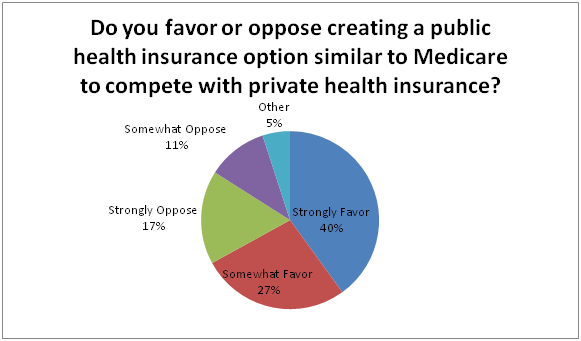
Two-Thirds Support A Public Plan?

According to the latest research from a Kaiser Health Tracking Poll of 634 respondents from June 1-8th:

Since, I strongly believe responses are biased by context, I wonder how many people respond that way when they realize that they will be pushed to this plan. [The Lewin Group estimates that as many as 118.5M people (2/3rds of those who have insurance today) would be shifted to public coverage.]

Poll On Cost Of Treatment For Life Extension

A hot topic is how much is an additional day / month of life is worth.  With some costs for a medication rising to $50,000 or more, this is something that we need to grapple with.  I’m interested in your thoughts on the following questions:

  • What would you pay for an additional day / month of life?
  • What would you expect your employer to pay for you to have an additional day / month of life?
  • What would you expect your insurance company to pay for you to have an additional day / month of life?
  • What would you pay if there was a 1 in 1,000 chance that the additional month turned into an additional year?
  • Does that change if there is significant pain involved in the extension of life (i.e., you aren’t comfortable during your additional days/months)?

Deloitte 2009 Survey of Health Care Consumers

This is based on a Deloitte web-survey of 4,001 Americans in October 2008.

  • 73% are confused about how the US healthcare system works
  • Over 1/2 believe that 50% or more of healthcare dollars are wasted
  • 7 of 8 Americans believe themselves to be in good health
  • 1 in 3 are interested in working with a health “coach” to help them create and stick to a plan
  • 68% are interested in home monitoring devices that would check their condition and send results to their MD
  • 3 in 5 say financial penalties would improve their adherence
  • Only 1 in 3 Rx users say they compared treatment options
  • 22% say they looked or asked for information about a health insurance plan in the last 12 months
  • 9% have a PHR
  • Physicians who are more prescriptive (paternal) were preferred by a ratio of 2:1
  • 8 in 10 say they would consider switching from a physician recommended Rx if a pharmacist (RPh) indicated a cheaper alternative was available
  • Only 12% said they understood the term – biologics (should they?)
  • 35% are willing to accept a smaller provider network for a reduced premium and lower copayments
  • Only 25% favor increasing taxes to help cover the uninsured

Their major conclusions were:

  1. Health care is a consumer market
  2. The health care market is not homogeneous
  3. Cost concerns are changing behaviors
  4. Consumers want holistic care and resources to pursue wellness and healthy living
  5. Consumers embrace innovations that enhance self-care, convenience, personalization, and control of their personal health information

Impact on Life Expectancy

I’ll stay with the same theme here for a minute…

I found this one page graphic in the back of Newsweek (6/22/09) which caught my eye.  It was titled “Can You Cheat Death”.  It had some interesting facts from Livingto100.com, Archives of Internal Medicine, PLOS Medicine, and the Journal of the American Board of Family Medicine.

  • Life expectancy for the average American man = 75.2 years (80.4 for a woman).
  • Positive impacts:
    • +10 years if you have a blood relative who has lived to be 95 or older
    • +5 years if you regularly play puzzles like Scrabble or Sudoku
    • +5 years if you’re a married man
    • +5 years if you take 81mg of aspirin a day
    • +3 years if you eat 5 daily servings of fruits / vegetables
    • +2 years if you floss daily
    • +1.7 years if you go to church regularly
  • Negative impacts:
    • -0.5 years if you drink more than 5 cups of coffee a day
    • -1 year if you get less than 6-8 hours of sleep a night
    • -1 year if you have a family history of diabetes
    • -2.5 years if you don’t wear sunscreen and are outside a lot
    • -5 years if you are slowly putting on weight
    • -5 years if you regularly feel stressed out
    • -5 years if you eat red meat more than 2x per week
    • -5 years if you have less than 12 years of education
    • -7 years if you engage in unprotected sex with multiple partners
    • -15 years if you smoke
    • -15 years if you use IV drugs

Obviously, these are only average so you’re not doomed, but I view them as reasonable indicators of how you might influence your length of life.

One Cigarette vs. 11 Minutes of Life

So, if smoking a cigarette knocks 11 minutes off of your life, you would think that would capture people’s attention.  Or would you?  Given the framework of hyperbolic discounting, what is the value we put on that 11 minutes of life.  If I’m young, I see that as a very distant value with a lot of things that could happen between now and then.  The “benefit” of smoking the one cigarette is very real and immediate.  (I’ve never been a smoker, but I assume there is an enjoyment.)

It’s not very different from eating.  The extra spoonful of sugar in my coffee can (over the course of a year) add a pound and over the course of a decade add 10 pounds…BUT can I really make that tradeoff.

This is one of the fundamental challenges in healthcare especially for asymptomatic diseases where there aren’t regularly experienced symptoms – e.g., high cholesterol.

Regarding House Bill 458 (MO) On PBMs

To Whom It May Concern:

You should be embarrassed to produce this bill. It’s obviously based on a one-sided view of the world regarding Pharmacy Benefit Managers which is generated by sensationalist journalists, jilted employees, independent pharmacists who have lost marketshare to chain drugstores, and pharma manufacturers who have seen their marketshare decline. This type of legislation will only serve to drive up healthcare costs and is exactly the reason why a government run plan won’t work in this country. They’ll focus on lobbyist interests and not the true interests of the consumer.

Let’s go point by point through your legislation and point out some flaws – (see bill here)

1 – Why would a PBM have to tell a consumer what they pay the pharmacy? That’s like Best Buy being required to tell the consumer what they pay for a TV. Most PBMs and/or pharmacies often print on the receipt what the consumer’s payor (employer, managed care company) paid for the drug (i.e., your insurance saved you $100).

2 – Why is the government telling businesses how to do their job? As an HR manager, if I can get a better discount for my employees on their prescription drugs by limiting the pharmacy network, why shouldn’t I have that option. We have preferred vendors in most companies. Why shouldn’t that be true in pharmacy? There are ~60,000 pharmacies in the US which is more than enough.

3 – Again, why is the government interfering in pharmacy law and telling me (the consumer) what I can or can’t do? Why can’t I move my prescription from one pharmacy to another based on discount, convenience, service, or other issues? All you are doing is creating a consumer burden and physician burden with no benefit to anyone.

4 – Now you want to take away my ability to manage drug coverage. There are plenty of circumstances where limiting or denying coverage makes sense due to inappropriate utilization, availability of lower cost options, abuse, and other issues.

5 – I’m completely confused here. You want to tell the insurance companies that they can’t increase the percentage of costs that the member pays (which is really a benefit design issue for the employer) unless the drug prices go up.

6 – This topic has been discussed a lot around switching medications. Of course, the communications should be clear. The patient should understand their choices. They physician should be in the loop (which they are since they have to write the new prescription). You hopefully realize that these are done to lower healthcare costs AND that physicians neither discuss costs with patients (generally) nor do they believe it’s their job to do this.

7 – Do you really believe that the dispensing physician who is focused on caring for their patients has the time to keep up with all the medical literature that a Pharmacy & Therapeutics (P&T) Committee reviews in determining protocols around step therapy? Look at the research…it shows that it takes 17 years for evidence-based standards to become standard practice. I personally don’t want to rely on my individual physician (who does a damn good job) to understand all the latest literature (w/o an EMR). And, I would hope no MD would willingly write an Rx that causes harm. All step therapy programs offer a prior authorization override to the MD and the PBM systems look for drug-drug and other types of interactions.

So, I guess the question is why are you (the legislation) trying to force me (the consumer) to have more administrative headaches, higher costs, and be treated with outdated protocols? And, at the same time, you’re going to force my employer to have higher costs and likely have to stop offering healthcare. And, you’re going to put more administrative burden on my physician who is already overworked and potentially underpaid.

Oh, wait, I get it…If you make the existing companies unable to run their business and unable to use evidence-based standards to lower costs then a government run experiment in socialized medicine will look much better. I hope that the Obama camp recognizes you for your hard work in advocating for them.

So Much Confusion Over Generics

In reading the article about generic drugs and the subsequent comments, I am amazed at how much mis-information and confusion exists.

Let’s start with a few facts:

  • Generics are approved by the FDA and have to have the same manufacturing standards.
  • Generics receive a rating (e.g., A-B) and are chemically equivalent to the brand drug upon whose patent they are based.
  • Chemically equivalent drugs have the same active ingredients but different inactive ingredients.
  • Generics cost less since there is no research and no sales and marketing activity to support.
  • A high percentage of generic drugs are made by the brand drug manufacturers.
  • Consumers save money on generics.  Pharmacies and PBMs make money on generics.  Plan sponsors (i.e., employers) save money on generics.  Everybody wins!
  • The variance in active ingredients is no different on generics than it is on brands.

There is definitely plenty of misinformation out there.  I would suggest sticking with sites like the FDA’s site on what’s real.

As the study by Prescription Solutions (United Healthcare) shows, there is confusion in the market.

  • Nearly 1/3rd of Americans don’t know or believe that generics are identical to brand drugs.  (They’re not identical, but the active ingredients are.  I would have asked the question differently.)
  • 2/3rds of respondents didn’t know that generics typically cost 50-70% less than brands.  (That surprises me.)

Jacqueline Kosecoff, Ph.D., chief executive officer of Prescription Solutions, said, “Using generics helps make health care more affordable without compromising results. Many Americans erroneously believe that the most expensive drug is always the most effective drug, so by helping to change perceptions, we can help people save money and still get the best treatment available.”

New CMO – Dr. Jan Berger

I’ve had the chance to read Dr. Berger’s research over the years when she was at CVS Caremark. After having a chance to spend some time with her on a few topics, I am very excited that she is coming on board at Silverlink Communications as our Chief Medical Officer.

From the press release:

DR. JAN BERGER JOINS SILVERLINK AS CHIEF MEDICAL OFFICER

June 23, 2009

Burlington, MA – Silverlink Communications® Inc., the leader in healthcare consumer communications, today announced that Dr. Jan Berger, former Senior Vice President and Chief Clinical Officer for CVS Caremark, joins Silverlink as Chief Medical Officer. In her role, Dr. Berger will focus on setting the company’s overall vision and strategy for population health and clinical communications programs within the managed care, population health, and pharmacy benefit management space.

Dr. Berger brings more than 25 years of business and clinical expertise in healthcare, including more than 15 years as a medical director at both a health plan and a major regional hospital. She is actively involved in quality initiatives, participating in numerous committees for National Committee for Quality Assurance (NCQA); medication safety, participating in steering committees at National Quality Forum (NQF); and population health management through her Executive Board position at DMAA. She also serves on several influential editorial and healthcare company boards, including Editor in Chief of American Journal of Pharmacy Benefit. Her expertise expands Silverlink’s focus in population health and clinical outreach – specifically related to engaging and connecting with healthcare consumers in a variety of lifestyle management, disease management and preventive health activities.

“Jan is clearly one of the leading innovators in healthcare, with tremendous clinical acumen and an ongoing track record of business execution in programs that drive down healthcare costs and improve health outcomes,” said Stan Nowak, Silverlink’s co-founder and CEO. “We are extremely proud to have her join our executive team at a time when behavior change is critical to our national healthcare reform process.”

“Silverlink is at the forefront of using communications and analytics as strategic assets to help consumers make more effective healthcare decisions,” said Dr. Jan Berger. “With the consumer at the center of our healthcare cost equation, we have the opportunity to improve the health of our country and eliminate hundreds of billions of dollars that relate to preventable conditions. This is a complex but solvable problem and I’m passionate to be part of a team that is already making an impact.”

Gov’t Reduce HC Costs: Rx Decisions Say No

I have nothing against the pharmaceutical companies.  We need medications.  Development of medications costs money.  There are lots of failures to find one that works.  They deserve to make money.

That being said…they are smart and apparently the administration is inappropriately (IMHO) paying attention to what they suggest is right.

  • For Medicare PDP, the plans can no longer require the member to pay more when they choose a brand drug which is available as a generic.  WHY NOT?  It’s the same drug.  There may be a few exceptions called Narrow Therapeutic Index (NTI) drugs, but just make them exceptions.  This was a bad decision which will cost us taxpayers money.  (See prior posts – Potentially Ridiculous Decision and Uproar Over “Reference-Based”…)
  • Now, they jump on the savings that are offered for members who hit the “donut hole” and stay on the brand medication.  Why not just require MDs to give out samples?  Of course this will effect behavior and drive brand utilization.  Pharma is not stupid.  This is another decision which will cost us taxpayers money.

On the one decision where they go against pharma – drug reimportation, they make a bad decision.  Why import drugs?  Why not implement a therapeutic MAC (maximum allowable cost)?  This will definitely impact drug costs AND generic drugs (which make up almost 70% of the claims filled) are cheaper in the US.

This is the government that we want to manage the costs of our healthcare system when they can’t even make the logical decisions that anyone close the business could make.  Come on!

[IMHO = In My Humble Opinion]

Sold to Pharma

Could / Should Healthcare Follow The Car Dealer

Healthcare is one of the few industries where more supply equals more demand.  (Maybe the only one.)

So, as we look at the healthcare shortage of PCPs, RN, and RPhs, should there be more discussion of closing locations?  Should we pursue the tact of the car manufacturers in closing dealerships to have less locations?  This would fly in the face of the MinuteClinic type of strategy.

Or, I guess the better question is whether there are certain points in the process where more access points are needed, but there are other points in the process where less access points are needed.  For example, do we really need 6x,000 retail pharmacies in the US.  Certainly, in some urban and suburban locations where the average person passes more than 3 pharmacies to get to the one they use, the answer is no.  In some rural locations, there is no option other than the one pharmacy that is 20 miles away.

Would this change our behavior?  I believe analysis would show that less testing facilities and more difficult access to certain tests would certainly change their use.  Would this address the problem or simply create more services that were being done outside the system (i.e., cash businesses)?

I don’t know the answer, but I haven’t heard anyone talking about what seems like a logical discussion.

What Would A Public Healthcare Company Give Us?

I’ll admit upfront that I’m well behind in all my policy reading, but as a citizen and someone who works in healthcare, I have to wonder why this makes sense.

  1. Is it to lower administrative costs as Kathleen Sebelius said on TV this morning?  Since they only represent ~10% of the total healthcare costs, that’s not going to make a big difference.
  2. Is it to provide coverage for the uninsured?  This seems like a fundamentally good cause but how is that population defined.  Why can’t that happen in the existing system with the right incentives / mandates?
  3. Is it to provide competition for the current insurers?  This seems like a bad path.  Government competing with industry…will the playing field be even?
  4. Is it to provide a government subsidy to those that can’t be profitably insured?  Again…this is probably in the social interest of the country.  Can it be done w/o simply overspending?
  5. Is it to drive a long term investment in preventative care?  Now, this seems like an interesting perspective.  We know one of the issues with long-term investments in patient care is that members churn.  If I invest today in a member that I won’t have, I don’t get my money back.

I think my point here is that a public system (IMHO – In My Humble Opinion) isn’t the right question.  We have systemic challenges around incentives, payment structure, long-term care, supply and demand, health literacy, etc. that have to be addressed.

From what I’ve seen in Medicare Part D (PDP), I have no faith that a public system would manage trend.  They won’t even push people to chemically equivalent generics.  They blindly pursue re-importation.  They don’t have a very limited formulary.  They don’t have aggressive utilization management programs (e.g., step therapy).

Someone needs to set an aggressive goal of keeping trend to 0% for the next decade and then work toward that.

New Clinical Webinars – HEDIS, Adherence, Engagement

In June, we are offering three complimentary webinars to our clients and prospects on key topics of discussion.

Increasing the Effectiveness of Population Health Program Engagement
June 16th | 1:00 PM ET

Getting consumers to take charge of their healthcare behaviors and choices is critical to controlling costs and improving outcomes. Successfully welcoming and engaging consumers in DM and health management programs can be the toughest road for health plans and population health organizations. Strategies that motivate participatory engagement are key – but it takes more than a friendly voice and the right script.

Join Silverlink for a complimentary webinar where we will discuss the challenges of moving health behaviors and effective strategies organizations can implement to get ahead of the behavior change curve.

In addition, learn how to:

  • Leverage tailored messaging to drive high engagement rates
  • Enable continued engagement over time
  • Maximize buy-in and acceptance of health coaching
  • Combine multichannel approaches to elicit engagement and re-engagement
  • Optimize engagement campaigns through predictive analytics to drive results

Drive Positive Health Behaviors and Improve HEDIS Results

June 23rd | 1:00 PM ET

Whether your focus is on the HEDIS measures for women’s health, the diabetes metrics or a broad range of effectiveness of care measures, Silverlink can design communications strategies that increase your reach, motivate member action and improve HEDIS results.

With the backdrop of the economic slowdown, communicating with members about the importance of key preventive screenings is more critical than ever. Explore the many routes to break through health prevention challenges by tailoring communications interventions that work for your populations.

Join Silverlink for a complimentary webinar where we will present the results and lessons learned over several years in supporting HEDIS screenings including a recent campaign aimed at reducing health disparirities in African American and Hispanic populations related to colorectal cancer screenings.

In addition, learn how to:

  • Use a flexible framework that supports national teams in delivering effective outreach in local markets
  • Drive performance on high-profile HEDIS measures where plan performance has hit a plateau
  • Segment your membership to deliver highly personal messages using multiple levers
  • Design and target messages to help reduce health disparities
  • Combine multiple messages to support members with more than one gap
  • Leverage multichannel campaigns to maximize reach and action

Rethinking Medication Adherence

June 30th | 1:00 PM ET

More than 50% of consumers become nonadherent around their maintenance medications within the first 12 months of therapy. And, today’s economy is putting even more pressure on people to make economic tradeoffs that threaten their health. Several studies have shown that more people are skipping doses or not refilling medications. Non-adherence leads to $177B in direct and indirect costs to the healthcare system per year.

Silverlink provides a comprehensive suite of communications services to drive medication adherence from targeting and messaging to multi-channel campaign management and execution. Join Silverlink where we will discuss some of the common myths around and key strategies related to medication adherence.

In addition, you will learn about:

  • Critical success factors in designing adherence solutions
  • Important conditions to focus on for adherence
  • Success metrics and key measurements
  • Comprehensive solutions for all phases of the patient’s therapy from initiation through long term maintenance

Expanding the Role of the Clinic

I think the fact that Walgreen’s and CVS Caremark are expanding the role that the clinics can play in healthcare is a positive thing.  There will be lots of debates about how much can be handled at the clinics versus the physician’s office, but I think the key point should be that today’s model doesn’t work.  Chronic diseases are not managed.  We provide sick care not well care.

Launched over the last four years to care for such simple ailments as ear and sinus infections, strep throat or pinkeye, retail clinic operators now are training nurses to do specialized injections for such chronic conditions as osteoporosis and asthma.

In addition, they are offering treatments for advanced skin conditions that include removal of warts and skin tags or closing minor wounds. Care for minor “sprains and strains” also is being offered at some retailers, and pilot projects are underway for breathing treatments and special infusions of drugs derived from biotechnology.

We need to figure out how to lower the costs, make the system more accessible, get patients engaged, and drive people to preventative care.  I don’t know if the clinics can do this, but if they can, we should embrace them.  I think both companies are very well positioned to drive change with their breadth of services.  They touch the consumer on a regular basis and have the ability to use data, technology, and localized care to engage patients.

Should MDs Make Less Since Work Is Fulfilling?

It’s an interesting question, and one I had never thought about.  But, this is how I would summarize Penelope Trunk’s post.

Why do doctors need to make so much money? The non-financial rewards for being a doctor are larger than almost any other profession. Except teaching.

Can’t I have a good job that I like; make a difference in society; AND make a lot of money.  Is that too much to ask?

I guess it’s like saying why can’t I balance work and family AND make a lot of money.  It can happen, but it’s rare and hard. 

I’m not sure I buy her hypothesis about lowering standards to create more MDs which would drive down costs, but it’s an interesting perspective.

Facts, Ideas, and Thought Provoking Discussions

We had our client event a few weeks ago (and I am finally digging out). Additionally, I had the privilege to attend one of our client’s big internal events last week. They both gave me lots to think about. I am grouping them all together here to share.

  • Payors are becoming more interested in BPO (business process outsourcing) today. (Is that an economic reality or a competitive need?) Disease Mgmt is the exception here as plans are moving it back in-house.
  • Even thought over 30% of payors have more than 4 backend systems, some of them are looking for new claims systems for their individual business.
  • Marketing is the #1 investment area for 2009 (and hasn’t been in the top 10 for the past decade).
  • One plan out there has 72 different business intelligence tools they are using.
  • 67% of members haven’t been contacted by their plan in the past 18 months. (Is that good or bad?)
  • 80% of members get information from general healthcare sites not the health plan website.
  • Payors are starting to get into (or investigate) the social media world.
  • Reducing 3 risk factors (e.g., smoking) would reduce 80% of diabetes and 40% of cancers.
  • Safeway has kept their healthcare costs flat for 4 years by using incentives.
  • Over 80% of Americans are on 3-tier plans.
  • Only 10% of MDs aware of the cost of a drug to the patient…
    • And most think it’s the RPh’s job to address this
    • But 70% of patients don’t know the cost before it’s adjudicated
    • And 60% of patients w/o coverage don’t talk to MDs about cost
  • Just following guidelines would improve care and costs dramatically (e.g., hypertension by 25%)
  • Starting patients on generics increases their likelihood of reaching an MPR > 80%
  • For the same location, Marriott makes 8% more revenue than competitors based on personalization and use of data
  • The Royal Bank of Canada is beginning to use the value of your social network in determining things like your interest rate (e.g., John has a high net worth cousin that we want to retain).
  • Your IQ score plus your credit score can explain 95% of your success as an employee
  • At NetFlix, they found that people like their recommendations better than the movies people chose themselves
  • High performing companies are 5x more likely to consider analytics a key part of their strategy
  • One CEO is so focused on analytics that they talk about firing people for not using a control group.
  • Analysis is not an ideal but a truism. You have to both have the data and the intelligence to interpret it.
  • Healthcare is just realizing that consumers can be “convinced” to use specific products or services.
    • Behavorial economics (fear) versus inspiration (love).
  • There are more fast food restaurants in states with higher obesity – vicious cycle.
  • You have to engage consumers on their terms.
  • Do consumers really know what they want? If you ask them about receiving health care communications, what would they say? Can you honor those preferences? When do you override them?
  • Is communications and member insights really the only way to differentiate versus competition?
  • Your brain takes in more information than it can process…this is why sleep, exercise, relaxation, etc. is necessary for your brain to process all of it. (If true, do you forget more if you don’t do those things?)
  • You have to have both the Hedgehog (people that dig deep on data) and the Fox (people that connect the dots) to be successful. (Good to Great)
  • Personalization and pro-active communications are key.
  • 65% of healthcare products will be personalized in the next 5 years. (What are you doing to get there?)
  • BWM offers a great example of customization:
    • You could name your mini-Cooper
    • Your personalized key fob would activate billboards that showed a personal message (Hi Herbie!)
  • Interesting discussion on using automated member satisfaction solutions versus live agents. Do you get different outcomes? Which is more accurate?
  • Do members want to be “treated like a friend”? Wouldn’t some view this as too intrusive / presumptive?
  • Can you really motivate your employees if you have no personal relationship with them? I was surprised to hear some people say yes.
  • The most difficult thing is to stop doing what we’ve been doing.
  • Do you want to be part of a corporation or a movement?
  • 65% of employees are looking for another job (even in today’s economy).
  • 80% of employees don’t look forward to Monday (and heart attacks and strokes are higher on Monday mornings).
  • 25% of big company CEOs would meet the clinical guidelines to be defined as a psychopath.

Hopefully, like me, these give you a few things to think about and chew on.

Retail Clinics Scarce in Poorer Areas

Just like there are less grocery stores in poorer areas, less retail clinics are being built in those areas.  This systemic challenge makes health changes hard to overcome.  From USA Today (5/27/09):

Walk-in retail clinics in grocery and drugstore chains were designed primarily for convenience but also can help the uninsured find health care, proponents say. But a new study suggests most retail clinics aren’t in the poorest neighborhoods — they are in more affluent areas already well-served by other medical resources. A study by University of Pennsylvania researchers in Monday’s Archives of Internal Medicine mapped 930 retail clinics operating last year, then used U.S. Census data to describe the income and racial makeup of the neighborhoods. Only 123 clinics were located in areas defined by the federal government as medically underserved. Census tracts with clinics had lower percentages of black and Hispanic residents, lower rates of poverty, higher rates of home ownership and higher median incomes.

Top Wealth Centers

Since we know health disparities exist and we know (for example) that higher income and higher educated people are more likely to use generics, I think it’s important to understand some of the ways areas are evaluated and ranked by 3rd parties on their “wealth”.

Reading the St. Louis Business Journal last week, they showed the IL and MO cities and how they ranked.  The metrics were interesting:

  • Median household income
  • Households with incomes above $200K
  • Median home value
  • Households with 4+ vehicles (really?)
  • Adults with bachelors degrees

McLean, VA was the top ranked city:

  • $156,292 median household income (vs. $50,007 nationally)
  • 36% of households have an income above $200k (vs. 3.7% nationally)
  • 79% of adults hold bachelors degrees (vs. 27% nationally)

Lake Forest, IL was the second ranked city and has 5% of households with an annual income of more than $1.15M and 7.4% of households had 4+ vehicles.

(This analysis that they did was based on US Census Bureau’s 2005-2007 American Community Survey.)

Medco 2009 Drug Trend Report Part 2

(Continued) Here are my highlights from Medco Health’s 2009 Drug Trend Report:

  • They continue to be very aggressive about discussing David Snow’s blueprint for healthcare reform.
  • They also seem to be very focused on personalized medicine with several documents out there discussing it.  They mention it here along with GINA.
  • They also talk about Prevacid potentially making the Rx-to-OTC switch which we know has recently been approved.

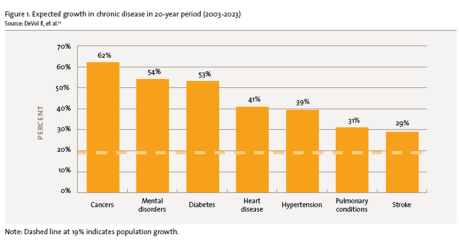
Half of all Americans are under treatment for at least one chronic disease.  For patients initially diagnosed with chronic or complex conditions, drugs are the first choice for medical intervention 88% (131 out of 149) of the time. Care of patients with chronic and complex diseases accounts for 75% of medical costs and 96% of total drug spending in the U.S.  However, about half of all patients abandon their prescribed therapy in the first year of treatment. Indirect costs linked to absenteeism, short- and long-term disability, and presenteeism (i.e., present at work but less than fully productive) can exceed associated direct healthcare costs by two to three times—making even more critical the rigorous management of these patients and tighter adherence to ongoing care.


Major contributors to these numbers include the epidemic of obesity, the persistence of tobacco and substance abuse, and physical inactivity. As the average age of our population rises, without a paradigm shift that changes the status quo, it is expected that the number of individuals with chronic disease will similarly increase (see figure below). – for original sources go to page 85 in the document)

Medco Chronic Disease Growth

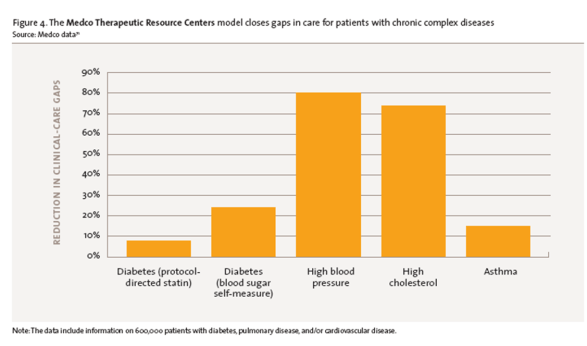
  • I was a little surprised that it wasn’t until page 97 that they showed results from the Medco Therapeutic Resource Centers (TRCs).

Medco TRC Outcomes

Alright, after a few crashes of the blog entry, that wraps it up…one more drug trend report to go.