Archive | Innovation RSS feed for this section

Why Can’t I Text My [Application]

I forgot to grab a receipt earlier today when I used my debit card.  Since I keep a record of all my transactions in Quicken, I quickly realized that I needed to e-mail myself the amount so I could enter it when I got home.  That got me thinking…why couldn’t I just text it to home home PC.  The PC is on the web.  It could “listen” for my message; receive it; and integrate it. 

I’m sure there’s more to it, but this could work for healthcare updates – weigh, blood sugar, blood pressure.  Sure, ideally my bank would update my Quicken and my bluetooth connected WiFi health monitoring devices would do it for me.  BUT, in the interim…

Band-Aid To Monitor Your Heart

Let’s stick with today’s examples that can be extrapolated to the future.  [Good Sunday am thinking]

I was reading in Fast Company [Dec 09 / Jan 10] about Corventis’ PiiX monitor. 

It’s a “wireless, water-resistant sensor that sticks to a patient’s chest like a large Band-Aid and monitors heart rate, respiratory rate, bodily fluids, and overall activity.”

Interesting!   I see an immediate use for this in team sports like the Tour de France where it can be monitored by a team manager and used to push fluids or encourage a change in pattern.  But, as the company talks about, imagine the power of using predictive algorithms here to know when someone may be in danger of a heart attack or some other medical issue. 

As devices like this become standard and are used to monitor our key bodily statistics and used, will we become healthier?  Again, will companies be able to use these to help guide our decisions through incentives – lower health care costs, lower life insurance costs?

I think as the data from these get transmitted electronically and populate PHRs and EMRs and get used by clinicians it will be very interesting to see how they change outcomes.

Blending Social Media and Healthcare

There is certainly lots of talk in healthcare around incentives.  What incentives will drive people to behave healthier – peer pressure, cash, non-monetary incentives, competitions (e.g., The Biggest Loser), or lower copays and deductibles.

There is also lots of talk about social media.  There have been lots of studies showing the power of your friends to influence your behavior – smoking, weight loss. 

Separately, I continue to hear more and more stories about agencies and lawyers using social media to find out about what people are really doing.  For example, my friend’s mom was recently on a jury of someone suing a physician for malpractice.  She claimed she had limited use of her legs.  But, the physician’s lawyer accessed her facebook page and saw her talking about all the stuff she was doing now that she felt better.  Oops.

Before I paint my future scenario, let me toss out one example that really got me thinking.  Burger King recently created the “Whopper Sacrifice” application for Facebook.  You received a free Whopper if you would delete 10 of your friends from your Facebook account.  23,000 users did it before they took it down.

So, if people would “sacrifice” their friends for a Whopper, what would people do for a 10% reduction in their premiums [or some siginificant savings on healthcare]?  Could companies get people [and use social media to track it] to spend more time with their thin friends that don’t drink or smoke and regularly exercise and get 8 hours of sleep a night?  Assuming the research is true, this would dramatically reduce costs and make those people healthier. 


Influencing Behavior Thru Smell?

We’re always taught as kids to think about all the senses, but that seems to go out the window at an early age. We start focusing on print or TV or some limited set of modes.

I’ve started to see more things lately around smell. I saw a simple one yesterday that I thought I would highlight.

“What we wondered was whether you could regulate ethical behavior through cleanliness.  We found that you could.”  [Katie Liljenquist, asst professor at Brigham Young University]

In an experiment, people who sat is a room with citrus-scented Windex were more likely to act fairly and charitably than those in an unscented room.  In an experiment from last year, the researchers showed that people were more judmental and critical about certain moral issues when exposed to fart-scented spray.  [I’m not sure how people come up with these studies.]

Anyways, I doubt we’re going to start using scratch-n-sniff stickers or seeing TVs with scent dispensers, but I think it’s an interesting question to think about when trying to influence health behavior.  How should a doctor’s office smell?  Would your workplace be healthier if it smelled different?  Would I choose different foods at the cafeteria if it had a different scent?

IronMan for Sick and Injured People

robot suitironman-4
If you ever saw the movie Ironman, you will find this interesting.

Cyberdyne, a Japanese electronics company, has released a promotional video showing an elderly patient with Parkinson’s disease using a robotic skeleton to walk for the first time in two years. Of course, we have some skepticism and paranoia about robots which will have to be addressed (think iRobot), but the potential is significant. Here’s a picture of their HAL (Hybrid Assisted Limb) from their website. [Honestly, I would be fairly skeptical if this hadn’t appeared front page in the USA Today.]

Robot Suit - HAL

“Insights” Gone Wrong

There is a great “cartoon” at the end of the recent Fast Company magazine that gives an example of how using information can lead you to a wrong decision.  It’s one of the reasons that I always point out the difference between someone who has provided services to an industry and someone who has worked in an industry.  It’s not the same.  Sometimes, you need to truly understand the nuances and how decisions are made.

It also made me think of a great Facebook example of how using social connections can lead to bad business decisions.  Given all the talk about making peer-to-peer recommendations based on your social network, this is a slippery slope to watch.  We are still new to this area and mistakes will happen.  One of the bigger ones that I have heard occurred in Facebook where they allowed advertisers to use member’s pictures.  Well, how do you think people felt when they saw the advertisements that say “Meet Singles In Your Neighborhood” with a picture of their spouse.  It didn’t go over well.

Great idea.  Interesting technology.  Bad application.

This will happen in healthcare.  The question is who will be first to stub their toe in the new world.

The 5 Questions (Regence Group)

Regence Group recently put out an interesting website – www.whatstherealcost.org.  It takes an unorthodox (for a health plan) approach to delivering several important points.  It reminds me of what Wellpoint has done with Tonik or some of the things Humana is doing at HumanaGames.

One of the things I found interesting and very straightforward for patients to think about were their 5 questions:

  1. How much does that cost?
  2. Is that really necessary?
  3. Is there a cheaper option?
  4. Is there a generic for that?
  5. Has anyone out there had this before?

Imagine if every time we were asked to take a test or start a new therapy that we (patients) asked these five questions of our provider.

CVS Caremark TrendsRx Report 2009

This is one of my favorite times of year. After working on the Drug Trend Report at Express Scripts for several years, I love to get all the trend reports from the PBMs and read them. The first one that I have had a chance to review is the one from CVS Caremark. I found it an easy to read document with good case studies and a mix of strategy and tactics.

Here are some of my highlights and observations:

  • 3 out of 4 clients cited “reducing health care costs” as their primary measure of PBM success…AND 2 out of 3 prioritized “plan participant behavior change” as the way to reach that goal. [Maybe the plan design bigot is finally dead.]
  • With pharmacy spend approaching $1,000 PMPY, I found their chart on potential cost reduction a simple way of pointing people to things they should think about.
    cvs_caremark_savings-opportunities-09
  • A 10% improvement in diabetes adherence can save $2,000 in annual health care costs. [I assume this is based on improving MPR and would definitely like to learn more on how the health care costs are quantified.]
  • They layout three objectives – improve use of lower cost drugs, improve adherence, and get people to take better care of their health. [Similar to the concept I laid out in my white paper of needing to be broader than just Rx benefit management.]
  • They talk about two of their solutions:
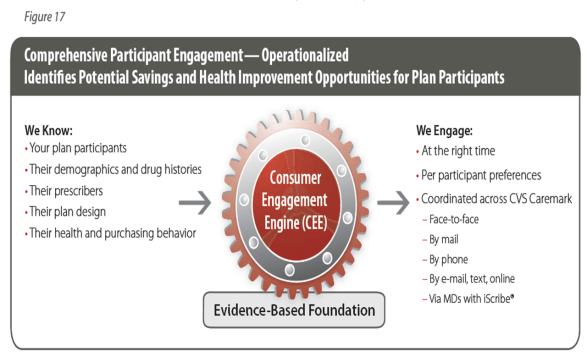
    • Consumer Engagement Engine (CEE) which is very similar to what Silverlink does and provides business logic for targeting the right member at the right time with the right message.

      consumer-engagement-engine

    • Proactive Pharmacy Care is their “medical neighborhood” concept to stitch together their entities – Mail Order, CVS retail, Specialty, MinuteClinic, and their disease management company.
  • Their trend was 3.9% PMPM in 2008 (or 2.8% excluding specialty drugs).
  • Medicare Part D utilization was up 4.1% compared to 0.8% for the rest of their BOB (book of business).
  • Their GDR (generic dispensing rate) averaged 65.1% for 2008 and was 66.3% in December 2008.
    • Best in class employers = 68.2%
    • Best in class health plans = 73.4%
  • As they remind you, a 1% increase in GDR is roughly equal to a 1% reduction in pharmacy spend.
    • [What I would like to see is improvements in GDR from new drugs coming to market in 2008 versus improvements that came from clients implementing plan design.]
  • They say [which I preach all the time} – “proactive consumer engagement improves results and lowers the risk of disruption. For best results, provide personalized actionable information at a range of touchpoints.”
  • I saw a few interesting things in one of the case studies they share about their “Generous Generics” program. [Does that name get used with consumers? What’s their reaction to it?]
    • $0 generic copay at mail [that should drive volume]
    • 10% coinsurance penalty for not shifting to mail after the second fill [similar in concept (I believe) to the Medco “retail buy-up” concept]
  • Top Ten Therapeutic categories (53% of spend):
    • Antihyperlipidemics
    • Ulcer drugs
    • Antidiabetics
    • Antidepressants
    • Antiasthmatics
    • Antihypertensives
    • Analgesics, Anti-inflamatory
    • Anticonvulsants
    • Analgesics, Opioid
    • Endocrine and Metabolic Agents
  • They state that the population of diagnosed diabetics is growing by roughly 1M a year.
  • They state that a generic for Lipitor is now expected in Q4 2011 [which I think is about a year later than originally expected]
  • They show some data from their Maintenance Choice program which I think has a lot of opportunity.
    • This is where you can get a 90-day Rx from either mail or a CVS store for the same copay. [The key here is for them to understand member profitability and for CVS Caremark to understand how to drive consumers to the preferred channel.]
    • [I would really need to understand their profitability by channel because if I read the chart in here right, it would appear that given the choice 45% of those at mail would choose 90-day at retail…a scary concept for mail order pharmacy.]
      maintenance-choice
  • They give a case on Maintenance Choice which leaves me looking for a key fact. They state that a recent implementation has a goal of 70% of the client’s day’s supply will go through the preferred network (CVS) or mail and that 20% of it goes through mail today. [What percentage goes through CVS today? If it’s a client in Boston, that one scenario. If it’s a client in Chicago, that would be another feat.]
  • Specialty pharmacy trend was 13.5%.
  • They say that pharmacogenomic testing is being used more frequently for specialty drugs. [I would love to know more…how often? For what drugs? Has it improved outcomes? Are their clients covering it? How are they playing in this space?]
  • They talk about adherence which continues to be one of the hottest areas in the Rx arena today. They give stats showing 15-48% improvement across different metrics and up to $142 in cost avoidance in one case. [Are these again control groups? What was the cost / benefit analysis or ROI? Is this improvement in average MPR (Medication Possession Ratio) or improvement in the % of people with an MPR of >80%?]
  • They talk about 88% of heart failure patients maintaining optimal prescription adherence compared to a norm of less than 50%. [My questions here (which isn’t apparent) is whether this was an opt-in program so the 88% is for engaged and active participants or whether it was across all targeted members.]
  • They provide a quick list of factors that will impact drug trend:
    • Driving costs:
      • Aging
      • Obesity
      • Diabetes
      • Specialty pipeline
      • More aggressive treatment guidelines and earlier diagnosis [which hopefully would lower total healthcare costs]
      • DTC advertising
    • Reducing costs:
      • Economy – reduced utilization and improved GDR
      • Increased availability of generics
      • FDA safety reform
      • Lackluster non-specialty drug pipeline
      • Utilization and formulary management
      • Consumer price transparency

Pharma Rx Costs Tied To Outcomes

Given our opinion that the PBM industry would be moving to more outcome based pricing, the articles today about Merck and Cigna‘s deal on pricing based on outcomes is very timely.  I “tweeted” about it early in the AM, but I have got the article sent to me by a lot of people.  So, here are a few of the things being said:

WSJ Blog

Now Merck and Cigna have announced what they’re calling a “performance-based contract” for Merck’s diabetes drug Januvia. But the deal is actually the reverse the pay-for-performance ideal: Merck will get paid less per pill, not more, if the drug works well.

Under the deal, Cigna will get a discount on the drug if patients’ blood sugar falls. Cigna will get additional discounts if patients faithfully take the drug when they’re supposed to. (These two variables often go together — taking the drug faithfully helps keep blood sugar down.)

Cigna PR

“Merck should be recognized as the first major pharmaceutical company to offer increased discounts on its oral anti-diabetic products, supporting CIGNA’s efforts to reduce A1C levels for individuals with diabetes, regardless of what medication they may be taking,” said Eric Elliott, president of CIGNA Pharmacy Management. “Improving people’s health comes first for both CIGNA and Merck. We hope this agreement will become a model in the industry.”

So…it seems like an aligned deal.  Merck and Cigna want adherence.  Employers want lower costs and better outcomes.

Promotion vs. Nudging vs. Mandatory Mail

Although there is always a dialogue about the lifecycle of mail order, I think some of the work out of the Consumerology group at Express Scripts is interesting.  The frameworks that they apply internally are very similar to the technology and approach that Silverlink uses with the rest of the market.  [Kudos to Sean Donnelly and Bob Nease for their work on this new approach.]

The traditional ways of driving mail order have been:

  • Over a copay incentive (and hope)
  • Letter and calls encouraging member to convert
  • Providing a call center to facilitate the conversion to mail (from an inbound call or from a transfer on an automated outbound call)
  • Mandatory mail – requiring the member to use mail or pay the full cash price for the drug
  • Retail buy-up – allowing the member to keep getting the maintenance drug at retail (after 2 fills typically) but requiring them to pay a penalty for choosing a higher cost channel

Now, “Select Home Delivery” uses the 401K approach of opt-out vs. opt-in to drive participation.  As behavioral economics would suggest, inertia will carry the momentum and by getting the member signed up in mail and moving them to mail will drive success versus requiring them to take an action. The idea here is to “nudge” the member versus force them or leave it up to them to take action.

Select Home Delivery optimizes the use of cost-saving Home Delivery, requiring members to opt out of the program rather than the traditional approach of requiring members to opt in.  The program is based on the psychological principle of hyperbolic discounting, which says immediate events (for example, the hassles of signing up for Home Delivery) loom large compared to downstream benefits (such as a lower overall copayment and receiving a 90-day supply).  Dr. David Laibson, an economics professor at Harvard and member of the Center’s advisory board, conducted research showing that applying this principle to 401(k) programs dramatically improved participation rates.

“Opt-out and active decision programs for 401(k) enrollment dramatically improved low employee participation rates. We wanted to explore whether these tools could also solve healthcare challenges,” Laibson said. “This is one of the first marketplace adaptations that successfully applies behavioral economics to improve healthcare.”  [quotes from Consumerology blog]

I think the new results from their blog (below) are impressive.  [BTW – If you’re a member at Lowe’s or another client which has used this, I would love to hear your reactions.]

select-home-delivery

Express Scripts Outcomes Conference Begins

As with each annual Outcomes conference, Express Scripts (ESRX) has released their annual trend numbers. Here are a few of the highlights from the press release:

  • Overall pharmacy trend = 3.0% (down from 5.5% in 2007)
  • Estimate consumers and employers are paying $42B too much in 13 therapy classes by not optimizing generics.
  • On average, a generic drug is over $90 cheaper than a brand name drug.
  • Generic drug usage increased by 7.5 percent, while utilization of brand name medications decreased 11 percent.
  • 67.3 percent of all prescriptions that Express Scripts filled were for generic drugs by the end of 2008. [I didn’t like the comparison which was an average across the 12 months ending in Sept 2008 from IMS of 63.7%…not apples to apples.]
  • In 2009, at least 20 branded drugs are expected to become available generically.
  • Over the next five years, more than $66 billion worth of branded drugs are expected to lose patent exclusivity.

“Using generic drugs that are safe and effective can help lower costs while still driving value for patients and employers,” said Steven Miller, MD, senior vice president and chief medical officer at Express Scripts. “Our results indicate that cost control is achievable through careful management of appropriate use of drugs and delivery channels, without shifting costs to consumers. Although the trend is the lowest it has been in over a decade, significant opportunity to lower spending still exists.”

“Finding ways to reduce spending without compromising health outcomes is the top priority for healthcare reform, as the Obama administration recognizes,” said Alan Garber, MD, PhD, Henry J. Kaiser Professor and director of the Center for Health Policy at Stanford University. “We have long used financial incentives to try to eliminate waste. Now we’re finding that tools that build upon the insights of behavioral economics and psychology can have powerful, positive effects.”

“In today’s economy, we are not only tracking wasteful spending across the country but developing strategies to reduce it,” said George Paz, chief executive officer at Express Scripts. “By applying the principles of behavioral economics we are helping consumers make better and more cost-effective healthcare decisions. We understand we cannot eliminate waste alone and we are committed to working alongside likeminded organizations, such as the Federal Coordinating Council for Comparative Effectiveness Research, to continue to identify strategies to improve our healthcare system.”

“Studies have repeatedly shown that people work much harder to avoid losses than to pursue gains,” said Bob Nease, PhD, the company’s chief scientist. “This suggests that a ‘stop wasting money’ message is more effective than a message focused on potential savings. In addition, by applying evidence-based segmentation, we have practical insight into which members are likely to be most sensitive to loss aversion. One size does not fit all.”

The Innovator’s Prescription – Christensen Book

I haven’t had the chance to read the book yet, but for those of you interested, I thought I would point you to the review from a few months ago on The Health Care Blog.

The book is mistitled. It should have been titled “The Innovator’s Diagnosis”. The book does a fantastic job at diagnosis (Dx) of problems in the U.S. health care system. It presents many new, innovative analytical frameworks and lenses through which to view the U.S. health system.

However, it’s weak on prescription (Rx): many of the proposed solutions are speculative, ungrounded, and/or defy political reality.

Upcoming Book By George Halvorson From Kaiser

I had the privledge of previewing George Halvorson‘s new book “Health Care Will Not Reform Itself” this week.  My book cover quote would go something like this:

“Opinions supported by facts all wrapped up in a narrative.  It’s like a fireside chat with one of the greatest leaders in healthcare.”

I won’t pull things from the book yet, but I found it a logical follow-up to his other book “Health Care Reform Now! A Prescription For Change“.  He talks about the need for bold goals and a clear set of metrics to drive change.  He talks about why healthcare costs go up and the fact that we need universal coverage.  And, he also hits on what seems to be the key theme of the day – reducing costs while improving outcomes.

While I was at the WHCC09, I got to sit down with George Halvorson and talk about healthcare for an hour.  It was a great privledge that I enjoyed a lot, and I could have talked for hours.  We hit on a bunch of topics so let me share some of them.

  • We talked about him writing books.  I was commenting on how much I like his writing style and was intrigued to learn that he said some professors don’t like using his books because they’re “too easy to read”.
  • We had a fascinating discussion around leadership and diversity and how he has created a very diverse leadership team at Kaiser.  I was also impressed to hear that one member of team does an international fellowship each year where they spend time abroad learning about how healthcare is delivered and managed in other countries.  [very progressive]
  • We talked about how healthcare was going to change.  He spent a lot of time on the need to create aggressive goals especially around the 10-20% of things that drive 80% of the costs.  For example, he asked why we don’t try to reduce asthma attacks or congestive heart failure by 90%.  And, he pointed out the fact that we don’t have a common set of goals that allows enterprises to reverse engineer the process and identify points of variance.  Without that process analysis and a specific goal, it is hard to drive improvements.

“We need to change our expectations of what is possible.”

  • We talked a little bit about where innovation will come from.  He talked about how Deming, a statistician, revolutionized manufacturing as a lead into the point that innovation will likely come from outside the industry.  [I think this is interesting as I have seen more and more executives at healthcare companies that are coming from outside of healthcare.  I also think things like the X-Prize may attract others to try their ideas.]
  • He gave some great examples of how Kaiser has deployed their 30 black belts.  The one I quickly jotted down had to do with how nurses change shifts.  This shift change is where all the information was exchanged about different patients and when accidents sometimes happened.  By changing the process, they dropped the accident rate and reduced the communication time from 40 minutes per shift to 12 minutes per shift.
  • We also talked about HIT (Healthcare Information Technology) and the need not only to drive utilization but to mandate system integration.  This tied in with an earlier conversation where we spoke about coordinated care versus uncoordinated care and the need to create a “virtual Kaiser”.  I think there is a lot to learn from the Kaiser model and some of the things they are doing with technology to drive care.  [I was pleasantly surprised that he believes physicians will embrace technology as a tool to help them standardize care.  I think that is critical path to successfully reducing costs while improving outcomes.]
  • I couldn’t jot down all the statistics fast enough, but he talked about how they were testing different “panel systems” in different geographies to see what the best process and technology solution would be.  They had had some great results.  [One fact he shared that jumped out at me was that 25% of people over 65 that break a bone die within a year.]
  • The last thing we talked about was probably the most insightful to me.  Given the amount of money spent in the last months of people’s lives, I was interested in his global perspective on whether that was a cultural issue.  He said that he thinks it is mostly that the care system in the US lacks honesty or the ability to be brutally honest.  We talked about one scenario where people who do nothing live an average of 140 days and those that get invasive surgery live an average of 100 days…but they are hoping to be that 1 in a 1,000 that live an extra year.  [Is it worth all that pain, surgery, and medicine for the last few months?]  We also talked about the new $100,000 breast surgery drug which extends the patient’s life on average for 1 month.  [Again, is that an appropriate use of money?  Would we spend it if it came out of our pockets?]

When the book comes out, I will try to pull out some of the key points, but I would recommend you pick it up and read it for yourself.  I think you will really enjoy it.

WHCC 09 Interview with Ed Batchelor (Humana)

I had an opportunity to sit down with Ed Batchelor from Humana yesterday.  He has an interesting role driving the Stay Smart / Stay Healthy program for them as part of his Corporate Web Strategy role.  From what I could tell, it’s a program done for the greater good of educating consumers about key healthcare topics.  To accomplish that, Ed has a direct reporting relationship to the operating committee at Humana and was brought in from outside the industry.

Here is an example of one of the videos that they are pushing out on YouTube.  I really like the whiteboard communication approach.

Some of the big takeaways from my discussion were:

  1. You have to meet the consumers where they are – Facebook, YouTube, Blogs.
  2. If you create a neutral educational message, consumers will trust information (even from health plans).
  3. You can only deliver information in “bits”.  Don’t overwhelm them.
  4. Fun is good.
  5. Regardless of what many (including myself) might think, seniors don’t all shy away from these social media.  [20% of the 1.1M views on YouTube have been from people over 55 years old]
  6. Success on YouTube doesn’t translate to blogs.

One question that I had was how to get away from the “healthcare speak” so that consumers could actually understand it.  He talked about 3 things:

  1. Bringing in an external person
  2. Using focus groups
  3. Using an outside agency

The other thing we talked about is that pull through that they are getting around employers and brokers.  They are pulling the videos in (like here) and re-using them.

This was a program they were highlighting in their booth and one of the public areas here so I appreciated the opportunity to sit down and learn more.

Sprint: What’s Happening Now

I am not sure how this helps Sprint sell more phones and/or services, but I enjoyed the advertisement. The concept of leveraging data to understand consumer behavior is essential. This is a topic we [Silverlink] are constantly working with our healthcare clients to address.

  • How do you know what members or patients are doing?
  • Do you understand their preferences?
  • What have they historically done?
  • Can you predict how they will act in the future?
  • What data is needed to do analysis and create a predictive algorithm?
  • How do you leverage that to create interactive and compelling communications?
  • How do you study their behavior change?  (e.g., did they get a flu shot after being reminded)

X-Ray Vision Carrots

Behavioral economics can apply in many instances.  It is the “hot” discussion topic in healthcare about how to understand how members (consumers / patients) make decisions and what factors influence their decisions.

In this article in Newsweek about getting kids to eat healthy, they talk about three things:

  1. Verbal encouragement
  2. Descriptive labels
  3. Improved access

Rather than calling them carrots, they talk about calling them “x-ray vision carrots”.  These 3 “principles” are relevant to a lot of communications.  You have to be proactive and provide encouragement to members to get a flu shot or do other preventative health actions.  You then need to find a way to describe the action in a way that is compelling.  And, finally, you have to make the action easy.

What’s Your Blog’s Personality?

I found this an interesting “blog analyzer“.  You put in your blog’s URL and it tells you the Myers-Briggs personality type of the author.  Mine was right on – INTJ.  I guess it shouldn’t be too surprising, but I can imagine all the opportunities to use that information in scale in the future.  As blogs, Twitter, Facebook, and other sites become the norm, an analyzer like this could categorize people’s personality types.

If a service could be created, communications could be tweaked based on personality to best get people to respond.

Buyology: Best Book of 2009

I am finally getting around to writing this up. I mentioned the book – Buyology – a few weeks ago. It is definitely the best book I have read this year. It is by Martin Lindstrom and is all about neuromarketing.

For those of you that don’t think it’s relevant to healthcare, think again. Healthcare is all about compelling individuals to take action and become responsible for their health. That is about understanding how they interpret information and what drives them.

Here are some of my notes from the book:

  • One of the processes used was fMRI (functional Magnetic Resonance Imaging) which measures the amount of oxygenated blood throughout the brain. Scientists can see what part of the brain is working at any given time.
  • The other process used was SST (steady-state typography) which tracks rapid brain waves in real time.
  • One of his first studies looked at the effect of cigarette warning labels and found that they not only failed to deter smoking but activated the nucleas accumbens.
  • What people say on surveys and in focus groups does not reliably affect how they behave. [although it is often the best we have]
  • Brand matters…He re-conducted the Pepsi Challenge and showed that if people knew what they were drinking they preferred Coke to Pepsi. When they didn’t know, 50% of people liked Coke. When they knew, 75% of people liked Coke.
  • He showed that consumers have no memory of brands that don’t play an integral part in the storyline of a program. Just putting something in the movie, TV show, or video game isn’t enough to get you mindshare. AND, those successful placements also weaken our ability to remember other brands.

“Our irrational minds, flooded with cultural biases rooted in our tradition, upbringing, and a whole lot of other subconscious factors, assert a powerful but hidden influence over the choices we make.”

  • In the Smiling Study that he references, they revealed that people are far more positive and have a better attitude toward the business when the person they are dealing with is smiling. [Maybe a key thing for avatars and real agents as they talk to people over the computer and/or phone.]
  • Our mirror neutrons allow us to get pleasure just by observing or reading about people doing something that would give us pleasure – e.g., opening a present with a new Wii in it. [You can go to www.unbox.it.com or www.unboxing.com to enjoy this.]
  • Logos are dead. They showed that images that are associated with smoking (for example) were far more potent in creating a reaction in the brain than the logo.
  • “Secret Ingredients” matter…he shared several examples of how things sold differently when there were non-existent things listed on the label.
  • When people viewed images associated with strong brands – iPod, Harley-Davidson, Ferrari – their brains registered the same activity as when they saw religious images.
  • They studied and showed that odor can activate the same brain response as the sight of the product. He talked about an interesting study that showed that “feminine scents” such as vanilla were sprayed in women’s clothing sections, sales of female apparel actually doubled.
  • Sex, extreme beauty, or a celebrity in an advertisement can hijack attention away from the information in the advertisement.

“I predict that soon, more and more companies (at least those who can afford it) will be trading in their pencils for SST caps. That traditional market research – questionnaires, surveys, focus groups, and so on – will gradually take on a smaller and smaller role, and neuromarketing will become the primary tool companies use to predict the success or failure of their products.”

Some interesting facts:

  • 300 million people, including 60% of male doctors, in China smoke.
  • 8 out of 10 new product launches fail within 3 months.
  • In 2005, 156,000 new products debuted globally (or one product every 3 minutes).
  • In 1965, a typical consumer could recall 34% of advertisements from TV. In 1990, that number dropped to 8%. In 2007, consumers could only remember 2.21 advertisements from all advertisements they had ever seen. [Talk about saturation.]
  • We walk almost 10 faster than we do a decade ago. 3.5 mph
  • A study in Denmark showed that people talked 20% faster than they did a decade ago.
  • And, if you don’t believe that culture matters…In Asian cultures, four is an unlucky number and one researcher found that heart attacks among US residents of Chinese descent spiked as much as 13% on the fourth day of each month.
  • Children that experience social difficulties in school are more likely to be preoccupied with collecting.
  • Both J&J and Play-Doh have lost their original fragrances and haven’t been able to replicate it.
  • When classical music was piped over loudspeakers in the London Underground, robberies, assaults, and vandalism dropped by over 25%.

Some of the interesting companies mentioned:

I thought he had a great story about a rock. If I gave it to you for your birthday, you’d be offended until I told it was from the Berlin Wall. And then when I told you it was from the moon, you would be even more impressed.

For more information, there is also a neuroscience blog.

Social Media Myths

This was a great article in Business Week.  It lays out nicely six myths to watch out for as you jump on the social media bandwagon.

  1. Social media is cheap if not free
  2. Anyone can do it
  3. You can make a big splash in a short time
  4. You can do it all in-house
  5. If you do something great, people will find it
  6. You can’t measure social media marketing results

Friends Don’t Let Friends

If they can use this concept for selling DirectTV over cable, why don’t we use this more in healthcare?

It could be…Friends Don’t Let Friends:

  • Pay too much for medication
  • Use brand drugs unnecessarily
  • Use retail for maintenance drugs
  • Call into the call center when the information is on the web
  • Go to the ER when they can call the nurse line
  • Pay too much for individual insurance

Maybe, in today’s economy, it will be time for healthcare companies to look for seriously at referral programs. 

  • Get a friend to come to mail order or the local CVS and get your next prescription copay waived.

Everyone is focused on saving money.  Social networking is all the rage.  People trust their friends.  

Now, I may not want to tell my friends that I am on cholesterol lowering medication so that may change it.  But, certainly people talk about higher level items like shopping for individual insurance.

Personalized Medicine Webinar

I don’t have anything to do with this, but it sounds pretty interesting.  Medco and Regence are talking.  Here is the teaser.  (Click here for more info and registration.)

Personalized medicine is moving rapidly. The FDA in December considered requests to require genetic testing for the colon cancer drugs Vectibix and Erbitux. Approval of such labeling changes could pave the way for a slew of other personalized therapies and diagnostics now waiting in the wings. Stakeholders anticipate significant clinical and financial savings. Recently approved genetic testing for the blood thinner warfarin, for instance, is projected to avoid 85,000 serious bleeding events annually and save roughly $1.1 billion a year!

On the other hand, questions remain whether the model actually provides a favorable return on investment (ROI). A new study finds that genetic testing for warfarin does not appear to be cost-effective in certain patients. And health plans and PBMs are trying to sort out which of the numerous diagnostic tests on the market actually provide clinical utility and improved results. One large health plan, for example, says its costs for diagnostic testing are growing at nearly 20% a year.

So where does all of this leave Rx payers in February 2009?

Seeing Significant Improvements With BPO

Business Process Outsourcing (BPO) or as I will sometimes call it CPO (Communications Process Outsourcing) is something we are definitely seeing a growing demand for in the market.  It blends technology, services, process management, consulting, and analytics.

Both IDC and Gartner have now talked about this in recent reports.

According to Janice Young, IDC program director, Payer IT Strategies, “we expect to see an increasing interest and likely investment in BPO in 2009 and 2010 for healthcare payers. Our recent results from our January 2009 healthcare payer survey of IT spending indicate that 45% of healthcare payers expect BPO investments to increase this year.” These trends are highlighted in IDC‘s U.S. Healthcare Payer 2009 Top 10 Predictions (January 2009).

Gartner research vice president, Joanne Galimi, reported on BPO services within health plans in a recent report entitled Healthcare Insurer Business Process Outsourcing Trends (January 2009). “Although things look gloomy for the larger economy, the potential for BPO to address immediate business pressures and long-term recovery goals for the health plans will be unprecedented,” says Galimi.

When I first came to Silverlink as a consultant in early 2007, this was exactly my vision.  I always talked about the “one throat to choke” model.  When you are in an operations role, it is always so difficult to coordinate modes, vendors, discrete data sources, and ultimately to get a holistic view of the member (or patient).  This is what I wanted to help build and is exactly what we have done.

Fortunately, we are now in a position where we can talk about how this service model has grown and how offering turnkey services for clients has driven results.  I love to focus on outcomes so this is exciting.  Here are a few from the press release we put out this morning:

  • Over a 300% improvement in retail-to-mail conversions for a large pharmacy benefit manager (PBM),
  • 54% increase in participation for a pharmacy program, representing between $150 and $175 per year per prescription in consumer savings,
  • 400% improvement in yield in a COB program, translating to over $20 million in cost savings to a major U.S. health plan, and
  • Up to an 82% increase in transfer rates for population health engagement for disease management, lifestyle management and treatment decision support programs.

Siftables: Very Cool Tools From TED

A friend shared this video this morning with me. Very cool. This is a presentation by David Merrill from MIT about Siftables. He has integrated new technologies with our traditional building blocks to build interactive, high tech blocks that can be used for spelling, math, music, and other ideas.

Imagine the ability to use these to teach people.

Cigna And Social Media

I usually hold Humana out as an innovator in the area of established health care companies using social media and other tools to drive awareness.  I was pleasantly surprised to find out more about Cigna’s activities on Facebook, MySpace, and Twitter along with their deployment of games (like Humana) from the World Healthcare Blog.

its_time_image_5

7 e-Patient Conclusions

Thanks to e-patient Dave’s reminder on the e-Patient blog

Here are 7 conclusions from the white paper that came out last year on this topic. Very important in diffusing some of the myths around the role of social networking in healthcare and the use of the Internet for information.

1. e-patients have become valuable contributors, and providers should recognize them as such.
“When clinicians acknowledge and support their patients’ role in self-management … they exhibit fewer symptoms, demonstrate better outcomes, and require less professional care.”

2. The art of empowering patients is trickier than we thought.
“We now know that empowering patients requires a change in their level of engagement, and in the absence of such changes, clinician-provided [information] has few, if any, positive effects.”

3. We have underestimated patients’ ability to provide useful online resources.
Fabulous story of the “best of the best” web sites for mental health, as determined by a doctor in that field, without knowing who runs them. Of the sixteen sites, it turned out that 10 were produced by patients, 5 by professionals, and 1 by a bunch of artists and researchers at Xerox PARC!

4. We have overestimated the hazards of imperfect online health information.
This one’s an eye-opener: in four years of looking for “death by googling,” even with a fifty-euro bounty for each reported death(!), researchers found only one possible case.

* “[But] the Institute of Medicine estimates the number of hospital deaths due to medical errors at 44,000 to 98,000 annually” … [and other researchers suggest more than twice as many]
* We can only conclude, tentatively, that adopting the traditional passive patient role … may be considerably more dangerous than attempting to learn about one’s medical condition on the Internet.” (emphasis added)

5. Whenever possible, healthcare should take place on the patient’s turf. (Don’t create a new platform they have to visit – take yourself wherever they’re already meeting online.)

6. Clinicians can no longer go it alone.

* Another eye-popper: “Over the past century, medical information has increased exponentially … but the capacity of the human brain has not. As Donald Lindberge, director of the National Library of Medicine, explains ‘If I read and memorized two medical journal articles every night, by the end of a year I’d be 400 years behind.”
* In contrast, when you or I have a desperate medical condition, we have all the time in the world to go deep and do every bit of research we can get our hands on. Think about that. What you expect of your doctor may shift – same for your interest in “participatory medicine.”

7. The most effective way to improve healthcare is to make it more collaborative.
“We cannot simply replace the old physician-centered model with a new patient-centered model… We must develop a new collaborative model that draws on the strengths of both systems. In the chapters that follow, we offer more suggestions on how we might accomplish this.”

A Single View of the Member

Do you dream of being treated as one consistent individual across a company?  Wouldn’t it be nice if they knew every communication they sent to you – letters, calls, e-mails – and knew every communication touch you had with them – webpages visited, faxes, inbound calls, e-mails?  Unless someone can tell me different, this is still a dream world at most companies and maybe more than a dream at most healthcare companies.  (It’s even more complicated if you start thinking about all the touches by the health players – hospitals, clinics, MDs, disease management companies – and integrating them.)

All that data could help paint a much better picture of each individual if blended with outcomes data.  Who responded to what?  When did they respond?  What did they do?  How did it vary by condition?  How did it vary by gender?  By age?  What can you use to predict response rates? (I.e., the key here is having data transparency, easy to access data, and the ability to mine and analyze the information.)

There are so many variables that it can be overwhelming.  That’s why I found the discussion around Campaign Management 2020 by Elana Anderson and then commentary by James Taylor interesting.

“we can dream of technology that supports fully automated marketing processes and black box decisioning, tools that simplify marketing complexity and support collaborative, viral, and community marketing” (Elana’s blog entry)

This really gets at the heart of some of the fun projects we are working on these days at Silverlink Communications with our clients where we are bringing Decision Sciences to healthcare and helping clients optimize their engagement programs, retail-to-mail, brand-to-generic, HEDIS, and coordination-of-benefits (among dozens of other solutions).  Helping clients layout a strategy, define a process, develop a test plan, execute a program, and then partner with them to improve results is what makes my job so exciting.

As we go into the new year, I hope all of you are having fun at your jobs or quickly find a new job if your unemployed.

Using Your FSA For Your Gym Membership

Maryland is working on a bill that will allow you to use your flexible spending account (i.e., pre-tax dollars) for things like gym memberships and sports equipment.  I am not sure I agree with the sports equipment since I could see a whole arbitrage opportunity of buying equipment with pre-tax dollars and then selling it on eBay.  But, I can see things like gym membership or even fees for a race qualifying.

I don’t have an opinion on the bill, but the concept sounds intriguing and sends the right message.