Archive | Managed Care RSS feed for this section

Some of my notes from RESULTS2010

This week was our [Silverlink Communication’s] annual client event – RESULTS2010 (click here to see the final agenda). I’ve talked about this before as one of the best events.  It was great! Educational. Fun. Good networking.  

Here’s a few of my notes along with a summary of the twitter feed (using hashtag #results2010). Unfortunately, the two of us twittering were also fairly involved so there are some gaps in coverage. And, my notes are sporadic due to the same issue.

Overall themes:

  • Communications are critical to driving behavior change.
  • We have to address cost and quality.
  • Reform creates opportunity.
  • Systemic problems require systemic solutions.
  • Measure, measure, measure.
  • Automated calls – while not the whole solution – work in study after study.
  • People are different.
  • There is a gap in physician – patient interactions. 

Notes:

  • Reform basics – guarantee issue, requirements for coverage, income related subsidy.
  • Independent payment advisory board has an aggressive goal – get Medicare spending to equal GDP growth + 1% each year.
  • ½ of the $1 trillion needed to pay for health reform comes from Medicare savings / reform…the rest from taxes.
  • Everyone’s fear is that MCOs become “regulated utilities” that just process claims…unlikely.
  • Need to address underuse, misuse, overuse, and limited coverage.
  • Need to measure quality and cost at the person level.
  • CMS pilots around shared savings are working – outcomes improved.
  • Medicare Part D only got one complaint per thousand for therapeutic interchange programs / drug switching.
  • The decision around defining MLR (medical loss ratio) and what fits in there is critical.
  • Healthcare is like anything else…it’s not great and needs to change, but don’t touch mine cause it works ok. [frog in the pot]
  • How do we make each healthcare decision an informed decision.
  • Decision aids.
  • Pull, push, or pay – 3 ways to drive awareness.
  • Moving from information about your care to information being care.
  • The incentive rebound effect…what happens when you take away an incentive.
  • Social interaction affects our behavior.
  • Solving for how to change consumer behavior cost effectively and in a sustainable manner is a good challenge to work on.
  • How do we move people from desires to action? From “I’d like to exercise” to actually doing it.
  • The fact that some European programs take 3-5 years to see an impact makes me wonder what that means for our US investment strategy given the member churn across plans.
  • Great examples of ethnographic interviews
  • Good McKinsey data on people’s perceptions – Annual Retail Healthcare Consumer Survey.
  • Inform / Enable / Influence / Incentivize / Enforce
  • One way of categorizing – willingness to change versus barriers to change (rational, emotional, psychological).
  • Attitudinal segmentation – cool…but how to scale?
  • Provider staffs attitudes are important.
  • Design – delivery – measurement
  • Readiness to coach
  • A culture of health
  • Have to mix up your tools (incentives, channels)
  • “Communication Cures”
  • The chief experience officer is a new role in plans and PBMs.
  • The only experience you have with health insurance is via communications. Make it count.
  • Loyalty is a result of cumulative experiences.
  • People have to trust you so they listen to your message
  • Communication maturity model
  • Price is what you pay; value is what you get. (Warren Buffett quote…he wasn’t there)
  • Shifting paradigms:
    • Consumption to sustainability
    • Possessions to purpose
    • Retirement to employment
    • Trading up to trading off
    • Perceived value to real value
  • Simple…less is more
    • 1/3 of people feel their lives are out of control.
  • Inflamation causes 80% of diseases (really)?
  • If only 10% of outcomes are driven by costs, why do we spend 100% of our time trying to fix that problem. [tail wagging the dog] [It’s the same point on adherence.]
  • There are 45M sick days per year from 5 conditions – hypertension, heart disease, diabetes, depression, and asthma.
  • Have to look at clinical efficacy and elasticity of demand.
  • Commitment, concern, and cost.
  • Five components – plan design, program, community, communication, and provider engagement.
  • Need a multi-faceted approach to create a culture of health.
  • MDs much more likely to talk about pros than cons.
  • There would be 25% less invasive procedures if patients fully understood the risks.
  • Foundation of Informed Decision Making
  • Huge gaps in patient view versus physician views around breast cancer.
  • Preference-sensitive care
  • Dartmouth Atlas
  • Genomics tells you the probability of being on a disease curve, but not where you are in the potential severity.
  • Only 60-70% of women get at least one mammogram their entire life.
  • Statin study – barriers to adherence:
    • 37% didn’t know to stay on the Rx
    • 27% side effects
    • 15% convenience
    • 15% MD instructions
    • 11% cost
  • In healthcare, we’re all taught to speak a language that no one else understands.
  • It takes a village.
  • Challenge – Use communications to cure cancer.
  • Collaboration. Innovation. Evaluation.
  • Adherence is a great example of where everyone’s interests are aligned.
  • There is no magic bullet for adherence.
  • You need a multi-factorial approach to address adherence…Physicians are rather ineffective at addressing adherence.
  • Evidence-based plan design works to impact adherence (although I think another speaker said no).
  • You have to think about operant conditioning. (Look at dog training manuals and kid training manuals – very similar)
  • Think about all the failure points in the process.
  • What is the relative value to the patient.
  • Reward system has to reward at the failure points not just at the end of the process.
  • Using a point system successfully increased the use of a select (on-site) pharmacy by 57% at one employer.
  • 75% of PBM profits are from dispensing generics…that’s why Wal-Mart was able to be a threat to the industry.
  • Drugs only work in 20-80% of people.
  • There are people with a gene that doesn’t break down caffeine.
  • 3% of people are ultrafast metabolizers of codeine (which turns to morpheine in the body)…that can be a problem.
  • Epigenetics – turning DNA switches on and off.

“Tweets”

Rebecca from ProjectHEALTH closes #results2010 with a remarkable talk on this crucial program; they work with 5,000 families/year.

Reid Kielo, UnitedHealth: 93% of members validated ethnicity data for HEDIS-related program using automated telephony #results2010

25% of Medco pt take a drug with pharmacogenetic considerations. Robert Epstein, CMO Medco #results2010

Bruce Fried: the “California model” of physician groups facilitate efficiencies that improve delivery; an oppty for M’care #results2010

Bruce Fried on Medicare: 5 star ratings have strategic econ. importance, med. mgt. and cust serv. key #results2010

Fred Karutz: members who leave health plans have MLRs 2 standard deviations below the population. #results2010

Fred Karutz: Market reform survival – retain the young and healthy #results2010

Poly-pharmacy has negative impact on adherence. #cvscaremark
#results2010

1 in 3 boys and 2 in 5 girls born today will develop diabetes in their life. SCARY! #results2010

20% of all HC costs associated with diabetes. #results2010. What are you doing to manage that?

Messages to prevent discontinuation of medication therapy far more effective than messages after discontinuation. CVS #results2010

25-30% of people who start on a statin don’t ever refill. #CVSCaremark
#results2010

Maintenace of optimal conditions for respiratory patients increased 23.4% with evidence-based plan design. Julie Slezak, CVS. #results2010

Value-based benefits help control for cost sensitivity for medications; every 10% increase in cost = 2% – 6% reduction on use. #results2010

Pharmacists who inform patients at the point of dispensing are highly influental in improving adherence. William Shrank #results2010

The game of telephone tag in HC is broken. Pt – MD communications. #results2010

37% of Pts were nonadherent because they didn’t know they were supposed to keep filling Rx. #results2010

Last mile: 12% of Americans are truly health-literate; they can sufficiently understand health information and take action. #results2010

Only 12% of people can take and use info shared with them. #healthliteracy
#results2010
#DrJanBerger.

We need to improve the last mile in healthcare… clear, effective conmunication. Jan Berger #results2010

#McClellan used paying drug or device manu based on outcomes as example of “accountable care”. #results2010

72% of those with BMI>30 believe their health is good to excellent; as do 67% of those w/ chronic condition. #McKinsey
#results2010

Are incentive systems more likely to reward those that would have taken health actions anyways (i.e., waste)? #McKinsey
#results2010

Only 36% of boomers rate their health as good to excellent. #results2010

27% of people believe foods / beverages can be used in place of prescriptions. #NaturalMarketingInstitute
#results2010

Why do we spend so much time on impacting health outcomes thru the system when that only explains 10%. #Dr.JackMahoney #results2010

Using auto calls vs letters led to 12% less surgeries & 16% lower PMPM costs in study for back pain. #Wennberg
#HealthDialog
#results2010

MDs are much more likely to discuss pros with patients than cons. #Wennberg
#HealthDialog
#results2010

Should physicians be rewarded as much for not doing surgery? How do economics influence care decisions? #results2010

Physicians were 3x as concerned with aesthetics than breast cancer patients in DECISIONS study. #results2010

Fully-informed patients are more risk-averse; 25% fewer of informed pts in Ontario choose angioplasty. #results2010

Patients trust physicians over any other source (media, social connections) but only receive 50% of key knowledge. #results2010

Informing Patients, Improving Care. 90% of adults 45 or older initiate discussions about medication for high BP or cholesterol. #results2010

What is #results2010? #Silverlink client event.

#results2010#Aetna Medicare hypertension program leads to 18% moved from out of control to in control using auto calls (#Silverlink) …

About 2 of 3 medicare pts have hypertension. #results2010

John Mahoney describes how he connects payors, providers, and care via research. #results2010

As information becomes commoditized in healthcare, sustainability enters the vernacular. #results2010

Segmentation innovations of today will be tomorrow’s commodities. Measurement and learning must be “last mile” IDC insights #results2010

Plans are strategically investing in bus. intel to reach wide population for wellness, not just the low-hanging fruit. #results2010

The single most significant future market success factor is measurable results. Janice Young, IDC Insights. #results2010

Knowing our attendees’ preferences could have fueled segmented, precise invitations to #results2010. Dennis Callahan from Nielsen Media.

Drivers of those sereking alternative therapies: stress, lack of sleep and energy, anxiety, inflammation. #results2010

Only 2% of people don’t believe it’s important to lead a healthy lifestyle. Their behavior could’ve fooled me. #results2010

Are purity and simplicity the new consumption? Steve French of Natural Marketing Institute explores. #results2010

Gen Y is the most stressed out generation. #results2010

Less is more. 54% say having fewer material possessions is more satisfying. Natural Mktg Institute #results2010

Loyalty is a result of a cumulative set of experiences. Individual intervention ROI is sometimes difficult. #results2010

Sundiatu Dixon-Fyle of McKinsey; understand how beliefs shape an individual’s ability to change behavior. #results2010

Don Kemper: each of 300M HC decisions made each year need to be informed. #silverlink
#results2010

Medicare Part D: 40% lower cost than projected, seniors covered through tiered coverage powered by communication. #silverlink
#results2010

Mark McClellan: Brookings is engaging private insurers to pool data to understand quality of care. #silverlink
#results2010

Mark McClellan at RESULTS2010; bend the curves, provide quality care efficiently. HC reform >> insurance reform. #silverlink
#results2010

Who’s Your Date To The Genetic Testing Prom?

Genetic testing (aka pharmacogenomics, personalized medicine) is certainly a hot topic these days.  There is lots of research around how to use the testing to manage drug spend by appropriately matching drugs with genetics at the individual member level. 

I find it interesting to see who’s going to the “prom” with whom here.  Another interesting perspective is how physicians feel about these (see survey).

  1. Medco acquired DNA Direct.
  2. CVS Caremark hired Per Lofberg from Generation Health and invested in the company.
  3. P&G invested in Navigenics.
  4. Walgreens was going down the path with Pathway Genomics before the FDA intervened.

So…what is Express Scripts doing?  I’ve heard some talk at a conference about their strategy which involves a broader focus on integrating data from multiple sources including genetic testing to help drive clinical decisions.  It seems like they’re either late to the party or smart in staying away.  The question is whether this is a nice to have, a differentiator, or something that consultants will start requiring the PBM to provide.  From their 2009 Outcomes conference:

[Genomics and personalized medicine]  The potential for improved outcomes and cost savings are attractive but still unproven.

Don’t Believe The Hype – Copay Waivers

Don’t believe the hype – its a sequel
As an equal, can I get this through to you
 

I talk about it all the time as most people do…non-adherence to prescription drugs is a real issue.  People don’t fill their initial script.  People who do fill their first script drop off after the first several fills.  By 12-18 months after a patient starts therapy, less than 50% of them are still taking their medications.  Here’s a few key articles on this: 

Common barriers to adherence are under the patient’s control, so that attention to them is a necessary and important step in improving adherence. In responses to a questionnaire, typical reasons cited by patients for not taking their medications included forgetfulness (30 percent), other priorities (16 percent), decision to omit doses (11 percent), lack of information (9 percent), and emotional factors (7 percent); 27 percent of the respondents did not provide a reason for poor adherence to a regimen.  Physicians contribute to patients’ poor adherence by prescribing complex regimens, failing to explain the benefits and side effects of a medication adequately, not giving consideration to the patient’s lifestyle or the cost of the medications, and having poor therapeutic relationships with their patients.  (NEJM article) 

Depending on what study you look at cost is certainly an issue, but it typically isn’t the primary issue.  I typically see cost as being a factor in 5-15% of the cases.  I think if you look at how Merck weighs cost in their Adherence Estimator that it is only a small factor.  A lot of this plays out in VBID (Value Based Insurance Design) which while not purely about copay waivers that certainly is an element of most solutions.  

A few friends of mine formed their own company (CareScientific) and had a paper published in AMCP recently.  From that article: 


VBID is receiving attention as a tool to increase medication adherence and lower medical costs. However, applying a “plausibility calculation” method to data generated from a recent VBID study involving reduction of drug copayments, this evaluation found that health plan sponsors are highly unlikely to experience net savings by implementing VBID programs, even under generous assumptions, for 2 reasons. First, the price elasticities of medications are too low to generate meaningful increases in medication adherence when copayments are lowered. Second, the potential reductions in the avoidable hospitalization and ER utilization rates across a commercially insured population with varying risk levels are generally not large enough to offset the additional plan costs of lowering copayments to increase medication adherence. 

I would also suggest looking at some of their tools that they’ve developed

So, getting back to how I’m tying in my reference to Public Enemy (rap musicians)… 

When I look at the upside for pharmaceutical manufacturers to grow the pie (get more Rxs through adherence), I often wonder why one of the default solutions is to fund copay waivers.  That happens by employers, health plans, and even the manufacturers.  There are many less expensive ways to get that lift by addressing things like reminders and tailoring information to individuals based on their personalized barriers. 

There are lots of high cost solutions that will make an impact.  The question is how to triage those resources to focus them on the right people.  It’s important to identify adherence risks (pro-active intervention) and adherence gaps (retrospective) and intervene with the patient.  

Here are a few of my other posts on this: 


Do People Self Diagnose?

I think we all venture a guess on why we feel bad – cold, flu, rash.  And, at least from my perspective, that might lead to an OTC (over-the-counter) medication.  BUT, apparently 30% of people use that self-diagnosis to self-prescribe and borrow medication from friends and family.  That has some more significant risks associated with it and can lead to an incomplete medical record if something happens to you (i.e., a severe side effect). 

According to the recent survey:

  • 3/4th of those that borrowed a medication did it to avoid seeking formal medical care
  • 1/3rd of those who tried to avoid a medical visit (or 1/4th of those that borrowed a medication) ended up at the physician anyways
  • 25% of those that borrowed a medication experienced a side effect (or believed they did)

I think we all know that borrowing medications is wrong.  The only time I would think you might be okay is you were prescribed the identical chemical entity and strength and had a friend that had changed medications and had some extra.  Since the reality is that there is a lot of excess medication out there given all the non-adherence.

The Facebook and iPod Generation

When I think of the current generation that is coming into the workforce, I think of people who:

  • Grew up with social media all around and are less concerned about privacy
  • Grew up with the ubiquity of technology having an iPod always on and being in constant communication with their mobile phone
  • Grew up with the US in a constant state of war – 9/11, Iraq, Afghanistan
  • Grew up with the idea of constant stimulus – portable video games, TVs in the car
  • Grew up with periods of market instability – technology bubble, 9/11, housing bubble
  • Grew up with a likelihood of living at home after college [and think that’s ok]
  • Grew up with more global awareness via CNN and the Internet
  • Grew up with allergies and general paranoia – no more leaving home as a kid and coming back when the sun set or eating peanut butter at school


I think the more typical perception of many of them is an overly privileged generation who can’t focus on one thing, expect everything (money, position, title, responsibility) regardless of whether they deserve it, don’t follow basic protocols (like a thank you after an interview), have been coddled their whole life, and have no respect for what others have done.  But I think every generation thinks that of the next generation.

I guess the official definitions are: (see good presentation)

  • Traditionalists – born before 1946
  • Baby Boomers – born btwn 1946 and 1964
  • Generation X – born between 1965 and 1981
  • Millennials – born 1982 to 2000

The Millennials are also called Generation Y, GenNext, the Google Generation, the Echo Boom, or the Tech Generation and are 76M strong. With immigration they are likely to surpass the Baby Boom generation in the 2010 census. [Note – Comments derived from reading an exerpt of The M Factor by Lynne Lancaster and David Stillman in the May 2010 Delta Sky Magazine.]


Their book – The M Factor – is focused on this generation. They talk about the fact that this generation is talking about and searching for “meaning” in their work. They’ve been raised by working parents that struggled with life balance and want more out of work for their kids. They see how work has become so engrained in our lives with Blackberries and other tools.

More than 90% of US Millenials said having opportunities to give back thru their company was somewhat to very important when considering joining an organization.

51% of young workers surveyed as part of the Kelly Global Workforce Index were prepared to accept a lower wage or lesser role if their work contributes to something “more important or meaningful”.

The question that a lot of this drives at is how do you leverage the passion and tech savvy Millenials as part of your workforce. They are going to drive changes. They are going to be innovators. And, they’re not going anywhere. Here’s a good blog on Generation Y.

It reminds me of some mock interviews I did a few years ago at my business school. I was stunned by some of the accomplishments of these people. They had founded companies and businesses. They had volunteered in the community. They were well read and had passion for things that I didn’t care about at their age. I was glad to have made it thru school with my peers. But, on the flipside, I talked with my friends who are the Dean of the School and run the Career Center to point out that not one of those people wrote me a thank you or sent me an e-mail. None of them ever asked me to help them find a job leveraging my network.

The article talks about this Millenial generation growing up at a time when the divorce rate had dropped and parents spent more time with their kids and transformed from authority figures to mentors and friends of their kids. This whole concept of “helicopter parents” has been explored in other areas and still amazes me. [Are you a helicopter parent test.] For example, 11% of US Millenials said they would feel comfortable involving their parents in salary negotiations. [If I had the option legally and a parent showed up with their kid for a salary negotiation, I would rescind the offer. If they can’t do that by themselves, how can I trust them to drive my business in pressure situations?]

In healthcare, the best example I always use for a company focusing on this generation or the “Young Invincibles” is Tonik Health which is a Wellpoint brand. I’m always surprised how few people know them. Take a look at their website (below) – the colors, the words, and the positioning is all so different than how most of us think about our health insurer. Here’s a good blog entry on the “millennial patient“.

Why is this relevant to my healthcare communications blog – because segmentation is so key to effective messaging. You have to understand this generation and how to engage them and drive them to take care of their health. Traditional language, modes, techniques, and messages may not work. The article (from the book) talks about their focus on feedback and scoring. They are used to constant [positive] stroking and having a score to evaluate success. They grew up being rewarded for everything. How does that manifest itself in a wellness system that tracks their good deeds (exercise, diet, preventative actions), provides them with rewards, frames their effort as contributing to the greater good, and integrates technology (e.g., connect devices)?

Only 3% of the people they surveyed said that Millenials handled negative feedback well. They haven’t been allowed to fail. This makes me think about one of my favorite quotes from IDEOFail Often To Succeed Sooner. You have to understand how to try, fail, learn, and try again to make improvements.

Here’s some recent research we’d done at Silverlink on the “young invincibles” and “Why I Have Health Insurance”:

Should Pharmacy Trend Go Up or Down?

As we enter the “drug trend report” season and we get to see everyone pull out their rules (not always equal) to show that their smaller, a friend asked me a good question the other night.  Is lower trend better?

It’s an interesting discussion.  We always assume that lower trend means the PBM is doing a better job shifting utilization to generics, moving people to mail order, driving specialty claims to the specialty pharmacy, implementing utilization management programs, etc.

BUT, if the PBM improves adherence, the trend’s going to go up.

If the PBM does a better job of moving specialty claims from medical to pharmacy, the trend’s going to go up.

If the PBM does a better job of making sure people get a claim after a step therapy reject, the trend’s going to go up.

If the PBM does a better job of getting people to fill their initial claims, the trend’s going to go up.

If the PBM does a better job of closing gaps in care, the trend’s going to go up.

I think this is one of the big reasons why a captive PBM (i.e., owned by the managed care company) should be viewed differently and has a unique opportunity.  They can make a convincing case that the trend should go up and be offset by lower medical costs.  That’s much harder for a standalone PBM to make.

How Does Adherence Fall Off?

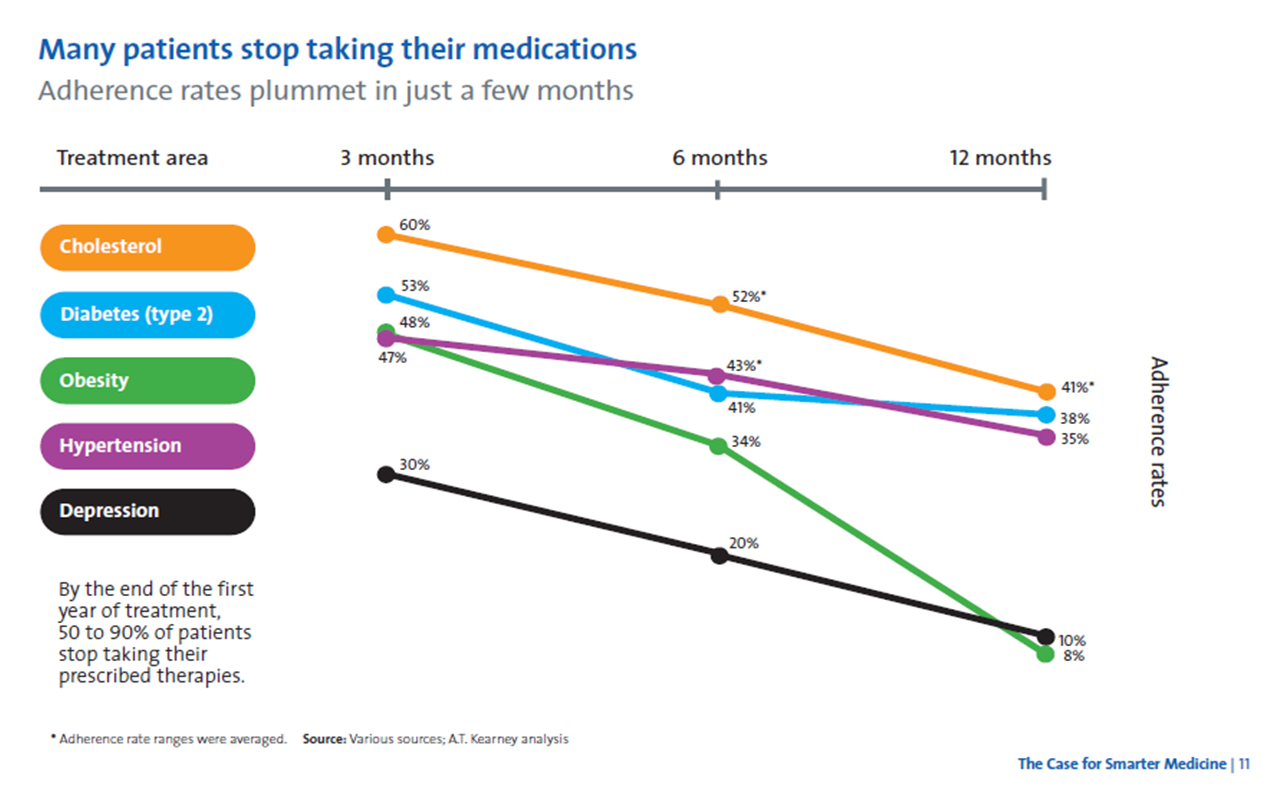
This is a nice simple graphic from a new Medco document that’s out – Case For Smarter Medicine.  We all know adherence is an issue especially in the first 3 months (for those that ever fill even their drugs one time), but this gives us a good picture of how it drops off over the first 12 months. 

The Best Healthcare Conference

In today’s budget conscious economy, people are constantly evaluating where to spend their time and money from a conference perspective.  Some conferences are good networking events.  Some of requirements to work in an industry.  Some are educational.  Some give you new ideas on how to run your business.  Some are in great fun locations with fun events.  Very few fit all of those.

I think our Silverlink Communications client event called RESULTS2010 does all of those.  [Hint – the conference is called RESULTS since that’s what we focus on with our customers.]  It takes on all the key issues we see in the market.  It brings in industry experts and clients to talk about what they are doing to address these issues.  Those problems are framed out by our industry experts that have line experience with these roles.  [Our leadership team comes from places such as Express Scripts, CVS Caremark, Gorman, and HCSC and our team includes people from McKesson, Humana, United Healthcare, IMS, DigitasHealth, Medco, and WebMD.  I challenge anyone to find a more knowledgeable vendor team.]  It gives people a chance to network and talk to their peers.  And, there’s some fun mixed in there.

This year’s event is focused on THE HEALTH CONSUMER.  I’m pretty sure it’s the only conference focused on communicating with consumers in healthcare.  The objective is to provide clients with ideas about how to educate, support, and motivate consumers to take actions which support health outcomes. 

Honestly, it was the original event that convinced me to come to Silverlink.  I was a consultant at my first event working with the company.  I met 75 users who were passionate about the company and had great first hand experience using the technology to make a difference in their companies.  I was able to ask them about the competition and understand why they choose Silverlink for their member communication partner.

So, what does this year’s event have in store:

  1. An amazing list of external speakers including Mark McClellan, David Wennberg, Don Kemper, Jack Mahoney, and Janice Young.
  2. A long list of client case studies – 14 so far.
  3. Specific tracks to cover our different client groups and allow for smaller discussion versus formal presentations – Pharmacy, Population Health, Medicare, and Managed Care.
  4. Industy experts on key topics such as consumer engagement, use of data in healthcare, consumer data, behavior change models and incentives, pharmacy economics, pharmacogenomics, medicare market dynamics, and the evolving retail healthcare model.
  5. Adherence experts such as Dr. Will Shrank from Harvard and Valerie Fleishman who led the NEHI adherence study that is widely quoted.
  6. Several fun events including golf, morning runs, and a few special sports related surprises.

There are several more speakers who you would know and I’m very excited to have come and speak…BUT, I want to leave something inside the package for you to want to rip it open and learn more.

How much does it cost?  Nothing (as long as you’re a Silverlink client).

Where is it?  Boston (a great city).

How do I learn more?  Well…if you work for a large managed care company, a population health company, or a pharmacy / PBM, you may already be a client.  We have over 80 clients today.  So, if you’re not on our invite list, think you might be a client, and want to learn more, let me know.  I’m at gvanantwerp at silverlink dot com.  [spelling it out avoids spam]

This year’s event is in late May so I hope to see many of you there!

The Adherence Estimator by Merck

Merck did research that was published last year showing that their 3-question Adherence Estimator (TM) was 86% accurate in identifying patients at risk for nonadherence.  Pretty impressive. 

A copy of the questions are below and were on the Tuft’s website which also shows the scoring mechanism.  This is something patients can take to determine their risk or plans, PBMs, pharmacies, MDs, disease management companies, or others could use. 

Ingrid Lindberg, Chief Experience Officer, Cigna

This was definitely my favorite and most interesting presentation and discussion from the World Health Care Congress in DCIngrid presented and subsequently spent some time talking with me.  She has what I would consider one of the coolest jobs – transforming a large company to be consumer centric and radically changing the way they think, speak, and act. 

From her presentation, here were a few notes:

  • There are 337 languages spoken in the US today. (health literacy issue?)
  • Only 23% of people understand what their health insurance policy means.
  • Most patients appear to be unaware of their lack of understanding in physician instructions and are inappropriately confident.
  • 35% of consumers spend less than 30 minutes reading their health benefit information.
  • Only 7% of people trust their insurer.
  • Trust translates to loyalty and satisfaction.
  • It’s a mix of quantitative and qualitative research.
  • They spent time monitoring sites like – www.pissedconsumer.com.  (do you?)
  • Their senior staff has to spend time listening to member calls each week.
  • They spent lots of time on ethographic research and identified 6 personas that they use for defining products – Busy Mom, Skeptic, CareGiver, Controller, Athlete, and Bargain Shopper.
  • They identified the #1 dissatisfier was language.  Plans talk to them in a language they don’t understand.  (For example, consumers think of providers as the insurer not a physician.)
  • Consumers didn’t want to be called members since it’s not a health club.  They didn’t want anyone other than their physician to call them patient.  They’ve elected to go with “customer”.
  • She talked a lot about how they’ve changed their EOB (explanation of benefits) and their plan overview to address things like what’s not covered.  She talked about how customers think of the EOB as the “this is not a bill form”.
  • They identified 10,000 separate letters that could go out to a customer.  They’ve re-written 9,000 of them. 
  • She talked about changing their call centers to 24/7 and the fact that they’ve now taken their 1M call in what used to be considered “after hours”.
  • She talked about re-designing their IVR to offer you a self-service option (press 1) or a talk to agent option.
  • She talked about their website and YouTube channel – www.ItsTimeToFeelBetter.com.
  • She talked about their understanding level being around 70% while the industry average is around 15% [of communications sent out].
  • This was in a 15 minute presentation and summarized only 2 years of work. 
  • She also shared some metrics that they use and improvements such as a 8 point improvement in one year of “values me as a customer”. 

And, they’ve shared some of this information in their press kit.  There is also an IBM white paper about some of the technology they’ve implemented.

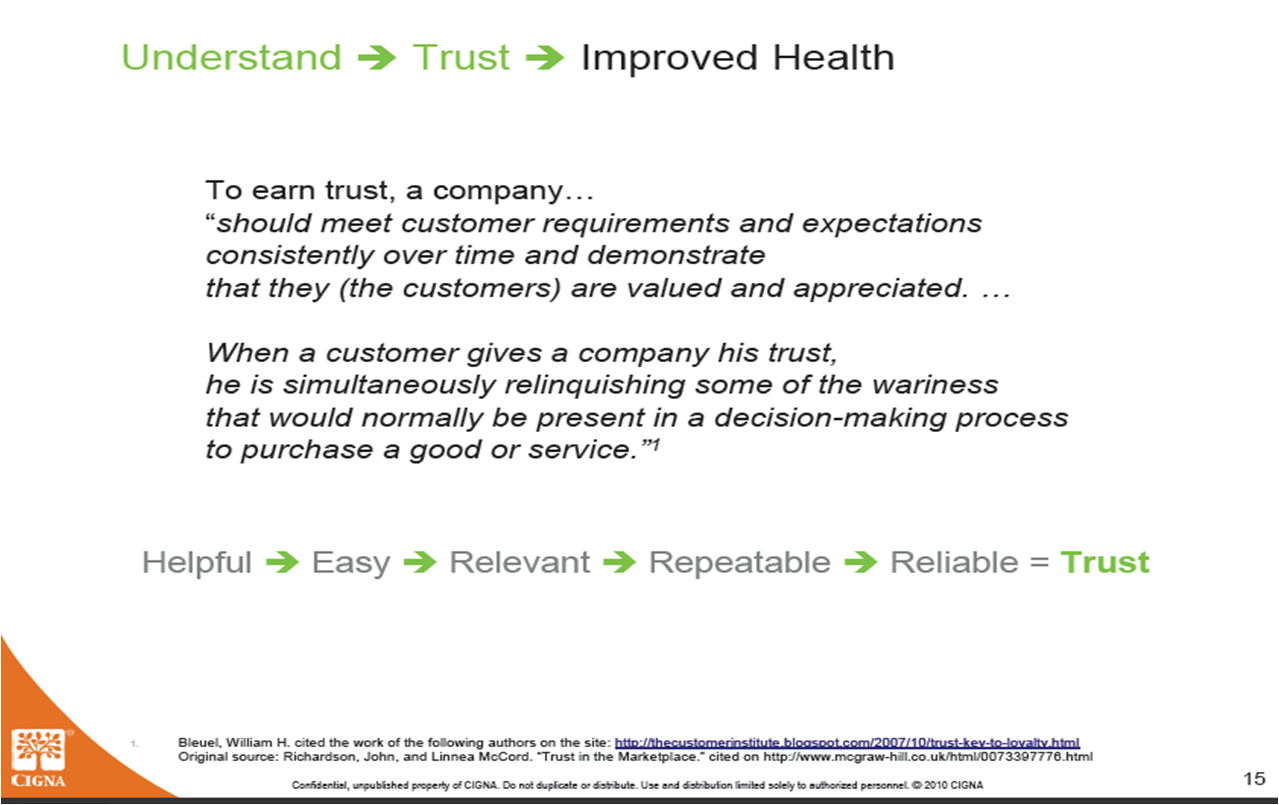
I think the following slide from her deck sums it up well.

Then I sat down with Ingrid to talk with her.  I had a thousand questions which I limited to about 10.  This is a topic I love and is why I love what I do – work with companies to help them develop consumer communication strategies and implement those strategies to improve the consumer experience and drive better health outcomes

  1. How long did it take?  This is about a 3-5 year effort which is complicated by the fact that people in these types of roles typically only last about 28 months.
  2. Did you do it all internally?  No.  They worked with Peppers & Rogers on a Touchpoint Map and used an IBM tool called Moment of Truth.  They also worked with IBM on a new desktop solution.  BUT, she was quick to talk about the fact that those were enablers while the majority of work had to be done by internal change agents since this is a cultural change.  She said that now almost 80% of Cigna people are using their recommended language and are aware of the changes made by her group.
  3. Why haven’t others followed?  It’s hard work. 
  4. How do you deal with consumer preferences?  This is one of my favorite topics to debate.  Should you offer consumers options on how you communicate even if you know that they might not pick one that is the most effective.  For example, I might say to send me an e-mail, but they get lost, they can’t contain PHI, etc.  She said that you have to ask but you have to navigate the path.  She seemed to agree with me that there are some communications where you want to ask (e.g., order status at mail) and others where you want the right to contact them (e.g., drug-drug interaction).  She talked about the fact that it’s all in the framing (e.g., if we have a message for you that could affect your safety, is it okay if we ignore your do not call request?).
  5. Are you changing Cigna’s physician communications also?  Yes.  The changes have become the “language of Cigna”.  Physicians are people, and they are also trying to educate physicians on what they’ve learned about how to communicate with customers.  She mentioned that the most difficult groups to change were the people that were knee deep in this healthcare language – internal people and consultants. 
  6. Based on my discussion with Andy Webber, I asked her if she thought that today’s fragmented environment would allow for a coordinated consumer experience.  She agreed that it’s difficult and that the consumer sees everything as their benefit.  They don’t see the piecemeal parts.  She mentioned that one of their clients had held a “vendor fair” to kickoff the plan year where she presented their learnings and all the vendors were told to use them immediately.  [Maybe that’s part of the solution.]

We then bounced around on a couple of interesting topics:

  • We talked about the fact that lots of companies are hiring non-healthcare people to help them better understand the consumer.  These include consultants, database people, marketing people, and innovators.  My personal opinion is that you need people that have worked in or around healthcare AND outside healthcare.  They also need to have consulting and line management experience.
  • She talked about their war room (she used another term) where they had a current state and future state (of patient experience) and showed all the 10,000 current communications as a waterfall. 
  • We talked a little about some of the things we’d done at Express Scripts when I was there including changing the way we referred to members at the call center to patients and the impact that had. 
  • I shared with her that our biggest difficulty was making web changes at Express Scripts which I thought would be the easiest to do.  She shared that changes on the web were one area where they were lagging and is difficult. 
  • She talked about trying to get innovation from customers by understanding what they want and giving it to them.

New And Easier Version of Medicare.gov

Got this from CMS…(looks better to me, but it’s been a while since I was there)

Today, the Centers for Medicare & Medicaid Services posted a new and easier to use version of www.medicare.gov, the Medicare consumer-focused Web site.  The updated Web site is part of the steps Medicare is taking to make using www.medicare.gov easier for seniors and people who care for them to find the information they need about Medicare. The improved Web site provides users with a summary of Medicare benefits, coverage options, rights and protections, and answers to the most frequently asked questions about Medicare.

The updated Web site reflects Web 2.0 design principles and concepts.  The new design was focus tested with seniors, caregivers and operators at Medicare’s helpline, 1-800-MEDICARE, some of the most frequent users of www.medicare.gov.  The new design gives Medicare more flexibility to quickly update information that is important to users, especially people with Medicare and family members who care for them. 

Take a tour of the new online face of Medicare by clicking on www.medicare.gov.

Why Are Copay Waivers So Popular?

It seems like whenever I talk to companies about adherence one of first things they want to discuss is copay relief.  It’s a solution I’ve used before so it’s certainly rationale.  But, let’s not forget that cost is not the primary reason for non-adherence.  Forgetfulness and lack of health literacy are often big drivers of non-adherence with medications.  This is easily validated when comparing lift in medication possession ratio (or more tactically refill rate) by looking at copay waiver type program (value-based design) versus communication programs.

Given that copay waivers often require $10+ per month and other programs can be conducted for much less, I question the ROI.  I’d love to see a head-to-head test.  Try education and refill reminders versus copay waivers to see which yielded a greater MPR improvement.

Voice Personality Is A Powerful Lever To Motivate Health Behavior

This article appeared in HealthLeaders (3/3/10) by two of my co-workers based on some very interesting work they’ve been doing.  

It’s not what you say, but how you say it that matters. The “how” includes a number of specific voice attributes, such as inflection, rate of speech, and intonation—all of which contribute to an overall perceived “voice personality.” 

Voice is a powerful lever in the ability to effectively communicate your message to ultimately motivate behavior. Would you be more apt to trust the voice of James Earl Jones or the voice of your local car dealer? How do you perceive these voices overall? Which voice personality most effectively delivers a message? The answers, of course, depend on the listener, what is being communicated, and the behavior you’re trying to motivate. 

In healthcare, individuals are educated and supported in the decisions they make about their health through communications. This article highlights a recent study of the impact of voice in healthcare communications and how individuals perceive voice as it relates to health messaging. 

Specifically, this research analyzes voice selection for interactive automated calls, an effective outreach channel widely used in healthcare to reach and motivate individuals. 

Subjectivity in Voice Selection
If you put a small group of people in a room and ask them to describe the voice they hear, the answers will be wildly different: “This voice sounds too perky.” “That one sounds robotic.” “This voice sounds friendly and cheerful.” Reaching a final conclusion about which voice is “best” often is a highly subjective process. 

While we don’t consciously listen to an individual’s voice attributes, we do subconsciously assess the voice’s characteristics and create inferences about the speaker. Over the telephone or on the radio, when voice is the focus, we paint a picture of how someone looks, what kind of person they are, their age, gender, and generally whether or not you trust them. 

We’re sometimes surprised in the end at how different the person is when we meet him or her face-to-face. By itself, voice impacts our perceptions, which affect how well we understand a particular message. 

In healthcare, it is a common belief that people prefer a female voice when receiving messages about their health. Perhaps this is because female voices are perceived as more nurturing and caring; and women are often the caregivers in the home. 

But is a female voice equally effective when communicating to all people, of every age, in every region, and for every type of health related behavior? For instance, is a female voice as effective for people of poor health status hearing a message about an important health screening? What about seniors hearing a reminder to take their cholesterol-lowering medications? 

Voice Research
To answer these questions, we created a framework to map specific voice attributes with voice personality. We conducted an attitudinal study to learn how people of different age, gender, and region perceive and respond to different voices. We surveyed 3,000 people across the country, in a statistically representative sample of the commercially insured U.S. population. 

Participants heard the same short informational wellness message spoken by several different voices representing a variety of ages, gender, and unique voice characteristics. Survey responders were asked to provide their opinions on the following: 

  • Is the voice perceived negatively or positively overall?
  • Which attributes do people generally use to describe a particular voice? (e.g., rate, volume, and age)
  • Is the voice perceived as introverted, extroverted, formal, or conversational?
  • Is the voice perceived as coming from someone who is more caring and sincere, or someone who is trying to sell something?
  • Do people believe and trust the voice?

The survey results provide a powerful depiction of how different voices are perceived by different segments of a population. 

What’s in a Voice?
High trust and care/sincerity ratings are important factors when trying to motivate healthcare behaviors. Medication adherence, for example, is associated with the quality of relationship between the patient and the physician. When people trust the voice they hear, and feel that the person speaking to them is sincere, they are more likely to change their behavior. 

There are many interesting attitudinal findings from our study including: 

  • Both men and women across all age groups preferred a male voice to a female voice overall.
  • Voices described as fast paced, young, highly extroverted, perky, and animated rated poorly in the trustworthy and caring categories.
  • Voices described as moderately paced, middle-aged, and well-spoken/educated, were rated most trustworthy and caring.
  • Seniors (those 65+ years old) aren’t as sensitive to voice age as other groups and don’t perceive older voices as necessarily older sounding. By contrast, younger groups perceive “older” voices more negatively.
  • Seniors aren’t as sensitive to the rate of speech as younger populations; therefore, slowing the pace may not be as impactful as was once thought for older populations.
  • Younger people (18- to 34-year-olds) are significantly more sensitive to voice age and rate of speech, which means very careful selection of voices for young audiences is important to drive behavior.,/li>
  • Young people showed stronger opinions overall between men and women when rating the voice gender they prefer. In other age groups, there is general agreement on voice gender preferences. Gender selection is therefore a more important factor for the 18-to-34-year-old age group.

The use of voice to motivate health decisions
The results of this study provide us insight into how people of varying gender, age, region, and health status perceive the voices they hear. Our goal is to validate how specific voices can be used as a lever to change behavior. 

Voice, like other communications levers, such as messages and timing, can be selected based on the demographics, purpose, tone, and intent of communication, as well as how voice supports brand identity. By validating attitudinal voice responses against behavioral activity, voice can ultimately become a measurable behavioral best practice in healthcare communications. 

While the bulk of our experience supports the conventional wisdom that a woman’s voice is more effective for healthcare communications, our voice research suggests that there are opportunities to use a male voice to measurably move health behavior. A recent outreach program to educate individuals about the importance of colorectal cancer screenings supports our attitudinal research. 

The outreach asked if the individual had received a screening during the past two years, and if they planned to schedule a consultation with their doctor. The same message was delivered by a male and a female voice. All population segments, including men, women, Caucasians, Hispanics, and Asians, answered the survey at a higher rate when a male voice was used versus when a female voice was used. 

Conclusion
By applying science and measurement, we can determine the voice qualities that are the most impactful for a specific health behavior and for a group of people. There are measurable patterns in overall voice preference. Communications programs aimed at driving individual behavior should include voice analysis. 

By measuring and understanding perceived voice personality, our research sheds light on an objective way to effectively apply voice in healthcare communications to ultimately impacts behavior change. 


Jack Newsom, ScD, is vice president of analytics at Silverlink Communications, and Ryan Robbins is voice production manager at Silverlink Communications.

Addressing Hospital Readmission Rates

High hospital readmission rates are a real source of concern for health plans, from both a quality and cost perspective. With 20% of Medicare patients being readmitted within 30 days of discharge, health plans and their partners have a significant opportunity to reduce readmission rates across all populations. Even just a half-point drop in readmissions for a Medicare plan with 1 million members can yield $10 to $15 million in annual medical cost savings.

In a new podcast, Dr. Jan Berger, Silverlink’s Chief Medical Officer, discusses how health plans can address this costly, growing issue affecting our healthcare system. Dr. Berger offers best practices for reducing readmissions such as:
• Expanding outreach to entire discharged population
• Reaching out within 24-72 hours of discharge
• Coordinating communications among members, physicians and care managers
• Identifying members at risk for readmissions

Download this podcast and visit our new Post Hospital Discharge Microsite to access other valuable resources on this important healthcare topic.

50,000 Adults Die Each Year Of Vaccine Preventable Diseases

Diseases easily preventable by adult vaccines kill more Americans each year than car wrecks, breast cancer, or AIDS.

I found this article from WebMD to be both interesting and surprising.  According to the article, the diseases are flu, Hepatitis B, pneumococca, meningitis, shingles, human papillomavirus, tetanus, and whooping cough.

According to the CDC survey:

  • Pneumococcal vaccine is used by 25% of Americans at high risk of severe illness and by 60% of Americans aged 65 and older.
  • Hepatitis B vaccinations were completed by 32% of high-risk U.S. adults under age 50 and for 34% of non-high-risk adults under age 50.
  • HPV vaccinations have been given to only 10.5% of American women 19-26 — and only 6% got all three shots.
  • Tetanus shots are current for only 60% of U.S. adults under age 65 and only 52% for older adults.
  • Flu shots are taken by fewer than two-thirds of adults at high risk of severe flu complications.
  • Shingles vaccines are taken by only 7% of U.S. adults 60 and older. 
  • So, that begs the question of whether consumers should be responsible for costs if they don’t take preventative measures.  I’m sure there are lots of reasons why they shouldn’t be, but let’s assume that the cost of vaccines were covered AND that their healthplan communicated to them the need to go get vaccinated.  In that case, if someone doesn’t get vaccinated, becomes sick, and causes thousands of dollars in cost to be incurred (which all of us pay for), is that ok?

    I have no problem bearing costs for people who are uninsured and support universal coverage.  I have no issue paying more if I can’t control my weight or chose to make bad decisions.  I see healthcare as covering things that I can’t prevent – accidents, genomics, etc.

    Letter From HHS to Anthem RE Rate Increases

    This was sent today (and then released to the public).

    February 8, 2010

    Leslie Margolin

    President, Anthem Blue Cross

    Delivered Via Fax

    Dear Ms. Margolin,

    One of the biggest pressures facing families, businesses and governments at every level are skyrocketing health insurance costs.  With so many families already affected by rising costs, I was very disturbed to learn through media accounts that Anthem Blue Cross plans to raise premiums for its California customers by as much as 39 percent. These extraordinary increases are up to 15 times faster than inflation and threaten to make health care unaffordable for hundreds of thousands of Californians, many of whom are already struggling to make ends meet in a difficult economy.

    Your company’s strong financial position makes these rate increases even more difficult to understand. As you know, your parent company,WellPoint Incorporated, has seen its profits soar, earning $2.7 billion in the last quarter of 2009 alone.

    I believe Anthem Blue Cross has a responsibility to provide a detailed justification for these rate increases to the public. Additionally, you should make public information on the percent of your individual market premiums that is used for medical care versus the percent that is used for administrative costs.  Policy holders in the individual market deserve to know if their premium increases would be invested in better medical care or insurance company overhead costs like salaries, profits, and advertising. I am aware that the State of California is investigating this matter, and urge Anthem Blue Cross to cooperate fully. In the meantime, I will be closely monitoring the situation.

    At a time when health care costs are a critical threat to families as well as the nation’s economy, I hope you appreciate the urgent nature of this request. I look forward to your prompt reply.

    Sincerely,

    Kathleen Sebelius

    Secretary of Health and Human Services

    Prime Therapeutics Drug Trend Report 2009

    It’s been a while since I did all my analysis on the drug trend reports last year. It’s almost time for some of them to start coming out again. Prime Therapeutics typically publishes their document at the end of the season (see press release). (see my review of their 2006 trend report)

    In general, I liked the report. It was an easy read and something that I think anyone could pick up and understand.

    General Notes:

    • Prime is owned by 11 Blues plans and partners with 5 additional plans.
      • $8.3B in drug spend under management.
      • 27% annual membership growth
      • 94% member satisfaction
    • Prime’s drug trend (PMPM cost) decreased by 0.5% in 2008. (Specialty trend was only 0.9%.) This is their 6th year of single-digit trend which is great. [I really want to dig in and know why – population, drug mix, plan design.]
    • Their generic fill rate was 63.7% (in December 2008). [This seems low…CVS Caremark’s for the same period was 66.3%.]
      • Some of this is plan design, but I think their average age is lower than other PBMs which would drive a lower GFR with higher acute drug use…which is more likely to be generic. [I’m speculating on age, but they share that their average age is 33 which seems low.]
    • 1.1% of their total Rxs were specialty drugs.
      • Neither here nor there, but they are the first company I’ve seen to show ingredient costs per day for specialty. (It was $75 vs. $2.50 for traditional drugs.) Most show costs as a 30-day supply.
    • Their average costs per Rx were $61.87.
      • Brand = $132.65
      • Generic = $19.20
    • Their Rxs PMPY remained flat at 11.5 which still seems low to me. [They state that the average number of retail Rxs per capita was 12.6…does that mean it’s actually higher once you add in the mail Rxs and adjust for days supply?]
    • Their average member cost share was 26.4%.
      • 27.2% for brands
      • 40.1% for generics
      • 5.0% for specialty
    • For Medicare, the utilization is much higher at 47.9 claims PMPY.
    • Their average age was 33.3 (commercial) and 72.7 (Medicare).
    • The GFR for their Medicare business went up 8.7 percentage points to 71.3% which is a huge jump.
    • I like how they break traditional drugs into two buckets – Spectrum (not my favorite name) and Focus. This allows them to show different strategies on these two (vs. specialty).
      • Focus are drugs for high blood pressure, high cholesterol, diabetes, respiratory disorders, and depression.
    • They say they have a GFR of 34.9% in specialty. [This seems incredible. I didn’t realize there was that much generic opportunity but maybe I’m outdated here.]
    • They show a chart on page 30 around generic fill rate which seemed strange to me. It shows the best in class sometimes exceeding what they consider the theoretical maximum. I think I understand why, but I’d have to challenge whoever came up with the theoretical maximum if I already have clients exceeding it.
    • They have a Generics Plus drug list which I imagine is a lot like the High Performance Formulary which we had at Express Scripts and was part of my GenericsWork solution that I launched when I was there.
    • They are the first PBM that I’ve seen recommend a $5 generic copay to try and avoid prescriptions being processed for cash and losing those claims for DUR purposes. I think this is great.
    • I was surprised to find out they have a generic drug alert program. [A program telling me the drug that I’m on is now available as a generic.] They might be the only PBM I know with this. From a consumer perspective, I think this is great. From a business perspective, I know that almost all of these people will get switched by their pharmacy to the generic without doing anything so the value of that mailing is pretty limited.
    • I was surprised to see them quote the Harris Interactive study from March 2005 on barriers for refilling medications. I like to see their data to compare.
    • They have a section on value-based plan designs and provide three types of pharmacy solutions – drug-based, behavior-based, or risk-based. Sticking with their focus on risky patients, they recommend a risk-based model. I like this concept although I’m more of a behavior based advocate myself. They other question I have is can you offer lower copays for people at risk without having any type of “equity” issue with the other employees within the same plan?
    • They have an Adherence Report which conceptually I like although it only goes out every 6 months. There is research out there that says intervening after a 14-day gap-in-care (i.e., lack of adherence) is important to get people back to therapy.
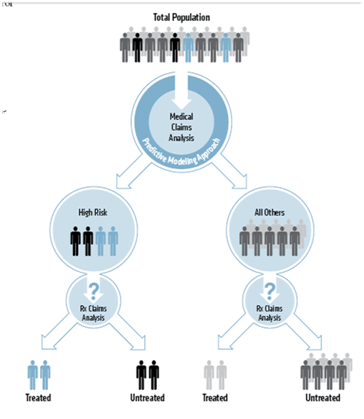
    • One of my favorite images that they’ve been using for a few years is the one below. It shows using a predictive model to focus on at-risk members and allows you to especially focus on those that are at risk based on medical data, but have no Rx claims. (Something they can do with the ownership by the Blues and access to medical data.) [They say these people are zero percent adherent which is a term I’ve never heard anyone use before.]

    Key Research Points:

    • For high risk patients (survived a heart attack or show signs of heart disease), one heart attack can be prevented for every 16-23 members who regularly take cholesterol lowering medication.
      • 3.2% membership is high risk and not on a cholesterol medication.
      • Patients who receive a targeted outreach are 3x more likely to begin therapy
    • Every one percent increase in GFR (generic fill rate) has the potential to reduce pharmacy expenses by 1-2%. [Walgreens also used 2% in their drug trend last year which is higher than what I’d seen before.]
    • They talk about increasing generic usage as likely to increase member’s adherence. [I think Dr. Will Shrank has shown in some of his research that those that start on generics are more likely to be adherent.]
    • I’d love more detail on the case study on page 9 so maybe I’ll have to read the references…BUT what it says is significant:
      • By getting 5,000 high risk members with high blood pressure to be compliant with a statin for 1 year, they saved $2.1M in potential medical costs.
        • Avoided – 44 heart attacks, 5 strokes, 20 heart failure hospitalizations, and 8 kidney failure hospitalizations requiring dialysis
    • There are currently 183 medications in development to treat diabetes and related conditions.
    • Patients with type 2 diabetes are 2.5x more likely to be hospitalized if they do not adhere to their medication therapy.
    • Those who report being non-adherent to their cardiovascular medications have a greater than two times the likelihood of having a heart attack, stroke, or other cardiovascular event.
    • For every heart attack avoided thru proper use of high blood pressure or cholesterol medication, a plan sponsor could save approximately $30,000.
    • Drugs for MS (multiple sclerosis) patients have a monthly cost of $2,200 (wholesale). 1 in 5 members with an out-of-pocket cost > than $250 declined to fill and they were 7x more likely to decline than members with costs of <$100.

    Potentially Conflicting Statements: (you have to read these things closely to find this stuff)

    • On pg. 21, they recommend a $10 copay for generics, but on pg 32, they say adherence is best when your generic copay is less than $10. Maybe two different questions, but seems inconsistent.
    • On pg 32, at one point they say that every $10 difference in Tier 2 copayments leads to a 2.3% higher GFR and in another point, they say a 2-3%. [I might be missing something here since the two are worded slightly different.]
    • On pg 35, they say that step therapy encourages members to use a generic alternative before a “second line, usually more costly brand medication.” I think this is meant to imply that it’s usually a brand drug versus it’s usually more costly. But, then on pg 46, they say before a “more costly medication”. It’s possible to have a generic as step one (or an OTC) than a more expensive generic as a step two, but I don’t think that’s very common. [For you clinicians, think H2 before generic PPI before brand PPI from a few years ago.]

    Will Paying You To Be Adherent Work?

    United Healthcare is launching a new program (Refill and Save) that is a different spin on the value-based designs we’ve typically seen. In a lot of value-based healthcare programs, companies lower copayments (or waive copayments) for patients in certain conditions to drive up adherence. This has been shown to work and improve results by about 10% which is great. [Although less than some of the adherence programs we’ve done at Silverlink.]

    In this case, United is paying patients $20 for every refill they fill for certain medications starting with asthma and depression. I’m very interested to see the results. There continues to be no silver bullet for adherence which is a problem which drives $290B in cost per year and results in 100,000 deaths.

    “Patients with chronic diseases such as asthma and depression who take their medicines regularly and who comply with prescribed treatments are likely to stay healthier. They not only feel better, they can potentially avoid costly medical problems that could result from delaying appropriate therapy,” said Tim Heady, CEO of UnitedHealth Pharmaceutical Solutions

    Interview with Cyndy Nayer from the Center for Health Value Innovation

    I had a chance yesterday to sit down and talk with Cyndy Nayer (President, CEO, and co-founder) from the Center For Health Value Innovation. For some of you, this is a new buzzword for others it has been around a while. I remember back in the early 2000s when stories of Pitney Bowes kept popping up and then working with a few of our clients (like Marriott) when I was at Express Scripts on what were being called “value-based designs”. [I even had an offer to go to ActiveHealth (now part of Aetna) and work on their Value Based offerings several years ago.]

    And, it’s a small world. Several people from my past are involved: (1) Peter Hayes was a client at Express Scripts and (2) Roy Lamphier played soccer with me in high school.

    What is the Center For Health Value Innovation?

    The center is an “information exchange” for value based design which as she points out is much more than just a prescription benefit and not simply giving people free drugs to make them more compliant. [If only it were that easy!]

    What do you mean by Information Exchange?

    A place where people can share stories, trends, info, and research. They see their job as getting information out there and providing support around modeling, analysis, and identifying gaps. [And, I know they do a lot of education as you can see Cyndy at many conferences.] She talked about educating the marketplace on an “actionable format” for implementing value-based design.

    Can you describe Value Based Design?

    Value Based Design is a suite of insurance design, incentives, and disincentives that support prevention and wellness, chronic care management, and care delivery. It is focused on linking stakeholders across the care continuum and developing structures like outcomes-based contracting where all stakeholders benefit from better health outcomes.

    She mentioned that in an upcoming edition of the Journal of Benefits and Compensation that there will be a paper that builds on some adherence concepts to discuss the 5 Cs of Value Based Design: [Noting that the first 3 come from some work from Merck.]

    • Commitment
    • Concern
    • Cost
    • Communication
    • Community

    We talked about the need for communications to be multi-directional and include the patient, the physician, the pharmacy, and other caregivers. We talked about community needing to expand on that to include family, the employer, and other entities. [As we all know, health care is local and value based design is no different.]

    We spent a little time here talking about community, and the need for this to happen at a community level. [Much like e-prescribing and other things have found out that localized momentum is important.] One question in my mind is who is the catalyst – the hospitals, the physicians, the local managed care companies, employers, grocery stores, wellness companies, pharmacies.

    We talked about the fact that this isn’t the same as Accountable Care Organizations, but like that concept, this has to be developed as part of the fabric of the community not imposed on the community.

    Being from Detroit, I asked if this was a model for them to help develop around. That is an area of focus and there has been some work done in the Battle Creek, Michigan area.

    Why are employers so interested in Value Based Design?

    Originally, employers were interested since it was something new, but the recession forced them to look at this more seriously. But, this is a long-term process and something which they benefit from. Better health lowers absenteeism, and businesses need health communities and healthy workers for growth.

    Why don’t companies implement Value Based Design programs?

    Companies don’t implement them because they’re not prepared for the amount of work needed to get started and it’s not a cheap fix. [If you want to save money, just drop the benefits…not that anyone really advocates that.] We talked about that lots of people react to the urban legends of just giving out free drugs [which isn’t Value Based Design] which would be easy. Companies need to realize there is work to be done to communicate this, design it, and manage the implementation across the community. BUT, once it’s installed, it’s completely sustainable.

    Is there a certification (i.e., URAC) for value-based design?

    She told me that nothing exists today and that it would be hard to do. Today, there isn’t alignment in the marketplace around incentives and a standard model. They spend a lot of time working with different groups to drive education and training to link health and productivity measurement with value and functional performance.

    What’s next for 2010?

    In 2010, they will be bringing much more information forward on how to support and extend the work done in the 1st book (Leveraging Health…which Dr. Jan Berger, Silverlink’s Chief Medical Officer co-authored with the Center) and the decision matrix that they recently published. They will continue to serve more as a guide helping interested parties in private, invitation only events to design solutions and then bring those solutions to market.

    How does someone learn more about Value Based Design?

    The simple answer is to go to the Center For Health Value Innovation website. They have a whole library of information there.

    CxPi Scores For Healthcare Companies

    CxPi is the Customer Experience Index from Forrester. 

    The CxPi is based on consumer evaluations during November 2009 across three areas: 1) meeting needs; 2) being easy to work with; and 3) enjoyability.

    As expected, pure healthcare companies fall towards the bottom here, but some of the retail pharmacies are much higher up.

    There weren’t a lot of excellent scores in the survey, and I’m sure we can all debate where the companies fall.  But, I think the point that healthcare clusters at the bottom (and has since the beginning) is a problem.  How do we improve that consumer experience?

    Why Didn’t I Know There Was A Generic Version

    I got this question e-mailed to me today.  The patient has been using the same drug for years and it lost it’s patent about 6 months ago.  They just found out that they could have saved a lot of money and wondered who should have told them.  Here’s my thoughts.

    1. It’s the member’s responsibility ultimately to search for ways to save money and ask for generics.
    2. A lot of managed care companies and PBMs won’t reach out when patents expire because 90% of the time the drug is switched to the generic within 90-days by the pharmacy.
    3. The key players who would communicate are aligned – the pharmacy / PBM makes more money when generics are used and the managed care plan saves more money.
    4. BUT, sometimes managed care plans or individual employers (groups) will opt-out or never sign up for communication programs so their members don’t hear about ways to save money.
    5. BUT, sometimes consumers opt-out of communications from the PBM or managed care company and therefore miss out on opportunities.
    6. BUT, sometimes physicians won’t allow the prescription to be switched to the generic drug (even when chemically equivalent) and will write the prescription DAW (Dispense As Written) or say no substitution allowed.
    7. BUT, there have been a few instances when due to exclusivity on the generic that it actually costs more than the brand during the initial 6-months and people don’t move to the generic.

    So, with lots of nuances, my reply was that no one had a legal obligation to tell her, but they all had good incentives to do it.  I suggest talking to the physician and/or the pharmacist.

    FDA “Listed” Drugs – A New Hassle

    As of 1/1/2010, Medicare beneficiares will face a new hassle at the pharmacy.  How big of a deal will this be?  I honestly don’t know.

    But, from their site:

    Starting January 1, 2010, if your pharmacy tries to sell you a version of a drug that isn’tlisted with the FDA, your Medicare drug plan might not pay for it. This means you mightgo to the pharmacy where you regularly get your Medicare-covered prescriptions filled, andif the pharmacy stocks only a version of the drug that isn’t listed (and, therefore, your planwon’t cover), the pharmacy may not be able to fill your prescription that day.

    Since there are multiple manufacturers of a generic medication, multiple forms (capsule, tablet), and sometimes repackagers, this could complicate things for patients simply trying to fill their medications.  I’m not sure I understand what’s being addressed here.

    Blending Social Media and Healthcare

    There is certainly lots of talk in healthcare around incentives.  What incentives will drive people to behave healthier – peer pressure, cash, non-monetary incentives, competitions (e.g., The Biggest Loser), or lower copays and deductibles.

    There is also lots of talk about social media.  There have been lots of studies showing the power of your friends to influence your behavior – smoking, weight loss. 

    Separately, I continue to hear more and more stories about agencies and lawyers using social media to find out about what people are really doing.  For example, my friend’s mom was recently on a jury of someone suing a physician for malpractice.  She claimed she had limited use of her legs.  But, the physician’s lawyer accessed her facebook page and saw her talking about all the stuff she was doing now that she felt better.  Oops.

    Before I paint my future scenario, let me toss out one example that really got me thinking.  Burger King recently created the “Whopper Sacrifice” application for Facebook.  You received a free Whopper if you would delete 10 of your friends from your Facebook account.  23,000 users did it before they took it down.

    So, if people would “sacrifice” their friends for a Whopper, what would people do for a 10% reduction in their premiums [or some siginificant savings on healthcare]?  Could companies get people [and use social media to track it] to spend more time with their thin friends that don’t drink or smoke and regularly exercise and get 8 hours of sleep a night?  Assuming the research is true, this would dramatically reduce costs and make those people healthier. 


    Why Keep Covering PPIs?

    I’m not a clinician so I’m sure there are some clinical exceptions to this general comment.  [For example, look at Aetna’s PPI Medicare information.]

    But, with Prilosec available OTC (Over The Counter) both as a brand product and as a generic (omeprazole) and now Prevacid will also be available OTC, I wonder why PBMs and plan sponsors don’t stop covering this class of drugs.  [See here for CVS Caremark’s overview on this.]

    BTW – PPIs (or Proton Pump Inhibitors) are generally used for acid reflux and some people can simply use other OTCs such as H2 Antagonists (e.g., Tagamet, Pepcid, Zantac).  [Consumers might also read Consumer Reports Best Buy Drugs report on PPIs.]

    Traditionally, PPIs represented one of the higher cost drug categories (and also one of the most highly rebated).  In CVS Caremark’s BOB (book-of-business), it represented 7.3% of their spend according to their TrendsRx 2009 publication.

    Plans have stopped covering NSA (non-sedating antihistamines) once Claritin went OTC.  This seems like the next natural category with perhaps some formulary override option for certain medical exceptions.

    Pharma Couponing

    Using copay coupons in place of real samples is both cost effective and allows pharmaceutical manufacturers to get more patient specific information (since patients typically have to register to get the coupons). They can be short-term or long-term. The primary site to go to is InternetDrugCoupons.com.

    Here’s my slides from the conference call I did the other day. Some of the quotes from the event are in the recent Drug Benefit News (11/13/09).

    Industries That People Trust

    Given all the healthcare debate this year, it will be interesting to see how that influences the annual Harris Interactive poll on industries that people trust.  (They should include government as an industry to see how that stacks up.)

    Let’s look back at the 2008 results to the two key questions (from a healthcare perspective):

    “Which of these industries do you think should be more regulated by government – for example for health, safety or environmental reasons – than they are now?”

    • Pharmaceutical and drug companies – 49%
    • Health insurance companies – 49%
    • Managed care companies – 39%
    • Hospitals – 27%

    “Which of these industries do you think are generally honest and trustworthy – so that you normally believe a statement by a company in that industry?”

    • Hospitals – 31%
    • Pharmaceutical and drug companies – 10%
    • Health insurance companies – 7%
    • Managed care companies – 5%

    It seems strange to me that more people want the drug companies to be more regulated than managed care, but that they trust the drug companies more. 

    I’d also love to know how many of those people had seen Sicko (the Michael Moore movie). 

    I would suspect that 2009 will show a huge spike in regulation around banking and a lack of trust of wall street.

    Consumer Preferences

    The concept of preference-based marketing has been around for a long-time and continues to become a hotter issue especially in healthcare.  The challenge, of course, is balancing what consumers know they want versus what they actually use.  Ask anyone if they want an automated call, and the immediate answer is no.  People think about those annoying “robo-calls” that use text-to-speech (TTS), have a pause when you pick up the phone, and are not personalized at.

    On the flipside, look at the data and outcomes which intelligence, voice-based call systems produce…it’s amazing.  People pick up the phone.  People interact with the technology.  And, the calls are highly personalized.

    But, we are at an interesting crossroads about companies beginning to think thru and capture information about you.  Do you want to be called at home or on your mobile phone?  When is it okay to text you?  What communications should come in print versus e-mail?

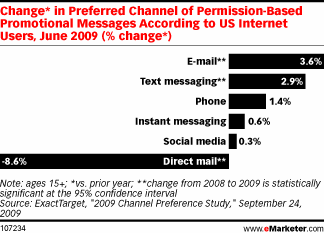
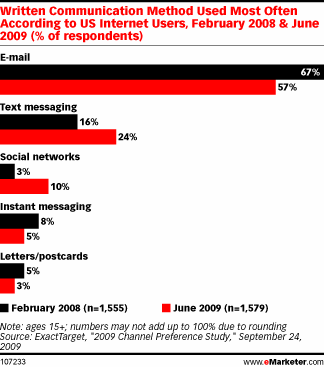
    “Just 32% of marketing decision-makers surveyed in July 2009 said they knew how their customers behaved across channels, and only 37% were aware of consumers’ channel preferences.”  (ExactTarget 2009 Channel Preferences Survey)

    The survey also showed changes in channel choice.

    Change in preferences

    Written format used