Archive | Managed Care RSS feed for this section

What’s In A Voice?

In the most recent copy of AHIP’s Coverage Magazine (JAN+FEB.09), there is a nice feature called “What’s In A Voice?” which talks about Silverlink Communications. You can find the whole article (“Motivating Change“) here, but I pulled out a few quotes:

“When the phone rings, it takes just the right voice to motivate a member to overcome the tendency to put off receiving preventative care.”

“Silverlink calls allow us to communicate with our members in a really personalized way without incurring the costs associated with hiring and training additional customer service representatives.” Linda Lyle, Cariten Healthcare Vice President of Operations

“This mammography campaign contained scripting that allowed the members to respond, [indicating] whether or not they had had a mammogram. We received a large number of ‘yes’ responses that we will pursue for HEDIS improvement, as well as to identify gaps in our data collection. This method of collecting data about our members is unique to telephone outreach. We are anxious to explore our findings.” ” We know how many listened to the message and how many hung up. We know how many people we actually reach.” Michael Bryne, Assistant Director of Quality Management at EmblemHealth.

The article also talks about using non-professional voices such as the Chief Medical Officer or a customer service representative who was really good with members. In one example, Eleanor Sorrentino, the Managing Director of Quality Management at EmblemHealth, talks about getting 50 calls from members thanking her for the automated call which was recorded in her voice.

A few other items talked about include the use of data and reporting which is available real-time to make decisions along with the use of natural sounding voices to drive a conversational experience which leverages internal and professional scripting resources to develop the best content.

Saving Money On Rxs

Are you interested in saving your members money?  There are a lot of things you can do.  Pill splitting is an easy solution with a quick impact.  Using generics and moving to mail order are others.  I am going to do a webinar on this in a few weeks. [March 10th and March 12th at 1:00 ET]

Even if you’re not specifically interested, I think you would be fascinated to see how we use a multi-modal approach to drive behavior.  It is modeled on what PBMs have been doing around mail order conversion for years.

Lots of people talk about multi-modal coordination.  We can and have done it.  Gartner is talking about Business Process Outsourcing (BPO) in healthcare and has mentioned Silverlink in their last two reports as one of the few vendors doing this.

I hope you can join us! REGISTER HERE.

Time To Sell?

There is always debate about captive PBMs (i.e., those owned by a managed care company).  In theory, I have always argued that they should have a leg up.  But, since pharmacy represents only 10% of total healthcare spend, the majority of the strategic focus is typically on the health insurance side of the business.  [BTW – The 3 largest captive PBMs are Wellpoint, Aetna, and Cigna.]

So, if you look at the stock charts below, you can see that while the PBMs (Express Scripts, Medco, and CVS Caremark) have all held up pretty well the managed care stocks (Aetna, Cigna, United Healthcare, Humana, and Wellpoint) have not held up as well.

If I owned a captive PBM, would this be the time for me to consider selling?  I have heard this debate a lot more recently than in recent years.

PBM 5-Year Stock Chart

express-medco-cvs-caremark-5-yearManaged Care 5-Year Stock Chart

wellpoint-cigna-aetna-united-humana-5-year[As I have disclosed before, I do not hold any individual stocks.]

Friends Don’t Let Friends

If they can use this concept for selling DirectTV over cable, why don’t we use this more in healthcare?

It could be…Friends Don’t Let Friends:

  • Pay too much for medication
  • Use brand drugs unnecessarily
  • Use retail for maintenance drugs
  • Call into the call center when the information is on the web
  • Go to the ER when they can call the nurse line
  • Pay too much for individual insurance

Maybe, in today’s economy, it will be time for healthcare companies to look for seriously at referral programs. 

  • Get a friend to come to mail order or the local CVS and get your next prescription copay waived.

Everyone is focused on saving money.  Social networking is all the rage.  People trust their friends.  

Now, I may not want to tell my friends that I am on cholesterol lowering medication so that may change it.  But, certainly people talk about higher level items like shopping for individual insurance.

Personalized Medicine Webinar

I don’t have anything to do with this, but it sounds pretty interesting.  Medco and Regence are talking.  Here is the teaser.  (Click here for more info and registration.)

Personalized medicine is moving rapidly. The FDA in December considered requests to require genetic testing for the colon cancer drugs Vectibix and Erbitux. Approval of such labeling changes could pave the way for a slew of other personalized therapies and diagnostics now waiting in the wings. Stakeholders anticipate significant clinical and financial savings. Recently approved genetic testing for the blood thinner warfarin, for instance, is projected to avoid 85,000 serious bleeding events annually and save roughly $1.1 billion a year!

On the other hand, questions remain whether the model actually provides a favorable return on investment (ROI). A new study finds that genetic testing for warfarin does not appear to be cost-effective in certain patients. And health plans and PBMs are trying to sort out which of the numerous diagnostic tests on the market actually provide clinical utility and improved results. One large health plan, for example, says its costs for diagnostic testing are growing at nearly 20% a year.

So where does all of this leave Rx payers in February 2009?

Ix for Rx Management

Josh Seidman from the Center for Information Therapy today announced on their blog that the center is going to begin focusing on “Ix for Rx Management” that will look at adherence along with other critical issues.  As I talk about all the time, finding the right way to deliver information to people in a way that they can accept it and act upon it is critical.  Given that we use more and more medications, this is a critical area where the center’s leadership can help build awareness of the problems.

“Although awareness certainly is an important precursor, it may be the easiest step in the pathway that takes the average consumer along the road to information consumption, then knowledge accumulation, and ultimately leading to behavior change. We know there’s a large body of research that tells us that, in order to be successful, our Ix initiatives need to “meet people where they are.” More specifically, we need to target the information to the individual’s particular moment in care and tailor it to their particular needs and circumstances.”

The Young Invincibles

“I could have gone to a major university for a year. Instead, I went to the hospital for two days.”

The New York Times had a good article about young people without insurance.  According to the article, there are 13.2M within this group or 29% of the age bracket (which I believe is limited to people in their 20’s).  The article talks about borrowing medications, setting their own bones, and using the Internet to self-diagnose.

“We see people with urinary tract infections taking meds better suited for ear infections or pneumoniaDr. Barbie Gatton explained (ER doctor in NY) “Or they take pain medicine that masks the symptoms. And this allows the underlying problem to get worse and worse.” — the problem is, they haven’t really treated their illness, and they’re breeding resistance.”

My impression is that most people in this age group only act as “invincible” since they can’t afford coverage.  The article does talk about legislation that would allow people to be covered under their parents insurance until they are 29.  That certainly helps some, but it puts a burden on employers that may not be fair.

Seeing Significant Improvements With BPO

Business Process Outsourcing (BPO) or as I will sometimes call it CPO (Communications Process Outsourcing) is something we are definitely seeing a growing demand for in the market.  It blends technology, services, process management, consulting, and analytics.

Both IDC and Gartner have now talked about this in recent reports.

According to Janice Young, IDC program director, Payer IT Strategies, “we expect to see an increasing interest and likely investment in BPO in 2009 and 2010 for healthcare payers. Our recent results from our January 2009 healthcare payer survey of IT spending indicate that 45% of healthcare payers expect BPO investments to increase this year.” These trends are highlighted in IDC‘s U.S. Healthcare Payer 2009 Top 10 Predictions (January 2009).

Gartner research vice president, Joanne Galimi, reported on BPO services within health plans in a recent report entitled Healthcare Insurer Business Process Outsourcing Trends (January 2009). “Although things look gloomy for the larger economy, the potential for BPO to address immediate business pressures and long-term recovery goals for the health plans will be unprecedented,” says Galimi.

When I first came to Silverlink as a consultant in early 2007, this was exactly my vision.  I always talked about the “one throat to choke” model.  When you are in an operations role, it is always so difficult to coordinate modes, vendors, discrete data sources, and ultimately to get a holistic view of the member (or patient).  This is what I wanted to help build and is exactly what we have done.

Fortunately, we are now in a position where we can talk about how this service model has grown and how offering turnkey services for clients has driven results.  I love to focus on outcomes so this is exciting.  Here are a few from the press release we put out this morning:

  • Over a 300% improvement in retail-to-mail conversions for a large pharmacy benefit manager (PBM),
  • 54% increase in participation for a pharmacy program, representing between $150 and $175 per year per prescription in consumer savings,
  • 400% improvement in yield in a COB program, translating to over $20 million in cost savings to a major U.S. health plan, and
  • Up to an 82% increase in transfer rates for population health engagement for disease management, lifestyle management and treatment decision support programs.

Process…The Key to Success

“We get brilliant results from average people managing brilliant processes. We observe that our competitors often get average (or worse) results from brilliant people managing broken processes.”

Sources: “Decoding the DNA of the Toyota Production System,” Steven Spear and Kent Bowen, Harvard Business Review, September-October 1999

I think this is so important especially in times like this when we are all focused on doing more with less. It is critical to understand how your process works; how to apply automation; and how to learn and improve it over time.

I came across a presentation from a webinar I gave back in 2007 on Business Process Management (BPM) which made me think about this. (Some of the vendors in this space include Pega Systems, Lombardi, and Appian.)  It’s also very relevant given Gartner‘s recent report on Business Process Outsourcing (BPO) in the payor space.

“Healthcare insurers should view business process outsourcing as a means to achieve business transformation while minimizing risk. Therefore, using BPO for nondifferentiating business processes is an essential step toward achieving competitive success and business growth.” Joanne Galimi in Healthcare Insurers Business Process Outsourcing Trends (January 23, 2009).

Finding a business partner that can work with you to understand your processes, understand what measures matter, help you improve your approach, and that is willing to take risk based on your success is important.   I always encourage people to not think of companies as vendors but as partners that bring them innovative ideas and help them iterate to improve.  I don’t believe in the big bang theory that I can do it right the first time and never need to change.  That flies in the face of everything that has been observed in different industries.


The Easiest $400+ You Can Save In Healthcare

In today’s economy, we are all looking for ways to save. And, it should be no surprise that pharmacy is the most frequently used benefit since, on average, people get fourteen 30-day prescriptions per year.

That being said, there are still hundreds of dollars that millions of us can save. Let’s take an easy example – Lipitor. Lipitor still has about $8B in sales here in the US. If you assume the monthly cost is $125 per 30-day supply and everyone on the drug filled it 12 times per year (which doesn’t happen but is a topic for another day), that means that each consumer on Lipitor represents $1,500 in revenue to Pfizer per year. Dividing the $8B by $1,500 tells me that there are about 5.3M consumers using Lipitor in the US.

On most formularies (or preferred drug lists), Lipitor is a 3rd tier drug meaning that consumers are paying $40-$50 per month for this drug. Considering the fact that Lipitor has a generic alternative which is called simvastatin (aka generic Zocor), consumers can often talk to their physician and use this drug as a lower cost alternative. Additionally, both of these drugs are maintenance drugs that can be filled at mail order which often represents a 30% savings to a consumer (based on average plan designs). And, finally, simvastatin is a drug which can be split according to many different companies.

Here is the math, but a consumer on Lipitor could talk to their physician to get started on simvastatin, split the pills, and after a few months move to mail. That would save them $400+ in many cases.

  • Assuming Lipitor is a 3rd tier drug with a $40-$50 monthly copay and the consumer fills the drug every month for a year, they would spend $480-$600 out-of-pocket.
  • Assuming they moved to simvastatin (with their MD’s approval) with a $10 copay, they would immediately drop their costs to $120.
  • Assuming they split their pills (i.e., got a higher dose of the medication and used a pill splitter to use ½ the pill each day), they would typically reduce their copays by 50% or drop their costs to $60 a year.
  • And, if they then moved the prescription to mail where they reduced a 90-day supply for the same price as a 60-day supply at retail, they would drop their out-of-pocket costs to $40 a year.

I don’t know about you, but that seems pretty easy. It’s clinically appropriate for most patients. The PBMs will typically help you with these programs by reaching out to your physician to get the new prescription.

Hopefully, you’ll be hearing from your PBM or managed care company about these savings. At Silverlink Communications, we are working with lots of them to design and execute these types of programs. It is always very rewarding to get in touch with consumers and bring them a message about how to save money.

If you are a health plan whose premiums are going up, this is a great way to reach out to your membership and provide them with a positive message about how you care and are responding to them in these tough economic times.

Healthcare…The Growth Area In The Economy?

I keep reading that the growth in employment in the US is coming in healthcare. Since I have heard that Aetna, Cigna, and BCBSMI have all let go 1,000+ people, that seems hard to believe. Combine that with multiple large healthcare companies that have said they won’t pay bonuses this year and the fact that pharma has let go about 30,000 people.

My take is that we are seeing a shift from large companies to smaller companies in the healthcare industry much like I could argue has happened in manufacturing and other services. This plays to the concept of the Starbuck’s Economy and driving to subsegments of the population.

I also think you are going to get all these people with big company experience that go on to become entrepreneurial (as long as capital frees up).

Will Plans Cover Genetic Testing?

I came across this fact the other day from Systemed Group, a division of Medco. According to the 300 health plans they surveyed, 38% of them said they will definitely (3%) or probably (35%) cover genetic testing within five years.

Interesting. What will this mean? What will these test consist of? What will they cost? How will they be used? Will they cover the drugs that are personalized based on genetic makeup?

Taking My Insurance Out For a Test Drive

I heard a commercial this morning talking about a “test drive” for drivers insurance. It made me think that with data standards this would be a pretty easy thing in healthcare.

Imagine that every year for open enrollment you would simply create a file of all your claims from the prior 12 months and upload them at some website “TestMyHealthInsurance.com”. That website would show your employer sponsored options along with individual insurance options and show you what your total out of pocket costs would be under each scenario (assuming the same claims).

We had an application like this at Express Scripts called ExpressChoice which allowed members to compare their next year’s pharmacy plan options based on the prior year’s claims. It was a very cool tool. Of course, there are limitations, but it’s much better than most of us have.

So, why not extrapolate that to a bigger market play and include health and pharmacy. Given all the exclusions and other small print in our policies, it is always impossible to compare.

Now, if you really wanted to blow people away, guarantee that the costs per claim for the same drug, treatment, etc. won’t deviate from the forecasted price by more than 10% year-over-year. I think you would capture some attention here.

Insights From Mercer’s Annual Survey

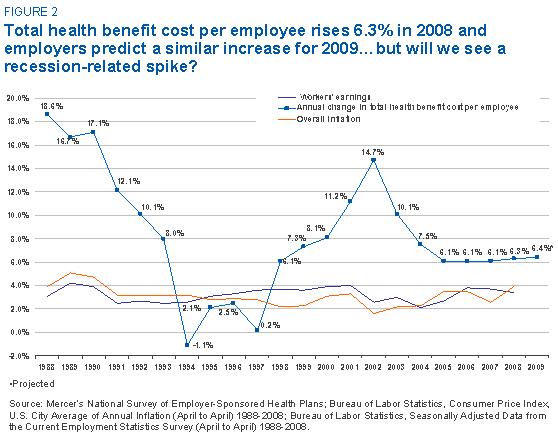
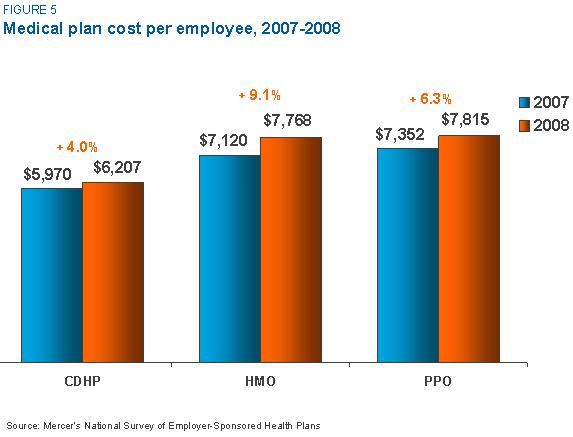
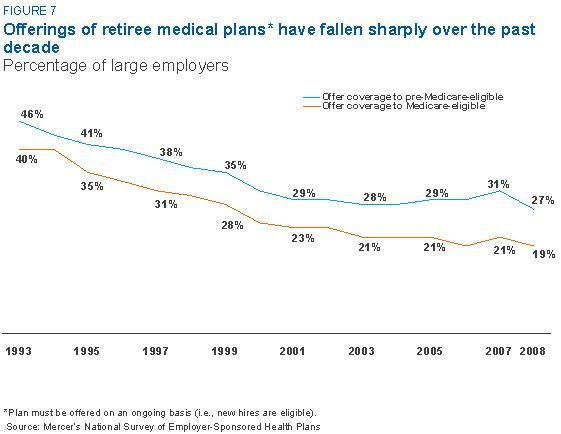
Here are a few insights from Mercer’s Annual Survey of Employee-Sponsored Health Plans:

1 – Less than 1% of all employers have provisions where smokers pay more (but 15% of employers with over 10,000 employees have such provisions).
2 – 32% of large employers off on-site or near-site clinics. (WOW! That surprised me.)
3 – 8% of large employers have provisions preventing coverage of spouses who have other coverage.
4 – A $1,000 health plan deductible is the norm.

mercer-cost-increase
mercer-cost-pmpy
mercer-retiree-medical

Need A Brady Bunch Show About Health Plans

This is a thought that I have had multiple times. Think about what The Brady Bunch did for architecture. Subconsciously or consciously, I believe it created a positive impression about architecture in the minds of millions of people growing up. I don’t think this was something that architectural associations thought up, but it would have been a good idea.

So, why doesn’t AHIP, the organization that represents the health insurance plans, come up with a way to fund or collaborate with hollywood to create a web story, a sitcom, or a movie in which the hero is an executive at a health plan. By day they are running the company and by night they are moonlighting at a free clinic helping improve health.

Maybe I am crazy, but I really believe this positive imagery would help the industry. In it’s place, the only thing we have are negative images from the movie Sicko or from stories about people being denied care or from our first hand experience with our benefit costs going up. This may not matter as the health industry changes, but I think it will be a long-time before we every really move to a single-payor system or something that radically eliminates the current structure.

Viral Marketing in Health: Humana Steps Up

I talked about Humana‘s innovation group a few days ago. They have done it again with two new games. One is on HumanaGames.com and the other is a Facebook application.

The Freewheelin Cycle Challenge is an online bicycle-racing videogame that matches you and a quirky virtual opponent. To make it to the finish line first, players energize their bicyclist and pick up speed by capturing nutritious snacks, such as nuts and oranges. They lose energy, however, by rolling over holiday junk food, including candy canes, cookies and other sugary snacks.

“The Battle of the Bulge” is an application that will be available at Facebook.com beginning Dec. 24. To participate, users go to “The Battle of the Bulge” Facebook page and answer a few questions about their lifestyle, including exercise and eating habits. Based on the responses, users are assigned a virtual waistline, affectionately called a “bellytar.” The goal of the game is to maintain an ideal weight.

But it won’t be easy. Other “friends of flab” can “fling fat” your way, making your bellytar’s pants literally bulge at the seams. In a worst-case scenario, you could be headed toward an online heart attack. To shape up, simply answer questions about exercise correctly and watch your bellytar shrink before your very eyes. Then answer questions about nutrition correctly to fling some fat of your own.

I find these to both be great examples of viral marketing which Seth Godin does a good job of explaining on his blog. Obviously, there is a long-term objective here which is driving healthy behaviors and positioning Humana as a leading edge company. They also hope to learn about human behavior and understand how tools like these can affect healthcare.

BCBSA On Consumer Driven Care

The BCBS Association released a study a few months ago on Consumer Driven Care.  Here is the presentation and a few highlights.  In general, it appears to show that it is working to save costs and get members engaged without negative side effects of them not using needed care.

  • CDHP enrollment is up 25%.
  • 10 percent more members said they would be careful about healthcare costs if they shared in the savings (incentives work)
  • 43% of those HSA (Health Savings Account) eligible with an open account use mail order pharmacy versus 30% of those with non-CDHP plans.  (Since overall mail use is around 18% this seems high, but the point is valid.)
  • 52% of those HSA eligible with an open account ask their MD about the cost of treatments
  • HSA eligibles are much more involved in tracking and estimating healthcare costs
  • HSA enrollees require more support from their plan – communications and service become more critical in driving their satisfaction.

Uproar Over “Reference-Based” Medicare Pricing – Please

Here is an overview of the issue on the WSJ Health Blog.

First off, I am not sure I would call it reference based pricing when the rest of the world calls it mandatory generics.  In many states, this is even a requirement where the pharmacy has to fill a multi-source brand (MSB) with the generic equivalent of the drug.

[In English, what this means is that once a brand drug has lost it’s patent and the drug is available as a generic then the generic (which is typically much lower cost) has to be dispensed.]

So, the issue is that apparently Medicare plans don’t always point out that if members choose the higher cost brand product (Prozac versus fluoxetine) that they will pay more..and often a lot more.  Brand manufacturers raise their prices on the brands after they lose patent since they know there are people out there who really want to purple pill and not the generic white pill (for example).

I don’t know if Medicare plans allow it, but I know a lot of clients who allowed members to get the brand name drug at their copay (not at the drug cost) if the physician wrote the prescription for DAW (dispense as written).  The problem is the physician might simply do this at the member’s request even if they don’t need it.  From everything I have ever seen, it should be less than 1% of members who really need the brand versus the A-B equivalent generic.  (Look here for the FDA information on generics.)

I don’t disagree that for the 1% that have an allergic reaction to the inactive ingredients (e.g., blue dye #17) that there should be an exception process BUT we can’t build for the exception and manage costs.  Too many people will choose the easy path and drive costs up significantly.

Humana is “Crumpling It Up”

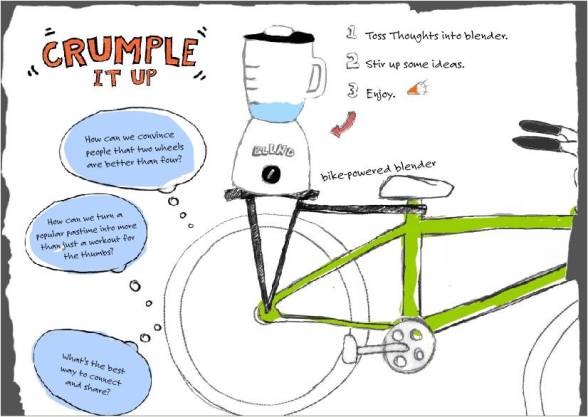
I have given it away in the title, but would you have looked at the webpage below and imagined this was from Humana.

crumpleitupYou can go to their website CrumpleItUp to learn a little more about what they are doing with bikes called freewheelin and what they are doing around games and health.

They have a fascinating group there in Louisville that works on innovative ideas.  A lot of them don’t drive the core business of health insurance but they are related to improving the health of the general public or looking at interesting ways to use technology.

They have recently added a blog about this that you can see here.  Additionally, I had a chance to meet with Grant Harrison from this group at the WHCC and also hear him speak as part of a panel on innovation.  I was very impressed with him and a few of the other people in the group.

As John talked about over at Chilmark Research, it is refreshing to see someone focusing on this type of innovation.  When I talked about innovation with a reporter recently, I suggested that Humana would be one of the first groups that they should interview.

5 Myths of Health Care

Charlie Baker, the CEO of Harvard Pilgrim, has a post on his blog about the Five Myths of Healthcare. It’s worth a read as is his blog.

1) America has the best healthcare in the world.

2) Somebody else is paying for your health insurance.

3) We would save a lot if we could cut the administrative waste of private insurance.

4) Health care reform is going to cost a bundle.

5) Americans aren’t ready for an overhaul of the health care system.

Six Steps To Innovation

Futurist Leanne Kaiser Carlson presented at the 2008 AHIP Business Forum.

Health is a growth field, Ms. Carlson explained, not only because of the amount of money spent on it but also its importance to everyone and the unique confluence of technologies that are on the cusp of revolutionizing health. Ms. Carlson showed examples of how computing, nanotech, neurotech, and genomics are coalescing to enhance human performance, human life, and human health from thought-controlled bionic limbs to artificial legs that are faster then human legs.

She presented six things that companies should be doing to innovate:

1. Pay attention to what is going on around you.

2. Create an innovation imperative.

3. Begin a specific fund for innovation and development.

4. Understand the landscape of innovation.

5. Create a culture of rapid prototyping.

6. Break competitive boundaries.

Who’s Responsible For Healthcare Costs?

I was recently at the AHIP Business Forum Chicago and was in a session where Amy Holmes, CNN Political Analyst and Peter Beinart, Editor-at-Large of The New Republic held a discussion on Decision 2008 and What it Means for the Future of Health Care.  They are two of the sharpest people I have seen speak in a while and they hosted a very engaging discussion on the issues and what the Obama win means for healthcare from both sides of the political spectrum.  (They also had a very entertaining “He Said, She Said” style that captivated the audience.)

The big changes they felt were bound to happen were cuts in Medicare and an expansion of the SCHIP program, and there were others that they said would be debated including being able to sell insurance across state lines, the government offering coverage, individual coverage mandates and coverage for pre-existing conditions.  But the biggest part of the discussion was around healthcare costs.  Costs that are out of control, who pays for services, and where will the money come from.  While at an aggregate level talking about healthcare’s spiraling costs is simple, it is not the heart of the issue.

Isn’t the issue about how as an industry we get individuals to change their behaviors?

The most powerful force for changing the economics of healthcare is the healthcare consumer.  If the consumer changes behavior (even small changes) there are billion dollar impacts in cost.  Our research shows that if a plan the size of Aetna is able to improve adherence by 1% they could save $238M!  According to the Journal of Occupational and Environmental Medicine (JOEM), 70% of all healthcare expenses are lifestyle related.  This is not a new number but it translates to $1.4 trillion in healthcare costs that could be controlled simply by modifying healthcare behaviors. 

So if our lifestyles are “killing us” and destroying a system meant to improve our quality/length of life, why are we not talking about that at the national level as THE core issue?  How can we as industry professionals develop solutions that support consumers and facilitate the changes they need to make?

I was excited to see in the third Presidential debate that both candidates addressed responsibility being in the hands of the individual.  Next steps:  Let’s see some discussion on programs and policies that truly look to impact healthcare consumer behaviors.

(This is a guest post from Chuck Eberl, VP of Marketing, at Silverlink Communications.)

Race And The Uninsured

It has been talked about in different research, but race appears to play a role in healthcare.

I thought this graphic did a good job of showing how this plays out relative to the percentage of people that are uninsured.

race-and-health-insurance

More On The Economic Impact On Healthcare

Deloitte just published the results of a survey they did which continues to hammer home the issue of how today’s economic times are affecting people’s health behaviors.  I am just getting ready to do my webinar on this.

Here are some of the results from Deloitte:

  • Only 6 percent of Americans surveyed believe their family is completely prepared to handle future health care costs.
  • More than half of respondents surveyed said that reducing costs (67 percent), increasing access (56 percent) and improving quality (57 percent) of health care are issues that are important to them in selecting a president.
  • Of the survey respondents who reported delaying or skipping care in the past 12 months, 27 percent said they did so because they could not afford the cost.
  • Nearly half (47 percent) said their household’s spending on health care products and services has increased during the past 12 months, and 63 percent said it limits their spending on other essentials.
  • Twenty-two percent said they have an outstanding medical bill that is more than 90 days past due.

So, I guess the question is “What are you doing for your members?”:

  • Are you helping them understand how to save money?
  • Are you encouraging them to stay compliant with their medications to avoid complications?
  • Are you encouraging them to be preventative (e.g., flu shot) to avoid ER visits?
  • Are you providing them with timely guidance on when to use Over-the-Counter (OTC) medications versus prescriptions?
  • Are you helping them split medications?
  • Are you moving them to mail order?
  • Are you encouraging 90-day prescriptions?
  • Are you offering them incentives for being healthy or managing their health – coupons, points?

We are seeing a lot more interest from members in this information.  They don’t know what they can do, but they want to do something.

Of course, the challenge is setting up these programs, personalizing the messaging, and getting results.  For those of you interested in these programs, contact me.  We have had some great results offering these as a turnkey service and driving the success rates up dramatically.  [2-5x improvement in 5 weeks]

No More “Robo-Calls”

This is a phrase you have probably heard several times this election period.  Somedays I think the same thing when I get 5-6 a day mostly from the Obama campaign.  It reminds me of some education I do with a lot of companies on the technology evolution around outbound calling.  Let me hit a few key points here.

First, everyone across industries is trying to figure out how to improve their access to customers (members).  How do they keep them up to date with relevant information in a timely, efficient, and effective manner.  Direct mail is a dying strategy.  E-mail is good sometimes, but you can’t push sensitive health information out via e-mail.  Text messaging has a role, but it’s not relevant for everyone.  So, automated calling has become a first-line solution rather than using call center representatives which are expensive (or more often as a complement to the call center representative making them more efficient).

Historically, call center representatives would “smile and dial” just trying to catch someone at home.  You might get lucky, but in most cases, you call 5-10 times just to get a person on the phone to talk with.  It’s not a good use of resources and time.

The next evolution was the dialer technology which calls out to people and once it hears a voice, it transfers the respondent to a call center agent.  But, the voice could be an answering machine in some cases or in many cases it might not be the right person.  These are the annoying calls you get where there is a delay after you say hello and before the person at the other end responds.  The technology is searching for an agent that’s not on the phone to connect you with.

People realized that using agents to call out wasn’t always necessary so they moved to “blast” or “robo-calls”.  These are non-intelligent calls that simply push a message out to someone.  As soon as you say hello, they start playing a recorded message and likely repeat it at the end in case it’s an answering machine they are “talking” to.  There is no interaction and no personalization.

But, that technology too has evolved.  You can now place highly personalized and interactive calls that leverage speech recognition technology.  The calls use your name and ask you to confirm that they are speaking with the right person.  The calls use the name of the company calling and potentially your employer.  The calls can also provide personalized information such as the drug you are taking or the health condition you have.  The voice is a recorded voice not a text-to-speech (TTS) solution.

The calls respond differently based on how you answer certain questions – i.e., different paths are dynamically generated.  And, the calls start to interact with other modes of communication – would you like to transfer to an agent to talk further?, would you like a copy of this offer sent to you in a letter or e-mail?, would you like a reminder sent to you as a text message?, or would you like us to fax your physician to get a new prescription for you?

The technology focuses on the interaction with the consumer and making it a pleasant experience.  In healthcare, people respond to this technology because of several factors:

  • It’s highly personalized to them.
  • It’s coming from a company they trust – their health insurer or pharmacy.
  • It’s interactive and conversational.
  • It’s important information – refill reminder, savings information, benefit change.
  • They have to authenticate themselves in order to receive sensitive information.
  • It adapts to them (e.g., please call me for future calls in the morning).
  • It offers them an opportunity to talk to an agent by transferring.

Now, I would say most companies are evolving from individual campaigns using different modes of communication (letter vs. calls) to an integrated communication strategy which has common messaging and is based on consumer preferences.  This approach allows for even better results and continues to drive personalization and customization based on historical learning and experiences with the individual.

But, mass customization does require technology and analysis.  Pulling in different data elements and looking at how to best deliver a message and get someone to listen and take action is complex work.  But, it’s a lot of fun watching success and outcomes improve as you move across the continuum.

Complementary Webinar – Cost Savings Programs

If interested, I am going to host a webinar for managed care companies and PBMs.  (Sorry, but this is limited to clients and prospects only.)

Proactive Cost Savings Programs for Your Members

In these economic times, members are looking for all the opportunities they can find to save money and reduce their out-of-pocket spending.  This is a great time to drive loyalty by proactively interacting with your members and helping them understand how to save money.

Some of the timely communication programs that will make an impact include:

  • Movement to generics (i.e., therapeutic interchange)
  • Movement to mail or 90-day retail
  • Pill splitting or dose consolidation

This is true for your commercial members as well as your Medicare members who are in the “donut hole”.  Don’t let your members struggle and end up skipping doses or not taking their medication.  This can lead to much bigger issues downstream.

Join Silverlink Communications for this interactive webinar and learn how you can design communication programs that help your members save money while improving your bottom line.

Register Here.

Article On Silverlink Communications

The October 2008 issue of ADVANCE for Health Information Executives contains a nice article about Silverlink Communications by Robert Mitchell. Here are a few items from the article:

  • It focuses on our Adaptive HealthComm Science approach which brings decision sciences to the area of driving healthcare behaviors. [This is what leading consumer companies, credit card companies, and gaming companies use to understand consumers.]
    • “Adaptive HealthComm Science looks at microsegments of the member population to try different interventions with different populations — all standing against control groups and measurements of what works best. It then adapts, learns and tries again. “The communication system continually learns and automates its processes so that it is capturing new data and learning along the way from those interactions. It is consistent and can be measured.”
      • It is amazing to see how much programs can be improved over relatively short periods of time by rapidly testing isolated variables to find the right solution for each microsegment of the population.
    • One of my favorite examples from my past was simply using stamps turned at an angle on a letter to improve the rate at which direct mail was opened. It looked more like a human had hand licked each stamp rather than a machine which put the stamp on perfectly each time.
  • It talks about the ability to do on the call calculations and dynamic pathing on the core automated calling platform.
    • On-the-call calculations: If you have 3 drugs to refill, but you only choose two of them then it can tell you what your copay is. Or, if you tell the caller your weight, it can calculate the difference from a prior weight it had collected.
    • Dynamic pathing: Based on answers you give, the call is intelligent enough to serve up different content to the member and/or route you to a different group of live agents based on rules.

“We’ve invested heavily in people, technology, processes and a methodology that continuously improves to maximize the effectiveness of health care communications,” Stan Nowak, CEO and co-founder of Silverlink, said. “Over the next few years, changes in the way health care stakeholders communicate with patients and health plan members will be one of the keys to lowering health care costs while driving consumer affinity.”

“To the consumer, health plan products are largely undifferentiated on the basis of benefits or network, and consumers experience their health plan almost exclusively through the communications they receive from the plan,” Nowak continued. “Health care organizations have an opportunity to clearly differentiate themselves through proactive and personalized communications, improving their members’ experiences with each interaction, and earning consumer trust and affinity. In essence, for health plans, communications is their product.”

60% Think We Are Headed To A Depression

You wonder how bad it is economically or where we are headed…look no further than the CNN poll out this morning showing that 60% of Americans think it is likely that we will go into a depression.  Not a recession, but a depression like many of us read about in the history book or saw in the movies.

Do people really know what the depression meant – 25% unemployment (for example).  So, if that’s the perception out there, imagine the impact on health behavior.  People will continue to look for savings opportunities – skipping pills, splitting pills, moving to generics, trying over-the-counter medications, moving to mail order.  They will likely be less likely to act preventatively – e.g., getting a flu shot.  They may be more willing to ride out bad symptoms at home rather than rush to the clinic.

This makes me think about an article I saw the other day that said that people don’t have any solutions to manage trend.  I think that’s BS.  The fact is people are afraid of the solutions to manage trend.  They don’t want to tell employees what to do or limit their choice.  In a tight labor market, companies want to keep the employees happy.  So, as the labor market opens up (i.e., higher unemployment) and healthcare costs go up, will companies finally embrace some of these tools.

For example, on the pharmacy side, we used to see a spike in call center volume of 1,000%+ on some of the aggressive programs – mandatory mail, step therapy, limited formulary, limited retail network.  That scared a lot of clients.  Maybe that attitude will change.  Granted pharmacy is 10% of medical spend so the bigger problem is on that side, but maybe companies will finally be willing to link out-of-pocket costs to controllable medical activities – weight, exercise, blood sugar, cholesterol, preventative testing.

If I were a insurer or a PBM, I would be focused on showing my value right now.  I would be delivering cost savings messages to all my members and help them understand how to minimize their out-of-pocket spend in this economy.

The Tough Economy is Impacting Health (and Potentially HEDIS)

A WSJ article of last week provides a glimpse into the many ways our strained economy is adversely impacting the healthcare-seeking behavior of individuals (see article here). It cites a D2Hawkeye analysis of medical service and pharmaceutical utilization (in a study performed before the most recent Wall Street and Main Street turmoil) and shows widespread impact across many healthcare categories. Consumers are cutting back on everything from mammograms to drugs to physician visits.

These findings should be a big stimulus for health plans, population health companies and PBMs to work more creatively on plan designs and communications strategies to support prevention and medication adherence.

Certainly, many individuals are feeling the pinch of health care costs to a greater extent than ever—with higher co-pays, bigger deductibles and for some Medicare members, the “coverage gap,” all contributing to choices people making. The D2 Hawkeye analysis of several Mid-Atlantic health plans looked at preventive and non-acute health services received between March 2007 and March 2008…

It shows pap smears are down 6% and antidepresssant medication fills declined by 19%

…despite the fact that for most of these members (in the study population) the cost-sharing changes year-to-year were minimal. So, the broader economic reality appears to be forcing consumers into making hard choices – trading off health care for other goods and services, whose prices are simultaneously rising.

NCQA is about to release its 2008 State of Healthcare Quality Report (tomorrow, October 2nd) which is its comprehensive summary of how plans across the nation are performing across the full range of HEDIS indicators . The data will reflect the healthcare services received by members in 2007, levels which from the D2Hawkeye study and other industry sources suggest we’ve declined. ….the time is now for innovation that spurs positive member behavior –in areas ranging from diabetes care to flu shots to colon cancer screening—to take center stage as an antidote to all the negatives the economy is now inflicting.

Healthcare Effectiveness Data and Information Set (HEDIS) is a tool used by more than 90 percent of America’s health plans to measure performance on important dimensions of care and service. (source)

This posting was written by Margot Walthall, Population Health Market Leader for Silverlink Communications. Margot has previously worked in director level roles in strategy, member communications and product management/marketing for three health plans and also in product marketing for a population health software and services company.

Margot’s work for Silverlink is focused on multi-channel communications solutions that enable campaigns in the areas of health engagement, health risk appraisals, health education in support of gaps in care/HEDIS, adherence programs, virtual coaching and health program satisfaction measurement. Margot has a master’s degree in health administration, as well as an MBA in marketing.

If you like this post and are interested in the topics here, don’t forget to sign up for my e-mail updates or add the RSS feed from the blog to your reader.