Archive | Silverlink RSS feed for this section

PBMs and Star Ratings

Finally, I’m hearing more talk about PBMs and their role in Star Ratings for Medicare. It seemed like this was a subtlety at the end of last year when I raised it as a 2011 priority.

Drug Benefit News had a story about it in their March 4, 2011 edition with examples from HealthTrans and PerformRx.

In general, there are opportunities to help impact Star Ratings by:

  • Blending pharmacy and medical data
  • Helping monitor patients on long-term medications
  • Increase cholesterol screening
  • Increase use of flu shots
  • Controlling blood pressure
  • Addressing physician communication gaps
  • Improving Customer service
  • Prior authorization process
  • Churn
  • Time on hold
  • Appeal process
  • Accuracy of information provided by customer service
  • Managing complaints
  • Helping with access issues
  • Timely information about the drug plan
  • Monitoring use of drugs with a high risk
  • Making sure diabetics us hypertension drugs

Since pharmacy is the most used benefit, it can have a very direct impact on the overall satisfaction. It can drive calls. It can be complicated. It can affect perception. And, it can lead to churn.

PBMs need to be working to proactively engage consumers. They need to use data to personalize the experience. They need to use clinical data to identify gaps in care. They need to drive adherence.

I personally hope that the Star “concept” becomes a more normal set of metrics outside of Medicare for measuring success and ultimately leads to a performance-based contracting framework.

Improving Your Call Center Without Just Adding People

In today’s economy, the last thing we want to do is scale up a company by simply adding people. Technology has to play a central role in allowing you to grow your company more efficiently.

At the same time, you want to grow without dropping your level of service. You want to improve the consumer experience.

And, to further complicate matters, you have to manage quality both to make sure that you comply with regulatory oversight and achieve goals around first call resolution. With our rapidly changing healthcare environment and legacy systems in many places, finding, training, and retaining good staff that can continue to keep up with the changes and understand the semantics between plan designs isn’t easy.

So, how do you do that? You’re in a balancing act between cost, quality, and experience.

This is one of the big areas where I’ve seen Silverlink Communications play a role. (Note: There are certainly other efforts which you can undertake in terms of single desktop and process reengineering, but I usually refer in some people I trust for those projects.)

Some people call our technology a “smart dialer”, but there is a difference. If you ever get a call at home from a call center using a dialer, you hear that silence after you say “hello”. The technology is looking for an agent to connect you with. On the flipside, if you’re an agent, you’re being connected with someone or even an answering machine that might not be the right person. That’s what a dialer does.

In our case, Silverlink is using mass personalization, voice detection technology, and speech recognition technology to screen the recipient for the call center. You hear the message right after you pick up the phone. It’s a message that has been carefully crafted using behavioral sciences and health literacy. It asks for you by name and identifies who’s calling for you. It then confirms your identity, and depending on what information is being used in the call, it may have to use multiple forms of authentication to verify who you are. Once we’ve assessed who you are (based on your responses), we’re able to deliver a personalized message to you about your healthcare. That personalized message is scripted in such a way to engage you in a conversation. During that conversation, we can then determine:

  • Are you interested in learning more?
  • Is this a good time for you to talk?
  • Would you like to talk to an agent or hear more now?
  • Would you like us to send you information in an e-mail, SMS, or snail mail?
  • Would you like a URL to go to for more information?

Occasionally, people ask about authentication. When you send a piece of direct mail, it’s a federal offense to open it if you’re not the intended recipient, but you have no proof that they did that unless your “nanny cam” picks it up. When you call someone, you have a record of when the call was made and what they person who picked up the phone said to authenticate themselves. This certainly seems better to me than any other channel.

Of course, this begs the question of recording all the calls. I’ve heard a few people tell me that they do this with other companies. I find that hard to believe since 12 states have consent laws which would require people to consent to being recorded when they were called. That would limit the effectiveness of the program, or if you didn’t do it, it would open you up to a big lawsuit.

So, how does Silverlink add value to a call center:

  1. Improving agent productivity. Automating standard questions. Connecting with the right person at the right time.
  2. Improving consumer engagement. Using behavioral sciences and health literacy to engage people and route them to the right agent based on skill set.
  3. Improving quality and consistency of experience. Personalizing the experience to engage the consumer but doing it in a way that addresses the clinical guidelines, regulatory requirements, and custom client requests in a consistent manner.
  4. Improving agent satisfaction. Your agents would rather talk to pre-qualified people or people who have an issue.
  5. Learning new information. In some cases, patients feel judged when people ask them questions (why aren’t you taking your medications). They may reveal more or other information in an automated environment.

Of course, automated calls aren’t the answer for everyone (although they work better than any other mode other than people…and sometimes beat them also). But, multi-channel coordination is a post for another day.

Rules Based Communications

After working with data warehouses, configuration engines, and workflow management systems, I’m a big believer in embedding rules into a process. Communications is no different.

Let’s look at a few rules:

  • Don’t communicate with someone more than X times per week.
  • Don’t call these people.
  • Use Spanish for people with that language preference.
  • Send a text message to people who have provided their mobile number and opted in to the program.
  • When applicable, use a preferred method of communication for reaching out to someone.
  • If a caregiver is identified and permission is on file, send the caregiver a copy of all communications to the patient.
  • Call the patient if the amount being billed for their prescription is greater than $75.
  • For patients between these ages, use the following messaging.
  • If the patient hasn’t opened the e-mail after 48 hours, then call them.
  • For clinical information, use this channel of communications.
  • For John Smith, only call them on Tuesdays between 5-6 pm ET.
  • For Medicare recipients, use this font in all letters.
  • For Hispanic consumers, use this particular voice in all call programs.
  • If the patient doesn’t respond after two attempts, send a fax to their physician.
  • For patients with an e-mail on file, send them an e-mail after you leave them a voicemail.
  • For patients who are supported by Nurse Smith, only call them when she is on duty and use her name in the caller ID.

I could go on. But, the point is that communications, like healthcare, is a personalized experience. We have to use data to become smarter (historical behavior, segmentation, preferences). We have to use customization to create the right experience. AND, probably the most difficult thing for lots of companies, we have to coordinate communications across modes (i.e., e-mail, direct mail, SMS, automated call, call center, web).

Ultimately, I believe consumers will get to a point where they can help set these rules themselves to create a personalized profile for what they want to know, how they want it delivered, and ultimately provide some perspective on how to frame information to best capture their attention.

To learn more, you should reach out to us at Silverlink Communications.

Can We Use Technology To Address Gaps In Resources – YES!

Dr. Joseph Kvedar writes a great piece about the psychology of persuasion and the possibility of using technology to engage consumers and drive behavior change.  This is an important topic as we look at addressing healthcare as a country.  Since behavior and consumer choice drive a significant portion of our healthcare costs, we have to think more about how to engage patients – what is the right message?  what is the right channel?  what is the right time to deliver the message?

We can deploy technology in smarter to ways to engage consumers in new ways that leverage our limited resources in better ways – i.e., get good and scalable outcomes without increasing costs.  That is what we do everyday at Silverlink Communications with our clients whether it’s around HEDIS, adherence, condition management, or many other programs. Recently, there was an article in Time Magazine that talked about some work we did with a Medicare population for Aetna.

I also think you can look at the research Stanford has published on the topic over the past decade.  You can also look at some of the data from the CVS Caremark Pharmacy Advisor program. While it certainly showed the value of having pharmacists involved, it also showed some positive results from automation.

The reality is that combining automation and live resources can be very powerful. Technology can screen and triage people to connect the at risk population with critical resources. This can allow resources to support as many as 4x as many consumers.

Growing Mail Order Pharmacy Utilization

A common topic which I discuss with PBM clients is how to improve their mail order utilization. Since more than 50% of their profits come from generics at mail order, this is a critical process. And, while the industry average is 13% utilization (on an adjusted script basis), there are many companies (especially outside of the big 3 PBMs – CVS Caremark, Medco, and Express Scripts) that have much lower utilization and therefore huge value in upside.

Today, I got the chance to speak to investors on this topic courtesy of Barclays Capital. I structured the discussion around three topics:

1. Why is mail order important to the PBM?
2. How do you improve mail order utilization?
3. What are the challenges to improving mail order utilization?

Attached are the slides which I used on the call.

Coupons From Manufacturers

I’ve talked about this a few times. It’s an interesting topic. Are coupons for prescriptions a good thing or a bad thing?

Let’s look at a few perspectives and considerations…

Manufacturer:

  • Do they improve my marketshare?
  • Do they protect my marketshare from new entrants?
  • Do they protect my brand versus generic competition?
  • Do they improve adherence (as measured by refill rates)?
  • Per point of marketshare, is it cheaper to rebate a drug or offer direct-to-consumer coupons?
  • Are coupons more effective than samples? (They are clearly less expensive to produce and distribute.)
  • I’d be interested in feedback, but I haven’t found any conclusive data. BUT, I think manufacturers are smart marketers. They wouldn’t be doing this if it didn’t work.

Payor:

  • Do the coupons support my formulary? (I would generally think no…otherwise why use them.)
  • Do the coupons improve adherence? Are they creating waste?
  • Are the coupons changing physician or patient behavior? Is this costing me money (e.g., less generic starts)?
  • Is this impacting my total drug spend since the consumer is no longer as price sensitive to copay differentials?
  • Do claims processing using the coupons still show up in the patient history such that drug-drug interactions and other safety checks can be conducted?

Customer:

  • Am I saving money? [Yes]
  • Is the coupon easy to use and understand? [I would think generally yes.]
  • They should be asking about their total cost of the drug over time since depending on the condition they may be less likely to convert to a lower cost drug (typically generic) when the coupon is no longer offered. Or, switching drugs may require them to visit the physician or have lab work done that will cost them money.
  • They should be asking…if others use this coupon, which means that they are filling a more expensive drug, what does that decision cost me (shared cost)?

As far as I know, there are very few limitations on couponing.

  • The state of MA doesn’t allow their use at all.
  • There are lots of restrictions about their use in Medicare and Medicaid such that those consumers are usually excluded from using the coupons.

This is generally a topic where there is little known about the answers to these questions (as far as I know).

There was an article in last week’s Drug Benefit News about this topic where I was quoted and built upon a few comments I made about Lipitor earlier:

“Payers are concerned that copay cards incent consumers to use higher-cost drugs,” George Van Antwerp, general manager of pharmacy solutions for Silverlink Communications, tells DBN. “The consumer no longer sees the penalty of using a more expensive drug.”

Pfizer, who declined to comment for this article, has given some indication that it will continue the $4 copay card only until November, when a generic version hits the market, but Van Antwerp says he’d be surprised if the company did not extend the offer. “Back when Zocor went generic, Merck actually made the brand drug cheaper than the generic drug,” Van Antwerp recalls. “United and a few other payers ended up putting brand name Zocor into the generic tier on their formulary.”

Compliance For Donations?

Would you be more compliance with your medications if you knew that every time you took a pill or refilled that a donation was made in your honor to a certain charity?  It’s an interesting hypothesis being put forth in this article – Leveraging Altruism To Improve Compliance… BUT I personally am fairly skeptical. 

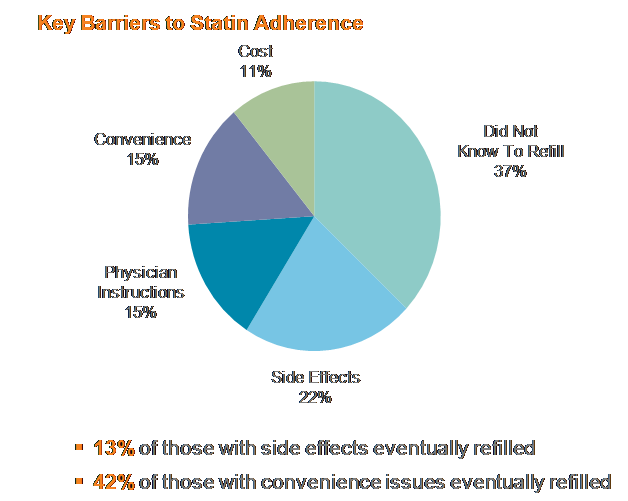
Let’s just look at the barriers identified in one recent barrier survey we did at Silverlink Communications for patients who had not refilled their statin medications. 

What do you see?

  1. Significant literacy issues.  People didn’t even know they were supposed to refill. 
  2. People don’t understand the medication and remember what the physician told them.
  3. Convenience…an easy to address opportunity.  These are key targets for a retail-to-mail or 90-day retail program.
  4. Side effects…this is harder to address but some of it can be managed by setting expectations up front.

Are those going to be addressed because a donation is being made?  I don’t think so.

Lipitor Going Generic

If you work in pharmacy, this has been on your radar since Zocor went generic years ago. Lipitor has been the biggest drug worldwide, and I believe the spend in the US is still almost $7B a year even with generic Zocor available. (See Consumer Reports on statins)

Now, it appears that generic Lipitor (atorvastatin) will be available 11/30/11 according to the Pfizer site. It looks like Ranbaxy who was first to file the ANDA will get the 180-day exclusivity (but I know several other generic manufacturers have challenged the patent).

So, what does this mean?

  1. Lipitor will likely move to the 3rd tier either immediately or at the next formulary update period once the generic is available on the market.
  2. Atorvastatin will become a part of statin step therapy programs.
  3. Pharmacies in states that have mandatory generic laws will begin auto-substitution of atorvastatin for Lipitor prescriptions unless there the script has a Dispense As Written (DAW) indication.
  4. Depending on the pricing of the generic, PBMs and pharmacies will be very aggressive about encouraging use of the generic version (as allowed with the AG settlements from years ago).

We’ve already seen Pfizer take some action which is to promote a $4 copay card (or 30-day sample) for patients. This is to protect market share, but it also makes me wonder if they won’t do something like Merck did by pricing the generic below the Ranbaxy price (see WSJ article).

Given that Pfizer owns a generic company (Greenstone), I have to imagine that they plan to sell atorvastatin thru that company. But, I think the big question that I would be focused on is whether there will be an “authorized generic” (look at the FTC interim report on this topic). This is a big topic in the industry. It allows the manufacturer who owns the patent to allow a generic manufacturer to make and produce a generic version outside of the ANDA process. Right now, it appears that Watson may get to bring an authorized generic of Lipitor to market.

Will you see the same energy around this as you did around Zocor? I remember having a whole “control room” that we developed at Express Scripts to encourage utilization of generic Zocor. It was built around several key things:

  1. What were all the channels that a patient communicated with the PBM and how did we educate them around the new generic? [And which could we do at what time so as not to limit the short term rebates that our clients were getting on brand Zocor which kept the prices down until the generic was available?]
    1. Member portal
    2. Mail order invoices / stuffers
    3. Inbound IVR messaging while on hold
    4. FAQs
    5. Training call center reps
    6. Formulary notification programs
  2. How did we inform physicians?
    1. Academic detailing – fax, letter, phone consultations, face-to-face visits
  3. What plan design changes did we encourage?
    1. Step therapy
  4. What could be done at the POS with the retail pharmacies?
  5. What could be done at mail?
  6. How would we track success?

Personally, as a PBM or pharmacy, I’d be trying to lock in a period of exclusivity with Watson or Pfizer to have the limited distribution of the generic Lipitor for a period of time. That would be a huge deal (if it could be pulled off).

Presto: E-mail Into Newsletters

I’ve seen several ideas over the years to try to figure out how to connect those of us that live and die by our electronic tether (e-mail, SMS, Facebook) to loved ones who don’t use a computer or in other countries where they don’t have computers (e.g., rural India several years ago).

Now there’s a new service called Presto (www.presto.com).  You set up a “printer” in their home which connects to an analog phone line.  You can then send them e-mails which get re-formated into a newsletter with the attachments printed.  You can tag photos in facebook for them to get printed.  You can schedule reminders for them that get triggered and printed at a fixed time. 

Sounds pretty cool to me.  In general, the older population (65-80) are pretty responsive to phone based solutions (like we do at Silverlink), but you do see a drop off after 80.  If this solution ever were to take off and the caregivers could opt-in their parents to accept reminders (e.g., adherence, medical appointment) from health plans, PBMs, ACOs, and other organizations, this would be an interesting new channel for reach.

Get Wellness Article in Time – Silverlink, Aetna, Hypertension

The recent issue of Time magazine includes an article called “Get Wellness” about wellness.  It talks about having MDs “prescribe” wellness (think Information Therapy or Ix) and the fact that Medicare enrollees will be eligible for wellness visits begining 1/1/11. 

The new wellness benefit tasks doctors with creating “personalized prevention plans,” which ideally will be tailored to each patient’s daily routine, psyche and family life. And if that sounds more like a nanny-state mandate than medicine, consider that some 75% of the $2.47 trillion in annual U.S. health care costs stems from chronic diseases, many of which can be prevented or delayed by lifestyle choices.
The article goes on to talk about the challenge this may create for physicians.  Can they act as nutritionists?  Can they change behavior? 
 
Of course, MDs won’t be the only one’s focusing here (although some of that could change with ACOs and PCMHs).  Disease management companies and managed care companies have focused here for a long time.  The focus in many ways these days is how to reduce costs in these traditionally nurse-centric programs with technology but without impacting outcomes and participation.  There is one example in the article from some work we are doing at Silverlink around hypertension
 
Some firms, in trying to bring down health care costs, have hired health coaches to reach out to the sedentary or overweight to get them moving more. Others use interactive voice-response systems to keep tabs on participants’ progress. In a study, Aetna set out to see whether it could reduce hypertension — and the attendant risks of stroke, heart attack and kidney failure — among its Medicare Advantage members. More than 1,100 participants were given automated blood-pressure cuffs and told to call in with readings at least monthly. They also got quarterly reminders to dial in. When they did so, an automated system run by Silverlink Communications provided immediate feedback, explaining what the readings meant and where to call for further advice. Alerts were also sent to nurse managers when readings were dangerously high. The result: of the 217 people who started out with uncontrolled hypertension and stuck with the program for a year or so, nearly 57% got their blood pressure under control.

Compliance “Rapid Response” Team

In the future, will we have teams who rapidly engage patients who don’t take their medications as prescribed?  Will those be medical teams for patients who recently got a transplant and police teams for mentally ill patients with a history of violence?

Seem pretty farfetched?

Compliance with medication is such a hot topic today that you’re finally see the technology innovators jumping in.  You have solutions like the GlowCaps system that have been around for a few years and demonstrated their impact.  Now, you have technology going even further to attach itself to the pill and send data back. 

The LA Times had an article that talks about some of these technologies:

  • Camera pills
  • A device that you wear around your neck to monitor swallowing the pill using RFID
  • A device that detects when it encounters stomach acid

BUT, the kicker here is that the article estimates this will only improve adherence by 5-15%.  Remembering to take the pill isn’t the only reason people don’t take their pills!!!

Just look at this on the 11 Dimensions of Non-Adherence or this on the Predictors of Non-Adherence or some of the research coming out of CVS Caremark.

You have to address health literacy.  You have to address side effects.  You have to address beliefs.  And, many other issues.

These solutions are “cool” and will finally tell us if people take a pill, but I’m not sure that’s the silver bullet.  Plus, at what cost?  Get a 5-15% improvement in adherence isn’t that impressive.  We’ve done that multiple times at Silverlink with a quick remind to patients about taking their medications or asking patients about their barriers and addressing them. 

As with any solution, it’s about figuring out who it benefits most and getting it to them at the right time.

Pharmacy Customer Experience

When most people start to this about segmentation in the pharmacy space, it becomes quickly overwhelming:

  • Age
  • Gender
  • Plan design
  • Geography
  • Income
  • Condition
  • Drug
  • New to therapy or ongoing therapy
  • Co-morbidities
  • Depression
  • Physician relationship
  • Support system
  • Education
  • Literacy
  • Etc.

I want to spend some time over a few posts beginning to break this down.  Today, let’s look at the five logical customer types:

  1. New Nancy:
    • Newly diagnosed
    • Not very familiar with her condition, the medication, the pharmacy process, or the PBM
    • Needs lots of hand-holding and education
    • Need to address gaps in the physician-patient encounter
    • Need to help her build a routine
  2. Caring Carin:
    • Caregiver for either dependents or parents
    • Picking up prescriptions for them and responsible for translating (sharing) information with them
    • Important to educate, but not the patient
    • Likely to be the “e-patient” but also stressed out (see sandwich generation)
  3. Sporatic Sam:
    • Someone who gets some acute medications occassionally (e.g., antibiotic)
    • Understands the healthcare system somewhat but not overly interested or engaged in the semantics
  4. Forgetful Frank:
    • Chronic medication user
    • Likely to have or develop multiple conditions
    • Not great with adherence to therapy
    • Understands their condition, but not worried about it (even if they should be)
  5. Steady Suzy:
    • Chronic medication user
    • One or more conditions
    • Understands the value of medication
    • Feels better when taking her medications
    • Actively managing her health
    • Generally adherent
    • Engaged with MD and pharmacist

I guess I could add Corrupt Cindy to talk about patients that abuse the system (a pharmacist friend of mine was telling me about a patient they caught this weekend with 6 different names across different pharmacies and a fake prescription pad). 

From a basic segmentation framework, are there others without getting into demographic attributes?

DBN: 2011 Pharmacy Predictions

Drug Benefit News (which is a must read publication) just came out with a summary of opinions from people about the new year (DBN, 1/7/11).  Here are a few highlights:

  • Focus on clinical programs to help MCOs hit their MLR targets
  • PBM consolidation and need for smaller PBMs to innovate (as my whitepaper discusses)
  • Potential for generic only formularies as generic fill rate is in the 70-80% range
  • Focus on specialty drug costs including the claims processed under the medical benefit (Express Scripts big push right now)
  • Outcomes based contracting (i.e., Merck and Cigna)
  • Direct contracting (i.e., Caterpillar, Delta)
  • Continued pharma shift to niche markets as brand oral solids make up <20% of claims
  • Health reform fallout
  • Continued streamlining and focus on MA and PDP
  • Continued innovation (i.e., Wal-Mart and Humana model)
  • Limited or restricted networks take off (finally)
  • Cost plus pricing
  • Modernizing Medicaid management and controlling costs

I was one of the people interviewed for the article.  My comments from the article are:

The things that I’m monitoring and think will affect the industry include mobile health, behavioral science application, preference-based marketing, risk based contracting, and integration with home monitoring devices. Rising costs will push several things such as increased management of the specialty benefit, more focus on adherence, and an increased understanding of how consumers impact health outcomes and how to best engage them. In 2011, innovations and changes in benefit design could include limited networks, more and more utilization management especially step therapy and 90-day retail or mail.

The biggest area of discussion in Medicare Part D right now is the Star Ratings. There are questions for PBMs about how they support the MA metrics and there are now specific PDP metrics. Understanding what those are, how to track them, how to influence them, and how to improve them will be a major focus in 2011.

New Pharmacy Whitepaper: Innovate Or Be Commoditized

In early 2009, I published an initial whitepaper on the PBM industry.  With all the changes going on in the industry, it seemed relevant to put out a new whitepaper although the total impact of reform and the definition of MLR is still TBD.  As I did before, I’m putting a summary here, and I welcome your comments.

You can download the whitepaper by registering on the adherence site at Silverlink Communications.  Thanks.  [If you’re a regular reader but not a logical client, you can request the whitepaper by contacting me.]

I think a quote from Larry Marsh (Managing Director, Equity Research) at Barclay’s Capital does a good job of summarizing it:

“Innovation will be increasingly important in the PBM world, as these companies seek to solve a greater set of pharmaceutical cost issues for their customers over the next 10 years.”

[BTW – If you want to get updates e-mailed to you as I post them, you can sign up here.]

************************

Innovate Or Be Commoditized: The PBM and Pharmacy Challenge for 2011

Doing more with less; dealing with constant change; and having technology be a part of everything…  Those are things that the next generation will take for granted.  For the rest of us, those are dynamics that are changing our personal and professional lives.  We’re constantly bombarded with information and decisions to make.

While the pharmacy industry has generally avoided the collapse of the automotive industry and the radical change of the health insurance industry, we’ve seen unprecedented change in the past few years.

It’s almost impossible to go a few days now without seeing information about prescription drugs in the mainstream news.  You might hear a financial analyst talking about the lack of blockbuster drugs in the pipeline.  You might read about a drug recall in USA Today.  You might see a new report talking about the $290B cost of non-adherence[ii] to the country.  Or, it might simply be water cooler discussions around how more than 25% of kids[iii] now take a prescription medication or how non-adherence can lead to hospital readmissions[iv].

This has raised the average consumer’s awareness of the industry and continues to push the trend of consumerism with which the entire healthcare industry is dealing.  Most of us in the industry already knew that pharmacy was the most used benefit (12 Rxs PMPY for PPO members[v]) and believed that pharmacists were a critical part of the care continuum.

The challenge now is for the industry to demonstrate their value beyond simple trend management.  The growth in generics will slow down while specialty spending grows.  Pharmacy and pharmacists have to become critical path in the care continuum and demonstrate how they engage consumers to improve outcomes.  It will become increasingly important to link outcomes and reimbursement as CIGNA Pharmacy did in their diabetes deal with Merck[vi].


[i] “Still More Pharma Jobs Go By The Wayside”, Pharmalot blog, posted on Nov. 3, 2010, http://www.pharmalot.com/2010/11/still-more-pharma-jobs-go-by-the-wayside/

[iii] Berkrot, Bill, “Prescription Drug Use By Children On The Rise”, Reuters, accessed on 1/4/11, http://www.reuters.com/article/idUSN1924289520100519?type=marketsNews

[iv] Leventhal MJ, Riegel B, Carlson B, De GS., Negotiating compliance in heart failure: remaining issues and questions, Eur J Cardiovasc Nurs., 2005;4:298–307 (abstract online at http://www.escardiocontent.org/periodicals/ejcn/article/S1474-5151(05)00038-1/abstract)

[v] Managed Care Digest Series: Key Findings, last updated Nov. 2010, http://www.managedcaredigest.com/KeyFindings.aspx?Digest=HMO

[vi] “CIGNA and Merck Sign Performance-Based Agreement”, CIGNA Press Release from April 23, 2009, http://newsroom.CIGNA.com/article_display.cfm?article_id=1043

Predictors of Non-Adherence

From the literature…(NEJM 353:5 August 4, 2005, page 491) with my comments about how to address them.

  • Predictor: Presence of psychological problems, particularly depression
    • Study: vanServelien et al., Ammassari et al., Stilley et al.
  • Predictor: Presence of cognitive impairment
    • Study: Stilley et al., Kino et al.
  • Predictor: Treatment of asymptomatic disease  [Need aggressive reminder system to initial create habit]
    • Study: Sewitch et al.
  • Predictor: Inadequate follow-up or discharge planning.  [Educational follow-up]
    • Study: Sewitch et al., Lacro et al.
  • Predictor: Side effects of medication  [MD or RPh education of patient]
    • Study: van Servellen et al.
  • Predictor: Patient’s lack of belief in benefit of treatment
    • Study: Okuno et al., Lacro et al.
  • Predictor: Patient’s lack of insight into the illness  [New to therapy educational content]
    • Study: Lacro et al., Perkins
  • Predictor: Poor provider-patient relationship  [Tips to patients on how to interact with MD]
    • Study: Okuno et al., Lacro et al.
  • Predictor: Presence of barriers to care or medications  [Barrier survey and personalized info to address barriers]
    • Study: van Servellen et al., Perkins
  • Predictor: Missed appointments  [Appointment reminders]
    • Study: Servellen et al., Farley et al.
  • Predictor: Complexity of treatment  [MTM type services]
    • Study: Ammassari et al
  • Predictor: Cost of medication, copayment, or both  [Value based plan design]
    • Study: Balkrishnan, Ellis et al.

Press Hits in 2010 (and before)

2010 was a good year.  21 press hits.  (Thanks to a great press team at Silverlink that supports my ideas.)

This built on some success with the press in 2008 (2) and 2009 (15).

Just out of interest, I went to pull some older press hits from pre-Silverlink:

AND, I finally found a link to my first healthcare publication in the International Journal of Radiation Oncology Biology Physics on using activity based costing to compare different treatment options.

How Donald Trump Would Evaluate Vendors?

I often get asked the question of how to best evaluate two vendors especially when I am out in a sales role for Silverlink.  People often see so many marketing pitches that they start to look the same.  Some people just want to do an RFP which often ends up just focusing on the cost lever.  Others get so focused on “cute” demonstrations.  What really matters is how they perform in a real scenario and what results they achieve.

I’ve talked about this for years after a client of mine did this with two vendors years ago (see old post from 2008), but after watching the Apprentice the other night, it helped me frame this.  Donald Trump has this great way of sorting thru lots of smart people.  It’s not perfect since I know as an INTJ that it probably wouldn’t be the best forum for me, but it’s a great analogy.

The resume is the marketing pitch.

The interview is the demonstration.

You can hit both of those out of the park, but it still may not be the right fit.  The question is how does the candidate work with others.  How does the candidate perform under pressure?  What are the end results?  How do they perform over time?

It’s obviously hard to duplicate that in a corporate world, but I always encourage our clients to put us head-to-head with the competition.

  1. Identify a challenge (e.g., increase use of mail order pharmacy).
  2. Ask each company to design their best solution.  (Focus on what questions they come back to you with…that tells you a lot.)
  3. Pull your target population and randomize them into one group for each competitor plus a control group.
  4. Make a few last minute changes to your program (which is reality) to see how the company deals with that.
  5. Have the company implement the solution.
  6. Look at their execution process.
  7. Look at their reporting.
  8. Compare their outcomes with the competition and against a control group.
  9. Ask them for recommendations on how to improve the program.

Now you’re at a point to make an informed decision.  You’ve seen how their team works.  You understand their process.  You’ve seen actual results.  You’ve seen how they think.

The money spent to get this decision right and the learnings you will have will pay for itself in the long term.  Everyone is always short staffed, but it’s worth it.

At the end of the day (IMHO), you want to find partners not vendors.  A few key partners that understand your business, challenge your assumptions, and improve your outcomes is always better than a lowest cost player.  Focus on substance not glitz!

(And another hint I often tell people is to do reference checks with people who work with the company on a day-to-day basis not the executives who may be removed from the first hand experience.)

Pharmacy 2011 – 11 Things To Consider

I pulled together (in Prezentation Zen style) 11 Things to Consider in the Pharmacy industry.  It’s certainly a matter of opinion, but it’s a point of view meant to cause you to think.  I spend a lot time with clients thinking about the industry, and I thought this was a fun way to put some of those thoughts out there. 

I divided these up into two areas:

The Consumer:

  1. Patient Centric approach is critical path. (i.e., create an experience)
  2. Be proactive not reactive. (think Obesity)
  3. Literacy and health disparities need to be addressed. (simple and direct)
  4. People are different…act appropriately. (mass customization)
  5. Genomics are fascinating…but can be confusing. (and healthcare in general is already very confusing)

Business Strategy:

  1. The pharmacist role has to change from refills to outcomes. (see prior post)
  2. Blend high touch and automation in specialty. (they have the same needs about information)
  3. Integrate your physician and consumer strategies. (the HIT focus will make this more pressing)
  4. You need a STAR strategy for your PDP. (hottest topic in Medicare right now)
  5. Mobile is here to stay. (but may not be a business model unto itself)
  6. Social media will change the conversation. (so what are you doing)

Leading Trends in Rx Plan Management (Medco)

It’s always nice when you get on the marketing distribution list from companies. I love to get the PR and marketing materials to review. Medco recently sent me this document called “9 Leading Trends in Rx Plan Management: Findings from a National Peer Study“.

The survey was across 380 organizations plus 100 consultants and brokers. And, the survey was conducted prior to health reform passing so that’s an important timeline to keep in mind. It’s a nice quick read with lots of stats and charts from the survey with comparisons to last year’s numbers.

Executive Summary:

  • Less than 40% said they were extremely or very concerned about economic conditions affecting their ability to offer the same level of prescription benefits over the next 2-3 years. (down from 60%)
  • Plan sponsors are increasingly eager to find cost control solutions:
    • 90% – promoting the use of formulary products (brand and generic)
    • 80% – encouraging the use of mail order
    • 83% – helping members make more effective healthcare choices
  • 76% of plan sponsors state that balancing costs with care is the key philosophy (which is a reversal from 5 years ago where it was providing broad coverage)
  • Respondents see pharmacy as representing 22% of their overall costs (a higher number than I’ve seen before so I’d like to see actual data here)
  • Surprisingly, plan sponsors were more concerned over DTC advertising and minimal attention to personal health than aging and use of specialty drugs
  • 72% EXPECT their PBM to help reduce overall healthcare costs (what I’ve been saying for a few years)
  • 79% say that specialty pharmacy is better managed by the PBM than the health plan

The 9 leading trends:

  1. A transformative shift in benefit philosophy continues
  2. Rising costs replace economic woes as key affordability issue
  3. Plan sponsors prefer targeted but limited government employment
  4. Use of integrated data is becoming standard practice
  5. CDH plans are struggling to gain momentum
  6. Specialty medication management programs are increasing sharply
  7. Generics and preferred drug programs moving from incentives to mandates
  8. Decisive move towards stronger mail incentive programs
  9. Plan sponsors look to PBMs to reduce overall healthcare costs

(The ones that surprised me here were #4 which I just haven’t seen significant movement on and #7 where I haven’t seen much in the way of mandates, but I’m on the outside looking in these days.)

#1: Transformative Shift in Benefit Philosophy

  • Only 6% are focused on limiting coverage
  • Honoring retiree commitments is still the #1 factor in guiding retiree benefits
  • 95% of benefit advisors agree

#2: Rising Costs as Key Affordability Issue

  • 72% blame physicians for complying with patient requests for more expensive branded medications
  • 52% believe that engaging members to make better health and cost related decisions is their number one priority (which is exactly what Silverlink does for clients!)
  • 95% of benefit advisors agree

#3: Targeted but Limited Government Involvement

  • 60% say the government should have minimal or no role in providing prescription benefits (only 15% preferred a private plan)
  • 71% want the government to help bring generic biologics to market faster
  • 42% believe the government should mandate e-prescribing initiatives
  • 75% of benefit advisors agree that government proposals will help lower Medicare Part D costs

#4: Use of Integrated Data

  • 64% use integrated data to improve health and financial outcomes (I would guess much of that is outsourced to 3rd parties. This also still doesn’t include lab values.)
    • 74% do it to improve case management
    • 70% do it for disease management
    • 68% do it to identify members at risk
  • 95% of benefit advisors agree on the likelihood of recommending data integration over the next 2 years to control drug costs

#5: CDH Plans are Struggling

  • 27% of respondents offer a consumer-directed health plan but 73% say their members are reluctant to join
  • It was virtual tie between those that thought CDH plans helped reduce Rx costs and those that didn’t…but the majority of people agreed that they help employees better understand the real costs of healthcare
  • 67% of benefit advisors agree on the likelihood of recommending a CDH plan over the next 2 years to help control costs (which seems out of line with the employer perspective)

#6: Specialty Medication Management Programs are Increasing

  • 83% of respondents plan to install clinical and cost-management programs to help contain the cost of specialty medications
  • 40% cite specialty as the key cost driver
  • Respondents believe that billing under the pharmacy benefit:
    • Provides more consistent pricing (79%)
    • Provides a better understanding of therapy management savings opportunities (77%)
    • Provides a more complete and accurate picture of specialty spending (80%)
  • The programs being used are:
    • Utilization management (64%)
    • Limit days supply (63%)
    • Preferred pharmacies (58%)
    • Step therapy (55%)
    • Move coverage from medical to pharmacy (41%)
    • Waive copayments to increase use of a preferred pharmacy (9%)
  • 76% of benefit advisors agree on the impact of UM programs controlling specialty drug costs

#7: Mandates Over Incentives For Formulary Agents

  • 58% are requiring the use of generics and preferred drugs (does this mean going back to closed formularies?)
  • 90% use programs that incent (i.e., lower copays I assume)
  • 94% are likely to increase member communications to encourage the use of generics
  • 63% of benefit advisors agree on mandating the use of generics to control costs

#8: Stronger Mail Incentive Programs

  • 58% have installed programs where the member pays more at retail after a set number of refills (I think this is a Medco anomaly…they’ve always had the highest mail utilization)
  • 85% have a cost-share strategy that favors mail
  • 38% waive one or more copays as an incentive to move to mail
  • 5% auto-enroll members in mail
  • 54% believe dispensing errors are less likely at mail (while 7% believe retail is better)
  • Mail order is seen as having a better chance to maximize generic use (by a 5:1 margin over retail)
  • 69% of benefit advisors agree that dispensing errors are less likely at mail than retail

#9: PBMs and Overall Healthcare Costs

  • Why use a PBM:
    • More focused and experienced at controlling drug costs (88%)
    • Most competitive drug prices (88%)
    • Provide detailed analysis and reporting to help explain cost drivers and identify savings opportunities (87%)
    • More innovative approaches to controlling costs (83%)
  • After cost control of Rx, what do they look for in a PBM:
    • More effective in promoting adherence (69%)
    • Helps control overall healthcare costs (72%)
    • Better medication counseling (70%)
  • Benefit advisors believe the following are the most critical priorities for plan sponsors:
    • Engaging members (39%)
    • Controlling specialty costs (24%)
  • Ensure the pharmacy benefit supports a broader health strategy (20%)

Wal-Mart and Humana for Medicare Part D

Again, I’m a little late on this story (too much work), but I was thinking about it after the CMS news recently that they were going allow plans with a 5-star rating to have an open enrollment season all year round.  That’s a huge deal. 

(If you’re don’t know what the Star Ratings are about,  see the Kaiser Family Foundation piece on What’s In The Stars or if you’re working on improving your Star Ratings, you can see Silverlink’s Star Power solution.)

Humana Walmart-Preferred Rx Plan

If you missed it earlier this year, Humana announced that they were partnering with Wal-Mart to offer the lowest national plan premium for 2011 for standalone PDP plans (see details).  Consumers who select the plan will get a lower copayment when they use Wal-Mart pharmacies.  (I’ve talked about limited networks before so it will be interesting to see if this gets more to be offered in the marketplace.)

“The basics of the preferred network – tight formulary and a low premium – offer an affordable value proposition for patients.”  William Fleming, Vice President of Humana Pharmacy Solutions (from Drug Benefit News on 10/8/10)

This creates a network with 4,200 preferred pharmacies and 58,000 non-preferred pharmacies.  Personally, I’m still surprised more people haven’t gone to the $0 copay for prescriptions at mail which Humana offers in this plan (for tier-one and tier-two).  United Healthcare has recently rolled out a program called Pharmacy Saver which has some similar attributes to the Humana plan. 

So, has it made a difference?  We won’t know yet.  I would expect it would.  The economy is still tight.  Seniors are budget conscious.  Humana has good brand equity.  Wal-Mart, especially in certain geographies, is frequented heavily by this population.

Medicare open enrollment is from November 15th thru December 31st.  This certainly caught everyone’s attention when it launched.  (You can see some of Adam Fein’s comments when it first was announced and here’s a more recent AP article on the topic.)  In a few months, we will know a lot more.

Technology Challenges (and Opportunities) For Pharmacy

Here’s the presentation that I’m going to deliver tomorrow (11/2/10) at the NCPDP education event in Portland.  The question posed was what are the busines models needed to survive and thrive in the new economy.  My mind immediately jumped to what are the challenges in the industry, what are the trends that got us to where we are, and how can pharmacies (or PBMs) think about turning these challenges into opportunities.

At the end of the day, I think there is still lots of white space for pharmacies to leverage technology to build relationships with their clients (consumers / customers / patients).  I think technology makes that scalable. 

One bias that I also have long-term is that (with the right economic model) retail pharmacies should focus on the acute drugs and new prescriptions and get compensated for the initial education and titration with the patient and the physician.  After that, maintenance drugs which are essentially just refills should be handled by the lowest cost option – kiosks, central fill, mail order.  I think that would encourage a different payment model centered around cognitive services and encourage greater collaboration between retail and the mail order pharmacies. 

Express Scripts Model – DBN Article

I was quoted in yesterday’s Drug Benefit News with one of my favorite people – Dr. Steve Miller from Express Scripts.  This was a follow-up to talk about their predictive model for adherence.  Steve confirmed what had previously been reported that it is 85% accurate in predicting the 10% of people least likely to be adherent.  He says that the model takes into account past behavior, demographics, condition, and the drug.  Those sound like a lot of the right variables.

The article teases us with information that CVS Caremark is planning to publish a study in the upcoming months on their model.  Medco Health Solutions comes across as more of a skeptic in the article talking about efforts from 20 years ago that were difficult and expensive to execute. 

My quotes were very consistent with what I’ve shared on the blog – fascinating, somewhat skeptical, more concerned about the group that is somewhat adherent than those that are the bottom 10%, implementation of behavior change is more important that the model. 

“Everybody’s trying similar efforts in terms of how to predict adherence…but there hasn’t been a model that has proven itself as being a good predictor.  Maybe Express Scripts has cracked the code…I would assume that if you can accurately predict who is going to be adherent that will be a good tool.”

However, attempting to change behavior in the top 10% of patients likely to be nonadherent will be tough, Van Antwerp contends. “The industry is still waiting for that proof,” he maintains. “If we can predict that patients are adherent but can’t change behavior, then the model doesn’t do us much good.”

Some Social Media Videos

More and more, I am getting in conversations with clients about emerging media and how that plays into their healthcare communications strategy.  Whether that is simpler things like PURLs, SMS, and mobile applications or more complex decisions around Twitter, Facebook, YouTube, blogging, and social media. 

Here are a few things from YouTube that I thought were good on the general market.

Predicting Non-Adherence

There is lots of buzz over yesterday’s article in the WSJ about Express Scripts being able to predict who will be adherent.  Today’s blog post on the Corporate Research Blog added some details (or further confused me).  It says that the model is 80% accurate in predicting the 10% of people who are least likely to be adherent.

Is that all it does?  For sake of this post, let’s assume it does.  That seems much less interesting and much easier to do.  In talking with a leading researcher in this area that has looked at the correlation of 9,000 variables to adherence, he told me that nothing was highly correlated, but the most correlated metric was past behavior.  Where they adherent in the past on other medications?  Did they take preventative action (e.g., get flu shots, mammograms)? 

Several people have been looking at how credit scores can be used to predict adherence.  Given errors in credit scores, this may be deceptive even if it works.

But, back to the issue.  If you know who’s least likely to be adherent, so what?  Do you give up on these people?  They aren’t likely to chance behavior.  Do you try harder or have a different strategy with these people?  If you succeed and move them to taking their medications 40% of the time (using a proxy like a 40% medication possession ratio), does it make a difference? 

I would think it’s better to focus on the people who are likely to be adherent and how to enable them to move from 40-70% MPR to >80% MPR.  We often work with clients to stratify their population and have different intervention strategies (channel, messaging, level of effort, etc.) across where they fit in the model (value, likelihood to engage, likelihood to change).

Humanizing Healthcare Thru Science

I was getting ready for a presentation last week and thought that the right way to position technology was as “science” that helps to humanize an overly complex healthcare system that overwhelms most people.  In thinking about that, I stumbled upon the UnitedHealthcare concept of “Health in Numbers“.

Another example of this is the WSJ article this morning on using data. The question is how to find the right mix of data to use and understanding what data applies when. Healthcare isn’t like consumer products. People change segments over time. The segment they fit in for adherence is different than the segment they might fit in for retention programs.

Stop By The Silverlink Booth At The Forum 2010 (DMAA)

Next week in DC is The Forum 2010 which is the annual event for The Care Continuum Alliance (formerly known as The Disease Management Association of America).  If you’re there, you should stop by the Silverlink booth and attend the presentations that we’re giving with some of our clients and other industry leaders. 

  Aligning Employee, Employer & Provider Research to Maximize Value-Based Benefits
October 13, 1:00 – 2:00 p.m.
Jan Berger, MD, MJ, Chief Medical Officer, Silverlink Communications
Cheryl Larson, Vice President, Midwest Business Group on Health (MGBH)
   
  Improving Statin Adherence through Interactive Voice Technology & Barrier-Breaking Communications
October 13, 2:15 – 3:15 p.m.
Ananda Nimalasuriya, MD, Chief of Endocrinology & Complete Care, Kaiser Riverside
George Van Antwerp, MBA, General Manager, Pharmacy Solutions, Silverlink Communications
   
  Addressing Colorectal Screening Disparities in Ethnic Populations
October 14, 12:30 – 1:30 p.m.
R. Reid Kiser, MS, National Director, Clinical Excellence Special Projects and Reporting, UnitedHealthcare
Jack Newsom, MBA, MS, ScD, Vice President, Analytics, Silverlink Communications
   
  Addressing an Epidemic – Improving Diabetes Care with Personalized Communications
October 14, 3:00 – 4:00 p.m.
Jan Berger, MD, MJ, Chief Medical Officer, Silverlink Communications
William Shrank, MD, MSHS, Instructor, Harvard Medical School and Associate Physician, Division of Pharmacoepidemiology and Pharmacoeconomics, Brigham and Women’s Hospital

Pharma Manufacturers Need To “Blur” The Rx

Years ago when I was at Ernst & Young as a consultant, several of the partners wrote a book called BLUR.  The concept (that I took away) was that products and services were being combined into offerings.  That one could not stand without the other.  A quick example for me is General Motors with OnStar, but there are numerous examples out there.

In pharmacy, I think this has been the standard around specialty drugs for years.  Manufacturers produce the drugs and sell them to a pharmacy for distribution.  With that, they provide educational materials, adherence programs, or other “services”.

I think going forward that there is going to be increasing need to differentiate even oral solids (traditional small molecule products) that are less expensive and focus on chronic conditions.  Formularies are only going to get more narrow.  Comparative effectiveness is going to push companies to compare overall outcomes of products.  Why not find a way to wrap a similar service strategy around these medications in a more technology driven, scalable manner?

It seems like a great way to show that not only is your product effective when taken, but that patients on your product are more engaged with their condition and more likely to stay adherent.

Auto-Renewal / Auto-Refill Article In Drug Benefit News

Per my prior two posts on this, Drug Benefit News (DBN) published an article today on this topic. Renee talked with me along with several other people to get a perspective on the topic.

Here are a few quotes from the article:

“Auto-refill for prescriptions is all the focus lately,” says George Van Antwerp, General Manager of Pharmacy at Silverlink Communications. “Everyone from the big PBMs to the local pharmacies are encouraging this.” This is because auto-refill programs address one of the common patient-reported issues with adherence — forgetfulness — allowing insurers to “minimize gaps in care.” Auto-renewals, on the other hand, are not considered common practice and many payers are hesitant to implement the service.

Express Scripts, Inc. is one of the few PBMs developing an auto-renewal program, which it will offer through home delivery. “Renewals are much more problematic than refills for patients when procrastination occurs,” Bob Nease, Ph.D., chief scientist at Express Scripts, tells DBN. “If you procrastinate on getting a renewal, it’s not just a matter of calling the pharmacy. You have to get a new prescription with a physician. And if you talk to physicians, they pull their hair out over this issue.”

Others contend that auto-refill and renewal programs may up plan costs by increasing medication waste. The concern is that auto-renewals may result in “provisions of medications that may not be a current active medication therapy or where the patient may have experienced an adverse effect and their drug therapy may have been modified by their physician,” contends Andy Szczotka, senior vice president of corporate clinical services at HealthTrans. “This may lead to potential medication waste and increased member and plan sponsor costs.”

“This is all done under the assumption that you’re improving adherence,” [Jerry] Shipkin [from SXC] says. “But I have not seen solid evidence that this improves adherence.”As an alternative, SXC sends its members auto-reminders with phone calls or e-mails to inform patients about their upcoming refill. “This is a more patient-friendly program,” Shipkin argues. “When you measure patient adherence on this program, it’s just not significantly lower than what you might get on an auto-refill program when you calculate the reversal.”

Van Antwerp contends that auto-reminders aren’t enough. “Everyone does auto-reminder programs,” he says. “In my mind, that’s the minimum that a pharmacy or PBM should do.”In addition, he argues, “anything can lead to accumulation if the patient is not using their medication and refilling their drug on a regular basis.” However, “how many patients do that?” he asks. “Drugs cost money.” While it could drive up more prescriptions, “no one’s going to pay for — and/or pick up — scripts they don’t need,” he maintains.

CVS Caremark Corp. claims its “Ready-Fill” program is “a convenience our members love,” according to Bari Harlam, the PBM’s senior vice president of marketing. The program includes auto-refills and auto-renewals. “There are a lot of people that have trouble being adherent, and this is a service that we offer to our consumers that helps do the work for them,” she tells DBN.

CVS Caremark members enrolled in the program receive notifications about their refill a few days before it’s shipped, and have the option of cancelling the refill. The PBM also calls its members’ physicians to request additional refills. “The physicians’ offices view this as part of the normal workflow, and retail and mail pharmacies are always reaching out to them for particular medications,” Harlam says.

Auto-Refill (Part II)

A few weeks ago, I posted my thoughts on the auto-refill solution that various pharmacies are implementing. After talking with a reporter about the topic, I posted it in a discussion group to get some additional thoughts. As a proponent of the solution, I was surprised by a few of the comments and questions which were more skeptical.

With that in mind, I thought I would post some clarifications to the issues raised in the discussion group.

  1. Is the auto-refill solution the same for retail, mail, and specialty?
    Generally, it is retail pharmacies and mail order pharmacies that are implementing this type of program for maintenance drugs. You wouldn’t want to implement this on controlled substances (even if it was legal). You wouldn’t want to implement it for drugs where patients frequently change strengths (i.e., titrate). You wouldn’t want to implement it when a patient was new to therapy in case of side effects or other issues. Once they are stabilized on a maintenance medication, this makes a lot of sense.
  2. Is auto-refill a solution for adherence? Aren’t there many other issues?
    People are non-adherent for numerous reasons. The most common reason in many studies is “I forgot”, but there are significant issues around health literacy. There are also cost barriers, side effects, and belief or cultural issues.
    Obviously, auto-refill won’t address all of those issues, but it can help with the people who say they forget to refill. It can also help minimize the gaps in care which exist (i.e., I run out of pills a few days before I pick up or receive my new prescription).
  3. Does auto-refill lead to accumulation of drug supply?
    Anything can lead to accumulation if the patient is not using their medication but refilling their drug on a regular basis. [How many patients do that…the drugs cost money.]
    This concern can be addressed in two ways: (a) setting the auto-refill trigger to be after 85-90% of the days supply last dispensed should have been used AND (b) reaching out to the consumer to see if they are ready for their next fill.
  4. Isn’t the best strategy for adherence to use “live” agents?
    Of course, we’d all love the luxury of talking to every patient at length around their therapy (imagine a world where commercial MTM was economically sustainable). This would be ideal, but in general, this “live” interaction is best for the initial diagnosis and new start of a script.
    Plenty of studies have shown that automated calling technology compares very favorably to nurses, agents, and other professionals in driving consumer behavior (at a much lower cost). Speech recognition technology creates a conversational tone with the consumer and can employ best practices such as personalization, motivational interviewing, behavioral sciences, and linguistics in a systemic way.
    At Silverlink, our studies have shown significant lift in improving refill rates and closing gaps-in-care around adherence through the use of automated calls.
  5. What about “auto-refill reminders”?
    This is exactly what I advocate. It’s much like the “choice architecture” that Express Scripts talks about in their Consumerology positioning around mail order. You’re more likely to get someone to refill a medication (typically appropriately) when asking them to opt-out of the refill than asking them to opt-in to the refill. And, neither I (or anyone I know) would advocate having a patient enroll in an auto-refill program and simply keep getting their medication shipped to them to simply drive up revenues and false adherence metrics.
  6. What about health literacy and education?
    This came up several times. An understanding of their disease, why the medication is important, what the medication will do, and other issues are critical for a patient to be engaged and “own” their condition. This is a systemic issue that begins with the lack of time for discourse at the physician’s office and runs throughout the entire process. We have to address these things. The more you can personalize adherence communications to reflect personal barriers and proactively address them during the interaction with the patient the better. Some of that can automated, but yes, some it has to be “escalated” to a “live” interaction.
  7. At the retail pharmacy, doesn’t this increase returns to stock?
    Again, I think this is in how you implement the program. Since I recommend that clients implement it with a reminder to the patient to tell us if you don’t need it refilled yet, I think you can avoid some of this. You might also be able to embed some system logic into your system (i.e., you could look for other therapeutically equivalent new starts within the same therapy class in the past 30-days to identify patients that may no longer be on the original drug).An example of the process might be:
  • Patient X fills their 4th fill of a maintenance drug on 3/17.
  • Patient X receives an offer to enroll in the auto-refill program.
  • Patient X receives an automated call on 4/10 stating “This is your pharmacy calling. Is this Patient X? As requested, we are calling to let you know that we are ready to refill your medication. If you are no longer taking the medication or you have more than 7 days supply left, please call us at 800# to let us know. Otherwise, your medication will be ready for you to pick it up in 2 days.” [Note that this would have to follow certain HIPAA guidelines.]

You can see more dialog on this at The Pharmacy Chick blog or in this article from last year.

“Steven Friedman, VP of pharma services at PDX-Rx, notes that the company’s dispensing and adjudication software, when engaged for auto-refill, has been shown to add as much as two additional months on therapy (i.e., two more months of adherence) in a six-month period—a substantial improvement both in adherence and in pharmaceutical sales.”

What’s the net of all this (IMHO)…

  • Adherence is a huge issue.
  • We need to try lots of things to address it.
  • People forget more than they are likely to admit.
  • Auto-refill (renewal) isn’t for everyone but is a nice service when implemented right.
  • It will drive up more Rxs but no one’s going to pay for (and/or pick up) scripts they don’t need.
  • I support it.