Archive | Books / Articles RSS feed for this section

The Medco Drug Trend Report Is Out

Medco just released their Drug Trend Report this morning. For the second year, I got invited to their press call, but unfortunately, I had to miss the call. I sent in four questions:

  1. ADHD trend continues to increase.  With the new DSM-5 proposal, it looks like there will be more teens and adults diagnosed with adult ADD.  Do you see this accelerating the trend in this category even more?
  2. As generics get closer to 80%, the remaining brand drugs will have to try new strategies to sustain utilization.  One of the growing tactics is copay coupons or cards.  Do you see this as an issue?  Are there tactics that you intend to use to address these through POS programs or other programs?
  3. You talk about clients spending less PMPM on members age 0-18 which seems to run counter to the focus from last year on more, younger patients using maintenance drugs.  What do you attribute that drop in spending to?
  4. You bring up biologics.  It’s unlikely that biologics will generate large price drops as we’ve seen from generics.  What do you estimate will be the savings associated with biologics and will we see therapeutic interchange programs or will you manage the biologics more like a step therapy program?


Here are a few of the key highlights from the report:

  • Overall drug trend in 2010 remained low at 3.7%.
  • 2010 spending on specialty drugs accounted for 16.3% of plan costs but was responsible for a remarkable 70.1% of drug trend.
  • At 16.7%, diabetes was the therapeutic category that contributed most to trend.
  • The cost of cancer care is projected to rise from $124.6 billion to as much as $207 billion by 2020.

The report has a large focus on specialty which is really where the industry is going. I’ll dig into the report when I have some additional time.

Multi-Tasking Limits Self-Control

What a scary thought!  Essentially, the research is implying that we have finite self-control and can use it up on things like multi-tasking (which is pretty much a daily reality for most people I know).  And, since self-control is important for dieting, exercise, endurance, or concentration, this could be a real problem. 

This really creates an interesting issue around consumer engagement.  Are you better engaging them earlier in the day when they have more self-control to concentrate and evaluate information?  Or, are you better engaging them later at night when they’re relaxed and not multi-tasking?  Or, on the flip-side, should consumers think differently about how and when they engage based on their ability to evaluate complex decisions or options especially around something like healthcare? 

The human psyche is equipped with the capacity to solve problems using different mental states or mindsets.  Different mindsets can lead to different judgment and decision making styles, each associated with its own perspective and biases. To change perspective, people can, and often do, switch mindsets. We argue, however, that mindset switching can be costly for subsequent decisions. We propose that mindset switching is an executive function that relies on the same psychological resource that governs other acts of executive functioning, including self-regulation. This implies that there are psychic costs to switching mindsets that are borne out in depleted executive resources. One implication of this framework is that switching mindsets should render people more likely to fail at subsequent self-regulation than they would if maintaining a consistent mindset. The findings from experiments that manipulated mindset switching in five domains support this model. (abstract from paper Being of Two Minds: Switching Mindsets Exhausts Self-Regulatory Resources by Ryan Hamilton, Kathleen Vohs, Anne-Laure Sellier, and Tom Meyvis)

Making People Talk

Getting people to talk is often key to engaging them.  With that in mind, I found these five common personality types and what it takes to make them talk interesting (from The Most Dangerous Business Book You’ll Ever Read as profiled in Inc. magazine on April 2011):

  • Teachers – listen closely and ask lots of questions
  • Jargon dorks – politely ask them what they mean by key industry terms or acronyms to get them to explain in detail
  • Complainers – spark a complaint fest by offering a few of your own
  • Smartypantses – knowingly make an incorrect statement and watch them share information to prove you wrong
  • Worriers – create the impression that whatever they say is no surprise…”oh, of course”

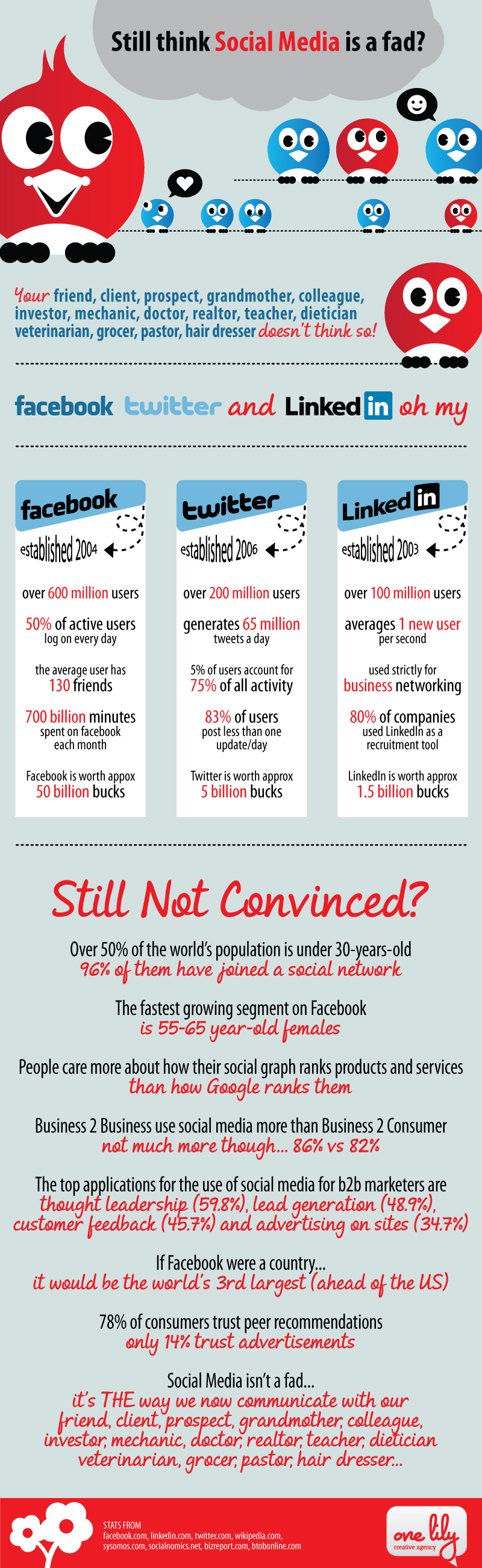
Social Media A Fad? Infographic

I love infographics so I’m sharing this.  I personally don’t know anything that thinks social media is a fad.  I think there is lots of debate about its proper use in different types of businesses especially in patient care, but I think it’s proven it’s here to stay in some form.

No Plans To Split Up CVS Caremark

I’m glad to see Larry Merlo come out in the CVS Caremark earnings call and talk about them not splitting up the company (see Adam Fein’s post).  I’ve been talking about this for a while (see old post).  I think that they have the right combination of assets to do something really significant. 

They followed that up with a press release this morning:

Speaking at the Annual Meeting of Stockholders for the first time as CVS Caremark CEO, Merlo said, “The fact is no one else can match our combination of assets — a leading PBM, one of the largest retail pharmacy chains, a leading specialty pharmacy, a growing Medicare Part D business, and the largest and fastest-growing network of retail health clinics. CVS Caremark is using these combined assets to develop and implement innovative programs and offerings, such as Pharmacy Advisor and Maintenance Choice, which should drive long term value for shareholders.”

The rumors and stories of increased value of splitting the company up were getting to be too much noise.  Employees, clients, customers, investors, and everyone else needed them to come out and set the record straight.  Of course, anything can be debated and changed over time, but you need a clear direction.  I’m glad to see them stand up and reiterate their strategy and vision around creating a unique set of assets to derive unique value. 

[Disclosure: As I’ve shared before, CVS Caremark stock is one of a few individual stocks that I own.]

15 Things You Should Know About Prescription Non-Adherence

One question I frequently get is “what should I know about adherence”. This is then followed by “so what should I do about it”.

Here’s my starter list of what you need to understand about medication adherence.

  1. It’s a $290B problem.
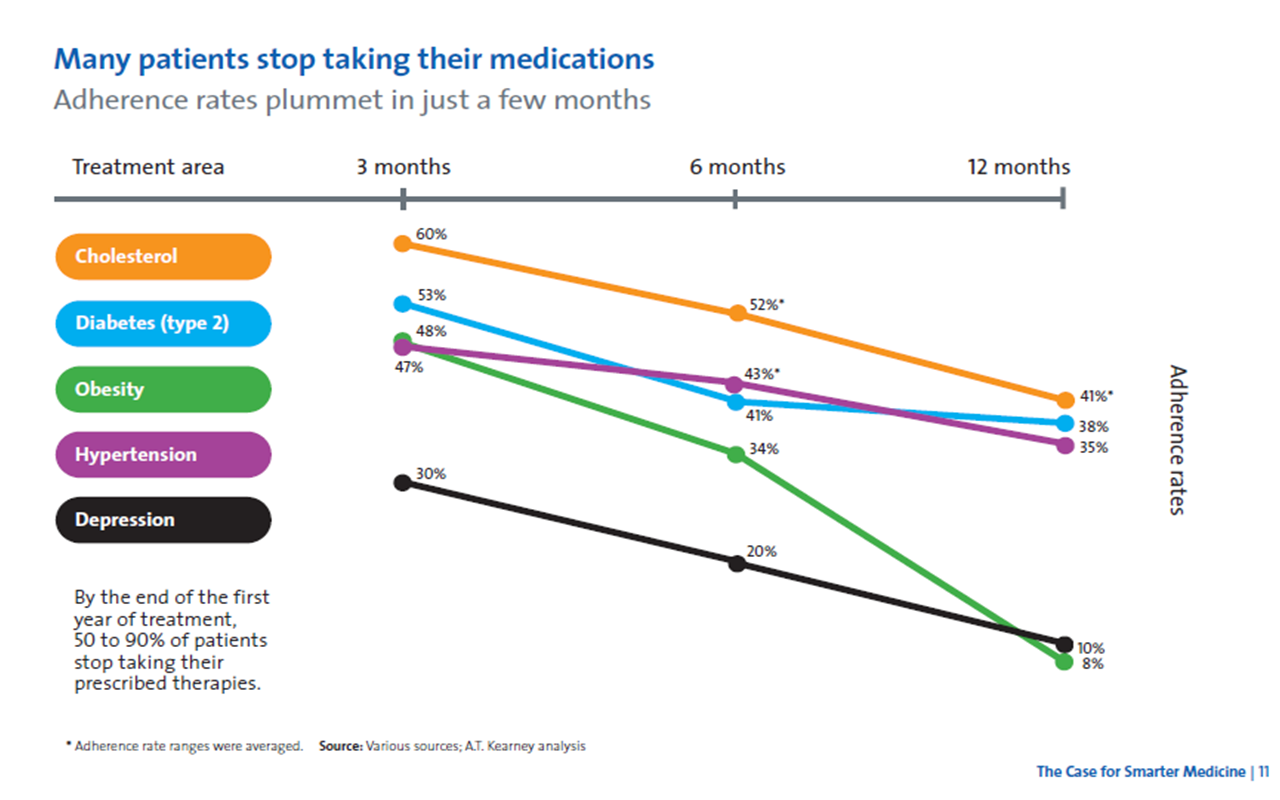
  2. Patients fall off therapy quickly.
  3. There are a lot of reasons for non-adherence…it’s not just about reducing out of pocket spend. AND, to make it more complex, there are variations by gender, culture, medication, condition, trust, copay levels, etc.
  4. There are lots of predictors of non-adherence (old study, Express Scripts, Merck tool), but generally the best predictor is past behavior.
  5. Interventions can improve adherence (CVS Caremark study, Express Scripts study, Silverlink data). BUT, physicians generally don’t see non-adherence as an issue they can address. (see also White Coat adherence)
  6. Patients don’t think they’re non-adherent (see “Rx Adherence Hits The Ignorance Wall” by Forrester that says only 8% of people think they are regularly non-adherent).
  7. Adherence reduces total healthcare costs (CVS Caremark study, Sokol study).
  8. Communications matter (misperceptions, physician-patient gap, health literacy, what physicians tell patients).
  9. There are lots of cool technologies that will work for different people (talking bottles, monitoring devices, iPhone reminders, websites, pill boxes). BUT, improved labeling and bottle design may not be the answer (analysis of Target improvements).
  10. Starting on generics (or lower cost drugs) improves the probability of adherence.
  11. Pharmacist involvement is key and impactful (CVS Caremark study, Ashville).
  12. 90-day prescriptions lead to better medication possession ratio (Walgreens study, CVS Caremark study, Kaiser study, Express Scripts study).
  13. Complexity of therapy (e.g., number of prescriptions) increases the likelihood for non-adherence.
  14. Electronic prescribing gives us new visibility into primary adherence and should also create opportunities to improve this issue.
  15. It’s an area where everyone wins and there’s lots of research…but there’s no silver bullet.

Should You Pay Physicians For Medication Adherence?

I’d love to hear some physician perspectives on this. It’s a question that comes up every once in a while.

Let’s start with a few facts:

The question of course is what to do about that. Most of the programs focus on consumer or patient interventions.

  • Refill reminders
  • Gaps-in-care
  • Off-therapy reminders
  • Auto-refill programs
  • POS consultations by the pharmacist

But, interestingly, I’ve seen a few other studies recently that show that prescription programs targeting physicians can influence behavior (example here). I’ve also heard a few companies talk about paying physicians to keep patients adherent.

There are a few arguments that happen here:

  • Should the physician play a role in adherence?
  • Does the physician know if a patient is adherent? Should they get this data? From whom?
  • If the physician asks the patient, will they tell them to truth or will it simply be a case of “white coat” adherence?
  • Should this be a performance metric in a pay-for-performance environment?
  • Will PCMHs and ACOs structures change this and make adherence a critical issue for discussion between the patient and physician?

In general, I think most people believe that physicians (as indicated in studies like this one) don’t see prescription adherence as a big issue that they can or should influence. Is that true? Would “incentives” change that?

Of course, the debate isn’t limited to paying physicians as multiple companies are paying consumers to be adherent. Here’s a post from last year from another blogger called “Paying Patients To Take Their Medications Is Stupid” which is similar to one of my posts from last year.

Another Reason To Lose Weight – Memory

In case you (or me) need another reason to lose weight…A study in Surgery for Obesity and Related Diseases showed improvements in scores for recall and attention after patients lost weight with bariatric surgery. 

Why would body weight have anything to do with brain function? It turns out that obesity works on a number of different metabolic pathways that can affect the way we process information. “Obesity affects a number of physiological mechanisms that can have an adverse effect on the brain,” says [John] Gunstad. “Hypertension, Type 2 diabetes, sleep apnea, all of which are consequences of being overweight, are all bad for the brain.”  (source)

Looking Forward To The Silverlink Client Event – RESULTS2011

One of my favorite events every year is the Silverlink Communications client event in May in Boston.  Our marketing team does a great job of pulling together a mix of clients and external speakers to really motivate and challenge the audience.  It’s not much of a sales event, but it does a great job of pushing a lot of key topics for discussion.  (See prior posts – last year’s event, notes from RESULTS2010, and notes from RESULTS2009.)

This event was one of the things that originally convinced me to join Silverlink back in 2007.  Sitting and talking with clients about their experiences with the company, their shared passion for results and outcomes, and their interest in collaborating to improve outcomes for consumers was motivating.

This year should be no different.  This year’s theme is – “Seeing Healthcare Through The Eyes Of The Consumer“.  There are presentations on sustaining engagement, obesity, diabetes, health literacy, social media in healthcare, adherence, loyalty and retention, health reform, STAR, HEDIS, and many other topics.

Some of the speakers include:

  1. Dr. Atul Gawande (Harvard, The New Yorker, Author)
  2. Thomas Goetz (WIRED Magazine)
  3. Dan Buettner (Author, The Blue Zones)
  4. Mark Merritt (PCMA)
  5. Dr. Will Shrank (Harvard)
  6. Jim Wilson (WilsonRx)
And many other executives from across healthcare.
It promises to be another banner event.  I’ll share some summarizes as time allows via Twitter and eventually after the event.
I guess with attendance maxed out and the hotel sold out it’s time for me to buckle down and work on my presentation!

Should You Worry About The Drug Dealer Or Your Prescriptions?

Drug abuse has been an issue for years. I think the advertisement on TV that has a drug dealer talking about getting less calls makes a point that I hear more and more – patients selling their prescription drugs to make money.  Some of this is intentional, but some of this is opportunistic.  You don’t have to go far to hear about seniors being arrested for selling their prescriptions to make money to pay bills (recent article). 

And, recreational use or overuse of controlled substances is a growing problem.

“Unintentional drug overdose is a growing epidemic in the U.S. and is now the leading cause of injury death in 17 states,” Center for Disease Control Director Dr. Thomas Frieden was quoted as saying in a statement from the White House’s Office of National Drug Control Policy. (source)

There are lots of stories about kids using prescriptions drugs for ADHD recreationally to help them study.  There has probably been a switch over the years from stealing liquor from parents liquor cabinet to borrowing a few of their prescriptions (see story on 5 drugs kids steal most often).  It’s a scary thought.  (Or, this article says that 20% of the time adults are asking kids if they can use their ADHD medicine.)

The Partnership For a Drug-Free America‘s latest survey has 61 percent of teens reporting prescription drugs are easier to get than illegal drugs, up significantly from 56 percent in 2005. And 41 percent of teens mistakenly believe abuse of medicines is less dangerous than abuse of illegal street drugs.

When Lifestyle Changes Aren’t Enough…

A story in the Lifetime Fitness publication focused on the this line which you often hear in pharmaceutical advertisements “When lifestyle changes aren’t enough . . . ”  But, obviously, their pitch is that changing your life can and does work with a blend of diet and exercise.

In fact, research shows that basic shifts in nutrition, activity, stress and other lifestyle factors can be more effective than drug protocols in treating inflammatory health conditions — dramatically improving overall health and fitness in the process.

They provide a nice summary of articles in a PDF that I thought were worth sharing.  It includes articles on the following suggestions:

  1. Eliminate processed carbs
  2. Avoid sugars and alcohol
  3. Emphasize healthy fats
  4. Pack in phytonutrients
  5. Get more food-based fiber
  6. Aim for a blend of activity — high and low
  7. Get plenty of rest
  8. Set boundaries around work
  9. Meditate regularly
  10. Manage stress
  11. Minimize inflammation

Does Changing Drugs Erode Trust

One of the big tools that PBMs use to manage drug trend and improve generic fill rate is step therapy. Another one is therapeutic substitution. Both of them rely upon the patient to change medications.

Based on a study published last year, one of the issues identified for adherence was the patient’s belief or trust in their physician. Switching medications (I.e., trial and error) was viewed as eroding that trust.

It creates an interesting question about these tools. Do they erode trust? Do they impact adherence? I think the standard perception would be that lower cost medications would improve adherence. I know research by Shrank has shown that starting on generics leads to better MPR. Is that true for patients that start on a brand and move to a generic?

On the other hand, the research points to the need for the physician to explain to the patient about the plan for care which might include “trial and error”. Certainly personalized medicine may change this need in the long-term, but in the interim, does this create a chance for PBMs to support MDs in a new way by providing this context to the patient?

More questions here than anwers, but an interesting topic.

Patient Educ Couns. 2010 Jul 30.
“Practicing medicine”: Patient perceptions of physician communication and the process of prescription.
Ledford CJ, Villagran MM, Kreps GL, Zhao X, McHorney C, Weathers M, Keefe B.
George Mason University, Fairfax, VA, USA.

Abstract
OBJECTIVE: This study explores patient perceptions of physician communication regarding prescription medications and develops a theory of the effects of perceived physician communication on the patient decision-making process of medication taking.

METHODS: Using a grounded theory approach, this study systematically analyzed patient narratives of communication with physicians regarding prescription medications and the patient’s resulting medication taking and adherence behavior.

RESULTS: Participants described concern about side effects, lack of perceived need for medications, and healthcare system factors as barriers to medication adherence. Overall, participants seemed to assess the utility of communication about these issues based on their perceptions of their physician as the source of the message.

CONCLUSION: The theory generated here includes patient assessments of their physician’s credibility (trustworthiness and expertise) as a critical influence in how chronically-ill patients process information about the need for prescribed therapy. Trial and error to find appropriate medications seemed to deteriorate patients’ perceptions of their physicians’ credibility.

PRACTICE IMPLICATIONS: A practical application of this theory is the recommendation for physicians to increase perceived expertise by clearly outlining treatment processes at the outset of treatment, presenting efficacy and timeline expectations for finding appropriate medications.

Interview With Dr. Victor Strecher (Founder of HealthMedia) From #WHCC11

While I didn’t get to meet Victor at the World Healthcare Congress in DC, I got a chance to do a phone interview with him last week. For those of you that don’t know who he is, here’s a quick bio:

Victor J. Strecher, PhD, MPH
Professor, Health Behavior & Health Education; Director, Health Media Research Laboratory; Director, Cancer Prevention and Control, University of Michigan School of Public Health;
Chairman & Founder, HealthMedia, Inc.
Dr. Victor J. Strecher graduated in 1983 with an M.P.H. and Ph.D. in Health Behavior & Health Education from the University of Michigan. After positions as Assistant and Associate Professor in the School of Public Health at the University of North Carolina, Dr. Strecher moved back to the University of Michigan, where he became Professor of Health Behavior & Health Education and Director of Cancer Prevention and Control in the University of Michigan’s Comprehensive Cancer Center.

Dr. Strecher also founded the University of Michigan’s Center for Health Communications Research (CHCR): a multidisciplinary team of behavioral scientists, physicians, computer engineers, instructional designers, graphic artists, and students from a wide variety of disciplines. For over a decade, Dr. Strecher’s center has conducted research studies and demonstration projects of computer-tailoring and interactive multimedia programs.

In 1998, Dr. Strecher founded HealthMedia, Inc.– a company designed to create interactive health communications solutions for medical care, employer, pharmaceutical, and government settings. The intention of HealthMedia, Inc. is to bring the highest quality science, operational capabilities and creativity to the marketplace.

My key takeaways from the conversation were:

  1. We have to focus on intrinsic motivators in healthcare.
  2. A little help at the right time is a lot better than a lot of help at the wrong time.
  3. Selecting physicians based on organic chemistry scores without weighing empathy may be a issue.
  4. You have to listen to the patient, assess their needs, and provide them with tailored information.
  5. Social media has to embrace “collaborative filtering”.
  6. Most behavior change companies are hitchhikers while some like PBMs are tollbooths. It’s better to be a tollbooth.
  7. Choice has to expand over time.

Intrigued? You should be. Dr. Strecher was a fascinating person to talk with (see some of his insights). We only spent 30 minutes together, but I could easily imagine sitting with him in at my alma mater (University of Michigan) and talking for hours about healthcare communications and how this can impact the country and our outcomes.

We started off by talking about the shift in focus to the consumer over the past decade and how even while this has happened we (healthcare companies) have been guilty of seeing the patient from our perspective not from their perspective. This took us down the path of talking about motivation and what gets people to take action. We focused on the fact that health (in and of itself) isn’t a big motivator, but being healthy to see your kids or grandkids certainly is. We talked about how financial rewards aren’t the right (or only answer) and how there is a need to really understand and articulate intrinsic motives (see write-up on Drive by Daniel Pink).

We talked about his company HealthMedia (owned by Johnson & Johnson) and what they do to collect information on motivation. We talked about the use of stories (a topic that keeps coming up) and providing the right amount of help at the right time. He talked about how HealthMedia monitors consumers, provides them with coaching, and continuously evaluates their goals. He also talked about how they use online technology and mobile technology to get the right connection at the right time.

This led us into a discussion about how important behavior is in health outcomes. He mentioned that 70% of cancers are related to behavior – scary. But, at the same time, we don’t chose candidates for medical school based on their abilities to engage patients or show empathy. We choose them based on their organic chemistry scores. (As a physician, he could say that while I’d probably get tomatoes thrown at me for that comment.)

At this point, I really wanted to understand what HealthMedia has learned to get people off the couch and engaged. It all sounded a little too theoretical to me. He talked about their core process:

  1. Listen to the issues. Assess the patient using branching technology and feedback to them.
  2. Try to figure out what they need using a software algorithm.
  3. Tailor information to them based on what you’ve learned (e.g., if they are concerned about gaining weight when quiting smoking, help them with that). And, I thought a key point here was to help them prioritize their actions rather than giving them a laundry list of things to do.

But, one of the keys in getting them to engage is to work through their intermediaries – employers and payers. For example, while you might encourage consumers to take an HRA for a financial reward, you may need a “health champion” at the employer site to really motivate people at a personal level. Or in another example, he talked about how Kaiser uses Epic and how HealthMedia integrates there. This creates an opportunity for “information therapy” which can be given to the consumer as a follow-up action from their encounter.

We went on to talk about social media which is one of those big topics in healthcare today. Obviously, there is lots of research that talks about the “peer pressure” effect on weight and smoking and other topics. (He mentioned the book Connected here.) But, how to you build trust (see recent post on this) and route consumers to the relevant information. He brought up a concept which was new to me called “collaborative filtering”. My interpretation of this is essentially having an expert monitor and guide consumers to relevant information within the social media realm. You want to find relevance in the data which means it has to be from “friends” who have experience with the topic.

I was asking him about the challenge of building trust given how many companies are out there and the amount of information which consumers are bombarded with. This is when he created the great visual of most companies as being hitchhikers in the behavior change world while others like PBMs are tollbooths. The tollbooths create a pause in the process which is triggered around an event. This event is an opportunity to get the consumer engaged. Of course, in general, these “golden moments” (my phrase) aren’t taken advantage of as much as they could be.

But, if they were, consumers would understand what they want and how a particular behavior maps to those desires. This would lead to improvements in adherence and other outcomes.

We wrapped up by talking about preference-based marketing and the impact of choice. He had some great points here which is an area of interest for me since there’s not much research. He pointed out that choice is instrumental since it appeals to autonomy. BUT, not everyone wants autonomy. Too much choice can be overwhelming. In summary, he suggested that less choice is best early on when the consumer is overwhelmed (e.g., newly diagnosed), but as they become more of an engaged patient over time, more choice is better.

QR Codes – The Ultimate Opt-In Tool

You probably are starting to see them more (those 2D barcode boxes).  They’re called QR codes.  Here’s a few articles about them:

I find this a fascinating area.  Imagine a few examples here:

  1. You want to get a member to opt-in to a program (e.g., auto-refill).  You can put a QR code on their invoice.
  2. You want to offer an educational video about a condition.  You can put a QR code on the Rx label.
  3. You want to get consumers to opt-in to a SMS program.  You can put a QR code on a mailing.
  4. You want to offer a physician access to the clinical studies about a drug.  You can fax them some information with QR codes on it. 
  5. You want a patient to learn more about a condition.  You could put up DTC materials in the provider’s office with QR codes. 

I think you get the point.  I expect this will grow rapidly especially as the smart phone market grows and more and more people have cameras in their phones (devices). 

One of the biggest uses right now in pharmacy is from Walgreens where they allow you to order a refill by scanning the QR code on their bottles using their mobile app.

The CVS Caremark Drug Trend Report (Insights) Is Out

The new CVS Caremark Insights 2011 report (Drug Trend Report) is out.  I haven’t read it yet, but here’s the summary from the press release:

  • 2.4% overall trend
  • 13.7% specialty trend
  • GDR of 71.5%

“The continuing increase in the use of expensive specialty drugs, as well as the growing prevalence of chronic disease, calls for innovative health care solutions such as an integrated pharmacy home to help patients deal with complex therapy regimens and stay adherent,” says Troyen A. Brennan, MD, MPH, Executive Vice President and Chief Medical Officer of CVS Caremark. “Developing a pharmacy home was one of the recommendations raised by our recent research conducted with Harvard Medical School and Brigham & Women’s Hospital. That work and this report make it clear we must devise better ways to serve the chronically ill. This trend report shows we are making headway in that fight.”

The Express Scripts 2010 Drug Trend Report – Waste and Intent Focused

As I’ve talked about in the past, after working on the Express Scripts Drug Trend Report (recent copy here), I really enjoy getting the chance to read through them every year (see 2009 review or 2008 review). Over time, they’ve become less about the clinical side of the business and more about the programs used to engage the consumer with consolidated class specific data still included.

This year’s report is similar, but it is built around a new study that Express Scripts just completed with Harris Interactive. It comes to a rather surprising but interesting conclusion –

We discovered that the majority of people want to engage in the same behaviors plan sponsors seek to promote, but these desires often remain dormant. That is, there is a persistent intent–behavior gap. The key is structuring interventions that close the gap between what patients already want and what they actually do.

What’s the key point here? The point is that this says that consumers really want to move to generics and move to mail order, but they don’t do it. Is it that simple? I’d love to think so. And, for generics and mail order, I’m more likely to believe that inertia is a large factor. BUT, as I’ve talked about before, adherence has lots of complicating dimensions.

They focus on the gap between the physician and the optimal outcomes. This is certainly a major factor, but beyond consumer intent, there are issues of health literacy and physician beliefs that have to be addressed. Regardless, the point is correct…how do we engage and motivate consumers to change behavior especially if they are pre-disposed to change (when presented with the right facts).

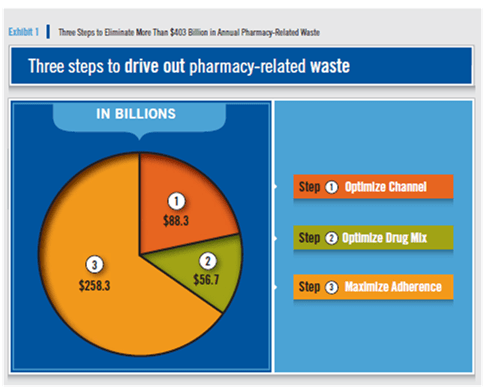
They did continue to build on last year’s focus on WASTE. They estimate that the waste in 2010 was over $403B as broken down below:
As adherence is a key issue here, they highlight the difference in adherence rates between retail pharmacy and mail pharmacy.

The focus of the report and the early press I’ve seen has been on the following chart. What it shows is some of the data from the Harris study saying that 82% of people would chose a generic (that are on a brand) and (depending on copay savings) 55-71% would chose retail.

One topic that I was glad was in the survey was limited networks. This is a topic everyone’s talking about from ReStat to Wal-Mart to Walgreens to CVS. Here’s what the research said with some explanation for what it means:

Of note is that about 40% said they would be willing to switch retail pharmacies to save their plan (or employer, or country) money. This fi gure is not as low as it fi rst appears because before a plan implements a more narrow retail network, a large fraction of members already use these pharmacies and therefore don’t have to switch pharmacies. It is not unusual, for example, for a client using a broad network to have 70% of prescriptions processed through pharmacies that are in the narrow network; members currently using these pharmacies do not have to make any changes. When a narrow network is implemented, if 40% of the users of the remaining 30% of prescriptions would willingly move to a lower-cost network pharmacy (as suggested by the survey), we estimate that the resulting overall market share within the narrow network would rise to 82% {70 % + (30% x 40%)}. (page 14 of the DTR)

All of this tees up their family of “Select” offerings (see Consumerology page) which builds on the success of Select Home Delivery and applies the concept of “Choice Architecture” from the book Nudge.

They talk about some of their work with adherence and their Adherence IndexSM. This metric is certainly one that has the industry’s attention as people wonder about the predictive value, how this is used, and how to craft solutions around such an index. My perception has been looking at studies like this one by Shrank and colleagues that past behavior remains the best predictor of future behavior, but I’m happy to be wrong.

So…what were the trend numbers?

  • 1.4% in the traditional (non-specialty drugs)
  • 19.6% in specialty
  • 3.6% overall

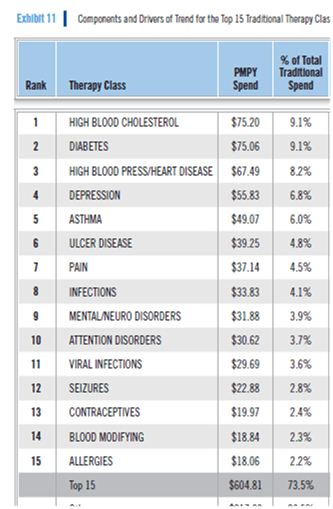
One of the other lists that I always find helpful to have is what are the top 15 drug classes and the PMPY spend.
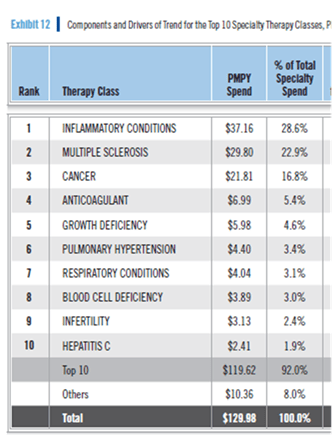
Of course, in today’s world, you really want to know this for specialty medications:
So, as always, I would recommend you read the report. Lots of great information in here. Interesting research. Good thoughts on consumer behavior and how to change it.

I think this week is their Outcomes conference which was always a good event.

How does luxury “framing” impact decision making?

Are people who travel in town cars and on corporate jets different—on a psychological level—from you and me? Does the availability of luxury goods “prime” individuals to be less concerned about or considerate toward others? The answer from new research seems to be yes.

It’s an interesting question with relevance for us in healthcare.  Does the environment in which we work and make decisions impact our decisions?  Is that true for day-to-day work?  For conferences?  For delivery of care?

In general, I believe most of us that work in healthcare are passionate about improving outcomes.  We want to understand how people make decisions.  We want to understand why things happen.  This isn’t just a job.  Given that, these types of studies are important as we think about healthcare communications.  What types of images should we use in our print media, web, and e-mail?

It also makes me wonder about verbal queues or sonic branding.  Can certain words or noises make us more or less likely to make choices that are in the best interest of the group.  For example, if we framed decisions as savings money which would be provided to a charity would more people respond to take that action (e.g., moving to a generic drug) than if we framed it as saving money for the company and therefore allowing more earnings-per-share (EPS). 

“people who were made to think about luxury prior to a decision-making task have a higher tendency to endorse self-interested decisions that might potentially harm others.” (HBS professor Roy Y.J. Chua on what they found in their research)

Save Lennox Campaign Points To Two Health Issues

Have you heard about the Save Lennox campaign?  It’s a sad story of a little girl’s dog in Ireland that’s been incarcerated.  The girl is disabled and the dog is her service dog.  I had the chance to hear Victoria Stillwell from It’s Me or The Dog (TV show) talk about this last night.

What struck me (beyond the story) were two things:

  1. The importance of service dogs within healthcare.  They now do a lot of things beyond simply help the blind.
  2. The rising issue of dog bites and the fact that breed specific legislation (BSL) doesn’t work.  Dog bites have gone up in areas where pit bulls have been banned.


How the application changes your experience? Flipboard and Twitter

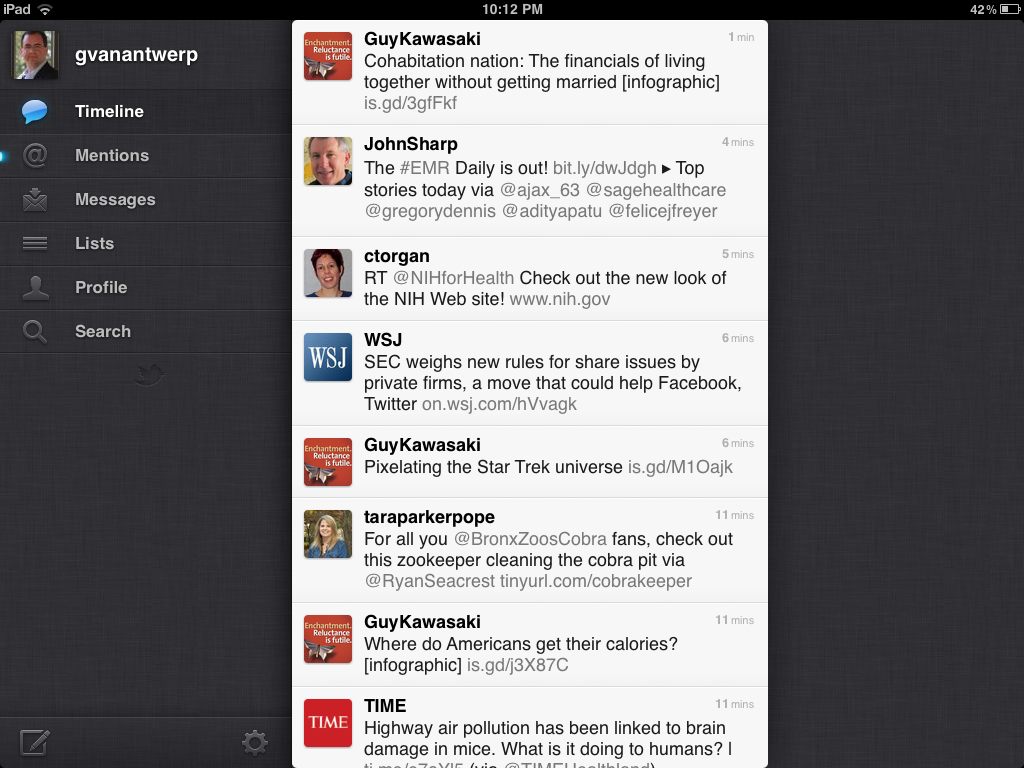
I’ve found Twitter to be a great way to get news.  You follow a core group of people who talk about topics that you care about and can quickly sort through mainstream and other news and events. 

But, I was shocked to see the difference in experience moving from using Twitter in a standard format to using it within Flipboard.  Flipboard takes the links and activates them.  It pulls in images, and it makes it into a book.  See the two images here from my new iPad2.

The Physician As Island Versus Support From Intermediaries

Should physicians have the final say in patient care?

Someone tweeted me this question the other day. It made me start to think…

Logically, individuals trust their physician to act in their best interest and make the best decisions (based on the information they have).  But, this has shifted from the MD as the primary source of knowledge to the MD as a part of a care team.

There are probably more, but I can think of 5 important things that need to be fixed for the physician to be seen as an ‘information island’ where they can make the best decisions without intermediaries (PBMs, managed care, disease management companies) intervening:

1.  They have to be able to not practice defensive medicine.

2.  They have to understand my costs.

3.  There have to be no meaningful differences based on geography or income or race.

4.  They have to adopt best practices quickly.

5.  They have to be able to be paid based on outcomes.

Some of these are systemic changes that have to be addressed (#1 and #5). The other three can be addressed thru technology (as long as physicians are willing to embrace the science of medicine not just the art).  As a quick example, look at Dr. Atul Gawande’s book. – The Checklist Manifesto or look at some of the work by companies like Health Dialogue on shared decision making.

Now, maybe the person that asked the question is taking a more radical stand and physician’s embrace the support these companies provide them, but that hasn’t historically been true.

Interview With Dr. David Wennberg At #WHCC11

I had the opportunity to sit down with Dr. David Wennberg (Chief Science & Product Officer, Health Dialog) at the 8th Annual World Healthcare Congress (Twitter hashtag #WHCC11).  David is a fascinating and engaging speaker.  He has lots of publications, works with the Dartmouth Atlas, and leads the Health Dialog Analytic Solutions group. 

David and I began our time talking about “informed choice”.

In this environment, doctors need tools that identify patients lacking evidence-based care. They also need to ensure that patients undergoing surgery have been exposed to informed choice, not just informed consent, when there is more than one legitimate treatment path. With these resources in place, physician groups can ensure that they are in control of their own destiny when it comes to performance evaluations.  (source)

This is an important issue in healthcare.  Giving patients (1) complete information in (2) language that they can understand and helping them (3) frame their options relative to their preferences is at the core of this issue. 

Health Dialog calls this Shared Decision Making and focuses on how to engage targeted consumers and help them make their best decision.  Their customer support personnel go through a certification process and use decision aids to enable the process. 

This led us into a discussion about “trust” (see prior post) and then into a discussion about “embodied conversational agents“.  Obviously, if you’re going to help consumers make decisions, they need to trust you.  We talked about the need to have transparency, the need to for disclosure, and the importance of using clinicians in the engagement and discussion process.  In many cases, nurses and the empathy that they have are critical to this process.

But, I know from prior exposure to Health Dialog that they have figured out ways to blend technology and agents.  They do a lot with data and analytics to really understand the popluation.  They’ve worked hard to avoid the traps that “disease management” has fallen into over the years.  He shared with me some amazing engagement statistics. 

We talked about the value of peer-to-peer videos for people to understand their condition and talked about some recent studies around storytelling and distributing that information via DVD to patients (see more on study).  We went on to talk about how engaging the consumer in the decisions about their care increase success, but that many models have been a challenge to scale.  Health Dialog just published an article in the NEJM called A Randomized Trial of a Telephone Care-Management Strategy which demonstrated an ability to scale the solution and get results. 

At baseline, medical costs and resource utilization were similar in the two groups. After 12 months, 10.4% of the enhanced-support group and 3.7% of the usual-support group received the telephone intervention. The average monthly medical and pharmacy costs per person in the enhanced-support group were 3.6% ($7.96) lower than those in the usual-support group ($213.82 vs. $221.78, P=0.05); a 10.1% reduction in annual hospital admissions (P<0.001) accounted for the majority of savings. The cost of this intervention program was less than $2.00 per person per month.

Before I could even jump to my next question about ACOs, he made the natural transition to the fact that the new ACO regulations mention shared decision making 8 times.  I believe we both agreed that whatever actual form these new practice settings take that they will accelerate the importance of leveraging technology and things like shared decision making to engage the consumer.  The key is to leverage the PCP setting whether it’s the MD or someone on their staff as the foundation for engagement.

This led me to ask him about physician acceptance of technology as part of their practice (more on this later).  He felt that they had moved from resistance to understanding the technology and “guides” can enable them to practice better medicine.

Does virtual exercise count towards physical activity?

I remember when I first played Wii Boxing and was sweating like I just went for a lite run.  It made me believe that there was something about using games to get kids to exercise even if they weren’t playing outside (which is ideal). 

A new study published in the Archives of Pediatrics & Adolescent Medicine confirms this.  I guess the category is formally called “exergames”, but they looked at several games including (with their Metabolic Equivalent Task value):

  • Wii Boxing: 4.2 METs
  • Dance Dance Revolution: 5.4 METs
  • Cybex Trazer: 5.9 METs
  • LightSpace: 6.4 METs
  • Xavix: 7.0 METs
  • Sportwall: 7.1 METs

Here’s the summary:

[the researchers] found the games “compared favorably with walking on a treadmill at three miles per hour, with four out of the six activities resulting in higher energy expenditure”

Data: Should You Be Paranoid?

I think we all know or are quickly realizing that everything we do leaves a trail of breadcrumbs.  That trail is a series of data points which now can be aggregated to create a record of you.  What you do?  What you buy?  What ads you respond to?  Who your friends are?  The list goes on. 

The question of course is whether you should be paranoid and worried about it. This video below shows you the extreme scenario of how data could be abused.

In a more balanced view, Time Magazine had an article call Your Data, Yourself which just appeared on March 21, 2011.

Oddly, the more I learned about data mining, the less concerned I was. (Joel Stein, author of article)

The article talks about a variety of companies that collect and sell data:

  • Google Ad Preferences
  • Yahoo!
  • Alliance Data
  • EXelate
  • BlueKai
  • RapLeaf
  • Intellidyn

The author makes a key point…a lot of the things we get for free are free because people collect and sell our data.  Otherwise, these “free” business models wouldn’t exist.  Would you pay for all the content and other things you get today or do you just want to understand what happens to your data?

On the other hand, the author shows you how data put together adhoc can paint erroneous pictures of you.  Should you care?  Do you want to fix this?  Can you control it?

This is all important since there is some do-not-track legislation being discussed.  (See Joe Manna’s post on this for some additional perspective)  Several people bring up the good question…

While we say that we don’t like to know that our data is being used to target ads at us, do we really want to have to sort through all the irrelevant advertisements?

Of course, we all become a lot more sensitive around healthcare data.  But, somehow, I doubt many of us think about what happens when we use our work PC to research a condition (see article on 10 ways to monitor your employees).

The article also suggests some sites for protecting yourself:

Don’t expect this one to go away.  With issues like the data breach at Epsilon, people are concerned.  Additionally, as data gets co-mingled and your credit score is used to determine health programs (for example), there may be limits about what and how information is used.

A Few Points On Generics

I’m sharing a few quotes from the recent Drug Benefits News on generics here:

“Despite the fact that generics use has long been mainstream, a recent survey we conducted found nearly one-third of Americans still do not know or believe that generics have the same active ingredients and effectiveness as brand name drugs,” Brian Solow, M.D., senior medical director for clinical services at Prescription Solutions, the PBM subsidiary of UnitedHealth Group

It would be interesting to look at that data based on age, gender, number of prescriptions used, physician, geography, and several other factors.  That 1/3rd is similar to what I’ve seen in terms of skeptical physicians which would then make a lot of sense as patients of those physicians would be skeptical of generics.

“We are advocating an increase in the differential between generic and brand name copays,” David Lassen, Chief Clinical Officer at Prime Therapeutics LLC says. “Right now the average differential between Tier 1 generics and Tier 2 preferred brands is about $15. We think this difference should be bigger.  We’ve seen research suggesting consumers need to save an average of $25 in order to select a generic over a brand name drug.”

An interesting point on copay differentials that a friend of mine recently made is what is the actual differential after grandfathering and formulary overrides which happen.

Cured After The First Fill!

I was at a presentation recently where a Chief Medical Officer from one of the PBMs was talking about a survey they did on statin users and why they didn’t refill.  Amazingly, he said that 21% of people said they thought they were cured after the first fill.  Talk about a problem.

This data reminds me of a barrier survey from a statin adherence program that we did where 37% said they didn’t know they were supposed to refill their medication. 

This topic then reminded me of a study that was published in the Archives of Internal Medicine in 2006 which looked at the frequency with which physicians did certain things when talking with patients.  So, how often did they explain the duration of therapy to the patients – 34%!

Sometimes, we spend so much time trying to solve the complexities of adherence when there are baseline activities which can make a huge difference.

Trust As The Foundation For Healthcare Communications

Trust improves medical outcomes. It is the number one predictor of loyalty to a physician’s practice. Patients who trust their doctors are more likely to follow treatment protocols and are more likely to succeed in their efforts to change behavior. (Introduction of The Trust Prescription)

I just finished reading The Trust Prescription For Healthcare by David Shore. I would recommend it. It definitely framed things in a differently light. I also had a chance to talk with David on the phone and pick his brain a little. He sounds like a great speaker, and I’m looking forward to his new book coming out around building trust as an intermediary (i.e., managed care company or PBM).

A few of my highlights from the book are:

  • Trust can be a differentiator.
  • Trust is good business.
  • The physician to patient relationship is where the baseline of trust exists today. Although he brings up the question of whether that trust erode as you get more and more time pressure.  [I don’t remember the book specifically addressing the pharmacist – patient trust relationship although one would assume it is a similar foundational element.]
  • Trust is critical in healthcare because you’re asking a vulnerable patient to believe you can help them.
  • Profits may be negatively correlated with trust in healthcare (but not in other industries).
  • He pointed out the fact that it’s ironic that while pharmaceutical companies do so much good they get such a bad rap.
  • It was the first time I had seen someone introduce the issue of how healthcare entities are portrayed in TV shows and how while this is generally neutral that managed care organizations in the early 2000’s were portrayed negatively (and probably still are).
  • He talks about the concept of “response shift” which I think it an important phenomenon about how our expectations change over time and the effect of expectations on trust.
  • He talks about how two things happen when trust erodes – government intervention and consumer activism. [Hey…that’s where we are today!]
  • He uses two examples many times which are very relevant:
    • Volvo is known for safety not specifically for making cars. They make sure this is consistent in their branding (e.g., not funding NASCAR races). It gets to the core of defining who you are. [This concept also made me think about the new Dawn campaign about saving wildlife.]
    • You can build trust equity like Johnson & Johnson did which helps you when you have issues. [The question is how long they can draw on this given their current issues.]
  • He holds out a few healthcare power brands but says there are very few – Mayo Clinic, Cleveland Clinic, BCBS, Kaiser, Massachusetts General.
  • He talked about the concept of a Brand Architecture which made me think about some of the recent rebranding efforts at United Healthcare.
  • He talks about how consumer understanding and communications are key to building trust.

Communication in healthcare typically runs into a series of obstacles related to listening, clarity, and confidence.

Some of the interesting research data was [noting that this was a book from 2005]:

  • 56% of consumers say they will pursue something simply because it was made by a company they trust. (Macrae and Uncles 1997)
  • About half of people agree that “doctors are not as thorough as they should be” and “doctors always treat patients with respect”. (National Opinion Research Center 1998)
  • Race was a highly significant variable in trust correlation even when researchers controlled for other variables. (Corbie-Smith, Thomas, and St. George 2002)
  • Patients are more likely to take a drug that they have requested than a drug with which they are unfamiliar. (Handlin et al 2003)

It book made me think of some interesting questions:

  • Does transparency build trust with consumers?
  • Does concierge medicine build trust overall?
  • Does the use of technology by physicians enable or erode trust? [I believe he said that a lot of physicians didn’t think so.]
  • Do non-profit systems have more consumer trust?
  • What does all the news about drug problems, medical errors, and other issues do to the overall trust of the system?
  • What are the trust queues for consumers by type of healthcare entity? (For example, a dirty bathroom at a hospital might make you worried. What’s true for insurers, PBMs, pharmacies, etc.?)

One key point to pull out that he makes is that

Without branding, healthcare becomes a retail industry, and in retail, as in residential real estate, the three most important factors are location, location, and location.

Only 56% Want To Set MD Appointments Online – Why Not?

To me, this survey has three major themes:

  1. People are still hesitant to communicate with their MDs using social media [not that surprising].
  2. People are slow to use the web even for administrative functions [why].
  3. Hispanics are much more willing to use technology to engage their provider [why].

Some of the data:

  • 85% would not use social media or instant messaging channels for medical communication if their doctors offered it.
  • Only 11% of respondents said they would take advantage of social media such as Twitter or Facebook to communicate with their doctor.
  • Only 20% said they would use chat or instant message.
  • 52% said they would confer via e-mail.  (versus 89% of Hispanics)
  • Only 48% said they would pay their physician bills online. 
  • 72% would take advantage of a nurse line if it was offered by their doctor.