Archive | Events RSS feed for this section

Walgreens Quote From NACDS As “Community Pharmacy”

While many of us would consider Walgreens as one of the two models of chain pharmacy (with CVS), this quote from one of their executives from the NACDS conference in Boston right now makes it sound like they consider themselves more of a community pharmacy.

“There is no greater value in healthcare delivery than community pharmacy.  When I talk of value, I am not talking just about all that community pharmacists do everyday to help reduce drug spend.  Though that is important, pharmacy’s value goes so much deeper.  It is about community pharmacy – and the expertise of pharmacists – as a true partner in a comprehensive and collaborative approach to healthcare.  It is about improving patient health, while delivering part of the solution to driving down health costs across the spectrum by preventing more costly forms of care.”  Walgreen Co. Divisional Vice President, Government and Community Relations, and 2011 National Association of Chain Drug Stores (NACDS) Pharmacy & Technology Conference Chairman Debbie B. Garza, RPh

Maybe this has been their long-term positioning, but I also wonder if a few events haven’t pushed them from being a mediator in the middle of the industry to taking a more hardline approach:

  • CVS (their competition) buys Caremark changing their retail perspective
  • Walgreens jumping into the direct-to-employer model at Caterpillar with Walmart
  • CVS Caremark and Walgreens network dispute in 2010
  • Walgreens sells their PBM to CatalystRx
  • Walgreens and Express Scripts ongoing dispute

Given the traditional angst between the independents and the PBMs, will Walgreens harden their position to be closer to the independents and what will that mean for the overall industry?

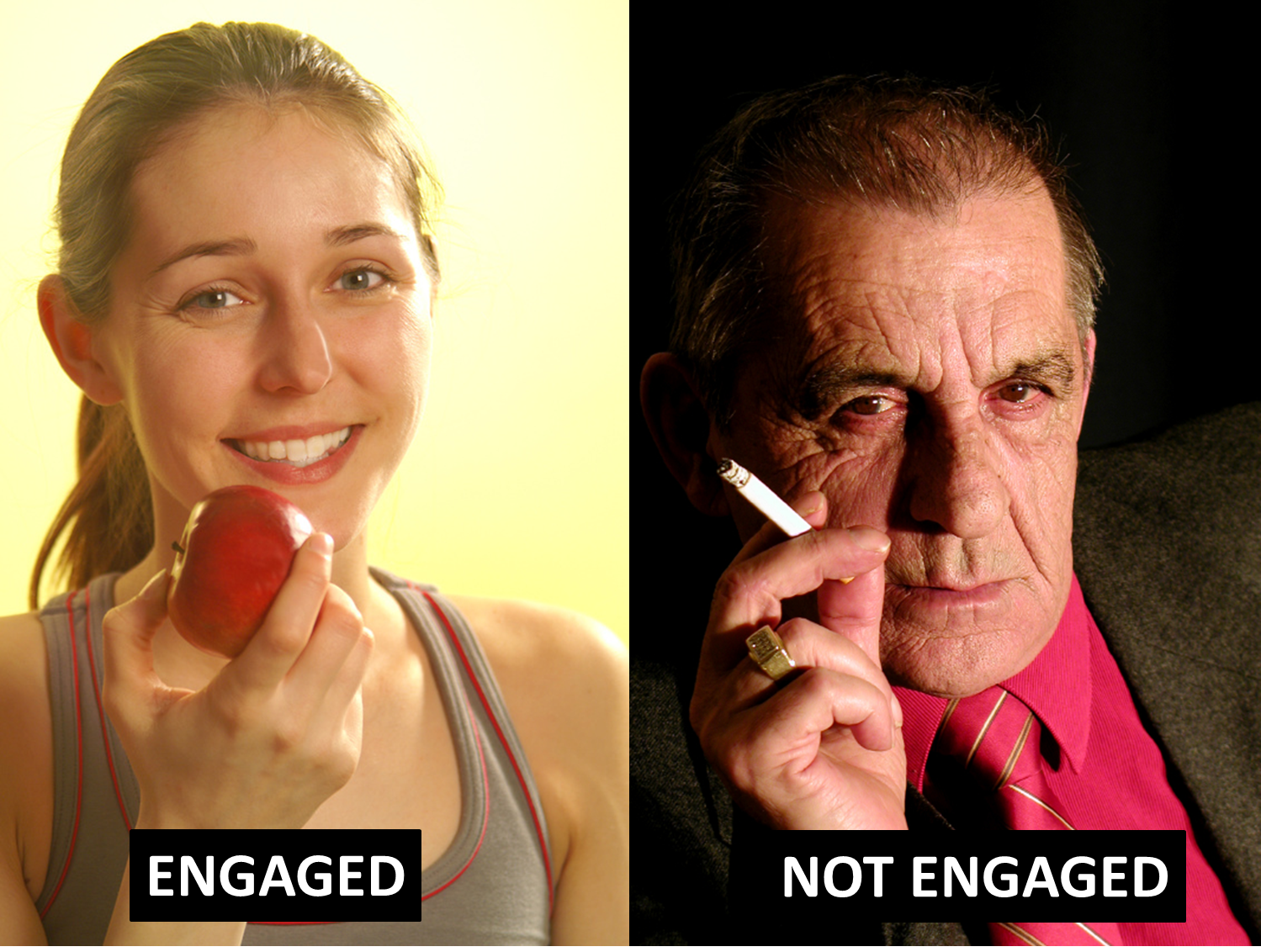
Engaging The Un-Engaged


One of the hot topics in a lot of healthcare conversations these days is engagement.  There’s the “easy” engagement for the e-patients that are actively involved in their healthcare.  Then there’s the much harder engagement of those that aren’t engaged.  And, finally, there’s the issue of chronic engagement.  I can easily get someone to engage a few times with an incentive or some other “trick”, but how do I get them to stay engaged over time.  It’s not easy.

This is one of the topics that will be discussed at the upcoming Forum 11 in San Francisco.  If you’re coming, look me up.  I’m presenting on Friday.

New Running Challenge Coming To St. Louis – RunRuckus

For those of you that like running challenges but are tired of the treadmill or your typical neighborhood run, this might be just the challenge.  This is part of the new extreme sports trend, but on a manageable scale for people like you and I.  A good friend of mine is working with the company that is sponsoring Run Ruckus in St. Louis and several other places (Columbus, Boston, Kansas City, Pittsburgh, and more in 2012).

While I’ll admit that I’m a little nervous since my training has been slack here, a good race is always a motivator to step it up.  And, 4 miles in obstacles should be interesting.  Want to join me?  I may have a 2 free passes to the first people that reach out to join me.  Let me know.

In the meantime, take a look and consider signing up.

Express Scripts (ESRX) to buy Medco (MHS) – WOW!!

In maybe even bigger news than the CVS acquisition of Caremark, Express Scripts announced this morning that they were merging (buying) Medco (for more information go to www.betterrxcare.com) . I’ve imagined a lot of scenarios for the industry, but this was not one.

You now have one big independent PBM with one owned by a retail and the third biggest owned by a payer. A big difference from a few years ago. The 3 models represent fundamentally different approaches.

I knew the United Healthcare decision would prompt something radical to happen in the industry, but I saw Medco driving that not being acquired. This brings a lot of things to mind:

1. What does this mean for the Walgreen’s negotiations with Express Scripts?  (original post)

2. What will the combined entity look like in terms of Consumerology + Therapeutic Resources Centers, International, Specialty, rebates, trend management, mail order operations, call center, and leadership?

3. There will be some serious consolidation over time of people and facilities. How long will this take?

4. Which system(s) will be used?

5. Will this accelerate other consolidation? I would think this puts other PBMs in play.

6. Will United build on their PBM by being an acquirer of other PBMs? How will CVS Caremark respond?

7. With the FEP decision re: Medco, will this impact DOD at Express Scripts?

8. Which of the executives survive? For example, much of David’s team (Medco CEO) has been together for a while. Do they have parachutes? Do they all leave?

9. This becomes a huge client for a wholesaler and other vendors. How will they throw their weight around and what does that mean for the competition?

10. How will they leverage unique components across companies (e.g., different approaches to Medicare, systemed, worker’s comp)?

Of course, all of this assumes the SEC approves this, but I assume the parties feel this is very likely. The industry will look like the wholesalers from a concentration perspective. Will this simply be the beginning of mass consolidation across healthcare – payer, hospital, pharma, technology?

And, at the end of the day, what will the combined entity’s culture be and how will other’s react? I’m sure you’ll see lots of lobbying against the combined entity.

And, in all this, I think people probably missed an analyst report on another PBM that said they thought two captive PBMs with an estimated value of $200-400M would be up for sale in the near future. Who could that be?

Other articles on this:

Will Copay Cards Doom Rebates?

Only 20% of the people I surveyed believe that copay card success could ultimately be the end to pharmaceutical rebates, but I think it’s a fascinating discussion topic.

If you’re a manufacturer, you have a finite budget to drive sales of your product. That budget can go to DTC advertising, market access (i.e., rebates), samples, copay cards, adherence programs, physician education, detail reps, and a few other areas.

The question of course is what do you get for your rebate dollar. Would I rather pay a $10 rebate to the PBM based on formulary status or would I rather offer a $10 “coupon” to the consumer to fill my drug?

This leads to a lot of questions:

  • What does formulary status gain you in terms of increased market share above national market share?
  • Could formulary status with Medicare / Medicaid get you trickle down effects that make you care less about formulary status within a plan or PBM?
  • Do copay cards work to gain new marketshare, get new starts, reduce primary adherence, reduce abandonment, or improve MPR?
  • Will your drug be affected utilization management programs?
  • Which builds better long-term brand equity?
  • Will health reform change anything in terms of the individual’s ability to access drugs (i.e., PBM of one)?
  • Which is more likely to influence a physician – formulary status or copay relief?
  • If there are less “me-too” drugs will the majority of relevant drugs be “on-formulary” due to clinical reasons so you can’t gain much?
  • How will personalized medicine impact the formulary concept in the long-term?

I’m in the middle of researching the topic of copay cards for my AIS webinar on July 13th. It has uncovered a few nuggets about changing PBM and manufacturer relationships, support for these programs, proof points, and other items I’ll share then.

Of course, if it became clear that these cards were being used for market access not for adherence and improving outcomes, that would put these two on a head-to-head collision course. Or, if these tools slow down the generic adoption curve post patent-expiration, that could also draw some attention across the industry. (I believe Lipitor will be a big test of this since the increased margin from generic Lipitor is already factored into the PBM valuations and impacting that would impact stock price which would be a big deal.)

Medco Follow-up On Questions RE: 2011 Drug Trend Report

In my post a few weeks ago, I had four questions which my initial read of Medco’s Drug Trend Report had generated. I just got the answers to them…

Q: ADHD trend continues to increase.  With the new DSM-5 proposal, it looks like there will be more teens and adults diagnosed with adult ADD.  Do you see this accelerating the trend in this category even more? 

A: The proposed changes to the diagnostic criteria for ADHD / ADD in the DSM-V include changing the age of onset limit (on or before age 12, instead of age 7) and lowering the required number of symptoms which effectively will “loosen” the criteria and permit doctors to more easily diagnose the condition. If this indeed takes place, we would expect some further acceleration of the ongoing upward trend in ADHD drug use.

Q: As generics get closer to 80%, the remaining brand drugs will have to try new strategies to sustain utilization.  One of the growing tactics is copay coupons or cards.  Do you see this as an issue?  Are there tactics that you intend to use to address these through POS programs or other programs?  

A: Medco believes the best way to manage costs for both patients and payors is through the use of clinical and managed care programs that incentify the use of lower cost alternatives when clinically appropriate.  

Q: You talk about clients spending less PMPM on members age 0-18 which seems to run counter to the focus from last year on more, younger patients using maintenance drugs.  What do you attribute that drop in spending to? 

A: Because the prevalence in the pediatric category is so much lower than that of the adult population utilization/prevalence can trend higher than adults, but spend could be down, especially since there is much heavier use of specialty medications in the adult population. It’s a trend versus spend look.

Q: You bring up biologics.  It’s unlikely that biologics will generate large price drops as we’ve seen from generics.  What do you estimate will be the savings associated with biologics and will we see therapeutic interchange programs or will you manage the biologics more like a step therapy program? 

A: The industry is awaiting the final FDA guidance for approval and possible interchangeability of biosimilars. The estimates are that biosimilar will be priced in the range of 15% to 30% of branded product pricing. And as with generics, it is anticipated as biosimilars become increasing more accepted and completion begins within the biosimilar market itself, saving may increase overtime. 

Up To 200,000 MDs Require eRx Exemption From CMS

Electronic prescribing has been an effort for at least the past decade and significant progress has been made (see Surescripts latest report). That being said, we all know that changing behavior in the office setting is difficult. It has been the bane of many a technology vendor in the healthcare space.

On the one hand, I’m not surprised to see that lots of physicians might apply for an exemption from CMS around electronic prescribing.

BUT, I was surprised by several things in this article:

  1. Some physicians simply used electronic prescribing to write the 10 scripts required and then turned it off.
  2. The fact that there could be so many doctors that fit the approved exemptions.

The exemptions are for physicians who:

  1. Practice in an area with limited high speed Internet access.
  2. Work in an area where a limited number of pharmacies accept electronic prescriptions.
  3. Cannot prescribe enough drug orders electronically due to local, state, or federal laws (e.g., controlled substances).
  4. Have limited prescribing activity. [but yet still see a lot of Medicare members]
  5. Have insufficient opportunities to report the e-prescribing measures because of their patient type.

I didn’t think that could get you to 200,000 physicians (who were actively working with Medicare patients). The one that seems most feasible is for physician who register to participate in the Medicare or Medicaid EMR incentive program AND both adopt and use the technology by the 2011 deadline. They can also get exemptions.

Physicians care because they have to:

  • Prescribe electronically 10 times before June 30th to avoid a 1% penalty on all Medicare payments in 2012 or
  • Prescribe more than 25 times before Dec 31st to earn a 1% bonus in 2012.

Depending on your patient base, this seems like a pretty good business case to at least get a system in; write for 26 prescriptions; and collect your bonus.

Short Survey On Copay Cards

Are they good?  Are they bad?  Are there times when they should be used?  Will they replace rebates?  When are they used?  Do they work?

AIS (Drug Benefit News) has asked me to do a webinar on copay cards in early July.  This is a hot topic area with limited information out there.  Rather than simply offer my opinion, I thought I would reach out to those of you that work in pharma, PBMs, retail pharmacies, and health plans to capture your opinions.  I put together two brief (<10 question) surveys, but I’m also happy to talk live if you’d prefer. 

 If you don’t feel like you’re the right person or you feel like you know others that would respond, please feel free to forward this to others.  I’m happy to share the results back with those of you that participate.  Thanks.   

 The survey for physicians and manufacturers is here – http://www.surveymonkey.com/s/ZQVM7DK.

 The survey for pharmacists, PBMs, and payers is here – http://www.surveymonkey.com/s/ZSBS32Y.

 Have a great holiday weekend!

AIS Webinar Regarding Drug Coupons

Health Plans vs. Drug Coupons:

Tactics to Combat Brand-Name Drug Promotions

AIS Webinar: Wednesday, July 13, 2011

When faced with the loss of patent protection, brand-name drug manufacturers are increasingly launching promotional programs to maintain market share of their blockbuster drugs and improve brand loyalty. These promotions, including copay coupons, discount cards and rebates, can pose headaches for PBMs and health plans. But there are strategies plans can adopt — including zero-dollar copays, over-the-counter initiatives and utilization management strategies — to reduce the impact on utilization and move more enrollees to low-cost generic alternatives. Discover the pros and cons of various strategies.

Pharmacy Kickoff At #RESULTS2011

I’m currently presenting at our client event (see twitter hashtag #results2011 for real-time comments). My presentation is an extension of my white paper on the future of the PBM / pharmacy industry along with a blend of data from our annual client survey and Silverlink Communications best practices with a focus on our work around medication adherence. It also builds on my thoughts from NCPDP that I shared late last year.

Here are a few of the points I touch on:

  • Avoiding being commoditized by adding value
  • Keys to success with a focus on:
    • Evidence-based approaches
    • Consumer engagement
    • Patient experience
    • Cross-channel coordination
  • Adherence and other priorities
  • How to use SMS to drive self-service
  • An approach to condition management in hypertension and diabetes
  • Focus on the “un-engaged” but don’t forget about the engaged consumers
  • Case studies and research around adherence
  • Timing and sequencing of direct mail, automated calls, and e-mail
  • Measuring “trust”

Here’s a teaser of some of the slides I’m presenting:

MD Adherence Campaign – Uphill Battle

Based on the feedback I got on my post on KevinMD about paying MDs for adherence and other research out there, it would seem that this new campaign called Script Your Future is facing a significant uphill battle.  While I completely agree with the concept of pushing adherence discussions to the point-of-prescribing, the question is whether this will happen during the physician encounter.  The other challenge is whether patients realize that they are non-adherence.  Prior studies have indicated a lack of awareness around how non-adherent they are.

Looking Forward To The Silverlink Client Event – RESULTS2011

One of my favorite events every year is the Silverlink Communications client event in May in Boston.  Our marketing team does a great job of pulling together a mix of clients and external speakers to really motivate and challenge the audience.  It’s not much of a sales event, but it does a great job of pushing a lot of key topics for discussion.  (See prior posts – last year’s event, notes from RESULTS2010, and notes from RESULTS2009.)

This event was one of the things that originally convinced me to join Silverlink back in 2007.  Sitting and talking with clients about their experiences with the company, their shared passion for results and outcomes, and their interest in collaborating to improve outcomes for consumers was motivating.

This year should be no different.  This year’s theme is – “Seeing Healthcare Through The Eyes Of The Consumer“.  There are presentations on sustaining engagement, obesity, diabetes, health literacy, social media in healthcare, adherence, loyalty and retention, health reform, STAR, HEDIS, and many other topics.

Some of the speakers include:

  1. Dr. Atul Gawande (Harvard, The New Yorker, Author)
  2. Thomas Goetz (WIRED Magazine)
  3. Dan Buettner (Author, The Blue Zones)
  4. Mark Merritt (PCMA)
  5. Dr. Will Shrank (Harvard)
  6. Jim Wilson (WilsonRx)
And many other executives from across healthcare.
It promises to be another banner event.  I’ll share some summarizes as time allows via Twitter and eventually after the event.
I guess with attendance maxed out and the hotel sold out it’s time for me to buckle down and work on my presentation!

The Royal Wedding Symbolism For Healthcare

This is a day most of us will remember.  I still remember the wedding of Princess Diana.  Regardless of how you feel about the monarchy, it is a joyous celebration of life.

It made me think of several words that are key to healthcare – trust, passion, and engagement.  (Another great example here is the real Patch Adams.)

Let’s start with trust.  You have to trust your physician.  You have to trust that the course of treatment will work.  You have to trust that your actions can make a difference.  Those are fundamentals to getting better. 

Passion is another critical element (even if the royal couple was light on the PDA).  Healthcare runs the risk of becoming a “hot industry” with sustainable business which draws people towards it to be employed and get paid well.  That’s very different from the traditional people who were in healthcare because they felt passion for curing people.  I talked with one researcher recently that mentioned one of his client had to increase their staffing by over 10% to get the same jobs done.  They attributed that to a lack of passion for the job.  (On the flipside, healthcare needs those from outside the industry to help reform ourselves.  Change has to be a mix of internal and external.)

Engagement is a word I use often.  The idea here of the long-term engagement process, transition into being a royal, and the commitment the royal couple feels is very different than the quick engagement and wedding of Princess Diana.  I see that as very similar to the need for long-term solutions that engagement people around intrinsic motivators not the short-term boosts we see from things like financial rewards or quick diets.  Healthcare is a change.  Engagement is a process NOT an event.

The people over at Seduce Health pulled out a few other lessons from the wedding which I agree with. 

So…engage your employees, your family, your members, and your patients.  Build up their passion for life and health and help them believe that they can be successful.

The Express Scripts 2010 Drug Trend Report – Waste and Intent Focused

As I’ve talked about in the past, after working on the Express Scripts Drug Trend Report (recent copy here), I really enjoy getting the chance to read through them every year (see 2009 review or 2008 review). Over time, they’ve become less about the clinical side of the business and more about the programs used to engage the consumer with consolidated class specific data still included.

This year’s report is similar, but it is built around a new study that Express Scripts just completed with Harris Interactive. It comes to a rather surprising but interesting conclusion –

We discovered that the majority of people want to engage in the same behaviors plan sponsors seek to promote, but these desires often remain dormant. That is, there is a persistent intent–behavior gap. The key is structuring interventions that close the gap between what patients already want and what they actually do.

What’s the key point here? The point is that this says that consumers really want to move to generics and move to mail order, but they don’t do it. Is it that simple? I’d love to think so. And, for generics and mail order, I’m more likely to believe that inertia is a large factor. BUT, as I’ve talked about before, adherence has lots of complicating dimensions.

They focus on the gap between the physician and the optimal outcomes. This is certainly a major factor, but beyond consumer intent, there are issues of health literacy and physician beliefs that have to be addressed. Regardless, the point is correct…how do we engage and motivate consumers to change behavior especially if they are pre-disposed to change (when presented with the right facts).

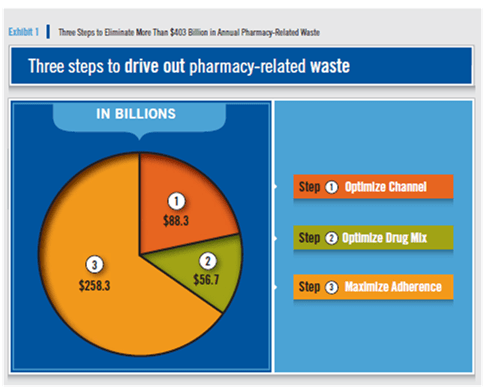
They did continue to build on last year’s focus on WASTE. They estimate that the waste in 2010 was over $403B as broken down below:

As adherence is a key issue here, they highlight the difference in adherence rates between retail pharmacy and mail pharmacy.

The focus of the report and the early press I’ve seen has been on the following chart. What it shows is some of the data from the Harris study saying that 82% of people would chose a generic (that are on a brand) and (depending on copay savings) 55-71% would chose retail.

One topic that I was glad was in the survey was limited networks. This is a topic everyone’s talking about from ReStat to Wal-Mart to Walgreens to CVS. Here’s what the research said with some explanation for what it means:

Of note is that about 40% said they would be willing to switch retail pharmacies to save their plan (or employer, or country) money. This fi gure is not as low as it fi rst appears because before a plan implements a more narrow retail network, a large fraction of members already use these pharmacies and therefore don’t have to switch pharmacies. It is not unusual, for example, for a client using a broad network to have 70% of prescriptions processed through pharmacies that are in the narrow network; members currently using these pharmacies do not have to make any changes. When a narrow network is implemented, if 40% of the users of the remaining 30% of prescriptions would willingly move to a lower-cost network pharmacy (as suggested by the survey), we estimate that the resulting overall market share within the narrow network would rise to 82% {70 % + (30% x 40%)}. (page 14 of the DTR)

All of this tees up their family of “Select” offerings (see Consumerology page) which builds on the success of Select Home Delivery and applies the concept of “Choice Architecture” from the book Nudge.

They talk about some of their work with adherence and their Adherence IndexSM. This metric is certainly one that has the industry’s attention as people wonder about the predictive value, how this is used, and how to craft solutions around such an index. My perception has been looking at studies like this one by Shrank and colleagues that past behavior remains the best predictor of future behavior, but I’m happy to be wrong.

So…what were the trend numbers?

  • 1.4% in the traditional (non-specialty drugs)
  • 19.6% in specialty
  • 3.6% overall

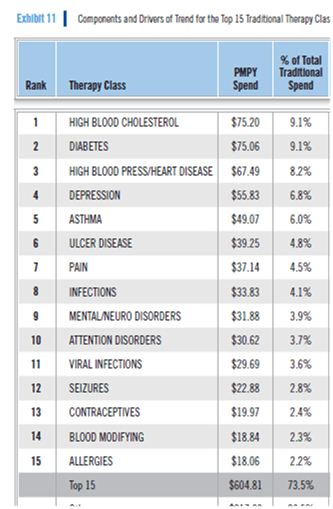
One of the other lists that I always find helpful to have is what are the top 15 drug classes and the PMPY spend.

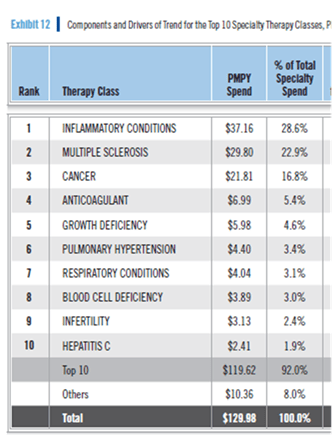
Of course, in today’s world, you really want to know this for specialty medications:

So, as always, I would recommend you read the report. Lots of great information in here. Interesting research. Good thoughts on consumer behavior and how to change it.

I think this week is their Outcomes conference which was always a good event.

Save Lennox Campaign Points To Two Health Issues

Have you heard about the Save Lennox campaign?  It’s a sad story of a little girl’s dog in Ireland that’s been incarcerated.  The girl is disabled and the dog is her service dog.  I had the chance to hear Victoria Stillwell from It’s Me or The Dog (TV show) talk about this last night.

What struck me (beyond the story) were two things:

  1. The importance of service dogs within healthcare.  They now do a lot of things beyond simply help the blind.
  2. The rising issue of dog bites and the fact that breed specific legislation (BSL) doesn’t work.  Dog bites have gone up in areas where pit bulls have been banned.


Interview With Dr. Olivier Raynaud At #WHCC11

I had an opportunity to sit down with Dr. Olivier Raynaud from the World Economic Forum while I was at the 8th Annual World Healthcare Congress in DC. If you don’t know them, they put on DAVOS.

It was a great discussion as Dr. Raynaud brings a wonderful macro-economic view of the healthcare problem with lots of global experience. Let’s start by talking about three areas of focus:

  1. Better health from better data
  2. Creating the right health ecosystem connecting different players
  3. Building leadership

These all sound so simple – right?

The first one – data. This is critical and something that the World Economic Forum worked on to create a data charter for healthcare. Getting multiple constituents to agree even conceptually would be a battle (in my assessment).

The second one – ecosystem. His prospective was so much broader that the typical – patient, provider, pharmacist, payer. For example, he talked about the city mayor as critical. He talked about how addressing smoking, exercise, and food choices was systemic and had a profound impact on our work, our lives, and ultimately our taxes. He talked about employers and how 54% of the world’s population is an employee.

We talked about how employers or cities are more likely to take a long-term view of health than an entity that has to show Fiscal Year results. We talked about the impact on productivity, reputation, and loyalty that health can have for a company and how those things impact costs like recruiting costs.

The third topic – leadership. Here we talked about the need to think differently and create global efforts. We spent a lot of time talking about starting Electronic Health Records during pregnancy since there are certain behaviors (smoking, drugs, eating) that can impact the child and ultimately their health. This framework is just starting to be discussed by people and is becoming easier with the proliferation of technology and low-cost of data.

We talked about the fact that 60% of costs are preventable. He suggested that the history of how AIDS has been addressed offers some great lessons learned around Access, Awareness, and Education. Just getting people to get tested has had a big impact.

[Meanwhile, someone else at the conference talked about the general failure of health programs across the world and the percentage of spend that doesn’t contribute to improved outcomes…a complicating factor.] The World Economic Forum has an opportunity to identify and spread best practices by getting all the constituents together and aligned.

We then finished up talking about engagement and trust. He had a great perspective about different search algorithms. For example, if you search for vaccines in the US, the CDC has most of the top placements. But, that’s not true outside the US. You might see lots more about fear of vaccines. There is a need ultimately for some type of “trust certification”. But, that has to meet the academic’s and clinician’s needs but be useable by the general public and take into account peer-to-peer and other data that is now appearing.

It was an interesting discussion that just helped open my eyes to a broader perspective. I wish them a lot of luck in pulling these groups together to expand the ecosystem and create leaders that know how to use data to make a difference.

The New Kaiser Center For Total Health (#WHCC11)

While I was at the World Healthcare Congress yesterday, I had the opportunity to go into DC to visit the new Kaiser Center for Total Health. This is their showcase in the East to facilitate discussions around improving healthcare. It’s not a replacement for the Garfield facility in CA, but it will create an more accessible forum for dialog with policymakers and international visitors. (NYTimes post about the opening)

It’s one of those fun places where you can go and interact with technology. It’s full of technology like telemedicine and telemonitoring. It provides you with demos of the world’s smallest ultrasound device and connected devices. It showcases Kaiser’s rich history and their MyHealthManager tool.

Their online tools have some great stats:

  • 3.3M members signed up
  • 25.8M test results viewed in 2010
  • 10.7M emails sent to MD’s in 2010

There are a lot of videos where you can hear employees, members, clinicians, and others talk about what they think “total health” is. And, they have a massive interactive mural about their walking initiative.

It seems like this type of interactive, high technology space is becoming an asset at several companies. We used to have this innovative, brainstorming space at E&Y years ago and clients loved it. I believe IDEO has this type of space.

I enjoy it. It’s interesting, inspiring, and creates a dynamic work environment. I look forward to see how this space gets used and what others think.

Interview With Dr. David Wennberg At #WHCC11

I had the opportunity to sit down with Dr. David Wennberg (Chief Science & Product Officer, Health Dialog) at the 8th Annual World Healthcare Congress (Twitter hashtag #WHCC11).  David is a fascinating and engaging speaker.  He has lots of publications, works with the Dartmouth Atlas, and leads the Health Dialog Analytic Solutions group. 

David and I began our time talking about “informed choice”.

In this environment, doctors need tools that identify patients lacking evidence-based care. They also need to ensure that patients undergoing surgery have been exposed to informed choice, not just informed consent, when there is more than one legitimate treatment path. With these resources in place, physician groups can ensure that they are in control of their own destiny when it comes to performance evaluations.  (source)

This is an important issue in healthcare.  Giving patients (1) complete information in (2) language that they can understand and helping them (3) frame their options relative to their preferences is at the core of this issue. 

Health Dialog calls this Shared Decision Making and focuses on how to engage targeted consumers and help them make their best decision.  Their customer support personnel go through a certification process and use decision aids to enable the process. 

This led us into a discussion about “trust” (see prior post) and then into a discussion about “embodied conversational agents“.  Obviously, if you’re going to help consumers make decisions, they need to trust you.  We talked about the need to have transparency, the need to for disclosure, and the importance of using clinicians in the engagement and discussion process.  In many cases, nurses and the empathy that they have are critical to this process.

But, I know from prior exposure to Health Dialog that they have figured out ways to blend technology and agents.  They do a lot with data and analytics to really understand the popluation.  They’ve worked hard to avoid the traps that “disease management” has fallen into over the years.  He shared with me some amazing engagement statistics. 

We talked about the value of peer-to-peer videos for people to understand their condition and talked about some recent studies around storytelling and distributing that information via DVD to patients (see more on study).  We went on to talk about how engaging the consumer in the decisions about their care increase success, but that many models have been a challenge to scale.  Health Dialog just published an article in the NEJM called A Randomized Trial of a Telephone Care-Management Strategy which demonstrated an ability to scale the solution and get results. 

At baseline, medical costs and resource utilization were similar in the two groups. After 12 months, 10.4% of the enhanced-support group and 3.7% of the usual-support group received the telephone intervention. The average monthly medical and pharmacy costs per person in the enhanced-support group were 3.6% ($7.96) lower than those in the usual-support group ($213.82 vs. $221.78, P=0.05); a 10.1% reduction in annual hospital admissions (P<0.001) accounted for the majority of savings. The cost of this intervention program was less than $2.00 per person per month.

Before I could even jump to my next question about ACOs, he made the natural transition to the fact that the new ACO regulations mention shared decision making 8 times.  I believe we both agreed that whatever actual form these new practice settings take that they will accelerate the importance of leveraging technology and things like shared decision making to engage the consumer.  The key is to leverage the PCP setting whether it’s the MD or someone on their staff as the foundation for engagement.

This led me to ask him about physician acceptance of technology as part of their practice (more on this later).  He felt that they had moved from resistance to understanding the technology and “guides” can enable them to practice better medicine.

CalPERS and Medco

Those of you that follow the industry are certainly aware of this news story.  It was definitely a surprise this past week when CalPERS announced that they were dropping Medco as their PBM based on allegations of improper behavior.

For an industry where transparency has replaced years of opaqueness, this will be an issue.  Whether Medco is guilty or not-guilty, industry foes will use this to taint the perception of the PBMs.  I am sure some people cheered when this came out thinking “finally we may have found something” while the rest of us shook our heads in disbelief.

Happy Fat Holiday!

Not to be a party popper since I love the holidays, and I ate my Corned Beef & Cabbage meal a few days ago (and hope to have another).  But, I pulled up a quick recipe to see the calories (700), the calories from fat (470), fat grams, etc. in such a meal (assuming you only eat one serving), and it got me wondering.

If we look at all our holidays – New Years, Valentine’s Day, St. Patrick’s Day, Fat Tuesday, Fourth of July, Easter, Christmas, Thanksgiving, etc., is there any wonder we have food issues?  A lot of our favorite memories are tied to holidays which are tied to food.  You take those experiences (which typically include some snacks and deserts), and you can eat a few days calories in one day.

Not that it’s bad if you burn off more calories than you take in, but it certainly embeds this food problem right into our culture.

Should The State Board Of Pharmacy Govern PBMs?

Mississippi has introduced legislation that would move the oversight of PBMs from the State Insurance Commissioner to the State Board of Pharmacy.  From a clinical care perspective, there seems to be some logic here, but from a business perspective, it doesn’t work.  Right now, the State Boards are generally made up of local pharmacists with an occassional PBM pharmacist on the board. 

Since that group negotiates with the PBMs for rates, it would seem to create a major conflict of interest.  PCMA has honed in on this and is actively fighting it. 

I guess that’s like saying that hospitals should govern managed care organizations.

Words Matter: Have You Drugged Your Kid Today

I think I’m going to start a series tagged to “words matter” where I call out some of the examples that I notice. The first one is the story about a teacher getting fired for her bumper sticker on her car. (Something I never thought would happen.) Her bumper sticker said “Have You Drugged Your Kid Today”.

First off, I think people are entitled to their opinions.

Second, I think we all would agree that there are certainly times when patients are given medications rather than ask to change.

Whether kids are over-medicated today versus the past is hard to know. We are certainly more aware of conditions these days, but I think this is a hot topic. Just look at some of the articles on the topic.

It’s not like the teacher was taking some massively controversial position. She wasn’t teaching the kids. She was simply expressing an opinion on a hotly debated topic in a quick sound bite which she put on her car in the form of a bumper sticker.

Todd Park (HHS CTO) On Unlocking Innovation Mojo (#mhs10)

I came out to the Mobile Health Summit (Twitter hashtag #mhs10) in DC today, and I had the opportunity to interview Todd Park who is the Chief Technology Officer (CTO) for the US Department of Health & Human Services (HHS). Todd is a great resource for the country and perhaps a surprising bureaucrat (in the nicest sense of the word) given his background as a consultant and then co-founder of athenahealth.

It was an interesting discussion starting around what his role is. The CTO role is a new role in the US government which he describes as an internal change agent who is responsible for working with HHS leadership. He described his objective as forming virtual start-ups to advance new solutions. [A radical departure for those of us that view government as a monolithic organization which is slow to change and full of red tape.]

He said that one of the first questions people ask when they see the new initiatives such as HealthCare.gov is who were the consultants he brought in from Silicon Valley to do the work. He says that it was all internal people. We talked about that being a cultural change which he described as “creating the right vision” and a “work pathway”. That sounds exactly like what one might see a change agent being responsible for – better leveraging internal assets by changing the framework for service delivery.

We talked about several of the initiatives that HHS has worked on lately:

  1. HealthCare.gov which is a focused on helping consumers find public and private options for healthcare. He said this was a 90-day implementation. I think if you go to the site you’ll see a few things:
    1. Easy navigation
    2. Content for multiple personas
    3. Links to social media
    4. Videos, widgets, blog postings, iPhone app, etc.

    This is much like what you would expect from a direct-to-consumer company or your health plan.

  2. The Open Health Data Initiative which is focused on taking data which HHS has and making it available for use by companies for FREE. The idea is to stimulate an eco-system around the data and enable better health thru better decisions. He uses the NOAA framework as an example for how they share data to sites like weather.com. He then mentioned that they had done a brainstorming session earlier this year to think about what could be done with this data (some of which was new to everyone). You can learn more and see the 2-hour YouTube video here, but a talk by Todd Park at another event is below.


  3. The Blue Button Initiative which was launched in October and focuses on getting Medicare members and veterans to get a copy of their own data to print, download, share, upload, etc. Already more than 100,000 have downloaded their data. This should certainly be an enabler for PHR adoption.

We then went on to talk about HHS as a “reservoir of innovation mojo” which needs to collaborate with the public sector. In Todd’s words, he sees government as needing to be a catalyst and enabler. When he joined, his idea was not to fly in like aliens and change HHS, but to come in and find ways to unlock the mojo which already existed.

I asked him if he sees this as being a model for the private sector. Obviously, one of the challenges we have everywhere is figuring out the right way to balance co-opetition and competition. If we’re going to “solve” our obesity epidemic, we need to have some collective knowledge and insights rather than constantly re-creating learnings in a microcosm. On the flipside, companies want to create intellectual property and sustainable differentiation. It’s not easy to balance.

But, Todd mentions that several companies are already following in the “blue button” model such as Gallup / Healthways which is making their Well Being Survey data available publicly (for FREE) for the top 200 cities.

Of course, there is a lot of work to do here. I asked him about what the government was doing to address some things at a national level (e.g., obesity) where in my mind we almost need a reframing such as that which happened with littering, smoking, or wearing our seat belts. He brought up three things that were happening:

  1. National Quality Initiatives
  2. HealthyPeople 2020
  3. Community Level Dialogues

One of the other things that we talked about was the challenge of making changes to health outcomes with the health literacy levels in the US. I suggested that we need to address this systemically as I believe we need to address financial literacy…beginning in the schools and the home. He talked about needing to making learning fun through educational games. He mentioned that the First Lady had been promoting the creation of apps to accomplish this as part of a competition. (This made me think of the iTots article in today’s USA Today.)

We closed with a quick discussion on other things that he’s monitoring that will drive healthcare innovation. He talked a lot about improvements in the provider payment system – think Accountable Care Organizations (ACOs) and Patient Centered Medical Homes (PCMH). The goal with these is the change from “pay for volume to pay for value”.

Talking to Todd gives you a positive view on what government can do. I can see him motivating his team and his prior teams to follow his vision and embrace change.  I’d have to agree with Matthew Holt’s article on Todd Park from earlier this year.

The Future Of Pharmacists

I went into yesterday’s NCPDP presentation expecting that I would be an outlier in proposing a radical model for pharmacists … but others had the same ideas before I spoke. I think everyone has talked about pharmacists wanting to do more counseling with their patients for years. Some of this is fulfilled with Medication Therapy Management (MTM) which began to be a compensated service under Medicare.

But, there is a huge gap in terms of what pharmacists are trained to do and what they actually do. I remember initially running into this concept when I worked on my pharmacy kiosk model. Some people saw this as a horrible thing that would replace the pharmacist. I actually saw it as a way to free up their time to focus on the patients that needed counseling not on people filling an antibiotic or getting a refill for the 30th time. In that case, I ended up going to talk to the Head of the St. Louis College of Pharmacy to see his thoughts. I remember him talking about the gap between what the students learn and the reality of what they do.

Most pharmacists (unfortunately) become high paid pill counters for much of their day. As someone said yesterday, “I didn’t go to school to learn to count in 5’s.” Another person pointed out yesterday that the top questions at the pharmacy are “How much will this cost”, “How long do I need to take this”, and “where’s the bathroom”. These aren’t things that require clinical knowledge.

There was a healthy discussion yesterday about expecting more from pharmacy technicians. For refills (which are 55% of prescriptions filled), why can’t they handle the process with oversight from the pharmacist.

Which I think brings us around full circle…

We’ve gone from a shortage of pharmacists to an overabundance of pharmacists. This has changed the paradigm. How do we leverage them?

At the same time, we have a shortage of PCPs which is likely to get worse with more insured people. Why can’t pharmacists step in here?

The change in flu shots may be the beginning. Will this be the start of all immunizations for people over 7 (as one person suggested yesterday) moving to the pharmacy? Given the profit on these, that would be a boom for the pharmacies, but it would certainly get pushback from the physician groups.

I would also suggest that the pharmacist could act as a PCP in helping manage care. Think about conditions like diabetes where the pharmacist in certain settings would have a unique ability to help the patient select food or look at devices. They could become a much more active “floor” resource for people shopping.

And, my radical idea that another presenter suggested yesterday was to look at focusing the pharmacist on new fills and initial titration. This of course would blow up the financial model in pharmacy. Why not pay them $10 or $15 per new fill and for the next 2 fills (of maintenance drugs) and then move everything to mail order, kiosks, central fill, and/or pharmacy technicians. We could write rules into the system to flag the technician to ask questions of people on statins every 12 months about getting lab work done or muscle pain.

At the end of the day, I would argue that pharmacy needs a radical overhaul like the entire healthcare system, BUT since it only represents 10-15% of total healthcare spend, some would argue that improving it be 25% (which would be huge) would only impact 2-4% of our healthcare spend. The problem with this is it’s like the PBM trying to justify adherence without looking at the impact on total health, absenteeism, and other factors.

Today, prescriptions are first line therapy for 90% of diagnosis. Over 50% of patients take 1 or more maintenance drug. And, most patients drop off their maintenance prescriptions by the end of year one. This costs us $300B a year.

Finding a new role for pharmacists and pharmacies, and giving them a better seat at the table is an imperative for change not an option. At the same time, there is a role for integrating technology into what they do to automate the simplier, repetive tasks. I’m not sure who’s the champion here, but I was emboldened by the fact that I wasn’t a radical at the conference.

Technology Challenges (and Opportunities) For Pharmacy

Here’s the presentation that I’m going to deliver tomorrow (11/2/10) at the NCPDP education event in Portland.  The question posed was what are the busines models needed to survive and thrive in the new economy.  My mind immediately jumped to what are the challenges in the industry, what are the trends that got us to where we are, and how can pharmacies (or PBMs) think about turning these challenges into opportunities.

At the end of the day, I think there is still lots of white space for pharmacies to leverage technology to build relationships with their clients (consumers / customers / patients).  I think technology makes that scalable. 

One bias that I also have long-term is that (with the right economic model) retail pharmacies should focus on the acute drugs and new prescriptions and get compensated for the initial education and titration with the patient and the physician.  After that, maintenance drugs which are essentially just refills should be handled by the lowest cost option – kiosks, central fill, mail order.  I think that would encourage a different payment model centered around cognitive services and encourage greater collaboration between retail and the mail order pharmacies. 

Stop By The Silverlink Booth At The Forum 2010 (DMAA)

Next week in DC is The Forum 2010 which is the annual event for The Care Continuum Alliance (formerly known as The Disease Management Association of America).  If you’re there, you should stop by the Silverlink booth and attend the presentations that we’re giving with some of our clients and other industry leaders. 

  Aligning Employee, Employer & Provider Research to Maximize Value-Based Benefits
October 13, 1:00 – 2:00 p.m.
Jan Berger, MD, MJ, Chief Medical Officer, Silverlink Communications
Cheryl Larson, Vice President, Midwest Business Group on Health (MGBH)
   
  Improving Statin Adherence through Interactive Voice Technology & Barrier-Breaking Communications
October 13, 2:15 – 3:15 p.m.
Ananda Nimalasuriya, MD, Chief of Endocrinology & Complete Care, Kaiser Riverside
George Van Antwerp, MBA, General Manager, Pharmacy Solutions, Silverlink Communications
   
  Addressing Colorectal Screening Disparities in Ethnic Populations
October 14, 12:30 – 1:30 p.m.
R. Reid Kiser, MS, National Director, Clinical Excellence Special Projects and Reporting, UnitedHealthcare
Jack Newsom, MBA, MS, ScD, Vice President, Analytics, Silverlink Communications
   
  Addressing an Epidemic – Improving Diabetes Care with Personalized Communications
October 14, 3:00 – 4:00 p.m.
Jan Berger, MD, MJ, Chief Medical Officer, Silverlink Communications
William Shrank, MD, MSHS, Instructor, Harvard Medical School and Associate Physician, Division of Pharmacoepidemiology and Pharmacoeconomics, Brigham and Women’s Hospital

DEA National Take-Back Day (Prescriptions)

This topic continues to get more attention.  Don’t leave your old medications around for your kids to use.  Don’t flush them down the toilet and into our water supply.  Turn them in for safe disposal.

WASHINGTON, D.C. – The Drug Enforcement Administration and government, community, public health and law enforcement partners today announced a nationwide prescription drug “Take-Back” initiative that seeks to prevent increased pill abuse and theft. DEA will be collecting potentially dangerous expired, unused, and unwanted prescription drugs for destruction at sites nationwide on Saturday, September 25th from 10 a.m. to 2 p.m. local time. The service is free and anonymous, no questions asked.  

For more information, visit: http://www.deadiversion.usdoj.gov/takeback/  

NCPDP Nov 2010 Event: The New Economy And …

On November 2nd, NCPDP is hosting an educational event called “The New Economy and It’s Impact on Healthcare, Pharmacy, and the Patient.” Sounds pretty cool! It’s a topic we all talk about.

What does the new sense of frugality mean? What will new forms of insurance mean? How will pharmacy evolve? Will MTM work? Will MTM become a product for commercial? How is the consumer’s behavior changing relative to information and compliance?

The agenda includes yours truly along with people from:
* Kaiser
* Walgreens
* AARP
* Sanofi-Aventis
* North Carolina Association of Pharmacists
* Eaton Apothecary
* American Society of Consultant Pharmacists
* RegenceRx

10% Discount On DMAA Registration

As a speaker at the upcoming conference, they sent me a discount code…

Register Now for The Forum 10

DMAA: The Care Continuum Alliance, the leading trade association for wellness, prevention, disease management and other services across the continuum of care for chronic conditions, invites you to its 2010 annual meeting, The Forum 10, Oct. 13-15, in Washington, D.C. Join leading health plans, wellness and care management organizations, physician groups, health IT companies, state and federal programs and other stakeholders as they discuss health care reform, share best practices and network. Keynote speakers include best-selling author and motivation and engagement expert Dan Pink; and a panel presentation by nationally recognized consultants on workplace wellness strategies. View complete programming details

Special Registration Offer: Viewers of this notice can receive 10 percent off standard Forum pricing by using discount code “FRIENDS-FORUM” during the registration process. Go to online registration

DMAA Client Presentations

We (Silverlink Communications) are very excited to see three of our clients get selected to present at DMAA this year.  That is a tribute to all their hard work, creativity, inspiration, and willingness to leverage technology to improve outcomes.

Here are the presentation summaries from online:

Reducing Blood Pressure in Seniors with Hypertension Using Personalized Communications
CONTINUUM OF CARE SERIES
Wednesday, Oct. 13, 1-2 p.m.

  • Examine how an integrated communications program that utilizes remote monitoring and interactive voice response components combine for an easily scalable, cost-effective solution to reduce hypertension.
  • Review a program where 18 percent of participants transitioned their hypertension from out-of-control to well or adequate control.
  • Identify best practices for how personalized, automated, interactive communications can be leveraged to control hypertension in a scalable manner.
  • Evaluate how high blood pressure readings alerted patients with immediate feedback and education to help them better manage hypertension.

Improving Statin Adherence through Interactive Voice Technology and Barrier-Breaking Communications
Wednesday, Oct. 13, 2:15-3:15 p.m.

  • Examine how interactive voice response (IVR) and barrier-breaking communications can measurably improve statin adherence.
  • Review key barriers to statin adherence, including several barriers that are more significant than cost.
  • Identify best practices for using IVR technology to improve statin adherence by addressing specific barriers.
  • Evaluate how continuous quality improvement processes were used to drive higher response rates to IVR prescription refill reminder calls.

Addressing Colorectal Screening Disparities in Ethnic Populations
Thursday, Oct. 14, 12:30-1:30 p.m.

  • Examine how interactive voice response (IVR) technology and personalized messaging improves the rate of colorectal cancer screening for different populations.
  • Review the impact of ethnic-specific messaging on colorectal cancer screening rates and how this differs by ethnicity.
  • Examine how engagement is influenced by the gender of the voice in communications outreach.
  • Identify how to use predictive algorithms to project race and ethnicity to support tailored communications.