Archive | Social Media RSS feed for this section

Only 56% Want To Set MD Appointments Online – Why Not?

To me, this survey has three major themes:

  1. People are still hesitant to communicate with their MDs using social media [not that surprising].
  2. People are slow to use the web even for administrative functions [why].
  3. Hispanics are much more willing to use technology to engage their provider [why].

Some of the data:

  • 85% would not use social media or instant messaging channels for medical communication if their doctors offered it.
  • Only 11% of respondents said they would take advantage of social media such as Twitter or Facebook to communicate with their doctor.
  • Only 20% said they would use chat or instant message.
  • 52% said they would confer via e-mail.  (versus 89% of Hispanics)
  • Only 48% said they would pay their physician bills online. 
  • 72% would take advantage of a nurse line if it was offered by their doctor.

Social Media Is A Health Issue?

Social media as hazardous to your health!  Talk about a nice counterintuitive report.  I think we all worry about our kids spending too much time online and not getting enough exercise, but what about “Facebook depression”, cyberbulling, and sexting…not to mention age-inappropriate material?

In yesterday’s USA Today, there’s an article about how social media can enrich children’s lives but can also be hazardous to their mental and physical health.  It’s focused on a report by the American Academy of Pediatricians, but I think this also builds on the Kaiser report out earlier this year about the amount of time kids spend in front of electronic media – 7.5 hours PER DAY. 

because tweens and teens have a limited capacity for self-regulation and are susceptible to peer pressure, they are at some risk as they engage in and experiment with social media, according to the report. They can find themselves on sites and in situations that are not age-appropriate, and research suggests that the content of some social media sites can influence youth to engage in risky behaviors. In addition, social media provides venues for cyberbullying and sexting, among other dangers. Youth who are more at-risk offline tend to also be more at-risk online.

Interesting.  Do you agree?

Who’s Your HOL For Improving Engagement

Following up on my post earlier today, I went to an article in PharmaVOICE from January 2011  called Engaging the Empowered Patient by Carolyn Gretton.  It has lots of interesting statistics and quotes.  Here’s a few:

These consumers have done at least one of the following based on finding information online:

  • Challenged their doctor’s treatment or diagnosis
  • Asked their doctor to change their treatment
  • Discussed information found online at a doctor’s appointment
  • Used the Internet instead of going to the doctor
  • Made a healthcare decision because of online information

I’ll have to drill into the report because I’d love to know how many have done the first two things, what the physician response was, and (ideally) if it impacted their outcome in any way.

40% of online consumers engage with social media on health sites either by reading or posting content, though frequency of engagement varies widely.  (based on a survey from Epsilon and eRewards)

That last part is where the issue is (IMHO).  Consumers do use lots of these tools BUT sustaining their interest and engagement over time is difficult.

The Epsilon report – A Prescription For Customer Engagement: An Inside Look at Social Media and the Pharmaceutical Industry – pointed out that consumers use healthcare social media for:

  • Support
  • Sense of intimacy with others with a similar experience
  • Foundational information about their condition and symptoms
  • Information about drugs and supplements
  • Health news

Many of the individuals who are highly engaged in social media feel better equipped to manage their health.  (Mark Miller, SVP, Epsilon)

I was really surprised that the Epsilon study said that consumers viewed product sites to be as important as healthcare provider interactions.  I could argue both sides here.  Obviously, the product site is going to have some bias.  On the other hand, given the complexity of treatments and therapies these days, it has to be close to impossible for the provider to stay up on all the latest information. 

Not surprisingly, the author of the article talks about people having mixed feelings about the product managers participating in a social media site.  BUT, I think everyone would agree that with proper disclosure and the right person, this can work very well. 

The article introduces a new term (for me) here – HOLS or Health Opinion Leaders.  It talks about them becoming active parts of the pharma brand team.  That sounds like an interesting role. 

It was also interesting that they talked a lot about gaming as an engagement mechanism.  It’s not something I’ve spent as much time with, but it keeps coming up (even more than incentives).  They talk about several examples:

They also bring up an older game as a cautionary tale – Viva Cruiser – which riled critics for trivializing ED. 

At the end of the day, it’s the same old challenge – how to get the consumer to act and stay engaged?

Should Drug Makers Take Action Off Social Media Comments?

I think it’s a fascinating question that was raised around Actos. Here’s the text about a wool.labs report:

In this month’s report on social media’s influence in the world of diabetes, wool.labs presents an analysis of social media conversations beginning as far back as 2002 and continuing to the present, noting a significant shift in patient attitude toward the drug.

Early on, the presenting side effects such as weight gain and edema drew concerns and warnings from some patients. Some questioned whether the drug should be used in combination with insulin. But even while the debate raged on, wool.labs’ analysis showed the conversation could have been shifted had drugmaker Takeda meaningfully interceded before 2006 when comments about the drug began to turn sarcastic, and before long, angry and hostile.

There are enough tools and companies out there that IMHO companies (and brands) should be able to actively manage social media sites to understand what consumers think.  I don’t know this case specifically so I won’t comment on it, but certainly, companies need to have a robust Voice of the Customer process by which they understand what consumers think of them.  And, if it avoids future litigation, leads to add-on products, or even helps re-position a current product, this mechanism can be very valuable.

Social Media Analysis – The Involved Patient

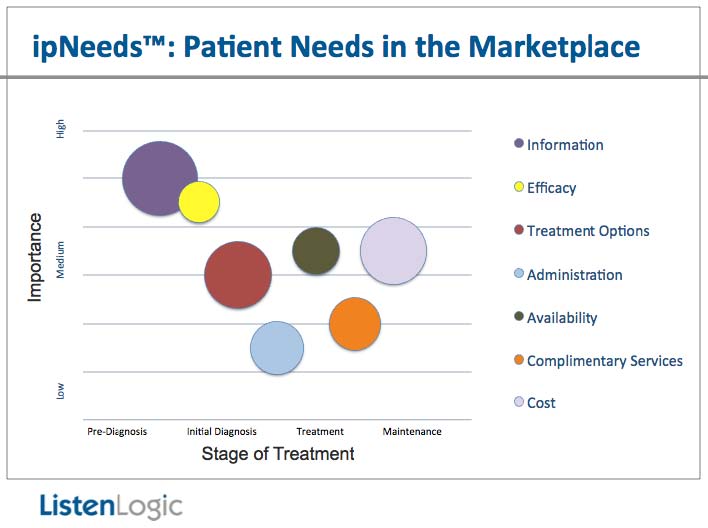
I just finished reading a whitepaper by ListenLogic Health.  They do social media analysis for pharmaceutical companies on what patients think.  There is some interesting data in there looking at what people talk about based on age.  They also show several charts about information searched for or discussed by stage.  I pulled out one chart from their whitepaper to share:

They also share some data on what patients say they want from physicians.  This is things like explaining their data better, helping them understand their options, and all basically focus on engaging them.

CatalystRx Engaging Patients With Avatars

Last week, I got to see one of the more interesting presentations I’ve seen in a while. CatalystRx presented on some of the work they are doing with a mobile application to be released later this year. The application uses an avatar (well technically an “embodied conversational agent“) to engage with the consumer. I’m not sure how well that will work with a senior population, but the technology (shown in a video demo) was very cool.

The application is based on lots of research (and designed by the people who made Happy Feet). For example, they talked about:

  •  
    •  
      • The importance of finding the right balance between too cartoonish and too human. They referenced some Disney research about size of the eyes versus the size of the head which creates a positive memory trigger due to similarities to baby’s faces.
      • Creating a “trusted advisor” for the patient (using David Shore’s book – Trust Crisis in Healthcare).
      • The importance of the face and how it shows emotion (both human and avatar).
      • How small talk engaged the consumer and builds trust even when it’s an avatar telling first person stories.

Some of the research comes from Chris Creed and Russell Beale’s work.

Recent research has suggested that affective embodied agents that can effectively express simulated emotion have the potential to build and maintain long-term relationships with users. We present our experiences in this space and detail the wide array of design and evaluation issues we had to take into consideration when building an affective embodied agent that assists users with improving poor dietary habits. An overview of our experimental progress is also provided.

The application helps patients to:

  • Make decisions
  • Identify pharmacies
  • See prescription history
  • Get reminded about refills
  • Get information about generics and formulary compliance
  • Receive personalized interventions

Obviously, mobile solutions as a way to engage patients using a secure environment for delivering PHI is a holy grail (for those that download and stay engaged). This was an interesting and promising variation on some of the solutions out there. I look forward to learning more and seeing it once it’s fully available.

Social Networking For Pharmacists

Drug Store News has partnered up with Skipta to form a pharmacists social networking site.  Interesting.

1. Why Skipta versus some other forum?  [Personally I prefer less places to log in not another one]

2. Will pharmacists use it?  [TBD]

3. Is it good to have a private social networking location?  [Probably if used appropriately]

4. Wouldn’t it be great to use this to facilitate pharmacist and MD dialogue on key topics – adherence?

I’m not sure what else to say on this yet.  Obviously, pharmacists have the same issues as doctors – do you friend your patients, what liability do you have for what you say in these channels, is it considered medical advice, etc.

A Couple Quick Lessons From Super Bowl Ads

“Success is like anything worthwhile. It has a price. You have to pay the price to win and you have to pay the price to get to the point where success is possible. Most important, you must pay the price to stay there.” – Vince Lombardi


While I didn’t have any personal stake in the game on Sunday and am generally a college football fan, I definitely enjoyed watching Green Bay win.  I’ve always liked many of Vince Lombardi’s quotes, and one of my first consulting projects was working with the Oneida Indian tribe in Green Bay. 

That being said, I (like many others) enjoy watching the advertisements.  In reading a post-game summary of the commercials in USA Today, there were two interesting points:

  1. One of the two winners (it was a tie) was for Doritos and was based on a customer created advertisement (which cost him $500 to produce). 
  2. Four of the top 10 advertisements (Doritos x2 and Pepsi x2) had been posted on Facebook and YouTube for days.


I think this presents several interesting scenarios in healthcare marketing:

  1. Why don’t we have more customers submitting and creating “advertisements” for us?  I personally would love to see 30-second spots by pharmacy users talking about why they chose mail order or a particular retail store.  Or, imagine a new mom talking about how great her experience was at a particular hospital.  [That seems a lot more compelling than the signs that tell me the number of births at a particular location.]
  2. Maybe familiarity doesn’t breed contempt but rather trust.  Should we think differently about how we share information concurrently on different channels?  [Hint: YES]  Is there value in sticking with a theme for a period of time?  [IMHO – Yes]

The Art of Creating A “Campaign”

For a little more color on this program – click here.

What you saw here:

  • Engagement takes planning and creativity
  • Engagement is a process
  • Messaging before the event is critical
  • A retention strategy for sustained involvement is important
  • Think about your influencers and how to turn them into advocates
  • Clear goals and objectives
  • A defined metric of success

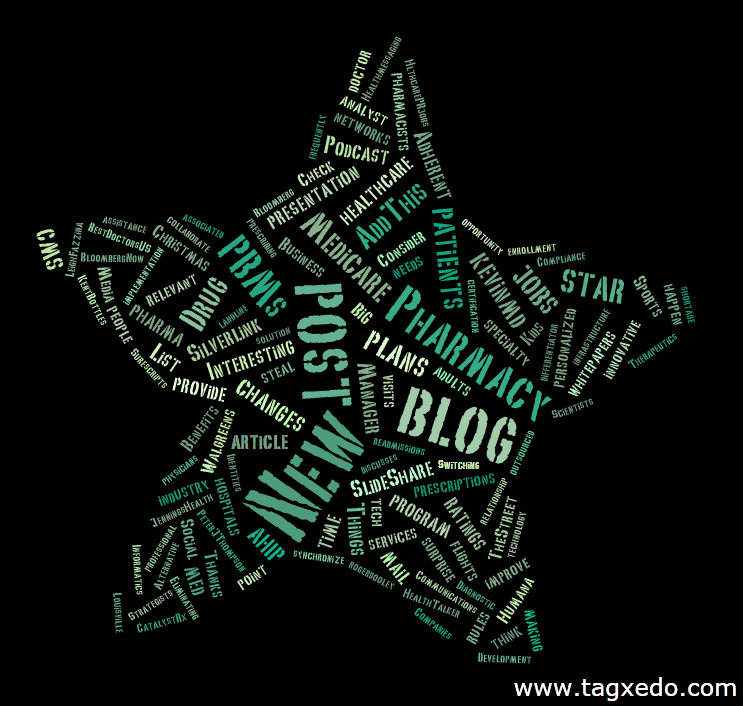
Blog Tags via Tagxedo

A PR agency used Tagxedo in their holiday card.  I thought it was pretty cool.  You could comment about something with a hashtag in Twitter, and it would update the image.

There are lots of other things you can do.  I created two simple images – one for the blog and the other for my Twitter feed. 

PBMs and Social Media

I always get pulled into the discussions about what PBMs are doing, should be doing, or could be doing in social media. For now, let’s just look at the current state – i.e., who is doing what.

I’m going to focus on the big channels – Twitter, Facebook, YouTube, and blogging.


Twitter

Other (Facebook, YouTube, Blogs)

CVS Caremark @CVS_Extra

@CVS_Health

@CVSCaremarkFYI

http://www.youtube.com/user/CVSPharmacyVideos

http://www.facebook.com/CVS

Medco @DrObviousPhD

@LibertyMedical

@Medco

http://www.youtube.com/DrObviousPhd

http://www.facebook.com/DrObviousPhD

Walgreens @Walgreens

@WalgreensNews

@WalgreensHealth

http://www.facebook.com/Walgreens
Express Scripts @BobNease

@EScripts

http://www.consumerology.com/blog
MedImpact @MedImpact  


To make it easy, I created a Twitter list on my profile of the PBMs, pharmacies, and several other key resources in this area – http://twitter.com/#!/gvanantwerp/pharmacy-pbm.

I welcome your links to other PBM or pharmacy social media assets. I looked under CatalystRx, Prime Therapeutics, and SXC also. I also checked Cigna Pharmacy, Humana Pharmacy, Prescription Solutions, and Kaiser Pharmacy. I couldn’t find more, but I’m sure there’s a few I missed.

The question of course is how to judge if these are successful. Is it the number of followers or fans? I would argue no. The goal of social media is to create a dialogue and engage the patients or consumers. Given the traditional focus on the PBM on the business-to-business relationship and the pharmacy on the business-to-consumer relationship, there is an interesting question of how the mail order pharmacies (owned by the PBMs) make that leap. Can social media create a forum for discussion about plan design, drug trends, and other things in straightforward language that engages consumers? Will consumers be willing to use these channels to interact with the PBMs or only with their pharmacist? This could be an area where companies like Walgreens or CVS Caremark who have a large physical footprint can leverage a real-world connection with consumers to a virtual one easier than others.

As you can see, there are not a lot of people doing a lot yet. This area will change a lot in the next 5 years.

CVS Adds Mobile Application

Communications continue to evolve.  Mobile health in the form of applications has either crossed the chasm or is crossing the chasm.  I expect in 5 years that most communications in healthcare for people under 45 will start with a mobile application.  It may “escalate” to other modes, but using a secure application on the ubiquitous mobile phone will be a primary starting point to engage them.

Caremark rolled out their mobile application earlier this year.  Now CVS has rolled out there application.  Several other companies have rolled out their applications also.  Humana’s application is out (mobile site).  Another big PBM is piloting their mobile application with one employer right now. 

So, what does the CVS mobile application do:

  • Find nearby CVS/pharmacy locations using the GPS-based store locator with integrated driving directions and maps;
  • Refill prescriptions from a personalized prescription history for pickup at any CVS/pharmacy;
  • Transfer prescriptions from another pharmacy to CVS/pharmacy;
  • Access the Drug Information Center to retrieve critical details about medication management, including instructions for use, dosing information, side effects and relevant safety warnings;
  • View and manage sales circular to create a custom shopping list and identify money-saving deals each week; and
  • Schedule a flu shot at any local CVS/pharmacy location.

Some Social Media Videos

More and more, I am getting in conversations with clients about emerging media and how that plays into their healthcare communications strategy.  Whether that is simpler things like PURLs, SMS, and mobile applications or more complex decisions around Twitter, Facebook, YouTube, blogging, and social media. 

Here are a few things from YouTube that I thought were good on the general market.

Mobile / Social Media Stats c/o HubSpot

I’ve never met the people over at HubSpot, but I like the information that they’re making available.  (Thanks SF for the suggestion.)

Here’s a few graphics from a recent post on their blog about mobile infographics.  (BTW – I love infographics)

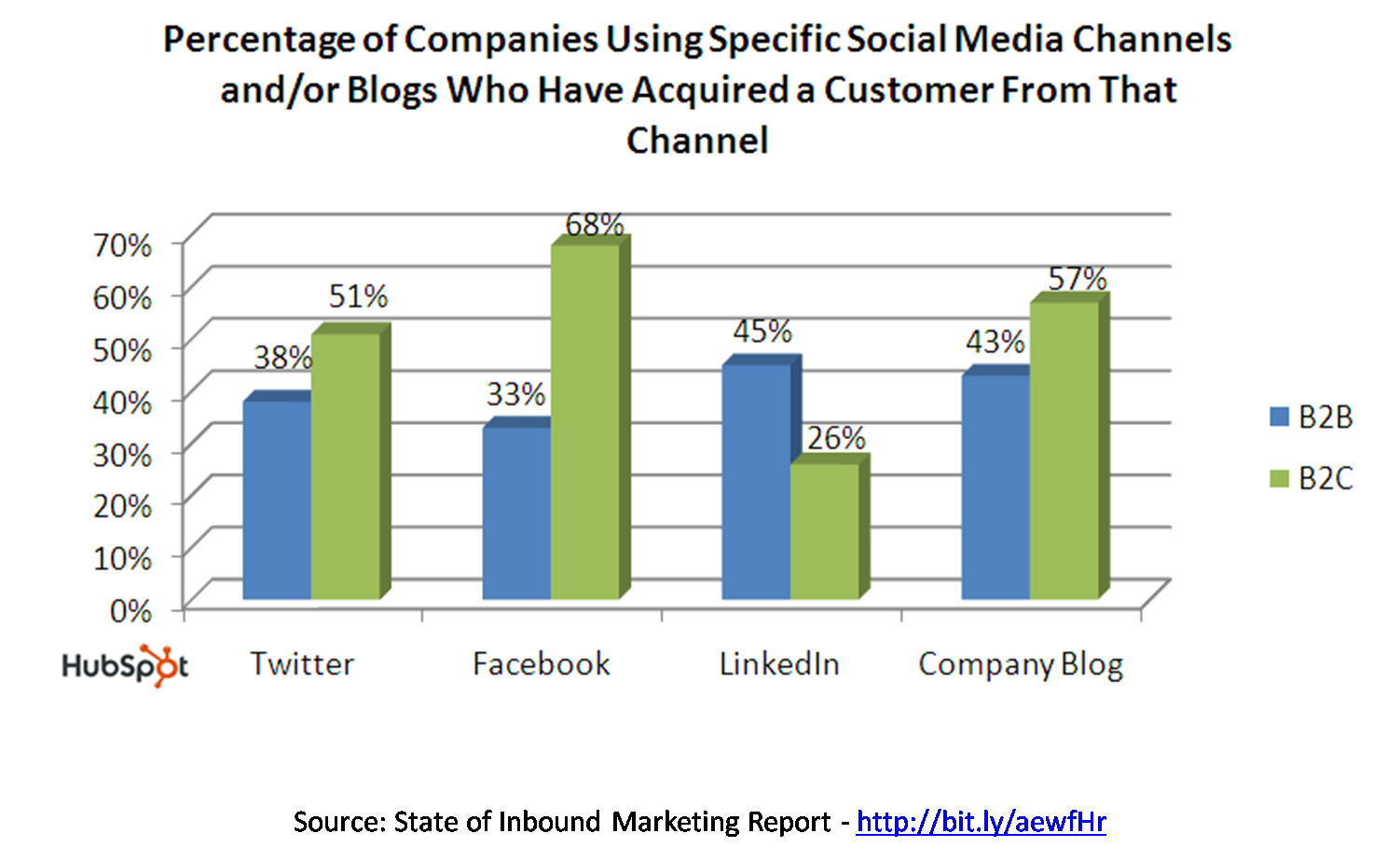
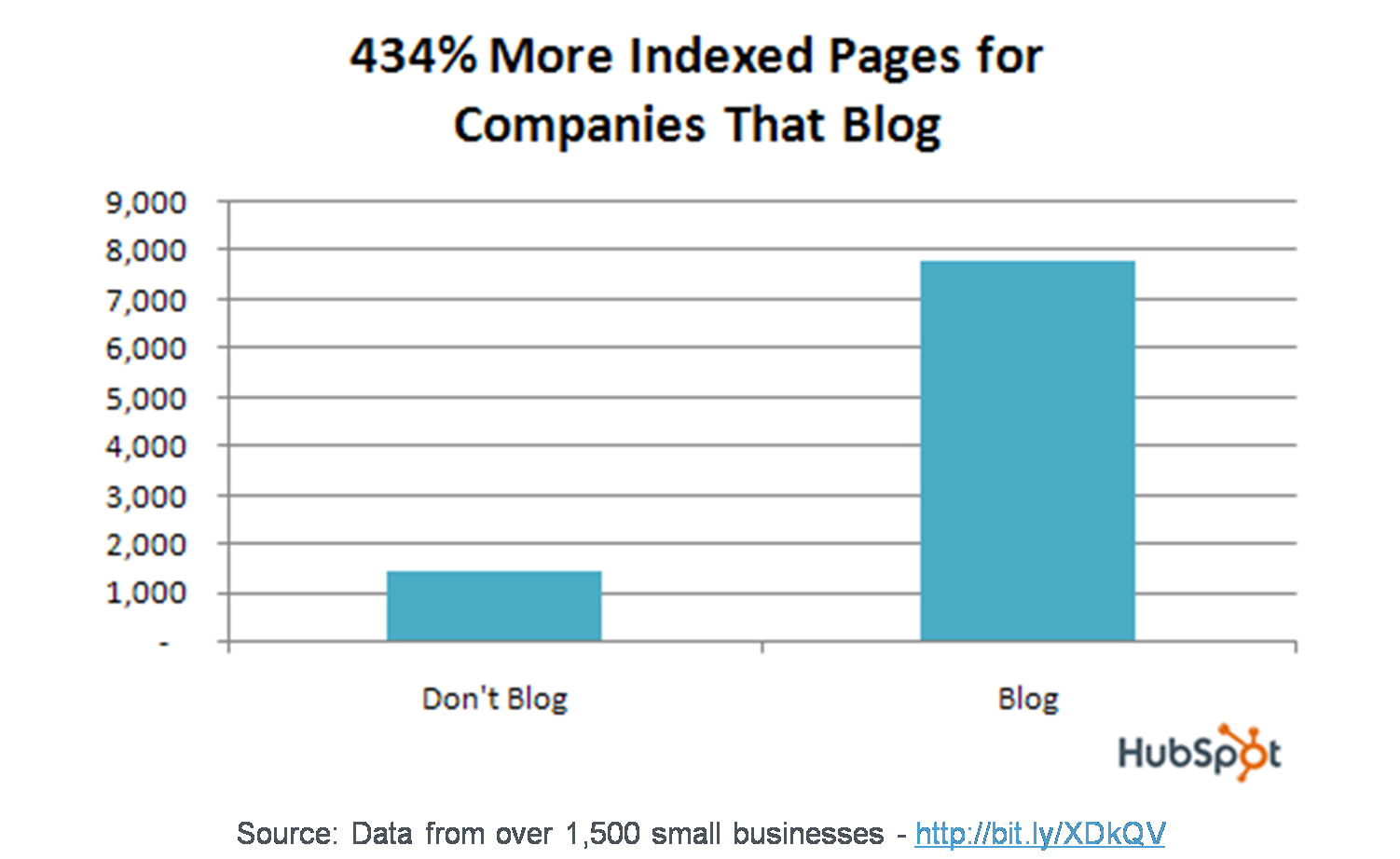
In another area of their site, they have some interesting data on how blogging and social media drives leads.  Here are three of them that I found interesting.

Book Review: Social Media Marketing

I just finished reading the book – Social Media Marketing: Strategies for Engaging in Facebook, Twitter, & Other Social Media by Liana “Li” Evans. It’s a good book especially for those who are new to the social media space. It’s an easy read with good examples. If you’ve been assigned the job of developing a social media strategy or are getting proposals from people in the space, you should read the book.

From her conclusion, let me pull a few things:

Important points to remember:

  • Not all companies are the same
  • You need to understand your audience
  • Cookie cutter solutions don’t exist
  • Don’t be afraid of the negative; embrace it as an opportunity
  • Measure what you’re doing

Her process is essentially:

  • Understand your market
  • Research where your audience is
  • Define your goals
  • Decide who owns what
  • Create your strategy
  • Implement and measure
  • Tweak, retweak, and stop if it’s not working

“Understanding that your audience and customers might not be where the media thinks they are (Twitter and Facebook, for example) is an important concept to grasp if you want to be successful.”

Reading her book definitely influenced my post from the other day on the 7 Myths of Social Media. Here are some other items from my review of my notes:

  • Types of social media
    • Social news sites
    • Social networking
    • Social bookmarking
    • Social sharing
    • Social events
    • Blogs
    • Microblogging
    • Wikis
    • Forums and message boards
  • Her 3rd chapter provides a good starting point of different metrics to think about.
  • She suggests several buzz-monitoring services:
  • She mentions Groundswell by Charlene Li and Josh Bernoff multiple times.
  • She gives an example about how Royal Caribbean managed an online situation.
  • If you’re giving away something, make sure it’s unique and special. Don’t just give the members of a community something they could get at any other place.
  • She talks about blogs as a “double-edged sword” where they can do whatever they want. I find it an interesting perspective since her PR company reached out to me and sent me the book to review. Did they do their background to see my prior book reviews? Did they know their pitch would appeal to me and they wouldn’t end up on the Bad Pitch Blog?

One question that I didn’t get answered was “What do you do with your content as your audience shifts from one technology to another?” I think this will be an issue as things move from (for example) MySpace to Facebook. What do you do with the old content? How do you keep things relevant without having to manage 20 different locations? (She suggests looking at Pete Cashmore’s Mashable site.)

  • She reinforces a key point several times which is that all your employees need to realize how their actions online affect the social media strategy that your company has.
  • Several times she reinforces the point that you can’t control the discussion.
  • She made an interesting observation that the Share This type applications that let you choose from multiple sharing services are actually a problem since they overwhelm people. (I guess this is like the concept of limiting choice as a way to help people decide.)

I wonder what it would be like if plans and PBMs were to share proposed plan designs with consumers via social media and engage them in dialogue. Would it change what was used?

She suggests Mike Grehan site – www.searchenginewatch.com – for information on search engines.

So, there is lots more in the book. I’d suggest you check it out.

How Seniors Use Social Media (Pew)

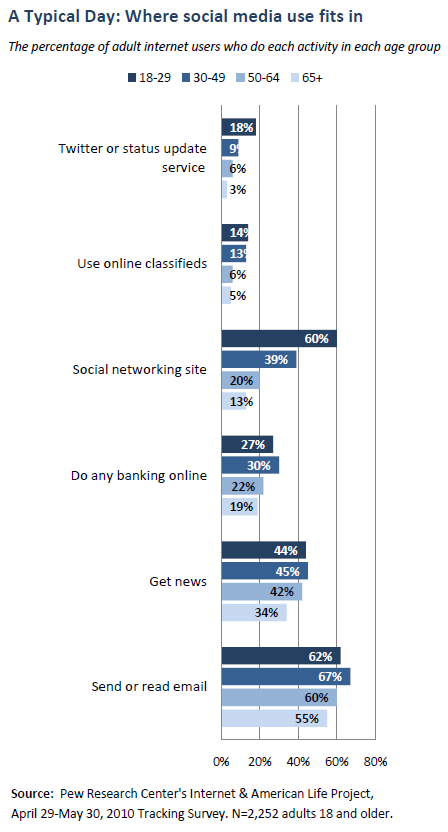
Not a big surprise…the Baby Boomers use technology.  Many of us have had their parents, uncles, grandparents, etc., send them a “friend invite” or talk to them about technology.  This will obviously continue as it’s more the norm and you have people that have been using technology for years age into retirement and look to connect with disparate friends and family.

Here are two charts from the recent report from Pew – Older Adults and Social Media.  Very interesting to watch the trends.

Seven Myths Of Social Media

I’m just finishing up a book on social media (book review to come shortly). As I was reading it and based on my experience, I came up with a few myths:

  1. You have to be everywhere.  It’s impossible.  There are so many sites out there.  You have to know your audience and determine where to spend your effort.  You MIGHT have to stake your claim to avoid someone else using it and provide information for consumers to reach you, but you can’t actively contribute and add value across the social media spectrum.
  2. Set it and forget it.  Social media is about dialogues and continuous information.  You can’t put up static content like a website and come back every week, month, year and update it.  The best companies respond (for example) to a Twitter comment about them in 24-hours while some never respond. 
  3. Build it and they will come.  There is a constant dialogue about whether you have to “own” the community or simply participate in it.  There is certainly reason to create content (i.e., blog posts, tweets), but you have to find a non-marketing environment to interact with your customers and influencers and understand their needs.  In many cases, that environment might already exist and you need to join it.  Additionally, you can’t simply launch something or join something without pushing out information about it.  For example, if you have a Facebook page, you need to have a link on your website, put it in your LinkedIn profile, include it in your press releases, etc.
  4. Marketing should own social media.  Traditional marketing has been about the controlled message.  Social media is about participatory messages.  There’s a big difference.  Additionally, social media can be and needs to include any employees who are actively engaged in social media.  We’ve seen numerous examples of employees who comment inappropriately only to jeopardize their job.  (I’ll agree that there are issues here to still be defined regarding privacy versus freedom of speech.)  Marketing can’t reply real-time about operational issues.  Ownership is a collective effort.
  5. You can outsource your social media.  This is a big mistake.  There are lots of consultants who will tell you what you want to hear.  They will talk about some channel or channels that work (e.g., Twitter experts, Facebook experts).  They’ll talk about search engine optimization (SEO) and what to do.  They’ll tell you that you need an iPhone app or a YouTube channel.  The reality is for your solution to be genuine and timely that it needs to be someone(s) who understands the company, feels passionate, and is empowered to do something quickly.
  6. Tell me..tell me…tell me.  This works great for presentations.  But, you’re now a part of the audience (although an informed member with an agenda).  You need to tailor your objectives to what the audience wants / needs.  In a community, they’re there for a reason.  They are discussing a topic and sharing their thoughts.  They want you to add value not sell your products or agenda.  They want to be valued.
  7. You can avoid it.  This is an obvious one.  With 500M users on Facebook and YouTube being the second most popular search engine, you have to understand how people find you on the Internet.  Google is a verb.  Current generations will grow up with theses modes, smart phones, and be uninhibited by our sense of privacy.  Technology is and will continue to be more ubiquitous.  The way people learn about companies is changing.  The way people learn about people is changing.  Relationships between people are changed based on technology.  Companies have to understand what’s being said about them and embrace it not run from it. 

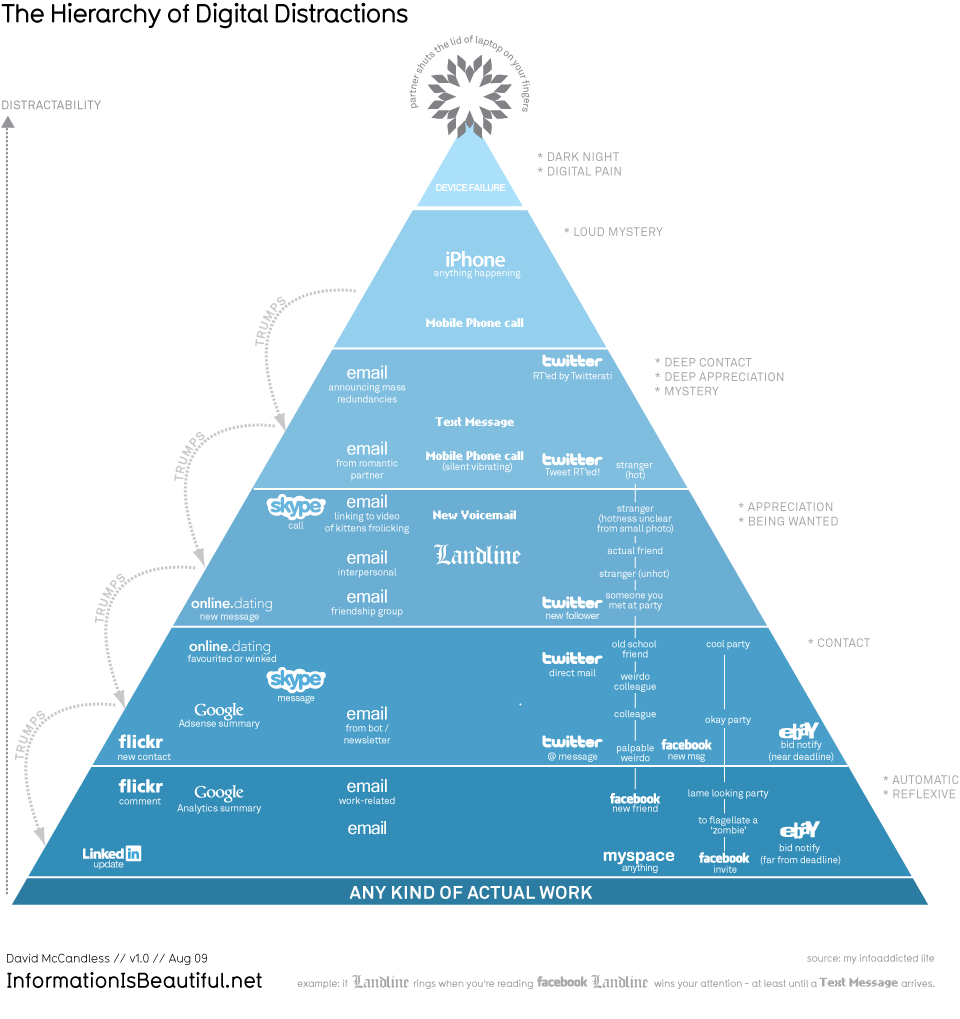
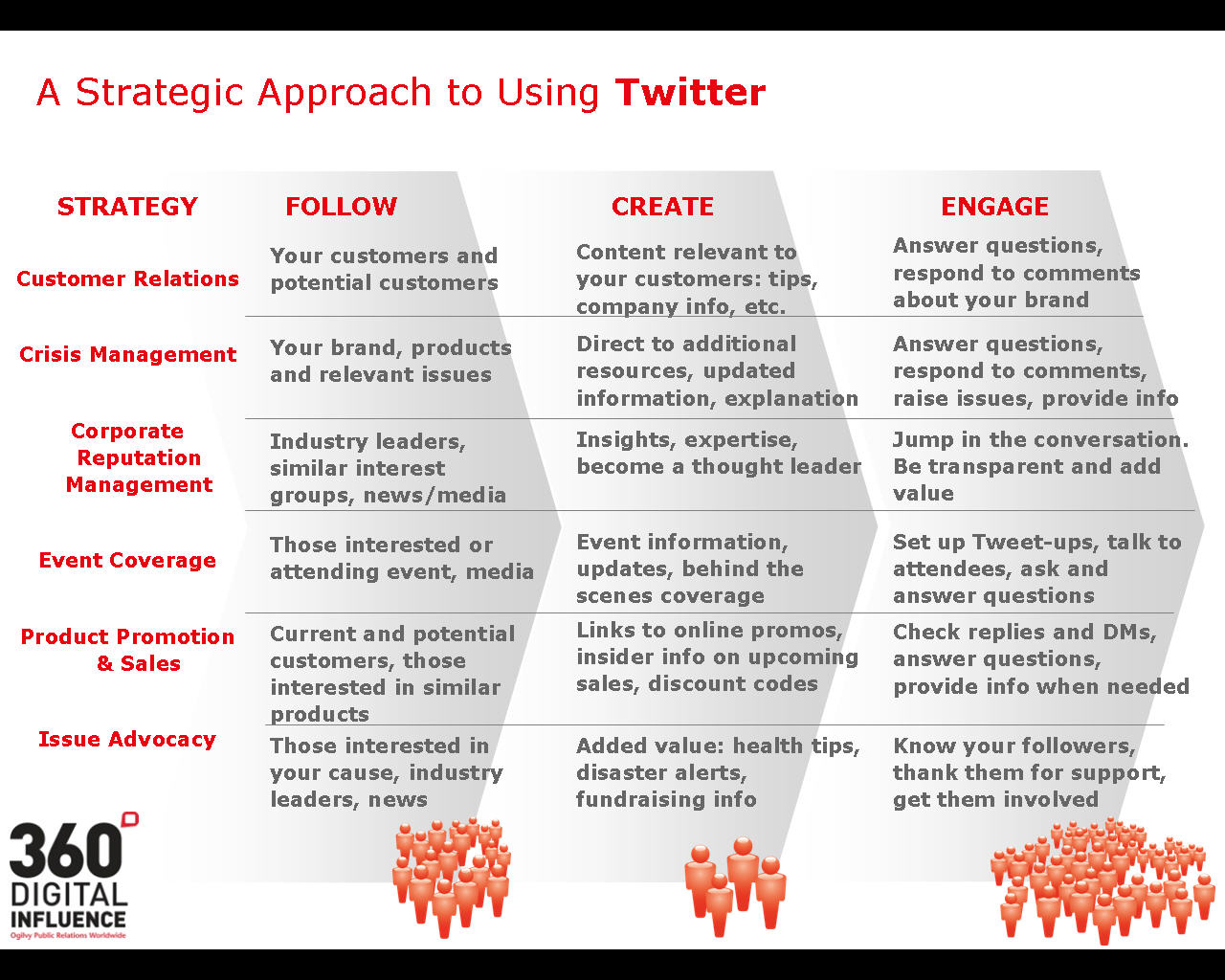
There are tons of infographics out there that symbolize some of this.  I pulled a few of my favorites together here, but you can find more.

Complexity of Decision Making

In today’s world, the amount of information is overwhelming.  At the same time, we are constantly striving to practice DIY (do it yourself) medicine where we are reaching out to experts to help us sort thru information (especially when data is conflicting).  But, a lot of that assumes we know what we need or we know when to ask for help.

A study published recently in the Annals of Family Medicine looked a small group of diabetics and how they received information about their condition. 

They collected a nice long list of different sources used for information:

  • People
  • Physician
  • Nurse, nurse practitioner
  • Dietitian
  • Diabetes educator
  • Pharmacist
  • Dentist
  • Eye doctor, eye laser surgeon
  • Health care professional(s), specific role not indicated
  • Self, have had training as health professional or worked in medical field
  • Hospital-based diabetes center
  • Insurance company nurse, nurse, dietician, educator, wellness program personnel
  • Workplace nurse, health professional or wellness program
  • Family, including family members with diabetes
  • Friends, neighbors, coworkers, acquaintances, other patients, personal interaction, “word of mouth”
  • Classes or seminars
  • Support groups
  • Participation in research study
  • Comprehensive weight loss program
  • Health fair or similar event
  • Media
  • Internet (Web sites, search engines)
  • Information from organizations (eg, American Diabetes Association, American Kidney Foundation), other than from their Web sites
  • Books
  • Magazines (eg, Diabetes Forecast, Diabetes Self-Management, popular magazines—especially health/diet, cooking, women’s, African-American interest)
  • Television (eg, “D-Life,” news programs, talk shows, food-oriented shows)
  • Newspaper/newsmagazine articles
  • Booklets, brochures, etc, from clinic or health professionals
  • Booklets, brochures, newsletters, e-mail newsletters, etc, from miscellaneous sources (“in the mail”)
  • Information from pharmaceutical company, drugstore, medication supplier
  • Information from insurance company
  • Library
  • Bookstore
  • “Reading” or “studying” (type of material not specified)
  • “Media” or “articles” (not further specified)
  • Nutrition labels on food packages
  • Nutritional information pamphlet, fast foods
  • Product information (eg, Glucerna, information in insulin kit)
  • Atkins, South Beach diets
  • Reader’s Digest “Change One” program
  • Exercise videos
  • Printed reports of laboratory results

RESULTS Five themes emerged: (1) passive receipt of health information about diabetes is an important aspect of health information behavior; (2) patients weave their own information web depending on their disease trajectory; (3) patients’ personal relationships help them understand and use this information; (4) a relationship with a health care professional is needed to cope with complicated and sometimes conflicting information; and (5) health literacy makes a difference in patients’ ability to understand and use information.

CONCLUSIONS Patients make decisions about diabetes self-management depending on their current needs, seeking and incorporating diverse information sources not traditionally viewed as providing health information. Based on our findings, we have developed a new health information model that reflects both the nonlinear nature of health information-seeking behavior and the interplay of both active information seeking and passive receipt of information.

Doctor – Patient: Relationship or Transaction…and Therefore

Don’t jump the gun too quick here. I assume most of you are going to say that there is an implicit (or explicit) relationship between the physician and the patient. They have some interest in your outcome and your care.

But, before you go there, I want to put forth a hypothesis. If this is true, is it okay for the physician to monitor your activities on your social network? (original question posted by The Side Note blog) Can they follow your tweets? Can they review your activities on Facebook or MySpace or some future site? Can they reach out to you to ask why you tell them you’re on a diet while you tweet about eating a Big Mac? Can they ask you about side effects that you’re having to a medication?

I’m positive that they don’t have the time to monitor these sites (but someone could do that for them). The question is whether it’s ethically okay for them to do that and use that information to provide you with care.

It seems like everyone else is using that information (which is public domain). Lawyers are using it. Tax collectors are using it. HR managers are using it. I would assume insurance adjusters might be using it.

Creators, Critics, Collectors, Joiners, Spectators, and Inactives

Which of these are you?  I’m clearly a creator and a joiner.

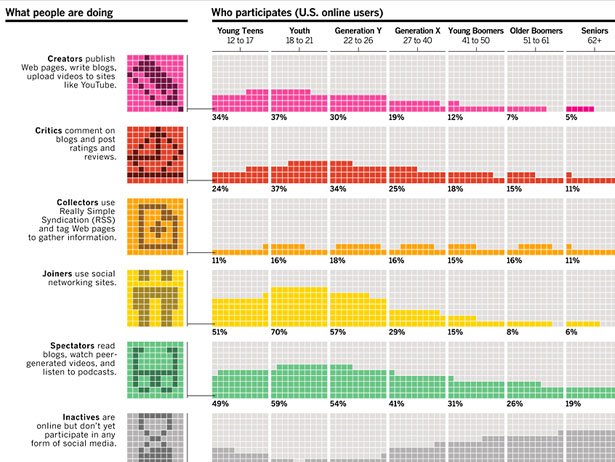
Forrester has created 6 overlapping groups of people from a social media perspective (paraphrased):

  1. Creators.  These are people who publish on the web (blog, website, video, podcasts).
  2. Critics.  These are people who post reviews online, comment on blogs, or contribute in other ways to existing content.
  3. Collectors.  These are people who read lots of information and may vote or tag pages or photos.
  4. Joiners.  These are people who have a profile on different social networking sites and visit them with some regularity.
  5. Spectators.  These are people who read online information, list to podcasts, and watch videos but do not participate.
  6. Inactives.  As suspected, these are the people who aren’t engaged in any of these social technologies. 

The other thing that I think is interesting is their breakdown of these groups by percentage (Based on their North American Technographics Interactive Marketing Online Survey (Q2 2009)).  As expected, in all these categories (except inactives), the younger age groups are more likely to represent these categories.  For example, 46% of people 18-24 are creators while only 12% of people over 55 are creators. 

  • 24% of people are creators
  • 37% are critics
  • 21% are collectors
  • 51% are joiners
  • 73% are spectators
  • 18% are inactives

10 Numbers You Need To Know For Mobile Health

I found this great list of statistics yesterday from RxEOB. I won’t repost them all here so you click thru to the original content, but I thought it was very helpful.

23%. Percent of American households who use only a mobile telephone, no land line. Another 15% of homes with landlines report they receive all calls to their mobile device.

32%. Percent of Americans whom have accessed the internet from their mobile phone as of 2009. (19% reported they did it “yesterday”). In total 56% of Americans have accessed the internet via some form or wireless device (e.g., phones, MP3 players, laptop, game consoles).

81%. Percent of physicians will own a smart phone by 2012. Physicians are one of the highest using Smartphone demographics overall.

5,820. The number of health apps that were available for download from the major online Smartphone app stores (as of a report published Q2 2010).

66%. Percent of Americans who are interested in receiving health related emails from their health insurance company… 52% would be open to receiving emails that provide them feedback on their health process.

Prioritizing Social Media Participation

If you haven’t read the article in USA Today titled “A doctor’s request: Please don’t ‘friend’ me“, I think you should.  It makes some great points and is symbolic of the challenge we all face relative to social media.

  • Should we participate?
  • Which tools should we use – MySpace, Facebook, Twitter, LinkedIn, Plaxo, blogging, …?
  • How much time to spend on them?
  • What should I expect from them – leads, contacts, friends, finding old friends?
  • Is this okay to do at work or should I do this at home?
  • Should these sites be blocked at work?
  • What can I or can’t I say?
  • Should I accept invitations from everyone who reaches out to me?

The author of this article talks about some of the more physician specific issues of becoming friends with your patients in Facebook, but it generally begs the question of where do those boundaries exist.

“Having a so-called dual relationship with a patient – that is, a financial, social or professional relationship in addition to a therapeutic relationship – can lead to serious ethical issues and potentially impair professional judgement.”

On the flipside, what if a friend of yours is a physician and you need to be treated.  Is that okay?  I think so.  I know my pharmacist very well.  We’ve even had her and her family over to the house several times.  But, we became friends through our kids and our gym not simply because we have a clinical relationship.  And, while we’ll talk industry trends occassionally, we rarely talk specifics.  Plus, the fact that I help lots of companies drive business away from her pharmacy (retail-to-mail) never sits too well!

So, I’ve selectively added social media sites over the years.  Here’s a quick picture of how I think about it.  I do not accept the majority of invitations that I receive simply based on a few key criteria which vary by tool.  For example, in Facebook, I generally have to view you as someone who I have or would invite to my house in order to be your friend.  In LinkedIn, I have to have connected with you in person or on the phone one or more times before I would become a connection. 

Text4Baby (or Bebe)

This seems to be one of the more successful texting programs in the healthcare space.  This public-private partnership with sponsors like J&J and Pfizer is leveraging texting technology to try to address the US infant mortality rate (with is 30th worldwide).

With 25% of people not having a landline and more and more people (especially younger generations) depending upon the mobile phone, this makes a lot of sense.  In general, the sick population for the healthcare companies are not the younger generations, but this is typically different for pregnancy.  What I didn’t know until reading an article about this is that Hispanics and African Americans are 2.5x as likely at Whites to put off prenatal care until the 3rd trimester or skip it altogether. 

So what do you do?  Text BABY (or BEBE) to 511411 and punch in your due date.

Who writes the content?  The National Healthy Mothers, Healthy Babies Coalition.

Is there a charge?  No.

What is the content?  You get up to 3 texts a week until the baby’s first birthday.  They talk about seeing their doctor.  Keeping their appointments.  Get immunizations.  Put babies on their backs to sleep. 

What do they hope to learn?  Will users have different outcomes?  Will they go to more appointments?  Will they stop smoking?  Will the incidents of low birth weight and pre-maturity decline?

Some of my notes from RESULTS2010

This week was our [Silverlink Communication’s] annual client event – RESULTS2010 (click here to see the final agenda). I’ve talked about this before as one of the best events.  It was great! Educational. Fun. Good networking.  

Here’s a few of my notes along with a summary of the twitter feed (using hashtag #results2010). Unfortunately, the two of us twittering were also fairly involved so there are some gaps in coverage. And, my notes are sporadic due to the same issue.

Overall themes:

  • Communications are critical to driving behavior change.
  • We have to address cost and quality.
  • Reform creates opportunity.
  • Systemic problems require systemic solutions.
  • Measure, measure, measure.
  • Automated calls – while not the whole solution – work in study after study.
  • People are different.
  • There is a gap in physician – patient interactions. 

Notes:

  • Reform basics – guarantee issue, requirements for coverage, income related subsidy.
  • Independent payment advisory board has an aggressive goal – get Medicare spending to equal GDP growth + 1% each year.
  • ½ of the $1 trillion needed to pay for health reform comes from Medicare savings / reform…the rest from taxes.
  • Everyone’s fear is that MCOs become “regulated utilities” that just process claims…unlikely.
  • Need to address underuse, misuse, overuse, and limited coverage.
  • Need to measure quality and cost at the person level.
  • CMS pilots around shared savings are working – outcomes improved.
  • Medicare Part D only got one complaint per thousand for therapeutic interchange programs / drug switching.
  • The decision around defining MLR (medical loss ratio) and what fits in there is critical.
  • Healthcare is like anything else…it’s not great and needs to change, but don’t touch mine cause it works ok. [frog in the pot]
  • How do we make each healthcare decision an informed decision.
  • Decision aids.
  • Pull, push, or pay – 3 ways to drive awareness.
  • Moving from information about your care to information being care.
  • The incentive rebound effect…what happens when you take away an incentive.
  • Social interaction affects our behavior.
  • Solving for how to change consumer behavior cost effectively and in a sustainable manner is a good challenge to work on.
  • How do we move people from desires to action? From “I’d like to exercise” to actually doing it.
  • The fact that some European programs take 3-5 years to see an impact makes me wonder what that means for our US investment strategy given the member churn across plans.
  • Great examples of ethnographic interviews
  • Good McKinsey data on people’s perceptions – Annual Retail Healthcare Consumer Survey.
  • Inform / Enable / Influence / Incentivize / Enforce
  • One way of categorizing – willingness to change versus barriers to change (rational, emotional, psychological).
  • Attitudinal segmentation – cool…but how to scale?
  • Provider staffs attitudes are important.
  • Design – delivery – measurement
  • Readiness to coach
  • A culture of health
  • Have to mix up your tools (incentives, channels)
  • “Communication Cures”
  • The chief experience officer is a new role in plans and PBMs.
  • The only experience you have with health insurance is via communications. Make it count.
  • Loyalty is a result of cumulative experiences.
  • People have to trust you so they listen to your message
  • Communication maturity model
  • Price is what you pay; value is what you get. (Warren Buffett quote…he wasn’t there)
  • Shifting paradigms:
    • Consumption to sustainability
    • Possessions to purpose
    • Retirement to employment
    • Trading up to trading off
    • Perceived value to real value
  • Simple…less is more
    • 1/3 of people feel their lives are out of control.
  • Inflamation causes 80% of diseases (really)?
  • If only 10% of outcomes are driven by costs, why do we spend 100% of our time trying to fix that problem. [tail wagging the dog] [It’s the same point on adherence.]
  • There are 45M sick days per year from 5 conditions – hypertension, heart disease, diabetes, depression, and asthma.
  • Have to look at clinical efficacy and elasticity of demand.
  • Commitment, concern, and cost.
  • Five components – plan design, program, community, communication, and provider engagement.
  • Need a multi-faceted approach to create a culture of health.
  • MDs much more likely to talk about pros than cons.
  • There would be 25% less invasive procedures if patients fully understood the risks.
  • Foundation of Informed Decision Making
  • Huge gaps in patient view versus physician views around breast cancer.
  • Preference-sensitive care
  • Dartmouth Atlas
  • Genomics tells you the probability of being on a disease curve, but not where you are in the potential severity.
  • Only 60-70% of women get at least one mammogram their entire life.
  • Statin study – barriers to adherence:
    • 37% didn’t know to stay on the Rx
    • 27% side effects
    • 15% convenience
    • 15% MD instructions
    • 11% cost
  • In healthcare, we’re all taught to speak a language that no one else understands.
  • It takes a village.
  • Challenge – Use communications to cure cancer.
  • Collaboration. Innovation. Evaluation.
  • Adherence is a great example of where everyone’s interests are aligned.
  • There is no magic bullet for adherence.
  • You need a multi-factorial approach to address adherence…Physicians are rather ineffective at addressing adherence.
  • Evidence-based plan design works to impact adherence (although I think another speaker said no).
  • You have to think about operant conditioning. (Look at dog training manuals and kid training manuals – very similar)
  • Think about all the failure points in the process.
  • What is the relative value to the patient.
  • Reward system has to reward at the failure points not just at the end of the process.
  • Using a point system successfully increased the use of a select (on-site) pharmacy by 57% at one employer.
  • 75% of PBM profits are from dispensing generics…that’s why Wal-Mart was able to be a threat to the industry.
  • Drugs only work in 20-80% of people.
  • There are people with a gene that doesn’t break down caffeine.
  • 3% of people are ultrafast metabolizers of codeine (which turns to morpheine in the body)…that can be a problem.
  • Epigenetics – turning DNA switches on and off.

“Tweets”

Rebecca from ProjectHEALTH closes #results2010 with a remarkable talk on this crucial program; they work with 5,000 families/year.

Reid Kielo, UnitedHealth: 93% of members validated ethnicity data for HEDIS-related program using automated telephony #results2010

25% of Medco pt take a drug with pharmacogenetic considerations. Robert Epstein, CMO Medco #results2010

Bruce Fried: the “California model” of physician groups facilitate efficiencies that improve delivery; an oppty for M’care #results2010

Bruce Fried on Medicare: 5 star ratings have strategic econ. importance, med. mgt. and cust serv. key #results2010

Fred Karutz: members who leave health plans have MLRs 2 standard deviations below the population. #results2010

Fred Karutz: Market reform survival – retain the young and healthy #results2010

Poly-pharmacy has negative impact on adherence. #cvscaremark
#results2010

1 in 3 boys and 2 in 5 girls born today will develop diabetes in their life. SCARY! #results2010

20% of all HC costs associated with diabetes. #results2010. What are you doing to manage that?

Messages to prevent discontinuation of medication therapy far more effective than messages after discontinuation. CVS #results2010

25-30% of people who start on a statin don’t ever refill. #CVSCaremark
#results2010

Maintenace of optimal conditions for respiratory patients increased 23.4% with evidence-based plan design. Julie Slezak, CVS. #results2010

Value-based benefits help control for cost sensitivity for medications; every 10% increase in cost = 2% – 6% reduction on use. #results2010

Pharmacists who inform patients at the point of dispensing are highly influental in improving adherence. William Shrank #results2010

The game of telephone tag in HC is broken. Pt – MD communications. #results2010

37% of Pts were nonadherent because they didn’t know they were supposed to keep filling Rx. #results2010

Last mile: 12% of Americans are truly health-literate; they can sufficiently understand health information and take action. #results2010

Only 12% of people can take and use info shared with them. #healthliteracy
#results2010
#DrJanBerger.

We need to improve the last mile in healthcare… clear, effective conmunication. Jan Berger #results2010

#McClellan used paying drug or device manu based on outcomes as example of “accountable care”. #results2010

72% of those with BMI>30 believe their health is good to excellent; as do 67% of those w/ chronic condition. #McKinsey
#results2010

Are incentive systems more likely to reward those that would have taken health actions anyways (i.e., waste)? #McKinsey
#results2010

Only 36% of boomers rate their health as good to excellent. #results2010

27% of people believe foods / beverages can be used in place of prescriptions. #NaturalMarketingInstitute
#results2010

Why do we spend so much time on impacting health outcomes thru the system when that only explains 10%. #Dr.JackMahoney #results2010

Using auto calls vs letters led to 12% less surgeries & 16% lower PMPM costs in study for back pain. #Wennberg
#HealthDialog
#results2010

MDs are much more likely to discuss pros with patients than cons. #Wennberg
#HealthDialog
#results2010

Should physicians be rewarded as much for not doing surgery? How do economics influence care decisions? #results2010

Physicians were 3x as concerned with aesthetics than breast cancer patients in DECISIONS study. #results2010

Fully-informed patients are more risk-averse; 25% fewer of informed pts in Ontario choose angioplasty. #results2010

Patients trust physicians over any other source (media, social connections) but only receive 50% of key knowledge. #results2010

Informing Patients, Improving Care. 90% of adults 45 or older initiate discussions about medication for high BP or cholesterol. #results2010

What is #results2010? #Silverlink client event.

#results2010#Aetna Medicare hypertension program leads to 18% moved from out of control to in control using auto calls (#Silverlink) …

About 2 of 3 medicare pts have hypertension. #results2010

John Mahoney describes how he connects payors, providers, and care via research. #results2010

As information becomes commoditized in healthcare, sustainability enters the vernacular. #results2010

Segmentation innovations of today will be tomorrow’s commodities. Measurement and learning must be “last mile” IDC insights #results2010

Plans are strategically investing in bus. intel to reach wide population for wellness, not just the low-hanging fruit. #results2010

The single most significant future market success factor is measurable results. Janice Young, IDC Insights. #results2010

Knowing our attendees’ preferences could have fueled segmented, precise invitations to #results2010. Dennis Callahan from Nielsen Media.

Drivers of those sereking alternative therapies: stress, lack of sleep and energy, anxiety, inflammation. #results2010

Only 2% of people don’t believe it’s important to lead a healthy lifestyle. Their behavior could’ve fooled me. #results2010

Are purity and simplicity the new consumption? Steve French of Natural Marketing Institute explores. #results2010

Gen Y is the most stressed out generation. #results2010

Less is more. 54% say having fewer material possessions is more satisfying. Natural Mktg Institute #results2010

Loyalty is a result of a cumulative set of experiences. Individual intervention ROI is sometimes difficult. #results2010

Sundiatu Dixon-Fyle of McKinsey; understand how beliefs shape an individual’s ability to change behavior. #results2010

Don Kemper: each of 300M HC decisions made each year need to be informed. #silverlink
#results2010

Medicare Part D: 40% lower cost than projected, seniors covered through tiered coverage powered by communication. #silverlink
#results2010

Mark McClellan: Brookings is engaging private insurers to pool data to understand quality of care. #silverlink
#results2010

Mark McClellan at RESULTS2010; bend the curves, provide quality care efficiently. HC reform >> insurance reform. #silverlink
#results2010