Archive | Silverlink RSS feed for this section

Pharma Couponing

Using copay coupons in place of real samples is both cost effective and allows pharmaceutical manufacturers to get more patient specific information (since patients typically have to register to get the coupons). They can be short-term or long-term. The primary site to go to is InternetDrugCoupons.com.

Here’s my slides from the conference call I did the other day. Some of the quotes from the event are in the recent Drug Benefit News (11/13/09).

Mail Order Retention (or Churn)

It is fascinating how life comes full circle.  I remember when I worked on the Sprint Data Warehousing project back in the 90’s.  At the time, it was the first 1 terrabyte warehouse being built, and we were using some very cool technology from Microstrategy which offered the first web-based DSS (decision support system).  One of the key components of the reporting solution and business driver model we created was churn (or retention).  You can look at it either way.

But, this is a classic example of focusing on the right metric and that you have to measure what matters (to throw out a few oldies but goodies).  Retention is a pretty new concept within the pharmacy world especially within mail order pharmacy.  Growth has been pretty constant for the past decade until the past 18 months.  Now, everyone is trying to figure out what’s happening and why.

  • Are people going to Wal-Mart and paying cash?  (Or other similar card programs at Walgreen’s and CVS?)
  • Are people simply filling less prescriptions?
  • Are people skipping doses and doing other things to stretch out their prescriptions?
  • Are people trying over-the-counter medications or using samples?

There are lots of questions that matter here.  And, you have to think through the mail order process.  How do patients experience it?  Why do they leave?  There’s lot of research that’s been done by the different PBMs here.

I had a chance to talk with Drug Benefit News about this the other day.  You can read the story here.  Here’s a piece of what we discussed:

Depending on the payer, mail-order customer retention rates vary from 75% to 95%, according to Van Antwerp. “Very few people left because of service issues,” he explains. “The majority left because of refill issues. They got to the point where they forgot to refill an important medication and couldn’t get it within a 24-hour time period…or it was up for renewal and they needed to get the next prescription written.”

To address that, some PBMs are working to develop better refill-reminder programs, including moving some customers to auto-refill, Van Antwerp says. “When you look at refill patterns, some people chronically refill too early so they hit that ‘refill too soon’ reject ,” he explains. “Others chronically refill too late.”

“Secondarily, we look at the channel that they’re using to fill,” he adds. “Some people still mail in their refill via ‘snail mail.’ Others use IVR [i.e., an interactive voice-response system].” His firm is working with some PBMs to help them understand each enrollee’s historical behavior, and then customize a response that helps improve mail-order retention while moving the member to the lowest-cost channel for ordering refills — either IVR or the member portal, Van Antwerp says.

Pavlovian Caller ID

When the phone rings, what the first thing you do?

caller ID

You look at the caller ID (or at least most people do).  A lot of people won’t answer the phone if they don’t recognize the caller or if there’s no caller ID.

Recently, I thought about how I was using caller ID at home.

  1. In one case, I used to use a service for my dry cleaning.  They would pick it up once a week and drop it off 48 hours later at my house.  The key was making sure I put it outside for them to pick it up.  It got to a point where I never even answered the phone.  I just looked at the caller ID and saw that they were calling.  That was enough to remind me to put the clothes out.
  2. In another case, I could tell how important it was for someone to reach me based on the number of attempts that they made to contact me and the frequency of their number on the caller ID.
  3. In a third case, I realized that I often called the caller ID on the phone rather than bothering to listen to the caller ID that was left in the message.

Certainly, these lessons apply across other channels (e.g., direct mail, e-mail).  The question is how do you incorporate them into your communication strategy and understand the magnitude to which they happen and influence results.

How to communicate with your members on flu 2010?

With H1N1 and the regular flu vaccines this fall, who really knows what to do?  Consumers are going to be looking for information and calling many of their providers and insurance carriers to ask the question.  Combine that management issue with the fact that only 40% of those that should get flu shots typically do, and you have a dilemna.  To hear more from Silverlink’s Chief Medical Officer (Dr. Jan Berger) and our lead for our Population Health solutions (Margot Walthall), clients and potential clients can attend our upcoming webinar on the topic.

Flu Program

22:1 ROI on Specialty Refills / Adherence

I always get very skeptical when an ROI goes above 3:1 so I was a little shocked to do some retrospective analysis with one of our Specialty Pharmacy clients at Silverlink and come up with an ROI that was 22:1 (or 2,200% ROI).  And, this was based on a pretty simple application.  (Of course it helps that specialty drugs are expensive and have a reasonable margin in some cases.)

But, for those of you interested, here are a few factoids:

  • A simple refill reminder program saved $12K per month in agents by automating the process
  • The program accelerated the refill timing within a 30-day period leading to less gaps-in-care
  • The program had almost a 20 percentage point jump in refill rates (a proxy for adherence)

It also validated a few things for us and the client:

  • As observed nationally, adherence has gone down over time (even on specialty medications) during this recession.
  • “I forgot” is still a common issue around adherence and solutions to address that should be the first thing that companies do.

Of course, the work doesn’t stop there.  We obviously want to continue our work on longitudinal analysis to look at MPR (Medication Possession Ratio) over time.  We also are working with them on addressing the other barriers on these medications (e.g., cost, side effects) by customizing communications by condition and based on the individual patient attributes.

If you’re interested in hearing more about how Silverlink works with clients on adherence (or tactically on refill automation), please feel free to reach out to me.

Jan Berger Co-Author Upcoming Book

Leveraging Health is the first book from the Center for Health Value Innovation! Using real-world case studies from public and private organizations — even small companies — this book illustrates 15 “levers” that can be used to motivate value-based changes in healthcare design.  The book will make its debut Sept. 30 at 8 a.m. at the National Press Club in Washington, D.C., with a book signing to follow at 5:30 p.m. at the Consumer Health Care Congress in Alexandria, Va. Author Cyndy Nayer will be presenting at the conference, and authors Jack Mahoney and Jan Berger will be on hand to sign the first copies! If you can’t make it to the congress, look for Leveraging Health this fall on Amazon.com.

New CMO – Dr. Jan Berger

I’ve had the chance to read Dr. Berger’s research over the years when she was at CVS Caremark. After having a chance to spend some time with her on a few topics, I am very excited that she is coming on board at Silverlink Communications as our Chief Medical Officer.

From the press release:

DR. JAN BERGER JOINS SILVERLINK AS CHIEF MEDICAL OFFICER

June 23, 2009

Burlington, MA – Silverlink Communications® Inc., the leader in healthcare consumer communications, today announced that Dr. Jan Berger, former Senior Vice President and Chief Clinical Officer for CVS Caremark, joins Silverlink as Chief Medical Officer. In her role, Dr. Berger will focus on setting the company’s overall vision and strategy for population health and clinical communications programs within the managed care, population health, and pharmacy benefit management space.

Dr. Berger brings more than 25 years of business and clinical expertise in healthcare, including more than 15 years as a medical director at both a health plan and a major regional hospital. She is actively involved in quality initiatives, participating in numerous committees for National Committee for Quality Assurance (NCQA); medication safety, participating in steering committees at National Quality Forum (NQF); and population health management through her Executive Board position at DMAA. She also serves on several influential editorial and healthcare company boards, including Editor in Chief of American Journal of Pharmacy Benefit. Her expertise expands Silverlink’s focus in population health and clinical outreach – specifically related to engaging and connecting with healthcare consumers in a variety of lifestyle management, disease management and preventive health activities.

“Jan is clearly one of the leading innovators in healthcare, with tremendous clinical acumen and an ongoing track record of business execution in programs that drive down healthcare costs and improve health outcomes,” said Stan Nowak, Silverlink’s co-founder and CEO. “We are extremely proud to have her join our executive team at a time when behavior change is critical to our national healthcare reform process.”

“Silverlink is at the forefront of using communications and analytics as strategic assets to help consumers make more effective healthcare decisions,” said Dr. Jan Berger. “With the consumer at the center of our healthcare cost equation, we have the opportunity to improve the health of our country and eliminate hundreds of billions of dollars that relate to preventable conditions. This is a complex but solvable problem and I’m passionate to be part of a team that is already making an impact.”

New Clinical Webinars – HEDIS, Adherence, Engagement

In June, we are offering three complimentary webinars to our clients and prospects on key topics of discussion.

Increasing the Effectiveness of Population Health Program Engagement
June 16th | 1:00 PM ET

Getting consumers to take charge of their healthcare behaviors and choices is critical to controlling costs and improving outcomes. Successfully welcoming and engaging consumers in DM and health management programs can be the toughest road for health plans and population health organizations. Strategies that motivate participatory engagement are key – but it takes more than a friendly voice and the right script.

Join Silverlink for a complimentary webinar where we will discuss the challenges of moving health behaviors and effective strategies organizations can implement to get ahead of the behavior change curve.

In addition, learn how to:

  • Leverage tailored messaging to drive high engagement rates
  • Enable continued engagement over time
  • Maximize buy-in and acceptance of health coaching
  • Combine multichannel approaches to elicit engagement and re-engagement
  • Optimize engagement campaigns through predictive analytics to drive results

Drive Positive Health Behaviors and Improve HEDIS Results

June 23rd | 1:00 PM ET

Whether your focus is on the HEDIS measures for women’s health, the diabetes metrics or a broad range of effectiveness of care measures, Silverlink can design communications strategies that increase your reach, motivate member action and improve HEDIS results.

With the backdrop of the economic slowdown, communicating with members about the importance of key preventive screenings is more critical than ever. Explore the many routes to break through health prevention challenges by tailoring communications interventions that work for your populations.

Join Silverlink for a complimentary webinar where we will present the results and lessons learned over several years in supporting HEDIS screenings including a recent campaign aimed at reducing health disparirities in African American and Hispanic populations related to colorectal cancer screenings.

In addition, learn how to:

  • Use a flexible framework that supports national teams in delivering effective outreach in local markets
  • Drive performance on high-profile HEDIS measures where plan performance has hit a plateau
  • Segment your membership to deliver highly personal messages using multiple levers
  • Design and target messages to help reduce health disparities
  • Combine multiple messages to support members with more than one gap
  • Leverage multichannel campaigns to maximize reach and action

Rethinking Medication Adherence

June 30th | 1:00 PM ET

More than 50% of consumers become nonadherent around their maintenance medications within the first 12 months of therapy. And, today’s economy is putting even more pressure on people to make economic tradeoffs that threaten their health. Several studies have shown that more people are skipping doses or not refilling medications. Non-adherence leads to $177B in direct and indirect costs to the healthcare system per year.

Silverlink provides a comprehensive suite of communications services to drive medication adherence from targeting and messaging to multi-channel campaign management and execution. Join Silverlink where we will discuss some of the common myths around and key strategies related to medication adherence.

In addition, you will learn about:

  • Critical success factors in designing adherence solutions
  • Important conditions to focus on for adherence
  • Success metrics and key measurements
  • Comprehensive solutions for all phases of the patient’s therapy from initiation through long term maintenance

CVS Caremark TrendsRx Report 2009

This is one of my favorite times of year. After working on the Drug Trend Report at Express Scripts for several years, I love to get all the trend reports from the PBMs and read them. The first one that I have had a chance to review is the one from CVS Caremark. I found it an easy to read document with good case studies and a mix of strategy and tactics.

Here are some of my highlights and observations:

  • 3 out of 4 clients cited “reducing health care costs” as their primary measure of PBM success…AND 2 out of 3 prioritized “plan participant behavior change” as the way to reach that goal. [Maybe the plan design bigot is finally dead.]
  • With pharmacy spend approaching $1,000 PMPY, I found their chart on potential cost reduction a simple way of pointing people to things they should think about.
    cvs_caremark_savings-opportunities-09
  • A 10% improvement in diabetes adherence can save $2,000 in annual health care costs. [I assume this is based on improving MPR and would definitely like to learn more on how the health care costs are quantified.]
  • They layout three objectives – improve use of lower cost drugs, improve adherence, and get people to take better care of their health. [Similar to the concept I laid out in my white paper of needing to be broader than just Rx benefit management.]
  • They talk about two of their solutions:
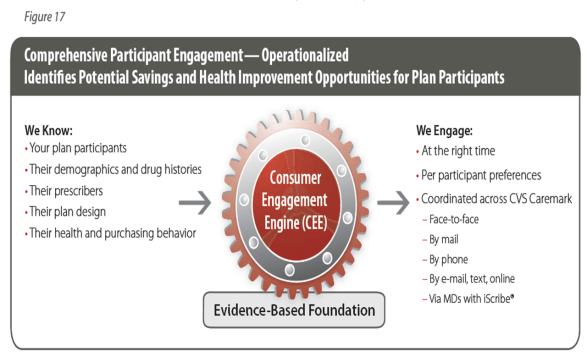
    • Consumer Engagement Engine (CEE) which is very similar to what Silverlink does and provides business logic for targeting the right member at the right time with the right message.

      consumer-engagement-engine

    • Proactive Pharmacy Care is their “medical neighborhood” concept to stitch together their entities – Mail Order, CVS retail, Specialty, MinuteClinic, and their disease management company.
  • Their trend was 3.9% PMPM in 2008 (or 2.8% excluding specialty drugs).
  • Medicare Part D utilization was up 4.1% compared to 0.8% for the rest of their BOB (book of business).
  • Their GDR (generic dispensing rate) averaged 65.1% for 2008 and was 66.3% in December 2008.
    • Best in class employers = 68.2%
    • Best in class health plans = 73.4%
  • As they remind you, a 1% increase in GDR is roughly equal to a 1% reduction in pharmacy spend.
    • [What I would like to see is improvements in GDR from new drugs coming to market in 2008 versus improvements that came from clients implementing plan design.]
  • They say [which I preach all the time} – “proactive consumer engagement improves results and lowers the risk of disruption. For best results, provide personalized actionable information at a range of touchpoints.”
  • I saw a few interesting things in one of the case studies they share about their “Generous Generics” program. [Does that name get used with consumers? What’s their reaction to it?]
    • $0 generic copay at mail [that should drive volume]
    • 10% coinsurance penalty for not shifting to mail after the second fill [similar in concept (I believe) to the Medco “retail buy-up” concept]
  • Top Ten Therapeutic categories (53% of spend):
    • Antihyperlipidemics
    • Ulcer drugs
    • Antidiabetics
    • Antidepressants
    • Antiasthmatics
    • Antihypertensives
    • Analgesics, Anti-inflamatory
    • Anticonvulsants
    • Analgesics, Opioid
    • Endocrine and Metabolic Agents
  • They state that the population of diagnosed diabetics is growing by roughly 1M a year.
  • They state that a generic for Lipitor is now expected in Q4 2011 [which I think is about a year later than originally expected]
  • They show some data from their Maintenance Choice program which I think has a lot of opportunity.
    • This is where you can get a 90-day Rx from either mail or a CVS store for the same copay. [The key here is for them to understand member profitability and for CVS Caremark to understand how to drive consumers to the preferred channel.]
    • [I would really need to understand their profitability by channel because if I read the chart in here right, it would appear that given the choice 45% of those at mail would choose 90-day at retail…a scary concept for mail order pharmacy.]
      maintenance-choice
  • They give a case on Maintenance Choice which leaves me looking for a key fact. They state that a recent implementation has a goal of 70% of the client’s day’s supply will go through the preferred network (CVS) or mail and that 20% of it goes through mail today. [What percentage goes through CVS today? If it’s a client in Boston, that one scenario. If it’s a client in Chicago, that would be another feat.]
  • Specialty pharmacy trend was 13.5%.
  • They say that pharmacogenomic testing is being used more frequently for specialty drugs. [I would love to know more…how often? For what drugs? Has it improved outcomes? Are their clients covering it? How are they playing in this space?]
  • They talk about adherence which continues to be one of the hottest areas in the Rx arena today. They give stats showing 15-48% improvement across different metrics and up to $142 in cost avoidance in one case. [Are these again control groups? What was the cost / benefit analysis or ROI? Is this improvement in average MPR (Medication Possession Ratio) or improvement in the % of people with an MPR of >80%?]
  • They talk about 88% of heart failure patients maintaining optimal prescription adherence compared to a norm of less than 50%. [My questions here (which isn’t apparent) is whether this was an opt-in program so the 88% is for engaged and active participants or whether it was across all targeted members.]
  • They provide a quick list of factors that will impact drug trend:
    • Driving costs:
      • Aging
      • Obesity
      • Diabetes
      • Specialty pipeline
      • More aggressive treatment guidelines and earlier diagnosis [which hopefully would lower total healthcare costs]
      • DTC advertising
    • Reducing costs:
      • Economy – reduced utilization and improved GDR
      • Increased availability of generics
      • FDA safety reform
      • Lackluster non-specialty drug pipeline
      • Utilization and formulary management
      • Consumer price transparency

Communication Strategy Regarding H1N1 (Swine) Flu

“There is a lot of media, a lot of news, a lot of rumor – the sooner you can get correct and accurate information to consumers, the better – otherwise people will look to other sources that may not always be accurate.”  (Jan Berger, President of Health Intelligence Partners on podcast)

We have been hearing a few things from our clients and have put some information up on the Silverlink website.  Some of the comments have been:

  1. I have seen a spike in call center volume about this topic.
  2. Clients want to change plan design to make sure Relenza and Tamiflu are covered and don’t require a prior authorization or have a quantity level limit on them.
  3. We want to proactively reach out to at risk populations – children, seniors, or people with a compromised immune system.
  4. We want to be able to flexibly target certain geographies.
  5. We want to remind people not to panic, drive them to quality information sources, and make sure they know the basics – wash your hands.

At a minimum, everyone is adding information to their websites.  Many consumers are Googling the topic or following updates from @CDCEmergency (on Twitter).

Healthplans, PBMs, and population health companies are at the heart of this.  They need a coordinated strategy to inform people appropriately as this issue continues to be top of mind.

We recorded a podcast last night with the Medical Director from Healthwise and Jan Berger who is the former Chief Medical Officer from CVS Caremark and is now president of Health Intelligence Partners.  In here, they answer some general questions about the situation and what companies should be doing to educate members.

The two standard solutions Silverlink is offering clients are:

  1. Offer an inbound FAQ (Frequently Asked Questions) line with CDC content and specifics about their plans.  This can help with overflow from their call center and/or be used as a direct line from their website or outbound communications.
  2. Selectively target populations (age, zip code, disease state) with a brief message reminding them to wash their hands and telling them where to get qualified information.

As with all our communications offerings, these can be customized (messaging, channel, targeting, etc.) to meet client requirements.  Additionally, since one of our technology advantages over others in the space is our flexibility, we can work with clients to keep these messages up-to-date as the situation changes and as new information has to be added.

Whitepaper: The Future of the PBM (Pharmacy)

As we have been working with a lot of PBMs over the past year, the question has come up many times – “where do you see the industry going?” After bouncing some ideas off a few of you, we have pulled together a whitepaper with the Silverlink Communications perspective. Certainly, each area of the whitepaper could have been its own chapter, but rather than turn this into a thesis, we are publishing it.

As I have said in a few recent articles including the one in HCPro, I think the Express Scripts acquisition of NextRx will likely accelerate a few of our predictions here.

The executive summary of the whitepaper is below. The final whitepaper is available here.

I would welcome any comments you have…

Executive Summary

In the next several years, we believe that three changes will drive the pharmacy marketplace and ultimately change the business model for PBMs. These changes will be accelerated by the current financial crisis which may drive further consolidation in the short-term. Consolidation which we believe will accelerate the “race to the bottom” where the traditional model of scale has been maxed out with parity achieved among the large PBMs.

1. The need to better engage the consumer in understanding their benefits and ultimately responsibility for their care;
2. The effort to automate and integrate data across a fragmented system and across siloed organizations; and
3. The shift from trend management to being responsible for outcomes.

Consumer Engagement
The industry-wide movement to consumerism will continue to affect plan design, but it will also thrust PBMs and pharmacies into the critical path of member engagement. With pharmacy being the most used benefit as well as the volume and accessibility of retail pharmacies, they will play a critical role in driving adherence and helping consumers understand healthcare. This will renew the focus on cognitive skills, medication therapy management and ultimately drive the desire for a more traditional “corner store” approach that can be scaled using technology.

Combining this with the macro-economic forces that are driving ubiquity of technology through mobile media and the evolution of the Internet from a pull media to a push media will also challenge the PBMs and pharmacies to innovate. They will be required to look outside of healthcare models to identify the right communications to drive behavior. PBM’s and pharmacies will have to leverage behavioral economics and personalization technology to get the right message to the right consumer at the right time through the right medium.
Automation and Integration
The consumer engagement challenges will only exasperate some ongoing challenges within the PBM and pharmacy community. This will include the lack of staff to provide more cognitive services and the general fragmentation of data across organizations and functional silos. Figuring out an overall “single view of the patient” which shows all the touch points and offers a coordinated multi-channel strategy for inbound and outbound communications will become a major focus.

In addition, in order to make these solutions efficient, the development of predictive models, much like the clinical and underwriting solutions being used today, will become the norm across the industry. As these models are fine tuned and the promise of e-prescribing becomes more of a reality, the channel for engaging physicians in the member’s care will finally exist. PBMs and pharmacies will be able to use data to allow physicians to understand when patients aren’t being compliant and when there is an opportunity to drive change.

From Trend Management to Outcomes
The traditional business model for the PBMs has been based on large scale negotiations to drive rebates and efficiencies within mail service – cost to fill and acquisition costs. At the same time as those efficiencies reach a maximum discount, the traditional tools for managing trend will have run their course. Although plan design won’t “die”, comparative effectiveness may reduce (or eliminate) the need for formularies, and in general, the ability to shift cost to the consumer above the 25-30% level will be difficult.

Both of these challenges will push the PBMs and pharmacies into a role where they are focused on driving health outcomes and being part of the bigger solution across the industry. They have a strong footprint to drive this change and as theranostics (or personalized medicine) evolves there will be an opportunity to find cost effective solutions to change the prescription landscape.

Promotion vs. Nudging vs. Mandatory Mail

Although there is always a dialogue about the lifecycle of mail order, I think some of the work out of the Consumerology group at Express Scripts is interesting.  The frameworks that they apply internally are very similar to the technology and approach that Silverlink uses with the rest of the market.  [Kudos to Sean Donnelly and Bob Nease for their work on this new approach.]

The traditional ways of driving mail order have been:

  • Over a copay incentive (and hope)
  • Letter and calls encouraging member to convert
  • Providing a call center to facilitate the conversion to mail (from an inbound call or from a transfer on an automated outbound call)
  • Mandatory mail – requiring the member to use mail or pay the full cash price for the drug
  • Retail buy-up – allowing the member to keep getting the maintenance drug at retail (after 2 fills typically) but requiring them to pay a penalty for choosing a higher cost channel

Now, “Select Home Delivery” uses the 401K approach of opt-out vs. opt-in to drive participation.  As behavioral economics would suggest, inertia will carry the momentum and by getting the member signed up in mail and moving them to mail will drive success versus requiring them to take an action. The idea here is to “nudge” the member versus force them or leave it up to them to take action.

Select Home Delivery optimizes the use of cost-saving Home Delivery, requiring members to opt out of the program rather than the traditional approach of requiring members to opt in.  The program is based on the psychological principle of hyperbolic discounting, which says immediate events (for example, the hassles of signing up for Home Delivery) loom large compared to downstream benefits (such as a lower overall copayment and receiving a 90-day supply).  Dr. David Laibson, an economics professor at Harvard and member of the Center’s advisory board, conducted research showing that applying this principle to 401(k) programs dramatically improved participation rates.

“Opt-out and active decision programs for 401(k) enrollment dramatically improved low employee participation rates. We wanted to explore whether these tools could also solve healthcare challenges,” Laibson said. “This is one of the first marketplace adaptations that successfully applies behavioral economics to improve healthcare.”  [quotes from Consumerology blog]

I think the new results from their blog (below) are impressive.  [BTW – If you’re a member at Lowe’s or another client which has used this, I would love to hear your reactions.]

select-home-delivery

Selling NextRx to Express Scripts

I was hoping I might get a chance to sit down with Angela Braly (CEO at Wellpoint) at the WHCC 2009 in DC to talk about the sale they announced yesterday NextRx to Express Scripts).  I think it’s a very logical decision, and I think they got a good price.  For my old team at ESI, there is a huge opportunity for them to drive mail volume.

In her keynote discussion this morning, she briefly mentioned the sale saying that they sold it to help lower healthcare costs.  While I completely agree in the short-term (i.e., rebate contracting, network negotiations), I remain mixed in my long-term view.

I talked briefly with Les Masterson about this yesterday for the article he just published – “PBM Sale Highlights Dilemna for Health Plans“.  I do expect this will push for the development of a new business model which will highlight automation, member engagement, and a greater role in driving outcomes.

George Van Antwerp, vice president, solutions strategy, at Silverlink Communications, Inc., in Burlington, MA, says health plans can benefit from having their own PBMs if they use them properly.

“I think that it’s beneficial to plans to own their own PBM if they can integrate data and create a better member experience; make the tradeoff between increased pharmacy spend and lower medical loss ratio; and manage to get most of the economies of scale in terms of operations and negotiation. That has proven hard to do within health plans, and therefore, there will be short-term interest in capitalizing on the valuation of the PBM business,” says Van Antwerp.

With three large PBMs left after the pending purchase, Van Antwerp says the trio will “race to the bottom in terms of negotiating scale leverage.” Van Antwerp predicts the remaining PBMs will ultimately try to differentiate themselves by offering healthcare management through member engagement, greater transparency, and a renewed focus on health outcomes.

Medicaid Communications

Interested in hearing more about this topic.  You can hear Margot Walthall from my team talking about this on an upcoming webinar.

The Medicaid Communications Lifecycle:  From Onboarding through Redetermination
April 28, 2009 | 1:00 PM ET | 10:00 AM PT

Introducing your Medicaid members to your plan’s benefits as well as their responsibilities is critical to developing a successful member / health plan relationship. Sustaining positive impressions over the course of the member’s eligibility is equally important to retaining Medicaid members.

Silverlink has developed a broad set of communications outreach programs that have yielded strong results for Medicaid and CHIP populations. Join us for this complimentary webinar where we will explore how Silverlink can help you cost-efficiently support:

  • The Medicaid onboarding process with welcome/HRA outreach
  • Targeted messages about health screenings to drive HEDIS results
  • Communications approaches that can reduce health disparities
  • Effective methods for educating members about the redetermination process that can inspire loyalty

Register Here

Sprint: What’s Happening Now

I am not sure how this helps Sprint sell more phones and/or services, but I enjoyed the advertisement. The concept of leveraging data to understand consumer behavior is essential. This is a topic we [Silverlink] are constantly working with our healthcare clients to address.

  • How do you know what members or patients are doing?
  • Do you understand their preferences?
  • What have they historically done?
  • Can you predict how they will act in the future?
  • What data is needed to do analysis and create a predictive algorithm?
  • How do you leverage that to create interactive and compelling communications?
  • How do you study their behavior change?  (e.g., did they get a flu shot after being reminded)

X-Ray Vision Carrots

Behavioral economics can apply in many instances.  It is the “hot” discussion topic in healthcare about how to understand how members (consumers / patients) make decisions and what factors influence their decisions.

In this article in Newsweek about getting kids to eat healthy, they talk about three things:

  1. Verbal encouragement
  2. Descriptive labels
  3. Improved access

Rather than calling them carrots, they talk about calling them “x-ray vision carrots”.  These 3 “principles” are relevant to a lot of communications.  You have to be proactive and provide encouragement to members to get a flu shot or do other preventative health actions.  You then need to find a way to describe the action in a way that is compelling.  And, finally, you have to make the action easy.

What’s In A Voice?

In the most recent copy of AHIP’s Coverage Magazine (JAN+FEB.09), there is a nice feature called “What’s In A Voice?” which talks about Silverlink Communications. You can find the whole article (“Motivating Change“) here, but I pulled out a few quotes:

“When the phone rings, it takes just the right voice to motivate a member to overcome the tendency to put off receiving preventative care.”

“Silverlink calls allow us to communicate with our members in a really personalized way without incurring the costs associated with hiring and training additional customer service representatives.” Linda Lyle, Cariten Healthcare Vice President of Operations

“This mammography campaign contained scripting that allowed the members to respond, [indicating] whether or not they had had a mammogram. We received a large number of ‘yes’ responses that we will pursue for HEDIS improvement, as well as to identify gaps in our data collection. This method of collecting data about our members is unique to telephone outreach. We are anxious to explore our findings.” ” We know how many listened to the message and how many hung up. We know how many people we actually reach.” Michael Bryne, Assistant Director of Quality Management at EmblemHealth.

The article also talks about using non-professional voices such as the Chief Medical Officer or a customer service representative who was really good with members. In one example, Eleanor Sorrentino, the Managing Director of Quality Management at EmblemHealth, talks about getting 50 calls from members thanking her for the automated call which was recorded in her voice.

A few other items talked about include the use of data and reporting which is available real-time to make decisions along with the use of natural sounding voices to drive a conversational experience which leverages internal and professional scripting resources to develop the best content.

Saving Money On Rxs

Are you interested in saving your members money?  There are a lot of things you can do.  Pill splitting is an easy solution with a quick impact.  Using generics and moving to mail order are others.  I am going to do a webinar on this in a few weeks. [March 10th and March 12th at 1:00 ET]

Even if you’re not specifically interested, I think you would be fascinated to see how we use a multi-modal approach to drive behavior.  It is modeled on what PBMs have been doing around mail order conversion for years.

Lots of people talk about multi-modal coordination.  We can and have done it.  Gartner is talking about Business Process Outsourcing (BPO) in healthcare and has mentioned Silverlink in their last two reports as one of the few vendors doing this.

I hope you can join us! REGISTER HERE.

Seeing Significant Improvements With BPO

Business Process Outsourcing (BPO) or as I will sometimes call it CPO (Communications Process Outsourcing) is something we are definitely seeing a growing demand for in the market.  It blends technology, services, process management, consulting, and analytics.

Both IDC and Gartner have now talked about this in recent reports.

According to Janice Young, IDC program director, Payer IT Strategies, “we expect to see an increasing interest and likely investment in BPO in 2009 and 2010 for healthcare payers. Our recent results from our January 2009 healthcare payer survey of IT spending indicate that 45% of healthcare payers expect BPO investments to increase this year.” These trends are highlighted in IDC‘s U.S. Healthcare Payer 2009 Top 10 Predictions (January 2009).

Gartner research vice president, Joanne Galimi, reported on BPO services within health plans in a recent report entitled Healthcare Insurer Business Process Outsourcing Trends (January 2009). “Although things look gloomy for the larger economy, the potential for BPO to address immediate business pressures and long-term recovery goals for the health plans will be unprecedented,” says Galimi.

When I first came to Silverlink as a consultant in early 2007, this was exactly my vision.  I always talked about the “one throat to choke” model.  When you are in an operations role, it is always so difficult to coordinate modes, vendors, discrete data sources, and ultimately to get a holistic view of the member (or patient).  This is what I wanted to help build and is exactly what we have done.

Fortunately, we are now in a position where we can talk about how this service model has grown and how offering turnkey services for clients has driven results.  I love to focus on outcomes so this is exciting.  Here are a few from the press release we put out this morning:

  • Over a 300% improvement in retail-to-mail conversions for a large pharmacy benefit manager (PBM),
  • 54% increase in participation for a pharmacy program, representing between $150 and $175 per year per prescription in consumer savings,
  • 400% improvement in yield in a COB program, translating to over $20 million in cost savings to a major U.S. health plan, and
  • Up to an 82% increase in transfer rates for population health engagement for disease management, lifestyle management and treatment decision support programs.

Process…The Key to Success

“We get brilliant results from average people managing brilliant processes. We observe that our competitors often get average (or worse) results from brilliant people managing broken processes.”

Sources: “Decoding the DNA of the Toyota Production System,” Steven Spear and Kent Bowen, Harvard Business Review, September-October 1999

I think this is so important especially in times like this when we are all focused on doing more with less. It is critical to understand how your process works; how to apply automation; and how to learn and improve it over time.

I came across a presentation from a webinar I gave back in 2007 on Business Process Management (BPM) which made me think about this. (Some of the vendors in this space include Pega Systems, Lombardi, and Appian.)  It’s also very relevant given Gartner‘s recent report on Business Process Outsourcing (BPO) in the payor space.

“Healthcare insurers should view business process outsourcing as a means to achieve business transformation while minimizing risk. Therefore, using BPO for nondifferentiating business processes is an essential step toward achieving competitive success and business growth.” Joanne Galimi in Healthcare Insurers Business Process Outsourcing Trends (January 23, 2009).

Finding a business partner that can work with you to understand your processes, understand what measures matter, help you improve your approach, and that is willing to take risk based on your success is important.   I always encourage people to not think of companies as vendors but as partners that bring them innovative ideas and help them iterate to improve.  I don’t believe in the big bang theory that I can do it right the first time and never need to change.  That flies in the face of everything that has been observed in different industries.


The Easiest $400+ You Can Save In Healthcare

In today’s economy, we are all looking for ways to save. And, it should be no surprise that pharmacy is the most frequently used benefit since, on average, people get fourteen 30-day prescriptions per year.

That being said, there are still hundreds of dollars that millions of us can save. Let’s take an easy example – Lipitor. Lipitor still has about $8B in sales here in the US. If you assume the monthly cost is $125 per 30-day supply and everyone on the drug filled it 12 times per year (which doesn’t happen but is a topic for another day), that means that each consumer on Lipitor represents $1,500 in revenue to Pfizer per year. Dividing the $8B by $1,500 tells me that there are about 5.3M consumers using Lipitor in the US.

On most formularies (or preferred drug lists), Lipitor is a 3rd tier drug meaning that consumers are paying $40-$50 per month for this drug. Considering the fact that Lipitor has a generic alternative which is called simvastatin (aka generic Zocor), consumers can often talk to their physician and use this drug as a lower cost alternative. Additionally, both of these drugs are maintenance drugs that can be filled at mail order which often represents a 30% savings to a consumer (based on average plan designs). And, finally, simvastatin is a drug which can be split according to many different companies.

Here is the math, but a consumer on Lipitor could talk to their physician to get started on simvastatin, split the pills, and after a few months move to mail. That would save them $400+ in many cases.

  • Assuming Lipitor is a 3rd tier drug with a $40-$50 monthly copay and the consumer fills the drug every month for a year, they would spend $480-$600 out-of-pocket.
  • Assuming they moved to simvastatin (with their MD’s approval) with a $10 copay, they would immediately drop their costs to $120.
  • Assuming they split their pills (i.e., got a higher dose of the medication and used a pill splitter to use ½ the pill each day), they would typically reduce their copays by 50% or drop their costs to $60 a year.
  • And, if they then moved the prescription to mail where they reduced a 90-day supply for the same price as a 60-day supply at retail, they would drop their out-of-pocket costs to $40 a year.

I don’t know about you, but that seems pretty easy. It’s clinically appropriate for most patients. The PBMs will typically help you with these programs by reaching out to your physician to get the new prescription.

Hopefully, you’ll be hearing from your PBM or managed care company about these savings. At Silverlink Communications, we are working with lots of them to design and execute these types of programs. It is always very rewarding to get in touch with consumers and bring them a message about how to save money.

If you are a health plan whose premiums are going up, this is a great way to reach out to your membership and provide them with a positive message about how you care and are responding to them in these tough economic times.

Improving Your Healthcare Communications

I put up a new page off the site that talks about HealthComm that many of you might find interesting.

Healthcare communications is a strategic opportunity for most healthcare entities. This framework should help you think about how to design solutions to drive behaviors within your membership.

A Single View of the Member

Do you dream of being treated as one consistent individual across a company?  Wouldn’t it be nice if they knew every communication they sent to you – letters, calls, e-mails – and knew every communication touch you had with them – webpages visited, faxes, inbound calls, e-mails?  Unless someone can tell me different, this is still a dream world at most companies and maybe more than a dream at most healthcare companies.  (It’s even more complicated if you start thinking about all the touches by the health players – hospitals, clinics, MDs, disease management companies – and integrating them.)

All that data could help paint a much better picture of each individual if blended with outcomes data.  Who responded to what?  When did they respond?  What did they do?  How did it vary by condition?  How did it vary by gender?  By age?  What can you use to predict response rates? (I.e., the key here is having data transparency, easy to access data, and the ability to mine and analyze the information.)

There are so many variables that it can be overwhelming.  That’s why I found the discussion around Campaign Management 2020 by Elana Anderson and then commentary by James Taylor interesting.

“we can dream of technology that supports fully automated marketing processes and black box decisioning, tools that simplify marketing complexity and support collaborative, viral, and community marketing” (Elana’s blog entry)

This really gets at the heart of some of the fun projects we are working on these days at Silverlink Communications with our clients where we are bringing Decision Sciences to healthcare and helping clients optimize their engagement programs, retail-to-mail, brand-to-generic, HEDIS, and coordination-of-benefits (among dozens of other solutions).  Helping clients layout a strategy, define a process, develop a test plan, execute a program, and then partner with them to improve results is what makes my job so exciting.

As we go into the new year, I hope all of you are having fun at your jobs or quickly find a new job if your unemployed.

More Guns and Safes but Less Pregnancies

Some of you will remember my blogging about Microtrends and Kinney Zalesne’s participation in the Silverlink Think Different event.  (Kinney is one of the author’s of the book – Microtrends.)  Well, the authors of the book are now writing a weekly column for the Wall Street Journal.

The first one is about the new Mattress Stuffers.  As we saw recently with people over-subscribing to treasury bills at 0% interest, there is a demand for safe places to put their money.  People have lost faith in a lot of the institutions that our economy is built on – housing, automotive, banking, government.  Purchases of guns are up this year.  Purchases of safes are up this year.

“refraining from having kids is the ultimate consumer pull-back”

As part of this consumer pullback, they predict that there will be a dip in pregnancies nine months from now.  We are certainly entering a new age that will shape this generation much like the Depression shaped my parents generation.  Expectations will be reset.  The way people invest will change.  People’s view of money (e.g., cash versus credit) will change.

I have already seen thrifty being “cool” versus extravagence being “cool”.  It won’t happen in this first wave of change, but I do think this is a good thing for preventative health.  People will be more interested in planning forward and making smart decisions that pay off long term versus figuring they can fix it retrospectively with money.

Article On Silverlink Communications

The October 2008 issue of ADVANCE for Health Information Executives contains a nice article about Silverlink Communications by Robert Mitchell. Here are a few items from the article:

  • It focuses on our Adaptive HealthComm Science approach which brings decision sciences to the area of driving healthcare behaviors. [This is what leading consumer companies, credit card companies, and gaming companies use to understand consumers.]
    • “Adaptive HealthComm Science looks at microsegments of the member population to try different interventions with different populations — all standing against control groups and measurements of what works best. It then adapts, learns and tries again. “The communication system continually learns and automates its processes so that it is capturing new data and learning along the way from those interactions. It is consistent and can be measured.”
      • It is amazing to see how much programs can be improved over relatively short periods of time by rapidly testing isolated variables to find the right solution for each microsegment of the population.
    • One of my favorite examples from my past was simply using stamps turned at an angle on a letter to improve the rate at which direct mail was opened. It looked more like a human had hand licked each stamp rather than a machine which put the stamp on perfectly each time.
  • It talks about the ability to do on the call calculations and dynamic pathing on the core automated calling platform.
    • On-the-call calculations: If you have 3 drugs to refill, but you only choose two of them then it can tell you what your copay is. Or, if you tell the caller your weight, it can calculate the difference from a prior weight it had collected.
    • Dynamic pathing: Based on answers you give, the call is intelligent enough to serve up different content to the member and/or route you to a different group of live agents based on rules.

“We’ve invested heavily in people, technology, processes and a methodology that continuously improves to maximize the effectiveness of health care communications,” Stan Nowak, CEO and co-founder of Silverlink, said. “Over the next few years, changes in the way health care stakeholders communicate with patients and health plan members will be one of the keys to lowering health care costs while driving consumer affinity.”

“To the consumer, health plan products are largely undifferentiated on the basis of benefits or network, and consumers experience their health plan almost exclusively through the communications they receive from the plan,” Nowak continued. “Health care organizations have an opportunity to clearly differentiate themselves through proactive and personalized communications, improving their members’ experiences with each interaction, and earning consumer trust and affinity. In essence, for health plans, communications is their product.”

Payers Spending On BI and Information Delivery

“Healthcare payer spending on business intelligence, information delivery and transparency is the fastest growing spending category in 2008 for healthcare payers,” said Janice Young, IDC Program Director, Payer IT Strategies.

This quote was in our press release this morning around the growth at Silverlink.  You can read about the company in the release, but I wanted to focus on this quote from IDC.

On the one hand, I think consumers should be saying “Amen!” that payers are focusing on business intelligence (BI) although that can mean a lot of things.  On the other hand, they would shocked to know how new this is to the healthcare space compared with the consumer packaged goods industry.  BI can help identify gaps in care and identify how to help patients become better.  BI can help personalize the messaging that you receive from your health plan so you don’t have these huge legal caveats about all savings and other specifics being based on your exact plan design and deductible.

Information delivery can also mean a lot of things.  Is this reporting to the employer?  Is this online analysis for the consumer?  Is this communications?

And, I am not sure what transparency means, but I hope it means things like letting consumers actually understand the price of goods and services and how to make tradeoffs between different options with all the data (e.g., quality, price, outcomes, patient experience).

Overall, for those of us in the healthcare communications space, this is a rising tide that helps.  It means the payers who support all of you consumers are raising the bar and looking at how to use their information to improve the experience and outcomes (ideally).  It could also allow them to better focus their efforts on the riskiest patients and discover the best way to drive behavior.

The data is there and has been there so figuring out how to use it and what to use it for is critical.  Mapping this against the patient expectations and desired activities can be a great positive for the consumerism movement.  Integrated data.  Accessible data.  Digestible data. Sounds great.

Our First Think Different Event

Today was our first Think Different event in Boston. This is a road show we are doing around our new positioning and how health care companies need to get outside the box to improve the effectiveness of their communications. It has four external speakers plus our CEO.

[Spoiler Alert: If you are attending an upcoming session, I may reveal some of the content here.]

I missed ½ the session today due to a client call, but I will be at 3 of the other 5 events. In listening to the first two speakers, I jotted down a few thoughts.

From Kinney Zalesne:

  • She spoke about moving to the Starbucks economy and how we have much more choice today in what we do, who we love, religion, and our gender. Everyone immediately thinks of gender meaning sex change operations, but the point here is that there is a group of people who don’t want to be forced to select a gender identity. Before you discount it, you should know that 100 corporations, 75 colleges, and 8 states now ban discrimination based on gender identity. This was a bit of a surprise to me, but when I was talking with a large health plan about this, they informed me that their new EMR (electronic medical record) allowed for 5 possible gender options.
  • She talked about people basically starving themselves to focus on the theory that has been demonstrated in animals, but not yet in humans which says that by eating 30% less calories you can extend your life by 40%. (Not something I will be doing.)
  • She talked about the Do-It-Yourself (DIY) Doctors which are the people who use the Internet to self-diagnose and treat the MD as an ATM for drugs (i.e., I need a prescription for simvastatin can you please write it for me). I have heard a lot of talk recently about the changing perception of physicians. I haven’t seen the statistics, but one person said that they have lost the most respect over the past 20 years than any other profession. I think Kinney’s point is more about them moving from being a supervisor role (i.e., you should do this) to an advisor role (i.e., thanks for your opinion…I will take it into consideration).
  • Her statistics about 5M working retired (i.e., >65 years old) and 2M working teens (i.e., using the Internet to make money before they leave high school) says a lot about how benefit design will need to change. The implications on needs and flexibility (e.g., imagine two primary addresses for snowbirds) could be significant.
  • In her talk about micro-targeting, my mind drifted to a few thoughts:
    • How has gas prices changed our opinion of other costs? A $15 copay used to be equal to 7 gallons of gas. When it only equals 3 gallons of gas, do we view the $15 differently? [Have you caught yourself saying gas is only $3.75 at this one station near my house?]
    • Just like your segmentation can change in healthcare, it is important to consider the macro-economic and political environment when communicating. Have you listened to all the car advertisements lately…they all talk about gas mileage?
    • If you need a simple example of why personalization matters, think about buying a car. I am not a mechanical person so if I came in and someone talked to me about horsepower and cylinders then I would be turned off. I care about comfort and low maintenance.
    • Finally, getting back to health, I thought about how difficult it is to be successful. Let’s assume there were 10 primary reasons for non-adherence and 3 primary channels for delivering information (live, letter, automated call). In this case, you have 10% chance of hitting the right message and a 33% chance of using the right channel (i.e., a 3% chance to be successful).

From Liz Boehm:

  • She shared a lot of great facts about patient awareness of technology and how adherent they are.
  • She points out a scary fact that while our health care needs are going up with the boomers we simultaneously have an issue with health care workers retiring which will only make things worse in the short term.
  • She showed that 47% of people had visited their health plan’s website. [I will have to push her on this data since I believe they visited, but I think the percentage that log-in and use the site has to be very small. I would estimate 10-15%.]
  • She talked about use of social media and gave an example of a MySpace group on diabetes.
  • I found the discussion on wellness very interesting where she pointed out that things like chocolate, riding an elevator, or for some smoking gives you an immediate positive feeling while dropping your cholesterol by 10 points or even trying to lose 1 pound per week is pretty abstract.
  • I have talked about loss aversion several times, and she talks a lot about it. Using it to make a link to why incentives matter in health care.
  • Talking about motivation, I like her point that it isn’t a reasonable suggestion if you can’t achieve it. It may make good clinical sense to have a BMI of <25, but for someone with a BMI of 31, perhaps setting a goal of 28 is more reasonable and not as discouraging.
  • In her talk about trust, it made me wonder how many people that work for managed care companies and pharmacy benefit management companies reveal that fact at cocktail parties. I am not talking about professional networking events, but your neighborhood events. Do you say who you work for and address their comments about service and/or coverage issues?

I finished my client meeting in time to hear Stan Nowak, our CEO and co-founder, speak and tie together the different points of view with some potential actions that people could take. As he often does, he talked a lot about the power of data and the fact that what’s new to health care is often old in other industries. We are an industry with the most data about people, but the least ability to use it effectively.

It’s also interesting to hear him talk about some of the “data exhaust” that is created by the analysis that the team does. These are facts that get revealed which may be surprising and may be things you never even thought to look for. For example:

  • Patients with emphysema are 40% more likely to engage in a communications program related to additional coverage than patients with migraines.
  • Patients with uncommon names are 18% more likely to complete a healthcare survey than those with common names.
  • Males with depression are 83% less likely to do pill splitting than females with depression.