Archive | Consumerism RSS feed for this section

Infographic: Word Of Mouth Advertising

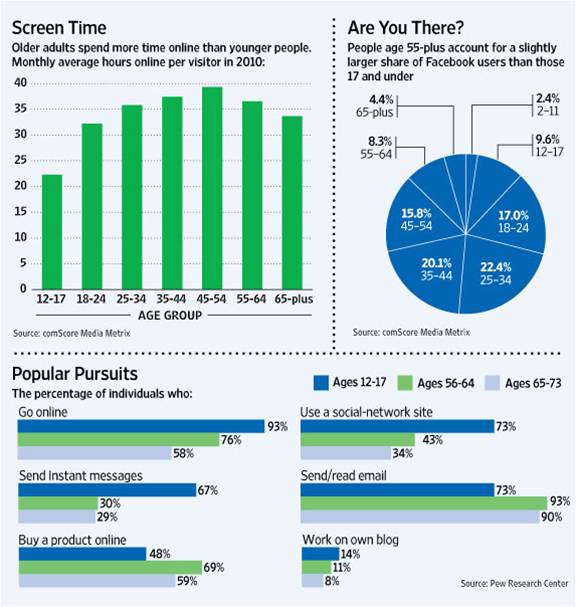
As healthcare moves toward a more retail model, word of mouth advertising becomes more important.  This is already true in terms of physician’s influence on prescription use or in some cases distribution location.  It’s also important from a Medicare perspective.  But, this will continue to increase in importance in the future with health reform.

I also believe that clients will require satisfaction scores as part of their SLAs (service level agreements) in many cases in the future and/or tie bonus dollars to this.  Will you be prepared?  Do you understand your customers’ satisfaction with you?  Do you know how to impact it?

What Will Happen With Generic Lipitor (atorvastatin)?

Well, it finally looks like generic Lipitor will be on the market soon.  I think November 30th is still the date.

Of course, now the question is what will this mean to you (the consumer)?  Since atorvastatin will be distributed by only one manufacturer for the first six months after the patent expires, there will not be a significant price drop.  Therefore, I know at least one (and have heard two) PBMs will be blocking the generic drug during that time.  Consumers will be able to get Lipitor at a generic copay.

I’ve offered my opinion on scenarios like this before.  I think it’s confusing to the consumer.  It’s great for Pfizer and generally everyone wins since it’s the same out-of-pocket costs to the consumer and lower cost to the plan sponsor (employer) than the exclusive generic (due to rebates), BUT I think it sends a confusing message.  “You can and should use generics except for in some cases where the brand drug is cheaper.”  I’m not sure how this plays out in states where generic substitution is required by law.

Of course, your other option is to go use the Lipitor $4 coupon.  If I were the Pfizer brand manager for Lipitor, I would offer a $50 payment for a 1-year supply of Lipitor and lock people in for the year.  [A seperate discussion needs to be had about how cash and coupon claims which don’t necessarily get adjudicated affect adherence measures for bonus payments like Star Ratings…and yes, I know that coupons aren’t supposed to be used for Medicare members, but I don’t think that’s monitored well.]

So, you might go to get your generic Lipitor and leave with the brand at your generic copay.  On the other hand, I wouldn’t be surprised to see some PBM negotiate well enough to get a better price on the generic than Lipitor (net of rebate).  [Of course, these are the types of scenarios that cause friction in the supply chain.  Which drug can the retailer buy better?  Does the client get the rebates shared with them or not?]

I know this is what some companies like GoodRx are looking at with their application which compares drug prices across retailers.  It shows you if there’s a coupon available (see broader article on them).  It suggests savings like splitting the pill.  (No mail or 90-day promotion yet that I saw.)  Of course, this is from a cash paying customer perspective.  But, with atorvastatin, you may want to compare your plan design with the cash price with coupons.  You’ll want to know if it’s part of the $4 generics program or if you get a better price with the CVS or Walgreens discount card programs.

Here’s two examples from GoodRx.  One is for Lipitor which shows some variation (and has no generic today).  The other is for Prozac which has been available as a generic for a while.

Using Hypothetical Questions To Influence Decisions

Most people don’t realize how questions can be persuasive, according to new research from the University of Alberta. Hypothetical questions usually start with the word “if,” meaning the information may or may not be true. Our brains process that information like the “if” isn’t even there, says study author Sarah Moore, Ph.D., a marketing professor at Alberta’s School of Business. “As a result, people accept the data you present at the beginning of a question as fact,” Moore says.

This is from an article in Men’s Health.  It made me think about lots of ways that hypotheticals could be used to drive consumer behavior in healthcare:

  • If you were able to avoid having your kids home with the flu shot this year, would you take them to get a flu shot?
  • If you were able to save $50,000 in healthcare costs over your lifetime, would you make sure to take your medications everyday?
  • If you were able to spend more time with your family rather than waiting in line at the pharmacy, would you be more likely to use 90-day prescriptions?
  • If you didn’t have to take any sick days next year, would you go in for your annual physical exam?
  • If you decreased your likelihood of losing your foot to amputation due to diabetes, would you go get a foot exam every year?

This fits well with a lot of the behavioral economics frameworks that companies are using today.

Patient Reasons For Participating (or not) in Genetic Test

Medco just put out a study that I found very interesting since it shares data around patients opting-in to a genetic test around use of statins.

In the big picture, it showed that those got the genetic test were more adherent.  Perhaps this points to a better belief in the therapy post-genetic test (similar to the placebo effect).

But, what first grabbed my eye was data on the consumers:

  • 53.8% participated in the study since they believed in the utility of genetic testing
  • Only 6.7% of those that declined cited privacy issues
  • Only 8.8% of those that declined cited anxiety about the results

This could be very promising for something that is complex but is certainly part of the future of medicine.

Sandwiches and Caregivers During AEP

October 1st marked the beginning of the Medicare marketing period leading into the enrollment period known at AEP (Annual Enrollment Period) which begins on 10/15. [For more on how Silverlink is helping clients with AEP – click here.] More to come on this topic, but for right now, I was just reading an article about the sandwich generation which made me think about this.

Traditionally, we think of sandwich generation as those that have young kids and parents to care for. Increasingly, that “young kids” age is getting stretched out as kids move back in post-college or even as they lose their jobs later in their career.

Perhaps, some of this will be good as we go through more integration of multiple generations into single households as other cultures experience, but it certainly is creating financial stress for the baby boomers. As you think about your marketing, this is just another wrinkle.

For example, according to Strategic Business Insights’ MacroMonitor, 39% of households headed by 60-64 year olds had primary mortgages compared with 22% in 1994. And, as we know, it’s often harder to get out of those houses these days as many people are unwater or can’t sell their homes.

How does this change our caregiver strategy as a healthcare provider? (assuming you even have a caregiver strategy)

On this caregiver point, here are some statistics from the National Family Caregivers Association:

More than 65 million people, 29% of the U.S. population, provide care for a chronically ill, disabled or aged family member or friend during any given year and spend an average of 20 hours per week providing care for their loved one.
Caregiving in the United States;
National Alliance for Caregiving in collaboration with AARP; November 2009
The value of the services family caregivers provide for “free,” when caring for older adults, is estimated to be $375 billion a year. That is almost twice as much as is actually spent on homecare and nursing home services combined ($158 billion).
Evercare Survey of the Economic Downturn and Its Impact on Family Caregiving;
National Alliance for Caregiving and Evercare. March 2009
The typical family caregiver is a 49-year-old woman caring for her widowed 69-year-old mother who does not live with her. She is married and employed. Approximately 66% of family caregivers are women. More than 37% have children or grandchildren under 18 years old living with them.
Caregiving in the United States;
National Alliance for Caregiving in collaboration with AARP. November 2009
1.4 million children ages 8 to 18 provide care for an adult relative; 72% are caring for a parent or grandparent; and 64% live in the same household as their care recipient. Fortunately, most are not the sole caregiver.
National Alliance for Caregiving and the United Hospital Fund, Young Caregivers in the U.S., 2005.
51% of care recipients live in their own home, 29% live with their family caregiver, and 4% live in nursing homes and assisted living.
Caregiving in the United States;
National Alliance for Caregiving in collaboration with AARP. November 2009
36% of family caregivers care for a parent and 7 out of 10 caregivers are caring for loved ones over 50 years old.
Caregiving in the United States;
National Alliance for Caregiving in collaboration with AARP. November 2009

New Walgreens Pharmacy Layout

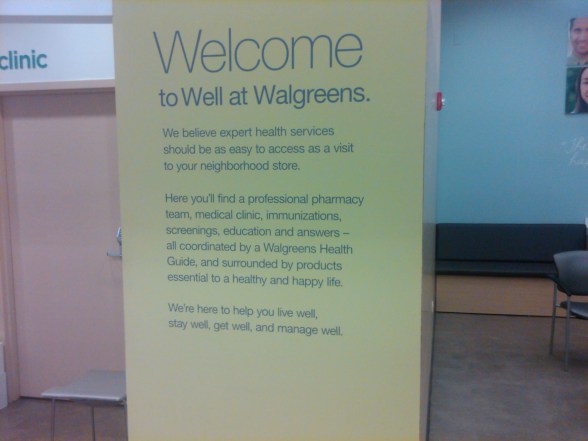
I was in a Walgreens last week in Chicago.  Maybe it’s just a newer store than my local store in St. Louis, but I thought the pharmacy looked very different.  I captured a few shots with my camera phone.  As you can see below:

1. There is an automated check-in option for refills. 

2. There is a pharmacist in front of the counter not just behind.  (And people were actively coming in and talking with him.)  The clinic also seemed to have a person on the floor roaving around interacting rather than sitting behind a podium. 

4. There was a sitting space with what appeared to be a meeting room.

5. Overall, there was a lot more signage and videos which made it a very lively and bright place to be. 


This seems like a different engagement strategy.  I’m surprised no one is talking about it.  The only thing I could find was a mention of a “training store” and 40 locations and the following mention in an article about Express Scripts and Walgreens:

As part of its plan to expand its healthcare offerings and reduce costs, Walgreen is working on pilot stores with new technology and a health guide on staff to help patrons more easily fill prescriptions, speak to pharmacists and see nurse practitioners at its in-store Take Care clinics. The first such store, in the village of Oak Park, Illinois, opened in November. Walgreen plans to have 20 stores in Chicago and other nearby towns by October.  (source)

It sounds like there are just a few stores so I must have got lucky to stumble into this one.  I had heard rumors of some re-design, but I hadn’t seen anything out there on the Internet.  Interesting.  I’d love to see a study to understand satisfaction, engagement rates, retention, etc. associated with this footprint versus the older store pharmacy layout.

Pharmacy Satisfaction Report

If you haven’t read through the Pharmacy Satisfaction Pulse Report, you’re missing some great information.  There’s not a lot out there about consumer level expectations for pharmacies but this is a good start.  (Full site with other data)

Here’s four charts I pulled out of the report to get you started…These should help you frame messaging around retail-to-mail, 90-day, and pharmacy adherence programs.


Increasing Preferred Pharmacy Usage (3 of 3)

This is the third of three posts on new ideas for increasing usage:
  1. Driving preferred pharmacy usage from the employer site
  2. Using social media
  3. Borrowing from other industries

The idea in all of these was to look at new ways that builds on the standard approach that we work with many clients on today.  And, if you believe that the Express Scripts / Walgreens dispute won’t get resolved, we’re going to see a lot of people using limited or preferred networks very soon.  This is also something that Adam Fein talked about in highlighting some of the progress Wal-Mart is making in this area.

So what are some examples of things we could borrow from other industries?

Referral Program:  Why not offer incentives for people who refer their friends and family into the pharmacy? Wouldn’t this play into the social network or peer-to-peer trends out there?

Satisfaction Surveys:  Why isn’t there more monitoring of the customer satisfaction to look for improvement opportunities?  [Note: I know there is some, but I think it’s under-utilized as a tool.]

Tiered Service Levels:  Frequent travelers get different levels of customer service.  Why don’t high utilizers with lots of co-morbidities and Rxs get a better level of service?

Points:  Why aren’t there more incentive systems and “points” that are used to reward consumers based on share-of-wallet or other metrics?  [I think there may be some legal issues here.]

Online Order Tracking:  Why can’t I watch my prescription being filled and track it around the system online?

Pharmacy Ratings:  Why isn’t there a consumer and business system that ranks pharmacies based on wait time, friendliness of staff, error rates, generic fill rates, overall satisfaction, or other metrics that can then be pushed to the consumers?

Incentives / Coupons: Certainly these have been tried and there are limits here especially in government funded benefits, but it’s still few and far between.

MD Programs: Physicians can certainly influence this decision.  Why isn’t there more effort to differentiate a pharmacy (mail, retail, specialty) by building relationships with high prescribers?

Check-in / Preferences: Why don’t the forms in the physician’s office (or applications) have you select a preferred pharmacy or have a pop-up with a preferred pharmacy in it to drive you there?

Credit: For some people, it’s an issue to front the money for the 90-day supply.  Why haven’t the mail order pharmacies partnered with a credit card company to allow for installment payment?

If you’re going to “win” at this game, you have to think differently.  You have to test and learn.  You have to capture insights from your customers and translate them into product offerings.  It’s not easy.

Handling A Mistake: Chevy’s Versus Jilly’s Cupcakes

I think in healthcare we are finally all realizing that the customer experience matters (#CEM).  The question is how to standardize and optimize that experience in scale and on a personal level when the people delivering that experience are call center agents, receptionists, physicians, pharmacists, pharmacy technicians, etc.  It’s the people in the field not those sitting in the corner office.

And, since exchanges will make healthcare a more individual buying experience and satisfaction is tied to loyalty, this is something we all need to figure out sooner rather than later.

As a family, we recently had a few experiences that show the two extremes here:

  1. Chevy’s.  This is a Mexican restaurant we frequent.  We go there probably once a week to the point where we have a preferred waiter (who knows our order before we sit down) and know the server and the manager.  Service has been great for years, but it’s begun to go down.  One night, it took 3x as long to get our food with no explanation, and we had to leave without eating.  The next time, the hot plate of food had some oil jump off and burn my wife (to the point of them getting her burn spray and ice).

    This seems like a great opportunity for an intervention by the manager.  But no.  They didn’t do anything.  They still charged us for the meal including my wife who’s leaving with an ice bag.  Oh well…time to find a new restaurant.

  2.  Jilly’s Cupcakes.  Here’s a cupcake store and restaurant that we’ve never been to, but we saw that they recently won on Cupcake Wars.  We decided to book a small birthday party there to decorate custom cupcakes.  When we show up, they are surprised.  Apparently, their reservations person wasn’t very good and got fired so they’re dealing with us and another party of 25 that have showed up unexpectedly.  A key opportunity for success or failure.

    I thought the General Manager did great.  She stepped right up and came up with a plan for us.  We got to go behind the scenes and meet the cupcake making team.  We got to customize our own cupcakes and really enjoyed it.  It was probably more memorable that the original party would have been.  In this case, I’m willing to drive people to her store and will send her a personal note to thank her.

One of the big points here is that it’s easy to either lose a lot of credibility or build up some credibility.  But, customers are fickle.  Much like companies strive for Six Sigma from a process perspective we need to keep that in mind from a customer experience perspective.  It won’t always go perfect, but how do you enable your staff and train them to respond quickly to keep the consumer happy and engaged.

Copay Cards: Don’t Throw The Baby Out With The Bathwater

Prescription Copay Cards continues to be a hot topic (see list of articles at the end here), but I see a lot of FUD (fear, uncertainty, and doubt) versus a lot of facts. At the end of the day, there are certainly a few stories about cases where costs have jumped up due to copay cards overcoming formulary positioning.

But, no one knows the total market impact. I’ve spoken with six different organizations that would be well positioned to know, but they don’t. It’s not tracked or easily available in the data. Reasonable estimates from Dr. Adam Fein over at DrugChannels put the market at about 100-125M Rxs which is about 3% of the total Rx market (assuming 3.3B Rxs/year) or 12% of the total brand market (assuming 75% GFR). [I validated those numbers with a specialty pharmacy that shared that they were seeing 13% of their claims come in with a copay card.] Certainly, the market has grown as IMS estimated in one recent article.

The question of course is whether these are good or bad and whether their use is malicious or not. My conclusions are based on talking with about 30 people in preparation for my AIS webinar on this topic today. What I concluded was:

  1. There is a win-win. Copay cards can improve adherence. Adherence can reduce total healthcare costs. There is a point at which the increased cost curve crosses the savings curve and is something to be considered.
  2. Today’s approach is a shotgun approach by which cards are available online (e.g., www.internetdrugcoupons.com) and by physicians. They’re not focused on patients with need or on patients with adherence barriers. They play into the misperception that cost is the primary barrier to adherence WHICH IT IS NOT. [Cost is an issue in <20% of the cases according to multiple barrier surveys.]
  3. Copay cards are really a CRM Trojan Horse for pharma to build a 1:1 patient relationship (or should be if they’re not thinking that way). Due to HIPAA, pharma doesn’t typically know who uses their drugs. If I were a brand manager, I would gladly trade some copay relief in return for increased adherence and the contact information for my patients.

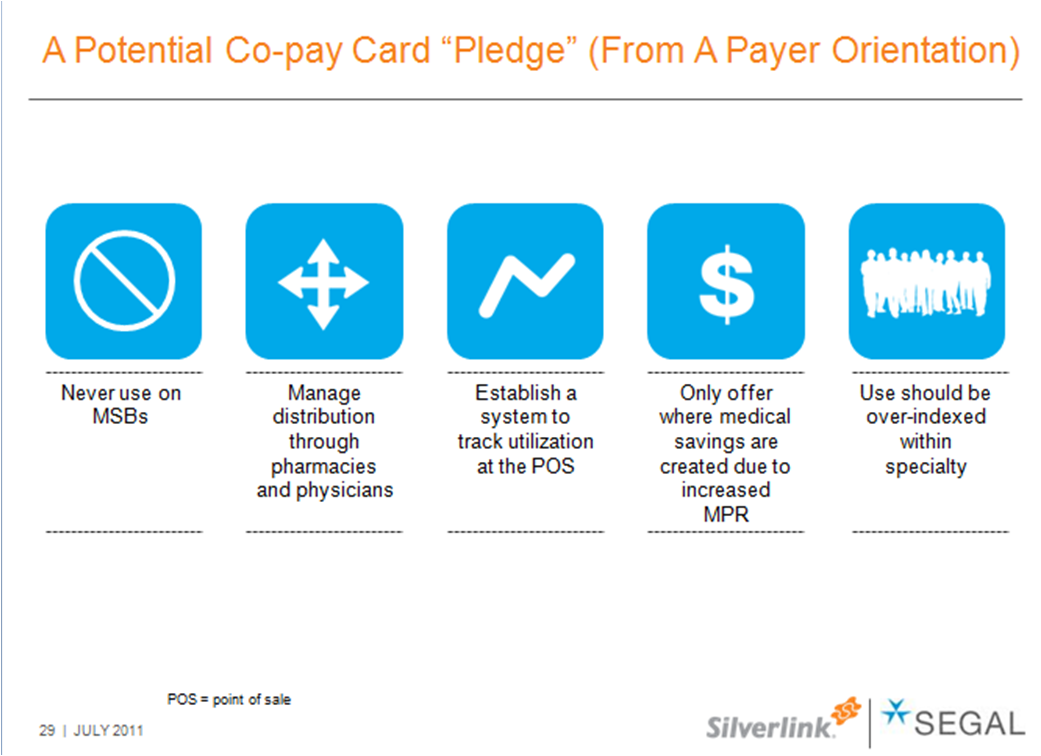
I think there are several ways that industry (especially pharmacies) should collaborate with pharma on how to leverage these copay cards at the POS with patients [call me to discuss]. But, to do that, I think the broader industry is going to require some type of rules which I am sharing shortly as a proposed “pledge”.


The other thing longer-term to watch is will this further change the PBM-Pharma relationship.  I think yes.  If the PBMs push for legislation on this marketing tactic or the manufacturers figure out that this is a better use of their spend than rebates, this will change the relationship. 

Additional Reading:

  1. Prescription Drug Coupons Bad for Patients
  2. Drug Firms Providing Kickbacks For Copays and Coinsurance
  3. DBN article – As Competitors Encroach, Pfizer Seizes A Few More Glory Days With Lipitor Promo
  4. Adam Fein blog posts
  5. Copayment Subsidies
  6. Coupons For Patients, But Higher Bills For Insurers

Silverlink eBook: 13 Common Pitfalls In Consumer Health Engagement

After working on consumer communications in healthcare for most of the  past decade, I realized that there were some common pitfalls that happen.  Many of them are pretty straightforward, but when rushed, they may get forgotten.  I worked with Dr. Jan Berger (our Chief Medical Officer) to identify a short list of them, and then the Silverlink marketing team pulled them together in a beautiful eBook

Each of the pitfalls is set up with a quote and a great image:

Then, there is a brief description to explain the pitfall on the page across from it:

What are some of the pitfalls:

  • Not knowing how to declare success
  • Limiting design based on company constraints
  • Forgetting about health literacy
  • Not understanding the entire process
  • Thinking you represent the customer

To get a copy of the entire eBook, you can register online.  [Alternatively, you can e-mail me at gvanantwerp at mac dot com.]

What I Learned In PharmaVOICE

I’ve been reading the magazine PharmaVOICE for the past year or so. I really enjoy it. I occasionally pull a few articles out.

I was reading the March 2011 version on the plane and found a ton of interesting information. I thought I would share some of the nuggets from it:

  • In 2010, 112M people (48% of US adults) were e-pharma consumers (individuals who went online to find pharma information). (Manhattan Research)
  • Fewer than 20% of consumers who go online for pharma information mistrust pharma websites (branded and unbranded).

“We found the degree to which consumers are open to online content from manufacturers surprising, considering the common perception that consumers are generally critical of pharma generated information.” (Manhattan Research Healthcare Marketing Analyst Maureen Malloy)

  • Top Prescribing-Driving Sites (Manhattan Research):
    • Levitra
    • Chantix
    • Cialis
    • Nexium
    • Yaz
    • Lyrica
    • NuvaRing
    • Symbicort
    • Viagra
    • Lunesta
  • Talk about how research is now “peer reviewed” via social media – original article.
  • Talk about the Sanofi-Aventis blog – Discuss Diabetes – which enables two-way conversations with patients in public.
  • Talk about how Merck is helping patients engage with consumers using online videos and checklists.
  • Talk about a text messaging service focused at teens and young adults for adherence – www.ireminder.com.
  • An interesting article by Ogilvy about 8 Health Engagement Zones and 7 things to keep in mind about public and individual communications:
    • Technology is not a panacea…it has to be adopted and incorporated into everyday behavior.
    • Information must be communicated and interpreted effectively to change behavior.
    • To cut through the “clutter”, information will increasingly be communicated via story-telling and visualization.
    • Technology will allow us to create the right message with the right tone in the right place at the right time. [or already does allow for this with the Silverlink Platform]
    • Health messaging will become personalized. [already happening]
    • Highly targeted, persistent, positive messaging will be needed to help overcome fear and embarrassment.
    • Although health is a serious matter, we don’t always have to take ourselves seriously when it comes to health communications. (e.g., gaming)
  • In the year ending Oct. 2010, $4.4B was spent on DTC advertising around pharmaceuticals.
    • Pharma 3.0 success will be “based not on how many drug units are sold, but on how well pharma’s market offerings improve health outcomes, putting patients and payers at the center of the model”.
    • Pharma investments in condition support tools – smartphone apps, websites, devices, and social media – was up 78%.
  • In a recent Harris poll, only 11% of respondents perceived the pharmaceutical industry as generally honest and trustworthy.
  • According to SDI, there’s been a shift in spending from 2007-2009:
    • 30% decrease in print
    • 32% increase in online activities targeting physicians
    • 29% decrease in magazine DTC advertising
    • 300% increase in internet advertising
  • Learned about a physician “hotlink” (my name) by AstraZeneca where they can connect with the AZ medical affairs team by a feature on their iPhone – formulary status, adverse event reporting, request samples, …
  • Similarly, learned about an “Ask Pfizer” button in Sermo.
  • According to the Manhattan Research’s ePharma Consumer v10.0 study – almost 3/4th of the people visiting pharma websites take a product related action afterwards. (That’s amazing!)

“When pharma is thought of as a health-services industry, the possibilities for growth in revenue, engagement, personalization, and freedom from pipeline dependency are almost endless.” (Paul Simms, eyeforpharma)

  • A list of manufacturers and what percentage of their portfolio is at risk in the next 3 years for patent expiration:
    • #1 Pfizer with $53.6B and 68% of their portfolio
    • #2 Lilly with $20.8B and 66% of their portfolio

“The industry has to address the consumer population across multiple channels with information that is timely, easy to understand, accurate, and actionable.” (Deborah Schnell, Health Advice Networks)

  • There was an article discussing a great question about whether “brand equity” exists after patent expiration.
  • There was talk about the shifting “customer” of pharma from the physician to the consumer and the formulary committee.
  • There were some statistics from a Tufts study on REMS where 75% of people thought the program needed a major overhaul.

I shared a lot here to make a point…this is a monthly magazine packed with interesting content. If you’re in this space, you should be reading it.

Domestic Medical Tourism and Telemedicine

The idea that local healthcare in a physical setting doesn’t work seems to be the crux of many solutions for leveraging limited resources (MDs) and addressing the geographical pricing differences which exist.  Given what we know about engagement and the value of the physical and personal relationship, there should be a better way.

BUT, without trying to solve for that…I thought I would share a few things that I recently saw.

BridgeHealth Medical is a Colorado based company that is focused on domestic medial tourism.  We’ve all heard about international medical tourism (i.e., flying someone to India for a surgery) and the savings there.  The key (and interesting) question is whether there is some middle ground within the US. 

At least according to the brief story I read in Inc. Magazine, they are getting some traction:

  • 40% savings on a total knee replacement
  • 22% savings on a spinal fusion surgery
  • 13% savings on a prostate surgery

I was amazed that the article said that Americans spend $2.1B outside the US today.  Will this replace that or will it be a new category of spend to track?

And, it will be interesting to track outcomes here and see whether savings translates to better survival rates or improved quality of life.  There will be challenges to the model as I’m sure there have been for international medical tourism.

Cisco on the other hand has rolled out their telemedicine initiative called HealthPresence which uses videoconferencing and high-tech medical equipment to share data.  Obviously, telemedicine has been a tool that’s been tried several times over the years with varying levels of success.  Can Cisco’s efforts and model finally push this from a fringe technology approach to mainstream? 

It’s certainly possible.  Timing may be right.  We’ve seen some success with AmericanWell’s efforts.  The question is how will the consumer respond.  Will they appreciate the easier access?  Will it impact the caregiver / patient relationship? 

Who knows…there is still a lot to learn especially in a country where we’ve been traditionally over-served with our access to healthcare.

The Customer Experience Matters Healthcare Nuggets

Are you focused on the customer experience?  If yes, then you should know who Bruce Temkin is and look at his research.

I follow his research mostly through his blog, and you can find teasers of information on healthcare by what he posts.  I thought I’d pull together a few of those things here:

1. In his loyalty ratings, Walgreens was one of the top 20 companies recommended to friends while Cigna, Aetna, Humana, Anthem, and BS of CA were all in the bottom 20.  [I’m not sure this should surprise us.  I would expect CVS was close to the top with Walgreens.  I’d assume many people don’t “recommend” their insurance companies in general.  I’ll have to try to find out if the PBMs appear on here.]

2. In his forgiveness rankings, retailers like CVS, Walgreens, Walmart, and RiteAid scored well.  TriCare scored very well.  Medicare and Medicaid had good scores, and Kaiser was the only health plan in the top 70.  [This is a key issue for retention and important in the retailization of healthcare…you will make mistakes so the question is how much good will you have to overcome those mistakes.]

3. In his loyalty rankings, you find out that African Americans are much more loyal to their health plans than Hispanics or Caucasians.  [How does this change your engagement strategy?]

4. Bruce even goes on to quantify the value for different industries.  For healthcare, he estimates that a $1B company could improve it’s topline by $179M / year by improving its customer experience.

5. In his experience ratings, he shares some specifics on health plans (see below):

And, I suggest you read some of his thoughts on changing how we analyze data.  I think his points about “contextual insights” make a lot of sense.

Highlights From The CVS Caremark Insights Report 2011

CVS Caremark has been on a roll lately releasing lots of research especially in the adherence area. They just released another study this week that said:

In a study published online this week in the Journal of the American Pharmacists Association (JAPhA) the researchers said,”Approximately one-half of caregivers reported they are more likely to forgo their own medications than the medication needs of their caregivees, especially if cost was a problem, and that caring for their family members was more important than caring for themselves.” The researchers added, “Our findings indicate care-giving status may be an important characteristic for providers to identify and that caregivers may represent a fertile target for adherence interventions to improve chronic disease management and prevent chronic disease.”

But, today, I want to focus on their drug trend report called Insights which was released a few weeks ago. The report begins with a focus on change pointing out a few facts which will change our healthcare experience. Here’s part of the introductory letter by Per Lofberg, the President of Caremark Pharmacy Services.

We all know change is a constant, in this industry and in life, but the change we face over the next several years is monumental and unprecedented. The sweeping nature of the health care reform legislation makes it difficult, as even the government admits, to predict how the system and its stakeholders will respond. Regardless of how much is unknown and “still to be determined” about reform, all of us continue to face the urgent, ongoing need to reduce health care spending and simultaneously improve health outcomes.

They take a different approach than Express Scripts (see review of this year’s drug trend report) and Medco in their drug trend reports which are more encyclopedic in their breakdown of class by class. CVS Caremark poses questions by group and then presents data to address those questions.  They focus on health reform and overall changes to the market dynamic.  [Both Adam Fein and I review most/all of these reports every year so I’d encourage you to look at both of our blogs if you want historical facts or comments about comparing the drug trend reports.]

  • Employer: Benefit costs are hurting our profitability. Something’s got to change.
    • Only 6% of employers believe their company will be better off as a result of healthcare reform.
  • Health Plan: How do I compete, comply, and control costs in this new world?
    • 120M members will be seeking or changing coverage between 2012-2016.
  • Physician: My practice is already stretched to the limit.
    • The US will have about 159,000 fewer doctors than it needs by 2025.
  • Consumer: Where do we go from here?
    • In 2010, 1 in 4 households reported having trouble paying medical bills.

Key Statistics:

  • Overall trend = 2.4%
  • Non-specialty trend = 0.8%
  • GDR for 2010 was 71.5%
  • Specialty trend = 13.7%

Specialty now makes up 14.2% of their BOB (book of business) overall spending…[something that some people are predicting will be close to 40% in under 5 years].

I really like how they breakout the charts by type of client (employer, health plan, and TPAs) since they have different approaches to trend management. Here’s the health plan one:

They talk about some of the future trend influencers:

  1. Economy
  2. Aging population
  3. Chronic condition prevalence
  4. Changing condition guidelines
  5. Health care reform
  6. Adherence
  7. Generic launches
  8. Specialty growth
  9. Brand price increases
  10. Less predictable events – weather, flu impact

Like others…they are saying that GDRs (generic dispensing rates) of 80% are now possible by 2012! Talk about a change in the past decade and why there is so much pressure on the manufacturers.

They mention it in the publication, but they’ve also issued some press about their effort to target the specialty spend that happens under the medical benefit. They estimate that 80% of the drug spend in the medical benefit is from specialty drugs with cancer representing 46% and three other categories representing more than 2%:

  • Anemia and neutropenia
  • Osteoarthritis and RA
  • Immune disorders

Given their broad footprint, they pose an answer rather than a question from the next constituent – the pharmacist:

I know I can make a real difference for people.

One of the big areas of focus for leveraging that F2F relationship is adherence:

They provide an updated statistic on average Rxs PMPY of 12.6.

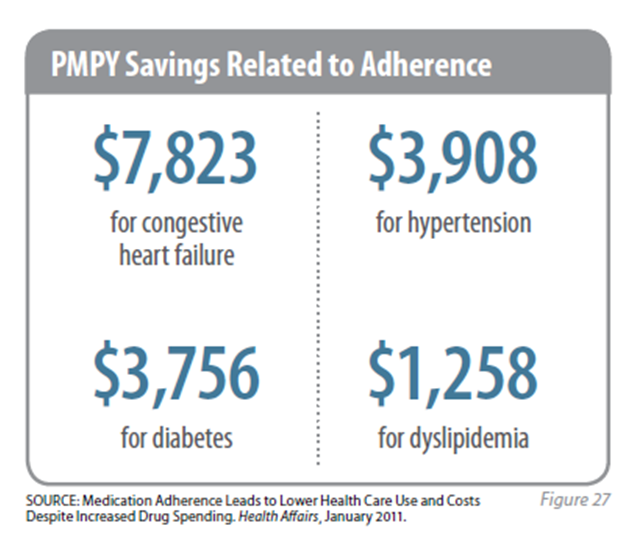
One of their big studies from the year was the one that was published around savings related to adherence:

I’ll end with a statement they highlight at the end:

“Every member interaction is an opportunity to improve outcomes for the plan and the member.”

Pharmacy Kickoff At #RESULTS2011

I’m currently presenting at our client event (see twitter hashtag #results2011 for real-time comments). My presentation is an extension of my white paper on the future of the PBM / pharmacy industry along with a blend of data from our annual client survey and Silverlink Communications best practices with a focus on our work around medication adherence. It also builds on my thoughts from NCPDP that I shared late last year.

Here are a few of the points I touch on:

  • Avoiding being commoditized by adding value
  • Keys to success with a focus on:
    • Evidence-based approaches
    • Consumer engagement
    • Patient experience
    • Cross-channel coordination
  • Adherence and other priorities
  • How to use SMS to drive self-service
  • An approach to condition management in hypertension and diabetes
  • Focus on the “un-engaged” but don’t forget about the engaged consumers
  • Case studies and research around adherence
  • Timing and sequencing of direct mail, automated calls, and e-mail
  • Measuring “trust”

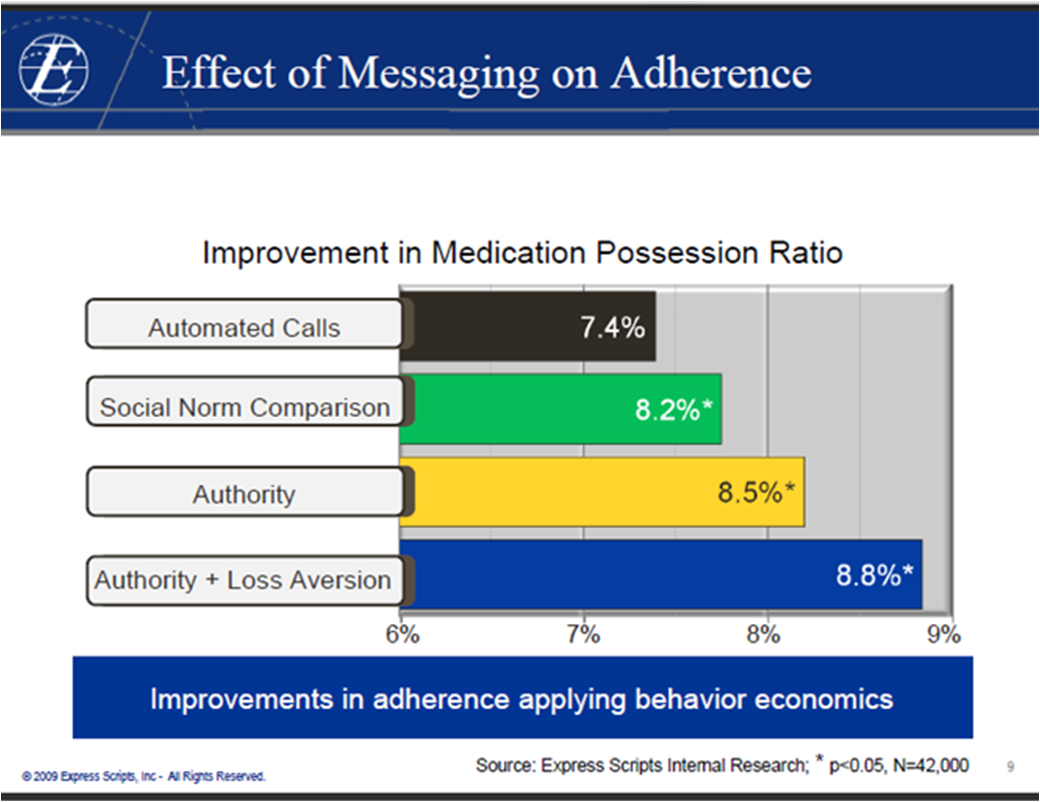
Here’s a teaser of some of the slides I’m presenting:

10 Things To Know About Engaging Patients

I just finished reading this publication by the Institute for Health Technology Transformation. Lots of quick nuggets of information summarized here. Let me share a few:

  • 88% of American adults with Internet acces research health information online; 60% say that the information they found influenced a decision (Pew)
  • Top sites (Alexa rankings) are NIH, WebMD, and medicinenet
  • 94% of patients say they at least sometimes forget important things they were told by their MD (Markle Foundation)
  • Only 3% of people have been harmed or know someone that’s been harmed by health information they found online (Pew)

They go on to provide some good usage statistics by age group; data around caregivers; data around who’s trusted and PHRs; and research from AARP and with Dr. Hibbard that shows the impact of engagement on outcomes.

PBM Mobile Applications – CVS, Humana, Medco, Express, Catalyst, Prescription Solutions

This week, Medco released their mobile application that they’ve been working with Verizon on.  Not a big secret in my mind since I’ve been hearing about it since last Fall.  I’ve talked about CVS Caremark’s application (CVS mobile), Humana’s application, and CatalystRx’s application.  So, this made me wonder why I hadn’t heard about one from Express Scripts.  It seems unlikely that they wouldn’t have one.

There doesn’t seem to have been a lot of fanfare, but they launched one in March.  Here’s a quick summary of it:

The new Express Rx mobile app works across multiple platforms, and is now available for a free download at both the Apple iPhone App Store and at the Android Market (simply search ‘Express Rx’).  In addition, members using a Blackberry or other smartphone device with web browsing capability can access our mobile optimized website at http://m.esrx.com.

With our new mobile app and mobile optimized website, Express Scripts members will be able to securely access the following functions:

  • Start Home Delivery – transfer available maintenance medications to the Express Scripts Pharmacy
  • Order Refills – select and schedule prescriptions to be refilled from the Express Scripts Pharmacy
  • Check Order Status – check to see if an Express Scripts Pharmacy order has shipped, the ship date and by what method
  • Find a Pharmacy – locate a nearby retail pharmacy using the GPS technology built into a smartphone
  • Drug Information – access Drug Digest database to look up drug information, common uses and possible side effects

The app consists of three features: My Rx Choices, which delivers on-demand, personalized out-of-pocket costs, interactions and other information for any prescription drug; My Medicine Cabinet, which allows patients to view the medications they’re on, including prescription and over-the-counter drugs, and set reminders for themselves; and Prescription ID Card, which allows convenient access to a member’s prescription drug card.

Of course, Walgreens also has a mobile application as does Walmart.  Neither of them are PBMs, but they are both critical players in the pharmacy space.
Next on my list to check out is Prescription Solutions.  They also have a mobile application which does:
  • Refill mail service pharmacy prescriptions
  • View your prescription history
  • Set up text message medication reminders
  • Check the status of and track orders
  • Locate a pharmacy by ZIP Code
  • Search your formulary by generic or brand name drug, status, or class
As one might expect, mobile web or mobile apps are quickly becoming the norm.  The key to look at is what is the functionality.  Is it simply putting their websites on a phone or are they developing other technologies that take advantage of the mobile environment (e.g., location based services or enhanced reality).  I’ll share some thoughts on those in another post.

Your Refill Logic Has To Be Dynamic

I signed up for an auto-refill program recently.  It quickly made me realize how stockpiling happens.  (Stockpiling is where a patient ends up with a large supply of their medication over time…typically due to refilling too soon.)

Imagine the following:

  • I get a 90-day supply of a medication.
  • At day 75, I get a refill of the medication.  (I have 105 days left at this point.)
  • 75 days later, I get my next refill.  (I now have 120 days left at this point.)
  • 75 days later, I get my next refill.  (I now have 135 days left at this point.)
The problem here is what I would call “static refill logic”.  The auto-refill program is triggered to fill the drug 75 days after it was last filled.
What is needed is “dynamic refill logic” which calculated days supply on hand.  This isn’t easy, but it makes a lot of sense.  The risk (if I’m a mail pharmacy) is that without this, I get gaps-in-care and/or create a short-term retention issue.
Imagine the following:
  • You ask me to refill, but I have 30 days on hand so I say no.
  • Now I forget to refill on time and I have a choice – (a) skip my medication for a few days or (b) go back to retail.  Neither is ideal for the mail pharmacy.
BUT, all of this could have been fixed if the logic was dynamic and they called to confirm my refill when I had just a few weeks left (i.e., enough to be thinking about refilling but also enough to have time to get it shipped to me).

Looking Forward To The Silverlink Client Event – RESULTS2011

One of my favorite events every year is the Silverlink Communications client event in May in Boston.  Our marketing team does a great job of pulling together a mix of clients and external speakers to really motivate and challenge the audience.  It’s not much of a sales event, but it does a great job of pushing a lot of key topics for discussion.  (See prior posts – last year’s event, notes from RESULTS2010, and notes from RESULTS2009.)

This event was one of the things that originally convinced me to join Silverlink back in 2007.  Sitting and talking with clients about their experiences with the company, their shared passion for results and outcomes, and their interest in collaborating to improve outcomes for consumers was motivating.

This year should be no different.  This year’s theme is – “Seeing Healthcare Through The Eyes Of The Consumer“.  There are presentations on sustaining engagement, obesity, diabetes, health literacy, social media in healthcare, adherence, loyalty and retention, health reform, STAR, HEDIS, and many other topics.

Some of the speakers include:

  1. Dr. Atul Gawande (Harvard, The New Yorker, Author)
  2. Thomas Goetz (WIRED Magazine)
  3. Dan Buettner (Author, The Blue Zones)
  4. Mark Merritt (PCMA)
  5. Dr. Will Shrank (Harvard)
  6. Jim Wilson (WilsonRx)
And many other executives from across healthcare.
It promises to be another banner event.  I’ll share some summarizes as time allows via Twitter and eventually after the event.
I guess with attendance maxed out and the hotel sold out it’s time for me to buckle down and work on my presentation!

The Royal Wedding Symbolism For Healthcare

This is a day most of us will remember.  I still remember the wedding of Princess Diana.  Regardless of how you feel about the monarchy, it is a joyous celebration of life.

It made me think of several words that are key to healthcare – trust, passion, and engagement.  (Another great example here is the real Patch Adams.)

Let’s start with trust.  You have to trust your physician.  You have to trust that the course of treatment will work.  You have to trust that your actions can make a difference.  Those are fundamentals to getting better. 

Passion is another critical element (even if the royal couple was light on the PDA).  Healthcare runs the risk of becoming a “hot industry” with sustainable business which draws people towards it to be employed and get paid well.  That’s very different from the traditional people who were in healthcare because they felt passion for curing people.  I talked with one researcher recently that mentioned one of his client had to increase their staffing by over 10% to get the same jobs done.  They attributed that to a lack of passion for the job.  (On the flipside, healthcare needs those from outside the industry to help reform ourselves.  Change has to be a mix of internal and external.)

Engagement is a word I use often.  The idea here of the long-term engagement process, transition into being a royal, and the commitment the royal couple feels is very different than the quick engagement and wedding of Princess Diana.  I see that as very similar to the need for long-term solutions that engagement people around intrinsic motivators not the short-term boosts we see from things like financial rewards or quick diets.  Healthcare is a change.  Engagement is a process NOT an event.

The people over at Seduce Health pulled out a few other lessons from the wedding which I agree with. 

So…engage your employees, your family, your members, and your patients.  Build up their passion for life and health and help them believe that they can be successful.

Does Changing Drugs Erode Trust

One of the big tools that PBMs use to manage drug trend and improve generic fill rate is step therapy. Another one is therapeutic substitution. Both of them rely upon the patient to change medications.

Based on a study published last year, one of the issues identified for adherence was the patient’s belief or trust in their physician. Switching medications (I.e., trial and error) was viewed as eroding that trust.

It creates an interesting question about these tools. Do they erode trust? Do they impact adherence? I think the standard perception would be that lower cost medications would improve adherence. I know research by Shrank has shown that starting on generics leads to better MPR. Is that true for patients that start on a brand and move to a generic?

On the other hand, the research points to the need for the physician to explain to the patient about the plan for care which might include “trial and error”. Certainly personalized medicine may change this need in the long-term, but in the interim, does this create a chance for PBMs to support MDs in a new way by providing this context to the patient?

More questions here than anwers, but an interesting topic.

Patient Educ Couns. 2010 Jul 30.
“Practicing medicine”: Patient perceptions of physician communication and the process of prescription.
Ledford CJ, Villagran MM, Kreps GL, Zhao X, McHorney C, Weathers M, Keefe B.
George Mason University, Fairfax, VA, USA.

Abstract
OBJECTIVE: This study explores patient perceptions of physician communication regarding prescription medications and develops a theory of the effects of perceived physician communication on the patient decision-making process of medication taking.

METHODS: Using a grounded theory approach, this study systematically analyzed patient narratives of communication with physicians regarding prescription medications and the patient’s resulting medication taking and adherence behavior.

RESULTS: Participants described concern about side effects, lack of perceived need for medications, and healthcare system factors as barriers to medication adherence. Overall, participants seemed to assess the utility of communication about these issues based on their perceptions of their physician as the source of the message.

CONCLUSION: The theory generated here includes patient assessments of their physician’s credibility (trustworthiness and expertise) as a critical influence in how chronically-ill patients process information about the need for prescribed therapy. Trial and error to find appropriate medications seemed to deteriorate patients’ perceptions of their physicians’ credibility.

PRACTICE IMPLICATIONS: A practical application of this theory is the recommendation for physicians to increase perceived expertise by clearly outlining treatment processes at the outset of treatment, presenting efficacy and timeline expectations for finding appropriate medications.

QR Codes – The Ultimate Opt-In Tool

You probably are starting to see them more (those 2D barcode boxes).  They’re called QR codes.  Here’s a few articles about them:

I find this a fascinating area.  Imagine a few examples here:

  1. You want to get a member to opt-in to a program (e.g., auto-refill).  You can put a QR code on their invoice.
  2. You want to offer an educational video about a condition.  You can put a QR code on the Rx label.
  3. You want to get consumers to opt-in to a SMS program.  You can put a QR code on a mailing.
  4. You want to offer a physician access to the clinical studies about a drug.  You can fax them some information with QR codes on it. 
  5. You want a patient to learn more about a condition.  You could put up DTC materials in the provider’s office with QR codes. 

I think you get the point.  I expect this will grow rapidly especially as the smart phone market grows and more and more people have cameras in their phones (devices). 

One of the biggest uses right now in pharmacy is from Walgreens where they allow you to order a refill by scanning the QR code on their bottles using their mobile app.

The Express Scripts 2010 Drug Trend Report – Waste and Intent Focused

As I’ve talked about in the past, after working on the Express Scripts Drug Trend Report (recent copy here), I really enjoy getting the chance to read through them every year (see 2009 review or 2008 review). Over time, they’ve become less about the clinical side of the business and more about the programs used to engage the consumer with consolidated class specific data still included.

This year’s report is similar, but it is built around a new study that Express Scripts just completed with Harris Interactive. It comes to a rather surprising but interesting conclusion –

We discovered that the majority of people want to engage in the same behaviors plan sponsors seek to promote, but these desires often remain dormant. That is, there is a persistent intent–behavior gap. The key is structuring interventions that close the gap between what patients already want and what they actually do.

What’s the key point here? The point is that this says that consumers really want to move to generics and move to mail order, but they don’t do it. Is it that simple? I’d love to think so. And, for generics and mail order, I’m more likely to believe that inertia is a large factor. BUT, as I’ve talked about before, adherence has lots of complicating dimensions.

They focus on the gap between the physician and the optimal outcomes. This is certainly a major factor, but beyond consumer intent, there are issues of health literacy and physician beliefs that have to be addressed. Regardless, the point is correct…how do we engage and motivate consumers to change behavior especially if they are pre-disposed to change (when presented with the right facts).

They did continue to build on last year’s focus on WASTE. They estimate that the waste in 2010 was over $403B as broken down below:
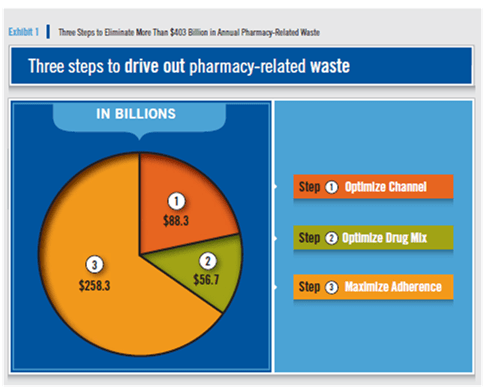
As adherence is a key issue here, they highlight the difference in adherence rates between retail pharmacy and mail pharmacy.

The focus of the report and the early press I’ve seen has been on the following chart. What it shows is some of the data from the Harris study saying that 82% of people would chose a generic (that are on a brand) and (depending on copay savings) 55-71% would chose retail.

One topic that I was glad was in the survey was limited networks. This is a topic everyone’s talking about from ReStat to Wal-Mart to Walgreens to CVS. Here’s what the research said with some explanation for what it means:

Of note is that about 40% said they would be willing to switch retail pharmacies to save their plan (or employer, or country) money. This fi gure is not as low as it fi rst appears because before a plan implements a more narrow retail network, a large fraction of members already use these pharmacies and therefore don’t have to switch pharmacies. It is not unusual, for example, for a client using a broad network to have 70% of prescriptions processed through pharmacies that are in the narrow network; members currently using these pharmacies do not have to make any changes. When a narrow network is implemented, if 40% of the users of the remaining 30% of prescriptions would willingly move to a lower-cost network pharmacy (as suggested by the survey), we estimate that the resulting overall market share within the narrow network would rise to 82% {70 % + (30% x 40%)}. (page 14 of the DTR)

All of this tees up their family of “Select” offerings (see Consumerology page) which builds on the success of Select Home Delivery and applies the concept of “Choice Architecture” from the book Nudge.

They talk about some of their work with adherence and their Adherence IndexSM. This metric is certainly one that has the industry’s attention as people wonder about the predictive value, how this is used, and how to craft solutions around such an index. My perception has been looking at studies like this one by Shrank and colleagues that past behavior remains the best predictor of future behavior, but I’m happy to be wrong.

So…what were the trend numbers?

  • 1.4% in the traditional (non-specialty drugs)
  • 19.6% in specialty
  • 3.6% overall

One of the other lists that I always find helpful to have is what are the top 15 drug classes and the PMPY spend.
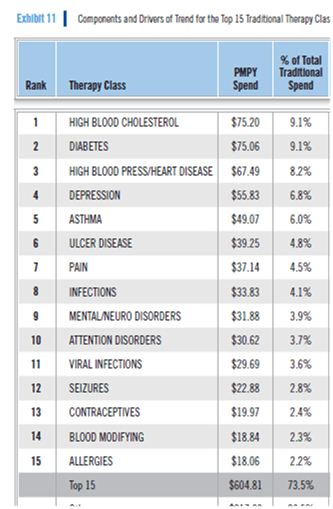
Of course, in today’s world, you really want to know this for specialty medications:
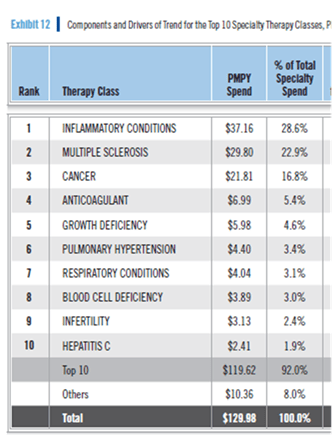
So, as always, I would recommend you read the report. Lots of great information in here. Interesting research. Good thoughts on consumer behavior and how to change it.

I think this week is their Outcomes conference which was always a good event.

How does luxury “framing” impact decision making?

Are people who travel in town cars and on corporate jets different—on a psychological level—from you and me? Does the availability of luxury goods “prime” individuals to be less concerned about or considerate toward others? The answer from new research seems to be yes.

It’s an interesting question with relevance for us in healthcare.  Does the environment in which we work and make decisions impact our decisions?  Is that true for day-to-day work?  For conferences?  For delivery of care?

In general, I believe most of us that work in healthcare are passionate about improving outcomes.  We want to understand how people make decisions.  We want to understand why things happen.  This isn’t just a job.  Given that, these types of studies are important as we think about healthcare communications.  What types of images should we use in our print media, web, and e-mail?

It also makes me wonder about verbal queues or sonic branding.  Can certain words or noises make us more or less likely to make choices that are in the best interest of the group.  For example, if we framed decisions as savings money which would be provided to a charity would more people respond to take that action (e.g., moving to a generic drug) than if we framed it as saving money for the company and therefore allowing more earnings-per-share (EPS). 

“people who were made to think about luxury prior to a decision-making task have a higher tendency to endorse self-interested decisions that might potentially harm others.” (HBS professor Roy Y.J. Chua on what they found in their research)

The Physician As Island Versus Support From Intermediaries

Should physicians have the final say in patient care?

Someone tweeted me this question the other day. It made me start to think…

Logically, individuals trust their physician to act in their best interest and make the best decisions (based on the information they have).  But, this has shifted from the MD as the primary source of knowledge to the MD as a part of a care team.

There are probably more, but I can think of 5 important things that need to be fixed for the physician to be seen as an ‘information island’ where they can make the best decisions without intermediaries (PBMs, managed care, disease management companies) intervening:

1.  They have to be able to not practice defensive medicine.

2.  They have to understand my costs.

3.  There have to be no meaningful differences based on geography or income or race.

4.  They have to adopt best practices quickly.

5.  They have to be able to be paid based on outcomes.

Some of these are systemic changes that have to be addressed (#1 and #5). The other three can be addressed thru technology (as long as physicians are willing to embrace the science of medicine not just the art).  As a quick example, look at Dr. Atul Gawande’s book. – The Checklist Manifesto or look at some of the work by companies like Health Dialogue on shared decision making.

Now, maybe the person that asked the question is taking a more radical stand and physician’s embrace the support these companies provide them, but that hasn’t historically been true.

Interview With Dr. David Wennberg At #WHCC11

I had the opportunity to sit down with Dr. David Wennberg (Chief Science & Product Officer, Health Dialog) at the 8th Annual World Healthcare Congress (Twitter hashtag #WHCC11).  David is a fascinating and engaging speaker.  He has lots of publications, works with the Dartmouth Atlas, and leads the Health Dialog Analytic Solutions group. 

David and I began our time talking about “informed choice”.

In this environment, doctors need tools that identify patients lacking evidence-based care. They also need to ensure that patients undergoing surgery have been exposed to informed choice, not just informed consent, when there is more than one legitimate treatment path. With these resources in place, physician groups can ensure that they are in control of their own destiny when it comes to performance evaluations.  (source)

This is an important issue in healthcare.  Giving patients (1) complete information in (2) language that they can understand and helping them (3) frame their options relative to their preferences is at the core of this issue. 

Health Dialog calls this Shared Decision Making and focuses on how to engage targeted consumers and help them make their best decision.  Their customer support personnel go through a certification process and use decision aids to enable the process. 

This led us into a discussion about “trust” (see prior post) and then into a discussion about “embodied conversational agents“.  Obviously, if you’re going to help consumers make decisions, they need to trust you.  We talked about the need to have transparency, the need to for disclosure, and the importance of using clinicians in the engagement and discussion process.  In many cases, nurses and the empathy that they have are critical to this process.

But, I know from prior exposure to Health Dialog that they have figured out ways to blend technology and agents.  They do a lot with data and analytics to really understand the popluation.  They’ve worked hard to avoid the traps that “disease management” has fallen into over the years.  He shared with me some amazing engagement statistics. 

We talked about the value of peer-to-peer videos for people to understand their condition and talked about some recent studies around storytelling and distributing that information via DVD to patients (see more on study).  We went on to talk about how engaging the consumer in the decisions about their care increase success, but that many models have been a challenge to scale.  Health Dialog just published an article in the NEJM called A Randomized Trial of a Telephone Care-Management Strategy which demonstrated an ability to scale the solution and get results. 

At baseline, medical costs and resource utilization were similar in the two groups. After 12 months, 10.4% of the enhanced-support group and 3.7% of the usual-support group received the telephone intervention. The average monthly medical and pharmacy costs per person in the enhanced-support group were 3.6% ($7.96) lower than those in the usual-support group ($213.82 vs. $221.78, P=0.05); a 10.1% reduction in annual hospital admissions (P<0.001) accounted for the majority of savings. The cost of this intervention program was less than $2.00 per person per month.

Before I could even jump to my next question about ACOs, he made the natural transition to the fact that the new ACO regulations mention shared decision making 8 times.  I believe we both agreed that whatever actual form these new practice settings take that they will accelerate the importance of leveraging technology and things like shared decision making to engage the consumer.  The key is to leverage the PCP setting whether it’s the MD or someone on their staff as the foundation for engagement.

This led me to ask him about physician acceptance of technology as part of their practice (more on this later).  He felt that they had moved from resistance to understanding the technology and “guides” can enable them to practice better medicine.

Data: Should You Be Paranoid?

I think we all know or are quickly realizing that everything we do leaves a trail of breadcrumbs.  That trail is a series of data points which now can be aggregated to create a record of you.  What you do?  What you buy?  What ads you respond to?  Who your friends are?  The list goes on. 

The question of course is whether you should be paranoid and worried about it. This video below shows you the extreme scenario of how data could be abused.

In a more balanced view, Time Magazine had an article call Your Data, Yourself which just appeared on March 21, 2011.

Oddly, the more I learned about data mining, the less concerned I was. (Joel Stein, author of article)

The article talks about a variety of companies that collect and sell data:

  • Google Ad Preferences
  • Yahoo!
  • Alliance Data
  • EXelate
  • BlueKai
  • RapLeaf
  • Intellidyn

The author makes a key point…a lot of the things we get for free are free because people collect and sell our data.  Otherwise, these “free” business models wouldn’t exist.  Would you pay for all the content and other things you get today or do you just want to understand what happens to your data?

On the other hand, the author shows you how data put together adhoc can paint erroneous pictures of you.  Should you care?  Do you want to fix this?  Can you control it?

This is all important since there is some do-not-track legislation being discussed.  (See Joe Manna’s post on this for some additional perspective)  Several people bring up the good question…

While we say that we don’t like to know that our data is being used to target ads at us, do we really want to have to sort through all the irrelevant advertisements?

Of course, we all become a lot more sensitive around healthcare data.  But, somehow, I doubt many of us think about what happens when we use our work PC to research a condition (see article on 10 ways to monitor your employees).

The article also suggests some sites for protecting yourself:

Don’t expect this one to go away.  With issues like the data breach at Epsilon, people are concerned.  Additionally, as data gets co-mingled and your credit score is used to determine health programs (for example), there may be limits about what and how information is used.