Archive | Methodology RSS feed for this section

Using the “Placebo Effect” in New to Therapy Situations

I was reading a book about trust which pointed out the concept of “remembered wellness“.  This concept is similar to the “placebo effect” in that it shows that patients who trust their physicians and their course of therapy are more likely to have better outcomes (e.g., HIV study).  WOW!!

I’ve talked before about the gap that exists when patients leave their physician’s office with a new diagnosis and we all know that health literacy is a big issue.

So…what are you doing to address this?  I’ve been talking a lot lately about “primary adherence” (i.e., getting people to start therapy) and about engaging patients when they first get a new prescription or a new diagnosis.  This concept of trust only makes this a more pressing issue.

Here’s your worse case scenario:

  • Patient is newly diagnosed with a chronic condition and given a new prescription.
  • They don’t have a great relationship with the physician and/or have limited understanding of the condition (due to literacy, fear, or other issues).
  • They fill the prescription once and stop taking the medication after a few days.

How can you step in here?

  • You can trigger an outreach based on diagnosis code.
  • You can assess their understanding of the condition and help them learn more by addressing their barriers.
  • You can engage them when they fill their first script.
  • You can follow-up with them after the first few days to make sure they stay on therapy.
  • You can enroll them in an adherence program.
  • You can enroll them in a condition management program.

But, the point here is that you need to be doing something that reinforces the decision to manage the therapy and help them to understand and believe in that course of treatment.  If they don’t believe and have trust, they are less likely to get to a successful outcome.
JD Power Customer Service Leaders – Pharmacy

Understanding how top performers achieve excellence is the first step to becoming a Customer Service Champion. The rest is up to you.

This is the statement by Gary Tucker, SVP, J.D. Power & Associates at the beginning of their publication Achieving Excellence in Customer Service from February 2011. 

If you’ve never read their reports, you should understand that they look at five areas – people, presentation, price, product, and process.  Interestingly, they use several examples from pharmacy to make their points about these five categories:

  • Proactive communications
  • Private space for consultation
  • Clear information about how to save money
  • Auto-refill

Another interesting thing they look at is whether the gap between high performing and low performing company has increased or decreased over time.  In the product industries, the gap has decreased due in many ways to quality improvements.  In the service industries, the gap has increased…WHY?

First, advances in technology have created new expectations among customers, resulting in new challenges for services. For instance, customers expect multi-channel service delivery and expect to choose whether to interact with their service provider in person, via the phone or e-mail, through online chat, or via Web-based self-service, among others. More challenging is that they expect the same level of service across communication channels. With ever-improving technology, it has been difficult for companies to keep all systems up to date and to remain equally effective in each.

They are preaching to the choir here.  This is exactly what I tell clients all the time. 

One of their examples that I’ve used for years is around the power of communications.  They show satisfaction with auto insurance based on whether your premium stayed the same or increased.  For those that it increased, they look at whether you were pro-actively informed and whether you had the option to discuss it.  What group do you think had the highest satisfaction?

  • Decreased premium
  • Increased premium, pro-active notification, and chance to discuss
  • No change
  • Increased premium, pro-active notification
  • Increased premium, no notification

Worried about satisfaction or churn?  Have lots of changes to plan design?  Here’s why you communicate.

In this report, they call out 40 companies as exceptional out of the 800 that were ranked.  7 of those 40 were pharmacies:

  • Good Neighbor
  • Health Mart
  • Kaiser Permanente
  • Publix
  • Veteran’s Administration Mail Order
  • Wegmans
  • Winn-Dixie

How To Select What Pharmacies Are In Your Network?

This seems to be the “meta-question” that everyone is talking around. 

  • Should every pharmacy be in the network?
  • Should mail be allowed?  Should I do mandatory mail?
  • How do I design a limited network?  Is it ok?
  • What about any willing provider?  [should that just be about cost]

Let’s start with the basics…You want a network that meets access standards, has high quality, improves outcomes, keeps members happy, and offers you the best price.

So, how do you build your network to decide who is in or out (ideally)?

  1. Select the minimum number of local pharmacies required to meet access standards for acute medications (this is your baseline)
  2. Look at your best price to add more pharmacies into the network – who will meet your price for generics, brands, 90-day, specialty
  3. Evaluate your tradeoffs – will you get a lower price if you exclude certain pharmacies?  will that impact access?  will that impact care?  will that impact satisfaction?  can you manage the disruption?
  4. Look at difference in satisfaction between pharmacies – should you take a lower priced pharmacy if the satisfaction is less?
  5. Look at difference in outcomes between pharmacies – should you take a pharmacy that has a lower generic fill rate (on an adjusted population) or a lower adherence rate (on an adjusted population) at the same price? 

Network design should look like formulary design.  You have to look at the value versus the cost.  You might include a higher priced pharmacy in the network if it gives you access, better outcomes, or lower net cost (i.e., better GFR).  You might exclude a lower priced pharmacy if it can’t prove any of this or if consumers who go there are dissatisfied. 

At some point, I would think we’ll see more metrics beyond price be used to measure pharmacies – discounts, GFR, safety (quality), medication possession ratio, satisfaction.  That would make this a lot easier with some standards. 

This would make it easier to have discussions about access in NY (for example) as PCMA is doing.  It would make it easier to have discussions about the Department of Defense (for example) as NACDS and NCPA are doing. 

The DoD is a good example here…Since the military (government) buys drugs better than anyone, I can’t imagine how much better some of these metrics would have to be to justify paying the additional costs at retail for fulfillment.  The base pharmacies and the mail order pharmacy all get their drugs from the government contracts.  At mail, the supply is managed separately so that they are replenished under those contracts.  I bet the cost is $10+ on average more for a drug at retail (non-replenishment) than it is elsewhere.  How do you justify that?  In my mind, retail should figure out how to replenish and segregate their inventory to stay in the network rather than fighting the shift away to mail.

PBMs and Star Ratings

Finally, I’m hearing more talk about PBMs and their role in Star Ratings for Medicare. It seemed like this was a subtlety at the end of last year when I raised it as a 2011 priority.

Drug Benefit News had a story about it in their March 4, 2011 edition with examples from HealthTrans and PerformRx.

In general, there are opportunities to help impact Star Ratings by:

  • Blending pharmacy and medical data
  • Helping monitor patients on long-term medications
  • Increase cholesterol screening
  • Increase use of flu shots
  • Controlling blood pressure
  • Addressing physician communication gaps
  • Improving Customer service
  • Prior authorization process
  • Churn
  • Time on hold
  • Appeal process
  • Accuracy of information provided by customer service
  • Managing complaints
  • Helping with access issues
  • Timely information about the drug plan
  • Monitoring use of drugs with a high risk
  • Making sure diabetics us hypertension drugs

Since pharmacy is the most used benefit, it can have a very direct impact on the overall satisfaction. It can drive calls. It can be complicated. It can affect perception. And, it can lead to churn.

PBMs need to be working to proactively engage consumers. They need to use data to personalize the experience. They need to use clinical data to identify gaps in care. They need to drive adherence.

I personally hope that the Star “concept” becomes a more normal set of metrics outside of Medicare for measuring success and ultimately leads to a performance-based contracting framework.

Rules Based Communications

After working with data warehouses, configuration engines, and workflow management systems, I’m a big believer in embedding rules into a process. Communications is no different.

Let’s look at a few rules:

  • Don’t communicate with someone more than X times per week.
  • Don’t call these people.
  • Use Spanish for people with that language preference.
  • Send a text message to people who have provided their mobile number and opted in to the program.
  • When applicable, use a preferred method of communication for reaching out to someone.
  • If a caregiver is identified and permission is on file, send the caregiver a copy of all communications to the patient.
  • Call the patient if the amount being billed for their prescription is greater than $75.
  • For patients between these ages, use the following messaging.
  • If the patient hasn’t opened the e-mail after 48 hours, then call them.
  • For clinical information, use this channel of communications.
  • For John Smith, only call them on Tuesdays between 5-6 pm ET.
  • For Medicare recipients, use this font in all letters.
  • For Hispanic consumers, use this particular voice in all call programs.
  • If the patient doesn’t respond after two attempts, send a fax to their physician.
  • For patients with an e-mail on file, send them an e-mail after you leave them a voicemail.
  • For patients who are supported by Nurse Smith, only call them when she is on duty and use her name in the caller ID.

I could go on. But, the point is that communications, like healthcare, is a personalized experience. We have to use data to become smarter (historical behavior, segmentation, preferences). We have to use customization to create the right experience. AND, probably the most difficult thing for lots of companies, we have to coordinate communications across modes (i.e., e-mail, direct mail, SMS, automated call, call center, web).

Ultimately, I believe consumers will get to a point where they can help set these rules themselves to create a personalized profile for what they want to know, how they want it delivered, and ultimately provide some perspective on how to frame information to best capture their attention.

To learn more, you should reach out to us at Silverlink Communications.

Why Aren’t There More Collaborative Practice Agreements?

Collaborative practice agreements (aka collaborative drug therapy management) are legal documents between a specific pharmacist and physician to allow the pharmacist to have more direction in the care of the patient relative to their medications. Given the challenge of the physician to keep up with all the mediations and their lack of access to plan design information and full drug history, I’m surprised that these documents haven’t become more popular.

My guess is that the logistics of a one-to-one legal document around standards of care is complex to scale (see how to set up). But, I always think about how easy this could be for addressing formulary management. The physician could agree to which drugs they considered therapeutically equivalent. They could then tell the pharmacist to choose the drug which was lowest cost for the patient.

Is Royal Pains Good Or Bad For Concierge Medicine?

I really enjoy the show Royal Pains which highlights a physician providing concierge medicine to the super wealthy in the Hamptons. The physician (Hank) and his staff doing an amazing job of diagnosing complex conditions based on a mix of science and deep dives with the patient to really understand their condition, their symptoms, and their environment.

On the one hand, it shows the power of building a relationship between the patient and the physician. It also shows how convenient it can be to have the physician coming to your house and monitoring you.

On the other hand, the type of attention and care shown here with all the technology being available within the home seems unreasonable. The cost to participate would be outrageous (I think).

So, it makes me wonder whether this is beneficial for the whole movement that companies like MDVIP or people such as Dr. Jay Parkinson are providing.

What’s Your Fitness Personality?

If you don’t read Experience Life magazine from Lifetime Fitness, I would recommend getting it or following them on Twitter. They put out some very interesting articles on expercise and food.

One that I found interesting was about Fitness Personalities. By using the Myers-Briggs test as a framework, Suzanne Brue developed 8 different categories (I’m a white). Given the difficulty of making exercise a lifetime habit for many of us, this could be a helpful framework for understanding what works, what doesn’t work, and with some rationale for why.

Here’s the quick summary:

  • Blues are safety-conscious, and good at creating their own space and concentrating in a gym.
  • Golds are traditional, conservative, and like to share their exercise experiences and results with others.
  • Greens are nature lovers who enjoy outdoor activities.
  • Reds like to live in the moment and compete in team sports.
  • Whites prefer to plan, hate to be rushed and are visionary types who enjoy calm spaces.
  • Saffrons like to express themselves as individuals and are attracted to spontaneous, engaging activities.
  • Purples are routine-oriented and enjoy repetition.
  • Silvers like exercise to be disguised as fun.

Congressional Statements Regarding MTM

In the new Medication Therapy Management Empowerment Act of 2011, there is a nice summary at the beginning of why this is important:

    Congress finds the following:
  1. Medications are important to the management of chronic diseases that require long-term or lifelong therapy. Pharmacists are uniquely qualified as medication experts to work with patients to manage their medications and chronic conditions and play a key role in helping patients take their medications as prescribed.
  2. Nonadherence with medications is a significant problem. According to a report by the World Health Organization, in developed countries, only 50 percent of patients with chronic diseases adhere to medication therapies. For example, in the United States only 51 percent of patients taking blood pressure medications and only 40 to 70 percent of patients taking antidepressant medications adhere to prescribed therapies.
  3. Failure to take medications as prescribed costs over $290,000,000,000 annually. The problem of nonadherence is particularly important for patients with chronic diseases that require use of medications. Poor adherence leads to unnecessary disease progression, reduced functional status, lower quality of life, and premature death.
  4. When patients adhere to or comply with prescribed medication therapy it is possible to reduce higher-cost medical attention, such as emergency department visits and catastrophic care, and avoid the preventable human costs that impact patients and the individuals who care for them.
  5. Studies have clearly demonstrated that community-based medication therapy management services provided by pharmacists improve health care outcomes and reduce spending.
  6. The Asheville Project, a diabetes program designed for city employees in Asheville, North Carolina, that is delivered by community pharmacists, resulted over a 5-year period in a decrease in total direct medical costs ranging from $1,622 to $3,356 per patient per year, a 50 percent decrease in the use of sick days, and an increase in productivity accounting for an estimated savings of $18,000 annually.
  7. Another project involving care provided by pharmacists to patients with high cholesterol increased compliance with medication to 90 percent from a national average of 40 percent.
  8. In North Carolina, the ChecKmeds NC program, which offers eligible seniors one-on-one medication therapy management consultations with pharmacists, has saved an estimated $34,000,000 in healthcare costs and avoided numerous health problems since implementation in 2007 for the more than 31,000 seniors receiving such consultations.
  9. Results similar to those found under such projects and programs have been achieved in several other demonstrations using community pharmacists.

Pharmacy Benefit Data From PBMI

I had a chance to read through the new 2010-2011 Prescription Drug Benefit Cost and Plan Design Report that PBMI puts out and is sponsored by Takeda Pharmaceuticals. Here are some of my highlights:

  • Percentage of the pharmacy claims costs paid by the beneficiary
    • Retail = 25.3%
    • Mail = 20.1%
    • Specialty = 15.9%
  • Average difference between retail and mail copayments (see chart):
    • Non-preferred brands = $18.38
    • Preferred brands = $7.15
    • Generics = $3.61
  • 5.1% of employers are covering genetic tests to improve drug therapy management
    • 68.8% of them are covered under the medical benefit
  • 43.0% of employers are restricting maintenance medication dispensing to select pharmacies (retail or mail) [much higher than I expected]
  • They give examples of the percentage of respondents using the following value-based tools:
    • 31.7% – reduced copayments in select classes
    • 19.7% – incentives to motivate behavior change
  • I was surprised to see a significant drop in the percentage of clients requiring specialty medications to be dispensed at their PBM’s specialty pharmacy.
    • 2009 = 53.8%
    • 2010 = 40.0%
  • There was a similar drop from 15.7% to 11.5% of employers restricting coverage of specialty drugs under the medical plan.
  • Given all the focus on medication adherence, I was disappointed to see that only 24.2% of employers were focused on maximizing compliance in specialty. [Maybe they haven’t seen all the studies on this topic.]
  • They have some nice comments on Personalized Medicine and the critical questions to address.
  • I was also surprised that less than 1% of employers were using onsite pharmacies or pharmacists.
  • They provided the following data on average copayments for 3-tier plan designs with dollar copayments:
    • Generics at retail = $9.45
    • Generics at mail = $19.06
    • Preferred at retail = $25.93
    • Preferred at mail = $53.63
    • Non-preferred at retail = $46.43
    • Non-preferred at mail = $98.25
  • The average pharmacy discounts (based off AWP) were:
    • Retail brand = 17.5%
    • Retail generic = 46.6%
    • Retail 90-day = 19.8%
    • Mail brand = 23.3%
    • Mail generic = 53.5%
    • Specialty = 18.7%
  • The one number that seemed off to me was the Rxs PMPM which they had as 2.29 for active employees. That would mean 27.48 PMPY which seems closer to Medicare. [I typically use 12 Rxs PMPY for commercial and 30 Rxs PMPY for Medicare as a quick proxy.]
  • For the first time, they showed the percentage of employers excluding coverage of non-sedating antihistamines (e.g., OTC Claritin) and proton pump inhibitors (e.g., Prilosec OTC). Both classes have had lots of blockbuster drugs go OTC (over the counter) so it makes sense to exclude coverage.
    • NSAs = 44.7%
    • PPIs = 30.6%
  • They provide a nice summary of how employers are using UM (utilization management) tools.

The report has tons of data on different scenarios, different plan designs, rebates, and many other topics. I’d encourage you to go online and read thru it.

BTW – The respondent group of employers included 372 employers representing 5.8M lives including both active and retired. The average group size (active only) was 9,736 which is a decent size employer group. And, 12% of the respondents were part of a union bargaining agreement.

NCPA Twisting Reality Again

I continue to be frustrated by NCPA (National Community Pharmacists Association). While I agree that the pharmacist – patient relationship is important, they continue to blatantly misrepresent the facts to make their point. On Tuesday, they sent a letter to Kathleen Sebelius, Secretary of HHS, stating the following:

While we strongly support your efforts to provide the states with measures to drive pharmaceutical program costs down, we respectfully disagree with the statement that mail order is a potential cost-savings program strategy. Experience has shown that mail order pharmacies almost never deliver the savings they promise and are often ultimately more expensive than community pharmacies. In 2009, retail pharmacies drove a 69% generic dispensing rate (GDR) while the three dispensing services of the largest PBMs – Medco Health Solutions, Inc.; Express Scripts, Inc.; and CVS Caremark – had GDRs under 58% for the exact same time period – leaving potential savings on the table resulting from increased brand usage.

Either they are naïve or they think HHS is. You can’t compare the GDR at retail pharmacies to the GDR at mail order pharmacies without significant adjustment for acute medications and seasonal medications that aren’t appropriate for mail order. Historically, those medications have had higher generic utilization than other conditions (e.g., antibiotics).

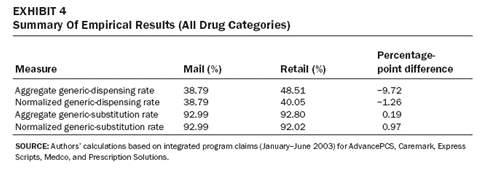
On the other hand, maybe they aren’t a history fan. The only independent study that I’ve seen comparing the two channels specifically on this issue was published in 2004 by Harvard in Health Affairs. It looked at claims from 5 PBMs across both channels, made the adjustments, and concluded that while retail had a slightly better GDR than mail, it had a lower generic substitution rate. It also pointed out that the majority of the different was attributed to the statin class which was over-represented in the mail order channel (and at the time was mostly brand prescriptions).

Or, maybe they haven’t looked at the chain GDR versus the independent GDR…In this presentation, you see what I would expect – chain GDR > independent GDR. Combine that with the percentage of scripts dispensed (i.e., weighted average) and the normalized GDR from the Health Affairs study probably would favor PBMs over independents.

Since PBMs make over 50% of their profits on generic at mail, it wouldn’t make sense for them to sub-optimize this area. Given the changes in drug mix over the past 7 years (i.e., more generics), I would hypothesize that if this study were done again you would see mail order matching or exceeding retail GDR especially GDR for independents.

Growing Mail Order Pharmacy Utilization

A common topic which I discuss with PBM clients is how to improve their mail order utilization. Since more than 50% of their profits come from generics at mail order, this is a critical process. And, while the industry average is 13% utilization (on an adjusted script basis), there are many companies (especially outside of the big 3 PBMs – CVS Caremark, Medco, and Express Scripts) that have much lower utilization and therefore huge value in upside.

Today, I got the chance to speak to investors on this topic courtesy of Barclays Capital. I structured the discussion around three topics:

1. Why is mail order important to the PBM?
2. How do you improve mail order utilization?
3. What are the challenges to improving mail order utilization?

Attached are the slides which I used on the call.

Lipitor Going Generic

If you work in pharmacy, this has been on your radar since Zocor went generic years ago. Lipitor has been the biggest drug worldwide, and I believe the spend in the US is still almost $7B a year even with generic Zocor available. (See Consumer Reports on statins)

Now, it appears that generic Lipitor (atorvastatin) will be available 11/30/11 according to the Pfizer site. It looks like Ranbaxy who was first to file the ANDA will get the 180-day exclusivity (but I know several other generic manufacturers have challenged the patent).

So, what does this mean?

  1. Lipitor will likely move to the 3rd tier either immediately or at the next formulary update period once the generic is available on the market.
  2. Atorvastatin will become a part of statin step therapy programs.
  3. Pharmacies in states that have mandatory generic laws will begin auto-substitution of atorvastatin for Lipitor prescriptions unless there the script has a Dispense As Written (DAW) indication.
  4. Depending on the pricing of the generic, PBMs and pharmacies will be very aggressive about encouraging use of the generic version (as allowed with the AG settlements from years ago).

We’ve already seen Pfizer take some action which is to promote a $4 copay card (or 30-day sample) for patients. This is to protect market share, but it also makes me wonder if they won’t do something like Merck did by pricing the generic below the Ranbaxy price (see WSJ article).

Given that Pfizer owns a generic company (Greenstone), I have to imagine that they plan to sell atorvastatin thru that company. But, I think the big question that I would be focused on is whether there will be an “authorized generic” (look at the FTC interim report on this topic). This is a big topic in the industry. It allows the manufacturer who owns the patent to allow a generic manufacturer to make and produce a generic version outside of the ANDA process. Right now, it appears that Watson may get to bring an authorized generic of Lipitor to market.

Will you see the same energy around this as you did around Zocor? I remember having a whole “control room” that we developed at Express Scripts to encourage utilization of generic Zocor. It was built around several key things:

  1. What were all the channels that a patient communicated with the PBM and how did we educate them around the new generic? [And which could we do at what time so as not to limit the short term rebates that our clients were getting on brand Zocor which kept the prices down until the generic was available?]
    1. Member portal
    2. Mail order invoices / stuffers
    3. Inbound IVR messaging while on hold
    4. FAQs
    5. Training call center reps
    6. Formulary notification programs
  2. How did we inform physicians?
    1. Academic detailing – fax, letter, phone consultations, face-to-face visits
  3. What plan design changes did we encourage?
    1. Step therapy
  4. What could be done at the POS with the retail pharmacies?
  5. What could be done at mail?
  6. How would we track success?

Personally, as a PBM or pharmacy, I’d be trying to lock in a period of exclusivity with Watson or Pfizer to have the limited distribution of the generic Lipitor for a period of time. That would be a huge deal (if it could be pulled off).

Get Wellness Article in Time – Silverlink, Aetna, Hypertension

The recent issue of Time magazine includes an article called “Get Wellness” about wellness.  It talks about having MDs “prescribe” wellness (think Information Therapy or Ix) and the fact that Medicare enrollees will be eligible for wellness visits begining 1/1/11. 

The new wellness benefit tasks doctors with creating “personalized prevention plans,” which ideally will be tailored to each patient’s daily routine, psyche and family life. And if that sounds more like a nanny-state mandate than medicine, consider that some 75% of the $2.47 trillion in annual U.S. health care costs stems from chronic diseases, many of which can be prevented or delayed by lifestyle choices.
The article goes on to talk about the challenge this may create for physicians.  Can they act as nutritionists?  Can they change behavior? 
 
Of course, MDs won’t be the only one’s focusing here (although some of that could change with ACOs and PCMHs).  Disease management companies and managed care companies have focused here for a long time.  The focus in many ways these days is how to reduce costs in these traditionally nurse-centric programs with technology but without impacting outcomes and participation.  There is one example in the article from some work we are doing at Silverlink around hypertension
 
Some firms, in trying to bring down health care costs, have hired health coaches to reach out to the sedentary or overweight to get them moving more. Others use interactive voice-response systems to keep tabs on participants’ progress. In a study, Aetna set out to see whether it could reduce hypertension — and the attendant risks of stroke, heart attack and kidney failure — among its Medicare Advantage members. More than 1,100 participants were given automated blood-pressure cuffs and told to call in with readings at least monthly. They also got quarterly reminders to dial in. When they did so, an automated system run by Silverlink Communications provided immediate feedback, explaining what the readings meant and where to call for further advice. Alerts were also sent to nurse managers when readings were dangerously high. The result: of the 217 people who started out with uncontrolled hypertension and stuck with the program for a year or so, nearly 57% got their blood pressure under control.

The Art of Creating A “Campaign”

For a little more color on this program – click here.

What you saw here:

  • Engagement takes planning and creativity
  • Engagement is a process
  • Messaging before the event is critical
  • A retention strategy for sustained involvement is important
  • Think about your influencers and how to turn them into advocates
  • Clear goals and objectives
  • A defined metric of success

CVS Caremark: Causal Link Between Adherence And Overall Costs

I’ve argued many times that prescription costs should (in many cases) go up not down.  But, the evidence to support that has often been anecdotal or from studies that people have struggled to replicate. 

CVS Caremark just released the results of their study “Medication Adherence Leads to Lower Health Care Use and Costs Despite Increased Drug Spending” in the January issue of Health Affairs.

  • Looked at pharmacy and medical claims
  • 135,000 patients
  • Patients with with one of more of the following – congestive heart failure, diabetes, hypertension, and dyslipidemia

“There have been many studies through the years that suggest adherence can save on health care costs, but the issue has not been central to health care cost discussions because those studies did not establish a causal link. We took the research further and what we found is that although adherent patients spend more on medications – as much as $1,000 more annually – across the board they spend significantly less for their overall health care costs”  by Troyen A. Brennan, MD, MPH, EVP and Chief medical Officer of CVS Caremark (source)

The savings associated with being adherent were:

  • Congestive heart failure = $7,823
  • Diabetes = $3,756
  • Hypertension = $3,908
  • Dyslipidemia = $1,258

It will be interesting.  Will this replace the “Sokol study” that everyone has historically quoted?  Will this lead to a rush of adherence programs for key conditions such as those studied here?  Will others try to replicate this study? 

I for one hope this changes the conversation from “prove the ROI” to show me how to best improve adherence across categories and segments of the population.  (To learn more about how Silverlink works with clients on adherence, you can go to our microsite.)

Alternative Pharmacy Network Whitepaper

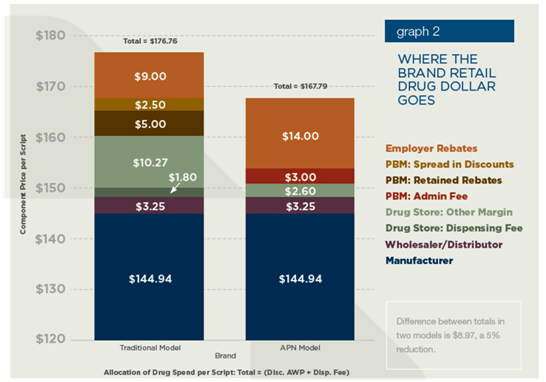
Milliman recently put out a whitepaper commissioned by ReStat on “Alternative Pharmacy Network” savings. My general opinion is that they use a lot of data and analysis mixed with some sensationalist statements to make the very obvious point that creating a limited or closed pharmacy network will save you money. (I hope they didn’t charge much for this.)

Net-Net: Limited or tier pharmacy networks are a great idea.  ReStat is building on their experience with Caterpillar which is a great program.  But, the whitepaper was flawed. 

Their conclusions were:

  • Potential Savings – The analysis shown in this report suggests that APN programs can offer a significant savings to employers relative to traditional networks. For an assumed range of consumer use of participating pharmacies, an employer with 10,000 lives could save $200,000 to $620,000 per year, depending on benefit design, without changing cost-sharing structures (see Table 3). Benefit design changes could increase or decrease the savings. A closed APN network (no coverage for non-APN pharmacies) would increase savings for a given benefit design.
  • Sources of Savings – In our analysis, the APN model can achieve lower cost because the PBM and retail pharmacy retain less revenue.
  • The Value of Limited Networks for Pharmacies -For medical benefits, health plans use network providers as part of overall quality and efficiency programs and are promoting network programs such as medical homes and pay-for-performance. Sponsors and PBMs can extend the advantages of networks to the pharmacy benefit. However, the ability to obtain value in a locale depends on the willingness of some pharmacies to participate as network members.
  • Plan Design Changes – Plan sponsors may need to change their plan designs to encourage use of the limited network. For example, the copays for limited network pharmacies may need to be decreased (from current levels) and/or the copays for non-network pharmacies may need to be increased to create a benefit differential between the network and non-network pharmacies. These plan design changes could reduce or increase the projected savings of a limited network, depending on the specific change.


My comments about their analysis:

  • They assumed that retail pharmacies would reduce their spread on generics by 44% (and brands by 78%) to be part of a limited network. That might be true for a large client with geographic concentration and for a retailer with low market share, but I think that’s a leap. (see chart below on brand pricing assumptions)


  • They say that spread for retail claims for PBMs can be 10-15% of AWP. I’ve seen plenty of deals that were negative (at least on brand drugs). In many cases, spread pricing doesn’t even exist.
  • They claim that PBM’s make money “(as part of a typically Drug Utilization Review program) actively encourages patients to switch to different medications as a core part of its business.” Really. That went out with the AG settlements back around 2004. Chemical substitution to generic equivalents certainly happens, but using DUR to push therapeutic conversion. I don’t think so.
  • They claim that PBM’s will buy drugs and repackage them to get a higher reimbursement rate at mail. I’ve never seen it (but that doesn’t mean it’s not done).
  • MAC pricing at mail. Yes. PBMs do make most of their money on generics at mail, and I’ve talked about the need to align your MAC lists at retail and mail before.
  • They also say “While mail order presents the opportunity to save sponsors money, attempts to encourage mail order by reducing copays could increase sponsor cost if the benefit plan is poorly designed (e.g., copays are reduced too much), utilization increases, or generic dispensing decreases.” I’ve talked about why clients lose money at mail before, but I’m pretty sure that there have been plenty of studies that show adherence improves (not unnecessary utilization). Studies have also shown that if you adjust for acute medications at retail then the generic dispensing rates are very comparable at retail and mail (or explained thru population differences).
  • They claim that the PBM’s make 10-15% on specialty drugs that they dispense (which seems high to me) and then use $5,000 per month as a number when the average 30-day supply of a specialty drug is more like $1,500.
  • They claim “Different manufacturers offer different rebates, which may factor into a PBMs decision making.” I think if you read the P&T process documents you would see that decisions about in or out are made based on clinical decisions and then a formulary can be broad or narrow based on the net price to the plan sponsor which does (and should) evaluate rebate impact.
  • They quote a source saying that 35% of rebates are kept by PBMs. Again, that seems really high. In my experience, there was an administrative fee equal to several percent of the AWP of the drug that was kept but the rebate dollars were passed to the plan sponsor.


While I like the simplicity of the flat fee payment model (i.e., I pay my PBM $3.00 per claim), it certainly creates no incentive for them to do better year over year in improving their negotiating with pharma and retailers or to worry much about trend management.

They talk briefly and seem to encourage ReStat’s Align product which seems like a very logical approach (used by other PBMs also).

Restat configures custom retail networks and benefit designs that create incentives to encourage member use of alternative in-network pharmacies and allows consumers the ability to shop based on price as well as service. Non-network pharmacies are also available but at a higher copay or costs.

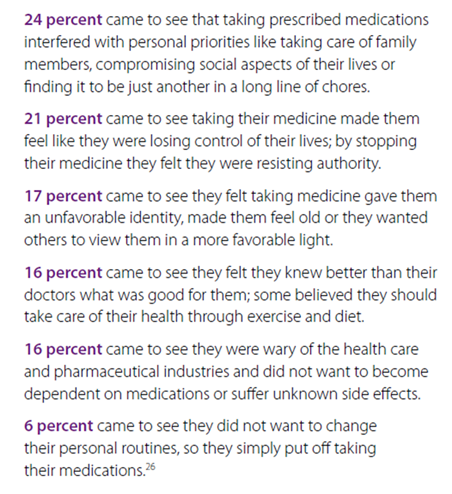
The 11 Dimensions Of Non-Adherence

I found this nice summary document on MAPS (Medication Adherence Profiling System) which was part of the Boehringer Ingelheim Pharmacy Satisfaction 2009 Medication Adherence Study.  Here are the dimensions and key issues:

  1. Reminder tools to address memory and confusion
  2. Enhance communications to address perceived ineffective communications
  3. Financial assistance to address monetary concerns
  4. Heighten transparency to address distrust of healthcare providers
  5. Promote regimen to address not taking medication as prescribed
  6. Practice discretion to address interpersonal discomfort and social barriers
  7. Empower the patient to address perceived negative consequences
  8. Confront avoidance to address denial and fear
  9. Demonstrate efficacy to address the perception that medication doesn’t work
  10. Allay concerns to address negative attributes of medication
  11. Continue touchpoints to address the lack of belief in the importance of ongoing therapy

The document goes on to give sample strategies and tactics for each dimension.

Express Scripts To Grow The “Select” Programs

It looks like the concept of “Select” Home Delivery which has been one of the products to come out of the Consumerology approach at Express Scripts is about to get some cousins such as Select Step Therapy, Select Networks, and Select Specialty.  Obviously, the concept of Active Choice has legs.  (I understand the networks and specialty, but I’m not sure what the step therapy product will look like.)

(Here’s a good article from the Brookings Institute on choice architecture for healthcare enrollment.)

The concept of choice has to do with the decision framework with which options are presented.  Making it active choice typically refers to the requirement of the consumer having to make a decision.  They can’t do nothing.  This doesn’t mean that the company can’t select a default recommendation, but it can’t implement that option without the consumer verifying it.  (See the book Nudge for more details on this concept.)

The example that is often used for choice architecture is enrollment into 401K plans.

The Not-So-Secret Handbook Of Pharmacy Facts

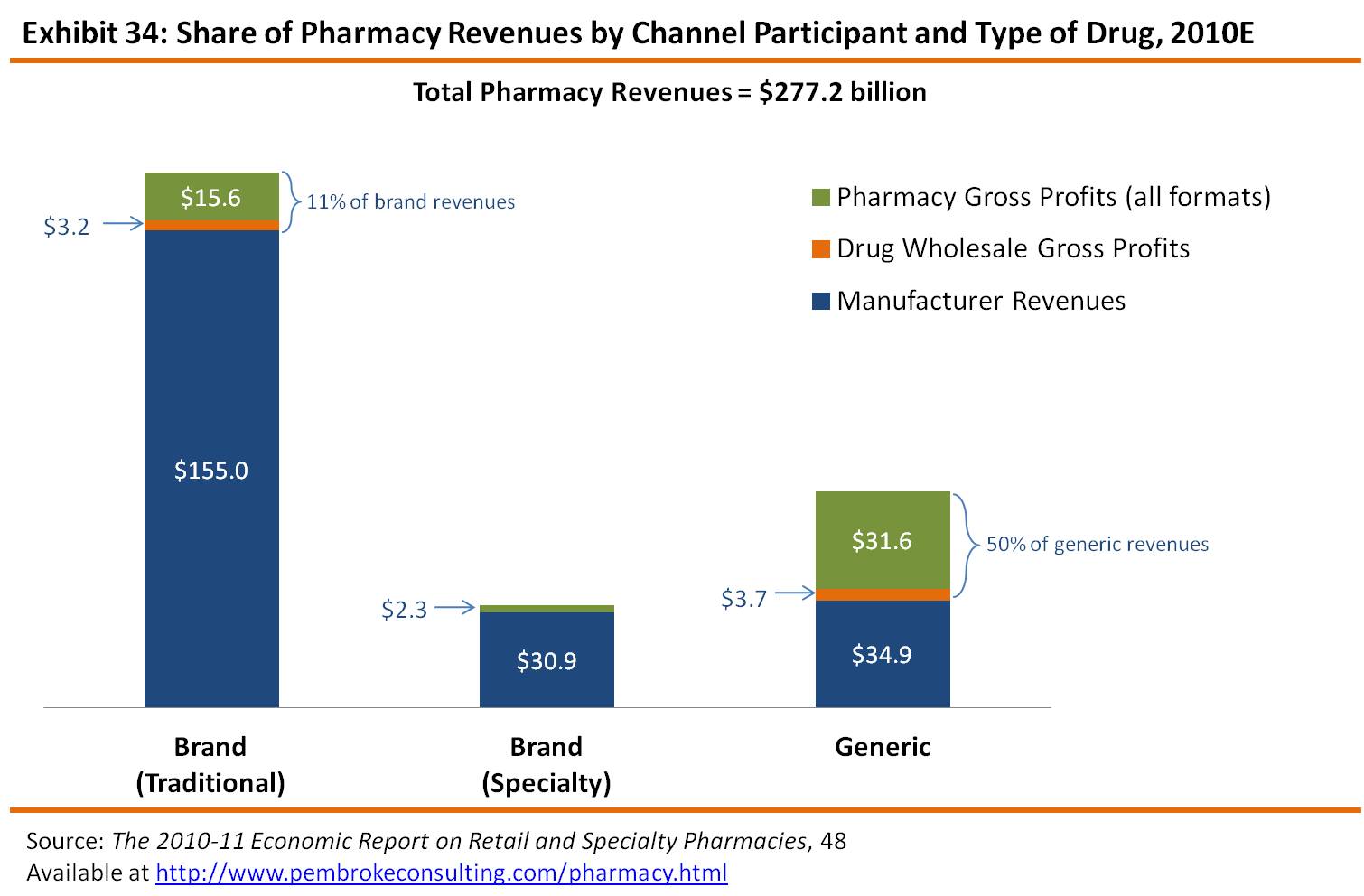
Adam Fein from Drug Channels just published his newest report – 2010-11 Economic Report On Retail And Specialty Pharmacies. If you’re going to spend money on a report, I would suggest you consider this one. You couldn’t Google the information and format it for the price.

He does a great job of aggregating data, looking at trends, creating great charts, and providing an informed perspective on the industry. Let me just pick out a few things to highlight from the report:

  1. He predicts four trends:
    1. Market growth and shift to specialty
    2. Boom-to-bust for generic drugs
    3. Cost-plus pharmacy reimbursement
    4. Preferred pharmacy networks
  2. He talks about the concentration of specialty pharmacies and the fact that 81% of health plans require their members to use 1-2 specialty pharmacies.
  3. He talks about the shifting market share among retail pharmacies and the fact that while only 31% of urban and suburban pharmacies are independents that number jumps to 65% in rural areas.
  4. He talks about the AWP discount that plan sponsors realize at retail compared to mail and how that gap has 58 basis points in 2010. (A key fact in understanding why you have to have the right plan design to save at mail.)
  5. And, one point that I often make (without the exact data) is that people paying cash for prescriptions pay too much. He shows that the gross margin for cash patients at independent pharmacies is a whopping 54% compared to 20% of less for other 3rd party and government reimbursed scripts.

Here’s an example of one of his charts (exhibit 34).

My final commentary on the report is that this should be a read for people trying to work in the industry or new hires in the PBM or retail management. I’m pretty sure all the analysts on Wall Street already read it.

Enjoy!

2010 Rx Benefits Survey (KFF)

This came out a few months ago, and I’ve been carrying it around for a while. (Here’s the summary.)

I read section 9 which is about the prescription drug benefits. A few facts from the report:

  • Almost 3/4 of people have copays (i.e., flat dollar amount) versus co-insurance (i.e., percentage of cost).
  • The average copayments were:
    • $11 first-tier
    • $28 second-tier
    • $49 third-tier
  • For co-insurance, the payments were:
    • 17% first-tier
    • 25% second-tier
    • 38% third-tier
  • 13% of workers had a plan with four or more tiers
  • 5% of workers have plans were the cost sharing is the same regardless of drug chosen

One of the more interesting things I saw is that average copays on first and second tier drugs are going up while the average coinsurance is going down.  Not much but directionally interesting.

CVS Caremark Insights 2010

I’m catching up on a few things this week. One of those is sharing my notes from the CVS Caremark Insights 2010 publication (their drug trend report). While this year’s report outlines all of the traditional things you would expect – trend, spend by condition, market conditions, generic pipeline, I really thought the exciting information was at the end where they really begin to stitch together the retail / PBM model. I’ve talked about why I believe in this model so strongly in the past (you can also see some of their executive’s comments here). And, I think my perceptions about the future of pharmacists create lots of opportunity for a combined entity. I also think they hint at some of the insights they gained from research around non-adherence and around abandonment which is important and creates a foundation for them around predictive modeling and focused interventions.

  • I like that this year’s publication starts with a letter from Per Lofberg (the new President). He has brought them a renewed perspective on the PBM within the overall CVS Caremark enterprise which I think has been very helpful for them in this year’s sales cycle. [I personally haven’t met him yet, but I’ve heard a lot of good things about him.]
  • This introduction talks about:
    • Generics, specialty, and genetic testing as key trends
    • Controlling costs thru – plan design, clinical strategies, and negotiations with the manufacturers and retailers
    • Executing flawlessly
    • Improving outcomes
  • I like the fact that they introduce the outcomes focus early on. I think that linking themselves to outcomes given their unique footprint (retail, PBM, clinic) is critical for long-term differentiation.
  • Much like I see at Prime, CVS Caremark is a company that is blending its long-term team with some new leadership from outside the company and from the retail side of the business to drive innovation and change. I believe the clients and market has seen some of those changes already.
  • A quarter of their clients maintained a gross trend of less than 3%.
  • I found it interesting at the beginning of the document where they talk about the recession and macro-economy where they mention the effect that the COBRA subsidy had on health consumption.
  • They say that their member contribution is 15.7% which seems really low to me, but that is pulled down by the Medicare average.
  • As everyone has talked about, one of the big drivers of cost this past year was significant price inflation (9.7%) for brand drugs.
  • Their generic dispensing rate (GDR) in Q1-2010 was 70.4%.
  • Their average specialty trend was 11% with a best-in-class trend of 7.3% which seems really low.
  • Not a big surprise, the top classes are similar to other PBMs with large commercial populations. Here’s the list of the top 10 categories:
  • They mention later on their managed Medicaid lives (which I didn’t even know that they had). I think this should be a good growth area along with their Medicare Part D (PDP) lives.
  • They introduce a new methodology which I like which looks at trend by group – employers, health plans, TPA, and Medicare. There are differences in each so being able to compare to a relevant peer group is valuable.
  • They also talk about another change which is looking at book-of-business (BOB) which represent their top clients which represent 65% of total drug spend.
  • Their average gross trend was 3.4% (or 2.4% if you exclude specialty).
  • Digging into the best-in-class numbers is interesting. For example, for employers, 78.6% of their days supply was filled at preferred channel pricing (mail order or 90-day retail). I assume this is essentially for just maintenance drugs, but it seems really high (which is good) and is a new metric for me to think about.
  • They talk about 77.7% of hypertensives (in employers) being optimally adherent (which I assumes means having and MPR > 80%). This seems pretty good, but I don’t have an industry number to compare to.

“With overall goals of reducing health care cost and improving member outcomes, health plan respondents in our 2010 benefit planning survey placed high value on proactive member outreach (93 percent), multi-channel access for members (87 percent) and opportunities for face-to-face consultation (73 percent)—all factors that can help keep members on prescribed therapies and satisfied.” (page 14)

  • For each segment, they give the distribution of trend numbers. Here’s the one for health plans:
  • The best-in-class Medicare and Medicaid number for Generic Dispensing Rate are high and set a high goal:
    • 78.2% Medicare Part D
    • 86.8% Medicaid

Member retention is critical and involves a balance of copay levels, premiums and drug coverage as well as less tangible factors. Member satisfaction plays a significant role in loyalty and re-enrollment. High-performing plans focus on effective member communication and outreach as well as added-value services such as the CVS ExtraCare Health card.

  • They talk about using a split generic tier design for Medicare to allow for different member copays for higher priced generics. I think this makes a lot of sense, but I don’t know all the details or member data and feedback to really understand how it plays out.
  • I’ve never spent much time on Managed Medicaid, but they give a few numbers here:
    • Their average age is 17.6.
    • The average PMPY spend is $288.
  • Several times they use the term “evidence-based” which I really like. I recently was using that term to refer to communications and talking about how to leverage data to create “evidence-based” communications to consumers.
  • They provide a nice 2-page summary of reform.
  • They put out a short list of recommendations:
    • Prepare to take advantage of pending new generics; evaluate plan design and communication strategies for quick mobilization when new launches are pending. (This will be a big year for this with Lipitor.)
    • Many specialty pipeline products are for orphan diseases and will have narrow indications; have plans in place to ensure appropriate utilization. (This will continue to be a bigger and bigger issue.)
    • If you haven’t already done so, investigate the use of genetic testing to help guide treatment decisions. (Given their relationship with Generation Health this is an area that I expect to hear a lot more about in future Insights publications.)
    • Newer, more expensive pharmaceuticals may offer little advantage over existing products in the class; consider step therapy or preferred product strategies. (I think Utilization Management (UM) activities like Step Therapy (ST) will be a continued focus for the next few years especially as biologics allow these “traditional” techniques to be applied to specialty.)
    • Use wellness and preventive programs to identify people at high risk for chronic disease and help them lower their risk profile. (This is an area that I would have liked them to talk more about. As I’ve said many times, this is an opportunity for them to shine and differentiate.)
    • Members with chronic disease who are non-adherent tend to have higher health care costs; evaluate your population’s adherence levels and the support you provide to help people stay adherent. (Differentiation in this area is a huge opportunity. I think they are doing some interesting work in this area as they’ve talked about in some recent press releases – Rx abandonment, barriers to diabetes care, US Airways program, and behavioral research.)
  • They provide a forecast on trend for overall, non-specialty, and specialty. Here’s their forecast for the overall trend.

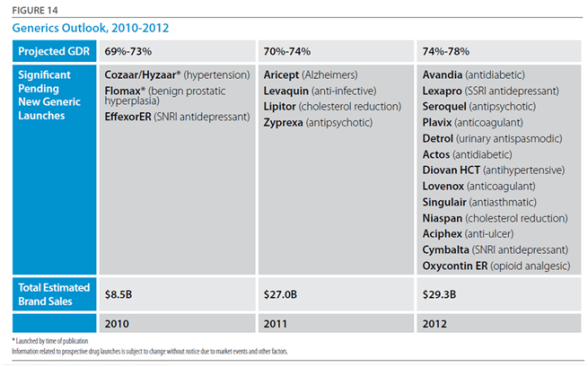
  • They give a clear chart on the generic opportunity and likely impact on overall generic fill rates for 2010-2012.

  • They go on to talk about specialty drugs which could be as much as 50% of the total spend by 2013…a scary prospect.
  • They have a good “state of the union” for specialty in the deck:
    • As of January 2010, 57 percent of all late-stage pipeline drugs fell into the specialty area.
    • 71 percent of applications for supplemental indications are for specialty products.
    • The number of new specialty drugs approved in 2009 was more than double the number of 2008.
    • Provenge, the first therapeutic vaccine—which utilizes the patient’s own DNA and stimulates the immune system to fight prostate cancer—was approved early in 2010.
    • Potential approvals 2010-2012 include four new products for multiple sclerosis (all oral), three for hepatitis C, and three for cystic fibrosis.
    • 18 of the products pending approval in 2010 target orphan diseases, which currently have few or no treatments.
    • While health care reform legislation provides for a pathway for approval of biosimilars, it also mandates a 12-year minimum exclusivity period for brand innovators with the possibility of additional exclusivity in 12-year increments for the development of new uses.
  • They then talk a little about pharmacogenomics (PGx). Again, I expect this to be a much bigger area in the future. It’s interesting. It’s changing rapidly. BUT, there is a huge education mountain for patients and MDs.

For a 1M member population, ~$12M is spent each year on 18 drugs that are administered to patients who do not respond and/or who are more likely to experience drug-induced medical complications.

  • I think some of the hidden gems begin on page 27 where they talk about their study on electronic prescribing:
    • 22.1% never filled their first claim. (why – samples?)
    • They found that those who had an eRx were most likely to fill than those with a paper Rx. (I personally would have bet on the other…i.e., that I have something physical in my hand that it would serve to remind me to go to the pharmacy.)
  • Another study towards the end was on abandonment (which they recently released more information on). It showed that copay, income, and whether it was an NRx (new start on Rx) were predictors of abandonment.
  • They also share work done around adherence focused on complexity of therapy – number of Rxs, number of MDs, number of pharmacies, and synchronization of refills. They talk about using this to score patients and predict risk of non-adherence. (I look forward to seeing more here since this seems very interesting especially in terms of focusing resources and developing a triage model.)
  • They shared the results of a deep dive on reasons for abandonment of prescriptions. Being able to respond and position messaging around these reasons is important.
  • They share some of the work from their Pharmacy Advisor program:
    • IVR messaging improved the odds of refills by up to 70.6% when members answered the phone.
    • Early IVR refill reminders were 2x as effective for first fill persistency rates at mail as compared to reminders after refill due dates.
    • Physician directed fax alerts about gaps in care nearly doubled gap closure rates.
    • Pharmacist interventions were most effective at improving adherence.
    • Members in VBID (value based insurance design) in which copays were lowered or eliminated were more likely to initiate therapy, less likely to discontinue therapy, and had better adherence.

“Diabetes is one of the most prevalent and expensive chronic diseases in the nation, costing the U.S. an estimated $174 billion a year,” said Troyen Brennan, MD, MPH, EVP and Chief Medical Officer of CVS Caremark. “The Pharmacy Advisor program improves clinical care because we are able to identify and address pharmacy-related care issues that if left unattended could result in disease progression and increased health care costs. We are also better able to engage the member in their care through multiple contact points, providing counsel that can improve adherence and help members optimize their pharmacy benefit and find the most cost effective options.” (quote from press release)

  • They talk about a pilot program they did in Polk County were patients signed a contract for care and was focused on diabetes care. It had some great results:
    • Reduction in blood glucose levels from 52% under or equal 7% at the beginning to 72% after one year.
    • 30% reduction in hospitalizations.
    • 24% reduction in ER visits.
    • Only 3.4% of enrolled members had poorly controlled diabetes (compared to national average of 29.4%).
    • Improved patient care – identification of potential adverse events, streamlined medication regimens, and formulary support.
    • (I personally would think this would get other plans (or PBMs) to partner with them on regional strategies where they have a strong retail presence.)
  • This also coincided with their announcements about their Pharmacy Advisor program which officially launches in January 2011. I’m very interested to see the uptake here which I would imagine will parallel the success of Maintenance Choice. This is a program which leverages their Consumer Engagement Engine (see image from last year’s report) and their retail presence to engage consumers.

Overall, it was an easy read without a lot of fluff. It cuts to the chase and gives you a good perspective on how they think. You begin to get a feel for what they are doing differently, but I imagine that you’ll continue to see a lot more research and case studies come out in the next year about some of the work they are doing.

(Note: In the sense of disclosure, CVS Caremark is a stock that I own.)

Prime Therapeutics 2010 Drug Trend Insights Report

I am way behind this year in getting thru the Drug Trend Reports and posting my comments.  I think I still have to do both the CVS Caremark report and the Walgreens report…and if I can get it, the SXC report also.  (You can see my thoughts from the Medco and Express Scripts Drug Trend Reports earlier.)

A few things I’ve found interesting this year were that Medco reached out via their PR group to engage me and several other bloggers in the space.  And, Prime Therapeutics has always been very active in engaging me around my thoughts on their report (see comment from last year) and continued to be proactive in discussing it with me and sending me a hard copy to read on the plane.

Overall, I think their Drug Trend Report continues to improve year after year.  It’s interesting in that this year I found the tone slightly more aggressive in talking about them versus their competition.  Certainly, Prime is going thru some changes (if you haven’t noticed).  They brought Eric Elliott on board who I think very highly of after hearing him speak and engaging him on a few topics.  Eric has brought in a set of core people from Aetna, Cigna, Express Scripts, and other places to complement an existing management team that really understands the market and how to work with the Blues owners.  [I personally think of them (and MedImpact or SXC) as a dark horse would could consider bidding on the Walgreen’s PBM lives while everyone is pretty focused on it being either Express Scripts or Medco.]

  • If you don’t know, Prime works with 17 BCBS plans who are either owners or clients.  They managed $9.1B of drug spend in 2009 and had 15M members.
  • Their overall trend was 3.4% which is good.  Everyone’s trend was generally low this year although I continue to question if this is the right metric for the industry.  I also wonder if they will embrace the outcomes based rebating that Eric did with Merck at Cigna.
  • Early on they talk about one of the ways they manage trend being through adherence and not manufacturer programs.  I might be out on a limb here, but I believe manufacturer funding on adherence programs (especially in specialty) is a good thing. 
  • They are always quick to point out that they report drug trend across their entire book of business not a random set or using any other cut of the data. 
  • They share some early analysis looking at medical claims where they identified that 1/3 of people with diabetic complications had no recent diabetes prescriptions.  A gap-in-care intervention opportunity. 
  • They also shared a study that I hadn’t seen published that members using a 90-day supply of medication (retail or mail) were 40% less likely to stop taking their drugs than those using a 30-day supply.  That’s a big difference. 
  • Interestingly they source a study saying that their members get Rx refills a day faster than competitors.  Again, that’s a big difference.
  • Generics were 67%.  (in 2009)
  • They talk about their MAC list (Maximum Allowable Cost) which is used to manage the cost of generics in the payment terms with the retailers.  They are the only PBM that I’ve ever seen do this. 
  • Their average costs per Rx were:
    • $145.51 Brand
    • $18.21 Generic
    • $62.40 Overall
  • They talk about the need to establish out-of-pocket (OOP) maximums for higher cost drugs.  I AGREE!
    • 1 in 6 cancer patients with high OOP costs abandon treatment
    • Capping OOP at $100 reduces abandonment to 4.9%
  • They (like others) discuss the impact of rising drug prices primarly around brand products. 
    • I had an interesting discussion with a reporter at the NY Times yesterday on this where he talked about manufacturers essentially paying the entire copay (20% of a $100,000 drug) to keep it getting filled. 
  • They projected that the GFR (generic fill rate) would exceed 70% by the end of 2010 which I suspect will happen (if it hasn’t already). 
  • It was interesting that they layout their pharmacy benefit for their employees.  That would be an interesting one to come across PBMs.  How do they treat their employees?  What do they recommend?  Do they take their own advice?
    • Generics were 10% with a $4 min and $10 max
    • Mandatory generic policy
    • Step therapy
  • Specialty medications had a 13% trend while representing less than 1/2 percentage of the overall prescriptions processed…but they did account for 12% of the cost.
  • Prime’s members filled 11.8 prescriptions per year (2.5% increase in utilization).
  • Prime’s Medicare trend was -5.6% with utilization of 48.2 Rxs PMPY.  The average age for their Medicare lives is 73 (compared to 33 in the commercial lives).
  • As I’ve talked about before, I like the way they break out their “Focus” drugs which are drugs used to cover diabetes, high blood pressure, high cholesterol, respiratory disorders, and depression.  These are categories with clear value propositions around adherence and are often co-morbidities. 
  • The average specialty drug cost $2,117.07.
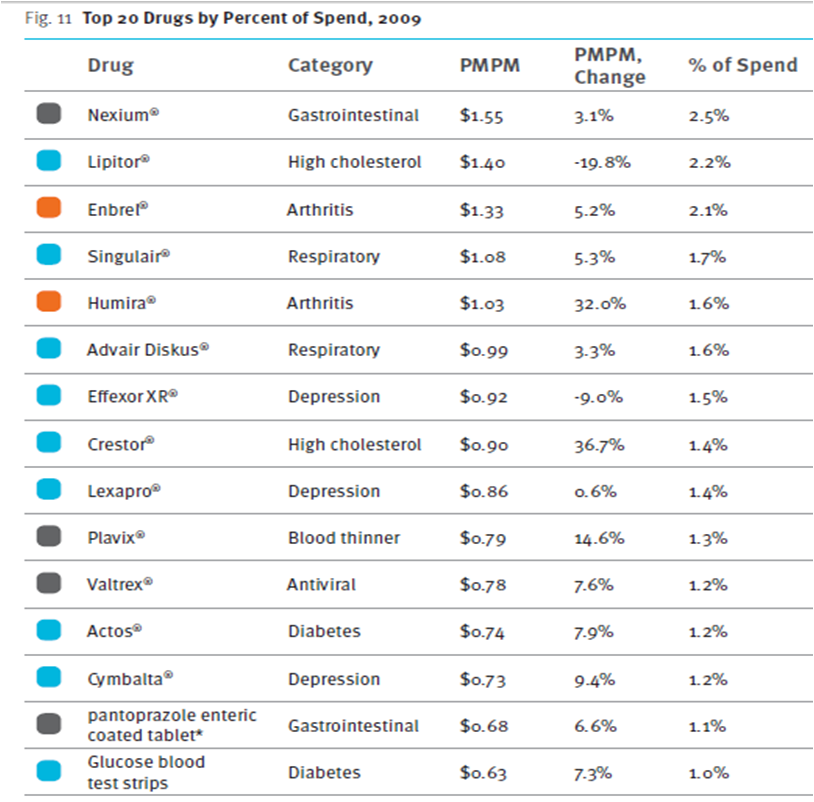
  • Here’s some of their top drugs based on spend:

  • A few facts…
    • 7 in 10 Americans die from chronic illness.
    • As many as half of all patients don’t adhere to their prescription regimens.
    • More that $100B is spent each year on avoidable hospital admissions due to non-adherence.
    • Adherence to high blood pressure treatment alone could prevent 89,000 premature deaths in the US annually.
  • They shared that 70.5% of their 683,000 members using a statin in the second half of 2009 had an MPR (medication possession ratio) of 80% or higher (which is considered clinically adherent).  They talked about using copay waivers, value-based benefit design, and member education to drive up MPR.  [I’d love to see how the 3 compared in terms of results and ROI.]
  • They talked about an MD intervention program around respiratory illness that got 10% of members to return to therapy.  [I’m a big believer that PBMs need to integrate their MD and consumer intervention strategies since 1+1 can equal 3 in some cases.]
  • They then go thru different therapy class (drug categories) to discuss each one.  In the gastrointestinal disorders (think Prevacid, Protonix, Prilosec), I was surprised they didn’t talk about a strategy to drive OTC (over-the-counter) use.  [Although with some of the new rulings about what can be considered part of your flexible spending accounts, it may change how people compare the costs of OTCs to copays.]
    • I’m still a big fan of step therapy in this category using OTCs then H2s then generic PPIs then brand PPIs, but I know step therapy with OTCs can be a pain. 
  • Specialty drugs accounted for 21% of the $300B in 2009 drug spend (National)…by 2030, it’s estimated that specialty will account for almost 50% of drug expenditures.
  • They talk about Ampyra (a new MS drug) but don’t talk about how they are managing that.  [From my NCPDP meeting last week, RegenceRx was talking about more aggressively managing this.]
  • They share the research from PhRMA that there are 861 drugs in the pipeline for oncology.
  • Here’s a nice graphic on designing the right benefit…

  • They provide some best practices around plan design which did prompt some questions for me:
    • They talk about value-based benefits when MPR is less than 80% for diabetes, high blood pressure, and high cholesterol.  I’m good with this as long as it’s not selectively offered to just those with low MPR (i.e., rewarding those who aren’t taking their medications).
    • They talk about requiring prior auth (PA) before a non-preferred drug is dispensed.  Does this mean the formulary is essentially closed?
    • They talk about using co-insurance to deter the use of brand-name and non-formulary drugs.  I’ve always been a skeptic here since the patient doesn’t know the cost of the medication so I believe that flat copays are much easier to understand the difference, but there might be research that I’ve missed on this one.
    • They talk about reaching out to MDs on generic utilization.  This should work but is tough.  I had an academic detailing team at Express Scripts and a generic sampling team.  I’d love to know what the success rate was and if MDs impressions of generics have changed over the past 5 years. 
  • For tiers, they share data that suggests that the copay savings needs to be $25.50 per month for a patient to choose a generic over a brand (and I might assume one brand over another).  As they point out, that’s much larger than the $13 difference which exists today.

Express Scripts Model – DBN Article

I was quoted in yesterday’s Drug Benefit News with one of my favorite people – Dr. Steve Miller from Express Scripts.  This was a follow-up to talk about their predictive model for adherence.  Steve confirmed what had previously been reported that it is 85% accurate in predicting the 10% of people least likely to be adherent.  He says that the model takes into account past behavior, demographics, condition, and the drug.  Those sound like a lot of the right variables.

The article teases us with information that CVS Caremark is planning to publish a study in the upcoming months on their model.  Medco Health Solutions comes across as more of a skeptic in the article talking about efforts from 20 years ago that were difficult and expensive to execute. 

My quotes were very consistent with what I’ve shared on the blog – fascinating, somewhat skeptical, more concerned about the group that is somewhat adherent than those that are the bottom 10%, implementation of behavior change is more important that the model. 

“Everybody’s trying similar efforts in terms of how to predict adherence…but there hasn’t been a model that has proven itself as being a good predictor.  Maybe Express Scripts has cracked the code…I would assume that if you can accurately predict who is going to be adherent that will be a good tool.”

However, attempting to change behavior in the top 10% of patients likely to be nonadherent will be tough, Van Antwerp contends. “The industry is still waiting for that proof,” he maintains. “If we can predict that patients are adherent but can’t change behavior, then the model doesn’t do us much good.”

Predictive Model + Segmentation + Intervention

I was fielding a few questions today about the predictive model from Express Scripts.  The concept of predictive modeling is one that everyone is working on and holds great allure.  BUT, it is only a piece of the puzzle.  In the dialogue, I identified three key tenets for success.

  1. Predictive Model – Can you predict who is likely to act in certain ways – be adherent, log-in to the member portal, use mail order, switch to generics, pick up the phone?
  2. Segmentation Model – Once you can predict people, can you develop a segmentation model about how to get them to take action based on different attributes – gender, age, past behavior, preferences, income, other?
  3. Intervention Strategy – If you can predict who is most likely to act and know what type of segment they fall into, do you have a cost-effective intervention strategy to get them to take action…right message at the right time using the right channel?  For adherence, this could be reminders, coaching, devices, or other tools.  (As many people say, a less sophisticated strategy executed perfectly is better than a complex strategy executed less than perfectly.)

And, then you need to study and refine these on an ongoing basis especially since topics like adherence may be affected by macro-economic trends (e.g., economy), patient beliefs (e.g., fatalism), and other attributes (e.g., plan design) on top of the attributes in your models. 

I do believe we’re early in the days of modeling and that the access to data and greater availability of informatics resources will increase the development and focus on these models.

COMFORT – A Way For Breaking Bad News To A Patient

I came across this framework that I like.  It seems to take into account the health literacy and emotional challenges of a patient when receiving and assimilating bad news. 

COMFORT stands for:

  • Communication
  • Orientation
  • Mindfulness
  • Family
  • Ongoing
  • Reiterative
  • Team

Communications – use clear and familiar language.

Orientation – set reasonable expectations.

Mindfulness – focus on the patient without being distracted.

Family – include the family in the information and the ongoing support.

Ongoing – stress the ongoing activities so there is no sense of abandonment.

Reiterative – continue to reinforce the message to help them come to terms.

Team – coordinate care so that there is not conflicting or confusing information.

Total Medical Costs Lower For Diabetics At Mail

I can’t believe I missed this one earlier this year especially since a friend of mine is one of the authors…BUT this is an important one for the industry showing that not only did adherence improve moving from retail to mail order pharmacy but as pharmacy costs when up the corresponding medical costs went down MORE!

I’m just going to paste the abstract from the Journal of Medical Economics below:

Objective: To compare long-term diabetes medication adherence and healthcare costs in patients using mail order pharmacy versus retail pharmacy.

Methods: The MarketScan database was used to identify patients who filled prescriptions for oral anti-diabetes medications in a retail pharmacy for at least 6 months before switching to mail order pharmacy for at least 12 months. These patients were matched to others who used retail pharmacy continuously for at least 18 months. A propensity score was used to create matched groups of patients comparable on probability of switching to mail order, weighted Poisson regression was used to analyze differences in medication adherence, and Tobit regression was used to compare costs.

Results: A total of 14,600 patients who switched to mail order were matched to 43,800 patients who used retail pharmacy continuously. The average adjusted adherence in retail pharmacy was 63.4% compared to 84.8% after switching to mail order. Per-member-per-month total healthcare and total medical costs were on average $34.32 and $37.54 lower in the mail order group, respectively. Diabetes-related medical costs were on average $19.14 lower in the mail order group, while pharmacy costs were $14.13 higher.

Limitations: Limitations include a patient population under the age of 65, no information on pharmacy benefit design, and limited follow-up time relative to that necessary to identify long-term diabetes complications.

Conclusions: After adjusting for measured confounders of medication adherence and disease severity, individuals who switched to mail order pharmacy had higher medication possession ratios and trended toward lower total and diabetes-related medical costs over time.

Press release about it here.

Here’s a slide showing the values:

Changing Rxs (or Doses) Without Asking Basic Question

I’ve talked about this with many clients.  Since physicians don’t always engage patients in the basic dialogue around adherence, how can they decide to increase doses or change prescriptions simply if the patient’s condition isn’t becoming better?  This has to drive waste in the system. 

The reality is that a physician may get a lab value that shows that their patient’s cholesterol (or A1c or…) is higher than it was last time.  They know the patient is on a certain dose of the medication.  They instinctively think to increase the dose or change the medication.  BUT…they don’t always ask the patient about their adherence to the medication.  This is attributed to multiple reasons:

  • They don’t see adherence as their issue.
  • They assume the patient is adherent.
  • They assume the patient would tell them if they weren’t adherent.
  • They assume if they ask that the patient would lie to them and say they were adherent.

I’d heard about a study done about a decade ago that had looked at this, but it had never been published.  I was excited to see that Medco had published some research on this topic today. 

There were some interesting things in the research also.  It was another validation on the fact that men are more adherent than women.  And, it showed that people with multiple conditions were more adherent.  I would expect that there is a curve around this that people with a few medications and those with lots of medications are least likely to be adherent, and those somewhere in the middle are most adherent.  (But, I’ve never looked at the data with this question in mind.)

Predicting Non-Adherence

There is lots of buzz over yesterday’s article in the WSJ about Express Scripts being able to predict who will be adherent.  Today’s blog post on the Corporate Research Blog added some details (or further confused me).  It says that the model is 80% accurate in predicting the 10% of people who are least likely to be adherent.

Is that all it does?  For sake of this post, let’s assume it does.  That seems much less interesting and much easier to do.  In talking with a leading researcher in this area that has looked at the correlation of 9,000 variables to adherence, he told me that nothing was highly correlated, but the most correlated metric was past behavior.  Where they adherent in the past on other medications?  Did they take preventative action (e.g., get flu shots, mammograms)? 

Several people have been looking at how credit scores can be used to predict adherence.  Given errors in credit scores, this may be deceptive even if it works.

But, back to the issue.  If you know who’s least likely to be adherent, so what?  Do you give up on these people?  They aren’t likely to chance behavior.  Do you try harder or have a different strategy with these people?  If you succeed and move them to taking their medications 40% of the time (using a proxy like a 40% medication possession ratio), does it make a difference? 

I would think it’s better to focus on the people who are likely to be adherent and how to enable them to move from 40-70% MPR to >80% MPR.  We often work with clients to stratify their population and have different intervention strategies (channel, messaging, level of effort, etc.) across where they fit in the model (value, likelihood to engage, likelihood to change).